
Monday, July 14, 2025 – TIME TO REVISIT THE FRICK AND EXPLORE THE NEW AND RESTORED AREAS


THE FRICK
COLLECTION
IS BACK
(No Photos Please)
Monday, July 14, 2025
Judith Berdy
Issue # 1484
This afternoon I visited the Frick Collection, recently reopened,after being enlarged and restored for 5 years. The restoration and new areas are tasteful and give you a more spacious area to see the artwork.
There is a new gift shop, a restaurant overlooking the garden and contemporatry staircase leading to new areas.
Here are a few of our old friends who are now on exhibit at the Frick.
The images of the artwork are from the internet.
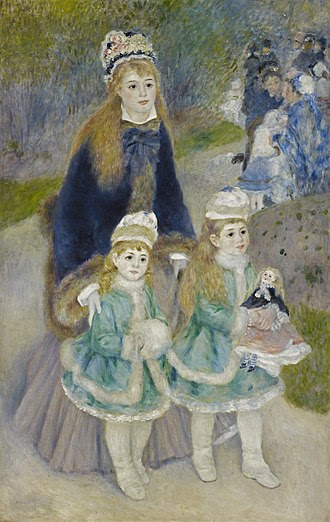
Mother and Children (also known as La Promenade) is an Impressionist painting by Pierre-Auguste Renoir that is housed in the Frick Collection.[1] Although the painting is most commonly known as Mother and Children, Renoir presented it with the title La Promenade in 1876.[2] The painting is displayed in an alcove under a set of stairs at the Frick.[3]
For years, this painting was barely visible in an alcove. Now it is on full view on the balcony of the second floor.
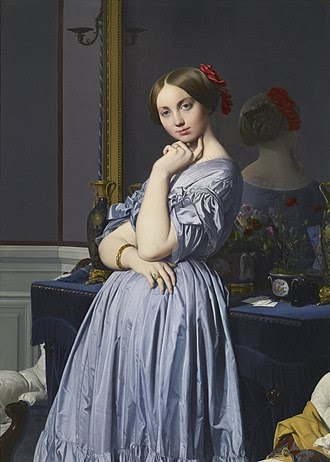
The Portrait of Comtesse d’Haussonville is an 1845 oil-on-canvas painting by the French Neoclassical artist Jean-Auguste-Dominique Ingres. The sitter was Louise de Broglie, Countess d’Haussonville, of the wealthy House of Broglie..
This painting has been moved to the new second floor galleries.
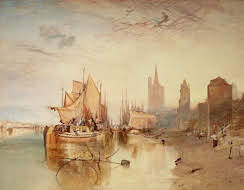
Cologne, the Arrival of a Packet Boat in the Evening is an 1826 landscape painting by the British artist Joseph Mallord William Turner.[1][2] It shows a scene as the Rhine River passes through the city of Cologne as a packet boat arrives. Visible on the skyline to the right is Great St. Martin Church, Cologne.
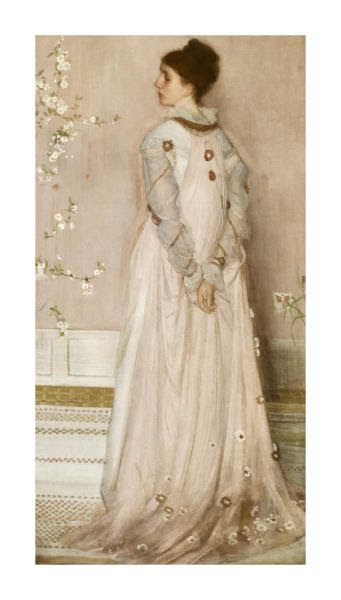
Frances Dawson (1834–1910) married in 1855 Frederick R. Leyland, a major Liverpool shipowner, telephone magnate, and art collector, who was one of Whistler’s chief patrons before the two quarreled bitterly over the decoration of the famous Peacock Room, once the dining room of the Leylands’ London townhouse and now in the Freer Gallery of Art in Washington.
Commissioned in the fall of 1871, this portrait was exhibited at Whistler’s first one-man exhibition in 1874 (an event sponsored by Leyland), but was never considered by the artist to be totally finished. Within its predominantly pink color scheme, intended to set off Mrs. Leyland’s red hair, the subject is depicted wearing a multi-layered gown designed by the artist. The abstract, basketweave patterns of the matting at the base are repeated on the frame, also designed by the artist; they offset the naturalistic flowering almond branches at the left, which suggest Whistler’s deep interest in Japanese art at this time. Like the portrait of Montesquiou, that of Mrs. Leyland is signed at mid-right with Whistler’s emblematic butterfly, a pattern based on his initials JMW and imbued with the formalistic preoccupations of the nineteenth-century aesthetic movement. The portrait is in fact so totally a work of exquisite design that Whistler’s contemporary Dante Gabriel Rossetti wrote of it, with some reason: “I cannot see that it is at all a likeness.”
Source: Art in The Frick Collection: Paintings, Sculpture, Decorative Arts, New York: Harry N. Abrams, 1996.
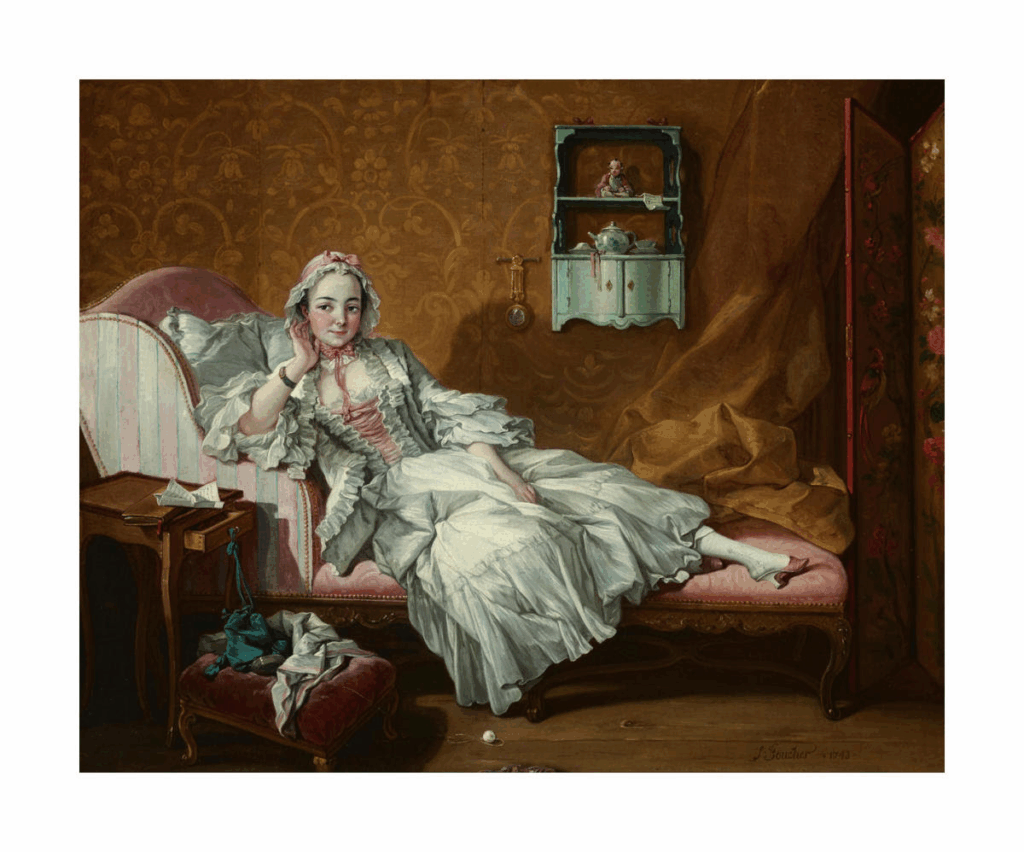
When Marie-Jeanne Buzeau (1716–after 1786) posed so pertly for this informal portrait ten years after her marriage to Boucher, she was twenty-seven and the mother of three children. She frequently served as model for her husband, and in later life she painted miniature reproductions of his more popular pictures and made engravings after his drawings. Besides offering such a candid image of the artist’s wife, the portrait provides a fascinating glimpse of a room in the apartment to which Boucher had moved the year before he signed this canvas on the rue de Grenelle-Saint-Honoré. The porcelain figurine and tea service on the hanging étagère reflect Boucher’s taste for the Oriental bric-a-brac so fashionable throughout the eighteenth century. In its composition the portrait is a witty parody of the classical Renaissance depictions of Venus by Giorgione and Titian, and as such the picture has acquired the sobriquet “Boucher’s Untidy Venus.”
Source: Art in The Frick Collection: Paintings, Sculpture, Decorative Arts, New York: Harry N. Abrams, 1996.
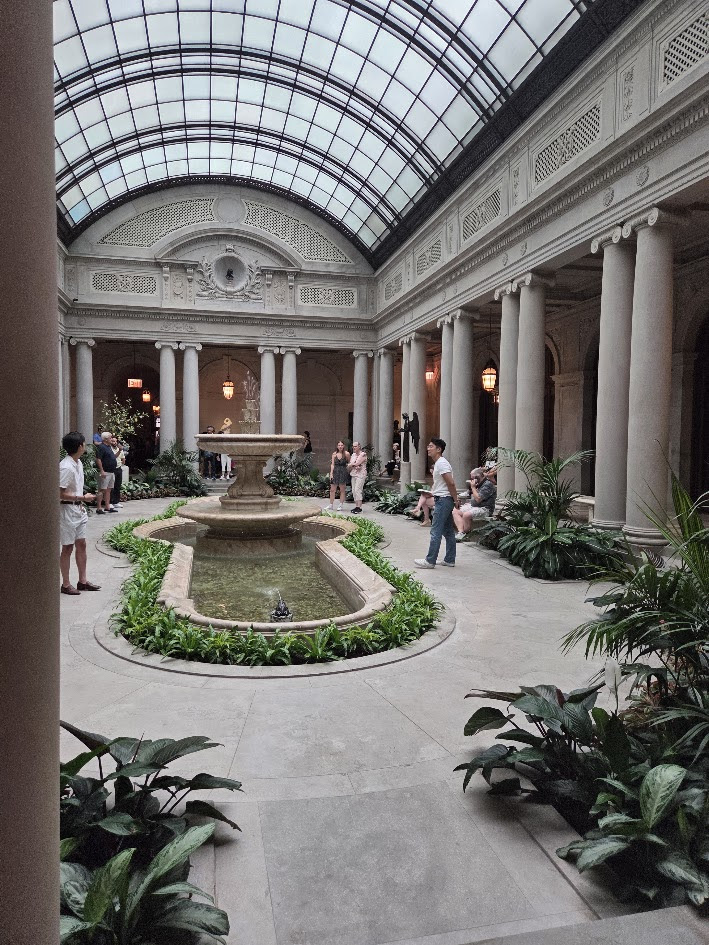
PHOTO OF THE DAY
The only area where photography is permitted at the Frick.

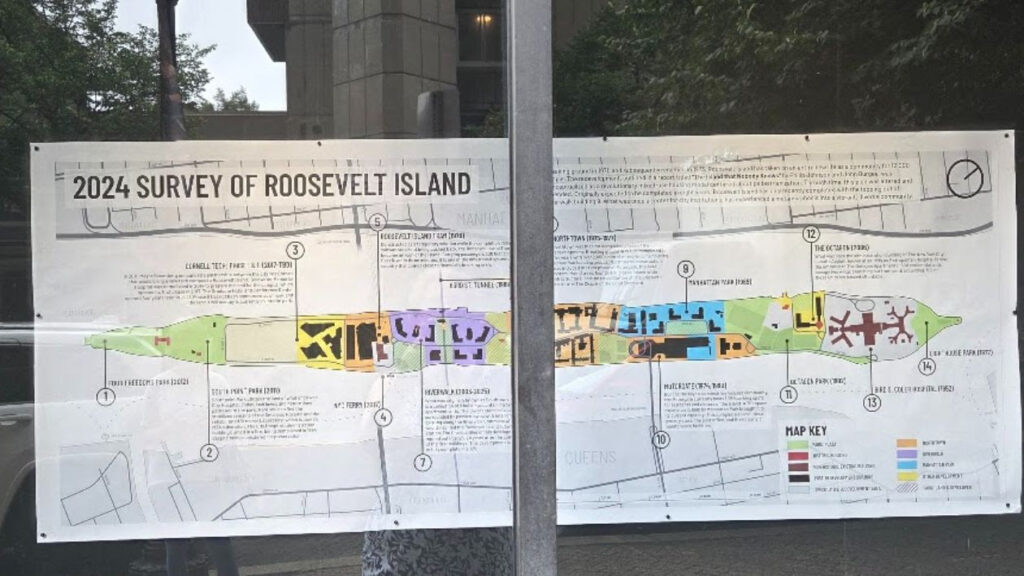
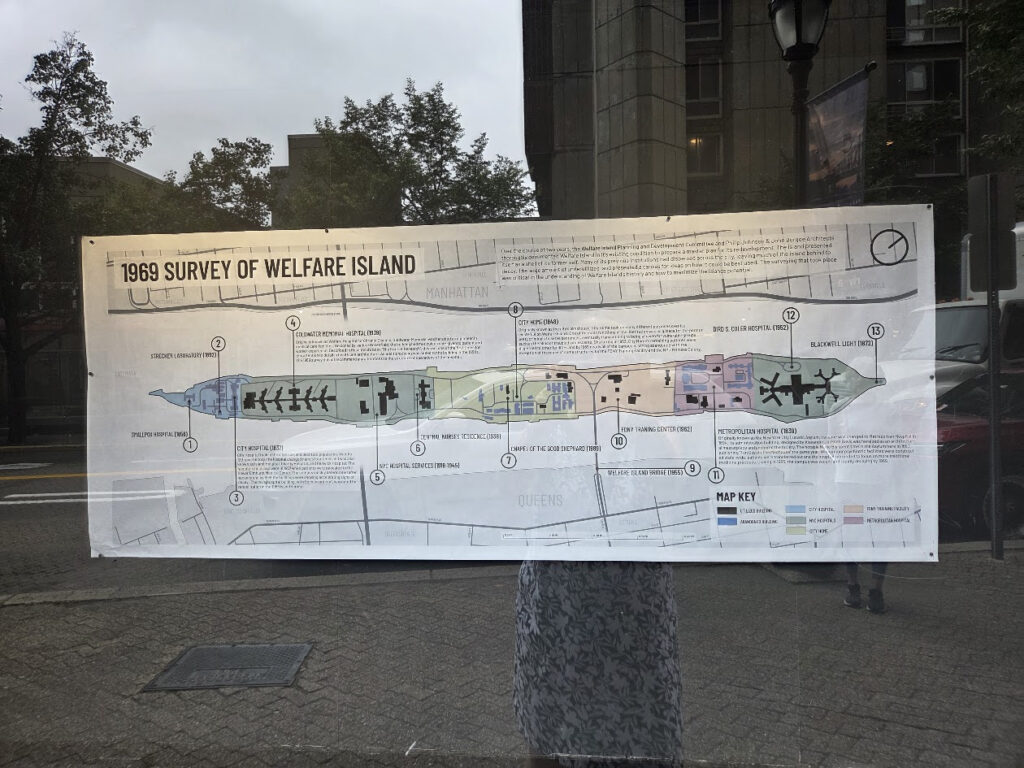
DYLAN BROWN THE CREATOR OF THESE MAPS NOW ON DISPLAY IN THE RIVERCROSS DISPLAY WINDOW. HIS WORK HAS ADDED MORE PERSPECTIVES INTO THE DEVELOPMENT OF OUR ISLAND.
JUDITH BERDY
The fenced in garden is restored and faces 70th Street.
CREDIT TO
THE FRICK COLLECTION
JUDITH BERDY
All image are copyrighted (c) Roosevelt Island Historical Society unless otherwise indicated
THIS PUBLICATION FUNDED BY DISCRETIONARY FUNDS FROM CITY COUNCIL MEMBER JULIE MENIN & ROOSEVELT ISLAND OPERATING CORPORATION PUBLIC PURPOSE FUNDS.


Copyright © 2025 Roosevelt Island Historical Society, All rights reserved.Our mailing address is:
rooseveltislandhistory@gmail.com
Leave a comment