Tuesday, March 3, 2026 – Mail Marvels: The Factory Behind the Boxes

CUTLER MAIL CHUTES
PART OF MANY OFFICE BUILDINGS
HISTORIC FACTORY IN PERIL
NEW YORK ALMANACK
TUESDAY, MARCH 3, 2026
ISSUE #1638
Once Ubiquitous in Skyscrapers, Rochester’s Mail Chute Building Languishes
March 1, 2026
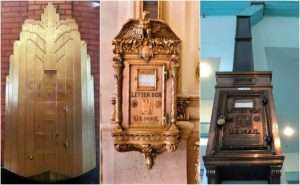
Western New Yorkers can always count on finding a little piece of home in the lobbies of historic buildings across the country and the world, including the Empire State Building, the Savoy Hotel in London, and the Bacardi Building in Havana.
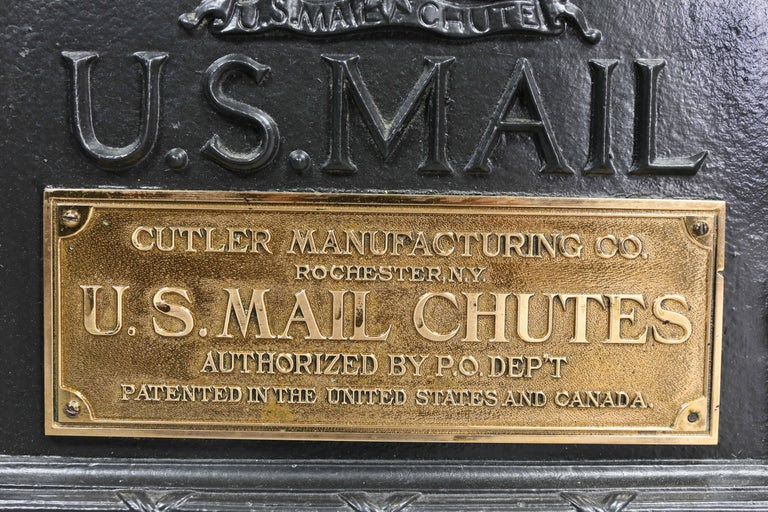
It’s likely that the mail chute, which quickly conveyed letters from the highest stories of ever-growing towers to their lobbies for pick-up, is emblazoned with the eagle insignia and name of the Cutler Mail Chute Company of Rochester, New York.
The first mail chute was installed in the Elwood Building in Rochester in 1884. The experiment was successful and chutes were installed in two New York City office buildings. The first mail chutes were limited to railroad stations and public buildings.
By 1905, the US Postal Service allowed mail chutes to be placed in hotels taller than five stories and in apartment houses with more than 50 residential apartments.
Holding the patents of James Goold Cutler, a Rochester architect and mayor, the Cutler company exercised a virtual monopoly on mail chute production in the late nineteenth and early to mid-twentieth centuries, the boom years of high-rise construction.
A 1920 headline labeled the Cutler mail chute an “essential part of every skyscraper equipment,” with the subsequent article noting the company “has the only factory in the world devoted to the production of mail chutes.”
That factory is the humble 1908 structure at 76-94 Anderson Avenue in Rochester’s Neighborhood of the Arts (NOTA), but passersby who look carefully will see the Cutler eagle rendered in terracotta gazing down from its parapet.
With its history producing a singular product found in buildings across the world until its closure in 1971, as well as its well-preserved early twentieth century industrial architectural features including its intact sawtooth roof, the Cutler Mail Chute Company building uniquely testifies to the city’s and the nation’s industrial history and graces a neighborhood transformed by a focus on arts and culture.
However, recent redevelopment plans appeared online that were unsympathetic to the history embodied by the site and indicated demolition as a possibility, prompting concerned neighbors to enlist the help of The Landmark Society of Western New York.
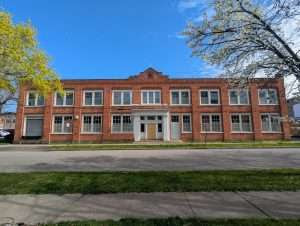
Led by the NOTA Neighborhood Association and guided by preservation architect and researcher Christopher Brandt, former Landmark Architectural Research Coordinator, Cynthia Howk, and The Landmark Society, advocates quickly took action to pursue City Landmark designation — an important tool that would require the City’s Preservation Board to review and approve future changes to the structure’s character-defining exterior.
While the Preservation Board recommended designation, the Planning Commission denied the application, citing concerns that designation would hamper development efforts.
Yet adaptive reuse has proven to be a catalyst for redevelopment by retaining the character and history that make a place distinctive and community-supported. This has been the story of many of Rochester’s historically significant buildings.
With no further local recourse available, The Landmark Society has filed a lawsuit challenging the Planning Commission’s decision. The case is awaiting a ruling, but the
vision remains the same: that one of Rochester’s foremost connections to our nation’s architectural heritage can be retained and repurposed for new use, rather than lost to demolition or incompatible alterations.
The Landmark Society of Western New York has included the Cutler Mail Chute Company Building in its 2026 Five to Revive — a list that identifies opportunities for targeted strategic revitalization. The list calls attention to sites across Western New York in need of rehabilitation.
Through this list, the organization hopes to facilitate investment and protect the area’s architectural heritage, by working with owners, developers, investors, and other partners to create connections and reactivate buildings in their communities.
Cutler Mail Box and Chute
Natioan Postal Museum
As urban business centers flourished in the 19th century and buildings grew vertically, rather than horizontally in response to growing urban land values, the Post Office Department sought an easier way for occupants to mail their letters. It was more convenient to collect the mail inside the office buildings instead of forcing tenants to deposit their mail in boxes on the street or post offices. The answer was the creation of mail chutes that would extend from the top floor to a receiving box located at ground level.
The first mail chute was installed in the Elwood Building in Rochester, New York in 1884. The experiment was successful and chutes were installed in two New York City office buildings. The first mail chutes were limited to railroad stations and public buildings. By 1905, the postal service allowed mail chutes to be placed in hotels taller than five stories and in apartment houses with more than 50 residential apartments.
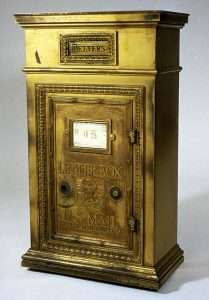
This receiving box, which was located at the bottom of the mail chute, was manufactured by James G. Cutler, who received patent #284,951 for his design. which stated that the box must “be of metal, distinctly marked ‘U.S. Letter Box,'” and that the “door must open on hinges on one side, with the bottom of the door not less than 2’6″ above the floor.” If a receiving box was to be placed in a building that was more than two stories high, the bottom of the box was required to be outfitted with an elastic cushion to “prevent injury to the mail.”
Mail chutes had to be accessible along their entire length and at least three-fourths glass fronted so that postal workers could easily locate and remove any lodged mail. Congress placed all chutes and subsequent mail matter under the exclusive custody of the Post Office Department in 1893 and made all chute construction work subject to postal regulations. Cutler’s company was the sole manufacturer of mail chutes and receiving boxes until 1904. During those 20 years, the company produced more than 1600 receiving boxes, and continued to produce them for several more years. This receiving box was constructed in 1920.
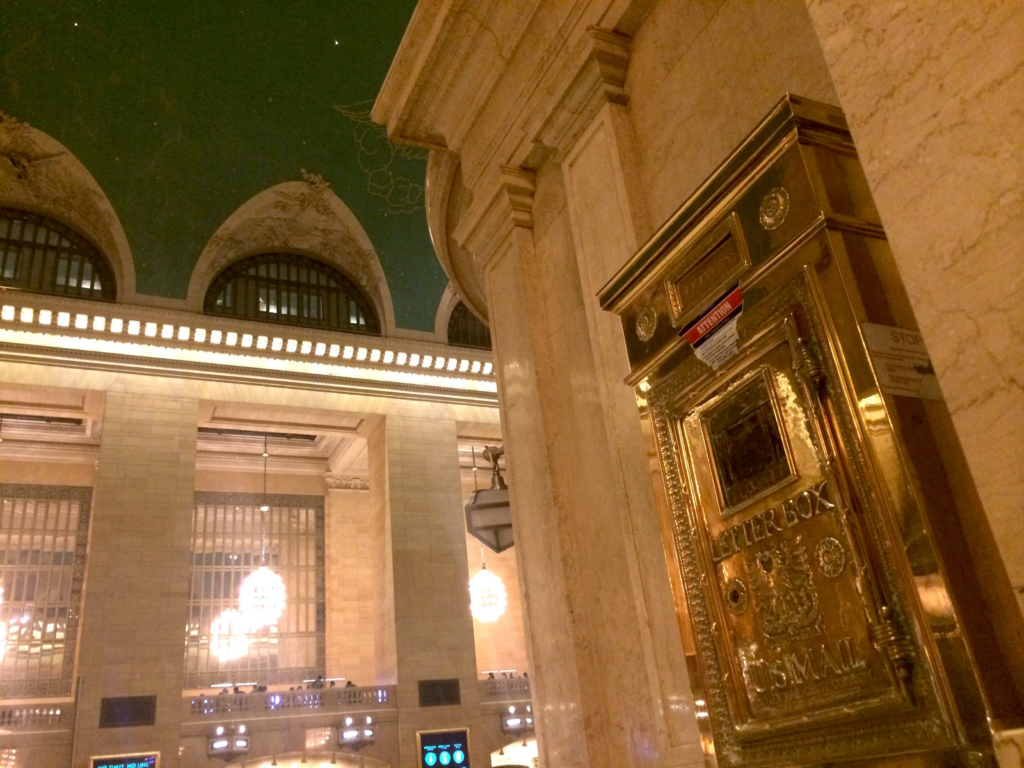
The wonderful mail box in Grand Central Terminal
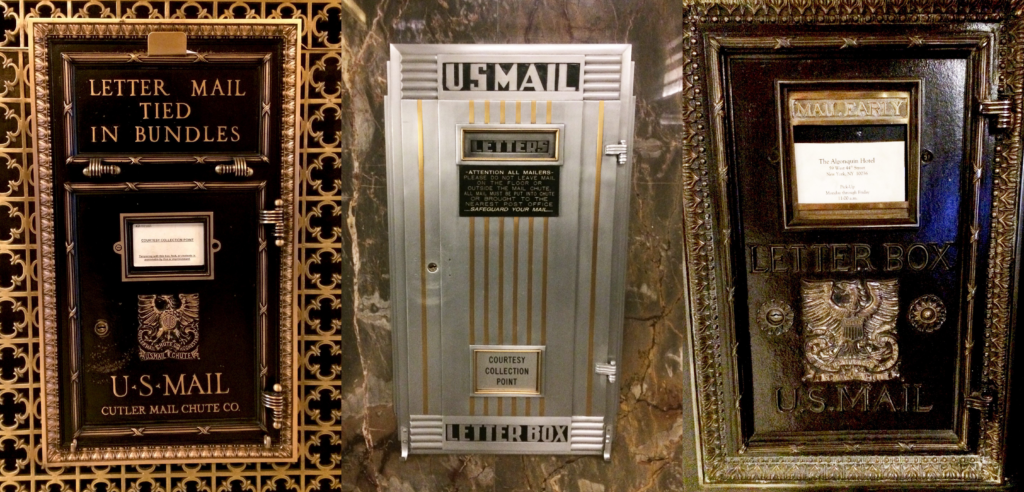
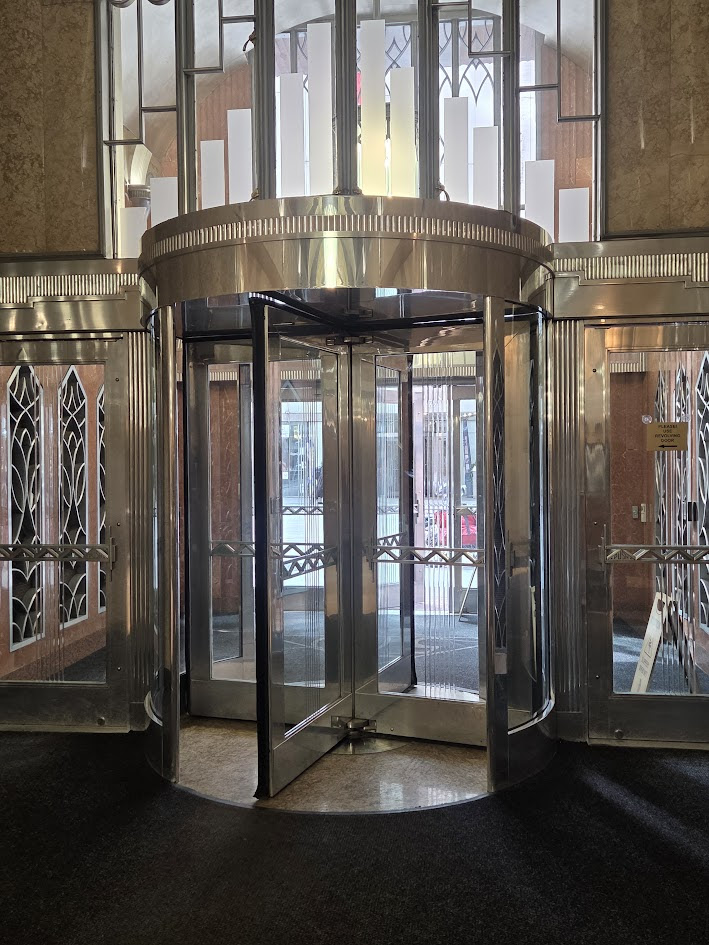
PHOTO OF THE DAY
THE WONDERFUL ENTRANCE
TO 575 LEXINGTON AVENUE, THE FORMER
GENERAL ELECTRIC BUILDING
CREDITS
UNTAPPED NEW YORK
NATIONAL POSTAL MUSEUM/ SMITHSONIAN MUSEUM
All image are copyrighted (c) Roosevelt Island Historical Society unless otherwise indicated
THIS PUBLICATION FUNDED BY DISCRETIONARY FUNDS FROM CITY COUNCIL MEMBER JULIE MENIN & ROOSEVELT ISLAND OPERATING CORPORATION PUBLIC PURPOSE FUNDS.


Copyright © 2026 Roosevelt Island Historical Society, All rights reserved.Our mailing address is:
rooseveltislandhistory@gmail.com
Leave a comment