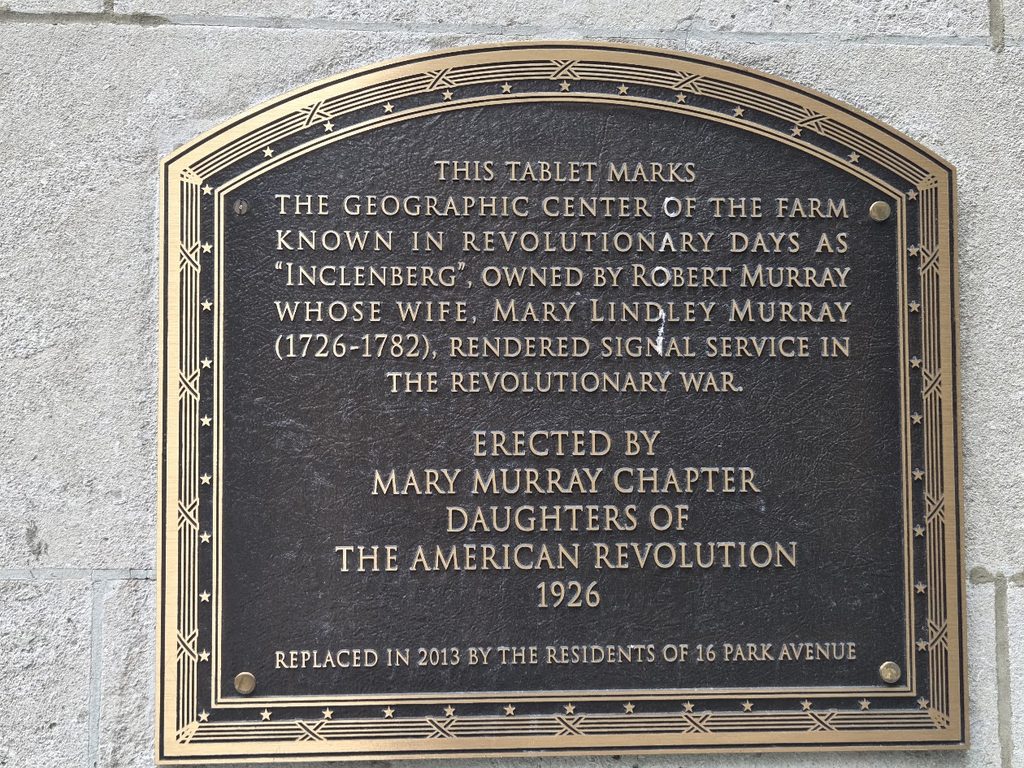
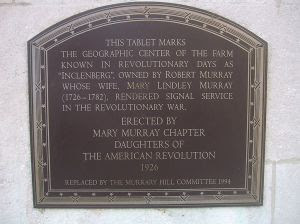
I was walking up Park Avenue from 33rd Street to 37th and discovered some sites that interested me on this warm, humid and damp morning. On the corner of 35th Street this plaque commemorates the farm named Inclenberg owned by Robert and his wife Mary Murray.
Where in colonial Manhattan was Inclenberg?
The only thing marking it is a bronze plaque discreetly affixed to an apartment building on Park Avenue and 35th Street in today’s Murray Hill.
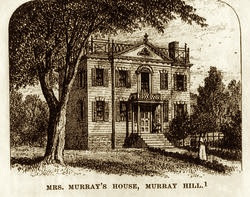
But in the 1750s, with New York City concentrated far downtown, this was the center of a 29-acre hilltop estate known as Belmont or Inclenberg, the latter also lending its name to the surrounding area.
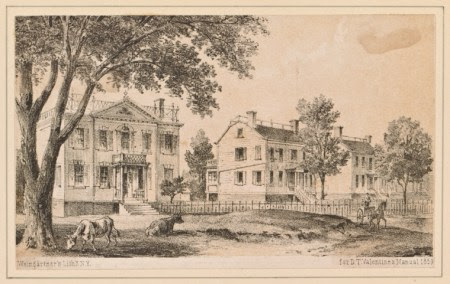
“A magnificent place altogether was Inclenberg . . . approached by an avenue of magnolias, elms, spruce and Lombardy poplars . . . the spacious, two-story mansion had a broad veranda extending around three sides, and . . . front windows commanding a view of Kip’s Bay and the East River.”
It was the home of prosperous businessman Robert Murray and his wife, Mary Lindley Murray, who entertained the city’s elite there, including George Washington.
Hosting Washington wasn’t Inclenberg’s only brush with Revolutionary War–era notoriety.
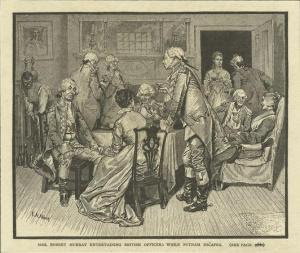
Legend has it that in 1776, Mary Lindley Murray—who, unlike her secret Loyalist husband, was a fierce supporter of American freedom—supposedly used tea, cake, and female charm to helped the Patriots escape the British army.
“When Gen. William Howe crossed the East River from Long Island in 1776, pursuing Washington’s troops and attacking New York City, Mrs. Murray and her daughters invited General Howe and his officers to tea,” states a 1999 New York Times article.
“They accepted and were detained long enough to allow Washington and his troops to escape.”
The Murrays died by the turn of the 19th century; their mansion burned down in 1835. The neighborhood and its once-formidable hill carry their name—while Inclenberg has been almost forgotten.
A New Look for Building Canopies
NY TIMES (c)
Since the weather was dark and raining, I have used the NYTimes images.
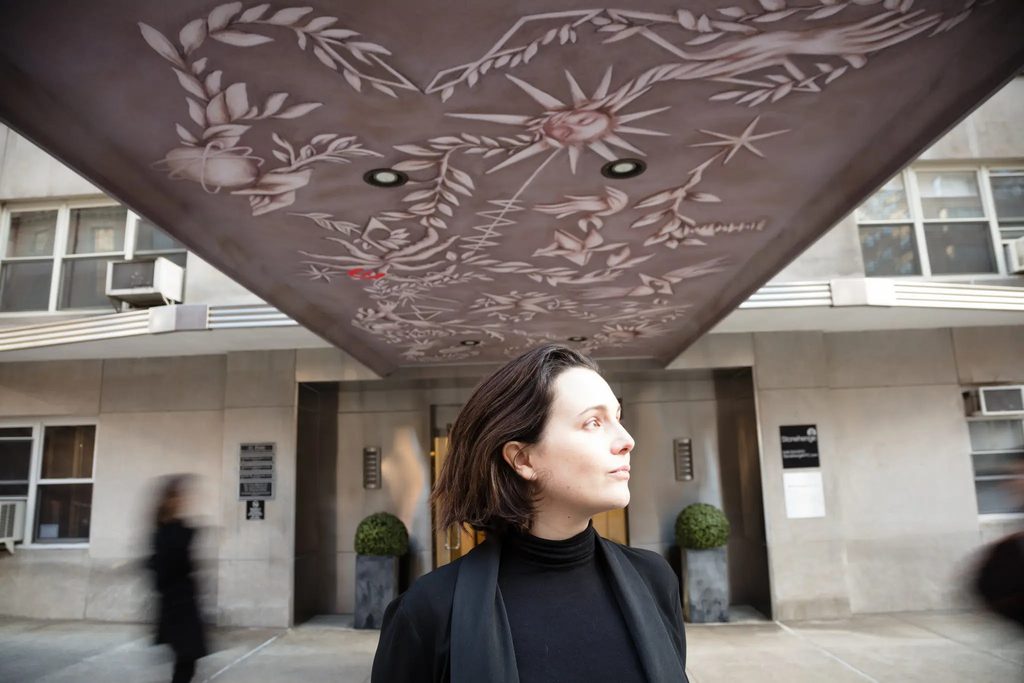
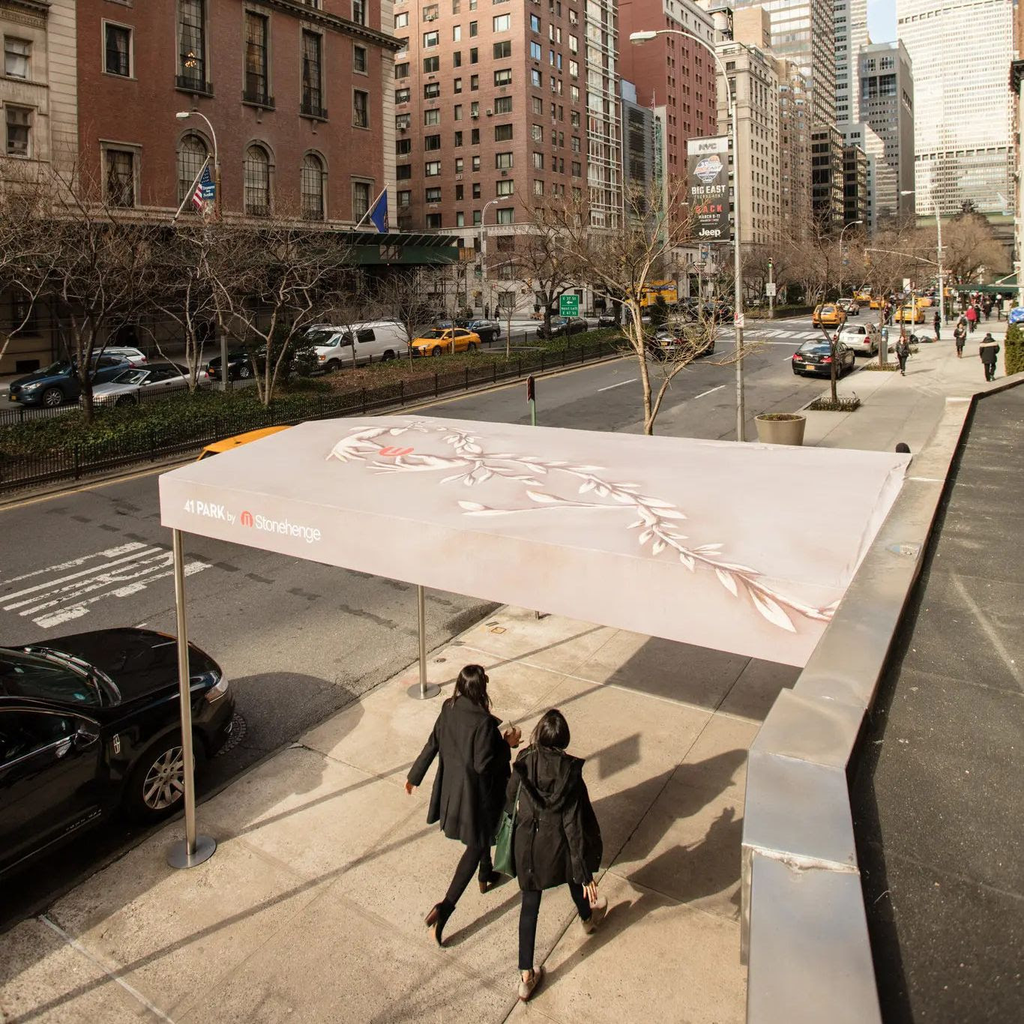
If you notice walkers slowing down in front of 41 Park Avenue in Manhattan, and wonder why, just look up.
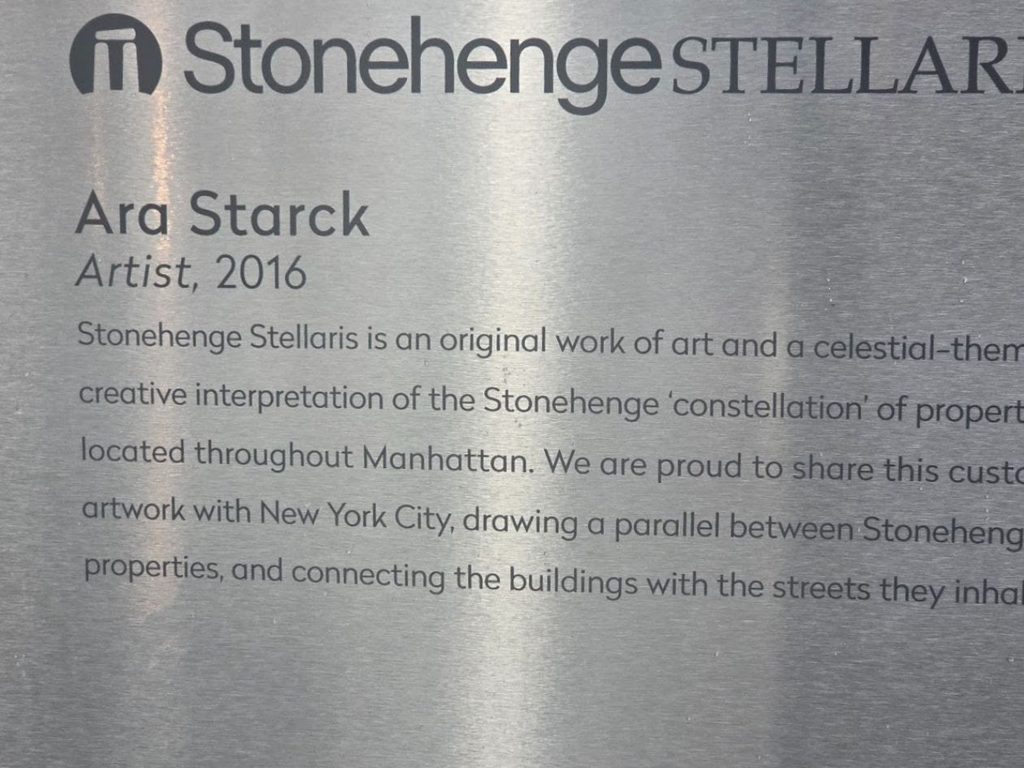
Sheltering the sidewalk is a fabric entrance canopy printed on top and bottom with a graphic treatment by Ara Starck, the Paris-born, New York-based artist. Seen from below, the work, named Stonehenge Stellaris, offers a surreal take on the heavens — an abstract map of Manhattan depicting Stonehenge NYC’s 23 rental buildings as constellations, where your location is indicated by a company logo. The top of the canopy, viewable from apartments above, depicts leafy branches that blossom into human hands.
“The awning is very important because it’s the first thing that greets you and then the last thing you see when you leave,” said Ms. Starck, a daughter of the high-profile designer Philippe Starck.
“I’m not the type of painter who thinks that art should be in a gallery,” added Ms. Starck, who has painted expansive ceilings in hotels designed by her father, including Le Meurice in Paris and SLS South Beach in Miami Beach. “The more I can go outside the frame, or even outside on the street, the happier I am.”
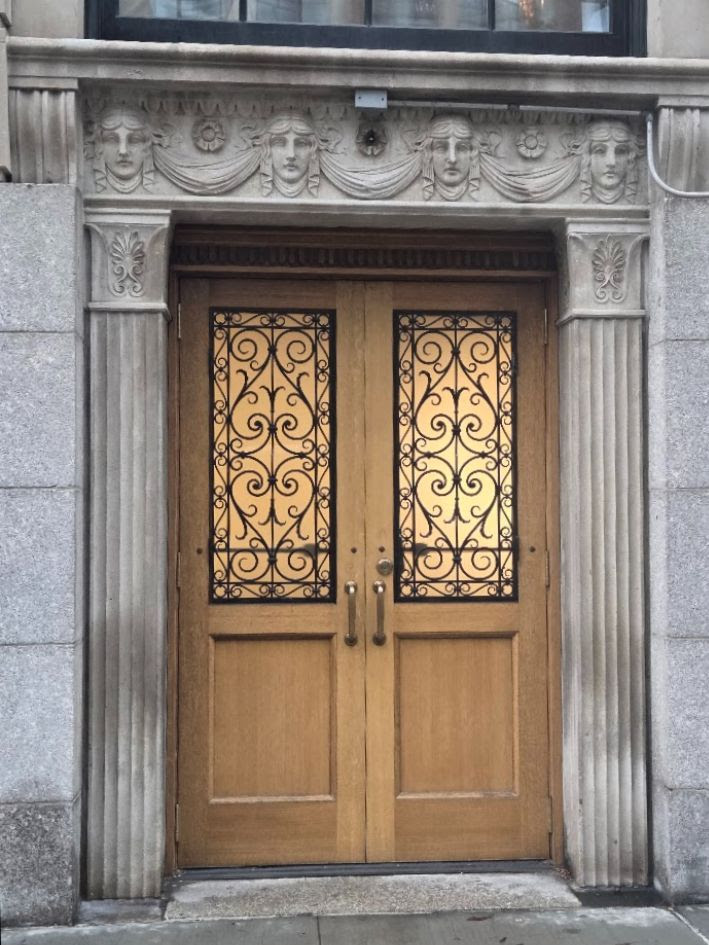
The side entrance to the UNION LEAGUE CLUB enhances Park Avenue
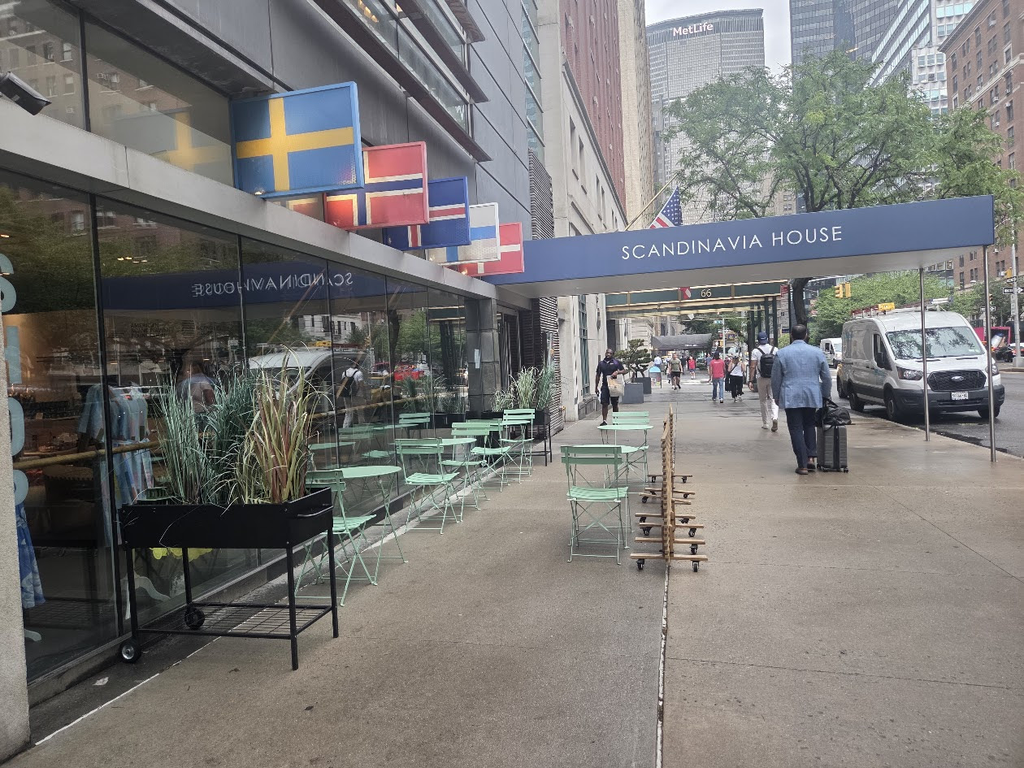
Time for a light lunch. Scandinavia House has a delightful cafe with a great snack to full meal menu.
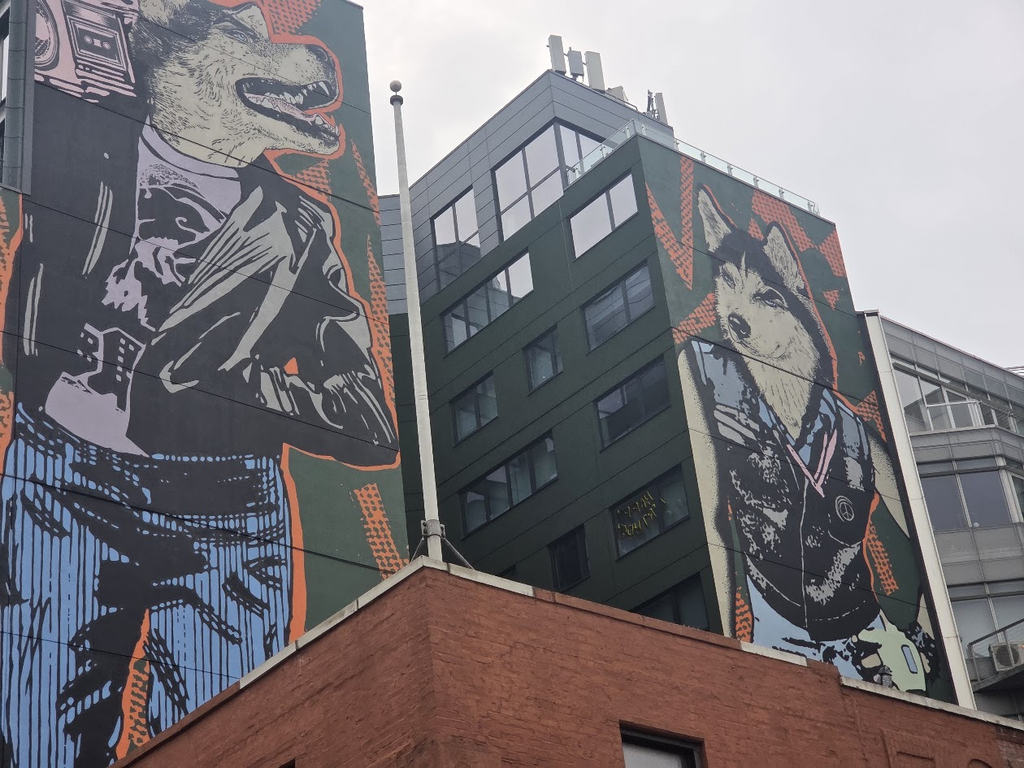
Interesting mural on the corner of 50 Street and Vernon Blvd.
CREDITS
NY TIMES EPHEMERAL NEW YORK Judith Berdy
All image are copyrighted (c) Roosevelt Island Historical Society unless otherwise indicated THIS PUBLICATION FUNDED BY DISCRETIONARY FUNDS FROM CITY COUNCIL MEMBER JULIE MENIN & ROOSEVELT ISLAND OPERATING CORPORATION PUBLIC PURPOSE FUNDS.
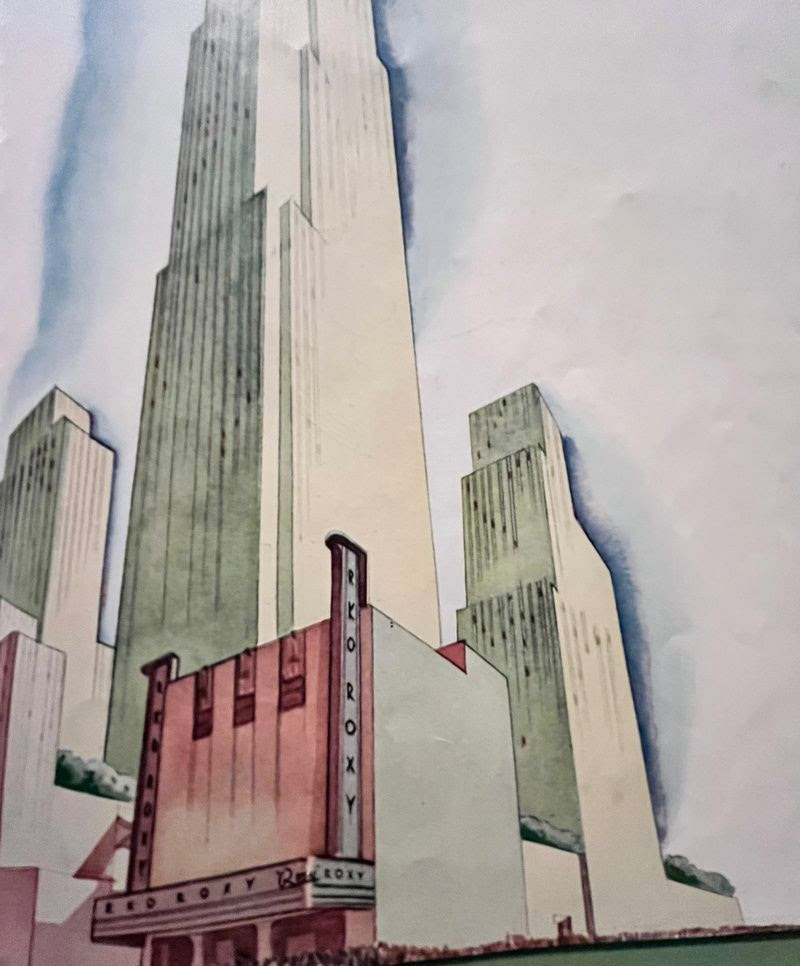
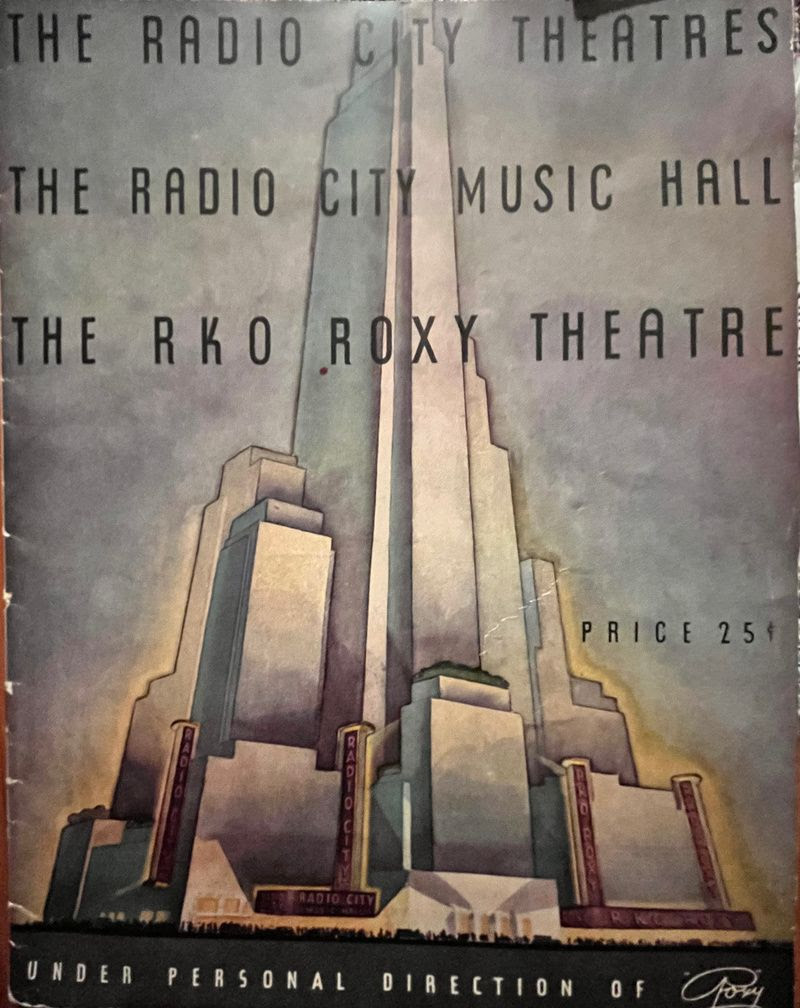
The only building to ever be demolished from the original Rockefeller Center complex was the RKO Roxy Theater, also known as the Centre Theater, at 1230 Sixth Avenue. The theater was named after Samuel “Roxy” Rothafel, a theater impresario whose name was synonymous with opulence and glamour. The theater, just a block away from the iconic Radio City Music Hall, hosted everything from motion picture screenings to ice skating shows throughout its short existence.
Image of the Roxy Theater Facade on the opening night program
Construction on the Roxy began in 1930 after the land was cleared of existing brownstones. The theater was meant to be a companion to the nearby Radio City Music Hall. While Radio City hosted live performances, the Roxy was intended to show films. Both theaters were designed by noted architect Edward Durell Stone.Stone’s designs for the two different theaters were very similar. Both fit the overall modernist, Art Deco style of the complex, were constructed out of limestone, and featured tall vertical marquees that ran perpendicular to a thin horizontal marquee. The two theaters did differ in size. While Radio City could accommodate over 6,000 seats, the Roxy was almost half the size, accommodating just over 3,000.Above the large windows on the 49th Street facade of the Roxy, there was a large metal and enamel sculpture titled “Radio and Television Encompassing the Earth.” The sculpture was designed by American Art Deco muralist Hildreth Meière, who also designed bas-reliefs that appear on the 50th Street facade of Radio City.A recreation of “Radio and Television Encompassing the Earth” was installed in the Rockefeller Center underground concourse in 1988. Untapped New York consulted multiple Rockefeller Center employees on a quest to locate the sculpture while researching the site for our Art Deco Icons of New York tour. At the time, it appeared to have been removed or hiding behind construction walls. Turns out, it was removed during construction and was salvaged by Olde Good Things. We were pleasantly surprised to see it on a recent visit to the antique store!
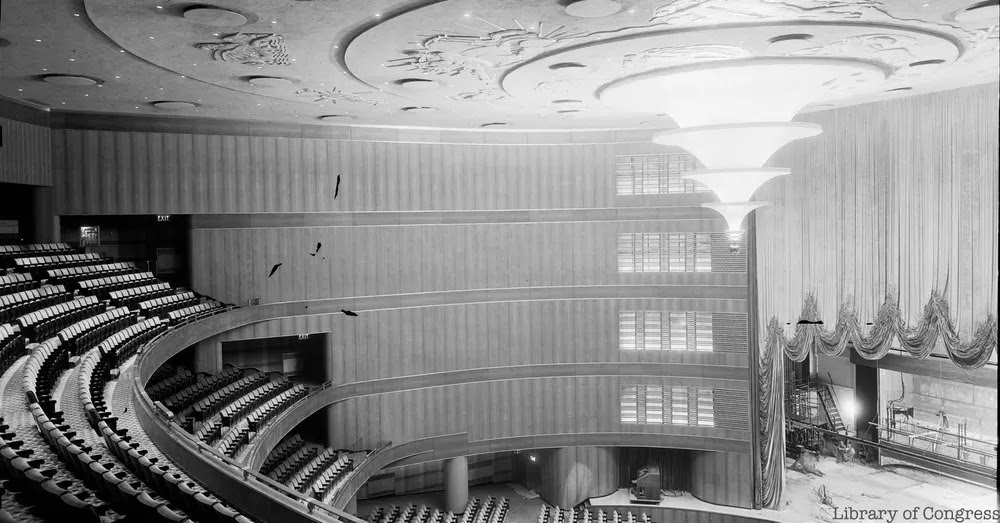
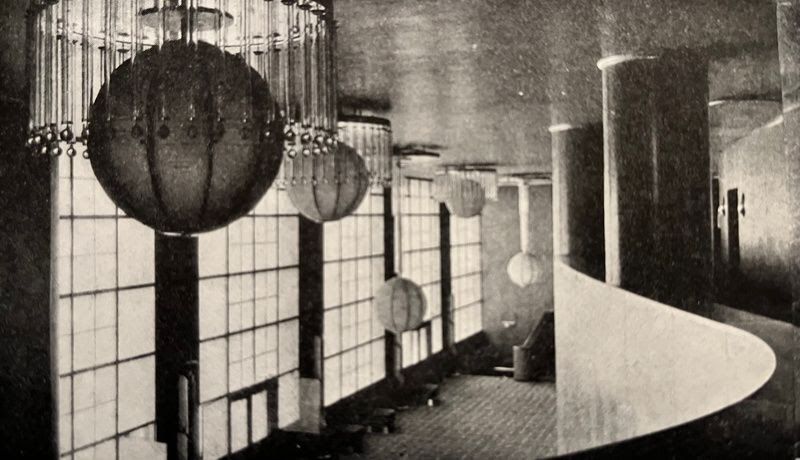
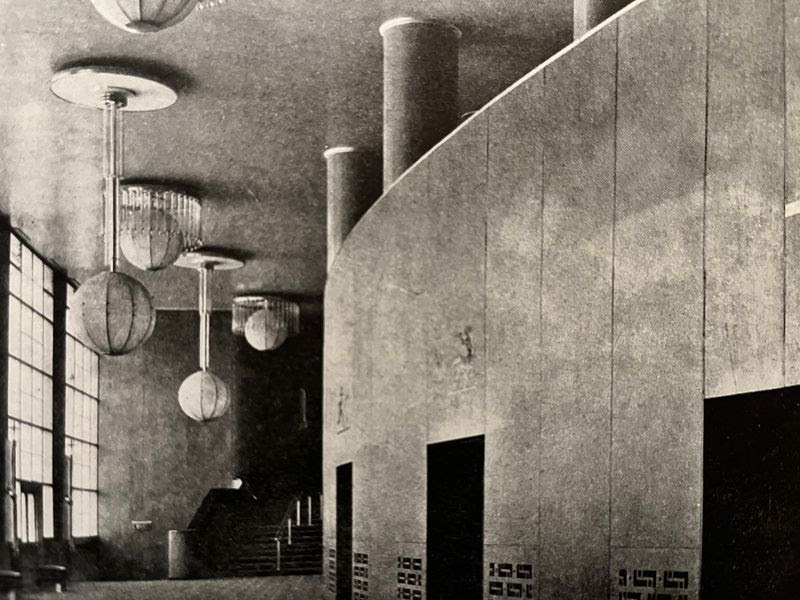
The interiors of the Roxy were designed by Eugene Schoen. Guests purchased their tickets at one of three ticket booths in a low-ceiling lobby. Next, they passed under a two-tiered fountain and into the grand two-story foyer. Light streamed in through 24-foot floor-to-ceiling Corning Glass windows dressed in red and gold velvet curtains. Hanging from the blue ceiling was a series of spherical chandeliers by Steuben Glass. Opposite the windows, an undulating wall covered in mahogany followed the curve of the theater’s mezzanine. It was an impressive, modern space that oozed glamour.
Roxy Theater Interior from the opening night program
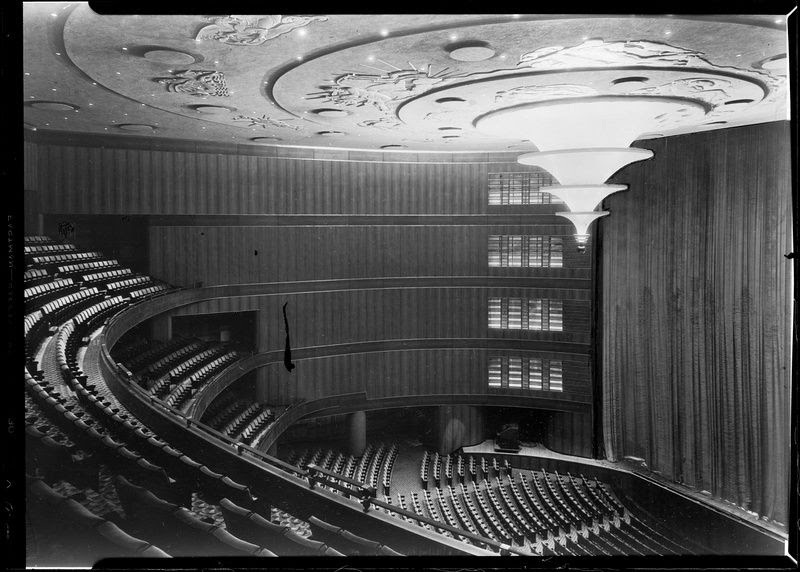
More works by Hildreth Meière were scattered throughout the interior, including above the auditorium doors. There, guests would pass under painted silhouettes of mythological Greek figures as they went through the leather-covered doors. The auditorium was covered in wood and plaid-patterned linen. The main feature of the space was a giant chandelier, said to be the largest light fixture in the world.
Roxy Theater Interior from the opening night program
The chandelier weighed six and a half tons and measured 30 feet in diameter. It had four different color settings, amber, red, green, and blue. Inside the three-tiered fixture were over a hundred floodlamps and dozens of spotlights. Swirling around the light were relief sculptures of gods and goddesses designed by Rene P. Chambellan with the Italian sculptor Cronozio Meldarelli. According to the New York Times, the artist said the figures represented the forces of love, enjoyment, sport, play, and freedom. Chambellan also created the iconic Atlas statue at Rockefeller Center and others around the complex.
The RKO Roxy Theater had a Gala Opening on December 29, 1932, just two days after the grand opening of Radio City. Entertainment for that evening was described by the New York Timesas “unusually interesting.” It consisted of a stage show and a feature film starring Myrna Loy and Leslie Howard called “Animal Kingdom.” In a brochure handed out on the opening night, Rosenthal wrote to guests, “within these gates may you find peace, and gayety, and inspiration.”
Library of Congress, Prints & Photographs Division, Gottscho-Schleisner Collection
In order to keep both the Roxy and Radio City theaters afloat, there were frequent changes to their programs, with the theaters swapping films and live shows throughout the 1930s. In 1933, the Roxy’s name was changed to the RKO Center Theater after a legal battle with the existing Roxy theater on Seventh Avenue in Times Square. By November 1937, rumors began to swirl about the possible demolition of the failing theater.
In 1940, John D. Rockefeller drove the last rivet of Rockefeller Center’s construction into the building next to the Center Theater, the new home of U.S. Rubber. Book publishers Simon and Schuster moved into offices above the theater. As development continued in Rockefeller Center, the theater tried to make ends meet once again with motion pictures. Walt Disney’s Pinocchio had its world premiere at the Center Theater in February 1940. Walt Disney’s name was added to the theater’s marquee and the building was adorned with a giant sign of Pinocchio’s face. The animated feature would be the last film shown at the Center. For the next ten years, the theater found success with ice skating shows, made popular by Olympic skater and actress Sonja Henie.
With the arrival of the 1950s, television was booming and the NBC network needed more space. Despite the success of the ice show, it was ousted from the theater when NBC took over and converted the space into a television studio. It took a lot of work and a lot of money to make the expansive theater auditorium conducive to television production, and some major stars of the time such as Eddie Cantor, Dean Martin, and Jerry Lewis declined to perform in the large space. As a television facility, the Center Theater hosted comedians, radio, television, and movie stars including Ed Wynn, Tallulah Bankhead, and Groucho Marx.
Opening night program
The last hurrah for the theater was hosting the New York broadcast of the 1954 Academy Awards. The award ceremony was also broadcast from Los Angeles. On the Center Theater stage, burgeoning Hollywood movie star Audrey Hepburn accepted her award for Best Actress in Roman Holiday.
When NBC’s lease was up in 1954, it was decided that the theater would be torn down. Radio City had its own demolition scare in the 1970s. By 1955, all traces of the Center Theater were gone and an annex to the U.S. Rubber Building designed by Harrison & Abramowitz stood in its place at the southeast corner of West 49th Street.
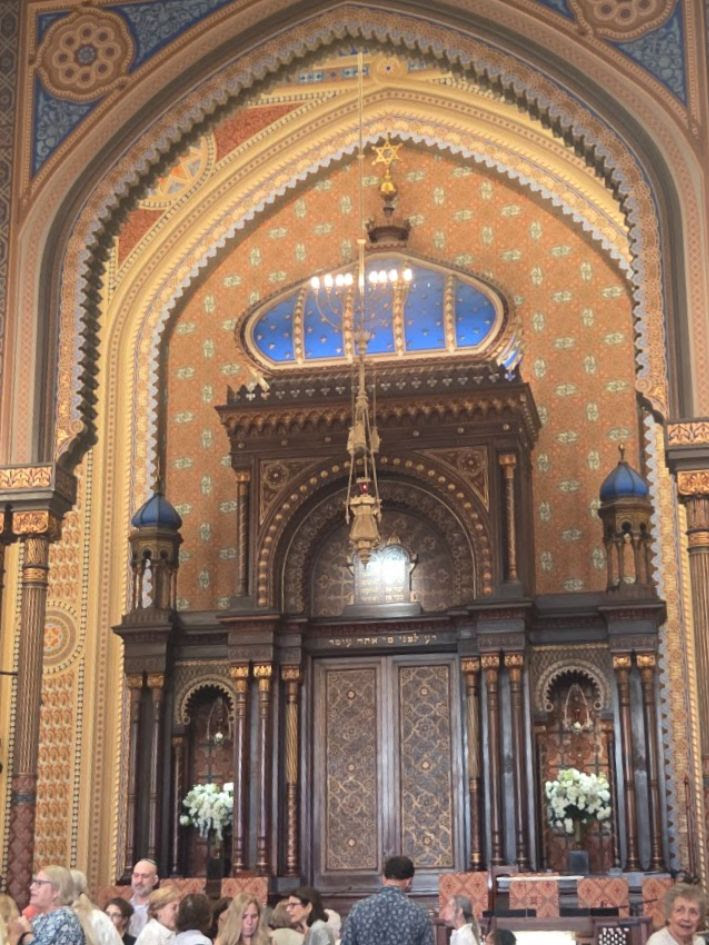
PHOTO OF THE DAY CELEBRATING THE SABBATH AT CENTRAL SYNAGOGUE WITH A FULL AUDIENCE THERE TO WORSHIP AND SUPPORT
CREDITS
Untapped New York Judith Berdy
All image are copyrighted (c) Roosevelt Island Historical Society unless otherwise indicated THIS PUBLICATION FUNDED BY DISCRETIONARY FUNDS FROM CITY COUNCIL MEMBER JULIE MENIN & ROOSEVELT ISLAND OPERATING CORPORATION PUBLIC PURPOSE FUNDS.
Day three, we have about 7 hours to see more of the City. I had contacted the Oneida History Center and was referred to Joe Caruso. Caruso is a Utica native, professional writer with a background working with many agencies and organizations in the area. He was the perfect guide for our day delving into the city history.
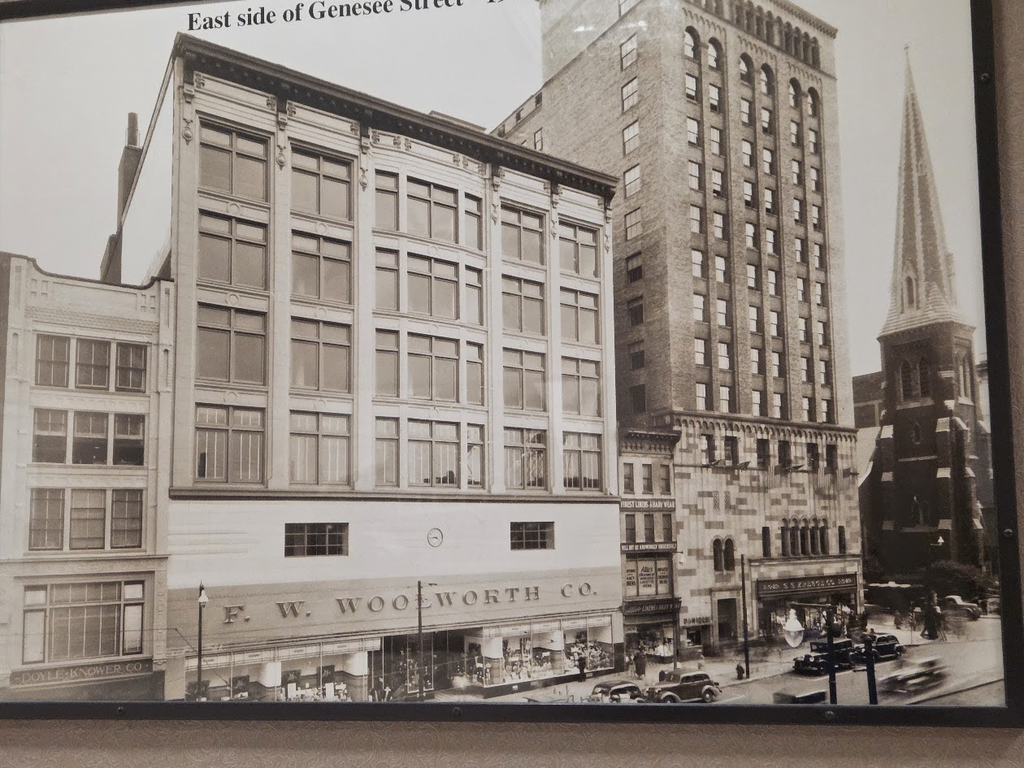
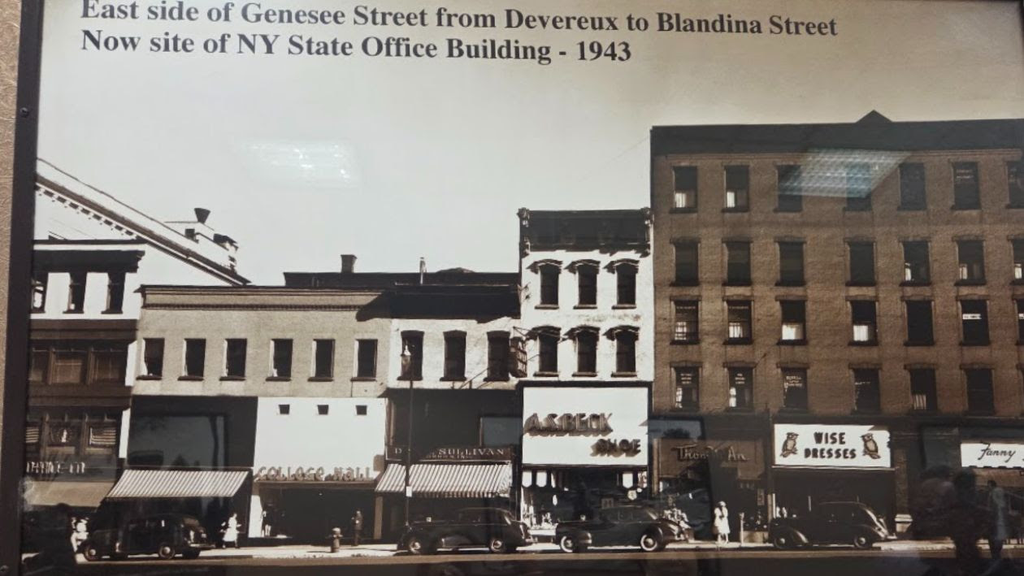
After introductions we decided that a walk would be in order. Accross the street from the hotel we were on Gennessee Street the main shopping avenue in years past.
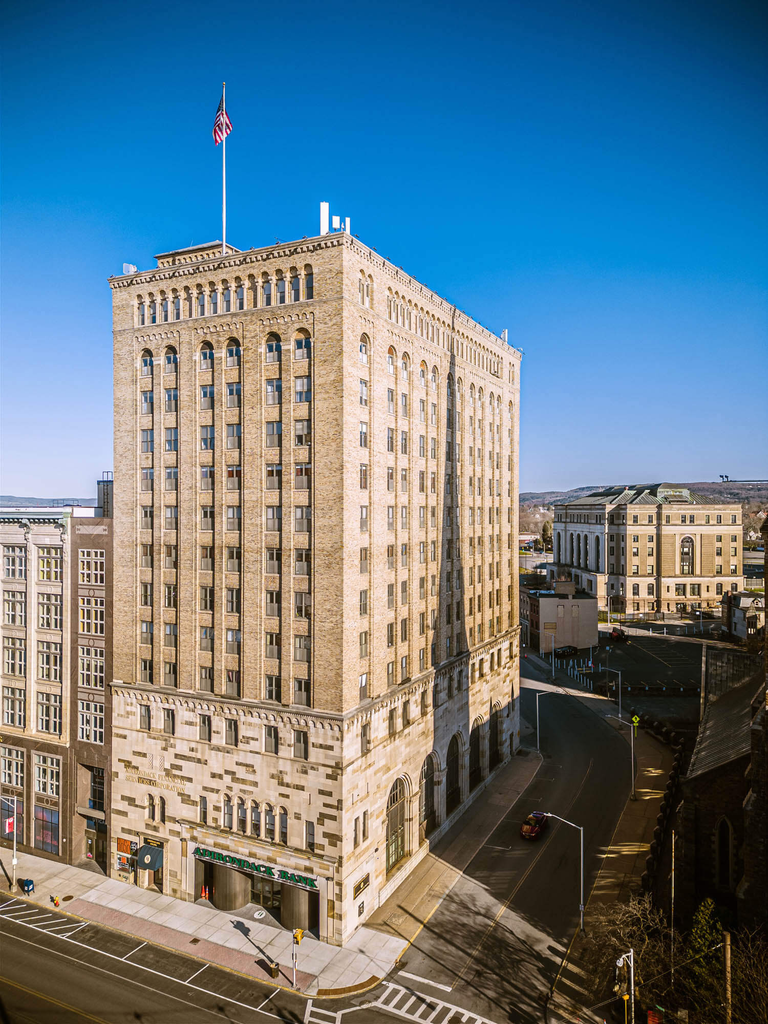
We walked into Adirondack Bank Building Initially constructed as the First National Bank, this building was designed by noted architects, York and Sawyer, in 1926. The 16-story office building features Sullivanesque style details. In the Main floor lobby is an exhibit of photos of downtown Utica, most from the ’30’s and ’40’s. It was great to compare the past and the present.
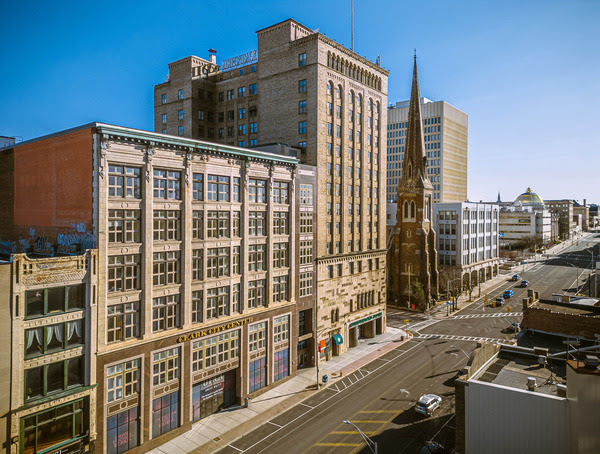
The massive F.W. Woolworths no longer exists but the building is being used as the Clark City Center Building Initially home to the Robert Frasers Department store, and subsequently occupied by the FW Woolworth Co., the Clark City Center Building is today primarily occupied by Utica University business school’s undergraduate and graduate programs.
A.S. Beck, Thom McCan SHoes and Fanny Farmer were as familiar here as on 34th Street, Manhattan.
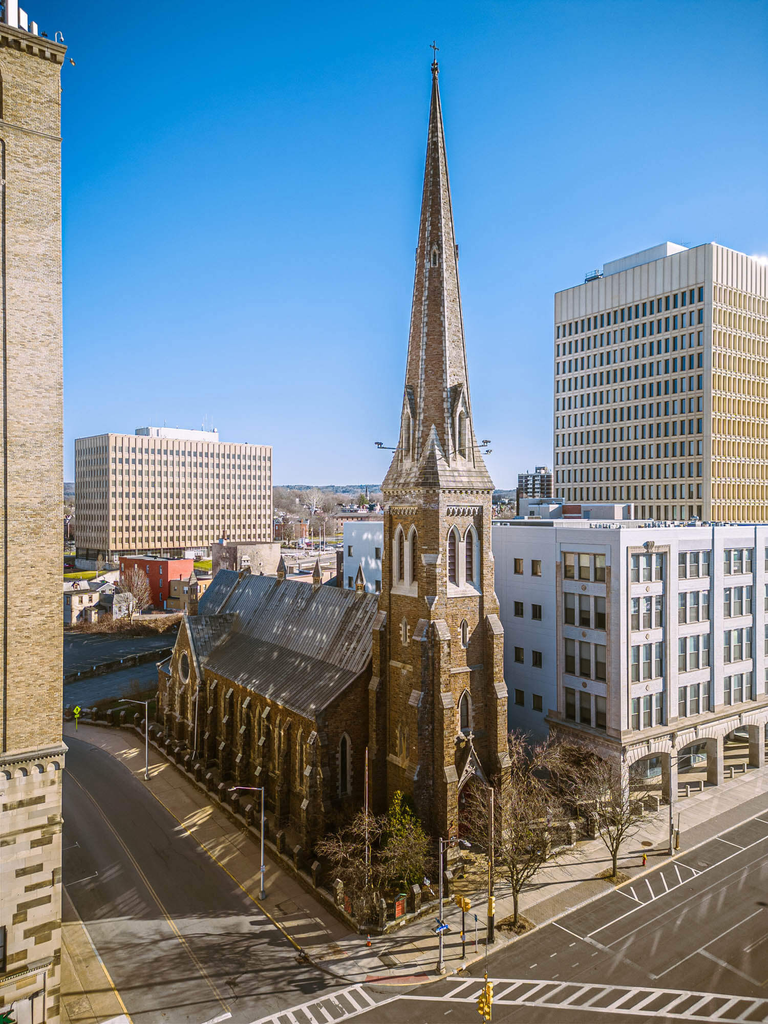
Joe suggested a visit to Christ Church, a magnicent structure by architect Richard Upjohn, (from the history):
Grace was an offshoot of the historic Trinity Church of Utica and was formed in 1838. Around 1847, Alfred Munson, a wealthy Utica businessman and a member of the congregation, secured the services of Richard Upjohn, architect of Trinity Church in New York City, to draw up plans for a new edifice and location for Grace Episcopal Church, which was ultimately built at the corner of Genesee and Elizabeth Streets in downtown Utica. In 1875 the tower and spire were completed under the personal supervision of Richard M. Upjohn, son of the original architect. The parish house, vestry room and choir room were added in 1884 and in 1890 the chancel was enlarged through the generosity of Mrs. Helen E. Munson Williams, who died before the work was completed. The new windows adorning the chancel were commissioned in her memory by her daughters, Mrs. Rachel M. W. Proctor and Mrs. Maria W. W. Proctor.
Henry Holiday, the notable English stained glass artist, was commissioned to design and create the seven windows. He took the great hymns of the church and the seven days of the Creation as the subject for what is considered by art experts the world over to be his masterpiece. Evidently Mr. Holiday considered them to be his best works for he chose them as the frontispiece of his definitive book on stained glass and copied them for the west window of the Cathedral Church of St. Savior, Southwark, London.
The present Parish House was constructed through the generosity of Mrs. Thomas R. Proctor and Mr. Frederick T. Proctor. The cornerstone was laid on Advent Sunday, 1926 and on May 15, 1928, the Parish House was dedicated.
The generosity of the Proctors to the church was also shown in a gift of the Lady Chapel. Stone from the dismantled old chapel was used in the new one, thus giving an impression of antiquity. Exquisite in design, the chapel was styled after Old World churches where it was the custom to dedicate the chapel immediately behind the high altar to the Mother of Christ. The chapel and its altar were consecrated on May 17, 1928.
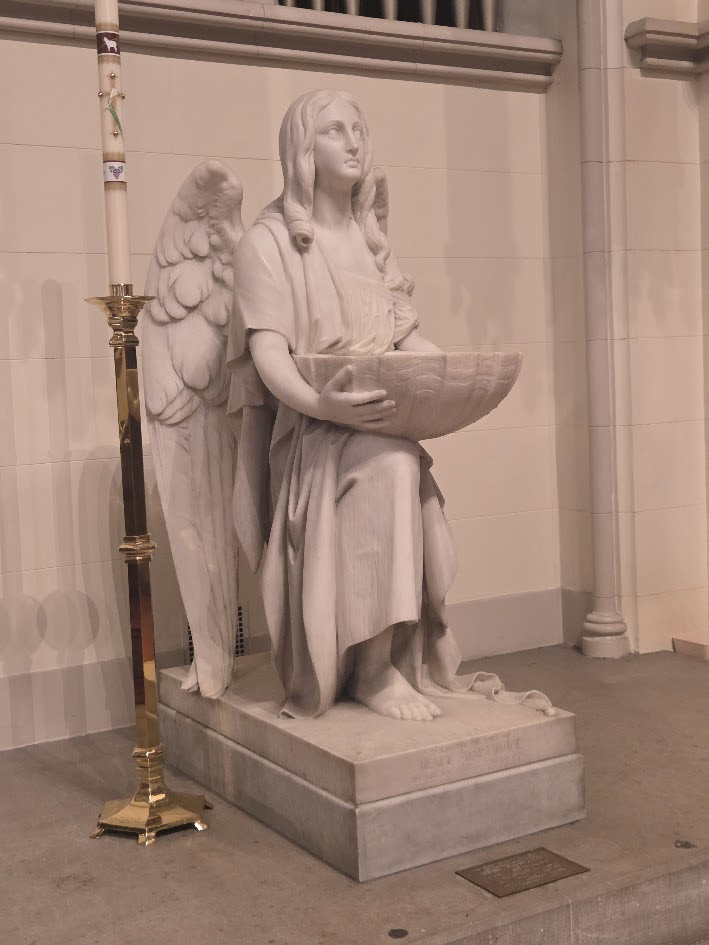
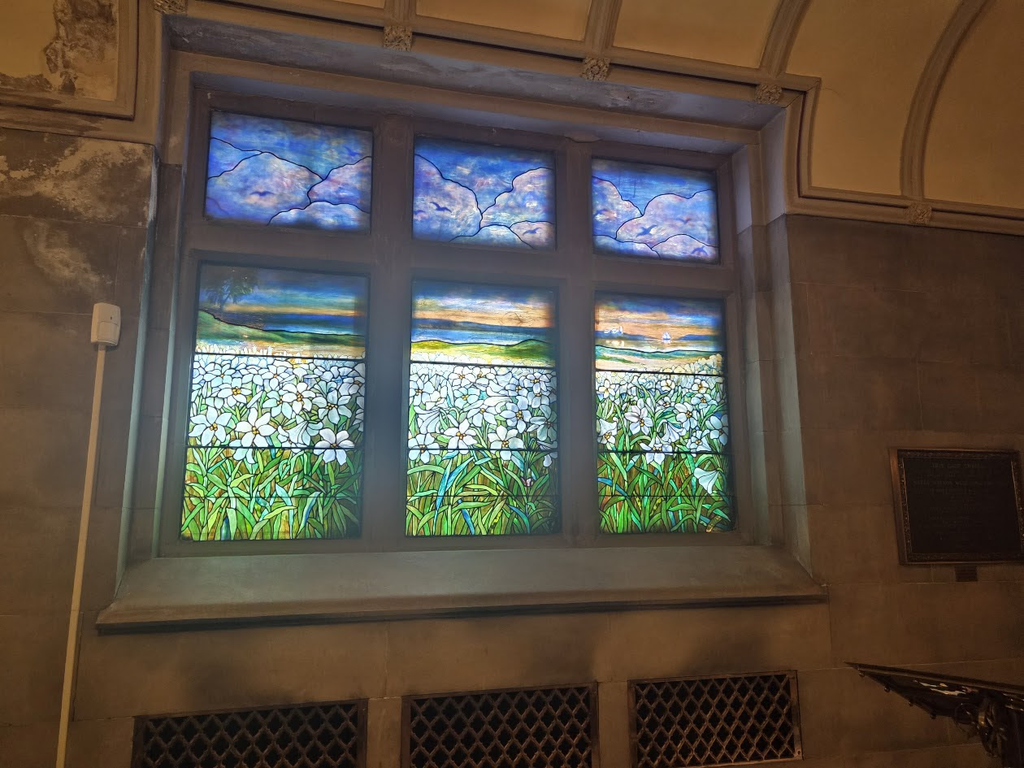
Impressive Tiffany window and baptismal font.
After walking around downtown it was time for lunch. We chose a local Lebanese Cafe. At Zeina’s Cafe, we were greeted like old friends. Lots of pita, hummus, falafel, tahini and Mediterranean specialties got us ready for some more sights.
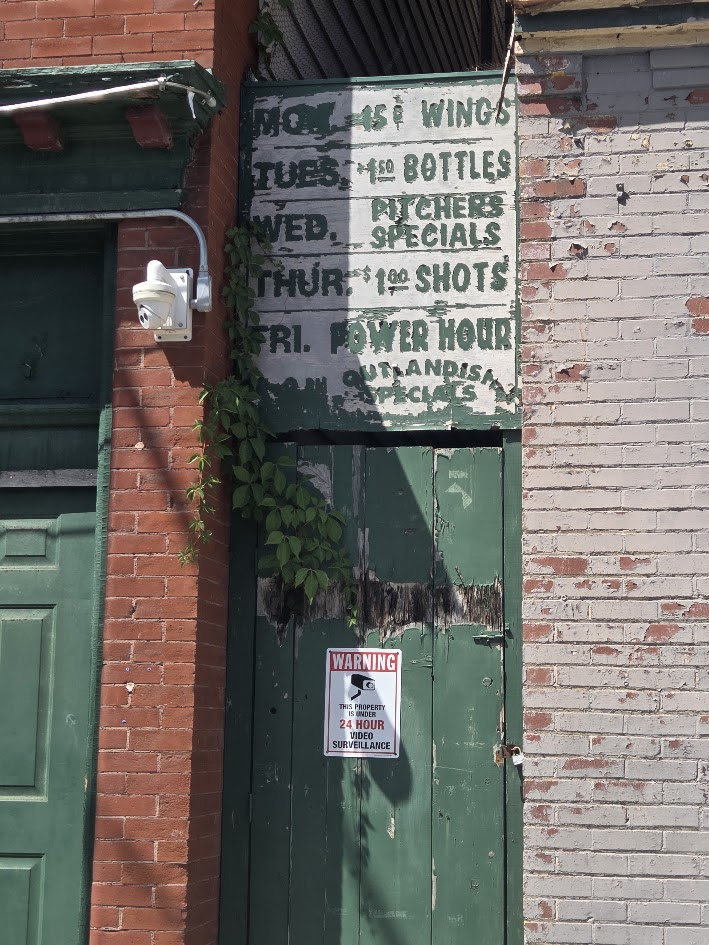
We had parked in front of an abandoned bar and could not resist their “menu”: MON 15 CENT WINGS TUES $1.50 BOTTLES WED PITCHER SPECIALS THUR $1.00 SHOTS FRI POWER HOUR OUTLANDISH SPECIALS
A wonderful courtyard surounded by art studios.
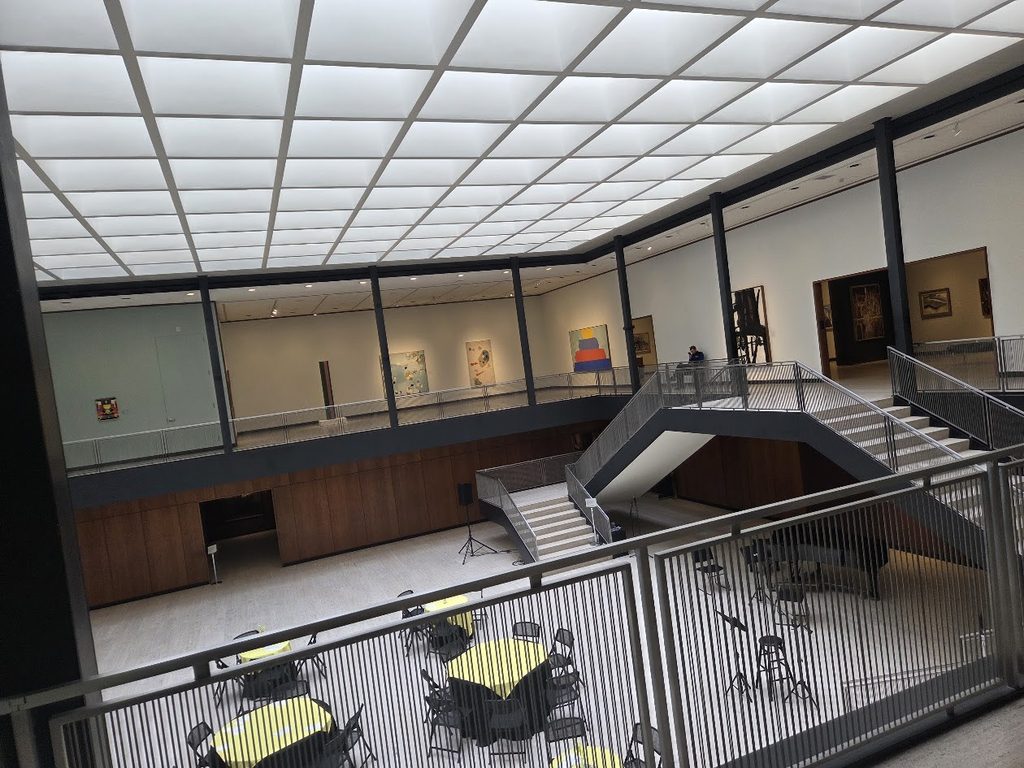
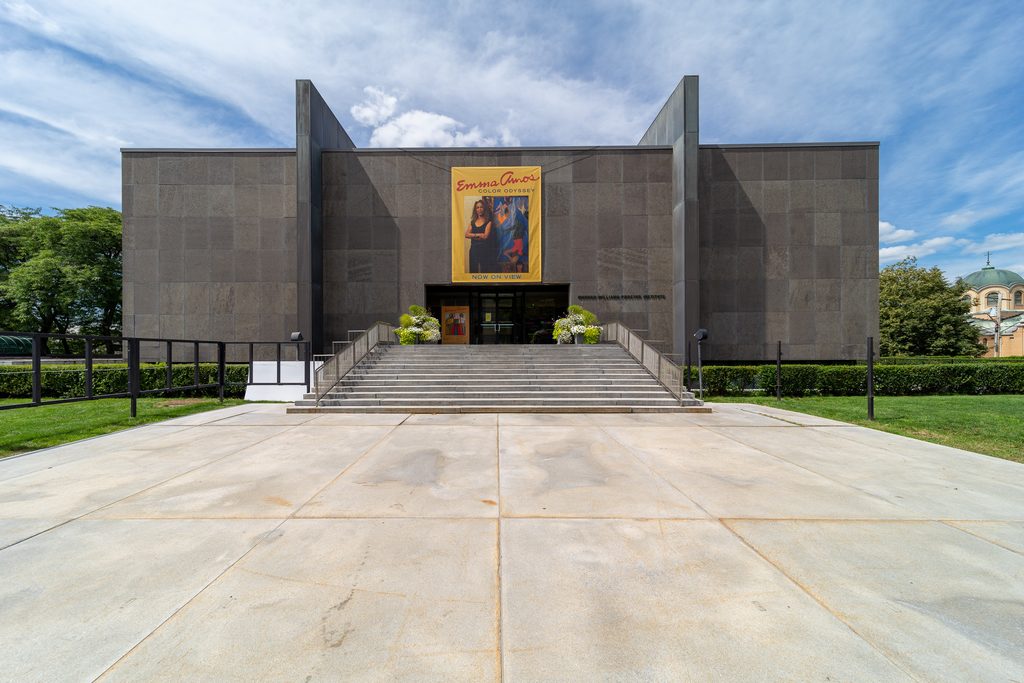
The Munson Museum is most impressive with its modernist design by Philip Johnson. It is surrounded by classical campus of Munson-Pratt, art college.
We stopped by the impressive Oneida History Cener, now housed in a former Christian Science church. With a large gallery, meeting space and archives, it is a wonderful space to learn about history.
It was almost 5 p.m. and our Amtrak train would be arriving soon. A great day with all kinds of sights and stories (Joe has lots of local stories, lore and information) and we were soon back to home.
CREDITS
JUDITH BERDY
All image are copyrighted (c) Roosevelt Island Historical Society unless otherwise indicated THIS PUBLICATION FUNDED BY DISCRETIONARY FUNDS FROM CITY COUNCIL MEMBER JULIE MENIN & ROOSEVELT ISLAND OPERATING CORPORATION PUBLIC PURPOSE FUNDS.
In honor of the 250th anniversary of the signing of the U.S. Declaration of Independence, World Monuments Fund (WMF) invited nominations for Irreplaceable America, a special open call that underscores the vital importance of preserving heritage places that encompass the multifaceted history of the United States.
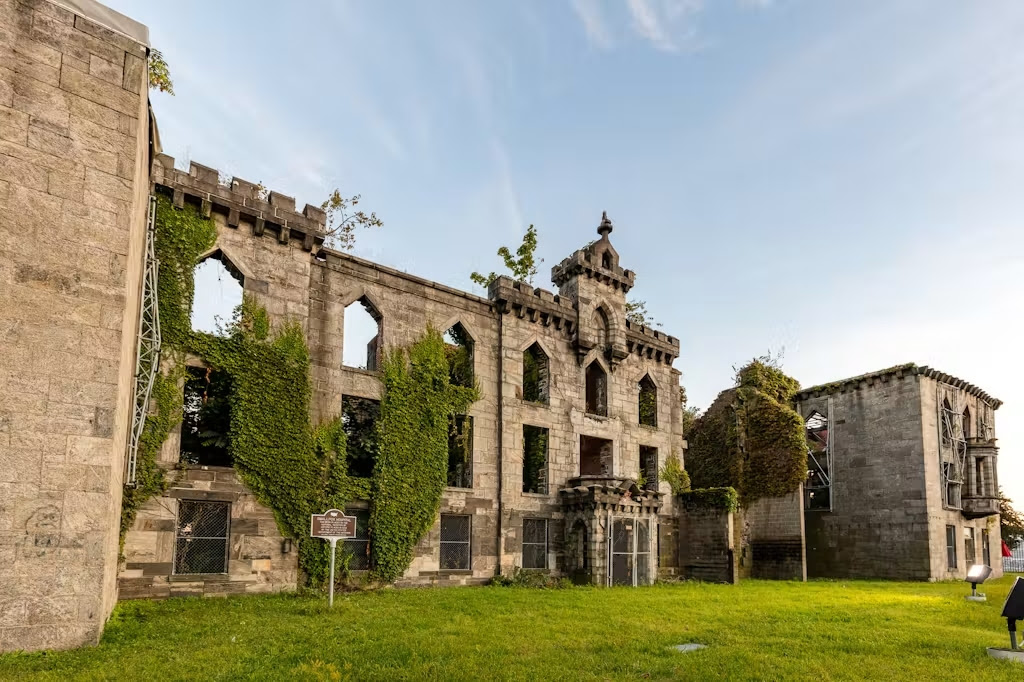
New York’s Smallpox Hospital Ruin, Roosevelt Island, New York
The first U.S. facility built to treat epidemic disease, this nineteenth-century smallpox hospital, designed by architect James Renwick Jr., remains a rare landmark in the history of medicine. After decades of neglect, the structure faces structural instability and requires extensive stabilization to allow public access.
Constructed between 1854 and 1856 in the Gothic Revival style, the Smallpox Hospital was built on what is now Roosevelt Island to isolate contagious patients from dense urban populations. Its interior layout was optimized for ventilation and quarantine, while its granite walls, quarried on-site by prison labor, reflect both the ambitions and complexities of nineteenth-century public health infrastructure. But after decades of disuses, the structure fell into disrepair, leading to the collapse of the roof and interior floors.
Today, the ruin is a focal point of New York’s East River and seen daily from the city’s roadways and institutions such as the United Nations and the World Health Organization. In the aftermath of the COVID-19 pandemic, the site has gained renewed relevance as a place to reflect on epidemic disease, public health resilience, and the protection of vulnerable populations. Stabilization and adaptive reuse is an opportunity to preserve a civic landmark while providing a place of reflection on public health, memory, and urban life on Roosevelt Island’s waterfront.
“We’re thrilled that this remarkable building has been recognized as irreplaceable to the American story. Once a place of suffering, it now stands as a powerful reminder that determined public health can make a disease obsolete. That message feels especially urgent today.” —Stephen Martin, Founder, Friends of the Ruin
What Selected Sites Receive:
National and local media coverage and publicity aligned with the 250th anniversary of the United States Declaration of Independence
Spotlights in WMF’s digital and printed materials
One year of strategic consultation with WMF heritage experts
Opportunities to develop preservation projects in partnership with WMF
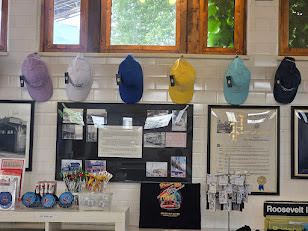
Time for a New Baseball Cap?
Multiple Colors Check them out at the Kiosk
CREDITS
The Ruin Judith Berdy
All image are copyrighted (c) Roosevelt Island Historical Society unless otherwise indicated THIS PUBLICATION FUNDED BY DISCRETIONARY FUNDS FROM CITY COUNCIL MEMBER JULIE MENIN & ROOSEVELT ISLAND OPERATING CORPORATION PUBLIC PURPOSE FUNDS.
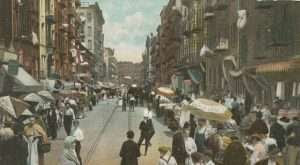
New York’s vibrant immigrant history created a diversity of ethnic enclaves in the city. When over time demographics changed or newcomers assimilated deeper into metropolitan culture, the identity of such areas diminished. Little Poland, Little Syria, Little Africa, Little Vienna, and the French Quarter (Little Paris) were once lively parts of Lower Manhattan but have long since disappeared (Little Italy and Chinatown being notable exceptions).
They contributed to the city’s rich tapestry of food. Many dishes that are considered today as quintessentially American have an immigrant origin.
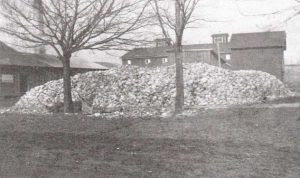
Sauerkraut played a foundational role in Manhattan’s socio-cultural history and New York’s agricultural development. Early settlers in New Netherland packed barrels of fermented cabbage for the long Atlantic crossing as high vitamin content offered protection against scurvy. Massive German immigration made it a dietary staple.
Sauerkraut & Scurvy
Sauerkraut, a German word meaning “sour cabbage,” is the product of a preservation process that is believed to have originated in China. Workers on the Great Wall fermented sliced cabbage in rice wine to survive freezing winters.
During the Mongol conquest, Genghis Khan’s armies not only plundered China but also adopted its fermentation methods, carrying those into Eastern Europe, reaching the Germanic regions and Low Countries in the sixteenth century.
With the expansion of long-haul maritime journeys in that era, Dutch sailors suffered high mortality rates caused by scurvy (the “disease of sailors”). Unable to preserve food, crew members developed vitamin C deficiencies with symptoms of bruising, bleeding gums, and internal hemorrhaging.
The vernacular word for the affliction was scheurbuik (torn belly). Dutch-born physician Johannes Echthius (1515–1576) who spent most of his medical career practicing in Cologne, latinized the word in 1541 to “scorbutus,” which became the medical term for scurvy.
In the seventeenth century, the expanding Dutch Republic sought medical solutions for this fatal scourge. Practicing in Leiden, the center of medical excellence at the time, Paul Barbette wrote Praxis Barbettiana (1669) in which he outlined the importance of diet and hygiene in combating shipboard illnesses.
Fewer casualties occurred when ships carried citrus fruits to feed the crew. Having learned that Dutch seafarers avoided scurvy by consuming fermented cabbage (zuurkool), English explorer Captain James Cook ordered his suspicious crew to eat “foreign” cabbage during his Pacific voyages. It’s said that by intentionally serving the dish to officers only, the ship’s sailors soon demanded their plateful.
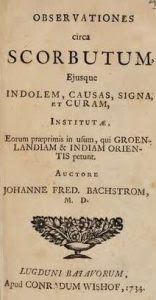
Scottish surgeon James Lind has been credited with providing a cure for scurvy in 1747, but earlier pioneering research in the Netherlands was carried out by a Polish-born physician named Johannes Bachstrom. Working in Leiden, he published Observationes circa scorbutum (Observations on Scurvy) in 1734, suggesting that a lack of fresh fruit and vegetables was the sole cause of scurvy.
Food preservation was a matter of survival for soldiers in the Continental Army too. Rations were small, unpalatable, and lacking nutrients. Meat was salted and flour made into hard biscuits to prevent molding. Scurvy was a continuous threat.
In a 1777 requisition to Congress, General George Washington called for significant supplies of sauerkraut to keep his troops fighting fit during the harsh winter months of the Revolutionary War.
Sauerkraut was far more than a medical remedy. The Dutch developed a taste for zuurkool, treating it as a delicacy. Settlers brought a taste for fermented cabbage to New Amsterdam. Manhattan’s bouweries (farms in old Dutch) were the colony’s food suppliers.
Cabbage was a vital crop cultivated on large patches along the Hudson River. It profoundly influenced New York’s agrarian landscape and established a culinary legacy that includes the passion for coleslaw (koolsla, the cabbage salad now known as coleslaw).
In the early 1800s, long after the British take-over of the colony, descendants of the first settlers (known as Knickerbockers) formed the exclusive “Krout Club” to defy the city’s vogue for French cuisine at the time.
They celebrated their heritage by feasting on traditional fare like zuurkool stamppot en rookworst (sauerkraut mashed with potatoes and smoked sausage). The club flourished in the first decades of the nineteenth century (the final feast took place in 1843).
The mass arrival of German-speaking immigrants further strengthened Manhattan’s connection with sauerkraut.
Rise of Germantown
Until the early nineteenth century, Yorkville was a hamlet in an area of farmland surrounded by country houses. Members of Manhattan’s social elite like Peter Schermerhorn or Jacob Astor owned summer estates on the banks of the East River.
In 1770, shipping magnate Jacob Walton and his wife Mary Cruger, daughter of New York’s 41st Mayor, settled in a newly built riverside residence named Belview Mansion at Horn’s Hook. Because of its strategic position, British cannon fire blew the property to bits during the Revolution.
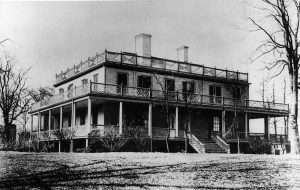
Using its foundations in 1799, Scottish merchant Archibald Gracie (1755-1829) built a federal-style wooden house on the site. John Quincy Adams and Louis Philippe, King of France, were among many famous guests who sat on its porch watching the river flow.
The “pastoral” landscape changed rapidly after 1834 when the New York & Harlem Railroad opened a station at 86th Street, triggering urban expansion.
Gracie Mansion survived the transformation. Ever since Fiorello La Guardia’s occupancy of the house in 1942, it has been the Mayor of New York City’s official residence.
From 1837 onward, the East Side became home to thousands of Irish immigrants who worked on the Croton Aqueduct. Its construction was carried out by disenfranchised laborers who lived in a slum area that would later morph into Yorkville.
Although not in use until 1842, the aqueduct created a crucial network for Manhattan’s residents and industry. It supplied clean water, eradicated waterborne epidemics, and eased fears of fire in the metropolis.
The introduction of the Second and Third Avenue elevated transit lines (“El”) accelerated the urbanization process. Improved means of transport led to an expansion of Yorkville’s manufacturing base.
German immigrant workers soon outnumbered the Irish as many of them found jobs in breweries that spread over several blocks from 90th to 94th Street.
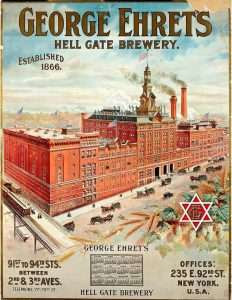
In 1866, George Ehret founded the Hell Gate Brewery in a massive brick clock-tower structure on East 93rd Street (named after the tidal strait in the East River). He had arrived in 1857 during the first wave of mass immigration from the German states.
Founded a year later, the adjacent brewery ran by Jacob Ruppert was just as impressive (his father is believed to have had been the first German malt dealer in the city of New York). Most of their German employees lived on or near to the premises – “Germantown” was born.
Sauerkraut Boulevard
Little Germany (Kleindeutschland) and Germantown were two distinct enclaves in different eras of settlement. The first developed during the 1850s in Manhattan’s Lower East Side. Centered around Tompkins Square Park, it was a close community that for some considerable time kept its culture and customs.
On June 14, 1904, an aging paddle-steamer named General Slocum left the Recreation Pier at the foot of East 3rd Street. She carried 1,331 passengers, mostly women and children belonging to St Mark’s Lutheran Church, on their way to an annual picnic on Long Island.
As the ship passed through Hell Gate a fire alarm rang. Emergency equipment turned out to be in a state of neglect as firehoses did not function and life vests were useless. Passengers jumping in the East River drowned in the treacherous waters.
In the end, 1,021 passengers died in the disaster. The traumatic event precipitated migration away from the district towards uptown Yorkville.
By then, New York City was the world’s third largest German-speaking city after Berlin and Vienna. Yorkville stretched from Third Avenue to the East River, between 79th and 96th Streets.
It became a hub of German life in the 1900s, renowned for its butcheries, bakeries, beer gardens, dance halls, and singing clubs. The district smelled of sauerbraten and schnitzel; its soundscape rang with German dialects, brass band music, and tunes of Wagnerian opera.
Sometimes referred to as “German Broadway,” East 86th Street was Yorkville’s main commercial and cultural artery. It was nicknamed “Sauerkraut Boulevard.”
Locals upheld established traditions such as eating pork and sauerkraut on New Year’s Day (pork for “rooting” forward; cabbage for the blessings of health and wealth). The consumption of home-made sauerkraut gave rise to a unique profession.
The krauthobler or cabbage shredder was an itinerant tradesman who went door-to-door in local tenements with a razor-sharp mandoline slicer to cut cabbages into uniform thin shreds ready for home-made sauerkraut or coleslaw.
The city’s passion for sauerkraut was of prime value to the State’s economy. Operating out of Phelps, a village in Upstate New York’s Finger Lakes region, the Empire State Pickling Company was founded in 1905.
Two years later it introduced the Silver Floss brand of canned and jarred sauerkraut. At its peak in the early 1930s, Silver Floss ran six fermentation factories in this cabbage-rich region. Phelps was lauded as the “Sauerkraut Capital of the World.”
Battle of Yorkville
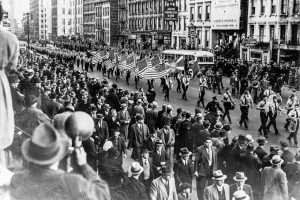
In the 1930s, several anti-fascist protests took place in Yorkville. The neighborhood welcomed German refugees but there were serious tensions too. The German American Bund was a pro-Nazi group led by Munich-born Fritz Julius Kuhn. It held frequent rallies and parades in Yorkville which terrified local Jews, many of whom had relatives in Europe and were aware of the fascist threat.
Former judge and member of Congress Nathan David Perlman (1887-1952) decided to intervene. When the Bund announced plans to stage a march celebrating Adolf Hitler’s forty-ninth birthday, he reached out to Meyer Lansky, a Jewish mobster.
The latter recruited several criminal “enforcers” of the Murder Incorporate group, including Harry “Pep” Strauss, a prolific contract killer, Jacob Drucker whose favorite murder weapon was an ice pick, and others.
On April 20, 1938, an army of Bund supporters wearing brown shirts goose-stepped from Carl Schurz Park to Yorkville’s Casino at 210 East 86th Street.
Posing as American Legion members, fifteen mobsters joined an audience that had gathered in the Casino’s ballroom, facing a stage decorated with Hitler pictures and swastikas, whilst waiting for the Bund’s leader to burst into his “Sieg Heil” drill and start a speech in praise of the Führer.
At that moment, although heavily outnumbered, the infiltrators attacked and created mayhem. The violent incident did not stop the Bund from attracting big crowds. On February 20, 1939, more than 20,000 people attended a Nazi rally at Madison Square Garden.
Months later, Kuhn was accused of embezzling money from the Bund and, eventually, convicted of grand larceny and forgery. With the arrest of several other officials, the Bund fell apart. When the United States entered World War II in December 1941, the government outlawed the organization.
End of an Era
As residents of Kleindeutschland started moving uptown to Yorkville in the early twentieth century, East European immigrants followed the exodus with Czechs clustering around East 72nd Street (Bohemian Broadway) and Hungarians settling at East 79th Street (Goulash Boulevard).
Manhattan’s first Little Hungary had been situated between Houston and East 10th Streets. Nicknamed “Goulash Row,” it had the Little Hungary restaurant as a hot spot.
Founded in 1888 by Max Schwartz at 255-263 East Houston Street, city guides referred to the offbeat eatery as a “widely known bohemian resort,” where customers enjoyed goulash and fine wines from the Tokaj region in the “midst of casks and barrels.”
Uptown New Yorkers flocked to the district to see downtown “foreign” life, enjoy the “atmosphere of Budapest,” and hear Romani bands perform fiery renditions of Franz Liszt’s “Hungarian Rhapsodies.”
Theodore Roosevelt was a friend of Max Schwartz and often dined at the restaurant during his time as New York City Police Commissioner. In February 1905, shortly after his first presidential election, he attended a dinner in his honor hosted by the Hungarian Republican Club.
When East European residents started moving uptown to Yorkville, Little Hungary stayed at its original location. It did not survive Prohibition, closing soon after its introduction in 1920.
Following anti-German sentiment in the First World War, Yorkville started to show signs of decline. It faced intense government scrutiny and populist harassment.
To avoid persecution, locals began hiding overt displays of heritage, renaming businesses, and abandoning traditions. Restaurants changed their menus, serving “Liberty Cabbage” instead of sauerkraut.
The final demise of Sauerkraut Broadway happened in the mid-1950s with the removal of the elevated Third Avenue train tracks. Property prices shot up, real estate dealers moved in, and the area lost its identity and character. Gentrification dissolved the historical German, Czech, and Hungarian enclaves.
A few old-world establishments resisted urban change and stayed in business. Founded in 1902 by Bavarian immigrants at 1670 First Avenue, Glaser’s Bakery was famed amongst clients for its black-and-white cookies (a New York classic), fudgy brownies, and traditional German pastries. Boasting a vintage “Old New York” interior of wood and glass display cases, tin ceilings, and mosaic floor tiles, the bake shop finally stopped trading in 2018.
The stores have vanished and memories are fading, but the ghost of Sauerkraut Boulevard lives on, its legacy linked to fast food. The pairing of “dachshund” pork bangers with fermented cabbage originated in Central Europe.
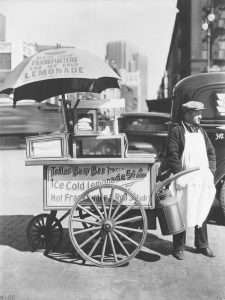
Immigrant vendors made traditional German “Wursts” (sausages) popular across New York City by selling them out of carts in milk rolls topped up with sauerkraut.
The “classic” hot dog had arrived. Sauerkraut remains a defining staple of street food and Jewish delicatessen (recall the Reuben sandwich) in the metropolis.
Time for a New Baseball Cap?
Multiple Colors Check them out at the Kiosk
CREDITS
NEW YORK ALMANACK
Illustrations, from above: October Beer Fest, East 86st Street in the German enclave of Manhattan; Cabbage yard of Ward Moulton Cannery in Clay, NY; Johannes Bachstrom, Observationes circa Scorbutum (Observations on Scurvy), Leiden 1734; Late nineteenth century photograph of Gracie Mansion; Calendar poster for George Ehret’s Hell Gate Brewery, founded in 1866; Little Germany in Manhattan in the late 19th century; German American Bund parade in East 86th Street, 1938 (Library of Congress); 1890 U.S. Census map titled “Density of Distribution of the Natives of the Germanic Nations”; and a New York hot dog stand, ca. 1900.
All image are copyrighted (c) Roosevelt Island Historical Society unless otherwise indicated THIS PUBLICATION FUNDED BY DISCRETIONARY FUNDS FROM CITY COUNCIL MEMBER JULIE MENIN & ROOSEVELT ISLAND OPERATING CORPORATION PUBLIC PURPOSE FUNDS.
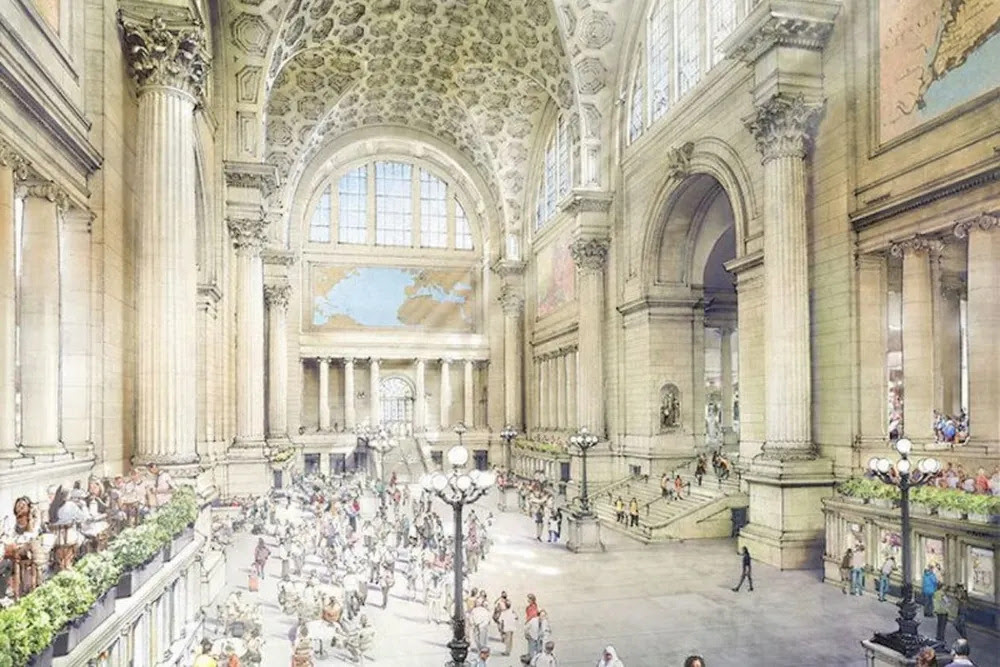
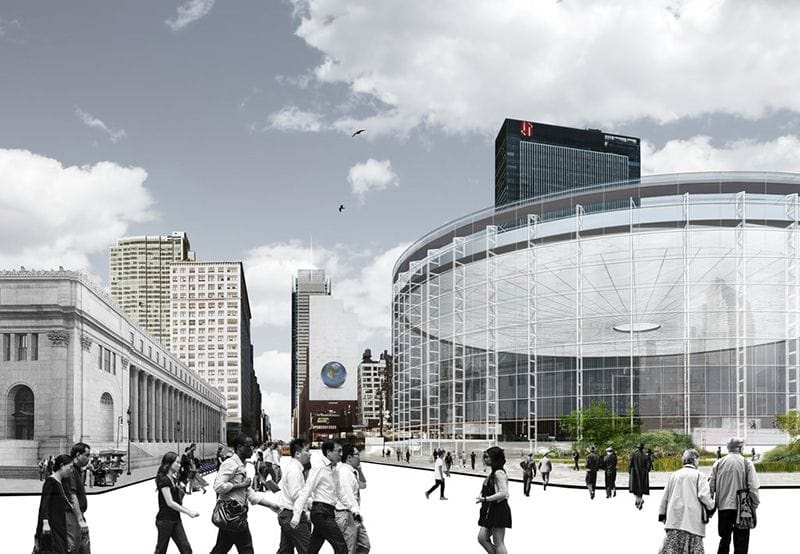
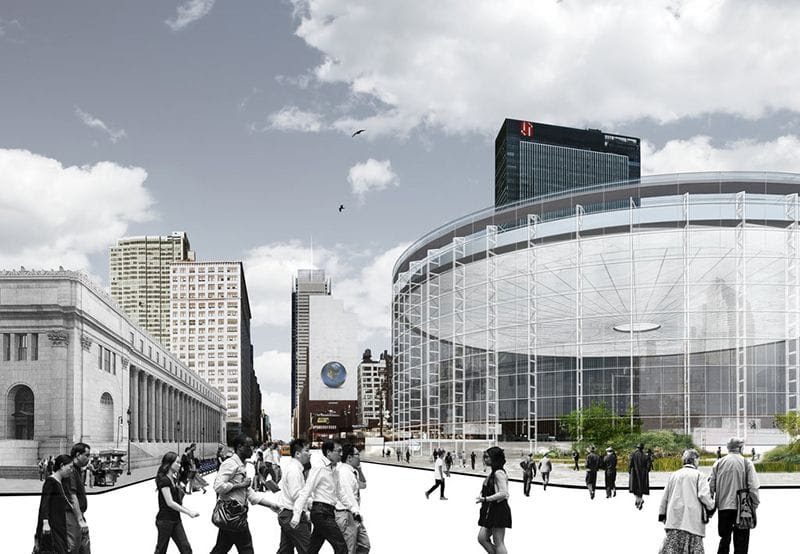
Explore unbuilt Penn Station redesigns, from a futuristic burial ground to a re-imagining of the original Beaux-Arts structure.
Rendering by Jeff Stikeman for Rebuild Penn Station
June 12 20265Share
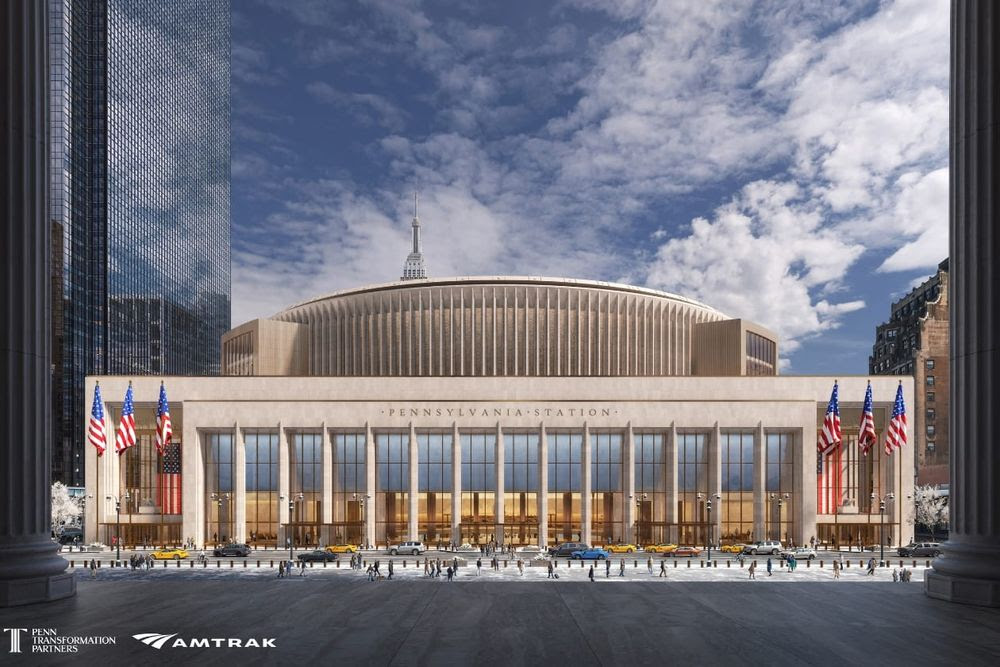
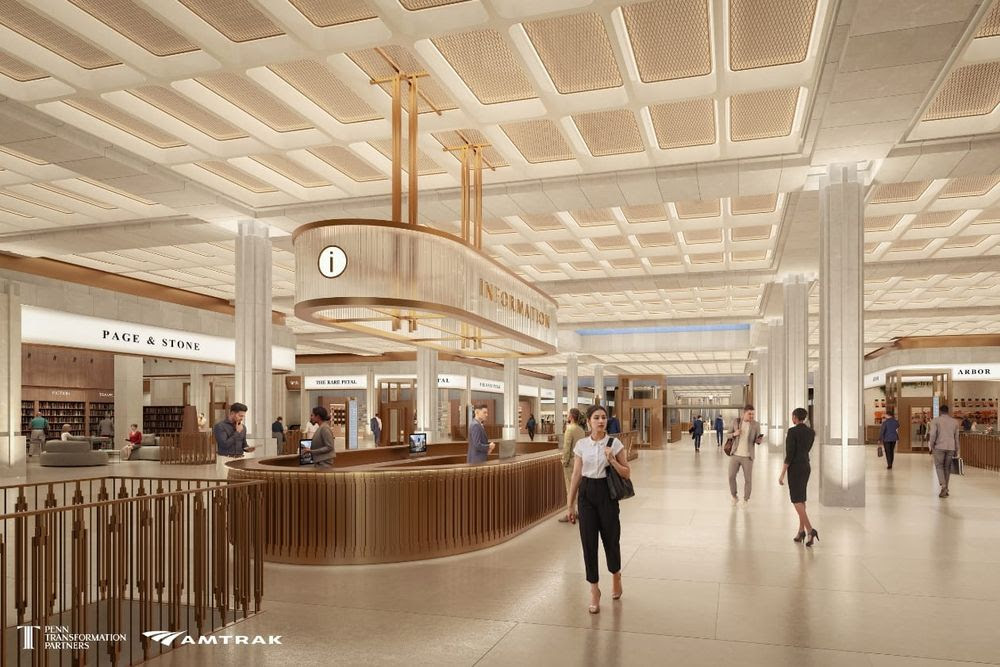
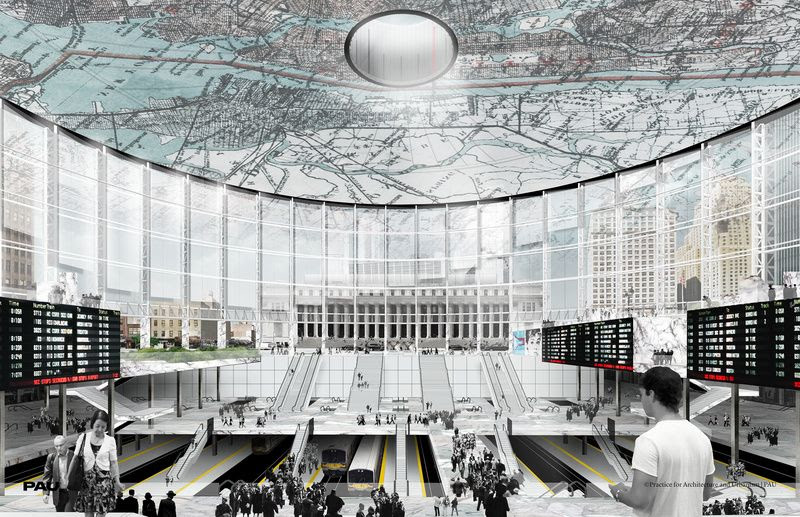
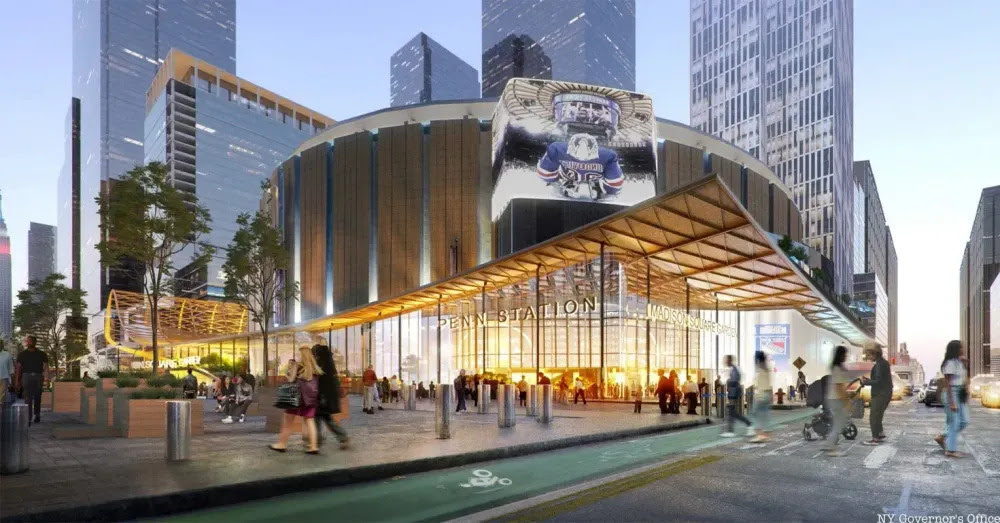
Ever since the original Penn Station was demolished in the 1960s, New Yorkers have longed a station that recaptures the beauty and grandeur that was lost. The latest plans from Penn Transformation Partners (PTP), a joint venture between master developers Halmar and Skanska, seek to deliver on those ideals with a revitalized station designed by Practice for Architecture and Urbanism (PAU). Backed by the U.S. Department of Transportation and Special Advisor to the Amtrak Board Andy Byford, this plan promises to make the “station safer, more spacious, and better connected, while elevating it into a modern civic landmark.” But it isn’t the first proposal to make such promises.
Rendering Courtesy of Practice for Architecture and Urbanism (PAU)
We’ve been following the revitalization and renovations of Penn Station for more than ten years, ever since Madison Square Garden’s permit expired in 2013 and ideas for what could possibly take its place began to swirl. As we contemplate the most recent renderings of what Penn Station may become, let’s take a look back at proposals that never came to fruition, from a re-imagined version of McKim, Mead & White’s design and a futuristic burial ground to an above-ground station that uses the bones of Madison Square Garden.
A FUTURISTIC CEMETERY
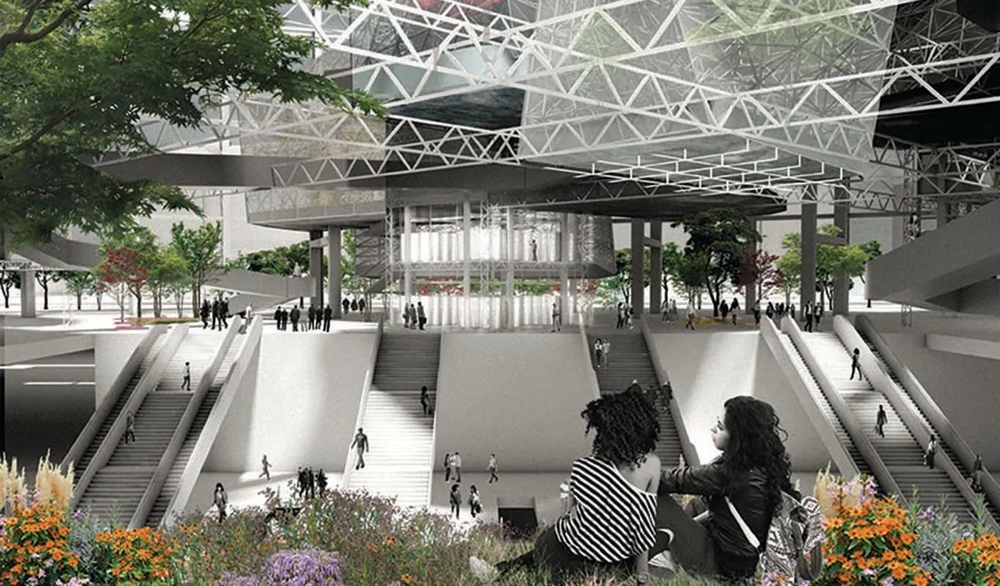
Madison Square Garden, reimagined as a cemetery and public space. All renderings by Mai Abusalih, Eric Giragosian, Min He.
One of the most unique takes on the future of Penn Station came from Columbia University’s Graduate School of Architecture, Planning and Preservation and the University’s DeathLAB. Envisioned by students Mai Abusalih, Eric Giragosian, and Min He in the summer of 2017, plans for #RIP: Encoding Memory envisioned an unconventional green space that would replace Madison Square Garden. This park-like setting would serve as a burial ground for both human remains and digital memories. The bodies of lost loved ones would go through promession, a form of “green cremation” and be used as fertilizer for garden spaces enjoyed by the living. Data servers spread throughout would help to control the garden climate and hold digital memories.
A Re-imagining of the Original Penn Station
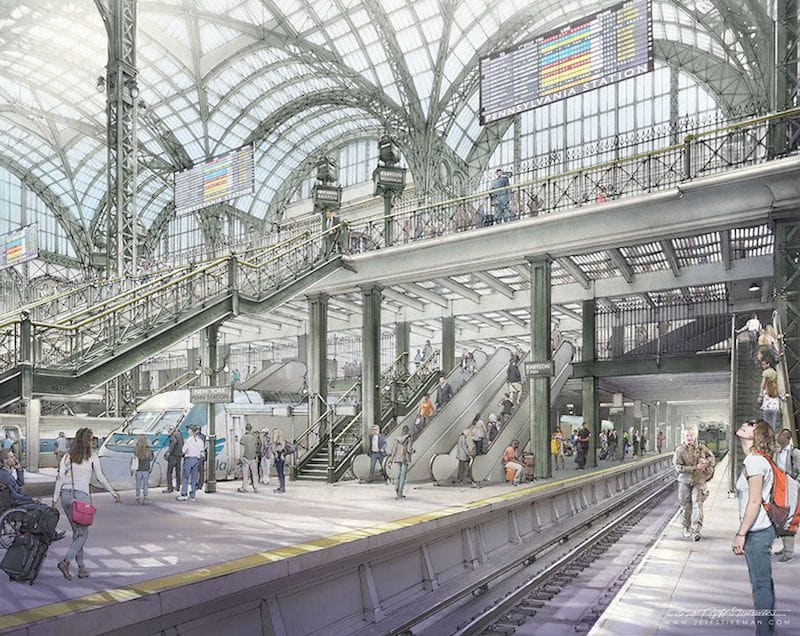
Rendering by Jeff Stikeman, Penn Design Modifications by Richard Cameron
In 2017, Rebuild Penn Station, a project of the National Civic Art Society, a 501(c)(3) nonprofit organization, launched an ad campaign advocating for the reconstruction of McKim, Mead & White’s original 1910 design. The stunning renderings that were part of the campaign show modern commuters and trains within the Beaux-Arts marble hall and light-filled concourse of the early 20th-century station. The organization estimated that it would take $3 billion to $3.5 billion to bring this vision to life and of course, Madison Square Garden would have to relocate, something that is not unprecedented in the venue’s history.
A Glass Ghost of Madison Square Garden
Rendering by Vishaan Chakrabarti/PAU Studios
Before Practice for Architecture and Urbanism (PAU) came up with the current design for Penn Station’s next chapter, founder Vishaan Chakrabarti unveiled a different vision. Shared with the New York Times in 2016, this initial idea included repurposing the steel skeleton of Madison Square Garden to create a glass atrium. By replacing the venue’s concrete cladding with glass, light would fill the station, all the way down to the exposed tracks. The see-through facade would also unlock a view of the Farley Post Office Building across 8th Avenue. In Chakrabarti’s design, a few pieces of the original station, including original staircases, could be preserved.
A Circular Public Park
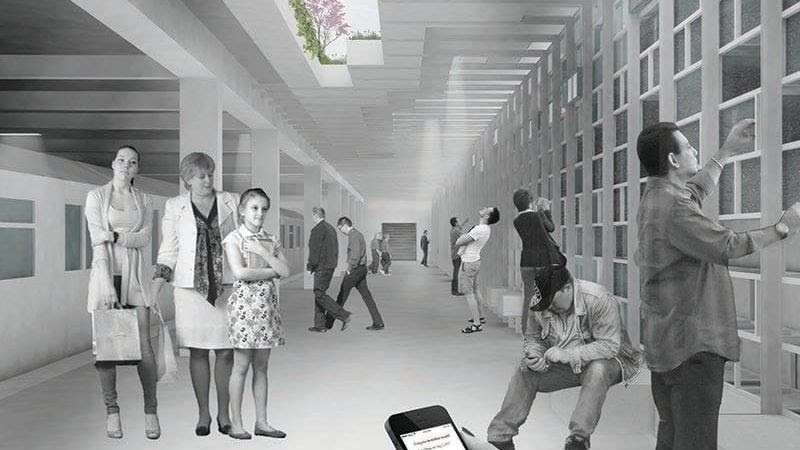
Rendering for a new Penn Station by Skidmore, Owings & Merrill (SOM)
In 2013, the Municipal Art Society of New York (MAS) challenged four preeminent New York City architecture firms to re-imagine Penn Station. Diller Scofidio + Renfro, H3 Hardy Collaboration Architecture, SHoP Architects, and Skidmore, Owings & Merrill (SOM) all created unique proposals.
The futuristic rendering above shows the track level of SOM’s design. This plan would have expanded Penn Station’s footprint by two additional blocks to accommodate high-speed rail lines and more local commuter service. Again, Madison Square Garden would have to be relocated, and in its place would be a central glass enclosed atrium, surrounded by a circular public park four times the size of Bryant Park.
The Governors’ Plans
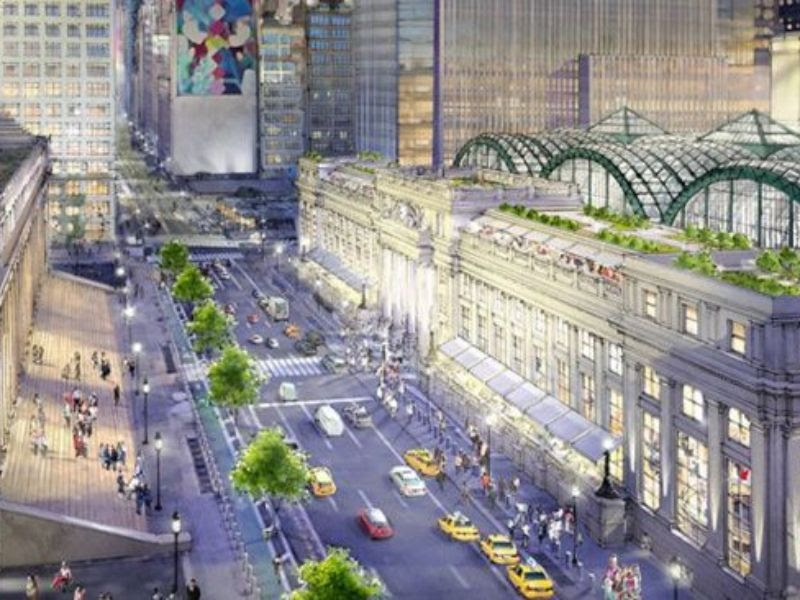
2023 Rendering Courtesy of the Governor’s Office, Design by WSP and FXCollaborative, with noted architect John McAslan
Before the U.S. Department of Transportation took control of Penn Station’s revitalization in 2025, multiple proposals were put forward by New York State under both Governor Cuomo and Governor Hochul. Along with changes to the train station, these plans often included development plans for the surrounding neighborhood. Untapped New York took up the charge of advocating for multiple landmark-worthy structures, including the original Penn Station power house, that could have been at risk of demolition under Cuomo’s Empire Station Complex proposal. These development plans were largely cut under Governor Hochul.
Parts of Cuomo’s plan that did come to fruition include the conversion of the Farley Post Office building into Moynihan Train Hall in 2021, the new entrances along 7th Avenue, and the renovated LIRR concourse, which Untapped New York Insiders got to tour with architects from SOM.
Gouveneur at the turn of the 20th Century and today as supportive housing
“These works are not only visually stunning, they’re a testament to the belief that art can uplift, inspire, and heal,” Tuttle says. “Through this exhibition, we honor a moment in New York’s history when public investment in the arts transformed civic spaces and enriched the lives of everyday New Yorkers—including the city’s youngest and most vulnerable patients.”“Another Wonderland: Abram Champanier’s Alice Mural” will be on view at the Museum of the City of New York from June 6 through September.
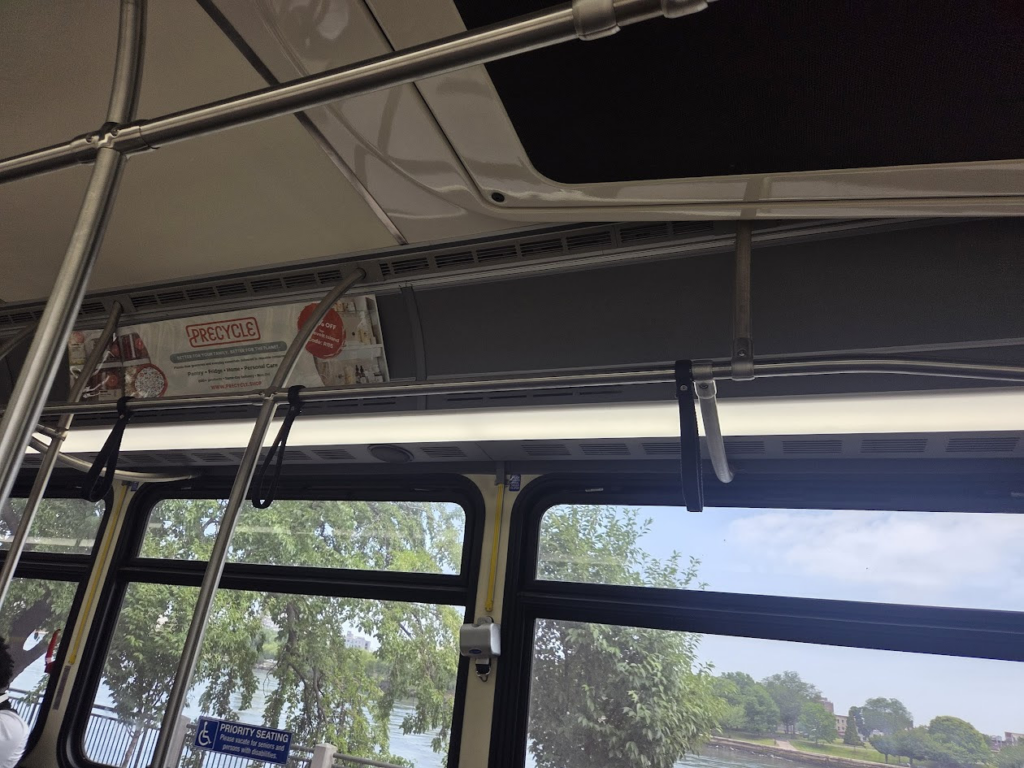
LET’S PUT MAPS ON BUSES
THE RED BUSES HAVE MOSTLY EMPTY PLACES WHERE WE CAN PUT EASY TO READ ISLAND MAPS
CREDITS
UNTAPPED NEW YORK Judith Berdy
All image are copyrighted (c) Roosevelt Island Historical Society unless otherwise indicated THIS PUBLICATION FUNDED BY DISCRETIONARY FUNDS FROM CITY COUNCIL MEMBER JULIE MENIN & ROOSEVELT ISLAND OPERATING CORPORATION PUBLIC PURPOSE FUNDS.
NEW COMMEMORATIVE PLAQUES FOR BOTH TRAM STATIONS DONATED BY POMA
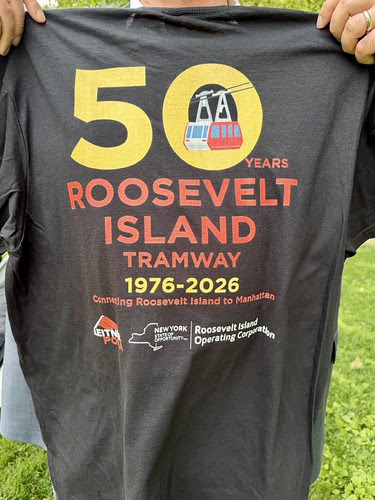
FREE TEES WERE GIVEN OUT BY POMA AND SUPPLIES ARE GONE.
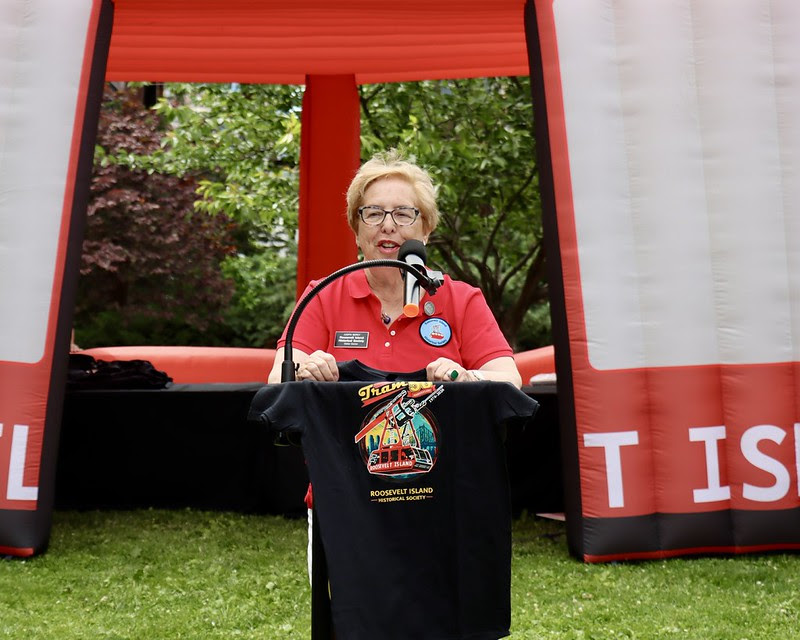
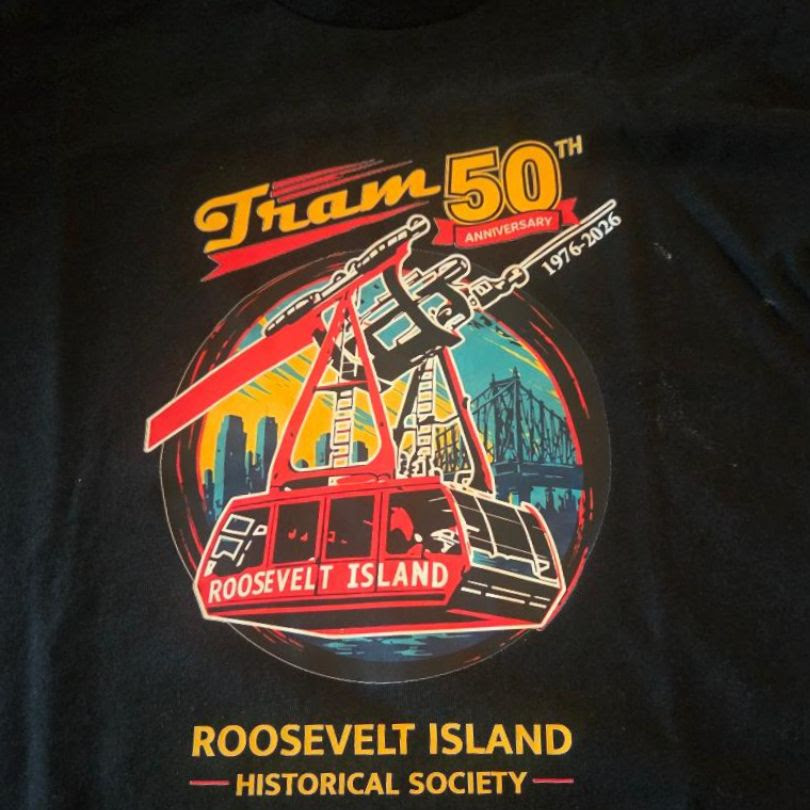
RIHS 50th ANNIVERSARY TEES ARE AVAILABLE AT THE KIOSK FOR $20-
GET YOUR RIHS EXCLUSIVE TRAM 50 TEE SHIRT IN ADULT SIZES AT THE RIHS KIOSK $20-
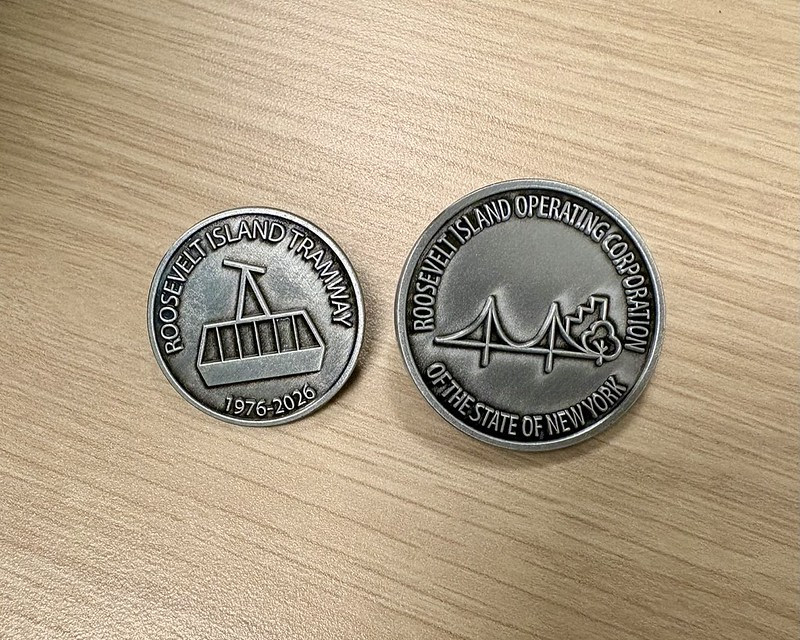
REPLICAS OF ORIGINAL COINS AND PINS WERE DISTRIBUTED
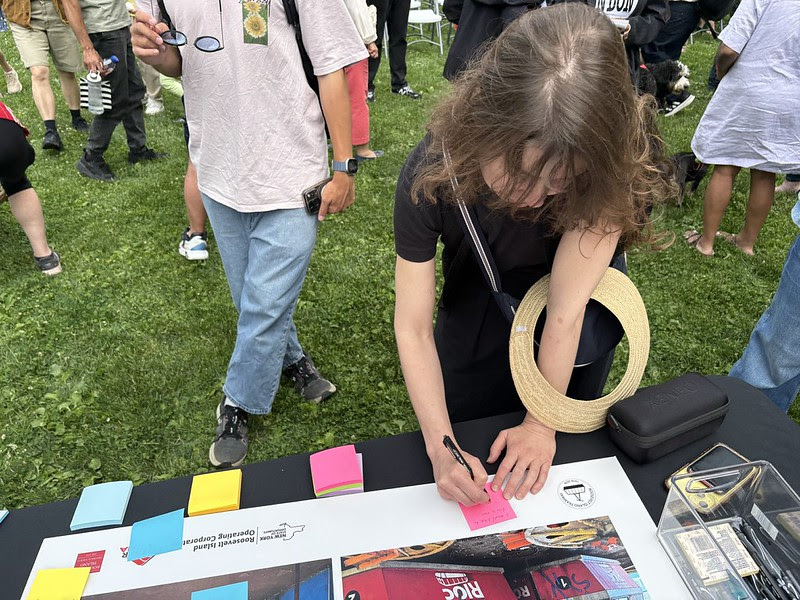
ADDING SUGGESTIONS FOR USES FOR ORIGINAL TRAM CABINS
CREDITS
IRIS CHAN-RIOC
JUDITH BERDY
All image are copyrighted (c) Roosevelt Island Historical Society unless otherwise indicated THIS PUBLICATION FUNDED BY DISCRETIONARY FUNDS FROM CITY COUNCIL MEMBER JULIE MENIN & ROOSEVELT ISLAND OPERATING CORPORATION PUBLIC PURPOSE FUNDS.
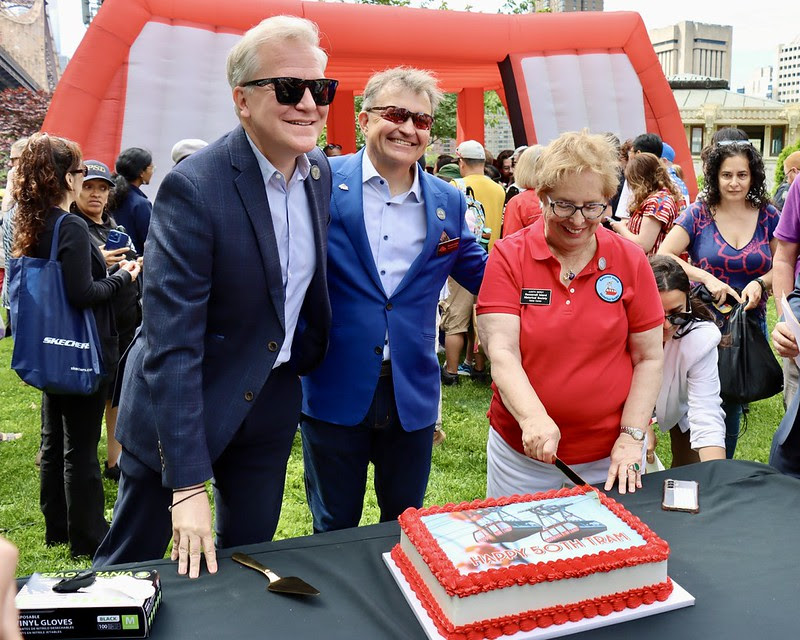
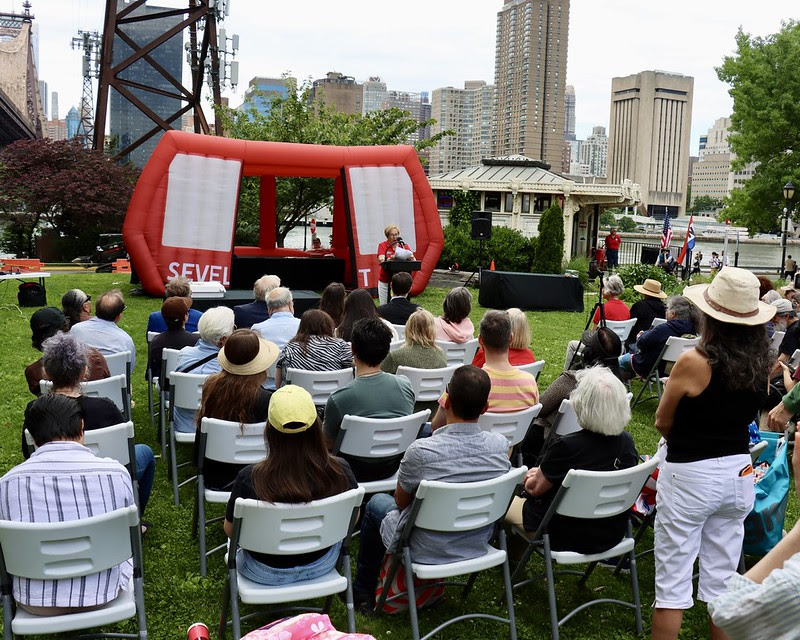
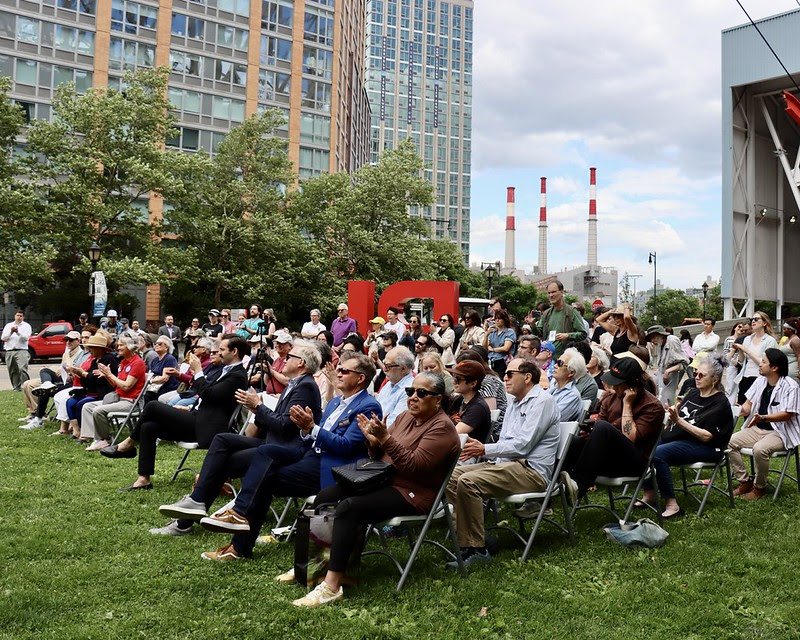
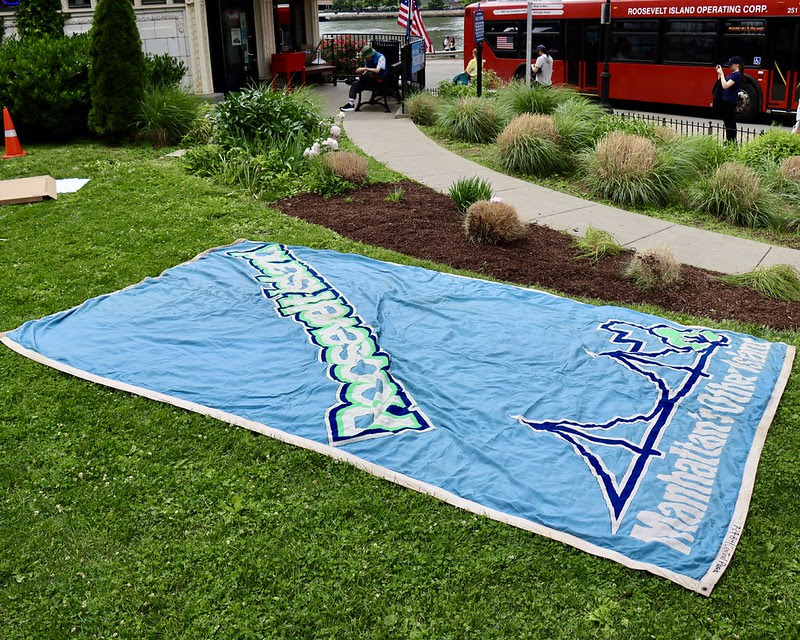
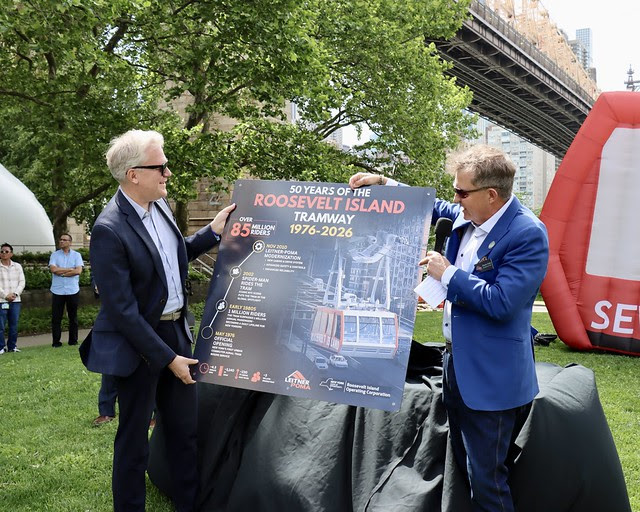
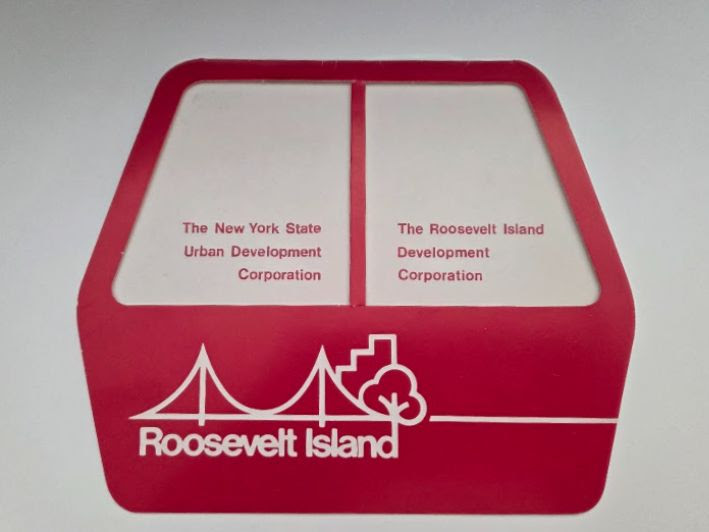
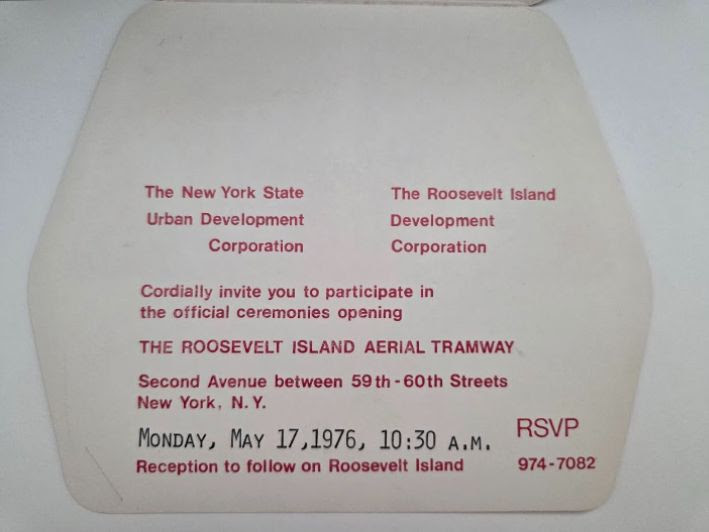
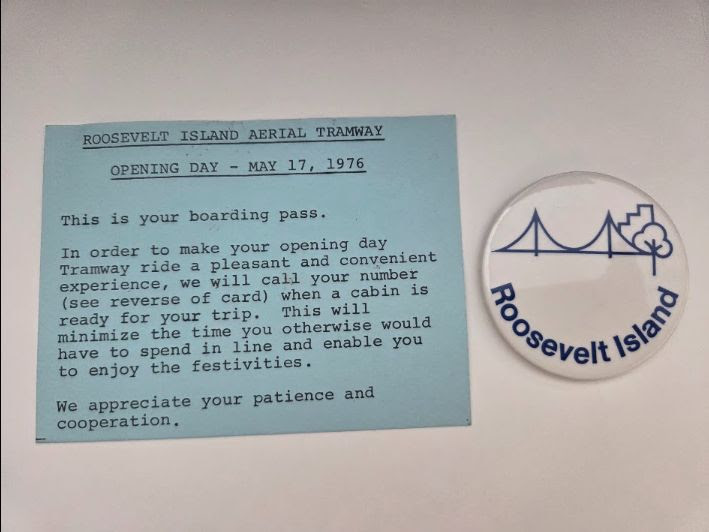
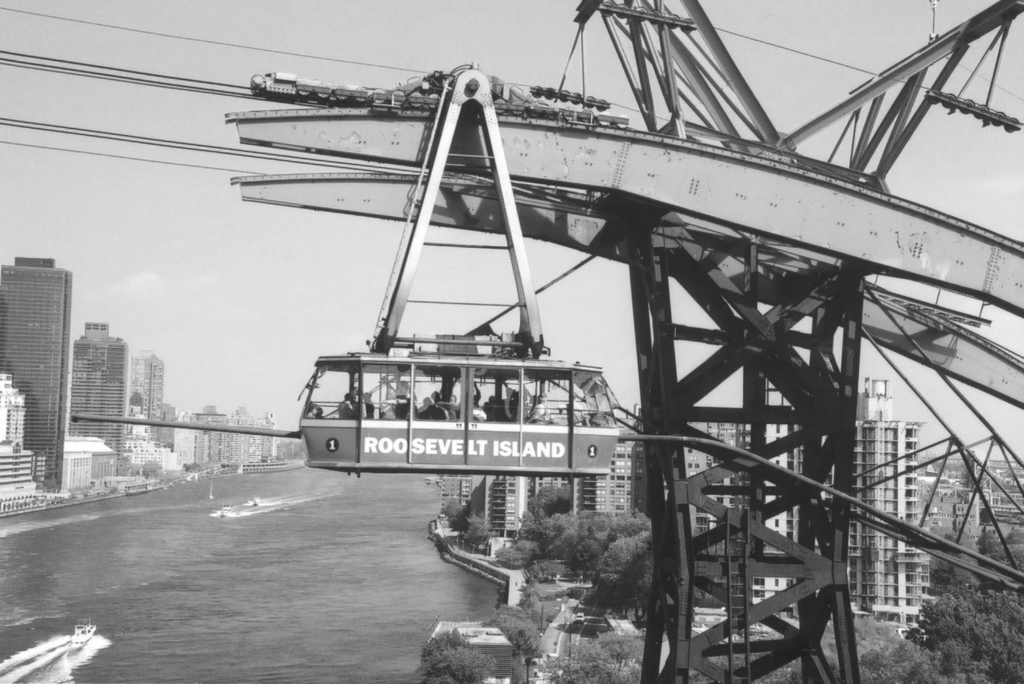
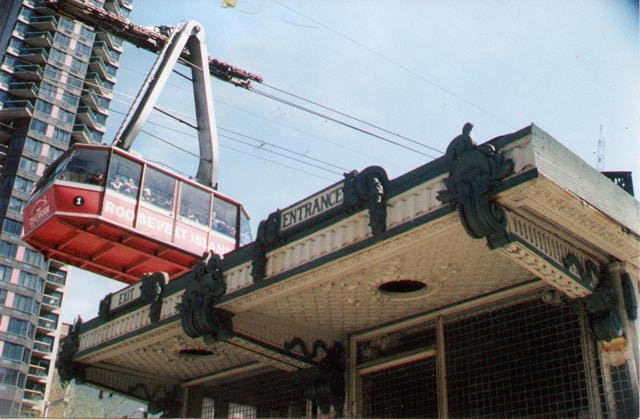
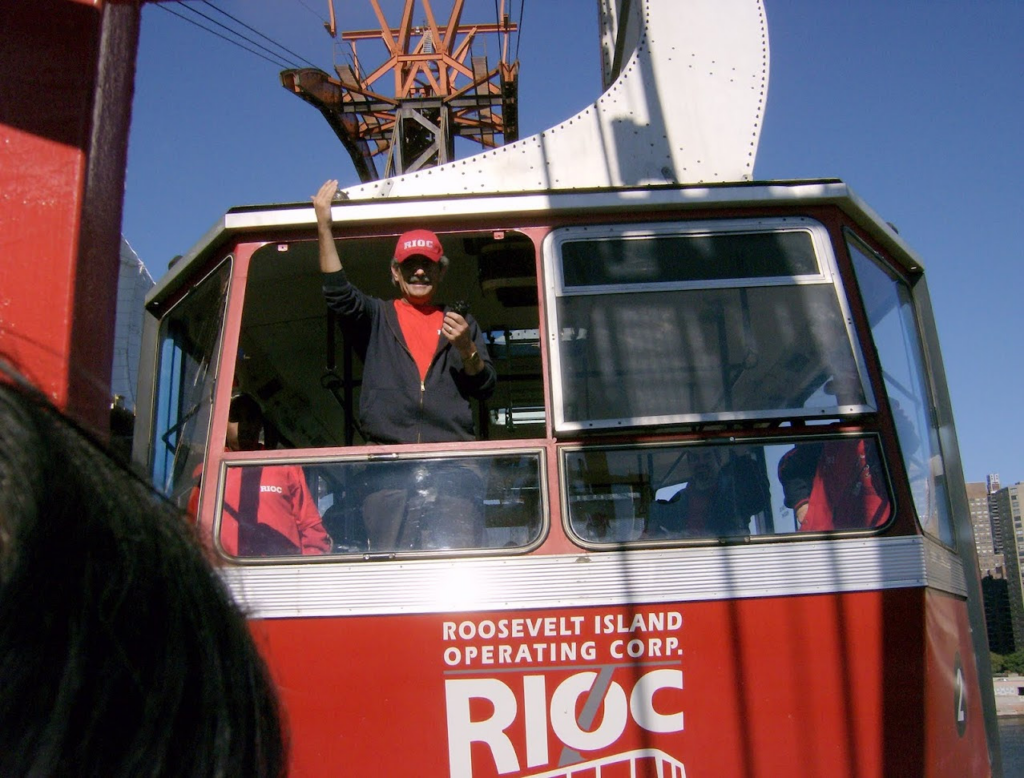
CELEBRATE THE TRAM’S 50TH BIRTHDAY THURSDAY, MAY 28TH TRAM PLAZA 3 P.M. ALL ARE WELCOME!!
SEE 1976 INVITATION BELOW
This is a text block. You can use it to add text to your template.
JOIN US ON THURSDAY, MAY 28TH AT 3 P.M. TO CELEBRATE THE TRAM’S 50TH BIRTHDAY PARTY
The invitation with the date stamped in, just in case.
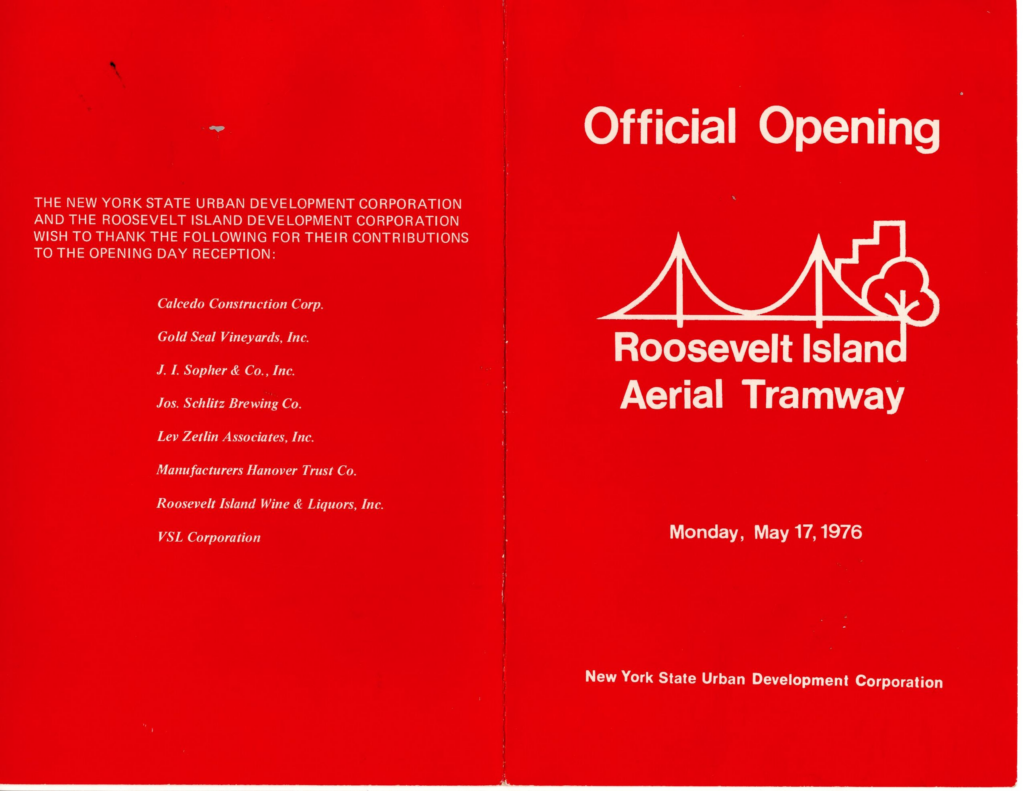
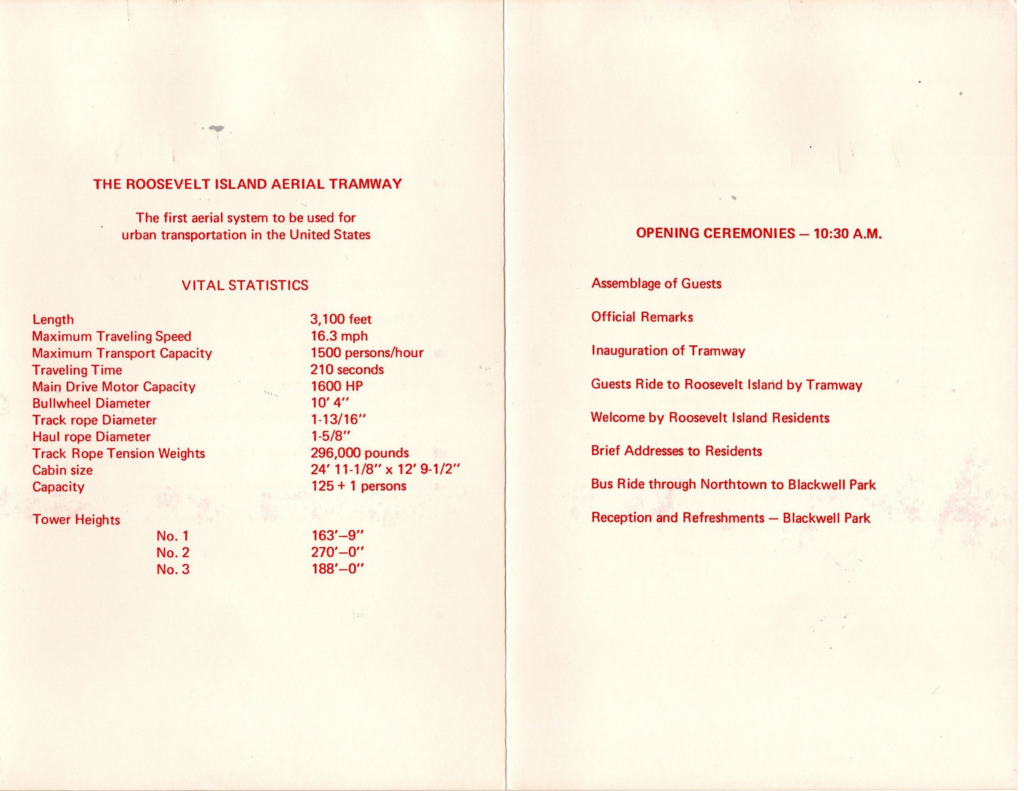
The Program for the Opening Ceremony
A Boarding Pass for Opening Day
I has watched Welfare Island for many years since I was a student working at the Goldwater Hospital in 1967. When I heard the Tram was opening, I walked over from my home at 65th Street on the evening of March 17th, 1967 and took my first ride that day.
FLOATING OVER SECOND AVENUE PAST THE KIOSK STILL ON SECOND AVENUE
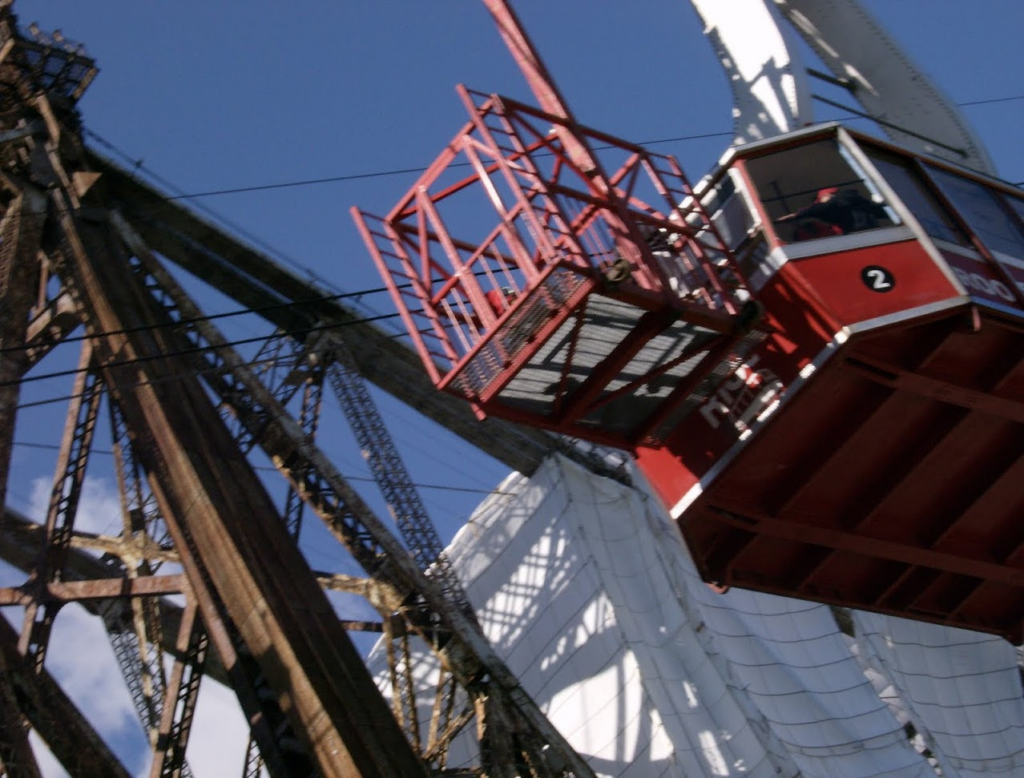
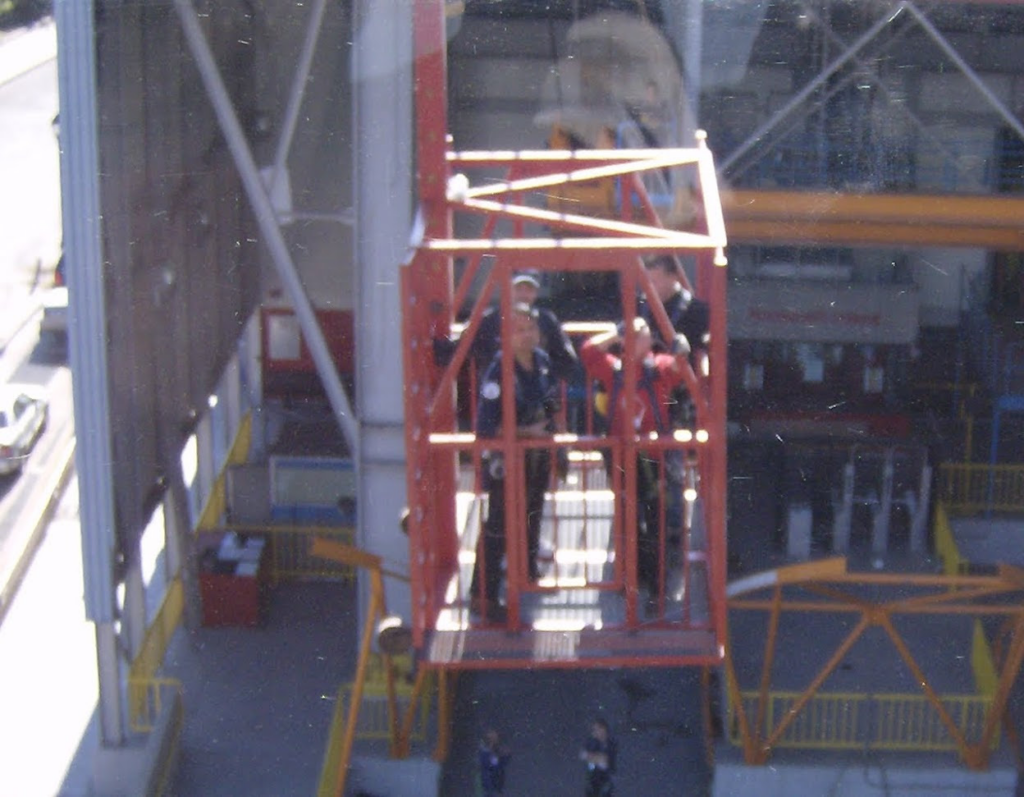
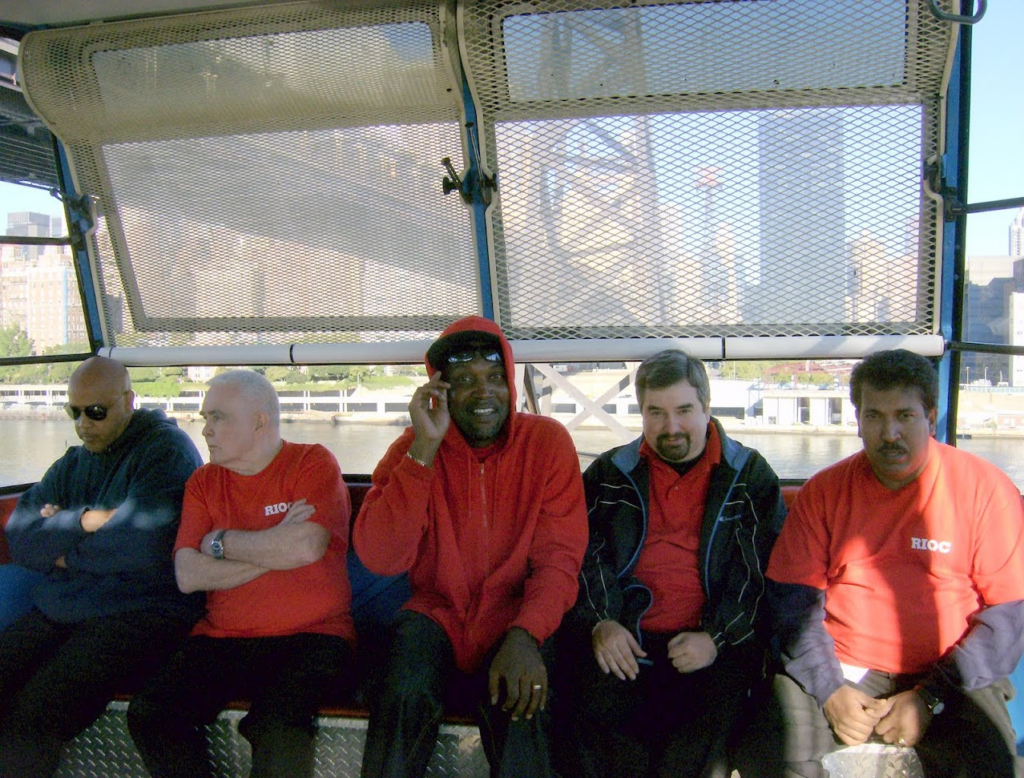
ANNUAL RESCUE DRILLS
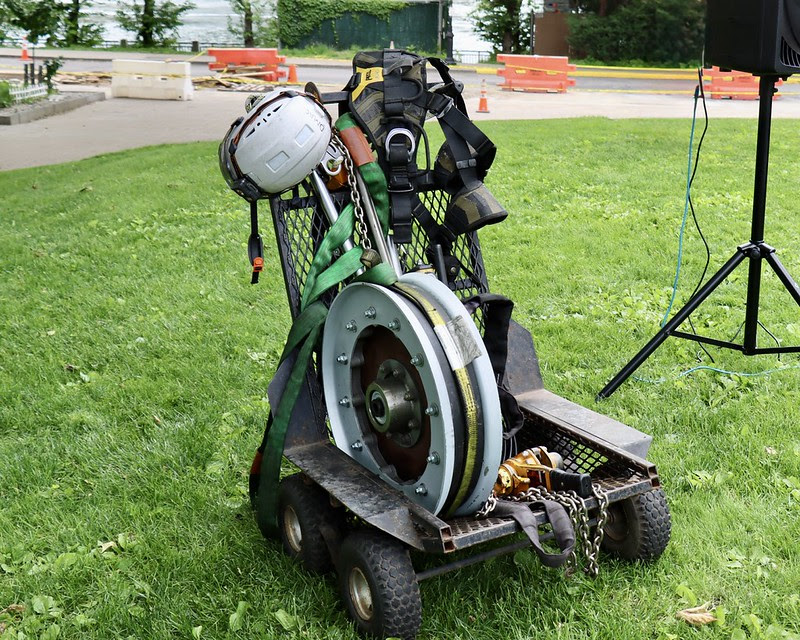
TAKE THE WINDOW OUT AND GET INTO THE RESCUE CABIN
WANT TO DO THIS CLIMB OUT THE WINDOW TO THE RESCUE CABIN?
ONLY ONCE THE RESCUE CABINS WERE USED IN APRIL OF 2006, WHEN THE CABINS WERE STUCK OVER THE RIVER. IT TOOK HOURS TO RESCUE ALL PASSEGERS SAFELY.,
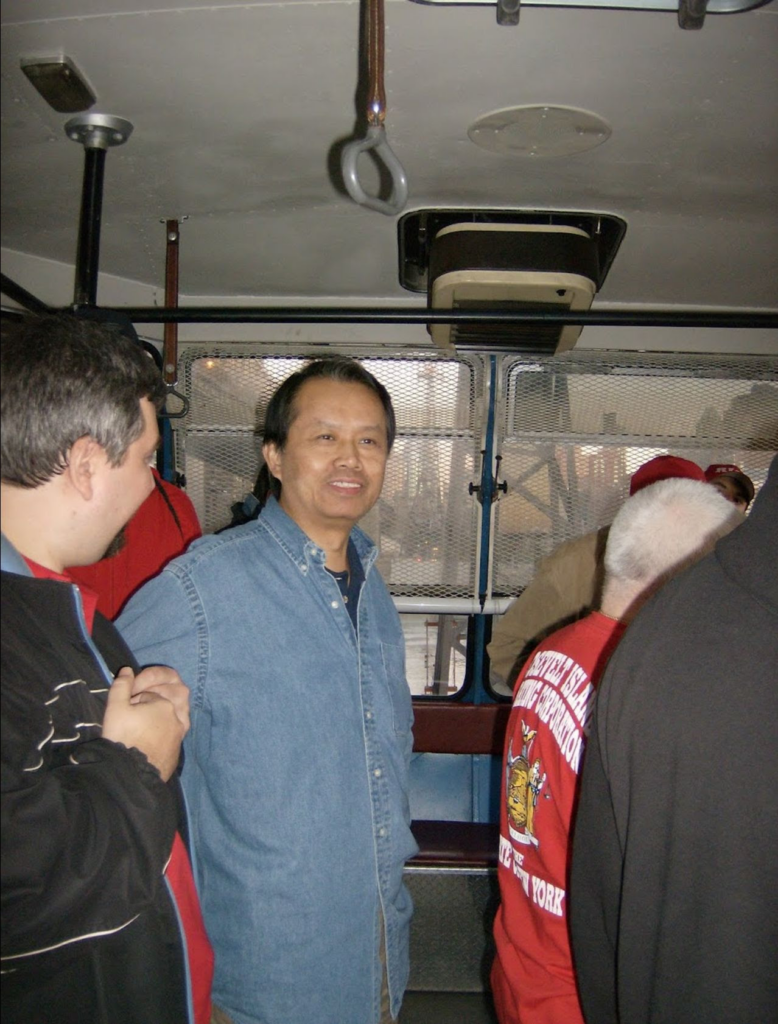
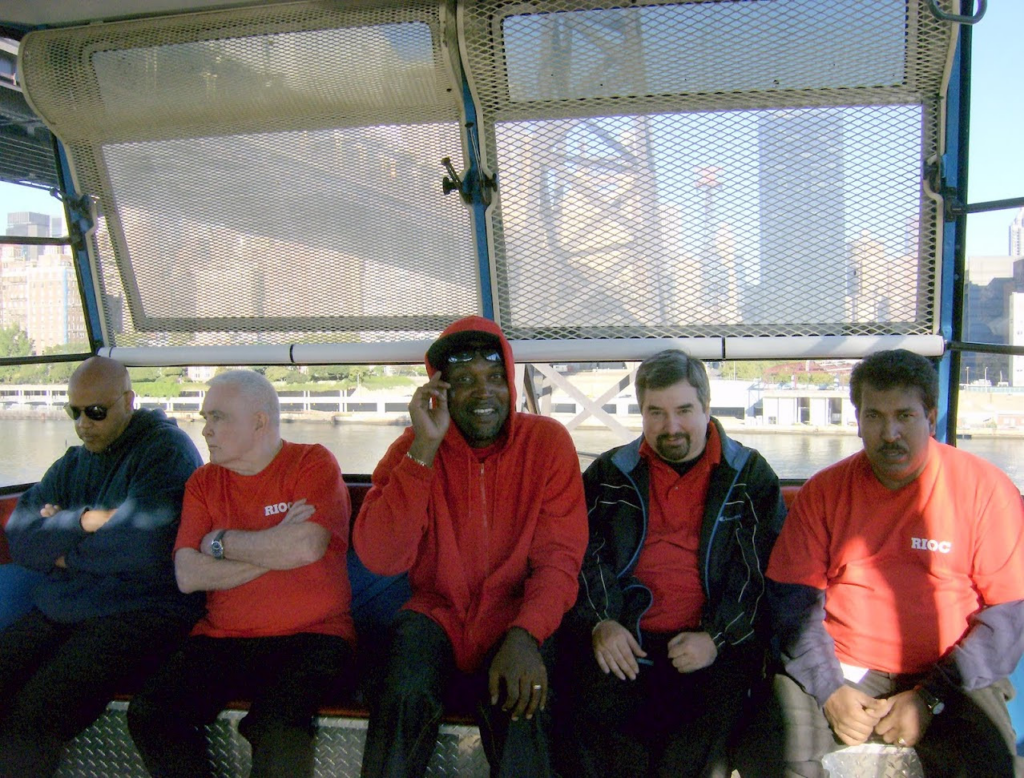
EVERYONE HAD TO PARTICIPATE ON A SUNDAY MORNING
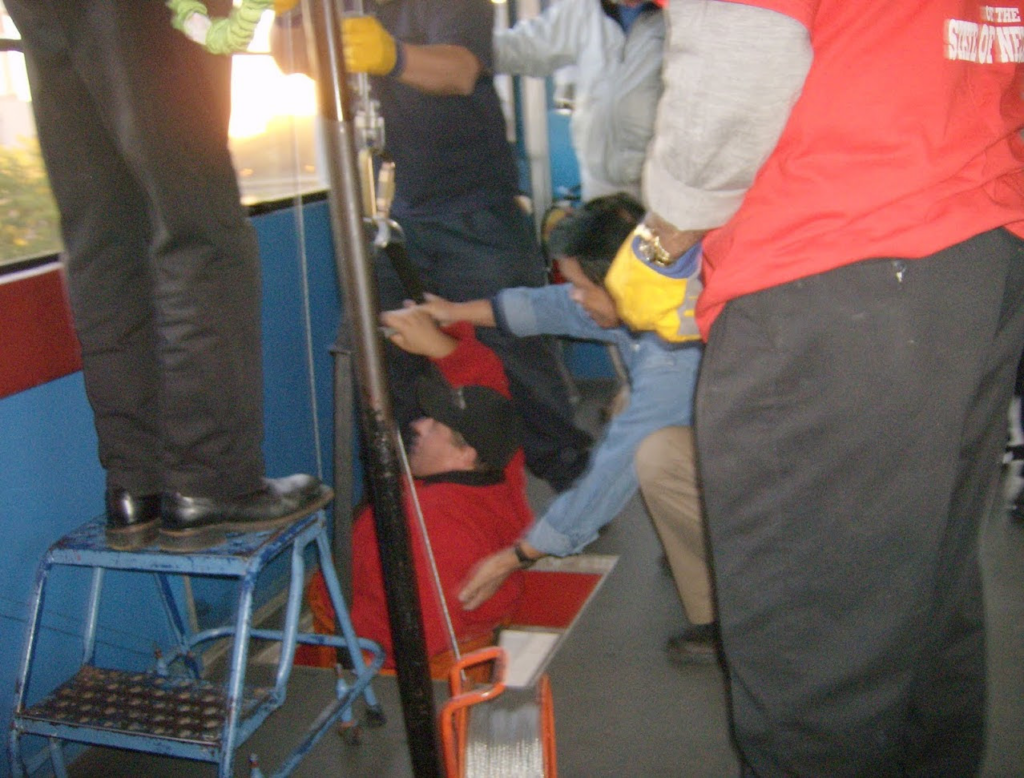
STAFF WAITING FOR THEIR TURN TO GET OUT THE FLOOR HATCH
DOWN YOU GO THRU THE FLOOR, WHEN THE CABIN WAS OVER LAND
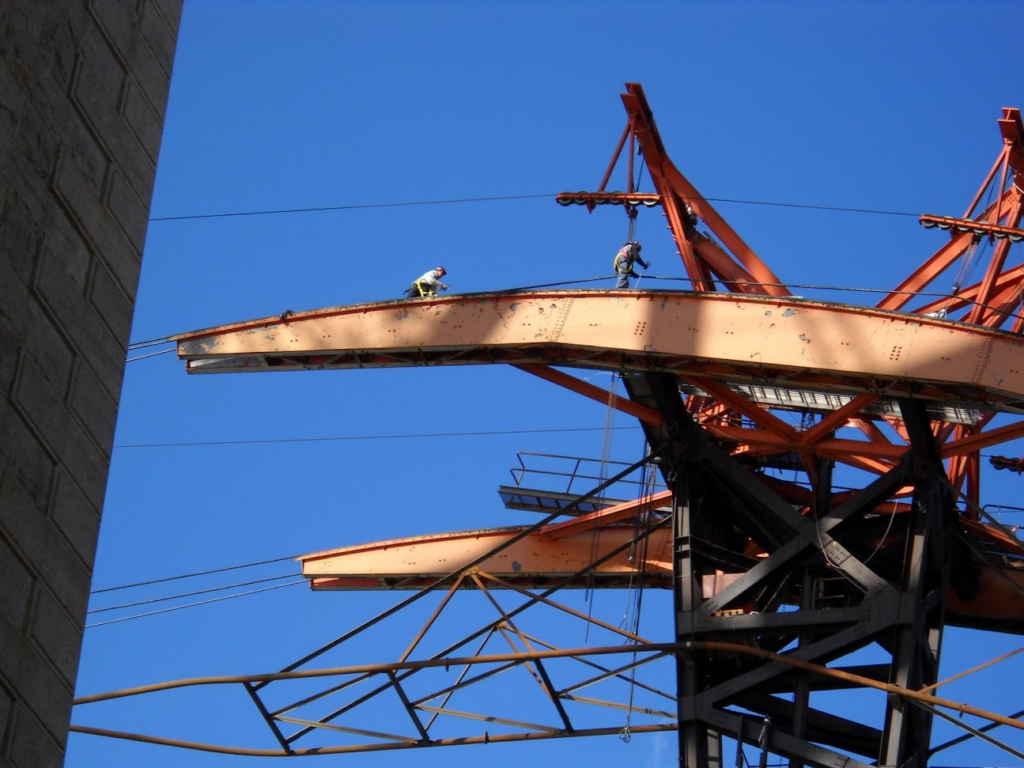
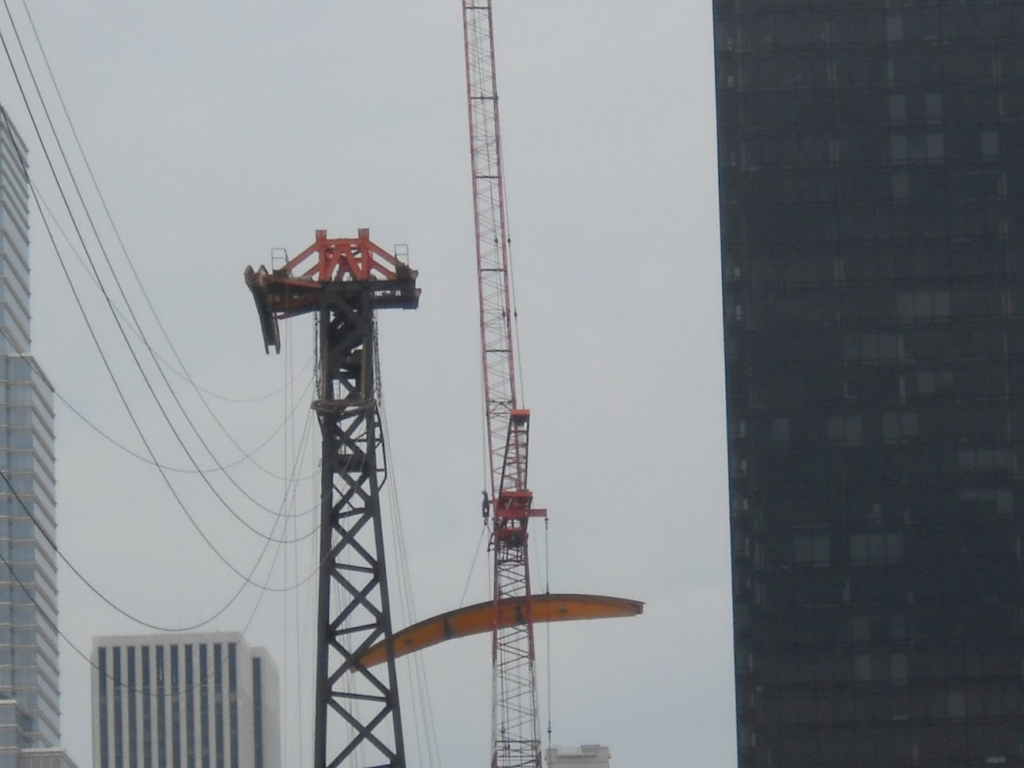
2010 THE GREAT REBUILD FROM A SWISS TO FRENCH DESIGNED TRAM
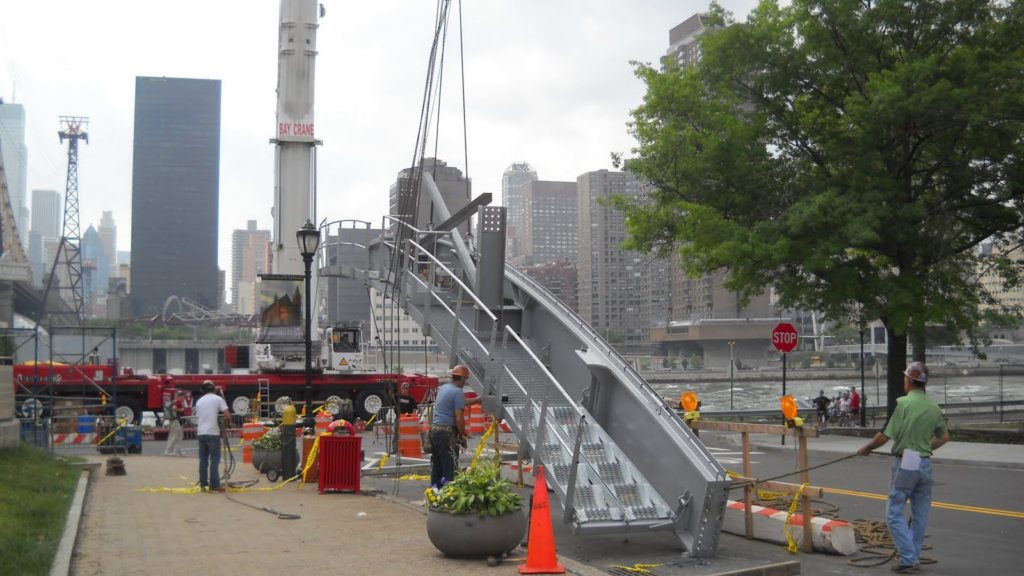
DISMANTLING THE OLD HANGER ARMS
Input caption text here. Use the block’s Settings tab to change the caption position and set other styles.
RESUE CABINS TO THE DUMP AFER ONE USE.
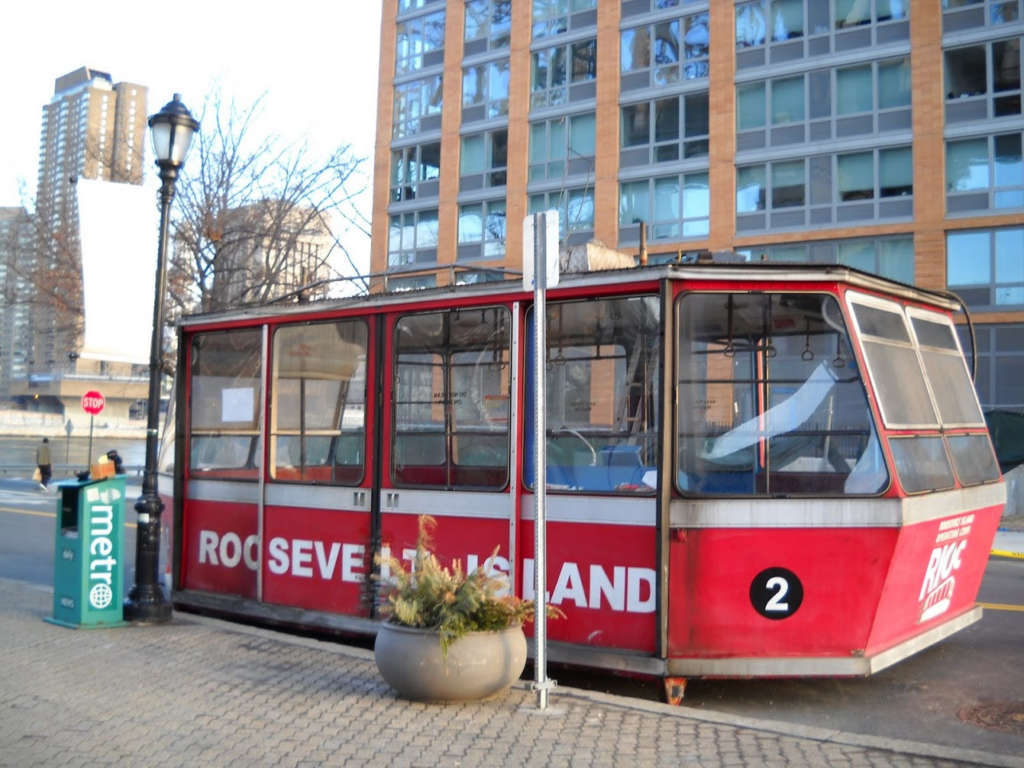
PARKED AT THE BUS STOP, WAITING FOR 15 YEARS NOW TO FIND A NEW LIFE……
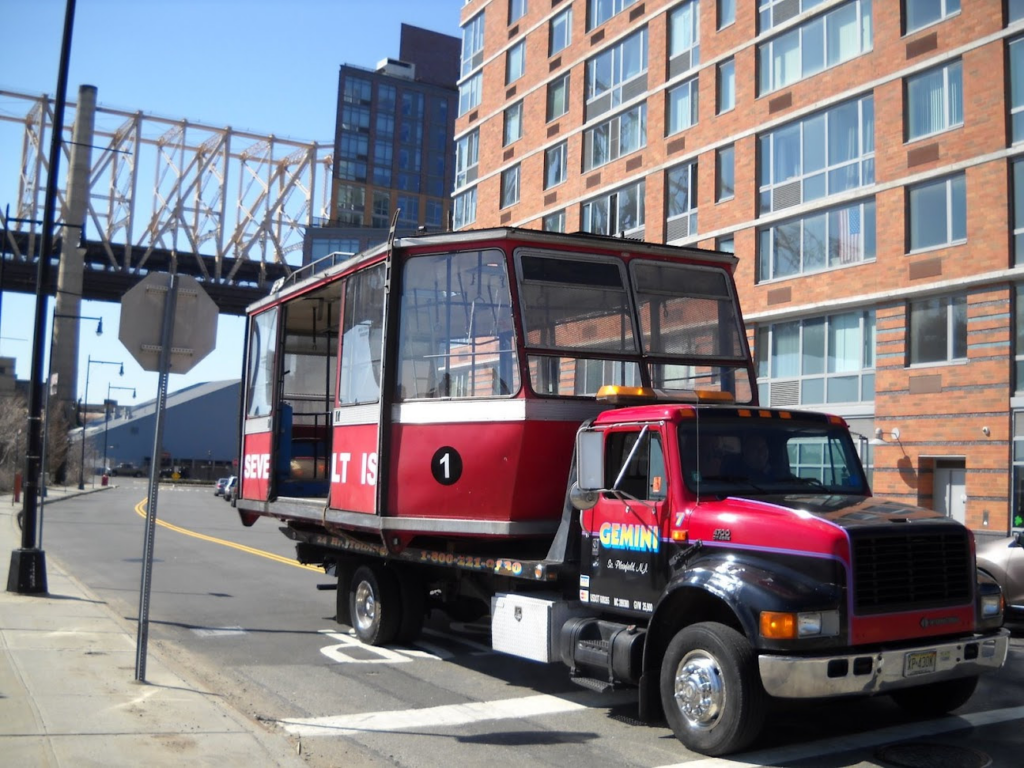
ONE TRIP ON GROUND LEVEL TO MOTORGATE
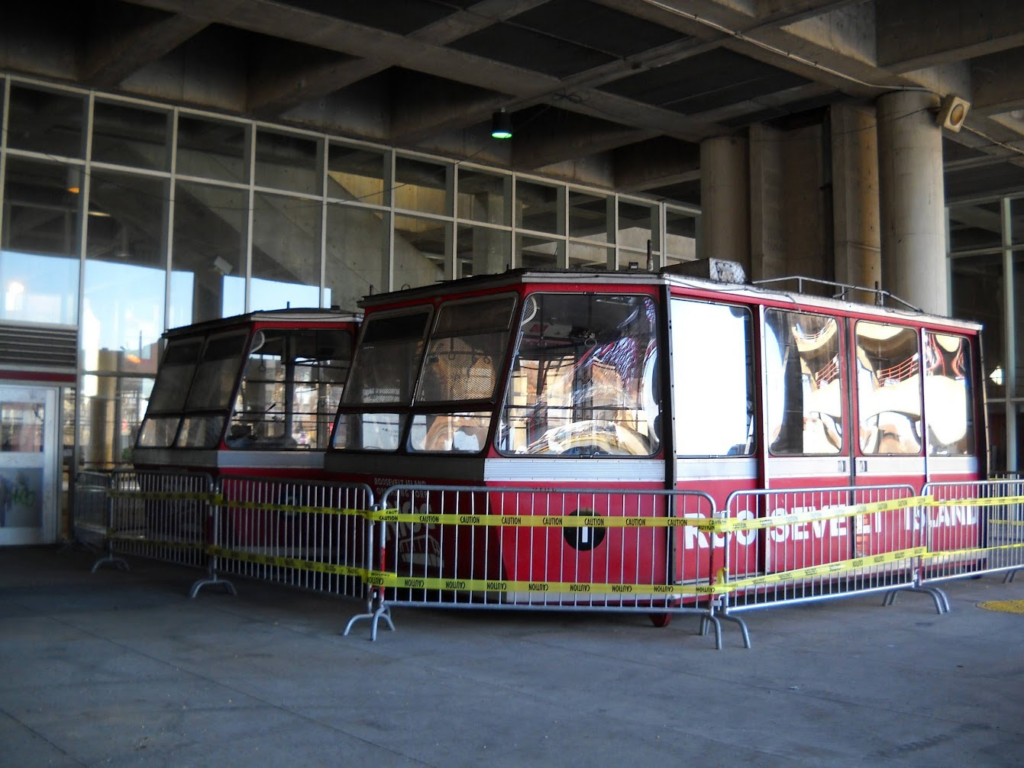
TRAM AT MOTORGATE STORAGE FOR 16 YEARS
THE NEW HANGER ARMS BEING INSTALLED DURING THE SUMMER OF 2010
ARMANDO CORDOVA, TRAM MANAGER CHECKING OUT NEW CABIN. ARMANDO OUR BEST FRIEND AND GREAT MANAGER IS RETIRED NOW AND SORELY MISSED… MY AMIGO!
CREDITS
ROOSEVELT ISLAND HISTORICAL SOCIETY ARCHIVES JUDITH BERDY
PHOTO OF THE DAY
All image are copyrighted (c) Roosevelt Island Historical Society unless otherwise indicated THIS PUBLICATION FUNDED BY DISCRETIONARY FUNDS FROM CITY COUNCIL MEMBER JULIE MENIN & ROOSEVELT ISLAND OPERATING CORPORATION PUBLIC PURPOSE FUNDS.
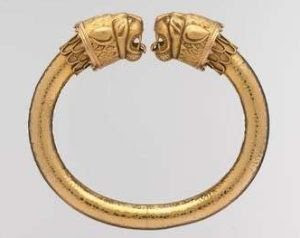
In September 1887, in broad daylight, a robbery took place at New York’s Metropolitan Museum of Art (the Met). The thieves got away with a pair of ancient bracelets described in a New-York Tribune crime report as “solid gold, about four inches in diameter, richly carved and studded with all manner of precious gems.”
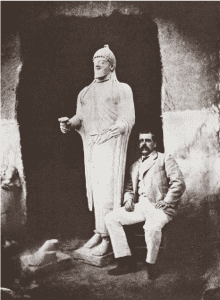
The police did not recover the items, but Tiffany & Co. created fine replicas (the firm acted as “sole agents” for the reproduction of the Museum’s works of art). Originating in Cyprus, the bracelets were part of the Museum’s “Cesnola Collection,” the formation of which itself was a story of mass thievery.
Diplomats & Other Vandals
The disclosure of early civilizations was a nineteenth century adventure tale. Royals and politicians visited excavation sites in Italy, Greece, or Egypt; newspaper headlines announced the latest digs; and thousands flocked to visit exhibitions of artifacts from distant millennia.
These were the pioneer days of digging, the rush for ancient treasures, when excavators employed hundreds of workers in a frenzied search for hidden riches. Out of this mania, archaeology was born.
Over the decades, passion for the past deteriorated into concerted theft and vandalism, erasing rather than illuminating the past.
The spade was in the hands of greedy diggers. The legal issues surrounding the retention of looted property are fought out in courtrooms to this day.
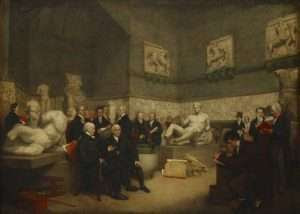
In the early 1800s agents working on behalf of the diplomat Thomas Bruce, Lord Elgin, shipped the “Elgin Marbles” from the Parthenon in Athens to the British Museum in London.
Ironically, the French added a newly coined word “elginisme” to the vocabulary, referring to an act by which antiquities are torn out of their cultural and spatial context.
In comparison to the extent of Napoleon’s art sackings, British public opinion regarded Elgin’s “purchase” of the Marbles as an entirely honorable transaction.
As looting (euphemistically called “acts of seizure”) in occupied territories was acceptable under international norms at the time, museums stacked their exhibition rooms with displaced objects.
The appointment of “collectors” such as Henry Salt (1780-1827) or the notorious Turin-born tomb raider Bernadino Drovetti (1776-1852) to Consular posts in British and French services respectively, as well as state-sponsored expeditions to secure antiquities for national collections, led to the mass export of stolen art works to Europe’s major museums. Cultural imperialism was in full swing.
Museums were the creation of plunderers; chauvinists pushed the concept of a National Museum. Europe’s great powers asserted their claim to pre-eminence by amassing vast collections of colonial objects.
In 1818, the British Museum acquired the colossal bust of Ramses II from the Abu Simbel Temple, Upper Egypt. Not to be outdone, three years later the Louvre obtained the “Dendera Zodiac,” a bas-relief taken from a chapel dedicated to Osiris in a temple complex on the Nile.
An international mob of early archaeologists stripped Egypt of its treasures in an insane rivalry for possession between the British Museum and the Louvre.
When France signed the Treaty of Amiens in March 1802, one of the British conditions of surrender was the handing over of antiquities Napoleon had removed during his campaign in Egypt, including the “Rosetta Stone.”
Egyptology was a competitive encounter between France and Britain in which passionate feelings of national pride and imperial prestige were at stake. The United States would join the circus later.
The Met
During the summer of 1866, several prominent Americans living in Paris put on a Fourth of July festival to celebrate the nation’s ninetieth birthday.
In his speech, lawyer and attorney John Jay II (1817–1894) pointed out that New York was ready to compete with Europe’s great cities by creating its own museum. He called for the foundation of a National Gallery of Art. As President of New York’s exclusive Union League Club, he actively rallied civic leaders, artists, and philanthropists to the cause.
The Met was incorporated on April 13, 1870, opening to the public in the Dodworth Building at 681 Fifth Avenue. The first object the Museum received was a Roman marble sarcophagus dug up in Tarsus, modern day Turkey, in 1863. The treasure was donated by J. Abdo Debbas, the American vice-consul in the region.
Collection formation at the Met started with the abuse of diplomatic privilege to smuggle a work of art out of its country of origin. Legal immunities eased such illicit movement. The Museum gained its reputation as a repository of antiquities after the acquisition of the Cesnola Collection of Cypriot Art.
Luigi Palma di Cesnola was born in July 1832 in Rivarolo Canavese, near Turin, then part of the Kingdom of Sardinia. His family was of minor Piedmontese nobility and Luigi embarked upon a military career.
In 1848, he served (and suffered defeat) in the Sardinian army fighting against Austrian forces in the First Italian War of Independence (1848-1849); he then volunteered in the Crimean War (1853-1856) on the side of the British.
In 1858 he settled in New York, founded a training school for army officers, and married the daughter of the 1812 naval war hero Samuel Chester Reid.
At the outbreak of the Civil War, he joined the Fourth Cavalry Regiment of New York with the rank of Colonel. In 1863, leading a charge of his troops at the Battle of Aldie in Virginia he was wounded and captured. Following his distinguished service, Luigi received the Medal of Honor for gallantry.
For his military credentials and multilingual abilities (fluent in Italian, French, and English), President Abraham Lincoln appointed the United States Army veteran in 1865 as Consul at Larnaca, Cyprus, then under Ottoman occupation.
His duties were light and, with plenty of spare time, he joined in the hunt for ancient treasures which had become a diplomatic pastime on the island. He was one of several amateur “gentlemen” diggers who plundered and pillaged the island’s antiquities.
Although academic interest in the history of Cyprus as one of the oldest civilizations in the eastern Mediterranean was deepening, adventurers, tomb robbers, and dodgy dealers exploited Ottoman indolence towards its heritage.
Cesnola was not bothered about scholarly considerations, nor did he show much respect for the socio-historical context of the objects he accumulated. His operations were a commercial venture. The past was for sale. As there were no institutional rules of provenance ethics nor any norms on dealings with cultural heritage, he used his consular office to collect some 35,000 antiquarian items.
By 1870, the scale of his activities had alarmed the authorities. He was denied permission to remove his treasures from the island. Using diplomatic levers, he was able to bypass custom officers and ship 360 large cases to Alexandria. For a while, the collection’s destination remained uncertain.
Negotiations took place with Napoleon III, who wanted the collection for the Louvre; Russian officials discussed a transfer to the Hermitage Museum at St Petersburg. Soon afterward, Cesnola transported the collection to London where its exhibition aroused interest.
At that point (1872), the Met intervened and bought the collection. Cesnola himself supervised its installation. In 1877, after his duty as Consul in Cyprus had ended, he took a seat on the Museum’s board of trustees and served as its first Director from 1879 until his death in 1904.
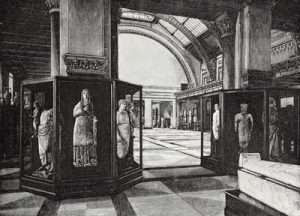
When in March 1880, the Museum moved to its permanent site at Fifth Avenue and 82nd Street the collection of over 6,000 works occupied a prime location on the first floor. He pushed for the publication of (unreliable) catalogues, including the six-volume, richly illustrated Atlas of Cypriot Antiquities and oversaw the arrangement of his artifacts in dedicated galleries.
Its display was trumpeted as an asset to the city, outdoing similar collections in London or Paris.
Treasure of Curium
Discovered in 1875, Cesnola unearthed the Curium antiquities at the site of Kourion, an ancient Greek city-state on the southwestern Cypriot coast.
They were added to the Museum’s earlier collection and enhanced its reputation – for a while at least. In 1877, Luigi “documented” his excavations and procurements in Cyprus: Its Ancient Cities, Tombs, and Temples.
Controversy started soon after publication when experts began fact checking the story lines. The “Cesnola Scandal” exposed his corrupt morals, crude methods, and unauthorized removals. His geographical descriptions were unmasked as either wildly inaccurate or completely fictional.
Archaeologists accused him of forging provenances and fabricating dates and/or locations; newspapers called him a liar and a looter.
Theft was a family affair. Luigi’s younger brother Alessandro also served in the military, before emigrating to America in the 1860s where he claimed citizenship. In 1873, he was appointed honorary American vice-consul in Paphos, a position that allowed for his involvement in archaeological activities on the island.
Between 1876 and 1878, in partnership with his father-in-law, the London financier Edwin Lawrence, Alessandro excavated many artifacts (by whatever means), principally from around Salamis.
His attempts to flout the ban on private excavations instituted by the first British High Commissioner following Britain’s occupation of Cyprus in July 1878, resulted in his expulsion from the island and the confiscation of part of the collection. He disposed of the bulk of the material at various auctions in London between 1883 and 1892.
Luigi’s projects were overseen by a character named Beshbesh, a Turkish fixer who contracted local vandals to plunder sites without record or documentation. He also bought objects from local dealers, inventing excavation narratives to justify his expenditure.
The Consul himself rarely visited the digs; he simply retold the stories and published them as factual accounts. This explained the extraordinary mixture of periods in the Curium treasure. The collection was not properly classified until 1914 by Oxford professor John Myres (1869-1954).
A pompous character, Cesnola remained unmoved by the tsunami of criticism directed against him. He died in 1904 at his apartment in the elegant Seymour Hotel on West 45th Street.
With the controversy raging over the acquisition of antiquities, their fraudulent restorations and illegal export, the collection became an embarrassment to the museum.
The Cesnola Collection was quietly dissolved over the decades, except for the most authentic pieces. When the Met opened new galleries in 2000, a reduced number of six hundred pieces was on display at its Department of Greek and Roman Art.
Agents of Displacement
Western museums were displacement agents of classical art and sculpture, either through the physical removal of artifacts, or through the misrepresentation of their original appearance.
Objects were adapted to fit European aesthetic taste, presenting Greek and Roman sculptures as pure white. All traces of coloring were scrubbed off to enhance the “marmoreal gleam,” fostering a false association between whiteness and beauty.
It was the wealth of our heritage that allowed for “cultural terrorism” to occur. Abundance provokes carelessness. If ancient treasures had been scarce, the alertness to protect them would have been more acute.
Cesnola is a comprehensive collection of Cypriot art, highlighting a blend of Greek, Egyptian, and Near Eastern influences that were at play throughout antiquity, but key issues surrounding the acquisition history of items stay unresolved.
While Cypriot officials acknowledge the collection’s importance for international study, there have been (sporadic) calls for the repatriation of “plundered” works.
There seems to be a resigned acceptance that the Cesnola treasures, like the Elgin Marbles, were removed with consent of the Ottoman regime, making a legal challenge of ownership complicated. The charge of “colonial theft” would be difficult to prove.
The black market of antiquities is still rampant as the looting of archaeological sites in conflict-ridden regions like the Middle East and North Africa continues.
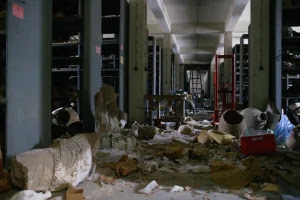
As of early 2026, ongoing conflicts and political instability in countries such as Syria, Iraq, Libya, Yemen, and recently Iran have resulted in the widespread pillaging of archaeological sites.
That situation has prompted attempts to exert international control over the illicit trade. The joint fight against the trafficking of cultural objects may encourage a trickier conversation on the status and presentation of museum collections.
To reduce ancient histories to a dreary display of exhibits removed from their original context and deprived of their spiritual essence, is meaningless. Rather than telling a coherent tale, museums impose a sense of lost history and forgotten cultural identities upon its visitors – mental fatigue rather than inspiration.
Restitution is the return of a cultural object to its rightful owner from which it was wrongfully taken. That is an obligation under the law and, therefore, a legally binding duty.
Repatriation is more complex. It implies the return of a significant object to its community of origin for historical, cultural, or spiritual reasons.
At present, this is a voluntary “ethical” choice, not an enforceable requirement. However sensitive and complicated proceedings might (and will) be, the discussion on repatriation must continue.
Apart from fostering restorative justice, the process will restore historical context by allowing communities of origin to reconnect with their heritage and rewrite Western-centric narratives. History itself will be the winner.
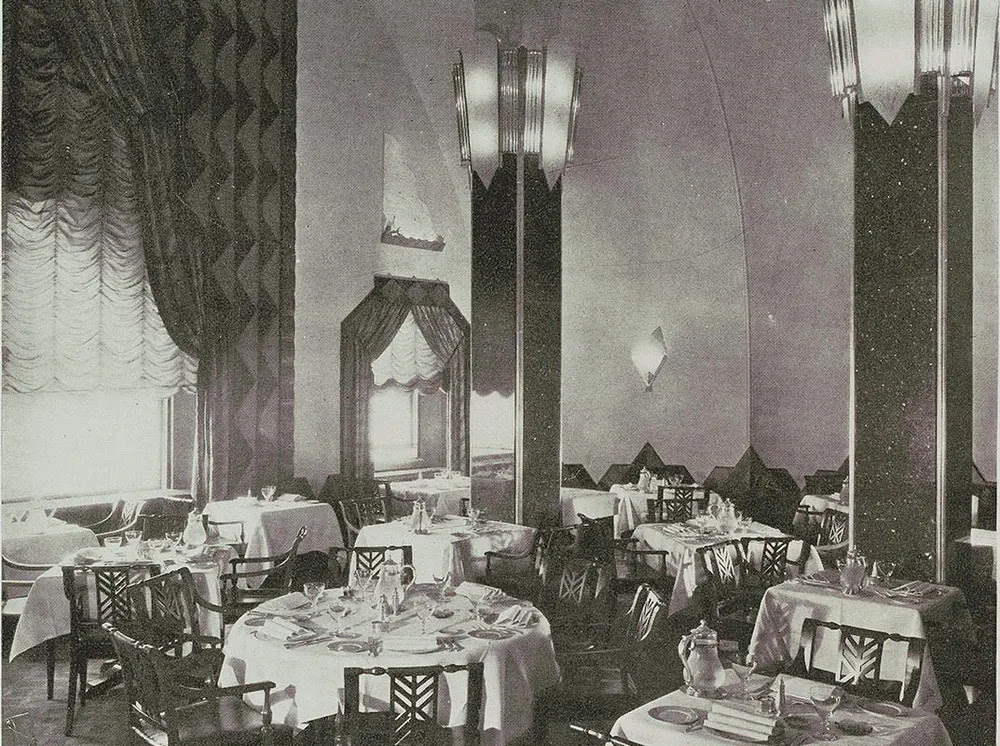
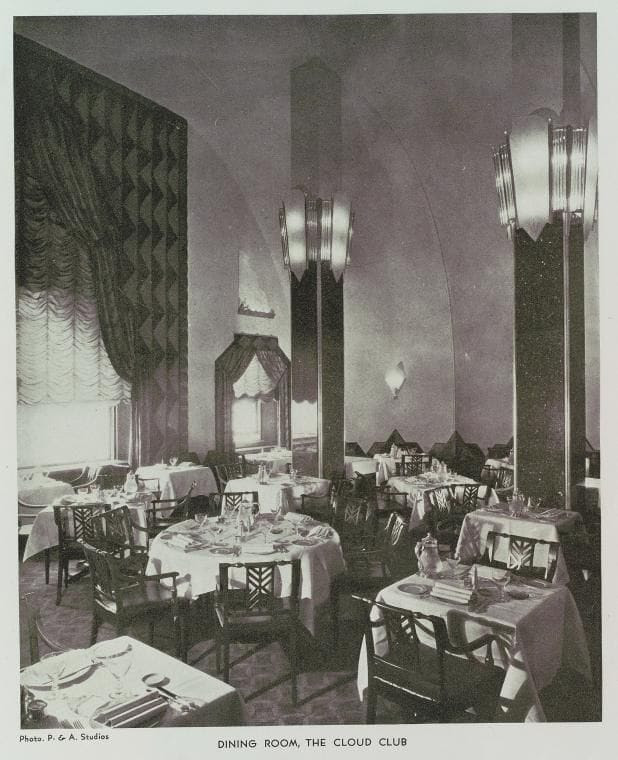
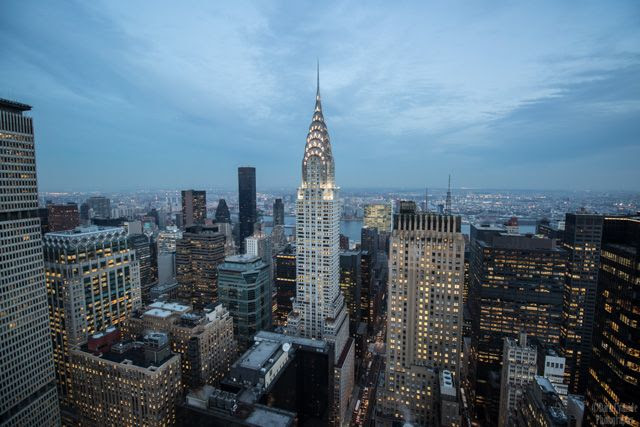
Once located on the 66th to 68th floors of the Chrysler Building, The Cloud Club belonged to a group of mile-high power lunch spots in New York City, atop the city’s most distinctive skyscrapers. The New York Times calls The Cloud Club “the inspiration for many of the others.” It was initially designed for Texaco, which occupied 14 floors of the Chrysler Building, and used as a restaurant for executives. It opened with 300 members of New York City’s business elite and only men were allowed to enter for many decades.
From the New York Public Library The Cloud Club was designed by William van Alan, and had an eclectic mix of design, ranging from Futurist in the main dining room, Tudor for the lounge, and an Old English grill room. Perhaps because of its decor, or its original function, it never became hip and stylish like the Rainbow Room but it did have amenities like a barber shop, a humidor, lockers for members to store their own alcohol of choice, and a wood-paneled bar that was used to hide alcohol during Prohibition. There was a stock ticker for the high powered financiers who frequented the club.
The Cloud Club closed in the 1979. The New York Times reported in 2000 that there were “various attempts in the early 1980’s to fill the three floors with everything from a nightclub to a disco to a lunch club for bankers” but they all failed. As of 2000, the marble and bronze staircase was still in the space, however, and the club had been “ravaged by time, neglect, water and vandalism.”
The club was later gutted to accommodate both potential office and hospitality tenants but according to the New York Post, potential restaurant operators were scared off by the “impractical layout.” As of the early 2010s, several, if not all floors were empty, but in recent years, AMA Capital Partners, a merchant bank focused shipping and energy, moved into the former Cloud Club floors.
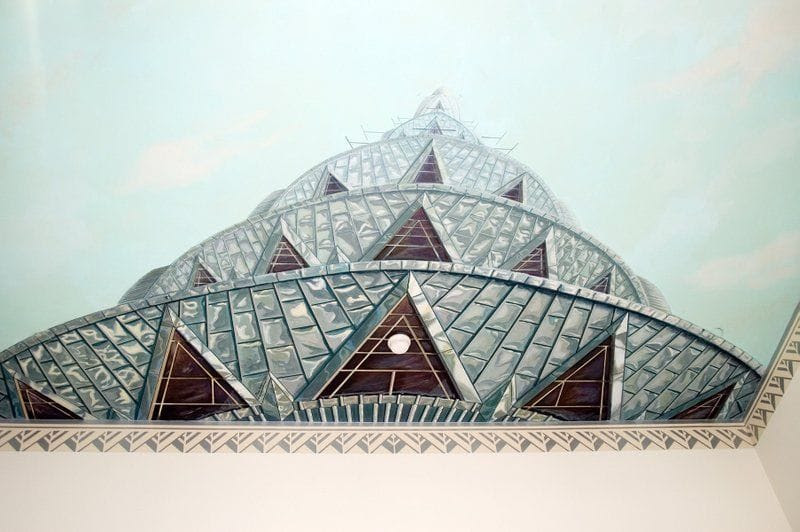
In 1931 when the Chrysler Building opened, it also had an observatory called the “Celestial” in the spire on the 71st floor. You could take in views of the city from all four sides for fifty cents. The star-themed observation deck closed down in 1945 and according to Moses Gates in his book Hidden Cities, it’s now occupied by a private firm. On a visit to the observatory in 2006, our Untapped New York Insider, Klaus-Peter Statz told us there were leftovers of a bar, with a bar, stools, and little tables, but not much else left
A mural of the Chrysler Building that was once in the observatory hallway, before entering the bar area. Photo by Klaus-Peter Statz
In fact, when Aby Rosen of RFR Holdings purchased the Chrysler Building in spring of 2019, he told the New York Post he was considering bringing back an observation deck. The Post reported that he was in discussion with Major Food Group and Stephen Starr about creating new restaurant spaces that “could rival the Cloud Club,” in hopes to revitalize the struggling ground floor.
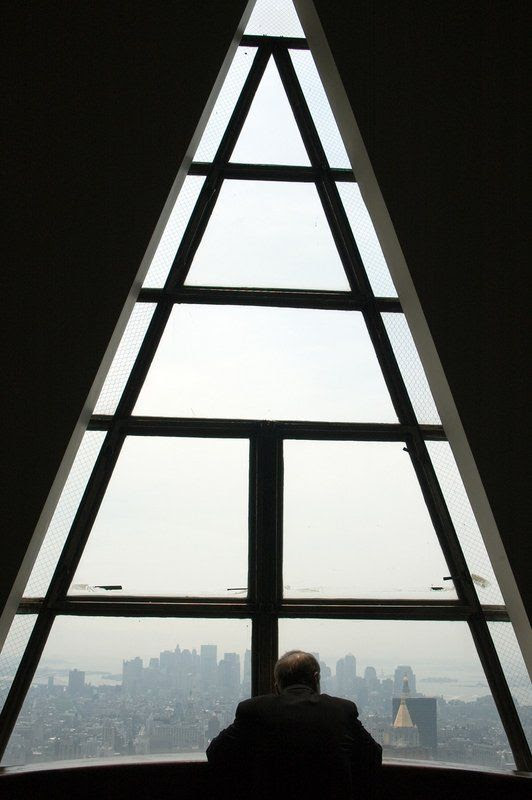
One of the triangular windows inside the observatory. Photo by Klaus-Peter Statz.
Rosen got a great deal on the building, which is known to be a difficult business operation, paying $151 million to the Abu Dhabi Investment Fund, which had bought a 90% stake in the building for $800 million back in 2008. Tishman Speyer had bought the building in 1997 for $225 million but sold it’s finals takes in 2019. Reports from early 2026 indicate the company may be eyeing the building again, after it went up for sale in 2025.
Time will only tell if anything comes of the grand plans to bring back an observation deck. Rumblings of a new skydeck for the Chrysler Building surfaced in 2022, according to Curbed New York. The observation deck, which some estimate will cost up to $40 to enter, would allow access to the currently private building. Though there are no finalized construction plans for the Chrysler Building’s new observation deck, the Landmarks Preservation Commission approved its construction in 2020.
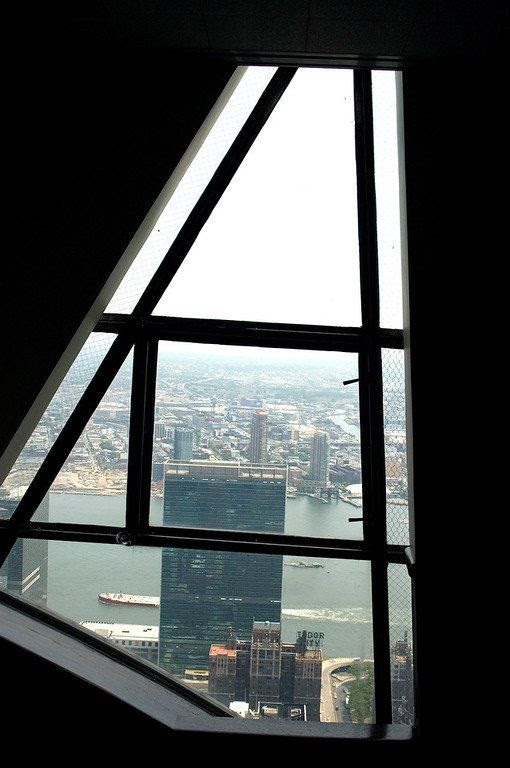
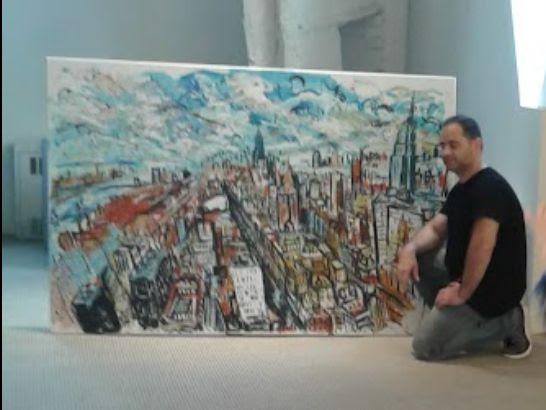
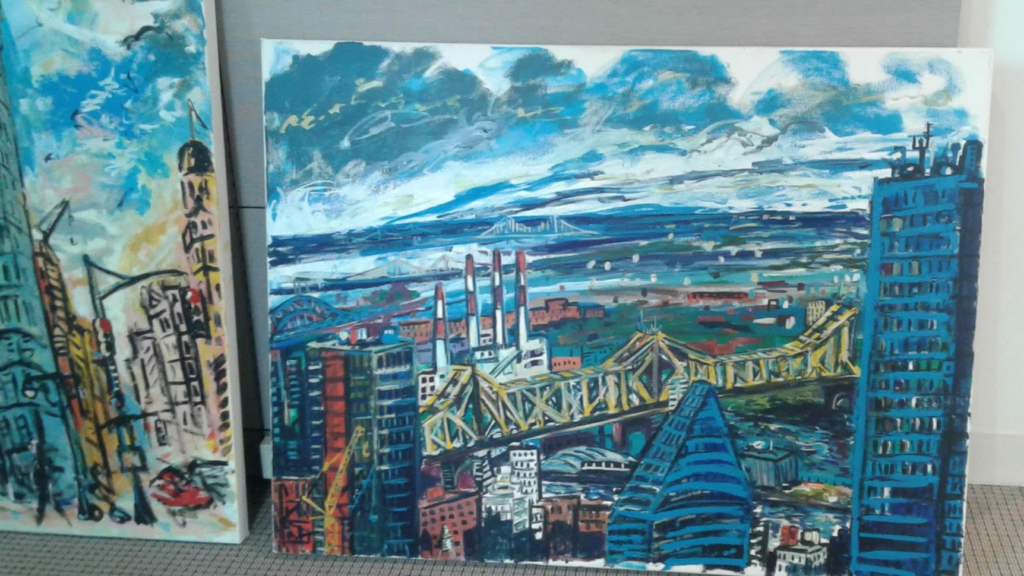
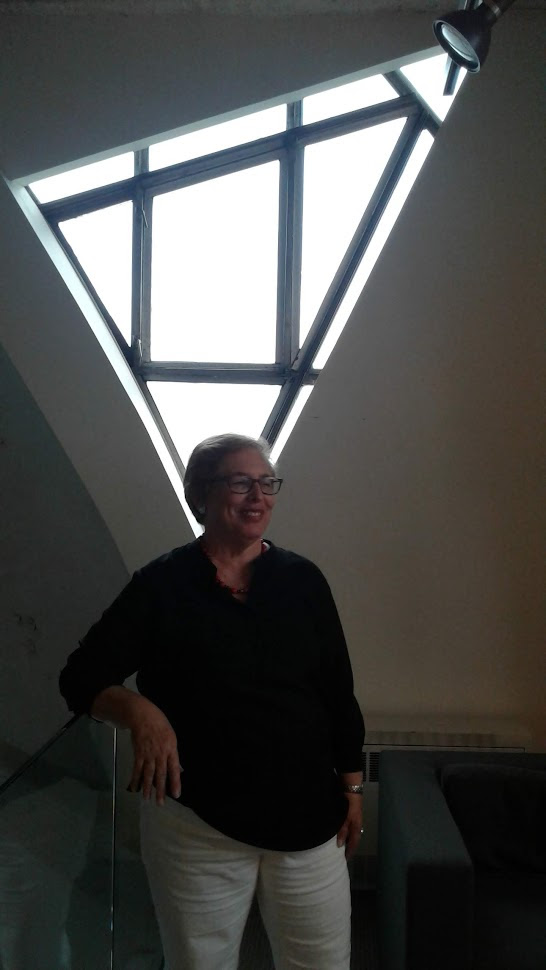
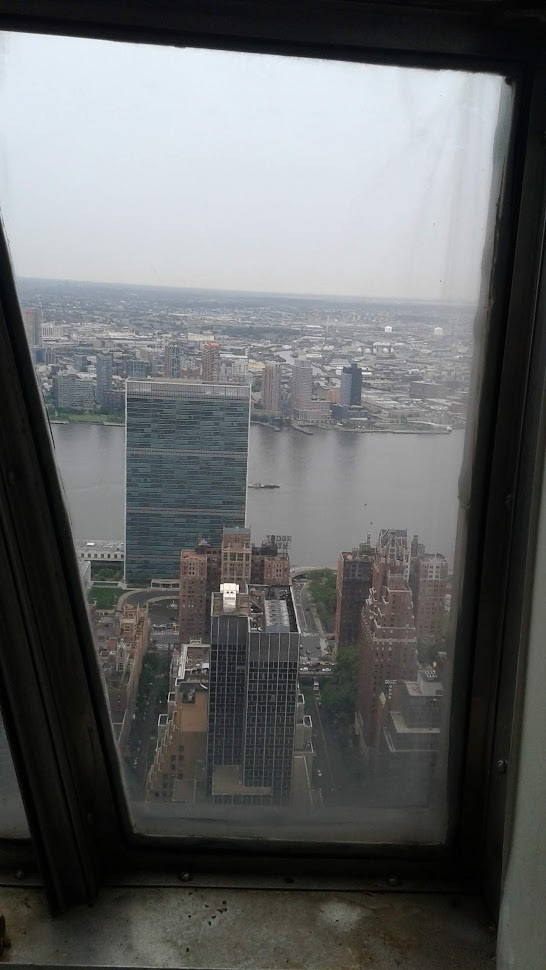
On a summer day in May 2018, Melanie Colter and I were invited to visit an office on the 65th floor of the Chrysler Building. Australian artist Marco Luccio had been using the space to paint views of the city. The space was rented by a maritime company and offered a great view of the infrastructure.
Marco Luccio’s paintings from the Chrysler
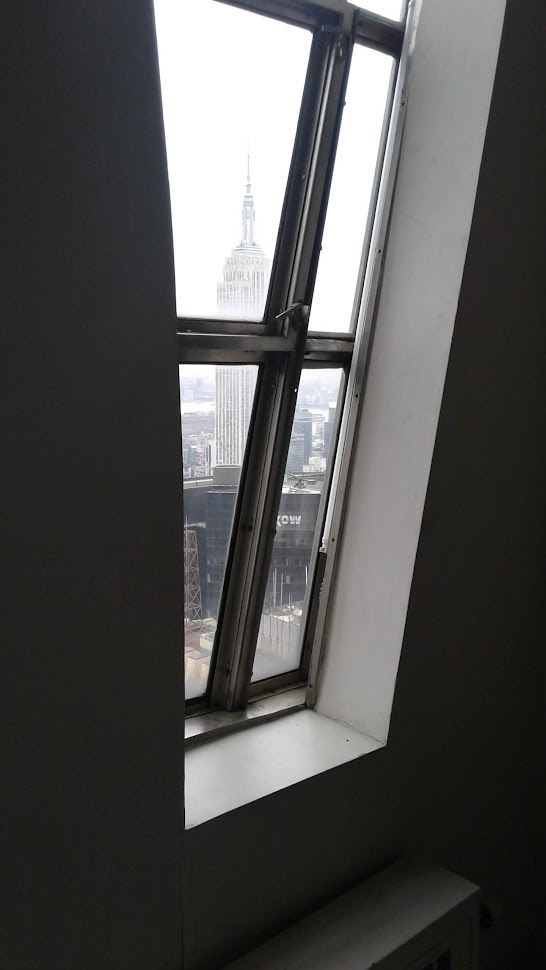
These triangular window have handles and open.
The beginning of LIC development from the window in 2018.
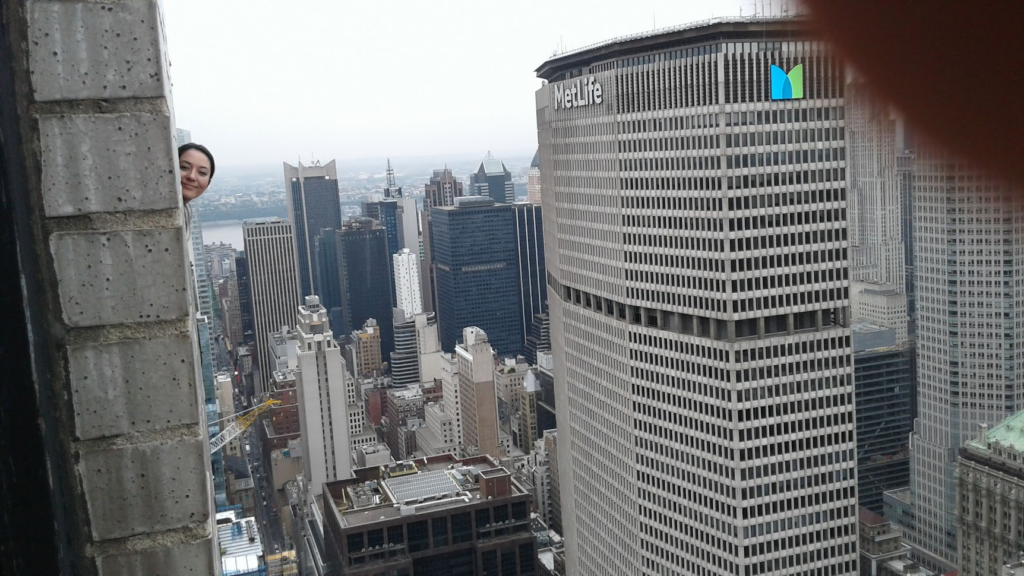
The big sister architectural masterpiece from the window
Melanie peeped ouf from an open window.
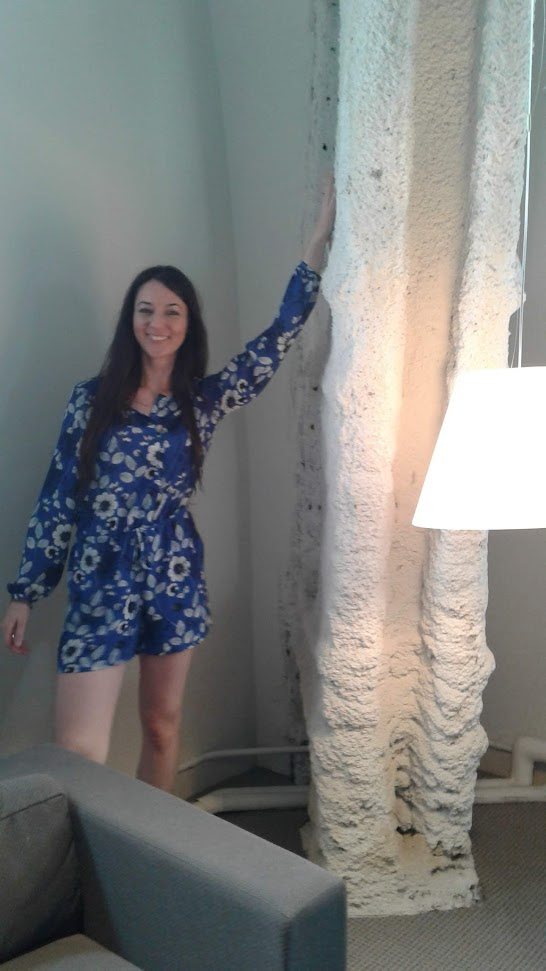
The support colums are clearly evident.
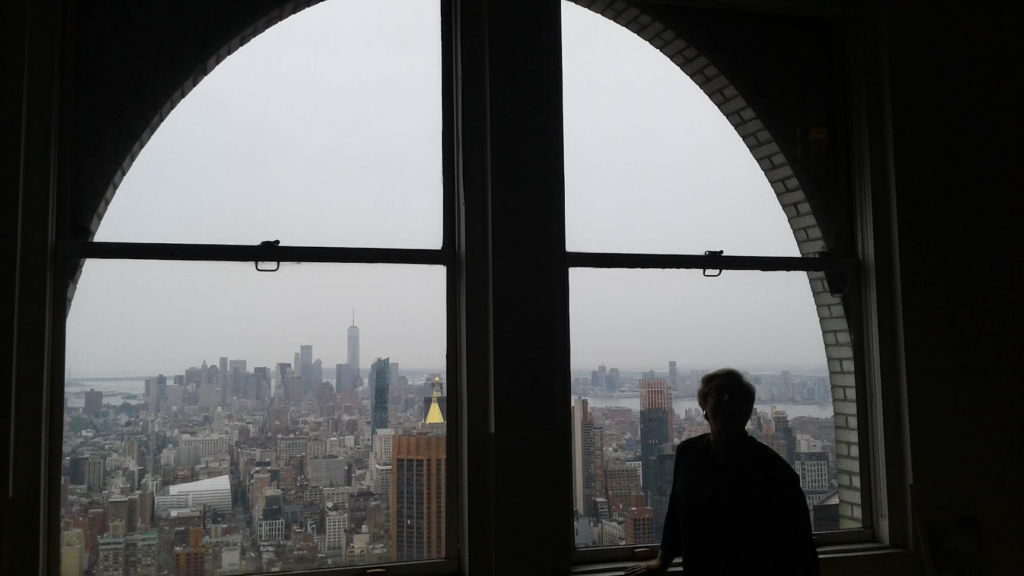
Imagine if this space with the windows, views and structure could be open to view.
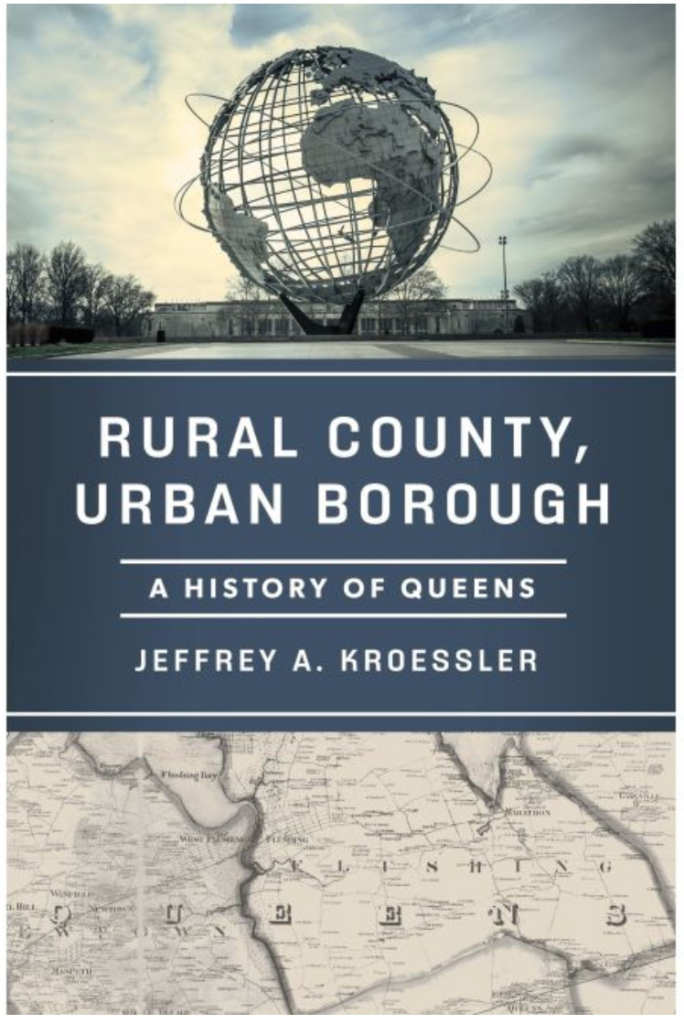
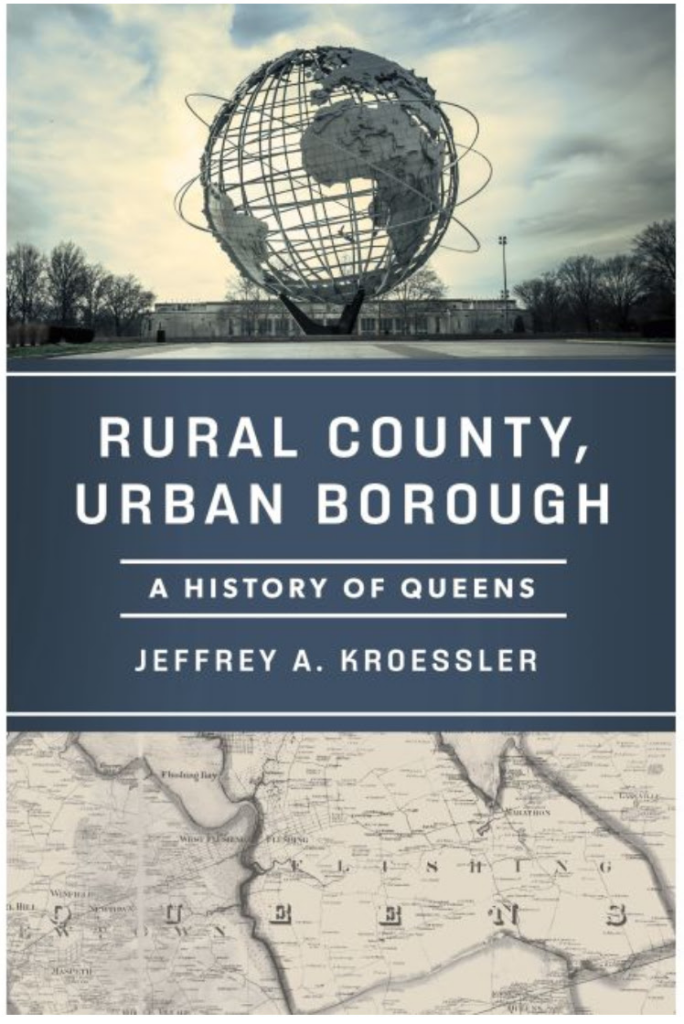
The borough of Queens is the largest of New York City’s five boroughs. It holds more people than Chicago or Los Angeles. And thanks to immigration, it is today home to a population of extraordinary ethnic, religious and linguistic diversity. Queens is also the subject of a new book by Jeffrey Kroessler, Rural County, Urban Borough: A History of Queens, published by Rutgers University Press.
Kroessler, an expert on the history and preservation of Queens, was working on the final edits for Rural County, Urban Borough when he died in 2023. His wife, the architect Laura Heim, took up the work of moving the book through the publication process. She selected and placed the images in the book and wrote its Preface and Acknowledgements.
Rural County, Urban Borough is a history with a strong sense of place. Covering the the history of Queens from European settlement to the present, Kroessler charts centuries of change in the landscape. He shows how politics, industry, transportation, government and real estate interests all shaped the borough. Linking Queens to New York City and the wider world, Kroessler illuminates important elements of American metropolitan history.
CREDITS
New York Almanack
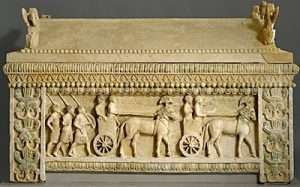
llustrations, from above: Tiffany reproduction of Cypriot bracelet from the Curium collection of the Met; Archibald Archer’s “The Temporary Elgin Room in 1819” with portraits of British Museum staff, a trustee and visitors. (British Museum); The Amathus sarcophagus from the Met Cesnola Collection; Luigi Palma di Cesnola, American consul in Cyprus and first director of the Met (Cultural Centre of the Popular Bank Group); Sculpture from the ‘Cesnola Collection’ on display at the Met (Harper’s New Monthly Magazine, May 1880); and the ransacked Iraq National Museum in 2003, during the Iraq War (photo by Patrick Robert).
Untapped New York
Judith Berdy
All image are copyrighted (c) Roosevelt Island Historical Society unless otherwise indicated THIS PUBLICATION FUNDED BY DISCRETIONARY FUNDS FROM CITY COUNCIL MEMBER JULIE MENIN & ROOSEVELT ISLAND OPERATING CORPORATION PUBLIC PURPOSE FUNDS.
The Lombardy city of Cremona is the birthplace of the violin. The name of Antonio Stradivari became a metaphor for perfection, and his presence sparked a cult of Cremonese violins.
Born in 1644, he continued a lengthy line of local luthiers who since the sixteenth century had produced fine instruments.
The town of Markneukirchen in Saxony’s Vogtland was the unofficial capital of a German and Czech cross-border region known as the “Musikwinkel” (music corner).
For its production of stringed instruments, the town enjoyed the reputation of a “German Cremona.” Immigrants from the region carried a rich tradition with them and, over time, would upgrade America’s musical landscape. Cremona calls for classical music; Markneukirchen stands for the modern age.
Music & Migrants
After the Thirty Years War, Bohemian Protestants from the Catholic town of Graslitz (Kraslice) fled their homes during the Counter Reformation and settled over the border. They brought the art of violin making with them.
In 1677, twelve refugee craftsmen came together and founded the Violin Makers’ Guild (Germany’s oldest continuous trade union). They codified standards of workmanship and turned the town into a hub of excellence. Over time, bow makers and string producers settled there as well.
At the same time, a start was made with guitar and zither production. Makers of woodwind instruments and French horns settled in the region at the turn of the eighteenth century. Almost the entire range of orchestral instruments became available in a single town.
Craftsmen worked from home, instructed apprentices, and sold their goods to wholesale dealers. With the march of industrialization, the manufacture of instruments largely kept its character as a cottage industry.
Rather than making entire instruments, artisans would concentrate on single parts such as fingerboards or tailpieces and supply them to an expert for completion. The region developed a range of specialisms.
The nineteenth century marked a peak in output. London’s 1851 World Exhibition put Markneukirchen on the export map. The American market took notice and there was a diplomatic effort to encourage trade relations.
In 1893, a Consular Agency was set up in the town, serving the instrument trade (until its closure in 1916) by easing the import processes for giant retailers like Sears Roebuck or Montgomery Ward.
Manufacture expanded rapidly. In 1913, the “Musikwinkel” produced forty percent of the world’s string instruments, totaling over 150,000 violins a year. Until the Second World War, it was one of the largest global centers of instrument making.
While many of its violins were affordable, Markneukirchen also maintained the benchmarks for quality instruments, being home to prominent dynasties like Heberlein, Hamm, and Roth.
King of Guitars
Vogtland’s violin making was regulated by guilds. In the early 1800s, the guitar was a relatively recent instrument, and most producers were members of the Cabinet Makers’ Guild.
Violin makers claimed exclusive rights to the manufacture of stringed instruments and the guild exercised its privilege to prevent their rivals from producing guitars.
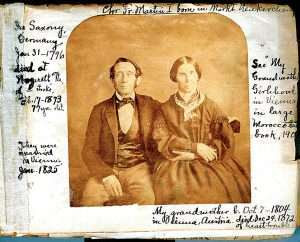
Christian Frederick (Friedrich) Martin was born on January 31, 1796, in Markneukirchen into a family of woodworkers. He learned his trade in Vienna as an apprentice to leading guitar maker Johann Georg Stauffer.
Returning to Saxony, Martin joined the Guild of Cabinet Makers and soon clashed with violin makers who tried to stop him from applying his trade. Unwilling to accept the locality’s confining rules, Martin moved to the city of New York.
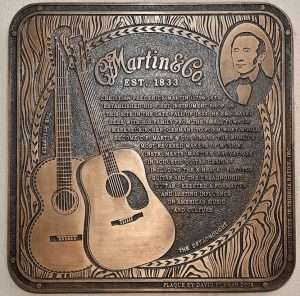
In 1833 he opened a workshop at 196 Hudson Street in Manhattan’s Lower West Side, producing instruments modeled after those of his Viennese mentor. The original building at the corner of Hudson and Vestry Streets has not survived, but a bronze plaque commemorates the site where this immigrant built his first American guitars.
In 1839 he moved to Nazareth, Pennsylvania, where he set up a workshop at the corner of Main and North Streets. Once settled there, his guitars evolved in shape and quality, whilst his reputation grew.
By the late 1840s, he had abandoned the Stauffer characteristics and developed a style of his own. During the Civil War sales increased as Martin’s portable “parlor” guitar became a means of relaxation for the troops.
Martin’s main distributor was Charles A. Zoebisch & Sons, a firm also known for producing brass instruments. Its founder Carl August Zoebisch, born in 1824, was an immigrant from Saxony too, arriving in New York in January 1842.
Having started his business in Mott Street, he traded from 1866 onward at 46 Maiden Lane, Lower Manhattan. The link between the companies endured until 1898, when Martin took on its own distribution.
By the end of his working life (he was succeeded by his son in the family firm), clients hailed Martin as the undisputed king of the acoustic world. Despite its European roots, he had transformed the guitar into an iconic American instrument that gave shape and substance to the nation’s modern musical landscape.
Spanning all genres, from country, R & B, or folk to rock & roll, the legends of song have endorsed Martin’s guitars. Hank Williams, Johnny Cash, Willie Nelson, Elvis Presley, Bob Dylan, John Lennon, Neil Young, Paul Simon, Eric Clapton, Ed Sheeran, and many other performers have strummed his creations.
The company stuck to its main mission throughout the decades: building acoustic guitars, never tempted to sell its soul to the electric market.
Mandolins, ukuleles, and electric guitars have featured in the company’s catalogues, but to connoisseurs the word “Martin” simply meant a classic flat-top acoustic guitar. America made music on Saxon-inspired instruments.
Civil War
During the 1850s Saxony’s instrument makers, primarily from Markneukirchen, emigrated to escape restrictive guild practices and political unrest, carrying their specialized skills to the United States.
Rudolph Wurlitzer was born on February 1, 1831, in nearby Schöneck where his father ran a family business of music distribution. The family had a long history of producing and selling (stringed) instruments, stretching back to the seventeenth century when Nicholas Wurlitzer began making lutes.
Little is known of Rudolph’s life (there is no biography). He joined the family firm after leaving school, but it is unclear why he made the decision to emigrate. Twenty-two-year-old Rudolph boarded a transatlantic liner in Bremen (the immediate reason to leave may have been a dispute with his father) and docked in Hoboken, New Jersey, in June 1853.
He arrived penniless and with no knowledge of English. Having started work in a New York City grocery shop, he quickly made his way up. He then moved to Cincinnati where he became part of the city’s large German-speaking immigrant community and set up his own company. Ambitious, energetic, intelligent, and frugal, he concentrated on what he knew best – the trade in musical instruments.
At the time, most instruments were expensive imports from Europe, and the business model involved a long supply chain and high transaction costs.
Rudolph’s connections gave him a competitive advantage as a was able to exclude the middlemen. He bought instruments directly from Saxon producers (and family members) and made them available for retail at relatively low prices.
The relationship was one of mutual advantage. Wurlitzer profited from his commercial networks in the “Musikwinkel,” while his home region benefited economically from his presence as a major American importer.
On September 19, 1868, Rudolph married Leonie Farny, an immigrant from Alsace, at Cincinnati’s Lutheran Church. Making their home on Franklin Street, the family kept a strong German identity and, at the same time, integrated fully into American society (he had been a naturalized citizen since October 1859).
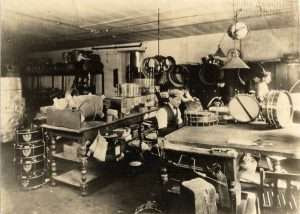
His contracts with the army during the Civil War and the Spanish-American War were signs of mutual respect. Drums, trumpets, and bugles played by United States soldiers during the Civil War bore Wurlitzer’s name.
The Rudolph Wurlitzer Company went from strength to strength with America’s growing passion for music and entertainment. The company offered a wide selection of instruments in its 200 page-long catalogues, mostly focused on “conventional” instruments.
Towards the end of the century, the firm became increasingly aware of public interest in mechanical music devices. The leisure industry began making new demands.
Mighty Wurlitzer
The development of automatic instruments gathered pace. Barrel organs took over Manhattan’s streets and fairs; coin-operated pianos played ragtime in packed saloons. With the craze for silent movies came the introduction of “orchestrions,” mechanical organs that imitated the sounds of a complete orchestra.
Eugene de Kleist was born Eugene von Kleist in Düsseldorf in 1853 (of Prussian noble stock), but changed his name after spending time in London where he built barrel organs for merry-go-rounds.
Wurlitzer would become the sole distributor of his products, including the 1899 “Tonophone,” a commercially successful coin-operated piano played by a pinned cylinder. When De Kleist withdrew from business, Wurlitzer took over his factory.
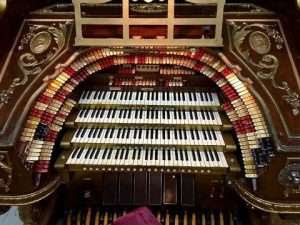
In 1910, the company bought an insolvent enterprise owned by the eccentric Cheshire-born Robert Hope-Jones. A pioneer in applying electrical technology, he sold his patent for what would become the company’s greatest triumph, an organ that went down in the history of cinema as the “One Man Orchestra.”
Otherwise known as the “Mighty Wurlitzer,” the organ was equipped with trumpets, tubas, clarinets, oboes, chimes, xylophones, drums, and other sound effects.
With the advent of silent movies in the 1920s, it became an international success. The introduction of sound (“talkies”) spelled the end for silent film. Organs were replaced by speaker systems. The “Mighty Wurlitzer” went out of fashion.
The company (and the music industry in general) survived the Great Depression thanks to the jukebox. Its rise coincided with the end of Prohibition and then reopening of countless bars and clubs. “Put a nickel in it” was the slogan – and dance away.
Early jukeboxes used heavy and fragile shellac 78-rpm records. Rival companies competed to improve the mechanism, leading to the so-called “Battle of the Speeds.”
Introduced by RCA in March 1949, the invention of the 45-rpm vinyl record accelerated the spread of the jukebox. It improved sound quality, increased capacity (100 selections), and lowered production costs. The 45s became synonymous with the “single,” featuring a hit on the A-side and an added song on the B-side.
The root of the word “jukebox” goes back to the coastal plain and Sea Islands of South Carolina, Georgia, and northern Florida where “Gullah,” a creole of West African languages and English, was spoken by enslaved people brought to the region in the eighteenth century.
The word “jook” meant disorderly or rowdy. A “jook joint” was a dance hall, gaming room, and brothel, all rolled into one. Early boxes were known as “nickel-in-the-slot machines,” until around 1937 when Time magazine popularized the nickname jukebox.
A novelty in the 1920s, the jukebox transformed into a post-war cultural icon. Omnipresent, the vogue was associated with an emerging youth culture. Located in diners, coffee bars, roadside cafés, soda fountains, and amusement arcades, these boxes provided a hub where teenagers could spend time together, dance, and socialize.
They allowed them to control their choice of music at their own chosen venues. Wurlitzer was the market leader, its name almost synonymous with the machine. Stylish and colorful designs added to their popularity both in America and Europe.
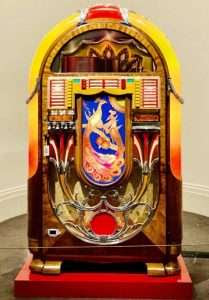
Wurlitzer’s vanguard role was enhanced by the participation of Paul Max Fuller (born in Corisca in 1897; and died in Buffalo in 1951), the most talented box designer of the era.
The company stopped producing jukeboxes in 1974; by that time, the firm had sold more than 750,000 of them. New electronic music devices caused the company’s decline. Japan took the lead instead.
C. F. Martin and Rudolph Wurlitzer were young immigrants who made a career in music, showing a commitment to traditional quality and artistry that was emblematic for their enterprises. The former provided uniquely American acoustics for over a century of contemporary music, while the latter supplied the soundscape of entertainment that shaped popular culture.
One stood for the creation of music, the other served its dissemination and consumption. Within their own realms, both men represented a Saxon creative versatility they brought to the United States, securing a niche of professional esteem for themselves in the nation’s diverse musical history.
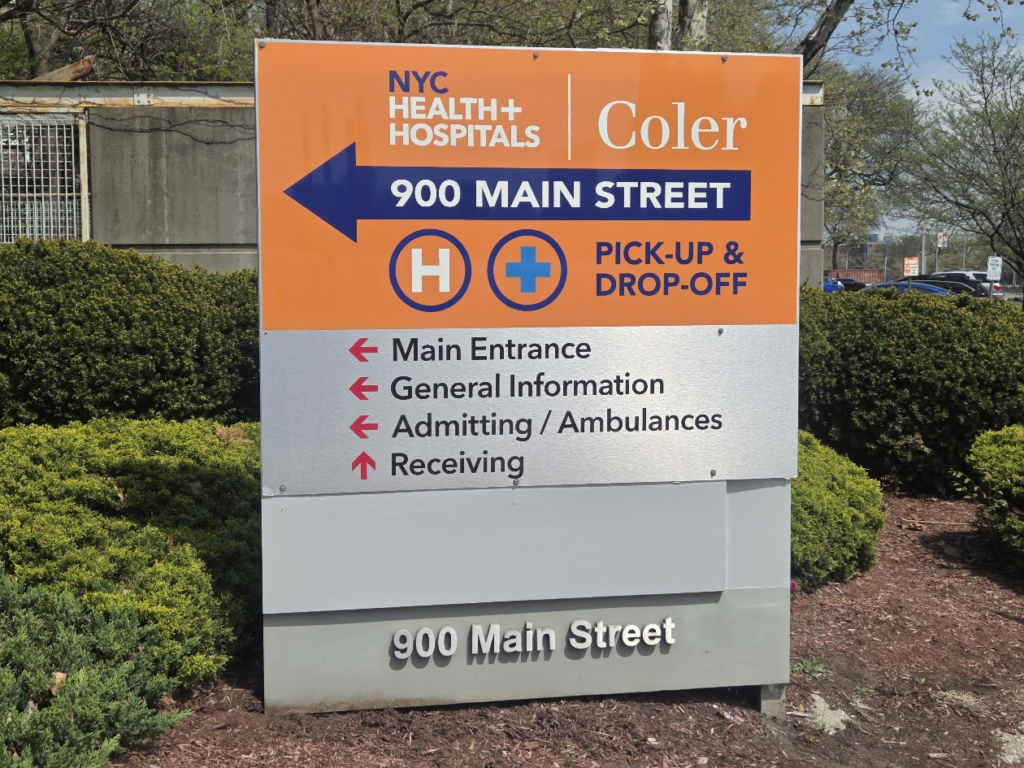
AN EASY WAY FOR DRIVERS TO FIND COLER HOSPITAL ENTRANCE
(MORE DIRECTIONAL SIGNS ARE ON THE WAY)
CREDITS
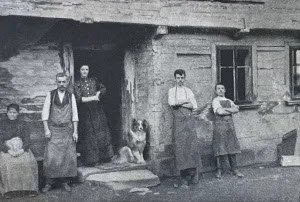
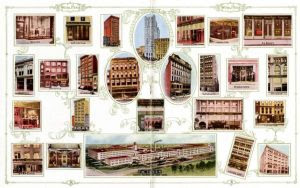
NEW YORK ALMANACK llustrations, from above: A modern European instrument shop; “A Typical Family of Violin-Makers Outside Their Cottage” in Markneukirchen, ca. 1900; C.F. Martin Sr and his wife Otilia from a scrapbook page (courtesy Martin Guitar Museum); C.F. Martin bronze plaque at the intersection of 196 Hudson Street and Vestry Street; Making Drums for the Spanish American War in the Wurlitzer Cincinnati Factory, 1898; Wurlitzer 4/26 orchestral organ, 1928 (LIU Paramount Theater, Brooklyn); Wurlitzer Stores and Factory 1916; Paul Max Fuller designed Wurlitzer jukebox model 850 “Peacock” design, 1941. Judith Berdy
All image are copyrighted (c) Roosevelt Island Historical Society unless otherwise indicated THIS PUBLICATION FUNDED BY DISCRETIONARY FUNDS FROM CITY COUNCIL MEMBER JULIE MENIN & ROOSEVELT ISLAND OPERATING CORPORATION PUBLIC PURPOSE FUNDS.