Wednesday, September 3, 2025 – JUST LOOK UP FOR THE TIME, NO PHONE NEEDED

RIDING
OFF THE ISLAND
ON THE Q102 BUS
Wednesday, Sept 3 , 2025
Judith Berdy
Issue # 1524
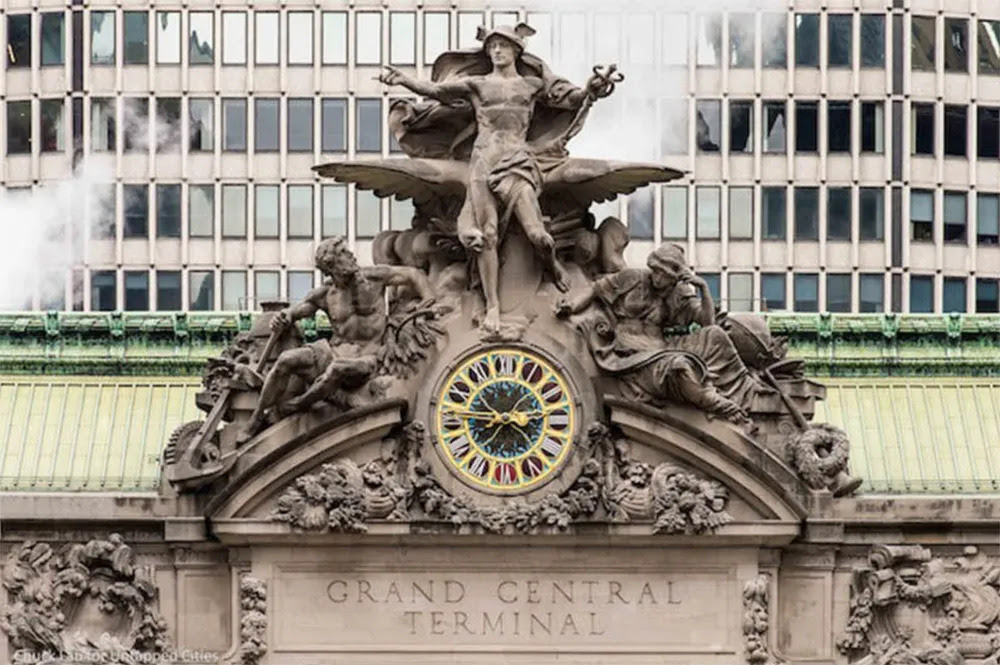
Long before everyone checked the time by glancing at their cellphones, many decorative clocks were installed to help New Yorkers keep track of time. While some were built as art pieces in more recent years, other clocks have often been recognized as essential pieces of “street furniture,” along with lamp posts, sign posts, and benches.
They have also been utilized in cities all over in order to maintain and enhance the quaintness of neighborhoods. In this piece, we highlight a few of New York’s most iconic time pieces you may or may not have noticed. Of course, this is only a sampling of the various fixtures you can find across the five boroughs. If you know of any others, leave us a comment below:
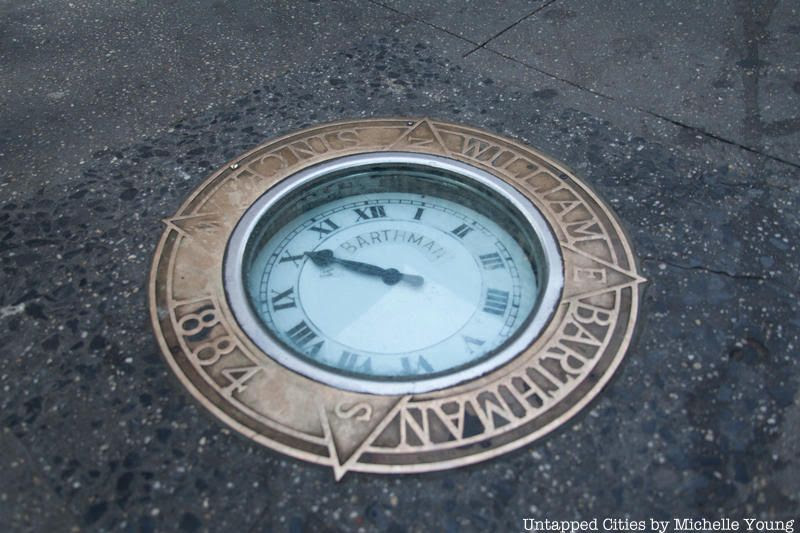
Located along the intersection of Maiden Lane and Broadway, outside the old location of Barthman Jewelers in Lower Manhattan, a clock occupies a small break in the sidewalk. It’s been located in that spot since 1896, originally installed by Barthman and one of his employees, Frank Homm.
The clock is an ode to the district’s prominence in the jewelry trade and was created to lure customers into the Barthman store over other jewelers. The only time the clock stopped working was during the Depression of the 1930s, and temporarily after Hurricane Sandy. The signature time piece was maintained from a mechanical room that is only accessible by going underground. Barthman Jewelers has since moved a few doors down from their original location. The clock mysteriously disappeared after passersby noted that it had been in disrepair, but it has thankfully been restored!
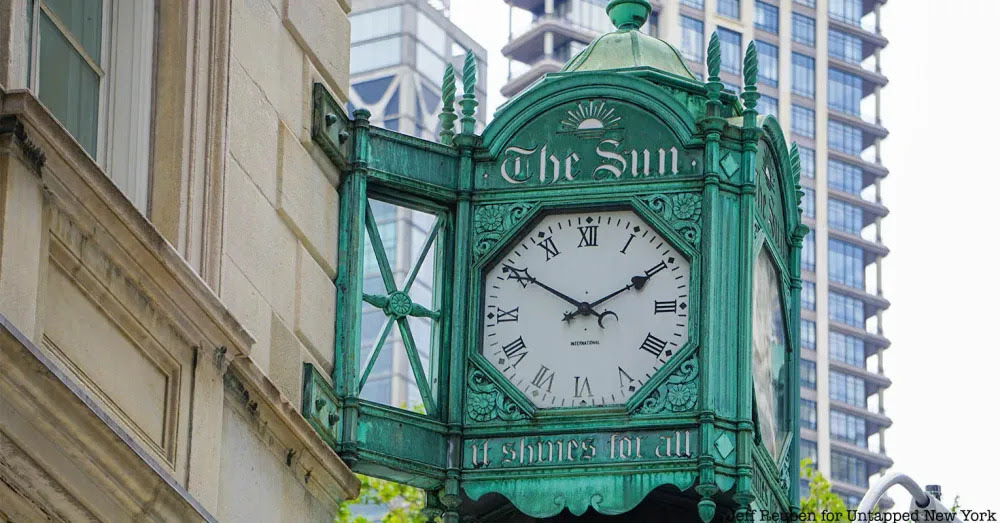
Located at 280 Broadway, The Sun newspaper’s former headquarters features a large clock and thermometer projecting from the facade of the building. The clock is inscribed with the paper’s name and motto: “It Shines for All.”
For those who don’t know, The Sun was a New York newspaper that was published from 1833 until 1950. It was the conservative rival to The New York Times and the New York Herald Tribune. Costing just one penny to purchase, The Sun was the first newspaper to report on crime and stories of ordinary citizens, making it a popular newspaper choice for the working class. Today, its former headquarters serves as the central offices for the New York City Department of Buildings. Originally, however, it housed the A.T. Stewart dry goods emporium, regarded as the first department store in New York. The Sun building is just one example of the many former locations of newspaper headquarters in New York City. It’s also full of many interesting and historical secrets, which you can read here.
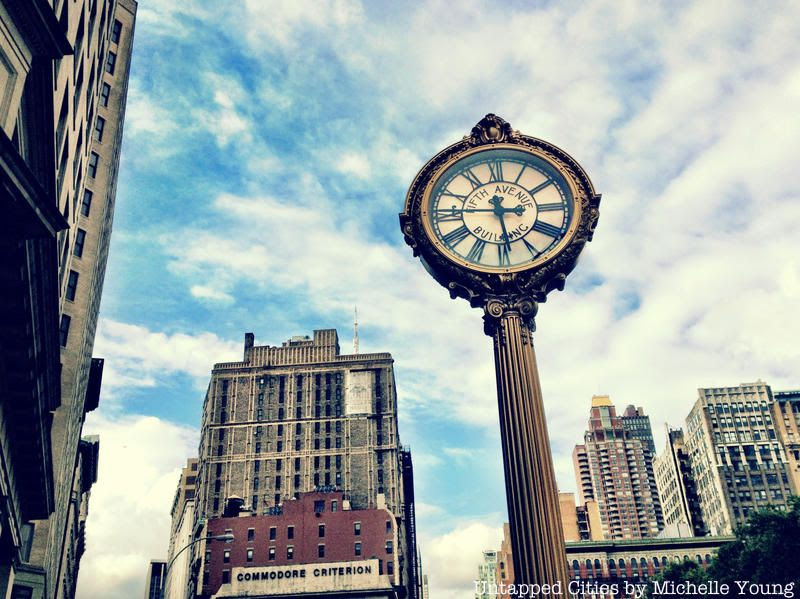
Located directly in front of New York City’s beloved Eataly, a decorative cast-iron sidewalk clock is situated next to a subway entrance, a newsstand, a telephone booth, a mailbox, lamppost, and numerous planters. The clock was manufactured by Hecla Iron works and is composed of an ornamented base and an Ionic column. Roman numerals on its face are also framed by wreaths of oak leaves and crowned by a cartouche.
Many people easily walk past this clock on a daily basis, but it’s been a fixture in the neighborhood since 1909, when it replaced an earlier clock that had accompanied the elegant Fifth Avenue Hotel. In an effort to preserve the historic importance and artisanship of cast-iron clocks, the city designated the clock an individual landmark in 1981. It’s one of seven sidewalk clocks designated as such. Three other ones are in Manhattan – in front of the Sherry Netherland Hotel, at 1501 Third Avenue and at 522 Fifth Avenue. There are also two in Queens, one at 16-11 Jamaica Avenue, thought to have been installed by Busch’s Jewelers and a Wagners Jewelers Clock at 30-78 Steinway Street. Lastly, there’s one in Greenpoint, the Bomelsteins Jewelers clock, at 753 Manhattan Avenue
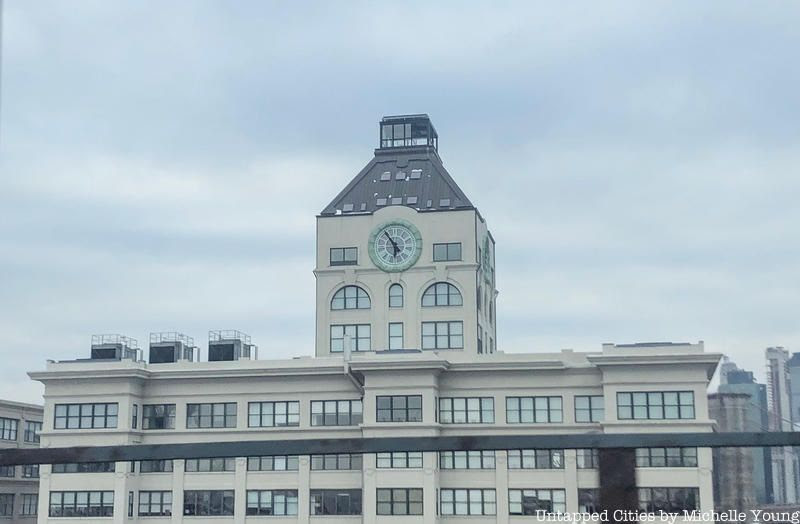
Located at the top of the 124-condominiums are four giant clocks, designating the residential building to be named “The Clock Tower.” Located in DUMBO, the tower is known for its iconic architectural qualities and the sweeping, unobstructed views it provides for its residents.
The clock tower was originally built in 1914 and received a total conversion in 1998. One of its most notable features is the penthouse at the top of the building, with transparent four 14-foot windowed working clocks surrounding the living area. The penthouse closed for $15 million last year, which earned itself the title of being the most expensive condominium sale ever in the borough.
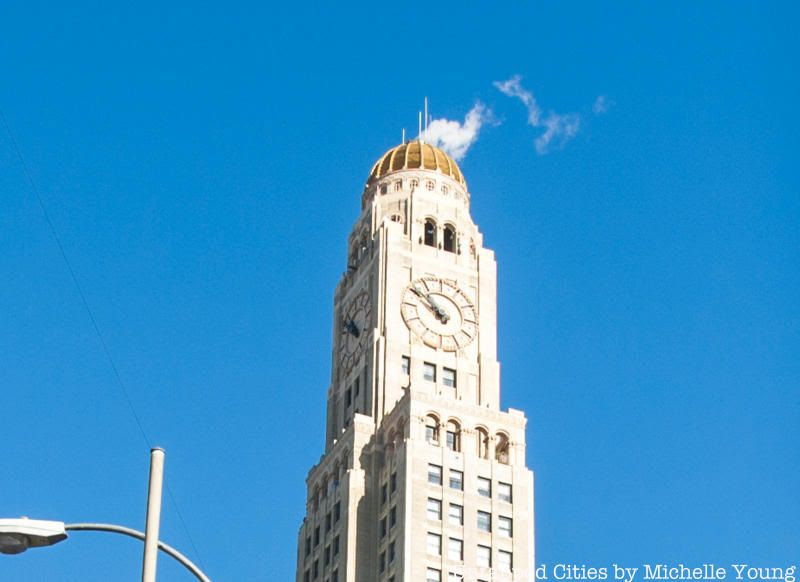
Built in 1927, the Williamsburgh Savings Tower is one of Brooklyn’s architectural icons due to its clocks located at the top of the building. The structure itself is among the tallest four-sided clock towers in the world, with each of the clock faces measuring 17 feet in diameter. At the time of their installation, they were the largest clock faces in the world, and the building was the tallest building in the borough — titles that have now been surpassed.
Originally built as the new headquarters for the Williamsburgh Savings Bank, the building has since been converted to luxury condominium apartments. It was declared a New York City landmark in 1977, and its clocks continue to make it one of the most recognizable towers in Brooklyn.
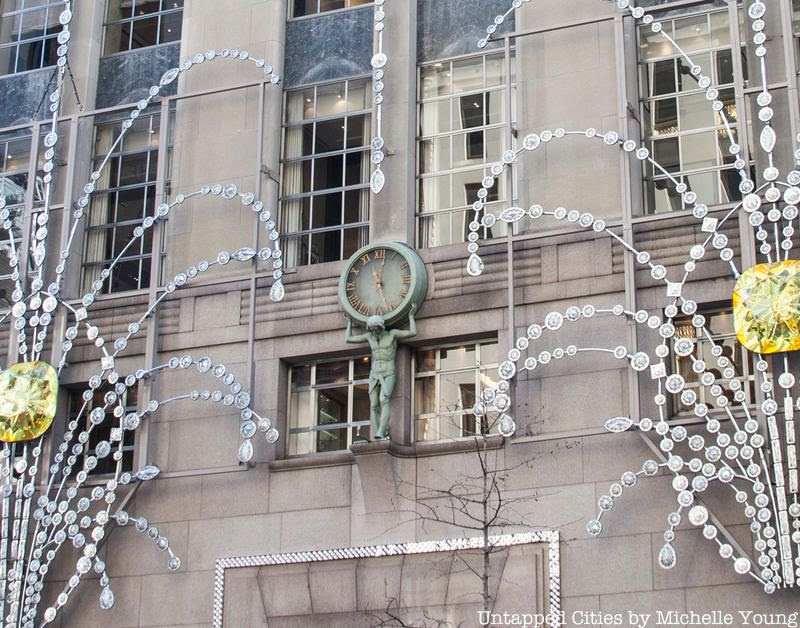
Another example of a major player in the golden age of Manhattan’s jewelry, Tiffany & Co. lured customers in with its decorative entrances. In 1853, the company built an impressive new building at 550 Broadway embellished with a beautiful clock.
To create the piece, Charles Tiffany commissioned dear friend and renowned sculpter, Henry Frederick Metzler. Standing at nine feet in height and four feet in diameter, the clock is held up by Atlas, the Greek Titan God and known as the bearer of the heavens. Over time, as Tiffany & Co. moved flagship locations, it transported the clock with them. Finally in 1940, Tiffany & Co. moved to their famous location on Fifth Avenue, and the sculptural clock continues to reside there today.
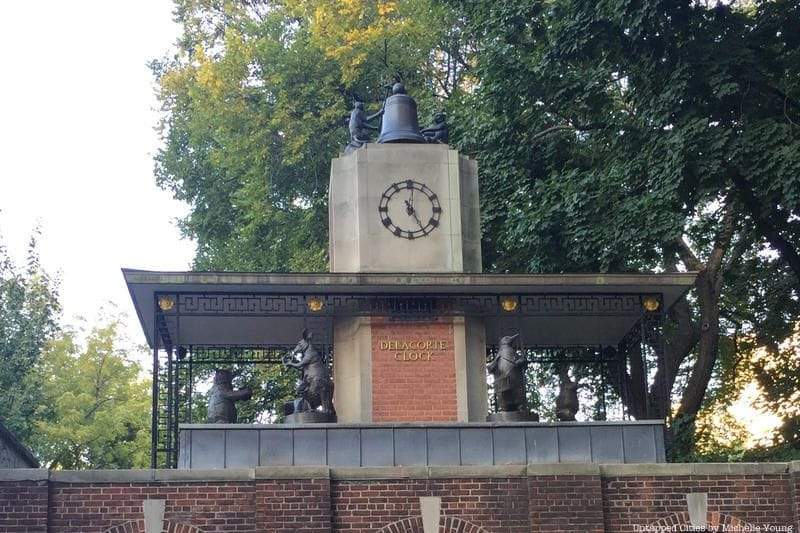
Located above the arcade between the Wildlife Center and the Children’s Zoo, Central Park Zoo’s iconic timepiece known as the Delacorte Clock has established itself as one of the most beloved monuments within the green space. The clock is dedicated to George T. Delacorte, the publisher and philanthropist who gifted the fixture to the park in 1965.
Everyday between 8am and 6pm, the digitally programmed clock plays one of thirty-two nursery rhyme tunes on the hour. It also features sculpted animals, including a penguin, kangaroo, bear, elephant, goat, and hippo that parade around the clock. Additionally, two sculpted monkeys with mallets strike the bell on the hour. The full list of songs, which can be seen here, are divided into four seasonal categories; Christmas songs, for instance, are programmed to play from December 1-25. For more fun facts and secrets of the Central Park Zoo, click here.
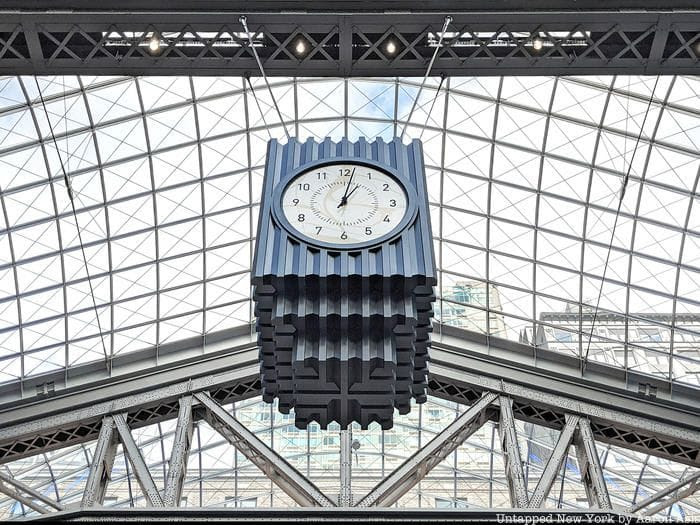
At the center of Moynihan Train Hall’s 255,000-square-foot atrium hangs an Art Deco clock designed by Peter Pennoyer Architects. It serves as an homage to the original Penn Station’s concourse clock and the beloved opaline-faced clock in Grand Central Terminal.
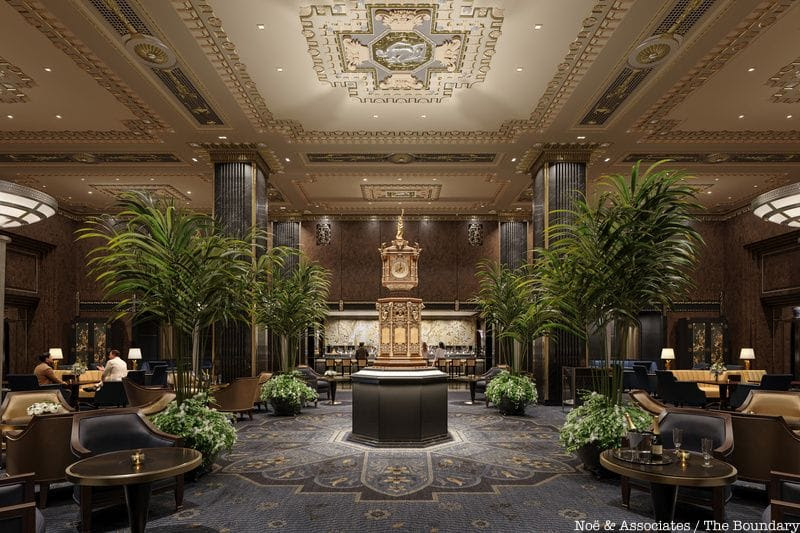
Queen Victoria commissioned this stunning clock to show off fine English craftsmanship at the 1893 World’s Columbian Exposition (akak The Chicago World’s Fair). John Jacob Astor IV later purchased the clock for display in the original Waldorf-Astoria Hotel on Fifth Avenue and 34th Street. It moved to the current Waldorf Astoria in 1931. During hotel renovations and its conversion into condomoniums, the famous clock underwent an extensive year-long restoration of its own and made a brief appearance at The New York Historical. Now that the hotel is once again open for bookings, guests can see the clock inside.
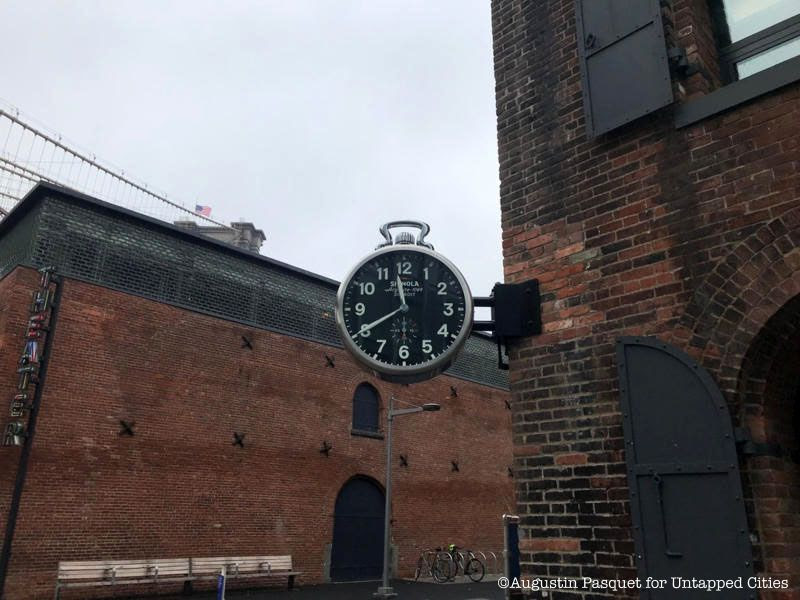
Although this is one of the newer clocks we’ve spotted around New York City, we appreciated the design and thought it was worth special mention. You can find the double sided, personalized time piece mounted on the outside of Shinola, a Detroit-based watch and accessories store located within the Empire Store’s waterfront shopping complex in DUMBO. Shinola also has another location in Tribeca.
Shinola has all of its clocks custom made by Electric Time Company, a legendary company in Medfield, Massachusetts. Originally founded in 1928, Electric Time Company is currently a manufacturer of tower and street clocks marketed worldwide. Its products can be found anywhere from New York City to the Magic Kingdom in Disney World, with each clock designed and installed on the premises of the location. They’re made to order and usually take up to three months to complete.
OUR QUEENS BUS ROUTES
WE HAVE POSTED THE NEW ROUTE MAPS ON THE BACK OF THE CHAPEL BUS SHELTER
TO SEE INDIVIDUAL ROUTE DETAILS GO TO:
https://www.mta.info/schedules/bus/queens
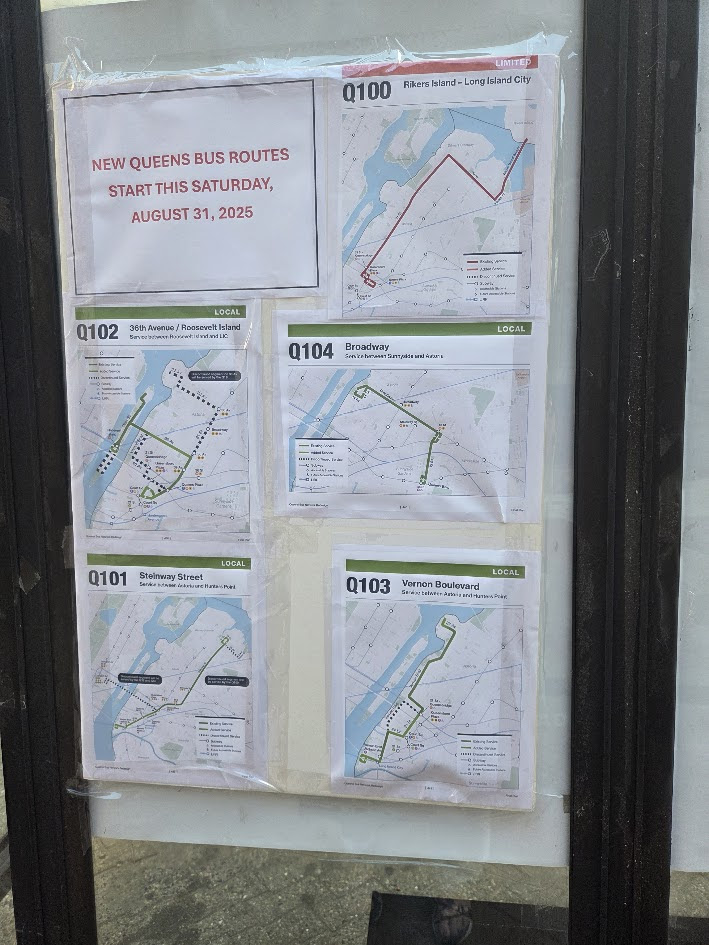
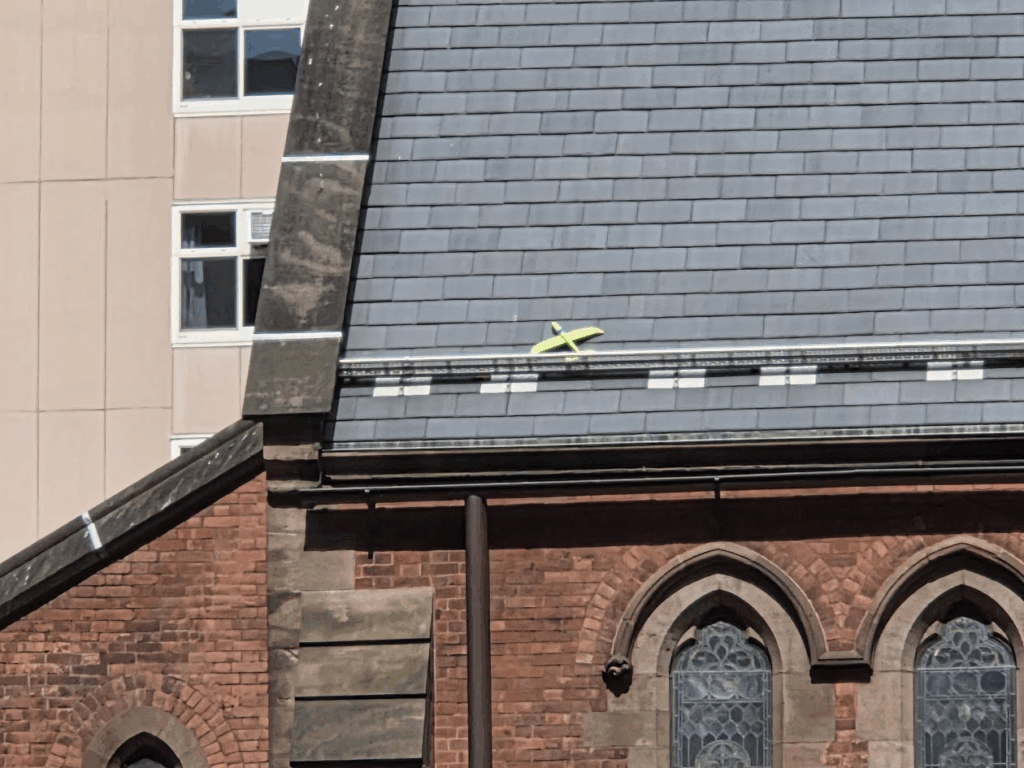
PHOTO OF THE DAY
PLANE LANDS ON CHAPEL ROOF
NO DAMAGE REPORTED
Credits
UNTAPPED NEW YORK
ALYSSA CIARDI
JUDITH BERDY
All image are copyrighted (c) Roosevelt Island Historical Society unless otherwise indicated
THIS PUBLICATION FUNDED BY DISCRETIONARY FUNDS FROM CITY COUNCIL MEMBER JULIE MENIN & ROOSEVELT ISLAND OPERATING CORPORATION PUBLIC PURPOSE FUNDS.


Copyright © 2025 Roosevelt Island Historical Society, All rights reserved.Our mailing address is:
rooseveltislandhistory@gmail.com
Leave a comment