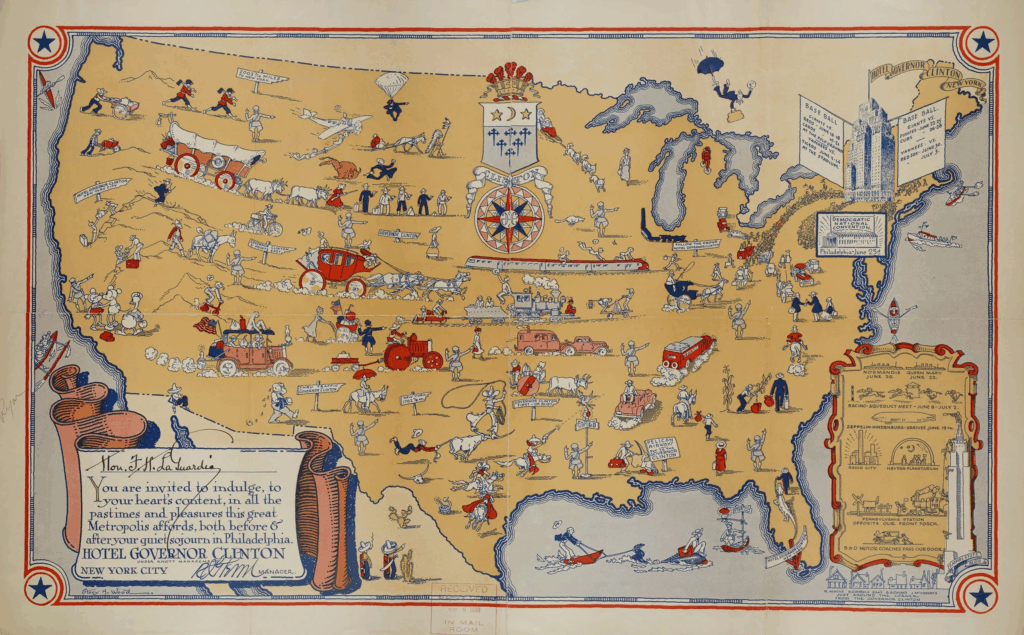
In a continuing series of articles highlighting unusual or unexpected items found in Municipal Archives or Library collections, this week For the Record features a delightful pictorial map created by artist Stacy H. Wood.
Hotel Governor Clinton map, by Stacy H. Wood, 1936. Mayor LaGuardia papers, NYC Municipal Archives.
Measuring 18 by 28.5 inches, the map depicts the United States decorated with clever cartoon figures and illustrations. It had been sent to Mayor Fiorello LaGuardia from the Hotel Governor Clinton, located on Seventh Avenue and 32nd Street in Manhattan. The Mayor’s mail room clerk date-stamped it received on June 9, 1936.
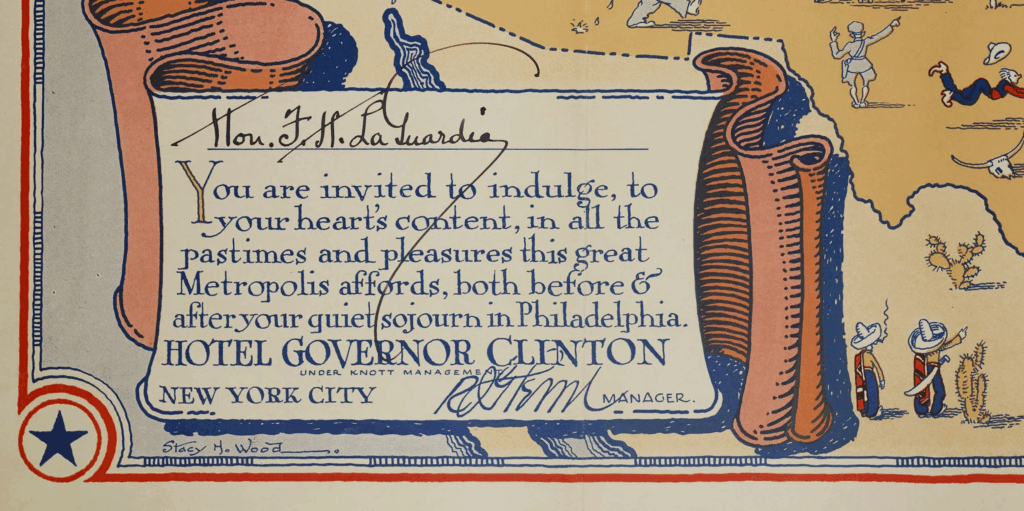
The purpose of the map is not entirely clear but seems to relate to the Democratic National Convention that would take place in Philadelphia on June 23, 1936. The legend on the lower left portion of the map is a message to Mayor LaGuardia: “You are invited to indulge, to your heart’s content, in all the pastimes and pleasures this great Metropolis affords, both before & after your quiet sojourn in Philadelphia.” And to that end, the map provides useful information about New York City events such as the dates for upcoming baseball games, arrival of ocean liners S.S. Normandie and Queen Mary, and the Zeppelin Hindenburg. It also helpfully notes the Hotel’s proximity to Radio City, the Hayden Planetarium, and Pennsylvania Station, as well as department stores, Macy’s, Gimbel’s, Saks, and B. Altman
City archivists came across the pictorial map in “Mayor LaGuardia Oversize Box #1.” In accordance with processing procedures, items that are too large to fit in half-cubic foot archival containers are “separated” from their original locations and placed in enclosures appropriate to their size. In place of the removed item, the processing archivist substitutes a “separation sheet” that provides a brief description of the item, date removed, and the new location.
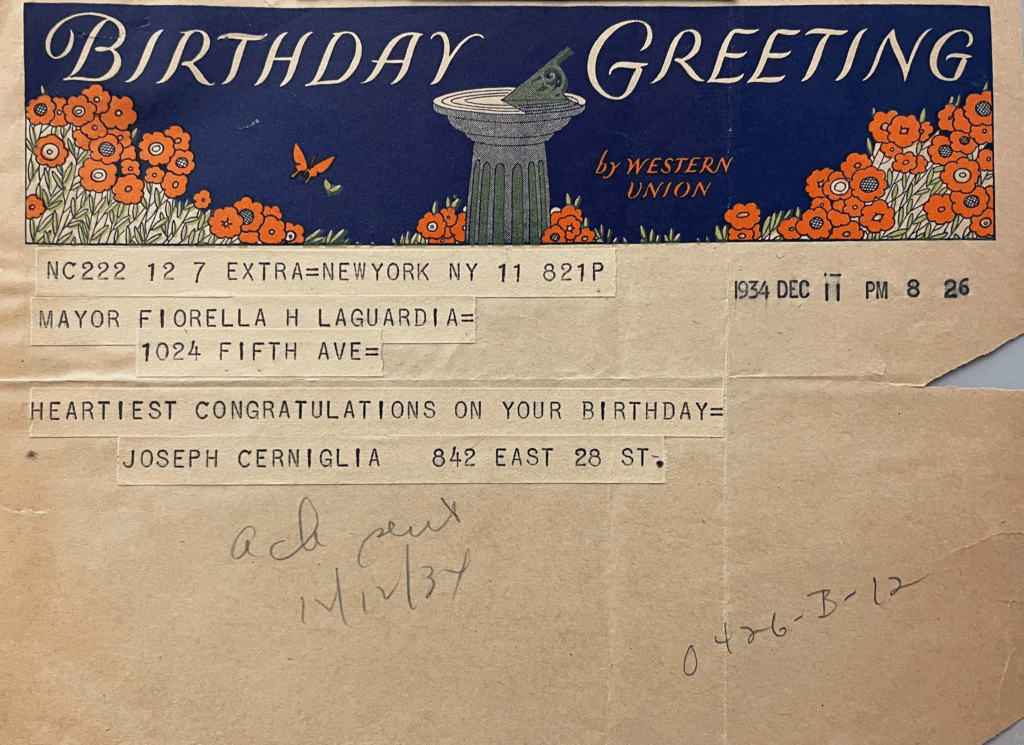
The separation sheet attached to the poster indicated that it had been originally filed in LaGuardia’s subject series in a folder labeled “Favors, Requests for, 1936-37.” Examination of the folder contents, and others similarly labeled, revealed an eclectic assortment of items. As one would expect, there are numerous letters to the Mayor (and/or his assistants) asking for help in obtaining jobs or other services. For example, on October 6, 1937, G. W. Cahan, of the Greenwood Lakes Estates Co. wrote to LaGuardia’s aide Stanley Howe asking for an introduction to Sanitation Commissioner William Carey, “… as I have an interesting proposition I would like to take up with him.” But it also contained other seemingly random objects such as a birthday greeting to the Mayor in the form of a colorful Western Union telegram.
Western Union telegram, 1934. Mayor LaGuardia papers, NYC Municipal Archives.
Most of the correspondence consists of the incoming letter and a carbon copy of the Mayor’s response. For the pictorial map there was neither a cover letter, nor a response. Perhaps the LaGuardia’s clerks decided that the poster’s legend inviting him to “indulge … in all the pastimes and pleasures of this great metropolis” constituted a request for a favor.
Hotel Governor Clinton map (detail), by Stacy H. Wood, 1936. Mayor LaGuardia papers, NYC Municipal Archives.
The serendipitous discovery of the pictorial map points out one of the limitations of archival description practices. Typically, archivists processing voluminous collections such as mayoral correspondence use the original record-creators’ identifications to describe folder contents, in this instance, “Favors, Requests For.” Item-level processing is generally not practical. It is unlikely that researchers interested in the work and career of the artist, Wood, would think of municipal government records as a possible venue for information. And even if they did, the “Favors, Request for” folder would not be an obvious source.
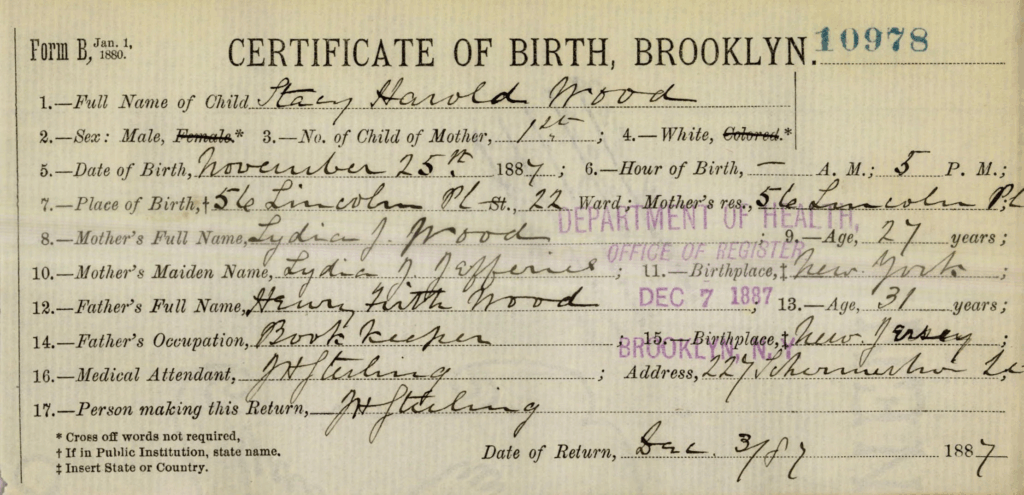
Brooklyn birth certificate for Stacy H. Wood, 1887. Historical Vital Records collection, NYC Municipal Archives.
Nevertheless, this work by the illustrator Stacy H. Wood is in the collection. An online search resulted in only minimal biographical information. He is described as an American children’s book illustrator and graphic artist active in New York during the first half of the 20th Century. Born in Brooklyn in 1887, he studied at Amherst, the Pratt Institute, and the Art Institute of Chicago. Among other cited works are other pictorial maps including one of the United States for the Boy Scouts of America 1935 Jamboree. Wood died on June 10, 1942, in Mt. Vernon, N.Y.
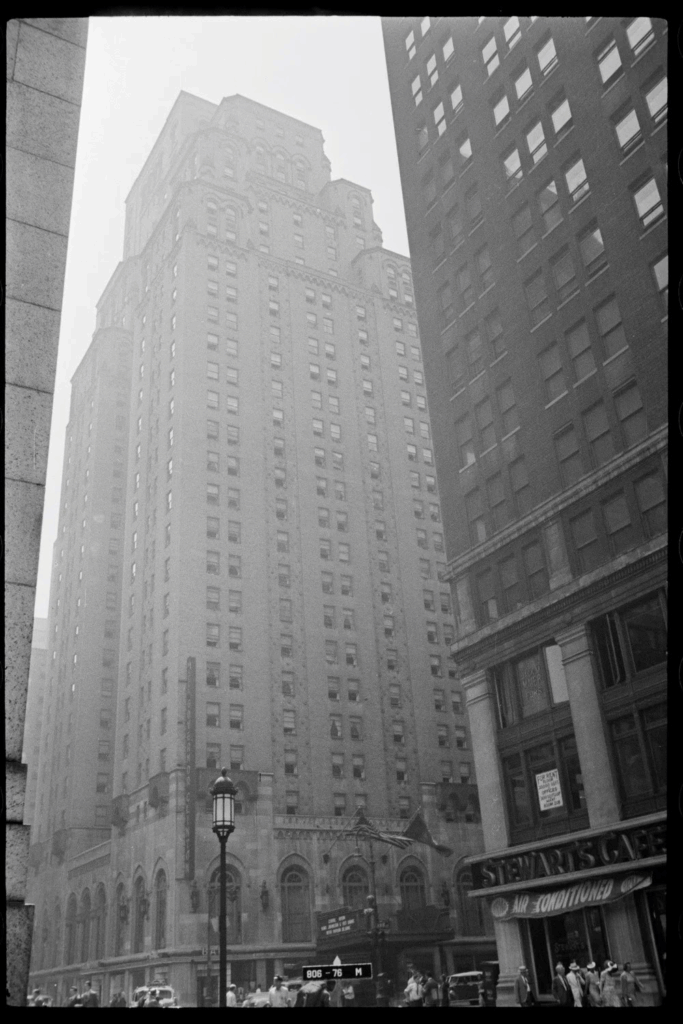
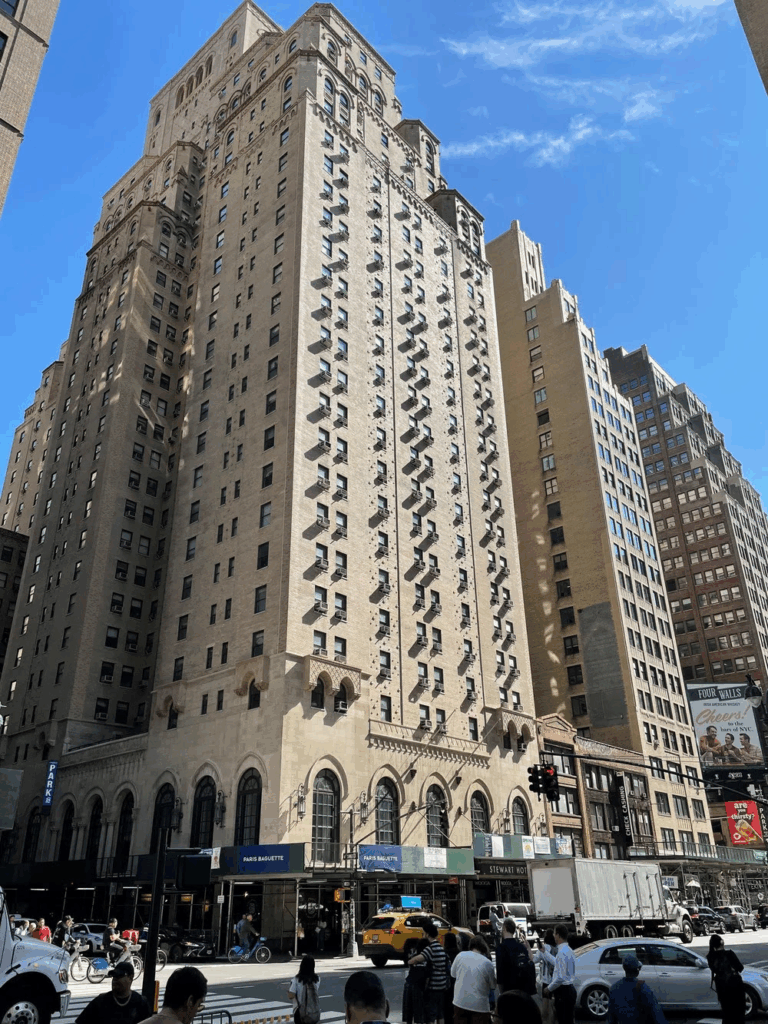
And the Hotel Governor Clinton? Renamed the Hotel Stewart at some point, it still stands today, a handsome example of Art-Deco-era construction in Manhattan. For interested researchers, the Manhattan Building Permit and Plan collections in the Archives would serve to trace its history beginning with the new building application filed on December 28, 1927, by architects Murgatroyd and Ogden. Subsequent applications document alterations and modifications through the 1970s. More recent reports indicate the building may be slated for residential conversion.
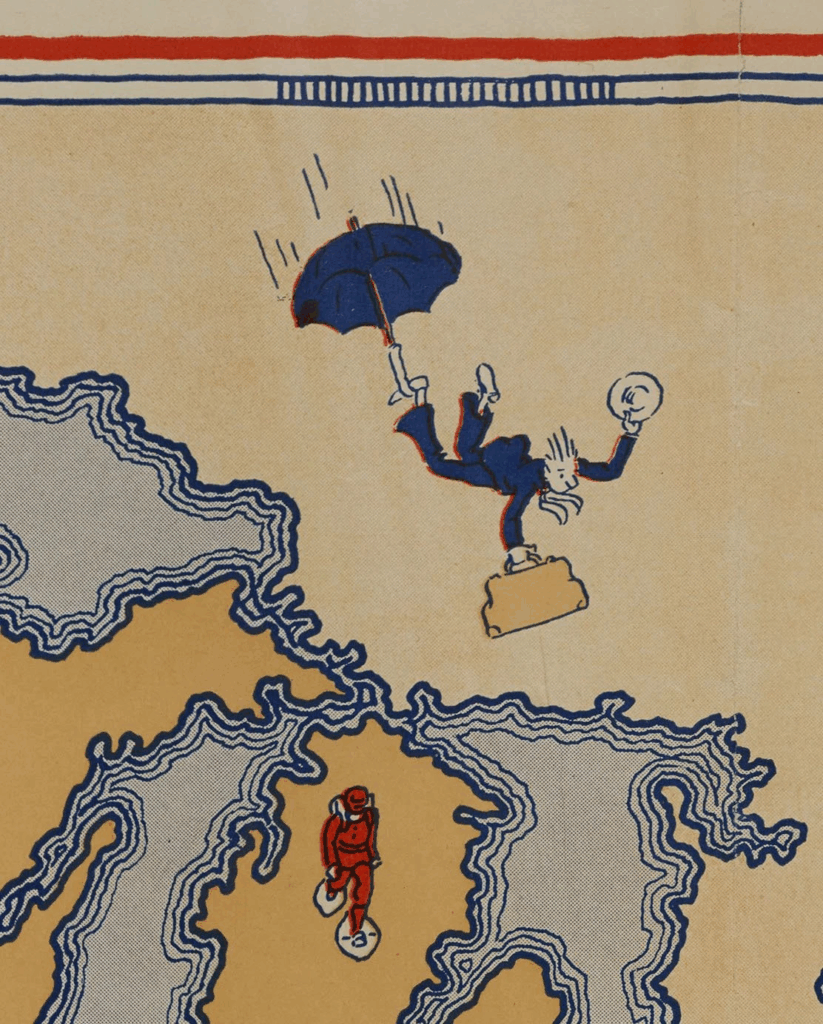
Now that we have “found” the artist Stacy H. Wood, readers are invited to take a closer look at his work. But be forewarned, you will need some time—there is a lot going on in this picture!
Hotel Governor Clinton map (detail), by Stacy H. Wood, 1936. Mayor LaGuardia papers, NYC Municipal Archives.
Hotel Governor Clinton, ca. 1939. Tax Photograph collection, NYC Municipal Archives.
Hotel Governor Clinton, ca. 1939. Tax Photograph collection, NYC Municipal Archives.
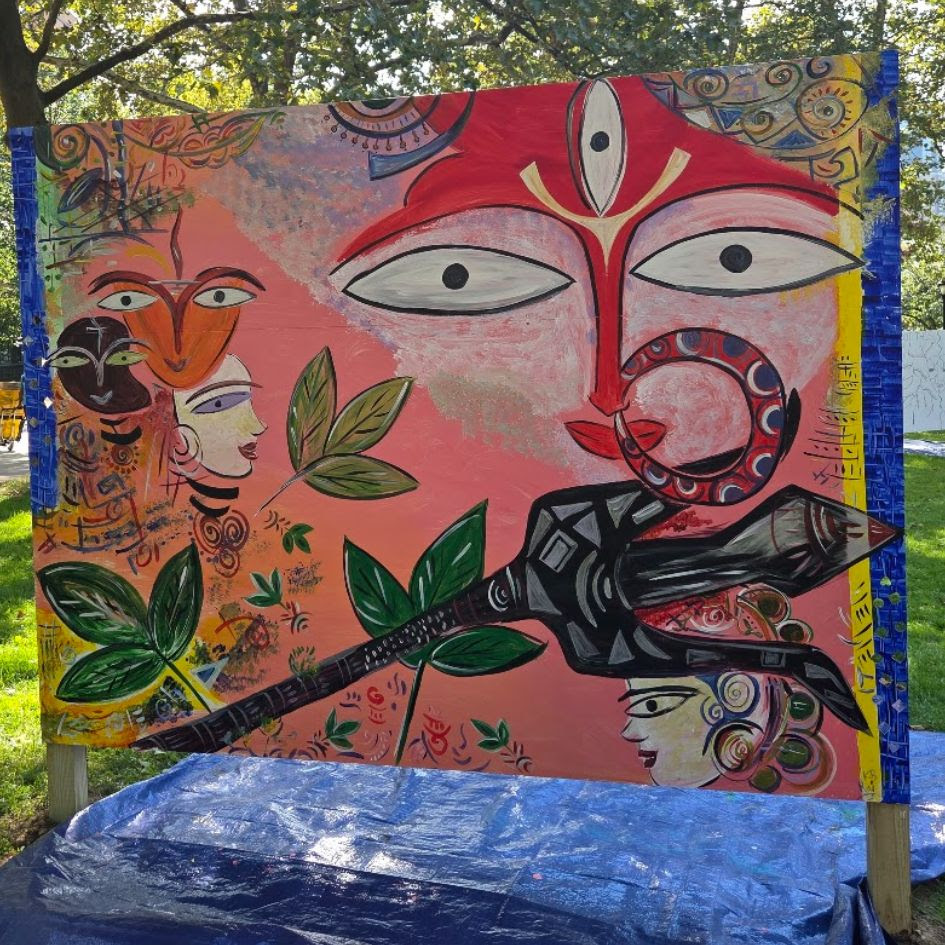
FALL FOR ARTS NOW ON AT RIVERCROSS LAWN
CREDIT TO
NEW YORK CITY MUNICIPAL ARCHVES
All image are copyrighted (c) Roosevelt Island Historical Society unless otherwise indicated THIS PUBLICATION FUNDED BY DISCRETIONARY FUNDS FROM CITY COUNCIL MEMBER JULIE MENIN & ROOSEVELT ISLAND OPERATING CORPORATION PUBLIC PURPOSE FUNDS.
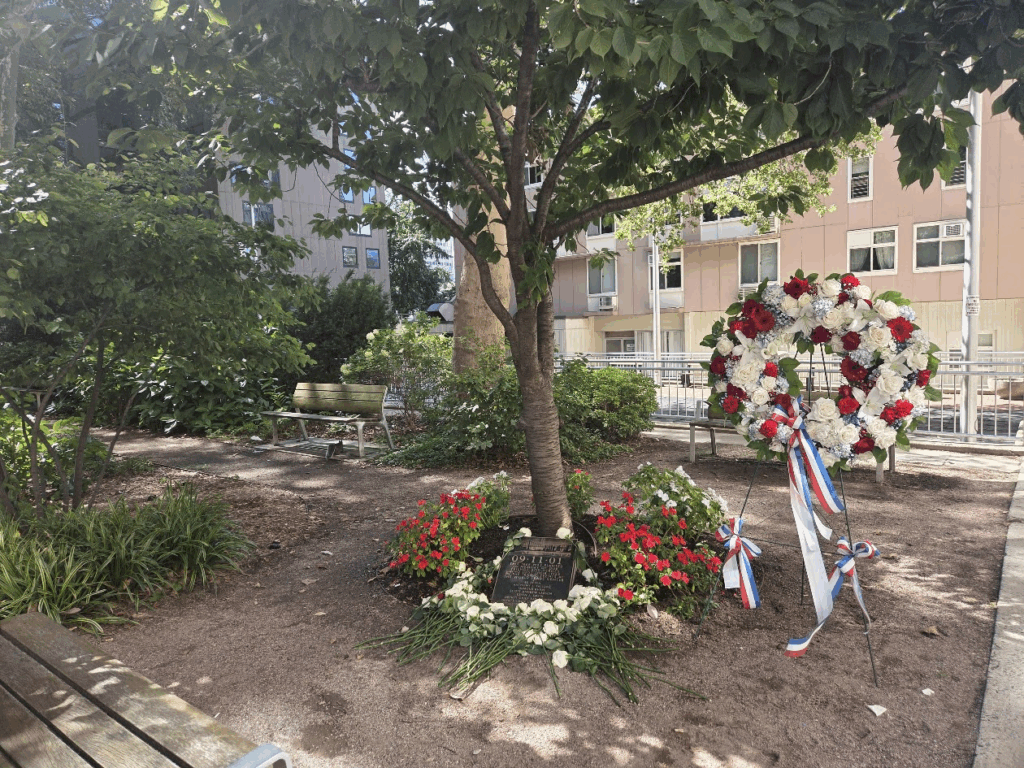
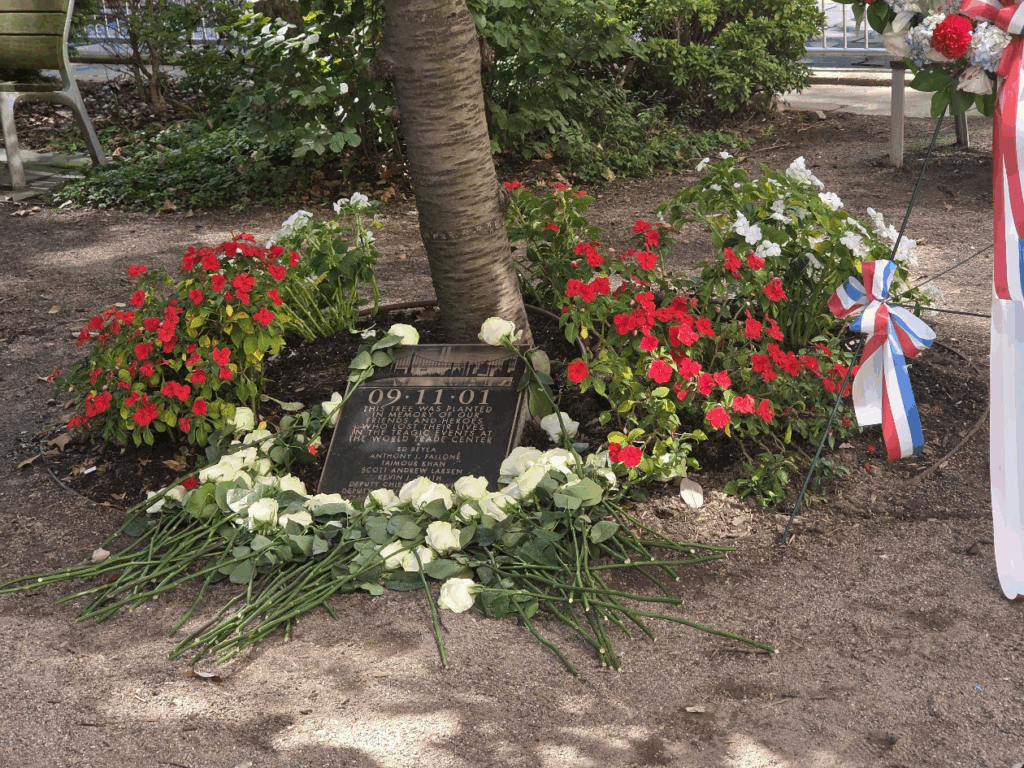
Floral wreath and white roses placed at the 9/11 Roosevelt Island Memorial
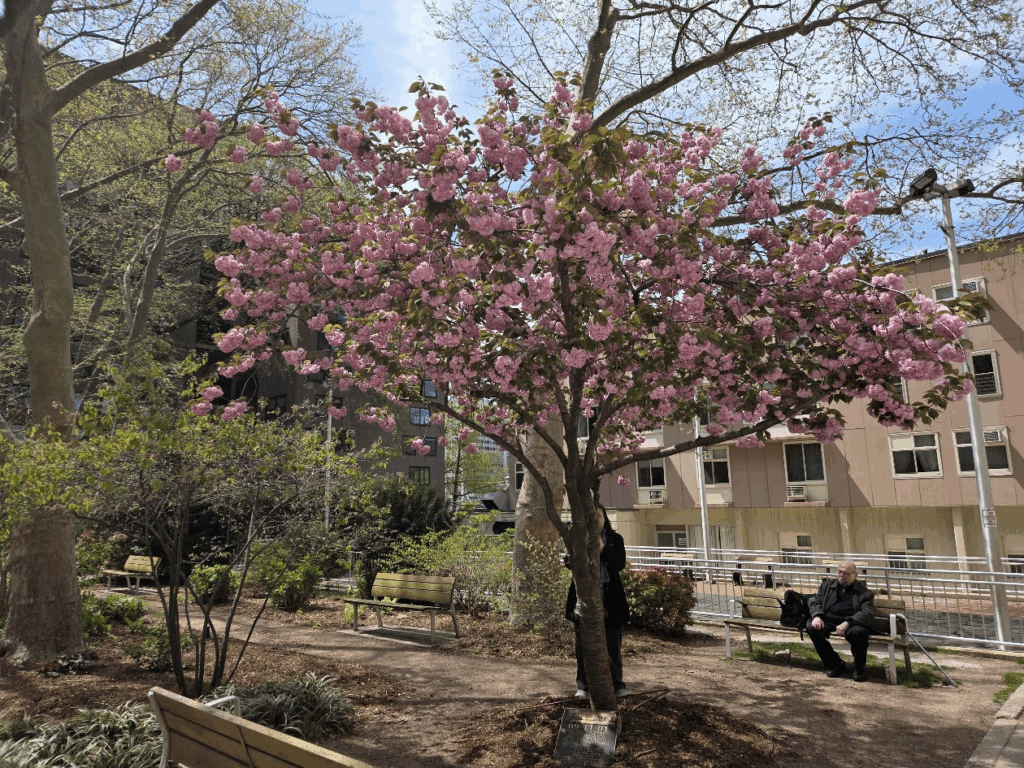
The plaque was a community inspiration with residents heading the campaign for the plaque and tree including islanders Vicki Feinmel and Margie Smith.
Everty spring the tree bursts with blooms.
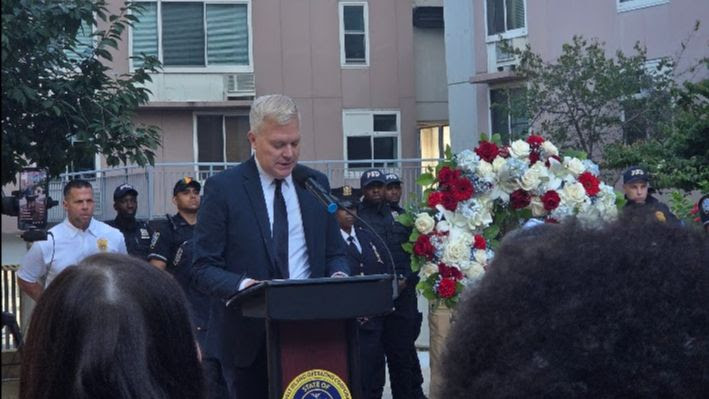
B,J. JONES Acting RIOC President and CEO addressing the audience.
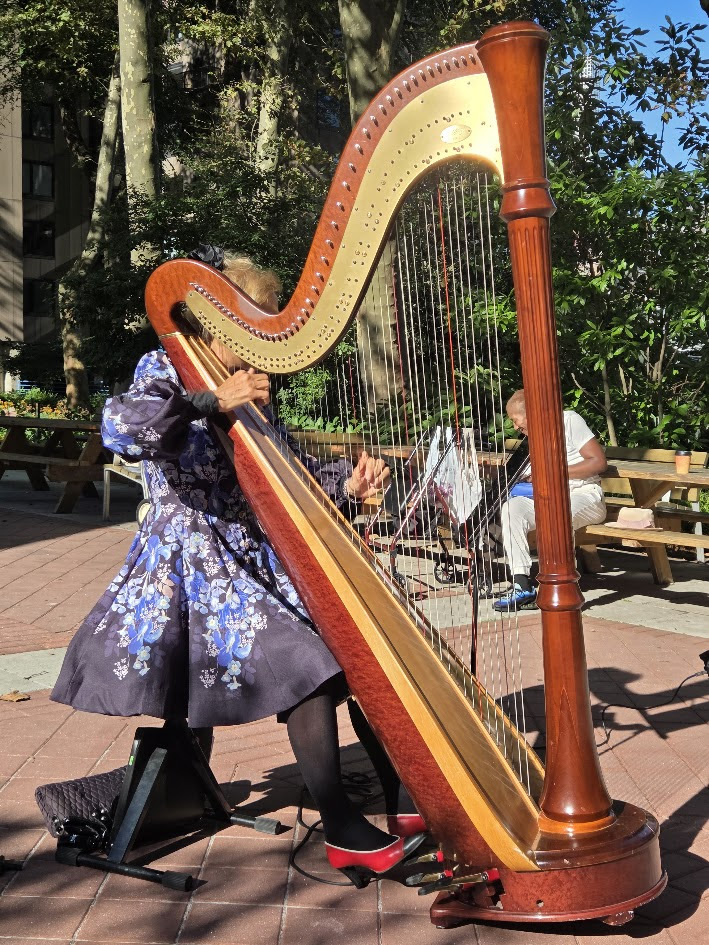
A splendid harpist performed as part of the ceremony.
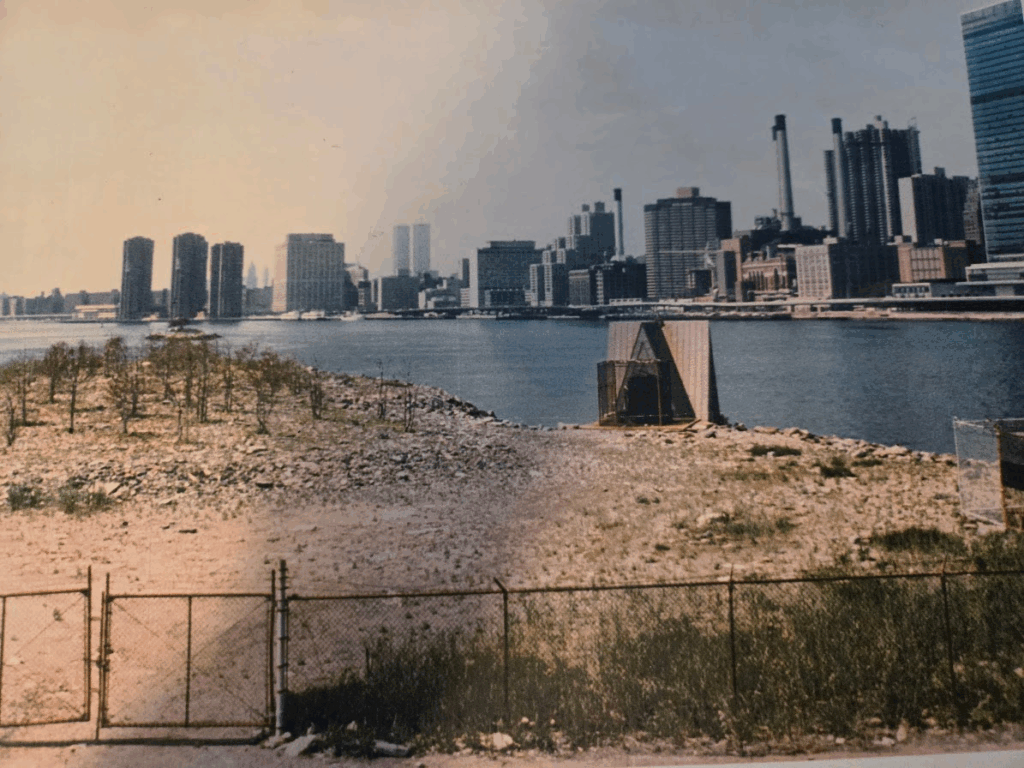
THE TWIN TOWERS FROM THE SOUTHPOINT WITH THE DELACORTE GEYSER IN THE 1980’S
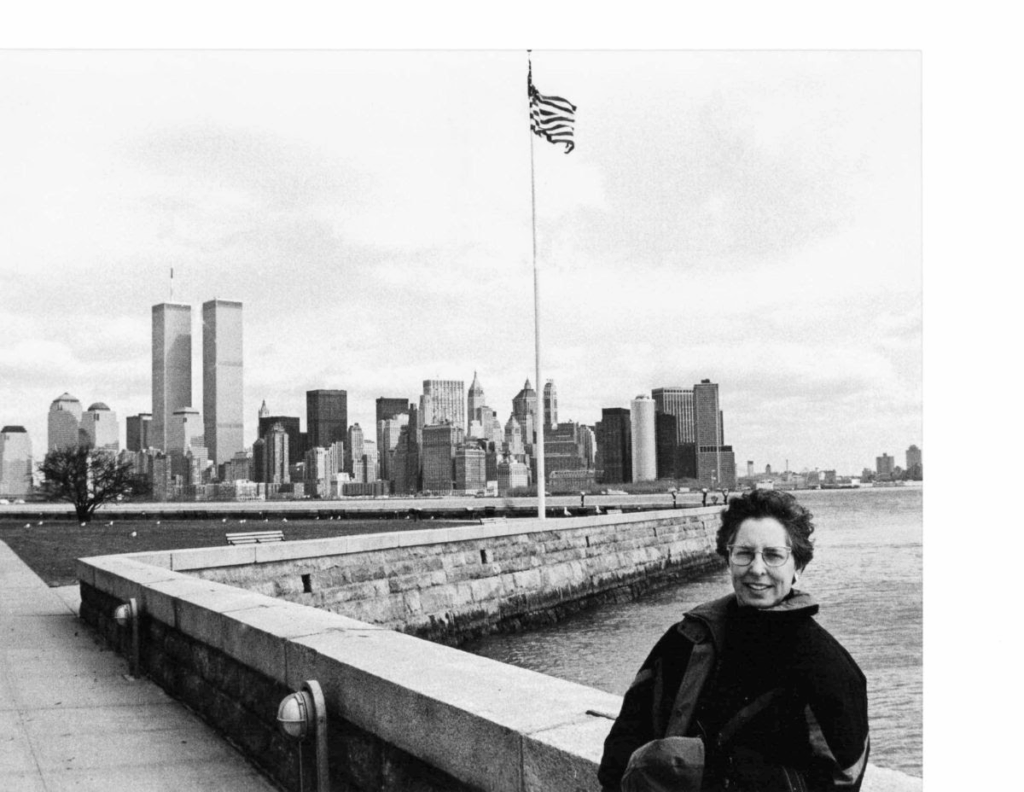
ON A WINDY WINTER DAY
At Ellis Island in 1998. Photo by Phillip Carvalho
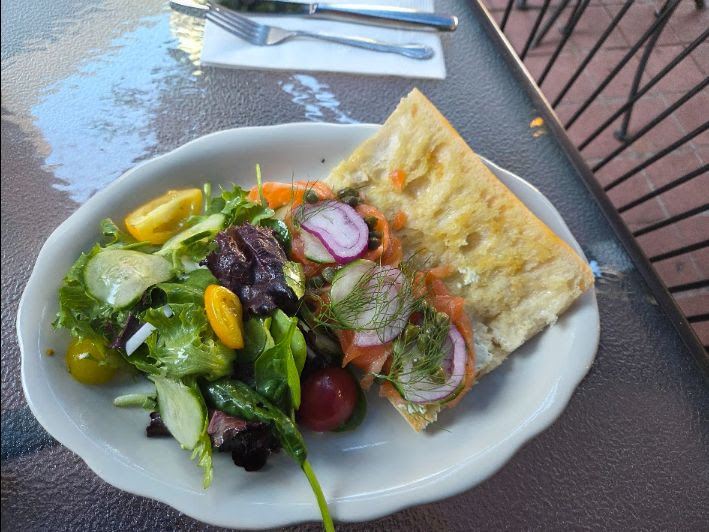
NEW EXPANDED MENU AT NISI GRILLED CHEESE IS BACK! A DELICIOUS SMOKED SALMON ON BAGUETE IS YUMMY. NEW MENU AVAILABLE UNTIL 4 P.M.
Credits
JUDITH BERDY PHILLIP CARVALHO
All image are copyrighted (c) Roosevelt Island Historical Society unless otherwise indicated THIS PUBLICATION FUNDED BY DISCRETIONARY FUNDS FROM CITY COUNCIL MEMBER JULIE MENIN & ROOSEVELT ISLAND OPERATING CORPORATION PUBLIC PURPOSE FUNDS.
Ai Wei wei debuts Camouflage at the FDR Four Freedoms State Park
Wednesday, Sept. 10, 2025
Judith Berdy
Issue # 1530
Camouflage by Ai Weiwei
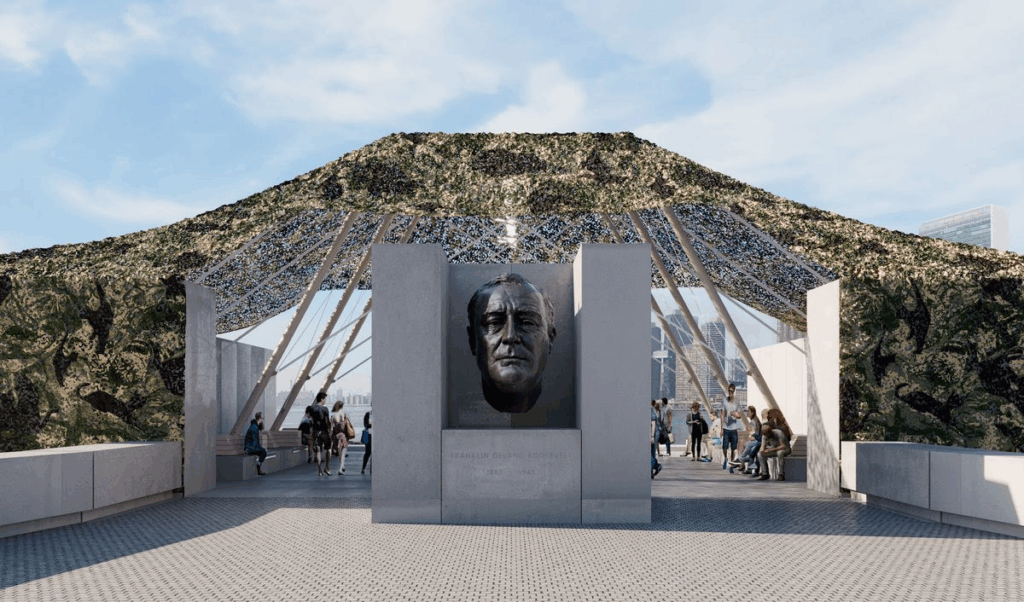
On display September 10 – November 10, 2025 The pavilion is designed with the Brooklyn-based design firm Camber Studio.
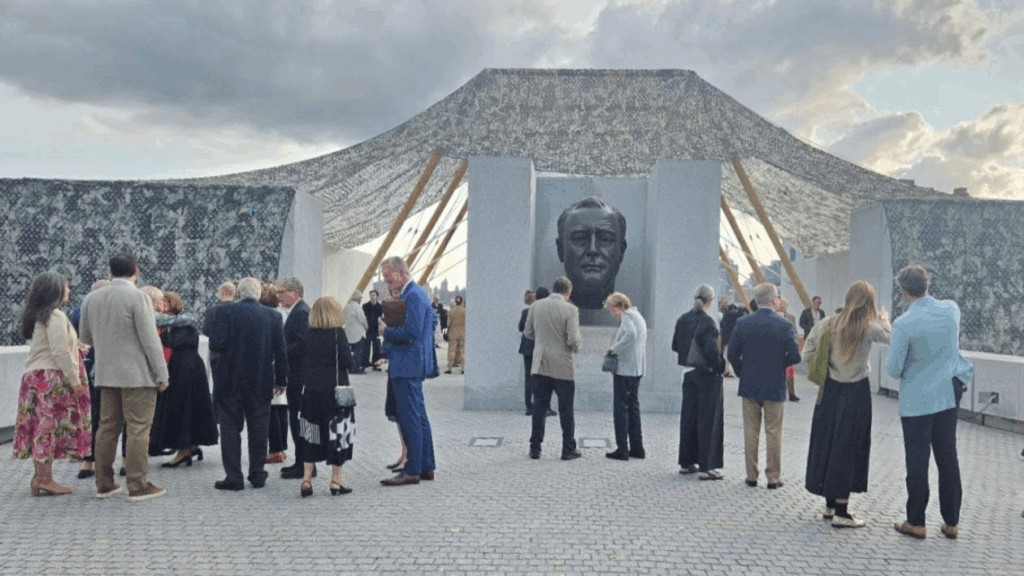
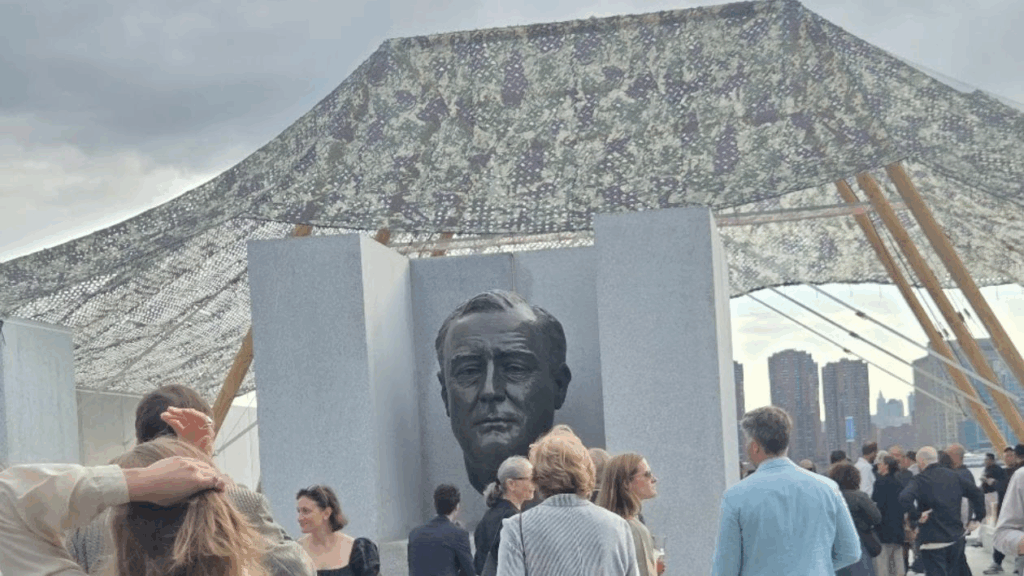
This project is based on and inspired by New York City’s Four Freedoms State Park, designed as a posthumous memorial by architect Louis Kahn to honor Franklin D. Roosevelt and his Four Freedoms. Situated on Roosevelt Island, in the East River between Manhattan and Brooklyn, the Park offers a striking view of Manhattan’s skyline and stands almost directly opposite the United Nations headquarters. The memorial spans a narrow passage approximately 200–300 meters long, centered around a statue of Roosevelt and his iconic speech on the Four Freedoms.
The concept of this project is rooted in the English term camouflage, defined in the Oxford Dictionary as both a means of disguise and concealment and as a tool for creating illusions to protect or to mislead. These dual meanings provide a compelling starting point. The installation employs camouflage as a central motif, covering the sides of the narrow passageway. Camouflage, ubiquitous in depictions of war—conflicts ignite and spread across various regions at the moment—has become a pervasive pattern across media and social platforms.
In this artwork, we reinterpret camouflage with cat patterns, replacing its traditional abstract designs. Cats, which have a sanctuary on Roosevelt Island, align seamlessly with the project’s message. Observations over time reveal that in the wake of human disasters—be it pandemics, wars, or environmental crises—animals, particularly those closely connected to humans, such as cats, often suffer profoundly. By incorporating cat patterns, the work reminds viewers that while human beings face crises of their own making, animals bear the brunt of these consequences, entirely innocent yet deeply affected.
The project explores the essence of Roosevelt’s four freedoms, beginning with freedom of speech—the fundamental right for everyone to express their understanding of goodness and justice, free from the influence of politics, religion, or economic power. It also reflects on freedom of religion, affirming that no one should dictate another’s faith or spiritual path. Freedom from want highlights the right to pursue one’s ideals, while freedom from fear takes center stage in our times. Today, fear pervades not only in war zones but even within so-called democratic societies, where uncertainty about the future renders freedom from fear a privilege, inaccessible to many.
The artwork uses the symbolic nature of camouflage to spark a dialogue about what needs protection and what requires the removal of disguise to reveal truth. This is a challenging question, but addressing it is essential.
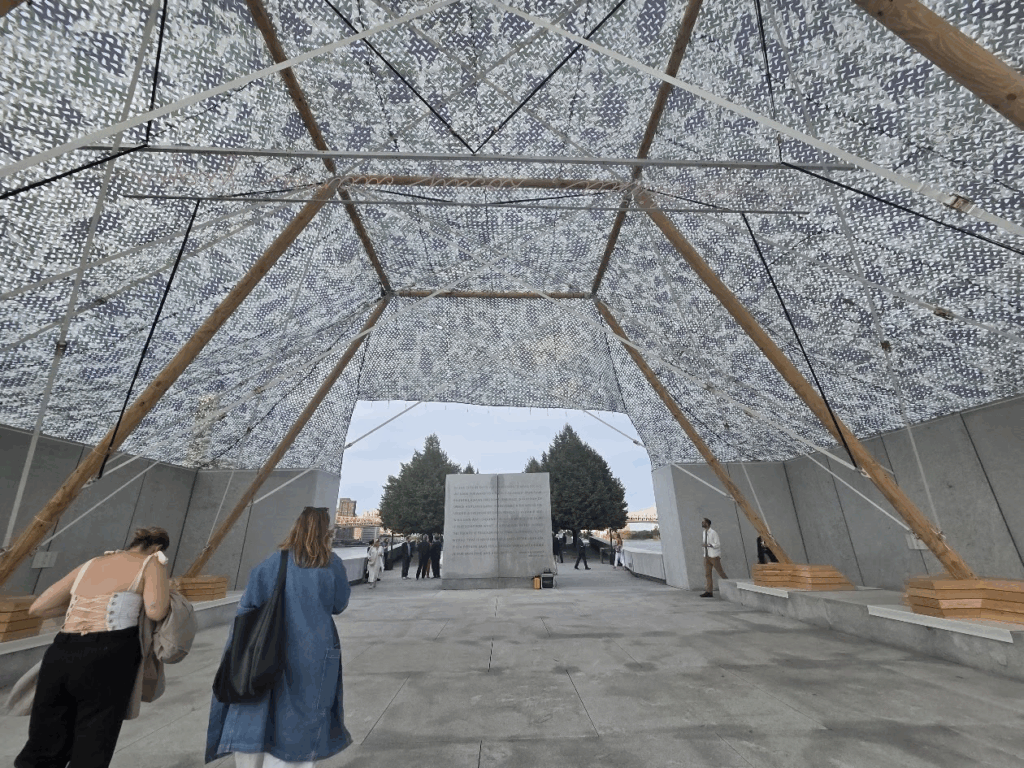
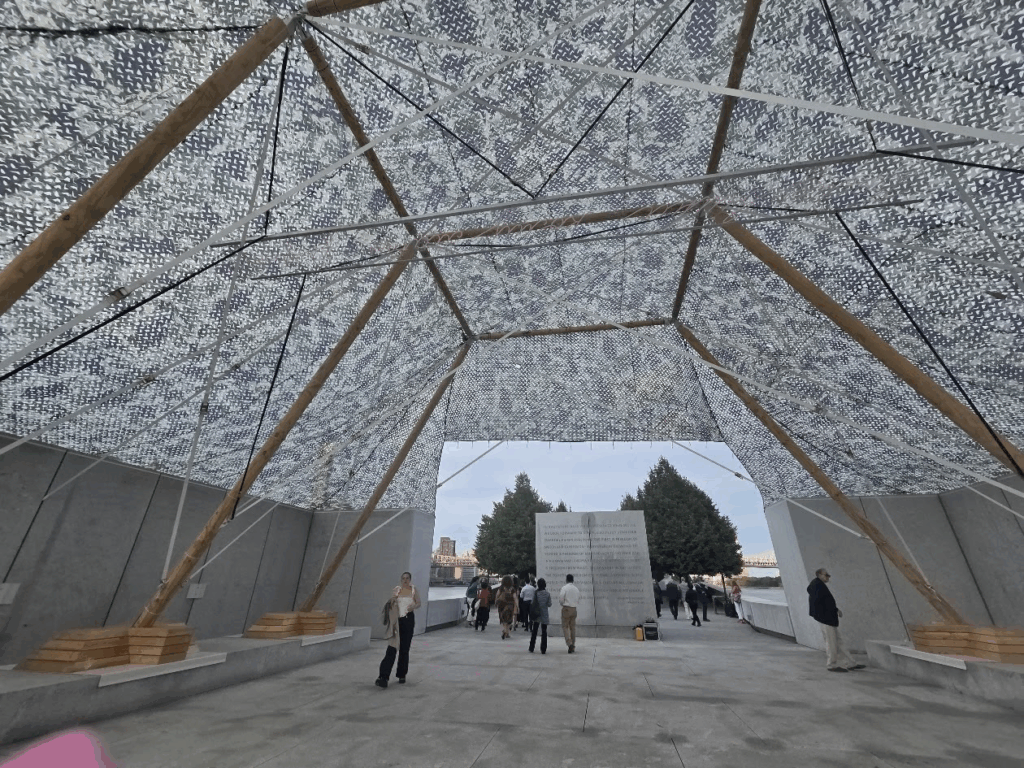
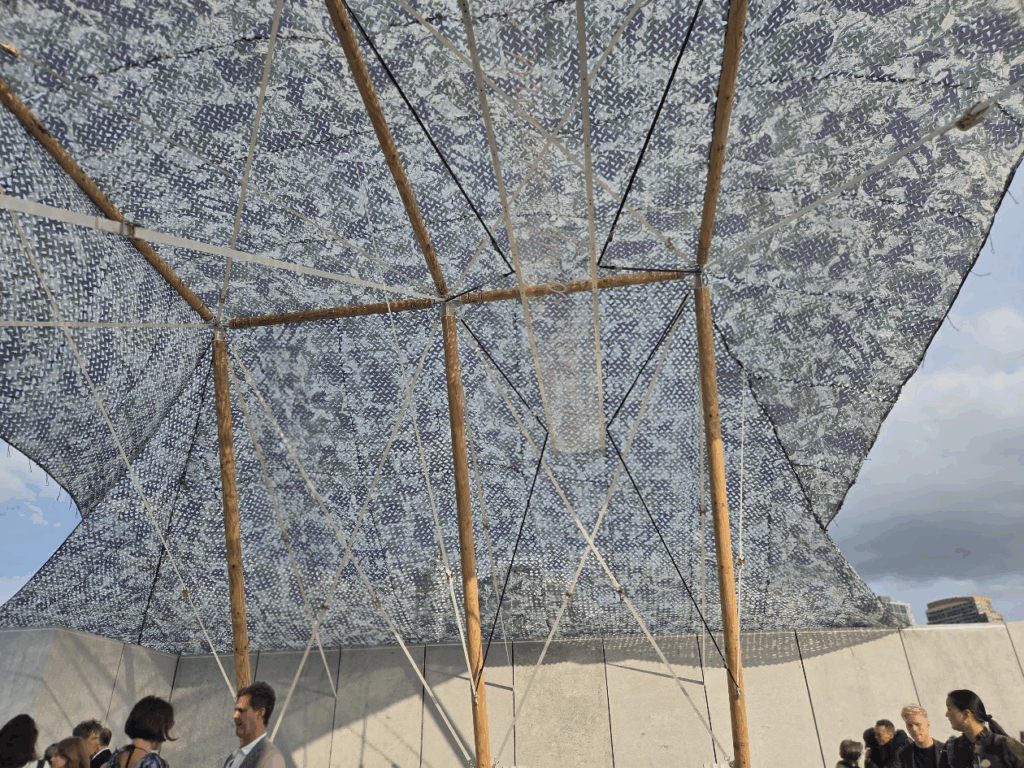
Meanwhile, we install a wooden watering frame structure at the end point of the narrow passage, draped in this camouflage. From the outside, whether viewed from New York or up close, or when the audience walks under the camouflage fabric, it resembles a battlefield. But it actually forms a pavilion-like space where people can feel the harsh and absurd reality of war.
A Ukrainian proverb, “Кому війна, кому мати рідна”, hangs from the built sanctuary structure: “For some people, war is war; for others, war is the dear mother.” In plain English, it captures the idea that for some, war is a disaster, while for others, it is an opportunity for profit. Similarly, the Chinese saying “bad luck and good fortune coexist” emphasizes the intertwined nature of misfortune and luck. Upon reflection, modern wars often arise from the pursuit of profit—but whose profit, and at what cost? How many lives must be sacrificed to achieve these gains? These are the questions we must confront.
The project incorporates public participation, encouraging visitors to print their wishes on ribbons that will be attached to the camouflage netting. This participatory element fosters greater engagement and amplifies the artwork’s message. Public involvement and awareness are integral to the essence of this work.
During the exhibition, admission to the Park will require a FREE timed-entry ticket. More information to come.
Camouflage by Ai Weiwei is commissioned by Four Freedoms Park Conservancy and the pavilion is designed with Camber Studio.
Approaching the end of the lawn and the tented area appears.
The structure is supported by giant timbers that are planted in large wooden stacks placed on the granite wall supports. More supports are strung into the walls. Though the camouflage fabic is light and airy, the supporting structure is built to support all types of wind and weather.
Nothing is better than to have kids approve of this new play area!!!
Ai Weiwei was happy to stand and great visitors. He easily chatted with the guests and told me of admiring our quiet island in the City.
Louela Streitz and I enjoyed the evening chatting with FDR, & RI staff, Cornell friends and neighbors.
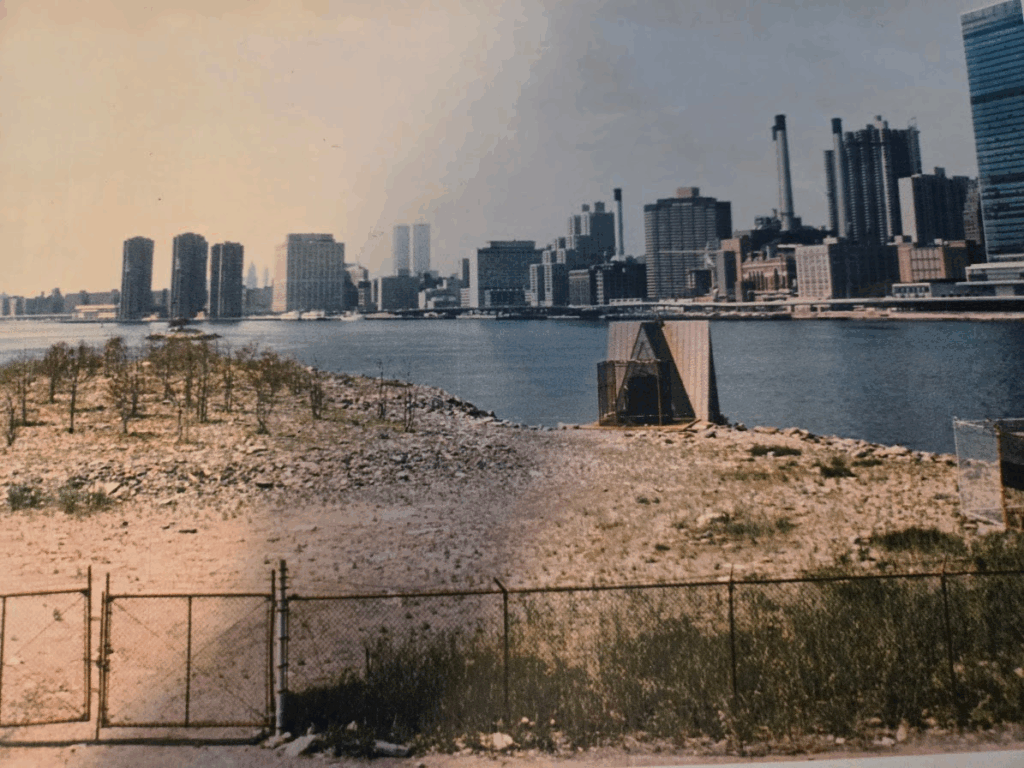
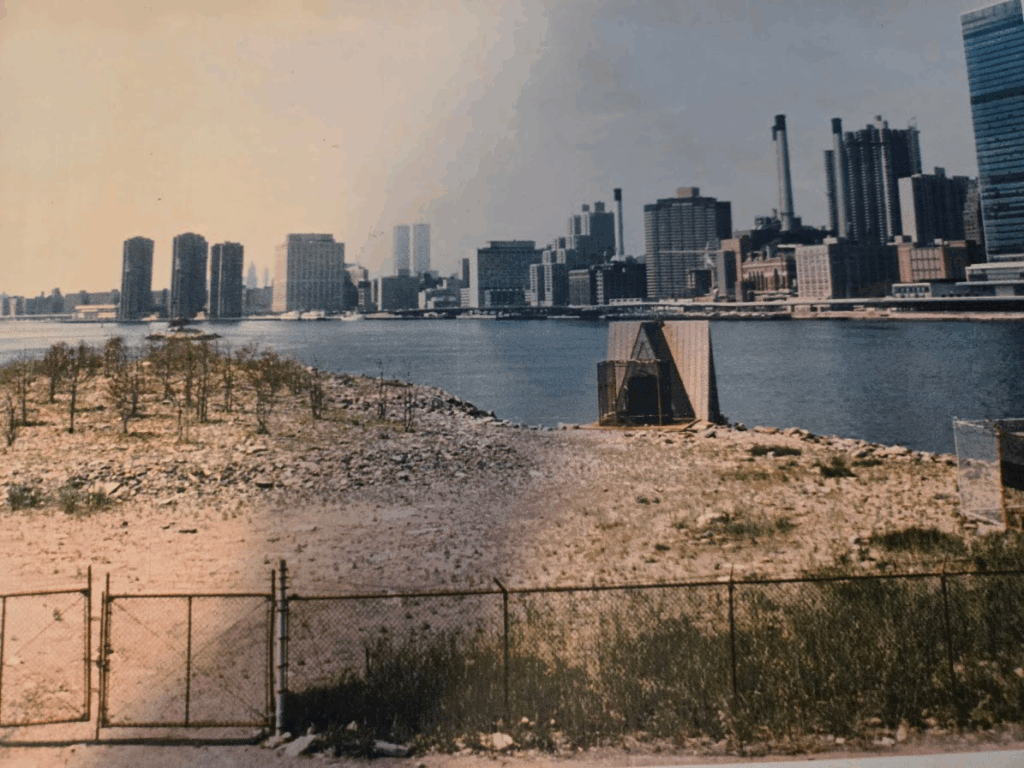
BEFORE THE FDR FOUR FREEDOMS STATE PARK, THE SOUTHPOINT WITH THE DELACORTE GEYSER IN THE 1980’S
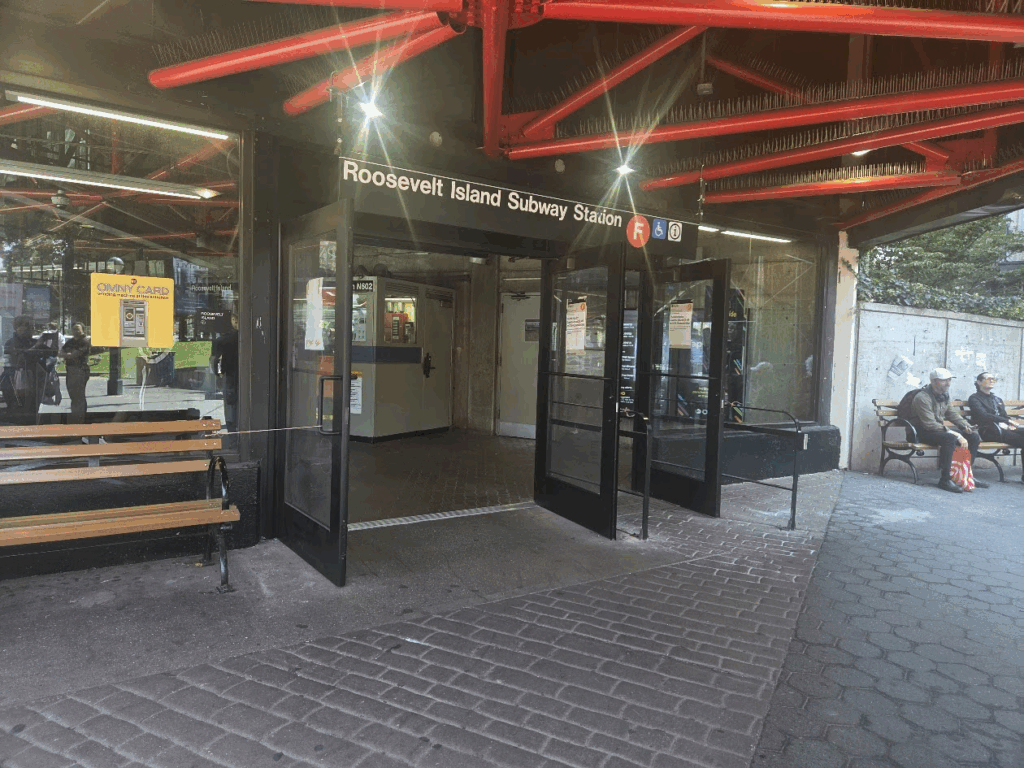
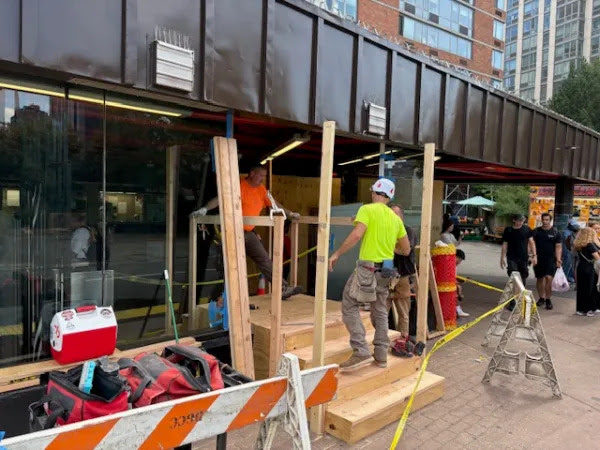
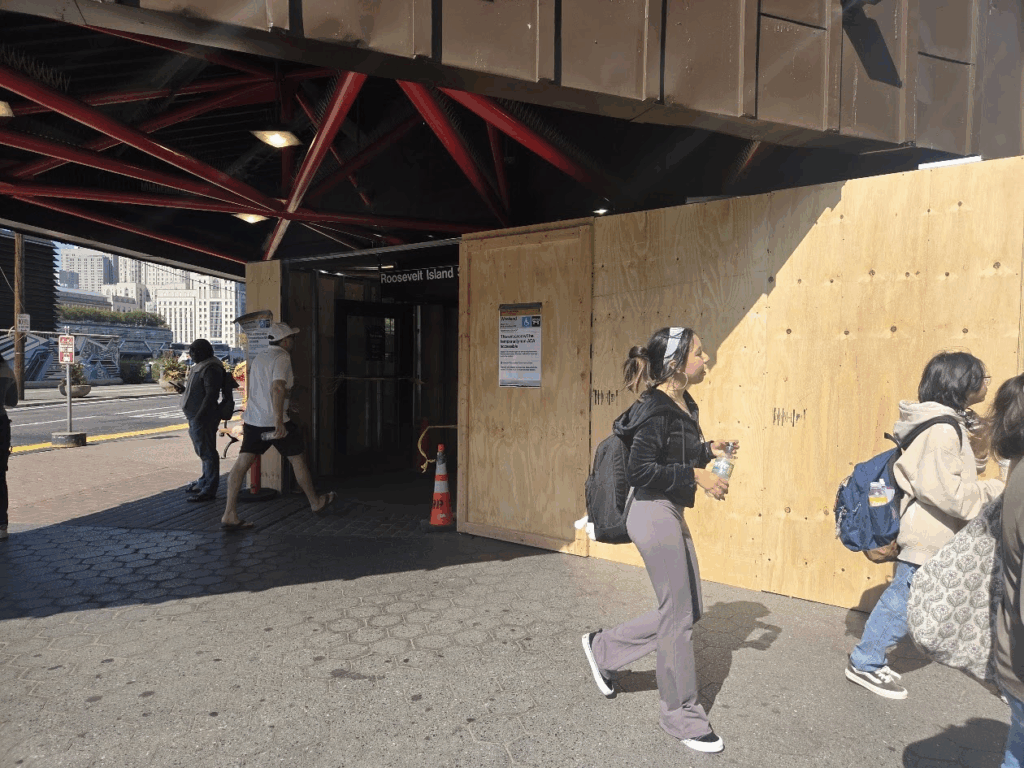
UPDATE ARE THESE THE NEW DOORS INSTALLED AT THE SUBWAY STATION, LOOKING JUST LIKE THE OLD ONES?
Credits
JUDITH BERDY
All image are copyrighted (c) Roosevelt Island Historical Society unless otherwise indicated THIS PUBLICATION FUNDED BY DISCRETIONARY FUNDS FROM CITY COUNCIL MEMBER JULIE MENIN & ROOSEVELT ISLAND OPERATING CORPORATION PUBLIC PURPOSE FUNDS.
If you lived or worked in the Gramercy area in the early decades of the 20th century, you probably passed it by without much thought
Amid modern transportation infrastructure like traffic lights, lampposts, and street signs stood a faded granite slab embedded in the sidewalk on Third Avenue near 17th Street.
What was this tombstone-like relic? New Yorkers of the era would have known it as one of Manhattan’s last milestones.
Milestones, or mile markers, helped travelers keep track of how many miles they were from City Hall as they traversed the primitive, unlit, often dangerous roads of a sparsely populated city.
Until the urbanization of the bulk of Manhattan Island in the late 19th century, milestones were often the only directionals a horseman or stagecoach driver had as they journeyed up or down one of Manhattan’s few north-south roads.
Taverns popped up around them; owners knew that weary travelers might need a hearty meal and a place to sleep before continuing in or out of the city. These “heirlooms of the past,” as one article called the milestones, were so critical, laws punished those who defaced them.
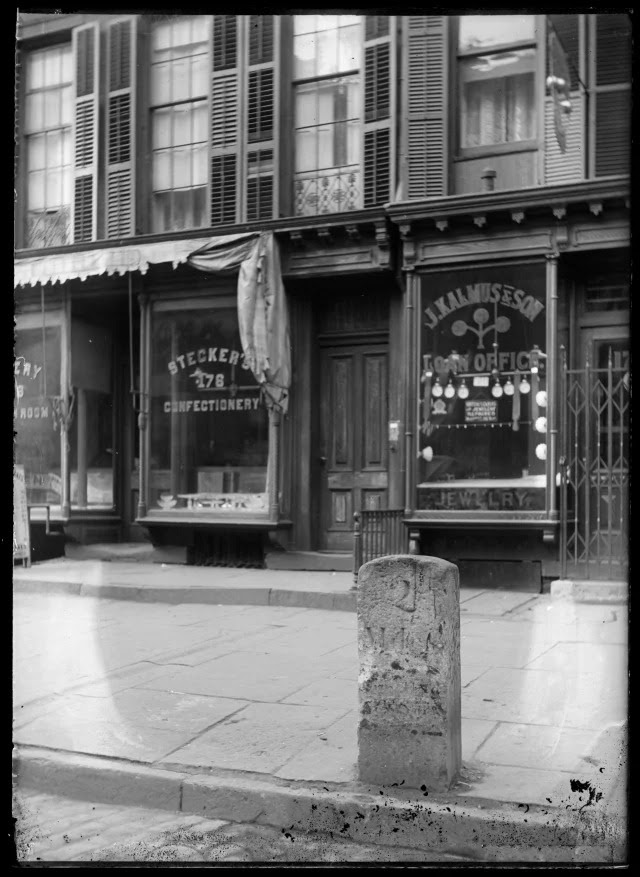
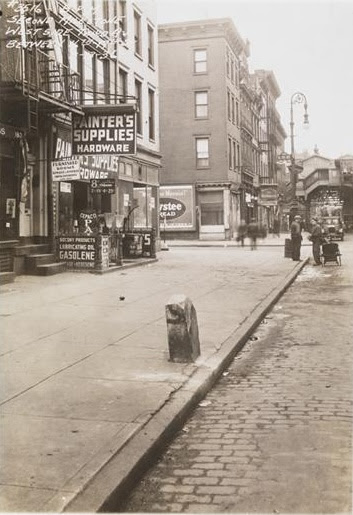
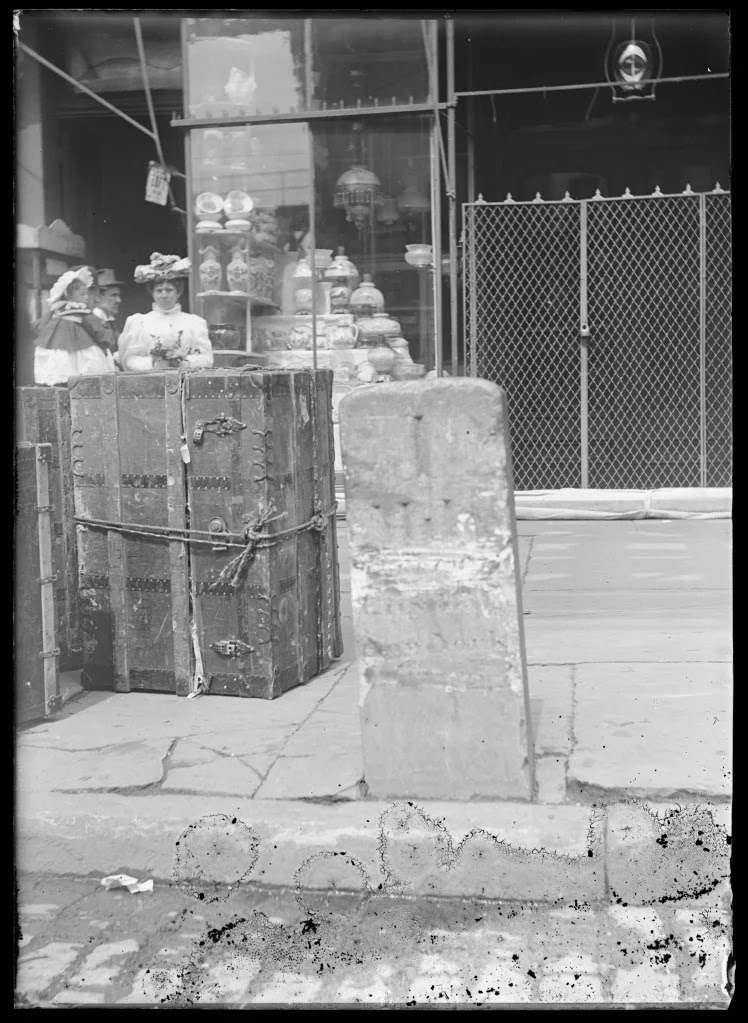
Mile marker 2, seen in the first three photos in this post, was one of 12 embedded along the Boston Post Road—a former Native American trail that ran from the Battery along the East Side and into the Bronx. Eventually subsumed by the conformity of avenues outlined in the Commissioner’s Plan of 1811, Boston Post Road roughly aligns with today’s Third Avenue.
Milestones also existed on the Bloomingdale Road, the colonial thoroughfare that began at 23rd Street and followed a path through today’s Upper West Side. Unlike the Boston Post Road mile markers, none of the Bloomingdale Road’s markers appear to have survived into the 20th century.
When mile marker 2 was removed from its longtime location on Third Avenue isn’t clear. The first photo, from 1900, reveals a chunk of granite that’s not in bad shape. The second image, from 1931, shows a closeup of a more battered milestone.
By the time the third photo was taken in 1936, it almost looks like trash on the curb waiting to be carted away. Which may have actually happened; the circumstances of its demise isn’t known.
But the fact that it managed to survive into the 1930s is astonishing. I’d attribute it to a combination of the sentimentality some New Yorkers had for ye olde days of Gotham, as well a benign neglect. After outliving its usefulness, most New Yorkers just ignored it.
The two-mile marker’s century-plus lifespan makes me wonder: What happened to the other 11 milestones that dotted Manhattan in today’s Midtown, Yorkville, and Inwood?
According to the City History Club, which in the early 1900s gained guardianship over the remaining mile markers, “some of the milestones have disappeared, while others have had a varied experience.” This includes destruction, theft, removal to a safe private yard, and getting wiped from the cityscape in the interest of “public improvement.”
Tracing the fate of these relics hasn’t been easy. But records and archives give us some information to go on.
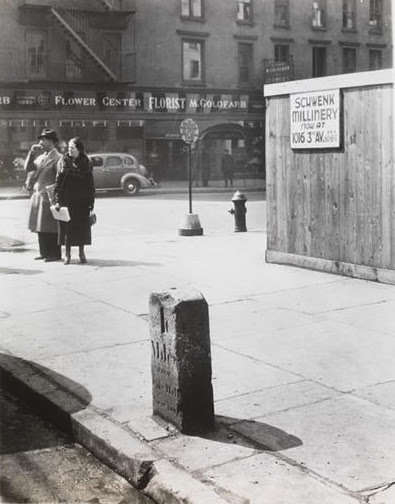
In 1904, just three of the original milestones still existed, according to a New York Times article from that year. These included mile marker 2 as well as mile marker 1, which stood in front of 213 Bowery near Rivington Street (fourth photo, from 1897).
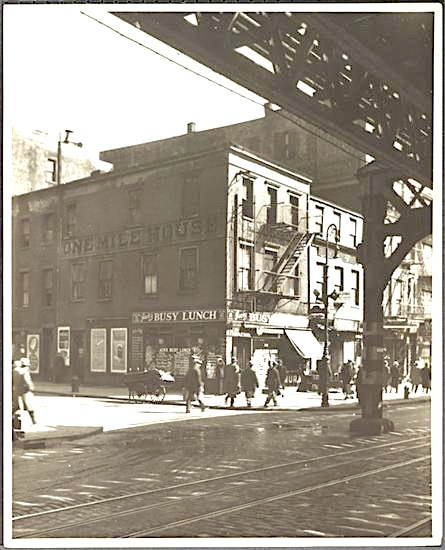
Incredibly, the one-mile marker existed at its original Bowery location until 1926, when a truck destroyed it, according to Kevin Walsh writing in SpliceToday in 2024. Keeping its memory alive was a 20th century tavern at this location called the One Mile House (see the lettering on the side of the building), visible in the photo below from 1932.
The other mile marker survivor per the Times was at Third Avenue just above 57th Street (possibly in the fifth photo). When and how that one got the boot is a mystery.
Ah, but wait! The Times article didn’t mention the two Boston Post Road mile markers that actually still exist in Manhattan to this day.
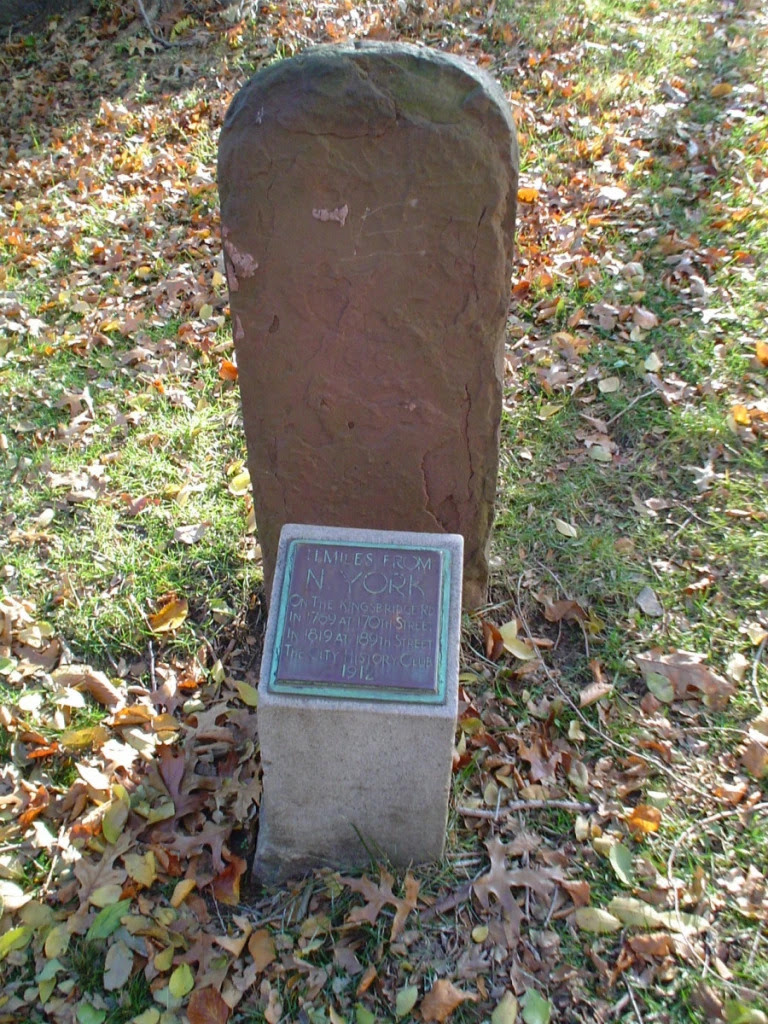
One, mile marker 11, originally stood at 189th Street. In 1912, the City History Club moved this weathered artifact to the safety of Roger Morris Park (below), which surrounds the circa-1765 Morris-Jumel Mansion on Jumel Terrace in Washington Heights.
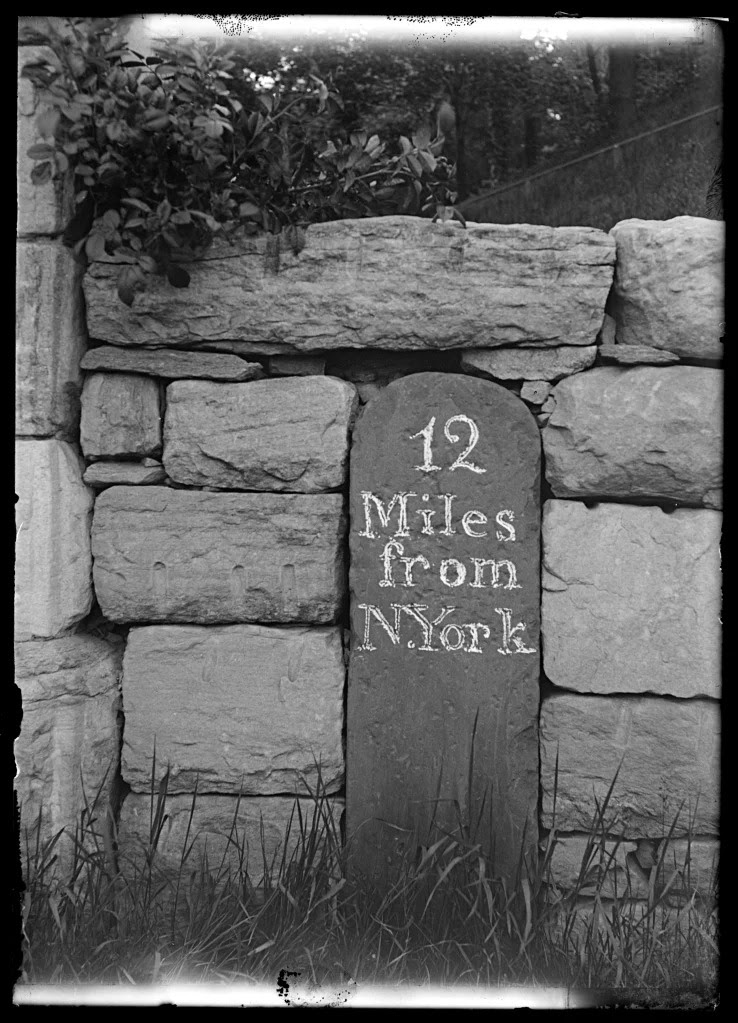
Mile marker 12 is the only milestone still visible on a city street. Its original location was at Hawthorne Street (now 204th Street) near Broadway. Workers building a mansion for wealthy merchant William Isham wanted to trash this relic, but Isham had it preserved as part of a stone gate at the entrance to his estate.
In 1911, Isham’s daughter donated to the city the land her father’s mansion once occupied, intending it to become a public park. That 12th mile marker is still built into the stone entrance that now marks Isham Park in Inwood.
Brooklyn and Queens had mile markers as well. One in Brooklyn remains (or remained? I haven’t seen it lately) on Avenue P and Ocean Parkway. In Bensonhurst, Milestone Park contains a replica of an 18th century milestone that once marked the distance to the ferries to Manhattan and Staten Island.
BEFORE THE FDR FOUR FREEDOMS STATE PARK, THE SOUTHPOINT WITH THE DELACORTE GEYSER IN THE 1980’S
All image are copyrighted (c) Roosevelt Island Historical Society unless otherwise indicated THIS PUBLICATION FUNDED BY DISCRETIONARY FUNDS FROM CITY COUNCIL MEMBER JULIE MENIN & ROOSEVELT ISLAND OPERATING CORPORATION PUBLIC PURPOSE FUNDS.
Ai Weiwei’s public art installation Camouflage goes on view 10 September at the southern tip of Roosevelt Island, directly across the East River from the United Nations and in tandem with its 2025 General Assembly—the 80th session since its founding at the end of the Second World War. At the Franklin D. Roosevelt Four Freedoms State Park, designed by the architect Louis Kahn in 1973 and realised posthumously in 2012, Ai is draping the memorial to President Roosevelt in fabric the artist designed with silhouettes of cats to reinterpret ubiquitous camouflage patterns used as a means of concealment in wartime.
“It is a deeply militarized symbol,” Ai says of the tent-like structure, supported by scaffolding, that protects, or shrouds, the memorial celebrating Roosevelt’s Four Freedoms—of speech, of religion, from want and from fear—espoused in his 1941 presidential address to the US Congress. “Presenting such an installation is necessary in a world marked by ongoing wars and the threat of even greater conflict.”
Art X Freedom
Camouflage marks the launch of Art X Freedom, the Four Freedoms Park Conservancy’s new annual commissioning programme of public art intended to inspire conversation around issues of social justice. “Let’s try to add the power of public art at a park, close to the UN, that’s dedicated to government for the good,” says Howard Axel, the conservancy’s chief executive, who is interested in compelling more people to make the short pilgrimage to the 3.5-acre park.
Ai Weiwei’s Camouflage is part of a new public art commission programme at Four Freedoms Park on Roosevelt Island
Like many New Yorkers, the acclaimed 68-year-old Chinese artist and activist, who now lives in Portugal, had never been to the park before touring it last November with Axel. On the triangular tip of the island, dramatically sited between Manhattan and Queens, Kahn designed two long alleys of Linden trees converging at a colossal bronze head of Roosevelt, poised within a granite niche. Carved on its backside is an excerpt from his Four Freedoms speech. This presides before a square open-air plaza, what Kahn called “the room”, defined on facing sides by a series of 6ft by 6ft by 12ft-high granite blocks spaced one inch apart.
“Kahn was very aware of the fact that Roosevelt is considered the architect of the UN,” says Gina Pollara, the executive director of the park who oversaw its building from the schematic plans Khan produced a year before his death. She describes this “room” as Kahn’s interpretation of a Greek temple as well as of the UN as an organisation of individual member states that compose something larger. “Roosevelt used to say that all the problems of the world could be solved sitting around a dining room table talking.”
The disguise of truth
Ai Weiwei’s Camouflage is part of a new public art commission programme at Four Freedoms Park on Roosevelt Island
Now Ai’s camouflage fabric will cover the room and cast dappled light on visitors, prompting considerations of “what needs protection and what requires the removal of disguise to reveal truth”, the artist says. Inside the tenting, LED lights spell out a proverb in Ukrainian that means: “Wars that bring misery to some may be ‘dear mothers’ to others.” Ai has also collaborated with the artist-run organisation For Freedoms that is providing ribbons printed with each of the Four Freedoms, on which people can write their own messages. These will be affixed to the camouflage netting during the exhibition.
Ai’s cat motif was inspired in part by seeing the outdoor Cat Sanctuary & Wildlife Rehabilitation Center just outside the entrance to the Four Freedoms park. In human disasters such as wars, pandemics and environmental crises, “cats are among the first to suffer”, Ai says, seeing them as emblematic of life’s most innocent and easily manipulated.
Embedded somewhere within his camouflage pattern is a single dog, which eagle-eyed viewers can have fun trying to find. “It is not only playful but also symbolic,” Ai says. “Among all the animals we love, there are different kinds. If we cannot allow those who are different to exist, civilisation itself would cease to exist.”
Watch for details about free timed tickets. The exhibition is slated to be on until November.
NEW DOORS ARE COMING TO THE SUBWAY STATION
AFTER YEARS OF BROKEN DOORS, HELD OPEN BY SAFETY TAPE, THE MTA IS INSTALLING NEW DOORS THIS WEEKEND, BUT THERE WERE MANY GLITCHES, LIKE HAVING PEOPLE WALK UP AND OVER 4 STEPS TO ENTER THE STATION………
STAY TUNED!! AND WATCH FOR THE “GRAND OPENING”
Credits
THE ART NEWSPAPER
All image are copyrighted (c) Roosevelt Island Historical Society unless otherwise indicated THIS PUBLICATION FUNDED BY DISCRETIONARY FUNDS FROM CITY COUNCIL MEMBER JULIE MENIN & ROOSEVELT ISLAND OPERATING CORPORATION PUBLIC PURPOSE FUNDS.
This is the gripping fictional opening scene of The Godfather II, although considerable artistic license was taken by its producer and director Francis Ford Coppola.
The “windjammer” was built in 1904 by William Hamilton & Company on the River Clyde on behalf of a German company. Named Kurt, it was used for bulk transport (coal or grain), not the transfer of migrants.
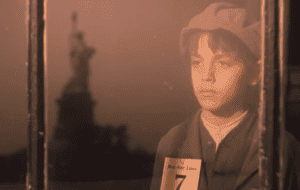
In Ellis Island’s Great Hall a nine-year-old boy named Vito Andolini, alone and lost, is hustled through a chaotic mass of new arrivals. In front of an impatient attendant and against the noisy background of many different languages, he does not speak at all.
The youngster is assigned the surname Corleone, the town he had fled to escape his family’s Mafia enemies.
Suspected of carrying smallpox, Vito is quarantined for three months on the island. Kept in isolation, he can only look out from his window to see the distant contours of New York City across the water.
The future Godfather had arrived in America, not realizing that at the time of his confinement fellow Sicilian and Italian immigrants were treated harshly by local authorities as they were held responsible for a smallpox epidemic in the metropolis.
Speckled Monster
Early researchers agreed that this “modern disease” (unknown to the Ancients) had been brought in the eleventh century from Northern Africa into Europe by Islamic invaders or returning crusaders.
Identified as an “import,” smallpox was carried on by European explorers into non-immune indigenous populations, particularly in the Americas.
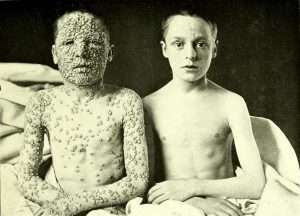
Once infected, a patient began showing flu-like symptoms. By day four, pustules or “pocks” appeared in the mouth, throat and nasal passages. Within twenty-four hours, a skin rash surfaced.
For some, this rash turned inward, hemorrhaging beneath the skin and through the mucous membranes. These patients died quickly.
For most, the pustules pushed to the surface; scabs started to form late in the second week. By week three, fever subsided and scars replaced scabs. Survivors were now immune, but pockmarks remained. The course of the disease took about a month.
The “speckled monster” of smallpox was regarded with terror. About three out of ten patients died a harrowing death. There was no cure.
The disease was castigated for being “doubly cruel.” It did not just herald imminent death, but disfigured victims by “pitted” scars which often led to complications.
Scottish poet Thomas Blacklock was left blind as a result of corneal scarring after ulceration (a leading cause of blindness).
Potter Josiah Wedgwood contracted smallpox as a child in 1742. He survived, but suffered a secondary infection in his right knee which would lead to an amputation.
Retrospectively gathered clinical evidence suggests that smallpox left some male survivors impotent.
Other than the plague, smallpox was responsible for more deaths than any other health calamity. For those who watched the gruesome symptoms from close by, the disease seemed to confound the powers of description.
Whereas the plague gave rise to a wealth of artistic representations, smallpox has no such history. Artists were reluctant or unable to deal with the theme. Very few painters dared to portray a patient – with one notable exception.
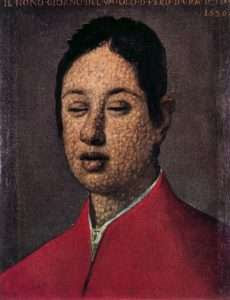
Antwerp-born Justus Sustermans was court painter to the Grand Dukes of Tuscany in Florence. The family was struck by a smallpox outbreak in the region in the autumn of 1626 with five members falling ill.
In October 1626, the artist painted two portraits of Ferdinand II de’ Medici, aged sixteen, at two stages of the disease (days seven and nine). Although Ferdinand recovered, the patient’s grotesque and repulsive painted images were received with shock and horror.
Job’s Boils
Smallpox came to America with the arrival of the first Europeans. It devastated generations of Native Americans (and helped assure the Spanish conquest of the Aztec and Inca Empires), created disastrous loss of life amongst enslaved Black people and was an existential threat to the colonies.
There were two means of combating the disease: quarantine and inoculation. When employed efficiently, isolation helped to stop it from spreading out of control. In the colonial period, the method was used by colonists and Native Americans alike.
Inoculation was introduced to the West in the early 1700s at London’s Royal Society, the leading scientific institution of the era. It caused fierce debate.
Based on Enlightenment principles of inquiry and observation, Voltaire (who learned about the process when living in London between 1726 and 1728) and like-minded thinkers championed inoculation as a triumph of empirical research over superstition and cheered its potential of improving public health.
In the summer and fall of 1721, smallpox ravaged Boston. The epidemic began when the British naval vessel HMS Seahorse arrived on April 22 with infected crew members on board. Although they were quarantined, the virus spread quickly, prompting residents to flee the city.
Boston had experienced outbreaks before. Just prior to 1721 a quarantine hospital had been constructed, but in spite of preventative measures over eight hundred residents died during the epidemic.
Having survived smallpox himself, Rev. Cotton Mather rejected the Church’s opposition to inoculation, arguing that medical science was God’s gift to mankind.
He encouraged Boston’s physicians to take up inoculation. They declined. Only surgeon Zabdiel Boylston inoculated his son and two members of an enslaved Black family in his household. These were the first three recorded cases in America.
The public’s response was hostile. Unease about inoculation lingered as opponents denied its safety and efficacy. The technique itself was unpleasant.
It involved the deliberate infection of an individual with the virus (“controlled exposure”), usually through an incision in the hand.
Inoculated smallpox was less virulent than its natural form. Although survivors gained lifelong immunity, they were still at risk of infecting others. The danger epidemic outbreaks remained.
Many Christians believed that God had allowed smallpox to spread among people as a punishment for their sins. Inoculation constituted interference with God’s will.
In 1767, the Mozart family was in Vienna where smallpox had crippled the city. Leopold Mozart refused to have his children inoculated, preferring (as he wrote to a friend in February that year) to “leave the matter to the grace of God.”
Young Mozart went down with the disease, but fortunately recovered. Poets (like William Blake) and theologians used the metaphor “Job’s boils” in relation to the symptoms of smallpox (the Old Testament tale of Job being subjected to a series of trials to test his faith, including an affliction of boils from head to toe).
Others described themselves as “conscientious objectors,” arguing that any imposed practice violated their free will. Physicians were accused of “collaborating” with government. Their intentions were questioned.
Speculation spread that doctors performed new procedures for personal gain. Activists viewed their anti-inoculation campaign as a righteous cause, one that was dedicated to shielding the public from a perceived threat.
Boston & Quebec
War and disease have a long and wretched history. In the colonies during the late-eighteenth century, smallpox was spread by troop movements. The British army had an advantage.
In England, the disease had long been endemic and most of soldiers had experienced smallpox in childhood and were therefore immune. By contrast, colonists as well as Native and Black Americans were vulnerable.
Signs of smallpox became evident during the early days of the American rebellion. Isolated incidents had occurred around Boston in 1774; soon after, the disease took hold of the city itself.
The first armed battle took place in April 1775 and smallpox festered through the summer while the Continental Army was entrenched around Boston. General George Washington feared that the disease could decimate his forces.
If smallpox would spread, he wrote to the Massachusetts House of Representatives in late 1775, it would be “disastrous & fatal to our army and the Country around it.”
This anxiety pushed him into decisive action. Washington had personal experience of smallpox and understood the danger of the disease.
In the autumn of 1751, aged nineteen, he had accompanied his half-brother Lawrence who was suffering from tuberculosis on a “healing” trip to Barbados.
Endemic in the Caribbean at the time, smallpox had been fairly uncommon in George’s Virginia. He had not contracted the disease as a child and was infected during the trip. Having survived the ordeal, he gained immunity. The fearful memory lasted.
Washington realized that it was impossible for his troops to gather in numbers without smallpox running rampant. Quarantine had some impact, but at times of military action such intervention was not feasible. He and his medical team decided to oversee a campaign of inoculating the entire army. It was arguably the most drastic decision that General Washington ever took.
The effort to control smallpox amongst his soldiers in Boston did pay off. The situation in Quebec was much worse. Throughout the siege of the Canadian city, American troops had to contend with an outbreak of smallpox.
On May 6, 1776, after a five-month fruitless battle, more than 1,500 soldiers fled up the St. Lawrence River as British regulars disembarked to relieve the Quebec garrison. In a chaotic withdrawal, all precautions to fight off the disease were ignored.
Five days later, soldiers began arriving at Sorel, a town where the Richelieu River enters the St. Lawrence. The presence of so many diseased men was a terrifying sight.
The approach of British troops forced what was left of the “Northern Army” to continue its retreat along the Richelieu River, eventually pausing at Île aux Noix, a small island near the north entrance of Lake Champlain.
The shattered army spent ten days there; most men were infected, there were few health care providers and no facilities to treat the diseased. Two mass graves were dug where more than nine hundred smallpox victims were buried.
The island was hell on earth. The bitter memory would last and impact an urgent search for ways of fighting the disease.
Foreigners tend to be held responsible for epidemics or pandemics. In the 1800s, Irish immigrants were blamed for bringing cholera to the United States, Italians for polio, and Jews for tuberculosis.
During the 1900s, Chinese incomers were accused of spreading the bubonic plague in San Francisco. This blame-game seems timeless and is played today in discussions on the origin of COVID.
Panic about epidemics caused scapegoating with the associated consequences of prejudice, social exclusion and discrimination.
George Washington’s approach succeeded as it decreased the mortality rate amongst soldiers and restored his army’s ability to continue the battle. His policy of forced inoculation may have paved the way for modern vaccination policies, but the practice created a new set of problems.
The idea of compulsory vaccination met with strong opposition. Washington’s intervention worked because it was restricted to a specific group in a specific military setting. Applied in wider society, it was inevitable that minority groups would be targeted.
An epidemic of infectious disease proved not just to be a challenge to the medical system, it also provoked social stigma as it secluded groups of individuals from mainstream society.
Racism played its part. Minority groups, mostly African-Americans or immigrants, were blamed for epidemics. The geographic concentration of segregated racial groups enabled coercive targeting programs.
Smallpox (according to a retrospective investigation) was imported into Kentucky from Honduras in the summer of 1897. At the outset, the disease was noted as limited to the “colored” race.
The first case in the town of Middlesboro was identified early in December that year. Intervention failed due to a lack of medical facilities, denial by the authorities, and ignorance amongst the local population.
The disease spread rapidly, resulting in the most severe epidemic the State had ever known.
Measures were driven by panic. Groups of police and health officials entered an African-American section of town to forcefully vaccinate men and women. Those who resisted were treated at gunpoint. Such smallpox raids were not unusual.
Blauvelt in Italian Harlem
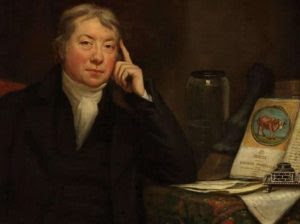
Although the first vaccine was developed in May 1796 by Edward Jenner, an English country doctor (the “Godfather of Vaccination”), smallpox remained rampant and was responsible for as many as 300 million deaths in the twentieth century alone.
An epidemic was the Apocalypse made real. It divided communities, disregarded boundaries and shattered social cohesion.
In 1901, New York City experienced an outbreak of smallpox, particularly affecting immigrant communities in Italian Harlem. The city’s health department responded with aggressive measures and singled out these districts of dense immigrant populations as “suspect.”
On a Friday night in February of that year, more than two hundred police officers and health officials led by Alonzo Blauvelt, Chief Inspector of the Board of Health, blocked the roofs, entrances and backyards of every tenement block in East Harlem’s over-populated Italian neighborhood between 106th and 115th Streets.
In a carefully planned raid, they entered every apartment without warning, preventing terrified tenants from running away.
If in good health, residents were forcefully vaccinated. Those who showed symptoms of infection, be they children or adults, were separated from their families and transported to the East River docks.
From there they were ferried to North Brother Island, just south of the Bronx, where a complex of quarantine hospitals had been erected. The island was associated with the notion of the “pest house.” Mere mention of the name made New Yorkers freeze with anxiety.
During the nineteenth century hospitals were not equipped to deal with contagious diseases. Patients were quarantined in isolation buildings known as pest houses.
Numerous stories were reported of mothers fighting with health officials to keep their sick children in their own care, rather than have them be taken away. Pest houses were associated with the horrors of suffering and death.
To this day, the term functions as a potent (literary) metaphor for various societal ills, connoting contamination, exclusion, isolation and social breakdown.
Although a vaccine had been developed for smallpox, many citizens did not heed warnings, refused to get vaccinated, or were unable to access facilities. From the very start of organized vaccination campaigns, there had been public resistance.
Blauvelt and his colleagues continued their task systematically. Tenants of homeless shelters, factory workers, members of the police force were all called out to be vaccinated. The approach was ruthless; the means applied were controversial.
Good ends can be achieved only by the employment of appropriate means. In his crusade for restoring public health, Blauvelt confused the means with the end.
His campaign deteriorated into actions that were cruel and oppressive. Brute intervention led to mistrust of public health measures, fueling “vaccine hesitancy” which, in turn, increased the risk of preventable disease outbreaks.
Other factors such as disinformation, unclear evidence, lack of access to health services, religious beliefs and/or individual prejudices contributed to this uncertainty.
In May 1980, the World Health Organization (WHO) declared smallpox to be eradicated, the first time in history that a deadly human disease was wiped out. For many social historians, it was a public health triumph.
Today, vaccination skepticism has become a topic of renewed controversy in American politics.
Fostering trust in public health efforts remains therefore imperative, as is the urgent need to find a way of putting government mandates in practice without compromising individual liberties.
[Editor’s Note: Florida Republicans announced Wednesday that they will “work to phase out all childhood vaccine mandates in the state” according to the Associated Press. “On the vaccines, state Surgeon General Dr. Joseph Ladapo cast current requirements in schools and elsewhere as an ‘immoral’ intrusion on people’s rights bordering on ‘slavery,’ and hampers parents’ ability to make health decisions for their children.”]
NEW DOORS ARE COMING TO THE SUBWAY STATION
AFTER YEARS OF BROKEN DOORS, HELD OPEN BY SAFTEY TAPE, THE MTA IS INSTALLING NEW DOORS THIS WEEKEND.
Illustrations, from above: Young Vito Corleone in smallpox isolation on Ellis Island staring at the Statue of Liberty (still from The Godfather II); Justus Sustermans, “Portrait of Ferdinando II de’ Medici on the ninth day of smallpox,” 1626. (Galleria Palatina, Florence); Detail of James Northcote’s “Portrait of Edward Jenner,” 1803 (National Portrait Gallery, London); and one of the boys was vaccinated in infancy; the other was not (Photograph by Allan Warner)
All image are copyrighted (c) Roosevelt Island Historical Society unless otherwise indicated THIS PUBLICATION FUNDED BY DISCRETIONARY FUNDS FROM CITY COUNCIL MEMBER JULIE MENIN & ROOSEVELT ISLAND OPERATING CORPORATION PUBLIC PURPOSE FUNDS.
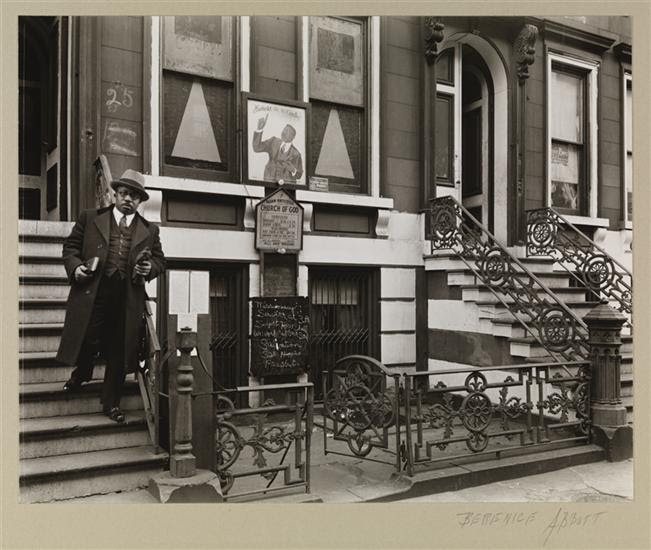
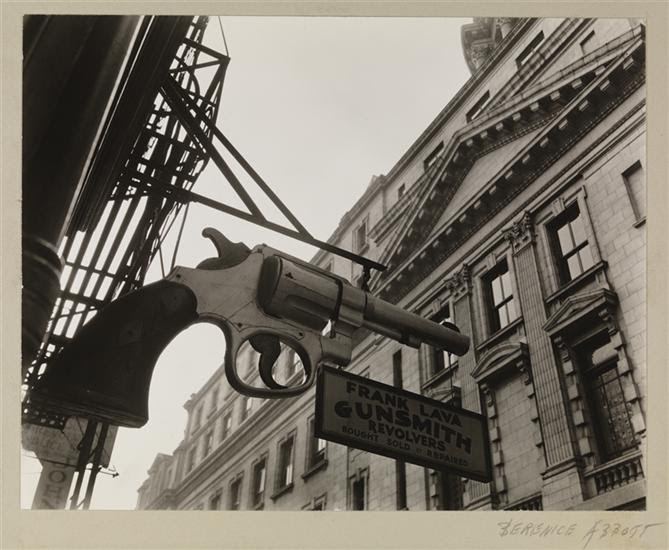
Photographer Berenice Abbott (1898-1991) Creator Berenice Abbott (1898-1991) Accession number 49.282.42 Unique identifier MNY12153 Description 25 East 132nd Street.
Photographer Berenice Abbott (1898-1991) Creator Berenice Abbott (1898-1991) Accession number 49.282.113 Unique identifier MNY15349 Description 6 Centre Market Place and 240 Centre Street. Dated February 4, 1937 Object Type photograph
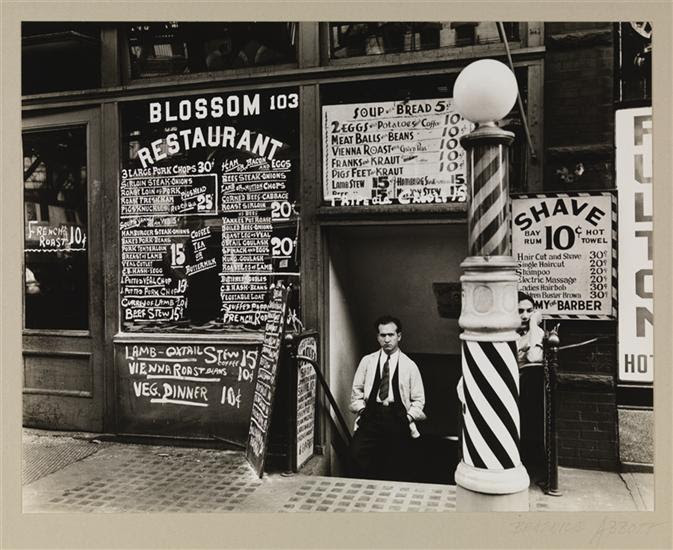
Photographer Berenice Abbott (1898-1991) Accession number 40.140.10 Unique identifier MNY18125 Description The window of the Blossom Restaurant, occupying the ground floor, and Jimmy’s Barber Shop, occupying the basement, of the Boston Hotel, a flophouse at 103-105 Bowery. Dated October 24, 1935 Object Type photograph Inscription / technical details Federal Art Project stamp and title, location, date and Abbott number inscribed in ink, mount verso bottom right.
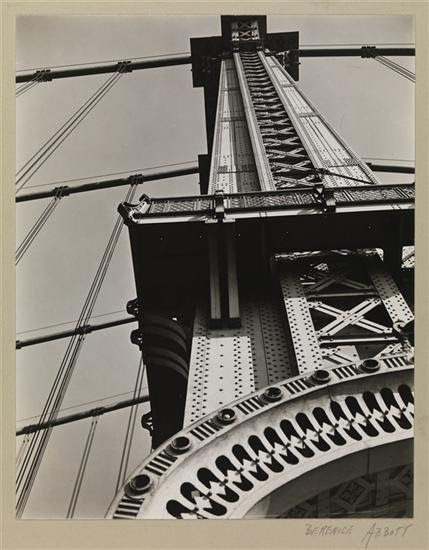
Photographer Berenice Abbott (1898-1991) Creator Berenice Abbott (1898-1991) Accession number 49.282.115 Unique identifier MNY20323 Description Looking straight up one of the Manhattan Bridge’s supporting piers, taken from the southern pedestrian walkway. Dated November 11, 1936 Object Type photograph Inscription / technical details “173” inscribed in red ink on mount verso, top left. | Abbott stamp on mount verso, bottom right. | Federal Art Project stamp on mount verso, center. | Title, location, date and Abbott number inscribe
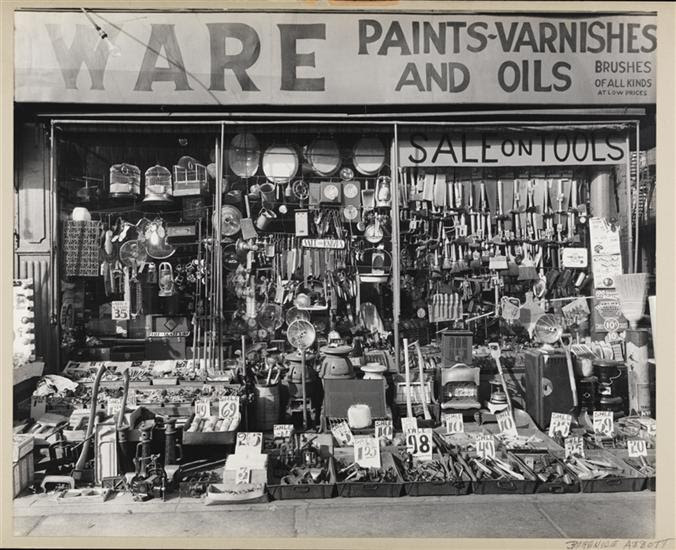
Photographer Berenice Abbott (1898-1991) Accession number 40.140.138 Unique identifier MNY9401 Description 316-318 Bowery at Bleecker Street. Dated January 26, 1938 Object Type photograph Inscription / technical details Federal Art Project stamp and title, location, date and Abbott number inscribed in ink, mount verso bottom right.
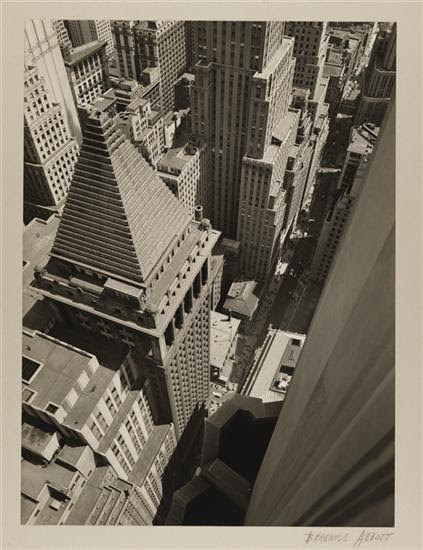
Photographer Berenice Abbott (1898-1991) Accession number 40.140.274 Unique identifier MNY24321 Description Wall Street with the East River beyond taken from the roof of One Wall Street. The pyramidal Bankers Trust Buiding is in the foreground. Dated May 4, 1938 Object Type photograph Inscription / technical details Federal Art Project stamp and title, location, date and Abbott number inscribed in ink, mount verso bottom right.
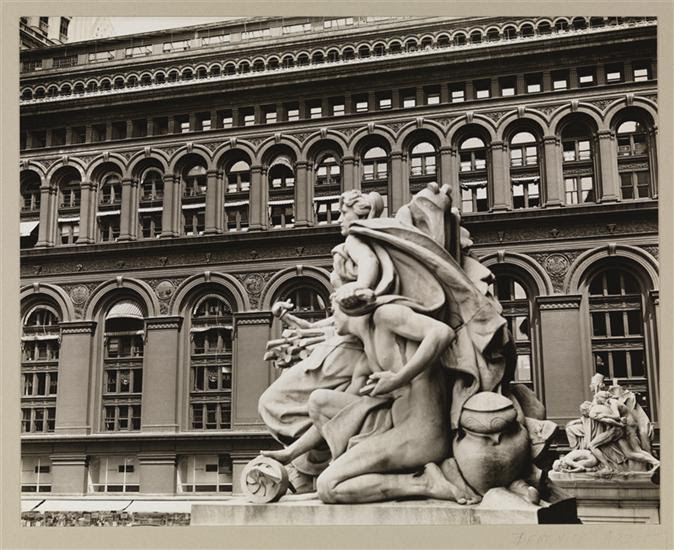
Photographer Berenice Abbott (1898-1991) Accession number 40.140.51 Unique identifier MNY30849 Description The U.S. Custom House Statues taken from the steps of the of the Custom House looking toward the Victorian Produce Exchange. Bowling Green at the foot of Broadway. Dated July 23, 1936 Object Type photograph Inscription / technical details Federal Art Project stamp and title, location, date and Abbott number inscribed in ink, mount verso bottom right.
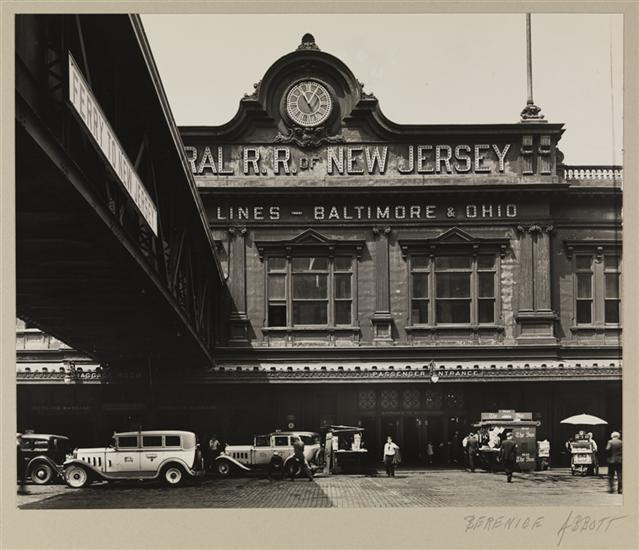
Photographer Berenice Abbott (1898-1991) Accession number 40.140.79 Unique identifier MNY32771 Description Foot of Liberty Street. Dated August 12, 1936 Object Type photograph Inscription / technical details Federal Art Project stamp and title, location, date and Abbott number inscribed in ink, mount verso bottom right.
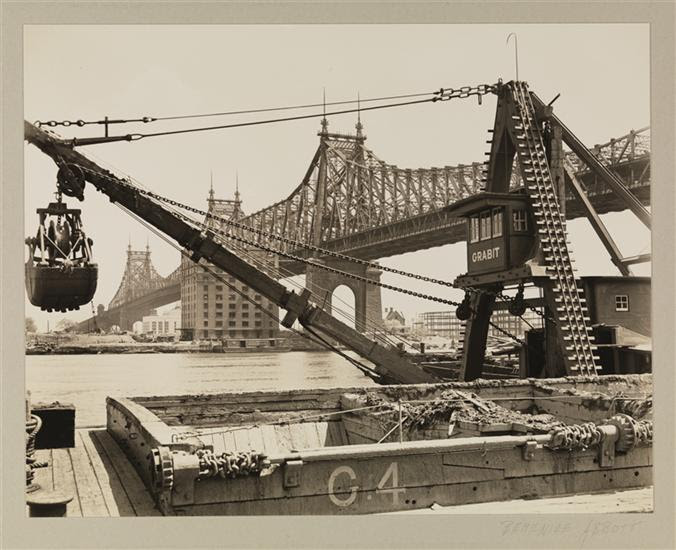
Queensboro Bridge I Photographer Berenice Abbott (1898-1991) Accession number May 7, 1937 40.140.204 Unique identifier MNY15955 Description The Queensboro Bridge taken from the 63rd Street Pier in Manhattan. Welfare Island with the Welfare Hospital for Chronic Disease is visible. Dated Object Type photograph Inscription / technical details Federal Art Project stamp and title, location, date and Abbott number inscribed in ink, mount verso bottom right.
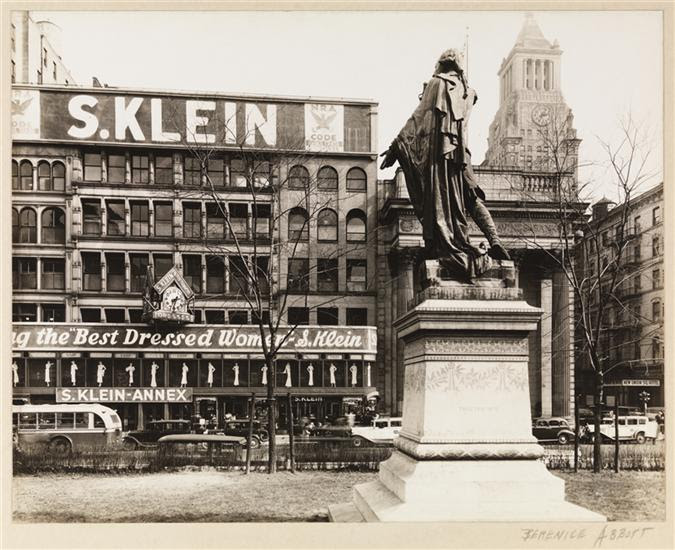
Photographer Berenice Abbott (1898-1991) Creator Berenice Abbott (1898-1991) Accession number 89.2.2.16 Unique identifier MNY201961 Description Fourth Avenue between East 15th and 16th Streets. The Lafayette Statue at Union Square with the discount department store, S. Klein, the Union Square Savings Bank and the tower of the Consolidated Edison Building in the background. Dated March 20, 1936 Object Type photograph Inscription / technical details Federal Art Project stamp and title, location, date and Abbott number inscribed in pencil on mount verso, bottom left. | Federal Art Project sticker adhered to mount verso, bottom right.
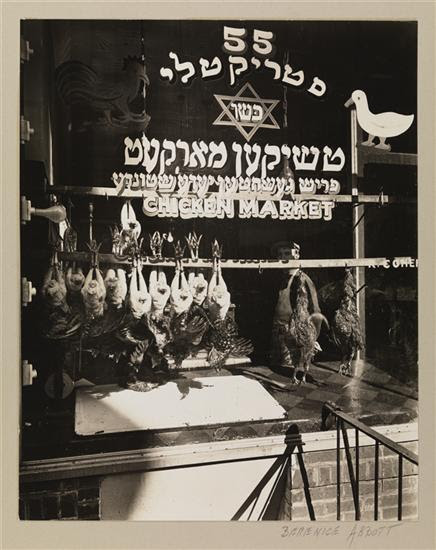
Photographer Berenice Abbott (1898-1991) Accession number 40.140.31 Unique identifier MNY11669 Description 55 Hester Street between Ludlow and Essex Streets. Dated February 11, 1937 Object Type photograph Inscription / technical details Federal Art Project stamp and title, location, date and Abbott number inscribed in ink, mount verso bottom right.
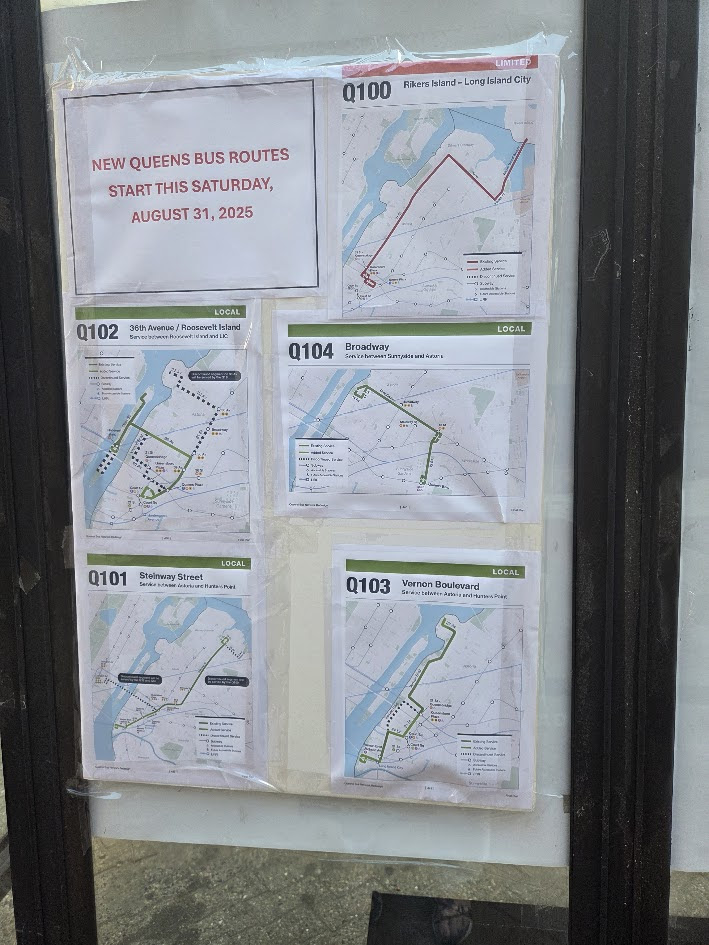
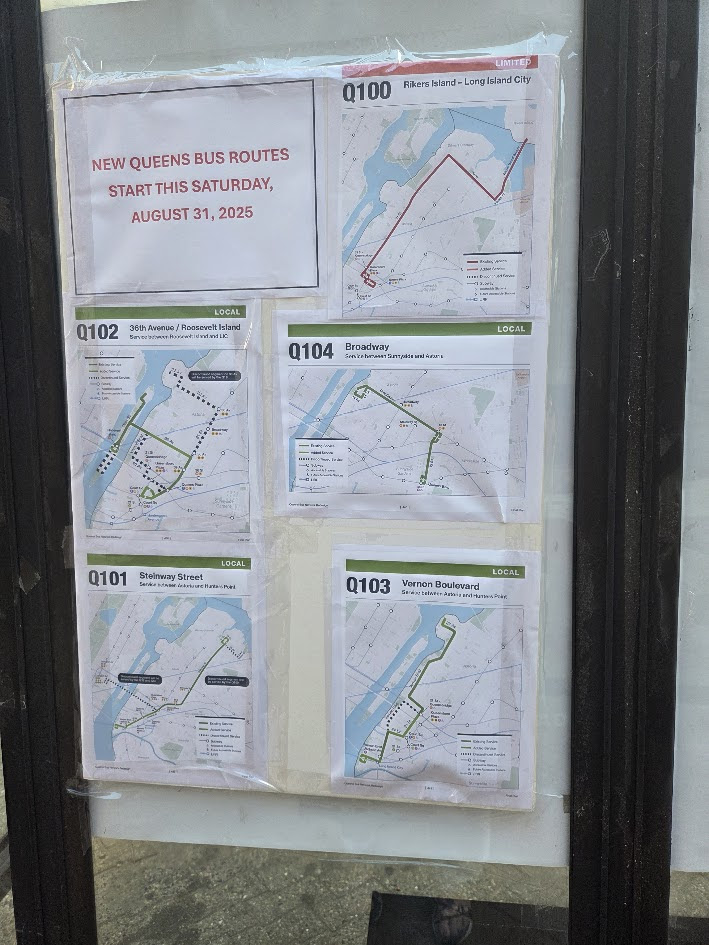
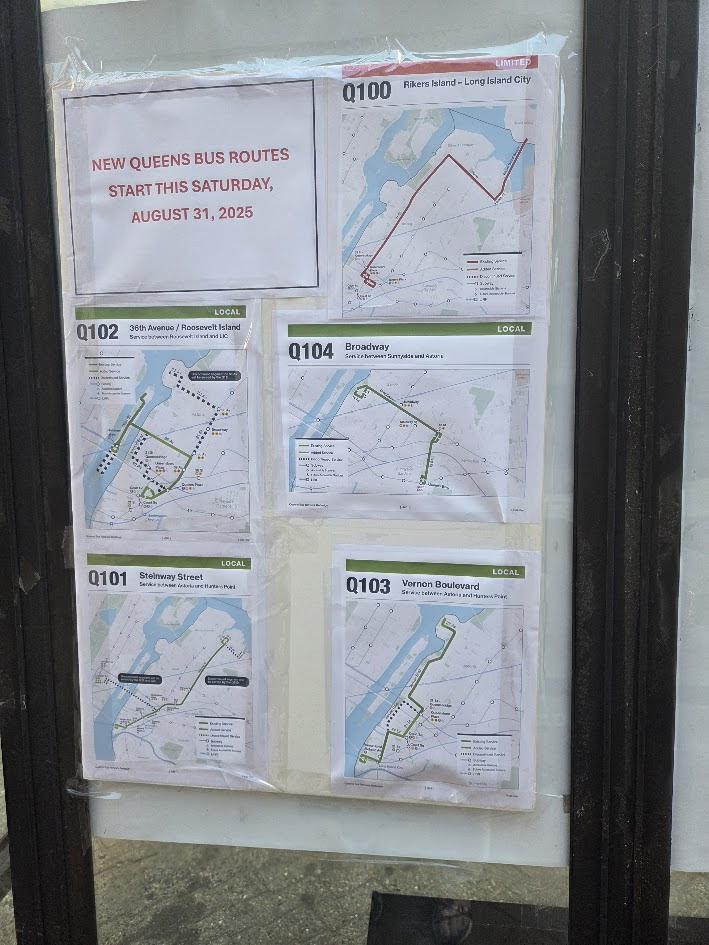
OUR QUEENS BUS ROUTES WE HAVE POSTED THE NEW ROUTE MAPS ON THE BACK OF THE CHAPEL BUS SHELTER
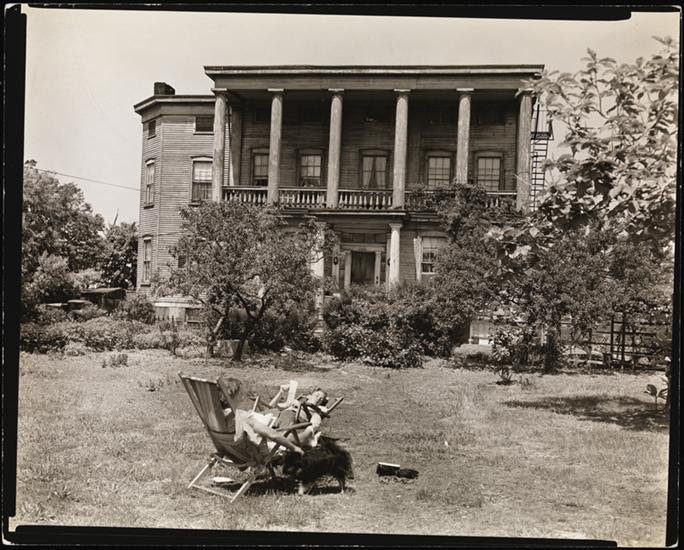
PHOTO OF THE DAY HOME IN ASTORIA ONCE THE HOME OF THE BLACKWELL FAMILY
FROM THE MUSEUM OF THE CITY OF NEW YORK 27th Avenue, no. 805, Astoria Photographer Berenice Abbott (1898-1991) Accession number 89.2.1.227 Unique identifierMNY70750 Dated May 25, 1937 Object Type photograph Inscription / technical details Abbott stamp on print verso, center. | Federal Art Project stamp and title, location, date and Abbott number inscribed in pencil on print verso, center.
Credits
MUSEUM OF THE CITY OF NEW YORK
JUDITH BERDY
All image are copyrighted (c) Roosevelt Island Historical Society unless otherwise indicated THIS PUBLICATION FUNDED BY DISCRETIONARY FUNDS FROM CITY COUNCIL MEMBER JULIE MENIN & ROOSEVELT ISLAND OPERATING CORPORATION PUBLIC PURPOSE FUNDS.
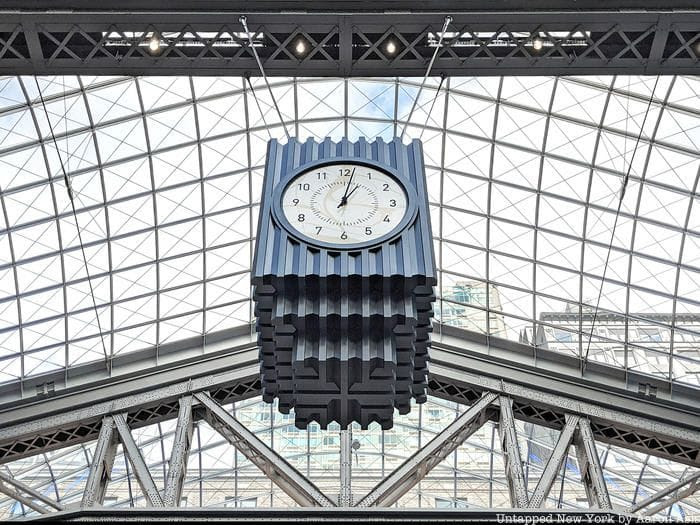
Long before everyone checked the time by glancing at their cellphones, many decorative clocks were installed to help New Yorkers keep track of time. While some were built as art pieces in more recent years, other clocks have often been recognized as essential pieces of “street furniture,” along with lamp posts, sign posts, and benches.
They have also been utilized in cities all over in order to maintain and enhance the quaintness of neighborhoods. In this piece, we highlight a few of New York’s most iconic time pieces you may or may not have noticed. Of course, this is only a sampling of the various fixtures you can find across the five boroughs. If you know of any others, leave us a comment below:
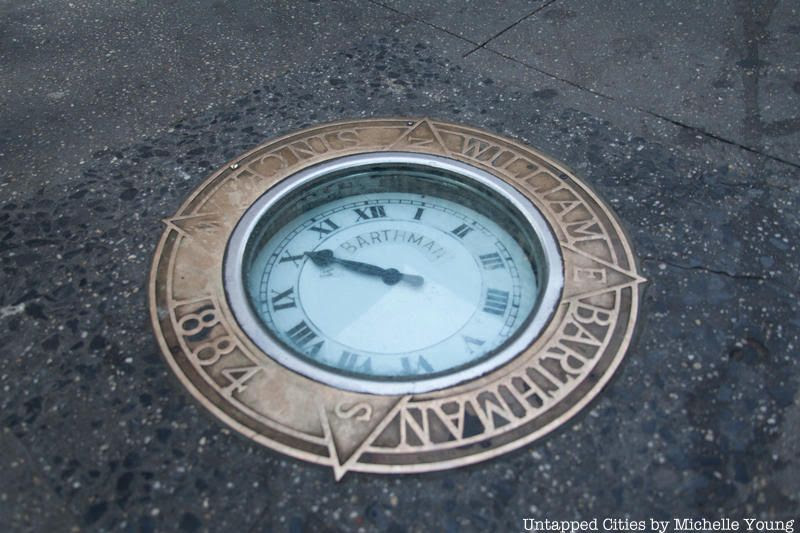
Located along the intersection of Maiden Lane and Broadway, outside the old location of Barthman Jewelers in Lower Manhattan, a clock occupies a small break in the sidewalk. It’s been located in that spot since 1896, originally installed by Barthman and one of his employees, Frank Homm.
The clock is an ode to the district’s prominence in the jewelry trade and was created to lure customers into the Barthman store over other jewelers. The only time the clock stopped working was during the Depression of the 1930s, and temporarily after Hurricane Sandy. The signature time piece was maintained from a mechanical room that is only accessible by going underground. Barthman Jewelers has since moved a few doors down from their original location. The clock mysteriously disappeared after passersby noted that it had been in disrepair, but it has thankfully been restored!
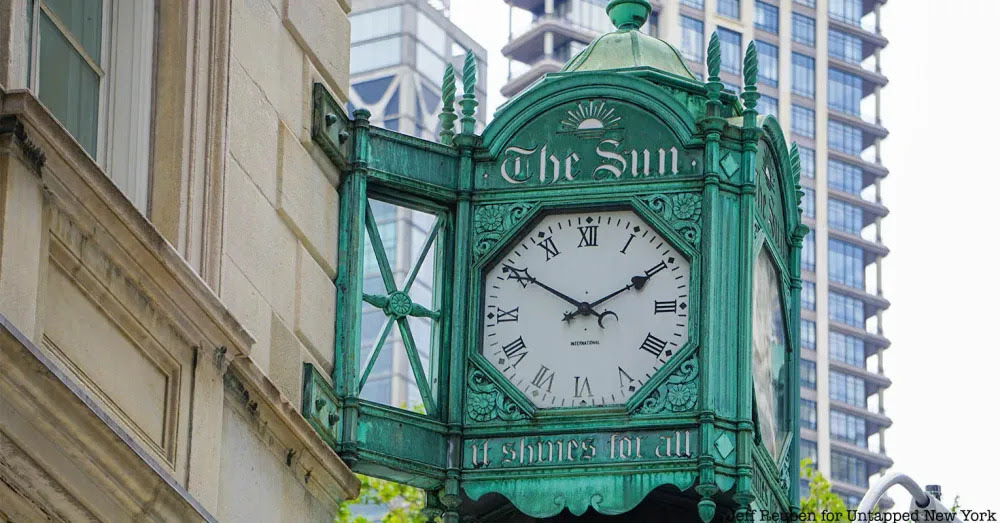
Located at 280 Broadway, The Sun newspaper’s former headquarters features a large clock and thermometer projecting from the facade of the building. The clock is inscribed with the paper’s name and motto: “It Shines for All.”
For those who don’t know, The Sun was a New York newspaper that was published from 1833 until 1950. It was the conservative rival to The New York Times and the New York Herald Tribune. Costing just one penny to purchase, The Sun was the first newspaper to report on crime and stories of ordinary citizens, making it a popular newspaper choice for the working class. Today, its former headquarters serves as the central offices for the New York City Department of Buildings. Originally, however, it housed the A.T. Stewart dry goods emporium, regarded as the first department store in New York. The Sun building is just one example of the many former locations of newspaper headquarters in New York City. It’s also full of many interesting and historical secrets, which you can read here.
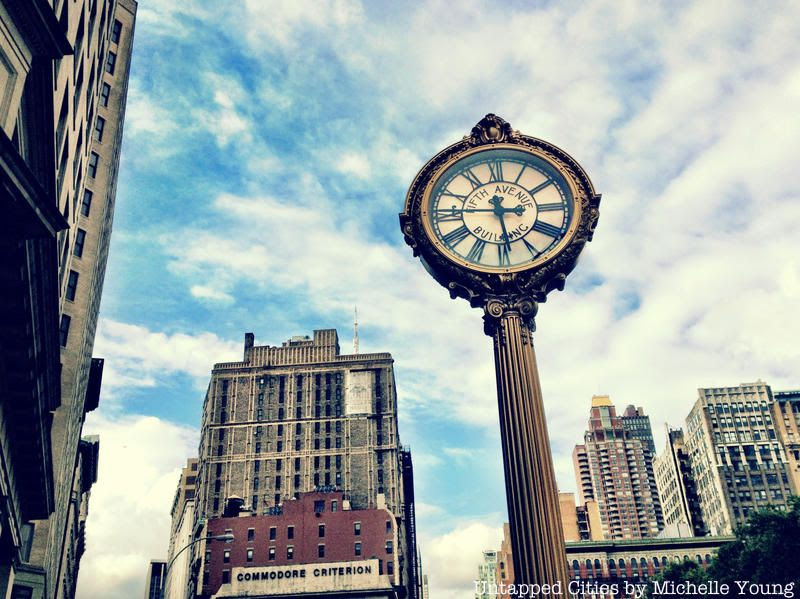
Located directly in front of New York City’s beloved Eataly, a decorative cast-iron sidewalk clock is situated next to a subway entrance, a newsstand, a telephone booth, a mailbox, lamppost, and numerous planters. The clock was manufactured by Hecla Iron works and is composed of an ornamented base and an Ionic column. Roman numerals on its face are also framed by wreaths of oak leaves and crowned by a cartouche.
Many people easily walk past this clock on a daily basis, but it’s been a fixture in the neighborhood since 1909, when it replaced an earlier clock that had accompanied the elegant Fifth Avenue Hotel. In an effort to preserve the historic importance and artisanship of cast-iron clocks, the city designated the clock an individual landmark in 1981. It’s one of seven sidewalk clocks designated as such. Three other ones are in Manhattan – in front of the Sherry Netherland Hotel, at 1501 Third Avenue and at 522 Fifth Avenue. There are also two in Queens, one at 16-11 Jamaica Avenue, thought to have been installed by Busch’s Jewelers and a Wagners Jewelers Clock at 30-78 Steinway Street. Lastly, there’s one in Greenpoint, the Bomelsteins Jewelers clock, at 753 Manhattan Avenue
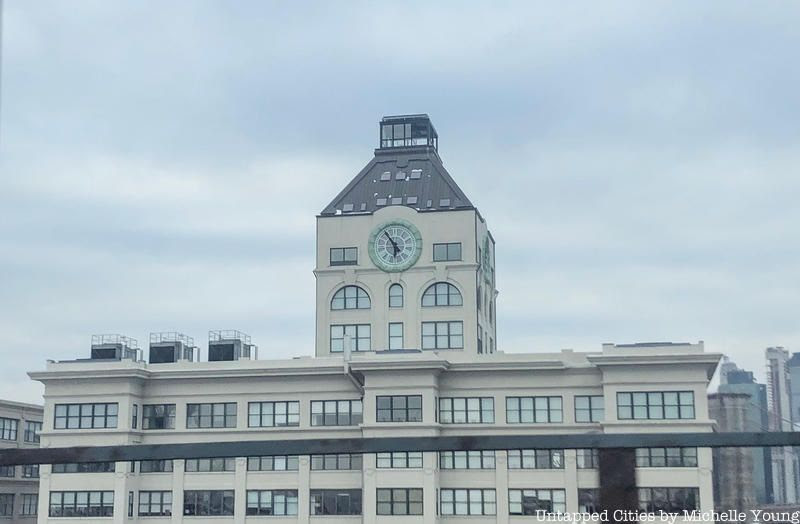
Located at the top of the 124-condominiums are four giant clocks, designating the residential building to be named “The Clock Tower.” Located in DUMBO, the tower is known for its iconic architectural qualities and the sweeping, unobstructed views it provides for its residents.
The clock tower was originally built in 1914 and received a total conversion in 1998. One of its most notable features is the penthouse at the top of the building, with transparent four 14-foot windowed working clocks surrounding the living area. The penthouse closed for $15 million last year, which earned itself the title of being the most expensive condominium sale ever in the borough.
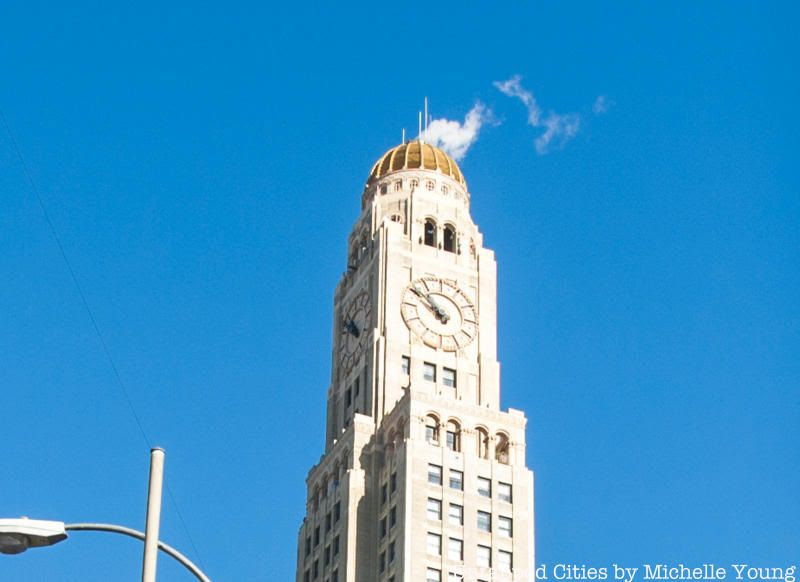
Built in 1927, the Williamsburgh Savings Tower is one of Brooklyn’s architectural icons due to its clocks located at the top of the building. The structure itself is among the tallest four-sided clock towers in the world, with each of the clock faces measuring 17 feet in diameter. At the time of their installation, they were the largest clock faces in the world, and the building was the tallest building in the borough — titles that have now been surpassed.
Originally built as the new headquarters for the Williamsburgh Savings Bank, the building has since been converted to luxury condominium apartments. It was declared a New York City landmark in 1977, and its clocks continue to make it one of the most recognizable towers in Brooklyn.
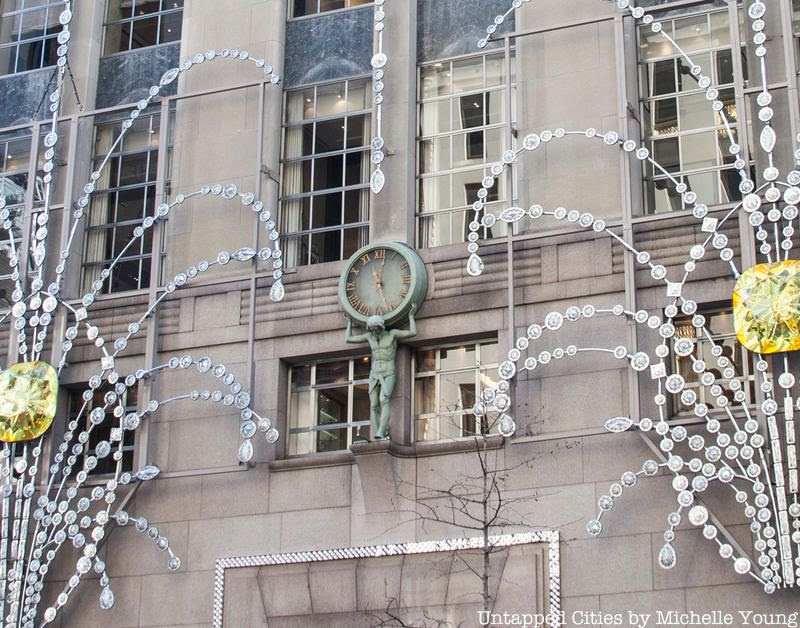
Another example of a major player in the golden age of Manhattan’s jewelry, Tiffany & Co. lured customers in with its decorative entrances. In 1853, the company built an impressive new building at 550 Broadway embellished with a beautiful clock.
To create the piece, Charles Tiffany commissioned dear friend and renowned sculpter, Henry Frederick Metzler. Standing at nine feet in height and four feet in diameter, the clock is held up by Atlas, the Greek Titan God and known as the bearer of the heavens. Over time, as Tiffany & Co. moved flagship locations, it transported the clock with them. Finally in 1940, Tiffany & Co. moved to their famous location on Fifth Avenue, and the sculptural clock continues to reside there today.
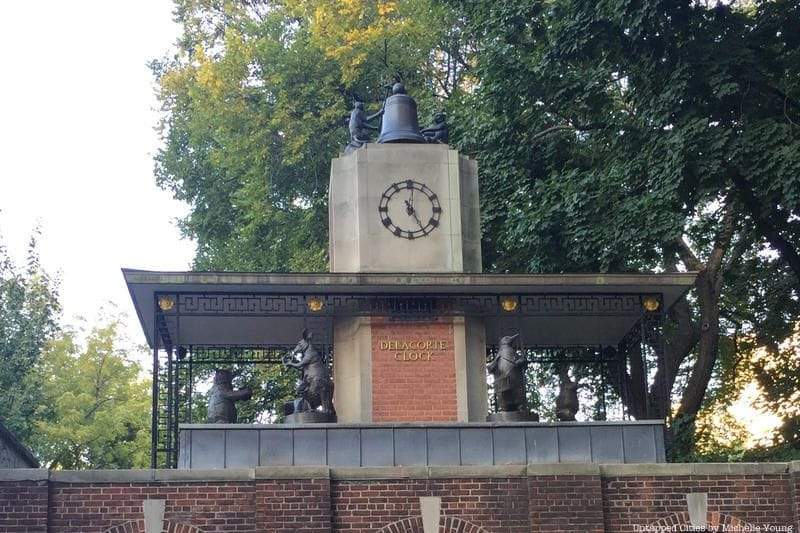
Located above the arcade between the Wildlife Center and the Children’s Zoo, Central Park Zoo’s iconic timepiece known as the Delacorte Clock has established itself as one of the most beloved monuments within the green space. The clock is dedicated to George T. Delacorte, the publisher and philanthropist who gifted the fixture to the park in 1965.
Everyday between 8am and 6pm, the digitally programmed clock plays one of thirty-two nursery rhyme tunes on the hour. It also features sculpted animals, including a penguin, kangaroo, bear, elephant, goat, and hippo that parade around the clock. Additionally, two sculpted monkeys with mallets strike the bell on the hour. The full list of songs, which can be seen here, are divided into four seasonal categories; Christmas songs, for instance, are programmed to play from December 1-25. For more fun facts and secrets of the Central Park Zoo, click here.
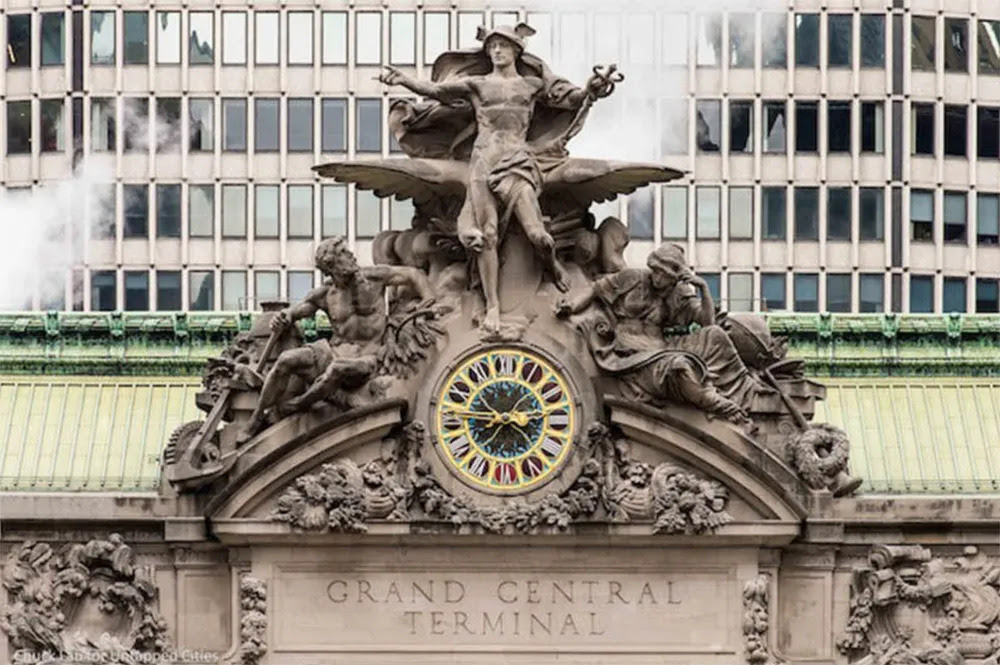
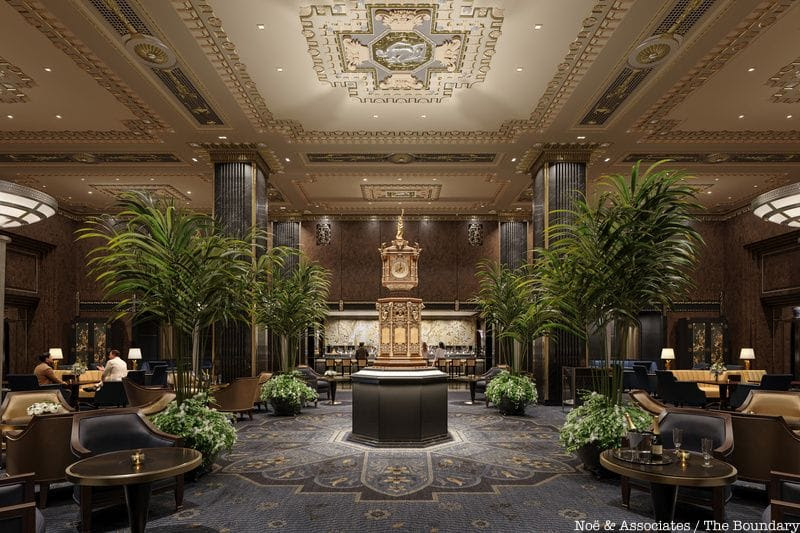
Queen Victoria commissioned this stunning clock to show off fine English craftsmanship at the 1893 World’s Columbian Exposition (akak The Chicago World’s Fair). John Jacob Astor IV later purchased the clock for display in the original Waldorf-Astoria Hotel on Fifth Avenue and 34th Street. It moved to the current Waldorf Astoria in 1931. During hotel renovations and its conversion into condomoniums, the famous clock underwent an extensive year-long restoration of its own and made a brief appearance at The New York Historical. Now that the hotel is once again open for bookings, guests can see the clock inside.
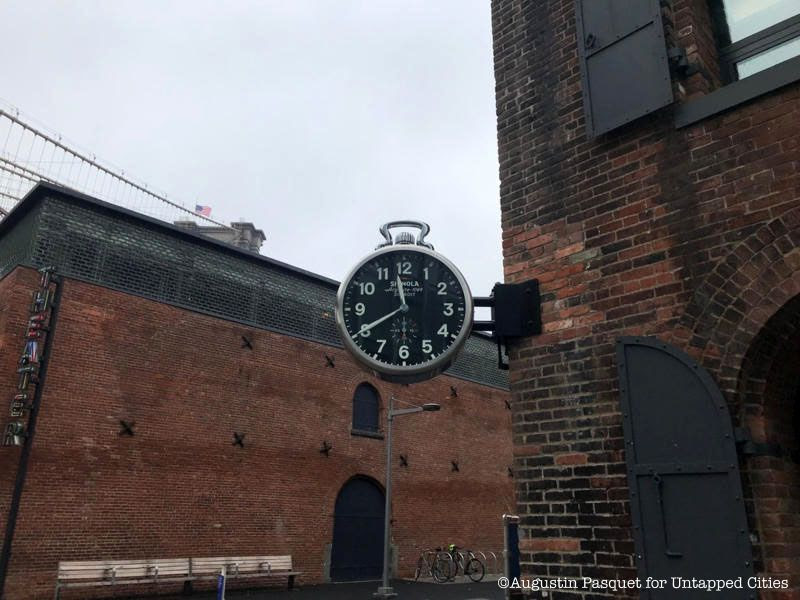
Although this is one of the newer clocks we’ve spotted around New York City, we appreciated the design and thought it was worth special mention. You can find the double sided, personalized time piece mounted on the outside of Shinola, a Detroit-based watch and accessories store located within the Empire Store’s waterfront shopping complex in DUMBO. Shinola also has another location in Tribeca.
Shinola has all of its clocks custom made by Electric Time Company, a legendary company in Medfield, Massachusetts. Originally founded in 1928, Electric Time Company is currently a manufacturer of tower and street clocks marketed worldwide. Its products can be found anywhere from New York City to the Magic Kingdom in Disney World, with each clock designed and installed on the premises of the location. They’re made to order and usually take up to three months to complete.
OUR QUEENS BUS ROUTES WE HAVE POSTED THE NEW ROUTE MAPS ON THE BACK OF THE CHAPEL BUS SHELTER
All image are copyrighted (c) Roosevelt Island Historical Society unless otherwise indicated THIS PUBLICATION FUNDED BY DISCRETIONARY FUNDS FROM CITY COUNCIL MEMBER JULIE MENIN & ROOSEVELT ISLAND OPERATING CORPORATION PUBLIC PURPOSE FUNDS.
I was off to test the new Q102 route from the Island to Court Square. On weekends there are just 2 buses an hour leaving the subway station at 15 and 45 minutes past the hour. The bus stops at the 546 Main Street stop. The 12:45 bus arrived with just one other passenger on it.
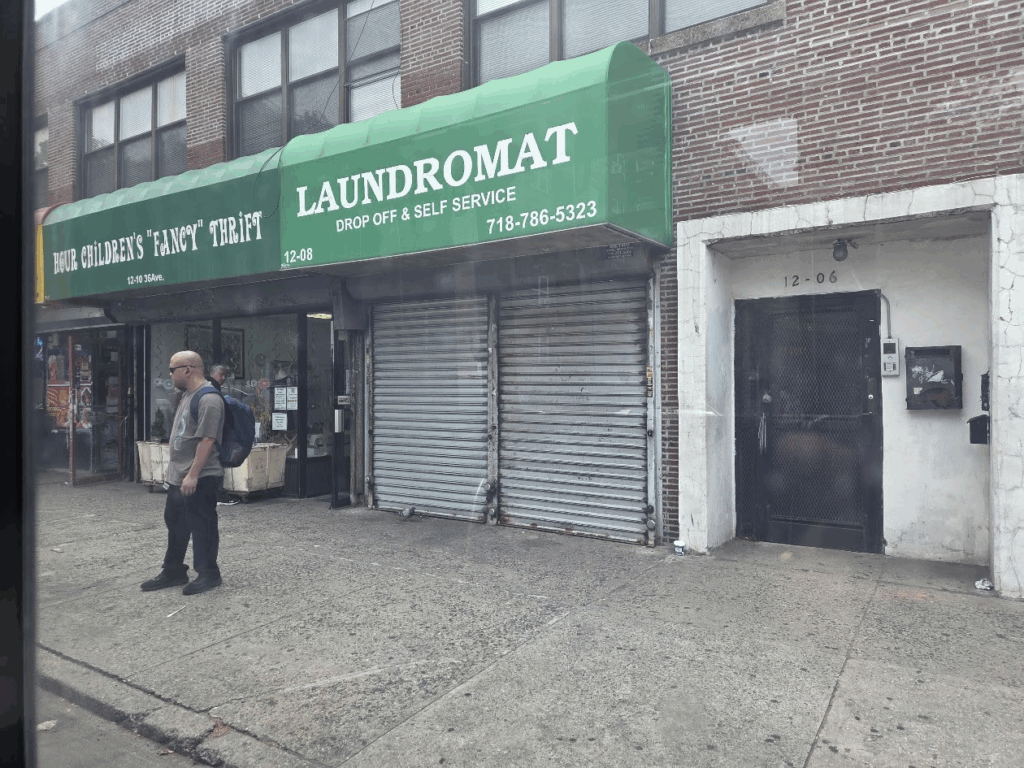
Proceeding east on 36th Avenue, the second stop is at 12th Street. This is a great location to get off and make a donation to the Hour Children Thrift Shop.
Being a holiday most shops were closed. Just before turning onto 31st Street, we passed Flowers by Lunelly, a great florist that has supplied wonderful and creative arrangements for many island events.
Being a holiday, the intersection between Northern Blvd, Queens Plaza and the bridge entry was quick. This intersection will be a challenge weekdays.
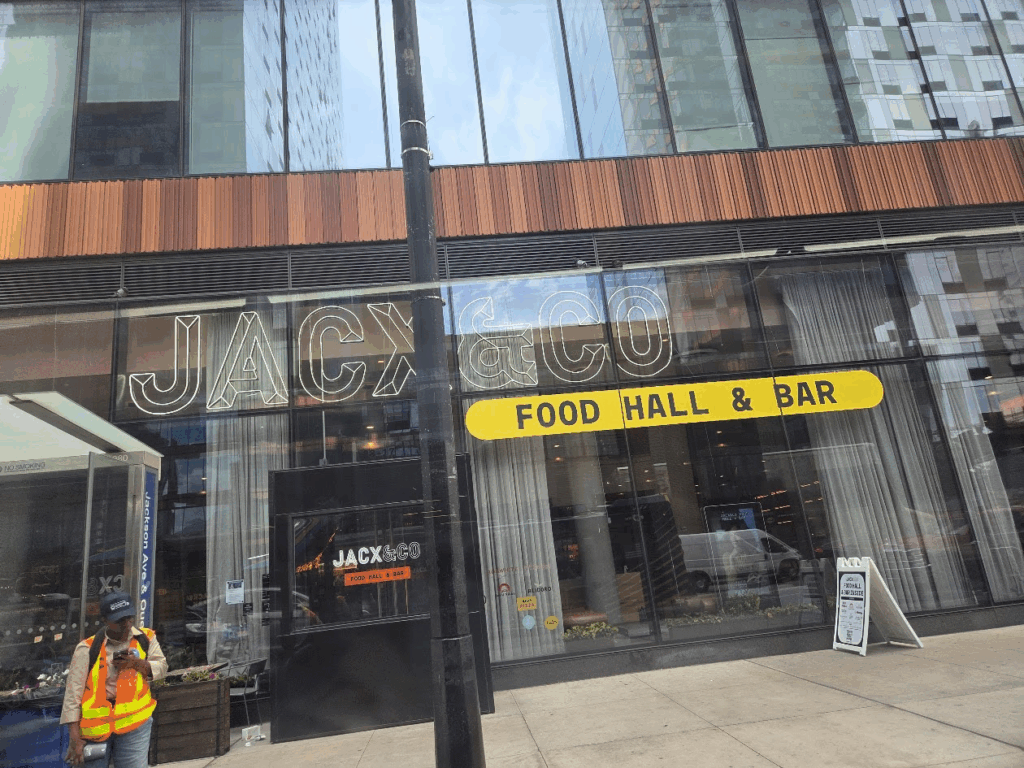
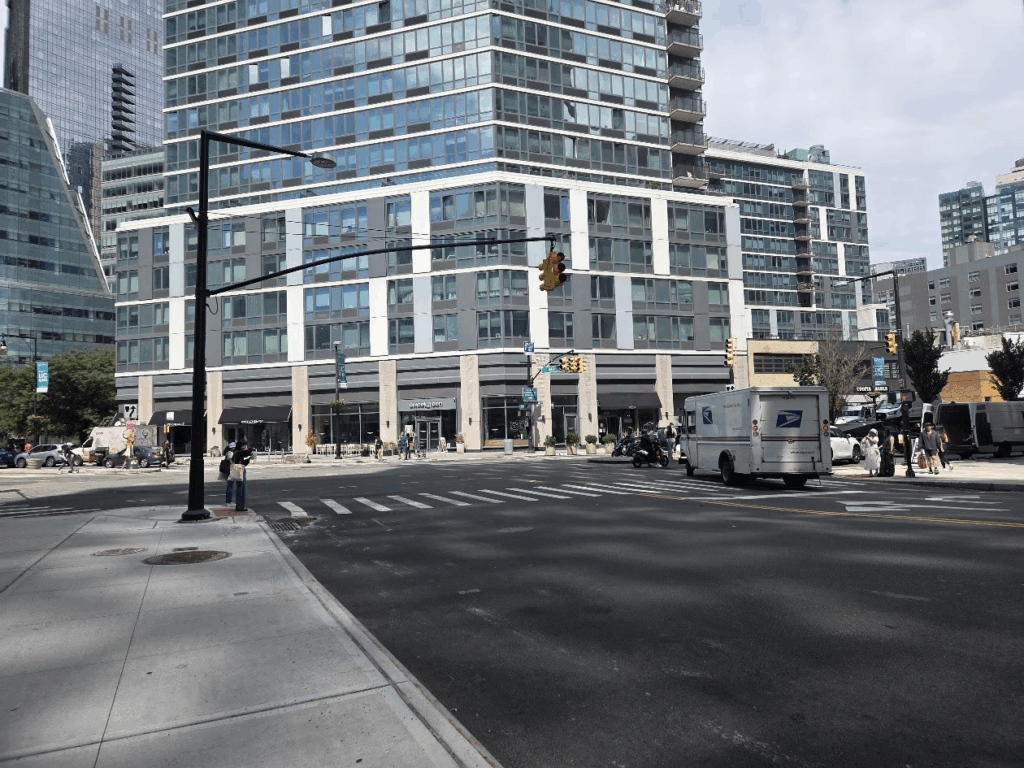
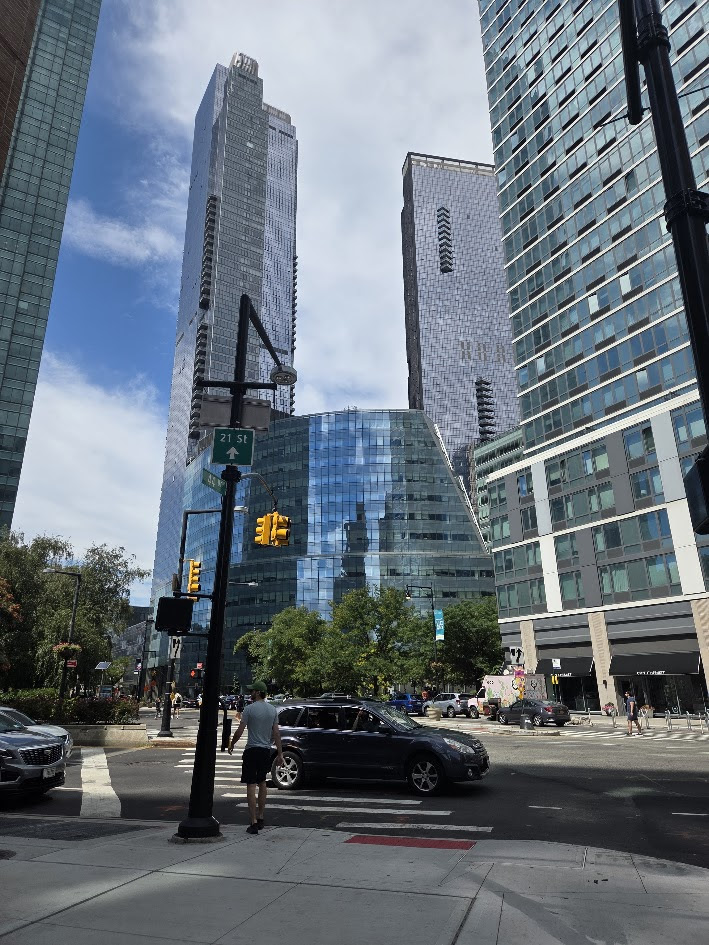
The 7 train is a few block walk from the N & R train at Queens PlazaOnce on Jackson Avenue, we were in the new skyscraper world of Long Island City. Jacx & Co, a giant food hall is the first dining spot on the avenue. Accross the street is al Murray’s Cheese, Serafina and a Chipolte. No longer an industrial area there are multiple dining spots may Asian.
The bus route ends at 44th Drive and Jackson Avenue. (The return starts at 43rd Avenue and Jackson Avenue)
It takes time to adjust to the neighborhood. Until recently the only hi-rise was Citi-Corp, now it is surrounded by other buildings. There is still a park in front of the building. There is a Target store on the other side of the building.
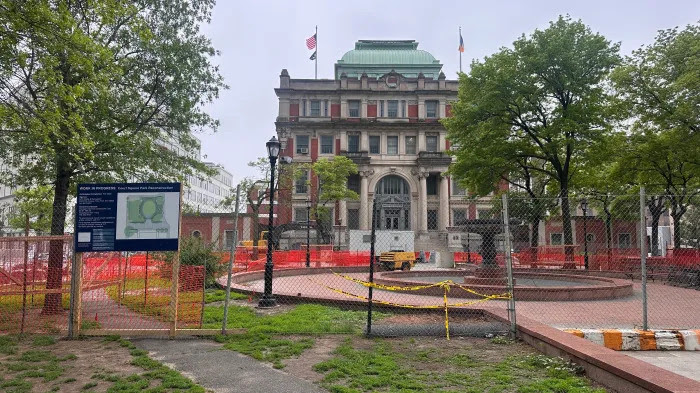
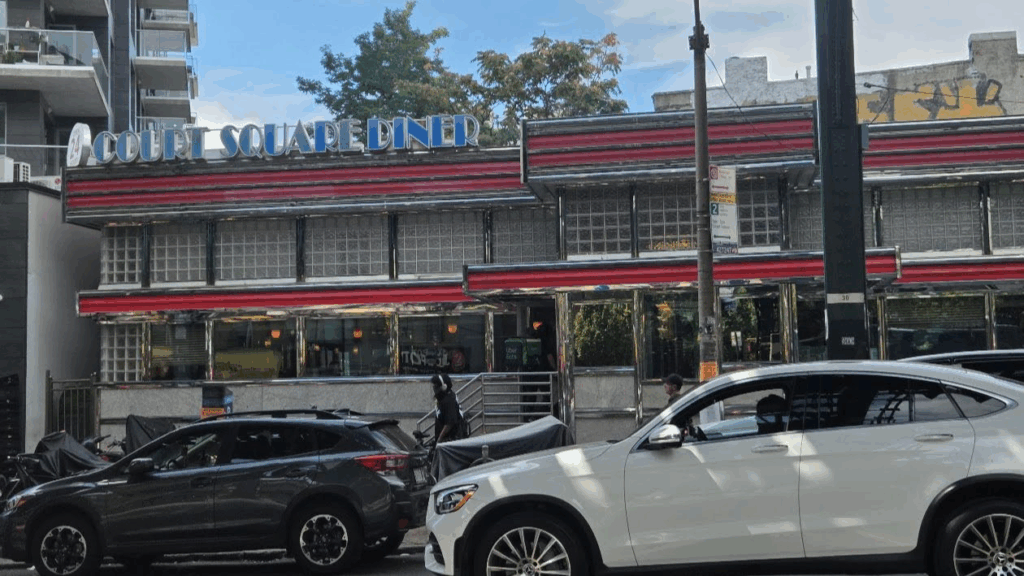
The grand courthouse is accross the street partially hidden by construction on the plaza outside the building.
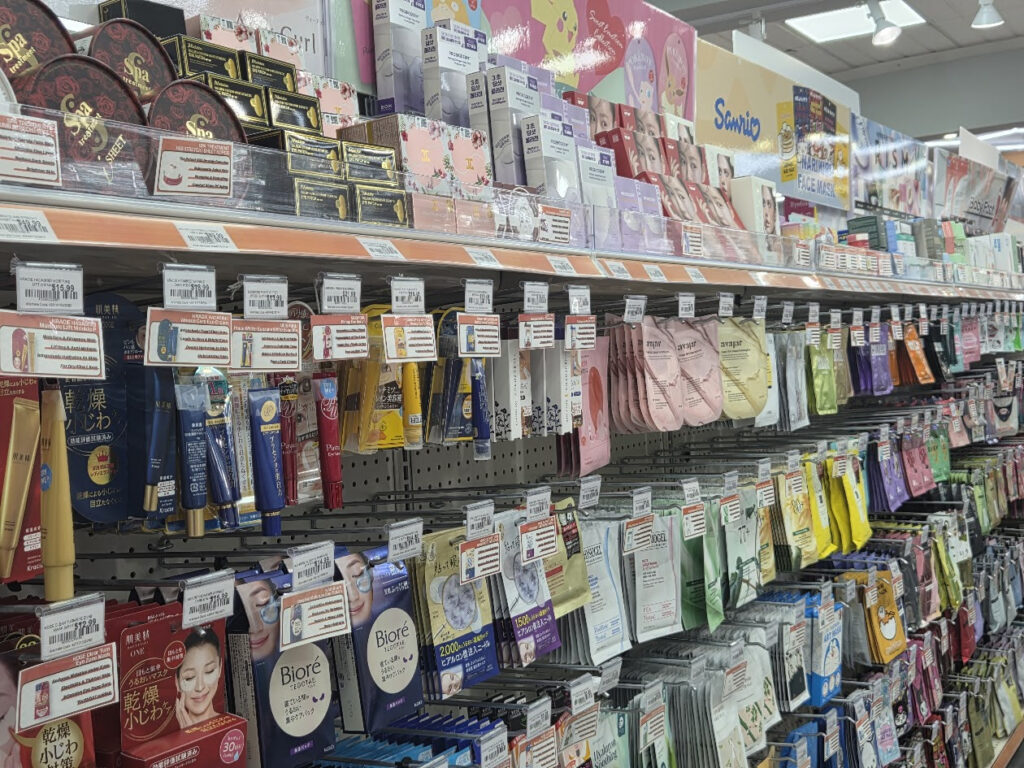
On the next block is Teso-Life, (from Google)Teso is a Japanese lifestyle store owned by a Chinese entrepreneur, as reflected in the presence of Chinese characters throughout the store. They carry a wide selection of Korean and Japanese skincare, haircare, makeup, and food.
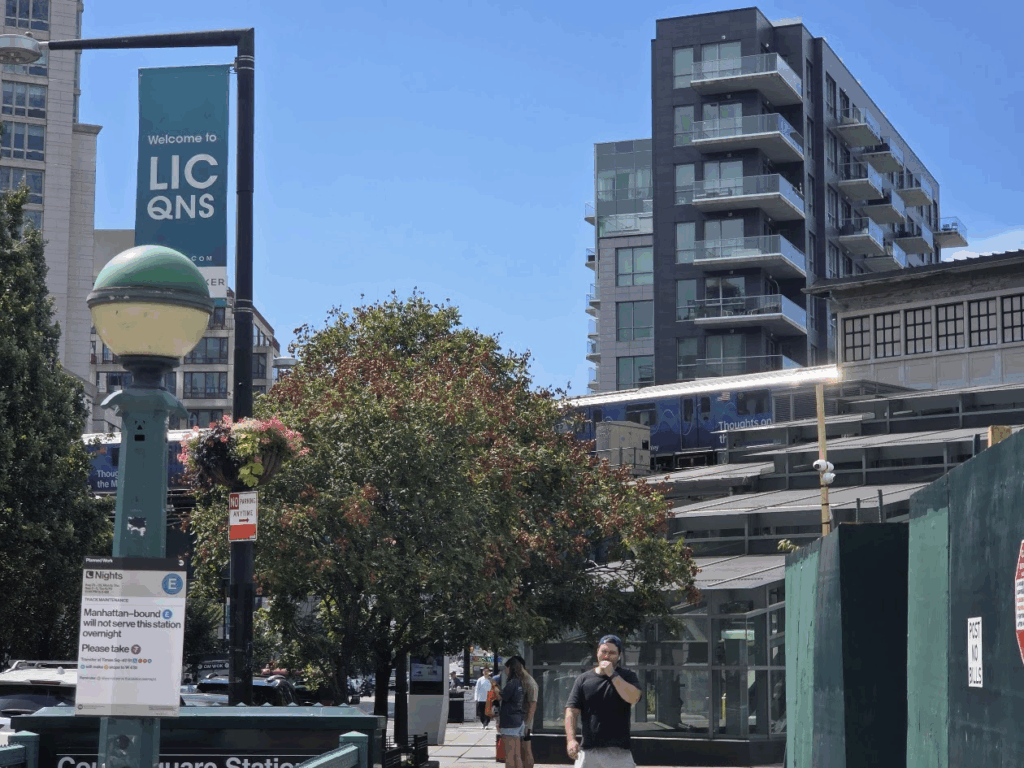
The E train station is on the corner.
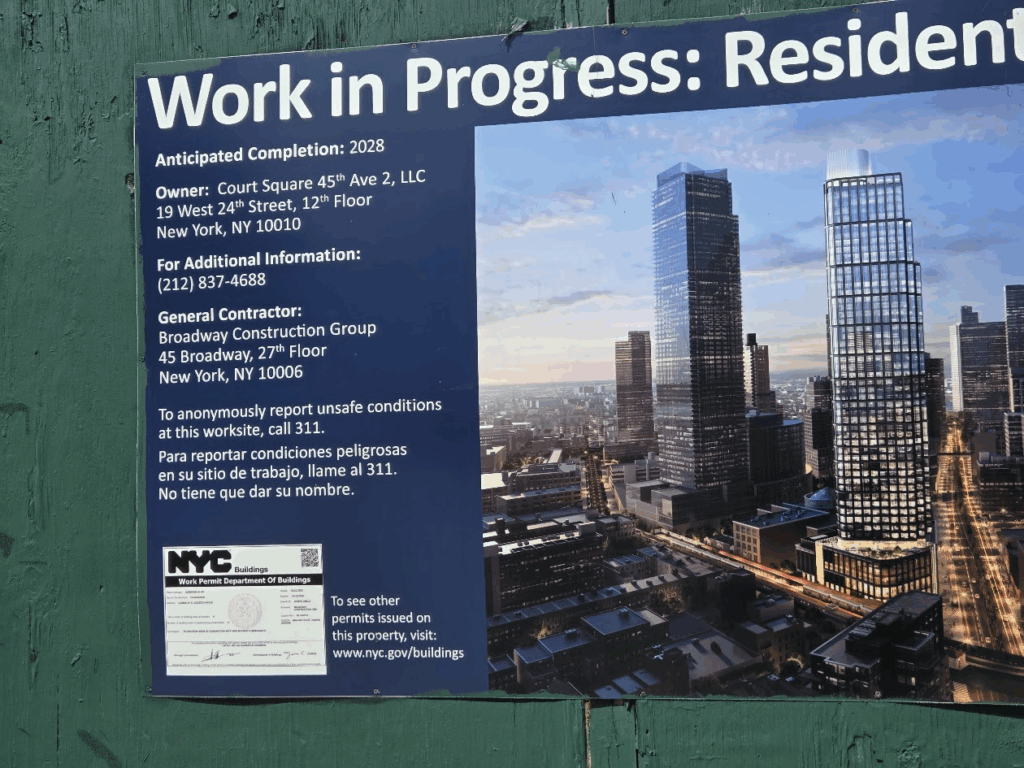
One of the few vacant areas has a sign posted that another monster hi-rise will soon appear. (Is there any planning or zoning in Queens?)
One remnant of old LIC remains on the corner 23rd Street.
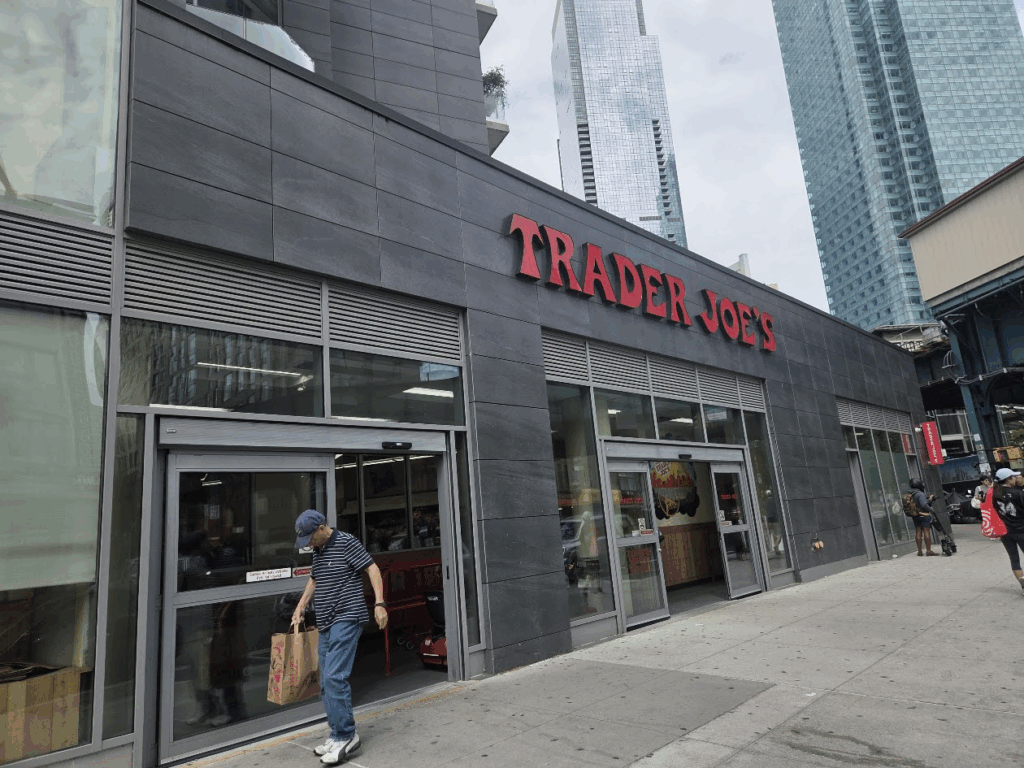
Next to the G train station and my destination was reached after a 10 minute walk from the bus stop. The store was crowded, but still easy to be in and out in less than an hour. An Uber ride seemed the best idea to bring my purchases home.
OUR QUEENS BUS ROUTES WE HAVE POSTED THE NEW ROUTE MAPS ON THE BACK OF THE CHAPEL BUS SHELTER
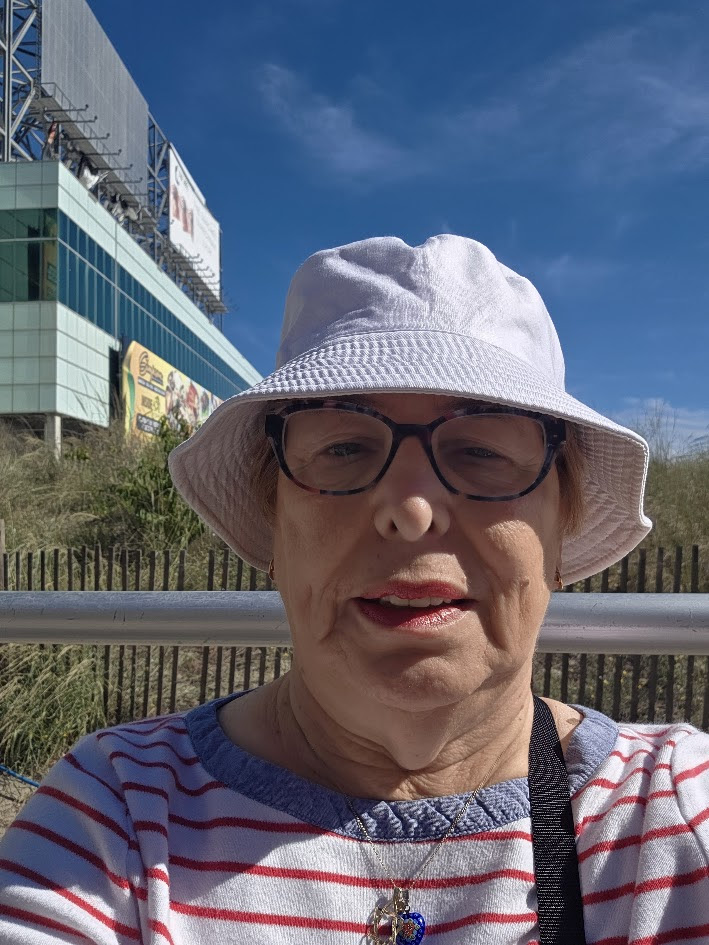
Saturday was escape day to Atlantic City with a group from our CBN Center. Trip was sponsored by RIDA. A day of fun in the sun!!
Credits
Judith Berdy
All image are copyrighted (c) Roosevelt Island Historical Society unless otherwise indicated THIS PUBLICATION FUNDED BY DISCRETIONARY FUNDS FROM CITY COUNCIL MEMBER JULIE MENIN & ROOSEVELT ISLAND OPERATING CORPORATION PUBLIC PURPOSE FUNDS.