Wednesday, December 17, 2025 – CANAL STREET HAS AN INTERESTING HISTORY

What Happened to the Canal
that Gave
Canal Street its Name?
WEDNESDAY, DECEMBER 17, 2025
ISSUE #1594
EPHEMERAL NEW YORK
When you think of a canal, images of the romantic waterways of Venice and Bruges might come to mind.
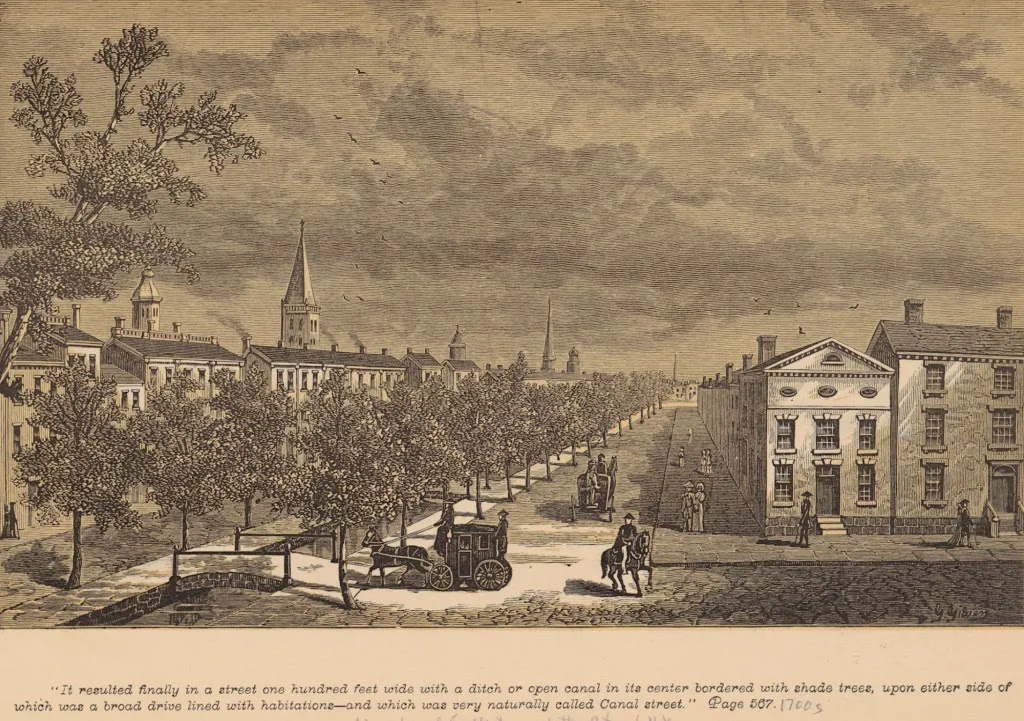
But Canal Street in New York City? It doesn’t exactly conjure up romance. True, an actual canal did exist here in the early 1800s. It was pleasantly designed—surrounded by trees, crossed by a footbridge dubbed the “kissing bridge,” and flanked on either side by tidy houses.
But whatever positive feelings New Yorkers may have had about the canal at first disappeared quickly. The water it carried was fetid, the ditch became an open sewer, and the residents of the newly opened Canal Street were relieved when it was permanently covered over.
The story of this short-lived canal starts in the 1790s, when New York City was grappling with a serious drinking water problem.
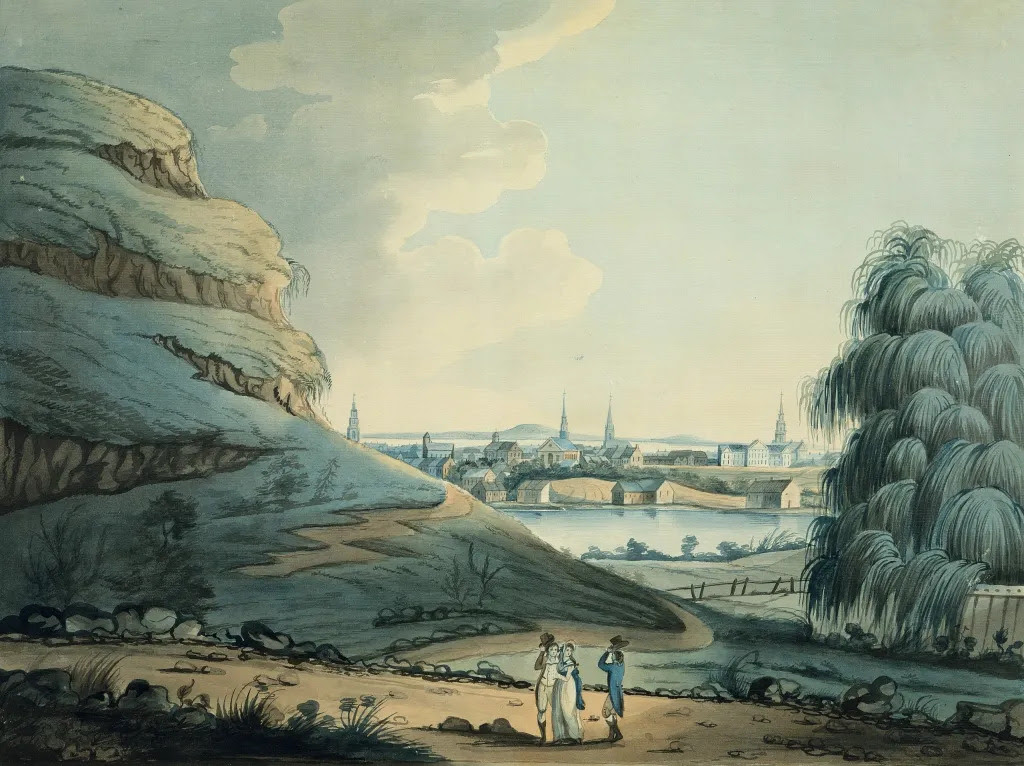
During its days as a Dutch colonial outpost, residents got their water from the many streams that crossed Lower Manhattan. By the time the English occupied Manhattan, a freshwater pond known as Collect Pond (above), roughly centered in today’s Chinatown, became a main source of safe water.
Collect Pond was picturesque, 60 feet deep, and fed by an underground spring, according to NYC Parks. Families picnicked beside its shore, and when the pond froze in the winter, skaters would take to the ice.
But as the 18th century progressed, industry began using the pond as a dumping ground. Waste from tanneries, slaughterhouses, breweries, and other manufacturers eventually transformed Collect Pond into a foul-smelling body of water that bred disease.
In the early 1800s, the city decided to drain this former water source, then fill it in and turn the new land into useable real estate. To properly drain the pond, a wide ditch needed to be built that would carry away the foul waters to the Hudson River.
By 1810, city officials began engineering “a plank-sided canal eight feet wide following a straight line from Centre Street to the Hudson, with a roadway on both sides,” wrote Oliver E. Allen in a 2013 article in the Tribeca Trib.
The canal had a promising start, with its charming footbridge and tree-lined promenade, states NYC Parks. “The canal was popular among the residents of what was by now a lively neighborhood surrounding it,” wrote Allen. That neighborhood would have been on the outskirts of the city center.
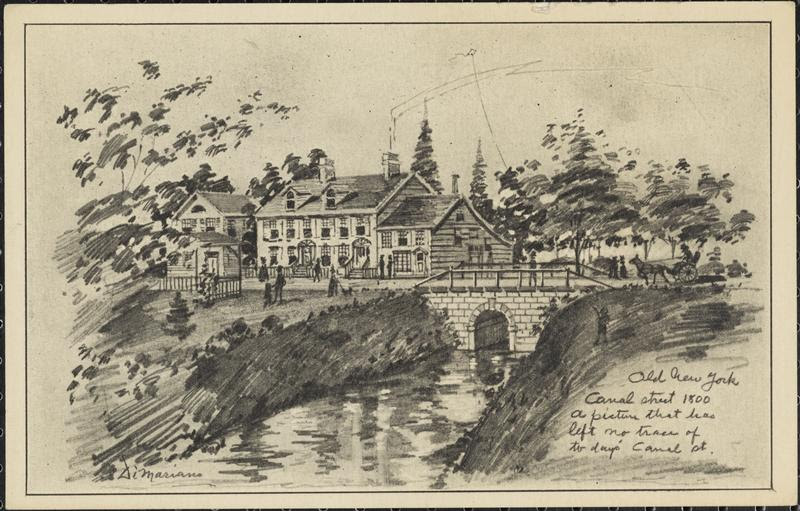
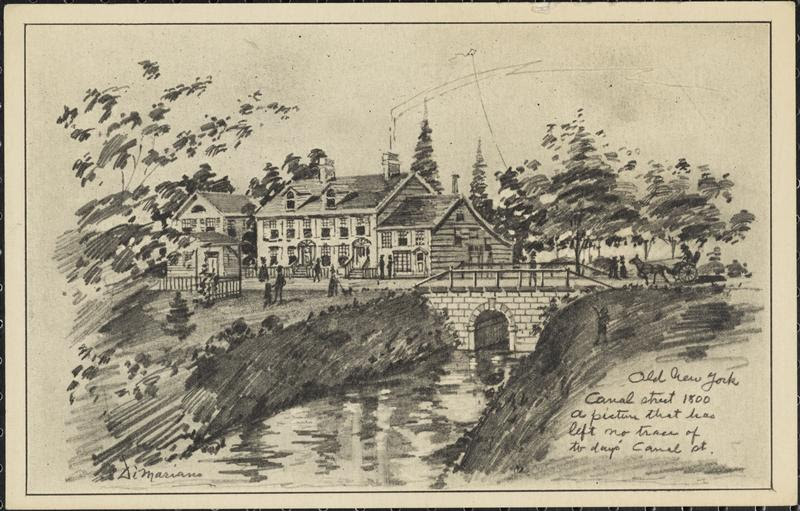
But thanks to sluggish water flow, the canal (above in 1811, at Broadway) became more like a cesspool. Stagnant water and rancid odors made nearby residents disgusted and angry.
By 1820, the decision was made to cover the canal and bury it under the street. Residents complained that it still emitted a foul smell, which makes sense, because the former canal was never actually filled in. Enclosed in a brick-arched tunnel, it became the city’s first sewer, according to New York water ecology organization NYCh2o.org.
As time went on, Canal Street’s fortunes didn’t change. Thanks to its proximity to the Five Points slum—built on the marshy land of the former Collect Pond—the street developed a rougher edge. Property values plunged, though commercial activity kept Canal Street a main business artery.
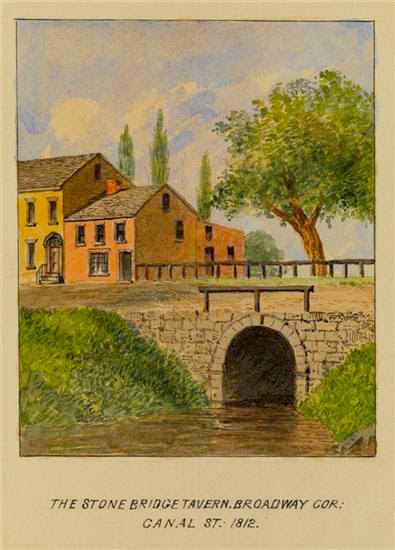
These days, Canal Street serves as kind of Lower Manhattan demarcation line. On one end, it’s the southern border of SoHo and the northern end of Chinatown. On the other end, it divides SoHo and Tribeca.
Each end of Canal Street still has a handful of early 19th century residences, the kind that would have lined the street when the canal existed. The canal is history, but the houses that once flanked it have been standing for roughly two centuries.
CANDLELIGHT SERVICE AT GOOD SHEPHERD
PHOTO BY JUDITH BERDY
CREDIT
EPHEMERAL NEW YORK
Tags: Canal Street early 1800s, Canal Street Name Origins, How Canal Street NYC Got Its Name, What Happened to the Canal on Canal Street NYC, When did Canal Street Open, When Was the Canal in NYC Drained
Posted in Lower Manhattan | 11 Comments »
THE COMMENTS ARE REALLY INTERESTING
All image are copyrighted (c) Roosevelt Island Historical Society unless otherwise indicated
THIS PUBLICATION FUNDED BY DISCRETIONARY FUNDS FROM CITY COUNCIL MEMBER JULIE MENIN & ROOSEVELT ISLAND OPERATING CORPORATION PUBLIC PURPOSE FUNDS.


Copyright © 2025 Roosevelt Island Historical Society, All rights reserved.Our mailing address is:
rooseveltislandhistory@gmail.com
Leave a comment