Weekend, January 31 to February 2, 2026 ISSUE #1618
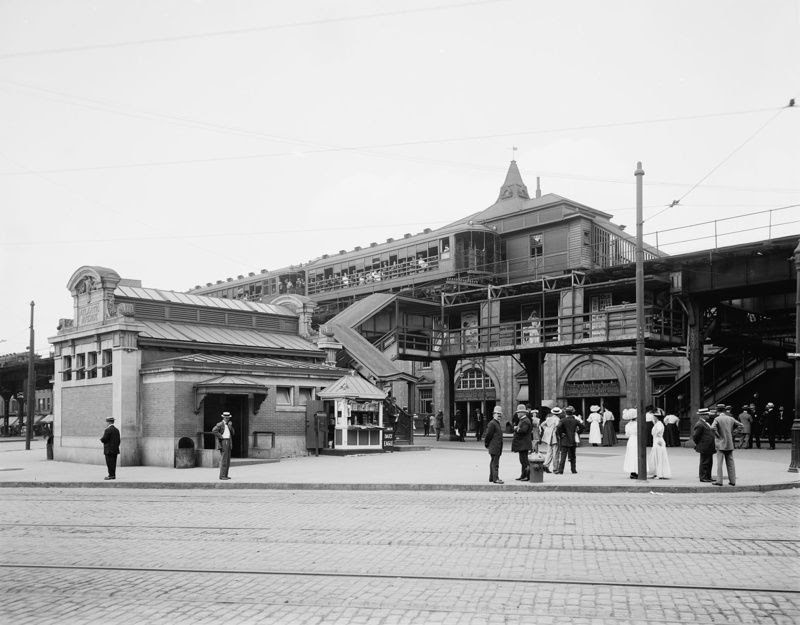
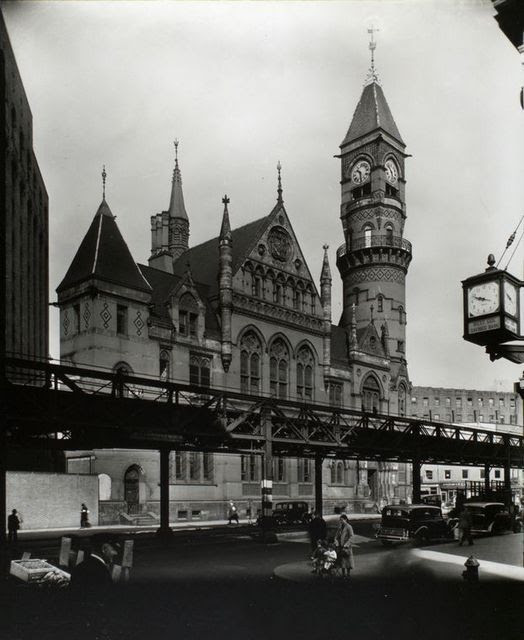
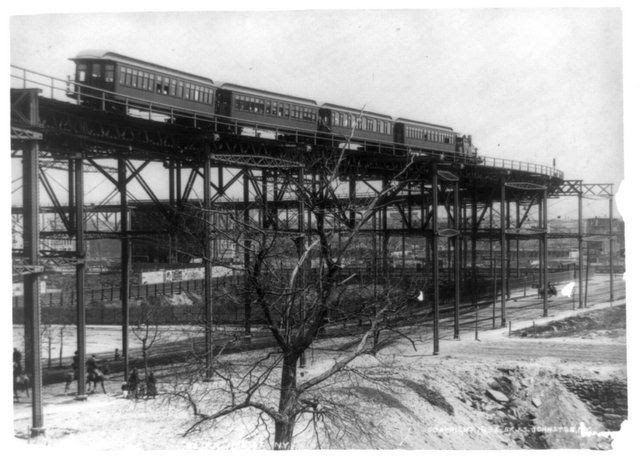
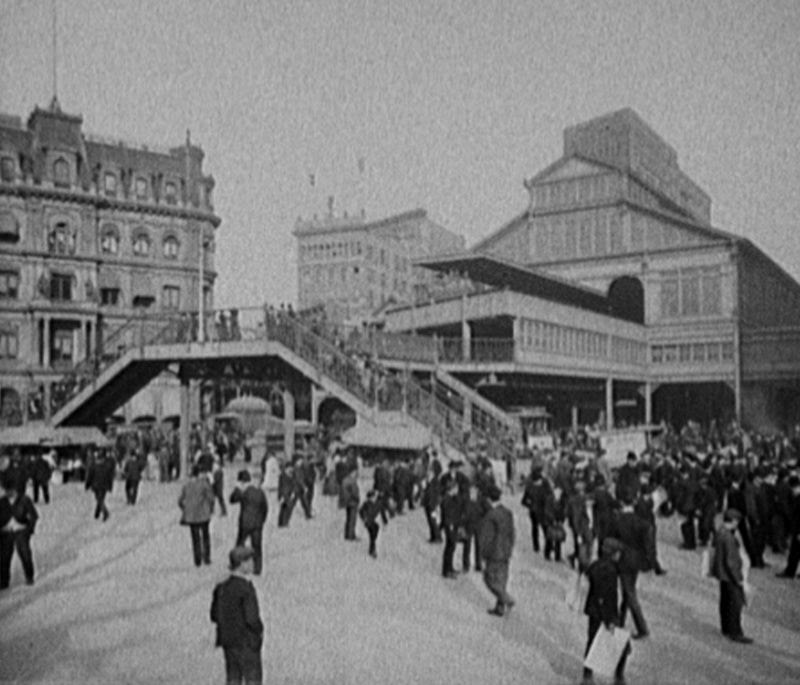
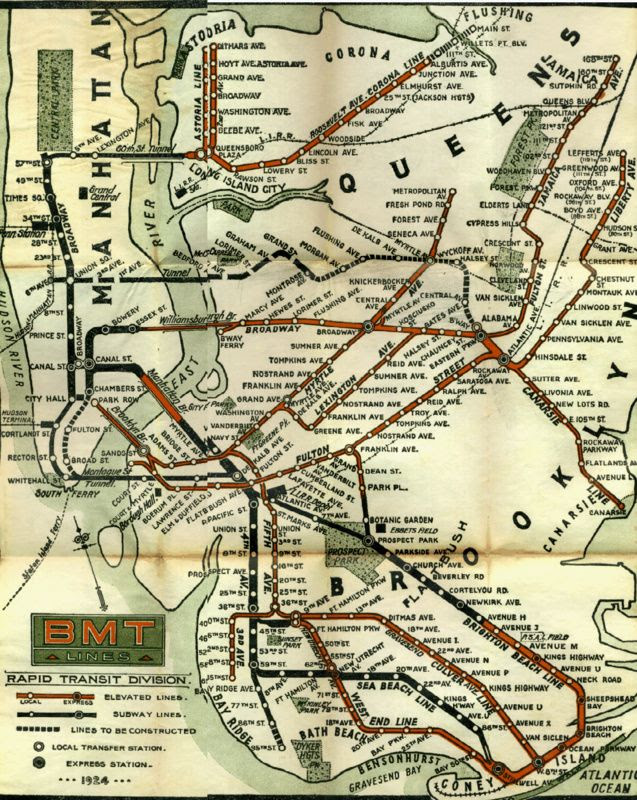
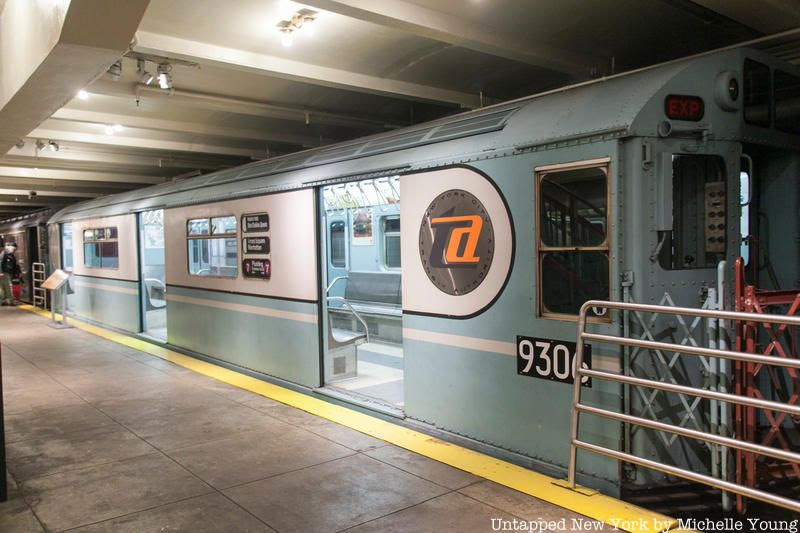
As New York City evolved and changed into the cosmopolitan city it is today, so did the transit lines connecting the city to the boroughs and Long Island. Here are 12 subway and rail lines that have been built, abandoned, then destroyed in New York City since the late 19th century some because of the construction of parallel underground lines, others because of changes in service patterns. With the triumphant return of the W line in the (supposedly) November 2016, we’re remembering some lines of the past.
12. Second Avenue El
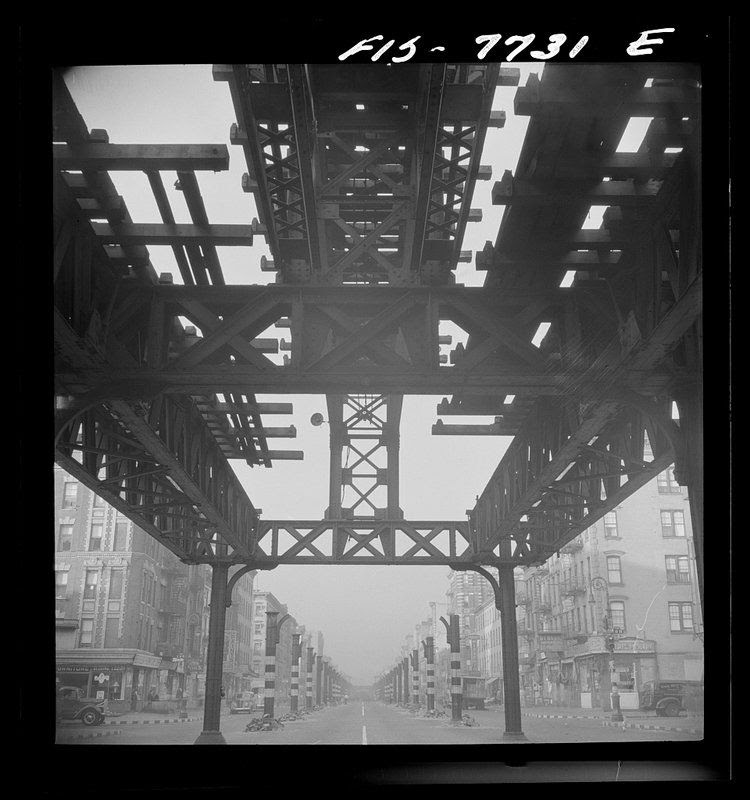
Looking south at 7 a.m. from 13th Street on Second Avenue, showing the elevated railway in midst of demolition. Photo by Marjory Collins from Library of Congress.
The Second Ave Elevated Line ran from 1880 until 1942. Construction began in 1879 by the Metropolitan Elevated Rail Company. Originally, there was thought to be enough room for a third rail, but when the first round of construction was done, only two rails were put down. On August 16, 1880, the line’s structures and tracks were ready to operate, running from South Ferry all the way up to 127th Street, the northern most limit at the time. Work on a third rail for the 2nd Ave el was completed in 1916 allowing for express services.
The last full length run of the train was on June 11, 1940. The line south of 60th Street continued to operate for about two more years. The New York Times reported on June 14th, 1942 one day after the 2nd Ave el was fully discontinued, that there were 200 passengers on the 6-car train as it pulled into South Ferry on its last run.
Construction for a Second Avenue Subway has been on-going, with a first section anticipated to open in December 2016 (though transit watchers are doubtful).
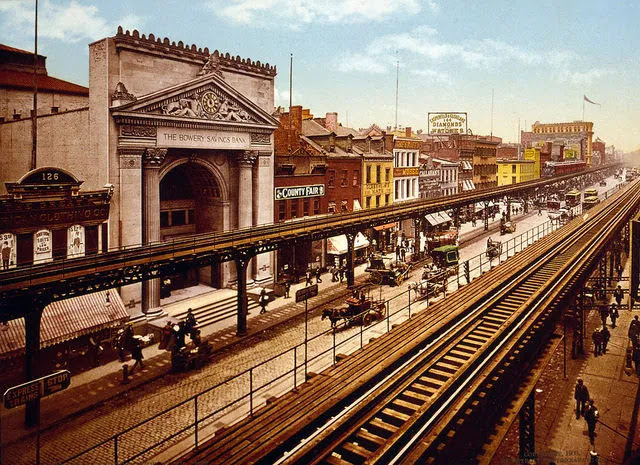
Constructed between 1875 and 1878, the 3rd Ave el ran from City Hall in Manhattan to the Harlem River. Through service between Manhattan and the Bronx began in 1896. This elevated line was the last elevated line to run in Manhattan with service to South Ferry ending in 1950 and City Hall in 1953. Northward, the 3rd Ave line had service from Chatham Square until 1955. However, service in the Bronx continued for a few years after operation ended in Manhattan. It ran between 149th Street and Gun Hill Road from 1955 to 1973. The line in the Bronx was completely demolished in 1977.
Originally known as the Brooklyn Union Elevated Railroad, the Fifth Avenue Bay Ridge Line opened in 1889 running from Park Row in Manahttan down Flatbush Avenue onto the 5th Avenue, ending at 65th Street by Stedman Plaza. This line stopped running in 1940. On June 25, 1923, there was a major train derailment that caused the death of eight passengers while injuring many others.
A 5th Ave el train derailed at the corner of 5th and Flathbush Avenues in Brooklyn where two cars fell of the elevated track, causing them to hang between the track and the street. Apparently, this wasn’t the first time an accident happened in this area. On January 24, 1900, not too far from the 1923 accident site, a train caught fire. Although no one was injured, it caused a lot of commotion.
Operation of the 6th Ave el, or Metropolitan Elevated Railway began June 5, 1878 with service from Church Street up to 58th Street with all stops on 6th Avenue. The cars on this line were painted a pea green color and cost 10 cents to ride in one of the finer cars at the time. This train ran until 1938 with demolition starting as early as August 11, 1924, with the IND line moving underground. The Fulton Elevated Line at the time was also in use, and in order to keep that particular line running and expedite the construction of the IND, the 6th Ave el needed to go.
There is some controversy surrounding where the metal of the demolished 6th Ave el went. There was speculation that the metal was being sold to Japan (remember some of the demolition occurred during World War II). The New York Times reported in 1938 that 20,000 tons of steel could “ultimately take the form of explosive shells raining down from Japanese bombers on a Chinese city.” But the Chairman of the Board of Transportation at the time, John H. Delaney, and former Borough President Stanley M. Isaacs both denied the shipping of the steel to Japan.
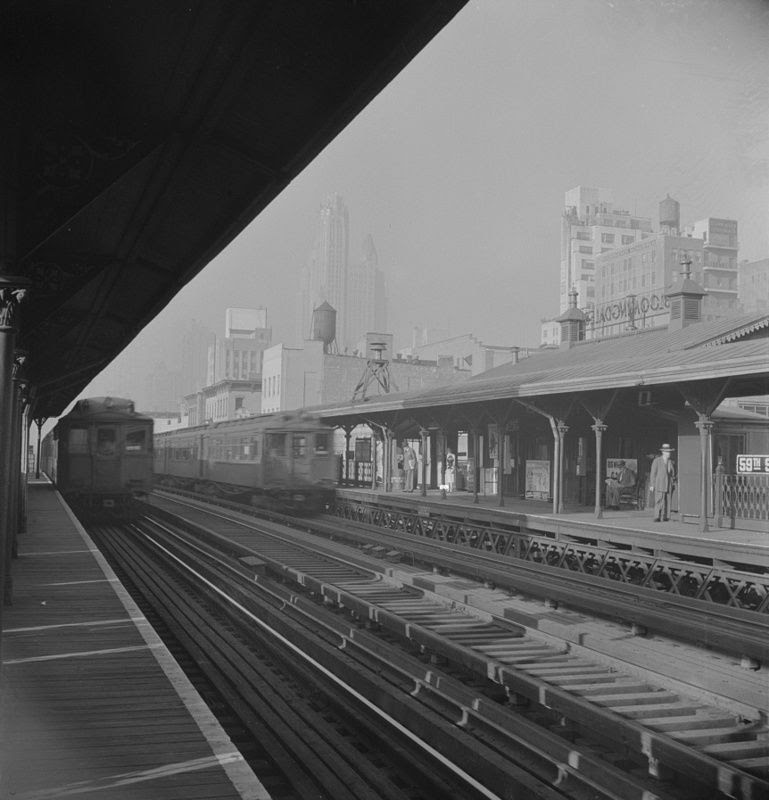
The 9th Ave el was the first elevated railway in New York City opening on April 20, 1871. It was originally powered by steam locomotives, but in 1885, the Manhattan Railway Company added an electrified third rail making the 9th Ave el the city’s first electrified railway. At the height of its operation, the line spanned from Manhattan’s South Ferry all the way up to Kingsbridge Road in the Bronx.
As the first elevated railway in the city, there were many other “firsts” associated with it, such as the first line to have three tracks which in turn allowed it to be the first train with express service. In 1918 that meant that express services would go directly from 125th street to 155th street.
Service on the 9th Ave el ended in 1940 in Manhattan since the new A/C/E train on 8th Ave began running in 1932. Operation in the Bronx continued to run as the “Polo Grounds Shuttle” to Yankee Stadium, but shut down in 1958 when the New York Giants (baseball team) moved to San Francisco.
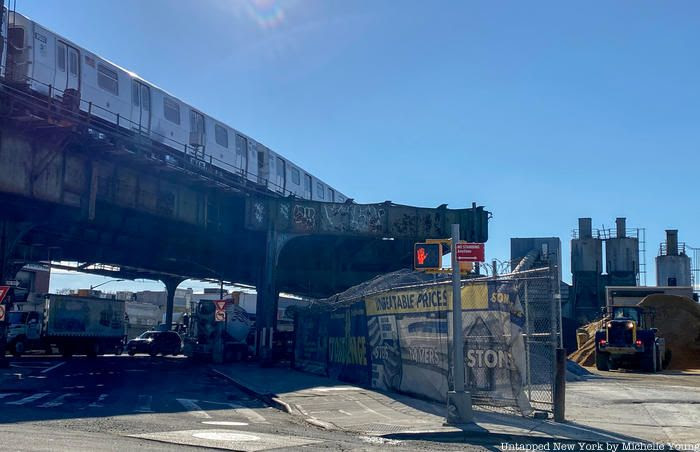
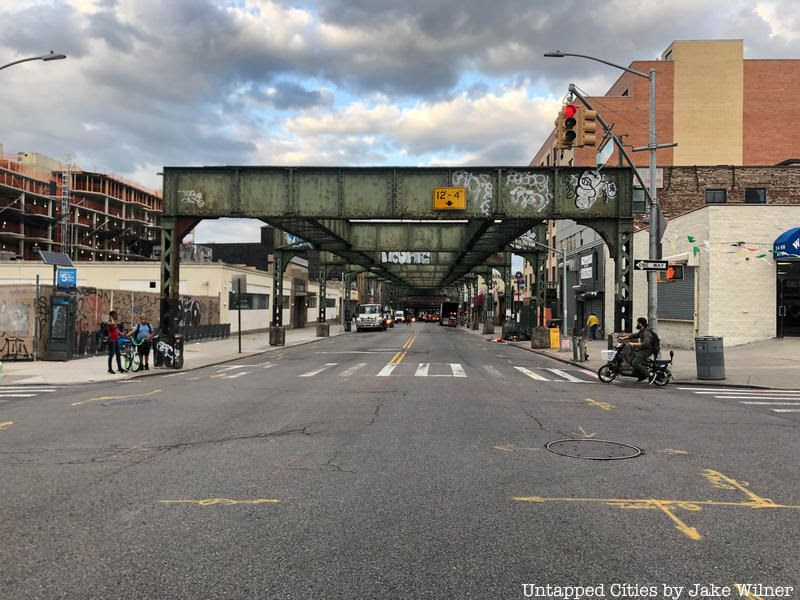
The Fulton Street el began running on April 24, 1888 originally from Fulton Ferry to Nostrand Avenue in Brooklyn. Over the next few years the line would extend until December 28, 1893 when it finally reached the Brooklyn city limit at Grand Avenue. On June 1, 1940, New York City acquired all the properties of the BMT (Brooklyn-Manhattan Transit Corporation) and the IRT (Interborough Rapid Transit Company) and abandoned all services from Fulton Ferry and Park Row to Rockaway Avenue.
The remains of the Fulton Street connection south of Atlantic Avenue were completely demolished in 2004. Even though the elevated line has been demolished, the IND Fulton Street subway runs pretty much on the same line since 1936, it’s just been duplicated underground.
This line, not to be confused with the IRT Lexington Avenue line, was the first standard elevated rail line in Brooklyn, which began running on May 13, 1885 from Washington and York Streets to Gates Avenue. This line was short lived because on April 27, 1889, the Lexington el began using the Myrtle Avenue Elevated line.
Service on the Lexington Line was not completely abandoned until October 1950. From 1904 to 1950, the Lexington Line basically ran on the elevated Broadway line. In the 1950s, ridership decreased because of the Myrtle Ave el and and underground line running under Lafayette Avenue, so the Lexington el was dismantled.
5. Long Island Rail Road at Chambers Street
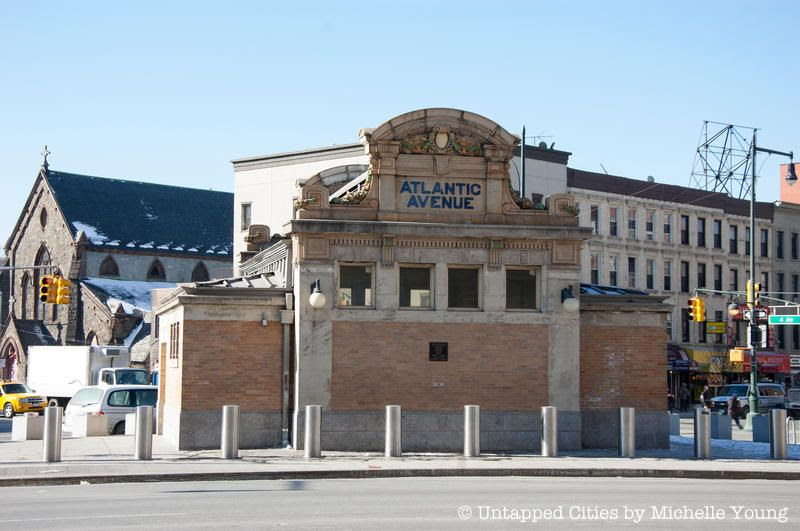
The Long Island Rail Road (LIRR)used to run south into Brooklyn past Atlantic Avenue and into Manhattan by Chambers Street. The LIRR would come up from underground at Atlantic Ave and ride on today’s J line at Fulton Street. In 1916, LIRR service to Chambers Street ended, deemed an unsuccessful experiment.
The LIRR ran from 1898 to 1917 from the lost Williamsburg Terminal to Far Rockaway during the summer. When the Williamsburg Terminal was demolished, the J train handled the service of LIRR to Far Rockaway from August 4, 1913 to 1916.
4. Culver Line
On June 19, 1875, the PP&CI railroad (Prospect Park & Coney Island) ran from Prospect Park to Gravesend Avenue and Neck Road. Until 1912, the line would go through multiple stages of ownership from the LIRR, the BRT, and then finally the South Brooklyn Railway.
On March 16, 1919, the Culver Elevated line was constructed from 9th Avenue to King’s Highway. Service eventually reached Coney Island on May 1, 1920. In 1954, new construction of the 6th Avenue IND connected it to the Culver el causing the elevated line between 9th Avenue and Ditmas Avenue to become practically unused. So, the MTA made the Culver a shuttle from 9th to Ditmas with stops at Fort Hamilton Parkway and 13th Avenue but eventually closed the shuttle in 1975. The structure was completely demolished in 1985.
3. Myrtle Avenue Line
Today there is a Myrtle Ave line that runs through Brooklyn, but it is not the same one the past. What is used today follows the remnants of the old Myrtle Avenue Line which ran from Jay Street to Metropolitan Ave until it was abandoned on October 4, 1969. This particular line was the last one in the entire city to use the wooden cars typically operated on the elevated lines.
The Myrtle Ave Line opened in April 1888 running between Adams Street station in downtown Brooklyn and Grand Avenue in Clinton Hill. Through the next few years it would slowly branch out further until 1906 when it was finally extended to Metropolitan Ave. Today, the eastern most part of the line between Wyckoff and Metropolitan Avenues is still being used by the M subway line.
2. World’s Fair Subway Line
This line was created specifically for the World’s Fair in 1939 in Queens. The line started near the Forest Hills-71st Street stop along today’s M/R lines, by what the Queens Boulevard line of the IND, ran through Jamaica Yard, turned north at the east side of Flushing Meadows-Corona Park and rolled into the World’s Fair Terminal Station. The two-mile long track cost a total of about $1.7 million to build, operate, and maintain.
On January 15, 1941, demolition of this line began following expense issues and political pressure. There was some movement back then to keep the line working, but there wasn’t much need after the fair ended as Citi Field and the US Tennis Association hadn’t been established yet. Moreover, the line didn’t meet construction standards for permanent lines at the time which required them to be underground.
This defunct LIRR line is a 3.5-mile long stretch of rail that starts in Rego Park and ends at Rockaway Peninsula. Constructed in 1908-09, this branch was created to connect the LIRR to Rockaway Peninsula. Before the Depression in the 1930s, there was a plan to connect this line with the IND subway line, but the economic downturn ultimately shelved those plans. So the line remained a part of the LIRR until 1950, but fires on the wooden tracks led the LIRR to sell it to New York City who rebuilt the tracks and converted it into a subway line with service to the Rockaways in 1956.
The line was also connected to the LIRR Montauk Branch via the Glendale Junction which stopped operating in 1946. The north end of the Rockaway Line above Liberty Avenue maintained its services until June 8, 1962. In the end, decreased patronage caused the line to close down.
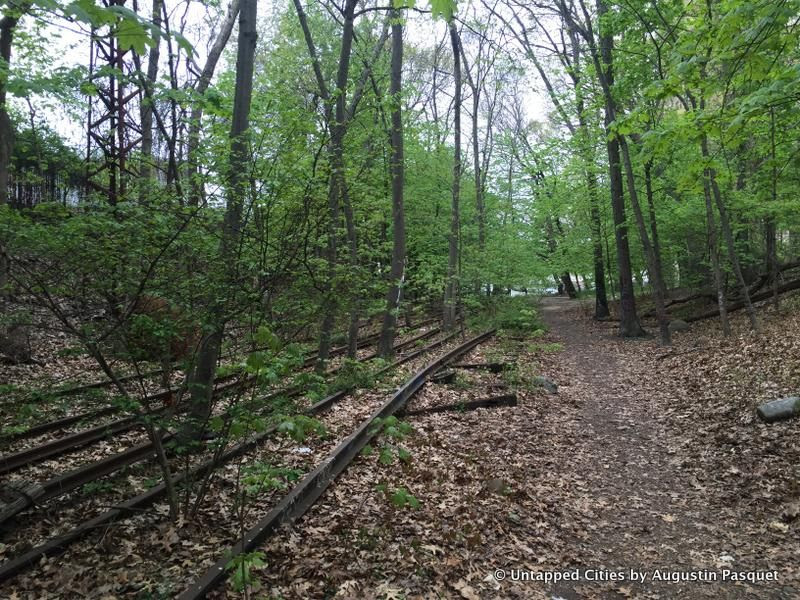
Today, there is an effort being made to convert the abandoned rail line into a park, or high line like on Manhattan. The project, dubbed the QueensWay, was started by The Friends of QueensWay (FQW) which aims to turn the railline into a park “enjoyed by bikers, walkers, joggers, visitors, tourists, workers and residents in Queens and the rest of the world.”
Stirring the Melting Pot: Photographs from The New York Historical Collections is on view at The New York Historical through March 29.
PHOTO OF THE DAY
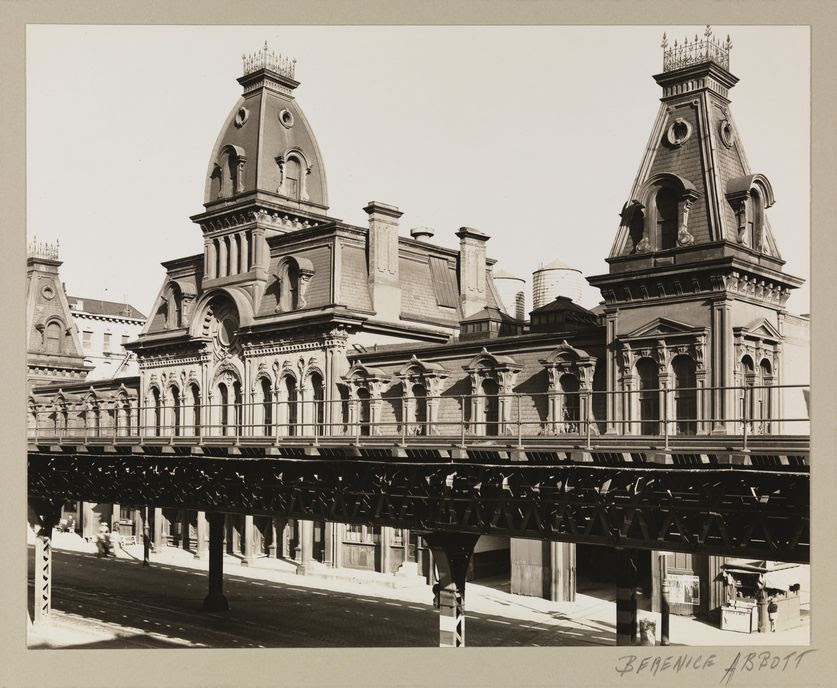
THIRD AVENUE CAR BARN AT 65-66 STREETS BERENICE ABBOTT-PHOTOGRAPHER 1936 Museum of the City of New York
All image are copyrighted (c) Roosevelt Island Historical Society unless otherwise indicated THIS PUBLICATION FUNDED BY DISCRETIONARY FUNDS FROM CITY COUNCIL MEMBER JULIE MENIN & ROOSEVELT ISLAND OPERATING CORPORATION PUBLIC PURPOSE FUNDS.
NYC’s Never-Built Pneumatic Tube Railway, from the Gotham Center Archives
Thursday, January 29, 2026
ISSUE #1616
Untapped New York is excited to announce a new editorial collaboration with the Gotham Center for New York City History. In this series, we’ll share fascinating stories from the Gotham Center archives. These scholarly articles will explore New York City history through a variety of lenses and cover topics that range from Dutch colonialism to modern art!This post on Gilbert’s pneumatic train is the first in a series of posts on the Gotham Center blog drawn from the authors’ work Never Built New York, published courtesy of Metropolis Books.
Rufus Henry Gilbert was among the most influential, and tragic, inventors to promote a mid-nineteenth-century transit scheme. Born in 1832 in Guilford, New York, Gilbert possessed an itinerant and brilliant mind. As a young man, he taught himself classical literature, mechanics, and mathematics; he apprenticed at a manufacturing firm but switched to studying medicine at the College of Physicians and Surgeons, becoming a distinguished surgeon and doctor. At the outbreak of the Civil War, he signed up as a Union surgeon and was decorated for performing the first operation ever done under fire. By war’s end, he had risen to become medical director and superintendent of all U.S. Army hospitals, chiefly training other doctors––who became known as sawbones––in the terrible art of amputation. This was hardly the road to rapid transit.
Chronic stomach ailments, which he had contracted during the war, forced Gilbert to resign his commission and abandon his medical practice. Prior to the war, grieving over the loss of his wife, he had sailed to Europe, where abysmal tenements convinced him that overcrowded slums were the chief cause of disease and early death among the poor. Gilbert’s answer to the cholera, typhus, and diphtheria rampaging among the downtrodden classes was, elliptically, rapid transit. He reasoned that fast and cheap public conveyances would allow the poor to flee their teeming, disease-infested neighborhoods, and live in the hinterlands, where they could enjoy clean air and water, and plentiful sunshine. The pathways to good health were the tracks to suburbia.
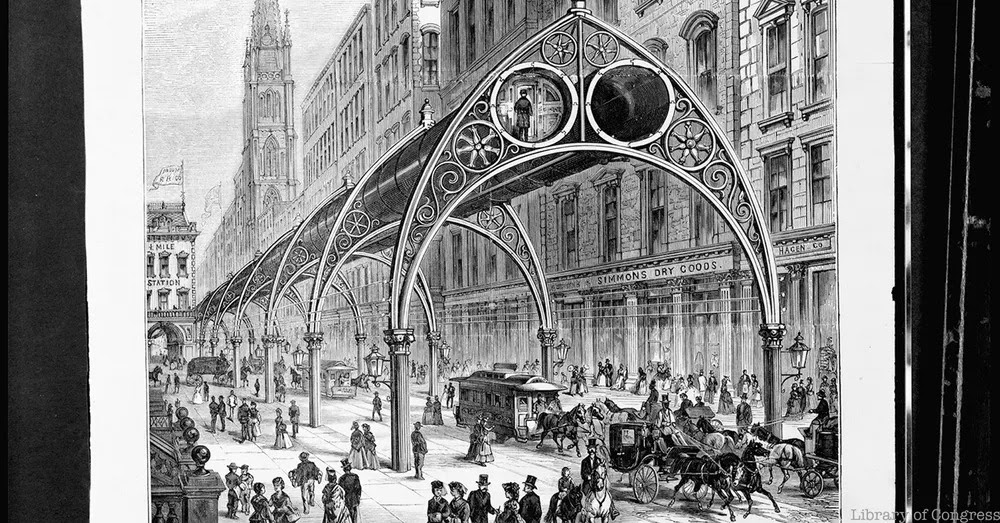
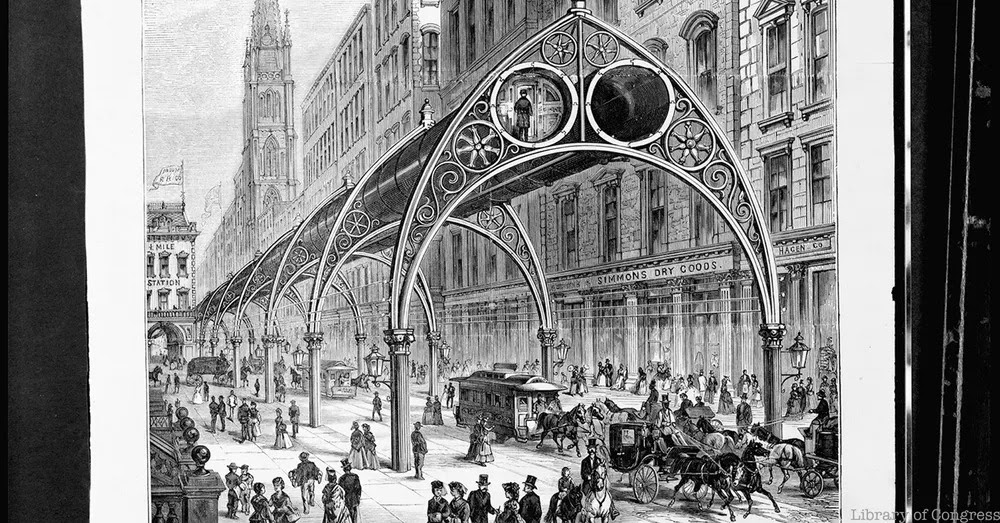
After a stint working as an assistant superintendent for the New Jersey Central Railroad, Gilbert at last devoted himself to perfecting rapid transit in New York City. Several iterations on, he came up with his Elevated Railway, for which he was granted a patent in 1870. Gilbert’s design was a hybrid––a combination of Alfred Beach’s air-powered underground and Charles T. Harvey’s cable-powered elevated––which had begun a brief experimental run on Greenwich Street in July 1868. Passengers would waft around town propelled by compressed air, moving through a double row of what Gilbert called “atmospheric tubes.” The elevated tubes, which he envisioned as eight or nine feet in diameter, were suspended from 24-foot-high, wrought-iron Gothic arches, held aloft on slender, fluted, Corinthian columns.
The arches, which were reinforced by trusses elaborately adorned with French curves and spoked rosettes, were a huge hit. The New York Times predicted the elevated would become “the pride and boast of the people living along the line” and lauded its “lightness and beauty of architectural design.”
Gilbert put his stations about one mile apart and provided them with pneumatic elevators, “thus obviating the necessity of going up and down stairs for transit,” said Scientific American. He also planned a telegraph triggered by the passing cars, which would automatically signal arrivals and departures from all points along the line.
In 1872, the state legislature gave Gilbert a charter to build his elevated pneumatic train. He was allowed three years to span nearly the length of Manhattan, from West Broadway and Reade Street in present-day Tribeca, along Sixth to the Harlem River.
Then Wall Street collapsed in the Panic of 1873. No one would invest in Gilbert’s fanciful and untested scheme.
Gilbert was not one to give up. He obtained at least two other patents for his “improved elevated railway,” which by 1874 had morphed from the exotic pneumatic train into a more conventional steam-powered train––still running on an elevated track, now held aloft on a less-graceful Gothic arch adorned in trefoils.
The great virtue of Gilbert’s plan, according to his civil engineer Richard P. Morgan, Jr., was prefabrication. “As all the parts will be prepared and fitted to each other before they are brought to their places, the structure can be quickly put up, and during the process of erection will occupy no more of the street than is now used by the erection of new buildings.”
In 1875, the state legislature freed the city’s mayor to appoint a Board of Rapid Transit Commissioners, which, in turn, authorized Gilbert to build his line on Second and Sixth avenues. Now he found backers, and on April 19, 1876, construction began at the corner of Sixth Avenue and 42nd Street.
The first train on the Gilbert elevated railroad passing through Sixth Avenue, Image via Library of Congress
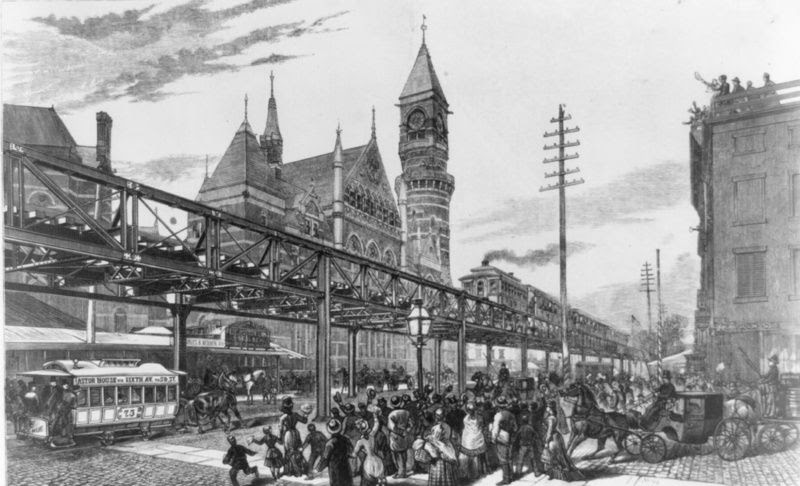
Two years later, on June 5, 1878, the Sixth Avenue El opened, and 30,000 riders overwhelmed the steam cars. Ten cents bought a ride from Rector Street to Central Park, via Church, West Broadway, and Sixth Avenue. The following day, Gilbert was stripped of his seat as a company director and, later, forced out altogether. His former partners, who were tied to “Boss” Tweed, swindled him out of his holdings and erased him from the company name, which became the Metropolitan Elevated Company.
The shady stock swap left the inventor impoverished and broken. He spent the last years of his life pursuing his victimizers in court. Gilbert was last seen on the streets of New York, hobbled, leaning on a pair of sticks as he walked to the elevated station at 72nd Street and Ninth Avenue. He died of his debilitating stomach ailments on July 10, 1885, at just 53 years old.
CREDITS
Sam Lubell is a Staff Writer at Wired and a Contributing Editor at the Architect’s Newspaper. He has written seven books about architecture, published widely, and curated Never Built Los Angeles and Shelter: Rethinking How We Live in Los Angeles at the A+D Architecture and Design Museum. Greg Goldin was the architecture critic at Los Angeles Magazine from 1999 to 2011, and co-curator, and co-author, of Never Built Los Angeles. His writing has appeared in The Los Angeles Times, Architectural Record, The Architect’s Newspaper, and Zocalo, among many others.
PHOTO OF THE DAY
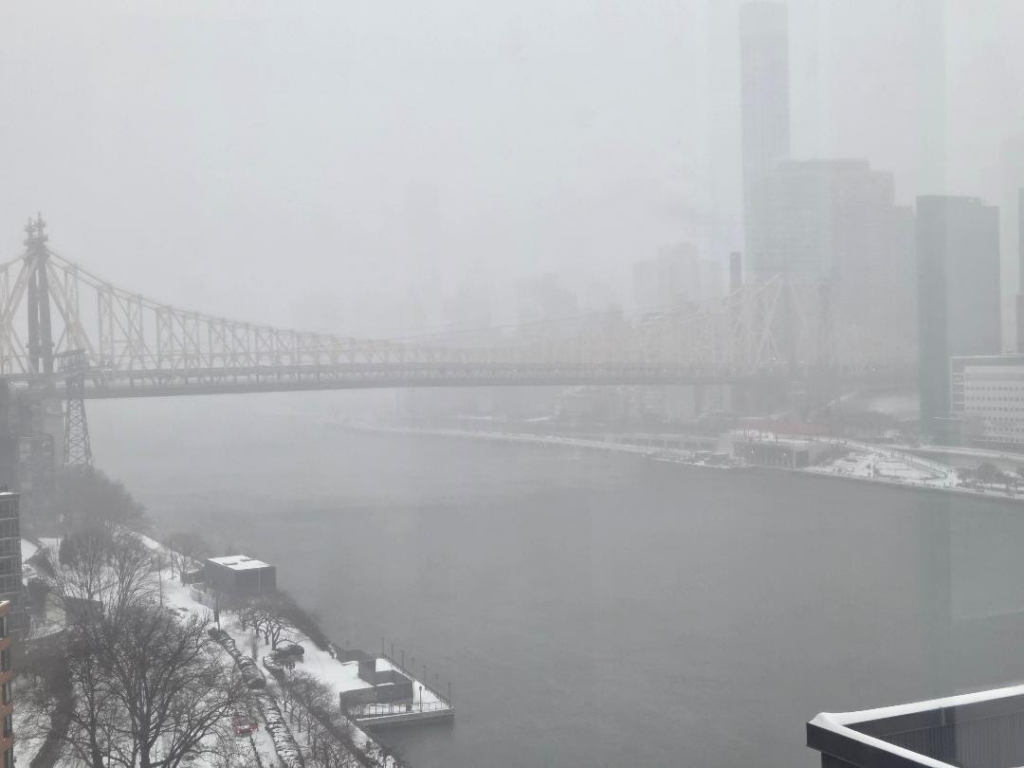
FIRST AVENUE, MANHATTAN
All image are copyrighted (c) Roosevelt Island Historical Society unless otherwise indicated THIS PUBLICATION FUNDED BY DISCRETIONARY FUNDS FROM CITY COUNCIL MEMBER JULIE MENIN & ROOSEVELT ISLAND OPERATING CORPORATION PUBLIC PURPOSE FUNDS.
New York City’s borough of Staten Island has a long history of quarantines and public reactions to them. Just over five miles from Manhattan, Staten Island has faced numerous disease outbreaks, with quarantine measures playing a central role in containment efforts. In the nineteenth century, mass immigration and the spread of infectious diseases overwhelmed the city, leading to stricter quarantine enforcement. At the time, immigrant health regulations were managed by municipal authorities and the State Health Office, which operated a quarantine station on Staten Island. The island became a focal point for disease containment, housing sick immigrants upon their arrival in New York. Throughout its history, Staten Island has also witnessed strong public opposition to quarantine measures, sometimes leading to violent protests—including during the most recent COVID-19 pandemic. [1]
In November 2020, as COVID-19 cases surged, the state ordered bars and restaurants to close by 10 PM. One Staten Island bar defied the mandate, resulting in the revocation of its liquor license. Some Staten Islanders saw this as government overreach, viewing the restrictions as an infringement on private businesses. As the most Republican-leaning borough in an overwhelmingly Democratic city, many Staten Island residents have long been skeptical of government intervention. Residents also feel neglected by the rest of New York City, fueling resentment toward state officials and policies imposed without their input. Tensions escalated when the bar’s manager continued to sell alcohol without a license and, in an attempt to evade arrest, struck a deputy sheriff with his SUV. [2]
This 2020 event reflects a broader pattern. From yellow fever in the 1700s to the HIV epidemic of the 1980s, disease outbreaks have shaped New York City’s history. Staten Island has a unique relationship with these epidemics. Since the early to mid-nineteenth century, Staten Islanders have expressed strong, sometimes violent, opposition to quarantine measures.
Throughout its history, Staten Island has maintained a tumultuous relationship with city, state, and federal governments, which often prioritized the interests of merchants and other elites over the concerns of the island’s residents. This tension is exemplified by the quarantine facilities established on Staten Island during the 1800s and 1900s.
Yellow Fever and Staten Island Quarantine
In 1799, yellow fever arrived in New York City through its bustling ports, which were already among the world’s busiest. Fearing a halt in commerce, government officials proposed quarantining ships and passengers to prevent the spread of disease. To contain the outbreak, commissioners from the state legislature sought to establish a quarantine facility away from Manhattan’s ports, choosing Staten Island, which consisted of independent towns before becoming a borough of New York City in 1898. [3]
When the commissioners acquired a site for a quarantine hospital on Staten Island in 1799, local landowners resisted. However, the government exercised eminent domain to seize the land, and soon hospitals and other buildings were erected to treat yellow fever and other contagious diseases. This facility became known as the New York Marine Hospital, or simply “The Quarantine.” [4]
Despite the prevalence of yellow fever in the late 1840s, calls to abolish the quarantine hospital persisted. A committee formed in 1849 to consider Staten Island’s concerns ultimately recommended relocating The Quarantine, although shipping merchants—concerned about potential disruptions to their interests—opposed this change. The merchants, wielding significant influence due to their economic contributions, successfully thwarted efforts to relocate the facility and kept The Quarantine in operation for a few more years. [5]
In 1856, another yellow fever outbreak reignited calls to remove The Quarantine, but once again, the proposal was blocked by merchants and immigration officials. The Quarantine suffered from poor mismanagement. Employees who worked at the hospital freely returned to their communities, becoming vectors for spreading disease. Compounding this issue, the prevailing miasma theory of the time held that diseases spread through “bad air,” creating further alarm. [6] Most of the hospital’s patients were immigrants, viewed by many as carriers of disease. The rapid increase in immigration during the 1840s and 1850s fueled anti-immigrant sentiments, adding tension to the already volatile situation. Mismanagement, xenophobia, and merchant interests culminated in what became known as the Staten Island Quarantine War.
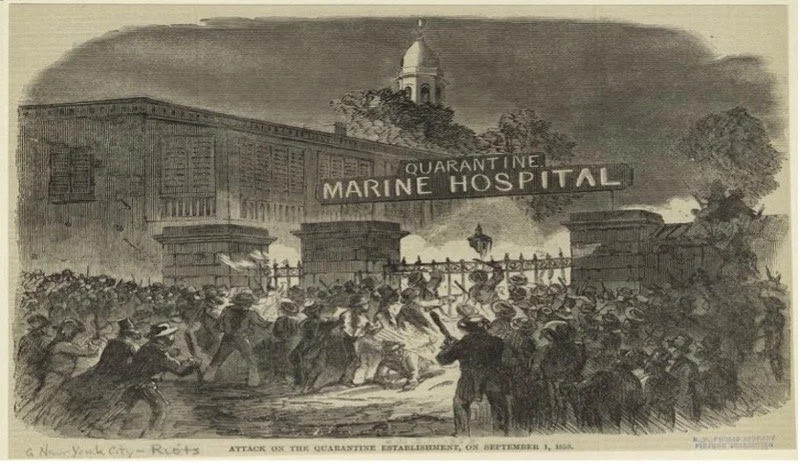
On September 1-2, 1858, a mob, organized by local landowners and fueled by years of neglect and anti-immigrant sentiment, attacked the Quarantine, setting it ablaze. No deaths were reported, but the hospital was completely destroyed. The federal government responded by establishing Swinburne and Hoffman Islands in 1860 to house immigrants arriving through New York’s ports, relocating quarantine facilities away from Staten Island. [7]
Completed in 1870, Swinburne Island—named after Civil War veteran and surgeon Dr. John S. Swinburne—became known as “Lower Quarantine,” where sick individuals were hospitalized. Hoffman Island, finished in 1872 and named after former New York Governor and New York City Mayor John T. Hoffman, was referred to as “Upper Quarantine,” where asymptomatic individuals were held. Though these islands were intended to replace quarantine efforts on Staten Island, the borough’s involvement with disease containment was far from over. [8]
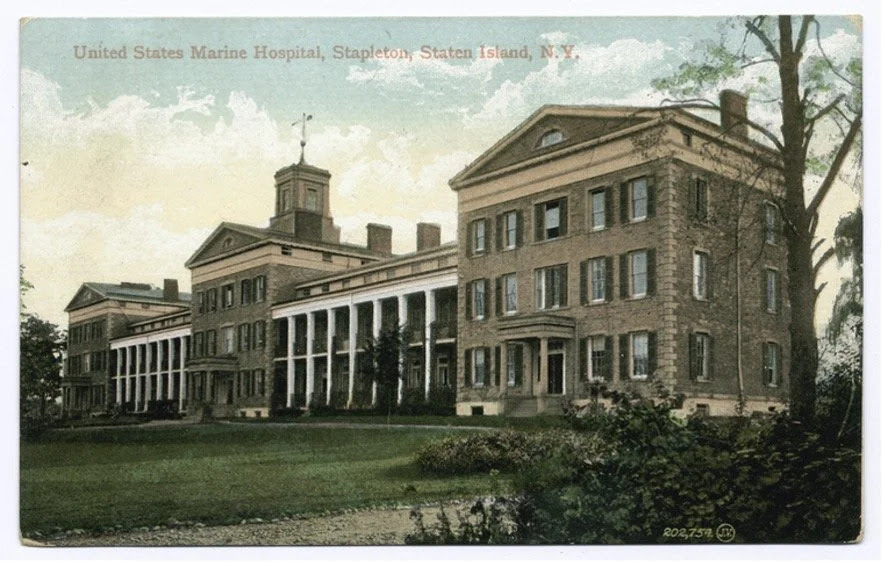
In 1878, another yellow fever outbreak prompted the passage of the National Quarantine Act, which shifted quarantine authority from state to federal control. This legislation reignited discussions about establishing a new quarantine hospital on Staten Island. The planned facility was to be known as the U.S. Marine Hospital. The following year, The New York Times referred to the Quarantine Act as “an experiment,” noting that the federal government had yet to exercise its authority over quarantine matters. While some raised concerns about the impact of quarantine regulations on commerce, the article emphasized that the measure was primarily a public health necessity, justified by the ongoing yellow fever epidemic. [9]
For Staten Island, the proposed U.S. Marine Hospital had little to do with yellow fever and more to do with federal authority. On Christmas Eve, the New York Times reported on local opposition to converting Staten Island’s Seaman’s Retreat into the new U.S. Marine Hospital due to concerns about spreading infectious diseases. [10]
Despite local resistance, the Seaman’s Retreat was sold to the federal government. A follow-up article in the New York Times reported that commercial bodies in New York City had petitioned Congress to acquire the property for a government hospital, dismissing fears about disease spread as “absurd.” Ultimately, the federal government proceeded with its plan, disregarding Staten Island’s past experiences and residents’ concerns. [11]
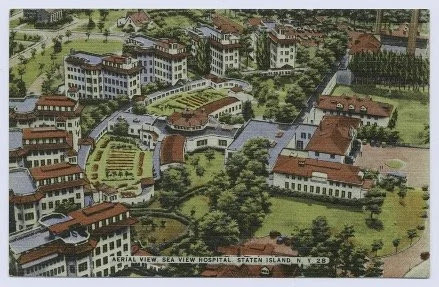
After Staten Island became a New York City borough in 1898, the island was once again chosen for a quarantine facility, this time for tuberculosis (TB). In 1905, New York City selected a site on Staten Island’s second-highest point to build a sanatorium. At the time, TB was treated with fresh air, sunlight, and a good diet, and sanatoriums provided a place for patients to receive such care. [12]
The resulting Sea View Hospital, completed in 1913, was not easily accessible to the poor, for whom treatment was often financially out of reach. Many working-class residents could not afford sanatorium care or take time off work, rendering the sanatorium a privilege unavailable to most.
Local landowners also opposed the sanatorium. In a letter to the New York Times, one Staten Island resident argued that the presence of “thousands of consumptives” would degrade property values and force long-time residents to sell their homes. Despite such protests, Sea View Hospital opened, providing TB treatment to those who could afford it. [13]
Modern Parallels: Staten Island and COVID-19
Staten Island’s longstanding tensions with New York City, state, and federal governments over quarantine matters were largely dormant until recent years, thanks to advances in vaccines and public health. However, the COVID-19 pandemic revived these debates.
In November 2019, the first confirmed COVID-19 case heralded a new era of pandemic response. Staten Island again found itself embroiled in quarantine-related conflict. The November 2020 incident involving a bar manager who struck a deputy sheriff with his SUV reflects a deep-seated resistance to state-imposed public health measures, echoing the Staten Island Quarantine War of 1858. While the 2020 conflict did not involve literal flames, it kindled a spirit of defiance that legislation alone cannot extinguish.
CREDITS
Carlos A. Santiago is the Programs Associate and Archivist at CitizensNYC, a grantmaking nonprofit that has provided microgrants to grassroots community projects across New York City since 1975. He holds a BA and MA in History from SUNY Buffalo and Brooklyn College, where he studied the history of tourism and urbanization in Puerto Rico. While managing digital collections at a genealogy nonprofit from 2019 to 2022, he uncovered stories about New York City that deepened his interest in researching the city where he was born and raised.
[1] Brendan P. O’Malley, Protecting the Stranger: The Origins of US Immigration Regulation in Nineteenth-Century New York (PhD diss., CUNY Graduate Center, 2015), 20-23.
[3] Richard M. Bayles, History of Richmond County (Staten Island), New York: From its Discovery to the Present Time (New York: L.E. Preston, 1887), 267.
[4] Bayles, History of Richmond County, 268.
[5] Bayles, History of Richmond County, 269.
[6] Bayles, History of Richmond County, 269-270.
[7] The Miriam and Ira D. Wallach Division of Art, Prints and Photographs: Picture Collection, The New York Public Library. “Attack On The Quarantine Establishment, On September 1, 1858.” New York Public Library Digital Collections. https://digitalcollections.nypl.org/items/510d47e1-281b-a3d9-e040-e00a18064a99.
All image are copyrighted (c) Roosevelt Island Historical Society unless otherwise indicated THIS PUBLICATION FUNDED BY DISCRETIONARY FUNDS FROM CITY COUNCIL MEMBER JULIE MENIN & ROOSEVELT ISLAND OPERATING CORPORATION PUBLIC PURPOSE FUNDS.
This past June 17, 2025, art historian and curator Bonnie Yochelson discussed her new book, Too Good to Get Married: The Life and Photographs of Miss Alice Austen on DORIS’ popular “Lunch & Learn” program. Yochelson’s biography explores Austen’s groundbreaking photography and how she challenged gender norms of her era. For those who missed the illustrated talk, it can be viewed on DORIS’ YouTube channel
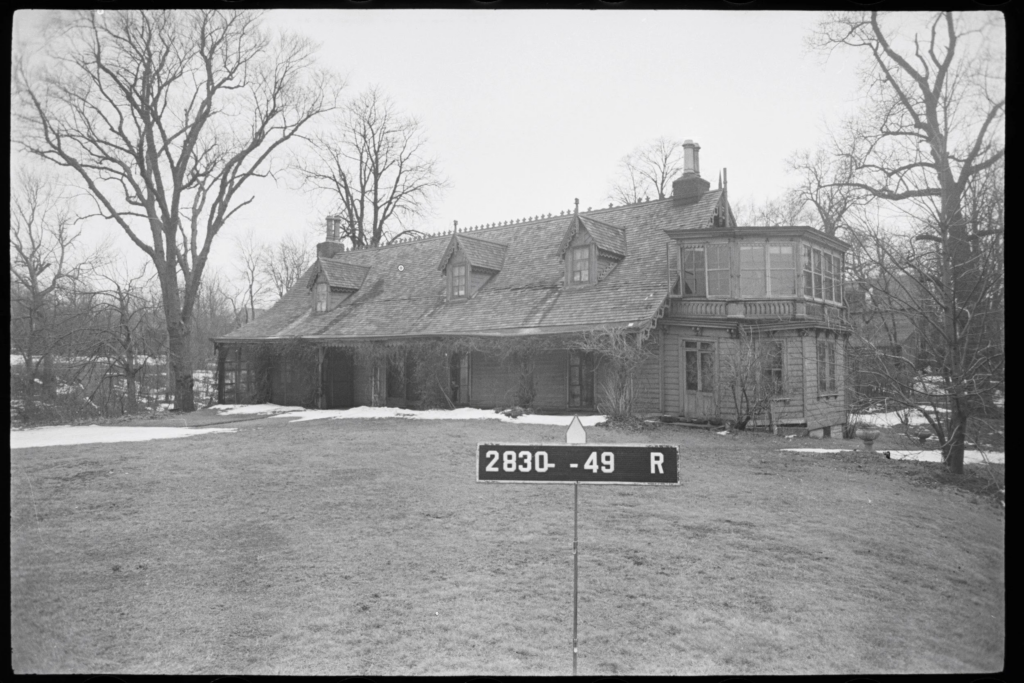
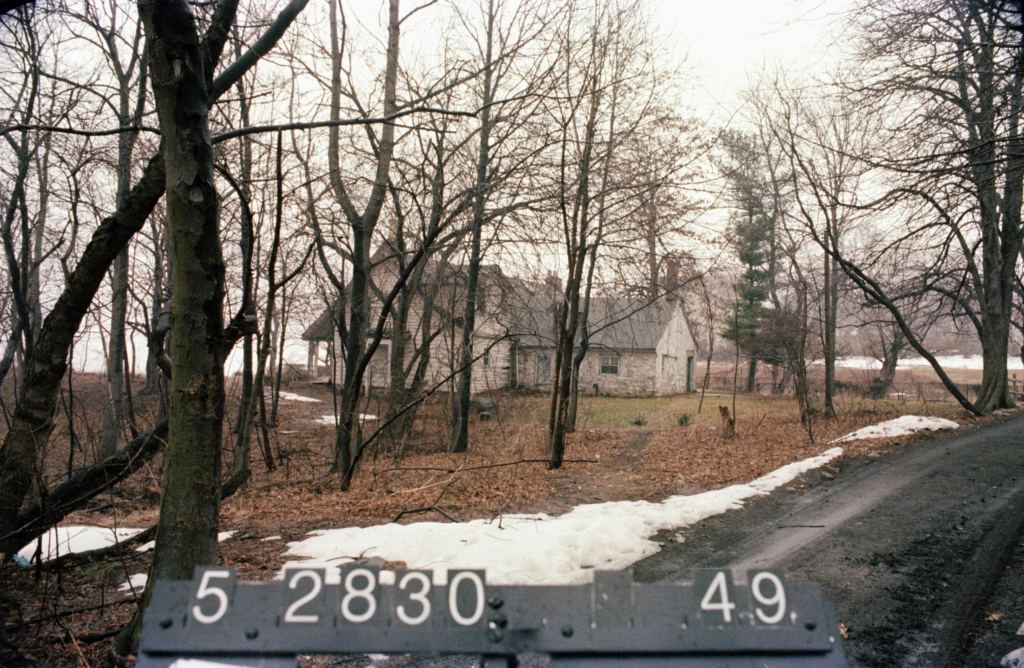
Staten Island Block 2830, Lot 49, 1940 “Tax” Photograph collection, NYC Municipal Archives.
This week, For the Record takes a journey through records in the Municipal Library and Archives that document Alice Austen (1866-1952), and her homestead in Staten Island. Located on bluffs overlooking New York Bay, the Gothic Revival cottage known as Clear Comfort is now in the portfolio of the New York City Historic House Trust. It has been fully restored and includes a museum dedicated to Austen’s work.
Researchers are often advised to begin their quest with the secondary sources available in the Municipal Library. And among them, the “vertical files” are particularly useful. Arranged by subject, they contain printed articles, unique ephemera and visual materials. Often cited in For the Record articles, the files did not fail to come through for information about Alice Austen, her house, and the history of its origins in the 17th century, near demolition in the 1960s, and full restoration in the 1980s.
Robinson’s Atlas of Staten Island, 1907. NYC Municipal Archives
Elizabeth Alice Austen was born on Staten Island in 1866. At age two, she and her family moved into the nearby home of her grandfather, John Austen, where she lived until shortly before her death in 1952. Austen’s aunt introduced Alice to photography in the 1880s. Over the next fifty years, Austen created more than 7,000 glass-plate negatives and prints. Her images chronicled Staten Island, New York City, and particularly focused on the life of her friends and social circle. In 1917, her life partner, Gertrude Tate, joined Austen in the house where they remained until financial losses resulting from the Great Depression led them to lose the property in a bank foreclosure proceeding. Shortly before her death in 1952, an Austen photograph appeared on the cover of Life magazine and led to wider recognition of her talent. Austen’s photographs are now considered among the finest produced in America in the late 19th and early-20th centuries.
Assessed Valuation of Real Property, Town of Edgewater, Staten Island, 1873, “Old Town” Records collection. NYC Municipal Archives
Alice Austen’s grandfather John Austen purchased the family home in 1844. It had been originally constructed as a one-room farmhouse in the 17th century and went through many years of gradual additions and alterations. Austen transformed it to the Gothic Revival style recognizable today. The Library’s vertical file helps to tell the story. The New Yorker magazine printed a “Talk of the Town” article on September 30, 1967. The uncredited author described a visit to “a benefit punch-and-supper party being given by an organization called—with portmanteau clumsiness characteristic of so many ardent champions of good causes—Friends of the Alice Austen House and Esplanade.” At that time, according to the article, a real-estate syndicate owned the house along with two parcels of adjacent land that they intended to demolish to make way for a cluster of high-rise apartment buildings. The article described the house, “long, low-roofed, and engulfed in the leafy jungle of a long-abandoned Victorian garden,” surrounded by a “jumble of old barns and outbuildings in the shadow of an enormous horse-chestnut tree.”
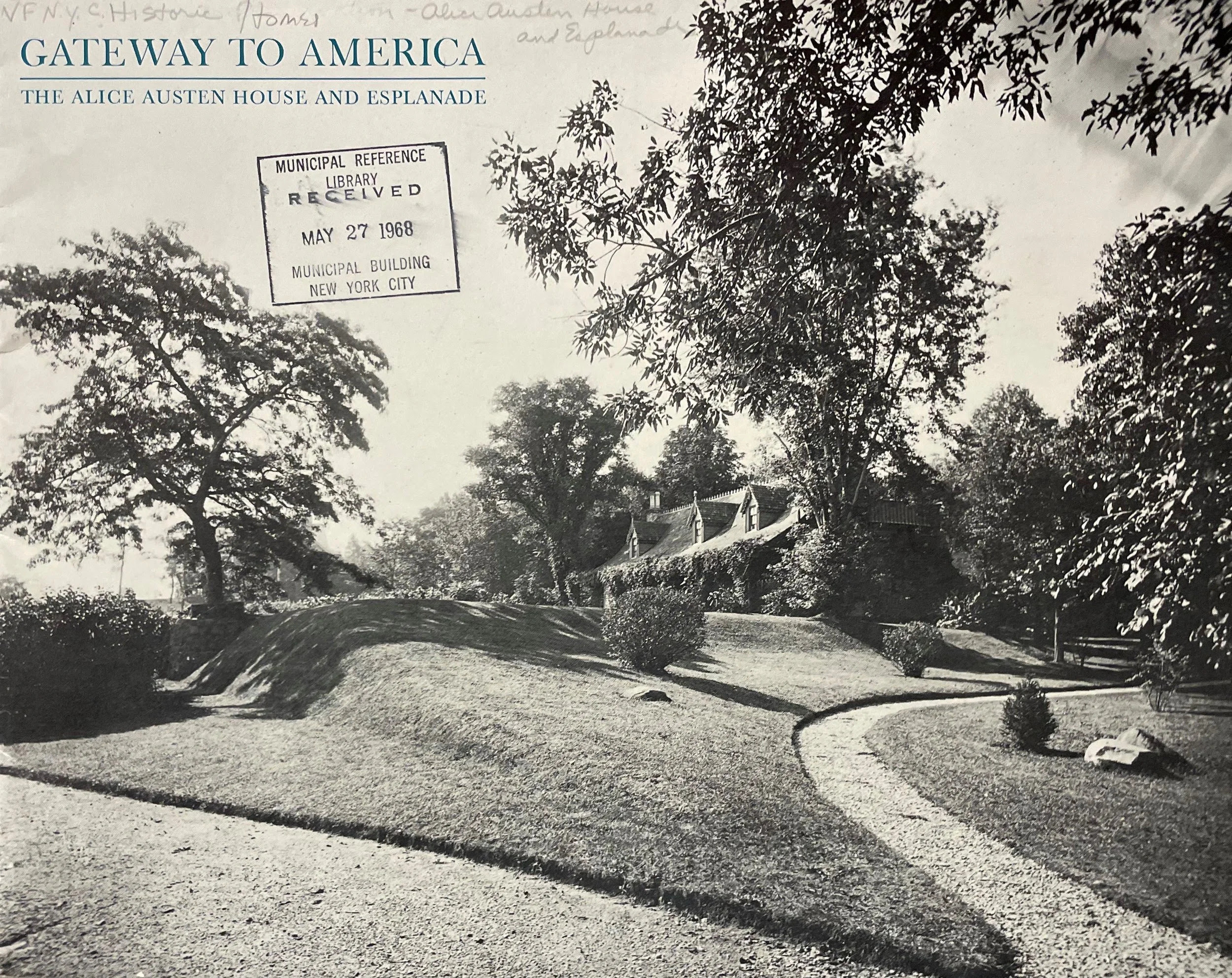
Gateway to America, The Alice Austen House and Esplanade, Friends of the Alice Austen House and Esplanade, 1968, pamphlet. NYC Municipal Library.
As is often the case with vertical file contents, the “NYC Historic Homes – Alice Austen House and Esplanade” folder also included ephemera such as a copy of an illustrated pamphlet, Gateway to America: Alice Austen House and Esplanade, dated 1968, prepared by the Friends group, mentioned in the New Yorker article. It is interesting to note that the “Friends,” listed in the pamphlet turned out to be very prominent mid-century New Yorkers: photographers Berenice Abbott and Edward Steichen; architects Philip Johnson and Robert A.M. Stern; historic preservationists Margot Gayle and Henry Hope Reed, Jr., among others. VIPs who apparently saw the importance of preserving the Austen homestead also included Joseph Papp, Alfred Eisenstadt, and Cornelius Vanderbilt.
The Friends succeeded in having the Austen house designated as a Landmark in 1971. According to the Landmark Designation Report in the Library collection:
“On the basis of a careful consideration of the history, the architecture and other features of this building, the Landmarks Preservation Commission finds that the Alice Austen House has a special character, special historical and aesthetic interest and value as part of the development, heritage and cultural characteristics of New York City…. Accordingly,… the Landmarks Preservation Commission designates as a Landmark the Alice Austen House, 2 Hylan Boulevard.” [November 9, 1971]
Staten Island Block 2830, Lot 49, 1980s “Tax” Photograph collection. NYC Municipal Archives.
Soon after, in 1976, the City took title to the property, and in 1984 restoration of the house began. This information is gleaned from another item in the vertical files. An article in the Staten Island Advance, dated January 11, 1988, quoted Parks Commissioner Henry Stern’s remarks at a ceremony marking commencement of the restoration in 1984: “If we were dedicating this park because of the fabulous view, that would be enough. If we were dedicating the restoration of the house because it is a 17th-Century home of historical importance, that would be enough. If we were dedicating this house because of the brilliance of Alice Austen, that would be enough. But to have all these three things come together makes this an enormous event for New York.”
The history of the Austen House in the “Friends” brochure and other published sources provide the necessary dates to pursue research in the Municipal Archives collections. For example, the “Old Town” collection, recently processed and partially digitized with support from the National Historical Publications and Records Commission is one source. The ledgers in the collection had been assembled by the Comptroller shortly after consolidation in 1898. They consist of administrative and financial records from all the towns and villages newly incorporated into the Greater City of New York. Among them are the records of assessed valuation of real estate. Given the importance of revenue from property taxes it should not be surprising that the Comptroller made sure those records were preserved.
Maps and atlases in the Archives locate the Austen homestead in the Town of Edgewater. In the 1873 Assessment Roll for the Town of Edgewater John Austin’s property on Pennsylvania Avenue is described as one house on one acre of land, valued at $3,000, with the tax bill $45.00; “Paid” carefully noted on the roll.
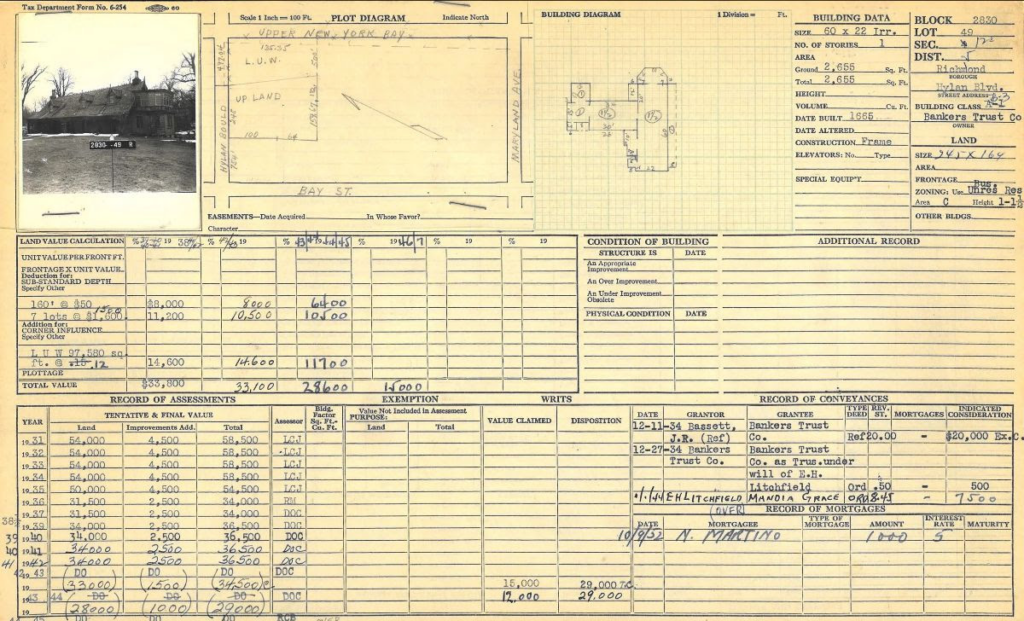
Property Card, Staten Island, Block 2830, Lot 49. NYC Municipal Archives.
The Property Card series are another essential resource in the Archives for research about the built environment. As noted in many previous For the Record articles, the cards list ownership, conveyance, building classifications, and assessed valuation data, generally from the 1930s through the 1970s. Each card also includes a small photographic print (also known as the “tax photographs”). The card for the Austen confirms Austen’s loss of the property to the bank during the Great Depression.
The Landmarks Preservation Commission’s 1971 designation report focused on the architectural significance of the “picturesque and charming example of the Gothic Revival style of architecture.” Similarly, most news accounts about Alice Austen and her house failed to acknowledge Austen’s relationship with her life partner Gertrude Tate. More recently, works such as Yochelson’s book have painted a more complete picture of Austen’s life and her role in the LGBTQ community. Today, the Alice Austen House is a New York City and National Landmark, on the Register of Historic Places, a member of the National Trust for Historic Preservation’s distinctive group of Historic Artists’ Homes and Studios, and is a National site of LGBTQ+ History. The LGBT-NYC Sites Project provides a well-researched description of the house and the significance of Alice Austen.
The Alice Austen House and Esplanade, Friends of the Alice Austen House and Esplanade, n.s. pamphlet. NYC Municipal Library.
CREDITS
NUYC Municipal Archives Kenneth R. Cobb
PHOTO OF THE DAY
All image are copyrighted (c) Roosevelt Island Historical Society unless otherwise indicated THIS PUBLICATION FUNDED BY DISCRETIONARY FUNDS FROM CITY COUNCIL MEMBER JULIE MENIN & ROOSEVELT ISLAND OPERATING CORPORATION PUBLIC PURPOSE FUNDS.
The Empire State Building (ESB) is arguably the most iconic building of the modern era. Its presence identifies New York City on screens large and small. King Kong clung to its spire; in 1945, the pilot of a B-25 Bomber, lost in a fog, crashed into its 78th floor; and during the Roaring Twenties, it emerged as the victor in the race to claim the title of “world’s tallest skyscraper.”
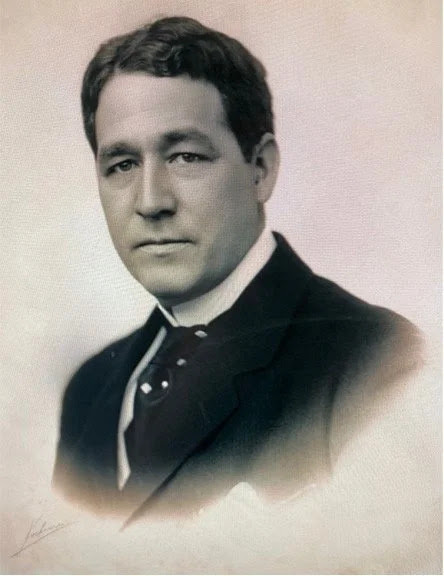
And yet almost all the stories about the origins of this New York landmark, online and in print, are inaccurate. They all omit the pivotal, behind-the-scenes role played by Louis Graveraet Kaufman (LGK) (1870-1942), the secret schemer, without whom the ESB would not have been built. LGK’s hidden machinations irrevocably changed Gotham — and world — history, yet few today know his name.
Louis Graveraet Kaufman
It is a name that was once familiar in New York City. The son of a German Jewish peddler of men’s furnishings and a part-Native-American mother, Kaufman grew up in Marquette, Michigan, on the south shore of Lake Superior. After high school, he took a series of undistinguished jobs and seemed destined for mediocrity until 1899, when he went to work for the local savings bank. Almost overnight, Kaufman revealed himself to be a financial savant able to grasp complicated financial and managerial concepts and utilize them with charm and finesse — techniques he would later apply to help make the Empire State Building a reality.
During the next few years, he married Marie Young, the daughter of a Chicago millionaire; took over the National Bank of Marquette; became president of the Michigan Bankers Association; and joined the Executive Committee of the American Bankers Association. His precipitous rise did not go unnoticed. In 1910, Elbert Gary, the powerful head of U. S. Steel, sent Kaufman to New York City with a mandate to combine two underperforming banks into a successful new one. Kaufman quickly grew the Chatham Phenix National Bank into a Wall Street powerhouse and then, through clever financial sleight of hand, made it the only national bank in the city with a system of branches.
But the Kaufman juggernaut didn’t end with banking. In 1915, he financed General Motors founder William Durant’s bid to reclaim control of his company, then changed its destiny. First, the two men collaborated on a series of complicated maneuvers to put the majority of GM shares back in Durant’s hands. Then, on the day of a pivotal board meeting, with control of the company still uncertain, Kaufman invited Chatham Phenix client, Pierre S. Du Pont of the mighty Delaware gunpowder company, to be present. Quite unexpectedly, Du Pont was invited to break the power stalemate by naming three new members to an enlarged GM board. He brought Du Pont stalwarts on board, including his financial guru, John J. Raskob. Although the move temporarily returned Durant to power, thanks to LGK, the Du Ponts were now in the mix and would run General Motors from 1920 into the 1950s.
High Society
Throughout the 1920s, Kaufman’s wealth continued to grow, and he and his family lived a life of luxury and social advancement. In the summer, celebrity guests like Mary Pickford, Ethel Barrymore, and Fred Astaire traveled by private train car to the Kaufmans’ 26,000 square-foot lodge on the shore of Lake Superior, to attend parties that sometimes went on for days. The Kaufman daughters were feted at debutante balls and presented at the Court of St. James, and the sons married Broadway dancers. In the wintertime, the Kaufmans removed to Palm Beach, where they entertained lavishly at their capacious villa and aboard their houseboat moored in Lake Worth.
Newspapers across the country chronicled the family’s every move. Marie Kaufman had a stable of racehorses, a famous collection of jewels, and soon, a fabulous new apartment. In 1929, likely because no one named “Kaufman” was welcome to rent on Park Avenue, Louis Kaufman built his own apartment building. He bought a lot at 625 Park Avenue and commissioned an elegant, neo-classical design from architect James Edwin Ruthven Carpenter. The triplex penthouse occupied by the Kaufmans, now owned by Henry Kravis, remains one of the most famous pre-war apartments in the city.
Louis Graveraet Kaufman. Photo is courtesy of Peter Kaufman, Marquette Michigan.
That same year, Kaufman received a visit from John J. Raskob. Raskob had served on the board of the Chatham Phenix, and Kaufman had been a board member at GM when Raskob was running the show, so the two men knew each other well. Now Raskob knew something else. Thanks to a creditor’s failure to make a loan payment, LGK was in the control of a prime building spot at Fifth Avenue and 34th Street. Raskob had an idea of how to use that land, and it was a big one. He and Kaufman were going to build the tallest building in the world.
Raskob had good reason to embark on such a project. He had been fired from GM for backing former New York governor Al Smith for president against Herbert Hoover in 1928 (GM president Alfred P. Sloan was a staunch Hoover man) and rebuffed by Walter P. Chrysler, whose company he’d hoped to run instead. He needed a project, particularly one that would top the skyscraper Chrysler was building and employ his friend Al Smith, who was out of work and hurting for money. And he needed Kaufman—a banker with a large pot of money at his fingertips and control of a huge building site with no height restrictions.
For Louis Kaufman, it was different. The twenties were roaring, and his bank was soaring. He needed nothing, yet he was attracted to Manhattan’s most exciting and perilous game — real estate. Kaufman had seen the fortune others were making in the booming commercial real estate market, and he relished the chance to become the progenitor of an iconic building that would stand the test of time.
The Chain of Events
Since 1893, the corner of Fifth Avenue and 34th Street had been home to one of New York’s most famous hotels — the Waldorf-Astoria. Over the decades, its ballrooms hosted lavish parties, and its suites housed Gilded Age elites. But by the 1920s, the hotel was a relic. The ponderous building was expensive to maintain, and New York’s society was increasingly living — and socializing — further uptown. In December 1928 the hotel’s owners announced that they were selling the site.
The winning bidder was Bethlehem Engineering, a company founded and run by Floyd deL. Brown. He was the consummate New York real estate man who knew the field as well as anyone. He was born in New York City in 1885, studied architecture in Paris, and received an engineering degree from Columbia University. In 1918, he organized the Bethlehem Engineering Company to engage in real estate development and by 1928, he had a long track record of successful projects.
Brown planned to build a 50-story loft, office, and showroom skyscraper, encompassing two million square feet. His company negotiated the deal with an initial burst of financing from the Chatham Phenix National Bank, and then, in February 1929, secured a $24 million construction loan from the Metropolitan Life Insurance Company. However, the MetLife loan, as large as it was, was not sufficient to cover the total cost. Brown needed to find another $10 – 12 million to make it all work. In the end, he could not raise the money, and he failed to make his scheduled payment to the bank. Chatham Phenix took over his claim.
Typically, a bank would not want to get involved in real estate development and would quickly get the contract off its books. But here is where Kaufman’s actions became pivotal, as he directly inserted himself into the lot’s future. If he had decided to let the whole thing go, who knows what would have happened to the site, but instead, he was that rare banker excited to try his hand at Manhattan real estate.
Kaufman’s Machinations
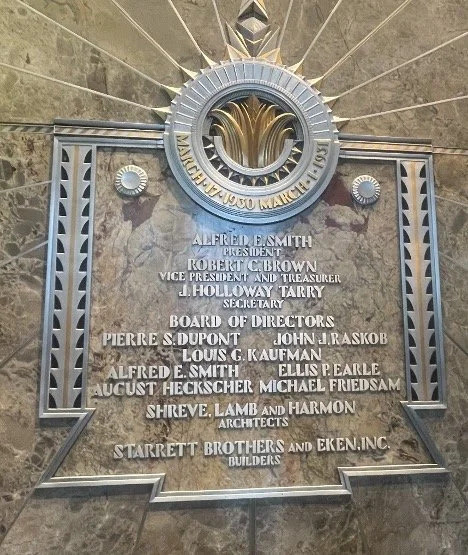
After Brown defaulted, Kaufman quickly formed a syndicate of like-minded men to proceed where Brown left off. The members pooled their equity, took out a loan from Chatham Phenix Bank for the remainder, and bought the lot from the bank. But after Raskob’s fateful visit, the property changed hands again. Kaufman and others in the syndicate remained financially involved, but Raskob took over as the lead developer, and Pierre Du Pont provided a substantial investment. Al Smith was installed as president of Empire State, Inc., the company erecting the structure.
However, after all the investors’ funds were pooled and combined with a MetLife mortgage, the new developers were still short the last $13.5 million needed to erect the world’s tallest building. Kaufman then put his financial acumen to work. In the fall of 1929, he created a new company, Chatham Phenix Allied Corporation (Allied), an offshoot firm owned by Chatham Phenix’s investment banking arm. Allied invested in bonds issued by the Empire State, Inc. And to raise the cash needed to buy the bonds, Allied took out a loan from Chatham Phenix Bank. (These insider dealings would later cause Kaufman great headaches when Federal officials began investigating the tangled webs of investment banking that caused the financial sector to collapse after the stock market crash.
The Great Depression
The Empire State Building officially opened on May 1, 1931, when, ironically enough, Herbert Hoover lit up the building with a switch at the White House, at precisely 11:30 a.m. But unfortunately for its investors, including Kaufman, the deepening depression was preventing them from realizing their skyscraper dreams. In fact, throughout the 1930s, the risk of default — and the total loss of their investment — was a haunting specter, and Du Pont, Kaufman, and Raskob repeatedly provided more capital to keep their building out of bankruptcy.
Plaque in the Lobby of the Empire State Building. Photo by Thomas Redstone.
For Kaufman, in particular, his giant investment in the Empire State Building proved to be a disaster. In 1931 he lost the Chatham Phenix Bank when it was subsumed by Manufacturers Trust Company, and his name disappeared from the annals of Wall Street. His stake in the Empire State Building was also considerably pared down, but he did manage to retain some ownership of the great skyscraper that he helped to build.
Were They Fools?
Because the Empire State Building opened in the early stages of the worst economic downturn of the 20th century, the conventional wisdom is that Kaufman, Raskob, and Du Pont were ego-driven, over-ambitious fools. They threw their money into a losing proposition, it is said, because they wanted to be big machers and were eager to beat Chrysler and collect the “world’s tallest building” trophy.
But the truth is a bit more nuanced. Yes, the Great Depression created the “Empty State Building,” but the severity and length of that downturn were much more severe than anyone could have predicted. And a review of the financials of the Empire State Building in the fall of 1929 shows that they were within reasonable expectations for real estate developments of the time.
Ultimately, only Pierre Du Pont lived to see the Empire State Building fulfill its promise. In 1951, the Empire State Building was sold for the highest price ever achieved by an office building in New York City. Today, it remains the pride of New York, and each year, some four million people ride its elevators to see the Manhattan skyline from its famous observatory. History has shown that Raskob and Kaufman’s apparent delusions of grandeur were, in fact, a grand vision that continues to enrich the city.
All image are copyrighted (c) Roosevelt Island Historical Society unless otherwise indicated THIS PUBLICATION FUNDED BY DISCRETIONARY FUNDS FROM CITY COUNCIL MEMBER JULIE MENIN & ROOSEVELT ISLAND OPERATING CORPORATION PUBLIC PURPOSE FUNDS.
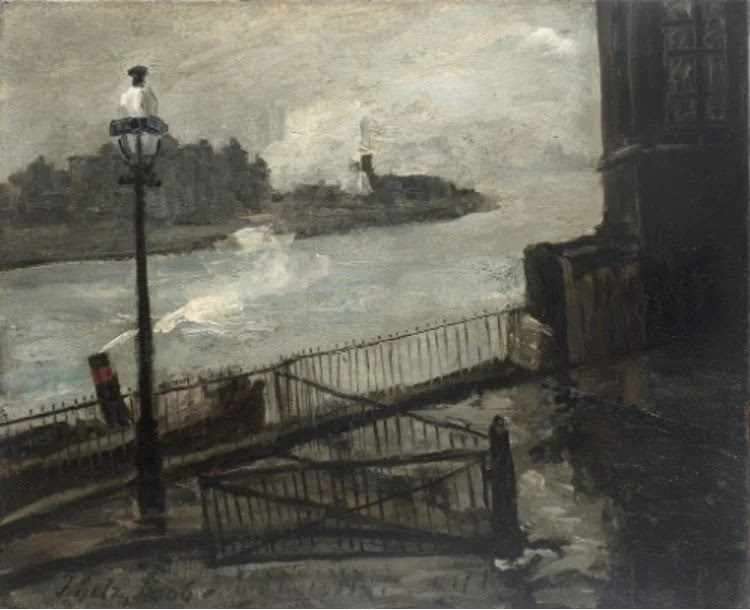
Figure 1. Julius Golz, The River, 1906, Oil on canvas, Delaware Art Museum.
American impressionist Julius Golz usually painted the New Jersey shoreline and countryside, but in 1906 he turned to the small strip of land in the middle of the East River known as Blackwell’s Island. Featuring the island on a wintry day from the perspective of someone standing on the opposite shore, The River (1906) was much bleaker in palette and gloomier in mood than most of Golz’s works (Figure 1). Robert Henri, leader of the Ashcan School of painting in New York at the turn of the 19th century, praised the work of his student, marveling, “Take the picture, for instance, of Julius Golz, the painter of Blackwell’s Island and the East River. What force and power is in this man’s work. He seems to be the only man who has ever painted the East River, that wonderful snowswept fence against that absolutely deep and tragic water and then beyond, Blackwell’s Island, and all done without a particle of sentimentality.” [1]
Golz may have been interested primarily in the river and the weather, but his choice to include Blackwell’s in his disquieting scene prompts a consideration of what the island, by then an infamous site of failed institutional reform, meant to artists. Certainly journalists, politicians, and reformers had their eyes on Blackwell’s during its time of operation, but several of New York’s artists also saw Blackwell’s as a site of interest — some for aesthetic reasons, others for social, and many for both.
Following a brief introduction to Blackwell’s Island and its institutions, this article will discuss the paintings featuring the island, which range from bucolic scenes that seemingly elide any social concerns to disturbing ones that offer, sometimes obliquely and sometimes explicitly, a referendum on the horrors that happened there.
Antebellum Reform and Blackwell’s Island
In 1843, reformer Dorothea Dix lamented the inhumane treatment of “helpless, forgotten, insane, and idiotic men and women; of beings sunk to a condition from which the most unconcerned would start with real horror; of beings wretched in our prisons, and more wretched in our almshouses.” [2] Being housed in jails without the opportunity to work, she claimed, exacerbated inmates’ mental decay; instead, the insane should be placed in “good asylums” and have employment, which would contribute to their mental health and maybe even help them recover. [3]
Dix was one voice among many in terms of advocates for the insane, indebted, and criminal. Part of a larger wave of social reforms and religious revivals in the first half of the 19th century, institutional reform focused on separating these people from the general population but treating them in a manner characterized by much more humanity than in the past. It was endorsed by politicians and elites worried about their (supposedly) deteriorating cities, doctors studying mental health, and reformers and religious leaders concerned about marginalized, suffering populations.
In New York City, Bellevue Hospital had been treating the sick as early as 1798, but by the mid-19th century it was acting not only as a hospital for the poor but also as the city’s penitentiary, almshouse, asylum, and workhouse — exactly the sort of chaotic institution reformers decried. City officials concluded that they needed new structures for each of these purposes, and, per prevailing theories, inmates ought to be isolated from the general population.
Blackwell’s Island, situated in the middle of the East River, seemed to be the ideal place to put the people the city wanted to reform — or simply forget about. Originally called Minnehanonck by the Lenape, the island was purchased by the Dutch and then ceded to the British after their victory in 1664. For a time it was occupied by a British military captain, John Manning, who later bequeathed it to his stepdaughter, Mary. Mary wed Robert Blackwell, and that family settled on the island for several generations before selling it to the city of New York in 1828.
Two miles long, with thick woods and stone quarries that provided building materials, Blackwell’s was close enough for the city (only a few hundred feet away at the island’s widest points) to transport people and supplies while also maintaining a separation. With a plan and a site in place, the city moved quickly. The penitentiary (for people convicted of serious crimes) opened in 1832, the Lunatic Asylum in 1839, the almshouse in 1848, the workhouse (for people convicted of minor crimes) in 1852, the Smallpox Hospital in 1856, and City Hospital in 1859. Many 19th century architects, doctors, social reformers, and urban planners were convinced that environment shaped a person’s conduct and, in the case of the insane, could even facilitate a cure, so the edifices were designed and constructed with care. [4] Several of Blackwell’s buildings were even designed by famous architects, and, in their classically beautiful and imposing facades, were meant to be visual manifestations of what the city considered its serious and noble endeavor of taking care of society’s less fortunate.
Despite the beautiful buildings and lofty goals, however, every single one of the institutions on Blackwell’s became notorious for their extreme disregard of the people under their care. Overcrowding and cut budgets were part of the problem, but deeply rooted biases regarding class, race, and ethnicity took their toll as well. [5] The poor were treated miserably, subject to the deeply rooted conflation of poverty with immorality and criminality. The penitentiary was considered “a disgrace to the city of New York,” its cells filthy and crowded, the incarcerated subject to violence, illness, and despair. [6] Of the penitentiary hospital, a New York Times reporter called it a “horrible moral ulcer” and shuddered, “I defy the stoutest-heartest layman to go through the wards of this hospital without fairly growing sick at the stomach.” [7]
The Asylum failed in its idealistic aims almost immediately. It was overcrowded, unsanitary, and the inmates were treated cruelly. In a direct violation of reformers’ plans to separate people by condition, inmates from the penitentiary were often brought in to act as guards at the asylum. In his 1842 visit for American Notes, Charles Dickens proclaimed that “I never felt such disgust and measureless contempt as when I crossed the threshold of this madhouse.” [8] The general population had some suspicions about the Asylum, passed along from inmates and some visitors like Dickens, but most of the time the actual conditions were hidden from visitors, who tended to be wealthy women whose financial support the institutions coveted. [9] In 1887 that changed, however, when young reporter Nelly Bly went undercover by pretending to be, as her admission stated, “positively demented.” [10] She published a searing expose of the facility in New York World, writing of the physical discomfort, the terrible food, and the abusive treatment on the part of nurses, concluding that even the sanest of women only needed two months here to “make her a mental and physical wreck.” [11]
Thanks to Bly’s investigation in particular, the failures of Blackwell’s Island became well-known across the country. [12] Some asylum inhabitants had already been moved to Ward’s Island at the time of Bly’s piece, and now the city began moving patients to other hospitals. In 1921 the city renamed the island “Welfare Island,” but as the 20th century progressed, all of its facilities were eventually abandoned and fell into ruin. In 1973, the city named the island yet again, this time for Franklin Delano Roosevelt, and began transitioning it to a master-planned, middle-class community.
The Art of the Island
The works considered here are almost all paintings. With the exception of Ben Shahn, who photographed the inmates of Blackwell’s Island Penitentiary in 1934 as a study for a mural he was painting at Rikers’ Island, the city’s new prison site, the documentary photographers of the early-mid 20th century did not seem to have made Blackwell’s a subject. And, again with Shahn as the exception, none of the artists during Blackwell’s days of operation actually created their works on the island or even tried to imaginatively depict what the interior of the island looked like. Rather, they are all from the perspective of someone on the river itself or on its Manhattan side — all of which makes sense given the fact that opportunities to visit the institutions were limited.
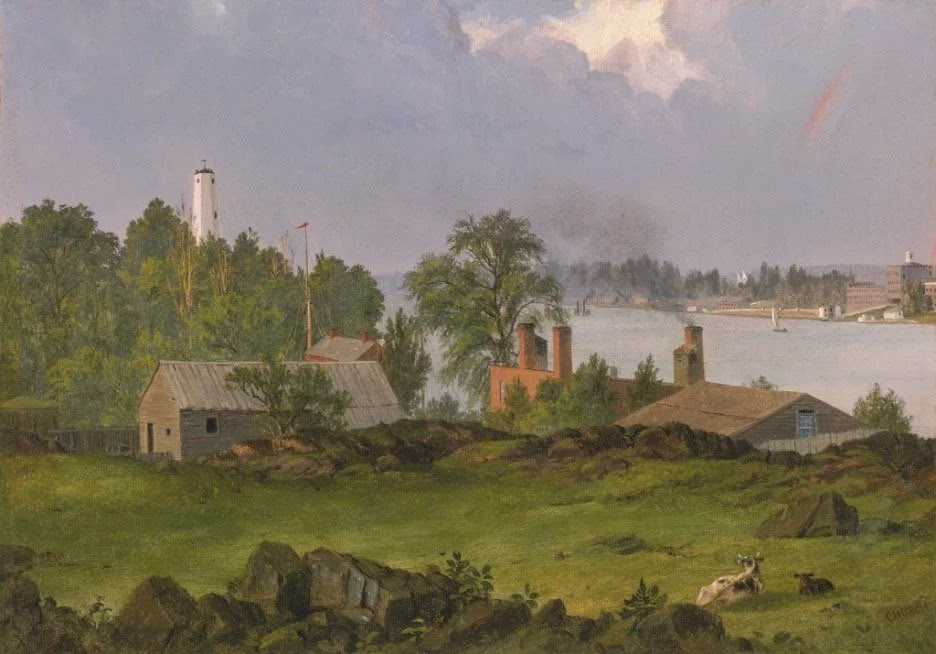
Figure 2. Frederic Edwin Church, View of Blackwell’s Island, New York(Youle’s Shot Tower, East River, New York; View of Hartford), 1850, oil on canvas, location unknown
Especially in the mid-19th century, Blackwell’s natural beauty was hard to ignore. In his 1850 work View of Blackwell’s Island, New York (Youle’s Shot Tower, East River, New York; View of Hartford), Frederic Edwin Church, one of the most famous painters of the Hudson River School, situated his viewer on the Manhattan shore, looking across the windswept river with sailboats and steamships to Blackwell’s (Figure 2). This is one of the earliest artistic depictions of the island and only some of the buildings are constructed, their size diminutive and their purpose inscrutable, and much of the island still lushly wooded. Church’s focus is primarily on the Manhattan foreground with its lambent green lawns, sleeping cows, and Youle’s tower (for manufacturing lead ammunition). It is an idyllic, pastoral scene complete with a rainbow in the sky after a passing shower.
Similar to Church’s work, Louis Grube’s 1857 painting East River and Blackwell’s Island, New York City, which was commissioned by the wealthy Beekman family,is almost misleading in its title, as the river and island are only barely visible from the expansive Beekman residence in the foreground. There is no hint of what went on over at Blackwell’s; for this influential family, it was simply part of their scenery.
Scottish-born and largely self-taught artist Andrew Melrose’s 1890 painting The Work House of Blackwell’s Island (c. 1890) explicitly identifies one of the island’s buildings, but it is painted from the river at a comfortable distance and, like Church’s work, is bright and almost cheery. A white steamboat and a small boat with passengers carrying colorful parasols approach the elegant edifices on the shore, and while the wind seems bracing, the bright blue sky and puffy, rolling clouds give no hint of anything sinister. It appears to be more of a scene of leisure that happens to be taking place on the part of the East River near the island than any sort of social commentary.
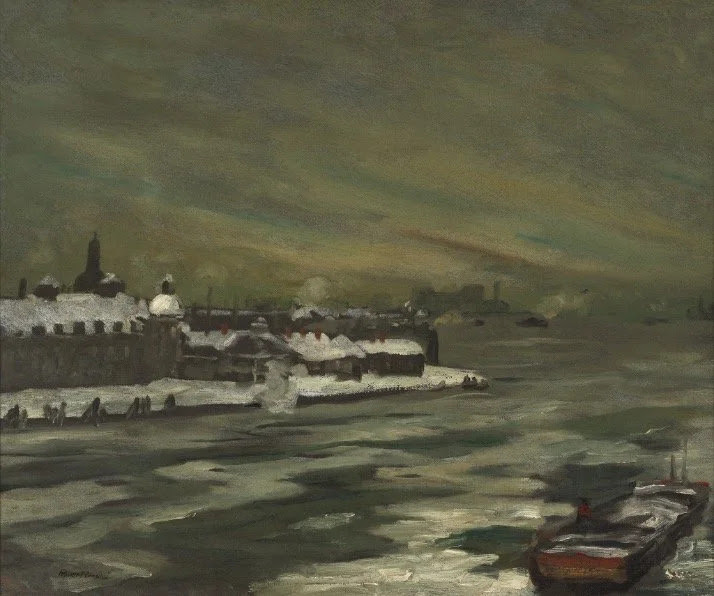
Figure 3. Robert Henri, Blackwell’s Island, East River, 1900, oil on canvas, Whitney Museum of American Art.
Even though it contains the same basic pictorial elements of sky, river, and island, Robert Henri’s painting, Blackwell’s Island, East River (1900) could not be more different from the prior works (Figure 3). By 1900, Bly’s expose had been published, and it is not too farfetched to imagine that many New Yorkers, especially socially-conscious artists, were aware of the failures of the island’s institutions. Like all the artists grouped under the term “Ashcan School,” a once-pejorative label from a critic that later was embraced by the artists themselves, Henri refused to sugarcoat the gritty urban environs in which he lived and worked. His studio on 58th street on the edge of Manhattan overlooked Blackwell’s Island, and in his several renditions of it he alluded to its seamier side. This version consists of a dingy, oily sky and a flat, gray river choked with ice. The tip of Blackwell’s juts out into the river, consisting of several buildings densely packed together, their roofs heavily laden with snow and puffs of smoke feebly rising into the sky. It is an unsettling image that cannot help but make one think of the poor souls shivering inside the walls.
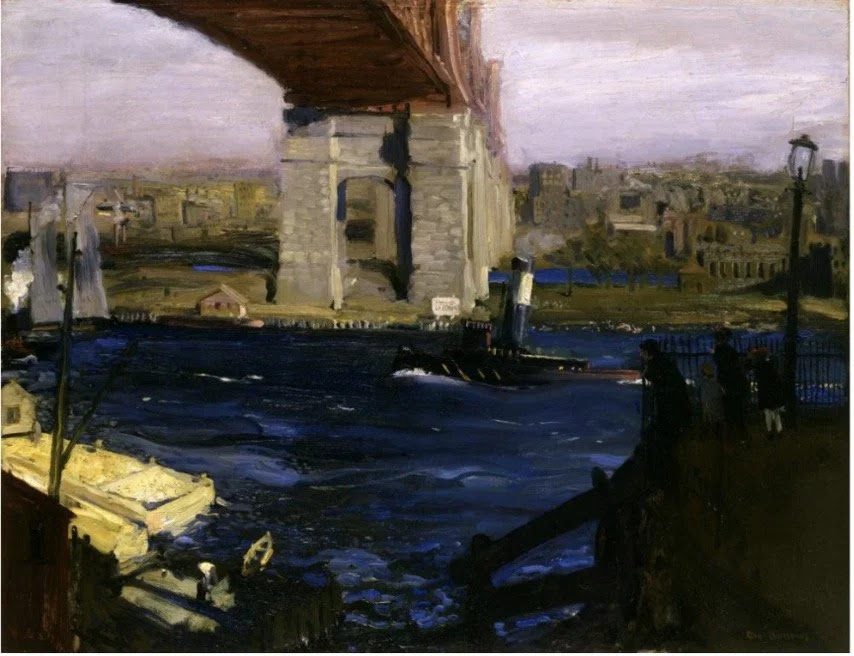
Figure 4. George Bellows, The Bridge, 1909, oil on canvas, Toledo Museum of Art.
Blackwell’s is featured in fellow Ashcan artist George Bellows’ 1909 work The Bridge, but while the artist often embedded social commentary in his paintings of urban life, he did not choose to do so here (Figure 4). Instead, Bellows focused on one of his other aesthetic passions — the infrastructure of the modern city. The titular bridge is the Queensboro Bridge, painted the year it was completed, and Blackwell’s Island is more or less incidental to the composition. It is there underneath the heavy span of the bridge, but it is just a short visual stop as the viewer’s eye moves over to the dense shores of Queens.
Figure 5. Edward Hopper, Blackwell’s Island, 1911, oil on canvas, Whitney Museum of American Art.
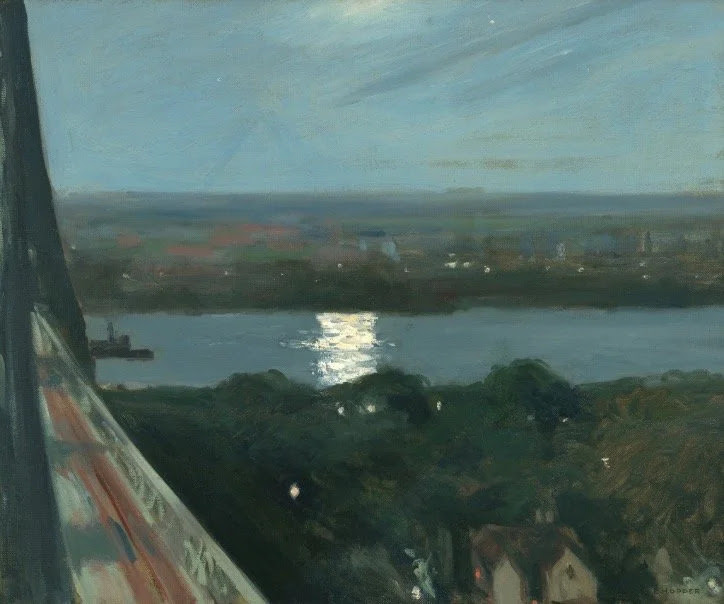
Edward Hopper also painted the new bridge and Blackwell’s Island. Blackwell’s Island (1911), the first of Hopper’s two works on the subject,is from the perspective of someone on the bridge at twilight, looking across the moon-dappled river to the island (Figure 5). Hopper renders the buildings almost abstractly, using thick brushstrokes to meld them dreamily into the landscape. It is a silent, serene scene, and while the island does not feel as incidental as it does to Bellows’ work, this early Hopper painting is likely meant to be a meditation on the city’s crepuscular beauty, not a nod to the island’s reputation.
Hopper’s second work depicting the island, Blackwell’s Island (1928), is stark and unsettling, related mostly in title to the 1911 piece. This work is similar to Hopper’s mid-career paintings such as Automat (1927), Night Windows (1928), Manhattan Bridge Loop (1928), Early Sunday Morning (1930), and Shakespeare at Dusk (1935), all of which depicted the spaces and inhabitants of the city with a “brooding, faintly sinister stillness,” as one critic for the New York Herald Tribune stated. [13] The river, a bright cerulean blue, occupies the bottom half of the canvas, and the top half consists of pale blue sky and odd clouds receding into the distance. All of the infamous institutions on the island are there, but by now had almost ceased operating. Hopper paints them as flattened, simplified, and lit brilliantly by the sun. Like most of his works, there is something slightly off about the scene — it is too quiet, too placid. Though the buildings are banal, Hopper suggests that there is something ominous that occurred within their walls.
“To get to one apartment, you have to go down two flights toward the Hudson, then turn right and go up two flights to the front door. Another front door is behind a small arched grotto,” explained Gray.
“A third is at the end of a thin, high-flying concrete walkway with a skinny iron railing, cantilevered out over a long and nasty drop to the railroad tracks below.”
At first, the sister buildings attracted elite tenants; one newspaper listed some of the “well known” New Yorkers who planned to make the Villa Victoria their home. But the sisters soon fell on hard times.
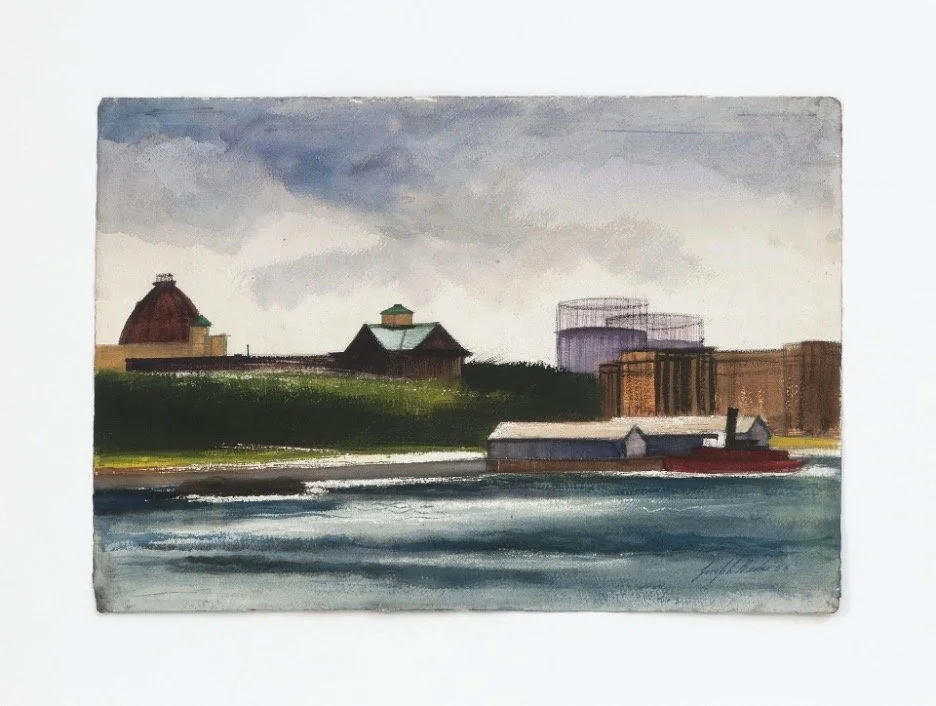
Figure 7. Joseph Barber, Welfare Island NY, n.d., watercolor on paper, private collection.
Yet others continued to imbue their paintings of Blackwell’s with something haunting. Joseph Barber’s early 20th century watercolor, Welfare Island NY (n.d.) uses shades of dark brown for several of the island’s decommissioned buildings, simplified and distanced from the viewer, and frames them with a slate-gray river and sky (Figure 7). Not a single living creature populates the work, but there is a distinct carceral tone to it, a sense that here on this island people were held and punished.
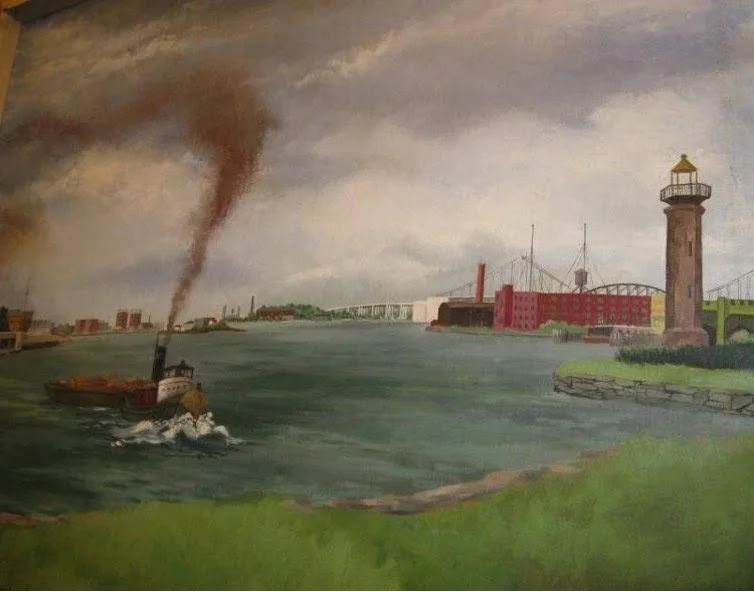
Figure 8. Ferdinand Lo Pinto, View from the Welfare Island, 1940, oil on canvas, overall: 24 x 30 in. ( 61 x 76.2 cm), gift of the Federal Works Agency, Works Projects Administration, the New York Historical.
Ferdinand Lo Pinto’s View from the Welfare Island (1940) visually equates the lighthouse on the right (the erstwhile entrance into the Lunatic Asylum) with steam of the ship on the left, both rendered in a rusty brown color in order to suggest something dirty (Figure 8). Though abandoned by 1940, the sepulchral structure still connotes surveillance and control.
Figure 9. George Picken, The Octagon, c. 1940, oil on canvas, private collection of the Igleheart Foundation, courtesy Lincoln Glenn Gallery.
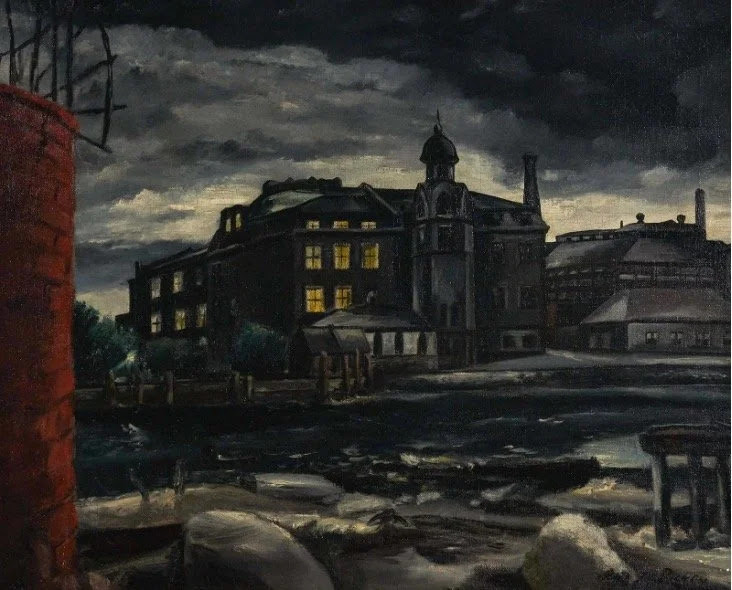
And then there is George Picken’s The Octagon (c. 1940), perhaps the most disturbing work depicting Blackwell’s Island (Figure 9). It is a grim image featuring the black river; a dark, cloudy sky with an eerie glow; the ruins of the lighthouse; and several buildings, most of which, including the titular octagon, are devoid of any light except for one that has every single window garishly lit as in some parody of warmth and comfort. By 1940 the Asylum was no longer functioning, making Picken’s suggestion of life within all the more haunting.
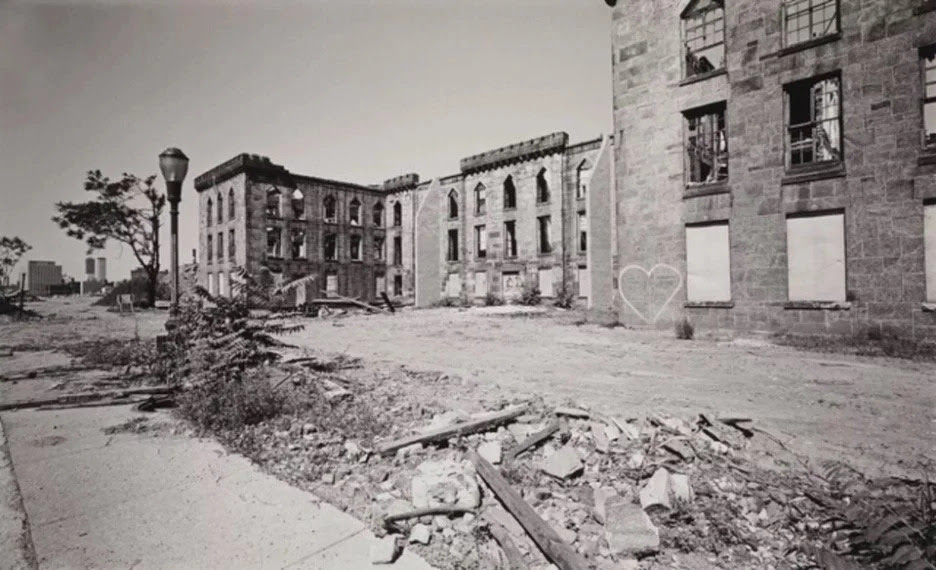
Figure 10. Gil Ortiz, Welfare Island, 1971, digital pigment print, private collection.
In the mid-late 20th century, as Blackwell’s buildings came down, middle-class New Yorkers moved in, and the city prepared to name the island for the third time, painters no longer made Blackwell’s the subject of their work.
We can end, then, not with a painting but with a photograph from 1971–Gil Ortiz’s Welfare Island (Figure 10). By focusing on the ruins of the buildings, Ortiz creates a deeply elegiac, mournful mood. The windows are either shuttered or shattered, the foliage ripped out or overgrown. There isn’t a single person to be seen, but the photograph acts as a trace of this site where so many suffered. The most poignant part of the image is the white outline of a heart some contemporary visitor had drawn on the side of one of the buildings; it reminds one of Roland Barthes’s punctum, or the “wounding” element of a photograph. It is impossible not to contemplate those lives lost, locked away, and forgotten on the island over the years.
CREDITS
Kristen Osborne-Bartucca is an educator and arts writer who focuses on the history and art of New York City. She holds an MA in American Studies from Columbia University and a BA in History from the University of California, Riverside. Her most recent publication is “Jane Freilicher’s Windows” Mutual Art magazine, August 2025, and she runs an instagram account, @newyorkarthistory.
[2] Dorothea Dix, Memorial. To the legislature of Massachusetts [In behalf of the pauper insane and idiots in jails and poorhouses throughout the Commonwealth. Jan. 1843]. National Library of Medicine. Accessed July 7, 2025. https://collections.nlm.nih.gov/catalog/nlm:nlmuid-101174442-bk.
[3] Dorothea Dix, Memorial soliciting a state hospital for the insane, 1845. Library of Congress. Accessed July 7, 2025. https://www.loc.gov/item/08015608/.
[4] Yanni, C. (2003). The Linear Plan for Insane Asylums in the United States before 1866. Journal of the Society of Architectural Historians, 62(1), 24–49. Accessed August 1, 2025.
[5] Grob, G. N. (1973). Class, Ethnicity, and Race in American Mental Hospitals, 1830–75. Journal of the History of Medicine and Allied Sciences, 28(3), 207–229. Accessed August 1, 2025.
All image are copyrighted (c) Roosevelt Island Historical Society unless otherwise indicated THIS PUBLICATION FUNDED BY DISCRETIONARY FUNDS FROM CITY COUNCIL MEMBER JULIE MENIN & ROOSEVELT ISLAND OPERATING CORPORATION PUBLIC PURPOSE FUNDS.
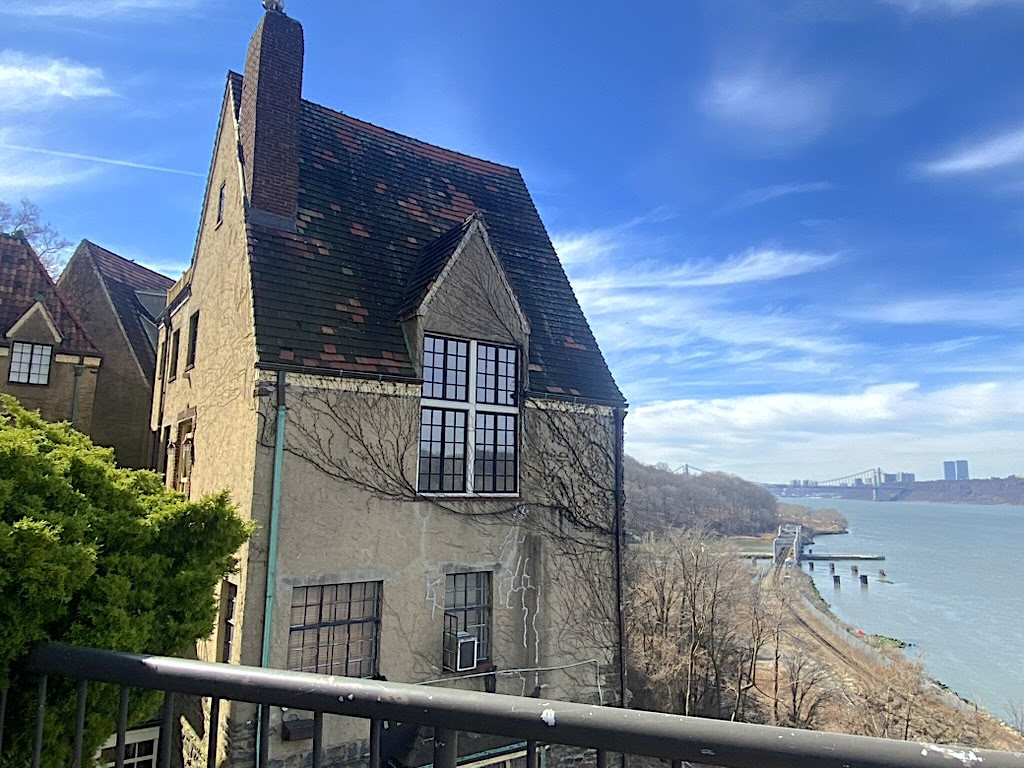
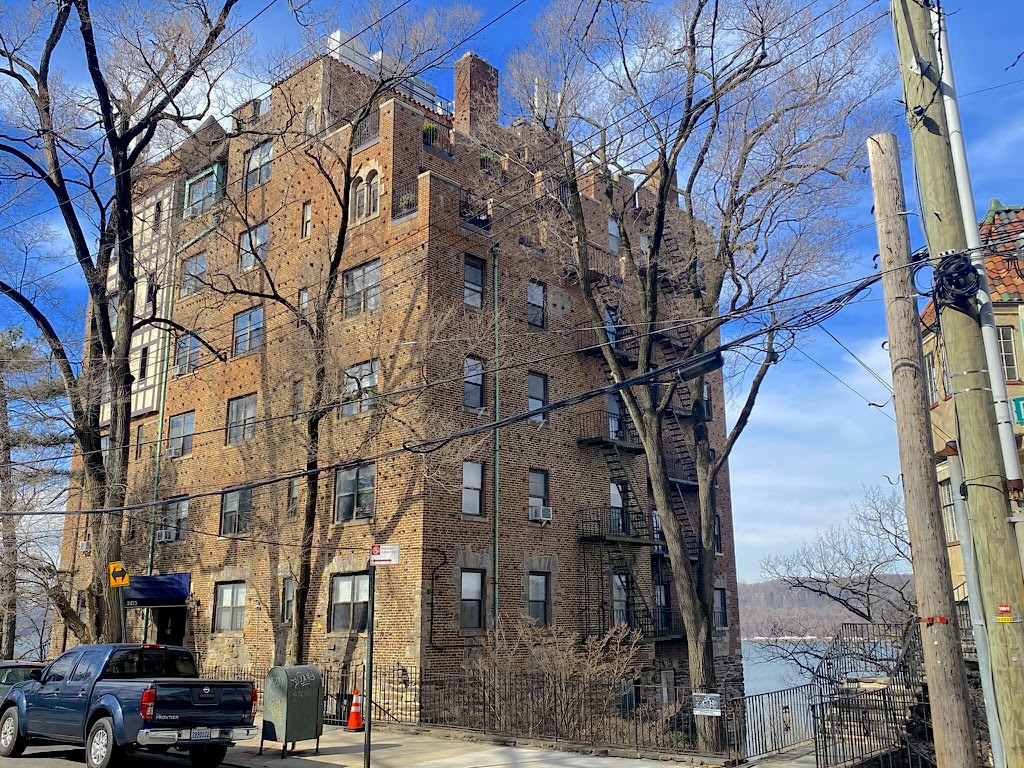
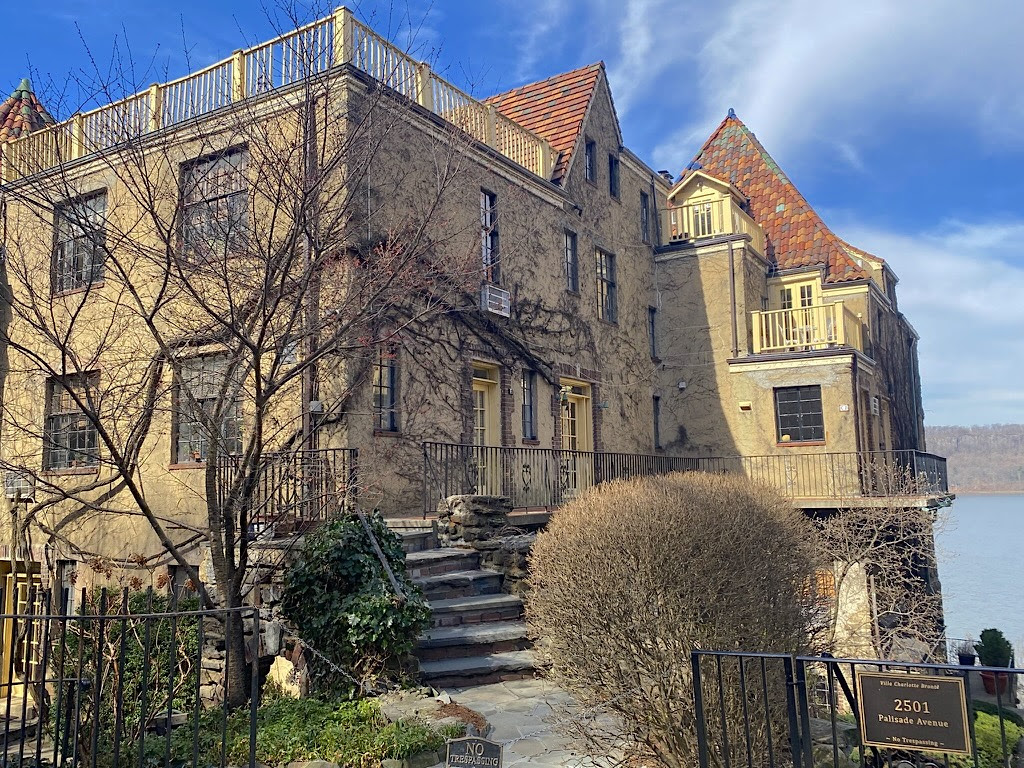
Once upon a time, on winding Palisade Avenue in the once isolated Bronx neighborhood of Spuyten Duyvil, there were three beautiful sisters—sister apartment buildings, that is.
The oldest sister, the Villa Rosa Bonheur, was completed in 1924. Fancifully named after a 19th century French painter and with only seven apartments, this sprawling cottage featured gorgeous views of the Harlem River looking toward Manhattan—until it met the bulldozer in 2021.
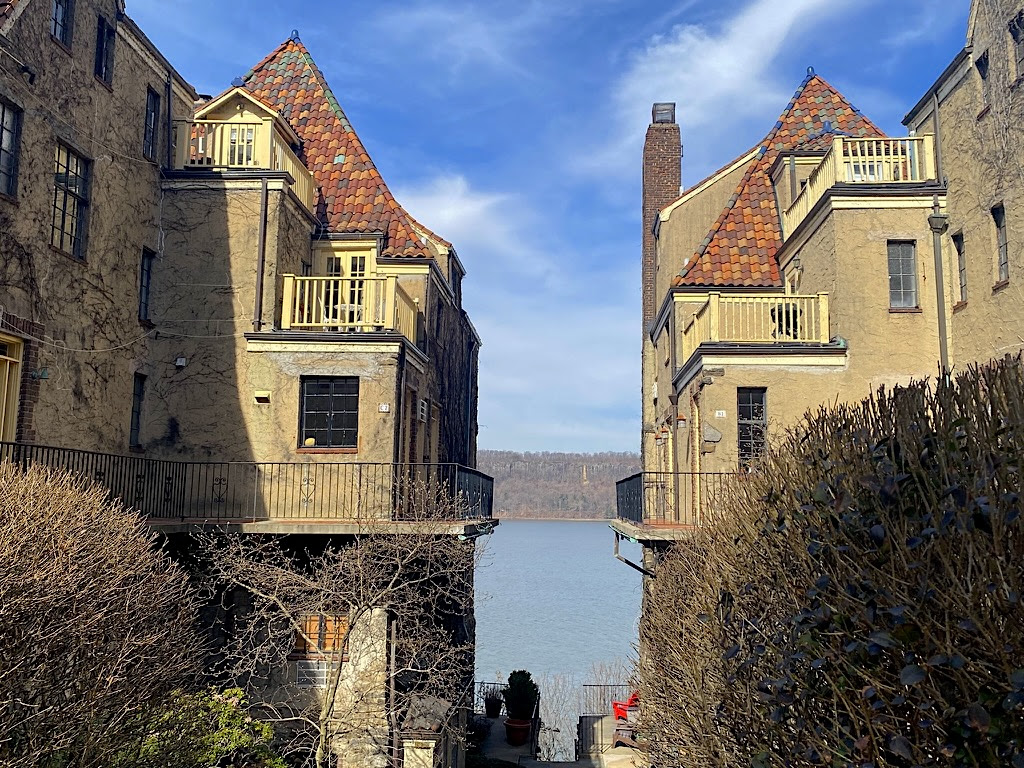
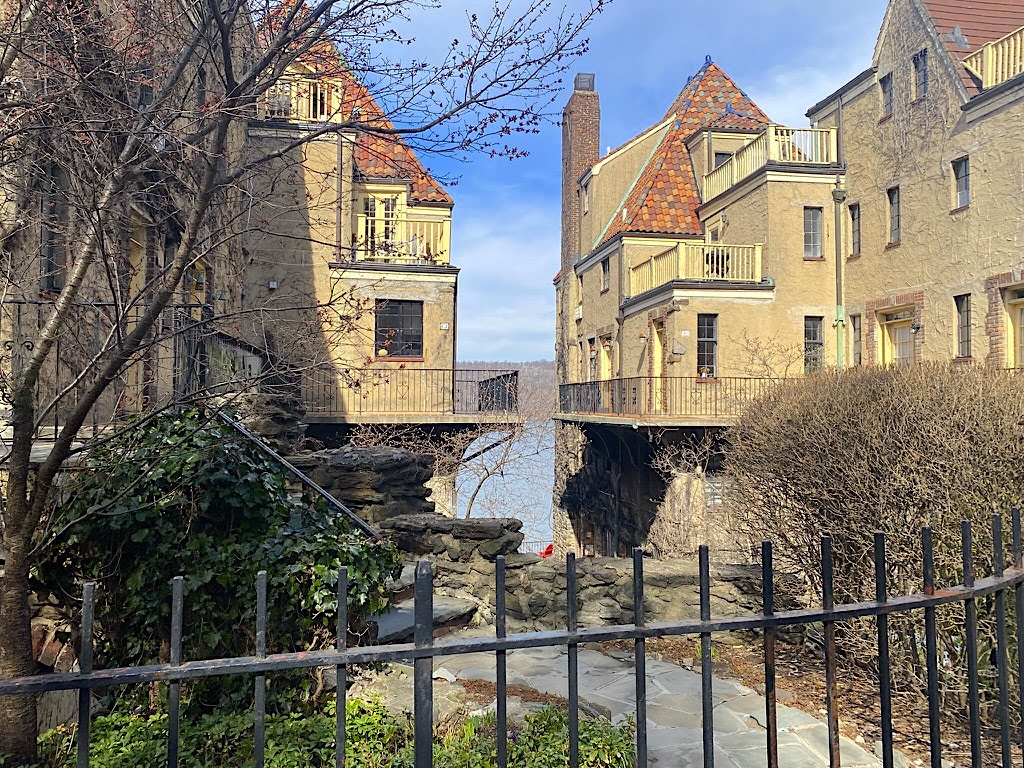
The youngest sister building, the Villa Victoria, went up in 1927. Not quite as dramatic as the Rosa Bonheur, the Victoria continues to exude Tudor loveliness on a steep cliff with sweeping Hudson River vistas (third photo).
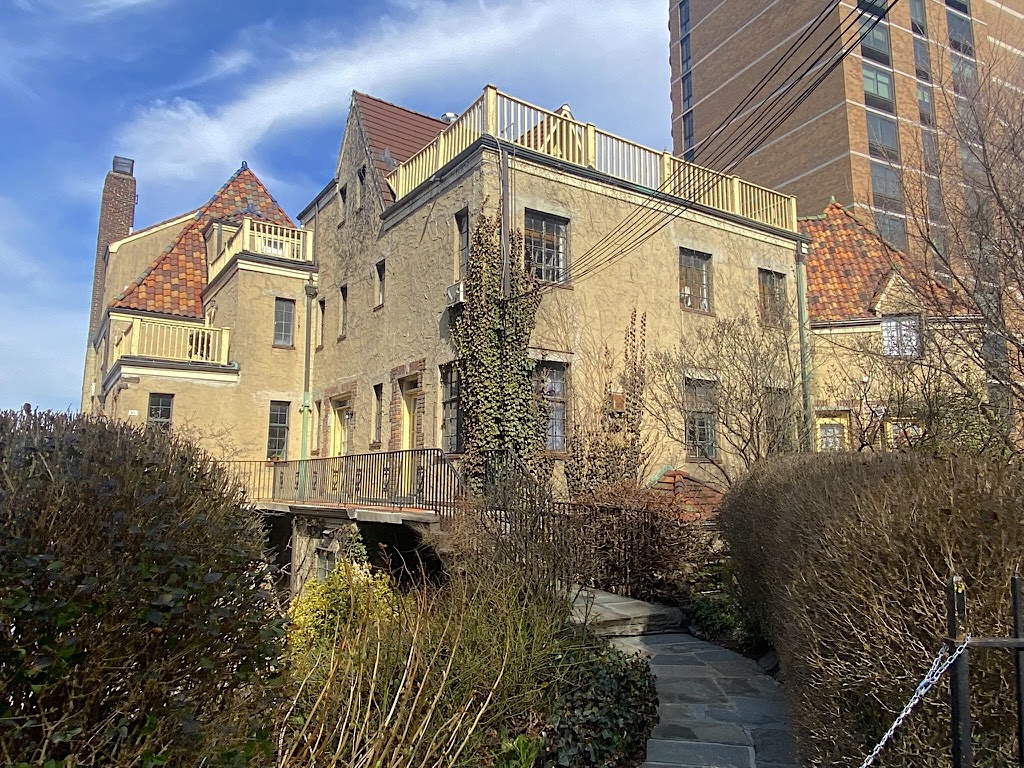
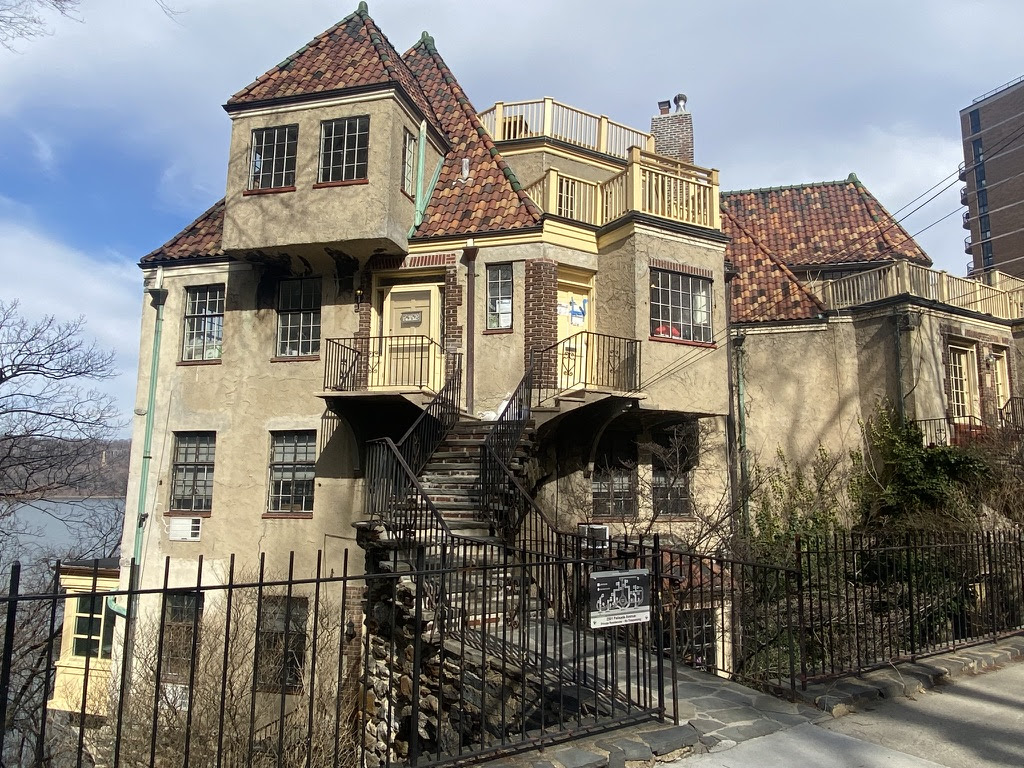
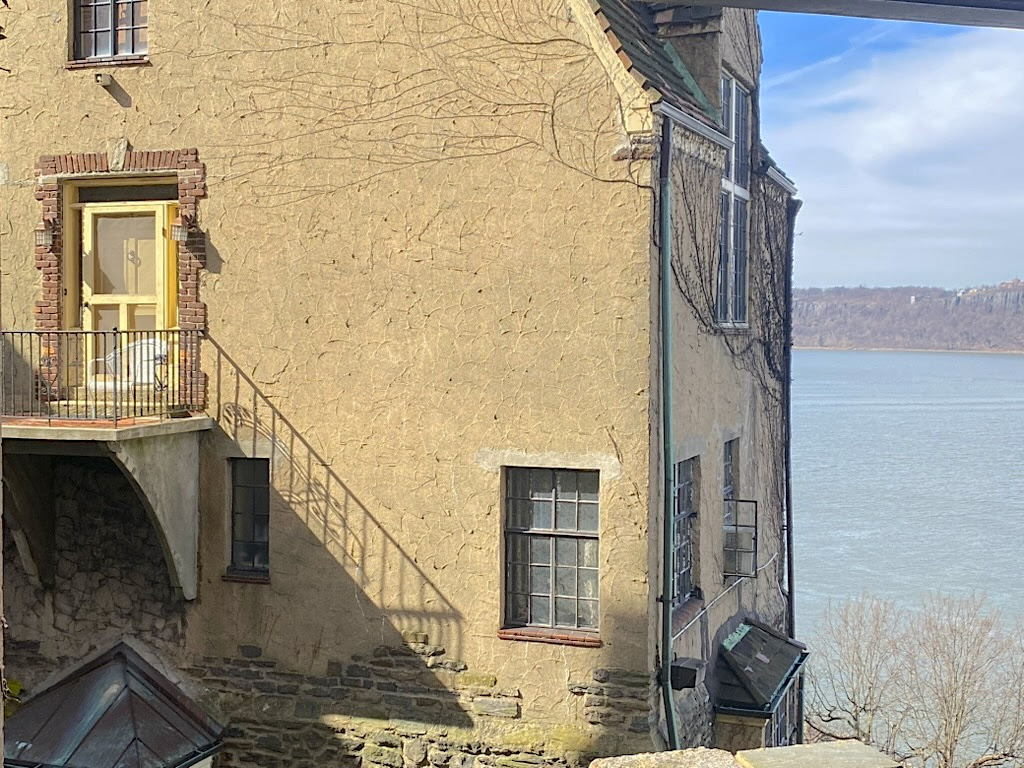
But it’s the middle sister building, the Villa Charlotte Bronte, that stole the show. Built in 1926 next door to the Villa Victoria, the Charlotte Bronte is a romantic fantasy that features two twin buildings bisected by a central sunken courtyard high above the Hudson River.
It’s an enchanting apartment residence designed in a style New York had never seen before.
“Each wing is a carefully irregular composition of tiled roofs, protruding bays, balconies, and casement windows,” wrote David Bady on Lehman College’s Bronx Architecture website. “Together they house seventeen apartments, no two exactly alike.”
The Charlotte Bronte has been described in various ways: like an Italian villa, Gaudi-esque, a pastiche inspired by a fairy tale.
“The exterior is made from stucco, featuring brick and stone ornamentation and multi-colored tiled roofs,” according to a writeup on Curbed. Each apartment had a wood-burning fireplace and varying views of the river; landscaped paths and walkways thread the villa into a cohesive unit.
As much of an showpiece as it is, the Charlotte Bronte and her sisters, all co-ops at their beginning, were built not to lure Manhattanites to the Bronx but to keep the “city ugly” of Manhattan from spoiling Spuyten Duyvil.
Their backstory begins in the 1910s, when residents of this formerly sleepy enclave became alarmed by the encroachment of urban development. The pace of urbanization in Northern Manhattan and the Kingsbridge section of the Bronx was swift, and the community realized that Spuyten Duyvil could be the next area to be carved up and sold to speculators.
Residents pushed back on urbanization, “lest it should jump the Harlem and Spuyten Duyvil Creek and spoil the romantic spot where nature still ran riot among the trees and flowers,” the New York Times reported in 1910.
To deter developers, some residents began buying up lots themselves and laying out plans for “houses of a more expensive character,” per the Times. The goal was to put up new residences (and turn a profit) while keeping the small-scale charm and character of Spuyten Duyvil.
One of these residents, lawyer and businessman John J. McKelvey, had lived in Spuyten Duyvil since the 1890s. At first, he tried his hand at building and selling individual homes, according to Christopher Gray in a 2006 New York Times article.
By the 1920s, he turned his imagination to co-ops. It was McKelvey who built the three sisters and gave them their delightful names. They are considered to be the first apartment houses in Riverdale. “These were not tenements, but ‘villas’ made up of individually owned duplex and triplex ‘studio homes,’” wrote Bady.
Architect Robert Gardner made unusual design choices for the Charlotte Bronte that distinguish it from the hundreds of elegant yet cookie-cutter apartment buildings lining Manhattan’s upper class avenues in the 1920s.
“To get to one apartment, you have to go down two flights toward the Hudson, then turn right and go up two flights to the front door. Another front door is behind a small arched grotto,” explained Gray.
“A third is at the end of a thin, high-flying concrete walkway with a skinny iron railing, cantilevered out over a long and nasty drop to the railroad tracks below.”
At first, the sister buildings attracted elite tenants; one newspaper listed some of the “well known” New Yorkers who planned to make the Villa Victoria their home. But the sisters soon fell on hard times.
“In 1933, Mr. McKelvey lost Villa Victoria in foreclosure, and the Rosa Bonheur co-op failed in 1941,” wrote Gray. The Villa Rosa Bonheur held on for decades as a private home, then in the 2010s was sold to a developer who tore it down—inciting much anger from the community.
Today, the Villa Victoria appears to be a rental building, while the Villa Charlotte Bronte remains a spectacular co-op residence with rarely available units. Spuyten Duyvil gained some apartment towers over the years, but much of this hilly enclave retains a small-town feel high above the bluffs.
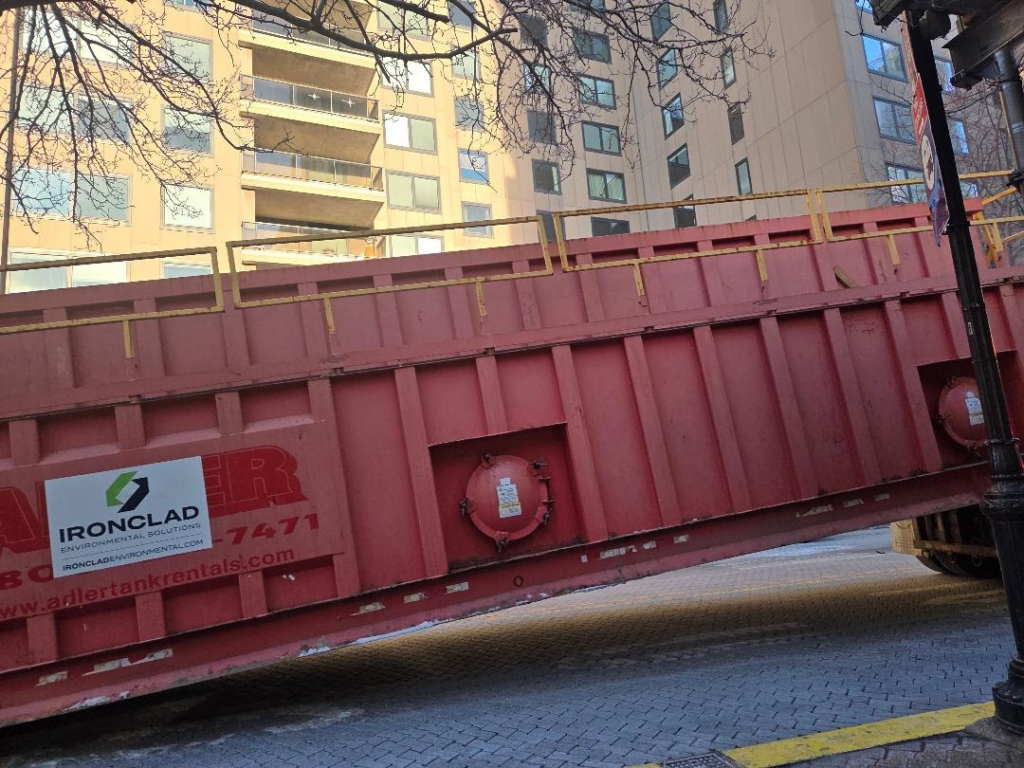
MONSTER DUMPSTER REMOVING DEBRIS FROM STEAM PLANT. WHAT HAPPENED TO BARGING? \WHAT HAPPENED TO COMMUNITY INVOLVMENT?
All image are copyrighted (c) Roosevelt Island Historical Society unless otherwise indicated THIS PUBLICATION FUNDED BY DISCRETIONARY FUNDS FROM CITY COUNCIL MEMBER JULIE MENIN & ROOSEVELT ISLAND OPERATING CORPORATION PUBLIC PURPOSE FUNDS.
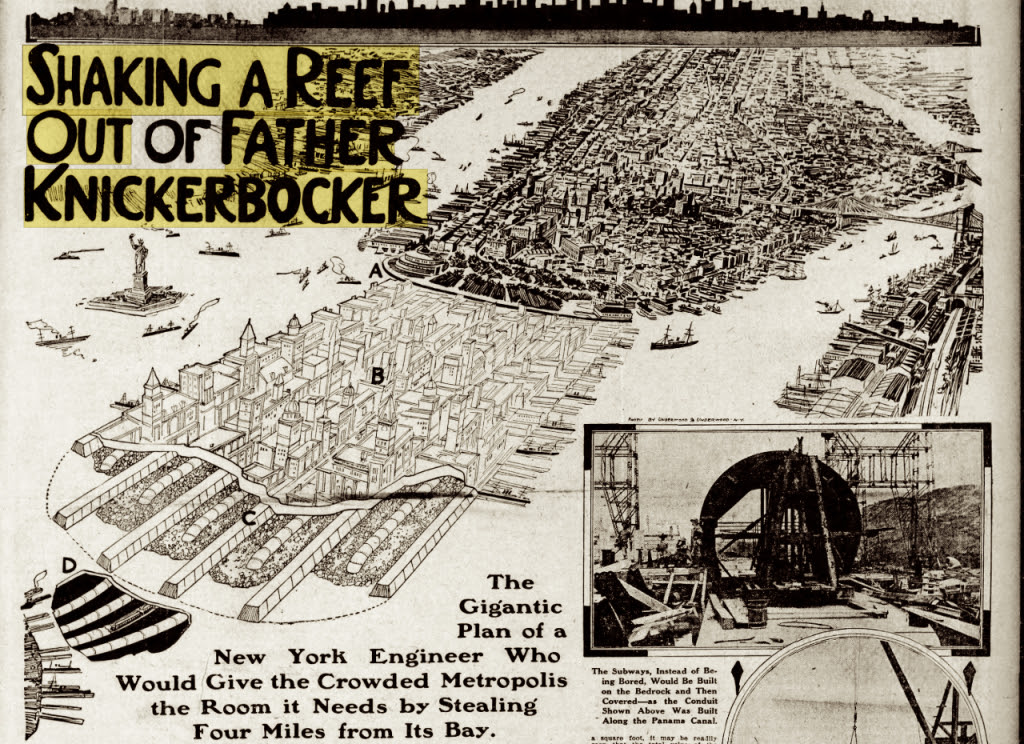
Manhattan started extending its land mass back in the colonial era, using construction debris, sunken ships, ashes, ballast, and other waste to reclaim land and enlarge the island.
Pearl Street used to be the southern boundary; Greenwich Street was at the edge of the Hudson River. Manhattan continued to grow in the 19th century, but by the early 1900s—with almost all of Manhattan urbanized—civil engineers were considering new ways to create more real estate.
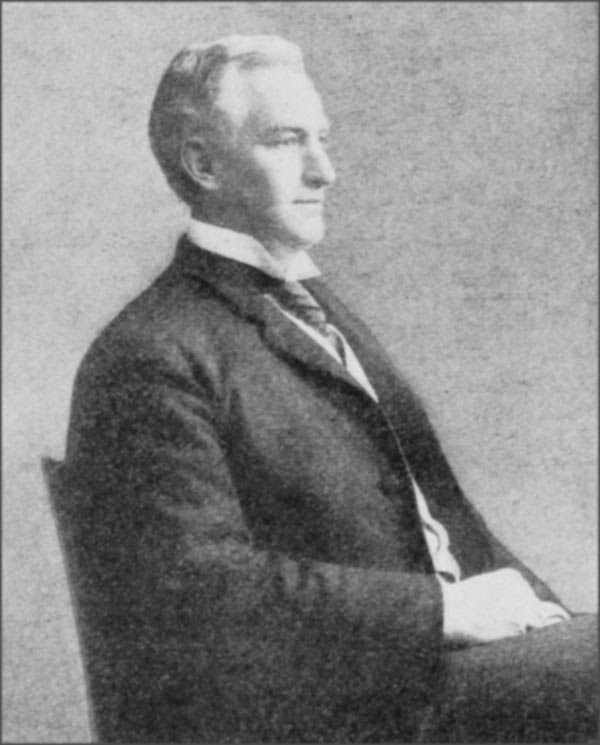
Enter a highly esteemed and successful engineer of bridges and skyscrapers named T. Kennard Thomson.
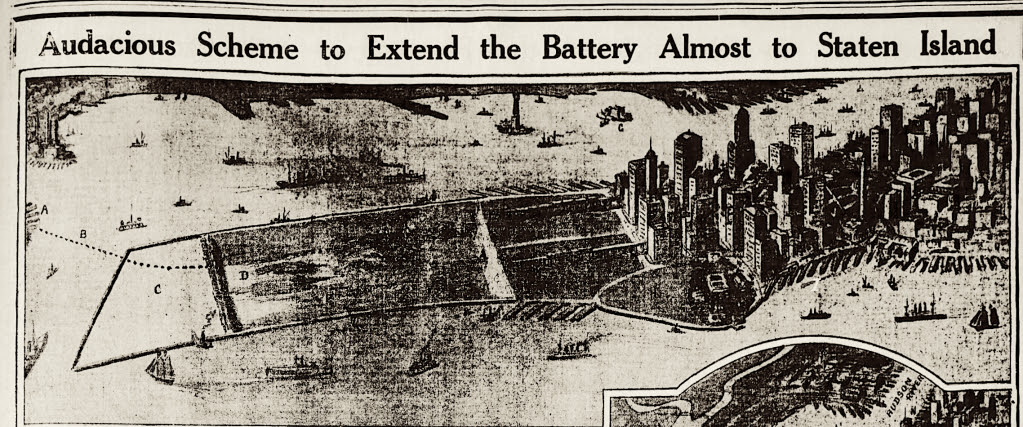
His proposal, popularized in a nationally syndicated newspaper article in June 1911, was to extend Manhattan four miles into New York Harbor, adding 4,100 acres to New York City’s most populated borough.
“The method of reclamation to be followed is extremely simple,” he told a reporter. “I would merely erect concrete seawalls from the Battery toward Staten Island for the desired length, and then fill them in.”
Thomson made his case by focusing on the taxes that could be collected on the additional land. But he was especially concerned with the journey ships took from the harbor to the docks in Manhattan.
Extending the island into the harbor while preserving a narrower ship canal above Staten Island would make it easier for ships to complete their voyage, he believed. The more ships that dock in Manhattan, the more enriched city coffers become.
Part of his proposal involved building a “six-track subway all around Manhattan Island, including the new extension. The subway would be built underneath the present dock line of the city.”
Visionary or pipe dreamer, Thomson was grounded enough to know that he needed city officials to get on board with his plan. The article states that his proposal was “under consideration, and other engineers who have looked into the matter regard it as entirely feasible.”
You can imagine what City Hall must have thought of this massive, likely quite expensive plan. But Thomson wasn’t finished coming up with new ideas for enlarging Manhattan.
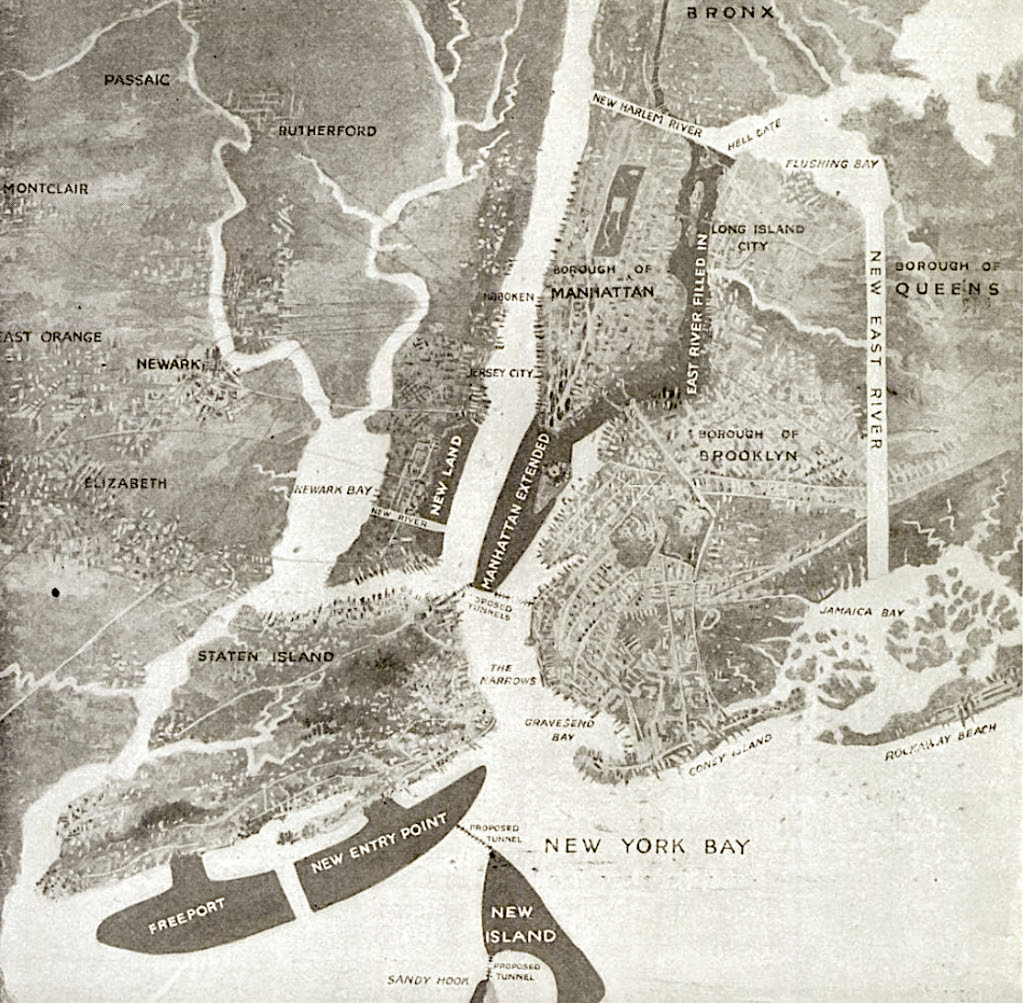
In 1916, he published a proposal in Popular Science not only to build into New York Harbor but to fill in the entire East River (third image), which would reclaim 50 square miles and create “a really greater New York.”
You know the end of this story. Like so many other fantastical ideas that never came to pass, Thomson’s second proposal never came to fruition.
[Top image: The Atlanta Journal; Second image: Geographicus.com; third image: Popular Science; Fourth image: New York Tribune]
All image are copyrighted (c) Roosevelt Island Historical Society unless otherwise indicated THIS PUBLICATION FUNDED BY DISCRETIONARY FUNDS FROM CITY COUNCIL MEMBER JULIE MENIN & ROOSEVELT ISLAND OPERATING CORPORATION PUBLIC PURPOSE FUNDS.
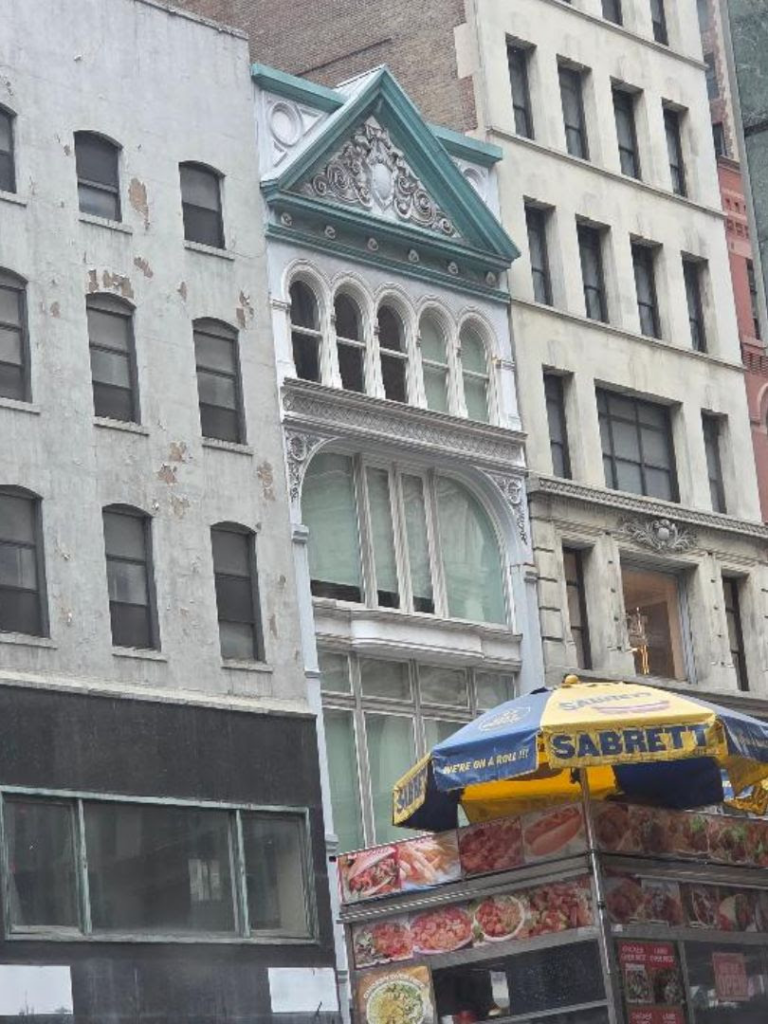
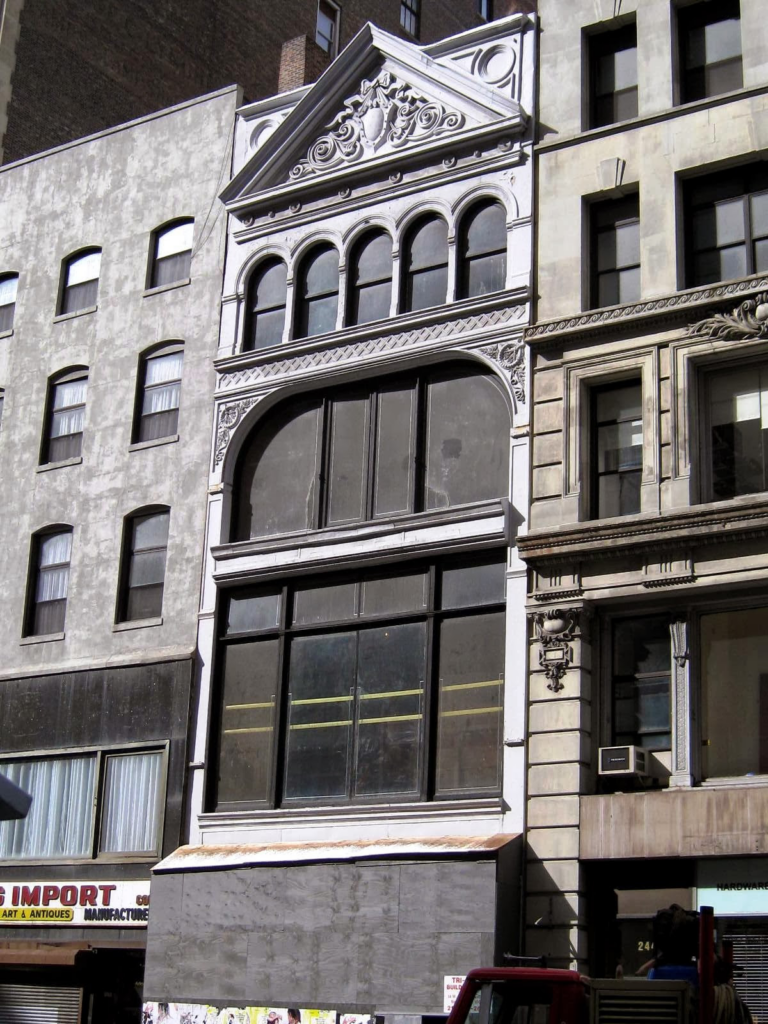
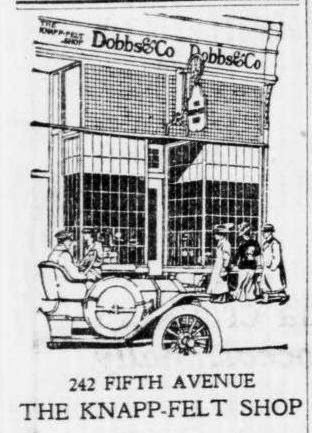
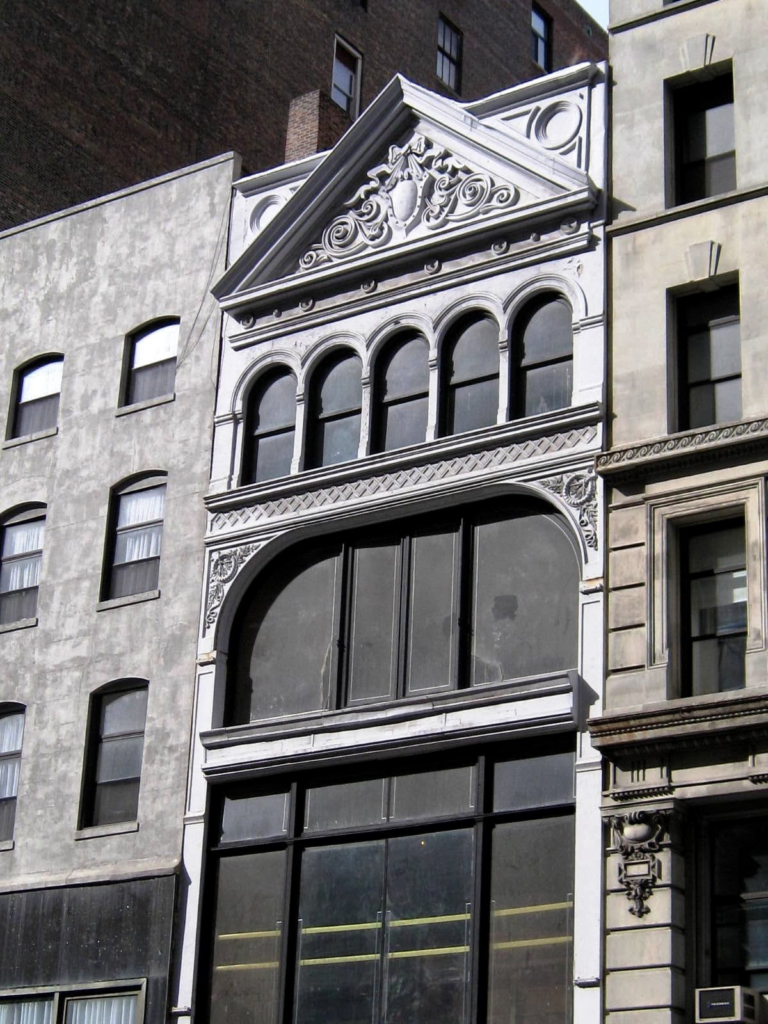
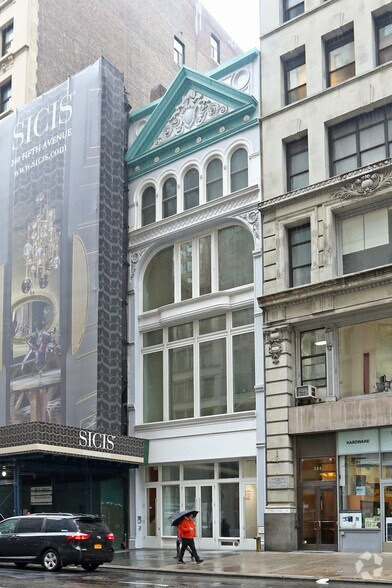
This morning I passed by 242 Fifth Avenue and sensed there must be a story about this lovely building between 27 and 28th Streets. There are many stories as you will read. (My photo from a cab, below)
There was some unpleasant business at City Hall in 1883 when it was discovered that city clerks and a few wealthy New Yorkers had committed fraud. John B. Carroll lined his pockets with graft while about $12,000 of taxes and water rents went unpaid. Another of the moneyed businessmen indicted was John C. Ely.
The New York Times reported on September 29 that year that “Mr. John C. Ely, who is mentioned in the indictment, is a large real estate owner in the north western part of the City. He has an office at No. 191 Broadway, and resides at No. 242 Fifth-avenue, a handsome brown-stone residence, near Twenty-eighth-st.”
The “handsome brown-stone residence” was typical of the neighborhood near Madison Square. Soon after the park opened in 1847 high-end homes began lining the surrounding streets. By 1870, when the park was re-landscaped, the northward-flowing tide of mansions had reached 28th Street. Frederick C. Colton, treasurer of the New York Bible Society lived in No. 242 at the time.
But now, in 1883 Manhattan’s millionaires had continued inching up the avenue and commerce was beginning to engulf the area. It would seem that the tax-evading Ely leased the house from Lucy Slade; but in any case soon after his name appeared in the newspapers he was gone.
The Presidential Election pitting Democrat Grover Cleveland against James G. Blaine was nearing and on June 26, 1884 The New York Times noted that the Republican National Committee had leased No. 242 Fifth Avenue the day before. The newspaper said “the building will be opened for the campaign as soon as possible. It is four stories in height and spacious enough to accommodate the army of clerks and employes which will be required to aid the committee. It is within easy reach of the hotels which cluster around Madison-square.”
The new committee headquarters was opened, symbolically no doubt, on the Fourth of July. Two weeks later the zeal of the Republicans caused no small bit of annoyance and inconvenience to neighbors. B.F. Jones decided that a huge banner with the portraits of Blaine and his vice-presidential candidate, Logan, should be stretched across the avenue for all to see. The owner of the house directly across the avenue refused to allow the banner to be bolted to his mansion; so it had to be erected diagonally across the thoroughfare to an apartment house.
On July 28 The Sun reported that “At 8:35 last night a sudden gust of wind slapped the Republican candidates in the face, pulled the iron fastening of the banner out of the apartment house wall, and brought things down with a crash on the electric light wires that cross the street. Mr. B. F. Jones’s wire cut half through the electric line. The cut wire sputtered like a blue light an instant, and then all the tall globed burners in the avenue from Madison square up to Forty-second street went out with a puff, and left the street nearly pitch dark.”
An engineer from the electric company worked on the dynamos until around midnight trying to correct the problem; then sent out an inspector. The cut wires could not be repaired until morning. “Meantime policemen did patrol duty in the dark, and pedestrians couldn’t make out any of the house numbers,” complained The Sun.
When the election was over and the committee gone, the estate of Lucy Slade conceded to the commercialization of the district and hired architect George Harding to convert the mansion for business. The brownstone façade and stoop were stripped off to be replaced by an up-to-date Queen Anne cast iron front.
Completed in 1885, Harding’s handsome design focused on appropriate space for the high-end retailers now filling this section of Fifth Avenue. The street entrance featured modern multi-paned arcade windows below a deep panel of glass tiles. Immense expanses of glass, made possible by the cast iron, flooded the showrooms of the second and third floors with sunlight. Above a small cornice and arcade of five openings sat an exuberant parapet featuring a deep pediment filled with intricate ornamentation tied up with a cast iron bow.
The building would become a favorite with exclusive decorating firms, art dealers and auction houses. On March 25, 1886 The Times reported that “Several windows and other pieces of stained glasswork, designed and manufactured by Mr. John La Farge, are on exhibition at No. 242 Fifth avenue. The fine effect of color in these pieces are evidence of progress in America in this branch of art.”
The exclusive antiques and decorating firm of H. B. Herts & Son moved here from the Washington Square area. Stanford White would visit the store as he was furnishing the Metropolitan Club, completed in 1893. Among his purchases were several clocks and a sideboard that came from the Newport cottage of E. D. Morgan.
Around the corner, at No. 6 West 28th Street, was another high-end antiques dealer, E. J. La Place. Two years before Stanford White would shop for the Metropolitan Club’s furnishings, both stores were hit by a smooth jewel thief.
Nettie Kirby Hamburger was the wife of alleged diamond thief Ralph Hamburger, alias Robert Howe, alias De Ford. While Ralph Hamburger was locked up awaiting arraignment in 1891, his wife was busy on her own. Nettie browsed through the expensive items in the shops on Fifth Avenue and the neighboring streets. The well-dressed woman then dropped by pawnshops with valuable jewelry and other items as merchants realized they were missing stock.
A suspicious Detective Cottrell shadowed Nellie and recovered thousands of dollars of stolen merchandise including diamond earrings, a diamond brooch, two silver-mounted cologne bottles, a heart with nine large diamonds and other pieces. Among the loot was a gold chatelaine watch for which H. B. Herts & Son had paid $900—over $22,000 today. The Sun reported on July 29, 1891 that E. J. La Place was among the merchants who identified Mrs. Hamburger.
By now H. B. Herts & Son was operated by brothers Maurice A. and Jacques H. Herts. Upstairs architect Charles De Rahm had his offices.
In April 1901 H. B. Herts & Sons advertised “A Great Public Sale” at the American Art Galleries on Madison Square South. The firm had signed a lease for a smaller space which would not be ready until the fall “and being compelled to vacate their present building on May 1st” had to liquidate their entire stock.
The inventory list hinted at not only the firm’s expensive stock; but at its carriage trade customers. Included were Chippendale, Adam, Empire, Louis XV and XVI, Sheraton, English, Dutch and Colonial furniture; “rare old tapestries, English and Dutch silver, ivories, enamels, bronzes, beautiful clocks and clock sets, silks and brocades.”
For several years, at least from 1902 through 1909, Rupert A. Ryley “men and women’s tailor,” operated from the building. Tailors on Fifth Avenue in 1902 catered only to the upper classes and Ryley and his wife summered in their own Newport cottage. The “merchant tailor” held memberships in the Manhattan, Democratic and New York Athletic Clubs and was active in Republican events.
A dashing Rupert A. Ryley (upper left) was possibly wearing a suit he created — photo from “The Great Sound Money Parade,” 1897 (copyright expired)
In May 1902 as his customers prepared for the warmer months, Ryley advertised “golfing, sporting and outdoor costumes. Riding habits and suits for men and women a specialty.”
Interestingly, in 1903 Auctioneers James P. Silo and A. W. Clarke advertised their sales here as being in the “Rupert A. Ryley Building.” At the same time The Yale & Towne Mfg. Co. opened its showroom in the building. The firm dealt in “artistic hardware of higher grades.” In 1903 it invited is customers, “especially architects and their clients,” to avail themselves “of the improved facilities thus offered for the selection of locks and hardware for buildings of all classes.”
The fashionable address may have been ill-fitted for a hardware showroom, for Yale & Towne seems to have quickly moved on.
Haberdashery Dobbs & Co. moved into the building in 1908, taking the ground floor retail store. Best known for their gentlemen’s hats, the firm offered items like “silk hats, opera hats, caps, canes and umbrellas.” In the fall of that year Dobbs & Co. promised in an advertisement “The quality is superb and the styles are of unquestionable taste and propriety.”
A Dobbs & Co. advertisement in the New-York Tribune on September 30, 1911 shows the arcade entrance — copyright expired
As automobiles began replacing carriages and the wealthy accepted the new trend, Dobbs & Co. was quick to cash in. On April 19, 1909 an advertisement in the New-York Tribune offered “Owners’ watertight cloth coats and chauffeurs’ complete outfits, together with many practical novelties in Automobile Apparel.” But it reminded customers of what had made it so successful: hats. “Derbies and Soft Hats $6, $4, in a variety of smart shapes in exquisite taste and of superb quality.” The $6 derby would cost about $150 today.
Dobbs & Co. moved next door to No. 244 Fifth Avenue around 1914. In its place, Edmond P. La Place, who, with Herts & Son, had been robbed by Nettie Hamburger years before, moved in. In announcing its new home, E. P. La Place listed “period furniture and faithful reproductions, Sheffield plate, antiques, interior decorations—curios, prints, period mirrors, oriental porcelain, tapestries, etc.”
E. P. La Place antiques would remain here until Edmond La Place’s retirement in 1921. The entire collection was auctioned off on Wednesday, April 13 of that year.
In the meantime, Darling & Co. auctioneers was operating from the building. The firm was renowned for liquidating the estates of the wealthy and famous. On May 27, 1919 The Evening World reported that “Thousands of dollars’ worth of gifts, including rare bronzes curios and period furniture, as well as diamonds and other jewels, belonging to the late “Pommery” Bob Vernon, sportsman, horseman and champagne agent” would go under the hammer here the following day.
The first day of that auction netted $11,698 and the Tribune noted that “Evelyn Nesbit Thaw bought several Chinese vases, silver, rugs and trophies.”
The expansive windows exhibited valuable furnishings and artwork–just no nudes.
A month later Darling’s prepared to auction the estate of Princess de Chimay (who was Clara Ward of Detroit before her marriage). The princess had married violinist Rigo “who was dear to the princess after she fled from her prince husband,” explained the Washington Times on June 27. Rigo was the beneficiary of her estate and “it was announced that he will play his fiddle on the last day of the sale.”
The auction included about $200,000 of the princess’s personal effects, including furnishings from her “splendid home in Paris and in Egypt on the Nile.” But it was her portraits that got Darling’s into trouble.
The Washington Times reported “Half a dozen portraits in the nude of the late Princess de Chimey…were placed on sale at auction yesterday…Louis Van Brink, the auctioneer, was quite unhappy because he could not exhibit these works of art in the window and draw a larger crowd.”
When the auctioneer had placed one of the portraits in the window (which Van Brink complained was “not so very nude either, for the princess was wearing a green girdle”) the vice society agents made a visit. The auction house was informed that the painting would have to be removed from public sight if the managers “wanted to avoid trouble.”
In 1920 playboy millionaire Joseph Browne Elwell, whist expert and turfman, was found murdered in his home. A pistol was found at the scene, along with a woman’s kimono. Elwell’s housekeeper told detectives that the kimono “was the property of a woman who made occasional visits to the Elwell house.” They were also interested in a life-sized painting of a “beautiful woman” that hung in the house who was unidentified.
The furnishings, artwork and personal effects of the Elwell mansion were auctioned at Darling’s in October 1920. Somewhat astoundingly, at least to 21st century minds, the evidence in the still-unsolved murder mystery was included in the sale.
On October 2 the New-York Tribune reported “A high-backed upholstered chair and a silk kimono, embroidered in blue and black after a Chinese design, made their appearance yesterday in the show window of Darling & Co., auctioneers, 242 Fifth Avenue, and of all the hastening thousands who glanced casually at the rugs and porcelains and figures that formed the remaining decorations of the window there were few who even noticed that the chair and the kimono had been added to the collection.
“Fewer still knew that they constituted chapters in a murder mystery which set New York by the ears less than four months ago—perhaps the opening and the closing chapters.”
The chair was the one in which Elwell had been sitting when a bullet was fired into his head. The Tribune mentioned both the kimono and the revolver, as well. “The identity of its owner is as much of a mystery as that of the owner of the revolver with which Elwell was shot. It was found in a room reserved for women who came to visit Elwell. No one ever has claimed it and it is listed among his belongings which Darling & Co. are to sell at public auction.”
Although the Elwell auction included priceless items, like a Rembrandt, it was the evidentiary pieces that drew attention. Following the auction the New-York Tribune reported that the kimono had sold for $423.50, and the painting of “the woman in gray” was sold to a man from Fort Worth, Texas for $335 (about $3,300 today).
Following the death of Oscar Hammerstein in August of that year, his widow placed an enormous amount of furnishings and artwork in the hands of Darling & Co. Along with “magnificent home furnishings” were Carrara marble statuary, sterling silver tea and coffee services, Napoleonic drawing room furnishings and rare bronzes and works of art. Mrs. Hammerstein included some of her husband’s invaluable possessions. “Among the articles on view will be a score of ‘Lucia’ in manuscript form, said to be a copy penned by the composer, Donizetti; an old violin, a Chinese vase eight feet tall and a life size bronze statue of Faust and Marguerite, listed as having won first prize at an exhibition at Le Brousse,” said The Sun on August 11, 1920.
A year later more of the impresario’s collection was auctioned here. The Evening World reported on September 14, 1921 “A Steinway concert grand opera piano is one of the relics that are to come under the hammer. It may have been the instrument upon which Mr. Hammerstein once composed an entire opera at a single sitting.
“A gold watch presented by the attaches of the Harlem Opera House, on May 8, 1890, has a catalogue number in the same sale.” There was a massive two-handle sterling silver cup that had been presented to Hammerstein by the Manhattan Grand Opera Company on April 20, 1907. It bore the signatures of the most illustrious opera figures of the day. Included in the 28 signatures were those of Campanini, Melba, Calve, Bassi, Giaconia and Muzzio.
By now the high-end jewelers and art dealers had moved further north; taking over Fifth Avenue’s grandest mansions and pushing its millionaires even further up along Central Park. The days of expensive antiques and artwork were coming to an end for No. 242 Fifth Avenue.
In 1922 the G. L. B. Manufacturing Company was operating here, manufacturing dresses. Three years later the ground floor was updated and the charming arcade windows were removed. The second floor was slightly altered at the same time.
Further ground floor alterations would occur in the 20th century and in the 1980s Bank Leumi operated a branch here. Then around the turn of the 21st century the building was boarded up. For a decade the structure sat empty and neglected.
Finally, in 2012 a group of investors, “the Pan Brothers,” purchased the building and announced intentions to convert it into four luxurious residential units above the first floor commercial space. Work commenced in 2013 when the boards were pulled off and the rusting cast iron façade was restored.
Above street level George Harding’s 1885 transformation of the old brownstone mansion is essentially intact. And the wonderful cast iron bow in the triangular pediment is fresh again.
CREDITS
Daytonian in Manhattan
PHOTO OF THE DAY
A SNOWY AFTERNOON
All image are copyrighted (c) Roosevelt Island Historical Society unless otherwise indicated THIS PUBLICATION FUNDED BY DISCRETIONARY FUNDS FROM CITY COUNCIL MEMBER JULIE MENIN & ROOSEVELT ISLAND OPERATING CORPORATION PUBLIC PURPOSE FUNDS.
Photos courtesy of the Flatiron NoMad Partnership by Bizi Media
You’re not seeing things—there is, in fact, a rosy-colored man lurking around Flatiron and Nomad. Known as Mr. Pink, the quirky character is part of Flatiron NoMad Glows Pink, a public art trail composed of 10 illuminated inflatable and resin sculptures perched on rooftops and in public spaces. Part of the Flatiron Nomad Partnership’s annual Winter Glow public art program, “Mr. Pink” is a “cuteism” sculpture by French artist Philippe Katerine, and Thursday marks the character’s first installation in New York City—it’s also the first time the sculptures will be illuminated.
Cuteism,” also known as “Mignonisme,” is a movement that embraces color, creativity, and playfulness in everyday life. From rooftops and public plazas, Mr. Pink invites New Yorkers to see their city in new ways, encouraging joy and connection while adding a burst of color to the streetscape during the colder months. Standing nine to 16 feet tall, each sculpture also provides a photo-ready moment for visitors.
“Mr. Pink is like all of us,” Katerine said in a press release. “He carries a scar on his heart—a reminder that we have all, at some point, been wounded. Like us, he seeks acceptance and a place to belong in the world. His rounded shape and wide-eyed expression invite playfulness, while the weight he bears hints at a gentle melancholy.”
He added, “Mr. Pink engages directly with those he encounters. If he waves, he asks for a response. If he opens his arms, he offers comfort. If he points the way, it is to remind us that there is always a direction, always a place where providence can be found. Encountering Mr. Pink in a city is never a coincidence.”
Mr. Pink will be here for six weeks, and his arrival kicks off with a celebration in the Flatiron North Plaza at 4:30 p.m. on Tuesday. During his stay in the neighborhood, visitors can embark on a self-guided art trail, and those who scan QR codes at all 10 installations will be entered into a raffle for prizes, including a complimentary two-night stay at Hotel Seville Nomad, which has also introduced a “Pretty in Pink” cocktail.
Other special offers include in-house experiences for guests at Virgin Hotels New York, free customization of select drinkware at YETI Flatiron, and limited-edition Mr. Pink keychains from Swingers Crazy Golf NYC. Additionally, the neighborhood will host a special Valentine’s Day activation at Flatiron North Plaza featuring themed installations and photo opportunities.
“By animating our rooftops and plazas with bold, joyful art, we’re supporting local businesses, energizing public space, and shining a light on what makes these districts so iconic,” James Mettham, president of the Flatiron NoMad Partnership, said.
Here’s where you can spot Mr. Pink:
Flatiron North Plaza, 23rd St. and Broadway
Flatiron Mini Plaza, 22nd St. and Broadway
Hotel Seville NoMad, 22 E 29th St.
Kew Management, 1129 Broadway
Porcelanosa, 202 Fifth Avenue (featuring two Mr. Pink structures)
The Capitol Plaza, 50 W 27th St.
The Church of the Transfiguration, 1 E 29th St.
Virgin Hotels New York, 1227 Broadway
BXP,200 Fifth Avenue
“Public art is essential to creating streets and public spaces that are welcoming and reflective of New York City’s creativity, especially when it invites people to linger, explore, support local business, and connect with one another,” former Department of Transportation Commissioner Ydanis Rodriguez said.
BRIGHT AND SHINY RIOC BUS #8 JUST BACK FROM A MAKEOVER WITH A NEW PAINT JOB!!!! WE LOVE THE BUSES WITH THE ON WALL SEATING!!!
All image are copyrighted (c) Roosevelt Island Historical Society unless otherwise indicated THIS PUBLICATION FUNDED BY DISCRETIONARY FUNDS FROM CITY COUNCIL MEMBER JULIE MENIN & ROOSEVELT ISLAND OPERATING CORPORATION PUBLIC PURPOSE FUNDS.