
Friday, January 2, 2026 – NEW YEAR’S DAY WAS A DAY TO VISIT FRIENDS ALL OVER THE CITY
Chronicling the Feasting and Frolicking
on
New Year’s Day
Over Two Centuries in
New York City
FRIDAY, JAN. 2, 2026
EPHEMERAL NEW YORK
ISSUE #1602
New York has always been a city that loves a party. But perhaps no residents of Gotham celebrated quite like the New Year’s Day revelers in the 17th century trading outpost of New Amsterdam.
Forget lavish Christmas dinners and over-the-top gift giving. In the Dutch colonial era, New Year’s Day was the bacchanalia of the year—with the town’s population of roughly 5,000 people drinking, dancing, carousing with neighbors, and enjoying the festive feel of the first of January.
Of course, tables laden with rich foods and copious spirits were a prominent part of the day.
“The women of New Amsterdam on New Year’s Day decorated their houses with all the skill at their command, and in silk and taffeta welcomed the dignitaries of the town,” wrote Rufus Rockwell Wilson in his 1902 historical study, New York Old and New.
Meanwhile, the men went calling, walking or riding their carriages to visit these decorated homes. There they would be treated to “a mighty punch bowl well reinforced by haunches of cold venison and turkeys roasted whole, and ornamented with cakes, comfit, confectionery, silver tankers, and bekers filled with rare Madeira and foaming ale,” according to The Story of the City of New York, published in 1888.
Indulging was all part of the fun. Outdoors in the January chill, “much drunkenness and other insolence” occurred, including the celebratory firing of guns by citizens welcoming the new year. Unfortunately, the gunshots sometimes hit other residents.
With this in mind, Director General Peter Stuyvesant outlawed this “unnecessary waste of powder” in 1655, though the custom of firing a gun on New Year’s has remained in place.
After the British took over the colony in 1664, citywide New Year celebrations continued, perhaps with more restraint. On January 1, 1790, George Washington received callers at his mansion on Cherry Street between 12 and 3 p.m., as he noted in his diary, adding that “a great number of gentlemen and ladies visited Mrs. Washington on the same occasion.”
As the 19th century commenced and New York’s population diversified, Christmas eventually supplanted New Year’s as the city’s major December holiday.
Yet the tradition of calling continued. In his autobiography, sculptor James E. Kelly recalled going calling as a boy in the 1860s, when “the glow and tingle of the walk was heightened by the gust of warm spice-laden air that greeted us, and as our pretty little girl schoolmates received us at the doors in all their holiday finery.”
Another child, a 10-year-old whose diary chronicles her privileged girlhood in the Greenwich Village of 1849 and 1850, remembered that the family received 139 callers at their Ninth Street home on January 1, and guests were served “oysters and coffee and cake.”
“The gentlemen keep dropping in all day and until long after I have gone to bed; and the horses look tired, and the livery men make a lot of money,” wrote little Catherine Havens in her diary.
By the Gilded Age, calling was on its way out. On January 3, 1888, the New York Times wrote that “few carriages were observed bearing the gentlemen about on a pilgrimage of good wishes, and as a matter of fact the ladies themselves did not even deem it necessary to inform their friends that they should not receive.”
“Neither the Astors nor the Vanderbilts were at home yesterday, and none of New York’s prominent ladies can be properly said to have received calls.”
With these old New Year’s traditions dwindling, nostalgia for the celebrations of colonial days took over.
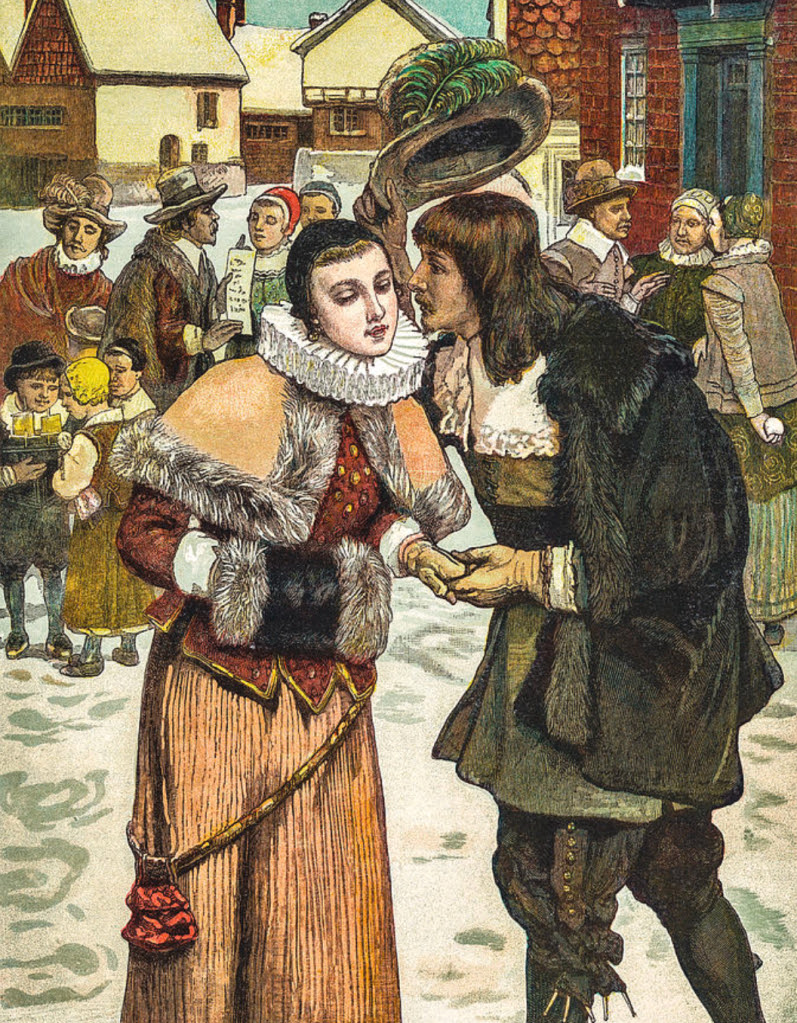
Periodicals published illustrations that imagined the merriment and good cheer of New Year’s Day in the 17th century. One example is in the image at the top of this post—a color-printed wood engraving of the New York of 1675, made from a late 19th century illustration by British artist George Henry Boughton.
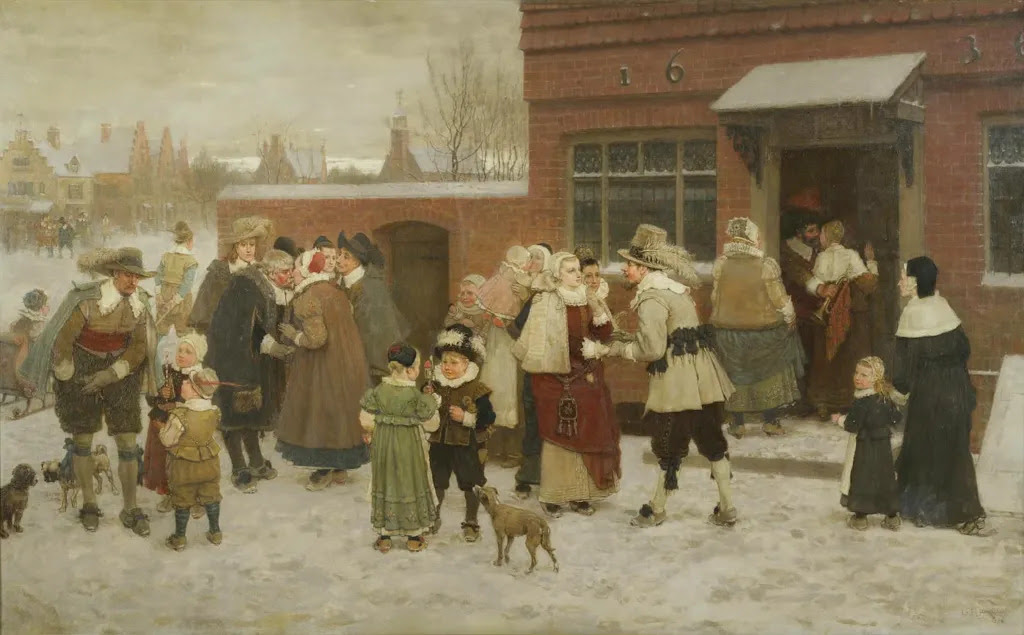
Boughton also created the third image of Dutch colonists celebrating the holiday in New Amsterdam in 1636, with Dutch-style gabled roofs in the background.
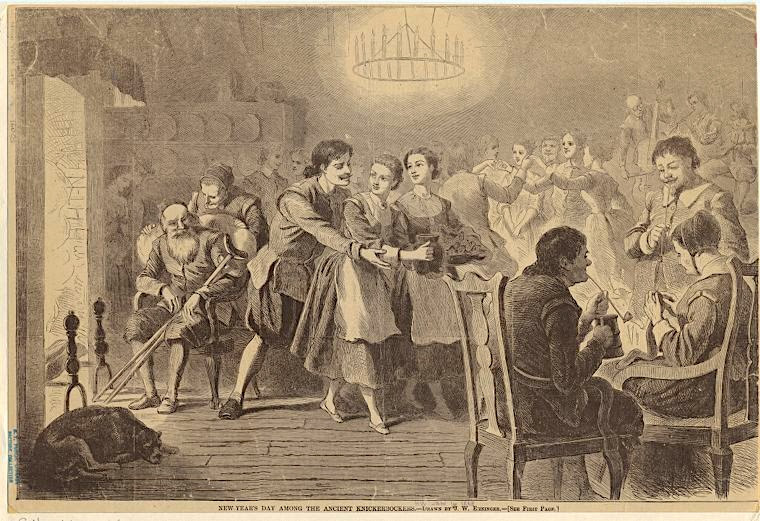
And the middle black and white image comes from an 1868 illustration by painter John Whetten Ehninger, who imagined a New Year’s Day of dancing, flirting, and pipe smoking among what he called the “Ancient Knickerbockers.”
CREDITS
[Top image: Metmuseum.com; second image: NYPL Digital Collections; third image: Wikipedia]
Tags: Colonial New York Holiday Traditions, Colonial New York New Year’s Traditions, New Amsterdam New Year’s Celebration, New Year’s Calling in New York City, New York New Year’s traditions, The Lost Tradition of New Year’s Calling
Posted in Holiday traditions, Lower Manhattan |
PHOTO OF THE DAY
COLER THERAPEUTIC RECREATION STAFF
GETTING READY TO DISTRIBUTE HOLIDAY GIFTS TO RESIDENTS.HEALTH AND BEAUTY GOODIES ARE DONATED BY GOOD SHEPHERD PARISH TO THE COLER AUXILIARY ANNUALLY

CREDIT
JUDITH BERDY
All image are copyrighted (c) Roosevelt Island Historical Society unless otherwise indicated
THIS PUBLICATION FUNDED BY DISCRETIONARY FUNDS FROM CITY COUNCIL MEMBER JULIE MENIN & ROOSEVELT ISLAND OPERATING CORPORATION PUBLIC PURPOSE FUNDS.


Copyright © 2025 Roosevelt Island Historical Society, All rights reserved.Our mailing address is:
rooseveltislandhistory@gmail.com
Leave a comment