For the last few hundred years, New York City has been one of the country’s epicenters of African-American and Black culture, from early free Black settlements in the 1820s to musical icons in the 1930s to modern-day Black activists. All throughout the city there are historic sites where influential Black figures lived and practiced their craft, from the Lewis Latimer House in Flushing to the Claude McKay Residence in Harlem. According to writer Laura Itzkowitz (an Untapped New York contributor and former managing editor) in her article for Architectural Digest “When Architecture and Racial Justice Intersect,” only 2% of the nearly 95,000 entries on the National Register of Historic Places focus on the experience of Black Americans, but you don’t have to search hard to find an abundance of sites connected to Black history around New York.
New York City is fortunate enough to have many relics of African-American struggles and victories preserved as landmarks. Yet there are many others, especially in the Bronx, that are forgotten or at best, commemorated only by a plaque. Here is our guide to Black historic sites in New York City across the five boroughs, including both landmarked and un-landmarked sites. Some have historic plaques, others do not.
We have organized the locations by date first built, but in some cases the connection to Black history may have occurred later than when the building was originally built, started in an earlier building that has been demolished, or have been connected to the site since the very beginning. This is by no means an exhaustive list, but we attempted to highlight here sites that should be known to the public as well as those that have slipped under the radar.
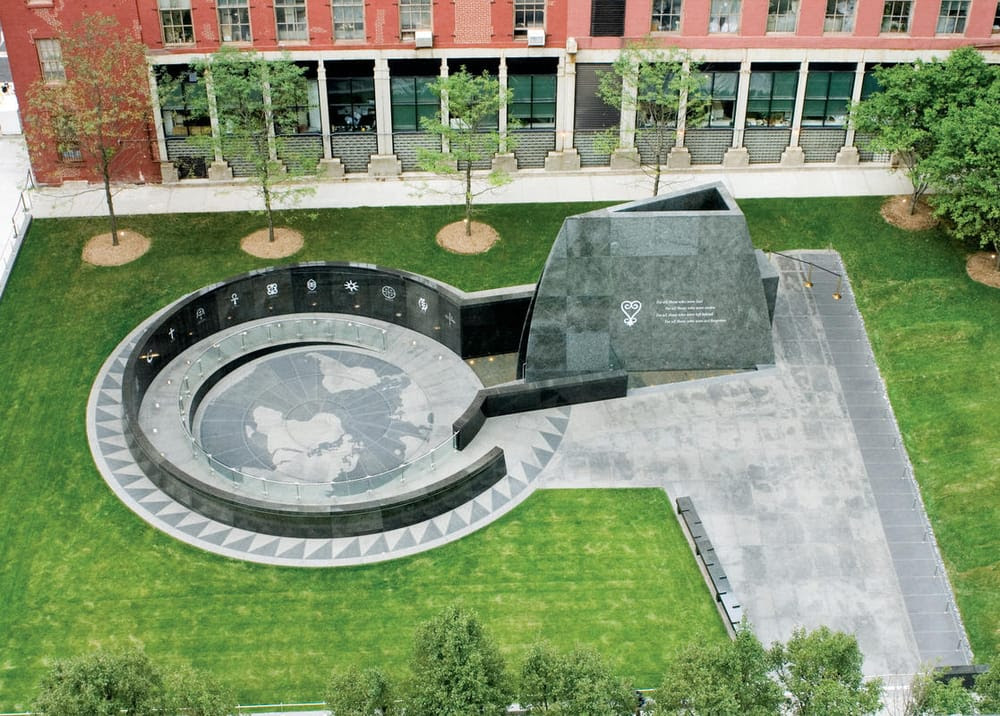
The African Burial Ground National Monument is found in the Civic Center area of Lower Manhattan that contains the remains of more than 419 Africans from the 17th and 18th centuries. It is estimated that there were as many of 10,000 to 20,000 burials in the 1700s, and it is considered New York’s oldest African-American cemetery.
In the 1600s, the Dutch West India Company brought over slaves from Angola, Congo, and Guinea, and by the mid-17th century, a village called the Land of the Blacks saw 30 African-owned farms in modern-day Washington Square Park. It was estimated that 42% of households in New York had slaves, which eventually totaled about 2,500 by 1740. Slavery was ultimately abolished on July 4, 1827, yet only one-third of the city’s blacks were free in 1790. The site was initially labeled on old maps as “Negro Burying Ground,” and the first recorded burials for people of African descent occurred in 1712, but it is speculated that the burial ground was in use two decades earlier.
Some of the bodies of the deceased were illegally dug up for dissection, which sparked the 1788 Doctors’ Riot. The city shut down the cemetery in 1794, and urban development began taking place over the burial ground. The land remained largely forgotten until bones were discovered in 1991 during an archaeological survey by the General Services Administration. Protests occurred just a year later after it was discovered that the GSA had damaged some of the burials and took little care in excavation efforts. George H.W. Bush signed a law to redesign the area and to install a $3 million memorial, which was dedicated in 2007 to commemorate the role of Africans and African Americans throughout New York City’s history. In 1993 the African Burial Ground was designated a New York City Landmark and a National Historic Landmark. It is also a National Historic Monument.
Dyckman Farmhouse
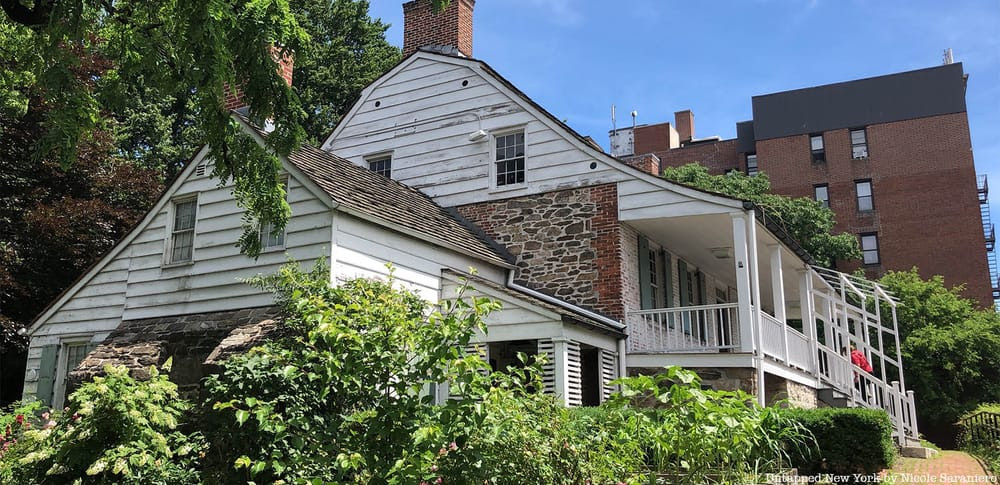
The Dyckman Farmhouse is Manhattan’s oldest remaining farmhouse, built around 1785 in the Dutch Colonial style. The home is situated in a small park in Inwood on the corner of Broadway and 204th Street, and today it serves as a New York City Landmark and a National Historic Landmark. William Dyckman, who constructed the home, died just three years after constructing the farmhouse, yet his son Jacobus would later inherit the house along with his wife Hannah, his eleven children, and a number of slaves and free blacks. Today, Inwood is home to a forgotten slave cemetery believed to have the remains of a number of the Dyckman family’s slaves.
As part of the DyckmanDISCOVERED initiative, the museum has investigated the stories of those enslaved by the Dyckman family. In 1820, a free black woman, a free black boy, and an enslaved man inhabited the home, and it is estimated that seven or eight slaves lived in the house when it opened. It was believed that freed blacks and enslaved workers would have used the house’s Summer Kitchen, a small one-and-a-half-story building adjacent to the farmhouse. A free black woman named Hannah worked as a cook for the Dyckmans and was born between 1784 and 1794. Although it was believed that the home housed a number of enslaved workers, the only one fully identified was Francis Cudjoe, who was set free in 1809. An official document stated:
“Recorded for and at the request of Francis Cudjoe this 11th day of January 1809. Know all men by these present that I Jacobus Dyckman of the City of New York on consideration of motive of humanity and sum of one dollar to me in hand paid Do hereby manumit and set free a Black man named Francis Cudjoe aged about Forty years. In witness whereof I have hereunto subscribed had my name and affixed my seal this eleventh day of January Anno Dominis one thousand eight hundred and nine. Jacobus Dyckman, Witness Peter.”
Seneca Village in present-day Central Park
Seneca Village was a settlement in the 19th-century in present-day Central Park, founded in 1825 by free blacks. With a population of around 250 residents at its peak, the village featured three churches, a school, and two cemeteries. Bounded by 82nd and 89th Streets, Seneca Village would exist for over three decades before villagers were ordered to leave due to the construction of Central Park.
A white farmer named John Whitehead bought the land in 1824 and sold three lots of it to an African American man named Andrew Williams and twelve lots to the AME Zion Church. After the outlawing of slavery, many African Americans began to move into the village from downtown. A number of Irish immigrants fleeing the Potato Famine also settled in the village. Most of the homes were well-constructed, two-story buildings, the Central Park Conservancy tells us, rather than shanties which were in the minority of the buildings. Workers typically were employed in construction and food service, with many women working as domestic servants. The African Union Church in Seneca Village was one of the city’s first black schools, named Colored School 3.
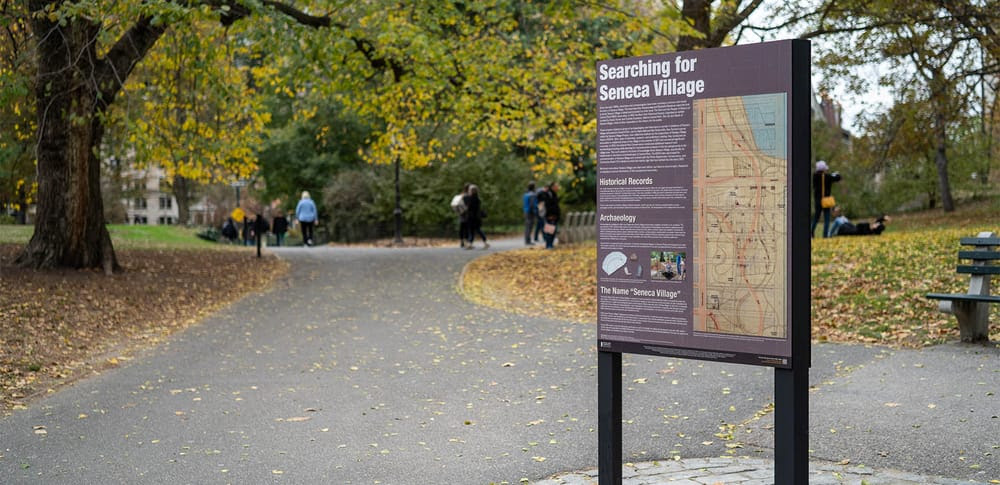
The Seneca Village Project, founded in 1998, was created to raise awareness of the settlement’s history as a middle-class, free black community. Today, a plaque commemorates the site where Seneca Village once stood. There have also been recent archaeological excavations to uncover traces of Seneca Village, and in 2011, researchers discovered foundation walls of the home of William Godfrey Wilson, who was a sexton for All Angels’ Church in the village. 250 bags were filled with artifacts during the digs, including the leather sole of a child’s shoe. Central Park recently celebrated the history of Seneca Village through new historic signage as well as free tours during Black History Month, of which Untapped New York partnered with the Conservancy to offer a special tour to our Insiders members.
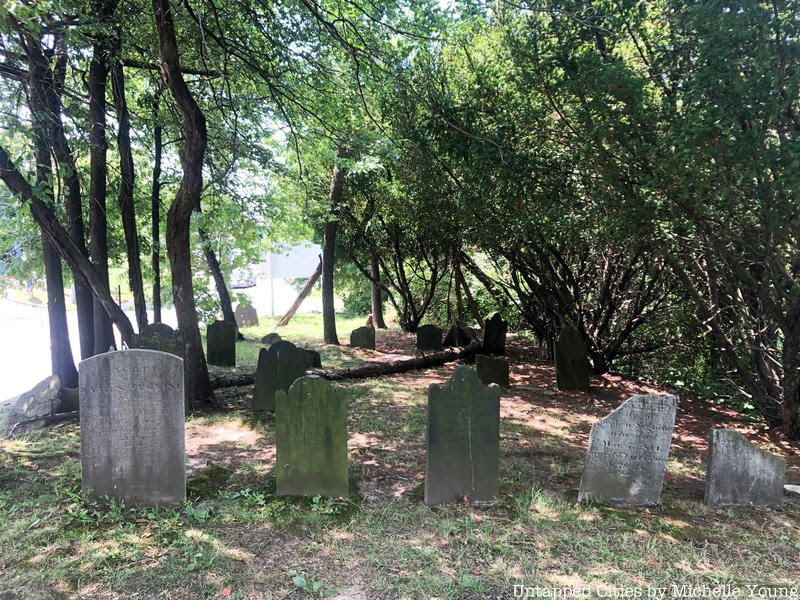
Blazing Star Cemetery is in Rossville, Staten Island nearby the Sandy Ground community
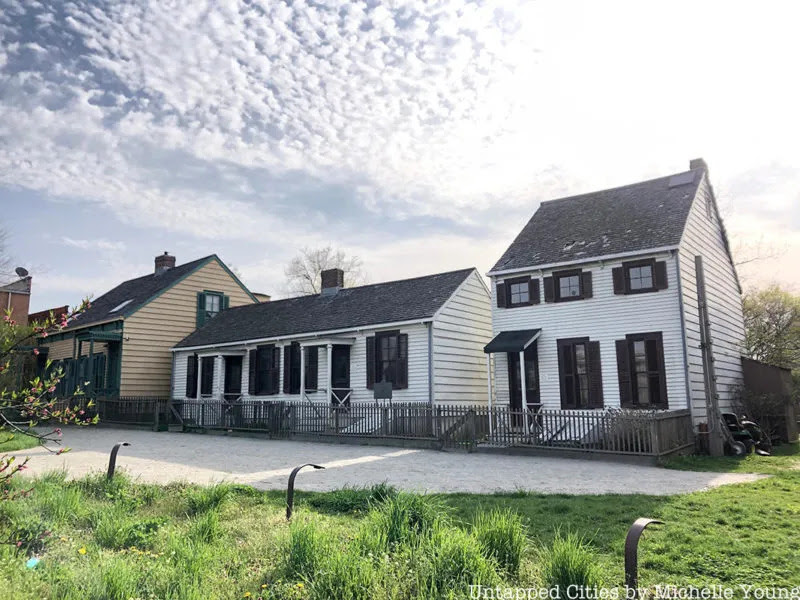
Sandy Ground was a community in Rossville, Staten Island, that was founded by free African Americans around the year 1828. Only a few months after slavery was abolished in New York City, an African American man named Captain John Jackson purchased land in the area, and the area quickly became a center of oyster trade. Many settlers would harvest and sell oysters at the nearby Prince’s Bay.
Sandy Ground was also an important stop on the Underground Railroad, and the settlement is currently considered one of the oldest continuously settled free black communities in the U.S. A church, a cemetery, and three homes from the settlement are today designated as New York City landmarks, yet most of the original houses were destroyed in a 1963 fire. Today, the Sandy Ground Historical Museum is home to the largest collection of documents detailing Staten Island’s African-American culture, history, and freedom.
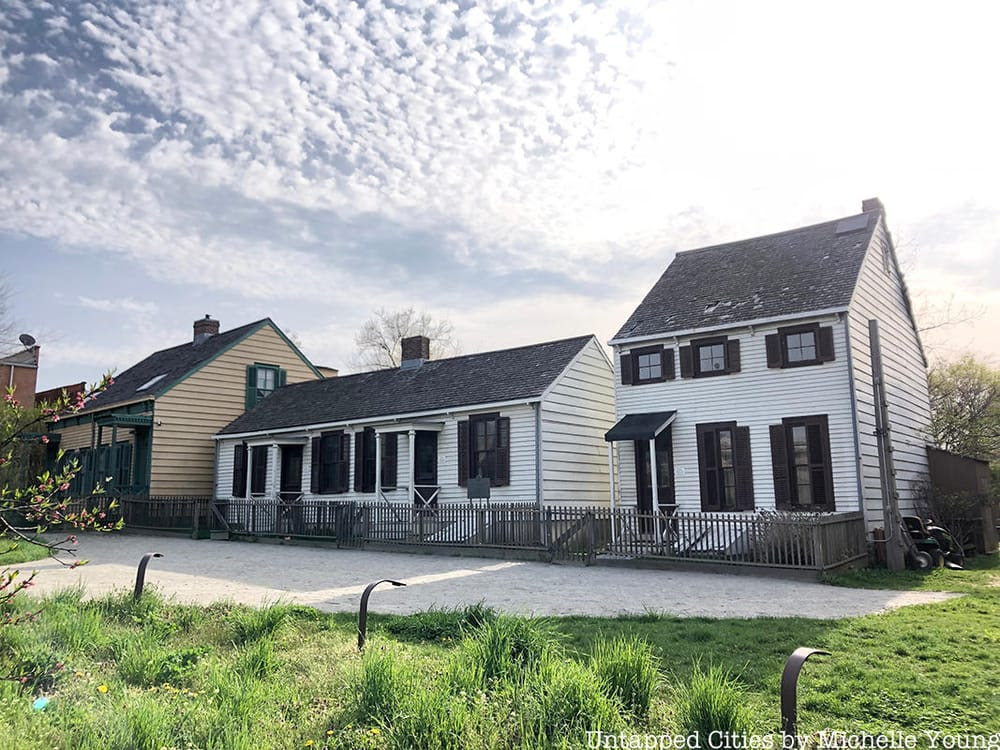
Historic Weeksville in Brooklyn
Like Seneca Village, Weeksville was a neighborhood that was founded by free African Americans, situated in modern-day Crown Heights, Brooklyn. Weeksville was founded in 1838 by James Weeks, an African-American longshoreman who bought land from Henry C. Thompson, a free African American land investor. The land was previously owned by an heir of John Lefferts, a member of the U.S. House of Representatives.
By the 1850s, Weeksville’s population had surpassed that of Seneca Village, with upwards of 500 residents from across the East Coast, with over a third of residents born in the south. Weeksville was home to two churches, a school (Colored School No. 2), and a cemetery, as well as the Howard Colored Orphan Asylum. Weeksville also had one of the first African-American newspapers called the Freedman’s Torchlight and served as headquarters of the African Civilization Society. Additionally, the area was a refuge for many African Americans who left Manhattan during the 1863 Draft Riots. Four historic houses dating back to the time of the village collectively make up the Hunterfly Road Houses, listed on the NRHP in 1972. The discovery of these houses led to the creation of the Weeksville Heritage Centerdedicated to the preservation of Weeksville.
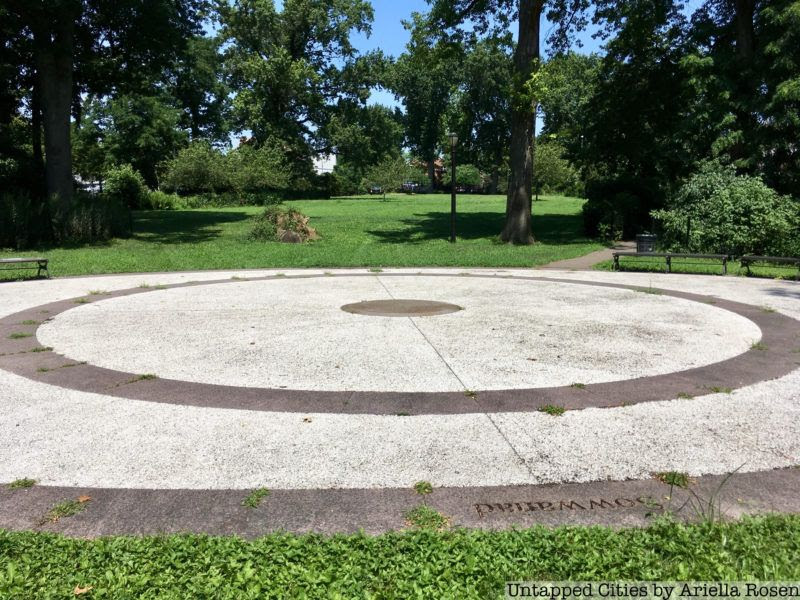
A memorial in The Olde Towne of Flushing Burial Ground honoring the dead who are buried there.
The Olde Towne of Flushing Burial Ground is a small burial ground alternatively known as the “Colored Cemetery of Flushing.” A large circular monument notes the burial of 500 to 1,000 people, primarily African Americans, Native Americans, and victims of four major epidemics of cholera and smallpox in the mid-1800s. Acquired by the town of Flushing in 1840 from the Bowne family, the burial ground contains the bodies of slaves and servants of the Flushing elite, as well as members of the African Methodist Episcopal Church. Death certificates issued in the 1880s confirm that more than half of the buried were children under the age of five. About 62 percent of the buried were African American or Native American.
In 1936, Parks Commissioner Robert Moses decided to build a modern playground on the site of the burial ground. Local activist Mandingo Tshaka halted plans of renovating the cemetery to preserve its history. The Queens Department of Parks commissioned a $50,000 archaeological study in 1996 of the burial ground. In 2004, $2.67 million was allocated to this site, leading to the creation of a historic wall engraved with the names from the only four headstones remaining in 1919.
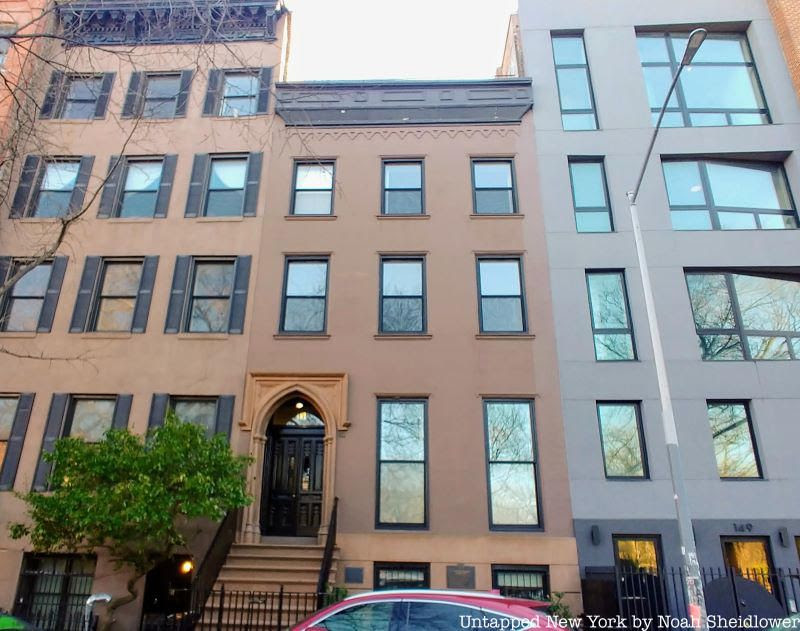
The Charlie Parker Residence at 151 Avenue B is a Gothic Revival-style rowhouse that served as the home of the legendary saxophonist from 1950 to 1954. Built in 1849, the rowhouse stands four stories tall and faces Tompkins Square Park. Parker lived on the ground floor with his wife Chan Richardson and their three children. By the time he moved, Parker had achieved great fame for helping to develop bebop with Dizzy Gillespie and for releasing standards such as “Ornithology” and “Yardbird Suite.”
He continued performing with jazz groups large and small while living at the home, releasing the album Bird and Diz in 1952. He notably performed at Massey Hall in Toronto in 1953 with jazz greats including Charles Mingus and Max Roach, resulting in the album Jazz at Massey Hall. Though, not all was smooth sailing at the rowhouse; he continued using heroin, and his health started to deteriorate. He spent time in a mental hospital after the death of his daughter in 1954 from cystic fibrosis and pneumonia. Parker died in 1954. In 1992, Avenue B between 7th and 10th Streets was renamed Charlie Parker Place. The Charlie Parker Jazz Festival is held annually at Tompkins Square Park.
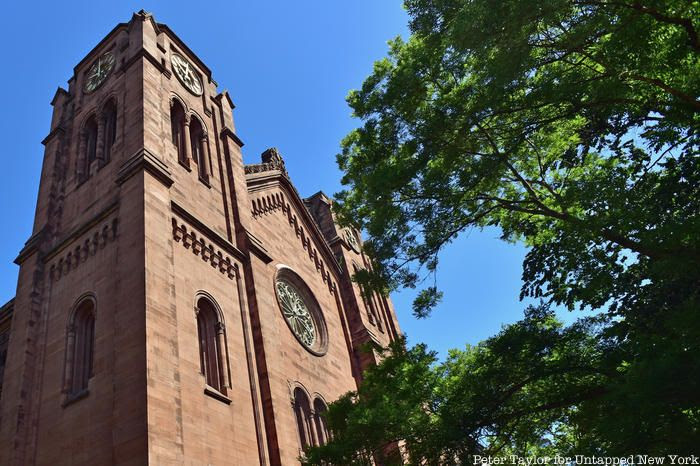
St. George’s Episcopal Church, a National Historic Landmark, is located in Stuyvesant Square and is designed in the Early Romanesque Revival style. The original church was located near Trinity Church from 1752, and this new church was constructed from 1846-1856 by Charles Otto Blesch and Leopold Eidlitz, the latter of whom worked on the New York State Capitol Building.
Although not a predominantly African-American church, St. George’s is perhaps best known for having among its congregants Harry Thacker Burleigh, a Black composer and baritone. He was one of the first African-American composers to incorporate spirituals into much of his music. He was accepted to the National Conservatory of Music in New York and was known for his compositions like his versions of the spiritual “Deep River” and songs like “Little Mother of Mine.” Burleigh was hired as a soloist at St. George’s, at the time an all-white church, and the deciding vote in this decision was made by J.P. Morgan. Burleigh would go on to teach composer Antonín Dvořák “Negro melodies” and Native American music, which Dvořák would later incorporate into his famous Symphony From the New World and his American String Quartet.
Langston Hughes House
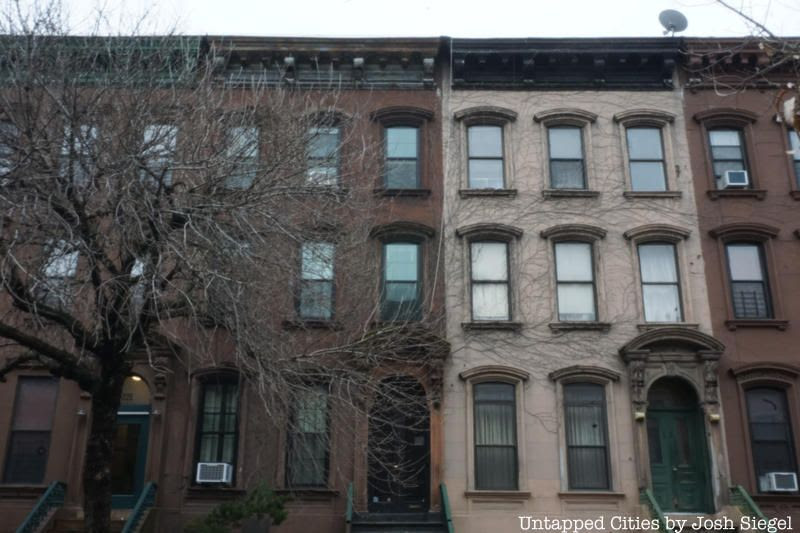
The Langston Hughes House on East 127th Street in Harlem was the home of Harlem Renaissance poet Langston Hughes where he wrote works like “Montage of a Dream Deferred” and “I Wonder as I Wander.” Built in the Italianate style in 1869, the house is a three-story building added to the NRHP in 1982.
Hughes used the top floor as his workroom for the last 20 years of his life. In 2019, the home received a National Trust for Historic Preservation grant, and today this home is the base of the I, Too, Arts Collective nonprofit, which preserves Hughes’s legacy and supports emerging underrepresented artists.
Lewis Latimer House
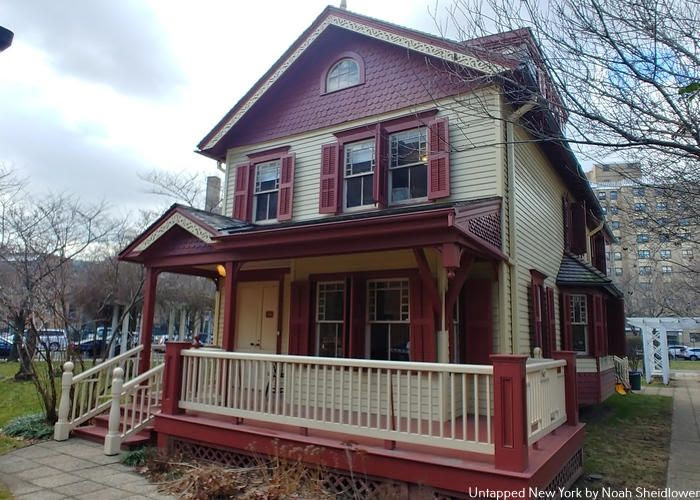
The Lewis Latimer House in Flushing, a red and white Victorian home, honors Lewis Howard Latimer, an African-American inventor and humanist born to fugitive slaves who lived in the home from 1903 until his death in 1928. Latimer was one of the founders of the Unitarian Universalist Congregation in Queens, and he was known for his work with figures like Hiram S. Maxim, Thomas Edison and Alexander Graham Bell. The red and white house, which dates back to around 1889, contains a museum dedicated to Latimer’s work and the achievements of other black scientists.
George Latimer, his father, escaped from Virginia to Boston before his subsequent capture and imprisonment. Abolitionists like Frederick Douglass strove to grant George freedom through a publication called “The Latimer Journal, and the North Star.” Growing up in the Antebellum period, Lewis Latimer joined the Union Navy in 1864 and later became an expert draftsman while working at a patent law office. After learning about physics and engineering, Latimer would work with Edison, under whom he invented and patented the carbon filament, which improved the production of the incandescent lightbulb. He also authored “Incandescent Lighting,” the foundation for modern electrical engineering theory. He would also go on to draft drawings for Bell’s invention of the telephone.
CREDITS
UNTAPPED NEW YORK
PHOTO OF THE DAY
A NEW WAY TO FIND 900 MAIN STREET Many Coler residents and visitors have been misdirected by APPsthat lead them to the back of Coler instead of the Main Entrance at 900 Main Street.. While the APPs are being modified, new clear signage is being posted at the north end. THANKS TO COLER ADMINSTATION AND NYC H+H FOR HELPING SOLVE THIS.
All image are copyrighted (c) Roosevelt Island Historical Society unless otherwise indicated THIS PUBLICATION FUNDED BY DISCRETIONARY FUNDS FROM CITY COUNCIL MEMBER JULIE MENIN & ROOSEVELT ISLAND OPERATING CORPORATION PUBLIC PURPOSE FUNDS.
The story of Harlem’s Last remaining Wood Clapboard House, Built at the Dawn of the Gilded Age
EPHEMERAL NEW YORK
FRIDAY, FEBRUARY 27, 2026
ISSUE #1635
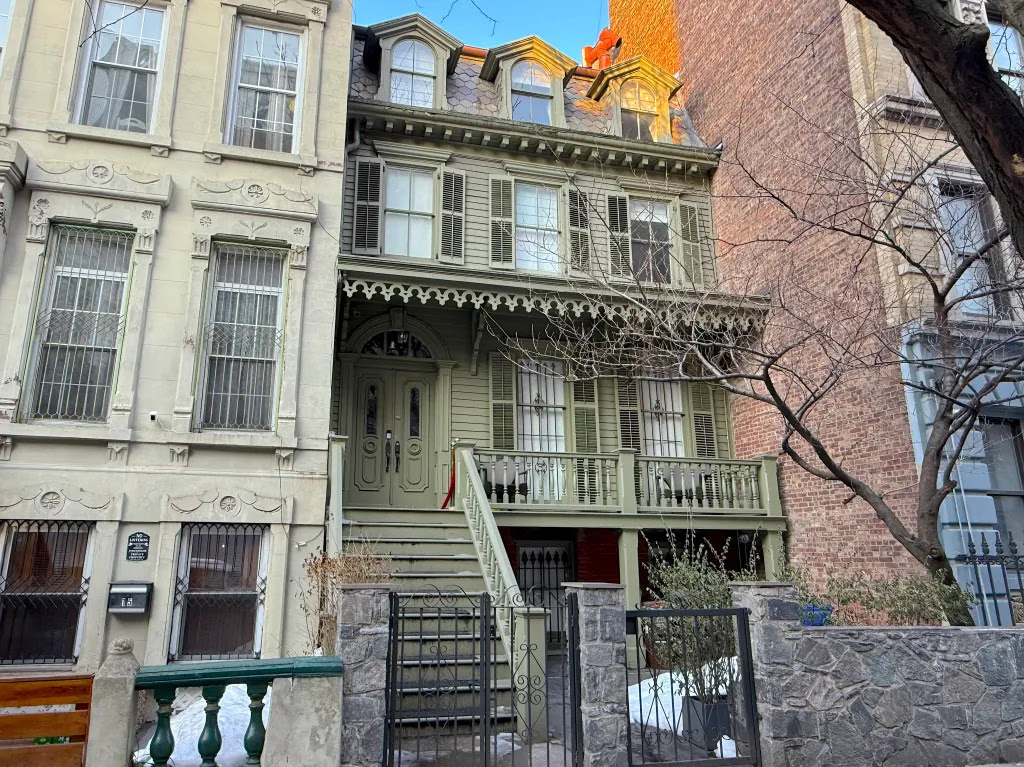
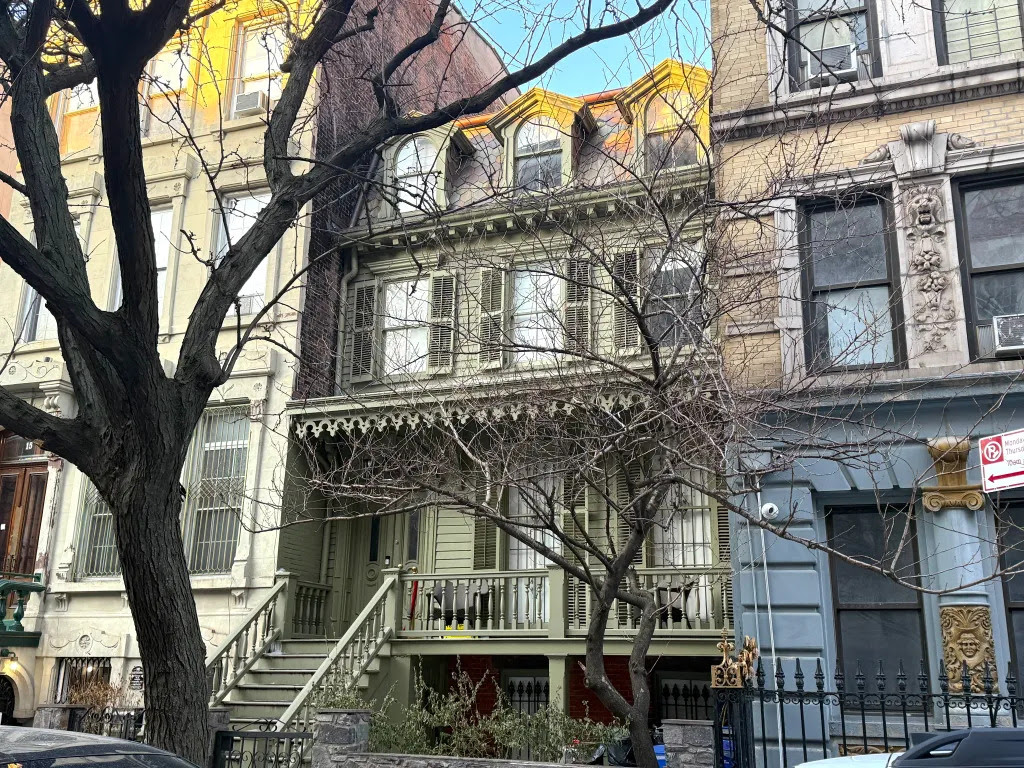
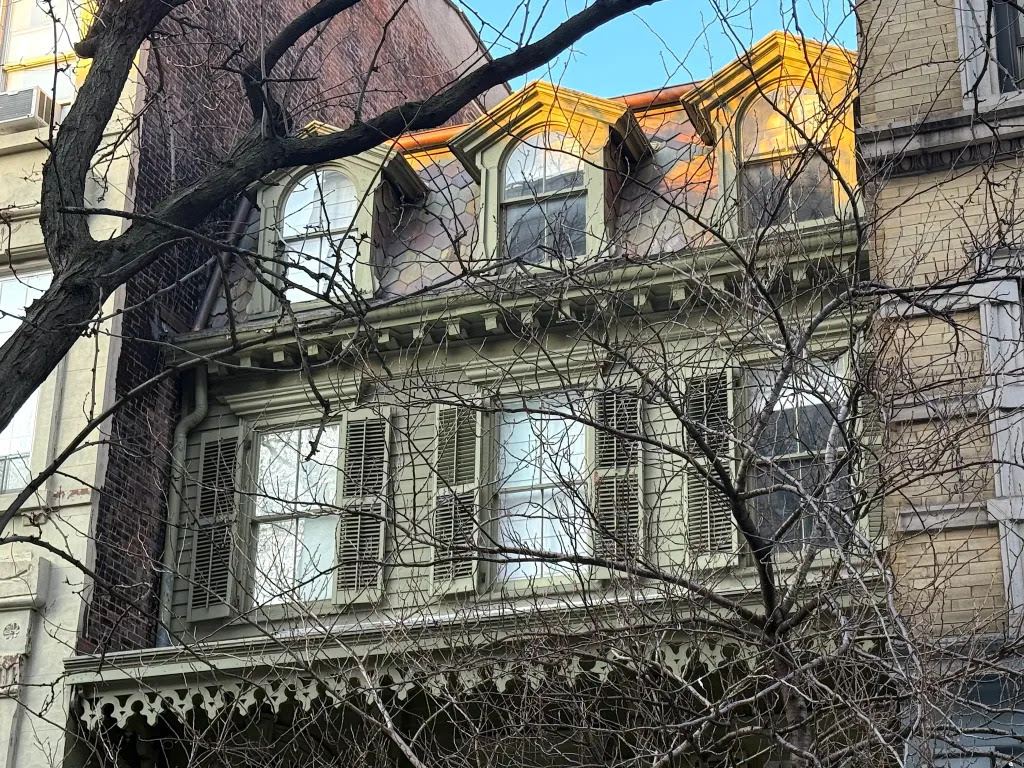
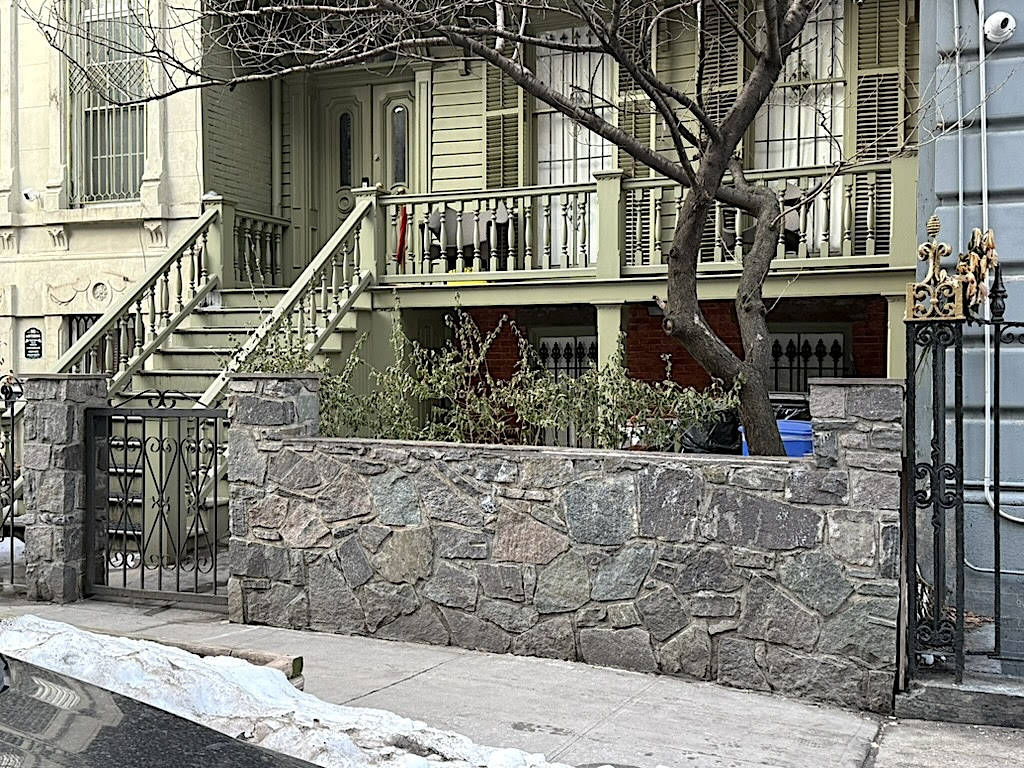
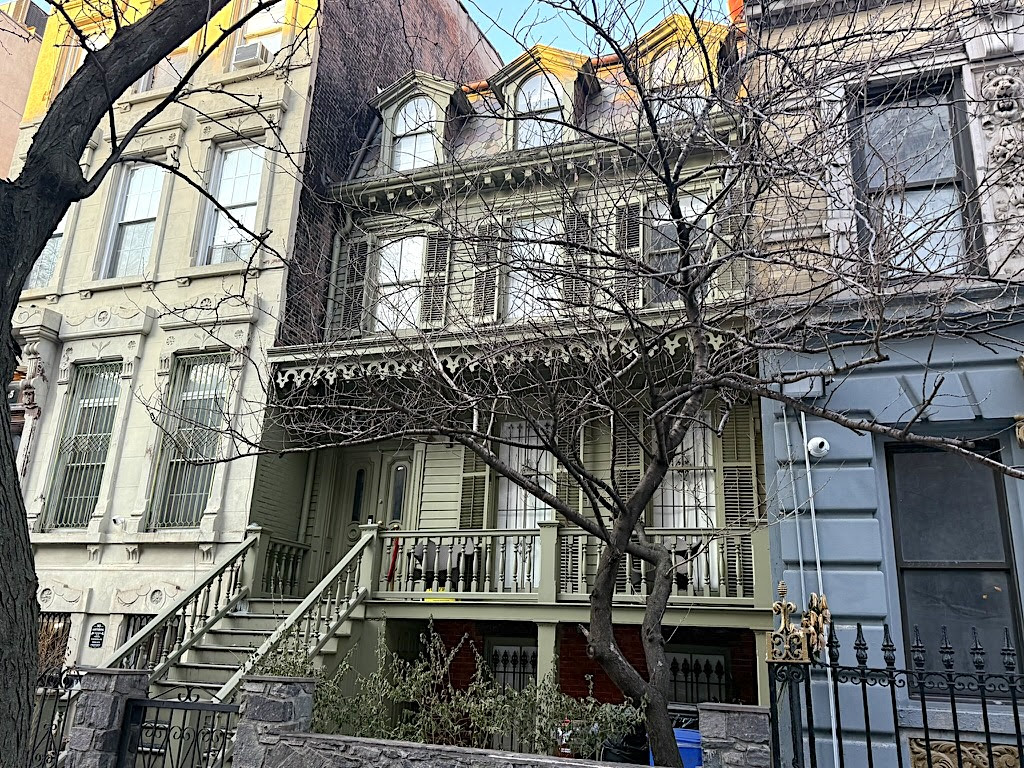
Can you stand another story of a storybook–like wood clapboard holdout? I hope so, because this 3 and a half-floor charmer, at 17 East 128th Street, has a backstory that dovetails with the urbanization of all of Manhattan.
Built toward the end of the Civil War and at the start of the Gilded Age, it’s a totem of Harlem’s transition from isolated farmland to a vital part of Manhattan’s cityscape. It managed to survive more than 160 years more or less intact because in all that time, it’s only had a handful of owners.
Let’s go back to mid-19th century Harlem. Mostly rural with well-spaced estate homes, farmhouses, and shantytowns, the area was cut off from the main city thanks to unreliable roads, plus spotty train and streetcar service.
Harlem’s population at that time numbered just 1,500, according to the Landmarks Preservation Commission (LPC) report on 17 East 128th Street. By contrast, Manhattan as a whole had more than half a million residents.
But 200 years of farming hurt the quality of the soil, and during the 1860s, the city’s population swelled. Developers began eyeing Harlem for its potential as a fine new residential area, especially with the impending arrival of elevated trains, which could whisk residents downtown and back.
Enter a real-estate investor named Abraham Overhiser. Owner of the lot at 17 East 128th Street, he sold it to another investor for $2,200, and in turn in 1864 that investor sold it to a James Beach for $5,900—which gives you an idea of how hot land in Harlem was toward the end of the Civil War.
The house probably went up in 1864 or 1865. The exact builder isn’t known, but “the design of the structure, its detailing, and the type of building materials used in its construction indicate that the house at 17 East 128th Street had to have been built at roughly this time,” states the LPC report.
The architectural design was the fanciful French Second Empire with Italianate touches, both popular residential styles at the time. As for the choice of wood, it had not yet been banned in Harlem as a building material in Manhattan (due to its penchant to go up in flames). That wouldn’t happen until 1882.
James Beach stayed in the house until 1874, watching before his eyes the transformation of this part of Harlem into an enclave of fine brownstones, row houses, and churches. That year, he sold it to a Hannah Van Reed for $11,000. Van Reed and her husband shared the house for 12 years.
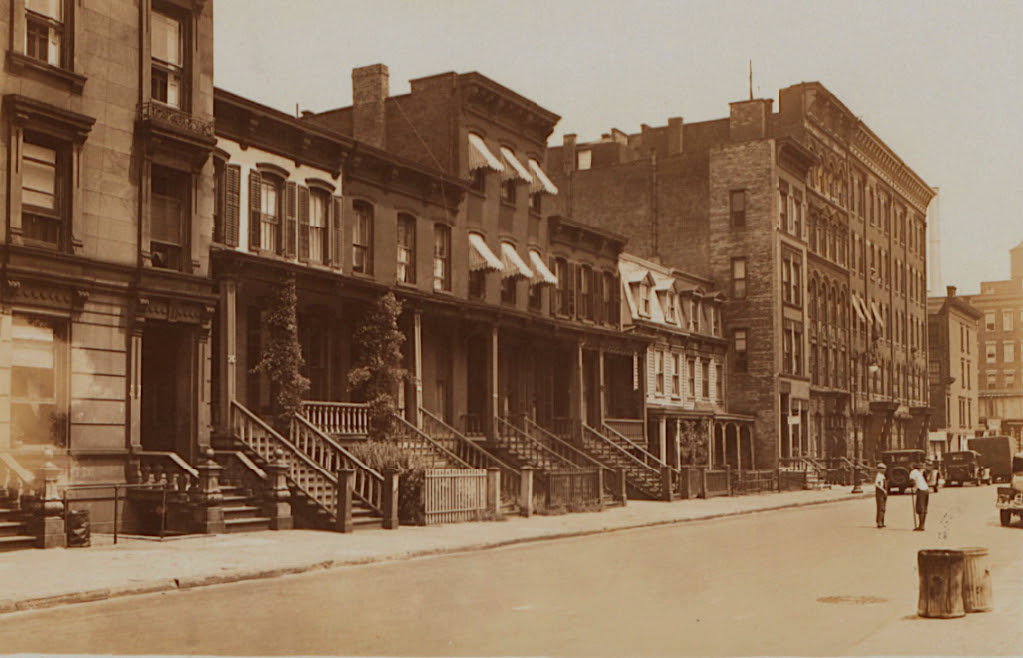
(Below, similar houses with front porches on East 128th Street between Park and Madison Avenues, 1932
In 1886, Viola H. Banning purchased the house, now surrounded by lovely residential blocks and just three streets away from the shopping, theaters, and services on bustling 125th Street. Banning lived in the house with her lawyer husband, Hubert A. Banning, who worked on Nassau Street downtown.
Sadly, Viola lost her husband on an elevated train platform in 1916. The Sun ran a small new item on June 5 of that year stating that a man’s body was found on the northbound platform at 66th Street. “Banning was on his way home when he dropped dead,” a reporter tersely wrote, misidentifying him as Herbert, not Hubert.
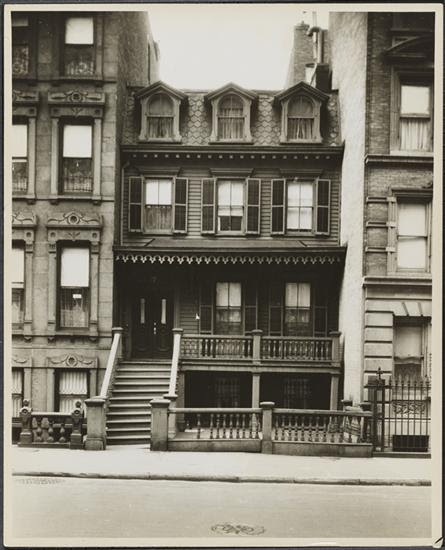
Viola continued to live in the house, passing it on to her son and daughter-in-law, who put it in a trust. After Viola’s death in the late 1920s, a trustee named Palmer Brooks sold the house for $12,000 to Margaret Lane, who seven years later sold the house for $1 to Louis and May Seeley. (Third image: the house in 1932)
The $1 sale “suggests some arrangement between Lane and the Seeleys,” states the LPC report. “Indeed, when Seeley, at the age of 90, sold the property in 1979, he told the buyer that he had inherited the property from his nanny. Evidently Margaret Lane was his nanny.”
At the time the LPC report was completed in 1982, it notes the current resident of the house as Carolyn Adams. Raised in Harlem, Adams joined the Paul Taylor Dance Company as a dancer and is described as being involved in numerous performance, preservation, and community events in the neighborhood.
A new owner appears to have purchased the house in 2015, completely updating the interior while maintaining its Second Empire and Italianate details. That includes the slate mansard roof, wood clapboard facade, and “gingerbread pendants” over the porch, which is in its original place—as are all the windows and the main entrance, notes the LPC report.
The details about the renovation in 2015 come from a sales listing, which seems to be active. The link to the listing includes dozens of gorgeous exterior and inside photos of this Civil War–era survivor, including the curvy banister and small backyard.
The listing price for 17 East 128th Street, still a one-family residence, isn’t so bad at $2.95 million. But it’s quite a lot higher than the $2,200 it went for in a very different version of Harlem in 1864.
All image are copyrighted (c) Roosevelt Island Historical Society unless otherwise indicated THIS PUBLICATION FUNDED BY DISCRETIONARY FUNDS FROM CITY COUNCIL MEMBER JULIE MENIN & ROOSEVELT ISLAND OPERATING CORPORATION PUBLIC PURPOSE FUNDS.
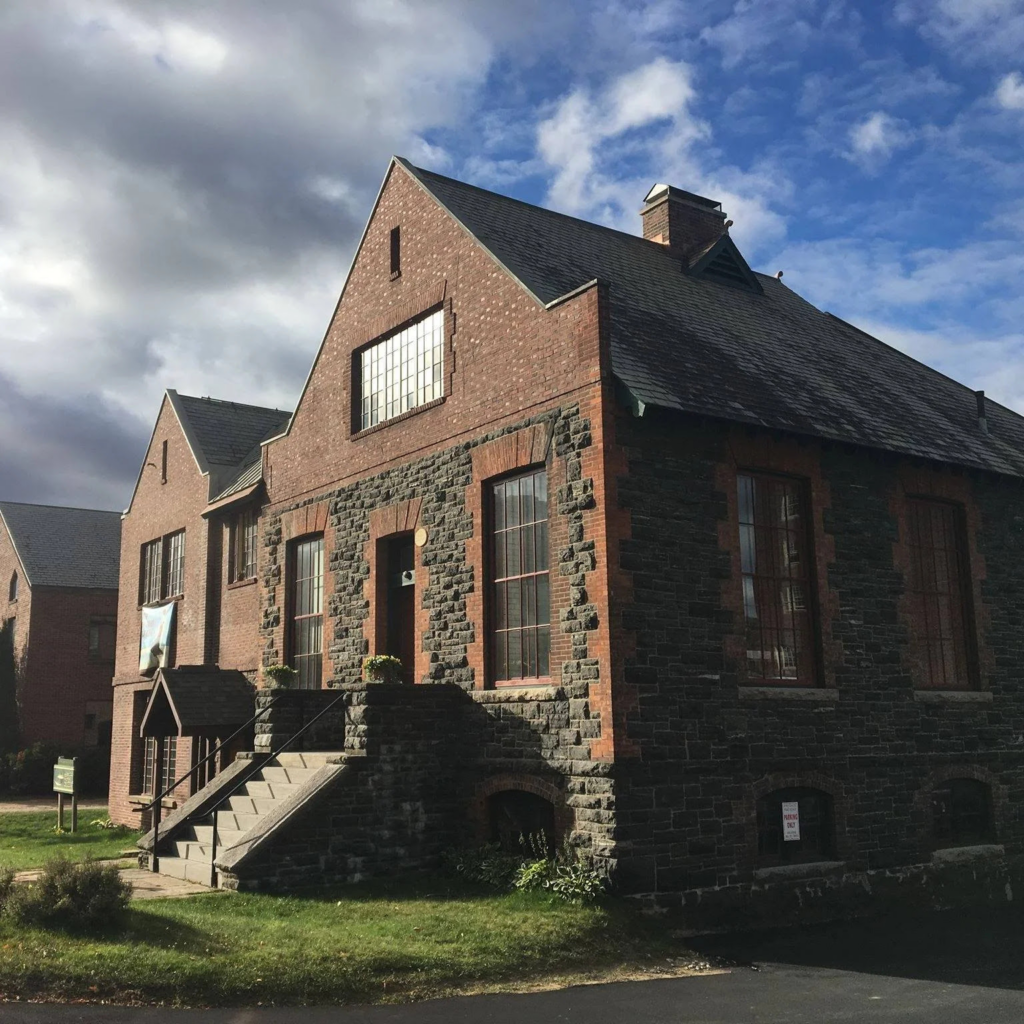
Edward Livingston Trudeau was born in 1848 in New York City to a family of physicians. During his late teens, his elder brother James contracted tuberculosis (TB) and Edward nursed him until his death three months later. At twenty, he enrolled in the College of Physicians and Surgeons at Columbia College (now Columbia University), completing his medical training in 1871. Two years later, he was diagnosed with TB too.
Following current climate-therapeutic theories that promoted the relocation of patients to regions with atmospheric conditions favorable to recuperation, he moved to the Adirondack Mountains. Seeking as much open air as he possible could, almost continuously living outside, he subsequently regained his health. In 1876 he settled in Saranac Lake and established a small medical practice. It was the beginning of a remarkable career and a new chapter in American medical history.
Industrialisation & Disease
The Industrial Revolution marked a turning point in our relationship with the environment. New production systems delivered more goods for consumption, but in the process natural resources were exploited, poisonous fumes emitted, water and soil polluted. Burning coal produced an “ink-sea of vapor, black, thick, and multifarious as Spartan broth” (Thomas Carlyle).
City streets were covered with grease, the sky smeared with soot. Factory chimneys blocked out natural light. A dramatic rise in population exacerbated the effects of contamination. Urban life became unbearable. For most city dwellers physical nature was mere memory. Slag-heaps were a more ‘normal’ landscape than shrubs and bushes. Those who could carry the cost of escape fled to the suburbs.
Disease accounted for many deaths in industrial cities. The poor lived in cramped homes and worked in dirty factories. Children developed rickets and bone deformities. With a chronic lack of hygiene or sanitary care, no clean water, and no knowledge as to what caused diseases, epidemics such as cholera, typhoid, and typhus could be devastating.
Known as phthisis and consumption from Hippocrates through to the nineteenth century, the term tuberculosis was introduced in 1834 by the German physician Johann Lukas Schönlein. For considerable time, the widely accepted miasma theory had suggested that epidemics were caused by noxious “bad air” emanating from rotting organic matter. Eventually, medical science realized that invisible micro-organisms were the source of contagion by which germs could jump from person to person in crowded cities.
The epidemic wasting disease of TB became associated with the process industrialization which had forced a poorly nourished working class to live in drafty and damp dwellings. Between 1810 and 1815, the disease accounted for more than twenty-five percent of deaths in New York City. In 1900, it was still the country’s most common killer. Fear of the “graveyard cough” is reflected in such names as “white death” or “great white plague” (white referring to the anemic paleness of those affected).
From the mid-nineteenth century to the mid-twentieth century specialist sanatoria were designed to isolate and protect well-heeled patients. Physicians advocated the jour médical, a regime of treatment that required a lengthy residence at a clinic. During the 1860s the twin villages of Davos Dorf and Davos Platz became a destination for European patients as the valley’s micro-climate was recommended for lung sufferers.
Pure Air & Heliotherapy
In 1863, German physician Hermann Brehmer founded his Heilanstalt für Lungenkranke in Göbersdorf, a “healing” village in Silesia’s Sudeten Mountains. Patients suffering from TB were promised a recuperation course with the aid of alpine air, nutritious food, crisp walks, and icy waterfall showers (Walddusche).
Brehmer’s encouragement of heliotherapy was a medical reversal. In the millennia preceding the industrial revolution, pallor was popular within the ruling classes, hinting at a noble life of leisure spent indoors. Whiteners to create a pale skin were widely used. Dark skin was associated with servitude and suggested toiling on the land. Industrialism halted the bourgeois preference for paleness. Physicians insisted that exposure to the sun would cure vitamin-deficiency diseases and enhance public well-being. Sunlight was thought to destroy the tubercle bacilli.
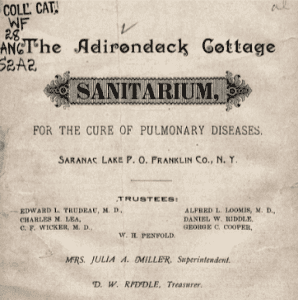
In 1882, Trudeau took notice of Hermann Brehmer’s ground-breaking methods in treating TB. Following the German example he founded the Adirondack Cottage Sanatorium in February 1885. The first patients were two sisters who had been factory workers in New York City. They were treated in a one-room cottage named “Little Red.”
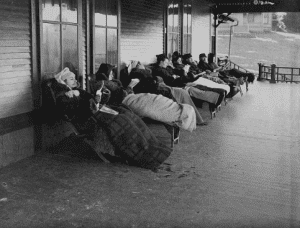
In February 1897 Trudeau published an essay on “Sanitaria for the Treatment of Incipient Tuberculosis” in the New York Medical Journal in which he stressed the invigorating influence of a life spent out of doors. Being exposed to the severity of atmospheric conditions in the Adirondacks proved to be the best stimulant to the patient’s assimilative powers. The combination of pure air, hygiene, unspoiled nature, nutritious food, moderate physical exercise, and a routine of complete rest equaled health and well-being.
Trudeau insisted that a sanatorium should consist of a set of pavilions connected by galleries and constructed in a manner that each ward could be kept dust free. Ventilation and an abundance of sunlight were vital. In order to achieve this, he developed a cottage plan. The Adirondack Sanatorium cottages were one-story buildings with a capacity for four or five. Each patient had his/her own room which opened into a central sitting area with a veranda (the ubiquitous Saranac Lake “cure porch”) on which outdoor treatment was carried out. The library, recreation pavilion, chapel, and infirmary were all separate buildings.
If, Trudeau insisted, the same principle could be applied to the tenement house residents of New York, it would be a practical step in the direction of curtailing the ravages of TB. The medical world challenged architects to play their part in battling disease.
Treatment & Architecture
Modernism introduced an acute social awareness in architecture and design. Health and hygiene became principle criteria. The emphasis on improved social housing coincided with the exploration of new building materials and technologies. Le Corbusier expounded his radical ideas on building and planning in Urbanisme (1924). In Germany, experimental houses were built for the influential “Weissenhof Seidlung” exhibition in Stuttgart (curated by Mies van der Rohe). With an emphasis on air, light and hygiene, architects re-defined their ideas about urban housing. Flat roofs, balconies, and terraces became fundamental parts of design. The color of modernism was white.
The search for treatment of TB influenced the development of architectural thinking. In the 1930s new sanatoria were being constructed throughout Europe. They were designed with the dictum Licht und Luft (light and air) in mind. Between 1932 and 1940, high in the Alps of Northern Italy, the biggest sanatorium in Europe (Eugenio Morelli Hospital) was built in Sondalo. Known as “Sanatorium City,” it contained 3,500 beds, a post office, shops, and a cinema. The hospital was immortalized in Vittorio De Sica’s film Una breve vacanza.
Away from Alpine areas, sanatoria were located in wooded environments. In 1931 Dutch architect Jan Duiker built the Zonnestraal (sunbeam) sanatorium at Hilversum. A classic example of heliotherapeutic architecture, the building was designed in an airy manner using transparent materials. Open and glazed interior spaces were painted in pale blue and cream to exclude gloomy northern lights. Its flat roofs, terraces, verandas, and covered corridors, the sanatorium expressed both modernism’s ideal of rational functionality and adhered to the demands of medical treatment.
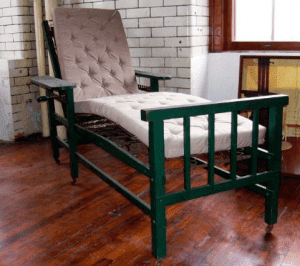
TB also inspired new furniture. Reclining “cure chairs” were part of a sanatorium’s outfit. The original design came from Peter Dettweiler who was a patient of Hermann Brehmer. In the early twentieth century, chaises-lounges in wood or chrome were designed by architects such as Alvar Aalto, Marcel Breuer, and Le Corbusier. Modernism promoted a therapeutic lifestyle in pursuit of health and hygiene. Dettweiler’s chair was taken as a model for the Adirondack Recliner, produced by George Starks at the Adirondack Hardware building at 28 Broadway in downtown Saranac Lake.
TB & Creativity
Over history, some diseases have been regarded as a badge of genius. In the eighteenth century gout had “patrician” pretensions. Voltaire, Smollett, Cowper, Fielding, and Joseph Banks were victims. These men represented Europe’s spiritual aristocracy.
TB was the Romantic’s illness. Sufferers of consumption took on the appearance of a pale and melancholic spirit. The disease was “celebrated” in the poetry of John Keats (who died of TB in 1821), Shelley and Byron. Chopin’s death from TB cemented its reputation as an affliction of artists. As consumptives wasted away physically, they gained spiritual resources. In the mythology of the disease, TB was an ailment of passion and “inward burning.”
The later nineteenth century was obsessed with medicine, both literally and metaphorically. Émile Zola defined his task as a novelist in surgical terms, using his pen as scalpel. At the age of twelve, William Ernest Henley was diagnosed with TB of the bone, which led to the amputation of his left leg below the knee. In 1873, his other leg was affected, but thanks to a new antiseptic surgical method, it was saved. Henley stayed almost two years in hospital. A collection of twenty-eight ‘In Hospital’ poems was included in his debut Book of Verses (1888).
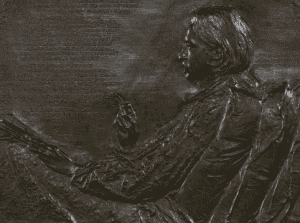
An early biographer of Robert Louis Stevenson argued that TB had enhanced the author’s talent. A sculptural relief by Dublin-born Augustus Saint-Gaudens (Irish mother; French father), depicts the novelist during a stay in New York City in 1887/8. The writer is portrayed with long hair, cigarette in hand, looking sharp and alert, despite being propped up by a stack of pillows in bed. Stephenson spent time in Davos as a patient. Illness enforced his creative presence.
End of an Era
After its founder’s death in 1915, the name Adirondack Cottage Sanatorium was changed to Trudeau Sanatorium. The institution also developed a school for nursing, and later the Trudeau School of Tuberculosis offering instruction courses in the latest treatment methods for the disease.
The first sanatoria were opened to paying patients. Trudeau’s institution also charged them, but at least made an attempt to treat poorer inmates at less than cost by active fund-raising. Many physicians and nurses served without pay. In Boston in 1889, the American Society of Climatology recognized the sanatorium as the best method of cure for TB, particularly for working-class patients. Sanatoria however remained a health haven for those who could afford the phenomenal cost of treatment (patients were held for long periods – from a minimum of six months to seven years or longer).
Before the First World War, the fight against TB was largely carried out by voluntary societies and spontaneous associations. The war brought new epidemics of the disease, forcing a more structured intervention. At last, the state became involved in organizing and planning healthcare and social solutions to the problems connected with the disease. In the end, science would supply the answers. After the discovery of streptomycin and the development of effective antibiotic drugs, the era of sanatoria came to an end. The Trudeau Sanatorium closed in 1954. It ruptured the close association between treatment, recuperation, and architectural design.
CREDITS
NEW YORK ALMANACK JAAP HARSKAMP
PHOTO OF THE DAY
READY FOR SUMMER?
All image are copyrighted (c) Roosevelt Island Historical Society unless otherwise indicated THIS PUBLICATION FUNDED BY DISCRETIONARY FUNDS FROM CITY COUNCIL MEMBER JULIE MENIN & ROOSEVELT ISLAND OPERATING CORPORATION PUBLIC PURPOSE FUNDS.
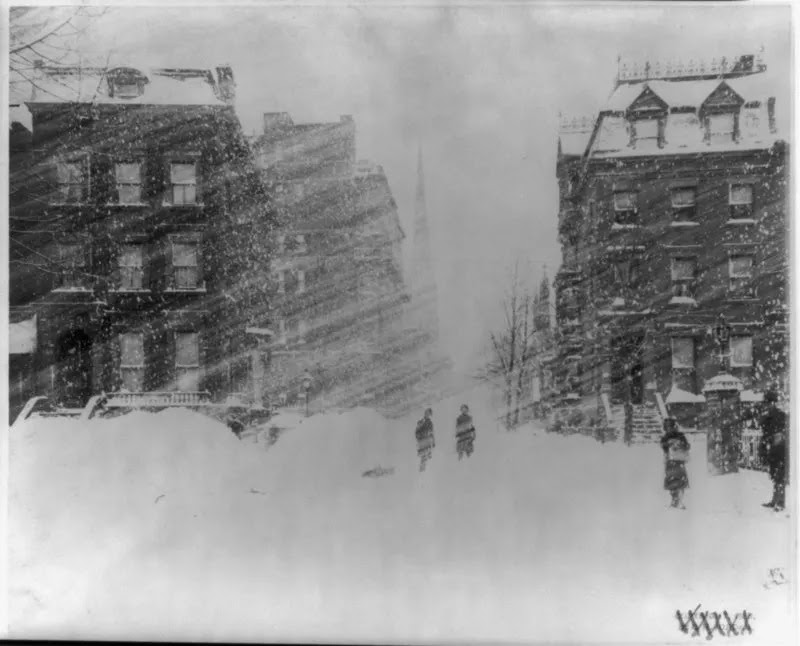
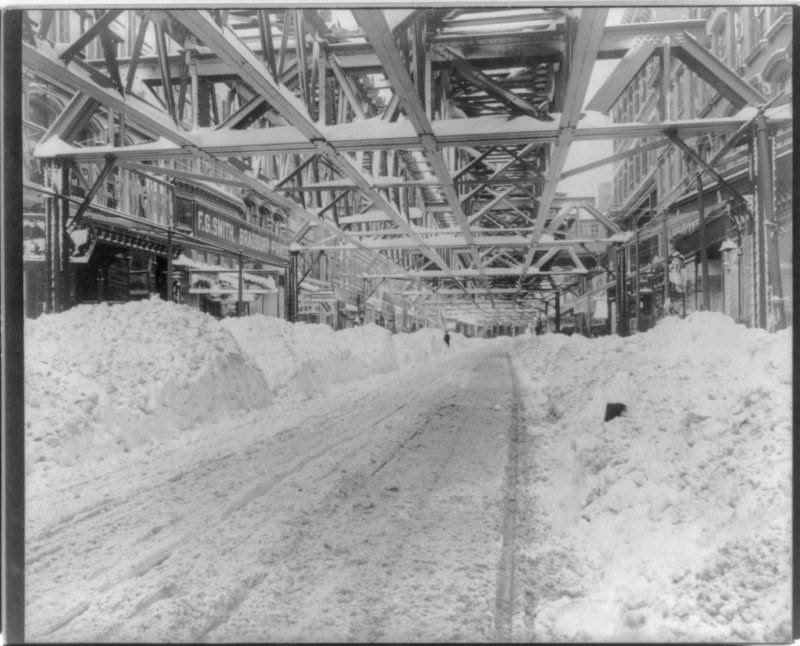
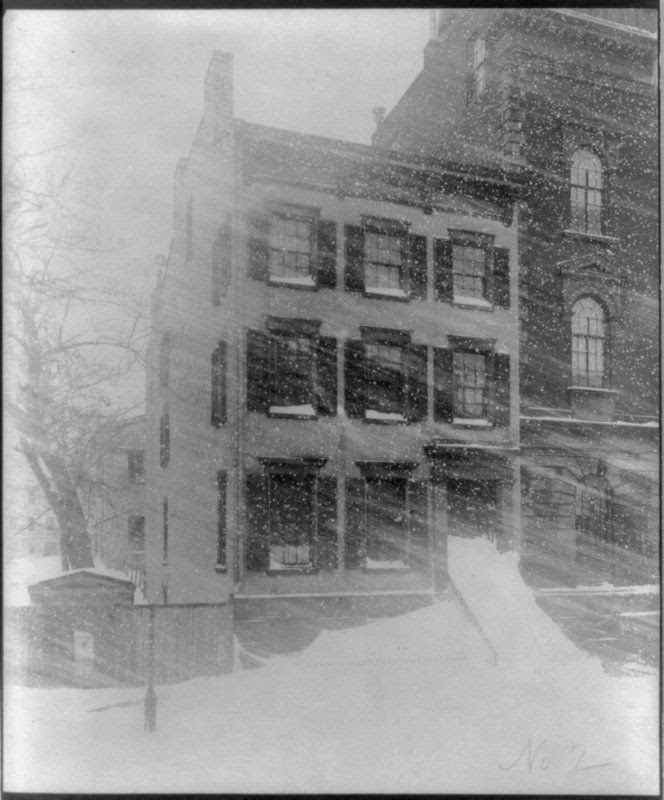
As New York City faces the first blizzard warning issued in nearly a decade, we’re reminded that even as March approaches, we can’t get too excited about spring being just around the corner. From March 11 to March 14, 1888, one of the most intense blizzards in American history buried New York City under mounds of snow and brought the city to a standstill.
When the head of the national Weather Bureau, Elias Dunn, closed up shop at his office on 120 Broadway on Saturday, March 10, nothing seemed out of the ordinary. At the time, the Weather Bureau kept in touch with the Coast Guard through telegraph and carrier pigeons(!), and Sunday’s forecast called for light rain. No one manned the Weather Bureau on Sundays, but following torrential downpours, Dunn decided to check anyway. There were no updates because, it turned out, telegraph lines had frozen up and down the Atlantic Coast.
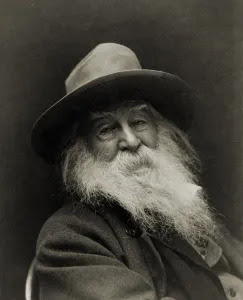
Walt Whitman had just published his new poem, The First Dandelion, about the coming of spring. It ran in the New York Herald the day of the blizzard. Doesn’t Walt Whitman look exactly like Gandalf the Grey? Here’s the poem:
Simple and fresh and fair from winter’s close emerging, As if no artifice of fashion, business, politics, had ever been, Forth from its sunny nook of shelter’d grass— innocent, golden, calm as the dawn, The spring’s first dandelion shows its trustful face
Julian Ralph’s Monday morning account of the blizzard morning is mesmerizing.
The wind howled, whistled, banged, roared and moaned as it rushed along. It fell upon the house sides in fearful gusts, it strained great plate glass windows, rocked the frame houses, pressed against the doors so it was almost too dangerous to open them. It was a visible, substantial wind, so freighted was it with snow. It came in whirls, it descended in layers, it shot along in great blocks, it rose and fell and corkscrewed and zigzagged and played merry havoc with everything it could swing or batter or bang or carry away.At half past ten o’clock, not a dozen stores on Fulton Street had opened for business. Men were making wild efforts to clean the walks, only to see each shoveful of snow blown back upon them and piled against the doors again.
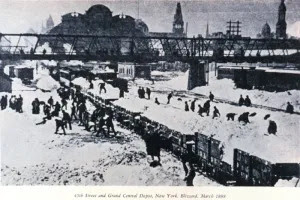
Starting at midnight on March 12, it snowed continuously in New York City for about 36 hours, piling up 20-40 inches of snow. Fierce winds created massive snowdrifts, with some accounts claiming drifts as high as 50 feet, and plenty of photographic evidence showing 15-20 foot drifts that barricaded people inside their homes.
Elevated trains were stranded up and down the tracks. Some passengers escaped to the street via ladders set up by the fire department or enterprising individuals on the ground. One train, stranded above a bar, was successfully able to hoist up buckets of beer to pass the time in revelry. This fiasco gave a major push to underground subway advocates, and work on the subway system commenced a few years later. Much was made of Andrew Cuomo’s decision to shut down the subways during last month’s so-so snowstorm. The entire system had never been shut down before because of snow, and was indeed designed to withstand that exact act of nature.
New York City was overwhelmed by fire and flooding. During and immediately after the blizzard, fire trucks were unable to move, and unchecked fires destroyed buildings all over the city. As the snow started to melt, another set of buildings was irrevocably damaged by flooding. Two hundred New Yorkers died during the blizzard, one of the largest losses of life from any event in city history, and the financial costs were catastrophic.
Among the dead was legendary political power broker Roscoe Conkling. Conkling was a U.S. Senator, wealthy Wall Street lawyer, the political benefactor of President Chester Arthur and facilitator of Gilded Age money and Republican politics. Outraged at price gouging by the cab he hailed in the middle of the snowstorm, he defiantly walked home. Or rather, he tried to, collapsing in the snow and dying two weeks later.
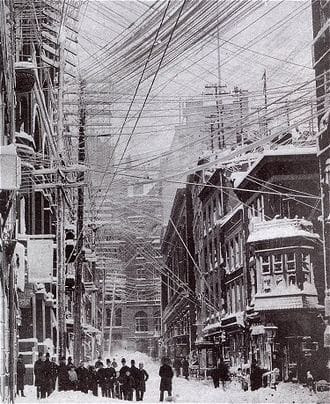
NYC’s pre-blizzard wiring system. Photo from Wikimedia Commons. Photo by Richard Arthur Norton/Public Domain.
One of the biggest hazards in the aftermath of the blizzard was navigating the telegraph and electric wires. The blizzard had brought not only snow, but devastating winds of up to 84 mph, knocking over poles.
In a blistering series of articles recounting the danger and damage afterwards, the New York Times demanded, “that all the electric wires – telegraph, telephone, fire alarms, and illuminating – must be put underground without any delay.” The city took steps to do this, at least in most of Manhattan, and that’s why downtown doesn’t look like the photo on the left.
Even though most of the city was shut down, the nightlife hummed along. Because conditions got too crazy to leave bars by nightfall, a number of them threw wild, all-night parties. P.T. Barnum, proprietor of Madison Square Garden, insisted the show must go on, and handed out champagne to his spare crowd, who eventually got drunk and danced in the circus infield while clowns cheered them on.
Our city infrastructure and ability to detect weather patterns are both vastly improved since 1888, but I wonder if the people are as hardy. Let’s hope blizzard season is over, and that those first dandelions will get to blooming soon.
CREDITS
UNTAPPED NEW YORK JANOS MARTON
All image are copyrighted (c) Roosevelt Island Historical Society unless otherwise indicated THIS PUBLICATION FUNDED BY DISCRETIONARY FUNDS FROM CITY COUNCIL MEMBER JULIE MENIN & ROOSEVELT ISLAND OPERATING CORPORATION PUBLIC PURPOSE FUNDS.
Streetscapes: Socony-Mobil Building; A Building of Steel On East 42d Street
By CHRISTOPHER GRAY
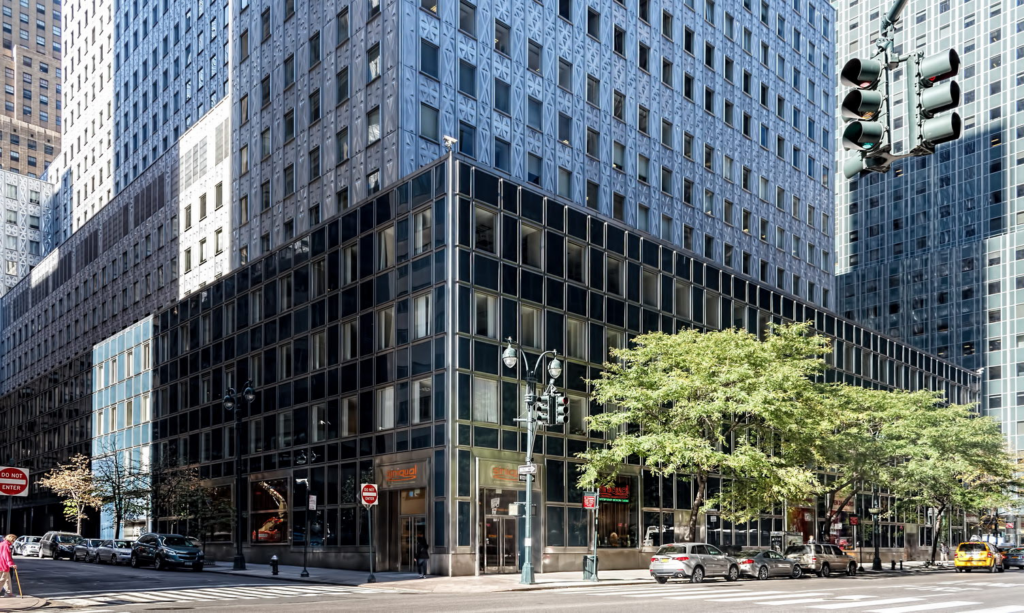
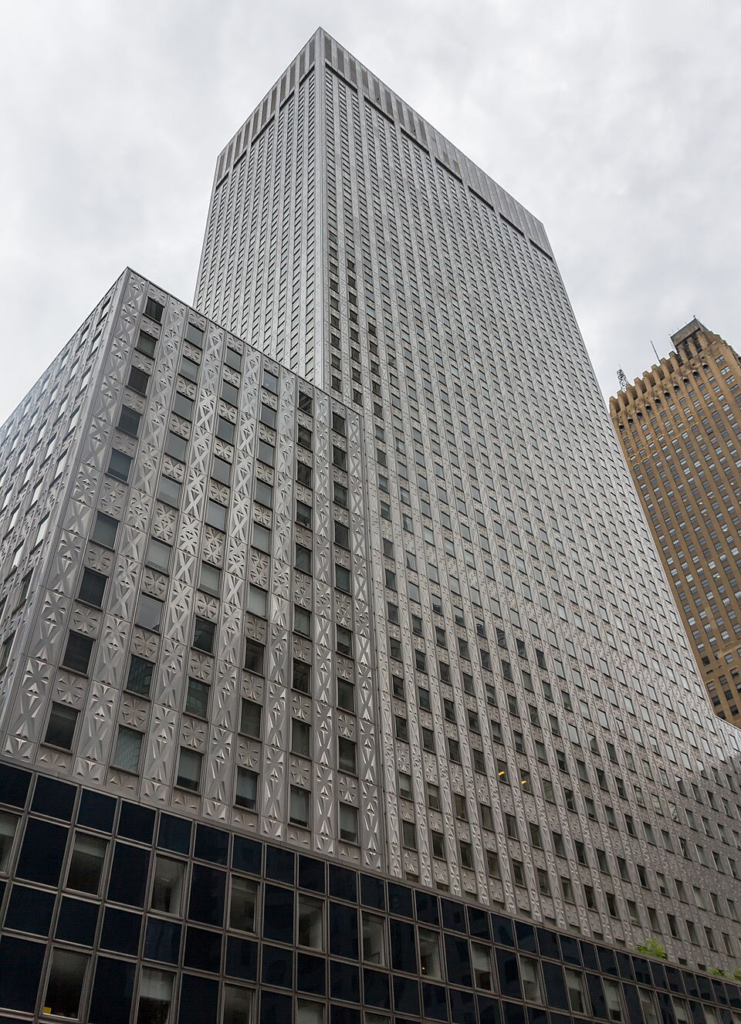
THE before-and-after drama of a building being cleaned always provides an interesting sidewalk spectacle. So do go and inspect the dramatic work on the waffled metal finish of the 1956 Socony-Mobil Building at 150 East 42d Street.
Except for cheap tin structures and copper buildings such as pier sheds, builders generally avoided metal-faced buildings until just after World War II. In 1946 Alcoa proposed an aluminum-faced office tower at 58th Street and Park Avenue. Although it was never built, the company did put up a similar office tower in Pittsburgh in 1953.
During the same period, the Goelet family, a major real estate owner, finally completed the assemblage of the entire block from Lexington to Third Avenues, between 41st and 42d Streets, parts of which it had owned for over a century. Two developers, John Galbreath and Peter Ruffin, persuaded the Goelets to accept their proposal for a first-class office building.
While accepting the basic form set out by the Goelets’ architect, John B. Peterkin, the developers brought in Wallace Harrison and Max Abramovitz, who were the McKim, Mead & White of postwar New York — polished, educated and well-connected.
Apparently because Galbreath and Ruffin had close connections to the United States Steel Corporation, an original design of brick over a granite base developed into one for stainless steel panels above a lower portion of glass. Steel priced out at one and a half times the cost of brick, but United States Steel, nervous about the inroads aluminum was making in the building-metals industry, offered to make up the difference.
The architects wanted the 0.037-inch-thick panels stamped with a raised pattern, both for architectural effect and for greater strength, and worked out different modular designs: picture frames, fields of teardrops, a clapboard-like design, bicycle chains and others.
(Published accounts reported that the builders were concerned that flat panels might create bright reflections that would annoy neighboring office tenants.)
They finally settled on one of irregular pyramids arranged in rectangles and rosettes; the final effect is delicate, almost floral.
By using steel panels on the 1.6 million-square-foot building the team gained several inches of floor space on the inside wall, greatly reduced labor costs on the skin, and saved weight — the panels weighed 2 pounds per square foot as opposed to 48 pounds per square foot for brick.
Opened in 1956, the Socony-Mobil Building sheltered an office population of 8,000 and was the largest metal-clad office building in the world. There had been aluminum-skin buildings in New York before, but stainless steel was, and remains, unique on such a large scale.
The only critical discussion of the building was by Lewis Mumford, writing in 1956 in his column “The Skyline” in The New Yorker. He thought the skin was “a disaster,” making the building look “as if it were coming down with measles.” Mumford particularly objected to the fussy quality of the panel design, and much preferred the stark geometry of the diamond-shape pressing of the aluminum panels of the new building at 666 Fifth Avenue.
THE Goelet estate still owns the land, but Mobil left the building in 1987 and sold it to the Hiro Real Estate Company for $240 million. Mobil’s departure, and a general downturn in office rentals, brought the occupancy of the building dangerously low, only 15 percent in 1991 according to a report at the time published in Crains New York Business.
According to Frank Ward, chief operating officer of Hiro, the occupancy rate is now up to 28 percent, and his company has just put in a new chiller for air-conditioning service. Crews of workers are also cleaning the stainless steel skin — the metal is dull and brownish, like something lost in the bottom of a dishwasher for a year or two.
The cleaned stainless steel makes a brilliant and startling contrast: when older masonry buildings are cleaned, there is a dissonance between the freshly scrubbed surface and the natural age of the brick or stone. But this is a building that really does look like new.
There is, however, something even more striking about the building. In the current fashion, even the owners of the best postwar buildings — like the Corning Glass building at 56th and Fifth and the Look Building at 488 Madison Avenue — have succumbed to the temptation of new lobbies and entrances or even whole facades.
But Hiro has decided that the original architects must have had a reason for what they were doing. Except for a pair of video terminals, the soft, swooping marble lobby remains intact, and Hiro has resisted the temptation to do anything more than polish it, inside or outside. It is an approach as unusual as a stainless steel skin.
Photos: The Socony-Mobil Building, above left, in 1956, the year it opened. (Ezra Stoller $; Esto); Building, above right, glows anew after a recent scrubbing.; Entry, right, to marble lobby, which remains intact. (Photographs by Jack Manning for The New York Times)
CREDITS
Christopher Gray New York Times
*Gray passed away a few years ago, but his wonderful
essays live on and are a wonderful memory of a
unique architectural essayist
All image are copyrighted (c) Roosevelt Island Historical Society unless otherwise indicated THIS PUBLICATION FUNDED BY DISCRETIONARY FUNDS FROM CITY COUNCIL MEMBER JULIE MENIN & ROOSEVELT ISLAND OPERATING CORPORATION PUBLIC PURPOSE FUNDS.
from the collection of the New York Public Library
As the 1920s roared on in New York City, Irving Chanin was busy building. The developer was responsible for several Garment Center buildings, as well as the famous Roxy Theatre, the Majestic Apartments and the Century Apartments on Central Park West, and the Royale and Majestic Theatres.
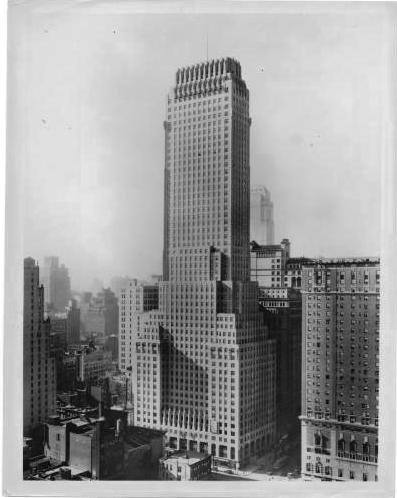
His signature building would rise at 122 E. 42nd Street at Lexington Avenue, The Chanin Building. Chanin commissioned architects Sloan & Robertson to design his 56-story tower. It would be the first major Art Deco office building in the city and, according to The City Review, “the finest expression of Art Deco in the city.”
Mayor James Walker was on hand for the dedication of the building in January 1929. It heralded the beginning of an age of iconic Art Deco buildings in Manhattan: Rockefeller Center, the Chrysler Building, and the Empire State Building would all rise in a matter of years.
Although the bulk of the structure, complying with the city’s demand for set-backs, has been declared somewhat unexciting; the crown of the building with its buttresses and piers has been called the finest in the city. What no one complains of, however, is the exuberant Art Deco decoration.
In their New York 1930, Architecture And Urbanism Between the Two World Wars, Robert A. M. Stern, Gregory Gilmartin and Thomas Mellins write:
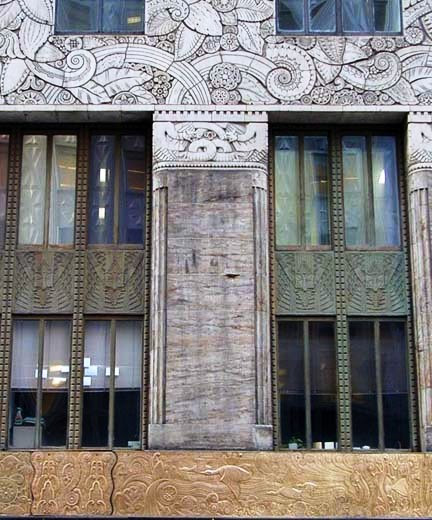
Above shop fronts sheathed in bronze and black Belgian marble, a bronze frieze narrated the story of evolution, beginning with the lower marine forms and then bursting forth with fish and birds. This formed a plinth for a two-story colonnade of massive Norman piers whose squashed cushion capitals were carved with writhing sea monsters. The fourth story was sheathed in terra-cotta panels rendered with a bold overall pattern of abstract floral patterns.
The frieze depicting evolution stopped at geese; the designers no doubt feeling that including man in the process, only four years after the Scopes Trial, might be too controversial.
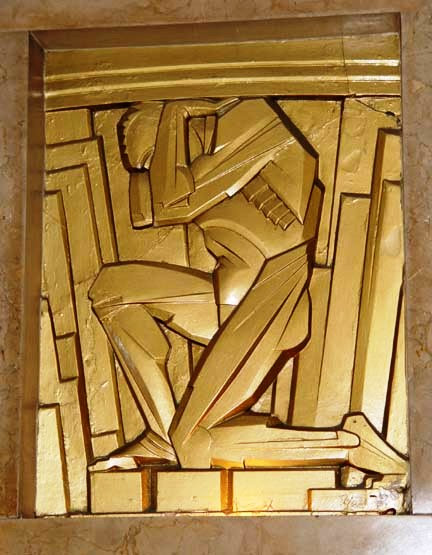
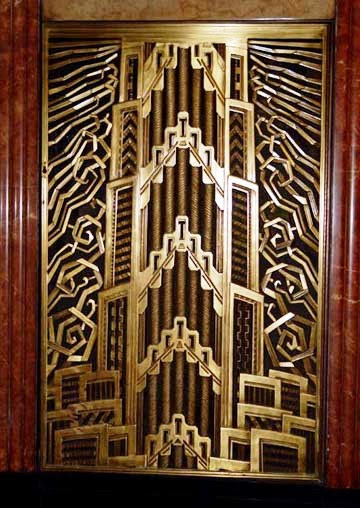
Chanin used his own architectural department head, Jacques I. Delamarre and Rene Chambellan, an architectural sculptor, to decorate the interiors. Fantastic Art Deco grills, elevator doors, mailboxes and sculptures greeted the visitor. Two bronze-painted plaster reliefs by Chambellan represent Achievement and Success. The means by which to gain these are represented in six matching reliefs: three are physical, Effort, Activity and Endurance; and three are mental, Enlightenment, Vision, and Courage.
On the 54th floor was an roof top observatory and on the 50th and 51st floor a 200-seat theater decorated in silver and black for the tenants’ sole use. Later the space was converted to offices.
Chanin installed his own offices on the 52nd floor, lavishing it with Art Deco ornamentation, including bronze gates. Below ground, the Baltimore Ohio Railroad Company leased space for ticket offices, waiting rooms and a bus terminal–complete with an immense turntable to turn the busses around.
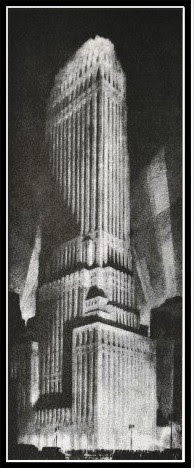
The Chanin Building was perhaps solely responsible for making 42nd Street the premier commercial address of the time. The imposing structure became the subject of one of Hugh Ferriss’s architectural paintings. Throughout the 20th century to the present it remains a striking presence in midtown–an Art Deco masterpiece.
CREDITS
Daytonian in Manhattan
All image are copyrighted (c) Roosevelt Island Historical Society unless otherwise indicated THIS PUBLICATION FUNDED BY DISCRETIONARY FUNDS FROM CITY COUNCIL MEMBER JULIE MENIN & ROOSEVELT ISLAND OPERATING CORPORATION PUBLIC PURPOSE FUNDS.
Under marquee and above 1260 Avenue of the Americas entrance
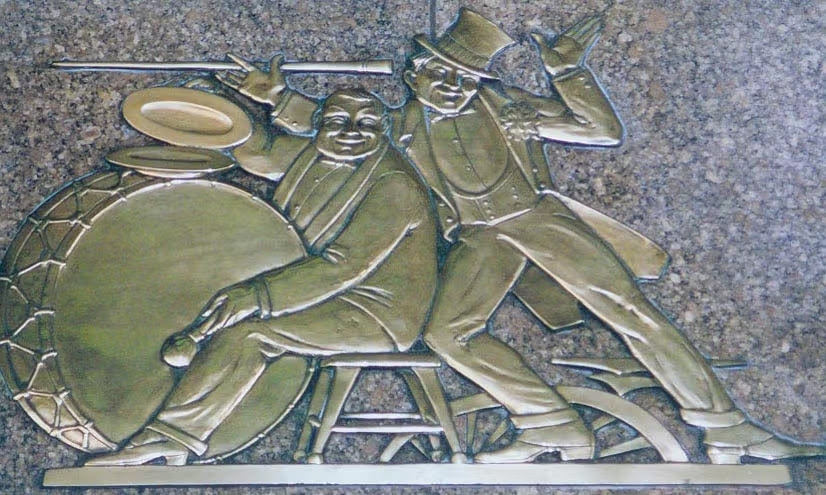
These six playful plaques under the marquee on the granite wall are both architectural decorations and introductions to the stage events ahead. Each one represents a different scene typical of international ethnic performances of the early twentieth century. Characteristic accessories and carefully depicted native costume make each easily recognizable, from five American dancers (the Rockettes) precision-kicking to a French cellist and German accordianist. Chambellan was also commissioned to model nearly all the architectural details, including grilles, handrails and moldings, in the Center.
Carving
Aspects of Mankind
Gaston Lachaise
American, born France. 1882 – 1935
1250 Avenue of the Americas
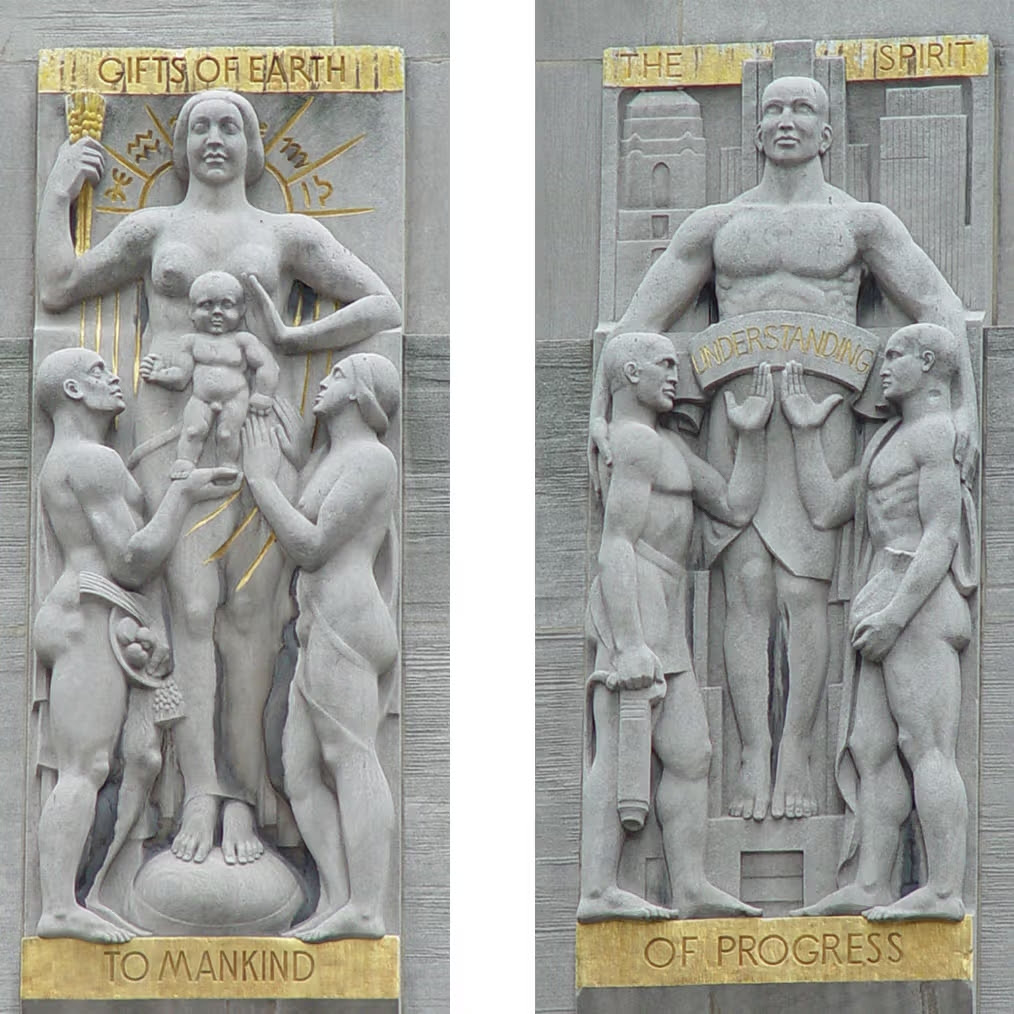
These four allegorical stone carvings express ideal aspects of the development of modern civilization: Genius Seizing the Light of the Sun (the development of electricity and communications), The Conquest of Space and Gifts of Earth to Mankind (an acknowledgement of spirituality), and The Spirit of Progress (a reference to the bond between capitalism and the unions during the building of the Center). Although Lachaise wasn’t popular with art critics at the time, he was championed by Nelson and Abby Rockefeller, who were supporters of avant-garde artists and collectors of his work.
Carving
Cornucopia of Plenty
Lee Lawrie with colorist Leon V. Solon
American, born Germany. 1877 – 1963
10 West 51st Street
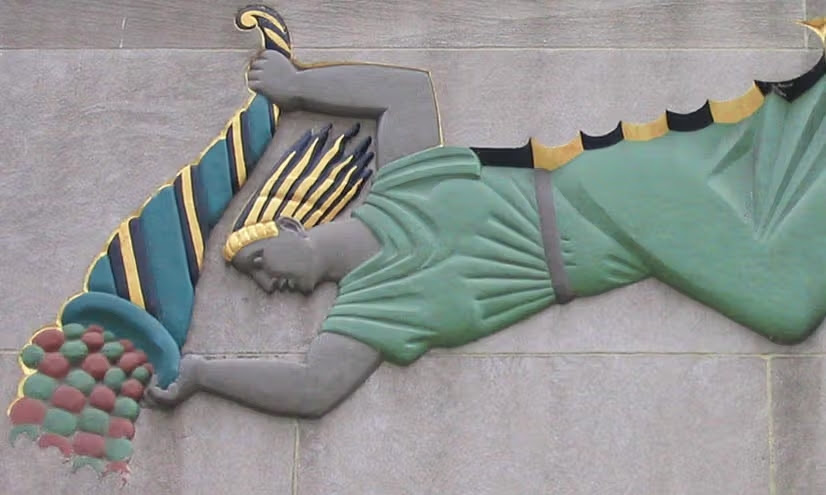
This polychrome-painted stone carving depicts a messenger soaring from the clouds, emptying an overflowing horn onto the earth. Lee Lawrie wrote that it symbolizes “the plentitude that would result from well-organized international trade”, a theme compatible to the activities of the building. The figure’s downward angle, her flowing golden hair and the dramatic spilling of contents from her cornucopia all skillfully convey a feeling of motion and energy.
Sculpture
Industries of the British Empire
Carl Paul Jennewein
American, born Germany. 1890 – 1978
Above 620 Fifth Avenue entrance
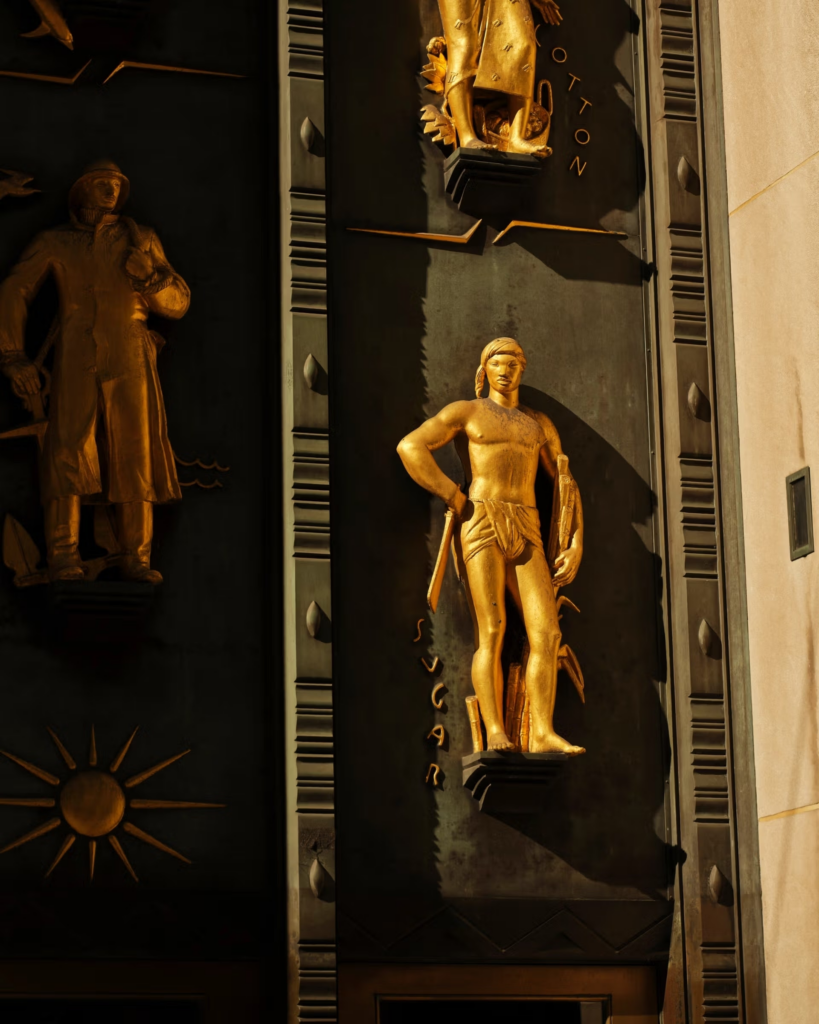
The nine gilded allegorical figures on this large bronze panel represent industries that were once considered major sources of income for the British. Depicted as beautiful, unemotional and idealized, they include Coal, Fish, Salt, Tobacco and Sugar. Australia is symbolized by Wool, Canada by Wheat and Africa by Cotton. A stylized sculpted sun is symbolic of the saying, “The sun never sets on the British Empire.” In New York City, Jennewein’s works can also be found at the Brooklyn Central Library and the Metropolitan Museum of Art.
Mosaic
Intelligence Awakening Mankind
Barry Faulkner
American. 1881 – 1966
1250 Avenue of the Americas
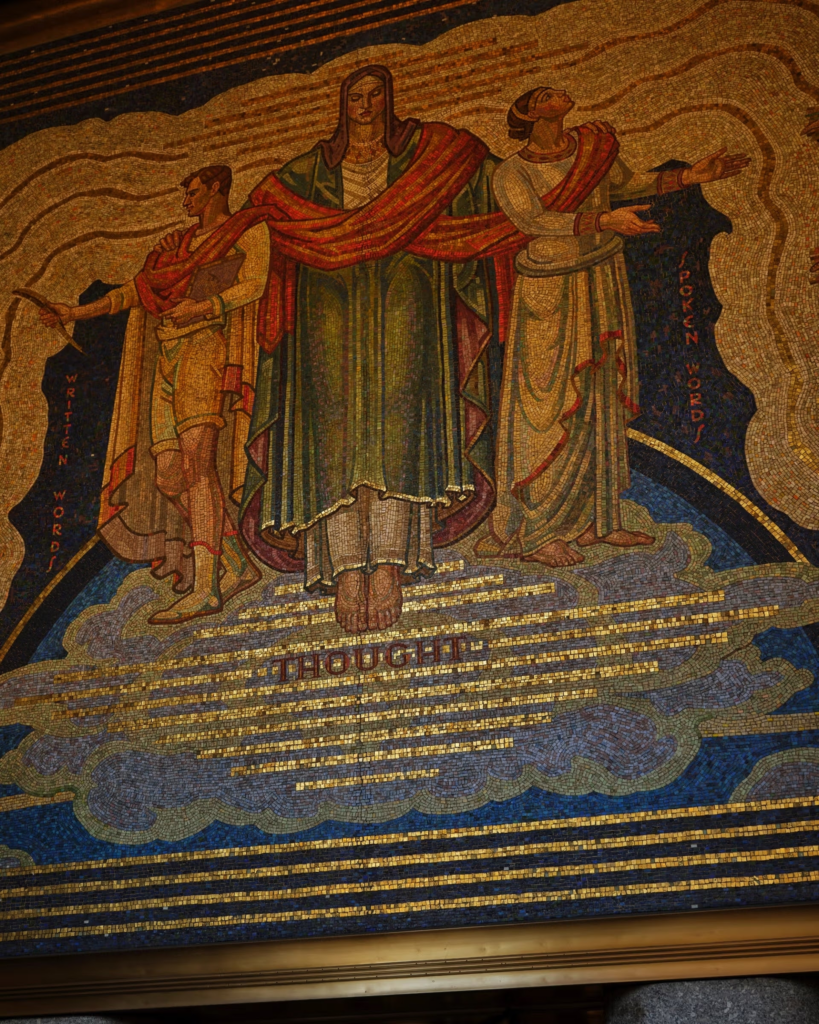
This mosaic of small glass tiles (tesserae) is composed of over one million glass tiles in two hundred and fifty colors, each hand-cut and hand-set. The work is a narrative concerning the triumph of knowledge over the evil of ignorance. The central figure of thought (intelligence) stands above the world, controlling the action in the mosaic; the two other powerful figures in this piece are spoken words and written words. Other figures symbolize creativity, ideas and intellectual efforts. The mosaic’s message is that thought will propagate new knowledge and advance civilization.
News
Isamu Noguchi
American. 1904 – 1988
Above 50 W 50th Street entrance of 30 Rockefeller Plaza
Soaring above the entrance to 50 Rockefeller Plaza, this dynamic plaque symbolizes the business of the building’s former tenant, the Associated Press. One of the major Art Deco works in the Center, it depicts five journalists focused on getting a scoop. AP’s worldwide network is symbolized by diagonal radiating lines extending across the plaque. Intense angles and smooth planes create the fast-paced rhythm and energy of a newsroom. News is the first heroic-sized sculpture ever cast in stainless steel and the only time Noguchi employed stainless steel as an artistic medium.
CREDITS
Rockefeller Center
All image are copyrighted (c) Roosevelt Island Historical Society unless otherwise indicated THIS PUBLICATION FUNDED BY DISCRETIONARY FUNDS FROM CITY COUNCIL MEMBER JULIE MENIN & ROOSEVELT ISLAND OPERATING CORPORATION PUBLIC PURPOSE FUNDS.
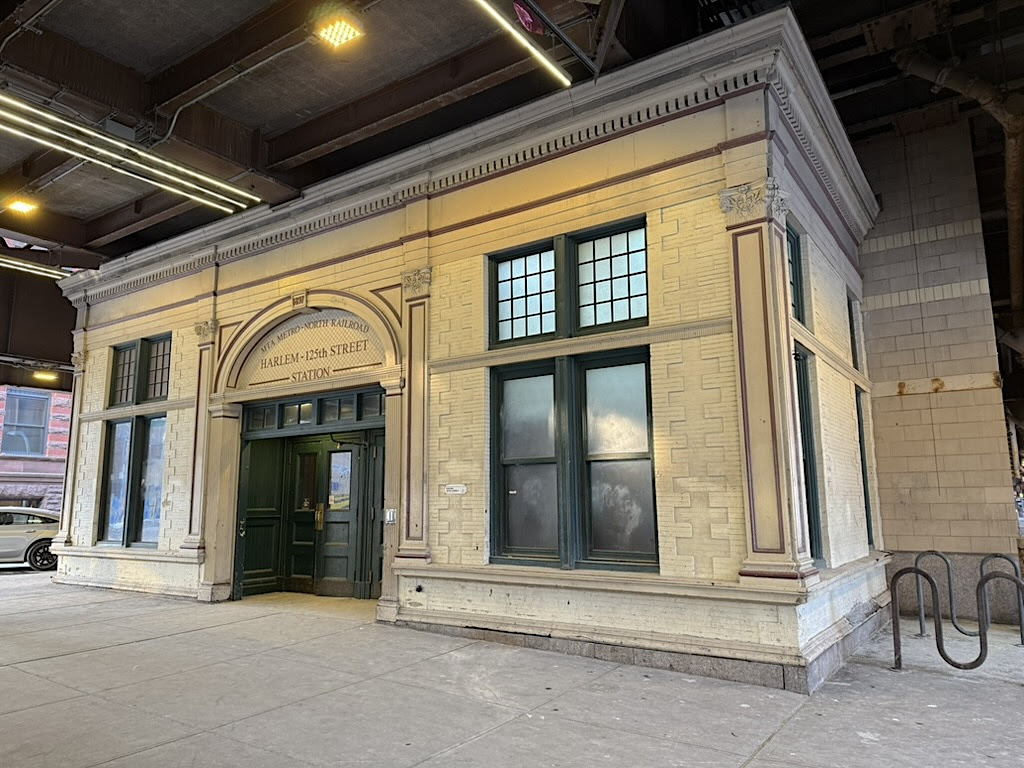
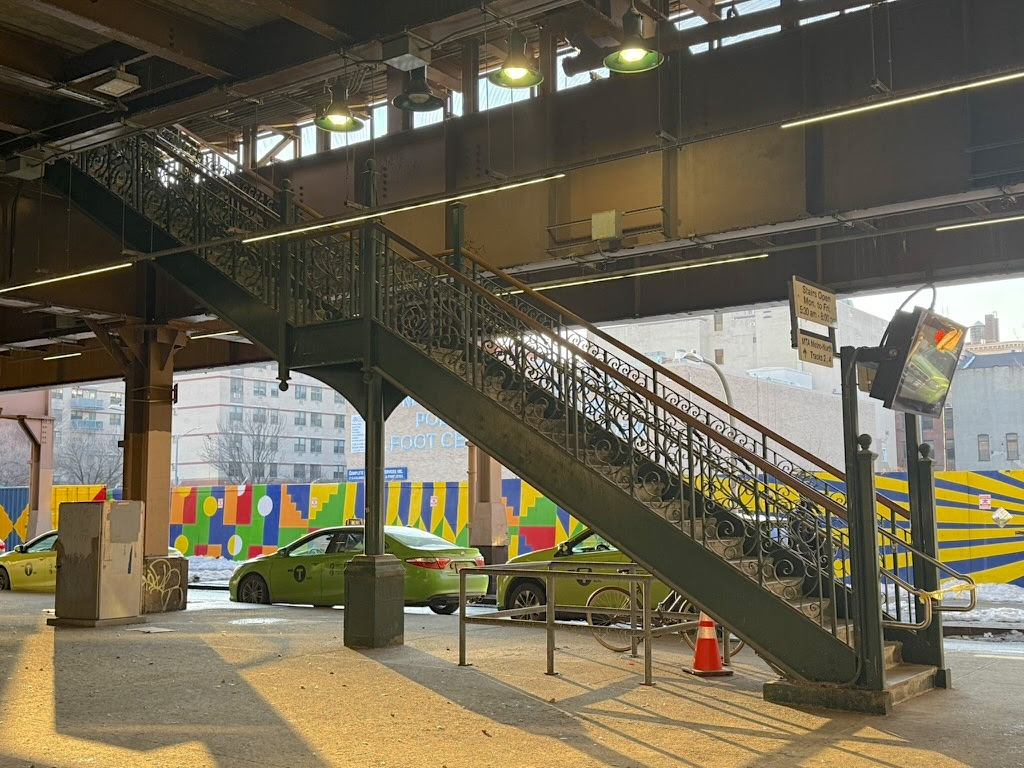
On busy 125th Street, it’s a lilliputian train depot, with a delicate blond-brick facade and a white cornice trimmed in terra cotta.
It’s so small, it looks like it’s hiding under the massive steel viaduct that carries Metro-North rail cars above Park Avenue to Grand Central Terminal in one direction and beyond Manhattan to Westchester in the other.
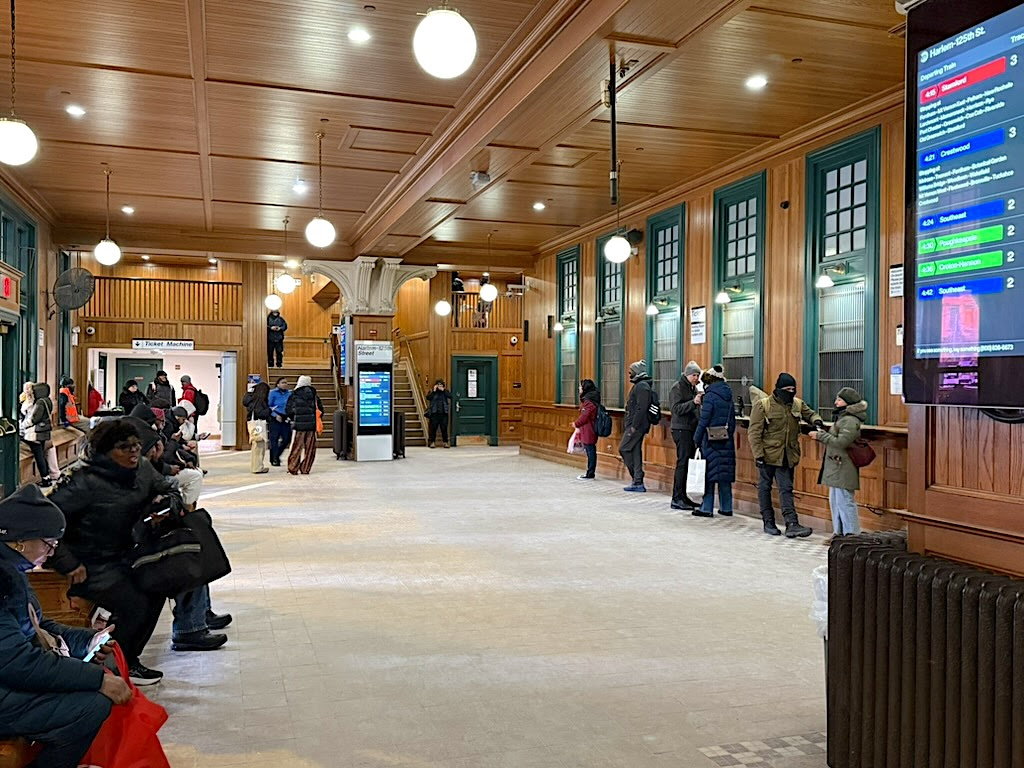
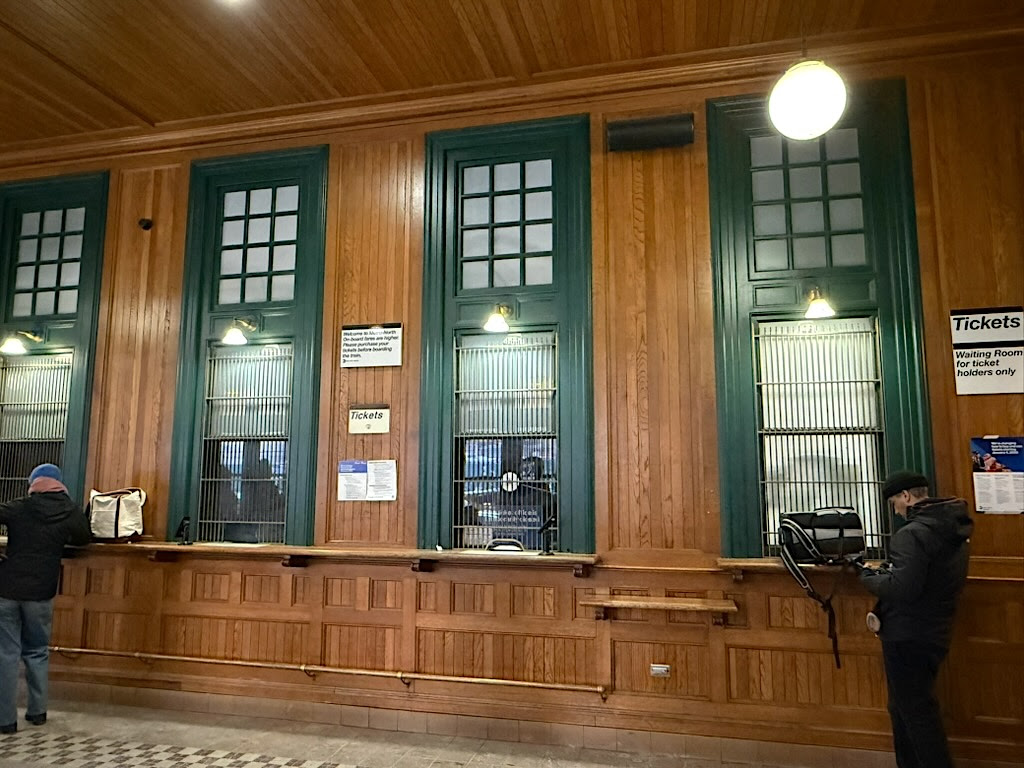
But once you walk inside, you’ll find yourself in a roomy rail station with a wall of ticket counters and a spacious waiting room straight out of the Gilded Age.
Oak paneling covers the walls, soft globes glow with light overhead, and the tiled floor and antique iron radiators give the feel of a late 19th century depot in a small village, not a major city.
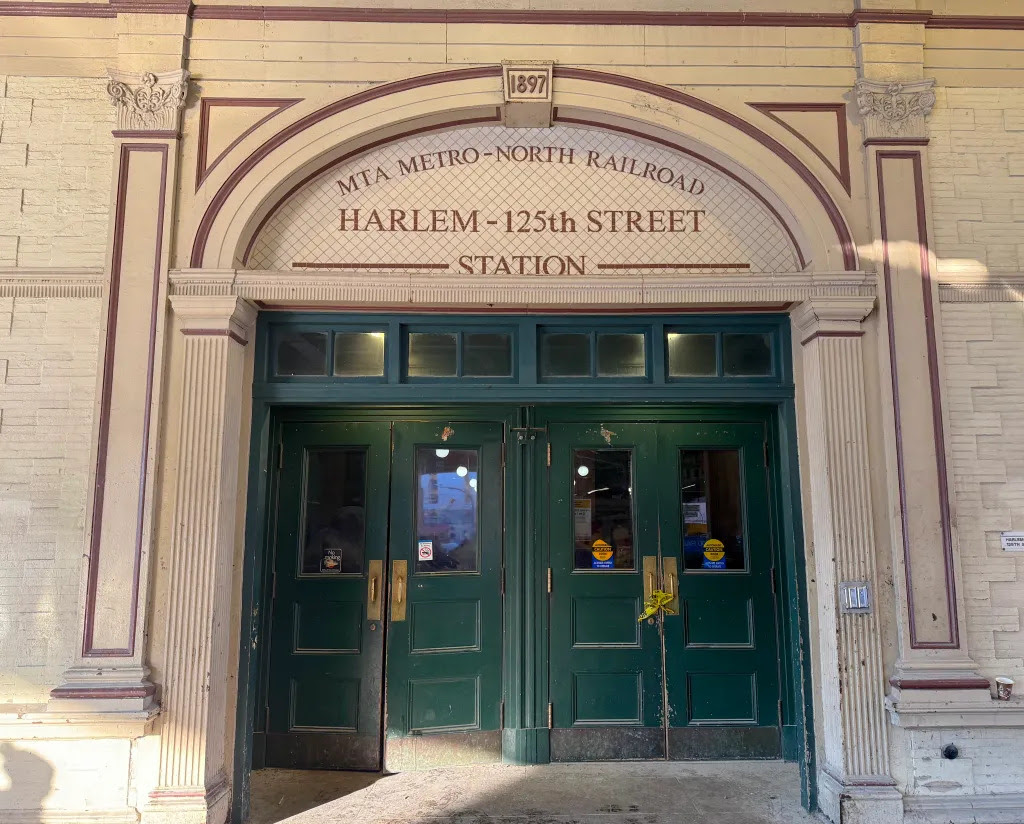
The interesting thing is, despite the date “1897” carved into the entryway, what’s now known as the Metro North Harlem-125th Street station is not an actual relic dating back to the Gilded Age—not exactly.
Though some of its components are original, it’s considered a 1990s “replica” of the train station built by the New York Central and Hudson River Railroads on this spot in 1897—when Harlem was shaking off its agrarian village past and joining the urban city.
In a review just before the 1897 station opened, The New York Times deemed it a big plus for Harlem residents.
“Passing through the tiled vestibule, one enters a spacious waiting room, 40 feet broad by 70 feet long, containing comfortable benches,” wrote The Times. “In one corner of the room is an information bureau, parcel room, and bicycle rack, while in the opposite corner is the telegraph and telephone office.”
“Back of the waiting room is a gentlemen’s smoking room and toilet, fitted with marble basins and plumbing of the latest approved pattern,” continued the Times.
The smoking room is gone, alas. But this recreation of the 1897 station is the latest in a series of railroad stops or actual stations at Park Avenue and 125th Street.
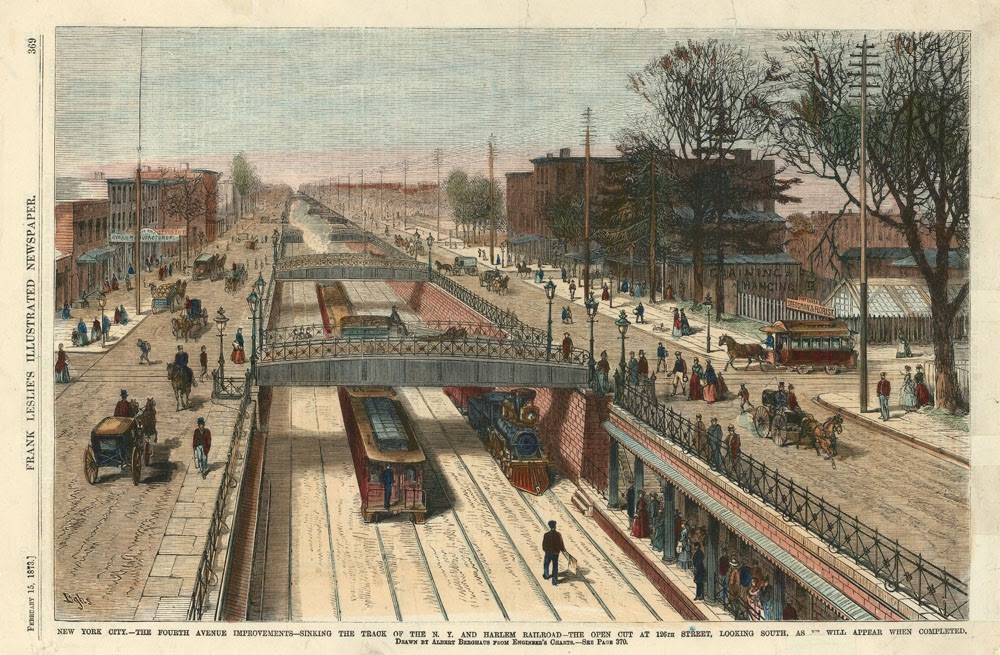
Park Avenue, then known as Fourth Avenue, had train tracks running at street level through lower Manhattan since 1831. Besides being noisy and unsightly, the street-grade tracks were extremely dangerous to pedestrians.
“The tracks extended north to Harlem at street level in 1837, and by 1860 trains struck a person or an animal almost every week, according to news reports of the time,” wrote Tina Kelley in a 1999 New York Times article. “The tracks were then lowered below street level north of 116th Street.”
To accommodate passengers getting on the sub-level trains at 125th Street, a new station was constructed in 1874, according to Joseph Brennan of Columbia University’s Abandoned Stations website. (The fourth image, above, shows what the new station was supposed to look like.)
The New York Times article from 1897 described that station as small and dingy, “down in the old Park Avenue cut.”
Harlem’s population was booming, but it was the opening of the Ship Canal connecting the Hudson River to the Harlem River that necessitated a second station, one that needed to be elevated.
“After a navigable connection was cut from the Hudson River to the Harlem River in the 1890s, allowing boats from upstate to travel down the East Side, the railroad bridge across the Harlem River needed to be raised, so the steel viaduct was built,” wrote Kelley.
For decades, the 125th Street station and its steel viaduct transported passengers in and out of the city. But years of neglect in the later 20th century—resulting in boarded-up windows and water damage—took a toll.
By the time Metro-North considered renovating it, much of the original details were beyond repair—hence the careful replication rather than renovation.
These days, it’s a bustling station filled with commuters, day trippers, and time travelers who appreciate the opportunity to wander through a Gilded Age-style jewel box with a platform offering views of Upper Manhattan.
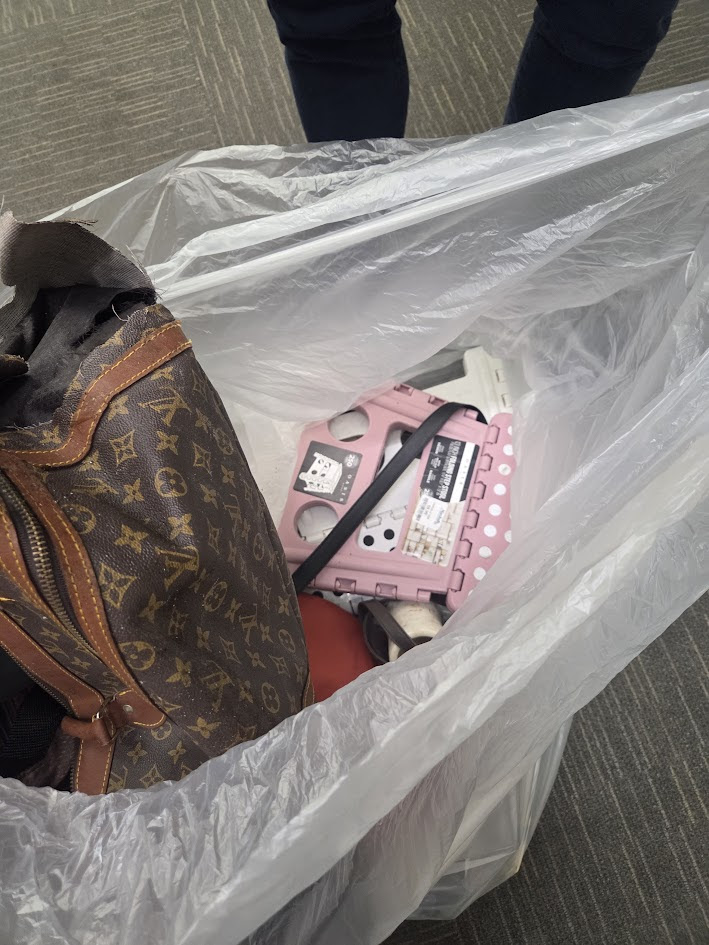
FOR THREE WEEKS ONE OF THE AVAC TUBES WERE CLOGGED WITH LARGE ITEMS THAT HAD TO BE EXTRACTED. THIS LARGE SIZE DUFFEL BAG AND TWO STEP STOOLS CERTAINLY SHOULD NEVER BE PLACE IN THE AVAC CHUTE IF THE ITEM IS LARGE LEAVE IT FOR STAFF TO REMOVE IT FROM AVAC ROOM AND DO NOT STUFF IT IN THE CHUTE.
All image are copyrighted (c) Roosevelt Island Historical Society unless otherwise indicated THIS PUBLICATION FUNDED BY DISCRETIONARY FUNDS FROM CITY COUNCIL MEMBER JULIE MENIN & ROOSEVELT ISLAND OPERATING CORPORATION PUBLIC PURPOSE FUNDS.
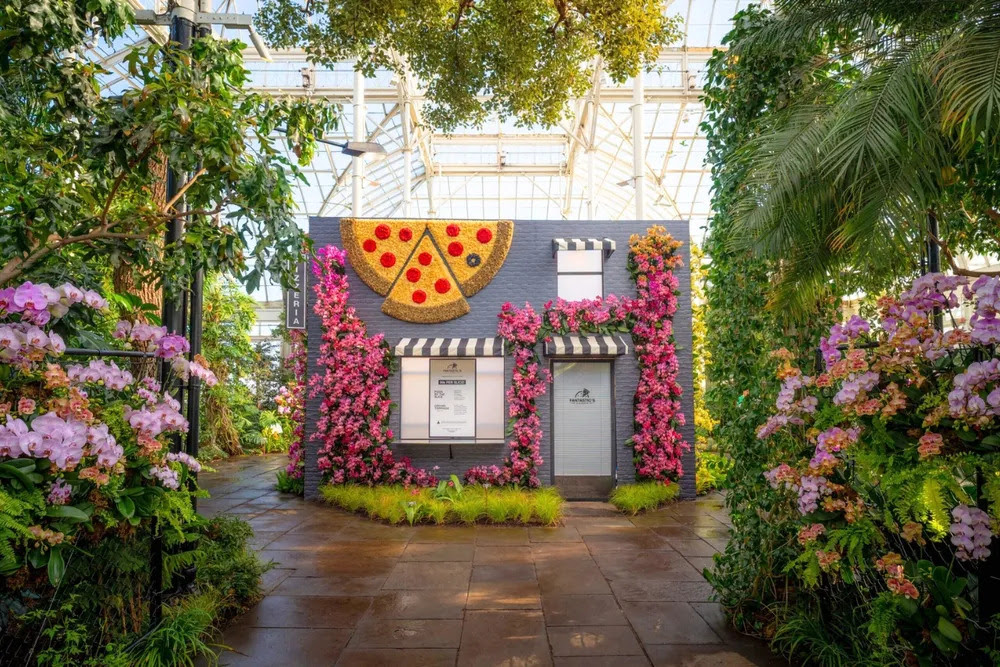
Photo Courtesy of the New York Botanical GardenMr. Flower Fantastic’s Concrete Jungle Orchid Show exhibition turns ordinary urban scenes into extraordinary floral arrangements! We got a sneak peek at the newly opened exhibit, which features iconic scenes of NYC recreated as bountiful floral displays at the New York Botanical Garden:
See the city’s urban spaces transformed by lively bursts of flowers!
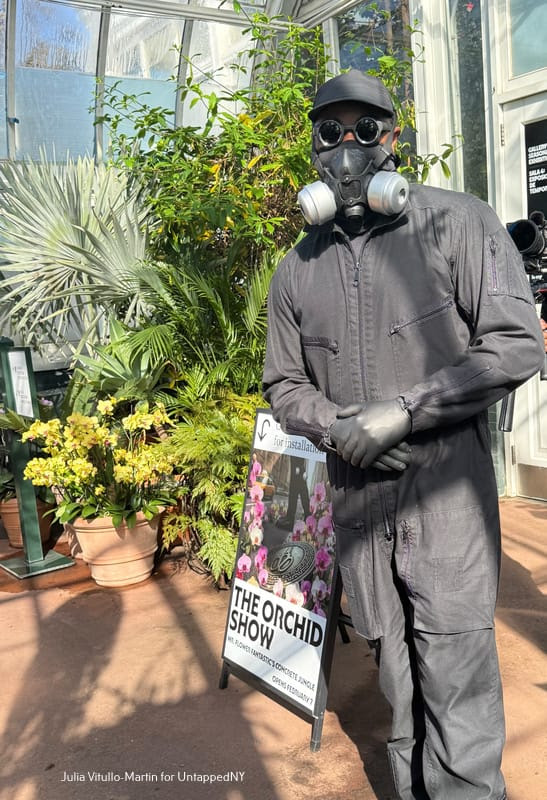
But then Alicia Keys and Jay-Z in their song, Empire State of Mind, called New York the “concrete jungle where dreams are made of,” a place where anything is possible for the talented and the ambitious. “These streets will make you feel brand new, big lights will inspire you.”Now the New York Botanical Garden, in its glorious 23rd annual orchid show, introduces New Yorkers to Mr. Flower Fantastic’s Concrete Jungle. And what a gorgeous, innovative, endearing jungle it is. MFF, as Mr. Flower Fantastic prefers to be called, maintains his anonymity with a cap, dark glasses, rubber gloves, and the gas mask that he needs for his severe pollen allergies. A self-taught floral artist, MFF developed his love for flowers growing up in Queens, tending to his mother’s garden.
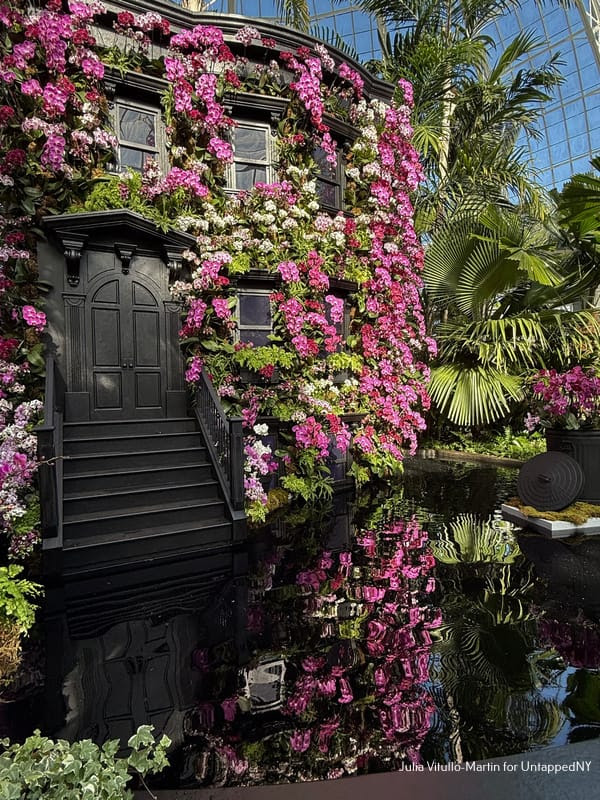
Mr. Flower Fantastic’s Brownstone
The first art you’ll see on entering the Enid A. Haupt Conservatory is a brownstone, covered in pink, fuchsia, and white orchids of the genus Phalaenopsis, says the NYBG. Frequently called the moth orchid, this flower that many of us have in our homes should not be disdained, says Marc Hachadourian, curator and manager of the garden’s Nolen Greenhouses. It likes the conditions we like—moderate light, humidity, and temperature—making it easy to grow and thrive. And thrive it certainly does in this orchid’s show. Hachadourian also says that the living orchids are not harmed by their lavish display over Mr. Flower’s “icons of everyday” New York life.
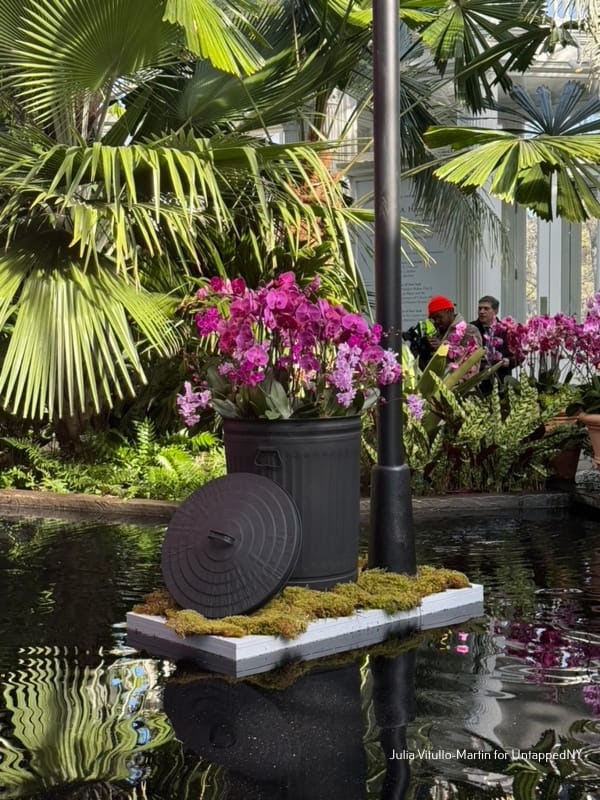
Mr. Flower Fantastic’s Trash Can
It may not be an object of beauty to you, but to Mr. Flower Fantastic, the classic New York trash can is to be cherished and planted with orchids.
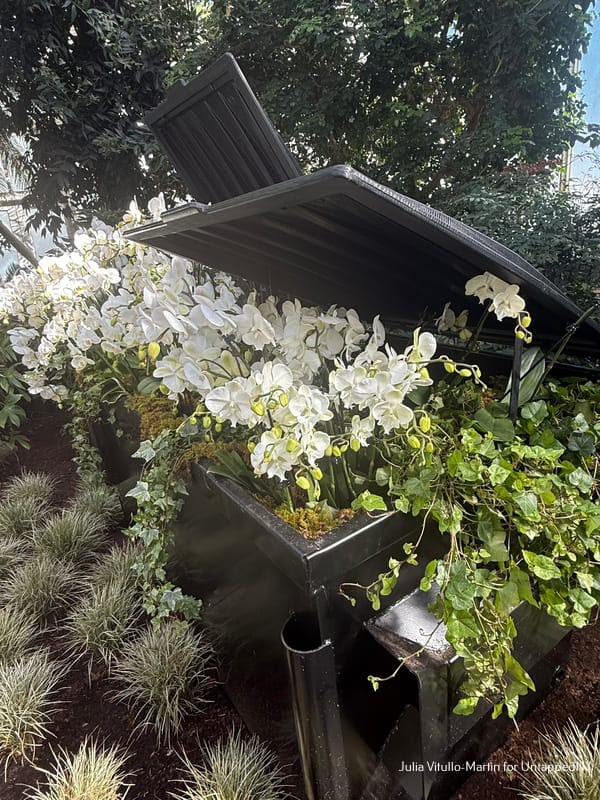
How could New York function without the dumpster, that ubiquitous receptacle for construction debris and household trash?
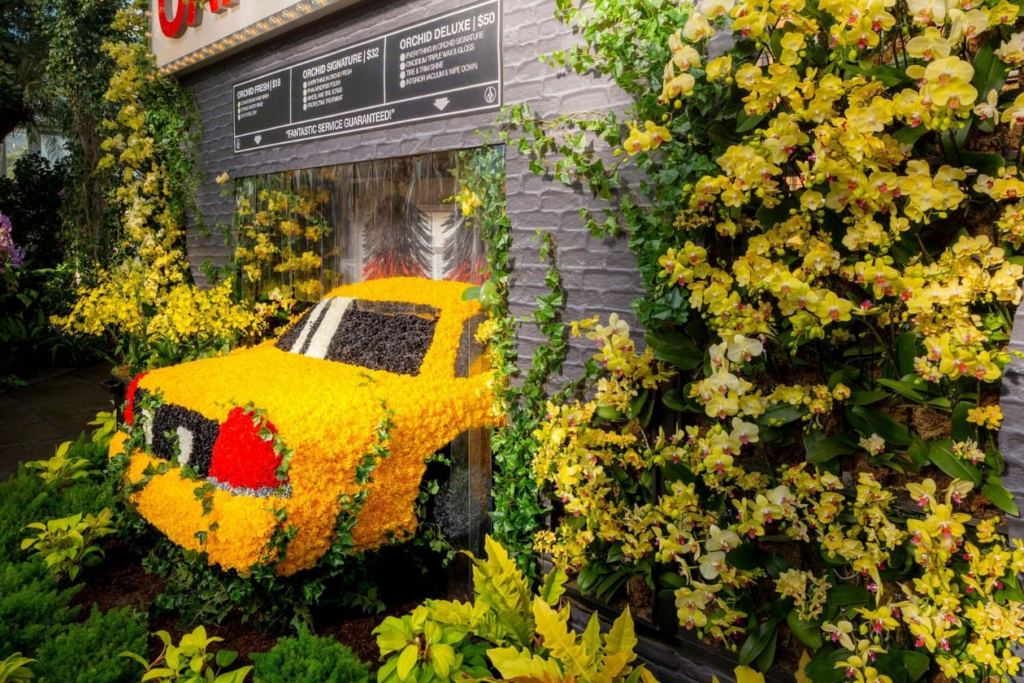
Mr. Flower Fantastic’s Car Wash with Yellow Taxi
This is one adorable car wash, with an adorable, carnation-covered yellow taxi pushing in to be washed. The current taxi was inspired by a previous installation, Taxi!!!, at the Queens Botanical Garden. MFF says that his tribute to the yellow cab “embodies diversity, tenacity, imagination, and brilliance.”
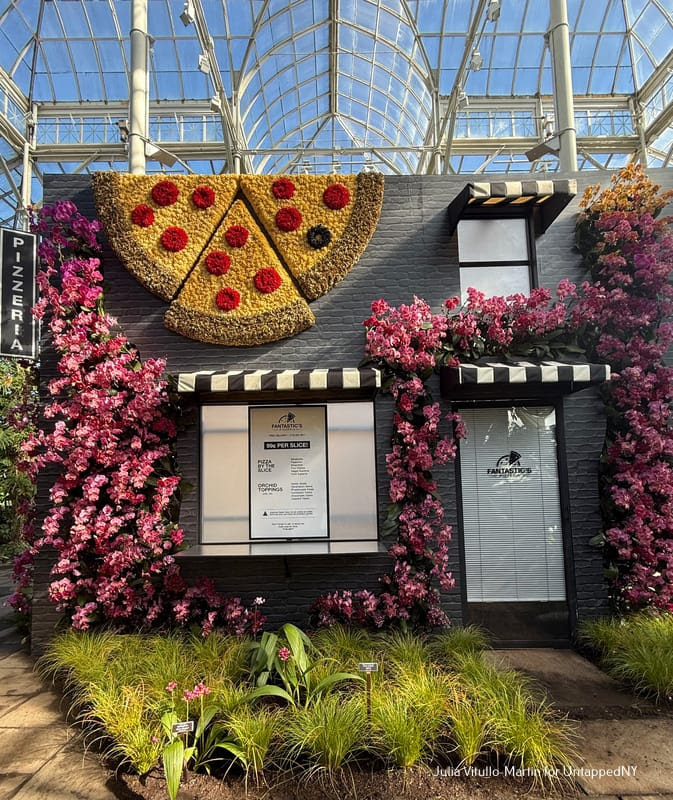
What can one say? Without their neighborhood pizzeria, many New Yorkers would starve. Here, for 99 cents a slice, you can get a Margherita, Pepperoni, or Neapolitan pizza with orchid toppings.
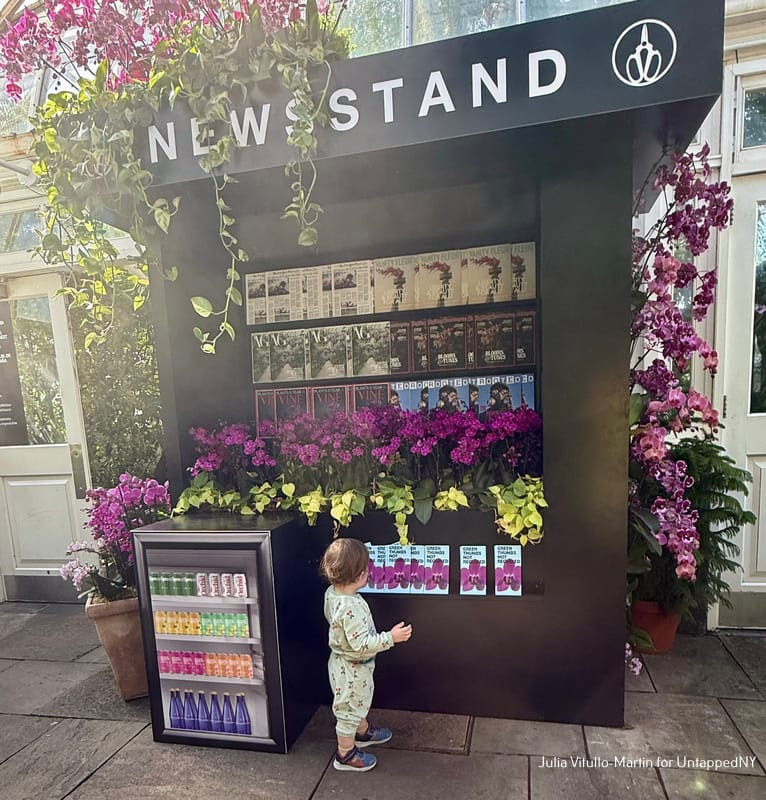
Mr. Flower Fantastic’s Newsstand
Reflecting the turmoil in the newspaper industry, newsstands are closing all over New York. But Mr. Flower Fantastic’s orchid-covered newsstand has a customer who is pondering picking up one of the guides to orchid care.
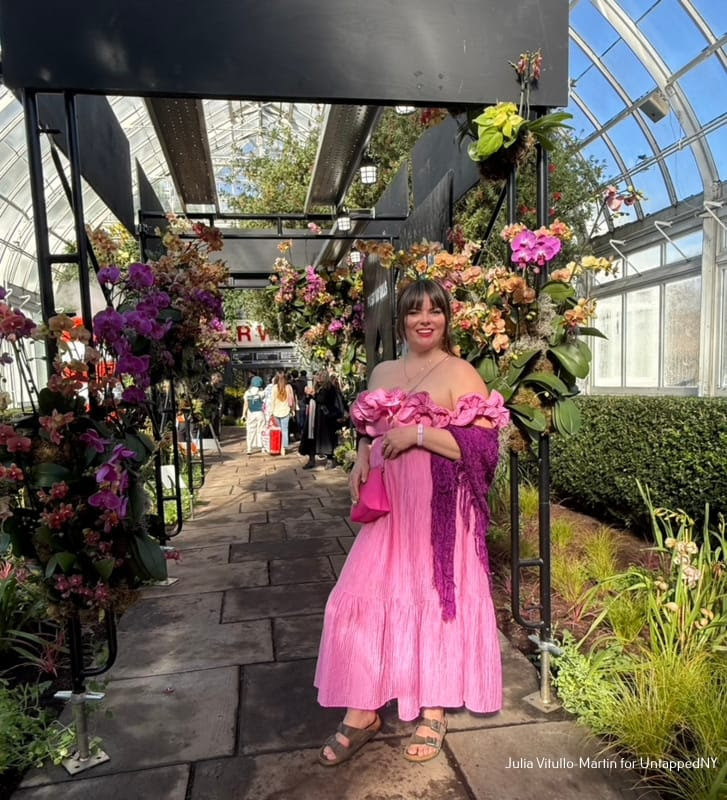
Lauren Fuller, NYBG Cultivator
One of the many joys of the annual orchid show is that regulars often dress up for the event. Here, Lauren Fuller, a social media influencer with the handle @node.mama, poses beautifully with cascading orchids. Lauren began her career in NYBG’s cultivators program, which gives social media influencers access to the garden’s grounds, as well as behind-the-scene tours. “Then we put everything up on social media,” says Lauren, “to get everyone excited about NYBG.
The mysterious Mr. Flowes know as MFF
CREDITS
Julia Vitullo-Martin
NEW YORK BOTANICAL GARDEN
All image are copyrighted (c) Roosevelt Island Historical Society unless otherwise indicated THIS PUBLICATION FUNDED BY DISCRETIONARY FUNDS FROM CITY COUNCIL MEMBER JULIE MENIN & ROOSEVELT ISLAND OPERATING CORPORATION PUBLIC PURPOSE FUNDS.
Artist Augusta Savage overcame poverty, racism, and sexual discrimination to become one of America’s most influential 20th-century artists. (More on her career in an upcoming issue)
Artist Augusta Savage and the Tragic Story of Her Lost Masterwork
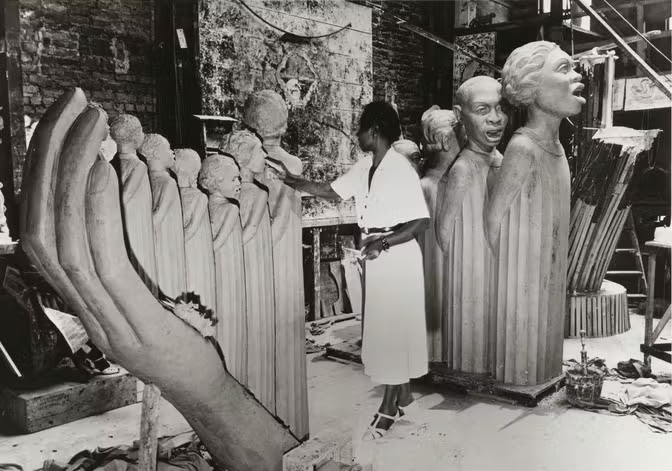
The photo of Savage working on ‘Lift Every Voice and Sing’ that was blown-up to life-size in the New-York Historical exhibition (Manuscripts and Archives Division, the New York Public Library)
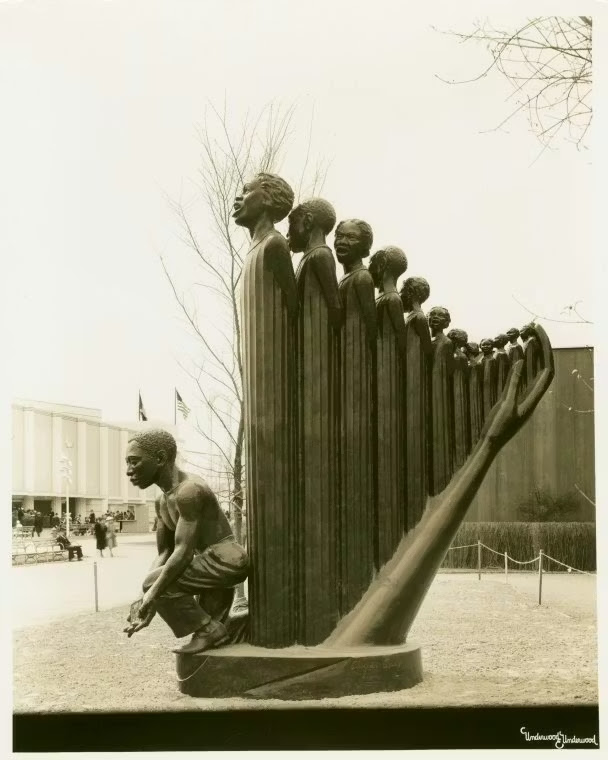
An estimated 44 million people attended the 1939 New York World’s Fair in Flushing Meadows-Corona Park, Queens, and witnessed its vision for a shimmering, Art Deco “World of Tomorrow.” Some five million of those visitors got a chance to behold Lift Every Voice and Sing. A sculpture by artist Augusta Savage, it stood at a towering 16 feet tall and was mounted in the courtyard of the Contemporary Arts Building near one of the Fair’s gates. Also called The Harp (a name Savage reportedly hated), the piece depicted a kneeling Black man holding a bar of music and 12 Black chorus singers representing strings on a harp, the sounding board of which was no less than the hand of God.
The piece represented the pinnacle of Savage’s career, and the fascinating story behind it was part of New-York Historical’s exhibition Augusta Savage: Renaissance Woman. Born in Green Cove Springs, FL, in 1892, Savage had already faced a lifetime’s worth of adversary, from her minister father who almost “whipped all the art out of me,” as she once said, to an American art world that could not and would not support the work of an African American woman. (Just one example: In 1923, she won a scholarship to study at the Fontainebleau School in Paris, an award that was revoked when the committee learned she was Black.) Savage persevered, and by 1937, she was a graduate of Cooper Union who had studied and exhibited in Paris, received commissions for busts of W.E.B. DuBois and Marcus Garvey, and founded the Savage Studio of Arts and Crafts in New York, one of the centers of the Harlem Renaissance. She was the director of the WPA-funded Harlem Community Arts Center in 1937, when she received a commission for a piece from the World’s Fair board, the only Black woman to receive that honor. The president of the Fair Corporation told the New York Times that they would have “no such segregation of this country’s different racial groups as had marked other American expositions.”
The piece—for which Savage was paid $360—was intended to celebrate African Americans’ contributions to the music of the world, and Savage already had a personal connection that lent itself to the theme. She had been friends with writer and activist James Weldon Johnson, whose poem “Lift Ev’ry Voice and Sing” was set to music and later adopted as the “Black National Anthem” by the NAACP.
Little is known about the creation of the piece, but Savage left her job at the Harlem Community Arts Center and worked on it for two years. The finished work was made of plaster that was lacquered to look like black basalt. This attention to the medium of her message is a running theme: Always short of funding, she often sculpted in fragile, but cheap, plaster or clay and rarely had the means to get her pieces cast in bronze.
The Fair opened in April 1939, and Lift Every Voice got its spot on a main stage of one of the biggest events in the world. “Miss Savage’s creation stands in a niche at the focal point of the building front and is commented upon by practically everyone who passes,” wrote The Afro-American, a Baltimore newspaper, at the time. In her essay on Savage in Women Artists of the Harlem Renaissance, art history professor Theresa Leininger-Miller notes that Savage certainly created more radical pieces in her life, like the figures of lithe modern dancers and fierce African Amazons she sculpted during her time in Paris in 1929 and 1930. But Wendy N.E. Ikemoto, the New-York Historical curator behind the exhibition, argues that the piece is ambitious even in the crowd-pleasing context of the World’s Fair. “It’s an inventive, gorgeous sculpture in many ways,” she says. “On the World’s Fair stage, it still communicates Savage’s mission: to promote Black arts and the Black community. In that sense, it’s an activist sculpture.”
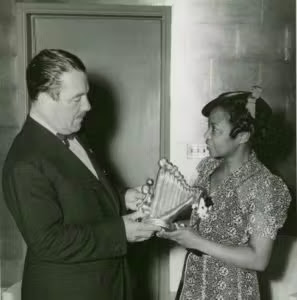
Savage presenting a replica of the piece to the President of the World’s Fair, Grover Whelan (Manuscripts and Archives Division, the New York Public Library)
Small, metal replicas of the piece were sold as souvenirs, and images of it were reproduced on postcards. But what became of the work itself? Sadly, it was destroyed by a bulldozer after the Fair’s close in the fall of 1940. World’s Fairs were meant to be temporary and ephemeral, and it wasn’t shocking for structures or artworks to be demolished at the end.
But the destruction of Lift Every Voice speaks to the larger tragedy of Savage’s work and how little of it survives today. Leininger-Miller—who’s working on a biography of Savage—now estimates that of the approximately 160 documented works by Savage, about 70 have been lost, mostly because Savage never had the means or support to cast them in more durable material.
This was true of Lift Every Voice, as well. The common assumption is that Savage wanted it preserved, but wouldn’t have been able to pay for storing it or casting it. So, all we have left are the small, imperfect replicas, one of which is part of Renaissance Woman, along with a blown-up, life-sized photo of Savage and her work-in-progress, just to give a measure of what was lost
The statue on display at the World’s Fair (Manuscripts and Archives Division, the New York Public Library)
Thwarted by never-ending racism and poverty, Savage left New York City in the 1940s for a rural life in Saugerties, NY, withdrawing from the art scene before her death in 1962. She’s best remembered today as a key mentor and educator in the Harlem Renaissance, and one of her often-repeated quotes takes pride in that, while betraying a heartbreaking resignation about her work. “I have created nothing really beautiful, really lasting, but if I can inspire one of these youngsters to develop the talent I know they possess, then my monument will be in their work,” she said in a 1953 interview. Still, who knows what new attention to Savage’s life and career might bring? In 2017, a New York Times op-ed called for the full-scale re-creation of Lift Every Voice as a public work of art. Maybe one day, Savage’s monument will be her own.
CREDITS
Written by Kerrie Mitchell, Content Editor New York Historical Society Blog
All image are copyrighted (c) Roosevelt Island Historical Society unless otherwise indicated THIS PUBLICATION FUNDED BY DISCRETIONARY FUNDS FROM CITY COUNCIL MEMBER JULIE MENIN & ROOSEVELT ISLAND OPERATING CORPORATION PUBLIC PURPOSE FUNDS.




 Mr. Flower Fantastic’s Concrete Jungle Orchid Show exhibition turns ordinary urban scenes into extraordinary floral arrangements!