Wednesday, February 18, 2026 – ART THAT HAS ENHANCED OUR CLASSIC CENTER FOR DECACES
The Art of Rockefeller Center
Wednesday, Feb. 18, 2026
Rockefeller Center
ISSUE #1629
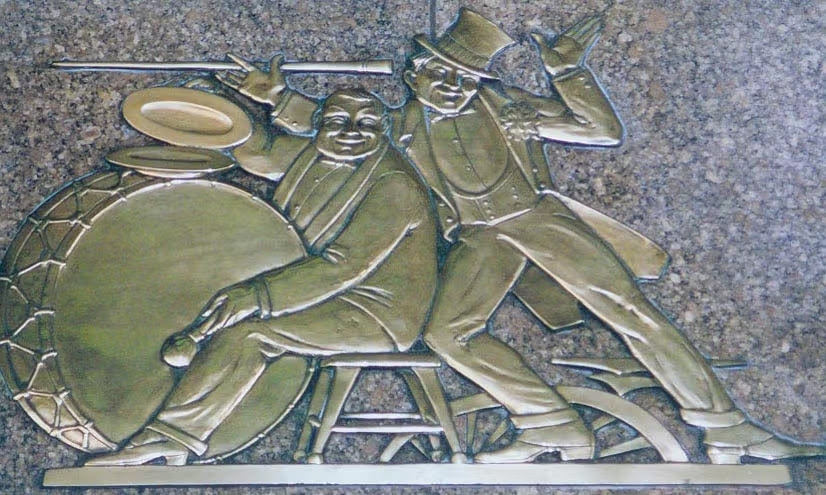
Acts from Vaudeville
Rene Paul Chambellan
American. 1893 – 1955
Under marquee and above 1260 Avenue of the Americas entrance
These six playful plaques under the marquee on the granite wall are both architectural decorations and introductions to the stage events ahead. Each one represents a different scene typical of international ethnic performances of the early twentieth century. Characteristic accessories and carefully depicted native costume make each easily recognizable, from five American dancers (the Rockettes) precision-kicking to a French cellist and German accordianist. Chambellan was also commissioned to model nearly all the architectural details, including grilles, handrails and moldings, in the Center.
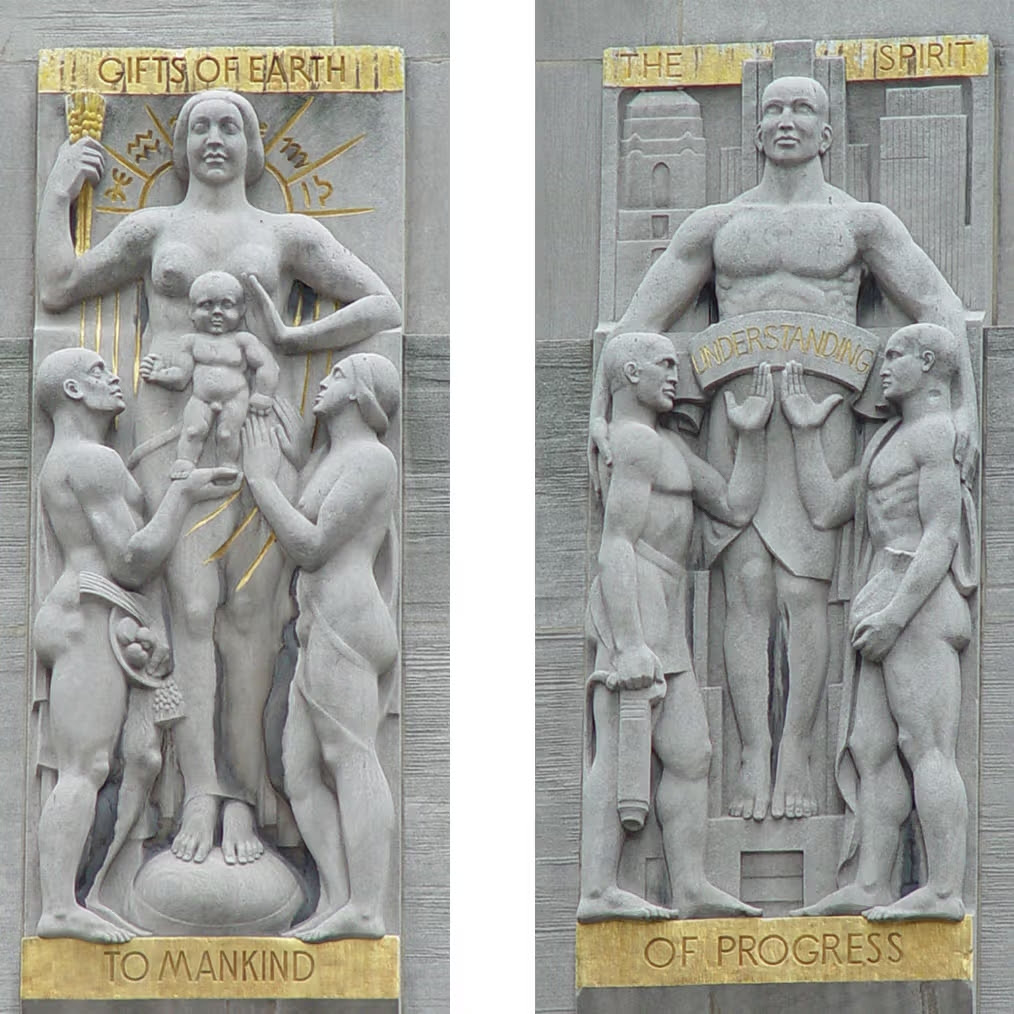
Aspects of Mankind
Gaston Lachaise
American, born France. 1882 – 1935
1250 Avenue of the Americas
These four allegorical stone carvings express ideal aspects of the development of modern civilization: Genius Seizing the Light of the Sun (the development of electricity and communications), The Conquest of Space and Gifts of Earth to Mankind (an acknowledgement of spirituality), and The Spirit of Progress (a reference to the bond between capitalism and the unions during the building of the Center). Although Lachaise wasn’t popular with art critics at the time, he was championed by Nelson and Abby Rockefeller, who were supporters of avant-garde artists and collectors of his work.
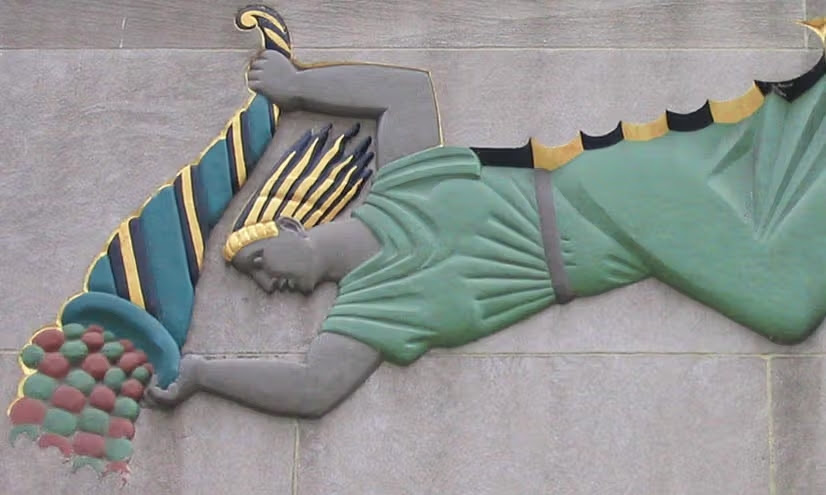
Cornucopia of Plenty
Lee Lawrie with colorist Leon V. Solon
American, born Germany. 1877 – 1963
10 West 51st Street
This polychrome-painted stone carving depicts a messenger soaring from the clouds, emptying an overflowing horn onto the earth. Lee Lawrie wrote that it symbolizes “the plentitude that would result from well-organized international trade”, a theme compatible to the activities of the building. The figure’s downward angle, her flowing golden hair and the dramatic spilling of contents from her cornucopia all skillfully convey a feeling of motion and energy.
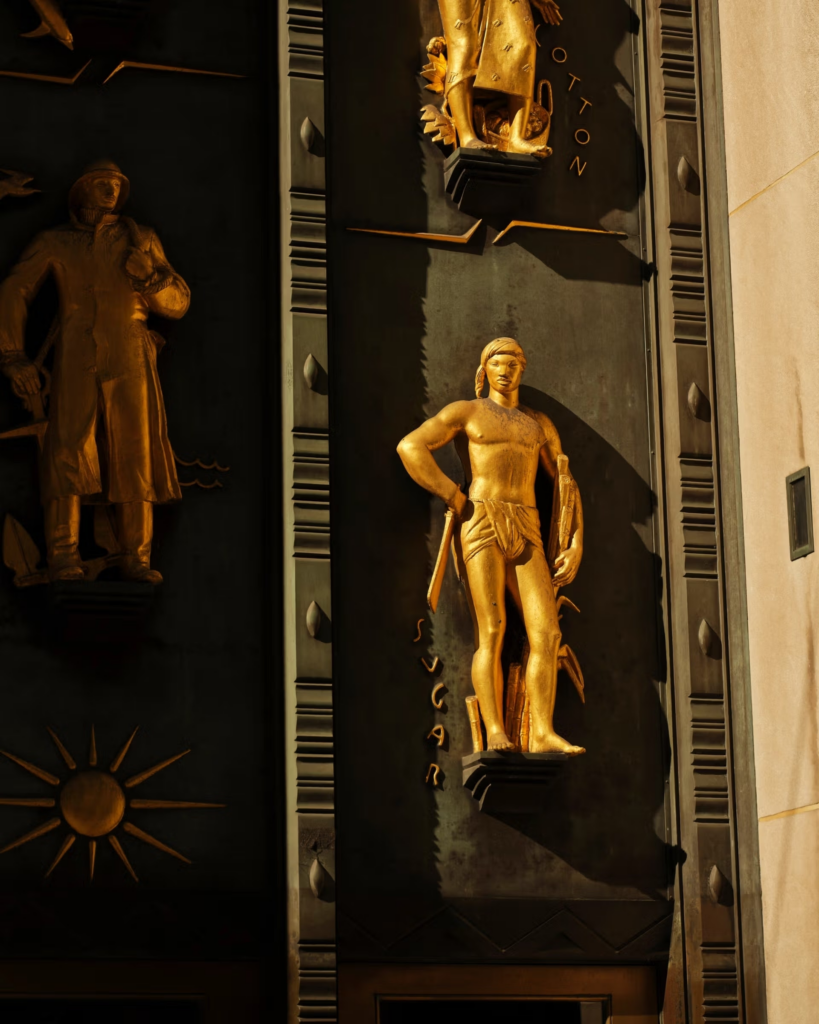
Industries of the British Empire
Carl Paul Jennewein
American, born Germany. 1890 – 1978
Above 620 Fifth Avenue entrance
The nine gilded allegorical figures on this large bronze panel represent industries that were once considered major sources of income for the British. Depicted as beautiful, unemotional and idealized, they include Coal, Fish, Salt, Tobacco and Sugar. Australia is symbolized by Wool, Canada by Wheat and Africa by Cotton. A stylized sculpted sun is symbolic of the saying, “The sun never sets on the British Empire.” In New York City, Jennewein’s works can also be found at the Brooklyn Central Library and the Metropolitan Museum of Art.
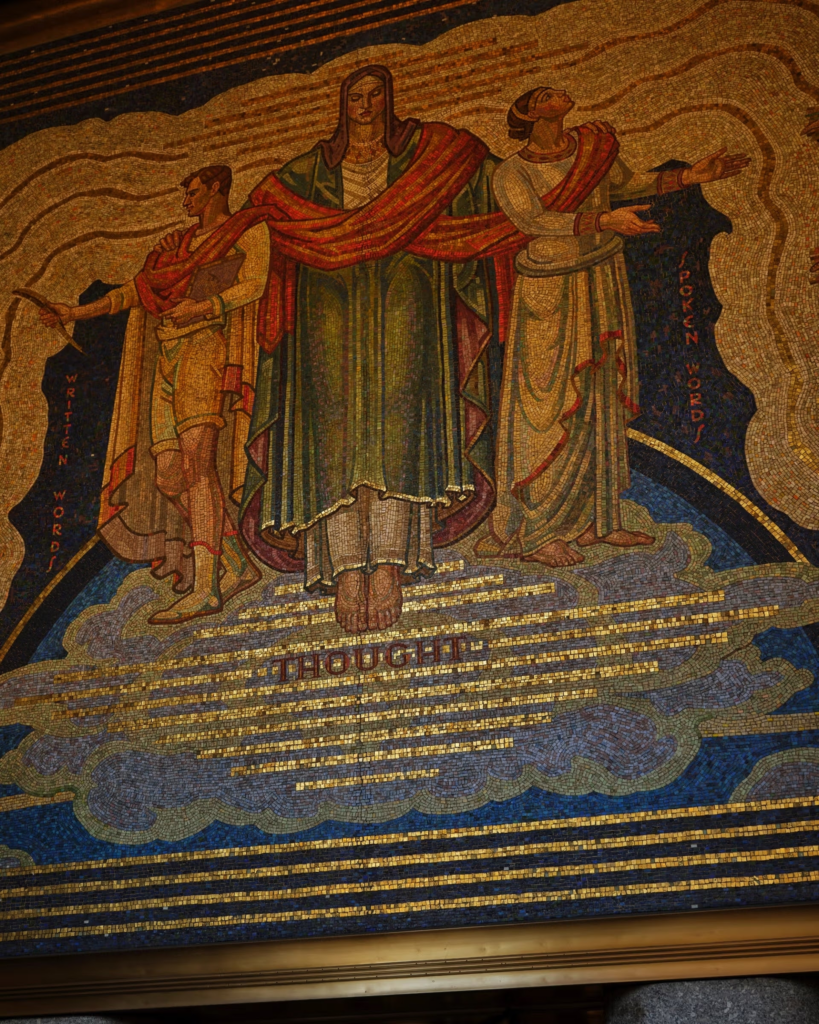
Intelligence Awakening Mankind
Barry Faulkner
American. 1881 – 1966
1250 Avenue of the Americas
This mosaic of small glass tiles (tesserae) is composed of over one million glass tiles in two hundred and fifty colors, each hand-cut and hand-set. The work is a narrative concerning the triumph of knowledge over the evil of ignorance. The central figure of thought (intelligence) stands above the world, controlling the action in the mosaic; the two other powerful figures in this piece are spoken words and written words. Other figures symbolize creativity, ideas and intellectual efforts. The mosaic’s message is that thought will propagate new knowledge and advance civilization.
News
Isamu Noguchi
American. 1904 – 1988
Above 50 W 50th Street entrance of 30 Rockefeller Plaza
Soaring above the entrance to 50 Rockefeller Plaza, this dynamic plaque symbolizes the business of the building’s former tenant, the Associated Press. One of the major Art Deco works in the Center, it depicts five journalists focused on getting a scoop. AP’s worldwide network is symbolized by diagonal radiating lines extending across the plaque. Intense angles and smooth planes create the fast-paced rhythm and energy of a newsroom. News is the first heroic-sized sculpture ever cast in stainless steel and the only time Noguchi employed stainless steel as an artistic medium.
CREDITS
Rockefeller Center
All image are copyrighted (c) Roosevelt Island Historical Society unless otherwise indicated
THIS PUBLICATION FUNDED BY DISCRETIONARY FUNDS FROM CITY COUNCIL MEMBER JULIE MENIN & ROOSEVELT ISLAND OPERATING CORPORATION PUBLIC PURPOSE FUNDS.


Copyright © 2026 Roosevelt Island Historical Society, All rights reserved.Our mailing address is:
rooseveltislandhistory@gmail.com
Leave a comment