
Friday – Sunday, March 6-8, 2026 – Tiffany & Co.: Home is Where the Clock Is

The 1905 Tiffany & Co. Building
401 Fifth Avenue
&
Tiffany & Co.’s 1853 Atlas Clock
Friday-Sunday, March 6-8, 2026
ISSUE #1640
Daytonian in Manhattan
Tiffany & Co Building
401 Fifth Avenue
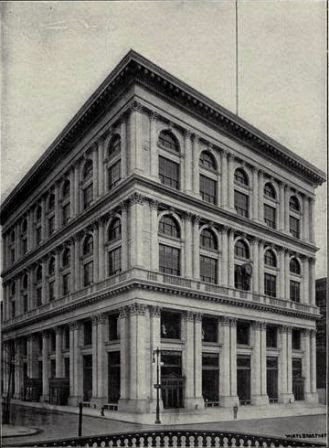
Young Charles Tiffany opened his first tiny store opposite City Hall in 1837, in the middle of America’s first great depression. When he died 65 years later in 1902 leaving an estate of $35 million, his store had become the benchmark of the jewelry business in America and the name Tiffany & Company synonymous with quality.
Tiffany’s store had moved to Union Square in 1870. The new cast iron store was praised by The New York Times as “a Jewel Palace…the largest of its kind in the world. A school of taste…a teacher of art progress.”
Charles Tiffany kept a staff of seven whose jobs were simply to keep files on the wealthy socialites across the country. Photographs, newspaper clippings and details of their financial position were kept at hand so that when moneyed patrons entered they were recognized, addressed by name and allowed to take their purchases without paying upfront. According to Tiffany, “When we give credit to anyone who had supposed himself unknown to us we are sure to retain him forever.”
At the time of this death at 90, Tiffany was planning to move his store once again. Fifth Avenue was the center of wealth in New York and the Waldorf-Astoria Hotel between 33rd and 34th Streets was where the well-heeled went to be seen. Diagonally across the street, at 401 Fifth Avenue between 36th and 37th Streets, the new Tiffany store would rise.
Tiffany’s vision moved ahead and the board of directors commissioned McKim, Mead & White to design the new store; a building appropriate to its surroundings. The move in 1905, along with Benjamin Altman’s great white marble emporium next door that would open a year later, would signal the upward encroachment of commerce into the Fifth Avenue stronghold of brownstone mansions and marble chateaux.
What Stanford White produced was, as novelist Henry James called it “a great nobleness of white marble.” Drawing on the Sixteenth Century Venetian Palazzo Grimani, the architect designed one of the most beautiful buildings of his career. The completed structure cost $1 million.
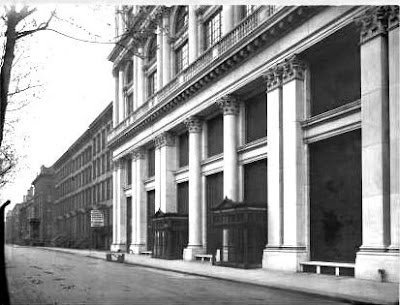
According to Francis Morrone and James Iska in their The Architectural Guidebook to New York, “There is a phenomenal lightness to this building that is an almost perfect amalgam of the Beaux-Arts and the Modern; the Tiffany Building is a truly underappreciated work that makes one wonder what White might have produced had he not died so tragically young.”
Indeed, Edmund Vincent Gillon and Henry Hope Reed felt White outdid the original. In their Beaux-Arts Architecture in New York: A Photographic Guide, they said “In some ways, thanks to the proportions given it by White, the Tiffany Building is superior to the model.”
Through its doors came brigades of New York’s and the world’s elite. In the days when society women draped themselves in pearl ropes and weighed themselves down in diamonds, the robin’s egg blue Tiffany & Co. box, introduced in 1847, had become a symbol of status.
With the Russian Revolution, which was quickly followed by World War I, times changed in Europe. As royal houses fell the exiled nobles sold off their jewels for desperately-needed cash. Many of these ended up in the vaults of Tiffany & Company. From their white marble palazzo, Tiffany customarily sold $6 million in diamonds each year. There were often over $40 million in jewels in the vault.
The one Tiffany & Company item no one seemed ready to purchase, however, was the Tiffany Diamond; the 128.5-carat gem still sits in the New York store, valued today at $22 million.
In 1940 Tiffany & Co. once again moved, this time uptown to Fifth Avenue and 57th Street. The move signaled a decline in what Morrone and Iska called “…maybe Fifth Avenue’s most beautiful building.”
While much of the upper building remained intact, the street level was brutalized. Pseudo-modern storefronts obliterated the Stanford White facade. “The beholder is shocked by the vandalism inflicted on the lowest row of columns on the Fifth Avenue front,” lamented Gillon and Reed.
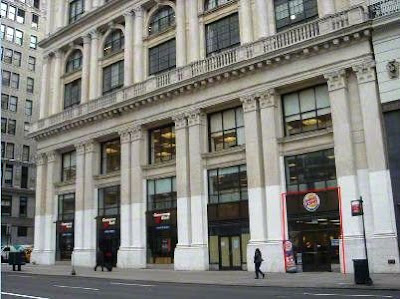
In 2003 an aggressive restoration brought back the three-story Corinthian columns that had been obliterated mid-century. Yet today, where Astors and Vanderbilts once shopped for silver ewers and diamond brooches, tourists in sneakers and shorts inhale Whoppers. And the building that Gillon and Reed termed “underappreciated” is in fact mostly overlooked and ignored.
Tiffany & Co.’s 1853 Atlas Clock
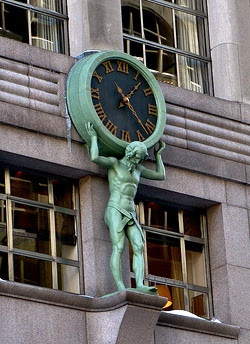
Charles Tiffany, during the midst of America’s first great depression, opened his first small store across from City Hall in 1837. His business thrived and ten years later he moved across the street to 271 Broadway. By 1853 Tiffany & Co. had established itself as a leader in the quality jewelry trade and Tiffany built an impressive new building at 550 Broadway. Feeling that the façade was “monotonous,” he commissioned his good friend Henry Frederick Metzler to carve a 9-foot tall figure of Atlas to be situated over the entrance, holding a clock, four feet in diameter.
Metzler was a carver of ships’ figureheads, or “bow portraits.” The bearded, lanky figure was a distinct departure from the hulking, muscular Atlases produced by most contemporary artists. Naked except for a crossed leather strap, Metzler’s Atlas does not bend under his burden, but stands upright and dignified. The left foot is poised to take a step off the statue’s base.
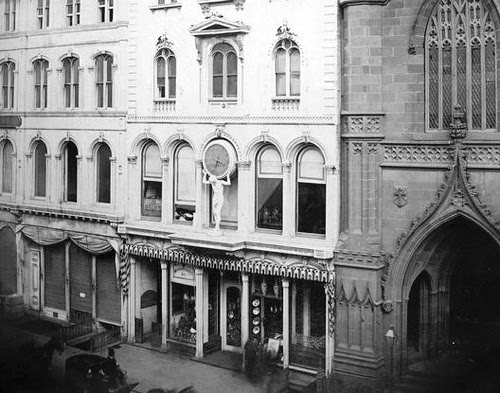
The carver did not attempt to present an heroic figure and instead created a realistic, natural human form; a masterpiece of woodcarving and design. When completed, the wooden Atlas, carved of fir, was painted to mimic the patina of weathered bronze.
Seventeen years later, in 1870, Tiffany & Co. followed the uptown movement of the retail establishments and opened a grand new store on Union Square. With the move came the clock, which was installed directly over the main entrance in a window opening.
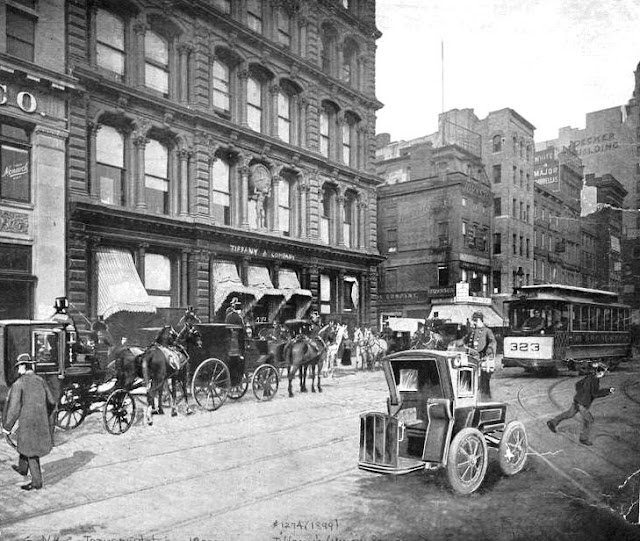
For 35 years the Atlas clock served shoppers and businessmen rushing along busy Union Square until Tiffany & Co. moved once again – this time to the imposing white marble palazzo designed by Stanford White on Fifth Avenue between 36th and 37th Streets. By now the Atlas clock was as much a symbol of Tiffany as was the robin’s egg blue box. With the clock on the façade, there was no need for advertising.
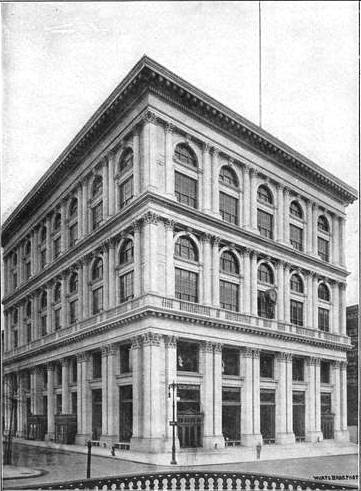
“Tiffany & Co. have decided to let the building remain practically unmarked,” reported The New York Times on September 6, 1905. “The only mark of Tiffany about the new building is the great clock outside of the third story on the shoulders of a giant Atlas. This ornament was taken from the Union Square store.”
The uptown odyssey was not yet over for Atlas. On September 7, 1940 a The New York Times headline read “Tiffany’s Atlas Moved; Clock Mounted on Wood Figure is Place on New Home.” Tiffany & Co. had built its next flagship store, a sleek modern structure at 727 Fifth Avenue at the corner of 57th Street. According to Tiffany & Co., “The limestone, granite and marble façade is free of ornamentation, except for the famous Atlas clock.”
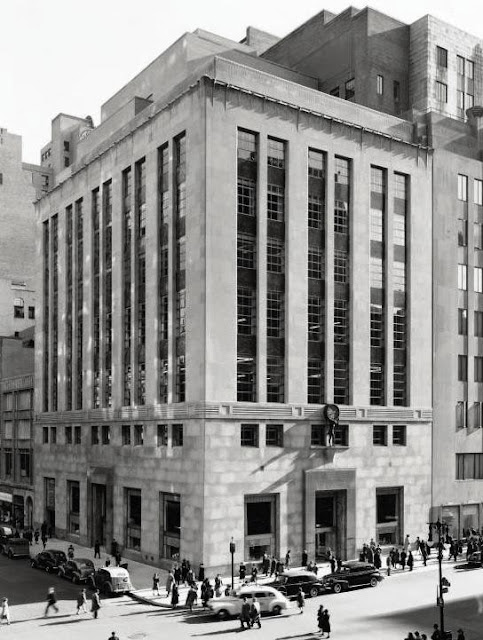
The Atlas Clock in its present location at Tiffany & Co.’s 5th Avenue and 57th Street building, ca 1940 – NYPL Collection
In 1980 Tiffany & Co. introduced the Atlas wristwatch, based on the design of the iconic clock outside. Atlas was removed in 1990 for restoration and again in 2006.
After more than a century and a half, Henry Frederick Metzler’s functional sculpture remains a fixture on Fifth Avenue and a priceless symbol of a firm. Amazingly, the mid-Victorian design is comfortably compatible with the streamlined façade on which it rests.
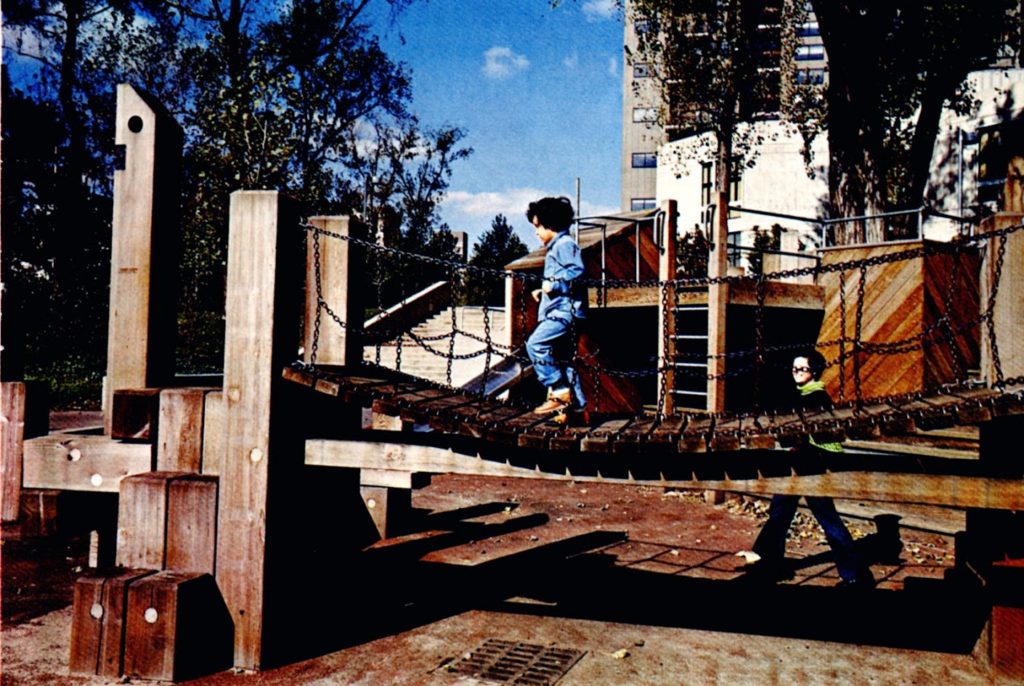
PHOTO OF THE DAY
The original Blackwell Playground was
an experience of timber, chains, ramps and ladders on a brick surface.This playground was replaced by something safer in the 1980’s
CREDITS
UNTAPPED NEW YORK
NATIONAL POSTAL MUSEUM/ SMITHSONIAN MUSEUM
All image are copyrighted (c) Roosevelt Island Historical Society unless otherwise indicated
THIS PUBLICATION FUNDED BY DISCRETIONARY FUNDS FROM CITY COUNCIL MEMBER JULIE MENIN & ROOSEVELT ISLAND OPERATING CORPORATION PUBLIC PURPOSE FUNDS.


Copyright © 2026 Roosevelt Island Historical Society, All rights reserved.Our mailing address is:
rooseveltislandhistory@gmail.com
Leave a comment