
Thursday, May 5, 2022 – WE MIGHT NOT BE TOO EXCITED WITH THESE NEIGHBORS


FROM THE ARCHIVES
THURSDAY, MAY 5, 2022
THE 667th EDITION
New visitors to New York
Stephen Blank
New visitors to New York
Stephen Blank
Whales are here and whale watching is a new addition to New York’s list of wonders. Another visitor has shown up, too – seals. We’re likely to see a lot more of them in the near future.
Two types of seals now hang out around here: Harbor Seals and Gray Seals. The Harbor Seal is a small seal, but with a distinctive rounded, short-muzzled head and spotted coat. Its eyes are very large and front flippers short. Nostrils form a wide “V” and ear openings are inconspicuous. The Gray Seal is bigger, and sometimes called “horseheads” because adult males have large, horse-like heads and large, curved noses.
They are both members of the “true” seal family. All true seals have short flippers, which they use to move in a “caterpillar”-like motion on land. They have no external ear flaps.

Harbor and Gray Seals visit New York. Photo by Celia Ackerman/Gotham Whale
Both like cold water, and they are typically found in large numbers in the coastal waters of Canada and south to Nantucket. In Canada, Gray Seals are typically seen in the Gulf of St. Lawrence, Newfoundland, the Maritimes, and Quebec. The largest colony in the world is at Sable Island, Nova Scotia. Harbor Seals are found year-round off the coast of New England, in particular Maine and Massachusetts.
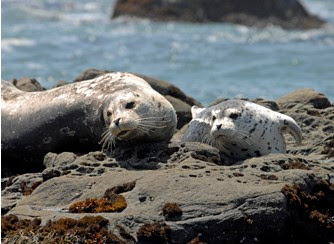
Photo courtesy of the Marine Mammal Center – Two Harbor Seals (Phoca vitulina) resting on a beach
These are not Sea Lions which are not seals – and that’s very important. California Sea Lions range up to 800 pounds, much bigger than the 300-pound Harbor Seal – although Gray Seals are a good deal larger than Harbor Seals. Sea Lions bark and use their front-body (head, neck, shoulders, chest, and front flippers) to swim, and can “walk” on land with their flippers (and clap). Harbor and Gray Seals are relatively quiet and spend more of their time out at sea. They swim primarily with their back-body (lower back, hips, and rear flippers). Though graceful in the water, they move clumsily on land because they can’t rotate their flippers like Sea Lions. Instead, they must flop or wiggle along on their bellies.
Because of their ability to use their flippers on land, Sea Lions often haul themselves out of the water and onto buoys, docks/piers, and sometimes even up onto fishing boats. They become territorial in some ports, taking over piers and docks. Their “seizure” of certain piers in San Francisco has become infamous.
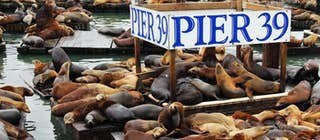
Seals don’t form large groups like Sea Lions. Sometimes, a group will gather at a haul-out site (a haul out site is a waterside spot where seals come ashore to rest or where food can be found). Even when they haul out together, Harbor Seals are wary onshore, and don’t touch each other, unlike Sea Lions who are much more sociable and generally hang out in large groups. Harbor Seals are sensitive and don’t like people getting close.
Seasonally monogamous, Harbor Seals are mostly solitary and don’t form harems. They begin to gather in small, mixed groups in late summer. The loose groups show no hierarchy. Mature seals (about 5 years old) pair up and, in September, swim off to secluded areas where they generally breed in the water. The marginally larger males are opportunistically promiscuous but defend no territory or harem group. Gray seals gather in large groups during the mating/pupping and molting seasons. Outside of this, they often share their habitat with Harbor Seals.
Seals were long residents of our region. In colonial times, there were huge populations of seals. They were driven out by excessive hunting for their oil, meat and skins. Because they ate fish, they were seen as competitors and bounties were paid on all kinds of seals up until 1945 in Maine and 1962 in Massachusetts. One could go into the town hall in Chatham and collect a $5 bounty per seal nose. They were called “seal buttons.” And increasingly polluted waters either drove them away or killed them. From the oil industry in the late 1800s to chemicals like PCBs and dioxins in the 1950s, the filthy waters could not sustain much life. So remaining seals cleared out.
After a century long absence, seals have begun to return in winter to New York City for a little rest and relaxation. They are returning because what drove them away have been sorted. The 1972 Clean Water Act was pivotal: a federal law designed to limit the discharge of pollutants into the nation’s waters and improve the quality of water for fishing and swimming, and our waters are much cleaner. Around the same time, seals’ lives were improved by the Marine Mammals Protection Act of 1972, which made it illegal to harass, feed, capture, collect, kill, import or export any marine mammal. Their traditional environment here is cleaner and safer.
At first seal populations increased slowly (a year after Congress passed the 1972 Marine Mammal Protection Act, a survey of the entire Maine coast found only 30 Grey Seals) but then rebounded from islands off Maine to Monomoy Island and Nantucket Island off of southern Cape Cod. The southernmost breeding colony was established on Muskeget Island with five pups born in 1988 and over 2,000 counted in 2008. According to a genetics study, the United States population has formed by recolonization by Canadian seals. By 2009, thousands of Grey Seals had taken up residence on or near popular swimming beaches on outer Cape Cod, A count of 15,756 grey seals in southeastern Massachusetts coastal waters was made in 2011 by the National Marine Fisheries Service. Grey and Harbor Seals are being seen increasingly in New York and New Jersey waters, and it is expected that they will establish colonies further south.
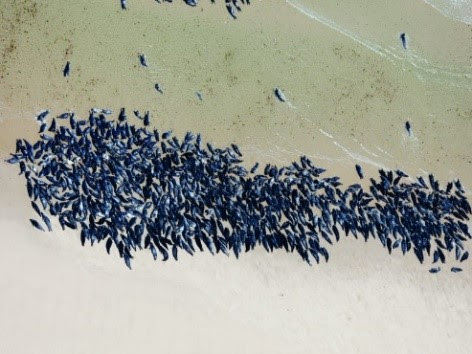
Gray seals on Cape Cod beach. Photo Credit: Wayne Davis, oceanaerials.com
In New York, we see Harbor Seals that migrate south from arctic waters in Nova Scotia, Maine, and Cape Cod to the warmer waters surrounding our city. They vacation here from about October through April before heading north to breed. Our winter is their summer. As one urban park ranger put it: “New York is like their Miami resort.”
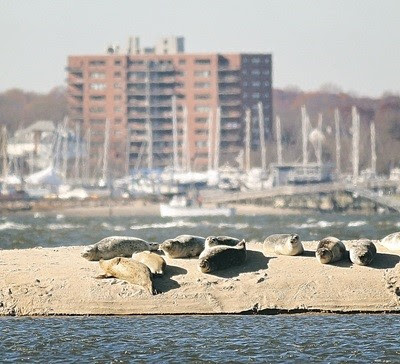
A small pod of Harbor seals spotted resting on a remote sandy island in New York Harbor before Thanksgiving Day
https://www.nyharbornature.com/uploads/6/9/1/8/69187715/img-8231-fotor_orig.jpg

Our Harbor Seal population is now stable at around 600, most near Orchard Beach in the Bronx and on Swinburne Island. The return of the seal is a “bioindicator of ecosystem health,” experts recent wrote. The seals are here in part, they wrote, because there are fish to eat and the quality of food can support them year after year, which represents “a clear example of local fauna reclaiming previous habitat.” Although the seals must watch out for boat traffic and can be stressed by motorized noise, their stability tells us that they and our water are doing better, but it also helps us prepare for more human interactions with seals, which are inevitable.
They’re not Sea Lions. But there are still problems. Anglers claim that seals steal their catch, right off their lines. “Ten years ago, we never saw seals, but now they’re everywhere,” said Willy Hatch, who’s been fishing the Cape and Islands for over 25 years. “They’re at Squibnocket Beach, Vineyard Sound, the Elizabeth Islands, Woods Hole, the Muskeget Channel. Often, the seals hear me anchor up and set up behind my boat. If I manage to hook a fish, a seal takes it right off my line. It gets worse every year as their population increases and their range expands.” As the seal population has increased. Cape Cod and the Islands are ground zero for a growing conflict between striper fishermen and seals. Since stripers are the great goal in New York waters, this conflict may spread here.

A gray seal snatches a striped bass off a fisherman’s line in the Cape Cod Canal. Encounters with seals shadowing anglers have become more common in recent years.
And great white sharks. There’s been a direct correlation between the increasing abundance of seals on the Cape and Islands and the growing presence of great white sharks. But it’s not because there are more sharks. More simply, as the seal population has increased, more great whites are hanging out where the seals are.
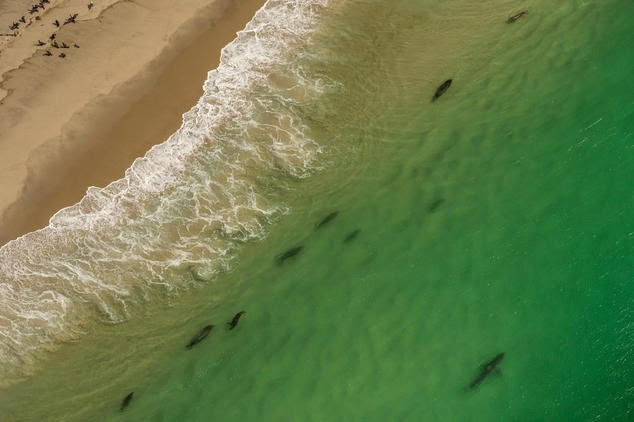
A great white shark hunts for gray seals in waters off the coast of Cape Cod. National Geographic/Alamy
And they stink. They eat fish and their plentiful poop is fishy and smelly.
That’s what happens when new folks arrive in the neighborhood. New folks, new adventures, new problems. Isn’t Nature grand?
Stephen Blank
RIHS
April 28, 2022
THURSDAY PHOTO OF THE DAY
SEND YOUR ANSWER TO ROOSEVELTISLANDHISTORY@GMAIL.COM
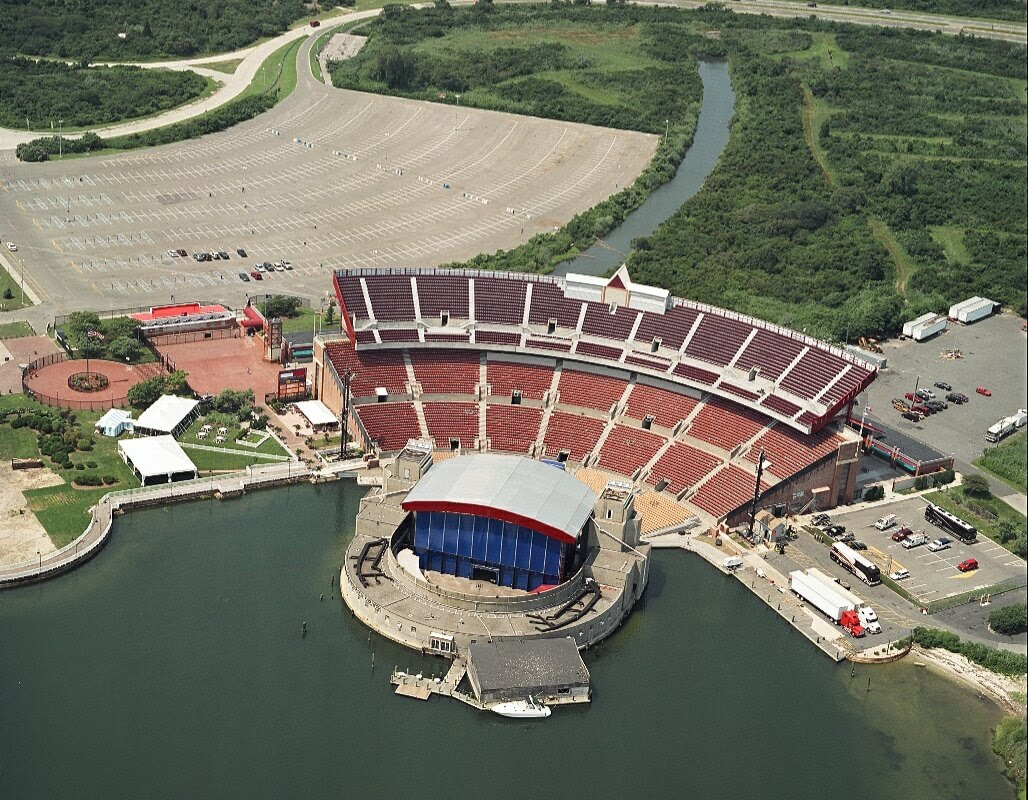
WEDNESDAY PHOTO OF THE DAY
CIVIC FAME ON TOP OF THE MUNICIPAL BUILDING
LAURA HUSSEY, ED LITCHER, ANDY SPARBRG, GLORIA HERMAN GOT IT RIGHT.

Text by Judith Berdy
Thanks to Bobbie Slonevsky for her dedication to Blackwell’s Almanac and the RIHS
Thanks to Deborah Dorff for maintaining our website
Edited by Deborah Dorff
All image are copyrighted (c)
Sources
https://www.onthewater.com/cape-cods-seal-problem
https://www.nps.gov/cabr/blogs/seal-or-sea-lion.htm
https://www.nyharbornature.com/uploads/6/9/1/8/69187715/img-8231-fotor_orig.jpg
FUNDING PROVIDED BY ROOSEVELT ISLAND OPERATING CORPORATION PUBLIC PURPOSE GRANTS CITY COUNCIL REPRESENTATIVE BEN KALLOS DISCRETIONARY FUNDING THRU DYCD


Copyright © 2022 Roosevelt Island Historical Society, All rights reserved.Our mailing address is:
rooseveltislandhistory@gmail.com
Leave a comment