Tuesday-Wednesday, September 23-24, 2025 – The days past of a thriving Jewish community of immigrants
“GENERATIONAL PERSPECTIVES”
Program at the RI NYPL, Monday, Sep. 29th, 6:30 p.m.
CELEBRATING OUR ISLAND AT 50 YEARS
How long have you lived on Roosevelt Island?
How many generations of your family have the Island their homes?
Our island has been home to many generations of families. It is easy to name so many families whose parents, grandparents arrived here in the 1970’s and 1980’s and now their families are raising kids, grand kids and even great grand-children.
Why is this so common?
What is it like to have all the generations near?
Join us for this discussion with our multi-families.
This program is sponsored by the
ROOSEVELT ISLAND HISTORICAL SOCIETY
THE NEW YORK PUBLIC LIBRARY.
This program is free and open to all.
VISUALIZING JEWISH NEW YORK
Tuesday-Wednesday, September 23-24, 2025
New York Public Library
Issue # 1539
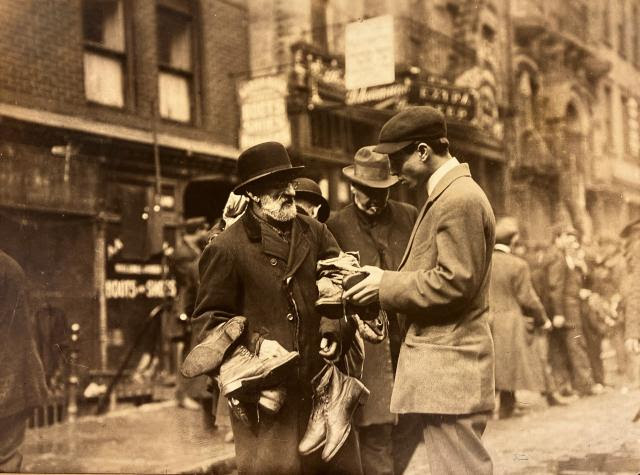
Percy Loomis Sperr, 1890–1964, “Shoes–peddler, Lower East Side”
New York, ca. 1930–34
Visualizing Jewish New York
Jewish life in New York drew the attention of many prominent photographers whose affection and fascination for the city found diverse expression in the early and mid 20th century. During this time, the Jewish population of the city was growing exponentially; it reached 1.6 million in 1920. Naturally, The New York Public Library became home to extensive collections by both Jewish and non-Jewish photographers who offer intriguing snapshots of Ellis Island and street scenes from the Lower East Side, the hub of early 20th-century Jewish life in New York City. They demonstrate the many different approaches to capturing scenes and people. There are the socially driven “photo-studies” by Lewis Wickes Hine (1874–1940), the meticulous and exhaustive explorations of Lower East Side architecture and immigrant life by Percy Loomis Sperr (1890–1964), the ever-changing New York landscapes of Berenice Abbott (1898–1991), and Morris Huberland’s (1909–2003) intergenerational portrayals of the Jewish inhabitants of the Lower East Side. Together, these images celebrate the energy and aspirations of the vibrant, dynamic Jewish community of New York.
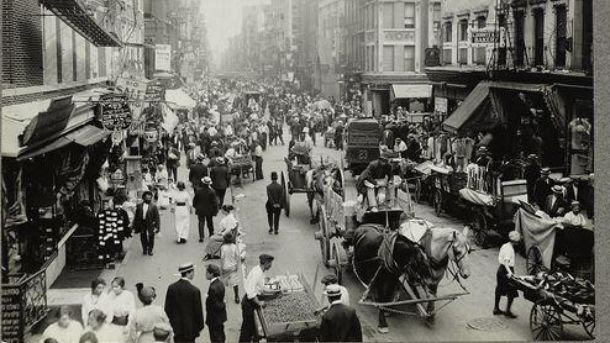
Market Day in the Lower East Side
Lewis Wickes Hine, 1874–1940
“Market day in Jewish quarter of East Side, New York City – 1912”
New York, 1912
In this photograph, Lewis Wickes Hine masterfully captures the vibrant life, dynamism, and exuberant spirit of the Lower East Side in 1912. Its atmosphere calls to mind the bustling market days in the Jewish towns in Eastern Europe, while the skyline of tenement houses and the pedestrians dressed in their Sunday best place the viewer in New York’s “Jewish quarter of East Side.”
The photograph offers a fascinating view down a long, unnamed busy street somewhere at the heart of the Lower East Side’s Jewish neighborhood. A seemingly endless row of shops lines both sides of the street, punctuated with pushcarts moving in different directions or stationed in the middle of the street, loaded with an array of wares ready to tempt some new Americans on a beautiful warm Sunday.
Hine indeed reveals the American life in the making, in the midst of the Lower East Side
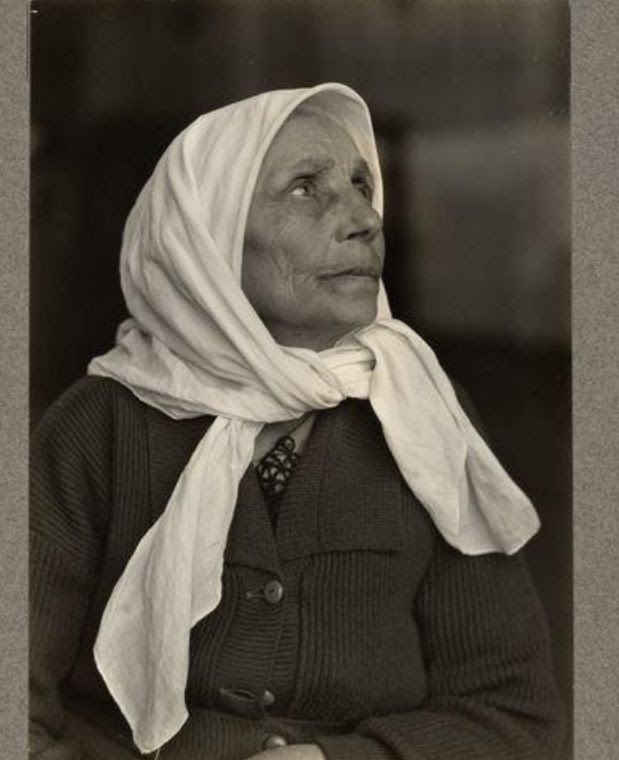
Jewish Grandmother on Ellis Island
Lewis Wickes Hine, 1874–1940
“Jewish Grandmother – Ellis Island, 1926”
New York, 1926
Lewis Wickes Hine was a renowned American sociologist and photographer who pioneered the use of the camera as a tool for social reform. He was born in Oshkosh, Wisconsin, and moved to New York in 1901. He studied sociology at the University of Chicago and Columbia University. Starting around 1904, he took thousands of photographs of immigrants who arrived at Ellis Island daily. He often referred to his work as “photo-studies,” as he was trying to see his models in detail, to deepen the perspective and make his art more impactful. For Hine, the new immigrants were not a faceless mass, but rather, vital individuals captured in real situations of life. Without depriving them of their personalities, he presented them as a group, thus amplifying the social message he aimed to deliver.
Hine frequently accompanied his gallery of portraits of Jewish immigrants on Ellis Island and scenes on the Lower East Side with some associative quotations by authors or with his own notes. These helped to frame a specific message and communicate it so the viewers would study his works from the societal point of view.
In this photograph that Hine captured on Ellis Island in 1926, the steady gaze of the Jewish grandmother is directed skyward, as though she is engaged in some kind of silent prayer.
“So this is America,” wrote Hine on the accompanying note card, as if reading the woman’s thoughts. He continued: “This Jewish grandmother’s face is filled with awe and hope, as she looks towards the land for which her people have gained, and to which they have given so much.”
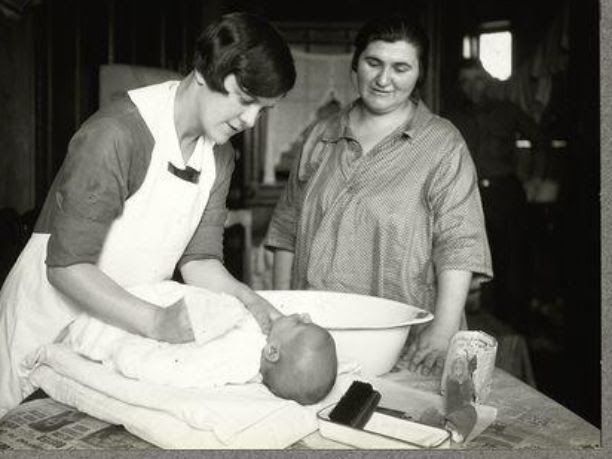
Lewis Wickes Hine, 1874–1940
“A Visiting nurse showing Jewish mother how to care for the baby, East Side, New York – 1925”
New York, 1925
In the early 20th century, numerous immigrant welfare organizations in New York City, including the prominent Educational Alliance on the Lower East Side, played a crucial role in providing services to the newcomers. These ranged from vocational training to language instruction to healthcare, all to help the immigrants adjust to their new country. Nursing classes were available to young mothers, who were strongly encouraged to take them. The classes showed the women how best to care for their babies and helped them to embrace the new, progressive American health and hygiene practices.
In this captivating photo-study from 1925 by Lewis Wickes Hine, we witness a revealing moment of interaction between two young women, a visiting nurse and a mother, both lovingly attending to a baby in one of the Lower East Side tenement apartments. Despite their proximity in age, they seem to belong to two different generations and even worlds, although they may be speaking Yiddish to each other. The younger woman, a nurse, most likely an immigrant herself, seems to be a well-established professional with more American experience. She shows the other woman, most likely a more recent immigrant, how to care for the child. The mother is observing the process with tender attention, but with a hint of hesitation on her face.
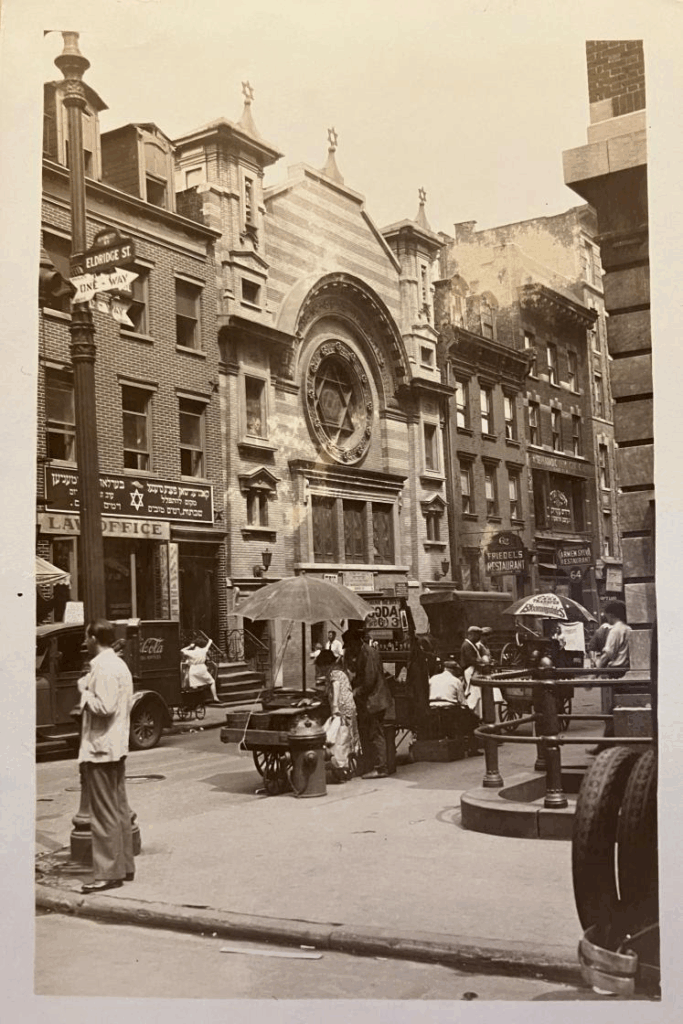
Percy Loomis Sperr, 1890–1964
“Manhattan: Rivington Street – Eldridge Street”
New York, 1930
Percy Loomis Sperr not only documented the addresses of the buildings on the streets that he captured in his photographs, but he also considered it essential to describe the local landmarks.
This photograph offers a snapshot of Rivington Street on July 23, 1930. Sperr’s typewritten note states: “56 to 64 Rivington Street, north side, east from but not including Eldridge, to but not including Allen streets, showing the Warshauer First Congregation Synagogue (No. 58-60).” He goes on to indicate: “The Congregation was organized in 1889 and conducts services in Hebrew.”
The synagogue is featured on the left side of the photograph in the context of daily bustling life on the street. It captures pushcarts lined up right across from the building, vendors and their customers, pedestrians, and cars parked on the pavement. Adjacent establishments, such as a law office and Friedel’s restaurant, are also in the frame.
The synagogue building was constructed in the Moorish Revival style by the renowned architect Emery Roth (1871–1948), a Hungarian Jewish immigrant who designed many Beaux Arts buildings in the city. It was originally built for the congregation Adath Jeshurun of Jassy, serving immigrants from Iași, Romania. But in 1907 the building changed hands and was sold to the First Warshauer (Warsaw) Congregation, which remained on the premises until 1973. Sperr’s photograph of 1930 may be the earliest surviving photographic documentation of this historic synagogue. The Library has other images of the same synagogue that the Polish-American photographer Morris Huberland (1909–2003) captured in the 1970s, apparently after the congregation’s departure.
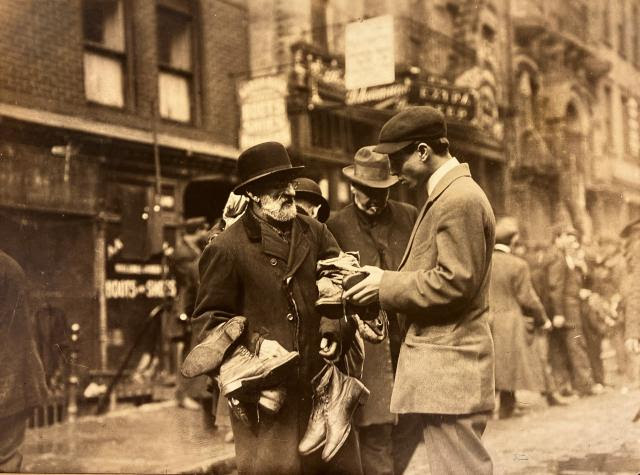
Percy Loomis Sperr, 1890–1964
“Shoes–peddler, Lower East Side”
New York, ca. 1930–34
Percy Loomis Sperr was an American photographer best known for his meticulous documentation of the streets of New York in the 1920s through the 1940s. This resulted in more than 30,000 images for The New York Public Library’s “Streetscape and Townscape of Metropolitan New York City, 1860–1942” project as well as for the “New York City, Immigrant Life” project. During this period, Sperr was an employee of the Library, working primarily in the Lionel Pincus and Princess Firyal Map Division. His librarian’s skills and access to the relevant resources added depth to his systematic explorations of the city. What makes the results of his work even more impressive is that this man with his small, simple camera was walking dozens of miles around the city’s five boroughs on crutches, as his right leg was paralyzed from childhood.
In terms of the studies of New York’s Jewish neighborhoods, Sperr’s collection is a precious gift and a trove of information on what the theaters, synagogues, shops, and tenement houses looked like in those days, and how life was conducted on the streets around these buildings. Sperr’s photographs reflected his fascination with immigrant communities and people in general, thus preserving for us many street scenes that enhance our understanding of these neighborhoods in the context of daily life for that time.
In this photograph, one can imagine a lively conversation taking place between the elderly shoe peddler in a weathered coat and hat, whom Sperr characterized as “itinerant,” clutching several pairs of women’s and men’s second-hand shoes, and the younger, fashionably dressed customer. They are likely bargaining over a possible purchase while standing in the middle of the pavement on one of the bustling market days on the Lower East Side. The photograph dates to the early 1930s and offers a glimpse into this moment of exchange between generations and styles.
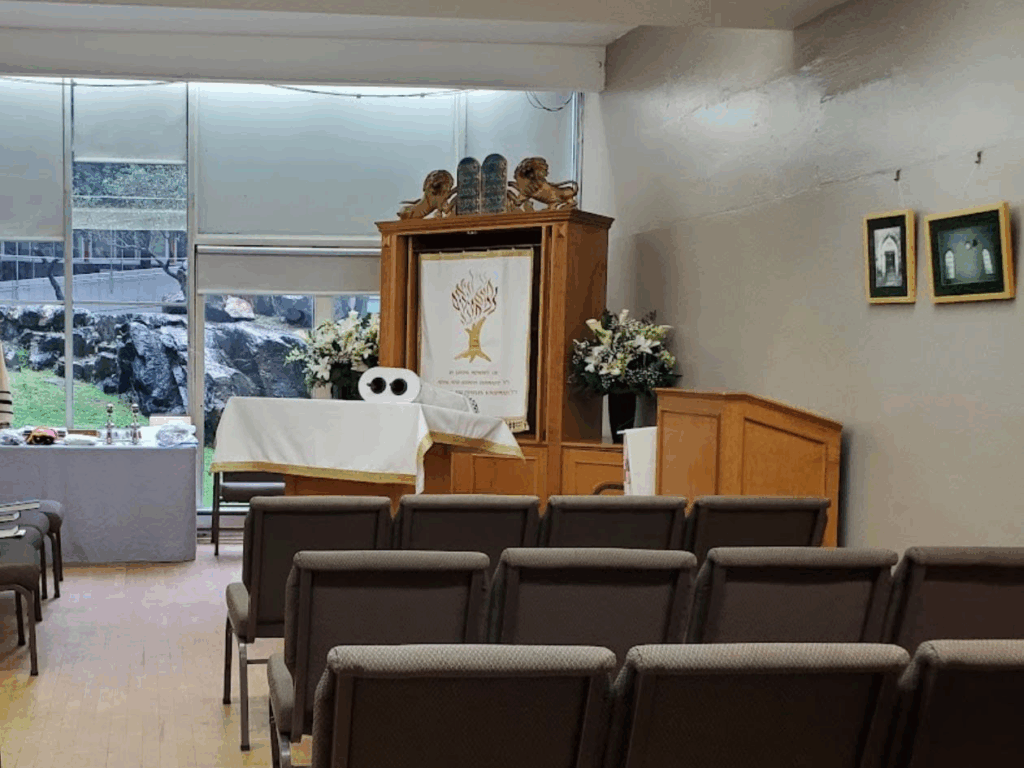
Your Seat Awaits at the RIJC.
www.rijc.org
CREDIT TO
New York Public Library
All image are copyrighted (c) Roosevelt Island Historical Society unless otherwise indicated
THIS PUBLICATION FUNDED BY DISCRETIONARY FUNDS FROM CITY COUNCIL MEMBER JULIE MENIN & ROOSEVELT ISLAND OPERATING CORPORATION PUBLIC PURPOSE FUNDS.


Copyright © 2025 Roosevelt Island Historical Society, All rights reserved.Our mailing address is:
rooseveltislandhistory@gmail.com
Leave a comment