
Wednesday, October 22, 2025 – A SOMBER MANSION ON 5TH AVENUE WITH GREAT ART

A Gilded Age Sugar Baron
and his Wife build a
Fifth Avenue “House of Fantasy”
for their Family and Art Collection
Ephemeral New York
Wednesday, October 22, 2025
Issue #1560
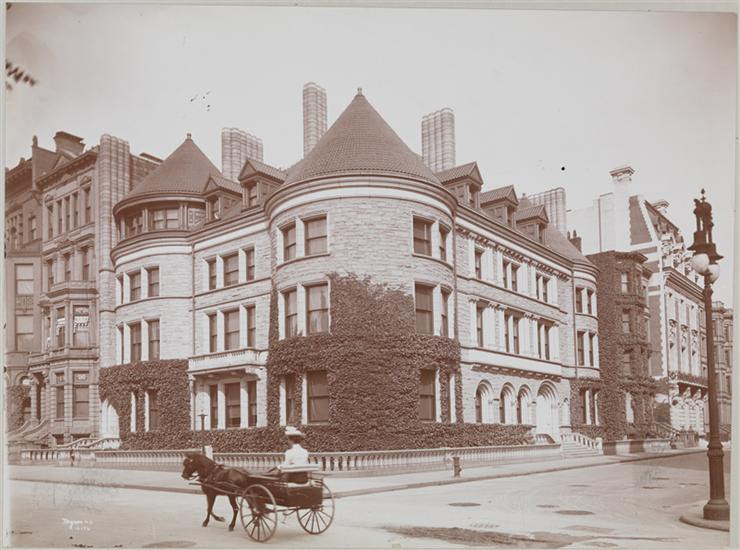
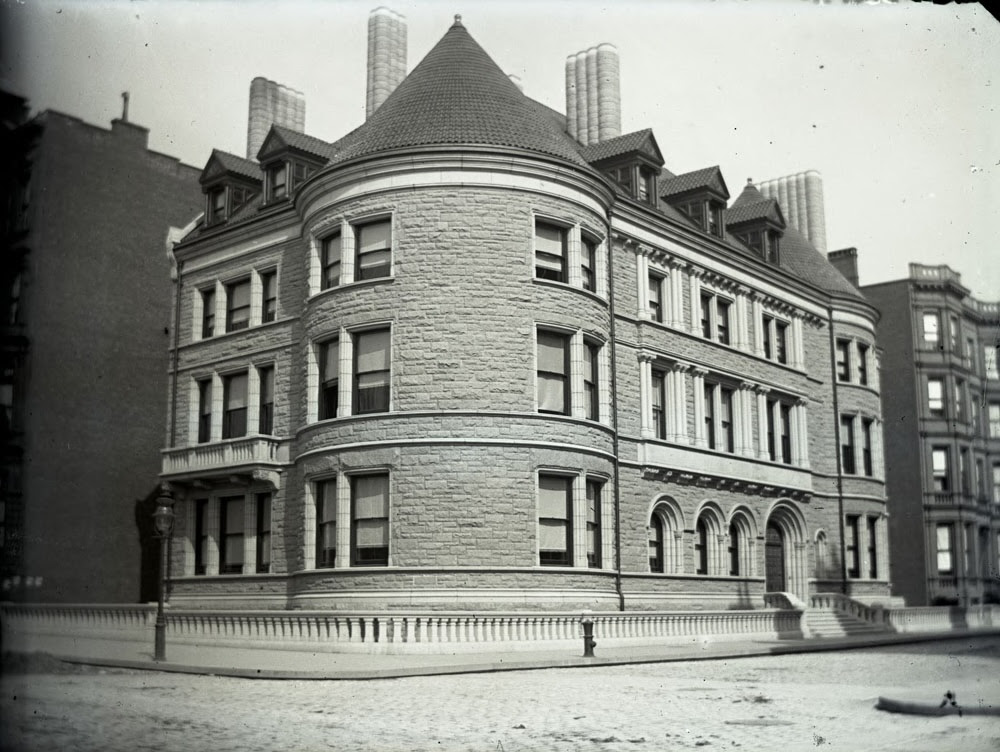
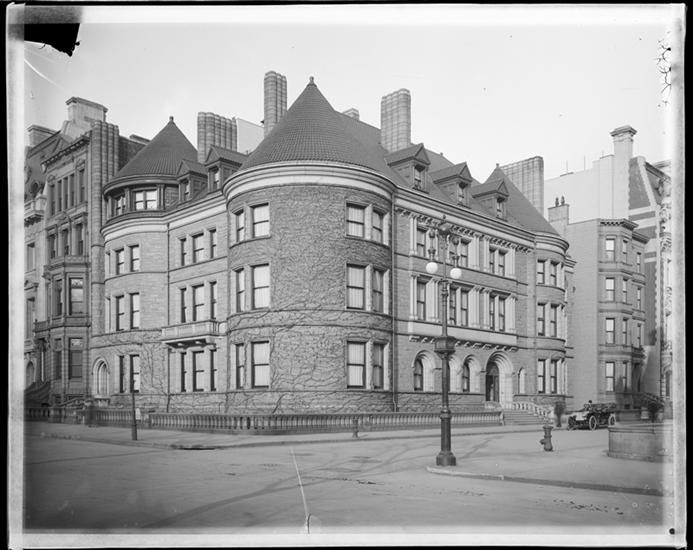
The house itself, a Romanesque Revival mansion completed in 1893 that spread across the northeast corner of 66th Street and Fifth Avenue like an open book, was sober and restrained.
Compared to Caroline and John Jacob Astor IV’s fantastical French Renaissance chateau one block south, as well as the many other gaudy showpieces lining the Gilded Age’s millionaire mile, it had an air of unobtrusive understatement.
But the rough-stone facade and turreted bays belied an interior so extraordinary, it made the house not just a family mansion but also a landmark of decoration filled with masterfully placed art and antiquities from all over the world.
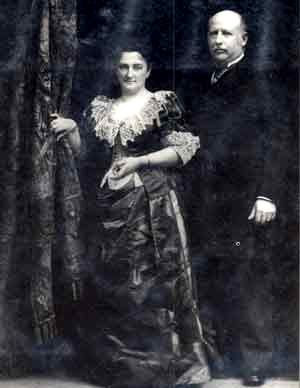
The husband and wife who built this “house of fantasy,” as one newspaper retrospective called it, were not only fabulously wealthy but also well-known in business, political, and social circles of the 19th and early 20th centuries: Henry O. and Louisine Havemeyer.
Henry Havemeyer—known as Harry—was the heir to a family sugar dynasty that operated a refinery along the East River in South Williamsburg. Hence Williamsburg’s Havemeyer Street, which may have been named for the sugary refinery or possibly for William Frederick Havemeyer, a relative who served three stints as New York’s mayor in the 19th century.
Starting as a teenage apprentice in the 1850s, Harry learned all about the business, from the secrets of sugar boiling to finance. Eventually he became one of the leaders of what was then called Havemeyer & Elder.
His work ethic and competitive nature helped Havemeyer & Elder corner the extremely competitive post–Civil War sugar market and make the East River waterfront the top sugar refining location in the nation. The company built a state-of-the-art refinery on the same spot in the 1880s, ran afoul of anti-trust laws, and in 1901 introduced a new name, Domino—which maintained a presence in Williamsburg until 2004.
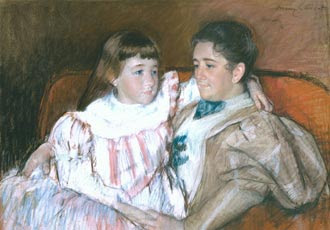
While Harry was a fierce businessman, he also enjoyed what seemed to be a fulfilling home life. Louisine, his second wife (above, with daughter Electra in an 1895 portrait by Mary Cassatt), was the daughter of his former business partner George W. Elder.
Later in life, Louisine would become known as a feminist and suffrage supporter who was arrested outside the White House during a 1919 march. But as a 19-year-old student on an extended trip to Paris with her family, she was introduced to painter Mary Cassatt—who became a pivotal figure.
“When we first met in Paris, [Cassatt] was very kind to me, showing me the splendid things in the great city, making them still more splendid by opening my eyes to see their beauty through her own knowledge and appreciation,” recalled Louisiane in her autobiography, via the Shelburne Museum website.
“With Cassatt’s tasteful eye and tap on the pulse of the Parisian art world, she guided Mrs. Havemeyer during their initial meetings to purchase modern art—works by Edgar Degas (1834-1917), Edouard Manet (1832-1883), and Cassatt herself—which would inform her, and later, her husband’s collecting interests,” states the Shelburne museum.
Harry and Louisine married in 1883, had three children, and spent the rest of their lives collaborating as art collectors. Harry had already purchased items on his own, such as carved ivory figures, Japanese lacquered boxes, and sword guards. Louisine continued her interest in scooping up the work of French Impressionists.
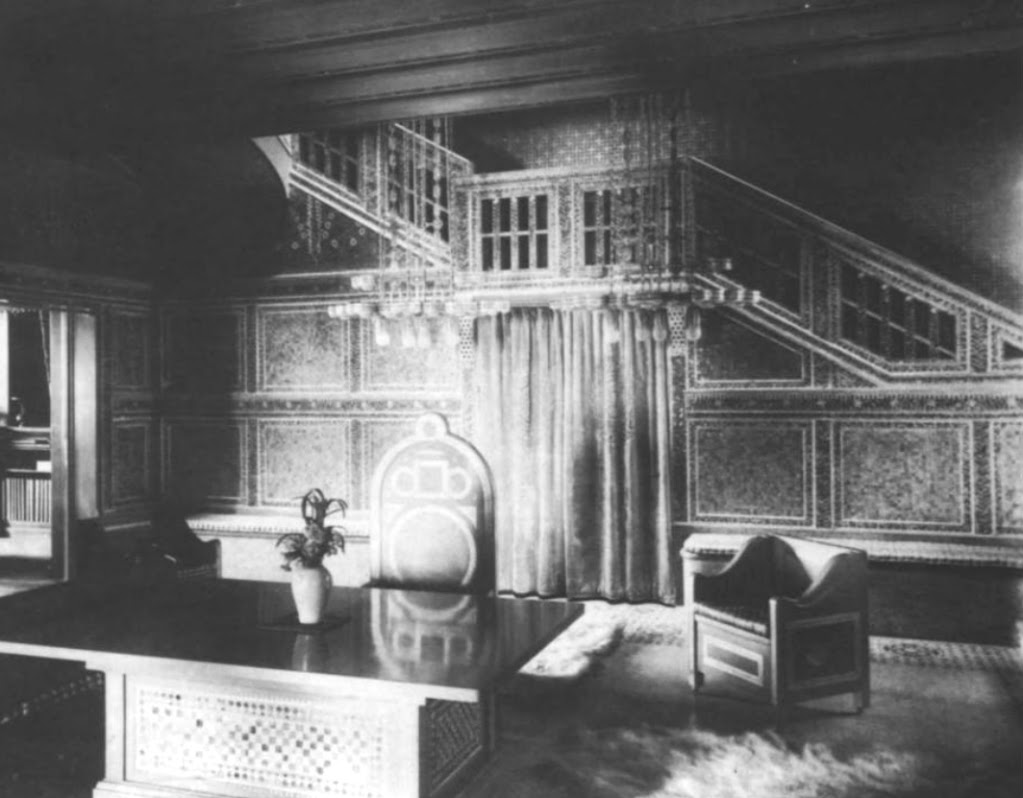
Eventually their collection included “nearly 2,000 Egyptian, Greek and Roman, Asian, Islamic and European paintings, sculptures, drawings, prints, and decorative objects,” wrote Michael Kimmelman in the New York Times in 1993.
As their collection grew, they needed a mansion with the proper light and grandeur to display their holdings. The commission to design the house went to architect Charles Coolidge Haight. For the interiors, they turned to the design firm run by Louis Comfort Tiffany and Samuel Colman.
“While Colman supervised the decorative schemas, Tiffany saw to the fabrication of opulent decorative elements that resembled giant pieces of jewelry,” states the University of Michigan Art Museum website.
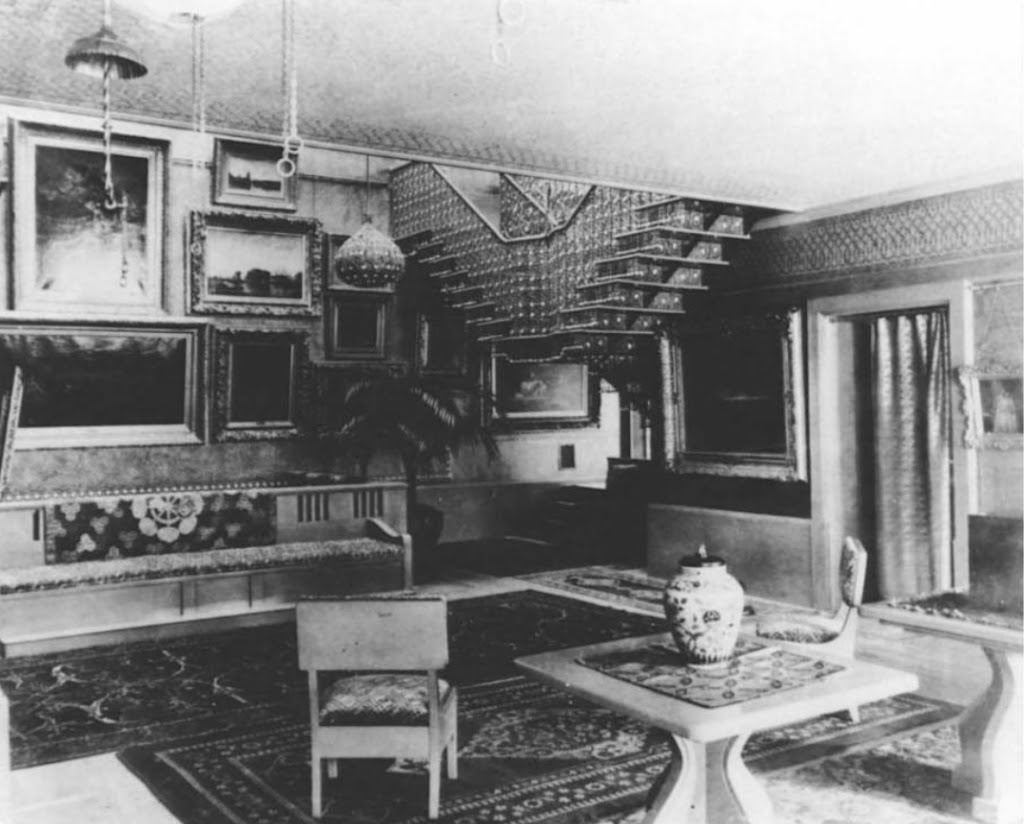
Perhaps the most imaginative feature in the house could be found in the second-floor picture gallery: a “flying” staircase. “The spectacular staircase was suspended, like a necklace, from one side of the balcony to the other,” wrote art and architectural critic Aline Saarinen, as quoted in Splendid Legacy.
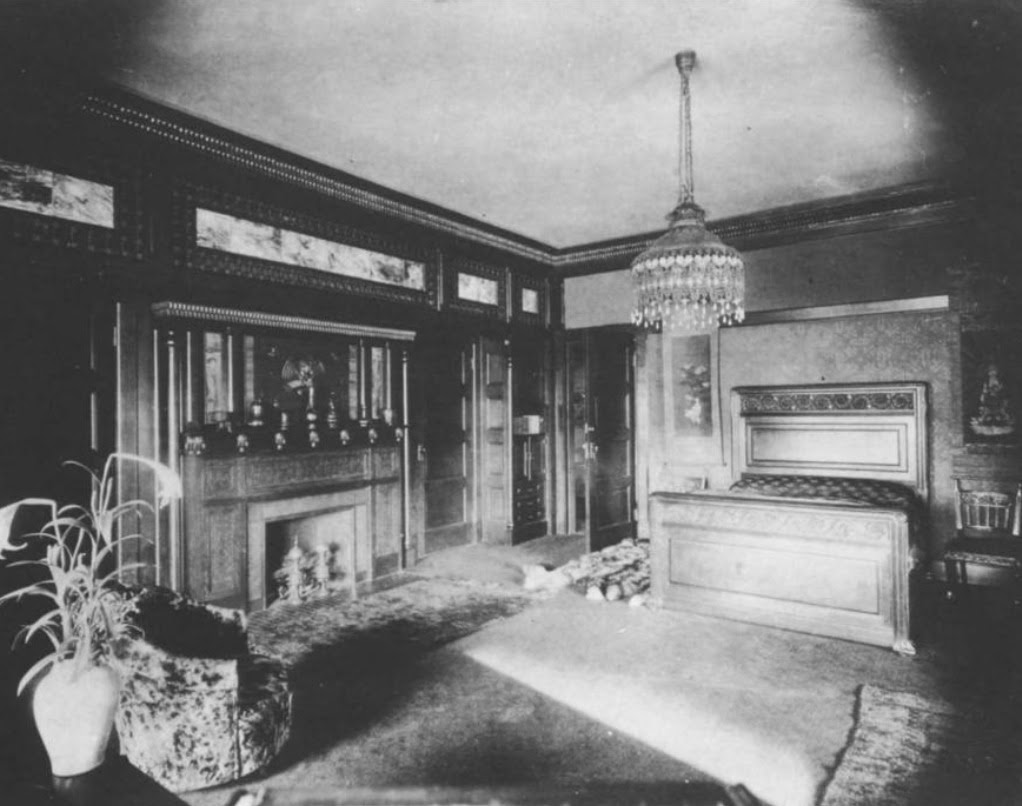
Also inventive in Louisine’s second-floor bedroom (below) overlooking Fifth Avenue was Tiffany’s use of “what seem to be two long printing blocks, possibly Indian and perhaps for textiles, adorn the headboard and footboard for the bed,” wrote Frelinghuysen.
“Every component of the eclectic interior décor pushed the limits of decorative design by merging principles of jewelry design, mosaic art, sculpture, metalwork, and textile and furniture design,” the Michigan museum continued. “Not one square inch was neglected; no surface was left untouched.”
What Tiffany and Colman created was a sumptuous work of art in itself. Visitors would go through the metal and opalescent front doors and find themselves in the main entrance hall (fifth image), with a glass mosaic-faced staircase and a frieze of “individual mosaic panels that repeated a motif of Islamic character,” states Alice Cooney Frelinghuysen in Splendid Legacy: the Havemeyer Collection.
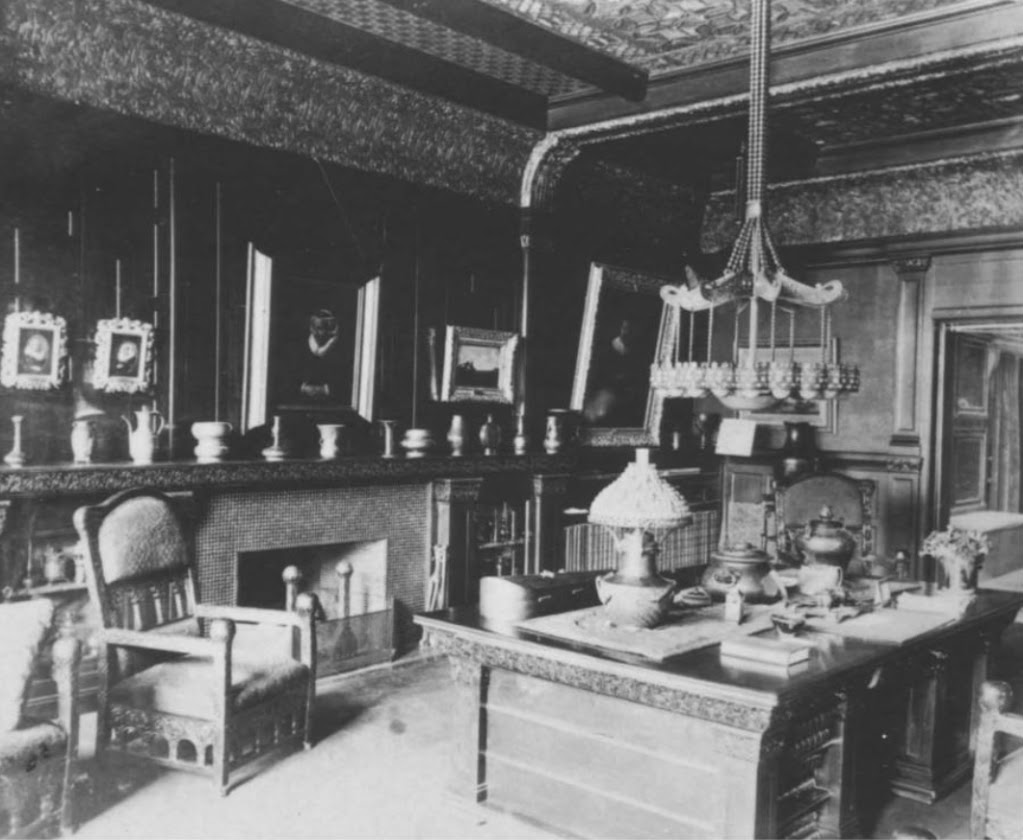
The library was known as the Rembrandt room (above), as it held the couple’s collection of Dutch pictures. Colman designed the furniture; the lighting fixture above the desk may be the first extant Tiffany chandelier, suggests Frelinghuysen, who was a family descendant by marriage.
It would not have been unusual for wealthy mansion dwellers to have art galleries in their homes. But because of their extensive collection and vision for how to display it, in partnership with Tiffany and Colman, the Havemeyers created a harmonious, enchanting, and spectacular space that received international attention.
Even after Harry passed away in 1907, Louisine continued collecting. Following her death in 1929, much of the couple’s holdings were bequeathed to the Metropolitan Museum of Art. Some went to the Shelburne Museum in Vermont, which was co-founded in 1947 by youngest daughter and art collector in her own right Electra Havemeyer Webb.
And the mansion itself? This fortress of art and antiquities went to the three children, who had the magnificent interiors broken up, sold off (some artifacts went to the University of Michigan Museum of Art), and the house demolished. Its replacement is an 18-story co-op completed in 1949.
A final relic of the Havemeyer fortune still stands in Williamsburg. The Domino sugar refinery is part of a complex rebranded Domino Park that includes the facade of the old brick refinery—an eerie ghost of one of the many riverfront industries that powered the fortunes made during the Gilded Age.
GETTING READY FOR HOLIDAY SHOPPING
AT THE KIOSK
Credits
[Top image: MCNY, 93.1.1.18063; second image: New York Historical; third image: Wikipedia; fourth image: Findagrave.com; images 5-8: Splendid Legacy: the Havemeyer Collection by Alice Cooney Frelinghuysen; ninth image: MCNY, X2010.7.1.4758]
Tags: Domino Sugar Refinery History Havemeyer, Electra Havemeyer Webb, Fifth Avenue 66th Street Mansion Havemeyer, Gilded Age Havemeyer Mansion, Gilded Age Mansions Fifth Avenue NYC, Havemeyer Art Collection Met Museum, Havemeyer Mansion Henry Louisine, Henry O. Havemeyer Domino Sugar, Louisine Havemeyer Art Collection
Posted in art, Upper East Side |
Ephemeral New York
All image are copyrighted (c) Roosevelt Island Historical Society unless otherwise indicated
THIS PUBLICATION FUNDED BY DISCRETIONARY FUNDS FROM CITY COUNCIL MEMBER JULIE MENIN & ROOSEVELT ISLAND OPERATING CORPORATION PUBLIC PURPOSE FUNDS.


Copyright © 2025 Roosevelt Island Historical Society, All rights reserved.Our mailing address is:
rooseveltislandhistory@gmail.com
Leave a comment