
Friday, November 14, 2025 – SOME BOOKS THAT MAY BE OF INTEREST TO YOU
SOME WINTER READING
Friday, November 14, 2025
Issue #1575
Ephemeral New York
Judith Berdy
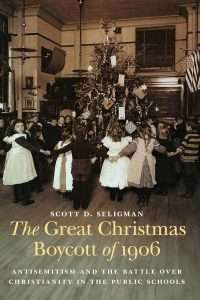
The Great Christmas Boycott of 1906
Today’s battle over Christianity in American public schools has deep roots. In the nineteenth century it was an intramural struggle between Protestants and later-arriving Catholics.
But at Christmastime in 1905, when the Presbyterian principal of a Brooklyn elementary school urged his Jewish students to be more like Jesus Christ, Jews entered the fray in a big way.
It was just the trigger Jewish activist Albert Lucas had been waiting for. Fresh from battling Christian settlement houses brazen about their intent to convert Jewish children, Lucas accused the public schools of proselytizing and demanded limits on religious content in the schools.
After the Board of Education let the principal off with a slap on the wrist and declined to clarify the rules governing religion in the schools, the New York Jewish community staged a boycott of the 1906 school Christmas pageants, prompting widespread student absences.
The protest elicited policy changes, but the board’s concessions generated an enormous antisemitic public backlash. Jews were accused of waging war on Christmas and of being less than true Americans, and warned not to push the issue, lest it arouse more prejudice against them.
The Great Christmas Boycott of 1906: Antisemitism and the Battle over Christianity in the Public Schools (University of Nebraska Press, 2025) by Scott D. Seligman traces the Christmas celebration dispute to the present day and describes how Jewish organizations of the twenty-first century, persuaded that politics are unlikely ever to permit a victory, seem to have reconciled themselves to the status quo and moved on to other, more winnable issues.

Even as Hitler and his Nazi regime ran roughshod over Germany and Europe in the 1930s, there were those in America who championed their rise. And nowhere so much as on Long Island.
Camp Siegfried in Yaphank (a community in the south part of the Town of Brookhaven, Suffolk County) became a focal point for certain German Americans to gather and espouse the Nazi cause.
Building on racial and ethnic biases, lack of trust in government and a dose of conspiracies, the German American Bund was able to contribute to a growing American fascist movement promoting antisemitism, isolationism, and even the overthrow of the United States government.
Fueled partially by Nazi Germany’s financing of propaganda, thousands of New Yorkers embraced the ideals of an American Reich through retreats such as Camp Siegfried, which groomed Nazi sympathizers to be ready for the fascist overthrow of the American republic.
In opposition to Nazism, multiple local citizen groups fought to combat the Bund’s organized efforts to undermine America.
In Nazis of Long Island: Sedition, Espionage & the Plot Against America (History Press, 2025) author Christopher Verga brings to life this often-overlooked history of New York’s World War II era.
Author Podcast Interview
On the latest episode of the Long Island History Project podcast, Christopher Verga untangles the history of the German American Bund, Father Coughlin, the America First movement, and more.
His book documents a time of unrest in the country when militias, foreign agents, and even elected officials actively opposed the American government.
You can hear the episode here.
The Long Island History Project is an independent podcast featuring stories and interviews with people passionate about Long Island history. It is hosted by academic librarian Chris Kretz.
Soon after its unveiling, Upper Room was described by The New York Times as “one of the city’s most popular works of public art. A magnet for Wall Street brown-baggers, it is also a favorite resting place for strollers along the esplanade, one of the choicest waterfront walks in the city.”
Progressive Era Arts and Crafts Communities
In response to the trauma of industrialization and urbanization in the late-nineteenth century, the Arts and Crafts Movement took America by storm. Art exhibits, workshops, and societies dedicated to handicraft, worker dignity, and the production of beautiful art for the masses sprouted from California to Boston.
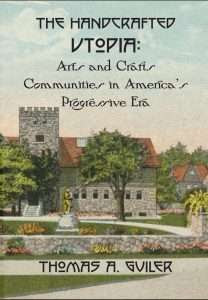
The Handcrafted Utopia: Arts and Crafts Communities in America’s Progressive Era (Couper Press, 2025) examines these utopian communities in the Arts and Crafts Movement.
Ralph Radcliffe Whitehead, Elbert Hubbard, and William Lightfoot Price were so enamored with the movement that they decided to build entirely new worlds — intentional communities — dedicated to pursuing those ideals.
Englishman Whitehead founded an art colony named Byrdcliffe in the Catskill Mountains. Hubbard, a former soap salesman, established an Arts and Crafts community business, Roycroft, outside Buffalo. Price, an architect, built the Rose Valley Association outside Philadelphia.
They endeavored to reform the economic and social inequalities of industrial capitalism through communal living, artistic development, craft, and the sale of finely crafted furniture, architecture, metalwork, and more. This was what they believed was living “the art that is life.”
For these community members, this meant producing and selling art with a social message as well as living everyday life as if it was a work of art.
In imagining a compromise between machine-dominated industry and handicraft, these artisans sought to critique industrial capitalism and carve out a space where craftspeople could once again flourish in community.
Rose Valley, Byrdcliffe, and Roycroft were total sensory installations of the Arts and Crafts Movement that stood as
community-workshops that were an alternative to brutal industrialization.
Author Thomas A. Guiler (Ph.D., Syracuse University) is the director of museum affairs at the Oneida Community Mansion House in Oneida, New York. He was assistant professor of history and public humanities at the Winterthur Museum, Garden & Library in Wilmington, Delaware.
He also served at the president of the Communal Studies Association. He has published on the history and material culture of intentional communities such as Oneida and of the Arts and Crafts Movement
The 1969 publication that laid out the master plan is on one wall, showing how a master plan was developed by this first step.
PHOTO OF THE DAY
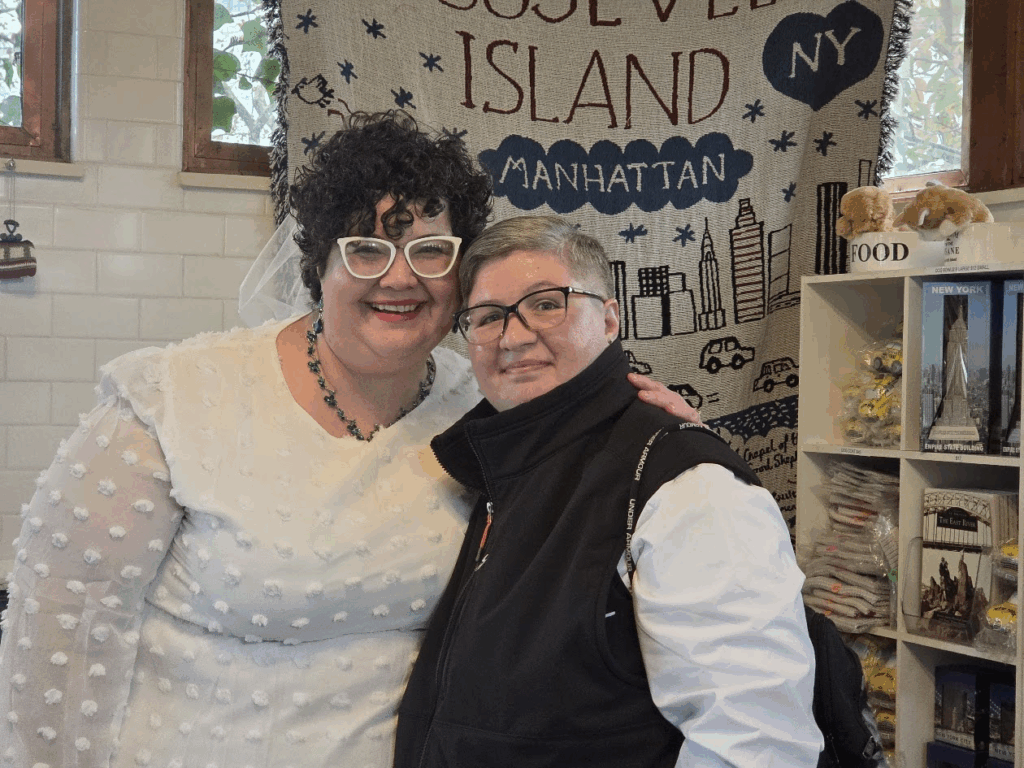
SONIA AND NADINE YEAGER WERE AT THE KIOSK TODAY ON THEIR WAY TO
THE MARRIAGE LICENSE BUREAU, FOR THEIR WEDDING CEREMONY!
CREDITS
NEW YORK ALMANACK
Judith Berdy
All image are copyrighted (c) Roosevelt Island Historical Society unless otherwise indicated
THIS PUBLICATION FUNDED BY DISCRETIONARY FUNDS FROM CITY COUNCIL MEMBER JULIE MENIN & ROOSEVELT ISLAND OPERATING CORPORATION PUBLIC PURPOSE FUNDS.
Copyright © 2025 Roosevelt Island Historical Society, All rights reserved.Our mailing address is:
rooseveltislandhistory@gmail.com
Leave a comment