Monday, November 24, 2025 – A CAST IRON LANDMARK IN NEED OF A TENANT
This Building is one of the Last Cast-Iron Structures in the Financial District, and it Hides an Unusual Backstory
Monday, Nov. 24, 2025
Issue #1580
Ephemeral New York
It’s a curious sight nestled amid layers of downtown loft buildings and skyscrapers: a delicate four-story stunner with a cast-iron front, pilasters framing great bay windows, and residential-style dormers on the top floor.
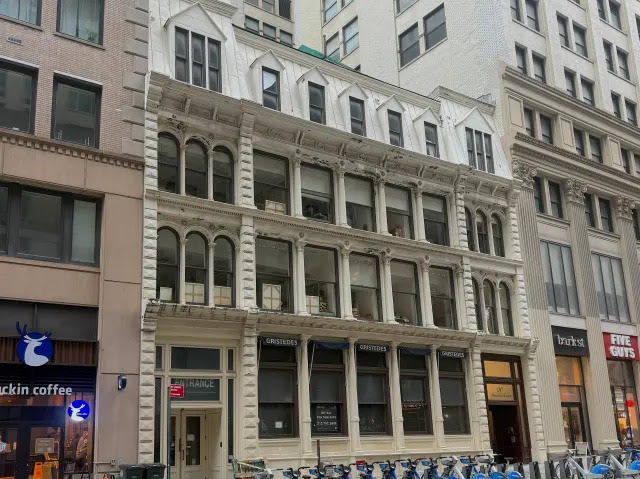
This building, done in the fanciful Second French Empire style popular in the mid- to late-19th century, is about 150 years out of place architecturally in today’s Financial District. But such a holdout must contain some fascinating secrets.
What secrets are part of 90-94 Maiden Lane’s backstory? Though it looks like one united structure reflecting cast iron’s use as a post-Civil War construction material, this jewel box actually combines four adjoining mercantile buildings, one of which dates back to 1810.
The story of 90-94 Maiden Lane starts in the 1790s. That’s when this former colonial path connecting Broadway and the waterfront was “lined with the houses and stores of prosperous merchants,” states the Landmarks Preservation Commission (LPC) in a 1989 report.
One of those merchants was James Roosevelt, a descendant of the prominent Knickerbocker family. Roosevelt opened a hardware store on the site and in 1809-1810 built a new store, which was partially replaced a decade later with a Greek Revival-style building.
“His business quickly became a large-scale operation supplying imported hardware, mostly Dutch, to a burgeoning building trade,” according to the LPC report.
Roosevelt refocused his business on imported British and French plate glass, then expanded to adjacent buildings as his fortunes grew. His son, Cornelius Van Schaack “C.V.S.” Roosevelt, joined what was now called Roosevelt & Son. Soon, C.V.S.’s sons also came aboard—one of whom was the father of future president Theodore Roosevelt.
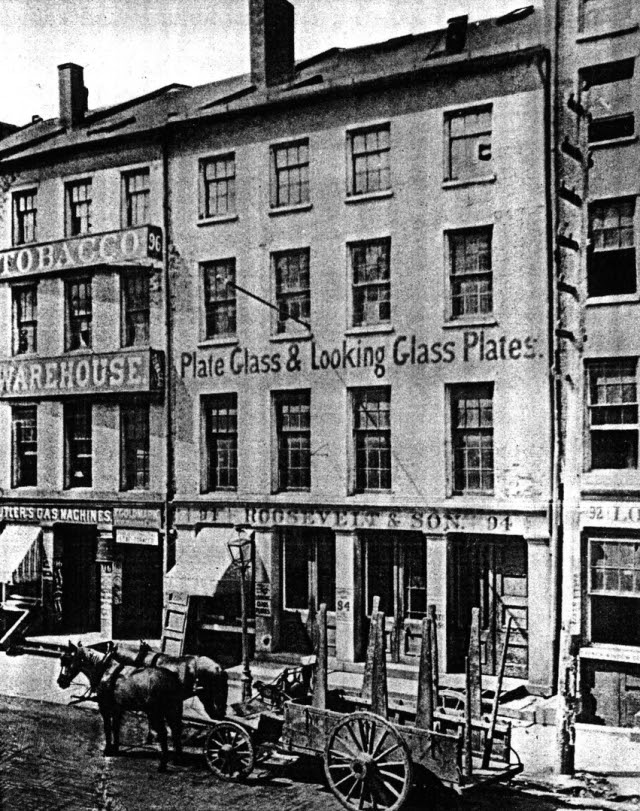
By 1870, Roosevelt & Son purchased adjoining land at 90-92 Maiden Lane and filed plans to combine their four adjacent mercantile buildings under one mansard roof and with a new cast-iron front.
Strong, fireproof, and relatively inexpensive, cast iron was introduced in New York City as a building material around 1850. Through the next decades, hundreds of cast-iron manufacturing buildings and commercial structures went up across the city, with many concentrated in today’s Soho.
But cast-iron structures also appeared in the Financial District. According to the LPC report, “at least 38 cast-iron-fronted buildings were located in the downtown area of Manhattan from Fulton Street to the Battery by the mid-1880s.”
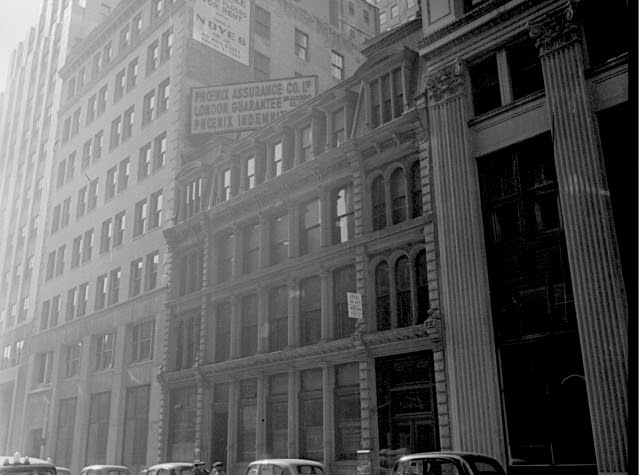
Today, few New Yorkers think of the Financial District as a cast-iron enclave—largely because most of these buildings eventually fell to the wrecking ball. According to the LPC report, only seven cast-iron structures still stand between Fulton Street and the Battery, including 90-94 Maiden Lane.
Not long after its 1870 conversion from four buildings to one, 90-94 Maiden Lane was vacated by Roosevelt & Son. An importer arrived in the early 20th century, and through the next decades alterations changed the arrangement of first-floor windows and doors. It’s hard to imagine that remnants of the original four buildings made it through the renovations.
The mansard roof was altered in the 1960s, according to Barbaralee Diamonstein-Spielvogel in her 2011 book, The Landmarks of New York, Fifth Edition. The building’s last occupant was a Gristede’s, and today it appears to sit empty.
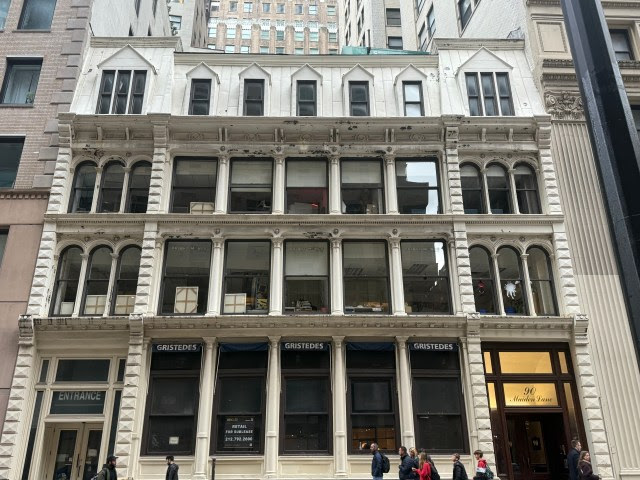
The lack of store signage and commercial activity seem to enhance its status as a outlier—the last of a once-popular style of building that would be endangered if not for historic preservationists.
“This building is the sole remaining example of the French Second Empire style in a post-Civil War commercial building constructed in the Financial District,” states Diamonstein-Spielvogel.
Besides that, 90-94 Maiden Lane also takes the honor as “the southernmost cast-iron building in Manhattan,” she adds. Let’s hope it keeps that designation.
PHOTO OF THE DAY
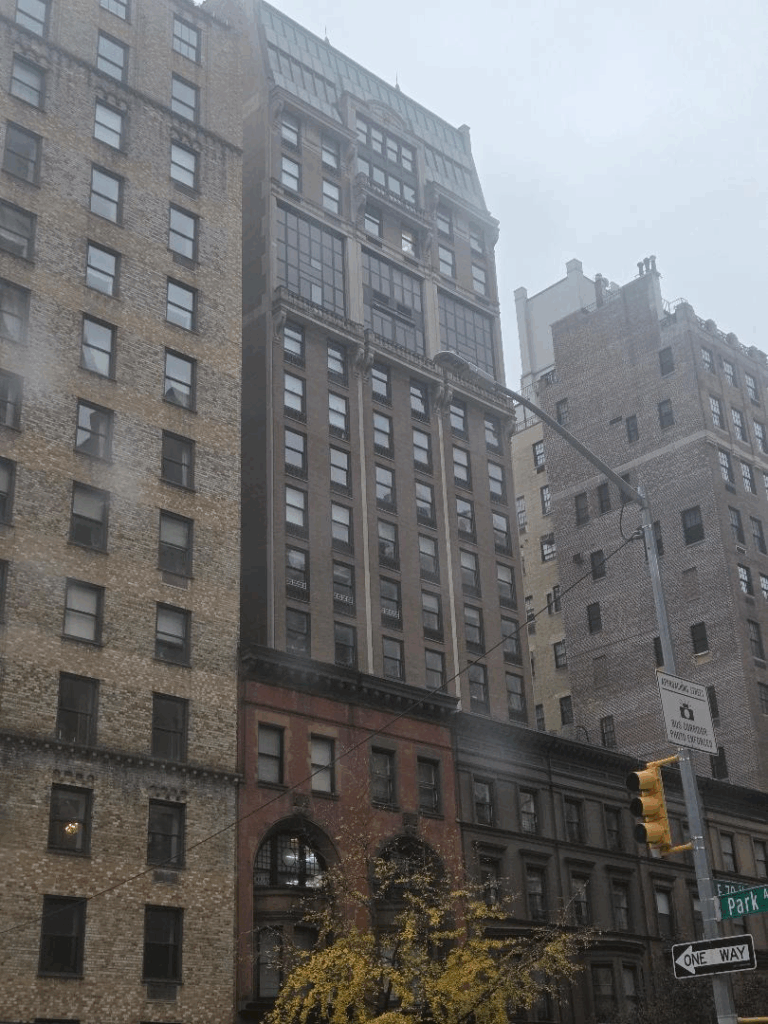
In contrast the graceful building above, I spotted this hodge podge on the Upper East Side.
CREDITS
Third image: LPC Report/William Cobb, The Strenuous Years; fourth image: NYC Department of Records & Information Services]
EPHEMERAL NEW YORK
JUDITH BERDY
All image are copyrighted (c) Roosevelt Island Historical Society unless otherwise indicated
THIS PUBLICATION FUNDED BY DISCRETIONARY FUNDS FROM CITY COUNCIL MEMBER JULIE MENIN & ROOSEVELT ISLAND OPERATING CORPORATION PUBLIC PURPOSE FUNDS.

Copyright © 2025 Roosevelt Island Historical Society, All rights reserved.Our mailing address is:
rooseveltislandhistory@gmail.com
Leave a comment