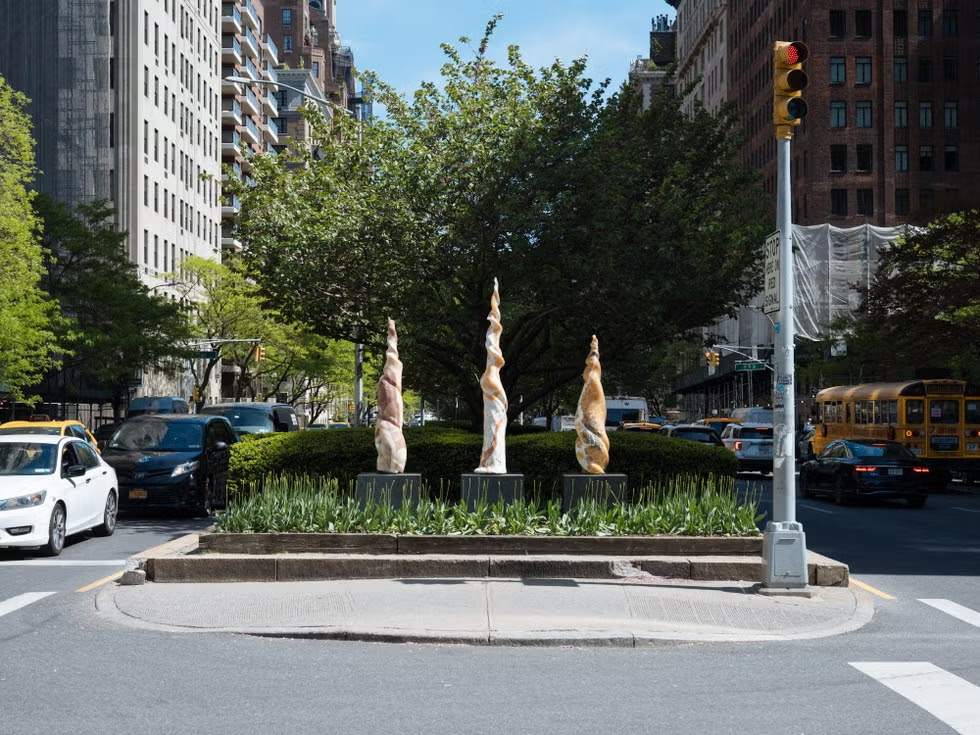
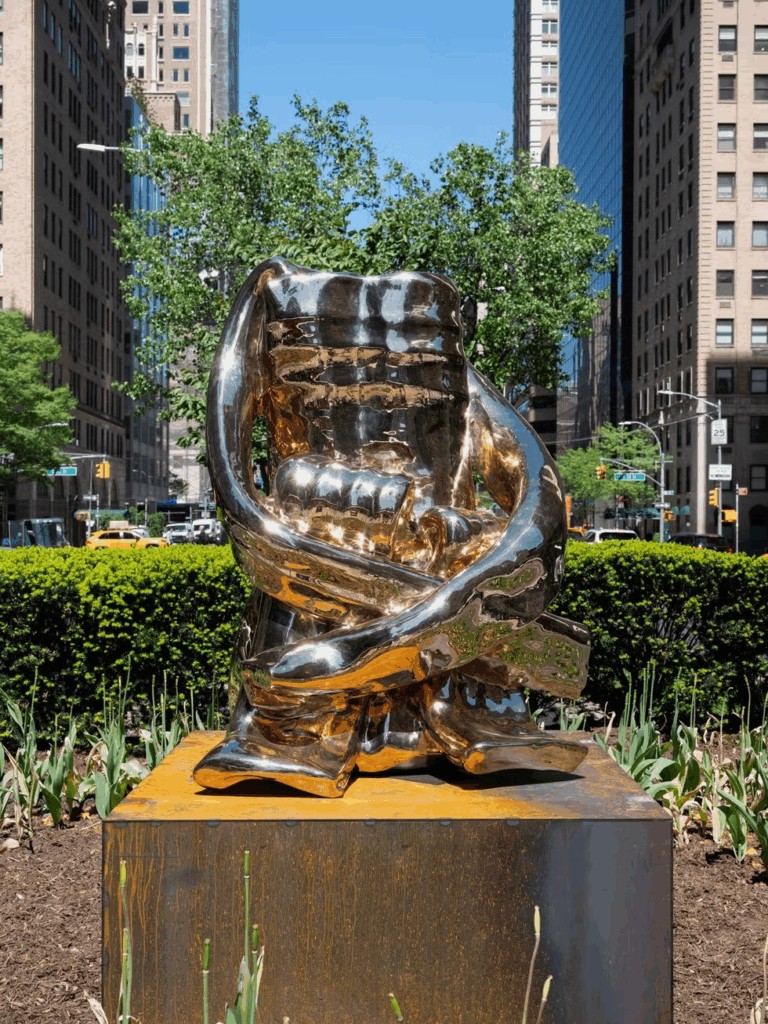
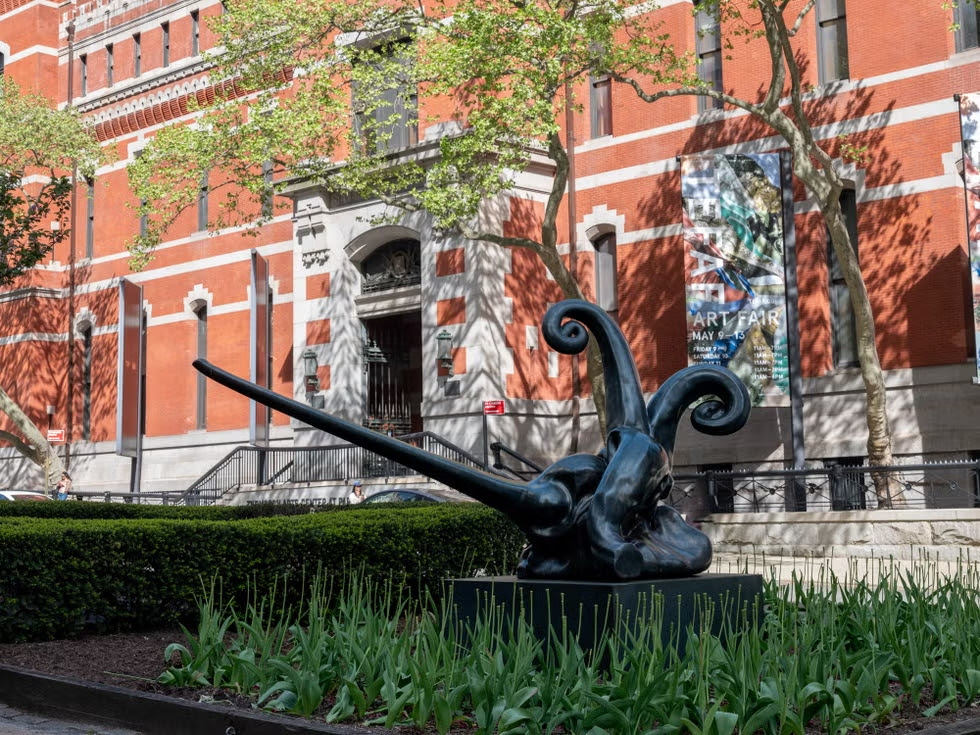
May means the bright-hued tulips are in full bloom on Manhattan’s Park Avenue. This year, however, New Yorkers will now find the colorful flowers accompanied by ten of Alma Allen’s sculptures, dotting the avenue’s lush malls between 53rd and 70th streets. Either in bronze or onyx, the sculptures, which are each titled Not Yet Titled, portray both humans—like a resting body with tightened limbs—or nature—tulips preparing to bloom.
“I am trying to see my own subconsciousness, because I am looking around the corners of reality,” Allen tells ELLE Decor.
Charlie Rubin, Courtesy of Kasmin, New York
The Utah-born artist drafts a smaller version of each sculpture in clay at his Tepoztlan studio, south of Mexico City. Each clay figurine—occasionally so fragile that Allen keeps it in the fridge—then goes through a 3D scanning process to render a template for its blown-up version. Allen then often wanders to his in-house bronze foundry to create the massive shiny replica of his miniatures. Occasionally, though, he leaves the task to a large robot which he programmed to precisely carve onyx while still maintaining the traits of his intimate hand gestures.
The Park Avenue sculptures, like much of Allen’s work, features ambitiously-scaled forms in allusive silhouettes and disarming colorations. The Fund for Park Avenue—the organization in charge of the street’s flowers every season—enlisted their Sculpture Committee to oversee the project in celebration of the organization’s 45th anniversary.
Charlie Rubin, Courtesy of Kasmin, New York
For The Fund’s President Emerita Barbara McLaughlin, the collaboration “emphasizes the power of contrast,” and, she tells ELLE Decor, “the boldness of sculpture and the delicate beauty of tulips.”
Allen’s other works have been exhibited in Kasmin Gallery’s roofgarden on the High Line and in the 2014 Whitney Biennial. From Brancusi to the Bronze Age, the self-taught artist looks beyond any time period to see the soul beneath. “I’ve never understood seeing a separation between the ancient and the modern,” he says. “The flow and the continuum in my work is about all of it being a sculpture.”
Charlie Rubin, Courtesy of Kasmin, New York
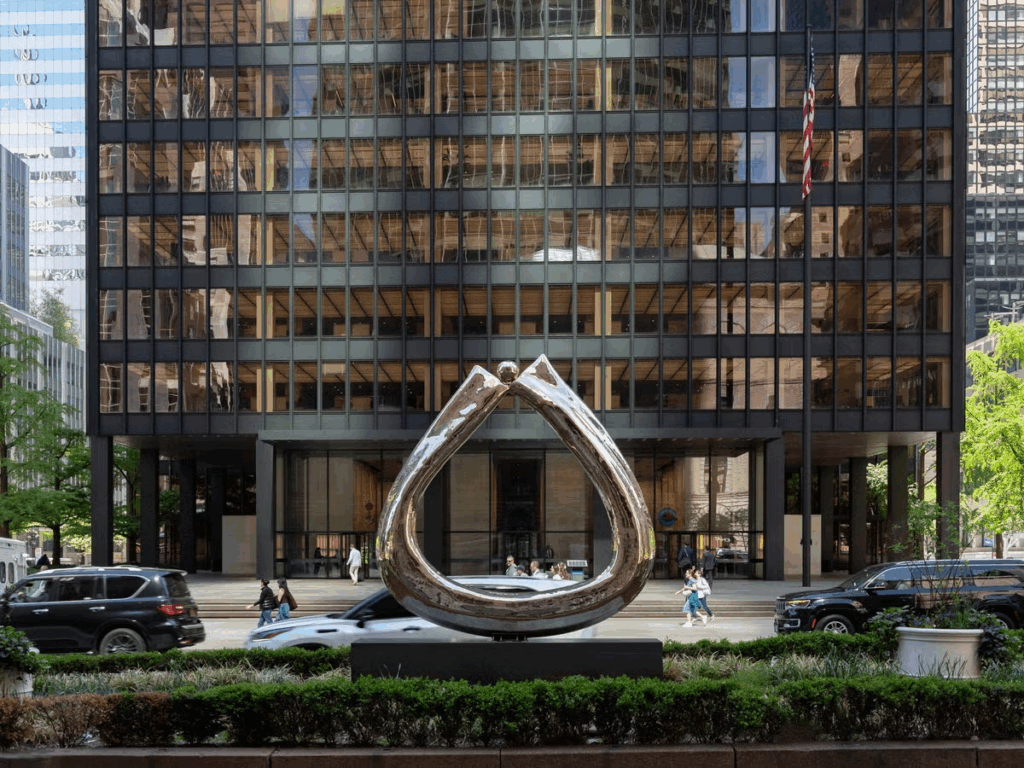
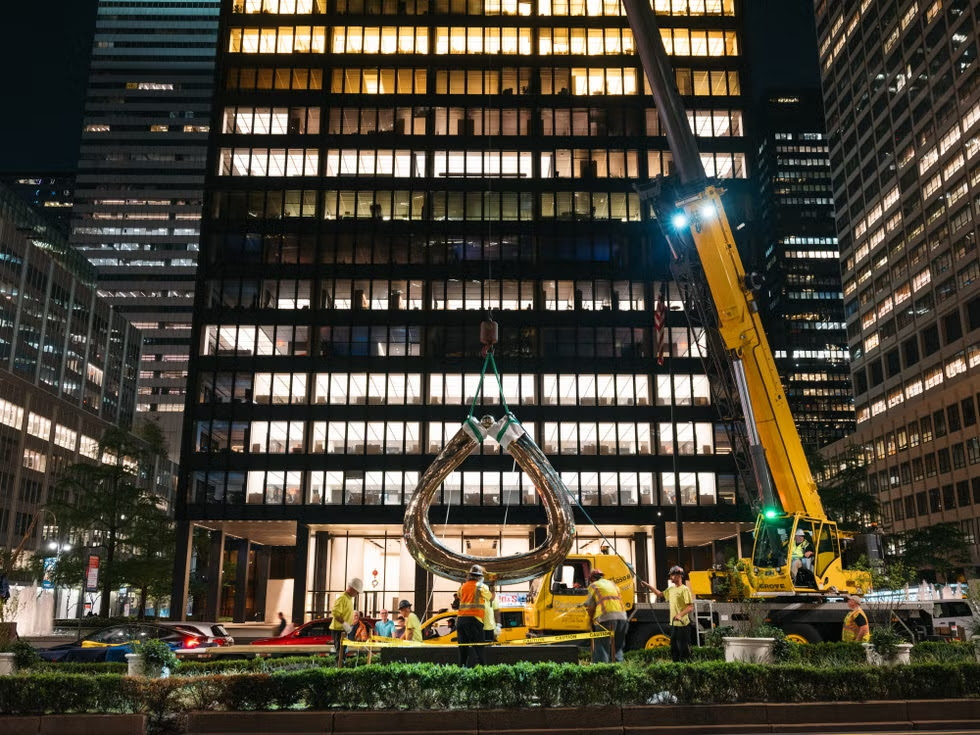
The presentation’s largest statement is a bronze uneven circle which comes together at its peak. There, a shiny sphere reflects the surrounding high-rise-dominated panorama, including the Seagram Building, as well as the flowers beneath it. At 119 inches high, the work traveled in its own flatbed truck from Mexico to New York. A trio of modest size onyx sculptures bookends the vertical lineup on 70th street—their spiraling pink-colored forms recall industrial tools and young buds.
Kasmin, New York The installation at night on Park Avenue.
He notices the nod to flowers in his sculptures. “Some of the works seem to be growing to reach for something… like the tulips.”
Alma Allen on Park Avenue is on view through September.
PHOTO OF THE DAY
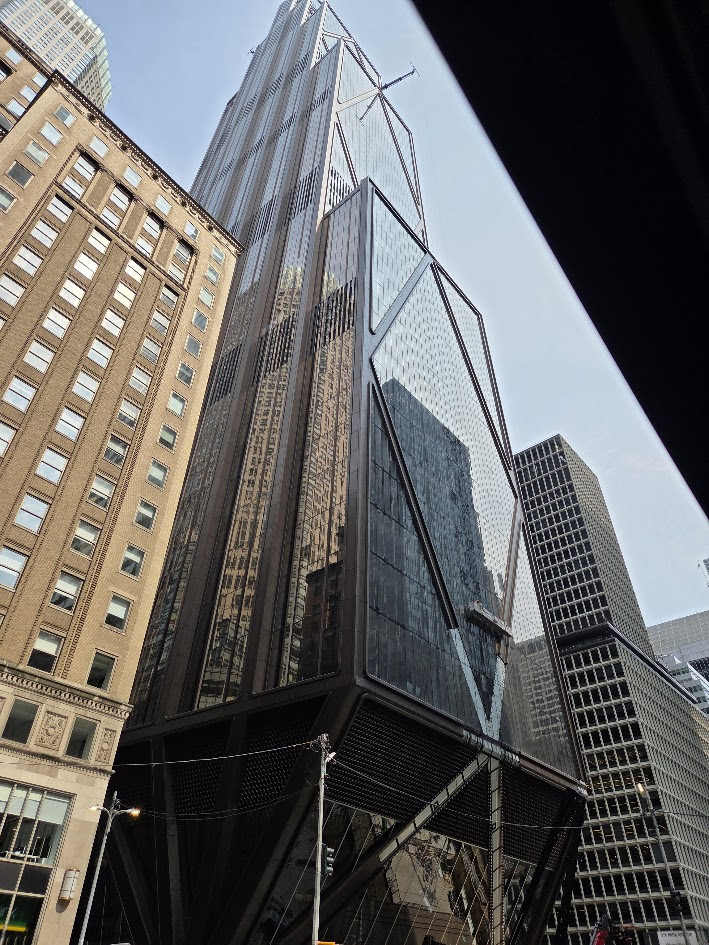
THE MORGAN CHASE BUILDING NEARING COMPLETION ON PARK AVENUE
CREDITS
JUDITH BERDY ELLE DECOR OSMAN CAN YEREBAKAN
All image are copyrighted (c) Roosevelt Island Historical Society unless otherwise indicated THIS PUBLICATION FUNDED BY DISCRETIONARY FUNDS FROM CITY COUNCIL MEMBER JULIE MENIN & ROOSEVELT ISLAND OPERATING CORPORATION PUBLIC PURPOSE FUNDS.
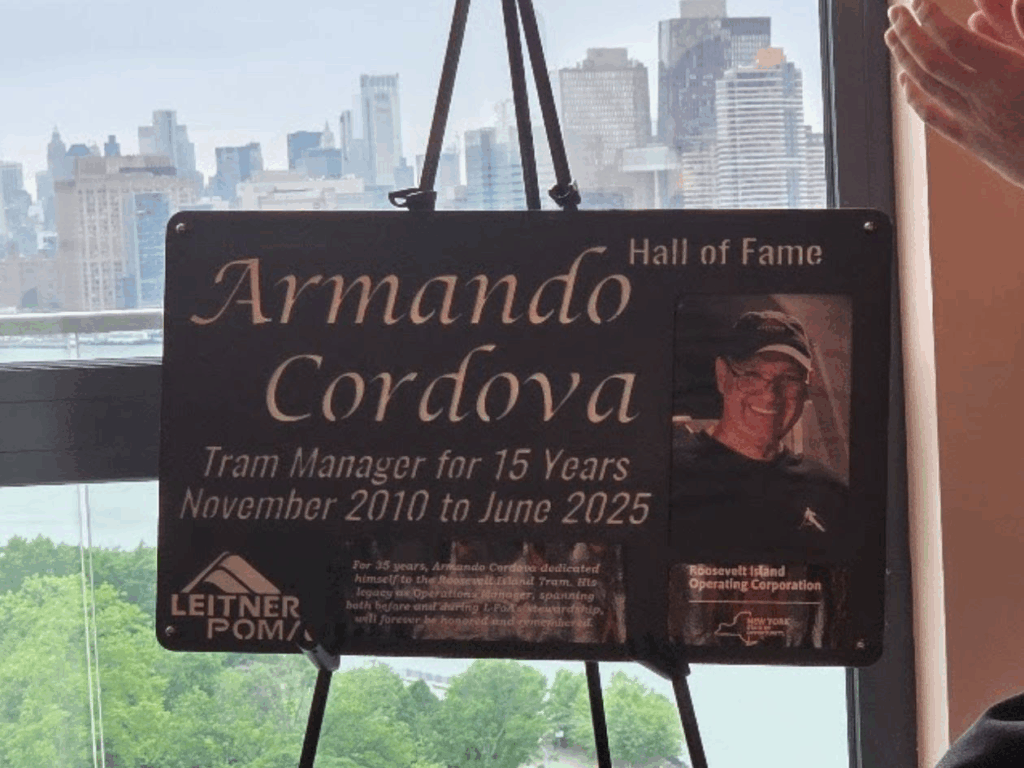
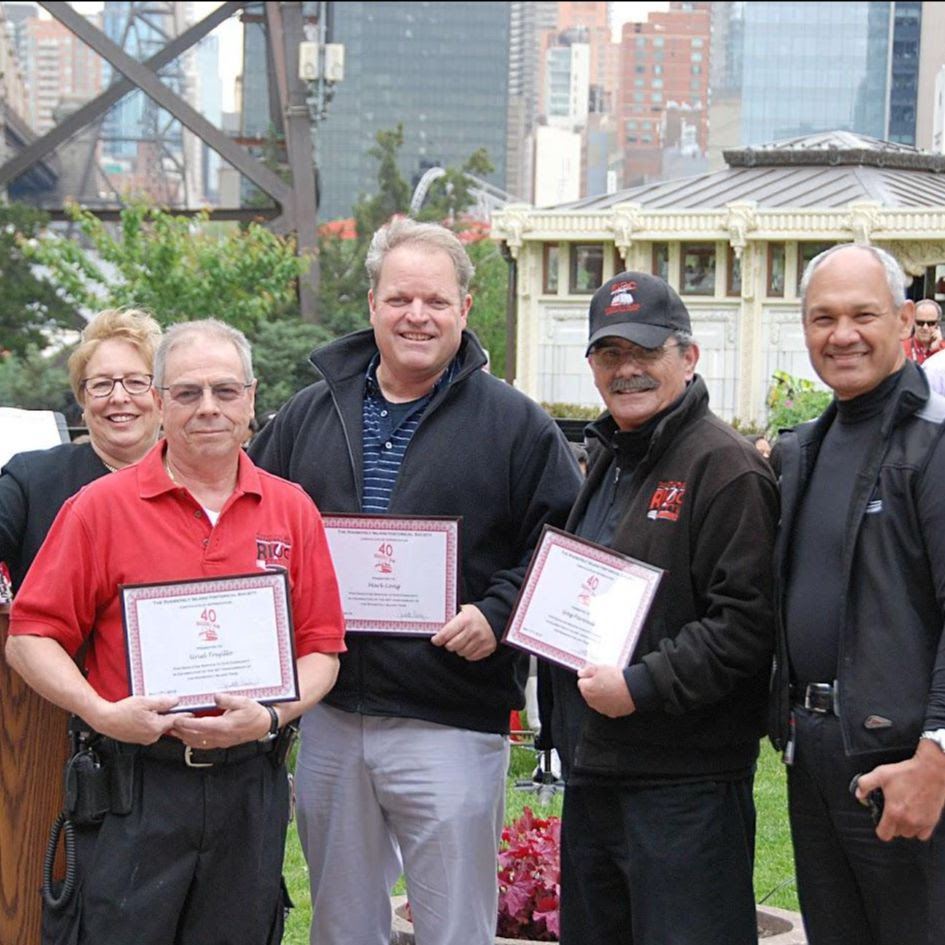
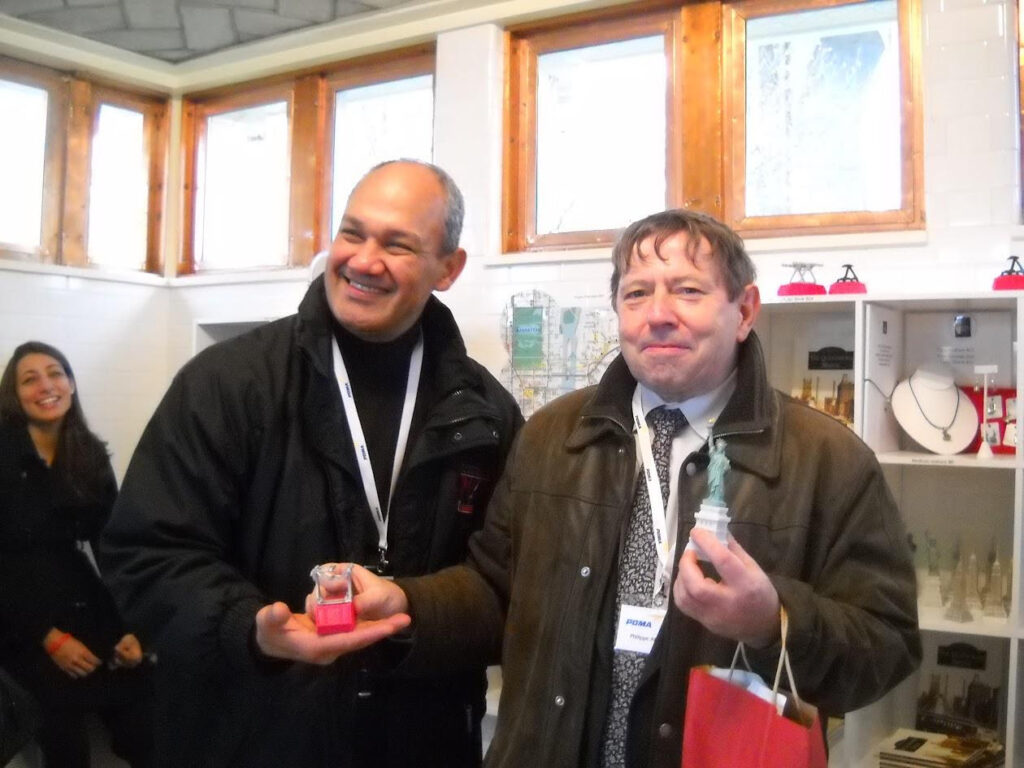
On Thursday, July 26th a retirement party was held for Armando Cordova, the Poma Leitner Tram Manager of the Tram since 2010.
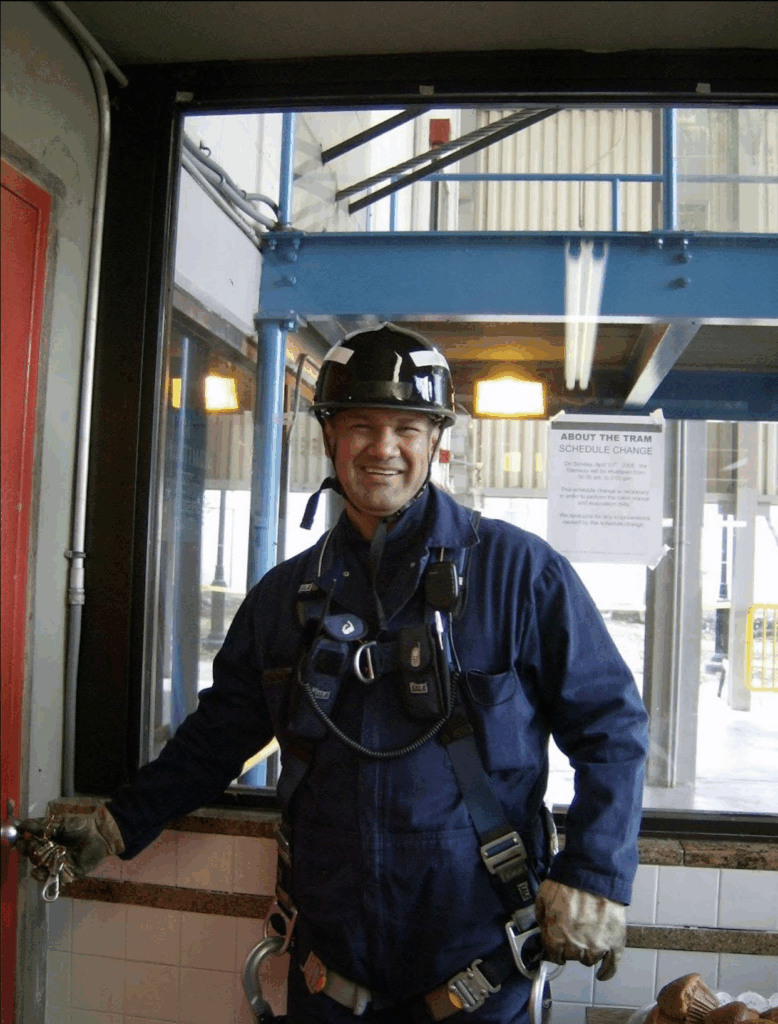
Cordova was the technical engineer and specialist who was the boss at the tram for 15 years. Always ready to solve problems, assist riders, he handled all the events and crisis’ with professionalism.
The Tram staff and kiosk staff are great neighbors looking out for each others. Cordova was the go to person when the electric would fail the visitor center or one of our heaters failed in midwinter. The tram staff has always been here to keep with a helping hand. Armando and his successor have made live on the plaza easier when the unexpected occur.
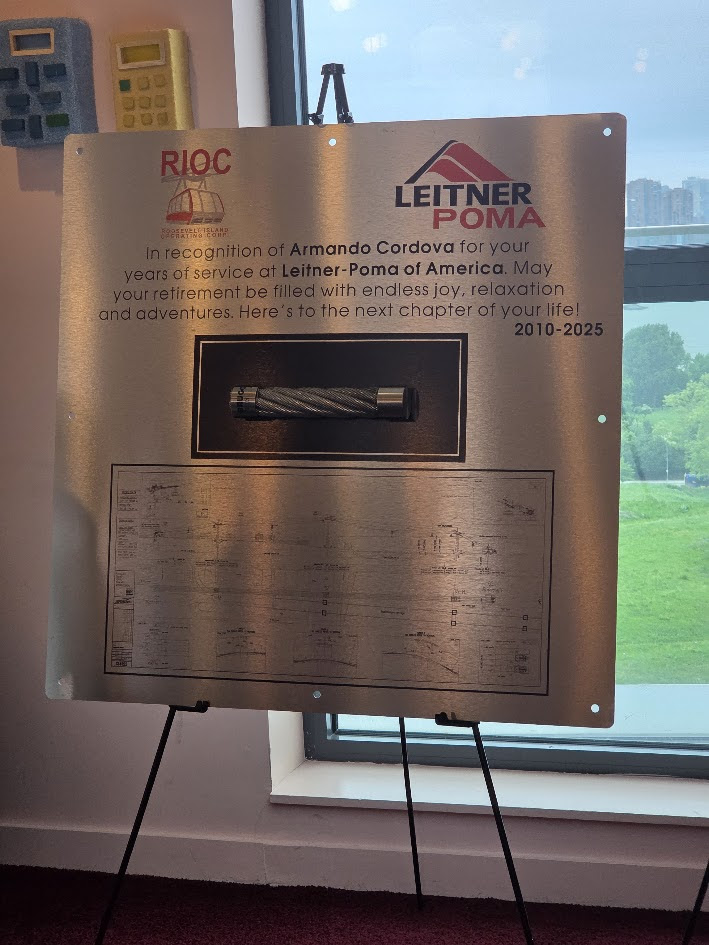
Plaque presented representing a portion of tram cable and the technical drawing of the cable car system
This plaque will be at the Tram and at Leitner Poma Headquarters
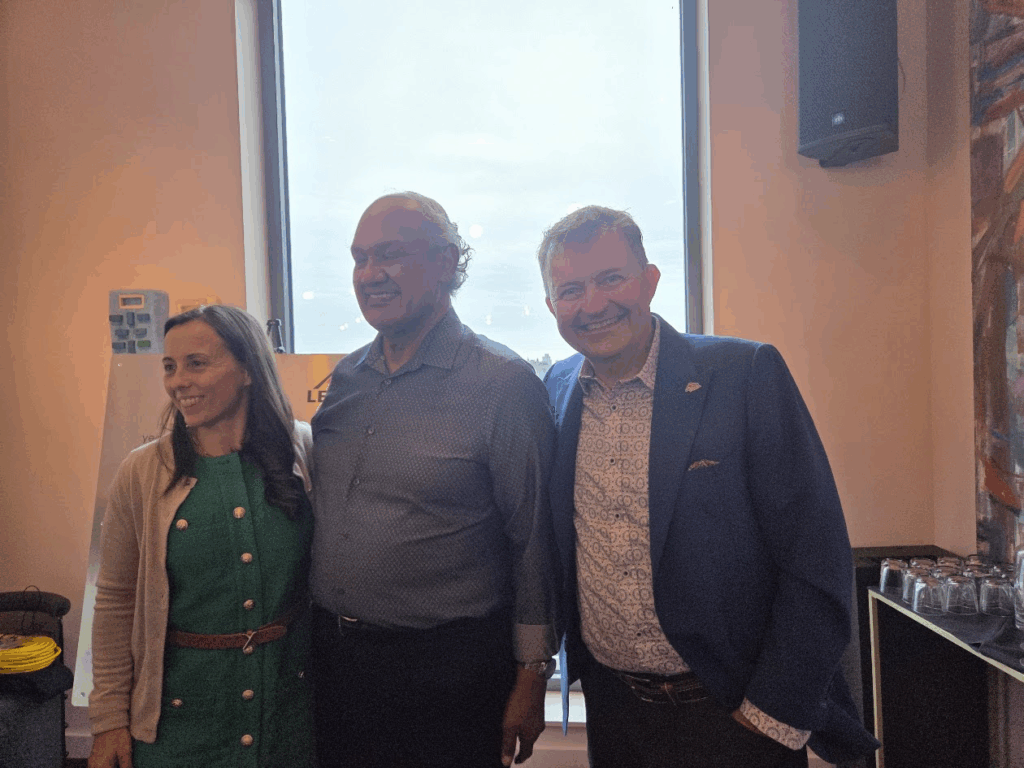
Mary Cunneen, Armando Cordova and Daren Cole, President/CEO of Leitner Poma
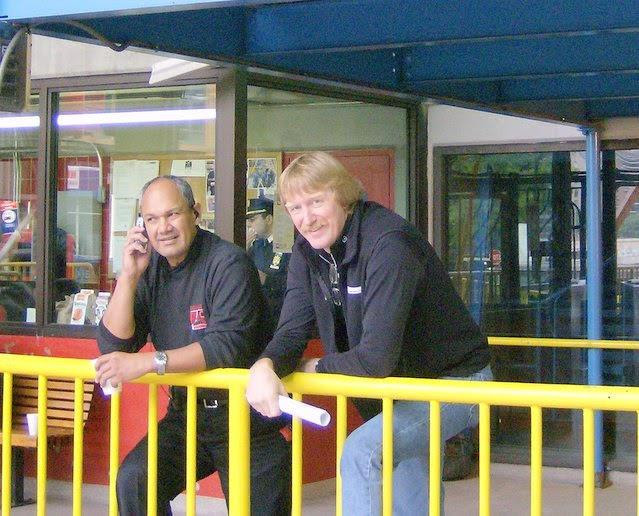
John, Greg and Armando at the reunion of co-workers. Greg soon celebrates 50 years at the Tram.
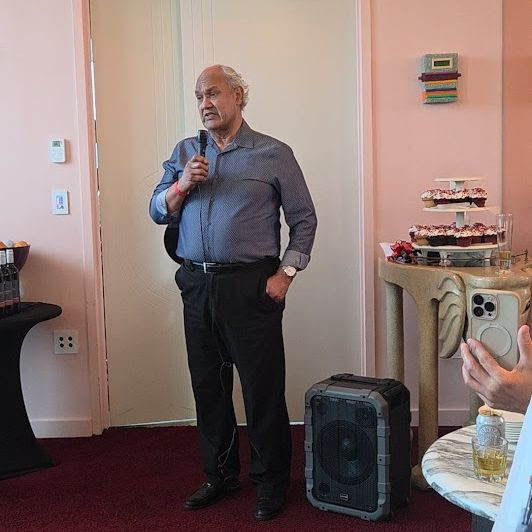
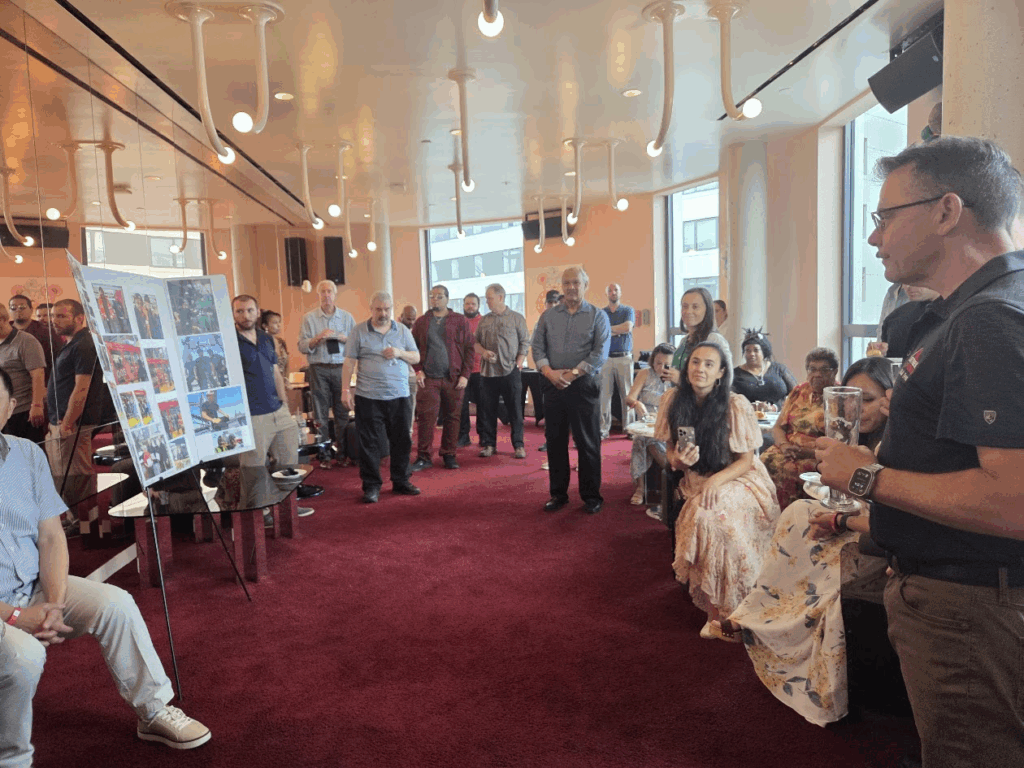
Speaking to the group, and telling of the safety always in forefront of the Tram staff.
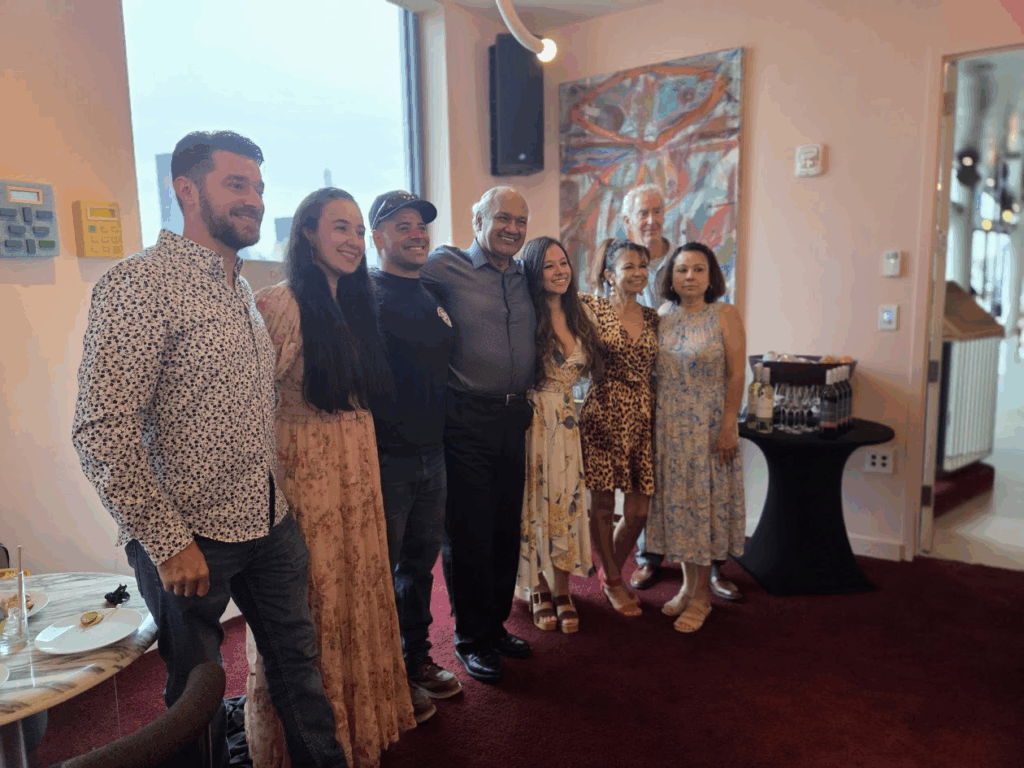
The Cordova family together. After a year of illness and tragedy they were together to celebrate Armando’s retirement.
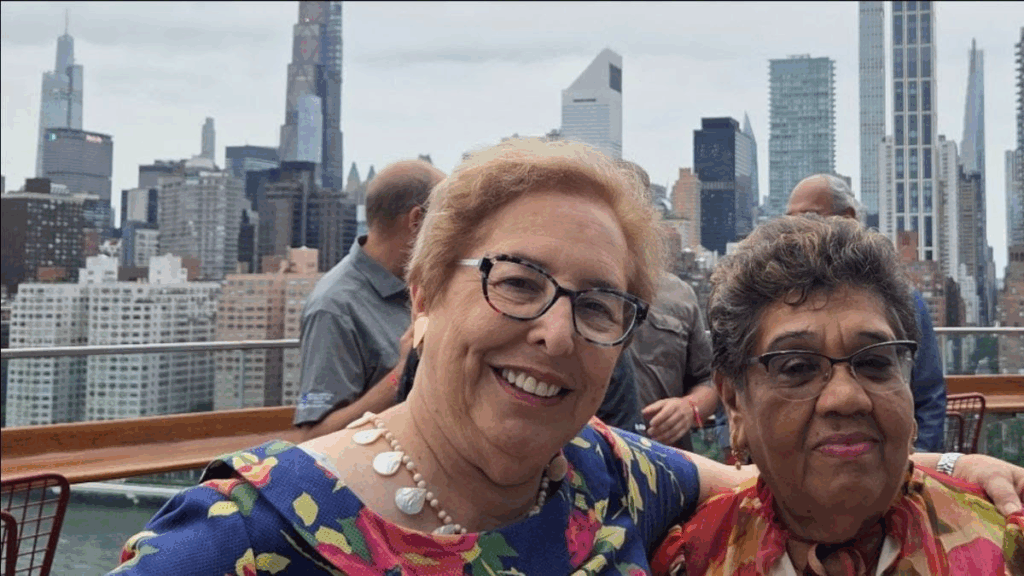
Minnie, the long time staffer joined me on the Panorama Room terrace for a great reunion.
Tram staff, RIOC management, and family were celebrating the event.
CREDITS
Judith Berdy
All image are copyrighted (c) Roosevelt Island Historical Society unless otherwise indicated THIS PUBLICATION FUNDED BY DISCRETIONARY FUNDS FROM CITY COUNCIL MEMBER JULIE MENIN & ROOSEVELT ISLAND OPERATING CORPORATION PUBLIC PURPOSE FUNDS.
When Washington Square Park Fountain Was Turned Into a Pool
Untapped New York
Thursday, June 25, 2025
Issue # 1473
Instead of a leisurely day around a cool swimming pool, I spent my day yesterday in the cafeteria of PS/IS 217. It was Primary Election Day and along with 23 other poll workers we were there to assist 591 residents to vote. Thanks to my great team, the PS 217 Principal Mandana we had a great day while the school was in session.
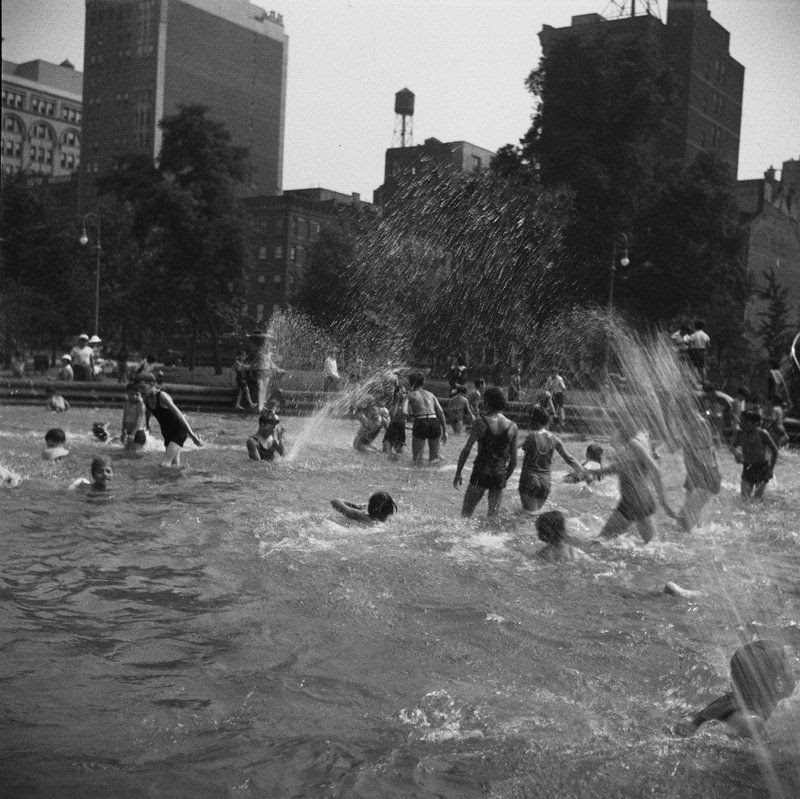
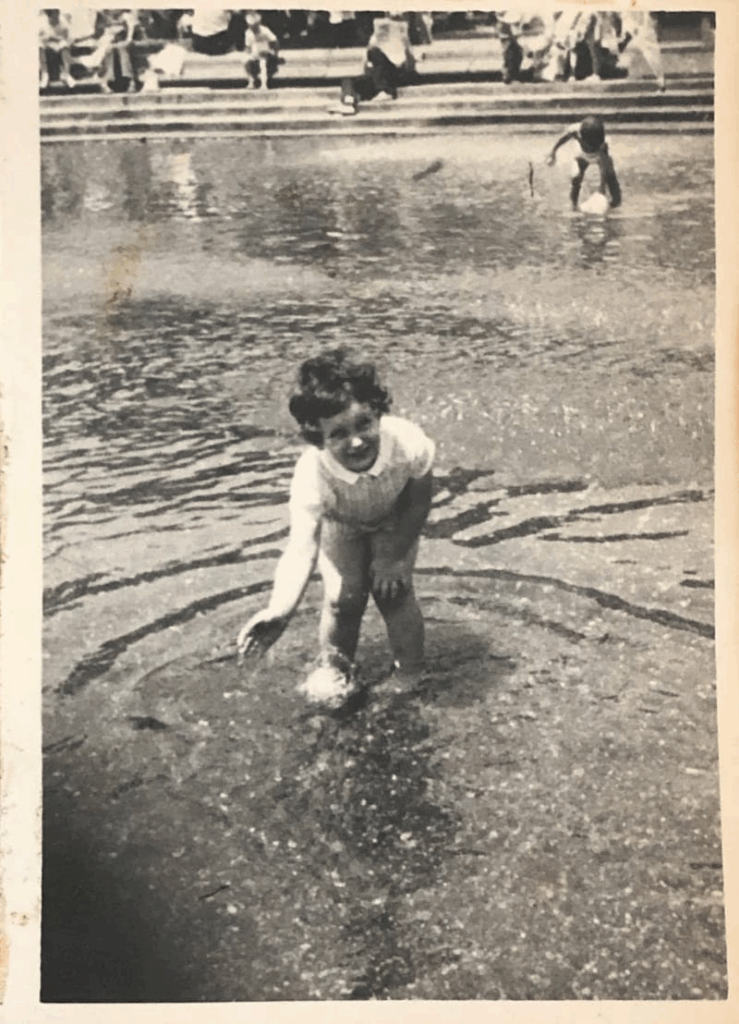
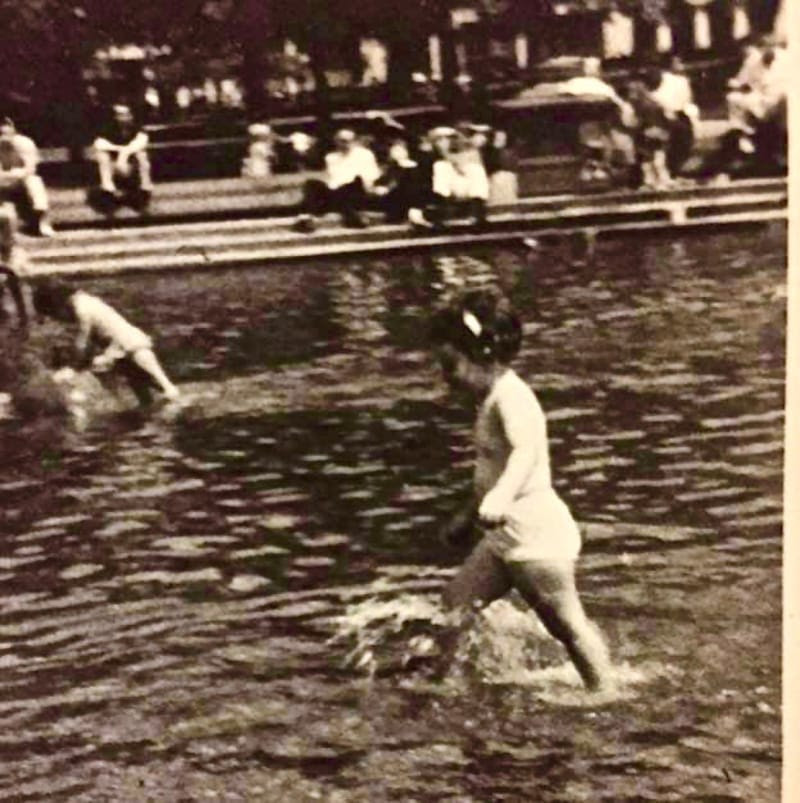
Aside from the voters, friends and families were there for the 8th grade graduation and th 5th grade moving up. It was quite a day at our neighborhood public school. As part of an earlier research, we worked with the New York City Department of Parks and Recreation Archive to locate these photos from 1935, when the Washington Square Park fountain (in its earlier form and location) was converted into a wading pool!
Renovation of the fountain took place in 1934, on the initiative of Robert Moses, who is otherwise reviled for his plan to put a highway through Greenwich Village. Moses had steps installed around the inside of the stone rim to assist people in accessing the water.
Photo from NYC Department of Parks and Recreation. Photo taken July 17, 1935
The original Washington Square fountain was a circular bluestone fountain completed in 1852. Its designer is unknown. That first fountain was replaced in 1870 by a water fixture recycled from Central Park. Architect Jacob Wrey Mould is credited with the design. Mould, who was Architect-in-Chief for the Department of Public Works at the time, also designed the fountain in City Hall Park, the wooden loggia at Belvedere Castle, and the Bethesda Terrace carvings and fountain base in Central Park among other sites.
Mould’s fountain, relocated from the Fifty-Ninth Street and Fifth Avenue entrance of Central Park to the center of Washington Square, sat in the same spot for over 130 years.
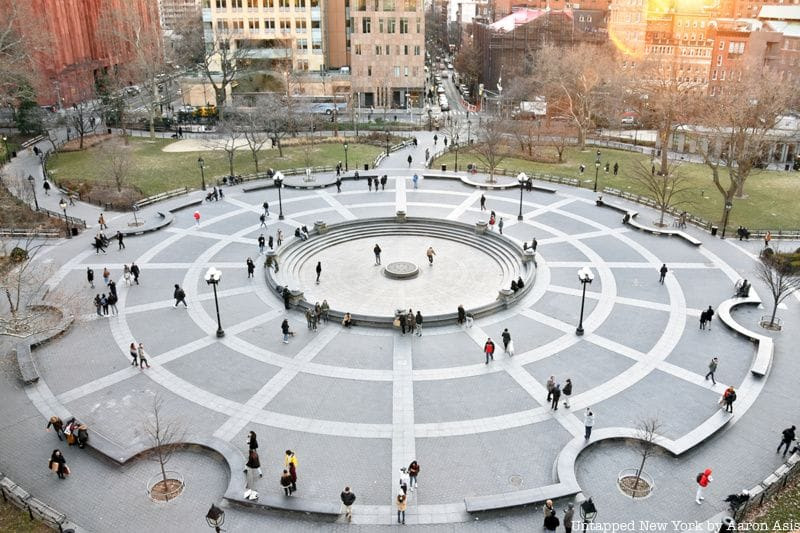
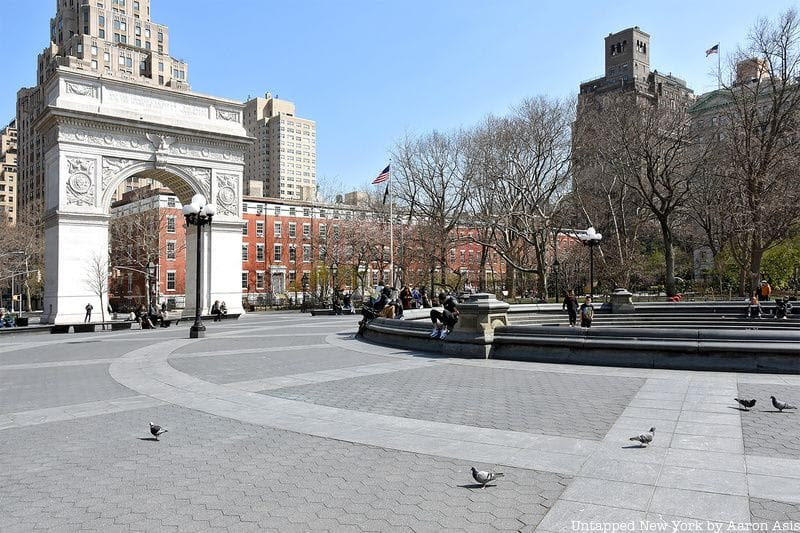
In 2009, the fountain was restored, combining elements from all time periods of its existence. It was also shifted east more than twenty feet, ostensibly to align with the Washington Square Park arch, but this reason—and if the fountain is actually aligned with the arch—has been hotly debated.
To this day, it’s not technically illegal to jump into a New York City park fountain, but you aren’t allowed to use it to take a bath or for personal hygiene. The 32,000 gallons of water that flow through this fountain are filtered, like the roughly 50 other fountains in New York City parks. Would you take a dip?
CREDITS
Untapped New York
All image are copyrighted (c) Roosevelt Island Historical Society unless otherwise indicated THIS PUBLICATION FUNDED BY DISCRETIONARY FUNDS FROM CITY COUNCIL MEMBER JULIE MENIN & ROOSEVELT ISLAND OPERATING CORPORATION PUBLIC PURPOSE FUNDS.
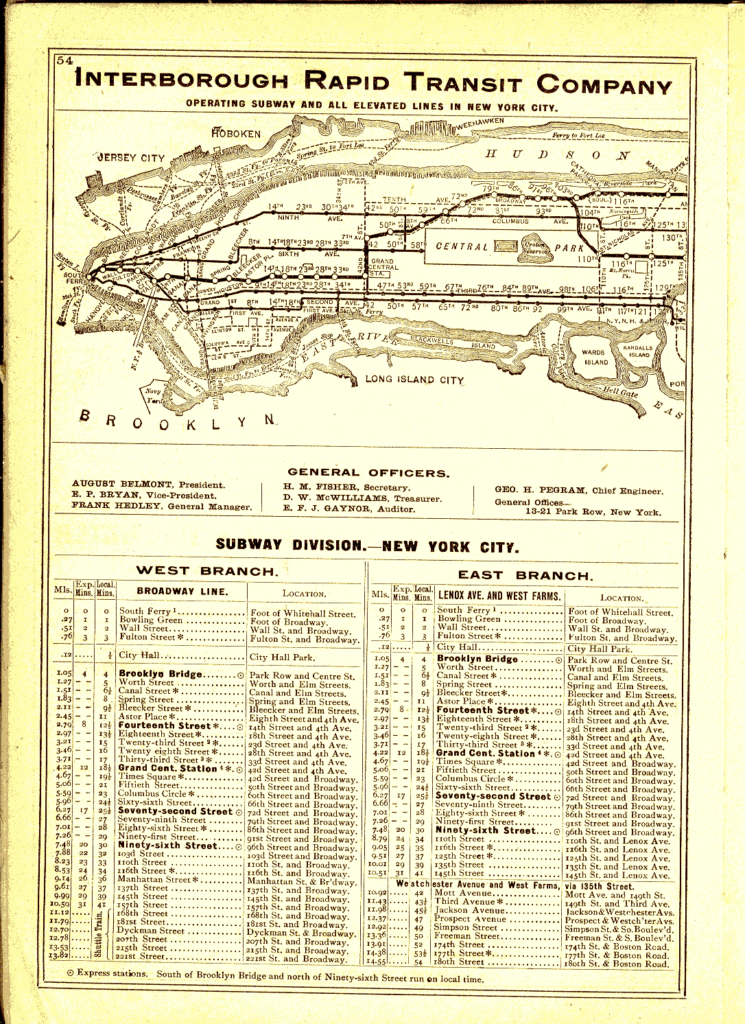
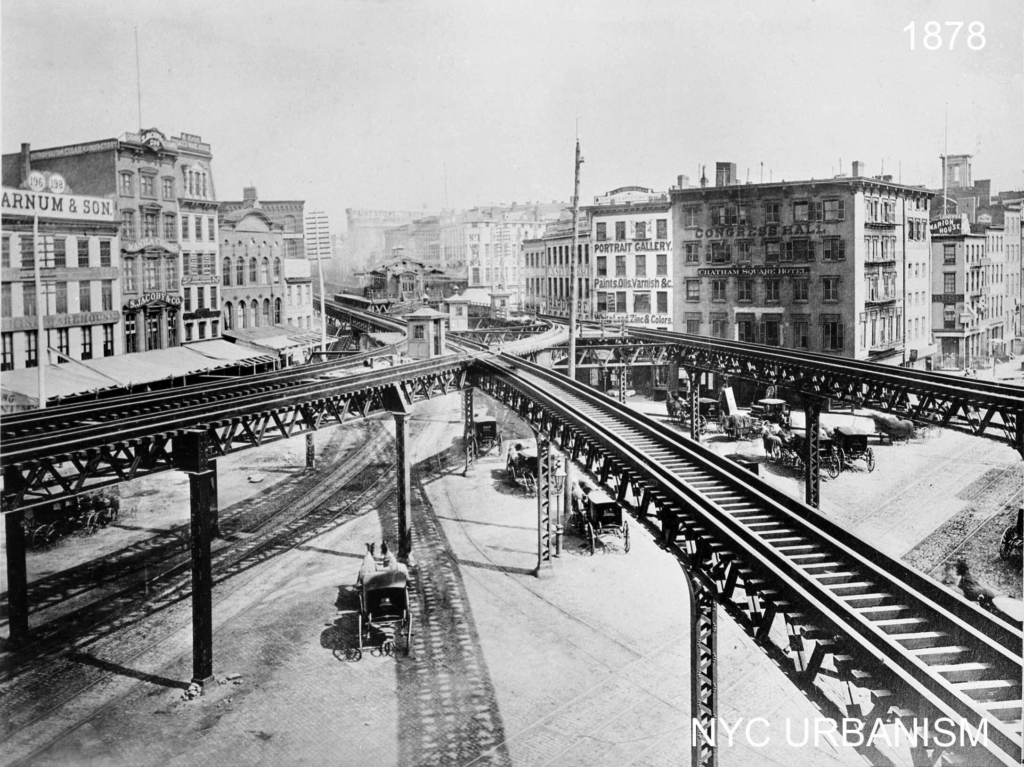
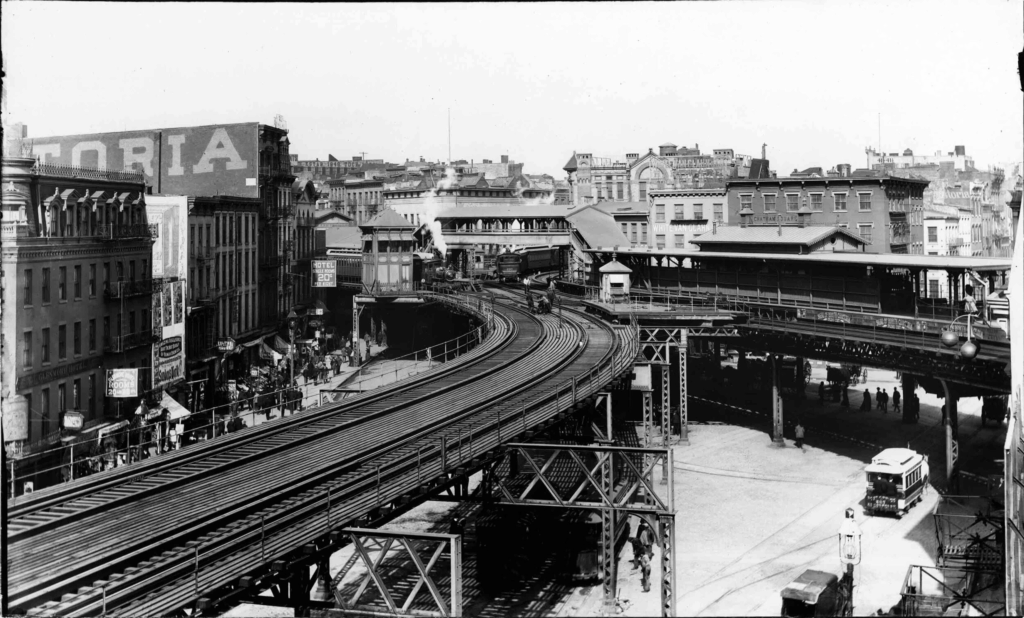
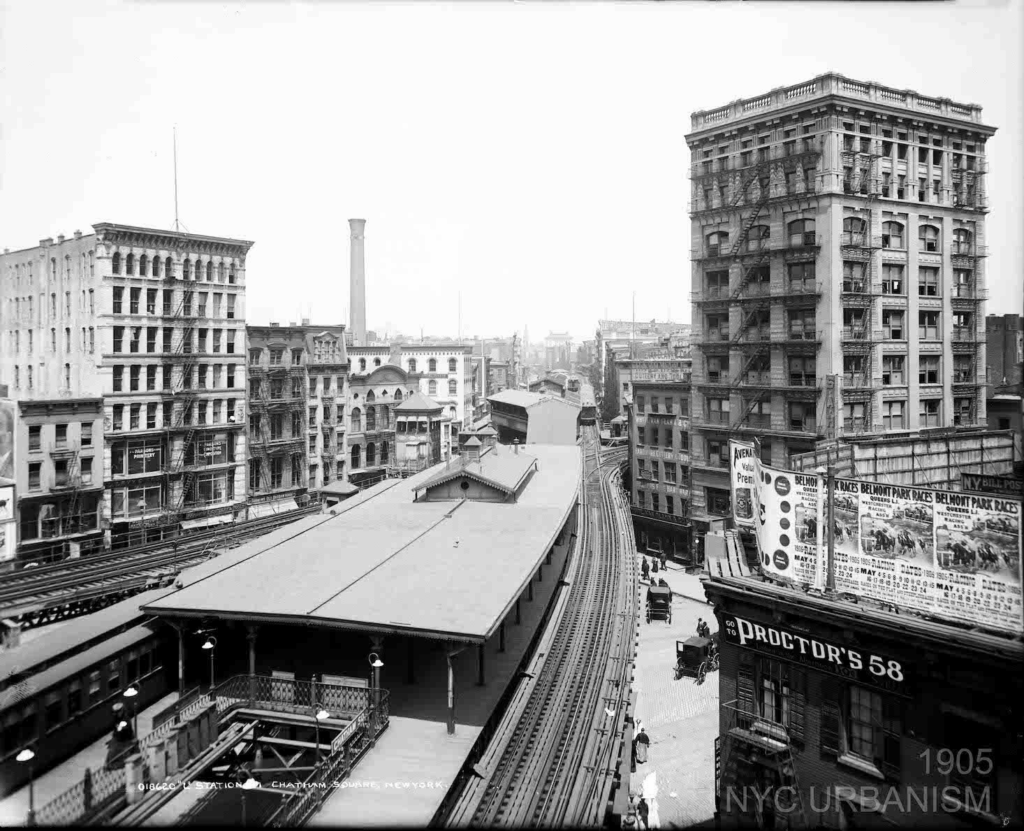
These photos from the 1890s – 1930s show Chatham Square’s elevated train lines. Just south of the entrance to the Manhattan Bridge, the tracks soared over the intersections of eight streets (Bowery, Doyers Street, East Broadway, St. James Place, Mott Street, Oliver Street, Worth Street, and Centre). The station connected the Second and Third Avenue lines on two levels, which would eventually be torn down in 1942 and 1955, with the anticipation of the Second Avenue Subway.
VACATION TIME
My own Cafe Aviva on the NCL Getaway. One advantage of being a solo traveler, great single cabins and a wonderful lounge with this great Espesso/Cappucino machine.
CREDITS
NYC URBANISM
All image are copyrighted (c) Roosevelt Island Historical Society unless otherwise indicated THIS PUBLICATION FUNDED BY DISCRETIONARY FUNDS FROM CITY COUNCIL MEMBER JULIE MENIN & ROOSEVELT ISLAND OPERATING CORPORATION PUBLIC PURPOSE FUNDS.
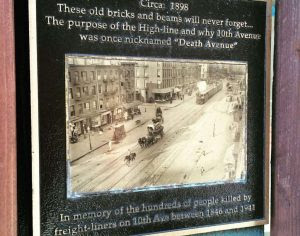
Attached to a brick wall of a restaurant/brewery called Death Avenue at 10th Avenue, almost hidden out of sight, a curious little plaque features a period photograph (ca. 1898) of steam locomotive running at street level surrounded by tenements, horses, pedestrians and children.
It commemorates hundreds of people who had lost their lives to the train. One of the victims was Seth Low Hascamp, a young boy (most likely) born into a family of German immigrants.* His death would help transform the area and its safety, a changeover that was recorded by a local Union Square artist.
Urban Cowboys
In 1846, the City of New York made what turned about to be a poor decision to authorize the construction of railroad tracks without barriers down the middle of 10th and 11th Avenues.
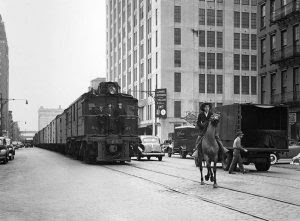
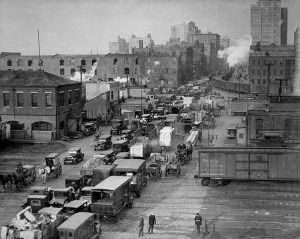
For nearly a century, giant steam locomotives operated by the New York Central Railroad pulled freight cars, sometimes several blocks long, through Manhattan’s congested streets, shipping commodities such as coal, dairy products and beef. Running along meat warehouses and grocery outlets, the railroad was responsible for much of the city’s food supplies.
The locomotives were equipped with hand brakes operated by a single person from the top of the car, but stopping the train quickly proved impossible. When mixed with an ever-growing crush of hansom cabs, motor cars and trucks, accidents happened regularly.
Hundreds of people were either killed or mutilated, many of them pedestrians and schoolchildren. For its large share of fatalities, 10th and 11th Avenues earned the moniker “Death Avenue.” The phrase was coined in 1892 by the New York World lamenting that so many lives had been sacrificed to a menacing “monster.”
The authorities had taken certain precautions. In the 1850s an ordinance was passed that permitted freight trains to share the streets with pedestrians, horse-drawn vehicles, carriages, streetcars and wagons, on condition that they would observe a speed limit of six miles per hour and that a person on horseback precede the trains to give ample warning of the train’s approach.
Known as West Side Cowboys, these legendary figures waved red flags by day and red lanterns after sundown to alert those moving on street level.
Safety issues on Death Avenue were finally addressed in 1929 when city officials and company operators reached an agreement to move the rail above street level.
On March 24, 1941, twenty-one year old George Hayde led the final West Side Cowboy ride up 10th Avenue. He and his bay horse Cyclone escorted a line of fourteen rail cars loaded with oranges (afterwards Cyclone got a new job at a riding academy). George was the last of the urban cowboys.
That same year the New York Times reported that during the preceding decade nearly two hundred people from nearby tenements had died, mostly children. The gruesome death of a seven-year-old school boy prompted protests.
On September 25, 1908, Seth Low Hascamp and a group of friends were playing games, climbing on and over the cars of a freight train that had stopped in the middle of 35th Street and 11th Avenue. Neither the conductor nor the brakemen were in their proper places when the train suddenly started forward.
Seth was thrown beneath the wheels and crushed. Although it was illegal for trains to stop at the location in order to avoid such accidents, the city coroner exonerated the crew and blamed the accident on the child’s own negligence.
The decision ignited a wave of anger resulting in a protest march held on the Saturday night of March 24th with five hundred children parading in silence up 11th Avenue carrying placards demanding that freight trains be removed from the city streets. Henry Shroeder, secretary of the newly formed “Track Removal Association,” reported that on dark winter afternoons an average of three school children were killed every month.
As the opposition of residents against train operators intensified, the Association changed its name to the “League to End Death Avenue.” In 1910 it claimed that over the years 548 people had been killed and 1,574 injured on 11th Avenue.
In spite of continuing protests, it was not until 1929 that the West Side Improvement Project was initiated. Conceived by urban planner Robert Moses, work started on building an elevated track that eliminated the deadly street-level crossings (the last stretch of track on 11th Avenue was removed in 1941).
In 1933, the first train ran on the “West Side Elevated Line” (later renamed High Line). Fully operational by 1934, the line was used to transport millions of tons of meat, dairy and produce. The last train ran along these tracks in 1980 (today, the High Line serves as a mile-and-a-half-long “greenway” with a variety of plants and trees built on the old elevated freight lines).
South of Union Square
In the early twentieth century, inexpensive property in the area south of Union Square attracted painters, writers, small publishers and political organizations that challenged conventional socio-cultural ideals.
Its central area was 14th Street, a vibrant hub of vendors, hawkers and a mass of diverse people navigating the district. Despite the hardships of the Great Depression, the street remained a focal point for urban life throughout the 1930s.
It was here that painters of the Fourteenth Street Group manifested itself. Not so much a “school” as each of the artists developed an individual approach, all were determined to depict the fabric of New York City’s daily life. They came to redefine realist painting by focusing on the surroundings of their namesake street.
Inspired by the Ashcan School, they shared an interest in urban subjects and sought to capture the energy of metropolitan life. Disavowing “elitist” calls for avant-garde experimentation, they persisted with figurative painting, using canvas and brush to call attention to the plight of ordinary people. One of the group’s key figures was Reginald Marsh (1898-1954).
Born in an apartment above the Café du Dôme at 108 Boulevard Montparnasse in Paris, both his American parents were artists. Frederick Dana Marsh was a muralist and Alice Randall Marsh a painter of miniatures (both exhibited work in Paris Salons in the years 1895 to 1899). The paternal grandson of a wealthy Chicago meat packer, Reginald grew up in a privileged environment.
The Dôme had opened in that same year 1898 and in the early decades of the twentieth century it was Paris’s premier gathering place for intellectuals and artists residing in Paris’s Left Bank.
The term “Dômiers” was coined to refer to the cosmopolitan group of creative individuals that gathered there. It was also a meeting place for the growing American literary colony in the capital.
The Marsh family returned to America in 1900, settling in Nutley, New Jersey, and working from a studio at 16 The Enclosure, a property formerly owned by the painter Frank Fowler who had established an artists’ colony there. It nurtured Reginald’s ambition to become an artist. After graduating from high school, he enrolled at Yale University’s School of Art.
Urban Underbelly
After graduation from Yale in 1920, Marsh moved to Manhattan where he was employed as a freelance illustrator for the New York Daily News with the specific task of producing (“raunchy”) sketches of vaudeville performers. The commission gave him an opportunity to hang around the Bowery‘s side-shows, to enter the dance halls of 14th Street, and stroll the beaches of Coney Island.
Marsh was fascinated by the city’s seedier locations. Like a Parisian “flâneur,” he strolled the streets with sketchbook and camera at hand discretely looking for iconic characters – down and out people on Skid Row, burlesque queens, macho men, streetwalkers – that served as source material for the urban panoramas he created at his studio whilst developing a mixed but distinct idiom of fine art, cartoon and caricature.
In 1921, he attended classes at the Art Students League where he studied with other members of what would become the Fourteenth Street Group (John Sloan was one of his teachers). Marsh admired the Ashcan painters for their urban vitality.
In 1925, he joined the staff of the newly founded weekly magazine The New Yorker. As one of its first cartoonists, he helped establish the magazine’s distinctive graphic style.
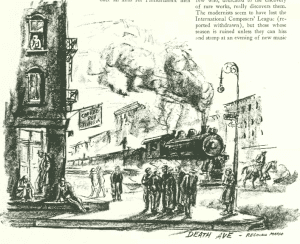
Several of his illustrations refer to Death Avenue, including one in the issue of November 5, 1927, which dramatically depicts the train cutting through the street with a group of jobless men hanging outside a cafeteria. An urban cowboy leads in front of the locomotive.
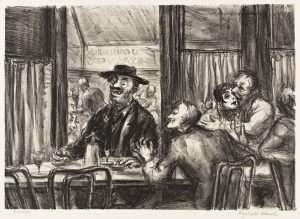
Marsh would return to Paris on several occasions. In 1928 he revisited the location of his birthplace, dedicating a lithograph to the Café du Dôme’s interior (with the legendary Pernod drinker Homer Bevans as its central figure). On return, he joined his friends working at a studio at 21 East 14th Street (since demolished).
He rejected the modernist movements gaining strength at the time. Instead he focused on depictions of everyday life close to his studio in Lower Manhattan with its theaters and low-cost shopping palaces such as Ohrbach’s or Samuel Klein on Union Square, creating images of jobless men on Manhattan’s heartless streets.
The term Social Realism was used to refer to painters who drew attention to the everyday conditions of working people and the poor and, by implication, who were critical of the social structures that maintained these conditions. Image, content and socio-cultural critique were linked.
Living at 11 East 12th Street during the 1930s, Marsh produced some of his best work having adopted traditional “egg tempera” (employed in early icon painting) as a means to express his creative vision.
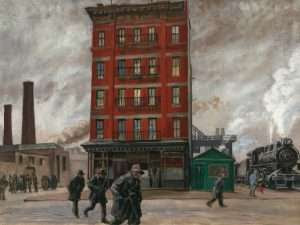
Railroad yards and locomotives had preoccupied him throughout his career. Fascinated both by the aesthetics of machines and the menace of their power, locomotives appear time and again in his paintings and prints. He witnessed and recorded the demise of Death Avenue’s crosstown railway line.
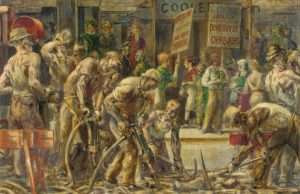
In 1937 Marsh created a painting entitled “End of 14th Street Crosstown Line” that juxtaposes two contrasting scenes.
At the forefront a group of demolition workers are tearing up the old railway tracks (the artist must have witnessed the project from close by); in the background picketers have gathered outside Ohrbach’s store demonstrating against its owner who had denied its workers the right to unionize.
(During mass New York City strikes that year workers of over a hundred department stores participated in collective action against their employers).
Marsh’s use of signs, placards and other graphics enhanced meaning and message, making this work a perfect example of what Social Realists intended to achieve in their work.
Reginald Marsh established himself as one of the outstanding chroniclers of pre-war Manhattan. He was to New York City what William Hogarth had been to London and – combined in one – what Honoré Daumier, Gustave Doré and Toulouse Lautrec were to Paris.
His paintings, drawings and prints captured the spirit and ambience of the ever-changing metropolis at a deeply troubling yet exciting time in its history.
* The name Hascamp (Haskamp) may be of Dutch or German origin. The boy was named for Seth Low who, from 1881 to 1885, served as Mayor of Brooklyn with the reputation of a municipal reformer. During his time in office he allowed local German beer gardens to stay open in spite of strong opposition of the local puritanical clergy.
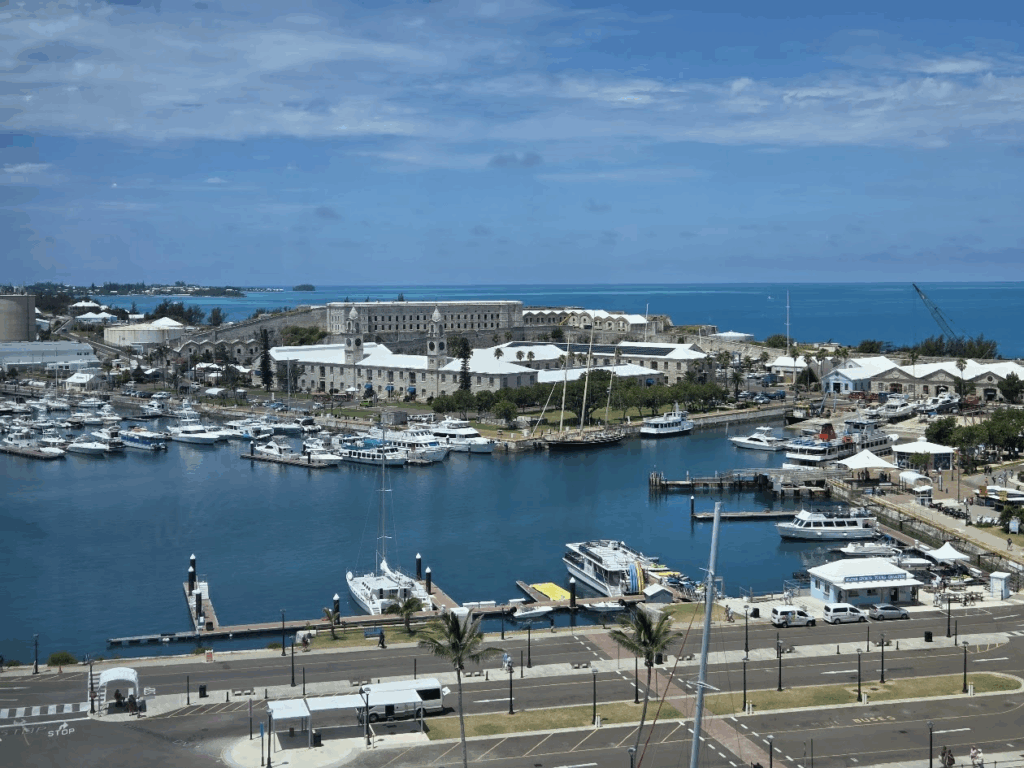
VACATION TIME
DOCKYARDS, BERMUDA
CREDITS
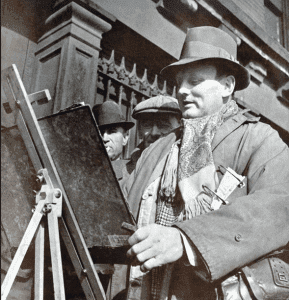
New York Almanack Illustrations, from above: West Side Cowboy riding on 10th Avenue (Kalmbach Publishing Co.); the plaque on 10th Avenue commemorating railroads accidents victims; Death Avenue before the High Line was built (Kalmbach); Reginald Marsh’s “Café du Dôme,” signed lithograph, 1928; Marsh’s “Death Avenue,” cartoon with urban cowboy in The New Yorker, November 5, 1927; Marsh’s, “Death Avenue,” 1928. (Whitney Museum of American Art); Marsh’s, “End of 14th Street Crosstown Line,” 1936 (Pennsylvania Academy of Fine Arts); and Reginald Marsh plein air sketching on 14th Street, Manhattan, 1941
All image are copyrighted (c) Roosevelt Island Historical Society unless otherwise indicated THIS PUBLICATION FUNDED BY DISCRETIONARY FUNDS FROM CITY COUNCIL MEMBER JULIE MENIN & ROOSEVELT ISLAND OPERATING CORPORATION PUBLIC PURPOSE FUNDS.
With its signature two-toned design and illustrations, the mock newspaper encouraged polite passenger etiquette and promoted local attractions.
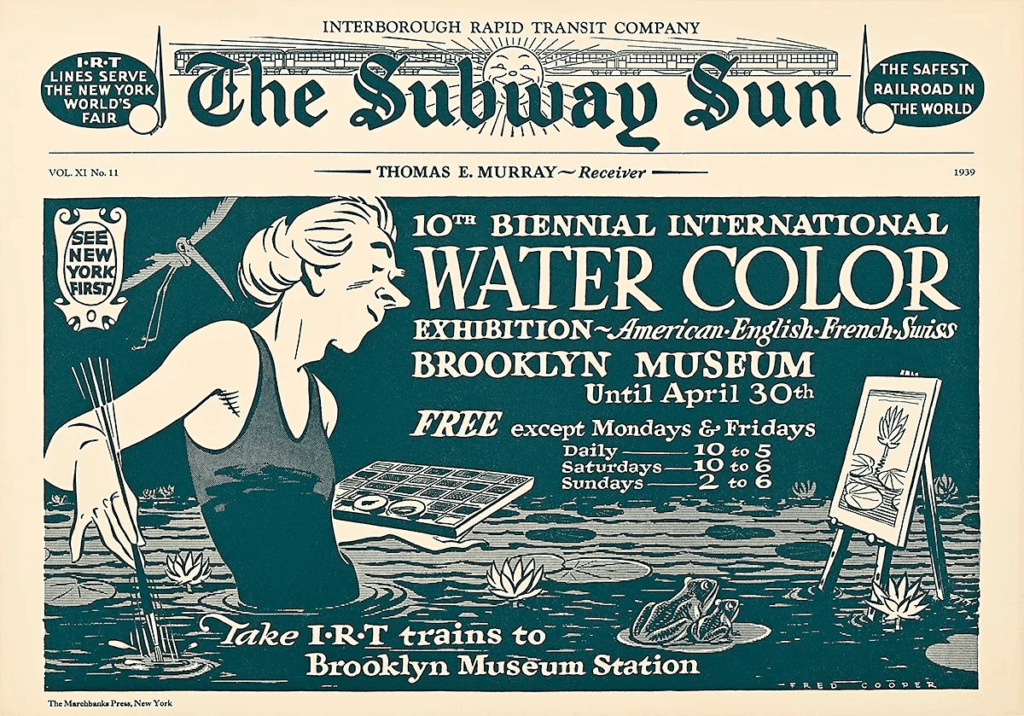
Fred Cooper, “10th Biennial International Water Color Exhibition/Brooklyn Museum” (1939) (all images courtesy Poster House unless noted otherwise)
Decades before the New York City subway cars were lined with advertisements for niche dating apps, personal injury lawyers, prescription weight loss medicines, and alternative internet browsers, the interiors of many of the city’s trains were adorned with editions of the two-toned mock newspaper known as The Subway Sun.
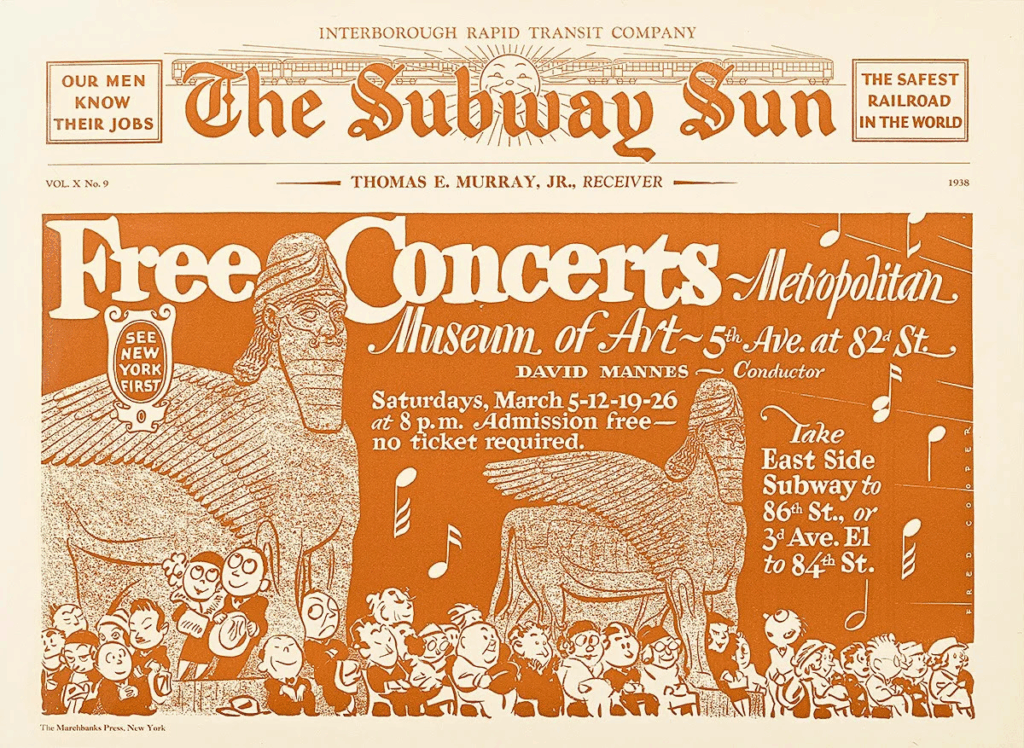
Primarily produced between 1936 and 1965 under the artistic direction of late cartoonists Fred Cooper and Amelia Opdyke Jones, the imitation periodical campaign by the Interborough Rapid Transit Company (IRT) fulfilled a variety of purposes in the subway system for over five decades. It encouraged polite passenger etiquette, but also promoted local attractions as a way to entice New Yorkers to use public transit — from the Metropolitan Museum of Art to the Brooklyn Botanic Garden.
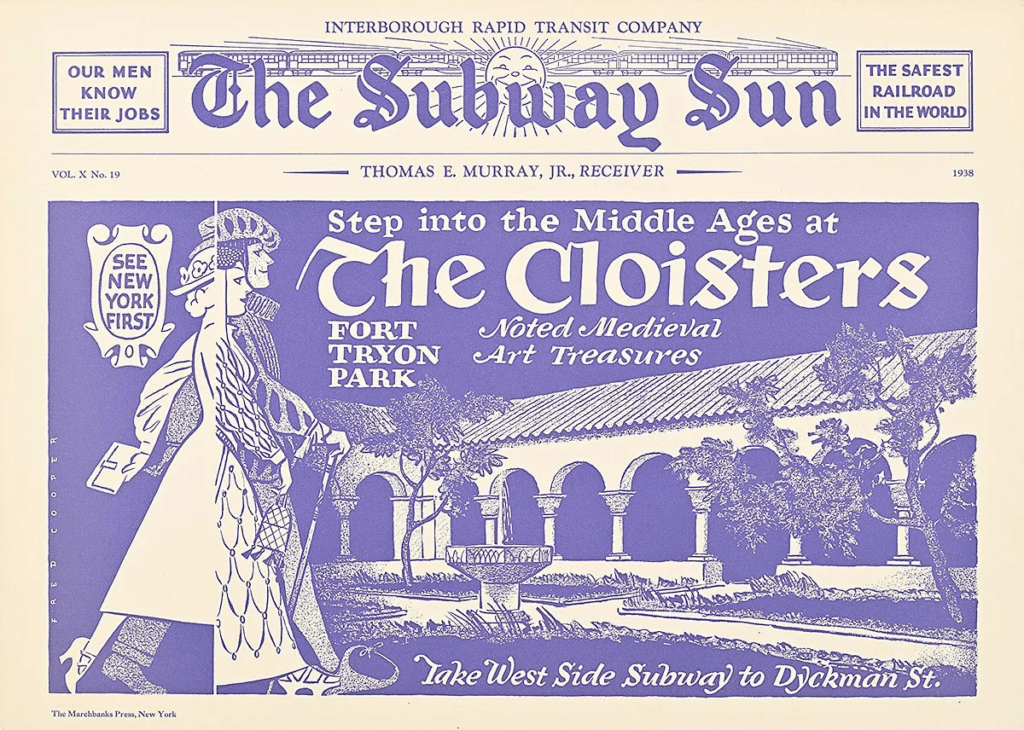
Fred Cooper, “The Cloisters” (1938)
Now, Manhattan’s Poster House is shining a light on the series for the first time in the new exhibition From the Bronx to the Battery: The Subway Sun, on view in the museum’s entry foyer through November 2. Curated by Es-pranza Humphrey, the show features 17 original in-car posters from the museum’s permanent collection, produced between 1937 and 1939. They showcase Cooper’s unique type design and signature illustration style that would eventually became the series’s defining aesthetic.
When The Subway Sun initially appeared in 1918 as a weekly promotional campaign for the IRT, the posters mainly focused on service announcements, operating expenses, and rules of conduct. They imitated the appearance of genuine newspapers, heavily laden with text and scarcely featuring illustrations. This design, however, shifted within a few years after the campaign began to incorporate advertisements for local sights and activities as a means to increase ridership.
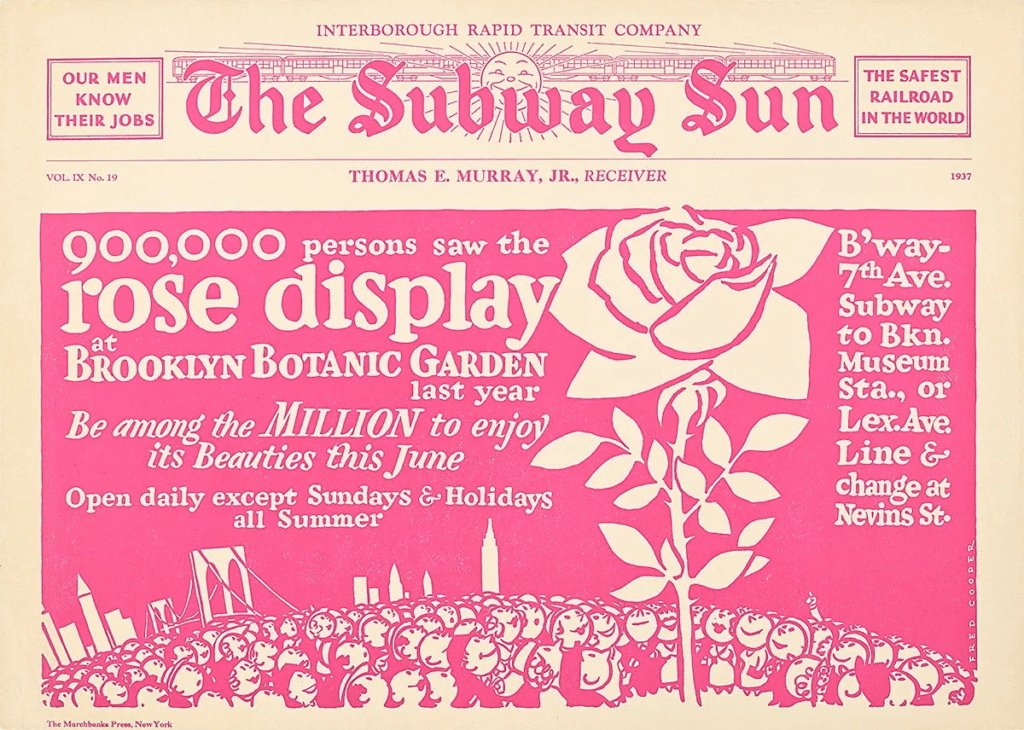
Fred Cooper, “Rose Display/Brooklyn Botanic Garden” (1937)
Cooper was an established graphic artist and political cartoonist when his designs for The Subway Sun first launched in the 1930s. His illustrations, which consisted of balloon-headed caricatures and one-of-a-kind lettering, often plugged public sights and events by blending helpful information with amusing characters. “His design adds a level of humor and familiarity, as these are posters that people would interact with during their rides on the IRT,” Humphrey, the museum’s assistant curator of collections, told Hyperallergic.
Fred Cooper, “Free Concerts/Metropolitan Museum of Art” (1938)
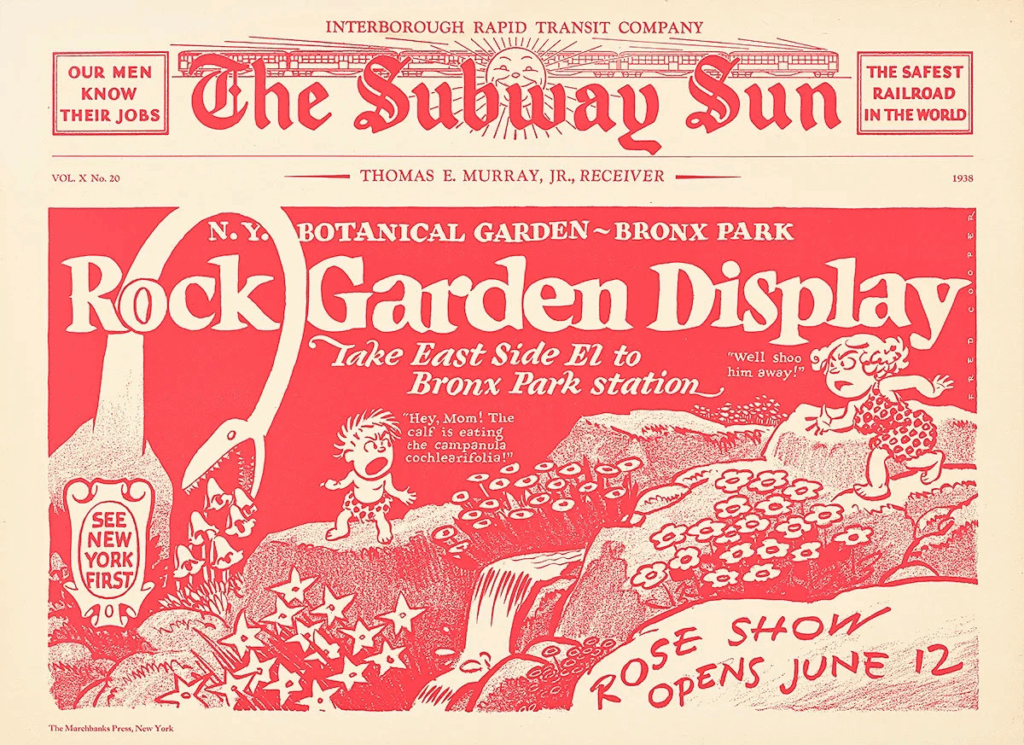
In a half-page ad for free weekend concerts at The Met, audience members are depicted together with massive Neo-Assyrian antiquities. Another bright-red poster promoting a rock garden display at the New York Botanical Garden in the Bronx revisits people of the Stone Age, depicting a child complaining to their mother about a dinosaur calf that is seen ravaging a bed of campanula cochlearifolia (fairy thimble) in the background. A 1939 ad promoting the 10th Biennial International Water Color Exhibition at the Brooklyn Museum gives a literal interpretation of the arts medium through an illustration of artist at an easel while half submerged in a lily pond.
Fred Cooper, “N.Y. Botanical Garden/Rock Garden Display” (1938)
In the 1940s, Cooper was succeeded by Jones, who also gave the publication a distinct voice. Many of her ads reminded riders how to be courteous to their fellow subway passengers by advising against inconsiderate behaviors like blocking train doors and manspreading — issues that continue to plague the transit system today.
VACATION TIME
After the last few months and a hip replacement, it is time for a week off the island. I will return soon and looking forward to seeing you. Judith Berdy
CREDITS
HYPERALLERGIC Judith Berdy
All image are copyrighted (c) Roosevelt Island Historical Society unless otherwise indicated THIS PUBLICATION FUNDED BY DISCRETIONARY FUNDS FROM CITY COUNCIL MEMBER JULIE MENIN & ROOSEVELT ISLAND OPERATING CORPORATION PUBLIC PURPOSE FUNDS.
Thursday, June 12, 2025 Untapped New York Issue #1469
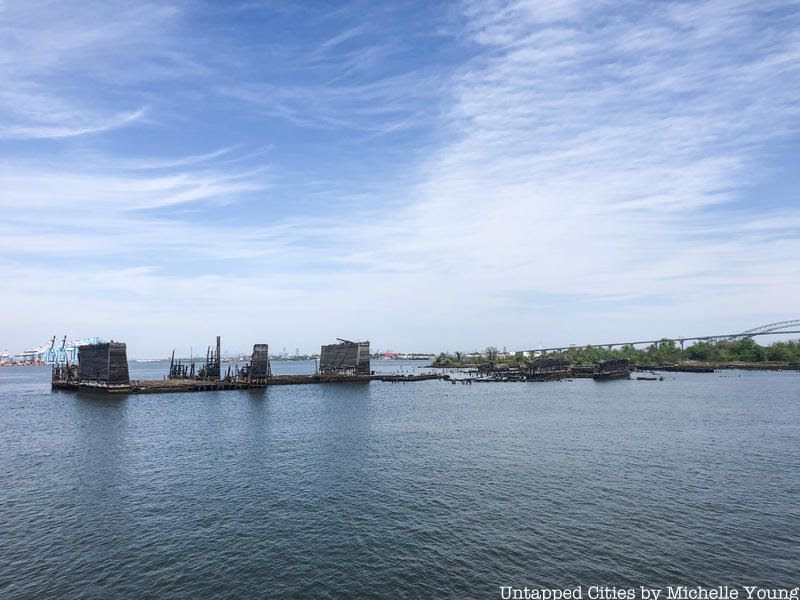
Shooter’s Island (Kill Van Kull)
This 43-acre island straddles the border between New York and New Jersey and derives its name from the hunting activities that took place here during the Colonial Era. As New York grew into an industrial port, the island accommodated an oil refinery and shipyard during the 19th century.
Today, the island is owned by the Department of Parks and Recreation, with the Audubon Society managing wildlife research. Many prominent historical figures from George Washington to Theodore Roosevelt and Prince Henry of Prussia once made use of the island, with the former utilizing it as a location to drop off covert messages during the Revolutionary War.
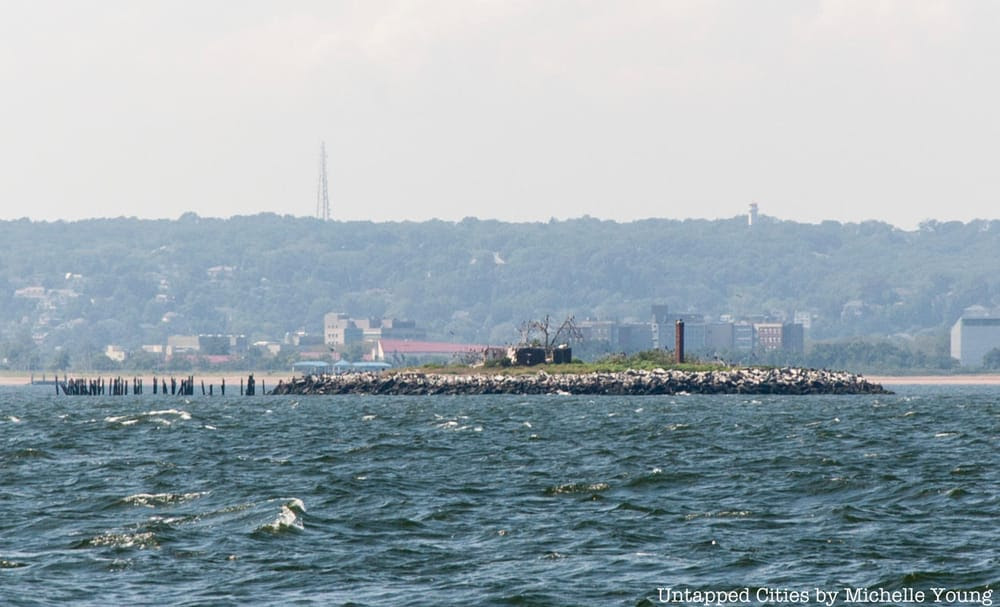
Hoffman & Swinburne Islands (Lower New York Bay)
This duo of artificial islands rests close enough to Staten Island’s shore that a proposal once existed to fill the gap between the landmasses to create a park. Such a proposal might not have existed if the planners had known that the islands originally hosted quarantine stations during the height of immigration into the U.S. in the late 19th/early 20th centuries.
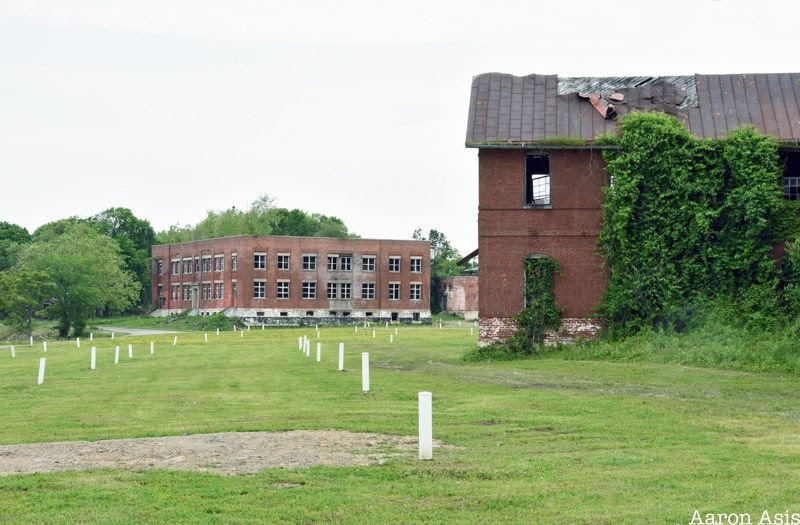
Constructed entirely of iron in order to keep the structures as airtight as possible, the facilities on the islands included a crematory and a mortuary for the less fortunate patients. Advances in the medical treatment of infectious diseases led to the decline of such facilities, with these two closing in 1923. Having been owned by the Department of Parks and Recreation since 1966, the islands were ironically preserved in order to maintain the “natural” topography of New York Bay.
North & South Brother Islands (East River)
Another duo of islands, these brothers are common in name only. North Brother‘s backstory features elements that have become typical for the avid New York historian, with a history of housing the sick, the addicted, and the condemned in confined spaces away from the public. The tuberculosis pavilion has been documented by photographer Christopher Payne, and much literature has been written about the site.
For what South Brother lacks in foreboding tales of the infirm, it makes up for in humorous eyebrow-raising real estate ventures. Originally the property of Jacob Ruppert–the owner of the Yankees largely responsible for bringing Babe Ruth to New York–the island’s only structure burned down in 1909. After Rupper sold the island, the real estate transactions went something like this: private ownership to public ownership to private again to public again, with prices ranging from $10 from an investment firm in 1975 to $2 million of Federal Grant money in 2007.
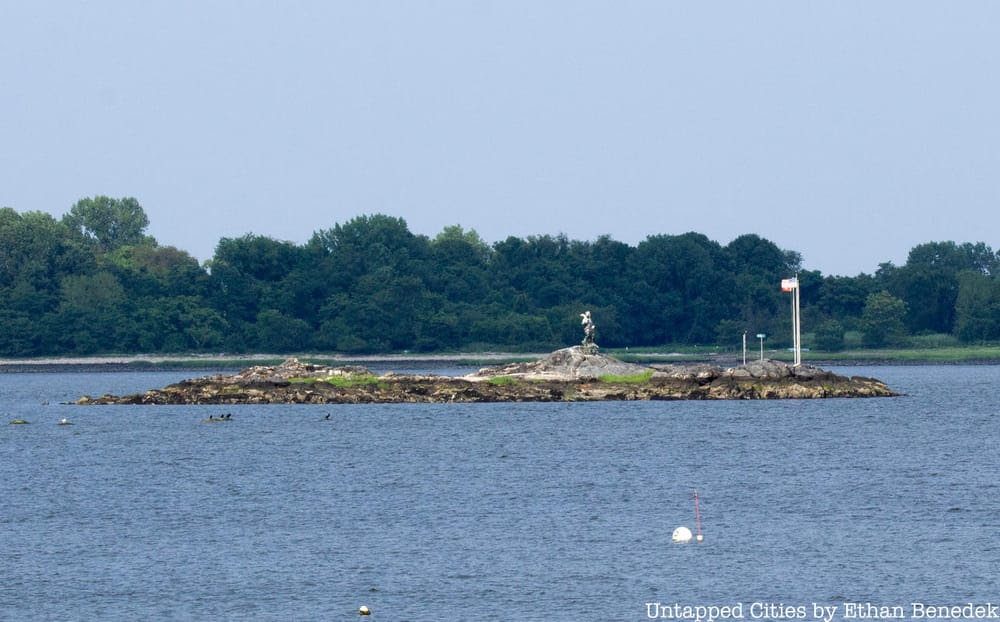
Rat Island (City Island Harbor)
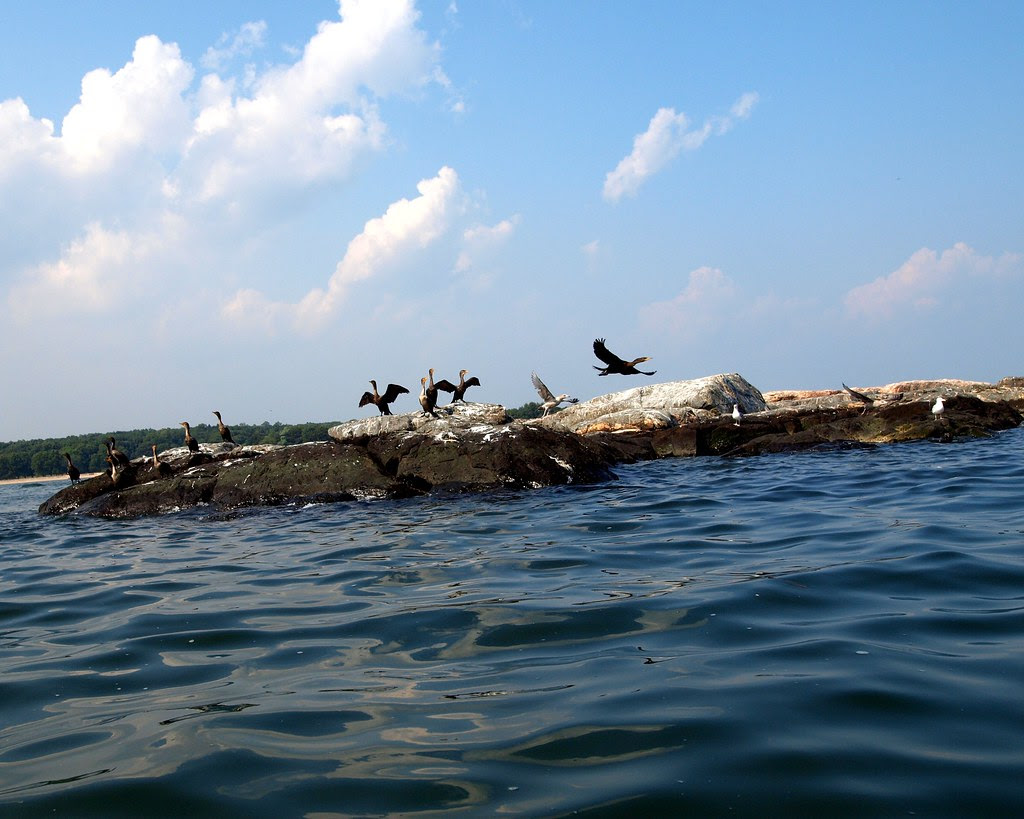
Gulls are the only living creatures attracted to the island.
As is to be guaranteed in New York, for every obscure real estate venture, there is always one that tops the last. Enter Rat Island, a 2.5-acre mass of bedrock and broken glass with no vegetation. To the average investor, the island is as devoid of value as it is devoid of life. But you won’t be able to discourage Alex Schibli, a former Port Authority employee and City Island resident who purchased the island for $176,000 in 2011.
Schibli claims that he has always wanted an island getaway, but perhaps he’s realized that such a development would be impractical on a landmass that is known for being completely submerged during average summer thunderstorms.
Ellis Island’s Abandoned Southside Hospitals
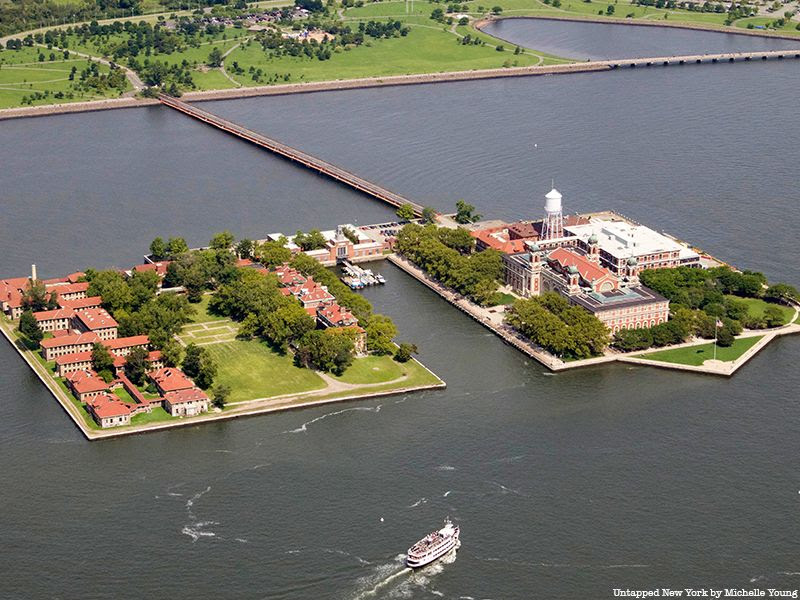
While Ellis Island has become one of New York City’s top tourist attractions, drawing over two million visitors per year, the 22-building South Side hospital complex is hidden in plain sight, just to the left of disembarking passengers headed towards the Great Hall. Looking at its desolate, skeletal frame now, it’s difficult to imagine its backstory as one of the largest public health undertakings in American history.
But the abandoned Ellis Island Hospital complex—once the standard for United States medical care (and later transformed into the FBI headquarters when the island served as a detention center)—has been left to decay for nearly 60 years. Join us for our upcoming hard hat tour, guided by a Save Ellis Island docent, where we’ll uncover its many, buried secrets. In this experience, you’ll visit the contagious disease wards, and the autopsy rooms, and have exclusive access to places usually closed to the public.
Mau Mau Island (Mill Basin)
Islands have historically played strategic roles for nations and their militaries, and those in New York City are no exception. While the battles on Long Island and Manhattan have been well documented, the naval skirmish that took place on Mau Mau is a little less well-known. That might have had more to do with the post-battle bar hop, though.
In 2011, the artist collective Swimming Cities hosted a raucous day of competitive naval events that pitted “gangs” sailing homemade vessels against one another. The manmade island sits across from Marine Park golf course and has attracted little media attention–save for the construction of a bird sanctuary–since.
High Island (City Island Harbor)
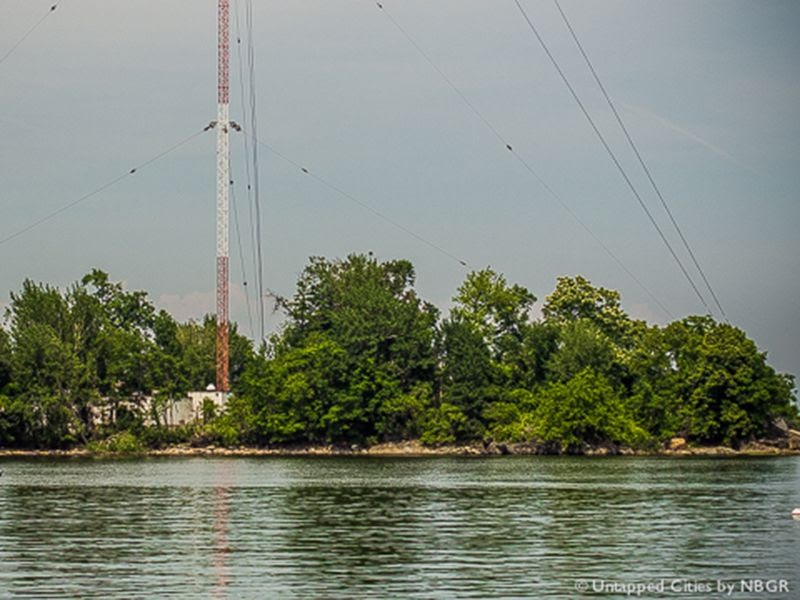
A stone’s throw from New York City’s most treasured obscure landmass, City Island, High Island has also proved a cozy home, first for sharks and then for humans. The bungalow dwellers were kicked out in 1962 to make way for a radio transmission tower, which was hit by a small plane just one day before owner WCBS switched to an all-news format. A new tower has stood in place since the incident and has a daytime broadcast frequency range from Cape Cod to Cape May.
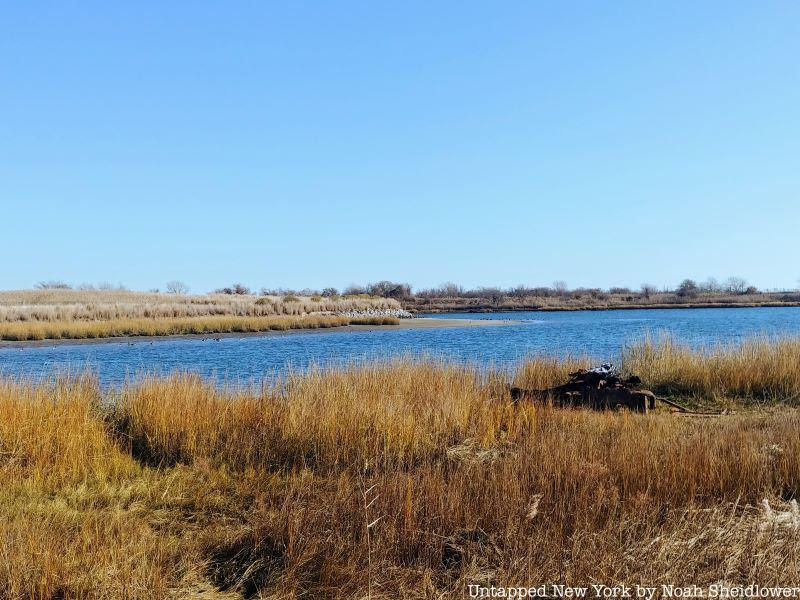
Isle of Meadows (Fresh Kills)
Image courtesy The City of New York and Freshkills Park by Daniel Avila
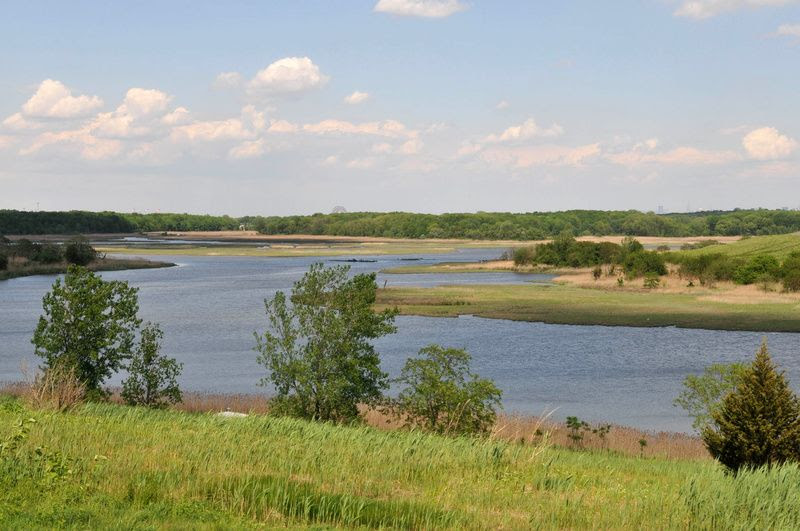
This 100-acre plot of land is as natural as they come, which is why the Audubon Society has fought so hard for its preservation over the years. Plans for its inclusion in the Fresh Kills Landfill were met with volatile opposition in the early 1990s, and today the island consists entirely of a nature preserve. Once declining populations of herons, ibis, and egrets now call the island home, and it has been considered one of the most crucial such refuges in the New York area.
Hart Island
Home to the largest tax funded cemetery in the world, Hart Island has been the final resting place for over 800,000 since 1869. Jacob Riis documented the island in his book, How the Other Half Lives, and estimated that 1 in 10 New Yorkers were buried on the island by the end of the 19th century. Like North Brother Island, it has often been associated with society’s unwanted, though a recent interview with a former resident indicates that it did not always bare a haunting persona.
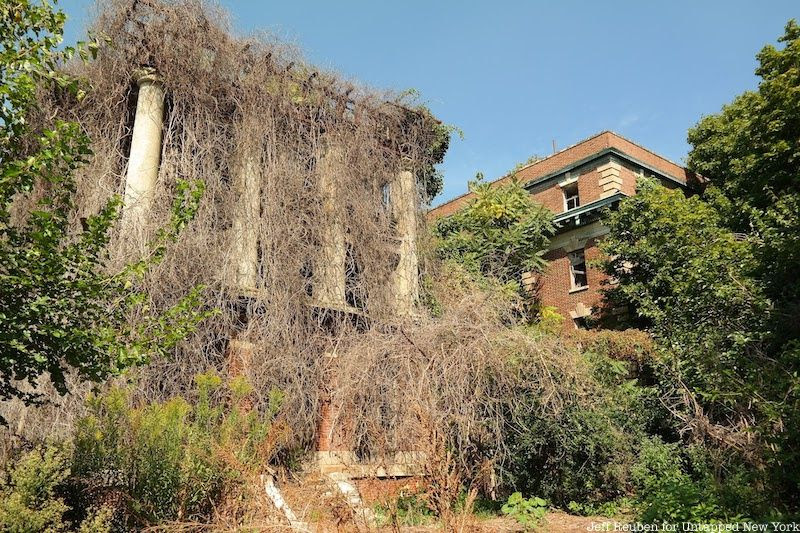
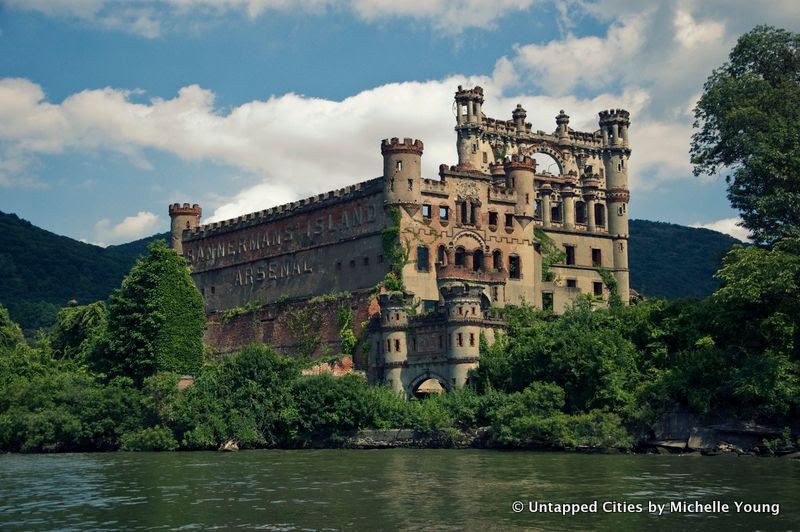
The decaying castle structures on Bannerman Island were built near the town of Beacon, New York by Scottish-American entrepreneur Francis Bannerman as warehouses for his business “Bannerman’s,” a catalog business for war surplus (including munitions and large artillery).
The Bannermans discovered the island by accident while canoeing on the Hudson and purchased it from an eccentric husband and wife duo named Mary and Anthony Taft for $600 (plus $1000 in notes that were paid off over two years). The Bannermans had to promise in writing that the island would not go back to its past use as a haven for illegal alcohol and prostitution. Francis Bannerman built the structures gradually. He was not an architect but would draw elements on napkins and envelopes based on castles he saw on travels to Europe, and give the sketches to his construction workers to build.
The current state of the structures is the result of a number of unfortunate incidents. In 1918, Francis Bannerman died and his family lost interest in maintaining the buildings. The powerhouse exploded in 1920, sending debris all the way across the Hudson and blowing out some of the warehouse windows. The gradual construction of the warehouses meant that buildings were supported by one another, lending a fundamental weakness to the design. In addition to the natural toll of time, a particularly harsh winter in 2010 led to the collapse of two major walls of the tallest warehouse.
Chimney Sweeps Islands
The decaying castle structures on Bannerman Island were built near the town of Beacon, New York by Scottish-American entrepreneur Francis Bannerman as warehouses for his business “Bannerman’s,” a catalog business for war surplus (including munitions and large artillery).
The Bannermans discovered the island by accident while canoeing on the Hudson and purchased it from an eccentric husband and wife duo named Mary and Anthony Taft for $600 (plus $1000 in notes that were paid off over two years). The Bannermans had to promise in writing that the island would not go back to its past use as a haven for illegal alcohol and prostitution. Francis Bannerman built the structures gradually. He was not an architect but would draw elements on napkins and envelopes based on castles he saw on travels to Europe, and give the sketches to his construction workers to build.
The current state of the structures is the result of a number of unfortunate incidents. In 1918, Francis Bannerman died and his family lost interest in maintaining the buildings. The powerhouse exploded in 1920, sending debris all the way across the Hudson and blowing out some of the warehouse windows. The gradual construction of the warehouses meant that buildings were supported by one another, lending a fundamental weakness to the design. In addition to the natural toll of time, a particularly harsh winter in 2010 led to the collapse of two major walls of the tallest warehouse.
Like High Island, the Chimney Sweep Islands lie just beneath City Island’s nose. Or, at least, just across Pelham Bay. Both are part of a group of 20 islands situated within the borders of Bronx County known as the “Devil’s Stepping Stones.” With a history of waxing and waning fortunes, they have provided both key landmarks for sailors during the 18th century and have hosted asylums.
As with much of the New York area’s etymology, the island group’s namesake harkens back to Native American origins. According to folklore, the “Devil’s Stepping Stones” are believed to have been formed during a skirmish between a local tribe and the Devil. Every time the Devil set his foot down into the water, a small landmass emerged. Regardless of the accuracy of such tales, the names are indicative of the barren nature of these uninhabited land formations, most of which are composed entirely of bedrock and are devoid of any discernible vegetation.
It is no surprise then that the Chimney Sweep Islands, whose name was probably derived from the fact that they look like chimney sweep tools, have never been inhabited by humans. Rather, flocks of seagulls and blue herons have long called them home, and they have now become popular with kayakers as a resting place.
ONE YEAR AGO
“DOUBLE TAKE” BY DIANA COOPER WAS REVEALED OUTSIDE OUR SUBWAY STATION
CREDITS
UNTAPPED NEW YORK Judith Berdy
All image are copyrighted (c) Roosevelt Island Historical Society unless otherwise indicated THIS PUBLICATION FUNDED BY DISCRETIONARY FUNDS FROM CITY COUNCIL MEMBER JULIE MENIN & ROOSEVELT ISLAND OPERATING CORPORATION PUBLIC PURPOSE FUNDS.
Wednesday, June 11, 2025 NYC Municipal Archives Issue #1468
Many pieces of New York have been lost over the years – from the days before European settlers arrived through the more recent places we loved, the restaurants we knew and even the sports teams we lost to California, New Jersey and elsewhere. One of the lesser-known losses – as infamous and smelly as it was – is Barren Island, which was located on the southeast shore of Brooklyn, on the way to the beach at Jacob Riis Park. Some of its history can be found in the Municipal Archives – largely in late 19th century state and local Health Department investigations – and in the digital collection of images from the early 20th century.
Houses built on stilts over swamp land, Barren Island, Brooklyn, 1937. Photographer: Edwards. WPA Federal Writers’ Project Collection, NYC Municipal Archives.
Historical records indicate that the Canarsee Native American tribe used what became known as Barren Island as a fishing outpost in the early 17th century and later “signed over” much of it to Dutch settlers. Largely unoccupied for many years, by the mid-19th century it had become a vast dumping ground where tons of waste and dead animals like horses, cattle, dogs, cats, rats and many other species from Brooklyn, Manhattan and The Bronx were rendered in several large factories on the island.The grease extracted from the waste yielded more than $10 million in profits annually.
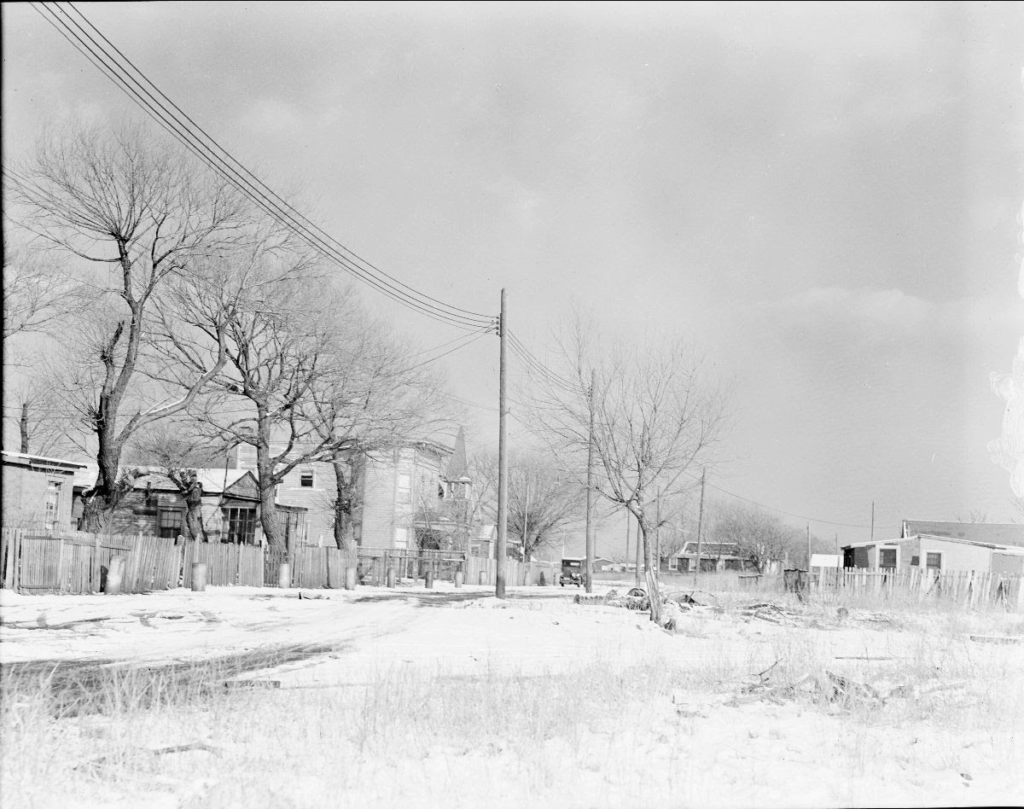
Street scene, Barren Island, Brooklyn, January 1938. Photographer: Sam Brody. WPA Federal Writers’ Project Collection, NYC Municipal Archives.
The residents, an ethnically diverse mix of blacks and poor European immigrants from Italy, Ireland and Poland, mostly worked in the factories and rendering plants, or service industries like grocery stores and bars. There also was a school, PS 120, and a church.
Catholic Church, Barren Island, Brooklyn, January 1938. Photographer: Sam Brody. WPA Federal Writers’ Project Collection, NYC Municipal Archives.
The Island inhabitants apparently became accustomed to the odors and noxious fumes from the island’s incinerators, but people living in the rest of Brooklyn complained long and loud about the stench. Finally, in October 1890, Governor David Hill responded to complaints about the “nuisance” on Barren Island “which affected the security of life and health” throughout Brooklyn by ordering a State Health Department investigation. The report from that investigation, contained in the archives, noted that a rendering plant operated by Peter White’s Sons received the carcasses of all dead animals collected on the city’s streets. “On an average there are over two thousand hogs kept on the premises… and the dead animals are dismembered and boiled and oils extracted therefrom,” the report said, noting that the odors were carried along to Rockaway Beach and other neighborhoods, “rendering those inhabitants sick and destroying the comfort and enjoyment of their homes.” The report also noted that a fertilizer plant on the island received “large quantities of fish,” which were allowed to accumulate on loading docks. “The smells from those fish factories are so powerful that it is impossible to keep the doors or windows of dwelling houses open when the wind blows from the direction of Rockaway, and many persons have been made sick…” The report recommended that the factories take measures to contain the odors and that state health inspectors make regular visits.
P.S. 120, Barren Island, Brooklyn, ca. 1905. Lantern slide. Board of Education Collection, NYC Municipal Archives.
The results were mixed at best. An 1896 report from the Brooklyn Department of Health – Brooklyn did not become part of New York City until 1898 – found that nuisances were still rife on the island five years after the state report. “This bureau, together with the sanitation bureau and the inspector of offensive trades has kept a close watch of the manufactories situated on Barren Island,” but noted that as long as rendering and fertilizer companies exist, there will be noxious odors and complaints. A subsequent inspection “found at the rendering plant dock three garbage scows, two of them being full and the other about half full… the plant is running night and day.” An inspection report for January 1896 found the carcasses of 21 dogs, 17 cats, 35 rats, along with numerous dead cattle, sheep and horses, which led to the naming of the nearby Dead Horse Bay. The City stopped dumping its garbage there in 1919. Complaints worsened in the early 20th century and the island’s population dwindled from a high of about 1,500 to several dozen by 1936, when City Parks Commissioner Robert Moses ordered the eviction of all residents as part of his plan to expand Marine Park. Before that happened, many of the buildings were abandoned and crumbling, as can be seen in 1930s-era photographs in the Archives.
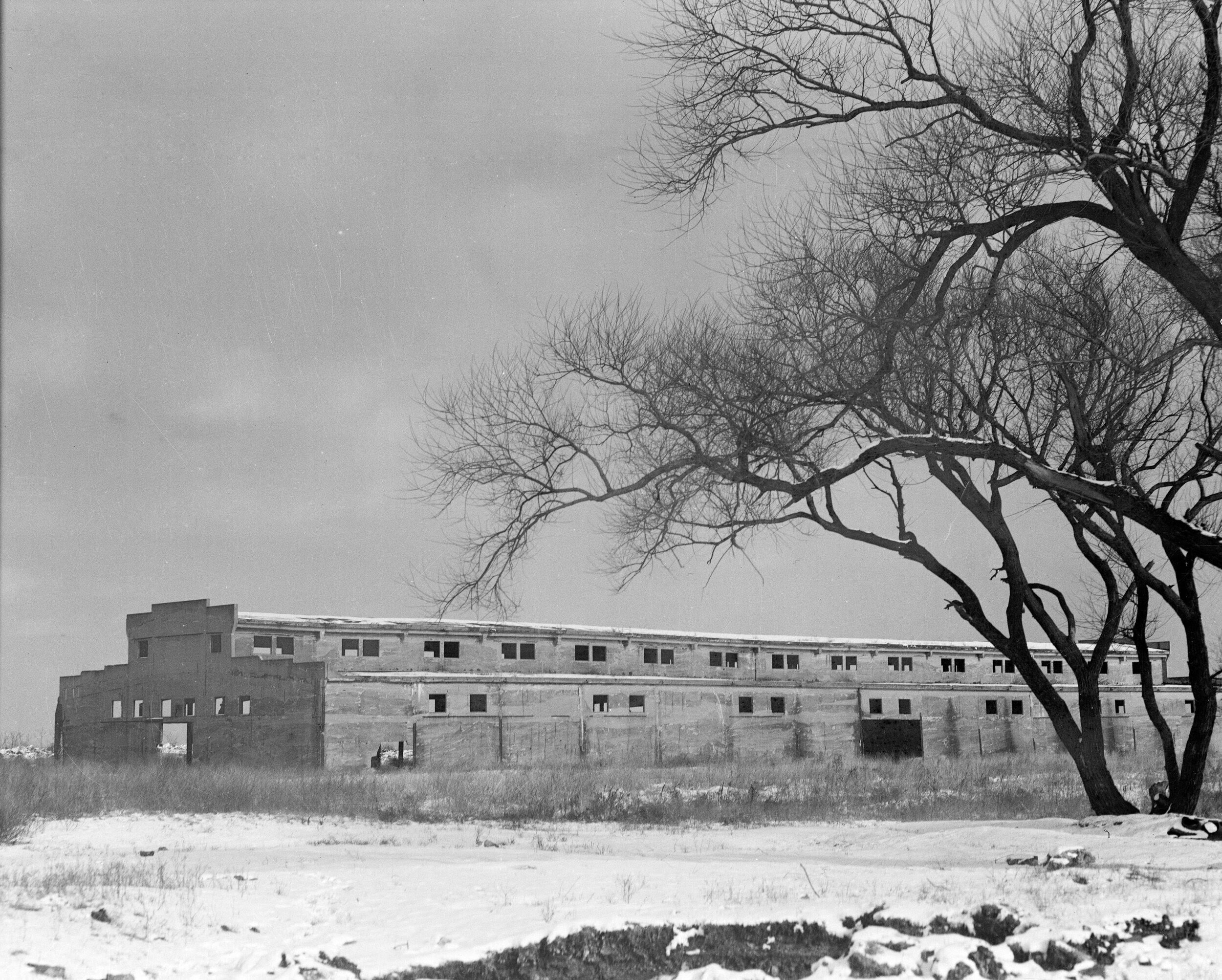
Abandoned rendering factory, Barren Island, Brooklyn, January 1938. Photographer: Sam Brody. WPA Federal Writers’ Project Collection, NYC Municipal Archives..
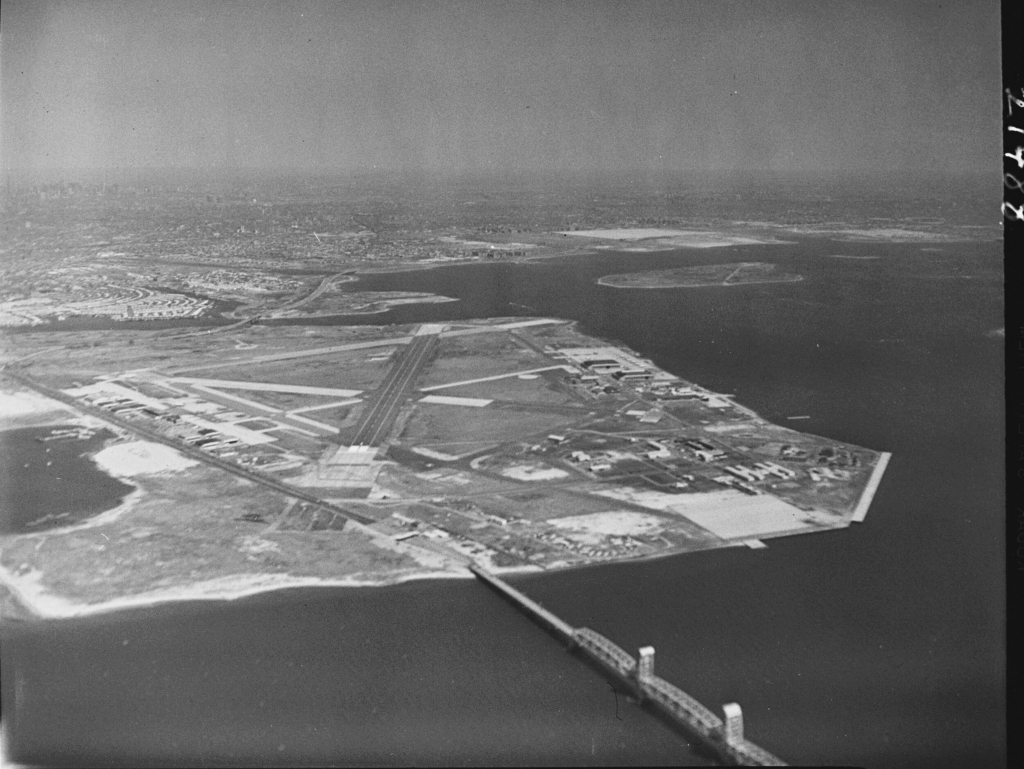
The island eventually vanished as the city used landfill and tons of sand to connect it to the rest of Brooklyn. It later become the home of Floyd Bennet Field and eventually part of Gateway National Park area. Now, it is gone and largely forgotten – yet another piece of the lost New York.
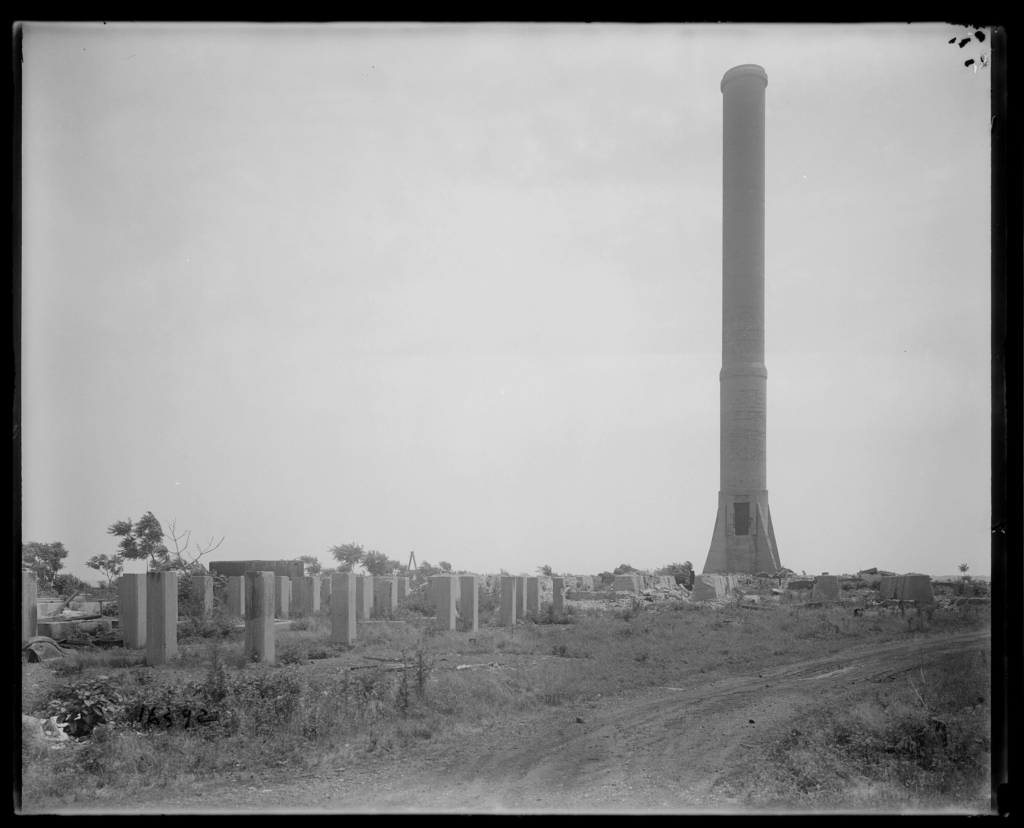
Municipal Airport Floyd Bennett Field (remains of incinerator on Barren Island), July 27, 1934. Department of Bridges, Plant & Structures Collection, NYC Municipal Archives.
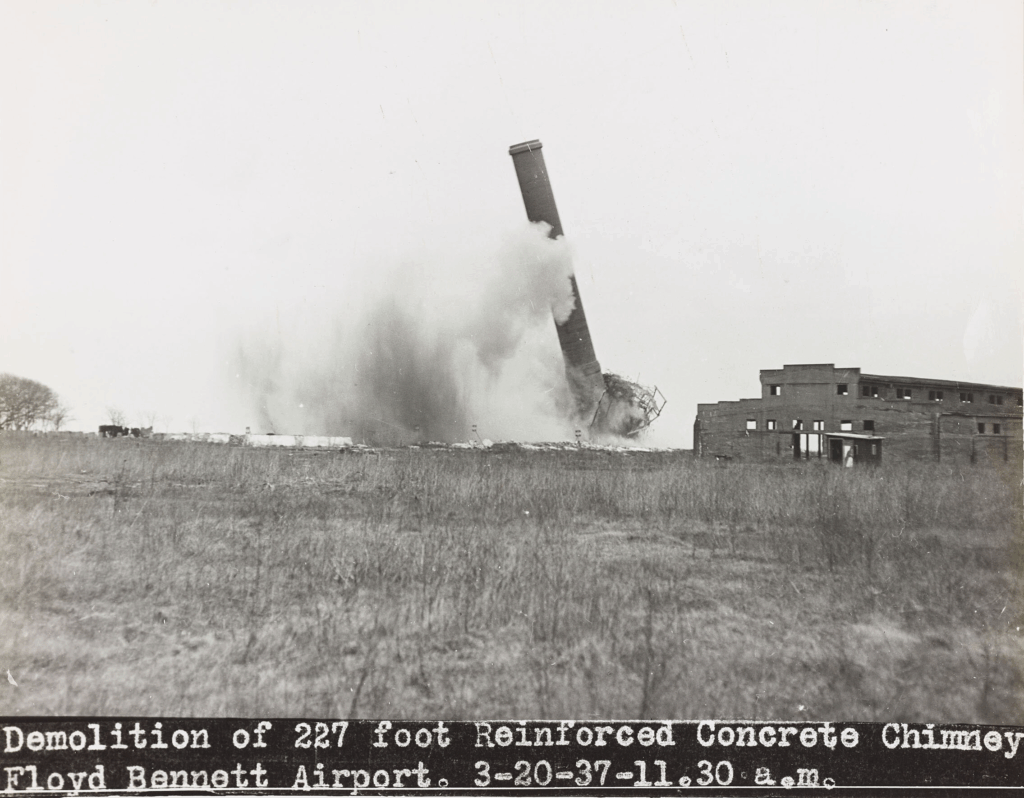
Demolition of 227 ft. reinforced concrete chimney at Floyd Bennett Airport on March 20th, 1937. NYC Municipal Archives Collection.
Floyd Bennett Field – aerial, May 7, 1970. Department of Marine and Aviation Collection, NYC Municipal Archives.
MOON OVER L.I.C.
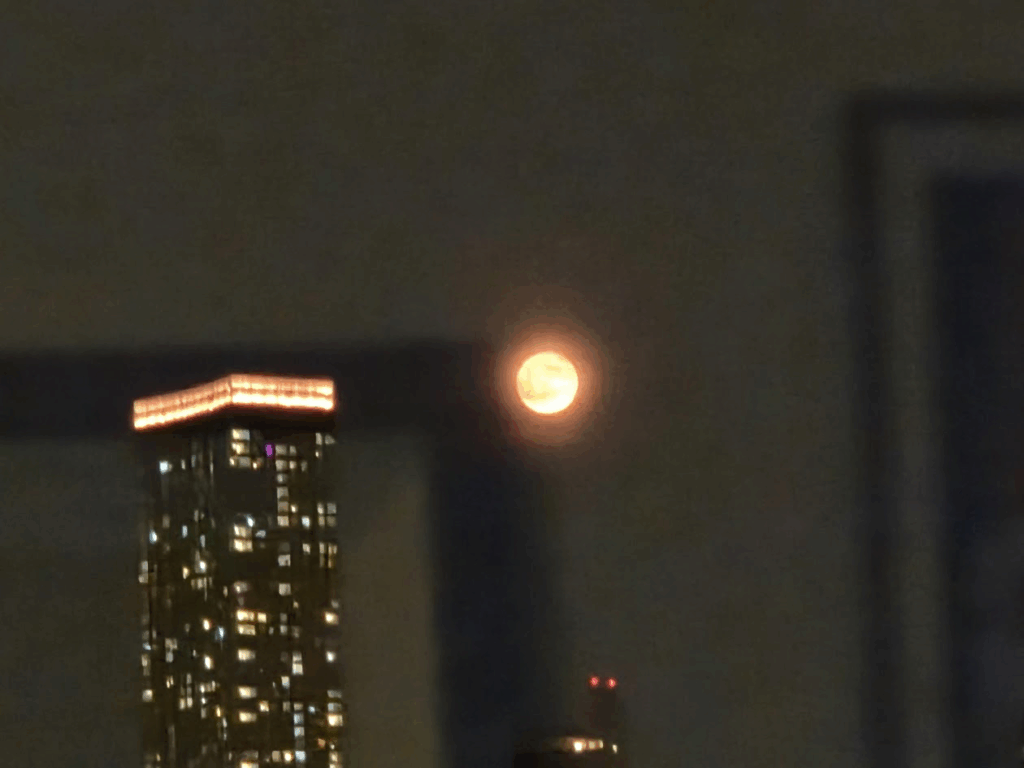
A WAXING GIBBOUS PHASE MOON VISIBLE LAST EVENING
CREDITS
NYC MUNICIPAL ARCHIVES STUART MARQUES
All image are copyrighted (c) Roosevelt Island Historical Society unless otherwise indicated THIS PUBLICATION FUNDED BY DISCRETIONARY FUNDS FROM CITY COUNCIL MEMBER JULIE MENIN & ROOSEVELT ISLAND OPERATING CORPORATION PUBLIC PURPOSE FUNDS.
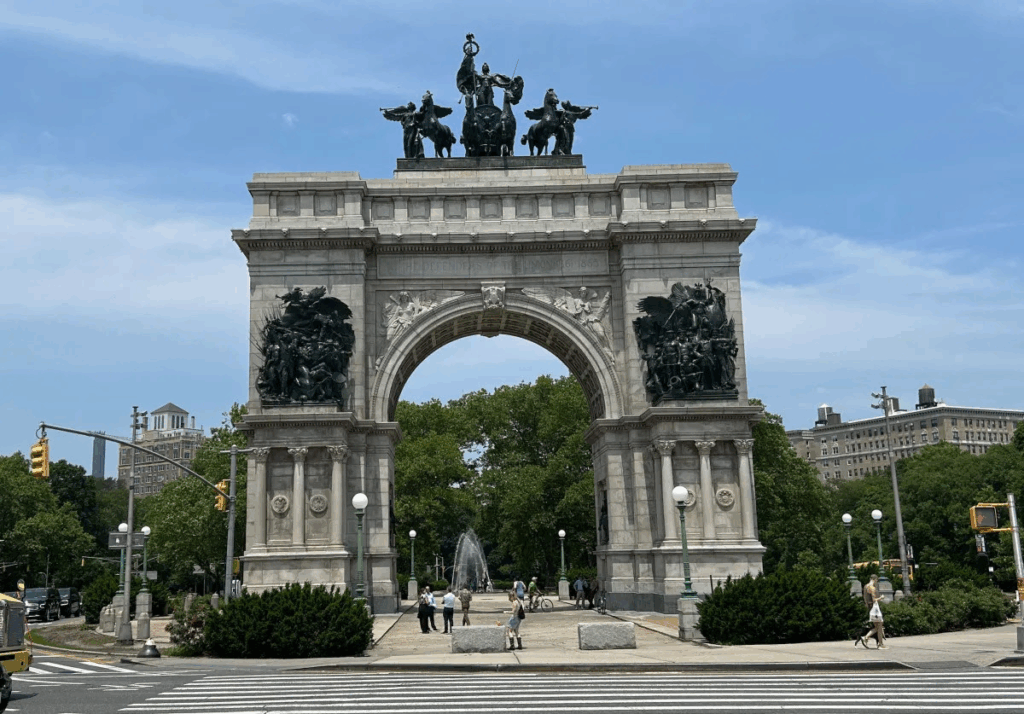
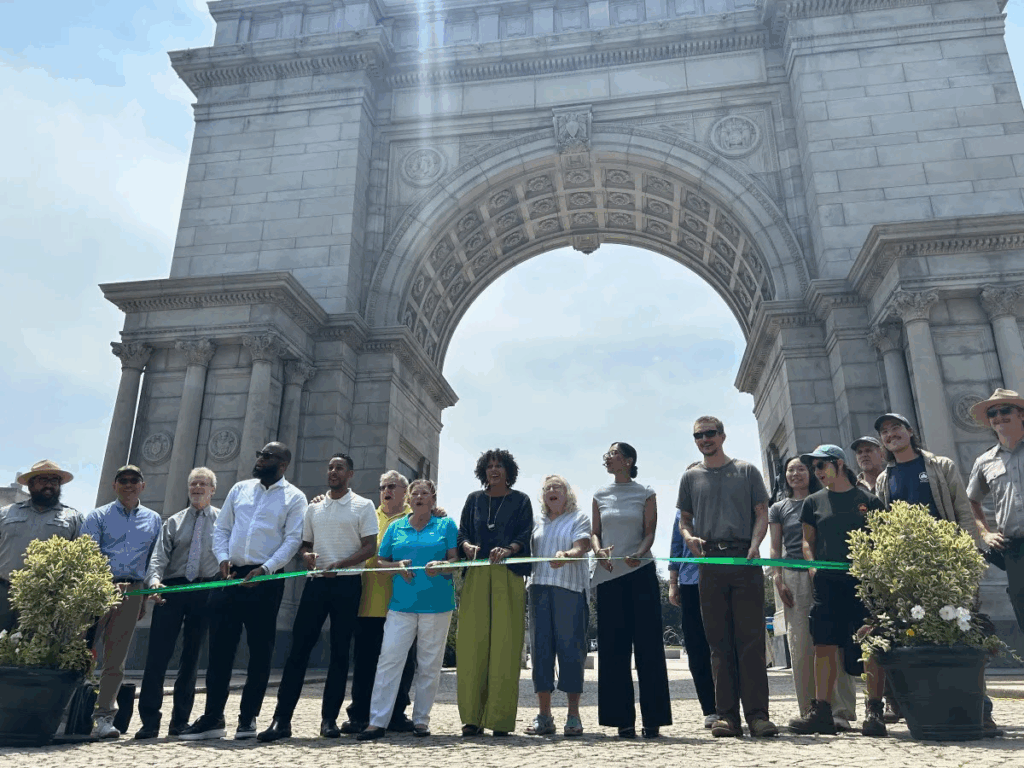
After nearly two years of extensive restoration, the soaring Soldiers’ and Sailors’ Memorial Arch at Grand Army Plaza in Brooklyn, New York, has reopened to the public. The completion of the nearly $8.9 million project was celebrated last week in a ribbon-cutting ceremony hosted by the New York City Department of Parks and the Prospect Park Alliance (PPA), which oversaw the refurbishment of the 80-foot-tall Beaux-Arts landmark.
Built between 1889 and 1892, Soldiers’ and Sailors’ Memorial Arch was designed by John H. Duncan as a commemoration of Union Army forces that fell in the Civil War. It is one of three Civil War triumphal arches in the city, which include the Washington Square Arch and the entrance to the Manhattan Bridge.
The arch hosts bronze statuary groupings honoring Union forces who died in the Civil War. (photo Maya Pontone/Hyperallergic)
Ribbon-cutting ceremony at the restored Grand Army Plaza Arch
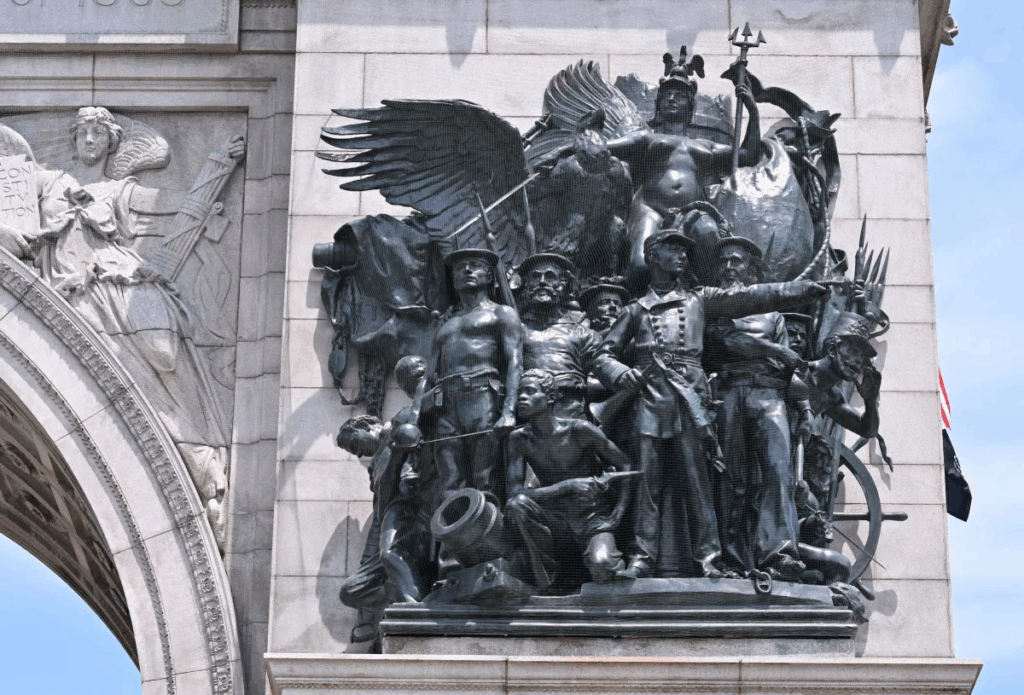
The recent makeover, funded by former Mayor Bill de Blasio’s administration, consisted mainly of repairs that replaced the roof and inner steel beams, fixed broken stonework, and reconstructed its interior spiral staircases. It also added a new internal drainage system and redesigned the monument’s evening lighting to highlight its bronze statuary groupings designed by Brooklyn-born sculptor Frederick MacMonnies. These works, which are located on its roof and north-facing pedestals, depict the goddess Columbia, a female personification of the United States, and Union Army soldiers and sailors; the grouping on the right side of the arch includes the city’s only public statue of a Black Civil War sailor.
The right statuary grouping includes the city’s only public statue of a Black Civil War sailor. (photo by Paul Martinka, courtesy the Prospect Park Alliance)
“This is where people say, ‘Okay, meet you under the arch… It’s kind of the heart and thoroughfare of the borough,” Morgan Monaco, president of the PPA, told Hyperallergic at the ribbon-cutting ceremony.
Previously delayed due to pandemic slowdown, the restoration was expected to wrap in the fall of 2023. However, as PPA’s Director of Architecture and Preservation David Yum told Hyperallergic, the restoration team that worked on revamping the arch encountered dozens of unforeseen challenges, one of the most difficult being addressing decades of moisture and water damage to the five-layer roof.
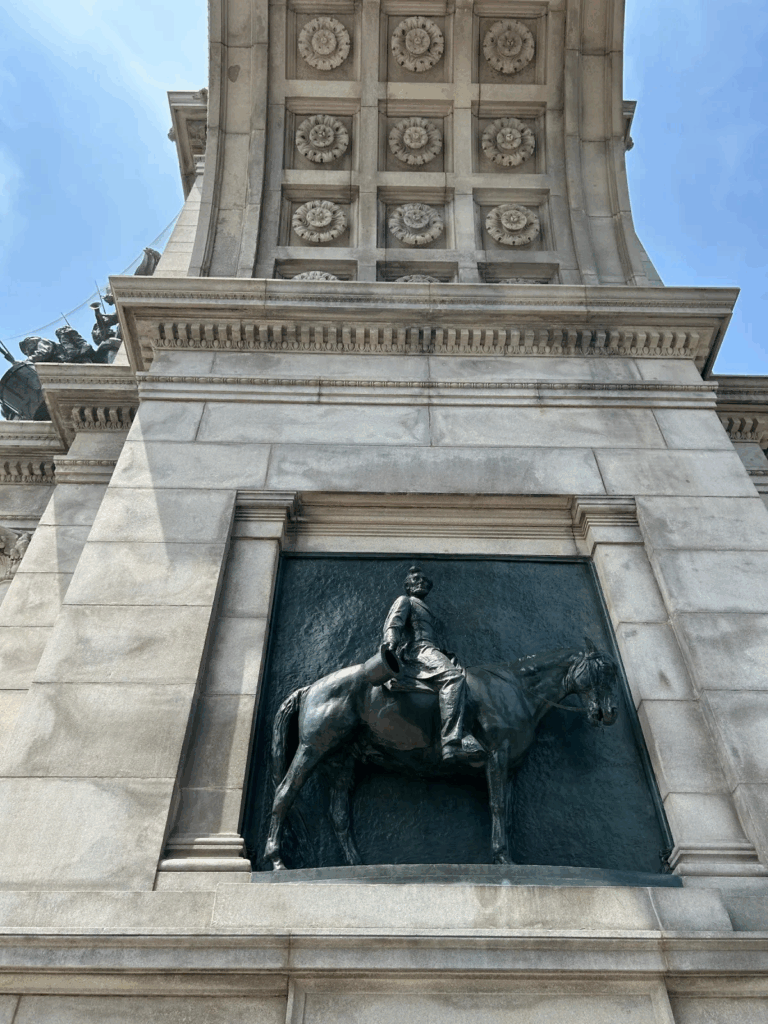
The arch hosts many works of bronze statuary, including a depiction of President Abraham Lincoln on its interior (photo Maya Pontone/Hyperallergic)
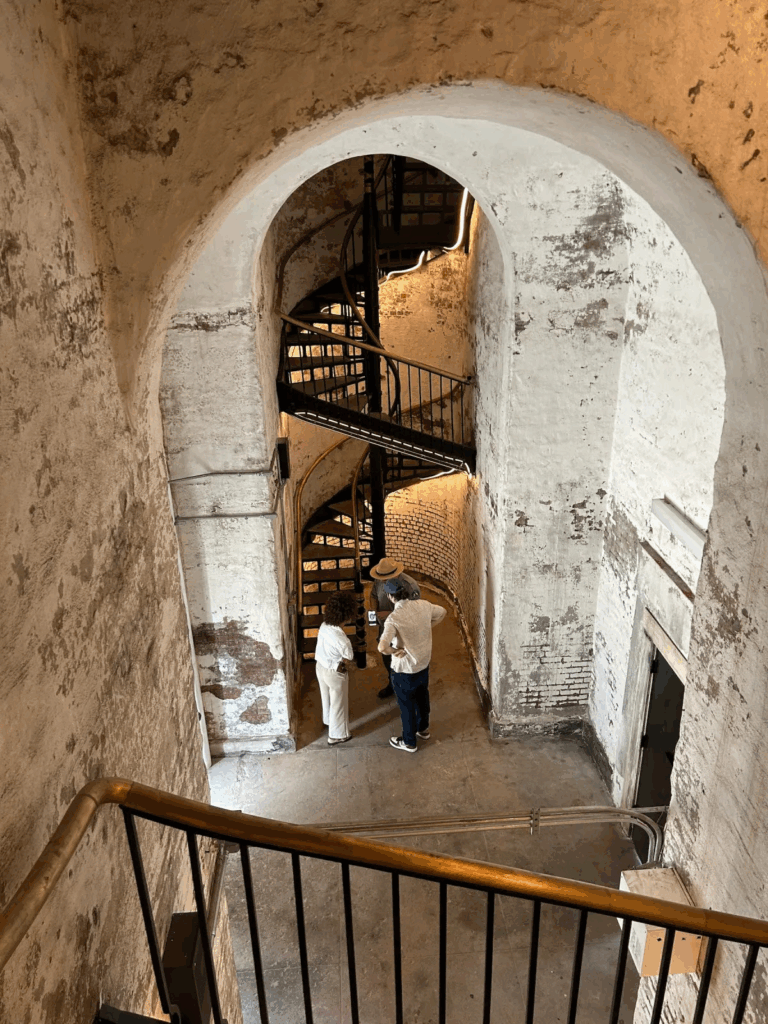
The restoration included a comprehensive cleaning of the arch’s inner spiral staircases, which lead up to the trophy room and roof. (photo Maya Pontone/Hyperallergic)
“ After decades of water, it was almost impossible to get all the moisture out, so that took us months and months [to figure out,]” Yum said. “It’s one thing when it’s one or two materials, but when it’s five materials, it’s really challenging.”
The entire project required extensive research into the monument’s materials and structural framework. Because the original blueprints for the memorial arch were lost to time, the PPA’s in-house team of architects had to rely on physical surveys from previous restorations and detailed scans of the arch’s interior developed with radar and magnetic technology. They used laboratory testing to trace the existing stonework mortar back to a quarry in Rosendale, New York, and replaced fractured stonework with matching stone from a Maine quarry. Additionally, the bronze and cast-iron spiral staircases and entrance gates were cleaned scrupulously in a process that required them to be completely disassembled and reassembled.
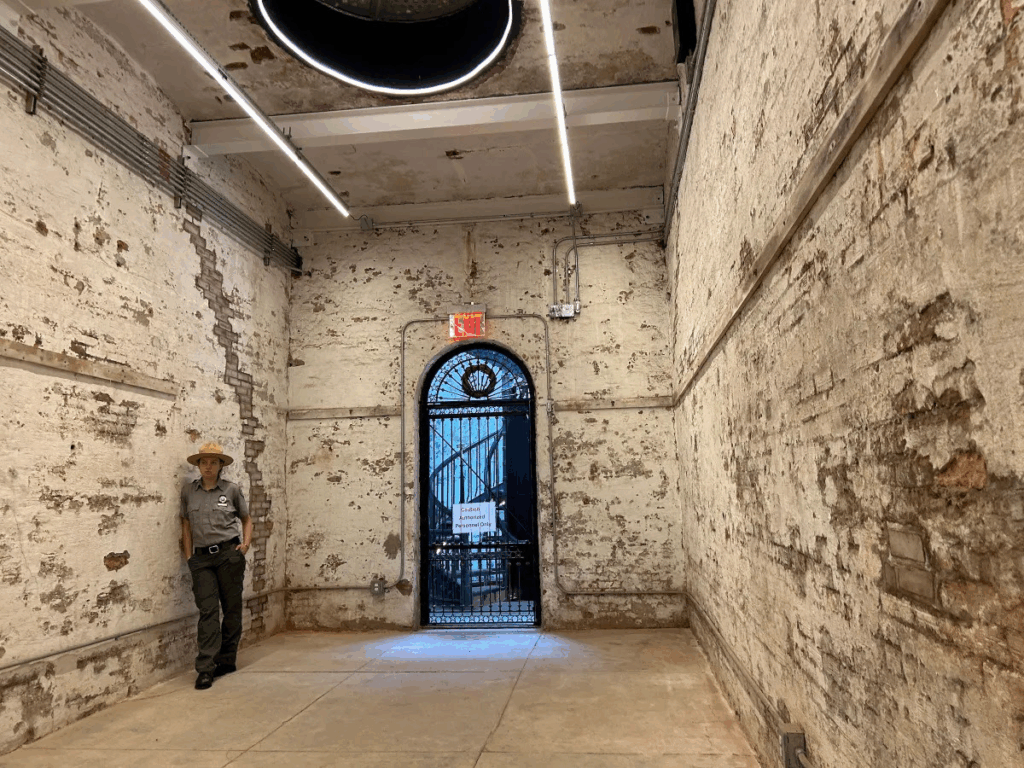
View of the arch’s trophy room today (photo Maya Pontone/Hyperallergic)
At last week’s ceremony, attendees got an up-close peek at the monument’s restoration, including a tour up the arch’s staircases and overhead Trophy Room. While no longer open to the public, these interior spaces were previously used as a public arts exhibition space in the 1980s and a storage for a Puppet Library collection in the early 2000s (which is currently located in Roosevelt Hall at Brooklyn College).
Alongside the work on the arch, the restoration of Grand Army Plaza has also involved repairs to the Bailey Fountain and landscaping improvements to the surrounding berms. The completion of the archway shortly follows the opening of the bronze sculpture installation Monuments to Motherhood (2024) by New York City-based artist Molly Gochman, which went on display directly across from the triumphal structure in late April.
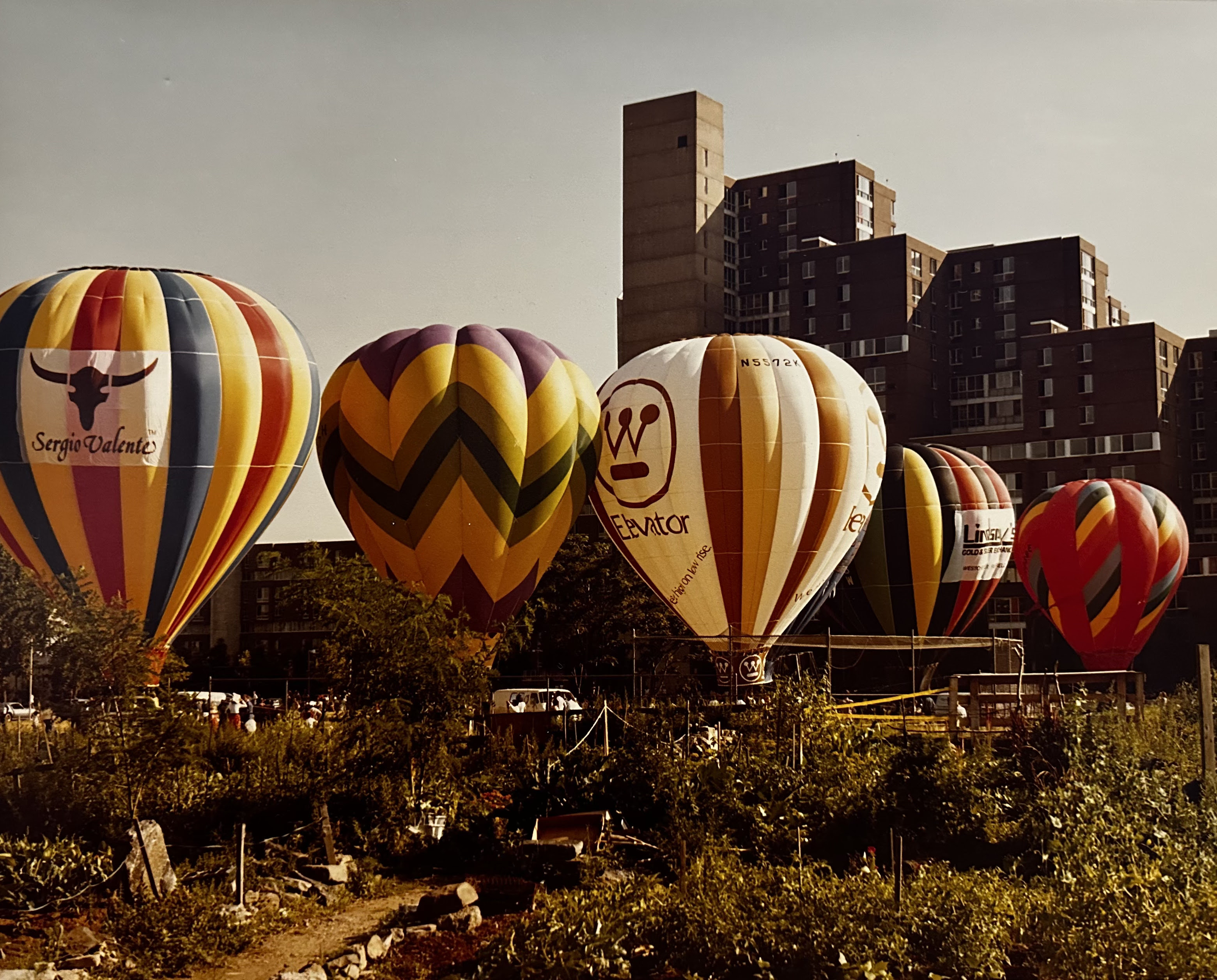
Wanted!
This wonderful large format print of a balloon festival on the Island in1977 was on our table and being admired by many visitors. Suddenly it was gone! Whether on purpose or accidentally, we would appreciate this photo from our archives being returned. Contact jbird134@aol.com if you have information on this photo.
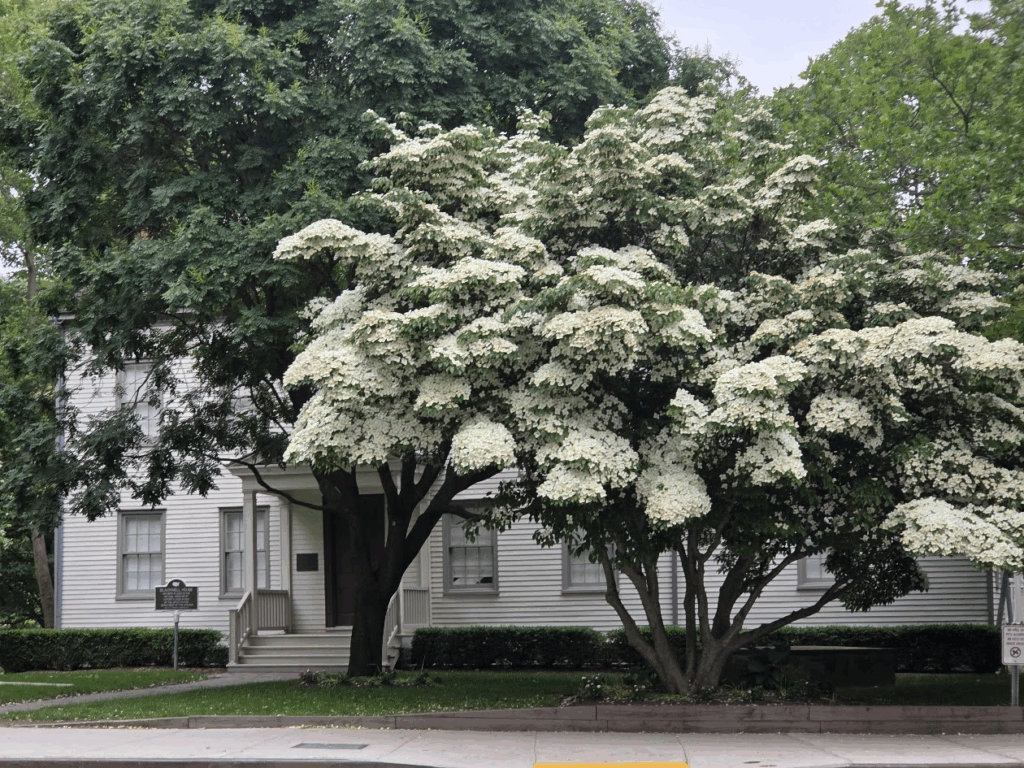
THE GRAND BLOOMING DOGWOOD (?) OUTSIDE BLACKWELL HOUSE
CREDITS
HYPERALLERGIC Judith Berdy Vesper Moore
All image are copyrighted (c) Roosevelt Island Historical Society unless otherwise indicated THIS PUBLICATION FUNDED BY DISCRETIONARY FUNDS FROM CITY COUNCIL MEMBER JULIE MENIN & ROOSEVELT ISLAND OPERATING CORPORATION PUBLIC PURPOSE FUNDS.
CELEBRATING ROOSEVELT ISLAND DAY ON FIREFIGHTERS’ FIELD
Monday, June 9, 2025 New York Almanack Issue #1466
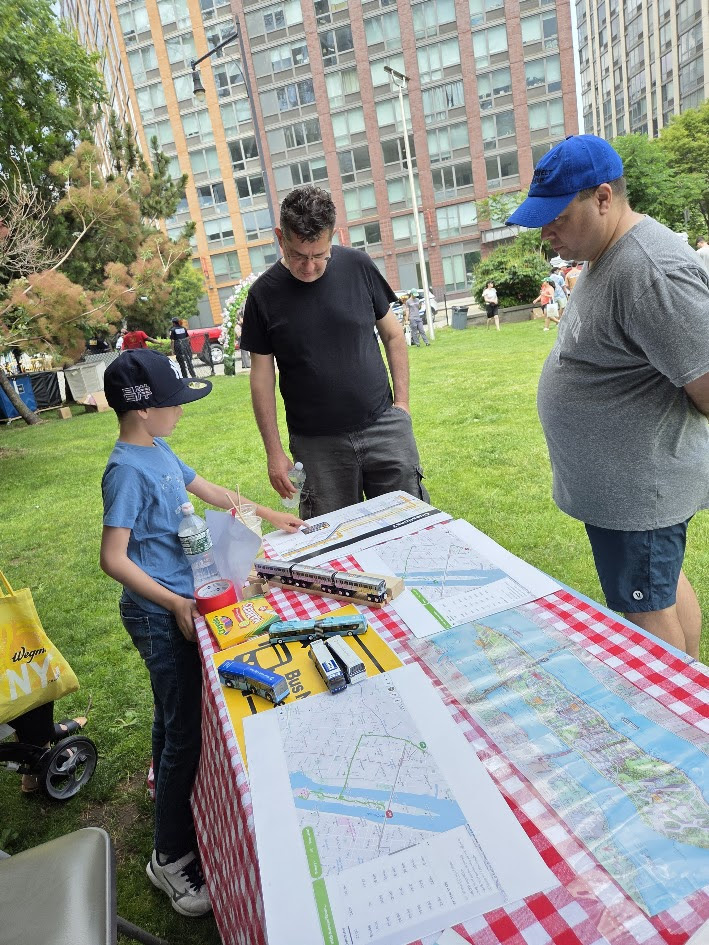
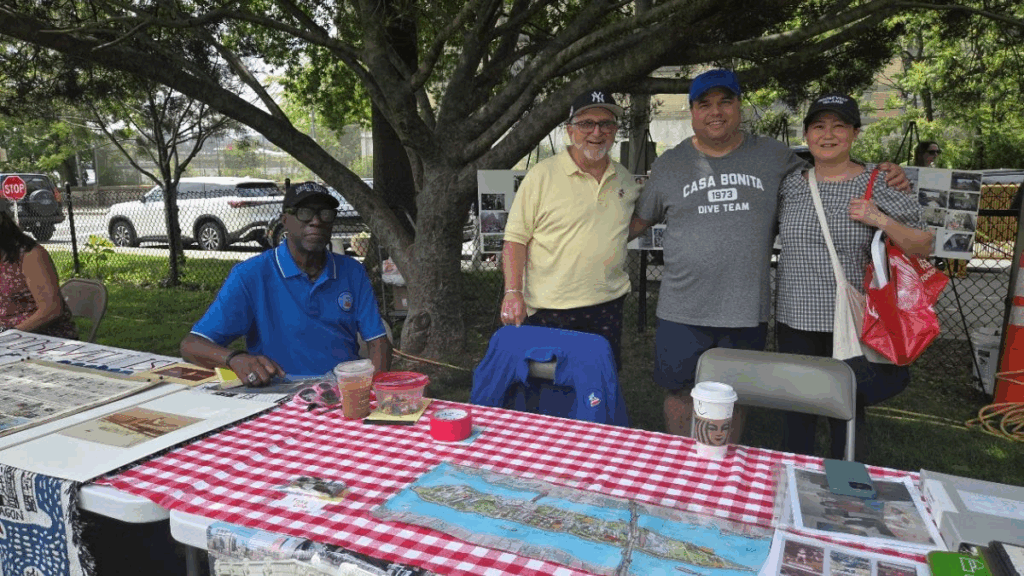
The new site for Roosevelt Island Day was a great success. Having a large field with separate spaces for different activities was a wonderful idea. Spread out over Firefighters’ Field, there were lots of new activities and space to spread out. Also, this location attracted many visitors from the Tram and Ferry, an additional plus on this sunny Sunday. Thanks to all the RIOC staff and community organizations for a great event.
Our new tram has arrived, ready to greet all and have no problems with crowding.
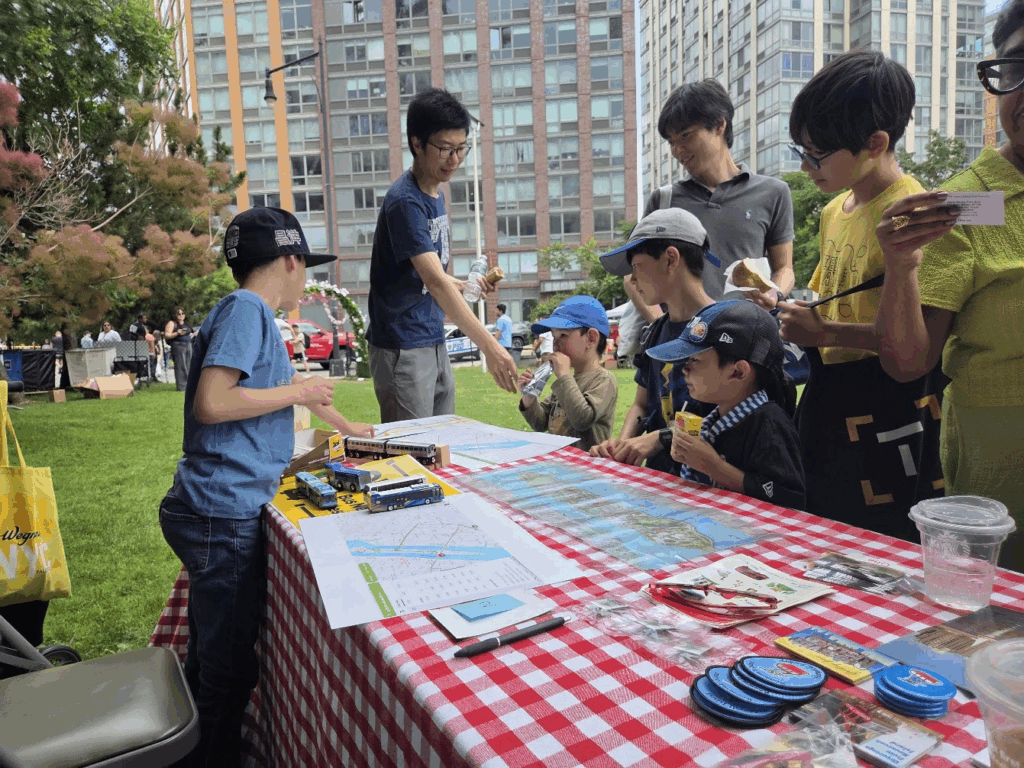
Masahiro Carson, a transit aficionado gave details to a visitor about T train service changes and new route for the Q102 bus.
Volunteers at the RIHS table Michael Stewart, Tom, Matthew and Moriko Carson, Masahiro & Takeru Carson. Our other volunteers: Gloria Herman, Ellen Jacoby, Dylan Brown, Tom & Sharon Carson,Tana Blevins, Sheila Waldron & Judith Berdy.
Masahiro explaining the complexities of transit to his peer group
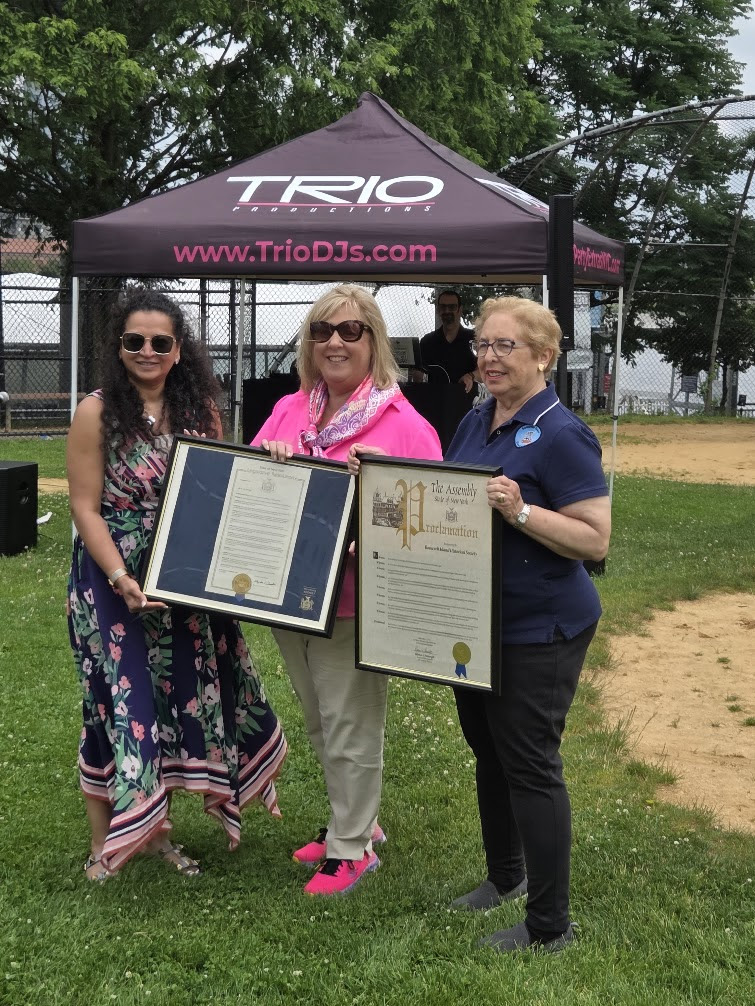
RIOC AND THE RIHS RECEIVED PROCLAMATIONS FROM ASSEMBLY MEMBER REBECCA SEAWRIGHT. ACCEPTING WERE DHRU PATEL AMIN, CFO OF RIOC AND JUDITH BERDY OF THE RIHS.
Wanted!
This wonderful large format print of a balloon festival on the Island in1977 was on our table and being admired by many visitors. Suddenly it was gone! Whether on purpose or accidentally, we would appreciate this photo from our archives being returned. Contact jbird134@aol.com if you have information on this photo.
CREDITS
Judith Berdy Vesper Moore
All image are copyrighted (c) Roosevelt Island Historical Society unless otherwise indicated THIS PUBLICATION FUNDED BY DISCRETIONARY FUNDS FROM CITY COUNCIL MEMBER JULIE MENIN & ROOSEVELT ISLAND OPERATING CORPORATION PUBLIC PURPOSE FUNDS.