Friday, February 13, 2026 – Remembering a 1939-1940 World’s Fair Masterpiece

Augusta Savage: Renaissance Woman
Friday, February 13, 2026
New York Historical Blog
ISSUE #1626
Artist Augusta Savage overcame poverty, racism, and sexual discrimination to become one of America’s most influential 20th-century artists. (More on her career in an upcoming issue)
Artist Augusta Savage and the Tragic Story of Her Lost Masterwork
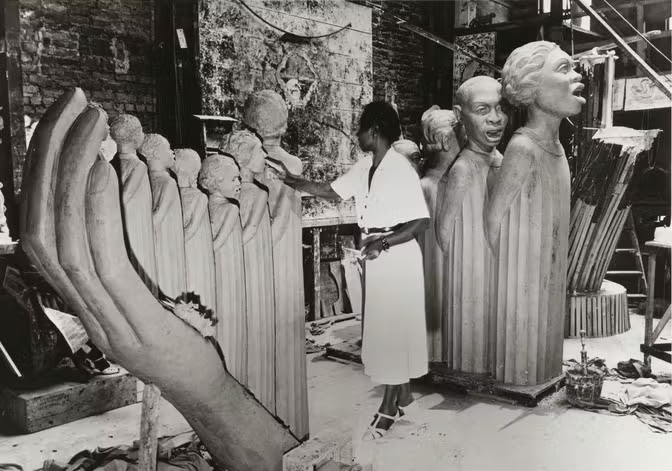
The photo of Savage working on ‘Lift Every Voice and Sing’ that was blown-up to life-size in the New-York Historical exhibition (Manuscripts and Archives Division, the New York Public Library)
An estimated 44 million people attended the 1939 New York World’s Fair in Flushing Meadows-Corona Park, Queens, and witnessed its vision for a shimmering, Art Deco “World of Tomorrow.” Some five million of those visitors got a chance to behold Lift Every Voice and Sing. A sculpture by artist Augusta Savage, it stood at a towering 16 feet tall and was mounted in the courtyard of the Contemporary Arts Building near one of the Fair’s gates. Also called The Harp (a name Savage reportedly hated), the piece depicted a kneeling Black man holding a bar of music and 12 Black chorus singers representing strings on a harp, the sounding board of which was no less than the hand of God.
The piece represented the pinnacle of Savage’s career, and the fascinating story behind it was part of New-York Historical’s exhibition Augusta Savage: Renaissance Woman. Born in Green Cove Springs, FL, in 1892, Savage had already faced a lifetime’s worth of adversary, from her minister father who almost “whipped all the art out of me,” as she once said, to an American art world that could not and would not support the work of an African American woman. (Just one example: In 1923, she won a scholarship to study at the Fontainebleau School in Paris, an award that was revoked when the committee learned she was Black.) Savage persevered, and by 1937, she was a graduate of Cooper Union who had studied and exhibited in Paris, received commissions for busts of W.E.B. DuBois and Marcus Garvey, and founded the Savage Studio of Arts and Crafts in New York, one of the centers of the Harlem Renaissance. She was the director of the WPA-funded Harlem Community Arts Center in 1937, when she received a commission for a piece from the World’s Fair board, the only Black woman to receive that honor. The president of the Fair Corporation told the New York Times that they would have “no such segregation of this country’s different racial groups as had marked other American expositions.”
The piece—for which Savage was paid $360—was intended to celebrate African Americans’ contributions to the music of the world, and Savage already had a personal connection that lent itself to the theme. She had been friends with writer and activist James Weldon Johnson, whose poem “Lift Ev’ry Voice and Sing” was set to music and later adopted as the “Black National Anthem” by the NAACP.
Little is known about the creation of the piece, but Savage left her job at the Harlem Community Arts Center and worked on it for two years. The finished work was made of plaster that was lacquered to look like black basalt. This attention to the medium of her message is a running theme: Always short of funding, she often sculpted in fragile, but cheap, plaster or clay and rarely had the means to get her pieces cast in bronze.
The Fair opened in April 1939, and Lift Every Voice got its spot on a main stage of one of the biggest events in the world. “Miss Savage’s creation stands in a niche at the focal point of the building front and is commented upon by practically everyone who passes,” wrote The Afro-American, a Baltimore newspaper, at the time. In her essay on Savage in Women Artists of the Harlem Renaissance, art history professor Theresa Leininger-Miller notes that Savage certainly created more radical pieces in her life, like the figures of lithe modern dancers and fierce African Amazons she sculpted during her time in Paris in 1929 and 1930. But Wendy N.E. Ikemoto, the New-York Historical curator behind the exhibition, argues that the piece is ambitious even in the crowd-pleasing context of the World’s Fair. “It’s an inventive, gorgeous sculpture in many ways,” she says. “On the World’s Fair stage, it still communicates Savage’s mission: to promote Black arts and the Black community. In that sense, it’s an activist sculpture.”
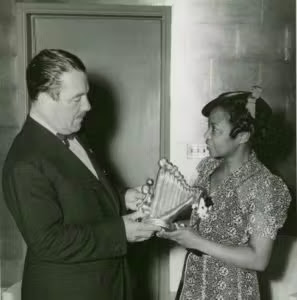
Savage presenting a replica of the piece to the President of the World’s Fair, Grover Whelan (Manuscripts and Archives Division, the New York Public Library)
Small, metal replicas of the piece were sold as souvenirs, and images of it were reproduced on postcards. But what became of the work itself? Sadly, it was destroyed by a bulldozer after the Fair’s close in the fall of 1940. World’s Fairs were meant to be temporary and ephemeral, and it wasn’t shocking for structures or artworks to be demolished at the end.
But the destruction of Lift Every Voice speaks to the larger tragedy of Savage’s work and how little of it survives today. Leininger-Miller—who’s working on a biography of Savage—now estimates that of the approximately 160 documented works by Savage, about 70 have been lost, mostly because Savage never had the means or support to cast them in more durable material.
This was true of Lift Every Voice, as well. The common assumption is that Savage wanted it preserved, but wouldn’t have been able to pay for storing it or casting it. So, all we have left are the small, imperfect replicas, one of which is part of Renaissance Woman, along with a blown-up, life-sized photo of Savage and her work-in-progress, just to give a measure of what was lost
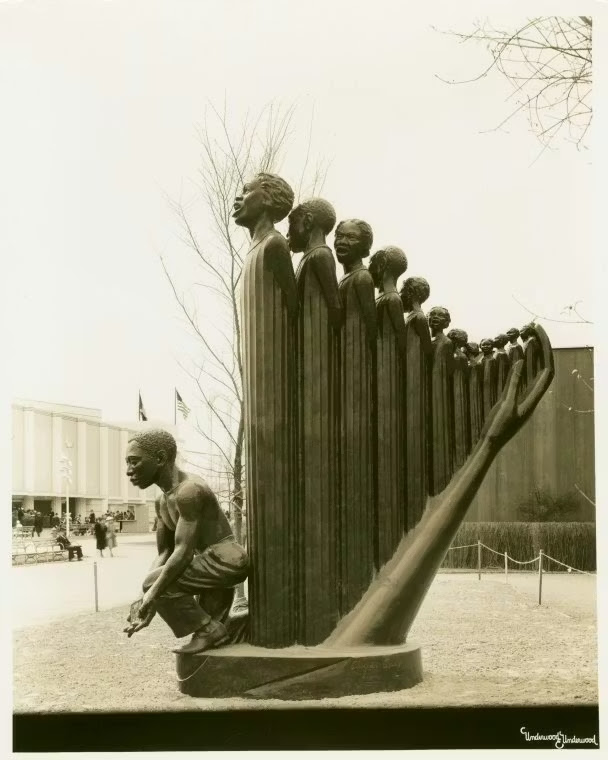
The statue on display at the World’s Fair (Manuscripts and Archives Division, the New York Public Library)
Thwarted by never-ending racism and poverty, Savage left New York City in the 1940s for a rural life in Saugerties, NY, withdrawing from the art scene before her death in 1962. She’s best remembered today as a key mentor and educator in the Harlem Renaissance, and one of her often-repeated quotes takes pride in that, while betraying a heartbreaking resignation about her work. “I have created nothing really beautiful, really lasting, but if I can inspire one of these youngsters to develop the talent I know they possess, then my monument will be in their work,” she said in a 1953 interview. Still, who knows what new attention to Savage’s life and career might bring? In 2017, a New York Times op-ed called for the full-scale re-creation of Lift Every Voice as a public work of art. Maybe one day, Savage’s monument will be her own.
CREDITS
Written by Kerrie Mitchell, Content Editor
New York Historical Society Blog
All image are copyrighted (c) Roosevelt Island Historical Society unless otherwise indicated
THIS PUBLICATION FUNDED BY DISCRETIONARY FUNDS FROM CITY COUNCIL MEMBER JULIE MENIN & ROOSEVELT ISLAND OPERATING CORPORATION PUBLIC PURPOSE FUNDS.


Copyright © 2026 Roosevelt Island Historical Society, All rights reserved.Our mailing address is:
rooseveltislandhistory@gmail.com
Leave a comment