New York’s vibrant immigrant history created a diversity of ethnic enclaves in the city. When over time demographics changed or newcomers assimilated deeper into metropolitan culture, the identity of such areas diminished. Little Poland, Little Syria, Little Africa, Little Vienna, and the French Quarter (Little Paris) were once lively parts of Lower Manhattan but have long since disappeared (Little Italy and Chinatown being notable exceptions).
They contributed to the city’s rich tapestry of food. Many dishes that are considered today as quintessentially American have an immigrant origin.
Sauerkraut played a foundational role in Manhattan’s socio-cultural history and New York’s agricultural development. Early settlers in New Netherland packed barrels of fermented cabbage for the long Atlantic crossing as high vitamin content offered protection against scurvy. Massive German immigration made it a dietary staple.
Sauerkraut & Scurvy
Sauerkraut, a German word meaning “sour cabbage,” is the product of a preservation process that is believed to have originated in China. Workers on the Great Wall fermented sliced cabbage in rice wine to survive freezing winters.
During the Mongol conquest, Genghis Khan’s armies not only plundered China but also adopted its fermentation methods, carrying those into Eastern Europe, reaching the Germanic regions and Low Countries in the sixteenth century.
With the expansion of long-haul maritime journeys in that era, Dutch sailors suffered high mortality rates caused by scurvy (the “disease of sailors”). Unable to preserve food, crew members developed vitamin C deficiencies with symptoms of bruising, bleeding gums, and internal hemorrhaging.
The vernacular word for the affliction was scheurbuik (torn belly). Dutch-born physician Johannes Echthius (1515–1576) who spent most of his medical career practicing in Cologne, latinized the word in 1541 to “scorbutus,” which became the medical term for scurvy.
In the seventeenth century, the expanding Dutch Republic sought medical solutions for this fatal scourge. Practicing in Leiden, the center of medical excellence at the time, Paul Barbette wrote Praxis Barbettiana (1669) in which he outlined the importance of diet and hygiene in combating shipboard illnesses.
Fewer casualties occurred when ships carried citrus fruits to feed the crew. Having learned that Dutch seafarers avoided scurvy by consuming fermented cabbage (zuurkool), English explorer Captain James Cook ordered his suspicious crew to eat “foreign” cabbage during his Pacific voyages. It’s said that by intentionally serving the dish to officers only, the ship’s sailors soon demanded their plateful.
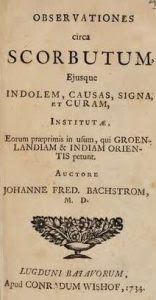
Scottish surgeon James Lind has been credited with providing a cure for scurvy in 1747, but earlier pioneering research in the Netherlands was carried out by a Polish-born physician named Johannes Bachstrom. Working in Leiden, he published Observationes circa scorbutum (Observations on Scurvy) in 1734, suggesting that a lack of fresh fruit and vegetables was the sole cause of scurvy.
Food preservation was a matter of survival for soldiers in the Continental Army too. Rations were small, unpalatable, and lacking nutrients. Meat was salted and flour made into hard biscuits to prevent molding. Scurvy was a continuous threat.
In a 1777 requisition to Congress, General George Washington called for significant supplies of sauerkraut to keep his troops fighting fit during the harsh winter months of the Revolutionary War.
Sauerkraut was far more than a medical remedy. The Dutch developed a taste for zuurkool, treating it as a delicacy. Settlers brought a taste for fermented cabbage to New Amsterdam. Manhattan’s bouweries (farms in old Dutch) were the colony’s food suppliers.
Cabbage was a vital crop cultivated on large patches along the Hudson River. It profoundly influenced New York’s agrarian landscape and established a culinary legacy that includes the passion for coleslaw (koolsla, the cabbage salad now known as coleslaw).
In the early 1800s, long after the British take-over of the colony, descendants of the first settlers (known as Knickerbockers) formed the exclusive “Krout Club” to defy the city’s vogue for French cuisine at the time.
They celebrated their heritage by feasting on traditional fare like zuurkool stamppot en rookworst (sauerkraut mashed with potatoes and smoked sausage). The club flourished in the first decades of the nineteenth century (the final feast took place in 1843).
The mass arrival of German-speaking immigrants further strengthened Manhattan’s connection with sauerkraut.
Rise of Germantown
Until the early nineteenth century, Yorkville was a hamlet in an area of farmland surrounded by country houses. Members of Manhattan’s social elite like Peter Schermerhorn or Jacob Astor owned summer estates on the banks of the East River.
In 1770, shipping magnate Jacob Walton and his wife Mary Cruger, daughter of New York’s 41st Mayor, settled in a newly built riverside residence named Belview Mansion at Horn’s Hook. Because of its strategic position, British cannon fire blew the property to bits during the Revolution.
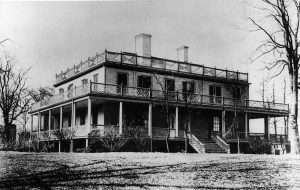
Using its foundations in 1799, Scottish merchant Archibald Gracie (1755-1829) built a federal-style wooden house on the site. John Quincy Adams and Louis Philippe, King of France, were among many famous guests who sat on its porch watching the river flow.
The “pastoral” landscape changed rapidly after 1834 when the New York & Harlem Railroad opened a station at 86th Street, triggering urban expansion.
Gracie Mansion survived the transformation. Ever since Fiorello La Guardia’s occupancy of the house in 1942, it has been the Mayor of New York City’s official residence.
From 1837 onward, the East Side became home to thousands of Irish immigrants who worked on the Croton Aqueduct. Its construction was carried out by disenfranchised laborers who lived in a slum area that would later morph into Yorkville.
Although not in use until 1842, the aqueduct created a crucial network for Manhattan’s residents and industry. It supplied clean water, eradicated waterborne epidemics, and eased fears of fire in the metropolis.
The introduction of the Second and Third Avenue elevated transit lines (“El”) accelerated the urbanization process. Improved means of transport led to an expansion of Yorkville’s manufacturing base.
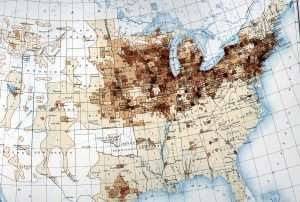
German immigrant workers soon outnumbered the Irish as many of them found jobs in breweries that spread over several blocks from 90th to 94th Street.
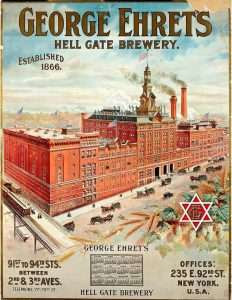
In 1866, George Ehret founded the Hell Gate Brewery in a massive brick clock-tower structure on East 93rd Street (named after the tidal strait in the East River). He had arrived in 1857 during the first wave of mass immigration from the German states.
Founded a year later, the adjacent brewery ran by Jacob Ruppert was just as impressive (his father is believed to have had been the first German malt dealer in the city of New York). Most of their German employees lived on or near to the premises – “Germantown” was born.
Sauerkraut Boulevard
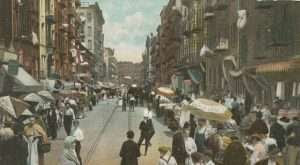
Little Germany (Kleindeutschland) and Germantown were two distinct enclaves in different eras of settlement. The first developed during the 1850s in Manhattan’s Lower East Side. Centered around Tompkins Square Park, it was a close community that for some considerable time kept its culture and customs.
On June 14, 1904, an aging paddle-steamer named General Slocum left the Recreation Pier at the foot of East 3rd Street. She carried 1,331 passengers, mostly women and children belonging to St Mark’s Lutheran Church, on their way to an annual picnic on Long Island.
As the ship passed through Hell Gate a fire alarm rang. Emergency equipment turned out to be in a state of neglect as firehoses did not function and life vests were useless. Passengers jumping in the East River drowned in the treacherous waters.
In the end, 1,021 passengers died in the disaster. The traumatic event precipitated migration away from the district towards uptown Yorkville.
By then, New York City was the world’s third largest German-speaking city after Berlin and Vienna. Yorkville stretched from Third Avenue to the East River, between 79th and 96th Streets.
It became a hub of German life in the 1900s, renowned for its butcheries, bakeries, beer gardens, dance halls, and singing clubs. The district smelled of sauerbraten and schnitzel; its soundscape rang with German dialects, brass band music, and tunes of Wagnerian opera.
Sometimes referred to as “German Broadway,” East 86th Street was Yorkville’s main commercial and cultural artery. It was nicknamed “Sauerkraut Boulevard.”
Locals upheld established traditions such as eating pork and sauerkraut on New Year’s Day (pork for “rooting” forward; cabbage for the blessings of health and wealth). The consumption of home-made sauerkraut gave rise to a unique profession.
The krauthobler or cabbage shredder was an itinerant tradesman who went door-to-door in local tenements with a razor-sharp mandoline slicer to cut cabbages into uniform thin shreds ready for home-made sauerkraut or coleslaw.
The city’s passion for sauerkraut was of prime value to the State’s economy. Operating out of Phelps, a village in Upstate New York’s Finger Lakes region, the Empire State Pickling Company was founded in 1905.
Two years later it introduced the Silver Floss brand of canned and jarred sauerkraut. At its peak in the early 1930s, Silver Floss ran six fermentation factories in this cabbage-rich region. Phelps was lauded as the “Sauerkraut Capital of the World.”
Battle of Yorkville
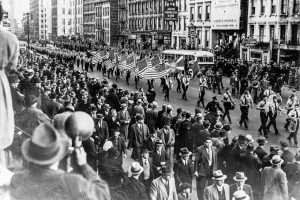
In the 1930s, several anti-fascist protests took place in Yorkville. The neighborhood welcomed German refugees but there were serious tensions too. The German American Bund was a pro-Nazi group led by Munich-born Fritz Julius Kuhn. It held frequent rallies and parades in Yorkville which terrified local Jews, many of whom had relatives in Europe and were aware of the fascist threat.
Former judge and member of Congress Nathan David Perlman (1887-1952) decided to intervene. When the Bund announced plans to stage a march celebrating Adolf Hitler’s forty-ninth birthday, he reached out to Meyer Lansky, a Jewish mobster.
The latter recruited several criminal “enforcers” of the Murder Incorporate group, including Harry “Pep” Strauss, a prolific contract killer, Jacob Drucker whose favorite murder weapon was an ice pick, and others.
On April 20, 1938, an army of Bund supporters wearing brown shirts goose-stepped from Carl Schurz Park to Yorkville’s Casino at 210 East 86th Street.
Posing as American Legion members, fifteen mobsters joined an audience that had gathered in the Casino’s ballroom, facing a stage decorated with Hitler pictures and swastikas, whilst waiting for the Bund’s leader to burst into his “Sieg Heil” drill and start a speech in praise of the Führer.
At that moment, although heavily outnumbered, the infiltrators attacked and created mayhem. The violent incident did not stop the Bund from attracting big crowds. On February 20, 1939, more than 20,000 people attended a Nazi rally at Madison Square Garden.
Months later, Kuhn was accused of embezzling money from the Bund and, eventually, convicted of grand larceny and forgery. With the arrest of several other officials, the Bund fell apart. When the United States entered World War II in December 1941, the government outlawed the organization.
End of an Era
As residents of Kleindeutschland started moving uptown to Yorkville in the early twentieth century, East European immigrants followed the exodus with Czechs clustering around East 72nd Street (Bohemian Broadway) and Hungarians settling at East 79th Street (Goulash Boulevard).
Manhattan’s first Little Hungary had been situated between Houston and East 10th Streets. Nicknamed “Goulash Row,” it had the Little Hungary restaurant as a hot spot.
Founded in 1888 by Max Schwartz at 255-263 East Houston Street, city guides referred to the offbeat eatery as a “widely known bohemian resort,” where customers enjoyed goulash and fine wines from the Tokaj region in the “midst of casks and barrels.”
Uptown New Yorkers flocked to the district to see downtown “foreign” life, enjoy the “atmosphere of Budapest,” and hear Romani bands perform fiery renditions of Franz Liszt’s “Hungarian Rhapsodies.”
Theodore Roosevelt was a friend of Max Schwartz and often dined at the restaurant during his time as New York City Police Commissioner. In February 1905, shortly after his first presidential election, he attended a dinner in his honor hosted by the Hungarian Republican Club.
When East European residents started moving uptown to Yorkville, Little Hungary stayed at its original location. It did not survive Prohibition, closing soon after its introduction in 1920.
Following anti-German sentiment in the First World War, Yorkville started to show signs of decline. It faced intense government scrutiny and populist harassment.
To avoid persecution, locals began hiding overt displays of heritage, renaming businesses, and abandoning traditions. Restaurants changed their menus, serving “Liberty Cabbage” instead of sauerkraut.
The final demise of Sauerkraut Broadway happened in the mid-1950s with the removal of the elevated Third Avenue train tracks. Property prices shot up, real estate dealers moved in, and the area lost its identity and character. Gentrification dissolved the historical German, Czech, and Hungarian enclaves.
A few old-world establishments resisted urban change and stayed in business. Founded in 1902 by Bavarian immigrants at 1670 First Avenue, Glaser’s Bakery was famed amongst clients for its black-and-white cookies (a New York classic), fudgy brownies, and traditional German pastries. Boasting a vintage “Old New York” interior of wood and glass display cases, tin ceilings, and mosaic floor tiles, the bake shop finally stopped trading in 2018.
The stores have vanished and memories are fading, but the ghost of Sauerkraut Boulevard lives on, its legacy linked to fast food. The pairing of “dachshund” pork bangers with fermented cabbage originated in Central Europe.
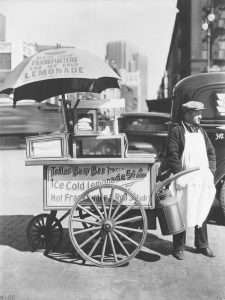
Immigrant vendors made traditional German “Wursts” (sausages) popular across New York City by selling them out of carts in milk rolls topped up with sauerkraut.
The “classic” hot dog had arrived. Sauerkraut remains a defining staple of street food and Jewish delicatessen (recall the Reuben sandwich) in the metropolis.
Time for a New Baseball Cap?
Multiple Colors Check them out at the Kiosk
CREDITS
NEW YORK ALMANACK
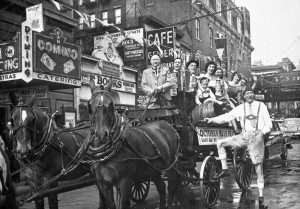
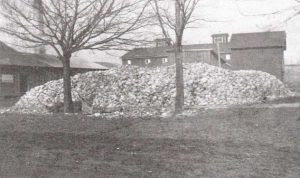
Illustrations, from above: October Beer Fest, East 86st Street in the German enclave of Manhattan; Cabbage yard of Ward Moulton Cannery in Clay, NY; Johannes Bachstrom, Observationes circa Scorbutum (Observations on Scurvy), Leiden 1734; Late nineteenth century photograph of Gracie Mansion; Calendar poster for George Ehret’s Hell Gate Brewery, founded in 1866; Little Germany in Manhattan in the late 19th century; German American Bund parade in East 86th Street, 1938 (Library of Congress); 1890 U.S. Census map titled “Density of Distribution of the Natives of the Germanic Nations”; and a New York hot dog stand, ca. 1900.
All image are copyrighted (c) Roosevelt Island Historical Society unless otherwise indicated THIS PUBLICATION FUNDED BY DISCRETIONARY FUNDS FROM CITY COUNCIL MEMBER JULIE MENIN & ROOSEVELT ISLAND OPERATING CORPORATION PUBLIC PURPOSE FUNDS.
The 1876 Centennial was an all-out party in Gotham—fireworks, military parades, musical performances, and thousands of American flags and bunting draped over the windows of city buildings, houses, and hotels.
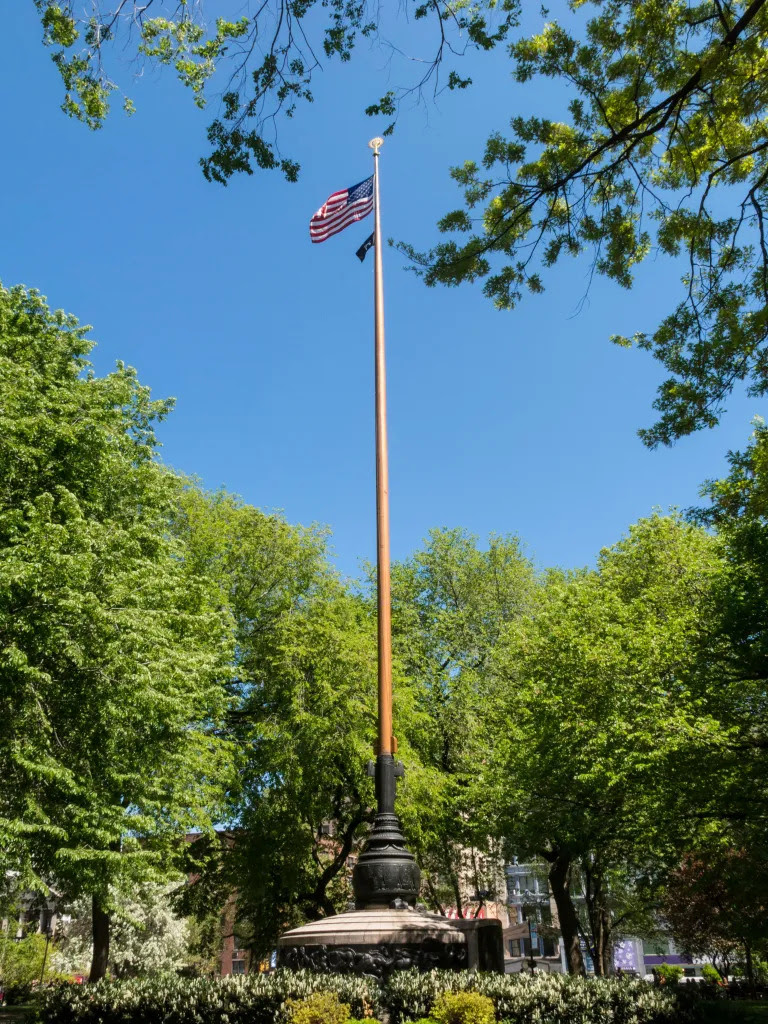
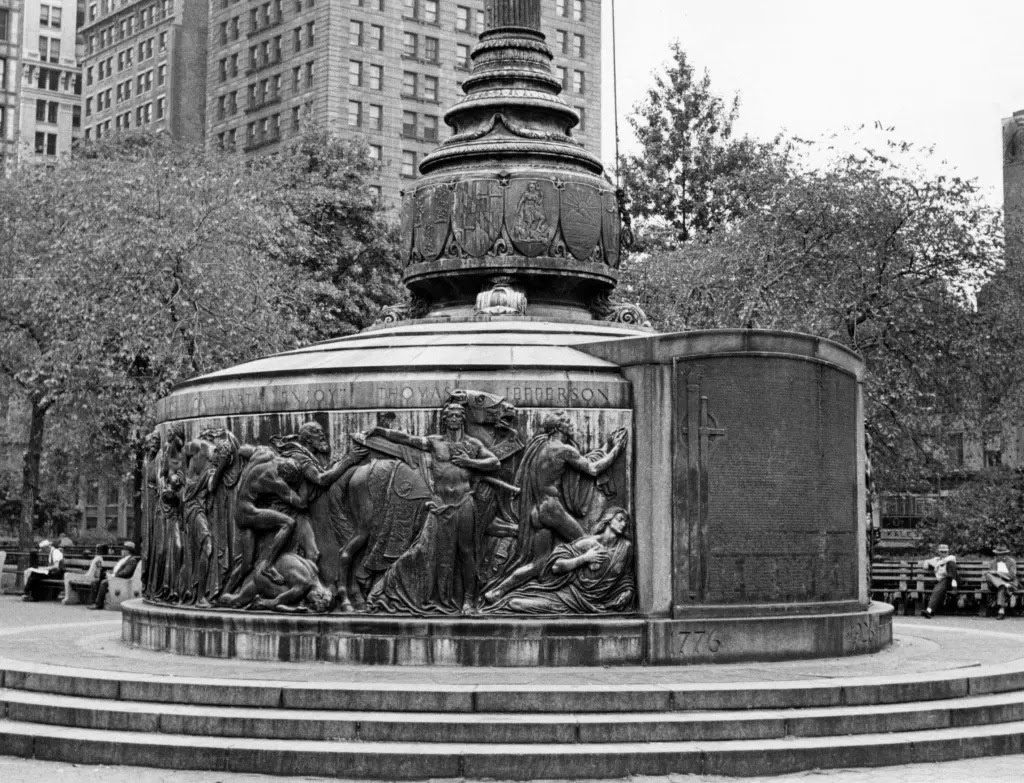
But the Sesquicentennial, or America’s 150th birthday? By comparison, it was much more low-key.The big national celebration took place at Philadelphia’s Sesquicentennial International Exposition. In New York City, smaller events focused on patriotic education and the creation of historical markers.Yet the 1926 celebration did bring a new addition to Union Square: the Independence Flagstaff, one of the tallest flagpoles in New York state, according to NYCParks. You’ll find this towering monument in the center of the park
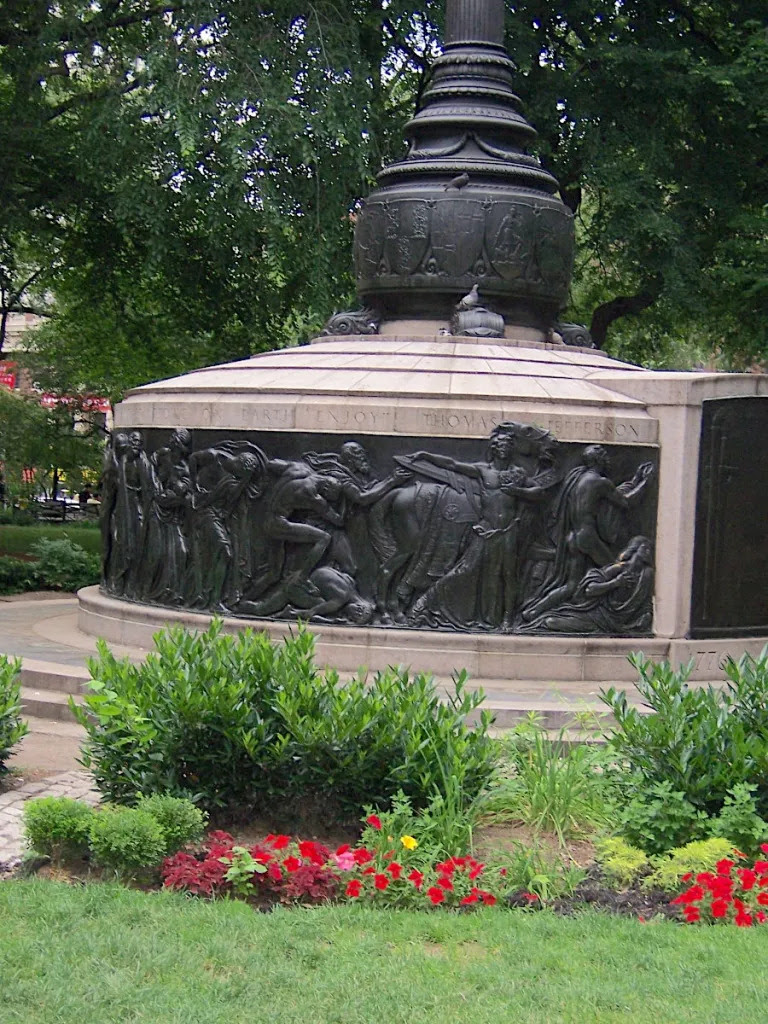
“The intricate bas-reliefs and plaques were completed in 1926 by sculptor Anthony De Francisci, and feature a procession of allegorical figures representing democracy and tyranny, the text of the Declaration of Independence, and emblems from the original 13 colonies,” states NYC Parks.
The problem was that the flagstaff was gifted to the city by the Tammany Society. This infamous political machine long associated with corruption and scandal had their headquarters near the park on East 14th Street.
The flagstaff was supposed to be dedicated to Charles Murphy, a recently deceased Tammany president. But controversy arose, as the dedication was considered an insult to America’s founding fathers.
“Public sentiment prevented honoring a symbol of Tammany corruption in a manner commensurate with Lincoln and Washington at Union Square Park, and by the time the Murphy Flagpole was dedicated on July 4, 1930, to commemorate the 150th anniversary of the Declaration of Independence, it was referred to as the Independence Flagstaff.”
That quote in the second photo chiseled into the base comes from Thomas Jefferson: “How little do my countrymen know what precious blessings they are in possession of and which no other people on earth enjoy.”
Time for a New Baseball Cap?
Multiple Colors Check them out at the Kiosk
CREDITS
EPHEMERAL NEW YORK
[Top image: Alamy; second image: NYCParks; third image: Angelo Rizzuto (1940s)]
All image are copyrighted (c) Roosevelt Island Historical Society unless otherwise indicated THIS PUBLICATION FUNDED BY DISCRETIONARY FUNDS FROM CITY COUNCIL MEMBER JULIE MENIN & ROOSEVELT ISLAND OPERATING CORPORATION PUBLIC PURPOSE FUNDS.
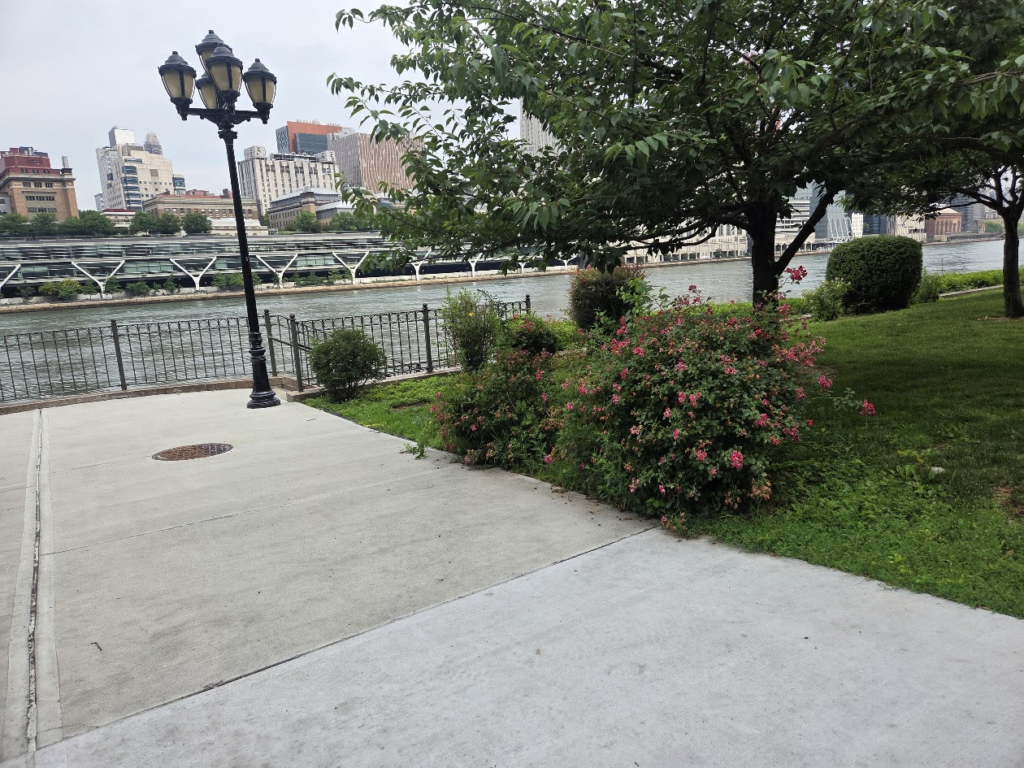
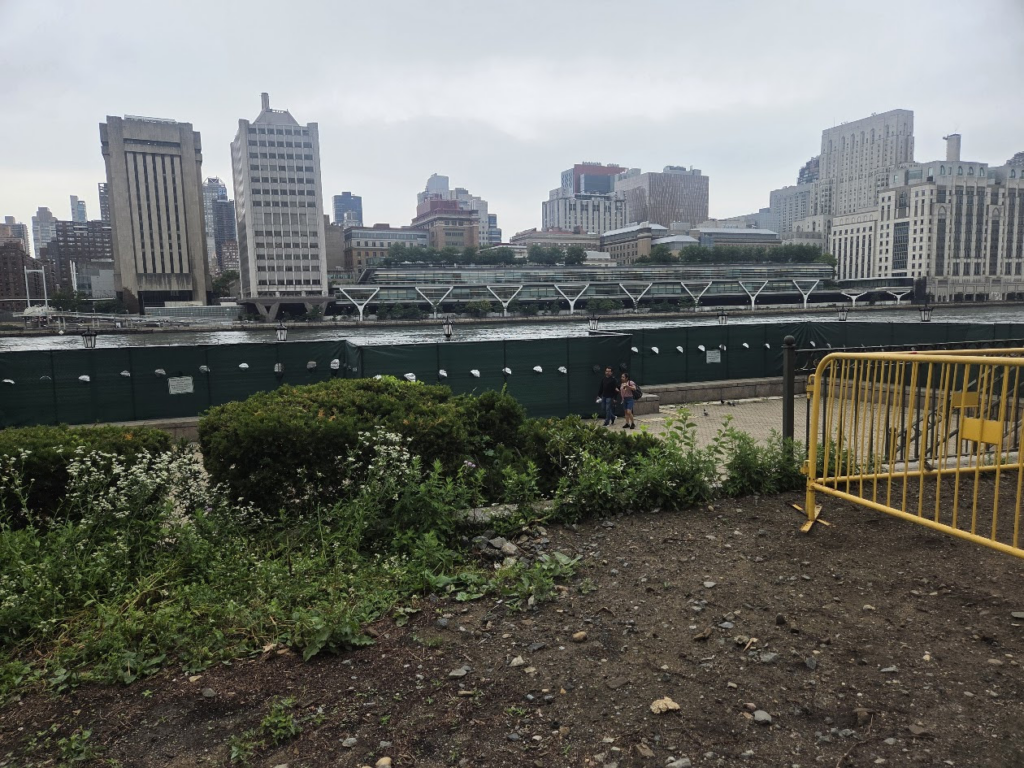
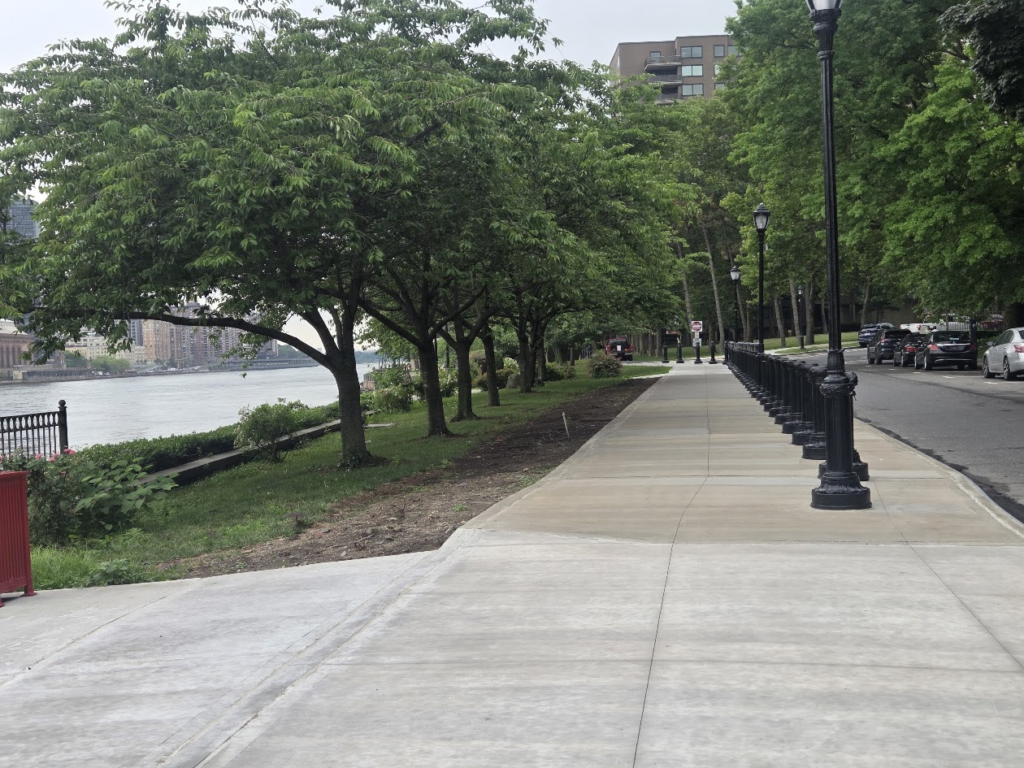
Walking home from the subway today, I tried out the newly expanded and repaved the walk to the Rivercross Lawn. Having a new wide angle visit ot the river, the wonderful Kwanzan cherry trees and even some rose bushes.
All of this had been hidden behind a hedge for years and now are in full view.
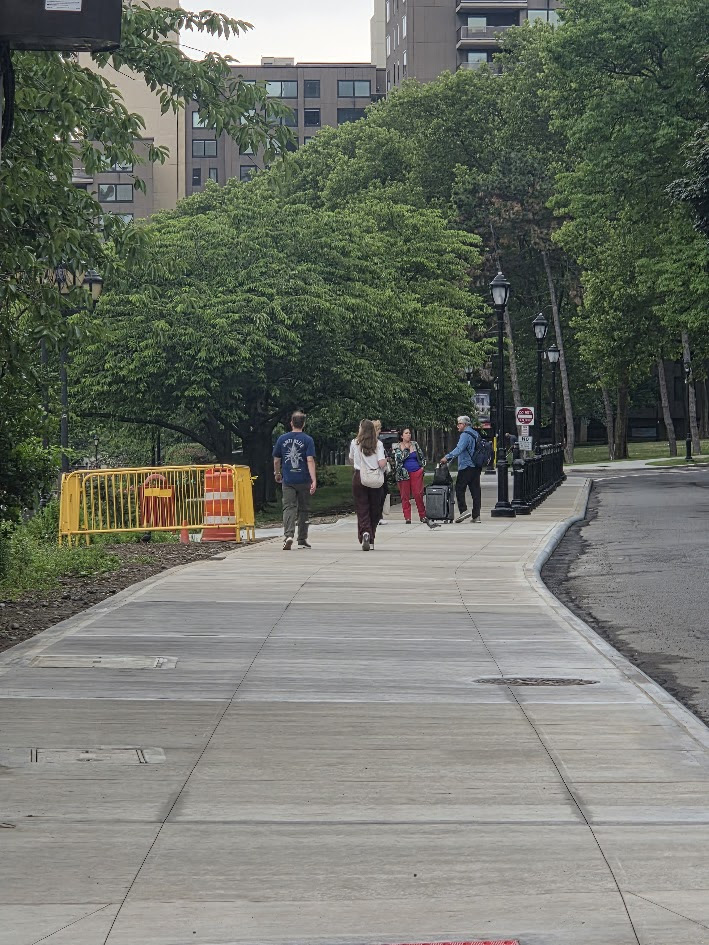
The steps are repaired and no need to sidestep puddles on the path.
No squeezing past other pedestrians
Hopefully “soon” Eleanor’s Pier will be repaired and the sitting area restored.)
The Kwansan Trees are fully visible now
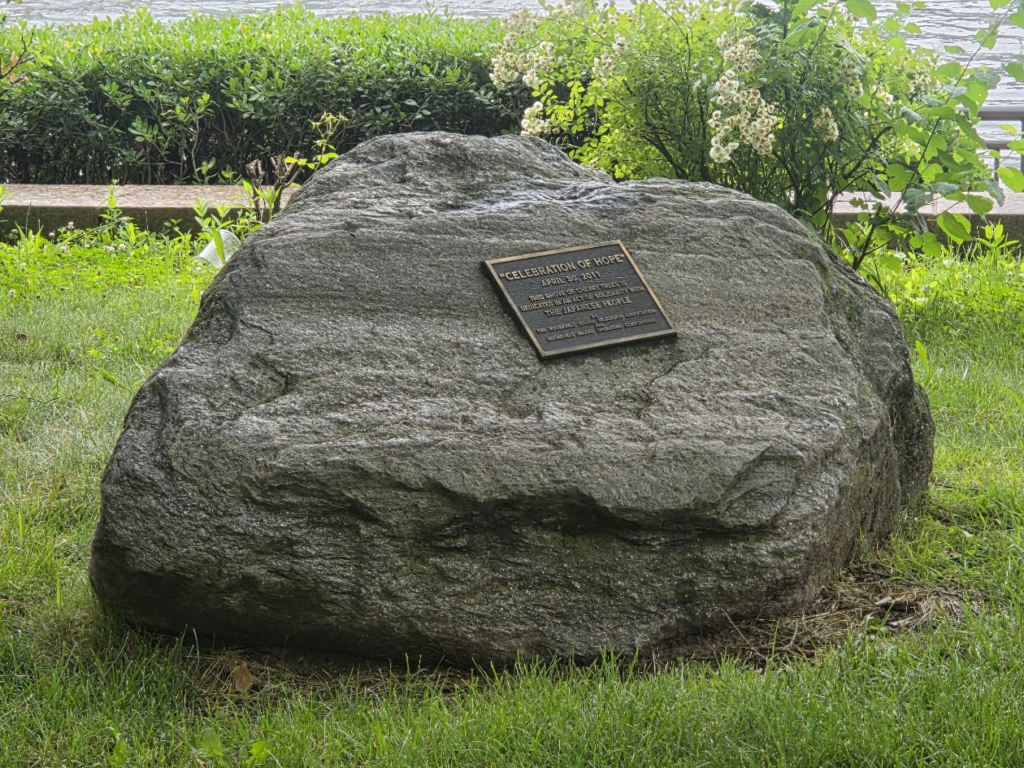
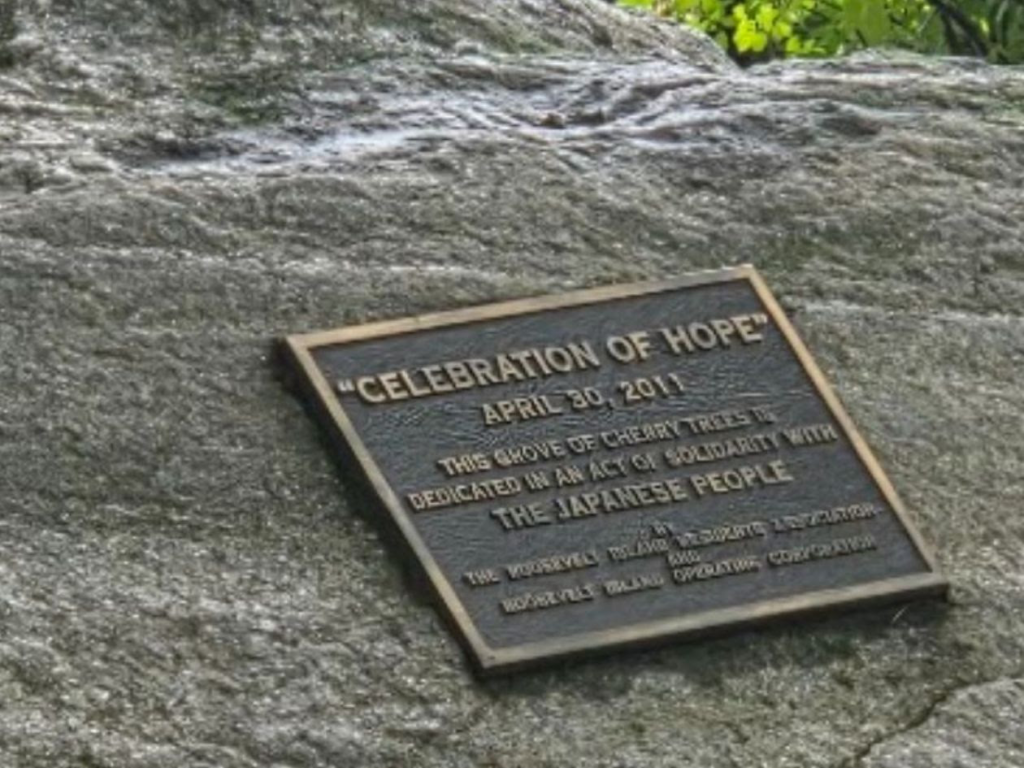
The commemorative plaque is now visible
The Island Organizations celebrated historic events, thanks Lynne Shinozaki
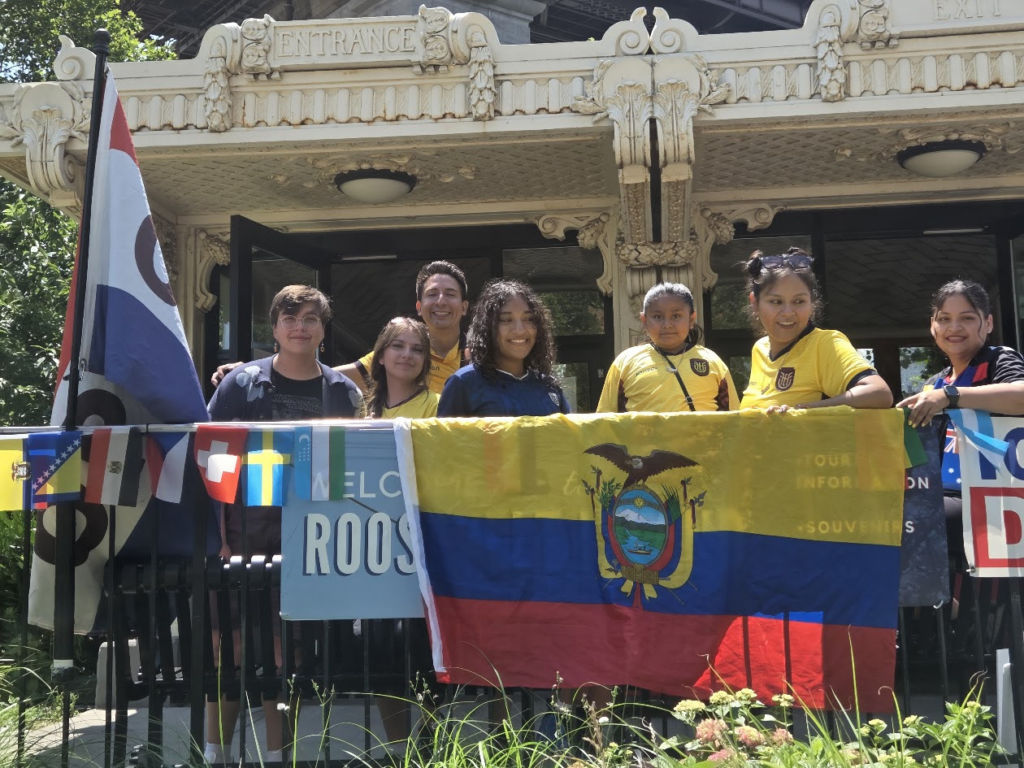
The Ecuadorian Visitors Were at the Kiosk Yesterday Their Team Won Their Match Yesterday!!
CREDITS
LITIZIA PITIGLIANI JUDITH BERDY
All image are copyrighted (c) Roosevelt Island Historical Society unless otherwise indicated THIS PUBLICATION FUNDED BY DISCRETIONARY FUNDS FROM CITY COUNCIL MEMBER JULIE MENIN & ROOSEVELT ISLAND OPERATING CORPORATION PUBLIC PURPOSE FUNDS.
For Semiquincentennial Armada, Lower Manhattan is the Berthplace of Liberty
Photo courtesy of OpSail 2000
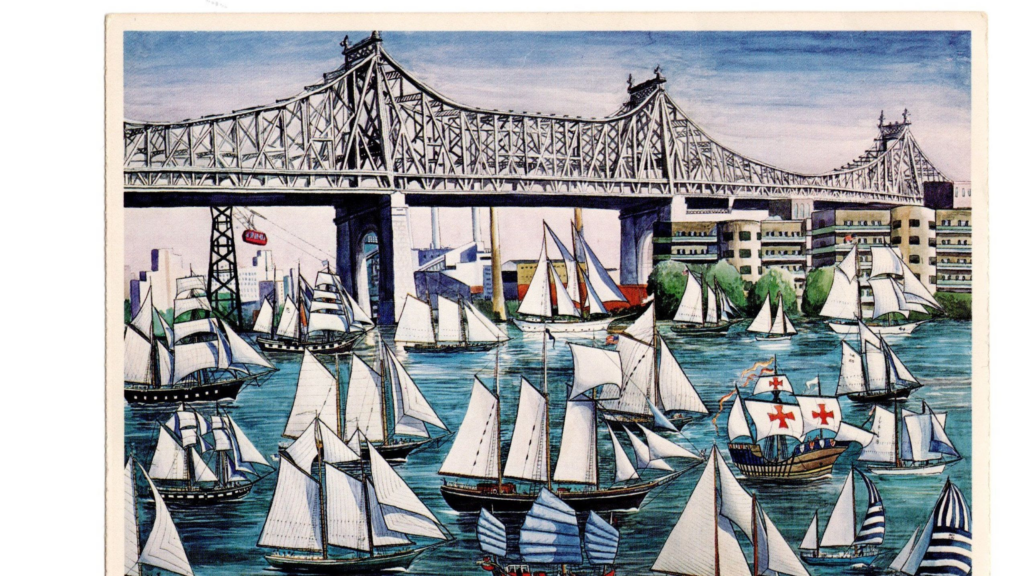
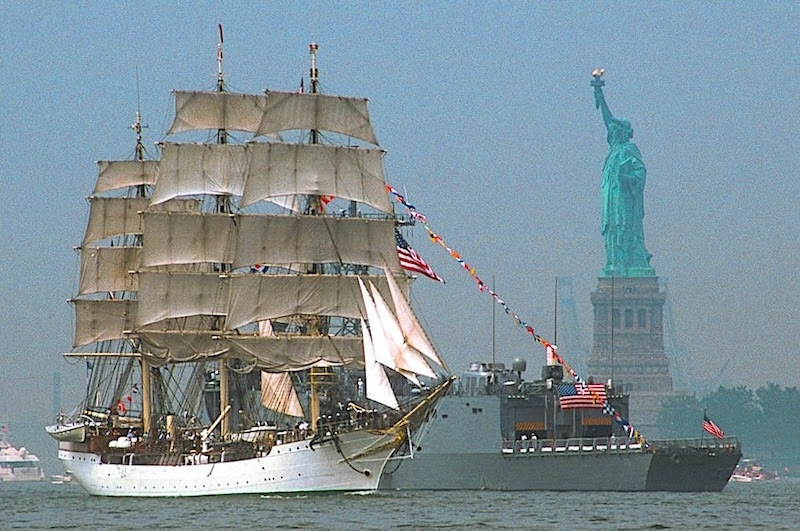
As America marks its quarter-millennium, the waters and skies surrounding Lower Manhattan next week will be the epicenter of naval and aeronautic spectacles that may not be equaled until the nation’s 500th birthday. Starting on Friday, July 3, the largest international group of tall ships and military vessels ever assembled in New York Harbor will gather on the East and Hudson Rivers. Herewith, the Broadsheet’s Baedeker for the Sail4th 250 flotilla.
Please note that the best free viewing locations for events on the East River will be at the South Street Seaport and the Battery. Prime spectator spots for Hudson River events will be the Battery, Battery Park City (in Wagner and Rockefeller Parks, the Pier A deck, and Belvedere Plaza, which has been temporarily reopened), and the Hudson River Park. Large crowds are expected at all free venues. Ticketed viewing opportunities are available on Governors Island (prices start at $200) and aboard tour boats.
FRIDAY, JULY 3
Class B Tall Ships Parade on the East River
1pm-3pm
Class A Tall Ship Gather in New York Harbor
Throughout the day
The festivities begin with the arrival of an international fleet of two dozen Class B tall ships. Owned by foundations and individuals, rather than governments, these traditionally rigged vessels measure under 40 meters (131 feet). The boats will sail down the East River from Long Island Sound, pausing at the South Street Seaport before proceeding to an anchorage at Gravesend Bay, Brooklyn, on the other side of the Verrazzano-Narrows Bridge. Participating Class B vessels include the Belle Poule (a 1930s vessel used as a training ship by the French naval academy in World War Two), INS Sudarshini (India), and Picton Castle (a Canadian vessel that in May 1945 accidentally liberated Norway from Nazi occupation by sailing into the port of Bergen hours after the Germans had retreated), among others. Meanwhile, more than 30 Class A tall ships (defined as square-rigged vessels, such as barques or brigantines, longer than 40 meters) from 20-plus nations will gather in preparation for Saturday’s Parade of Sail.
SATURDAY, JULY 4
International Naval Review
7:30am-12pm
The day begins with a rare International Naval Review, as the U.S. Navy hosts and leads a parade of dozens of military ships from around the world. At the front of the pack will be the flagship vessel USS Farragut—a 509-foot Arleigh Burke-class guided missile destroyer, named for Civil War admiral David Farragut, who is remembered for his immortal words at the Battle of Mobile Bay: “Damn the torpedoes … full speed ahead!” The ships will proceed north on the Hudson to the George Washington Bridge. The event, which showcases maritime cooperation and naval tradition, marks only the seventh international naval review hosted in U.S. history and the fourth held in New York Harbor (following smaller reviews in 1976, 1986, and 2000).
International Aerial Review
10:15am-11:30am
More than 150 U.S. and allied military aircraft led by the U.S. Navy’s Blue Angels (piloting their signature F-18 Super Hornets in “tight diamond” formation) will fly up the Hudson River over the parading ships.
Parade of Sail
9:30am-2:30pm
More than 30 majestic Class A Tall Ships (most ranging in size from 340 to 371 feet in length) that are used as naval training vessels and goodwill ambassadors by the nations they represent will participate. Joined by the Class Bs (see above), they will enter New York Harbor under the Verrazzano-Narrows Bridge, sail past the Statue of Liberty and up the Hudson River to the George Washington Bridge, before turning to navigate back to their respective berthing locations.
SUNDAY THROUGH WEDNESDAY, JULY 5-8
Public Ship Tours
Following the Parade of Sail and the International Naval Review, ships will dock around New York City. Lower Manhattan will host three tall ships, all at East River docks. Pier 17, at South Street Seaport, will accommodate two: the U.S. Coast Guard’s 295-foot barque Eagle (captured from the German Navy at the close of World War Two, and one of only two active commissioned sailing vessels in the United States military today) and the Oosterschelde (a 160-foot, three-masted topsail schooner from the Netherlands, built in 1918). For more information, click here. Nearby, at Pier 15, visitors can board the Pride of Baltimore II, a 1988 topsail schooner built in the style of 19th-century Baltimore Clippers. For tickets, click here.
Elsewhere around the city, the tall ships will be docked at the Intrepid (access at West 46th Street and 12th Avenue), Brooklyn Bridge Park, and the USS Sullivans Pier at Stapleton Waterfront Park on Staten Island.
Brooklyn Bridge Park (learn more and make reservations here)
Pier 1
Sagres (Portugal)
Sundarshini (India)
Pier 3
Gorch Fock (Germany) – open July 6-7 only
Pier 5
Mircea (Romania)
Intrepid Museum (tours of ships at the Intrepid piers may be reserved here)
Pier 86
Amerigo Vespucci (Italy)
Capitan Miranda (Uruguay)
Gladan (Sweden) – open July 6-7 only
Pier 90
Juan-Sebastian de Elcano (Spain)
Pier 91
Belle Poule (France) – open July 5-6 only
Bowdoin (Maine)
Dar Mlodziezy (Poland)
Guayas (Ecuador)
Juan Bautista Cambiaso (Dominican Republic)
Lady Maryland (Maryland)
Libertad (Argentina)
Lynx (Massachusetts)
Tabor Boy (Massachusetts)
When & If (Maryland)
Stapleton Waterfront Park (1.5 miles south of the St. George Staten Island Ferry terminal)
USS the Sullivans Pier
Arc Gloria (Colombia)
BAP Union (Peru)
Esmeralda (Chile) – open July 6-7 only
Tours are free, but making reservations in advance is strongly recommended. General information on Sail4th 250 can be found here and on ship tours here.
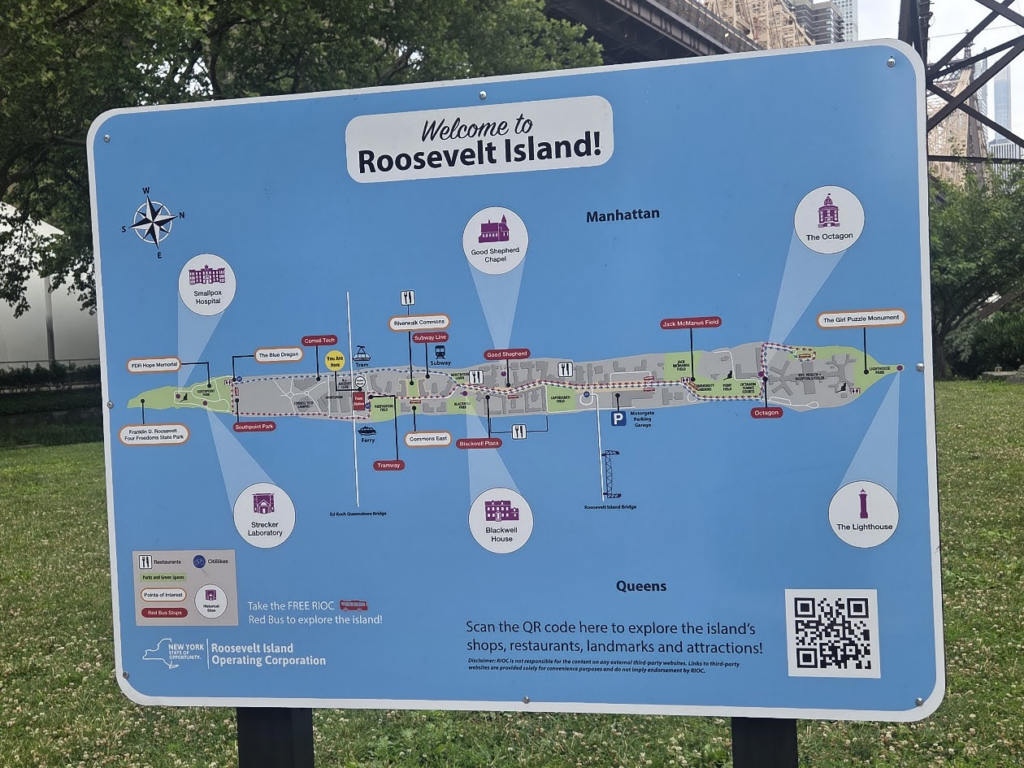
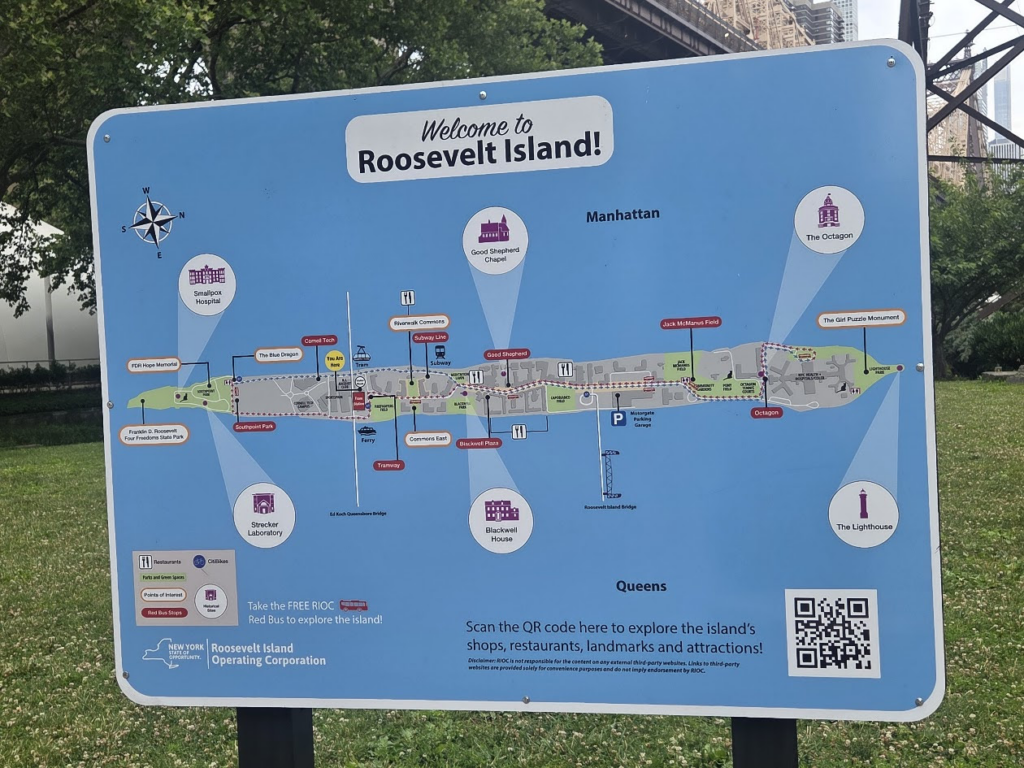
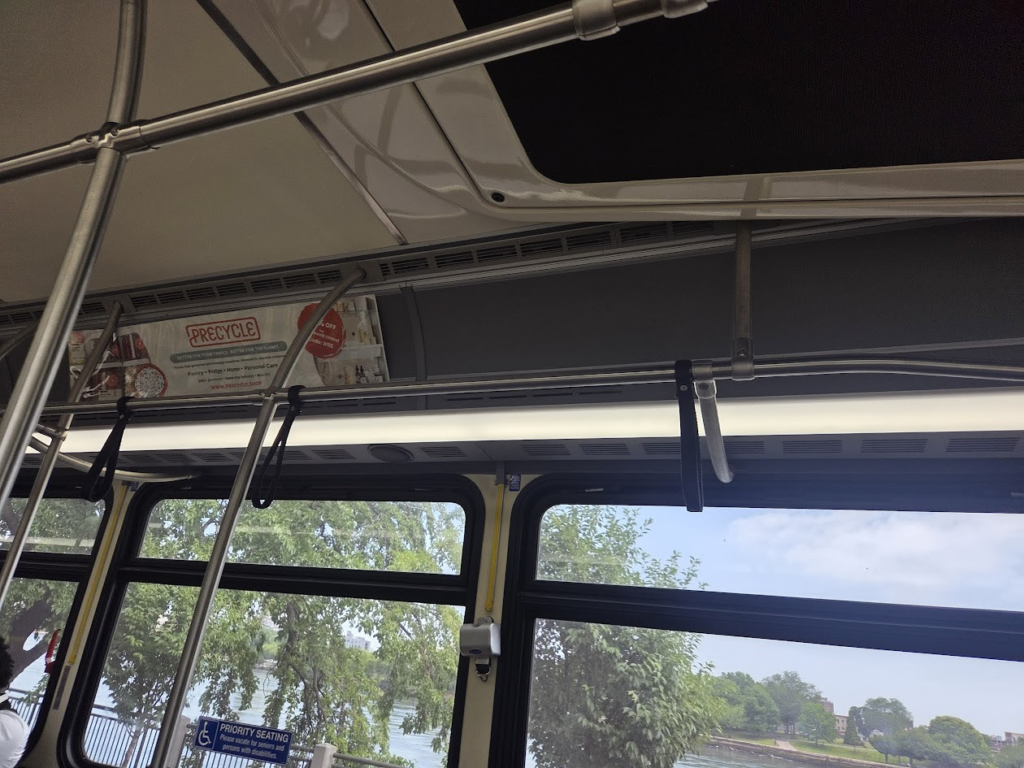
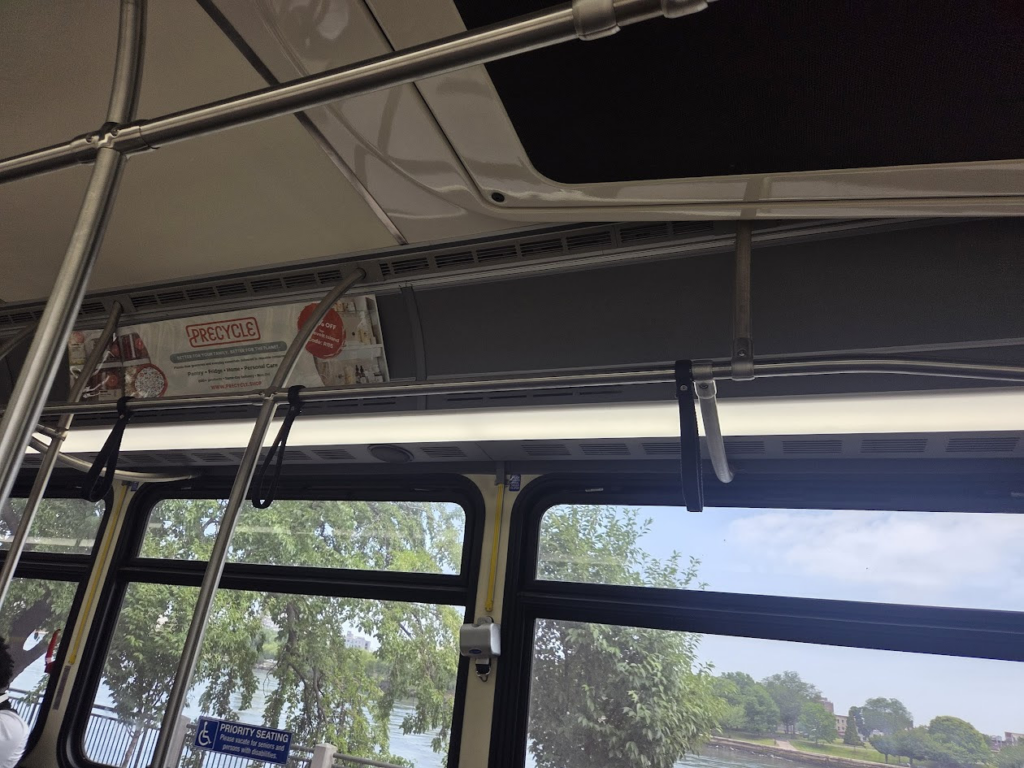
RIOC.. PLEASE PUT MAPS ON THE BUSES SO VISITORS CAN FIND THEIR WAY AROUND ROOSEVELT ISLAND
CREDITS
THE BROADSHEET
All image are copyrighted (c) Roosevelt Island Historical Society unless otherwise indicated THIS PUBLICATION FUNDED BY DISCRETIONARY FUNDS FROM CITY COUNCIL MEMBER JULIE MENIN & ROOSEVELT ISLAND OPERATING CORPORATION PUBLIC PURPOSE FUNDS.
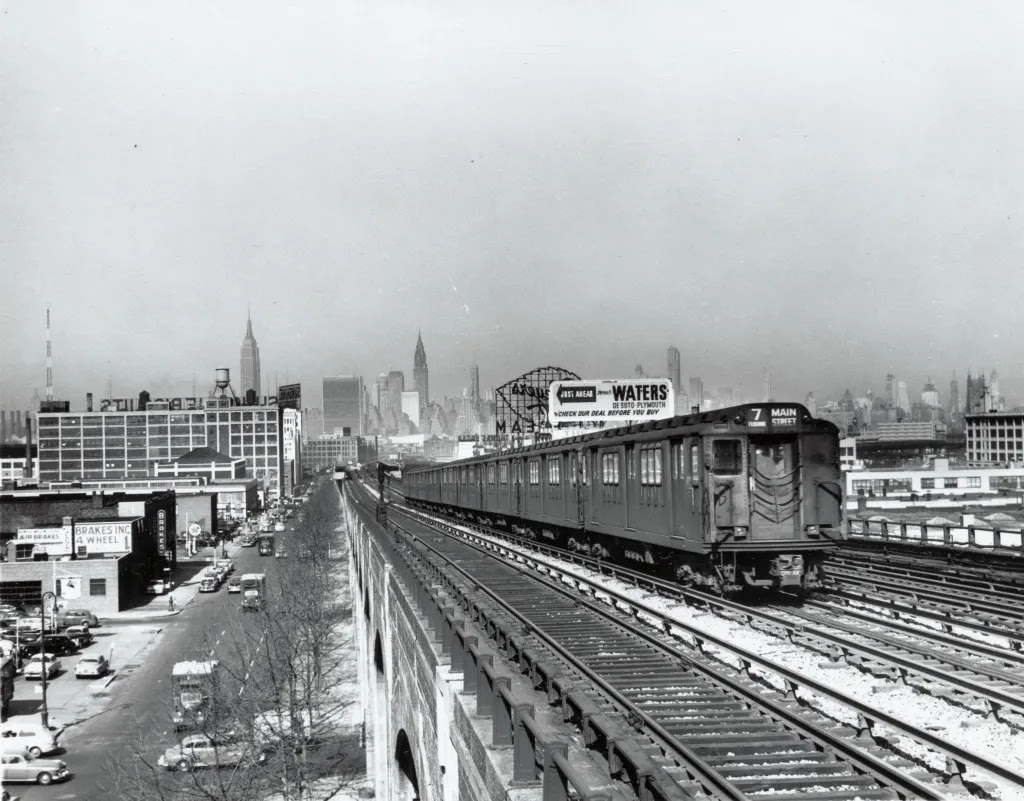
Max Hubacher, April 9, 1954, has me reliving my childhood with “(Queens, N.Y.) Subway and Manhattan’s skyline.”
That was the 7 train in 1954 and still is today, the IRT line running from (then) Times Square to Flushing. All of the line but the far west end is in Queens; all of the line but the Manhattan portion, the first two Queens stations, and the Flushing terminus is elevated. A chunk of the western part of the Queens portion runs over Queens Boulevard on a fancyish viaduct of concrete-encased steel. That stretch of the street is straight, and you see the result here: a wide street in two portions – eastbound and westbound – separated by the train. East of the straight run, the tracks curve a bit to follow Roosevelt Avenue; west of it, they curve to follow the boulevard to Queens Plaza, and then a big S curve into the tunnel heading to Manhattan.
From Queens Plaza to Flushing, the line has three tracks, and express trains run on the center track only in the direction of the rush. We’re looking at an express heading to Flushing, so this is the afternoon.
The old subway cars had narrow cabins for the drivers: you see the driver’s window to the left of the “7” sign, and the whole cabin was the width from the left side of the car to the door frame. That mean that the window in the center door faced the inside of the car and anyone – but most often a child – could stand there and watch the trip with the same view as the driver. I have no idea how many times I did that between 1970 (when I was tall enough to see through the window) and 1982 (when I moved out of Flushing). Several hundred, maybe? I wouldn’t be amazed to find out it was over a thousand: I commuted to school for six years on the 7 train, and watched out that window on the way home a lot.
In other words, this fairly anonymous photo is, for me, as familiar as home can be. The thing of it is that for any of the photos in the Hubacher collection at the NYPL, or any similar collection, there’s someone with similar memories. It’s not that I particularly love that viaduct, just that it’s permanently engrained in my head. When people involved in preservation talk about community and the built environment, this is part of what we mean: we learn the appearance of a place, the feel of it, and notice when it changes. Living in New York, you get used to the built environment changing, but not all of it, not all at once. If – and this is not going to happen in this century, so it’s a good hypothetical – the MTA were to tear down the elevated 7 train and replace it with a four-track subway, it would be an all around improvement: more capacity, better service, less above-ground blight. But a small part of me would mourn the loss of a piece of my past.
Re the title: I’m no Proust.
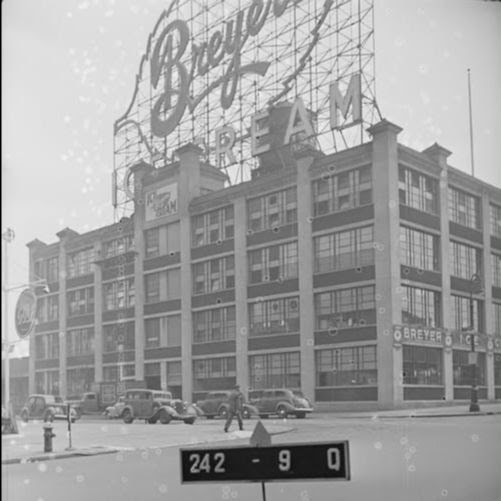
Do you remember the Breyer’s Ice Cream Factory on Queens Blvd? I am pretty sure the outline of the leaf may still be on the roof of the building.
RIOC.. PLEAS PUT MAPS ON THE BUSES SO VISITORS CAN FIND THEIR WAY AROUND ROOSEVELT ISLAND
CREDITS
OLD STRUCTURES ENGINEERING
All image are copyrighted (c) Roosevelt Island Historical Society unless otherwise indicated THIS PUBLICATION FUNDED BY DISCRETIONARY FUNDS FROM CITY COUNCIL MEMBER JULIE MENIN & ROOSEVELT ISLAND OPERATING CORPORATION PUBLIC PURPOSE FUNDS.
From 2007:Thirty years ago, The Municipal Art Society of New York (MAS) launched the Adopt-A-Monument program in collaboration with the NYC Public Design Commission and the NYC Parks Department, to secure private funding for the rescue of public art in danger of deterioration. To date, MAS’s Adopt programs have raised nearly $4 million dollars to conserve fifty-one works of art in all five boroughs. In honor of the 30th anniversary of the program, we are highlighting one restoration per month in 2017.
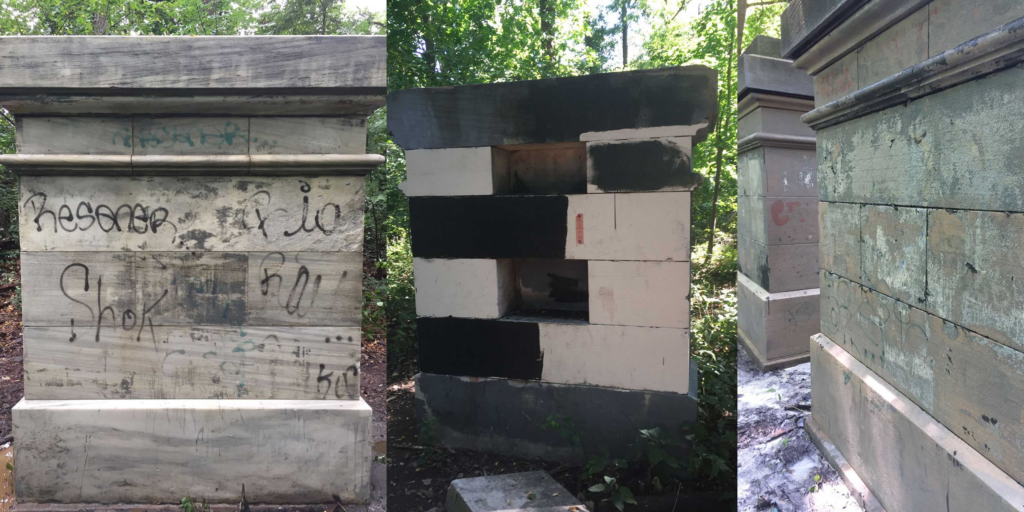
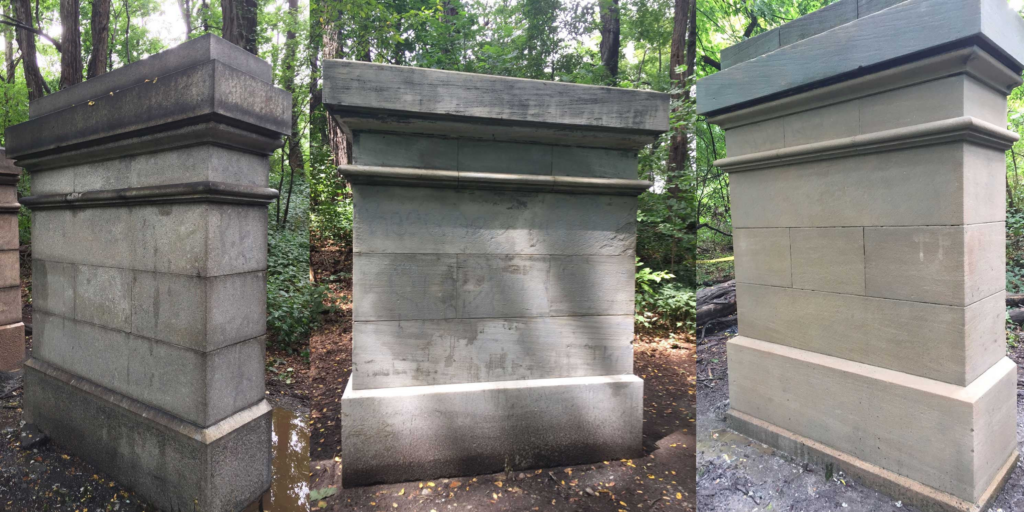
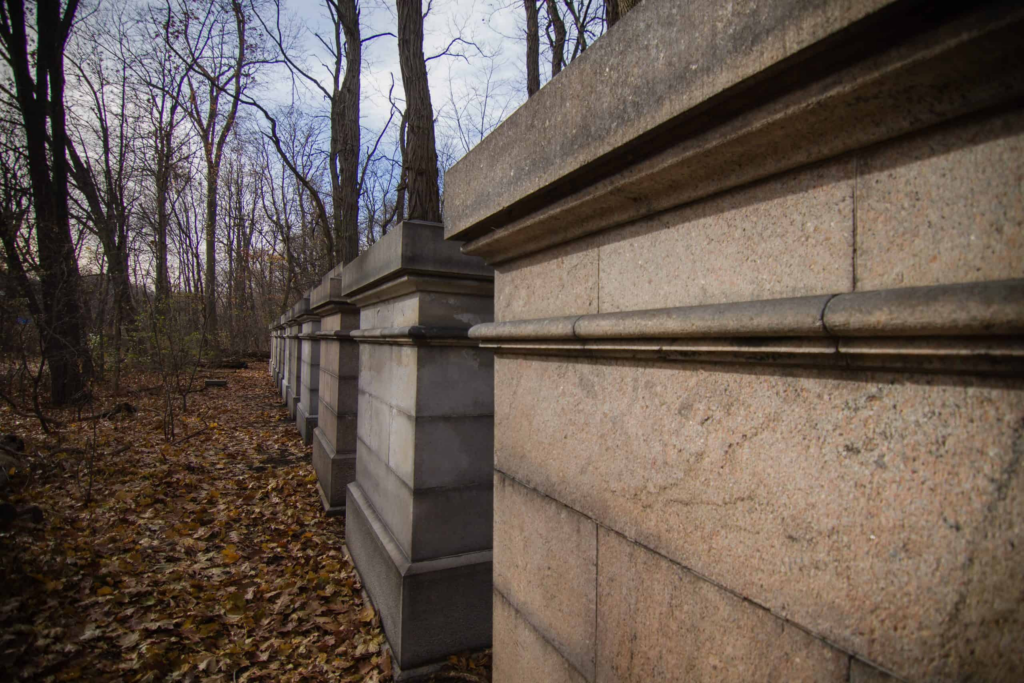
This summer a generous grant from the Paul and Klara Porzelt Foundation enabled the MAS to continue its legacy of involvement with Grand Central Terminal in a new and engaging way. Thirteen iconic ten-foot -tall stone pillars, “Grand Central Stones,” were placed in Van Cortlandt Park at the turn of the century to identify the most durable material for construction of the Terminal. Decades of graffiti, over- paint, and neglect had disfigured these monumental forms, obscuring their fascinating history. MAS partnered with Friends of Van Cortlandt Park to clean and conserve the stone pillars, returning them as closely as possible to their original dignity. Tatti Art Conservation executed the work.
The MAS invited renowned historian Francis Morrone to research the provenance of the Stones. We are delighted to share Francis’s article, part of which will be incorporated in a NYC Parks historic sign placed near Grand Central Stones. Please take a trip to beautiful Van Cortlandt Park, walk the Putnam Trail, and discover this untold monumental treasure.
MAS is grateful to our great partners at Friends of Van Cortlandt Park, as well as the Porzelt Foundation for their ongoing support for Adopt-A-Monument and conservator Steve Tatti and his team for their expert restoration of this piece of New York City history.
History of the Grand Central Stones
By Francis Morrone
The Grand Central Stones in Van Cortlandt Park are a surprising and important part of the history of Grand Central Terminal, one of the nation’s most important buildings, and a lesson in the built history of New York City.
In November 1905, the New York Central Railroad placed a series of stone samples in the open air on property the railroad controlled within Van Cortlandt Park. The purpose was to assess the effects of a New York winter on the samples of granite, limestone, and marble that the railroad and its architects, Reed & Stem and Warren & Wetmore, were considering for the exterior curtain wall of the head house of the new Grand Central Terminal, then under construction in midtown Manhattan.
Grand Central Terminal was constructed between 1903 and 1913, with the station head house located between 42nd and 43rd Streets and Vanderbilt Avenue and Depew Place, astride Park Avenue. The structure is faced in two stones: Indiana limestone in the upper portion, and Stony Creek granite, from Connecticut, at the shopfront level. Construction of the head house began in 1910. (All construction up to then had been on the vast underground portion of the terminal, including the tracks and platforms and marshalling yards.) In 1905, when the stone samples were placed in Van Cortlandt Park, the railroad had not yet settled on many details of the head house design, including its curtain wall materials. Pennsylvania Station, on Manhattan’s West Side, was then under construction and being faced in a beautiful Milford pink granite from Massachusetts. That was one of the stones the New York Central Railroad considered for Grand Central Terminal, and a sample can be found here.
“These samples,” wrote Real Estate Record and Builders’ Guide, “have been polished and finished by the constructors, and have been set up on a solid foundation, which was provided by the New York Central Railroad. In front of the samples is a grass plot, which is kept nicely mown, and is fenced around on three sides. Each sample of stone has the firm’s name on the back of it.”
Fifteen firms submitted samples. The firms and samples were:
Woodbury Granite Company of Vermont
The John Peirce Company (frequently misspelled as Pierce), the well-known contractor, provided a sample from the Bodwell Granite Company’s Fox Islands quarry in Maine
Booth Brothers provided Waldoboro granite from Maine
The George Doyle Stone Company provided Blue Bedford limestone from Indiana (at the time the head of the George Doyle Stone Company was Alexander Doyle, also known as a sculptor responsible for the bronze of
Horace Greeley in Greeley Square; Doyle was married in 1880 in Hallowell, Maine, suggesting a relationship with John Peirce, who had a close connection to that town and who [see below] provided a granite sample from Hallowell)
The Perry, Matthews & Buskirk Quarry provided buff limestone from Indiana
The Webb Pink Granite Company provided Milford pink granite from Massachusetts
The Thompson-Starrett Company provided Bethel granite from Vermont
Norcross Brothers provided Dorset marble from Vermont
Norcross Brothers provided Milford pink granite from Massachusetts
W.N. Flint & Company provided granite from Dummerston, Vermont
The John Peirce Company provided granite from Jonesboro, Maine
The John Peirce Company provided granite from the Hallowell Granite Works in Maine
Norcross Brothers provided granite from Stony Creek, Connecticut
John Peirce provided granite from the Mount Waldo Granite Works in Maine
The Milford Pink Granite Company provided granite from Milford, Massachusetts
Twelve samples of granite are listed, along with two varieties of Indiana limestone and one variety of marble (the Dorset that faces the New York Public Library). The granite selected was the Stony Creek, said in this list to have been provided by Norcross Brothers, while John Peirce is in fact credited as the contractor in charge of the terminal. Peirce, in fact, was an owner of the Stony Creek Red Granite Company. Some sources suggest the New York Central Railroad chose Indiana limestone for the greater part of its exterior curtain wall because it was the least expensive of the stones under consideration. It is true that the granites were more expensive. (Pennsylvania Railroad president Alexander Cassatt had indeed balked at the high cost of the granite, suggesting it be used only for trim, but his architect, Charles Follen McKim, insisted on its use.) But Indiana limestone was the most ubiquitous building stone of the City Beautiful era, and was much loved by New York architects and builders. In the following year the stone selections had been made and the John Peirce Company retained as contractor. Peirce, who held a financial interest not just in Stony Creek granite but in several Maine quarries, used the Fox Islands granite, from the coast of Maine, of which there is a sample here, for such prominent New York buildings as the United States Custom House, at Bowling Green, and the Hall of Records, on Chambers Street.
The Indiana limestone selected for Grand Central Terminal appears to be the sample provided by the Perry, Matthews & Buskirk Quarry, the second stone from the left. The sample of Stony Creek granite selected for Grand Central Terminal appears to be the third stone from the right.
Do note that today there are thirteen, not fifteen, samples on view in the park. It is possible that there were originally fifteen, and two have been lost, or that it was determined as unnecessary to have three samples of Milford pink granite; remove two of those three samples, and that leaves thirteen.
According to Real Estate Record and Builders’ Guide in November 1905, “Mr. [William H.] Masterson, of Norcross Brothers, stated that he believed this was the first time samples had ever been submitted in this way, the usual custom being to send a small piece of stone in the rough, or, possibly polished on one side, but never in his experience had samples been kept in the open and exposed to the elements for any period. It has entailed expenses on each firm sending samples, but the New York Central Railroad has taken up all freight charges.”
Grand Central Terminal opened in February 1913. The stone samples remain in Van Cortlandt Park. Notably, the blocks of stone in the park are carved at their tops in two bands of fine mouldings, no doubt to assess the effects of exposure on fine carved detail.
The stone samples are set out along a path beside the former right of way of the Putnam Branch of the New York Central Railroad. The right of way served New York & Putnam Railroad and New York Central Railroad passenger trains from 1870 to 1958, and freight trains to 1980. The right of way is now a Van Cortlandt Park nature trail. A short distance to the south of here can be found a remnant of the old Van Cortlandt Park station of the Putnam line. (See map of Van Cortlandt Park. Stones in lower, left-hand corner.)
The Grand Central Stones were cleaned and restored by Tatti Art Conservation, through the Adopt-A-Monument program of the Municipal Art Society of New York in collaboration with Friends of Van Cortlandt Park, and was made possible by a generous grant from the Paul and Klara Porzelt Foundation, August 2017.
Photos from The Municipal Art Society and NYC Parks Dept.
VISITOR OF THE DAY
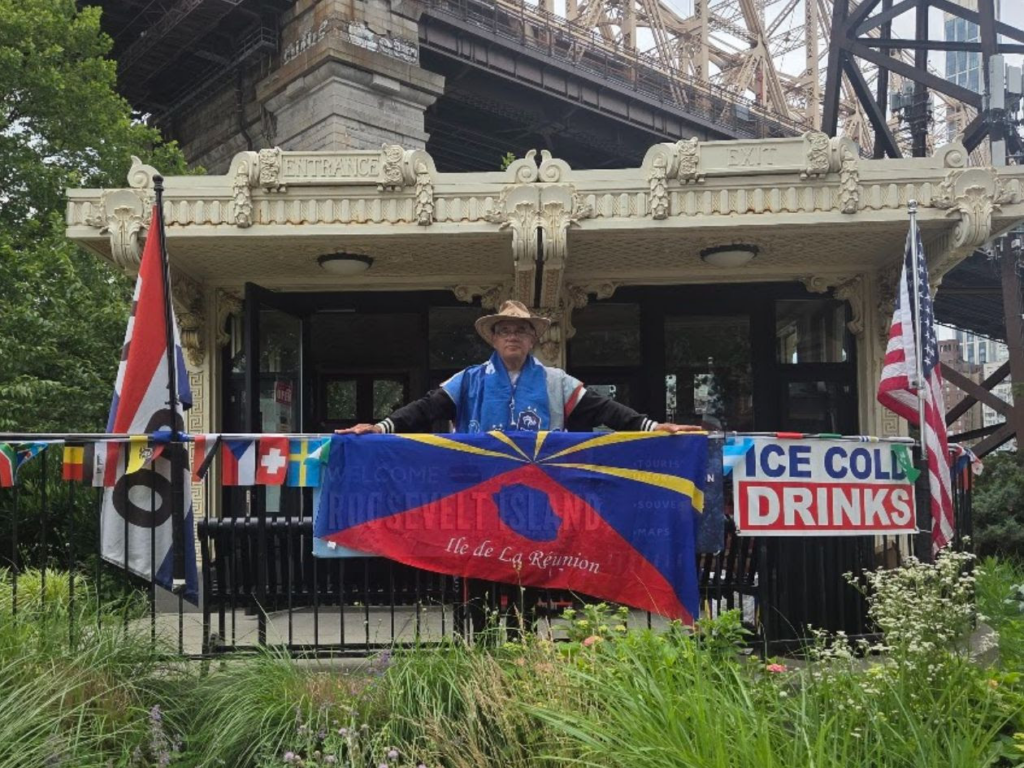
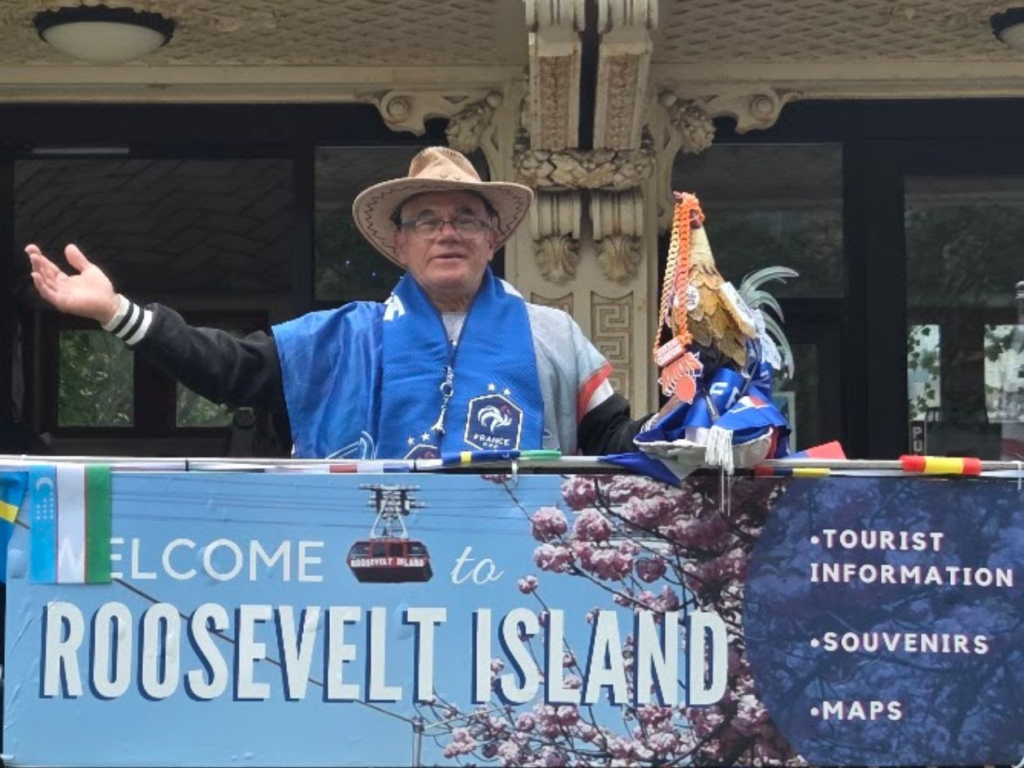
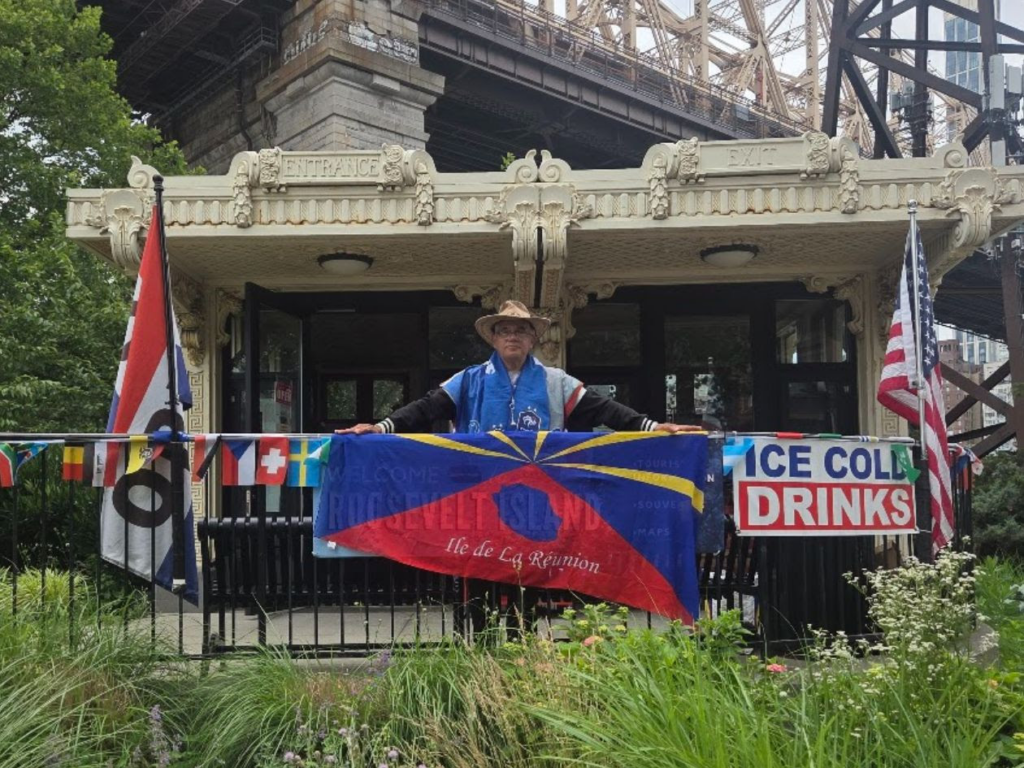
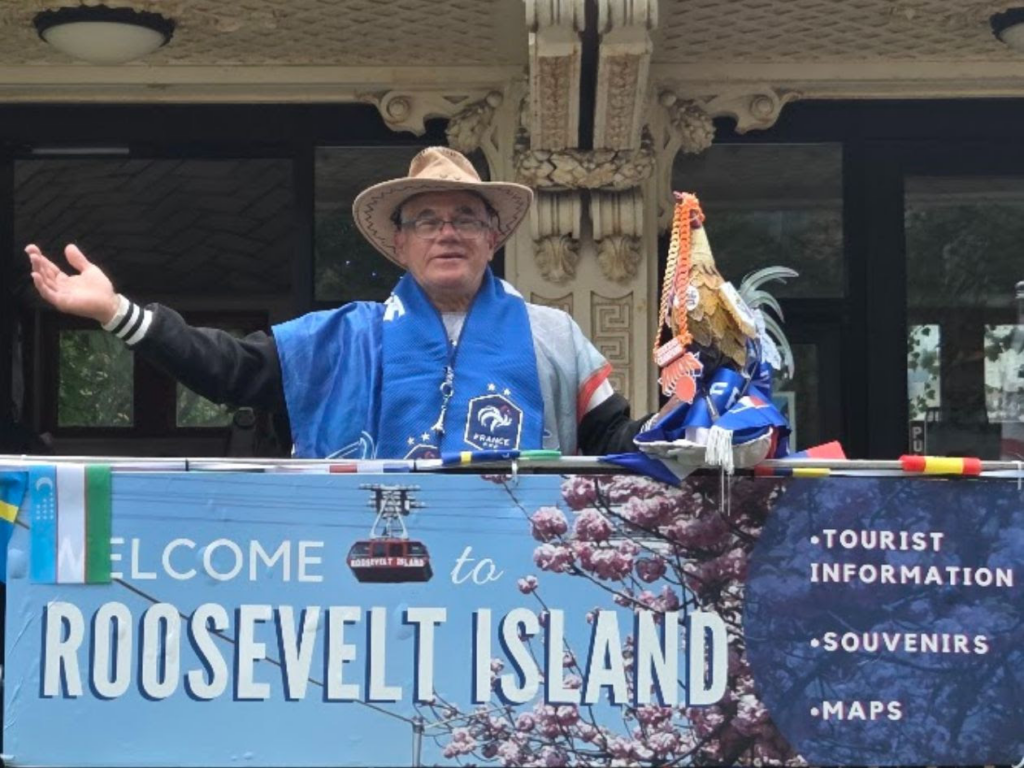
A GENTLEMAN FROM REUNION ISLAND (REUNION ISLAND IS OFF THE COAST OF MADAGASCAR IN THE INDIAN OCEAN)
He brought is golden cock with a NY Knicks badge on it!
CREDITS
MUNICIPAL ART SOCIETY NYC PARKS DEPARTMENT
Sources
Real Estate Record and Builders’ Guide, v. 76, no. 1953, August 19, 1905, 311.
Real Estate Record and Builders’ Guide, v. 76, no. 1966, November 18, 1905, 773.
Real Estate Record and Builders’ Guide, v. 77, no. 1990, May 5, 1906, 820.
Sidney Horenstein, “Building Stones of the New York City Area,” in Geology and Engineering Geology of the New York Metropolitan Area (eds. C.A. Baskerville, N.K. Coch, S. Horenstein, M. Prinz, J.H. Puffer, G.R.
Roberts-Dolgin and D. Weiss), American Geophysical Union, Washington, D.C., doi: 10.1029/FT361, pp. 4-6, 12.
All image are copyrighted (c) Roosevelt Island Historical Society unless otherwise indicated THIS PUBLICATION FUNDED BY DISCRETIONARY FUNDS FROM CITY COUNCIL MEMBER JULIE MENIN & ROOSEVELT ISLAND OPERATING CORPORATION PUBLIC PURPOSE FUNDS.
Photos by Jane Kratochvil, courtesy of Union Square Partnership
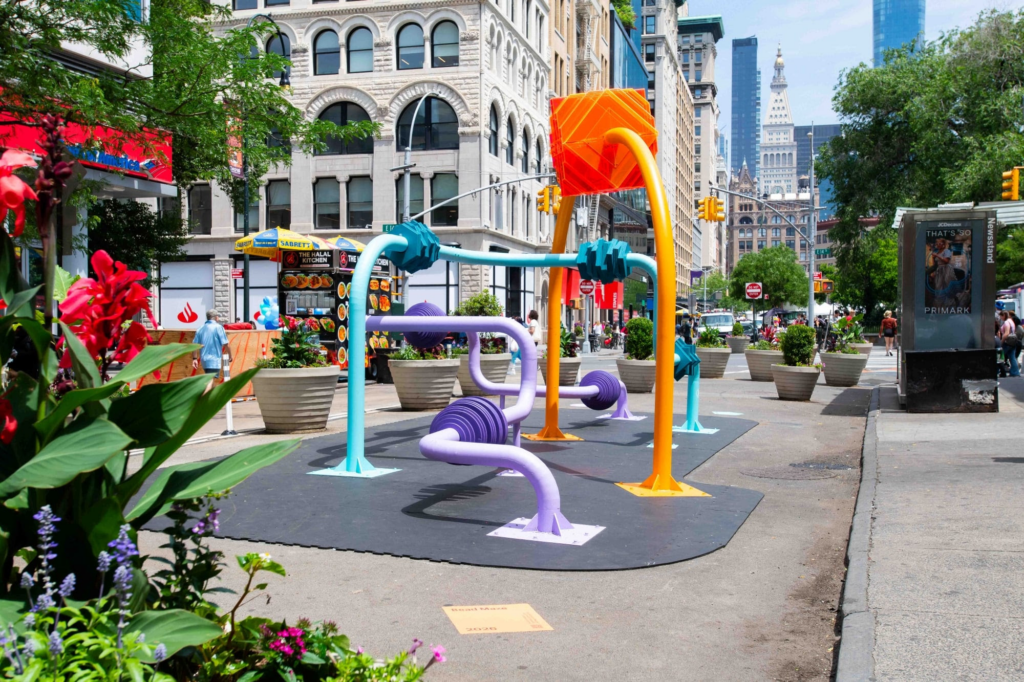
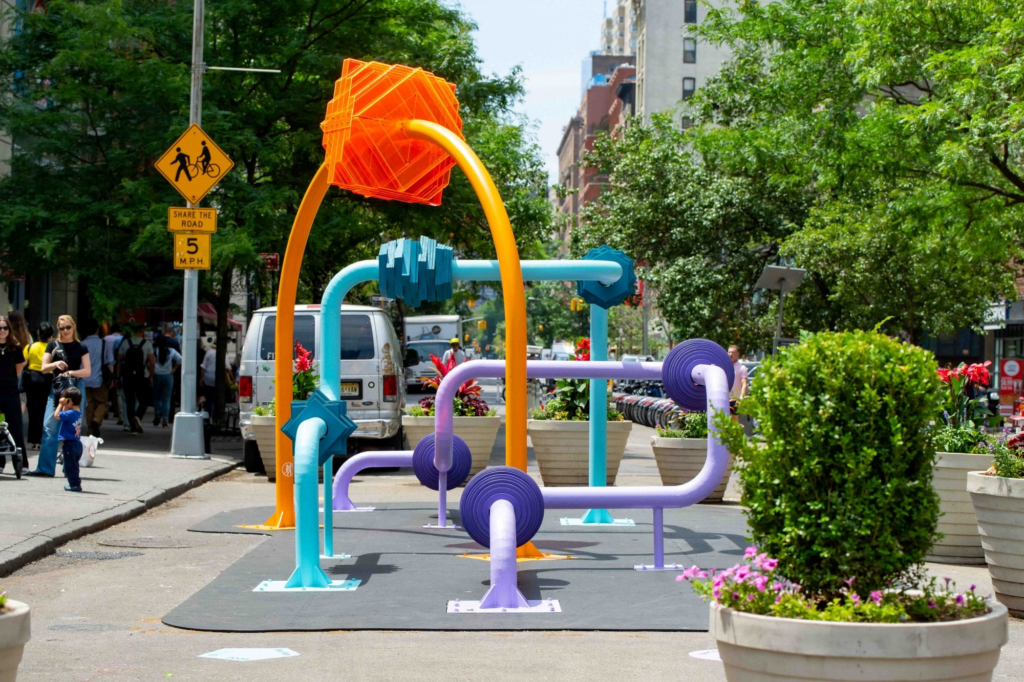
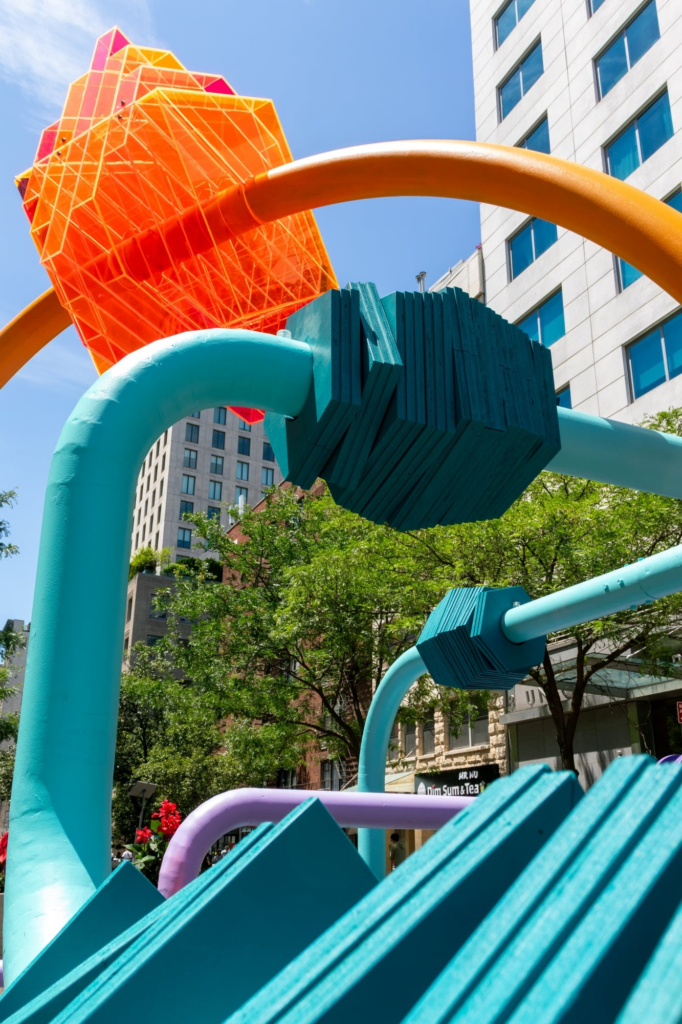
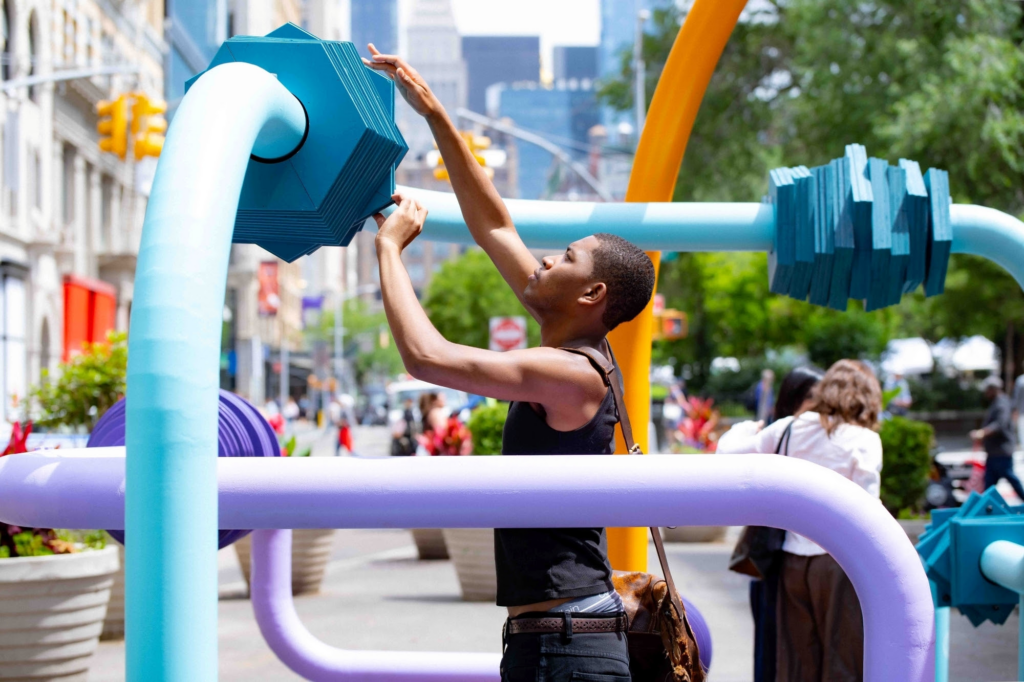
A new interactive public sculpture designed by Fashion Institute of Technology students opened at University Plaza in Union Square last week. Created in collaboration with the Union Square Partnership (USP), “Bead Maze” reimagines a doctor’s waiting-room toy as a large-scale artwork featuring interactive plywood beads connected by bent steel pipes and a color palette inspired by the vibrancy of the Union Square Greenmarket. The project, located between 13th and 14th Streets, was brought to life by design collective Scale Rule, which works pro bono to help realize student concepts through design, fabrication, and installation.
The massive artwork measures 26.5 feet by 13 feet, with heights ranging from 3 feet to 12 feet. It features curved steel pipes with movable plywood beads, with a signature acrylic bead resting atop the highest pipe serving as an “identifiable visual beacon.”
Arranged at varying heights across University Plaza, the installation invites visitors to move through its twisting form and slide beads along its winding pipes, an homage to the curving tunnels of the subway below. It is intended to evoke nostalgia across generations, offering a playful and memorable experience for visitors.
Scale Rule also worked with architectural studio Grimshaw and engineers Schlaich Bergermann Partner (sbp) to create the project. Bob Fisch, a member of the FIT Foundation Board, funded the installation and donated $1,500 to each of the seven students. Brooklyn-based A05 Studio fabricated the installation.
The design collective collaborates with architects and engineers and works pro bono to bring student concepts to life. It recently worked with Grimshaw and Schlaich Bergermann Partner on similar public art installations at the Queens Botanical Garden and Hofstra University.
“The public spaces in our cities are experienced by everyone, but too often shaped by too few,” Dan Bergsagel, co–founder of Scale Rule, said. “At Scale Rule, our mission is to bring more people into the process of designing the built environment we all inhabit.”
“Bead Maze has been an exciting opportunity to advance that aim with a new student cohort and at a different scale, embedded in one of the city’s most vibrant cultural crossroads,” he added.
The project builds on Union Square’s evolving public arts program, which includes the 7,500-square-foot 14th Street Busway mural, now in its sixth year. This year’s installation features artist Shantell Martin’s “Get Outside,” a mural encouraging viewers to reconnect with the outdoors and their communities while celebrating Union Square’s role as a hub for gatherings.
“Bead Maze is exactly the kind of artwork we want to champion in Union Square—visually compelling, deeply collaborative, and rooted in the life of the neighborhood,” Julie Stein, executive director of USP, said.
“We’re proud to work alongside the project team to continue to grow Union Square as a place where art thrives,” she added. “This project proves how shared spaces create unique opportunities for artists to build visibility while enriching our neighborhoods and inviting the public to experience civic space in new ways.”
FIT participated in the initiative to bring student creativity “into dialogue” with the city’s communities. The college plans to expand its public art programming on campus. Its collaboration with the USP reflects the district’s growing role as a hub for public art and a launchpad for emerging artists.
“Bead Maze” will be on view through November 2026.
VISITOR OF THE DAY
A GENTLEMAN FROM REUNION ISLAND (REUNION ISLAND IS OFF THE COAST OF MADAGASCAR IN THE INDIAN OCEAN)
He brought his golden cock with a NY Knicks badge on it!
CREDITS
6SQFT
JUDITH BERDY
All image are copyrighted (c) Roosevelt Island Historical Society unless otherwise indicated THIS PUBLICATION FUNDED BY DISCRETIONARY FUNDS FROM CITY COUNCIL MEMBER JULIE MENIN & ROOSEVELT ISLAND OPERATING CORPORATION PUBLIC PURPOSE FUNDS.
1. The Campus was Built on an Apple Orchard Owned by the Author of “‘Twas the Night Before Christmas”
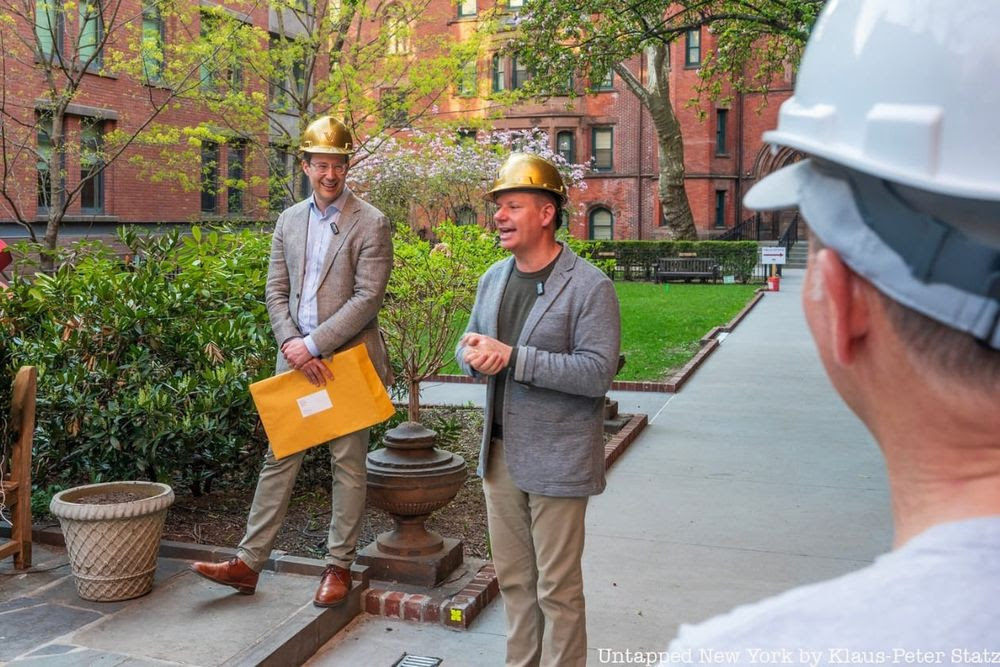
Nathaniel Rogers (left) from Beyer Blinder Belle and James Kellerhouse (right) from Vanderbilt University Leading a Tour for a group of Untapped New York Insiders
The campus sits on land that was once part of a sprawling Chelsea estate that belonged to a colonial New York family, the Moores. The estate, for which the modern-day neighborhood is named, stretched from what is now Eighth Avenue to the Hudson River, between 19th Street and 24th Street (though at the time, the street grid did not yet exist).
Clement Clarke Moore is largely credited as the author of the poem A Visit from St. Nicholas (‘Twas the Night Before Christmas). It was his father’s connection to the Episcopal Church that brought the seminary to their family land. Clement’s father, Benjamin Moore, was the second bishop of the New York Diocese of the Episcopal Church in the U.S., and was also the fifth president of Columbia University.
In 1819, Clement donated 66 tracts of land from his family’s estate to the Episcopal Church for use as a seminary campus. This land was once the family’s apple orchard. While no apple trees remain, there is still a lovely green space at the heart of the campus. In the subsequent decades, Moore continued to develop his estate into residential properties, with the Seminary as its centerpiece.
You Can Attend or Host Events in the Former Dining Hall
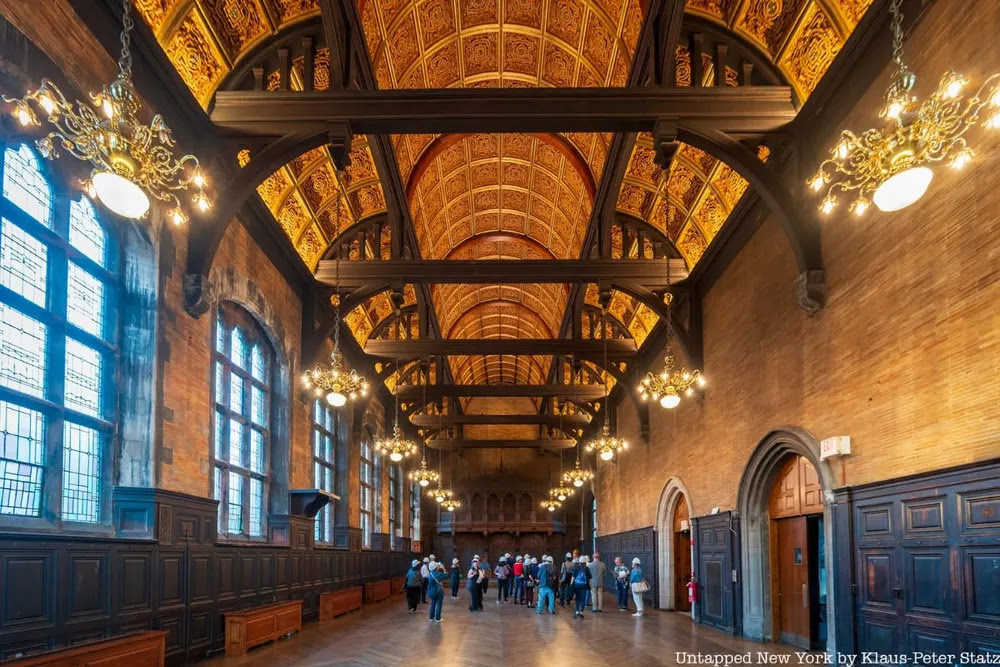
You don’t need to be a Vanderbilt or Seminary student to enjoy the gorgeous Chelsea campus. Throughout the year, Vanderbilt hosts a variety of events that are open to the public. These talks, performances, and workshops take place at Hoffman Hall inside the Refectory, a stunning room that once served as the Seminary’s dining hall.
Inside the grand room, you can admire original details from the late 19th century such as the ornate vaulted plaster and hammerbeam ceiling, coat hooks where Seminary students would their robes, a wood-burning fireplace, the dais where faculty would eat, and the musicians’ balcony above, accessed by a secret door from an apartment in the adjoining building!
This space can also be rented out for weddings and other special events. Learn more about upcoming public programs or reach out to host your own experience here.
3. The Oldest Surviving Building on the Block Now Holds Luxury Condos
West Building on Chelsea campus of Vanderbilt University at the General Theological Seminary
Since the 1820s, this block of Manhattan has seen many changes. The first iteration of the Seminary was just two buildings set in the center of the block: the East Building completed in 1827 and the West Building completed in 1836. While these two stone buildings served the Seminary’s needs for fifty years, by the 1870s the third Ddean of the Seminary, Eugene Augustus Hoffman, was envisioning a much grander future.
Hoffman commissioned architect Charles Coolidge Haight lay out an entirely new plan for the site. Haight’s plan included a series of more than a dozen structures laid out in an “E” shape, with all of the buildings set on the north edge of campus, along 21st Street. The southerly exposure of these buildings would take advantage of the natural light and green space on the rest of the block.
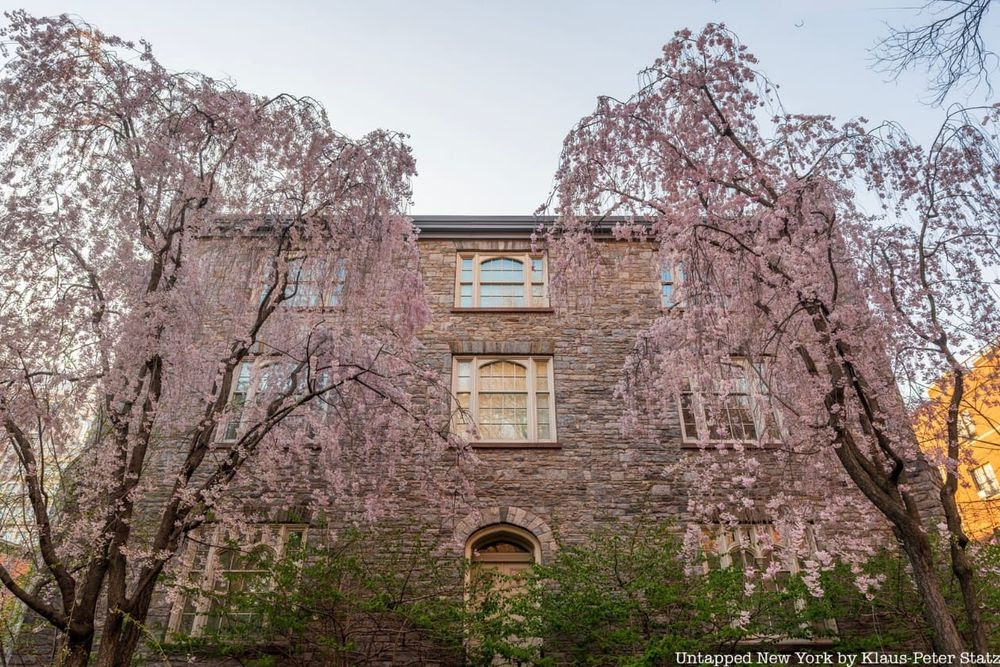
Unfortunately, Haight’s plan necessitated the demolition of the original East Building, but the West Building still stands. After its sale in 2011, the stone structure was converted into luxury condos as one half of a residential development at 455 West 20th Street. Today there is a mix of buildings from the 1830s, 1880s-1900s, 1930s, 1950s, and early 2010s on the block, but it still maintains much of its 19th-century charm. On our tour of the campus, we enjoyed sitting under the shade of the cherry blossom trees that frame the West Building’s eastern facade.
4. The Campus Was Modeled After Oxford
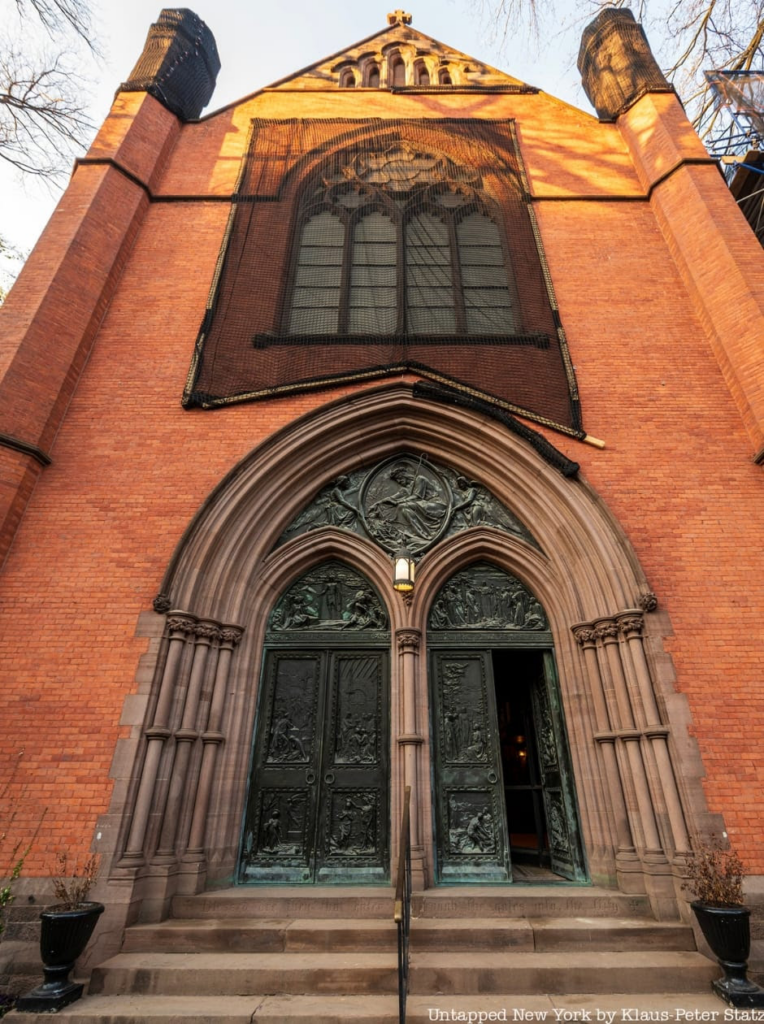
Between 1885 and 1905, Haight designed and built over sixteen buildings for the seminary campus. To imbue these structures with academic gravitas, he drew inspiration from some of the world’s most respected institutions, especially for the centerpiece of the campus, the Chapel of the Good Shepherd, constructed in 1886.
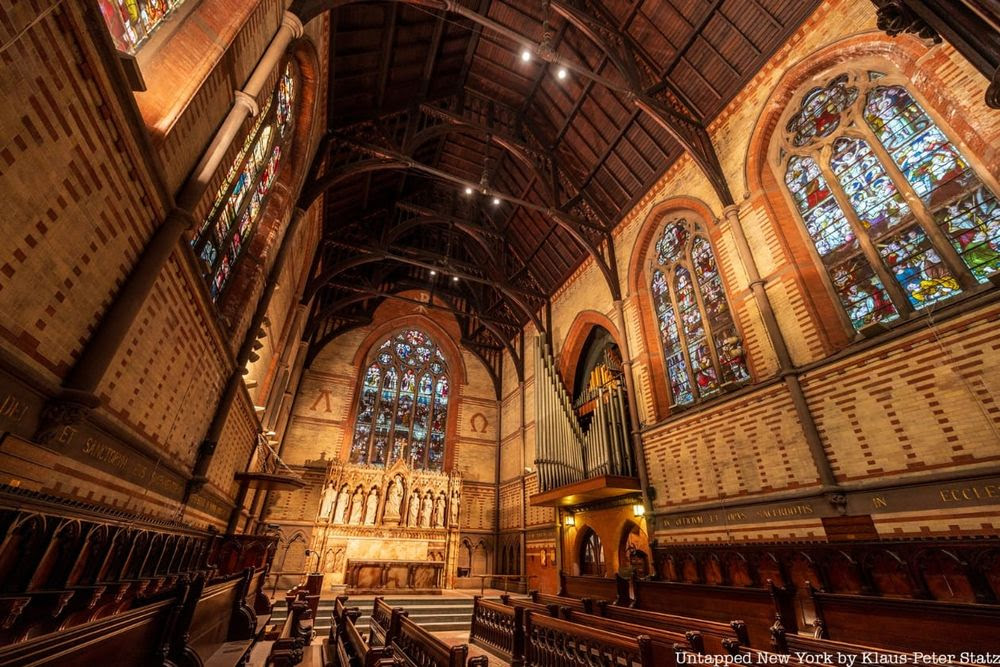
For the chapel’s tower, Haight looked to the square, spire-topped medieval tower of Magdalen College at the University of Oxford. Inside the chapel, Haight channeled the English architect William Butterfield. Butterfield used polychromatic mixes of bricks in his design of Oxford’s neo-Gothic Keble College, and you can see a similar pattern inside the Chapel of the Good Shepherd.
5. There is a Sculpture of the Architect Inside the Chapel
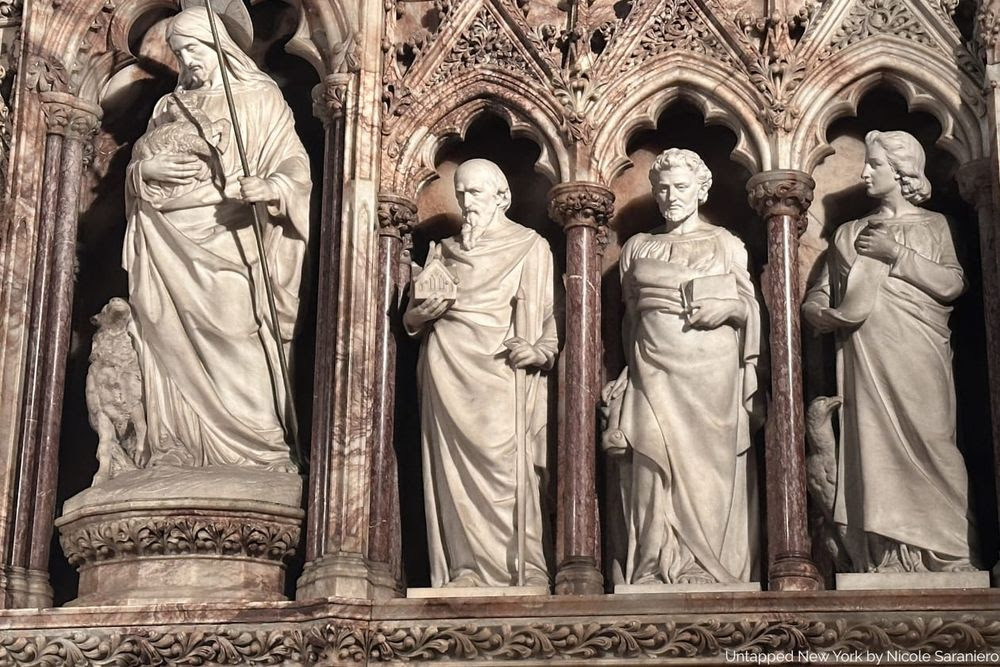
Haight was proud of his work at the seminary and became a permanent piece of the campus. Inside the chapel, behind the altar, you’ll find a sculpture of Haight in the ornate stone reredos. Just look to the right of Jesus, in the spot traditionally reserved for St. Paul, and you will that St. Paul is modeled after the architect and is holding a miniature chapel.
LET’S PUT MAPS ON BUSES
THE RED BUSES HAVE MOSTLY EMPTY PLACES WHERE WE CAN PUT EASY TO READ ISLAND MAPS
All image are copyrighted (c) Roosevelt Island Historical Society unless otherwise indicated THIS PUBLICATION FUNDED BY DISCRETIONARY FUNDS FROM CITY COUNCIL MEMBER JULIE MENIN & ROOSEVELT ISLAND OPERATING CORPORATION PUBLIC PURPOSE FUNDS.
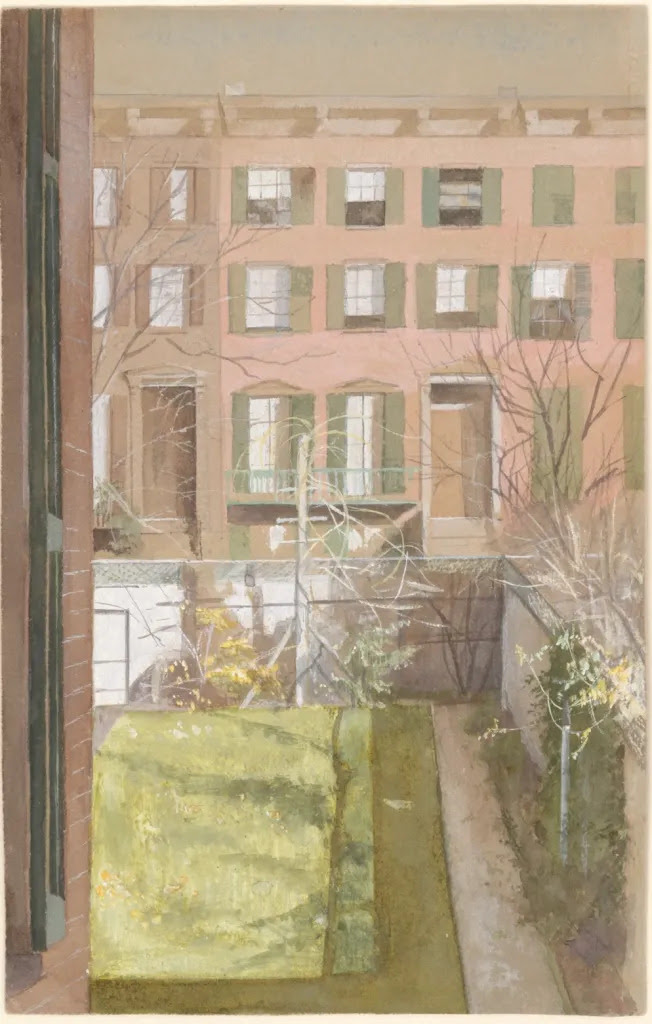
When Fidelia Bridges moved to 93 First Place in Brooklyn in 1854, her neighborhood was an enclave of recently built brownstones set back from the street with roomy front gardens.
Years later, in 1867, something compelled her to paint that front garden. Perhaps it was the contrast between the delicate yellow buds on bushes, the still-bare trees, and the fortress of stone houses across First Place.
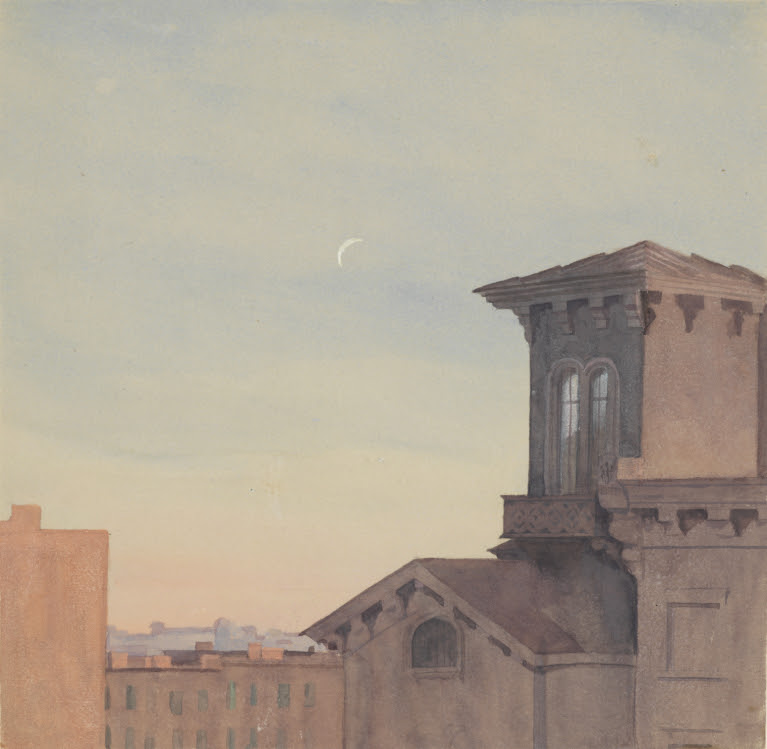
That same year, she also captured the early evening view from her top-floor window, centering a crescent moon against the muted skies over sparsely developed Brooklyn.
Both are unusual paintings, as streetscapes didn’t become popularized until the Ashcan artists arrived at the end of the 19th century, according to the Metropolitan Museum of Art. But in Civil War-era Brooklyn, Bridges was an unusual person.
Born in Salem, Massachusetts in 1834, Bridges was orphaned at 15. Traumatized by her parents’ deaths, she spent time in the country, staying in bed and drawing, as “her artistic talents became apparent,” according to a 2024 New York Times story.
She soon came back to Salem to teach, take art classes, and become a governess in the household of William August Brown, a well-to-do shipowner.
When the Browns relocated to Brooklyn in 1854, Bridges came with them. Her drawing must have impressed the family; in 1860, they funded her enrollment at the Philadelphia Academy of Fine Art.
Three years later, she returned to Brooklyn, taking a top-floor studio in the Brown family brownstone and launching her career as a noted and celebrated painter.
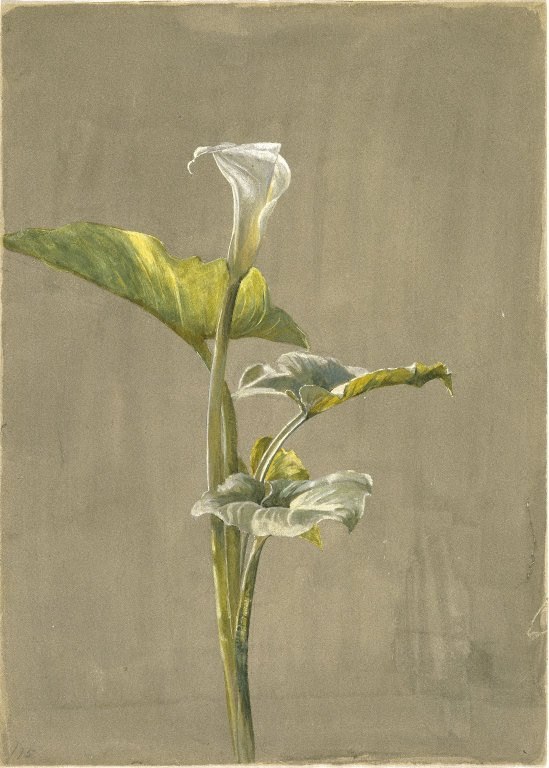
Bridges almost exclusively painted watercolors of natural images. Her delicate, exquisite works of botanicals and birds brought her acclaim, especially after the Civil War, when nature scenes had broad appeal.
“A close observer of nature and an admirer of Asian art and design, she turned scenes of local flora, birds and butterflies into graceful, affecting compositions,” stated the New York Times.
Dedicated to her art, Bridges worked 10-hour days, per the New York Times. Opting out of a life that included marriage and children, she exhibited her paintings and becoming the second woman to be elected into membership in the National Academy of Design.
Her career spanned 50 years, and she passed away in her home in Canaan, Connecticut in 1923.
Her sensitive depictions of the natural world—and the two paintings done from her top-floor studio—are part of the collections of major museums.
But like so many talented artists, Bridges has mostly been forgotten. 93 First Place, however, still stands in today’s Carroll Gardens.
LET’S PUT MAPS ON BUSES
THE RED BUSES HAVE MOSTLY EMPTY PLACES WHERE WE CAN PUT EASY TO READ ISLAND MAPS
All image are copyrighted (c) Roosevelt Island Historical Society unless otherwise indicated THIS PUBLICATION FUNDED BY DISCRETIONARY FUNDS FROM CITY COUNCIL MEMBER JULIE MENIN & ROOSEVELT ISLAND OPERATING CORPORATION PUBLIC PURPOSE FUNDS.
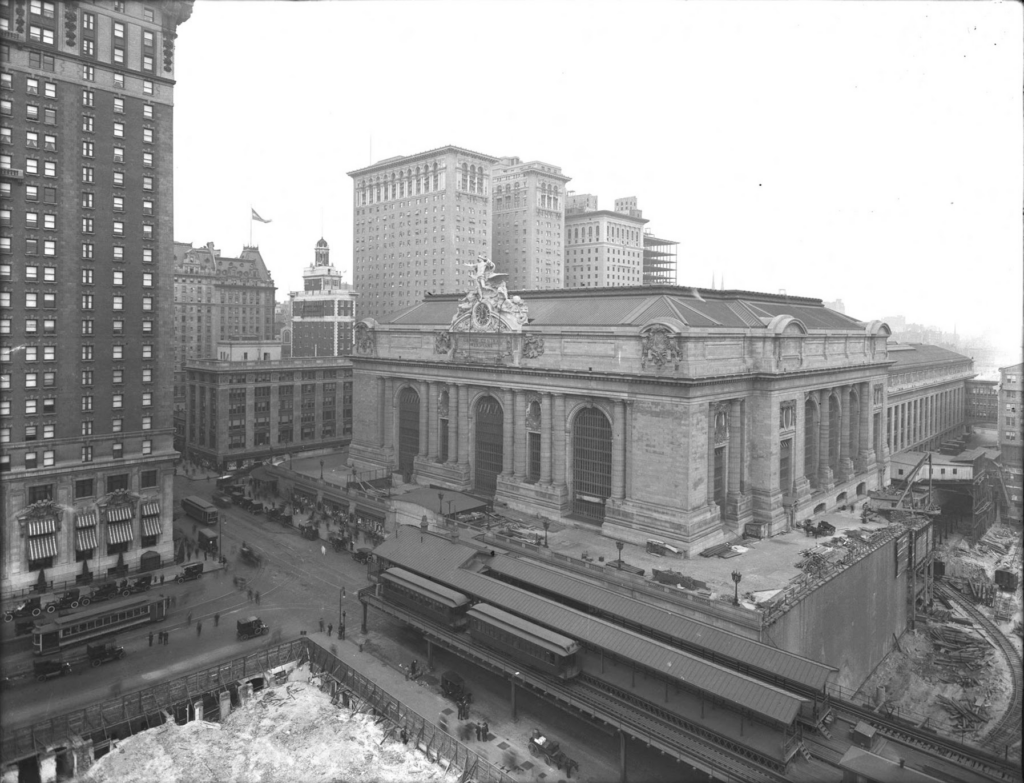
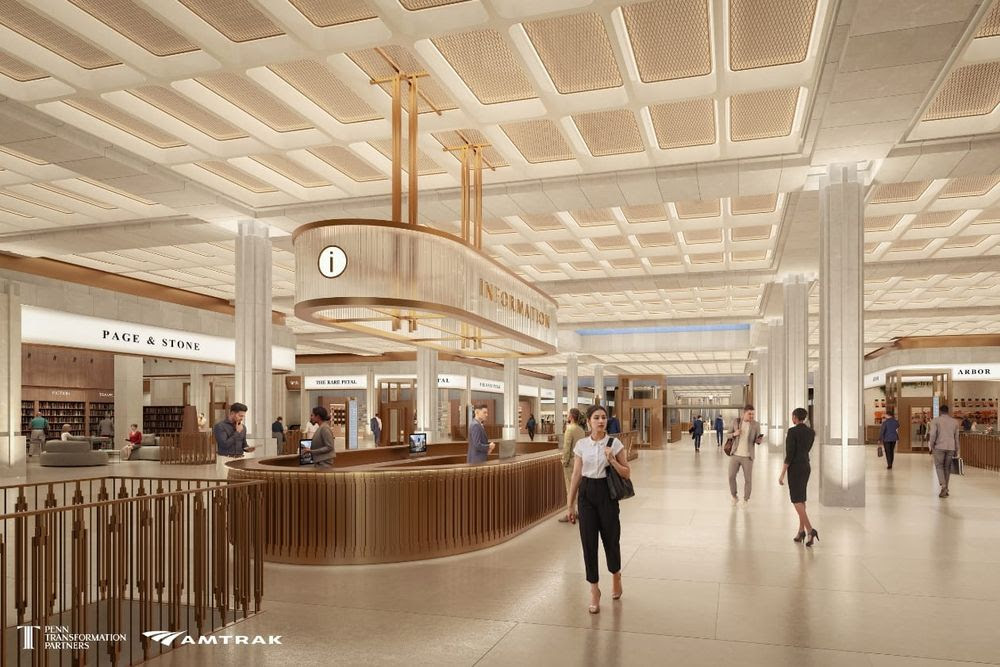
Explore unbuilt Penn Station redesigns, from a futuristic burial ground to a re-imagining of the original Beaux-Arts structure.
Rendering by Jeff Stikeman for Rebuild Penn Station
June 12 20265Share
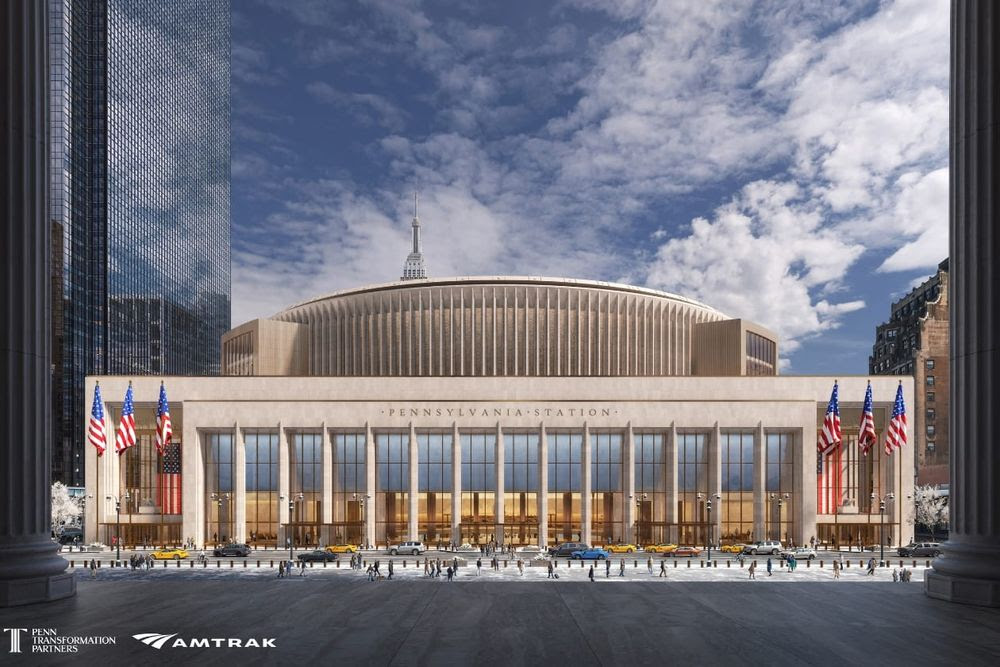
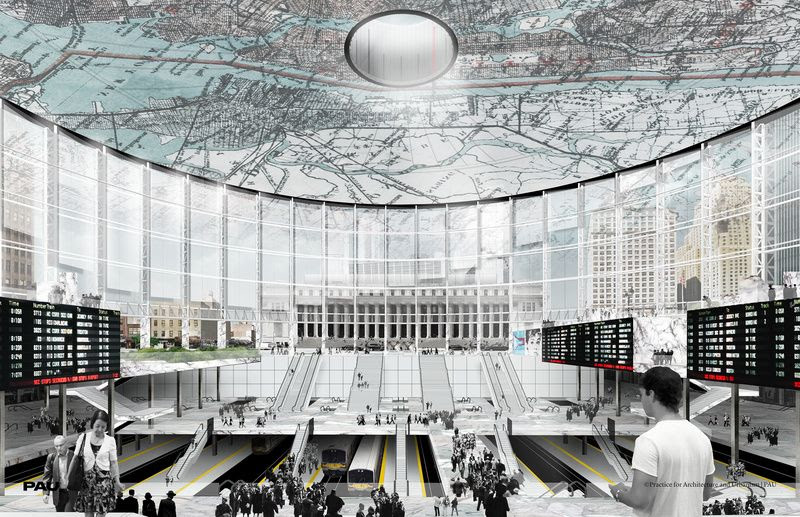
Ever since the original Penn Station was demolished in the 1960s, New Yorkers have longed a station that recaptures the beauty and grandeur that was lost. The latest plans from Penn Transformation Partners (PTP), a joint venture between master developers Halmar and Skanska, seek to deliver on those ideals with a revitalized station designed by Practice for Architecture and Urbanism (PAU). Backed by the U.S. Department of Transportation and Special Advisor to the Amtrak Board Andy Byford, this plan promises to make the “station safer, more spacious, and better connected, while elevating it into a modern civic landmark.” But it isn’t the first proposal to make such promises.
Rendering Courtesy of Practice for Architecture and Urbanism (PAU)
We’ve been following the revitalization and renovations of Penn Station for more than ten years, ever since Madison Square Garden’s permit expired in 2013 and ideas for what could possibly take its place began to swirl. As we contemplate the most recent renderings of what Penn Station may become, let’s take a look back at proposals that never came to fruition, from a re-imagined version of McKim, Mead & White’s design and a futuristic burial ground to an above-ground station that uses the bones of Madison Square Garden.
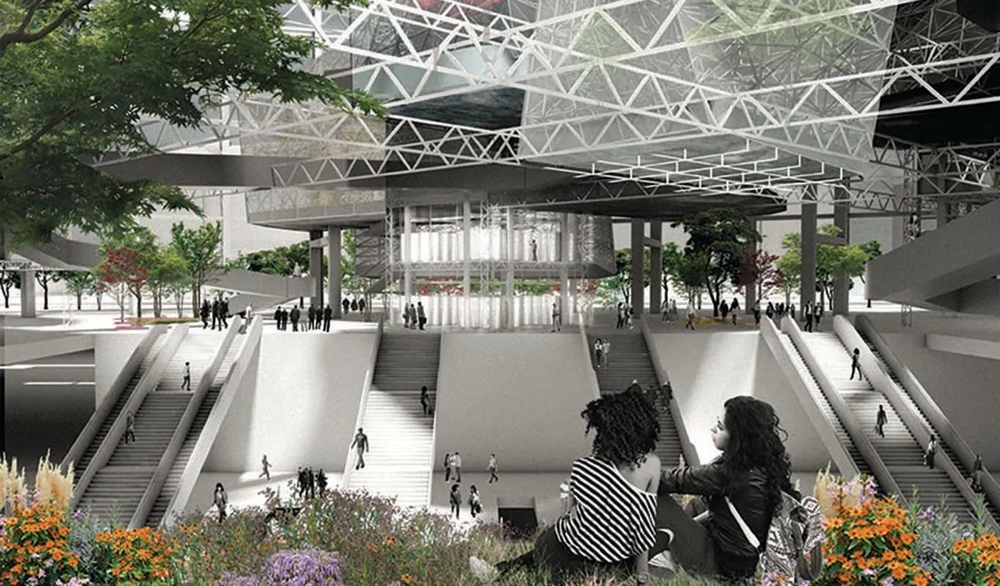
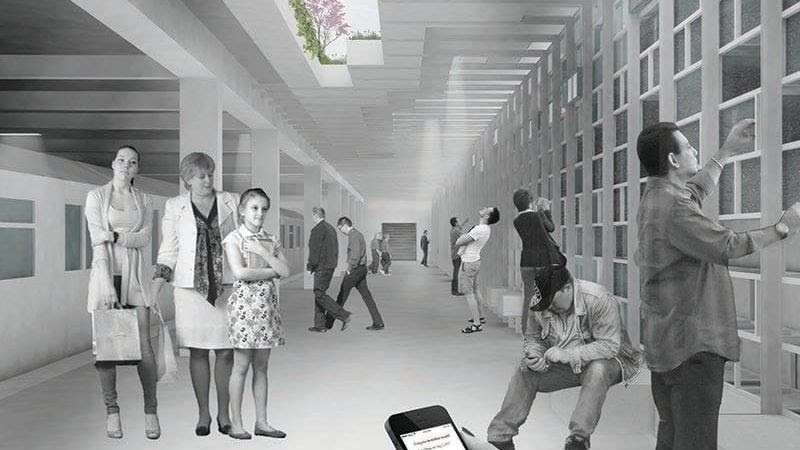
A FUTURISTIC CEMETERY
Madison Square Garden, reimagined as a cemetery and public space. All renderings by Mai Abusalih, Eric Giragosian, Min He.
One of the most unique takes on the future of Penn Station came from Columbia University’s Graduate School of Architecture, Planning and Preservation and the University’s DeathLAB. Envisioned by students Mai Abusalih, Eric Giragosian, and Min He in the summer of 2017, plans for #RIP: Encoding Memory envisioned an unconventional green space that would replace Madison Square Garden. This park-like setting would serve as a burial ground for both human remains and digital memories. The bodies of lost loved ones would go through promession, a form of “green cremation” and be used as fertilizer for garden spaces enjoyed by the living. Data servers spread throughout would help to control the garden climate and hold digital memories.
A Re-imagining of the Original Penn Station
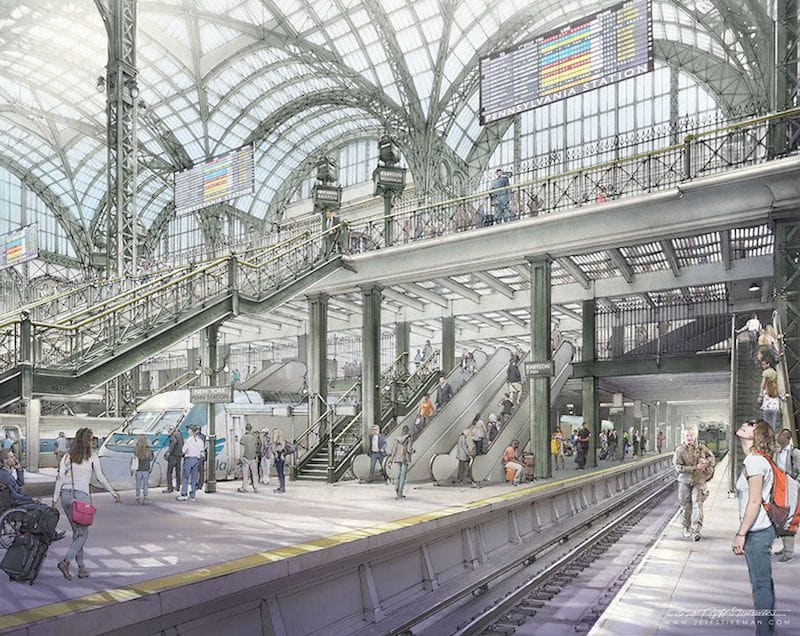
Rendering by Jeff Stikeman, Penn Design Modifications by Richard Cameron
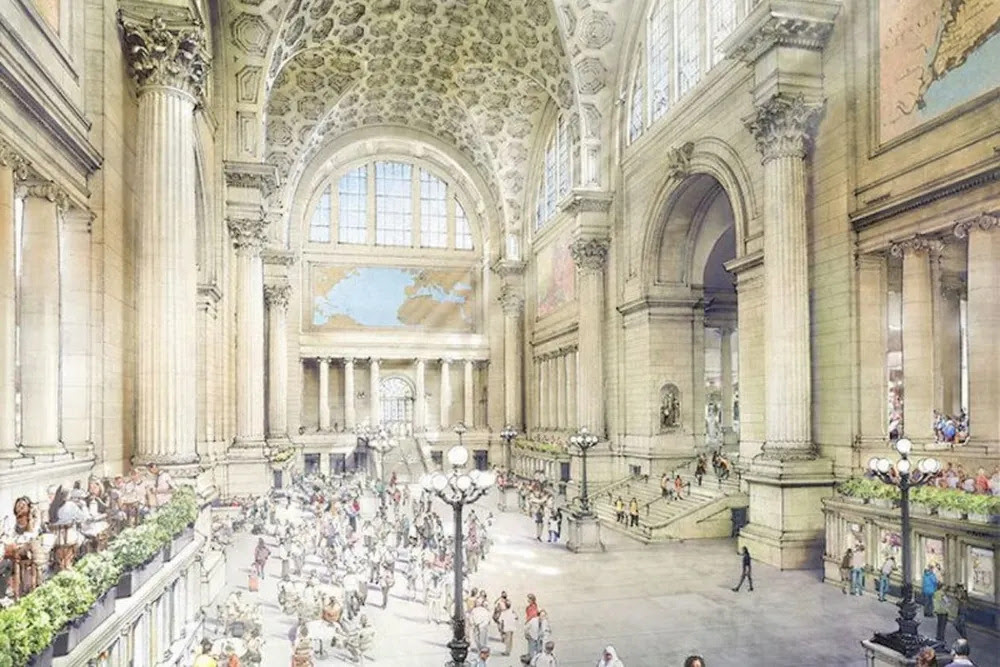
In 2017, Rebuild Penn Station, a project of the National Civic Art Society, a 501(c)(3) nonprofit organization, launched an ad campaign advocating for the reconstruction of McKim, Mead & White’s original 1910 design. The stunning renderings that were part of the campaign show modern commuters and trains within the Beaux-Arts marble hall and light-filled concourse of the early 20th-century station. The organization estimated that it would take $3 billion to $3.5 billion to bring this vision to life and of course, Madison Square Garden would have to relocate, something that is not unprecedented in the venue’s history.
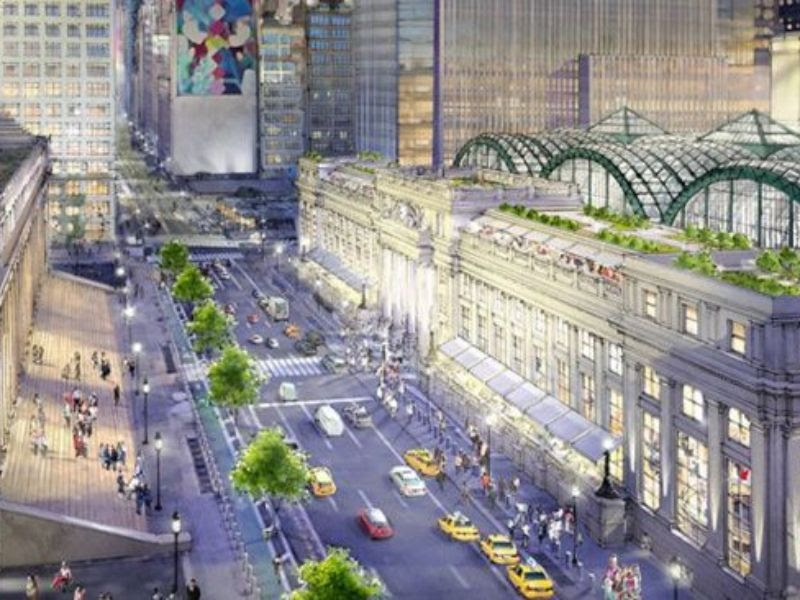
A Glass Ghost of Madison Square Garden
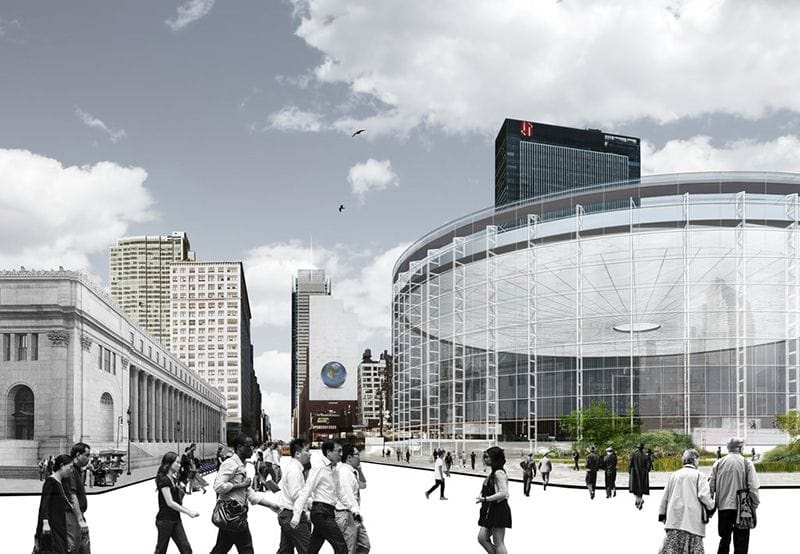
Rendering by Vishaan Chakrabarti/PAU Studios
Before Practice for Architecture and Urbanism (PAU) came up with the current design for Penn Station’s next chapter, founder Vishaan Chakrabarti unveiled a different vision. Shared with the New York Times in 2016, this initial idea included repurposing the steel skeleton of Madison Square Garden to create a glass atrium. By replacing the venue’s concrete cladding with glass, light would fill the station, all the way down to the exposed tracks. The see-through facade would also unlock a view of the Farley Post Office Building across 8th Avenue. In Chakrabarti’s design, a few pieces of the original station, including original staircases, could be preserved.
A Circular Public Park
Rendering for a new Penn Station by Skidmore, Owings & Merrill (SOM)
In 2013, the Municipal Art Society of New York (MAS) challenged four preeminent New York City architecture firms to re-imagine Penn Station. Diller Scofidio + Renfro, H3 Hardy Collaboration Architecture, SHoP Architects, and Skidmore, Owings & Merrill (SOM) all created unique proposals.
The futuristic rendering above shows the track level of SOM’s design. This plan would have expanded Penn Station’s footprint by two additional blocks to accommodate high-speed rail lines and more local commuter service. Again, Madison Square Garden would have to be relocated, and in its place would be a central glass enclosed atrium, surrounded by a circular public park four times the size of Bryant Park.
The Governors’ Plans
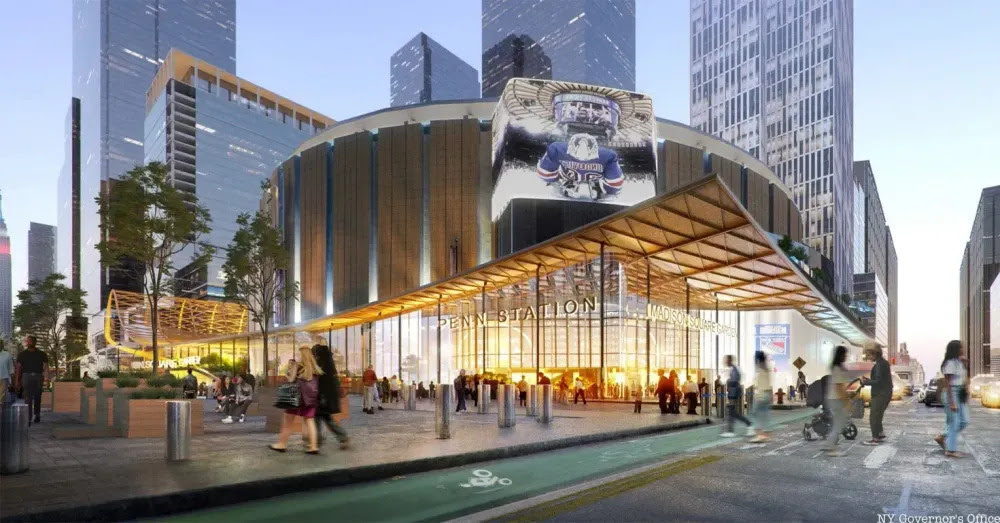
2023 Rendering Courtesy of the Governor’s Office, Design by WSP and FXCollaborative, with noted architect John McAslan
Before the U.S. Department of Transportation took control of Penn Station’s revitalization in 2025, multiple proposals were put forward by New York State under both Governor Cuomo and Governor Hochul. Along with changes to the train station, these plans often included development plans for the surrounding neighborhood. Untapped New York took up the charge of advocating for multiple landmark-worthy structures, including the original Penn Station power house, that could have been at risk of demolition under Cuomo’s Empire Station Complex proposal. These development plans were largely cut under Governor Hochul.
Parts of Cuomo’s plan that did come to fruition include the conversion of the Farley Post Office building into Moynihan Train Hall in 2021, the new entrances along 7th Avenue, and the renovated LIRR concourse, which Untapped New York Insiders got to tour with architects from SOM.
Gouveneur at the turn of the 20th Century and today as supportive housing
“These works are not only visually stunning, they’re a testament to the belief that art can uplift, inspire, and heal,” Tuttle says. “Through this exhibition, we honor a moment in New York’s history when public investment in the arts transformed civic spaces and enriched the lives of everyday New Yorkers—including the city’s youngest and most vulnerable patients.”“Another Wonderland: Abram Champanier’s Alice Mural” will be on view at the Museum of the City of New York from June 6 through September.
LET’S PUT MAPS ON BUSES
THE RED BUSES HAVE MOSTLY EMPTY PLACES WHERE WE CAN PUT EASY TO READ ISLAND MAPS
CREDITS
UNTAPPED NEW YORK Judith Berdy
All image are copyrighted (c) Roosevelt Island Historical Society unless otherwise indicated THIS PUBLICATION FUNDED BY DISCRETIONARY FUNDS FROM CITY COUNCIL MEMBER JULIE MENIN & ROOSEVELT ISLAND OPERATING CORPORATION PUBLIC PURPOSE FUNDS.