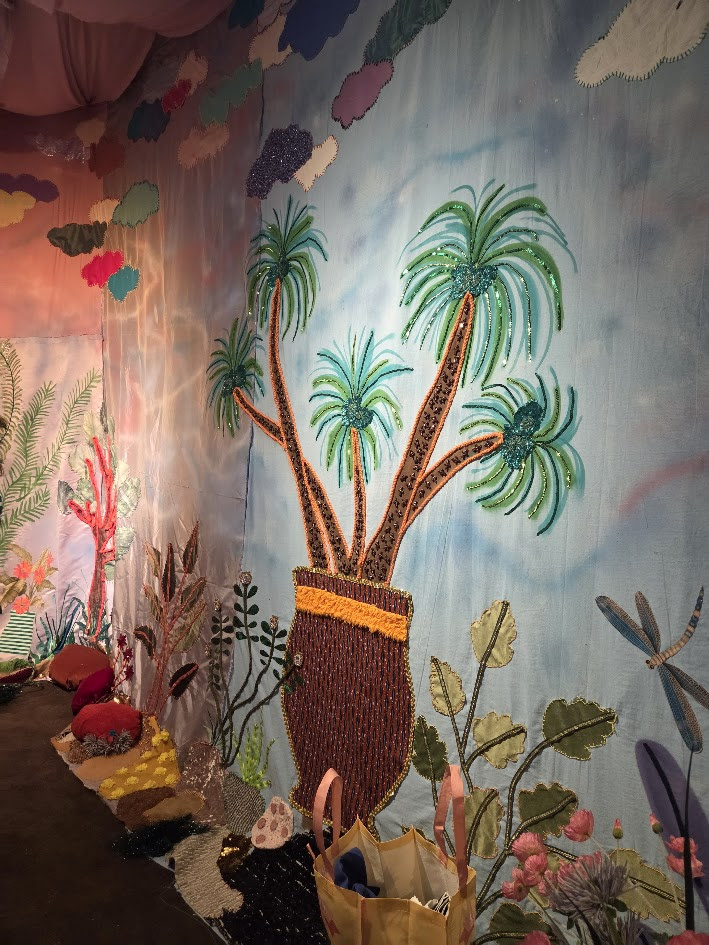
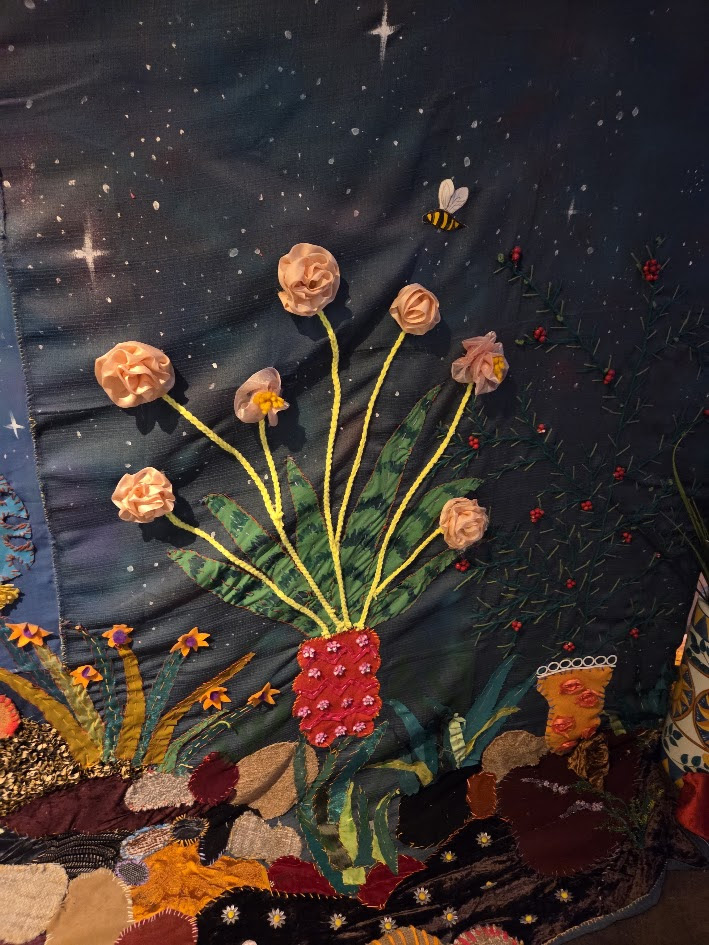
Explore the artists who make Printemps New York a truly unique space! Whether emerging or established, working in paint or sculpture, permanent or temporary, each of these amazing artisans bring their own distinctly fresh perspective and unique flair to your experience.
Wednesday, July 23, 2025
PRINTEMPS NEW YORK ONE WALL STREET Issue # 1491
Red Room Mosaic Art, 1931
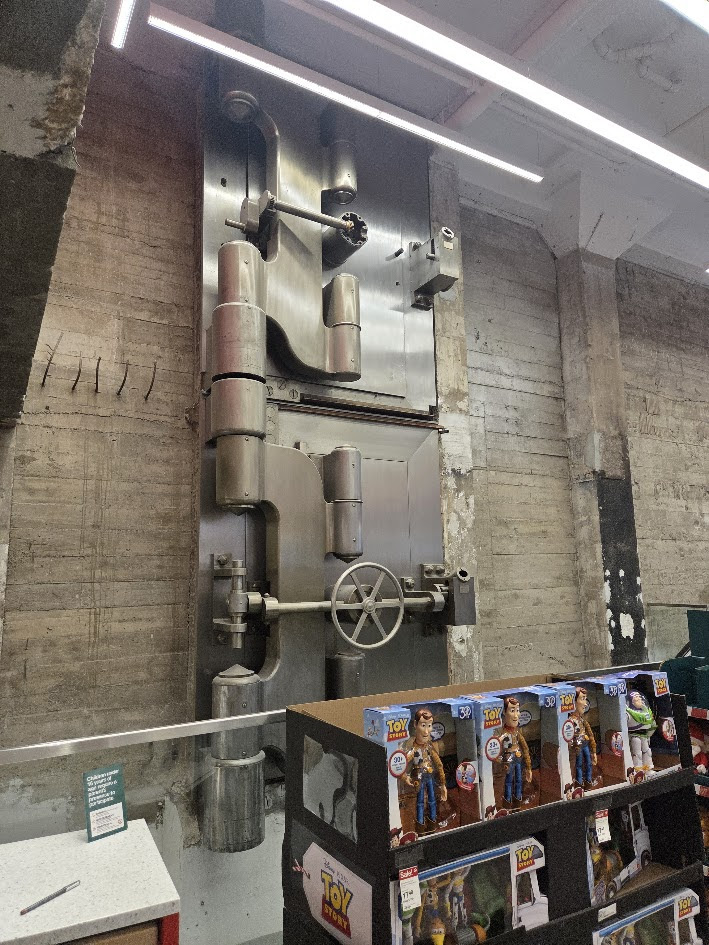
Designated an official New York City interior landmark in 2024, the Red Room is the pièce de résistance: sculptural walls, soaring 33-foot ceilings, and nearly three million red and gold mosaic tiles. It’s the vision of Hildreth Meière, the trailblazing Art Deco artist whose work also graces Radio City Music Hall and Rockefeller Center. Completed in 1931, originally designed as the banking hall for the Irving Trust Company, and later the Bank of New York, the space still feels bold, glamorous, and full of life …and shoes!
A newly crafted mosaic “river” by Pierre Mesguiche now winds its way from the Red Room’s entrance to the adjacent Red Room Bar. A celebrated mosaicist, and Printemps Paris collaborator, Mesguiche’s latest work creates a playful dialogue between Paris and New York and between the past and the future.
Riviera Botanica, 2025
South Korean artist Maria (Taehyoung) Jeon, brings a breezy charm to our store windows with Riviera Botanica, a layered digital work inspired by the carefree elegance of summer in the French Riviera. Merging vibrant flora with subtle human forms, she evokes a mood of playfulness and ease, bringing summer in botanical form to our windows.
Raised between New Zealand and the UK and now based in Seoul, Jeon draws on a multicultural perspective and a background in printmaking and animation. Eastern and Western influences blend in each digital brushstroke, bringing depth and harmony to her richly composed works
Fantasy Flower No.6, Frutti di Mare, and Chinese Restaurant No.8 Lamps
In collaboration with Todd Merrill Gallery Curated by Valentina Guidi Ottobri
Finnish artist Teemu Salonen brings a touch of the fantastical with his botanical, sculptural lamps that burst with color and movement. Known for blending natural forms with surrealist flair, Salonen’s pieces feel at once organic and otherworldly. Each sculpture invites a closer look, adding moments of surprise and delight throughout the space where blooms that appear caught in mid-movement underscore our endless spring
Currently in the Salon and Red RoomMAARTEN VROLIJK
The Blooming Glass & Ceramic Collection
In collaboration with Todd Merrill Gallery Curated by Valentina Guidi Ottobri
Amsterdam-based artist Maarten Vrolijk brings a sense of softness and joy to the space with his Sakura vases, each a playful, oversized form rendered in soft curves and luminous, layered hues. With a spirit that nods to Romanticism and Art Nouveau, the vases blur the line between function and sculpture. Their fragile transparency, set against the strong lines and saturated palette of the Red Room, creates a beautifully poetic contras
Origami Birds, 2025
Belgian artist Charles Kaisin brings his signature vision to New York with a shimmering flock of golden origami-like birds suspended across our Salon windows overlooking Broadway. Known for sculptural works that explore light, geometry, and organic form, Kaisin previously created a celebrated installation beneath the historic dome at Printemps Haussmann – making his presence at Printemps New York a fitting new bridge between Paris and New York
Champagne Bar, 2025
Brooklyn-based artist William Coggin created the Champagne Bar’s ceramic-clad façade, an organic sculptural form that evokes the look and feel of sea coral. Large slabs replete with craggy textures and hand-formed curves create a multi-sensory experience that invites guests to pause, touch, and take it all in. Tucked at the end of our marble Salle de Bain, the Champagne Bar offers an intimate escape – the perfect spot to enjoy a perfectly chilled, small-batch cuvée, surrounded by beauty.
Odyssey of Nature’s Rebirth, 2025
In collaboration with Nilufar Gallery Curated by Valentina Guidi Ottobri
Multi-media artist and fashion designer Christian Pellizzari brings a burst of whimsy and wonder to our Grand Foyer with Odyssey of Nature’s Rebirth, a vibrant, dreamlike garden where Murano glass flowers and intricate 3D prints bloom in full color. Having grown up near Venice, Pellizzari often draws on the centuries-old traditions of Murano glassmaking, blending them with contemporary techniques to create works that feel both timeless and new. Lining the entry with dazzling flowers, he welcomes every guest into a world of beauty, imagination, and renewal. Artwork is available for purchase.
Stained glass panels and windows, 2025
Pierre Marie, the renowned French glass artist, brings his exceptional mastery to Printemps New York with a series of hand-crafted, stained-glass windows and panels featured in both the Red Room Bar and Maison Passerelle. Bold, botanical, and with a nod to the Baroque, these pieces capture the interplay of light and color, drawing inspiration from the intricate patterns and grandeur of the iconic Printemps Paris dome. Each piece blends contemporary techniques with timeless design, making these works of art a stunning tribute to Parisian craftsmanship and the art of glassmaking – a first for Pierre Marie in the U.S.
All image are copyrighted (c) Roosevelt Island Historical Society unless otherwise indicated THIS PUBLICATION FUNDED BY DISCRETIONARY FUNDS FROM CITY COUNCIL MEMBER JULIE MENIN & ROOSEVELT ISLAND OPERATING CORPORATION PUBLIC PURPOSE FUNDS.
Wondering why the beachgoers in this Rockaway Beach postcard don’t look like they’re having much fun—with their heavy hats, head-to-toe bathing outfits, and stiff posture as they sit in wood chairs or stand near the water?
It might have something to do with some new beach rules instituted a few years earlier.
According to a 2017 article in the longtime Rockaway news site The Wave, an NYPD Captain named Louis Kreuscher was concerned that a surge in visitors to this popular summer destination in the early years of the 20th century might have a negative effect on morals and manners.
So he composed a list of etiquette violations, which The Wave published in an August 1904 edition. The rules included the following:
“No person or persons shall be allowed to sit on the sand under the boardwalk after dark; As the beach is a public place, kissing is strictly forbidden; No hand-holding allowed; Hugging is strictly forbidden and the beach is for the use of bathers and is not to be used as a trysting place…”
A Wikipedia page on the history of Rockaway Beach also referenced Kreuscher’s rules, adding that they allowed for the “censoring the bathing suits to be worn, where photographs could be taken, and specifying that women in bathing suits were not allowed to leave the beachfront.”
Not using the beach as a “trysting place” seems reasonable. But no hugging, handholding, or heading to the boardwalk in a bathing suit? At some point in the 20th century, these rules were ignored, the
All image are copyrighted (c) Roosevelt Island Historical Society unless otherwise indicated THIS PUBLICATION FUNDED BY DISCRETIONARY FUNDS FROM CITY COUNCIL MEMBER JULIE MENIN & ROOSEVELT ISLAND OPERATING CORPORATION PUBLIC PURPOSE FUNDS.

Stitching Meaning: Reflecting on the Themes of Real Clothes, Real Lives
We recently said goodbye to Real Clothes, Real Lives: Two Hundred Years of What Women Wore, an exhibition of historic clothing from the Smith College Collection, on display from September 2024 to June 2025 in our Joyce B. Cowin Women’s History Gallery. The closing of this popular exhibition gives us the opportunity to reflect on some of the larger themes that it explored—in this case, the centrality of sewing to 19th-century American women’s lives, and the difference that race, class, and legal status made in the ways that women experienced this ubiquitous work.
Anna-Marie Kellen, photographer. Homemade bustle-style day dress, 1875–80. Printed cotton. The Smith College Historic Clothing Collection, SCHCC 2012.4.38ab
Women’s sewing encompassed a vast and varied culture in the early to mid-19th-century United States. While every woman was expected to sew, the function of women’s sewing could vary enormously. Some women worked hard piecing together plain clothes, while others spent their leisure time stitching ornamental and fancy embroidery. Sometimes highly skilled women were paid for their sewing work. Most often, however, they were not.
Sewing box owned by Mary Elizabeth Babcock Morris (1808–1851), ca. 1830–40. Wood, tortoise shell, metal, cardboard, paper, textile, ivory, wax, gilding. The New York Historical, Gift of John B. Morris Jr., 1941.746a-cc
Prior to emancipation, many enslaved women were forced to sew for the women and families that enslaved them, for their fellow enslaved men, women, and children, and for their own families. Enslavers invested in, valued, and often advertised the sewing and seamstress skills possessed by the women they enslaved. For example, Ellen Thomas was taught the work of “fine sewing” while enslaved by Cornelia Kimball. Thomas commanded some of the most challenging sewing techniques, including how to add tucks and “back-stitch them in the front of men’s shirts.” This labor—the work of sewing—was integral to the foundation of American slavery, writes historian Alexandra J. Finley. Enslaved women “performed the day-to-day labor necessary to the functioning of the slave trade,” Finley argues, for it was “the ‘product’ of women’s labor–clean, healthy, and well-dressed bodies,” that “were put up for sale in horrifying ways.”
Hannah Jones, the granddaughter of an enslaved woman, recalled that her grandmother’s enslaver had forced her grandmother to sew 12 shirts just three days after she had given birth, demonstrating that free and enslaved women had vastly different relationships to sewing and to motherhood. Historian V. Lynn Kennedy notes that experiences like that of Hannah Jones’s grandmother reveal that “racial differences seemed to trump similarities in physical experiences” between women, “reaffirming rather than challenging social boundaries.”
Some enslaved African American women became highly skilled and sought-after seamstresses, such as the famous Elizabeth Keckley—who started working as a seamstress for the wealthy white families of St. Louis to spare her mother from being “rented out.” Still enslaved by Ann Garland (her half-sister), Elizabeth Keckley was at first prevented from keeping her earnings. But with determination and donations from some satisfied customers, she was able to buy her and her son’s freedom in 1855. She went on to become one of the most successful seamstresses in Washington, D.C. (and likely the nation), making dresses for both Mary Todd Lincoln and Varina Davis (whose husband, Jefferson Davis, was president of the Confederacy during the Civil War).
Unidentified photographer. Elizabeth Keckley (1818–1907), 1861. Moorland-Spingarn Research Center, Howard University
Due to sewing’s ubiquitous and tedious nature, free women often socialized and even organized around the task, especially before the introduction of the sewing machine in the mid-century. Delia Locke, a recent migrant to California, and her husband had 13 children, which meant a lot of sewing. But it did not stop Delia from attempting to “improve” society around her through the introduction of a sewing circle. In 1857, she hosted “the ladies of the neighborhood” to organize the Mokelumne River Ladies’ Sewing Circle. Delia, who had written up a Constitution and Bylaws ahead of the meeting, was appointed chairman, and later Treasurer.
Sometimes these sewing circles plied their needles for benevolent causes, selling the articles they stitched to raise money for “charitable purposes.” These religious sewing societies offered opportunities to women who sought socially approved access to more intellectual, or even political, pursuits.
Unidentified photographer. Elizabeth Keckley (1818–1907), 1861. Moorland-Spingarn Research Center, Howard University
This abolitionist flag was created in Andover, Ohio, an abolitionist center. The flag has only 20 stars and nine stripes because the creator left out every state and original colony that continued to uphold the practice of slavery.
For example, antislavery and abolitionist women activists famously organized around sewing. The women in these groups sewed goods for sale at antislavery fairs, educated themselves by reading antislavery literature and tracts aloud as they sewed, and sometimes stitched garments for people attempting to self-emancipate. Anna Murray Douglass, wife of Frederick Douglass, appears to have contributed to the Lynn Anti-Slavery Sewing Circle. Frederick Douglass urged them on, saying, “I can only say, work on; your cause is good; work on; duty is yours—consequences are the Almighty’s.” During the Civil War, women made and donated objects to Sanitary Fairs across the nation, raising hundreds of thousands of dollars for the US Sanitary Commission, which was tasked with providing hospitals, nurses, and medical supplies to wounded soldiers.
Towards the end of the 19th century, as more and more women acquired sewing machines and could quickly and conveniently complete their sewing at home, women’s relationship to sewing changed again. By the turn of the 20th century, many working-class households had machines, and the social, benevolent, and organizational elements of handsewing fell by the wayside. Nonetheless, women continued to find ways to center clothing and fashion in their everyday lives and in their organizing and activism.
Stay tuned for the next exhibition to be installed in the Joyce B. Cowin Women’s History Gallery: The New York Sari, opening this fall!
PHOTOS OF THE DAY
POSTAGE STAMP WITH FDR AND THE FOUR FREEDOMS
CREDIT TO
New – York Historical Society Written by Hope McCaffrey, Andrew W. Mellon Predoctoral Fellow in Women’s History
All image are copyrighted (c) Roosevelt Island Historical Society unless otherwise indicated THIS PUBLICATION FUNDED BY DISCRETIONARY FUNDS FROM CITY COUNCIL MEMBER JULIE MENIN & ROOSEVELT ISLAND OPERATING CORPORATION PUBLIC PURPOSE FUNDS.
New York City is an archipelago of islands. Of the five Boroughs, only the Bronx is connected by land to the continental United States. When temperatures rise many New Yorkers naturally gravitate to the 520 miles of shoreline along the rivers, bays and ocean that surround the city. Or would, if they could.
In recent years, sections of the waterfront have been reclaimed for housing and recreation; Brooklyn Bridge Park and Hudson River Park are two notable examples. But from the days of the first Dutch colonial settlement in the 1600s, until the 1960s, most of the waterfront had been virtually inaccessible except to those involved in the commercial maritime activities that had been the basis of the city’s economy. And if not consumed by docks, piers, factories and other structures, transportation arteries – railways, parkways, and highways – girded many more miles of the waterfront, further impeding access.
The Municipal Archives collections includes extensive documentation of the City’s investment in its waterfront. The records date from the earliest years of the Department of Docks (1870– 1897); Docks and Ferries (1898 -1918); Department of Docks (1919-1942); Marine and Aviation (1942-1977); Ports and Terminals (1978-1985), through its final iteration, the Department of Ports and Trade (1986-1991). These series offer hundreds of cubic feet of maps, surveys, official correspondence and photographs.
Here are some of the more evocative images of New York’s working waterfront in its glory days.
The Department of Docks photograph collection includes numerous large-format glass-plate negatives that depict the intense commercial activity along both the East and North (Hudson) River waterfronts. West Street, ca. 1922. Department of Docks Collection. NYC Municipal Archives.
Teams waiting at East 35th Street for the ferry to Brooklyn, November 1910. Department of Docks Collection. NYC Municipal Archives.
Dozens of steamship lines brought hundreds of thousands of immigrants to the United States via New York City. Italian Line, West 34th Street, 1903. Department of Docks Collection. NYC Municipal Archives
Not every inch of the waterfront was devoted to commercial activities. In 1897, the Department of Docks built the first Recreation Pier at Corlear’s Hook in Manhattan; others were added on the East River at 112th Street, and the Hudson River at Christopher Street and 50th Street. Designed in the French Renaissance style they featured seating for 500 on the second floor and typically offered musical entertainments and food concessions. Recreation Pier Rendering, undated. Department of Docks Collection. NYC Municipal Archives.
Recreation Pier. The sign over the entry doors reads: “Dancing on this Pier for Children from 3 to 5 p.m. Daily Except Sunday.” Recreation Pier, undated. Department of Docks Collection. NYC Municipal Archives.
The City began building the East River Drive in 1929 and the West Side Highway in 1931. By the time master builder Robert Moses finished construction in the 1950s, multi-lane arterial highways would line the waterfronts of four of the five Boroughs. Elevated Public Highway, looking south from Duane Street, June 23, 1937. Borough President Manhattan Collection. NYC Municipal Archives.
Completed in 1910, the Chelsea Piers along the Hudson River between Little West 12th Street and West 23rd Street were built to accommodate the new Titanic-class of ocean liners coming from Europe. Warren & Wetmore, architects of Grand Central Terminal, designed the pier sheds. Pier 56, Chelsea Piers Elevation, Department of Ports and Trade Collection. NYC Municipal Archives.
In the 1930s, W.P.A. Federal Writers’ Project staff photographed dockworkers loading and unloading cargo on piers throughout the city. By the 1960s, containerization would eliminate thousands of these jobs. Unloading coffee from Brazil at the Gowanus Bay Pier, Brooklyn, ca. 1937. WPA-Federal Writers’ Project Collection. NYC Municipal Archives.
The fishing industry persevered in lower Manhattan until 2005 when it relocated to the Hunts Point Market in The Bronx. Fulton Fish Market, April 14, 1952. Department of Marine and Aviation Collection. NYC Municipal Archives.
By the mid-20th century, New York was one of the worlds’ greatest port cities. At its peak this vast infrastructure extended well beyond lower Manhattan and included miles of Brooklyn’s waterfront. Aerial view of the Brooklyn waterfront near Atlantic Avenue, September 19, 1956. Department of Marine and Aviation Collection. NYC Municipal Archives.
The Department of Marine and Aviation collection includes large format color transparencies. Aerial view, East River, Manhattan, November 5, 1953. Department of Marine and Aviation Collection. NYC Municipal Archives.
Until the advent of jet air service in the 1960s, luxury ocean liners dominated the trans-Atlantic market. The S.S. United States and the S.S. America, New York harbor, April 7, 1963. Department of Marine and Aviation Collection. NYC Municipal Archives.
In the 1960s the commercial cargo industry defected to the Port of Newark in New Jersey which had space to accommodate the mechanized equipment needed to load and unload the containerized shipments. Many of the City’s plans to improve its waterfront infrastructure during that time period went no further than the drawing board. East River, Manhattan, Pier Improvements, Rendering. Department of Marine and Aviation Collection. NYC Municipal Archives.
Perhaps Department of Marine and Aviation Commissioner Edward F. Cavanagh was mourning the end of an era as he watched the arrival of the Queen Mary in New York harbor on February 6, 1953. (Negative damaged.) Department of Marine and Aviation Collection. NYC Municipal Archives.
PHOTOS OF THE DAY THURSDAY
Little League game in front of Central Nurses Residence 1978 (?)
CREDIT TO
New York Municipal Archives JUDITH BERDY
All image are copyrighted (c) Roosevelt Island Historical Society unless otherwise indicated THIS PUBLICATION FUNDED BY DISCRETIONARY FUNDS FROM CITY COUNCIL MEMBER JULIE MENIN & ROOSEVELT ISLAND OPERATING CORPORATION PUBLIC PURPOSE FUNDS.
The Establishment of the Postal Service in New York
Thursday, July 17, 2025 New York Almanack Issue # 1487
The Establishment of Postal Service in New York
July 16, 2025
What follows is excerpted from “The New York Post Office in Olden Times, by W.B.,Taylor, a paper read before the New York Historical Society on October 7, 1851.
The first regulation providing for the transmission of letters by post in the Province of New York, bears [the] date 10 December, 1672, when Governor [Francis] Lovelace [ca. 1621-1675] established “a post to go monthly” from New York to Boston and back again.
This regulation purported to be in obedience to his Majesty’s [King Charles II] commands, “who enjoynes all his subjects, in their distinct colonies, to enter into a strict allyance and correspondency with each other, as likewise for the Advancement of Negotiation, Trade, and Civil Commerce, and for the speedy intelligence and Dispatch of affayres.”
It gave notice that a messenger should start on 1st January, 1672-3:
“If any, therefore, have any small letters or portable goods, to be conveyed to Hartford, Connecticut, Boston, or other parts on the road, they shall be carefully delivered according to the directions by a sworne Messenger and Post, who is purposely employed in that affayre.
“In the interim, those that bee disposed to send letters, lett them bring them to the Secretary’s office, where, in a lockt Box, they shall be preserv’d till the Messenger calls for them. All persons paying the Post before the bag bee sealed up.”
In various patents granted subsequently for lands along this route, a condition was inserted, obliging the patentees to ferry the postman over gratis. Matters continued in this position until [Royal Governor Thomas] Dongan‘s arrival [in 1683], when he recommended setting up post houses along the coast, from Carolina to Nova Scotia.
He was authorized to farm the privilege to any undertaker for three or five years, the profits from all the post offices within his Majesties dominions, whether foreign plantations or in Europe, being claimed by the Duke of York.
Accordingly, an order in Council was passed on the 2d March, 1684-5, establishing a post office “for the better correspondence between the Colonies of America.”
The rates for riding post were fixed at 3d. per mile; the postage on every single letter not above 100 miles was to be 3d., if more proportionally.
In 1686, 14 September, an order was made for the delivery of ship letter[s] in these words:
“That no letters he delivered in any place whatsoever except the Custom House of this City; paying for every packett or double letter nine pence, for every single letter four pence half-penny; the one moyety [one half] of which moneys shall be given to such poor as shall be nominated by the Capt. General and Council, the other half to the officer of the Custom House, which is to continue until further order.”
In January, 1691-2, letters patent were issued under the great seal, granting unto ‘Thomas Neal, his executors and assigns, authority to erect post offices in America for the period of twenty-one years. He appointed Colonel Andrew Hamilton, of New Jersey, Postmaster General for the colonies.
Andrew Hamilton was the colonial governor of East and West New Jersey from 1692 to 1697 and again from 1699 to 1703. He also served as Deputy Governor of the neighboring Province of Pennsylvania. He died in 1703.]
In 1692 the latter brought the subject before the Council at New York, and the consequence was an act establishing a post office in that city. The rates established were: For every single letter to New York, 9d.; from Virginia to New York, 12d.; and for eighty miles and under, four pence halfpenny.
The charge was found, in the following year, to exceed the profits fourfold, and an aid of 50 pounds was voted, which was renewed in 1695.
The above act was renewed by the Legislature from time to time, yet for ten years after this the post from New York went eastward no further than Boston, and westward only to Philadelphia.
“There is no other post upon all this continent,” writes Lord Cornbury, in 1704.
“If I have any letters to send to Virginia or to Maryland, I must either send an express, who is often retarded for want of boats to cross those great rivers they must go over, or else for want of horses; or else I must send them by some passengers who are going thither.
“The least I have known any express take from hence to Virginia, has been three weeks. Coll. Nicholson and Coll. Seymour have wrote me word they will be here in September, and I do then intend to propose to them the settling of a Post to go through to Virginia.”
In 1710, Hamilton having sold his privilege to the Crown, the post office of Great Britain, Ireland, and America were placed under one direction, by the 9th [year] of Queen Anne [‘s rule].
The department of America was put under a Deputy Post Master General, to which office Benjamin Franklin was appointed in 1753 [alongside William Hunter].
The books of the Department were then kept by Benjamin Franklin himself, and are still preserved among the archives of the department [of the U.S. Post Office], in his own hand writing, when the whole force of the department was the Postmaster General, at a salary of $1,000 per annum.
[On July 26, 1775 the Second Continental Congress created the United States Post Office in Philadelphia under Benjamin Franklin.]
The present [in 1851] Postmaster General is assisted by nearly two hundred subordinates in the department, and nearly thirty thousand scattered throughout the country.
From all this it is plain that New York was the first colony in America that made legal provision for the transmission of letters by post.
All image are copyrighted (c) Roosevelt Island Historical Society unless otherwise indicated THIS PUBLICATION FUNDED BY DISCRETIONARY FUNDS FROM CITY COUNCIL MEMBER JULIE MENIN & ROOSEVELT ISLAND OPERATING CORPORATION PUBLIC PURPOSE FUNDS.
Bank of New York & Trust Company Building 48 Wall Street
Wednesday, July 16, 2025 New York Municipal Archives Ken Cobb, Director Brian Ferree, Archivist Issue # 1486
I took this photo last week and could not find out what building this artwork was atop it’s roof. I turned to the Municipal Archives, who identified the building as 48 Wall Street.
Landmarks Preservation Commission October 13, 1998; Designation List 298 LP-2025 (FORMER) BANK OF NEW YORK & TRUST COMPANY BUILDING, 48 Wall Street (aka 48-50 Wall Street and 46-48 William Street), Manhattan. Built 1927-29, Benjamin Wistar Morris, architect.
Landmark Site: Borough of Manhattan Tax Map Block 40, Lot 14.
On August 4, 1998, the Landmarks Preservation Commission held a public hearing on the proposed designation as a Landmark of the (Former) Bank of New York & Trust Company Building and the proposed designation of the related Landmark Site (Item No. 1). The hearing had been duly advertised in accordance with the provisions of law. Three witnesses spoke in favor of designation including a representative of the Historic Districts Council who also read a statement in support of the designation from the Municipal Art Society. A representative of the owner indicated the owner’s willingness to work with the Commission in adapting the building to new uses.
Summary This thirty-two-story neo-Georgian skyscraper,with its distinctive setback tower, was erected by the Bank of New York & Trust Company in 1927-29 to the plans of Benjamin Wistar Morris, a prominent designer of business and institutional buildings. Established in 1784, the Bank of New York was the second bank in the nation and is New York’s oldest financial institution. In 1796, it became the first bank to erect a building on Wall Street, setting a precedent for the future development of the street as New York’s financial center. The present building, the bank’s third on the site, was erected when the banking industry was taking a leadership role in the redevelopment of downtown with large new skyscrapers. An elegant steel-framed, limestone-clad structure, with a series of graceful setbacks, the building is decorated with large scale neo-Georgian details that reinforce the building’s picturesque qualities. The impressive three-story rusticated base, which housed the main banking floors, incorporates a raised basement, pedimented doorways, and large arched second-story windows. The building is a notable presence on Wall Street, while its setback tower, culminating in a Federal-style cupola crowned by an American eagle, contributes a striking and highly recognizable element to the skyline of Lower Manhattan.
The building was occupied by The Museum of Finance for a few years. The lower public spaces are now used as entertainment venues. About the Eagle from Wikipedia: The section above the 30th story forms a lantern-like cupola with four layers. The lowest layer is composed of the 31st and 32nd stories: the former has rectangular windows and the latter has square windows. Both stories measure three by three bays wide, with round-arched, gabled wings to the south and north. The second layer is a windowless octagonal section with niches cut into each corner.The third layer is cruciform-shaped, with rectangular openings on each of four sides flanked by a pair of columns, forming a colonnade. The top layer is a windowless square mass, topped by a pyramidal roof.[ The lantern is designed in the Federal style.
The pyramidal roof is capped by a 11-foot-tall (3.4 m) representation of an eagle on a globe, which represented New York state.] The eagle is located 513 feet (156 m) above the ground, and is gilded. The eagle was restored in 2008.
PHOTO OF THE DAY
How many structures can you identify from this 1930 photo? Click reply to Mailchimp
CREDIT TO
New York Landmarks Preservation Commission New York Municipal Archives Wikipedia JUDITH BERDY
All image are copyrighted (c) Roosevelt Island Historical Society unless otherwise indicated THIS PUBLICATION FUNDED BY DISCRETIONARY FUNDS FROM CITY COUNCIL MEMBER JULIE MENIN & ROOSEVELT ISLAND OPERATING CORPORATION PUBLIC PURPOSE FUNDS.
Social Realism as a movement in art and fiction emerged between the World Wars in response to the political and socio-economic turmoil of the period. To create in the 1930s, both in Europe and the United States, meant making an ideological choice.
The direction might be reactionary or revolutionary, it could be religious or materialist – the routes had in common a shift away from the experimentation of previous decades towards tradition, from individualism towards shared views.
Painters and authors turned to realism in order to make their work accessible to a wider public, portraying their subjects as victims of developments beyond their control. By calling attention to the miserable condition of working classes, they challenged the powers that were held responsible for the slump in conditions and standards.
Social consciousness in the arts originated in the dire consequences of the Industrial Revolution and the subsequent “rationalization” of the workplace. Artistic and economic history run parallel in this context and in some cases seem to overlap.
Migrant Family
Painter and printmaker Raphael Soyer (1899-1987) was born Raphael Zalman Schoar in Borisoglebsk, a Russian town on the left bank of the Vorona River.
His father was a Hebrew scholar; his mother worked as an embroiderer. In a family of six children (Raphael’s identical twin Moses was a painter as well) much emphasis was placed on intellectual and artistic pursuits.
Under pressure of relentless Tsarist pogroms, the exodus of Jews from the Russian Empire started in the 1880s and continued into the first decades of the twentieth century. In 1912, Raphael’s parents packed their bags and took their kids to America, changing their name in the process. They would eventually settle in Brooklyn.
Raphael had the good fortune of attending the free school of the Cooper Union. Between 1914 and 1917 he and his brother were educated at that great Manhattan institution.
His mentor at the League was French-born Guy Pène du Bois who encouraged him to explore his own style rather than adhere to “external” demands. His contacts with painters of New York’s Ashcan School proved inspirational. He shared their preference for gritty urban themes.
Du Bois advised him to show his work to Charles Daniel, owner of the Daniel Gallery at 2 West 47th Street. His first exhibition took place in 1929 and was well-received.
Selling a number of works emboldened him to dump his day job, rent a studio on the Lower East Side, and pursue painting as a career. In October that same year Wall Street’s Stock Market crashed.
Poverty & Depression
During the tumultuous years following Black Thursday, a great need emerged to provide millions of jobless people with meaningful employment. In esthetics, the theme of social engagement re-entered the debate. Many artists conceived creativity as an act of political participation.
Raphael became associated with painters of the Fourteenth Street grouping who worked from studios near Union Square. They depicted “rough” scenes from this district that was known as a hotbed of radicalism.
As economic decline began to impact people’s lives, Soyer portrayed local down-and-outs. Many of his works came to embody the Great Depression, but his approach differed from more politically motivated left-wing artists.
Soyer painted men and women in contemporary settings of subways and bars of the city’s East Side, parts of which had become dens of deprivation. His images of drifters and derelicts reveal a timeless vision of the human condition rather than the immediacy of social protest.
There was no attempt to propaganda or commentary in his work. He conveyed the plight of poverty without falling into the traps of melodrama. He remained what he set out to be as an artist: both a realist and a humanist.
Manhattan’s working-class girls were amongst his favorite subjects. The seamstress stands out as an iconic figure of whom he produced various images throughout his career (his mother being an embroiderer, he was used to pins and needles in his childhood home).
He depicted her as a slave of the trade, living in squalor and working against the clock. No finished products leave her hands; there is no pride in her labor. She is a piece worker; her life reduced to bits.
Soyer’s intuitive understanding of suffering may strike the viewer as highly personal and distinctive artistic quality. Yet, the painter’s seamstress is far from unique.
In art, tradition always intervenes – whatever the condition or locality of creation. The needlewoman has a long history, both in literature and in painting.
Division of Labor
Pins have always been around. Prehistoric people used thorns; in ancient Egypt, pins were crafted of bronze with decorative heads; in the Roman era, they were used to hold pieces of clothing together. Medieval Europeans produced pins from bone, ivory or gold. By then pin-making had become a bustling trade.
The textile industry and the associated production of pins and needles were important economic activities during the eighteenth century, both in England and France.
In 1755, an article on “Épingles” by Alexandre Deleyre included in Denis Diderot’s Encyclopédie (vol. 5) sparked interest in the manufacturing process of pins. In 1761, Henri-Louis Duhamel du Monceau published a study on L’art de l’épinglier in which he broke down the production process into a sequence of seventeen separate stages.
In The Wealth of Nations (1776: first chapter) Adam Smith promoted the concept of division of labor by pointing at the work of pin-makers. He distinguished eighteen distinct steps in the manufacturing cycle.
Production numbers were bound to be low if the complete process was handled by a single person. Divide these operations between ten separate workers and the output would increase dramatically.
As Smith burned his papers before he died, it is difficult to trace his research sources. He followed French intellectual developments and would have been familiar with relevant texts on the subject.
Duhamel’s study on pin-making was acquired by the library of Glasgow University where Adam Smith held a professorship. The library also subscribed to the Journal des Sçavans which, in November 1761, published an extensive review of the book. These sources were within his immediate reach.
The phrase “division of labor” however, had not been employed previously. Smith suggested the term in order to communicate his ideas concerning specialization in manufacture.
He predicted that the process would raise standards of living and increase the wealth of the nation, provided that the monotony of work be compensated by educational diversification. This proviso was soon forgotten as the concept of “productivity” became the sole criterion of economic success.
Birmingham in UK & USA
Pin-making went through the various steps of wire redrawing, straightening, cutting, sharpening the point, attaching the head and polishing. As a consequence, automation also happened in stages. Mass production started in 1828 once the first pin-making machine had been patented.
In a parallel process, the introduction of power-driven mechanical frames had sparked off protests amongst skilled workers. Taking their name from the legendary rebel Ned Ludd in 1811/2, “Luddites” began wrecking machines until the British Army intervened at the behest of factory owners. Dozens of protesters were executed or exiled to Australia.
Until the 1830s, the American market was supplied with mass produced pins from Birmingham in the West Midlands, England. A century later that situation was reversed.
Born at Jamestown in March 1792, Samuel Slocum had been engaged in construction work in various parts of Rhode Island. Around 1830 he took his family to London, later moving to Newport on the Isle of Wight where he became involved in the manufacture of pins.
In 1835, Slocum patented a machine for making pins with solid flat heads. Unable to find financial backing for his project, he returned to the United States.
Having settled in Poughkeepsie, he founded the manufacturing company Slocum & Jillson. Business flourished. In September 1841, he also designed a “machine for sticking pins into paper” which is often described as the first stapler.
Physician John Ireland Howe was working as a medic at the New York Almshouse where inmates produced pins by a laborious manual process. In June 1832 he exhibited a prize-winning machine at the American Institute Fair in the City of New York.
Soon after he established the Howe Manufacturing Company. Having moved the firm to the Birmingham, Connecticut, it became America’s largest pin manufacturer, incorporating Slocum & Jilllson in the meantime.
Birmingham in Connecticut out-produced British Birmingham. The American success story resulted in the demise of the English pin industry. By 1939 there were only a handful manufacturers left in the United Kingdom.
Art & Fiction
In Britain and France, cheap production methods led to the collapse of the cottage industry. It harmed dressmakers and milliners in particular. For these workers, mainly young women with little income or family support, there were few alternatives.
Lack of opportunities left them vulnerable to abuse and exploitation. They were reduced to “slopwork,” producing parts of garments that would subsequently be turned into dresses that were sold at considerable profit in fashion shops.
The overworked seamstress became the focus of considerable philanthropic attention. In London, the “Association for the Aid and Benefit of Dressmakers and Milliners” was the first charitable institution founded in March 1843, followed by “The Distressed Needlewomen’s Society” in 1847. She also entered art and literature.
Thomas Hood’s “The Song of the Shirt” was published in 1843 in the Christmas issue of the magazine Punch.
The poet highlighted the inhumane conditions under which needlewomen struggled to get by: “With fingers weary and worn, / With eyelids heavy and red. / A woman sat, in unwomanly rags, / Plying her needle and thread – / Stitch! Stitch! Stitch!”
The poem struck a chord amongst its readers.
Less than six months later – using a motto taken from Hood’s song – Richard Redgrave exhibited “The Sempstress” at the Royal Academy’s annual summer show.
In a review in The Times of London on May 8, 1844, its art critic argued that by exposing the miserable life of the needlewoman, the painting’s subject was “peculiarly of our time.”
By the time that George W. M. Reynold published his novel The Seamstress, or The White Slave of England (1853), the fate of the exploited dressmaker had entered the collective consciousness of the Victorian populace (with spoonfuls of sugary sentimentality).
In French academic art, needlework and femininity were fused. Time and again, the seamstress was portrayed as a young woman working from home, her hands occupied with needlework, her head bowed in silent concentration.
Paintings by Millet, Renoir or Pissarro evoke similar images of modesty and domesticity. The seamstress was a paragon of virtue. Needlework as a profession was appreciated as a respectable career.
Mechanization deprived skilled artisans of their jobs and pride. In textile centers such as Rouen, the gentle seamstress of old was turned into a low class “slopworker,” often with questionable morals.
As (rampant) prostitution was a far more profitable trade, it took moral strength to resist the temptation. In painting and fiction, the figure of the prostitute hovered behind the poverty-stricken seamstress. In stories by Guy de Maupassant and others, she represented two halves of the same whole.
Specialization and division of labor became central topics of social criticism. Pin-making functioned as a metaphor for the dehumanizing effect of modern manufacture.
Pins no longer implied progress as imagined by Adam Smith, but represented the worker’s degradation. “He who passes his life in making pin’s heads will never have a head worth anything more,” Francis Palgrave wrote in 1840.
Authors and artists focused their creative attention on the young woman who professionally handled pins and needles. With the emergence of social realism, the needlewoman appeared as the archetypal victim who had been robbed of her livelihood in process of mass production.
Raphael Soyer’s seamstress-images were hard-hitting portrayals of New York City’s Great Crash. At the same time, these depictions were a continuation of and a variation on Franco-British themes that had emerged in painting during earlier periods of economic upheaval.
DYLAN BROWN THE CREATOR OF THESE MAPS NOW ON DISPLAY IN THE RIVERCROSS DISPLAY WINDOW. HIS WORK HAS ADDED MORE PERSPECTIVES INTO THE DEVELOPMENT OF OUR ISLAND.
JUDITH BERDY
CREDIT TO
New York Almanack Jaap Harskamp Illustrations, from above: Richard Redgrave’s “The Sempstress,” 1846 (Tate Gallery, London); Raphael Soyer’s “Seamstress,” 1972; G.F. Watts’ “Song of the Shirt,” ca. 1847 (Watts Gallery Trust, Surrey); Roman pins made of metal; Anna Elizabeth Blunden’s “The Seamstress,” 1854 (Yale Center for British Art); illustration from 1893 edition of Thomas Hood’s “Song of the Shirt” published on behalf of the New Home Sewing Company, Massachusetts; and Frank Holl’s “Seamstresses,” 1875 (Royal Albert Memorial Museum, Exeter).
JUDITH BERDY
All image are copyrighted (c) Roosevelt Island Historical Society unless otherwise indicated THIS PUBLICATION FUNDED BY DISCRETIONARY FUNDS FROM CITY COUNCIL MEMBER JULIE MENIN & ROOSEVELT ISLAND OPERATING CORPORATION PUBLIC PURPOSE FUNDS.
This afternoon I visited the Frick Collection, recently reopened,after being enlarged and restored for 5 years. The restoration and new areas are tasteful and give you a more spacious area to see the artwork.
There is a new gift shop, a restaurant overlooking the garden and contemporatry staircase leading to new areas.
Here are a few of our old friends who are now on exhibit at the Frick. The images of the artwork are from the internet.
Mother and Children (also known as La Promenade) is an Impressionist painting by Pierre-Auguste Renoir that is housed in the Frick Collection.[1] Although the painting is most commonly known as Mother and Children, Renoir presented it with the title La Promenade in 1876.[2] The painting is displayed in an alcove under a set of stairs at the Frick.[3] For years, this painting was barely visible in an alcove. Now it is on full view on the balcony of the second floor.
Frances Dawson (1834–1910) married in 1855 Frederick R. Leyland, a major Liverpool shipowner, telephone magnate, and art collector, who was one of Whistler’s chief patrons before the two quarreled bitterly over the decoration of the famous Peacock Room, once the dining room of the Leylands’ London townhouse and now in the Freer Gallery of Art in Washington.
Commissioned in the fall of 1871, this portrait was exhibited at Whistler’s first one-man exhibition in 1874 (an event sponsored by Leyland), but was never considered by the artist to be totally finished. Within its predominantly pink color scheme, intended to set off Mrs. Leyland’s red hair, the subject is depicted wearing a multi-layered gown designed by the artist. The abstract, basketweave patterns of the matting at the base are repeated on the frame, also designed by the artist; they offset the naturalistic flowering almond branches at the left, which suggest Whistler’s deep interest in Japanese art at this time. Like the portrait of Montesquiou, that of Mrs. Leyland is signed at mid-right with Whistler’s emblematic butterfly, a pattern based on his initials JMW and imbued with the formalistic preoccupations of the nineteenth-century aesthetic movement. The portrait is in fact so totally a work of exquisite design that Whistler’s contemporary Dante Gabriel Rossetti wrote of it, with some reason: “I cannot see that it is at all a likeness.”
Source: Art in The Frick Collection: Paintings, Sculpture, Decorative Arts, New York: Harry N. Abrams, 1996.
When Marie-Jeanne Buzeau (1716–after 1786) posed so pertly for this informal portrait ten years after her marriage to Boucher, she was twenty-seven and the mother of three children. She frequently served as model for her husband, and in later life she painted miniature reproductions of his more popular pictures and made engravings after his drawings. Besides offering such a candid image of the artist’s wife, the portrait provides a fascinating glimpse of a room in the apartment to which Boucher had moved the year before he signed this canvas on the rue de Grenelle-Saint-Honoré. The porcelain figurine and tea service on the hanging étagère reflect Boucher’s taste for the Oriental bric-a-brac so fashionable throughout the eighteenth century. In its composition the portrait is a witty parody of the classical Renaissance depictions of Venus by Giorgione and Titian, and as such the picture has acquired the sobriquet “Boucher’s Untidy Venus.”
Source: Art in The Frick Collection: Paintings, Sculpture, Decorative Arts, New York: Harry N. Abrams, 1996.
PHOTO OF THE DAY
The only area where photography is permitted at the Frick.
DYLAN BROWN THE CREATOR OF THESE MAPS NOW ON DISPLAY IN THE RIVERCROSS DISPLAY WINDOW. HIS WORK HAS ADDED MORE PERSPECTIVES INTO THE DEVELOPMENT OF OUR ISLAND.
JUDITH BERDY
The fenced in garden is restored and faces 70th Street.
CREDIT TO
THE FRICK COLLECTION JUDITH BERDY
All image are copyrighted (c) Roosevelt Island Historical Society unless otherwise indicated THIS PUBLICATION FUNDED BY DISCRETIONARY FUNDS FROM CITY COUNCIL MEMBER JULIE MENIN & ROOSEVELT ISLAND OPERATING CORPORATION PUBLIC PURPOSE FUNDS.

On a warm summer morning, you’re sitting in your yard enjoying a slow moment, when a flash of color catches your eye. Bright orange and black wings dance through the air before alighting on a purple coneflower.
There’s a good chance your first thought is “monarch butterfly.” After looking at the butterfly more closely, however, you realize it’s not quite right for a monarch. It’s a bit too small, and there’s a black line bisecting the black veins on both hind wings. This is no monarch: this is a viceroy butterfly.
When I first learned about the viceroy, it was presented as a (literal) textbook example of Batesian mimicry. Batesian mimicry is when a harmless species copies the appearance or behavior – or both – of another species that is distasteful or dangerous to predators.
The story goes: monarch butterflies are noxious to potential predators because of the cardenolide toxins lacing their body, courtesy of the milkweed plants the larvae fed on. Viceroy butterflies have no such defenses, so they act as a copy-cat, disguising themselves as monarchs.
This often-repeated tale of the viceroy and monarch, made famous in Intro to Ecology textbooks, is incorrect. Research conducted in the 1990s indicated that the viceroy is itself distasteful to predators, perhaps even more so than the monarch.
The viceroy caterpillar feeds on the leaves of willows and members of the aspen family, and the leaves of these plants contain salicin, a precursor to salicylic acid which is the active ingredient in aspirin.
If you’ve ever mistakenly chewed on an aspirin, you know it is a very bitter pill to swallow. The viceroy caterpillar sequesters the salicylic acid into its tissue, thereby rendering the caterpillar (and butterfly) unappetizing.
As a result of this finding, the viceroy and monarch now are considered to be Müllerian mimics: two species that have evolved to look like each other to reinforce the message of unpalatability to predators.
This two-way mimicry is specific to the adult phase of the butterflies’ life cycles; larvae (the caterpillars) and pupae (chrysalises) are quite distinct from each other. The monarch butterfly is boldly colored both as an adult and a caterpillar, using a type of signaling known as aposematism, in which conspicuous colors and patterns warn possible predators that the signaler is toxic.
In contrast, the viceroy butterfly employs a more subtle strategy prior to metamorphosis: it mimics plant galls and bird poop.
The eggs, which are deposited on host plants such as willows (favored), poplars, cottonwoods, or aspens, resemble small galls, while the caterpillar and chrysalis stages look a lot like bird droppings. Not many animals have an interest in consuming bird droppings, so this tactic should help reduce rates of predation by visually oriented hunters such as birds.
The question is: if both species of butterfly consume and sequester noxious chemicals, why does the viceroy caterpillar adopt a strategy of cryptic mimicry while the monarch caterpillar proclaims its presence via aposematic coloration?
The answer may come down to host plant specificity. Viceroys prefer to lay their eggs on willows, but can use a variety of other host plants, some of which contain salicin and some that don’t, whereas the monarch uses only species of milkweed (Asclepias spp.) as host plants, all of which contain cardenolides (although in differing concentrations).
The cryptic mimicry of the viceroy may also protect individual caterpillars from predators who might cause lethal damage to the larva before realizing it is distasteful.
While the eastern and central North American populations of monarchs are famous for their migratory journey to Mexico, the viceroy is non-migratory and instead overwinters as a caterpillar, rolled up tight in a leaf. The caterpillar emerges in the spring and commences foraging on the leaves and catkins of the host plant.
PHOTO OF THE DAY
TWO GREAT ROOFTOPS NEAR WALL STREET. SPOTTED WHILE WALKING IN THE AREA, I CANNOT IDENTIFY THE BUILDINGS, BUT THE GRAND ART ON THE TOPS ARE MOST IMPRESSIVE.
CREDIT TO
NEW YORK ALMANACK Loren Merrill is a writer and photographer with a PhD in ecology. Illustration by Adelaide Murphy Tyrol. The Outside Story is assigned and edited by Northern Woodlands magazine and sponsored by the Wellborn Ecology Fund of New Hampshire Charitable Foundation: nhcf.org. JUDITH BERDY
All image are copyrighted (c) Roosevelt Island Historical Society unless otherwise indicated THIS PUBLICATION FUNDED BY DISCRETIONARY FUNDS FROM CITY COUNCIL MEMBER JULIE MENIN & ROOSEVELT ISLAND OPERATING CORPORATION PUBLIC PURPOSE FUNDS.
In 1912, Margaret Sanger was living in Manhattan with her husband Bill and their three children. She and Bill dabbled in radical politics, inviting socialists, anarchists, Wobblies, and intellectuals into their home. They debated issues with the likes of Big Bill Haywood, Emma Goldman, and Jack Reed. Arguing fiercely, they were all so determined to change the world in those days.
Sanger worked as a nurse, specializing in obstetrics. She visited her pregnant patients in their homes, a woman’s bedroom being much preferred for lying in than a hospital. Many were middle-class wives of lawyers, salesmen, and clerks, but calls from the tenements of the Lower East Side drew her as if by some magnetic force.
There she saw the wretchedness and hopelessness of the poor. She saw how pregnancy was a chronic condition for these women, and an impoverishing and debilitating one. Hearing a nurse was in the building, other wives congregated around her. “Tell me something to keep from having another baby,” each one begged. “We cannot afford another one yet.”
One evening a summons to Grand Street transformed Sanger’s life. The patient was a twenty-eight year old Russian woman named Mrs. Sacks. Her husband Jake was a helpful and loving man, but his trifling earnings could hardly support the three children the couple already had, the youngest only one year old.
Desperate to prevent the fourth child growing in her belly, Mrs. Sacks had tried to stop it with drugs and purgatives neighbors suggested. Finally a sharp instrument did the job. Now septicemia had set in. With Sanger nursing her tirelessly for three weeks, Mrs. Sacks recovered. But when Sanger told a visiting doctor how worried the woman was about another pregnancy, he turned to Mrs. Sacks and said, “Tell Jake to sleep on the roof.”
“He can’t understand,” Mrs. Sacks said to Sanger afterward. “He’s only a man. But you know, don’t you? Please tell me the secret, and I’ll never breathe it to a soul. Please!”
But how could Sanger tell the poor woman something she didn’t know herself? Three months later, Jake Sacks phoned Sanger, begging her to return. Sanger climbed the dingy stairs of the tenement once again to find Mrs. Sacks in a coma. She had tried to terminate another pregnancy. Ten minutes later she died.
Sanger folded the woman’s hands across her breast, drew a sheet over her pallid face as Jake wailed, “My God! My God!” Sanger left the desperate man pacing and walked home through hushed streets. She contemplated the women she had seen writhing in pain, the babies naked and hungry and wrapped in newspapers for warmth, the children with pinched faces and scrawny hands crouched on stone floors. And the coffins, white coffins, black coffins, coffins passing endlessly.
So much suffering. Her nursing delivered only palliatives to ease the suffering. Her treatment did nothing to prevent it. Sanger vowed no more. She was finished with nursing. From then on she would seek out the root of the evil, the endless cycle of pregnancies that brought to mothers miseries as vast as the sky. And so began the battle she would wage for the rest of her life.
For six months Sanger searched for an answer to the question so many women had asked: “How can I keep from having another baby?” She visited dozens of libraries, read volumes from Thomas Malthus on population to Havelock Ellis on sexuality. She spoke to physicians, who gave her useless information. She sought out progressives, socialists, others concerned for the poor.
They only warned her about the laws against distributing contraceptive information. “Comstock’ll get you,” they told her, referring to the notorious vice hunter. “Wait for the vote,” suffragists said. And from others “Wait until women have more education.” Or wait until the socialists are in power, or wait for this or for that. “Wait! Wait! Wait!”
At times, the only words of encouragement came from her Wobbly friend, Big Bill Haywood. When she concluded that no practical contraceptive information could be found in America, he told her to look in Europe.
In October 1913, she took her family, researching in England, France, and Holland. She learned much about European contraceptive methods over two months. Then she returned home with her children, leaving husband Bill behind to pursue his art career in Paris.
Through it all, Sanger embraced what she took to be a woman’s duty: “To look the world in the face with a go-to-hell look in the eyes; to have an idea; to speak and act in defiance of convention.” And back in New York, she did. From her small Manhattan apartment she launched her journal The Woman Rebel.
“Because I believe that woman is enslaved by the world machine, by sex conventions, by motherhood and its present necessary childrearing, by wage-slavery, by middle-class morality, by customs, laws and superstition,” she explained in the inaugural issue of March 1914.
Within days, newspapers reported The Woman Rebel had been barred from the U.S. mail under the Comstock law and that Anthony Comstock was on her trail. Thus began the war between Sanger and Comstock that would last until Comstock died in 1915, days after convicting Sanger’s estranged husband Bill of handing his agent a pamphlet on birth control.
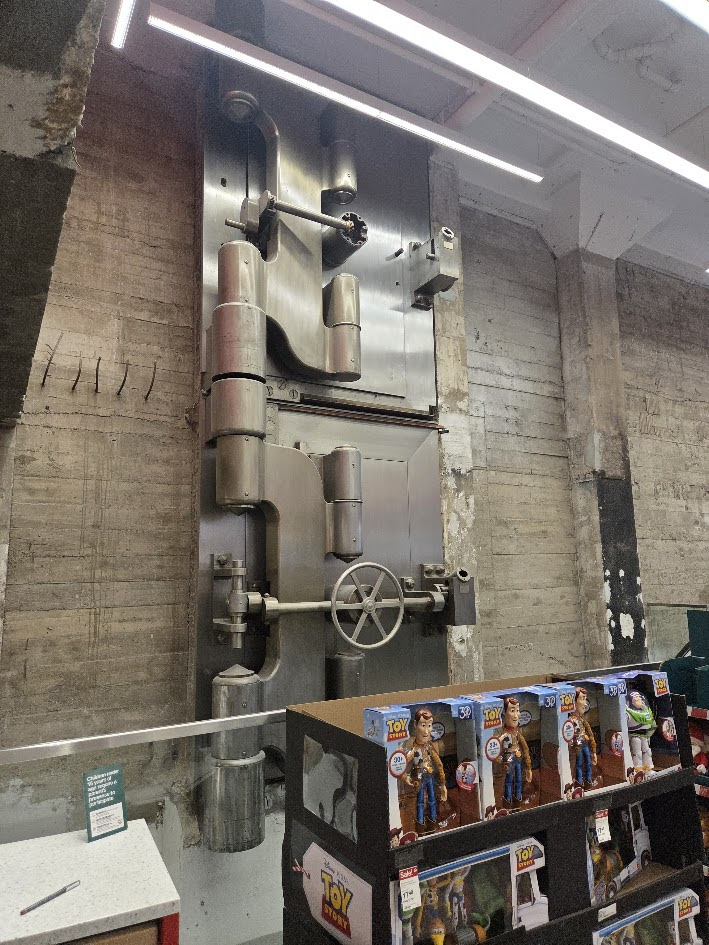
PHOTO OF THE DAY
TWO GREAT ROOFTOPS NEAR WALL STREET. SPOTTED WHILE WALKING IN THE AREA, I CANNOT IDENTIFY THE BUILDINGS, BUT THE GRAND ART ON THE TOPS ARE MOST IMPRESSIVE.
CREDIT TO
NEW YORK ALMANACK Illustrations, from above: Margaret Sanger in 1916 (Library of Congress); Jacob Riis photo “A Family In Its Tenement Apartment, 1910; Lewis Hine’s “View of Tenement Life on Elizabeth Street, Lower East Side,” ca. 1910 (Library of Congress); and the inaugural issue of Margaret Sanger’s The Woman Rebel. JUDITH BERDY
All image are copyrighted (c) Roosevelt Island Historical Society unless otherwise indicated THIS PUBLICATION FUNDED BY DISCRETIONARY FUNDS FROM CITY COUNCIL MEMBER JULIE MENIN & ROOSEVELT ISLAND OPERATING CORPORATION PUBLIC PURPOSE FUNDS.