Friday, October 9, 2026 – IMPROVING RAIL TRANSPORTATION TO UPSTATE AND BOSTON
Historic Boston and Albany
Railroad Revival Efforts Underway
New York Almanack
Friday, October9, 2026
Issue # 1761
Historic Boston and Albany Railroad Revival Efforts Underway
October 5, 2026 by Editorial Staff
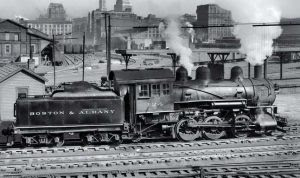
The rail line between Boston and Albany dates back to the birth of American railroading in the 1830s. Its construction was fueled by the economic rivalry between New England and New York exacerbated by the opening of the Erie Canal in 1825. Today, a new effort is underway to better link Albany and Boston by passenger rail.
Despite Massachusetts being home to some of America’s first canals, building a water route across the Berkshires was impossible so the Bay State turned to the emerging railroad technology to bypass the city of New York and Hudson River route and secure for themselves a direct trade route to the west.
The Boston & Worcester Railroad, chartered in 1831, was one of New England‘s earliest railroads. When it fully opened in 1835, it covered about 45 miles between the two cities.
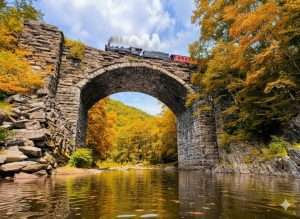
The Western Railroad was chartered in 1833, with the ambitious plan to conquer the Berkshires.
Building a continuous rail line over the mountains in the late 1830s was considered an impossible task due to the steep grades, but the Western closed the gap to the New York state line by 1841.
To combat the 1.8% mountain grade toward Pittsfield, the railroad had to station heavy, specialized “helper” locomotives in Chester, Massachusetts to pushed heavy trains from behind to give them enough power to scale the summit.
Upon reaching the New York line, the Western Railroad leased the Albany & West Stockbridge Railroad, finally opening a single route to the Hudson River in December 1941.
The combined chain of railroads between Boston and the Greenbush (now the city of Rensselaer) on the Hudson River formed what is believed to have been the longest and most expensive rail line in the world.
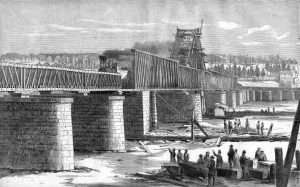
Before the completion of the Livingston Avenue Bridge over the Hudson River between Greenbush and Albany in 1866, passengers and freight crossed the river by a ferry to connect with the Mohawk & Hudson Railroad to Schenectady.
Or they traveled north to Troy via six miles of track of the Troy & Greenbush Railroad, finally constructed in 1845–1846.
This technically allowed rail travel between Boston to Buffalo, by way the covered Troy-Green Island Railroad Bridge in Troy which required cars cross be horse-drawn.
In 1851 the Greenbush-Troy line was leased to the Hudson River Railroad, which later came under the control of Cornelius Vanderbilt and merged into the New York Central Railroad, the company which consolidated the individual railroads between the Hudson River and Buffalo in 1853.
To more efficiently run the three disconnected lines between Boston and Greenbush, the companies merged on September 4, 1867 to form the Boston & Albany Railroad (B&A).
In the late 19th century, the railroad hired Henry Hobson Richardson to design stone passenger stations along the route, helping to standardize the railroad’s corporate identity.
The New York Central and Post-War Decline
In 1900, the much larger New York Central & Hudson River Railroad leased the B&A for 99 years. While the B&A operated as a subsidiary and kept its historic branding in New England, its independence was effectively over.
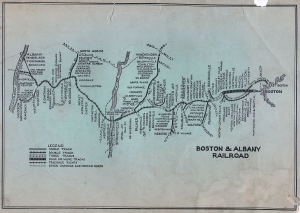
Like most American passenger rail lines, the B&A fell on hard time with the rise of the automobile, and especially after the Second World War with the building of the interstate highways and expansion of commercial aviation.
In 1968, the New York Central merged into the ill-fated Penn Central Transportation Company, which collapsed into bankruptcy just two years later.
On May 1, 1971, the newly formed Amtrak assumed control of long-distance passenger travel along the corridor. However, intercity service west of Framingham was temporarily discontinued in 1975 due to a lack of willingness of the state to subsidy the line.
Piece by piece the Massachusetts Bay Transportation Authority (MBTA) acquired the eastern tracks — first to Framingham in 1973, and eventually purchasing the remaining tracks to Worcester by 2010 — this established the modern Framingham/Worcester Commuter Rail Line.
In the meantime, freight infrastructure passed from Penn Central to Conrail in 1976, and was acquired by CSX Transportation in 1999.
The Boston-Albany Corridor Project
Today, the rail line between Albany and Boston remains heavily utilized by CSX freight trains, the MBTA commuter system, and Amtrak’s daily Lake Shore Limited.
Massachusetts’ ongoing Boston-Albany Corridor Project is working to restore the high-frequency intercity service that the original Boston & Albany Railroad spent the 19th century building.
Among the challenges is how to insert fast passenger rail onto tracks owned and heavily utilized by CSX freight trains. To solve this, MassDOT, Amtrak, and CSX are planning targeted infrastructure modifications:
The Pittsfield Track Capacity Project is expected to eliminate delays on Amtrak’s Lake Shore Limited and Berkshire Flyer by installing a new three-mile siding track in Richmond (near Pittsfield) and a new track switch. This will allow passenger trains to bypass parked or slow freight trains.
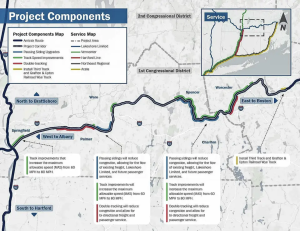
The Project is also exploring double-tracking and curve modifications along the “Inland Route” (the Springfield-to-Worcester section) to increase speeds. There are also plans to add modern Positive Train Control (PTC) and enhanced signaling to coordinate high-density freight and passenger traffic on shared tracks.
A second platform is being considered for the Pittsfield station to reduce congestion there and new station is being considered for Palmer, Massachusetts.
At present, it is assumed station stops will include South Station and Back Bay in Boston, Framingham, Worcester, Palmer (the proposed station), Springfield, Pittsfield, and Albany-Rensselaer.
In December 2023, the Boston & Albany Corridor was accepted into the Federal Railroad Administration’s (FRA) Corridor ID Program and MassDOT was awarded $500,000 to scope a Service Development Plan, which the FRA has since approved the scope, schedule, and budget for.
The Service Development Plan will study how passenger rail service on the Boston and Albany Corridor would operate and identify the steps needed to get there.
Last August, the US Department of Transportation announced Step 2 funding for the Boston & Albany Corridor through the FRA’s Corridor ID Program.
The announcement identified over $3.5 million in the award to be matched with $395,000 from MassDOT. This funding will be used to support the Boston-Albany Corridor Service Development Plan.
Upcoming Public Meeting
MassDOT is hosting a virtual public information meeting on the Boston and Albany Corridor Service Development Plan on Tuesday, October 6, from 6 until 7:30 pm. The meeting will be held virtually via Zoom.
Written questions and comments submitted through the Zoom Q&A feature will be read aloud and responded to at the end of the presentation, as time allows. A Q&A summary will be posted to the project website after the meeting.
For individuals who are unable to attend, a meeting recording will be posted to the project website. Comments and questions may be submitted anytime to bostonalbanycorridor@dot.
For more information, or to sign up to receive updates, visit the project website.
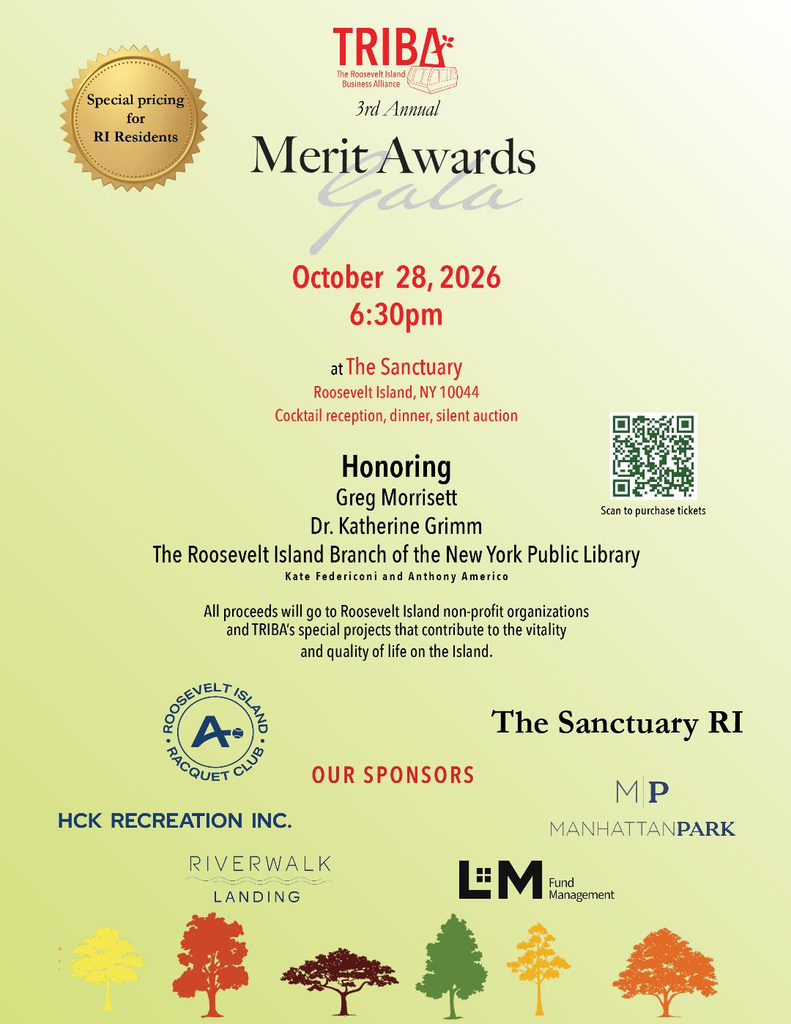
THE ANNUAL TRIBA EVENT IS COMING UP….STAY TUNED FOR REGISTRATION INFO.
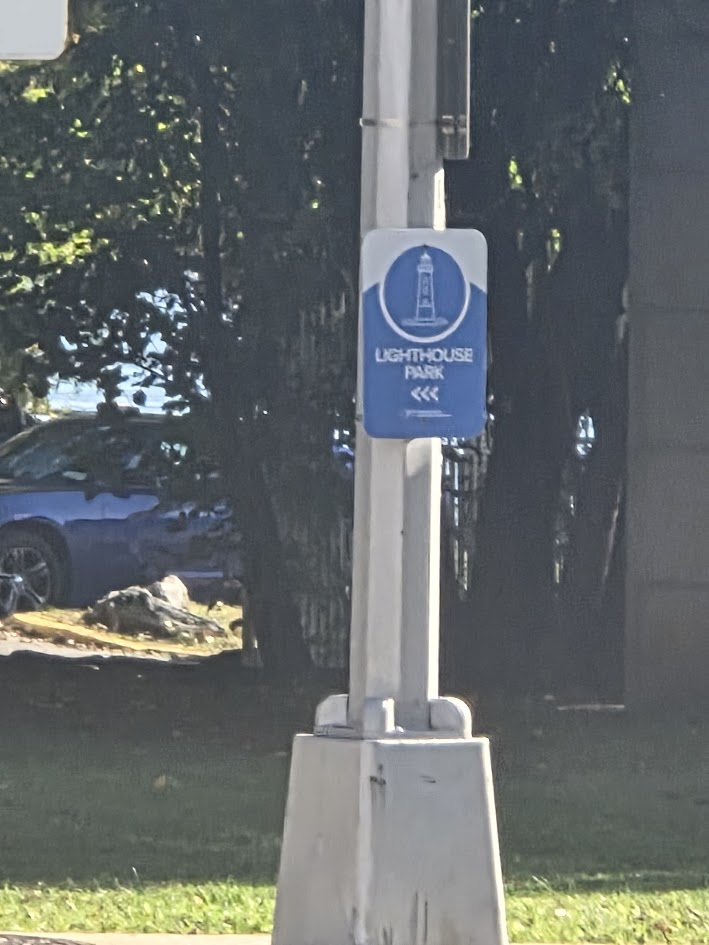
PHOTO OF THE DAY
Finally, a sign leading to the lighthouse
COULD IT HAVE BEEN SMALLER?
REALLY. RIOC
CREDIT
NEW YORK ALMANACK
JUDITH BERDY
All image are copyrighted (c) Roosevelt Island Historical Society unless otherwise indicated
THIS PUBLICATION FUNDED BY DISCRETIONARY FUNDS FROM CITY COUNCIL MEMBER JULIE MENIN & ROOSEVELT ISLAND OPERATING CORPORATION PUBLIC PURPOSE FUNDS.
Copyright © 2026 Roosevelt Island Historical Society, All rights reserved.Our mailing address is:
rooseveltislandhistory@gmail.com
Leave a comment