Wednesday, June 3, 2026 – THE KILLING FIELDS OF EAST NEW YORK

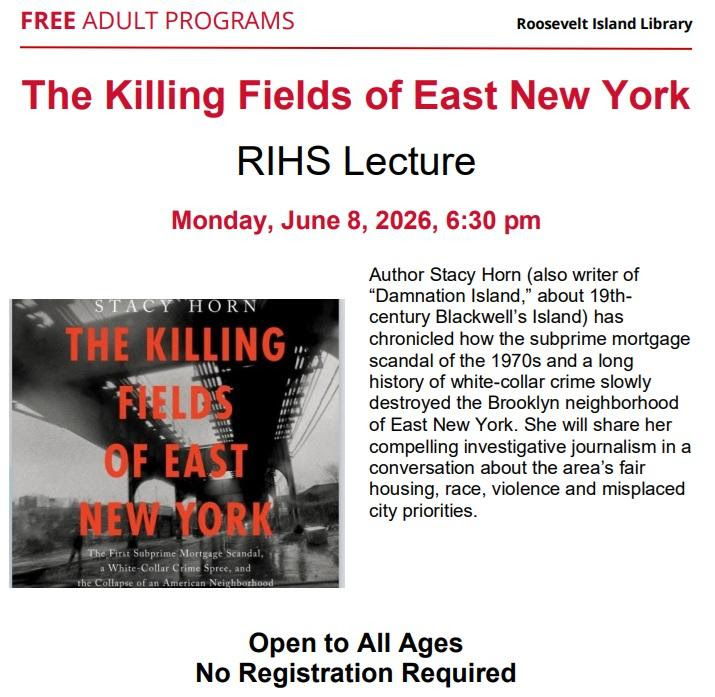
| In this groundbreaking work of investigative journalism and true crime, Stacy Horn sheds light on how the subprime mortgage scandal of the 1970s and a long history of white-collar crime slowly devastated East New York, a Brooklyn neighborhood that would come to be known as the Killing Fields. On a warm summer evening in 1991, seventeen-year-old Julia Parker was murdered in the Brooklyn neighborhood of East New York. An area known for an exorbitant level of violence and crime, East New York had come to be known as the Killing Fields. In the six months after Julia Parker’s death, 62 more people were murdered in the same area. In the early 1990s, murder rates in the neighborhood climbed to the highest in NYPD history. East New York was dying. But how did this once thriving, diverse, family neighborhood fall into such ruin? The answer can be found two decades earlier. In response to redlining and discriminatory housing practices, the Johnson administration passed the Housing and Urban Development Act in 1968. The Federal Housing Authority aimed to use this piece of legislation to help low-income families of color finally achieve homeownership. But they could never have predicted how banks, lenders, realtors, and corrupt FHA officials themselves would use the newly passed law to make victims of the very people they were supposed to help, and the devastation they would leave in their wake. A compulsively readable hybrid of true crime and investigative journalism, The Killing Fields of East New York reveals how white-collar crime reduced a prospering neighborhood to abandoned buildings and empty lots. Following the dual threads of the hunt for the network of criminals behind the first subprime mortgage scandal and the ensuing downfall of East New York, Stacy Horn weaves a compelling narrative of government failure, a desperate community, and ultimately the largest series of mortgage fraud prosecutions in American history. The Killing Fields of East New York deftly demonstrates how different types of crime are profoundly entangled, and how the crimes committed in nice suits and corner offices are just as destructive as those committed on the street. |
 |
Stacy Horn is the author of Damnation Island, which
has been a best-seller at our visitor center.
A BEACON RESTORED
MANHATTAN’S MONUMENT
TO A
SHIP THAT NEVER ARRIVED
WEDNESDAY, JUNE 3, 2026
THE BROADSHEET
MATTHEW FENTON
ISSUE # 1691
A Beacon Restored
Lower Manhattan’s Monument to a Ship That Never Arrived in New York to Shine Once Again
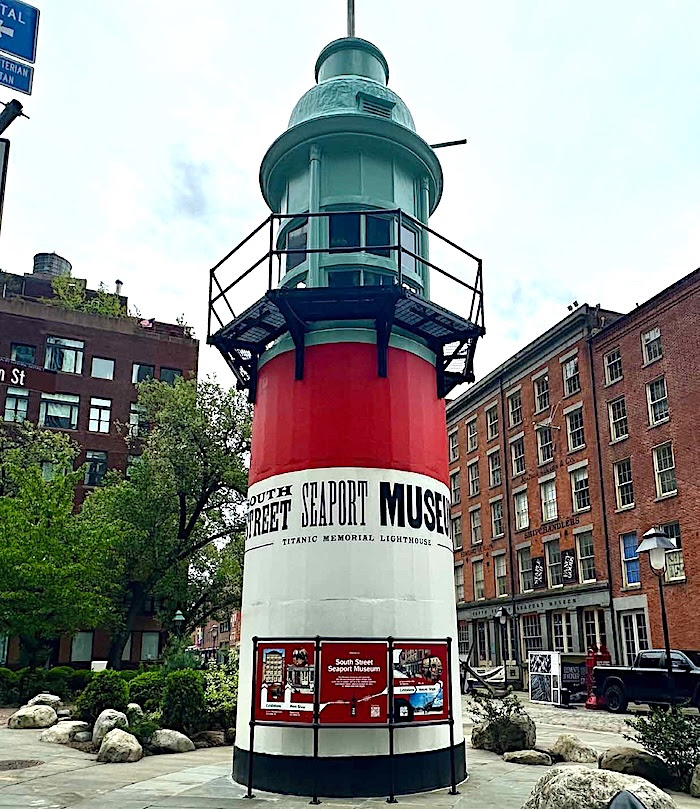
The Titanic Memorial Lighthouse, at the corner of Pearl and Fulton Streets since 1976, has been restored by the South Street Seaport Museum.
After a year of stabilization and refurbishment, the restoration of the Titanic Memorial Lighthouse by the South Street Seaport Museum is nearing completion.
Museum president Captain Jonathan Boulware reported to Community Board 1 members that programmers were finalizing the project and configuring the Memorial’s time ball, a long-dormant horological aid. A large metal globe that once descended a pole precisely at the stroke of noon each day (triggered by a telegraphic signal from the U.S. Naval Observatory in Washington, D.C.), the time ball of the Titanic Memorial Lighthouse enabled sailors aboard ships offshore to calibrate their marine chronometers, needed for celestial navigation and the determination of longitude at sea. (This device was the origin of the now-renowned Times Square ball drop on New York’s Eve.) “That maritime tradition will now happen again every day at noon,” Mr. Boulware said.
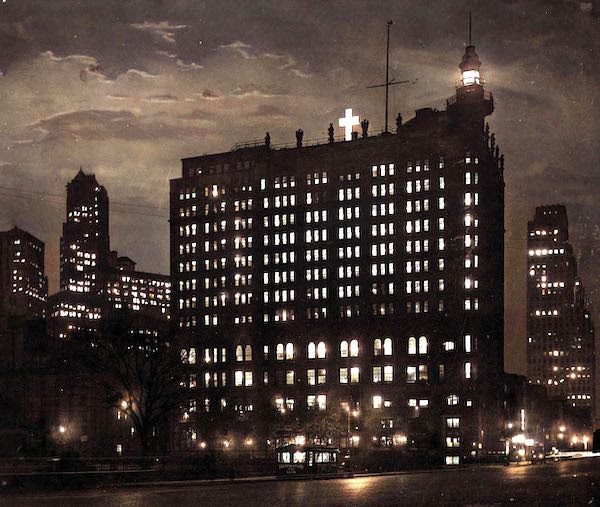
Above: The Titanic Memorial Lighthouse was originally located atop the now-demolished Seamen’s Church Institute at the corner of South Street and Coenties Slip, on the site of what is now Vietnam Veterans Plaza. Below: The “time ball” at the top of the lighthouse descended a pole precisely at the stroke of noon each day, triggered by a telegraphic signal from the U.S. Naval Observatory in Washington, D.C.
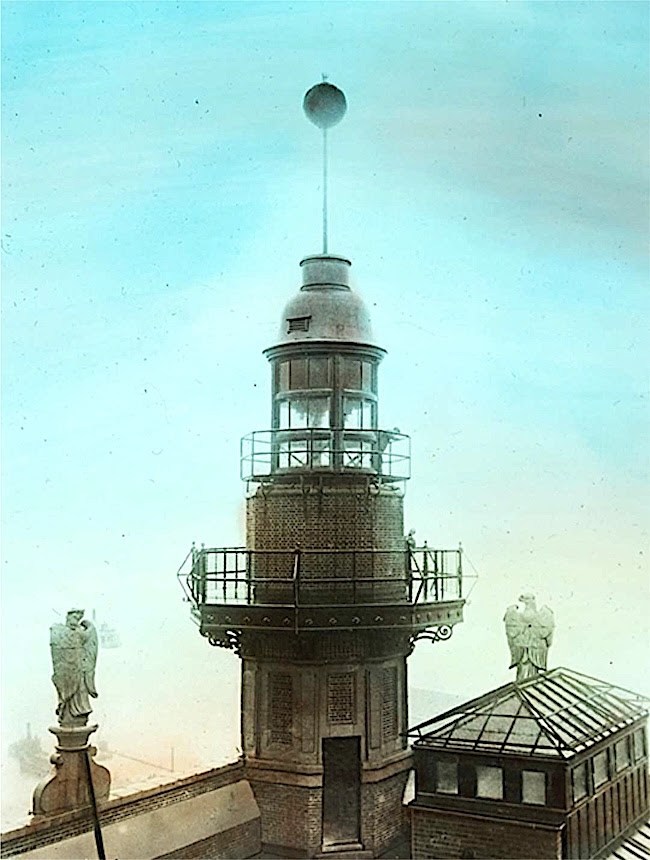
This local memorial to the 1912 sinking of the RMS Titanic has been hiding in plain sight at the corner at the corner of Pearl and Fulton Streets for five decades. Originally perched atop the Seamen’s Church Institute (a philanthropic organization that provides social services to mariners) at the corner of South Street and Coenties Slip, it was dedicated on April 15, 1913, the one-year anniversary of the sinking of the Titanic. Designed by the architectural firm Warren and Wetmore (who created Grand Central Terminal), the Titanic Memorial Lighthouse featured a trio of 2500-candle power mercury lamps, the emerald beams from which could be seen ten miles out at sea.
“There is a new set of lights in there, which are green,” Captain Boulware noted. “When the lighthouse was erected on the Seamen’s Church building on Lower South Street in 1913, it had three green lanterns, which were deliberately intended to avoid confusion with an actual lighthouse.”
The South Street Seaport Museum saved the Titanic Memorial Lighthouse a half century ago, by arranging to accept the structure as a donation when the Seamen’s Church Institute building was demolished in the mid-1970s. The Titanic Memorial was initially moved to Pier 16 and then in 1976, after a partial restoration, the lighthouse was moved to its current location atop a lighthouse-like base at Titanic Memorial Park where it welcomes visitors to the South Street Seaport Historic District.
“We also had a treatment for the plinth, the base, which is not part of the artifact itself,” Captain Boulware added, “but inhabits one of this object’s multiple roles, that of wayfinding, the entry point to the Seaport, making it really clear where you are. We’re already finding that people say, ‘meet by the lighthouse.’”
“The Titanic Memorial Lighthouse will again shine in Lower Manhattan as a beacon of history and hope in honor of those lost in the Titanic disaster,” he said, suggesting the lighthouse as a new locale for “a downtown New Year’s Eve celebration for New Yorkers.”
Matthew Fenton
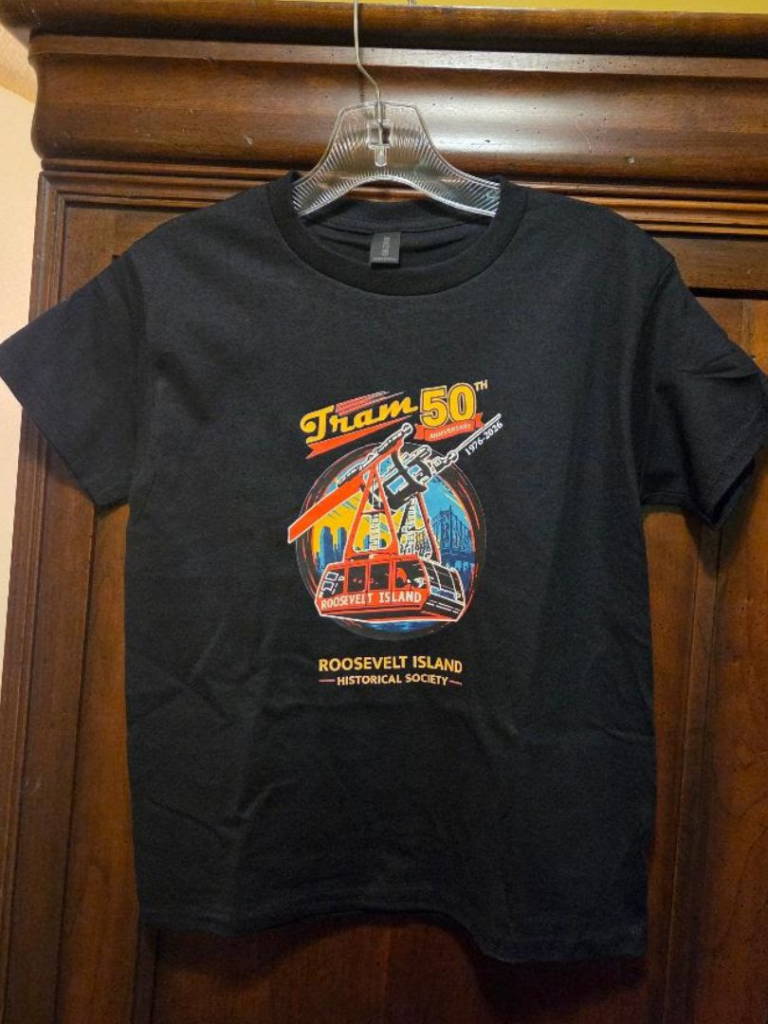
KID’S TEE SHIRTS HAVE ARRIVED
SIZES XS, S,M,L
AVAILABLE AT THE VISITOR CENTER NOW
CREDITS
THE BROADSHEET
All image are copyrighted (c) Roosevelt Island Historical Society unless otherwise indicated
THIS PUBLICATION FUNDED BY DISCRETIONARY FUNDS FROM CITY COUNCIL MEMBER JULIE MENIN & ROOSEVELT ISLAND OPERATING CORPORATION PUBLIC PURPOSE FUNDS.


Copyright © 2026 Roosevelt Island Historical Society, All rights reserved.Our mailing address is:
rooseveltislandhistory@gmail.com
Leave a comment