
Wednesday, July 15, 2026 – From Adversity to NYC: A New Chapter

A Minyan of Exiles
Graphic Novel Evokes
Legacy of Lower Manhattan as
Home to First Jews in North America
The Broadsheet
Wednesday, July 15, 2026
Issue # 1714
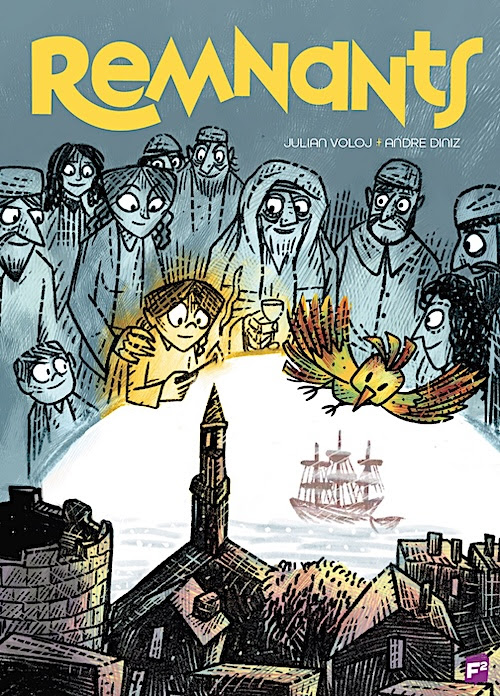
The first Jewish congregation in the United States, Shearith Israel, was established in Lower Manhattan in 1654 by 23 Sephardic Jews who fled Brazil when it was conquered by the Portuguese (who demanded that Jews convert to Christianity). The new graphic novel “Remnants,” by Julian Voloj, details the story.
This fledgling Jewish community eventually consecrated the Mill Street Synagogue, located on what is now South William Street. They called their new temple “Shearith Israel,” which translates literally as, “remnant of Israel.” It was the first Jewish house of worship in North America. Although that pioneering temple has long since vanished, the Shearith Israel congregation endures, and is now headquartered at Central Park West and 70th Street.
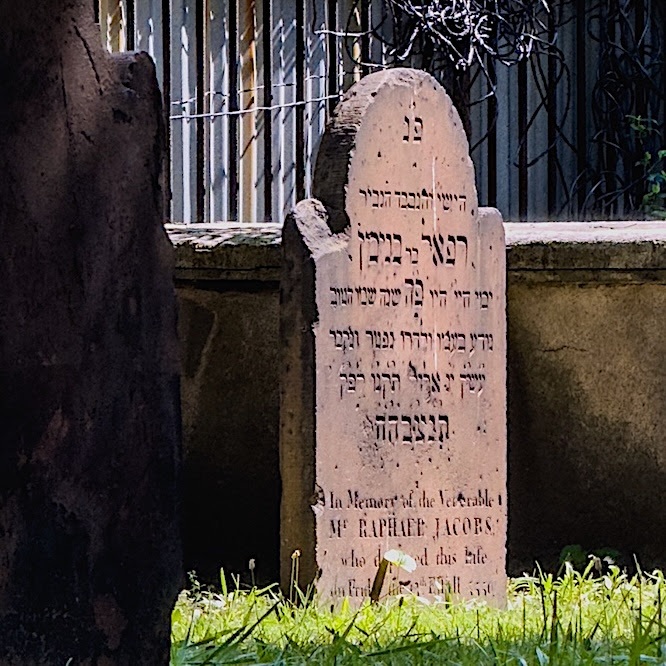
In Lower Manhattan, a different remnant remains: the Chatham Square Cemetery. In 1682, Shearith Israel built this cemetery, which still occupies its original site at 55 St. James Place (near Worth Street). It was a serendipitous walk by this burying ground—the second oldest in Manhattan, behind only that of Trinity Church—that inspired Mr. Voloj to write “Remnants.”
Mr. Voloj (who collaborated with artist Ardre Diniz on “Remnants”) grew up in Germany with two Colombian parents. He became a photographer, and, in New York, worked on a series on Jewish diversity. “I grew up in a small Jewish community in my hometown,” he said. “Coming to America was so different. I grew up in a minority, the last remnant of a once thriving culture. I came to New York in the early 2000s, when there was lots going on with exploring Jewish identity. I realized when people think of Jewish identity, they think of classic Ashkenazi identity,” a reference to Jews originating in Central and Eastern Europe, “but there’s so much more to Jewish identity.”
America’s first Jews were Sephardic (meaning they were descended from the Jewish community on the Iberian Peninsula), he noted. “Their ancestors were persecuted in Portugal and they created the first synagogue in Brazil, but had to flee when the Portuguese recaptured Brazil. For a long time, American Jewry was Sephardic, not Ashkenazi.”
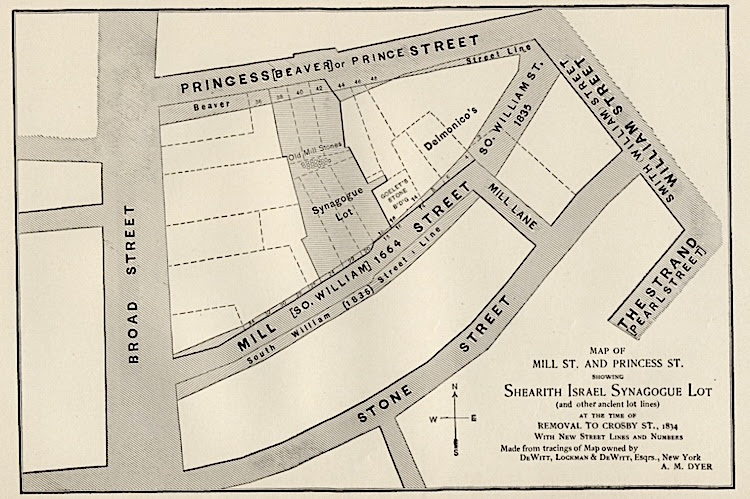
| This map from 1900 shows the location of the Mill Street Synagogue by superimposing tracings of earlier maps from the 1700s and 1800s with what was then a contemporary street grid. |
“The story of the 23 Jews is the origin of American Jewry,” he continued. “It’s an amazing story that they came in 1654. For American Jews, America was the promised land. For many years, Jews were excluded from industries and they created their own. This is how the comic book industry was created. The story also shows how everything changes—there were Sephardic Jews from 1654 onwards, then the German Jews who came after the failed revolution of 1848, then Eastern Europeans, then Holocaust survivors, then Syrians and Ethiopians. Today it is much more diverse because many different groups have come and it shows how identity always changes.”
Reflecting on the community that immigrants find in America and how his research for ‘Remnants’ has shaped his perspective, Mr. Voloj said, “I am an immigrant myself. I didn’t have the struggles other had coming here, but I was born to Colombian immigrants and saw that my dad, who was not able to learn the language perfectly in his lifetime, was discriminated against. I feel sympathetic to the struggle of immigrants. The landscape is becoming more xenophobic and anti-immigrant. ‘Remnants’ is an important tale, mainly directed towards younger readers but still a universal tale, of what it means to become an American.”
The author also believes the graphic novel form is uniquely suited for making history accessible to new generations of readers. “The general attention span is going down because we are on our mobile phones,” he said. “Graphic novels are a nice middle way, because it’s a book form, but it allows you to package complex topics.”
Mr. Voloj’s next project will recount the story of Julius Hirsch, the first Jewish player on Germany’s national soccer team. “In the 1910s, he was a huge star,” the author said. “He assumed that because he was such a beloved star, the Nazis would not kill him, so he ended up not fleeing and he was murdered in Auschwitz.” Produced in partnership with the German Soccer Federation, the new graphic novel was previewed on July 7 at the German House of Soccer, a pop-up fan zone in Chelsea, as part of New York’s World Cup festivities.
Grace Glukhov
PHOTO OF THE DAY
A BRIGHT NEW SIGN FOR COLER

CREDITS
The Broadsheet
“Lower Manhattan’s Local Newspaper”
All image are copyrighted (c) Roosevelt Island Historical Society unless otherwise indicated
THIS PUBLICATION FUNDED BY DISCRETIONARY FUNDS FROM CITY COUNCIL MEMBER JULIE MENIN & ROOSEVELT ISLAND OPERATING CORPORATION PUBLIC PURPOSE FUNDS.


Copyright © 2026 Roosevelt Island Historical Society, All rights reserved.Our mailing address is:
rooseveltislandhistory@gmail.com
Leave a comment