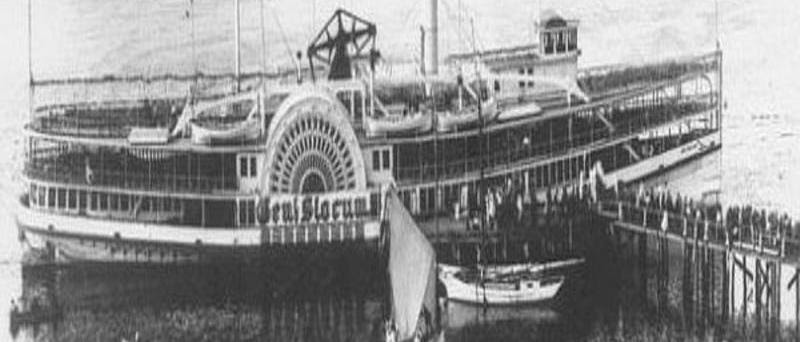
DAY TRIP STEAMER GENERAL SLOCUM CAUGHT FIRE AND CAPSIZED OFF NORTH BROTHER ISLAND IN 1904. LARGEST LOSS OF LIFE IN NEW YORK UNTIL 9/11. Bill, Ed Litcher, M. Frank, Gloria Herman & Hara Reiser all got it right.
Text by Judith Berdy Thanks to Bobbie Slonevsky for her dedication to Blackwell’s Almanac and the RIHS Thanks to Deborah Dorff for maintaining our website Edited by Melanie Colter and Deborah Dorff
All image are copyrighted (c) Roosevelt Island Historical Society unless otherwise indicated
Mailing address: Nick Golebiewski Studio Building 280, Suite 610, Brooklyn Navy Yard Brooklyn, NY 11205
FUNDING PROVIDED BY ROOSEVELT ISLAND OPERATING CORPORATION PUBLIC PURPOSE GRANTS CITY COUNCIL REPRESENTATIVE BEN KALLOS DISCRETIONARY FUNDING THRU DYCD
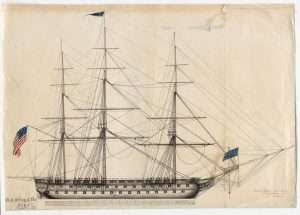
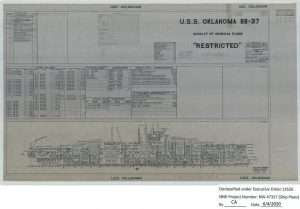
The Cartographic Branch at the National Archives is home to over one million ship plans, with records spanning more than 15 distinct Record Groups and over 25 separate series. These drawings are among the most requested records from researchers in the Cartographic Branch.
The National Archives holds ship engineering drawings for a majority of vessels commissioned by the United States Navy dating from the 1790s through the Korean War era. These drawings mostly consist of inboard and outboard profiles, deck plans, and sections, although additional general arrangement drawings exist for some ships.
The majority of ship plans held by the Cartographic Branch can be found within Record Group 19: Records of the Bureau of Ships. Established in 1940, the Bureau of Ships was responsible for the construction and maintenance of the ships of the US Navy.
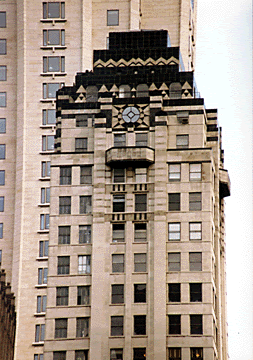
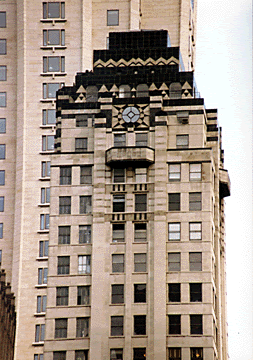
FULLER BUILDING, MADISON AVENUE AND 57th STREET HOME OF NEW YORK’S MOST PRESTIGIOUS GALLERIES LAURA HUSSEY AND CLARA BELLA GOT IT RIGHT!
Text by Judith Berdy Thanks to Bobbie Slonevsky for her dedication to Blackwell’s Almanac and the RIHS Thanks to Deborah Dorff for maintaining our website Edited by Deborah Dorff All image are copyrighted (c)
Sources
Photos, from above: drawings of Naval Vessels and Equipment, 1939-1945, U.S. Ship of the Line Ware #17; and USS Oklahoma (BB-37): booklet of General Plans – Cover & Title Page / General Dimensions & Data / Inboard Profile (National Archives).
FUNDING PROVIDED BY ROOSEVELT ISLAND OPERATING CORPORATION PUBLIC PURPOSE GRANTS CITY COUNCIL REPRESENTATIVE BEN KALLOS DISCRETIONARY FUNDING THRU DYCD
The late 1920s and 1930s were crucial years in New York’s rise as an international artistic center. Cultural contacts between Europe and the United States multiplied. American artists who had studied in Paris returned with fresh ambitions; dollar rich patrons were willing to finance new initiatives; the First World War had unsettled European artists and gallerists, many of whom settled in New York. They were joined by others who fled the Nazi threat. Manhattan was turning into a Mecca of modernism where a multi-national cohort of artists, dealers and investors mixed and mingled.
By our standards the art world was relatively small. At any one time in that epoch, there were probably fewer than fifteen galleries active in New York with only a handful concentrating on contemporary art. A pioneering role was played by Alfred Stieglitz’s 291 Gallery on Fifth Avenue. Operational since 1905, the gallery introduced the Parisian avant-garde to an American audience. In modernist Manhattan, Stieglitz was the Godfather.
A characteristic aspect of this period was the interaction between European gallerists and a generation of aspiring American artists. Stieglitz had set a pattern. His exhibition program consisted of introducing French modernists while simultaneously pushing a circle of up-and-coming local artists. Over time, the American presence became more prominent.
In the process, calls rang out to challenge “conservative” museums and establish an institution devoted to modern art. On November 8, 1929, New York’s Museum of Modern Art (MoMA) opened its doors. Under guidance of its first director Alfred H. Barr, a productive working relationship was established with Manhattan galleries. In the midst of these developments towered the figure of Julien Levy.
The Harvard Experience
Born in New York on January 22, 1906, into an affluent Jewish family (his father was a real estate developer and art collector), Julien Levy attended Harvard where he studied English literature before changing to the subject of museum administration under Paul J. Sachs, one of seven founding members of MoMA.
He began his foray into the avant-garde during his years at Harvard. The environment was an inspiring one. Fellow students from the mid-1920s onward included Alfred Barr; James Thrall Soby who built up a famous collection of modern art at the Wadsworth Atheneum, Hartford; and Arthur Everett “Chick” Austin, who would become director of the Atheneum and organizer of the first Picasso retrospective in America.
A member of this Harvard group of modernists, Levy became an avid collector with a lasting affinity for film and photography. Eager to exploit his own creative potential, he became frustrated by his father’s refusal to back him financially in making experimental films. He dropped out of Harvard in 1927 (one semester prior to graduation) and went to Paris intent on working with Man Ray.
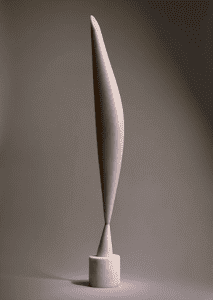
Ironically, it was Edgar Levy’s love for art that caused his son’s departure. In 1926, alerted by Julien, he acquired from the Brummer Gallery the marble Bird in Space (1923), the first in a series of iconic sculptures created over time by the Romanian-born French artist Constantin Brancusi.
It was on that particular occasion that Julien first encountered Marcel Duchamp, the legendary Dadaist artist and Surrealist sympathizer who represented the sculptor’s interests in America.
Brummer Gallery (East 57th Street)
A significant development in the art market of the early twentieth century was the role played by American collectors and their European suppliers. This occurrence was hurried along by the crippling economic effect of the First World War. The Old Continent was for sale.
Joseph Brummer was a Hungarian sculptor who, having left Budapest’s Academy of Fine Arts in 1904, settled in Paris. In 1909 he launched into a career of selling antiques, opening a gallery on Boulevard Raspail. When his brothers Imre and Ernest joined him, they traded as Brummer Frères.
With the onset of World War I, the property of all Austro-Hungarian and German enemy nationals was sequestered. Joseph and Imre moved to New York where they opened a gallery at 55 East 57th Street and cooperated until Imre’s death in 1928.
After the war, Ernest reopened his business in Paris. Until the beginning of the Second World War when Ernest joined Joseph in New York, the two branches worked together. The brothers flooded the American market with classical works of art and antiquities, but Joseph had other interests too.
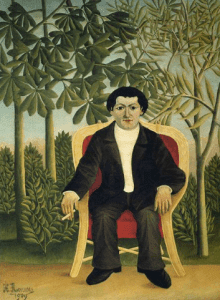
At his premises he organized some of New York’s earliest exhibitions of contemporary French art. Joseph brought avant-garde art to Manhattan, including paintings by Picasso and Henri Rousseau (who painted his portrait in 1909), and sculptures by Aristide Maillol, Jacques Lipchitz, and others. His 1926 Constantin Brancusi show drew wide critical approval.
Weyhe Gallery (Lexington Avenue)
The meeting with Duchamp was a crucial moment in Julien Levy’s career. He left Harvard, joined Duchamp in February 1927, and set sail for Le Havre. Also making the journey was Robert McAlmon, author, drinking pal of James Joyce, and founder of Contact Editions in Paris where he published work by Hemingway and Gertrude Stein, amongst others.
During the crossing Levy and Duchamp became close. Once in Paris, the latter introduced his young friend to many figures in the Parisian avant-garde. He also joined the circle of expatriates. At a party thrown by Peggy Guggenheim, McAlmon introduced him to London-born artist and poet Mina Loy (her father had escaped anti-Semitism in Budapest). She was accompanied by her daughter. Levy and Joella Loy married in August 1927. From the outset, he was entranced by his mother-in-law’s artistic gifts and would help to promote her poetry and visual art throughout her career.
After three years in Paris, the couple returned to New York where Julien started work as an assistant in the print room of the Weyhe Gallery. Also known as Weyhe Gallery & Bookstore, this establishment was a print and art bookshop established in 1919 by German-born Erhard Weyhe who, after running a book business in London’s Charing Cross Road, had moved to New York just before the outbreak of the First World War. The firm operated from 1919 to 1923 at 710 Lexington Avenue, and from then on in a four-story townhouse further down the road at no. 794.
The Gallery served as a meeting place for dealers and collectors who were interested in modern art. When Levy arrived as an apprentice, the Gallery was directed by Weyhe’s assistant Carl Zigrosser, the son of an Austrian immigrant (later in his career Carl worked as Curator of Prints and Drawings at Philadelphia’s Museum of Art).
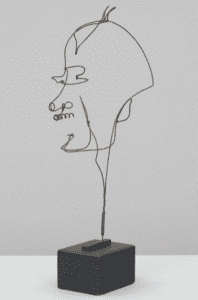
The Gallery specialized in contemporary prints and drawings, but Weyhe also collected and sold sculpture. At the time of Levy’s employment, Zigrosser organized in February/March 1928 the first solo exhibition of Alexander “Sandy” Calder’s wire sculpture. The event received considerable press coverage. Weyhe provided Levy with the practical experience of running a gallery, organizing exhibitions, and dealing with individual artists.
Julien Levy Gallery (Madison Avenue)
On November 2, 1931, funded by an inheritance from his mother, Julien opened the Levy Gallery at 602 Madison Avenue with an American Photography Retrospective Exhibition. The show was a tribute to Alfred Stieglitz, but Levy quickly realized that photography would not finance the running of the gallery and he was forced to shift his focus to modernist art.
On January 29, 1932, he presented the first exhibition of Surrealism in New York. Paying homage to Paris by naming the exhibition Surréalisme, the multi-media show featured painting, sculpture, collage, and photography. Levy introduced European artists to New York, whilst at the same time championing the work of young American painters.
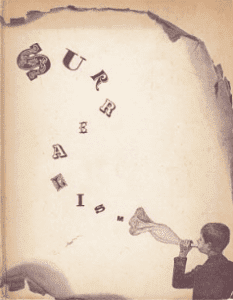
The interaction between established European and young American artists was intriguing. In the period leading up to the exhibition, Joseph Cornell visited the gallery. After viewing a collection of collages by Max Ernst, he hurried home to construct his own works. For the cover of his book on Surrealism (1936), Levy used a Cornell collage of a boy trumpeting the word “Surrealism” that had been on display at the 1932 exhibition.
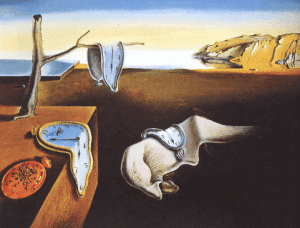
The show put the Levy Gallery on the map. Salvador Dali’s presence was largely responsible for the excitement. Key attraction was The Persistence of Memory (1931) which Julien had acquired during his stay in the French capital. It became the most discussed painting in the United States since Duchamp’s Nude descending a Staircase at the Armory Show in 1913.
Heydays & Legacy
Mina Loy was Levy’s mentor. She acted as his Paris representative and for the next five years she arranged the purchase and transportation of Surrealist art to Levy’s Gallery. In doing so, she became a central figure in the American reception of Surrealism.
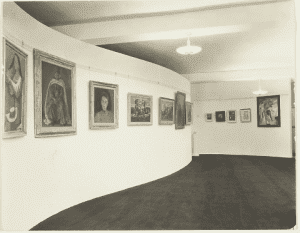
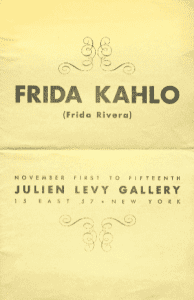
Loy exhibited her own paintings at the Levy Gallery in 1933. Julien was keen to promote female talent and mounted exhibitions by Lee Miller, Katherine Dreier, Leonor Fini, Dorothea Tanning, and others. Though the Gallery struggled financially, it developed a far-reaching reputation. In 1937, business was moved to 15 East 57th Street, where Levy mounted the first solo exhibition of the work of Frida Kahlo in November 1938. His eye for talent never let him down.
Mina Loy’s move to New York in 1937 ended her work as the gallery’s agent. Levy and Joella divorced in 1942, after which he remarried the artist Muriel Streeter. By that time, the world had changed. The bright Manhattan’s days of cosmopolitan exchanges were fading and so did Julien Levy’s passion as a gallerist. In 1949 he shut up shop, taught art history for a while, and retired to a farm in Connecticut where he wrote the Memoir of an Art Gallery (1977). He died there in February 1981.
As a gallerist, Levy set a blueprint by codifying the rituals of commerce (from press releases to boozy opening nights) and interaction between collectors, curators and critics to generate reviews and publicity. He also initiated a competitive working relationship with MoMA that was repeated in other major art centers where gallerists acted as scouts for new talent.
By the very nature of the institution, museums worked retrospectively. Having made an assessment of events and activities, curators looked beyond the immediate towards context and continuity. Levy’s Surréalisme of 1932 and subsequent solo shows of Surrealist artists laid the groundwork for MoMA’s comprehensive exhibition Fantastic Art, Dada, Surrealism in 1936/7. Although the event was rife with controversy and arguments between rival factions among the participants, it was nonetheless a groundbreaking attempt by Alfred Barr to present Dada as a historical movement.
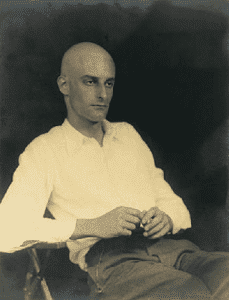
Illustrations, from above: Berenice Abbot’s portrait of Julien Levy in Paris, 1927 (The MET, New York); Bird in Space, 1923 by Constantin Brancusi (The MET, New York); Portrait of Joseph Brummer, 1909 by Henri Rousseau (National Gallery, London); Wire Portrait of Erhard Weyhe, 1928 by Alexander Calder (Whitney Museum of American Art); curved walls in the Julien Levy Gallery at 15 East 57th Street, late 1930s; The Persistence of Memory, 1931 by Salvador Dalí (Museum of Modern Art, New York); Joseph Cornell’s cover for Julien Lev’s book Surrealism (1936: Black Sun Press); and Frida Kahlo’s first American solo exhibition in November 1938 at the Levy Gallery, East 57th Street.
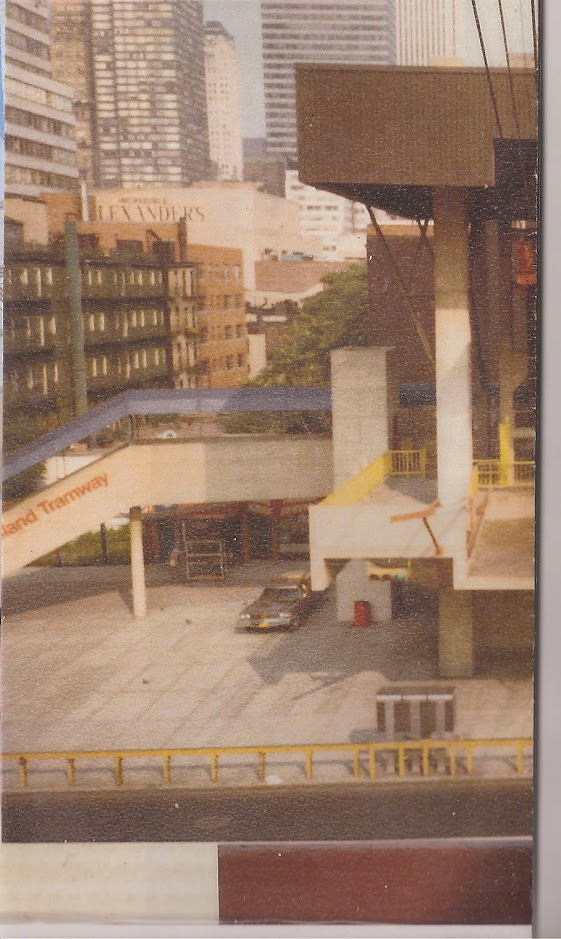
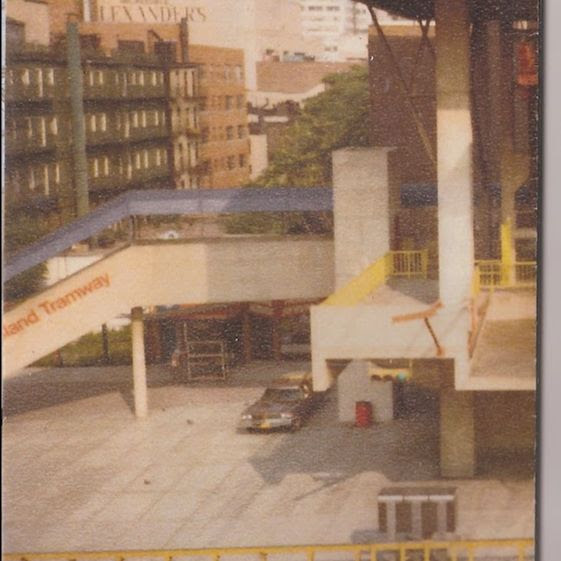
TRAM STATION IN 1980’S SEE ALEXANDER’S DEPARTMENT STORE IN BACKGROUND LONG STAIRCASE LEADING TO STATION PLATFORM PAY PHONES ALONG SIDEWALK
HARA REISER, NANCY BROWN, THOM HEYER, GLORIA HERMAN, ED LITCHER AND ARLENE BESSENOFF
Text by Judith Berdy Thanks to Bobbie Slonevsky for her dedication to Blackwell’s Almanac and the RIHS Thanks to Deborah Dorff for maintaining our website Edited by Melanie Colter and Deborah Dorff
All image are copyrighted (c) Roosevelt Island Historical Society unless otherwise indicated:
NEW YORK ALMANACK
Illustrations, from above: Berenice Abbot’s portrait of Julien Levy in Paris, 1927 (The MET, New York); Bird in Space, 1923 by Constantin Brancusi (The MET, New York); Portrait of Joseph Brummer, 1909 by Henri Rousseau (National Gallery, London); Wire Portrait of Erhard Weyhe, 1928 by Alexander Calder (Whitney Museum of American Art); curved walls in the Julien Levy Gallery at 15 East 57th Street, late 1930s; The Persistence of Memory, 1931 by Salvador Dalí (Museum of Modern Art, New York); Joseph Cornell’s cover for Julien Lev’s book Surrealism (1936: Black Sun Press); and Frida Kahlo’s first American solo exhibition in November 1938 at the Levy Gallery, East 57th Street.
RIHS (C) FUNDING PROVIDED BY ROOSEVELT ISLAND OPERATING CORPORATION PUBLIC PURPOSE GRANTS CITY COUNCIL REPRESENTATIVE JULIE MENIN DISCRETIONARY FUNDING THRU DYCD
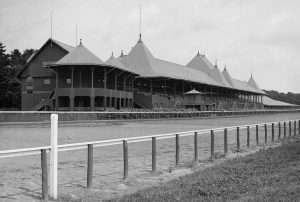
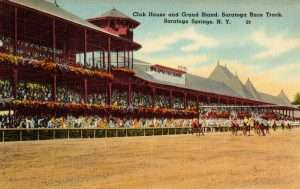
The Saratoga Race Course is instantly recognizable by its iconic roofline and unique treatment. The Gilded Age survives to our time through the turret-spiked, finial capped, slate roof of the grandstand.
The very distinguishable noble crown of racing’s dowager queen places one instantly at the Spa in the foothills of the Adirondack Mountains, and announces “Saratoga Springs.”
The summer resort, made popular by healing mineral waters that are part of indigenous history, saw thoroughbred horse racing introduced in 1863 on a track across Union Avenue, presently part of Horse Haven. The inaugural race meet was so successful that the following summer the track was relocated to its present site, with its larger grounds.
The group of pioneering sportsmen behind the effort, who were also successful in business, recognized the opportunity and potential at the track as a good gamble, and incorporated in 1865. As racing spurred breeding, the placing of wagers was tolerated, and the group named their new corporation “The Saratoga Association for the Improvement of the Breed of Horses.” The group furthered betting interests with the operation of a clubhouse that functioned as a casino, which operated behind a veneer of respectability for those “in the know.”
The shareholders of the track continually poured their revenues into the facility, and the racing contributed toward the then village’s economy, and was supported in turn by the established resort infrastructure. Spectators were accommodated at the track in a modest wood structure similar to those at many county fairgrounds. A grandstand with incremental stepped seating levels and a simple gable roof provided better race viewing, and cover from sun and shower. This building was constructed by local craftsmen, and it was repeatedly improved and augmented, as the reputation for great racing increased the popularity of the meet over a span of nearly three succeeding decades.
By that time many of the original incorporating shareholders of the Saratoga Association had passed away, and the casino had come under increased scrutiny for its principal shareholder, Albert Spencer. With a single controlling interest, several scribes were quick to point out that the “Saratoga Association, was an association in name only.” Rumors, which seem to especially permeate race tracks where the patrons are always seeking an edge, abounded in discussion about a change in ownership.
Tales of this sort were a common conjecture in polite conversation, as everyone who visited had an interest. This prospective sale discussion bore more credence than in the past, as Mr. Spencer, the majority stockholder, had earlier sold his very profitable clubhouse/casino enterprise to Richard Canfield. Also, the prospective principals in the projected deal were noted racing men of unlimited capital: Pierre Lorillard, August Belmont, Senator George Hearst, D.D. Withers, John A. Morris, A.J. Cassatt and W.L. Scott, with the syndicate headed by publisher William J. Arkell.
Arkell, whose own fortune was made in publishing a host of daily newspapers and the very popular Judge Magazine, along with Frank Leslie’s Illustrated Newspaper, had very strong ties to Saratoga County. He also operated the Hotel Balmoral there, at the same Mount McGregor location where the Drexel Family and Arkell provided the cottage used by former President U.S. Grant to compose his memoirs shortly before his demise.
It may have been as difficult to pull off a multi-partner high-profile deal in 1890, as it is today, and considering Arkell’s irritated comments on the matter, some things may not have changed. In response to a question from a Saratogian reporter on the track sale, Arkell, walking along Broadway, was quoted as responding:
“I have sold my interest in Judge to my partner, Russell Harrison, and have bought the Chicago stock-yards with a portion of the proceeds. I intend, of course, to invest three or four millions of dollars in Saratoga and then will buy up Canada and present it to the United States. Just at present I am negotiating for the purchase of the British Navy.”
With so many of his own reporters in the field, it is surprising Arkell allowed himself to answer a question that way. Comically the scrivener felt it necessary to explain, “It was evident from the sarcasm used Mr. Arkell is non-committal on the subject.”
The 1890 track season ended in Saratoga, and when the leaves were down as autumn transitioned to the frigid season, it was announced that all the officers and trustees of the Saratoga Association had been replaced by members of the Arkell syndicate, indicating an orderly property transition. As so often occurs in the thoroughbred racing world, the expected failed to materialize, mostly due to the unforeseen deaths of August Belmont and Senator Hearst.
Many daily publications during the winter of 1891 lamented the collapse of the transfer of the Saratoga Racing Association to the Arkell group, but indicated that the important changes and improvements projected would all be carried out as planned. It’s conjectured that the soon-to-be new owners moved beyond planning, with several modifications to the racing facility before the deal was closed. Indeed, several contracts let by the Arkell syndicate, such as the construction of a new betting ring by Saratoga’s master builder Andrew Robertson, were honored by Albert Spencer. Turnberry Consulting associates Paul Roberts and Isabelle Taylor in 2011 published in The Spa-Saratoga’s Legendary Race Course that perhaps the parameters for the classic grandstand, with its iconic slate roof and unique turrets with copper apex, were established by the Arkell group.
With the Arkell syndicate deal lost, Albert Spencer accepted another offer, and a paradigm shift occurred when the notorious Gottfried Gottlieb Walbaum purchased the Saratoga Race Course in August of 1891. This deal was brokered by Paul Grening, the proprietor of the Kensington Hotel on Union Avenue at Regent Street, with him becoming an officer of the transferred Saratoga Association.
Not all welcomed Walbaum in Saratoga, as his operations at the Guttenberg Race Track near Weehawken, New Jersey were more than suspect. The Brooklyn Eagle did not mince words, “The knell of doom has sounded for high class racing at Saratoga. Guttenberg has laid grimy hands upon it. Not satisfied with their illicit gains from winter racing the Guttenberg guerrillas propose to raid upon a New York track for thirty days of summer racing… The plagues of Egypt would be easier to bear.”
In late November of 1891 the Saratoga Association contingent, headed by G.G. Walbaum, met for a site review with H. Langford Warren, and discussed a contract for construction for a new clubhouse and grandstand complex. Given the limitations of 1890s design work, it would stand to reason that architect Warren “caught a flyer out of the gate” on his proposal, perhaps having been contacted originally by the Arkell group.
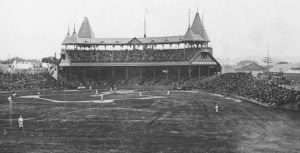
This same timeline neatly fits with author Maureen Meister’s conjecture in her book Architecture and the Arts and Crafts Movement in Boston- Harvard’s H. Langford Warren, which compares Warren’s Saratoga clubhouse/grandstand design elements to the South End Grounds baseball pavilion in Boston, opened in the spring of 1888. This ballpark, which housed Boston’s National League Club, had a very short existence, being torched accidentally by children in 1894.
Meister also states in her 2003 publication that “the Saratoga racetrack has been the subject of two books by contemporary historians, but the identity of Warren as its architect has not been noted.”
The Saratoga Association contracted with the firm of the previously mentioned Andrew Robertson to build the iconic clubhouse/grandstand complex from the Warren design.
Certainly Gottfried “Dutch Fred” Walbaum is never fondly recalled in Saratoga Springs, as his ignominious operations seriously imperiled racing at the Spa. It took the foresight of Richard T. Wilson, recently re-honored with his name on the mile course, to form a syndicate of interested sportsmen including William C. Whitney as President, to buy out Walbaum’s interests in late 1900 and expel his injudicious methods. However, all of us who admire Saratoga’s very recognizable stately crown, must bear in mind that Walbaum made this reality happen.
The Whitney and Wilson-led Saratoga Association began their operation of the track in 1901. Following that season, extensive changes were made by the Empire City track designer Charles Leavitt, increasing the size of the oval and repositioning its orientation on the grounds. This involved moving all the buildings on the property, with the clubhouse, grandstand and betting ring relocated.
To accomplish the rearrangements the grandstand was separated into three sections, and reset as separate units, with the areas between becoming major additions which increased the overall length of the structure. Just prior to the opening of the reconfigured track in June of 1902, the local Saratoga Association office was destroyed in the Arcade Building fire with a regrettable loss of life, and many irreplaceable records of the recent rebuild.
Through the succeeding years further alterations were made, with the Warren-designed clubhouse and its delightful two-story veranda and conical turrets replaced in 1928 by the present multi-tiered turf terrace designed by Samuel Adams Clark. The betting ring, inactive since the introduction of pari-mutuel wagering in 1940, was torn down in 1964, replaced by a 550-foot addition to the east side of the grandstand, which attempted to include Warren’s roof treatments. Architect Arthur Froelich and assistant Robert Krause ordered installation of new slate over both old and new structures.
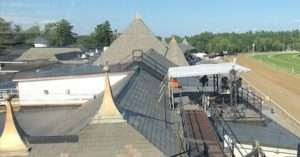
Since that time, the Victorian gem has taken on its so identifiable appearance, decorated with sculptured finials in a warm patina of tarnished copper, which so many fans of racing in Saratoga find a joy to behold.
RACQUET AND TENNIS CLUB, PARK AVENUE AND 52 STREET SUSAN RODETIS AND HARA REISER GOT IT RIGHT
Text by Judith Berdy Thanks to Bobbie Slonevsky for her dedication to Blackwell’s Almanac and the RIHS Thanks to Deborah Dorff for maintaining our website Edited by Melanie Colter and Deborah Dorff
All image are copyrighted (c) Roosevelt Island Historical Society unless otherwise indicated
NEW YORK ALMANACK
Photos, from above: Warren-designed clubhouse with 2-story veranda and conical turrets in the foreground, grandstand with pyramidal turrets center and betting ring far right (Library of Congress) ; Saratoga clubhouse turf terrace revision, completed in 1928, designed by Samuel Adams Clark, separated from the grandstand by the placing judge’s post (Boston Public Library, Tichnor Brothers Postcard Collection); South End Grounds baseball pavilion in Boston, designed by John Jerome Deery and operational 1888-1894 (Ballparksofbaseball.com); and Present day view of the Warren-designed grandstand slate roof, with its identifiable turrets and sculptured finials in their warm patina of tarnished copper (Bill Orzell).
FUNDING PROVIDED BY ROOSEVELT ISLAND OPERATING CORPORATION PUBLIC PURPOSE GRANTS CITY COUNCIL REPRESENTATIVE BEN KALLOS DISCRETIONARY FUNDING THRU DYCD
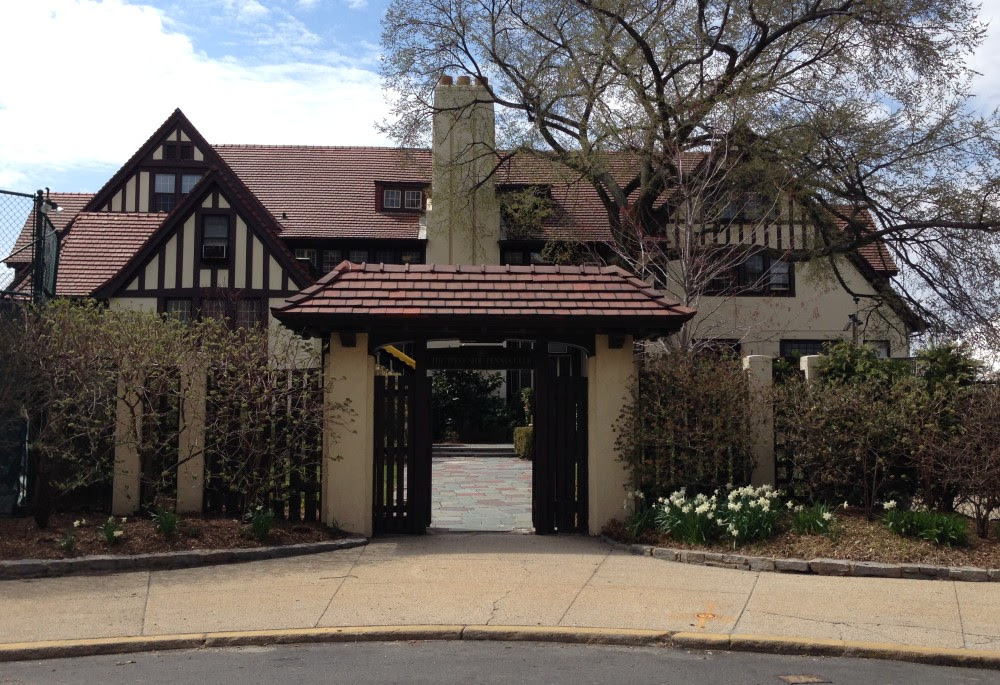
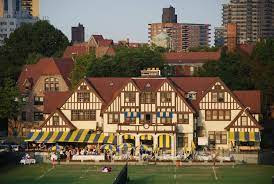
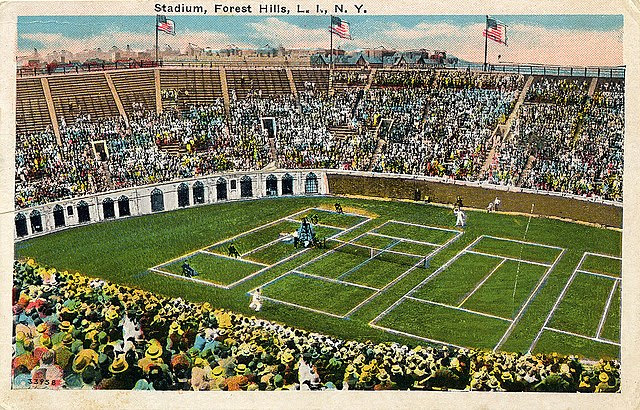
WEST SIDE STADIUM (NOW FOREST HILLS STADIUM), CLUBHOUSE AND STADIUM
WEST SIDE STADIUM (NOW FOREST HILLS STADIUM), CLUBHOUSE AND STADIUM
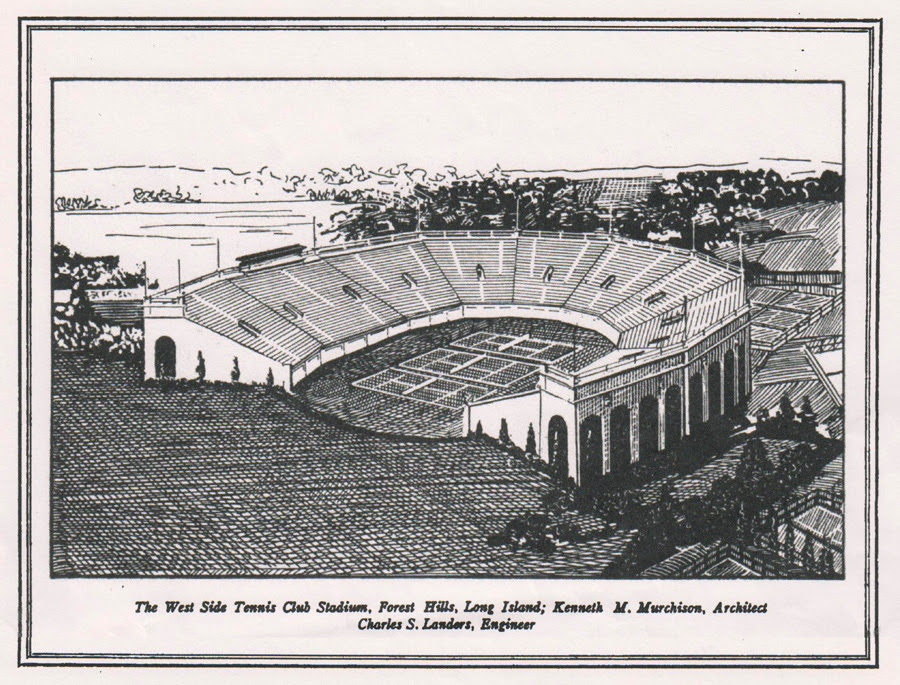
Clubhouse- Grosvenor Atterbury and John Almay Tompkins, 1913 Stadium- 69th Avenue between Clyde Street and Dartmouth Street, Kenneth M. Murchison, 1921-23
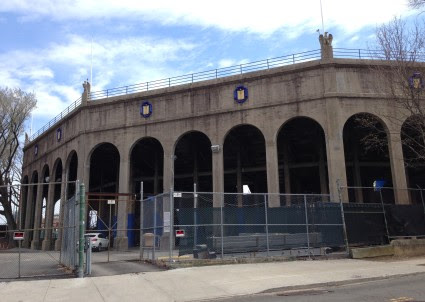
This internationally renowned tennis stadium is most famous for hosting the United States National Championship tennis tournaments, which were combined in 1968 to become the U.S. Open, from 1915 until 1977, when the tournament moved to the Arthur Ashe stadium in Flushing Meadows-Corona Park. The West Side Tennis Club was established in 1892 and originally operated on Central Park West in Manhattan, giving the club its name. The clubhouse was designed in the neo-Tudor style, in keeping with Atterbury’s other work in Forest Hills. The 14,000-seat stadium was designed by Kenneth M. Murchison, a well-known architect of public institutional buildings, having also designed such distinguished structures as Penn Station in Baltimore and the Hoboken Terminal. The United States’ first concrete tennis stadium, its architectural features include blue and gold glazed terra-cotta shields bearing the WSTC logo and “1923″, archways, eagles, shields, flagpoles and cornices. In 1956, the stadium hosted a major turning point in American history, when Althea Gibson became the first African American woman to compete in a world tennis championship (she won the Grand Slam). The stadium also served as a performance venue from the 1950s to the 1990s (Frank Sinatra, The Beatles, The Rolling Stones, Barbra Streisand and Bob Dylan, to name a few). In 2013, after many years of neglect, the West Side Tennis Club began an overhaul of the structure to restore it for use as a music venue once more. Turn left onto Dartmouth Street to make your way back to Station Square, noting the lovely streetscapes along the way.
THE EXTERIOR OF THE STADIUM
FROM JAY JACOBSON: Thanks for the story about B’nai Jeshrun. Growing up on the West Side of Manhattan in the 1940s, I remember it as one of a troika of synagogues where my friends would be Bar Mitzvahed. Rodeph Sholom, on 83rd street was most popular, as it’s Reform philosophy was appreciated by the families connected to it. I recall also dances, parties, and a gym as part of both B’nai Jeshrun and Rodeph Sholom.
My family paid no attention to religious philosophy. I was sent to the neighborhood schul. Until the day I was Bar Mitzvahed, neither of my parents had ever set foot in the very Orthodox West Side Institutional Synagogue.
And the day of that Bar Mitzvah was the last time I ever (except for my younger brother’s Bar Mitzvah) set foot in WSIS!
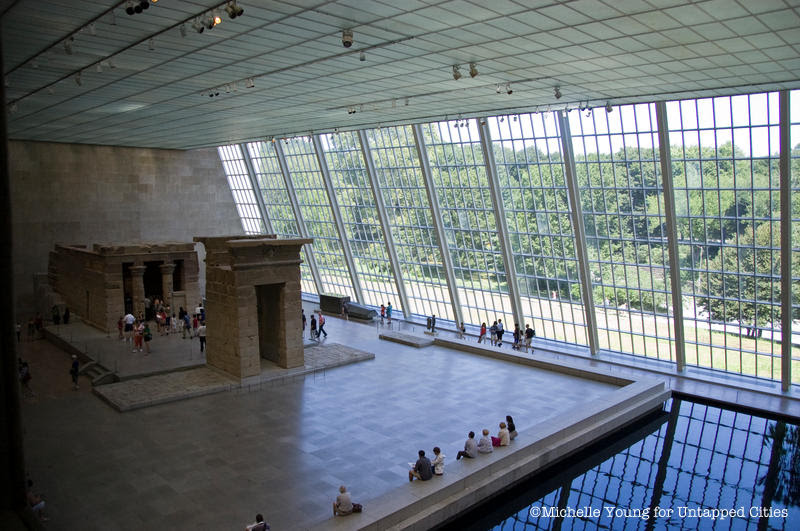
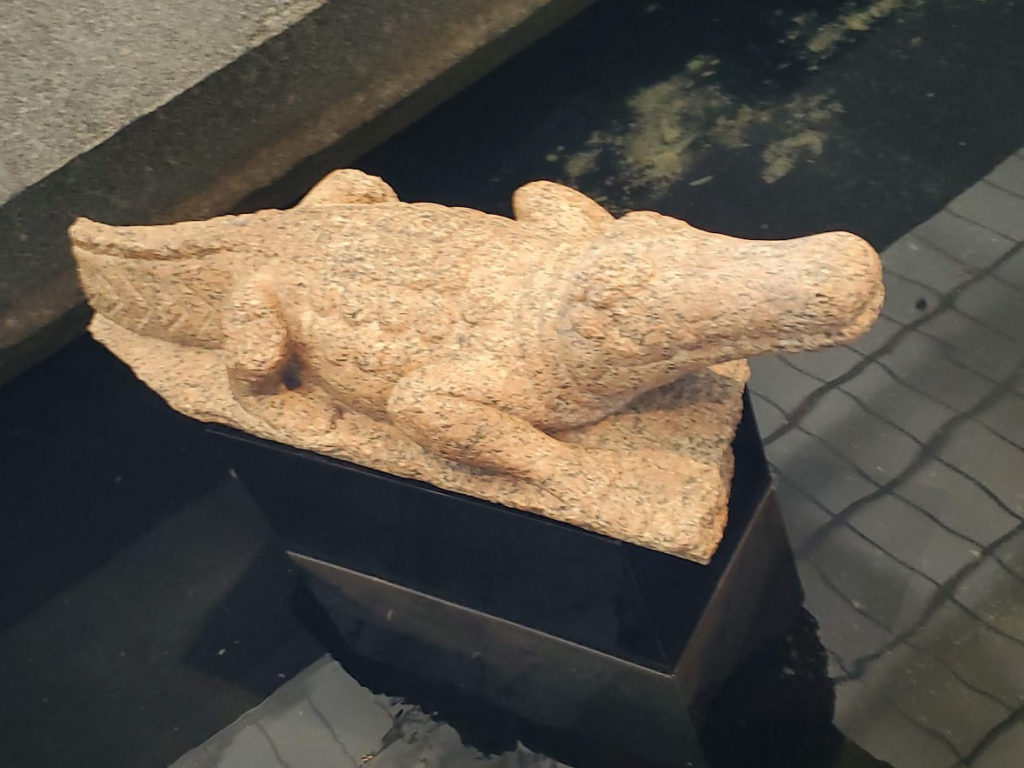
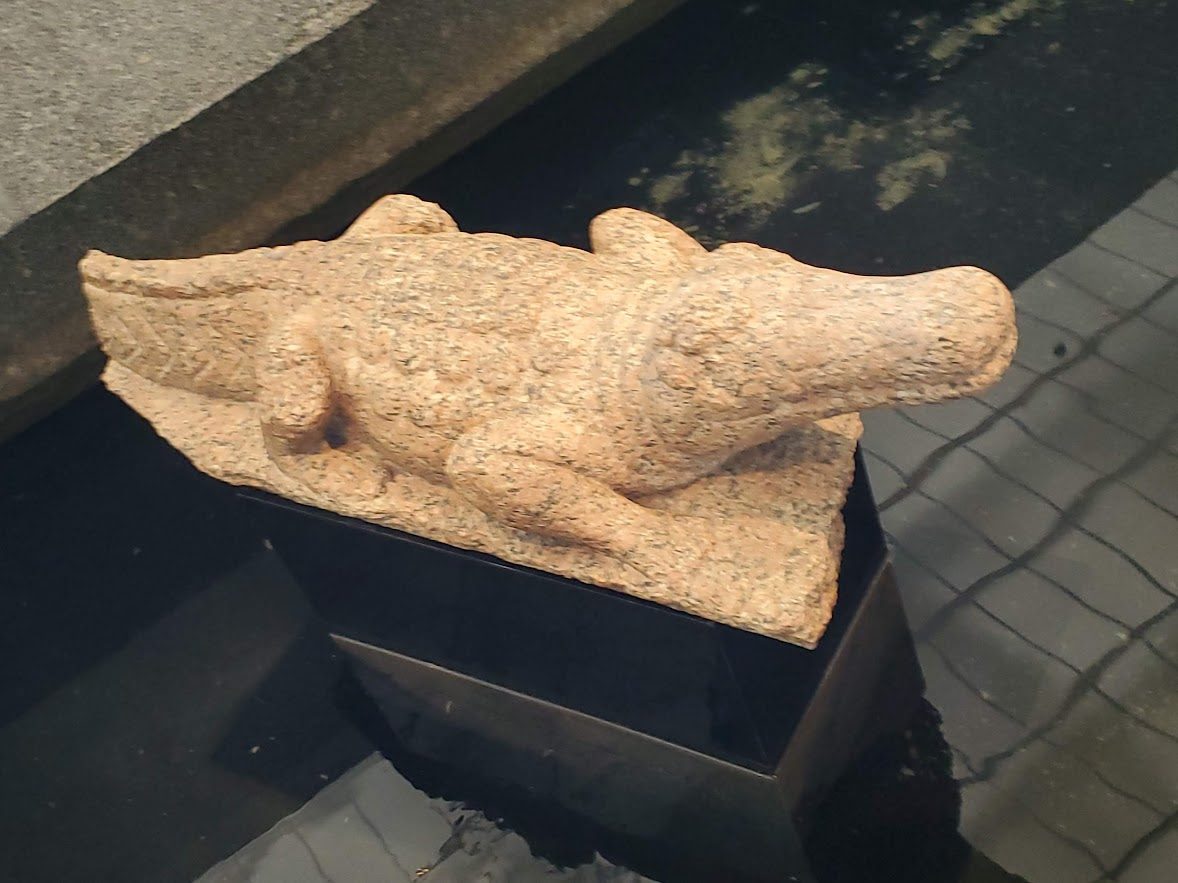
Part of the NYC Metropolitan Museum of Art Egyptian collection. Title: Crocodile statue Period: Roman Period Date: Late 1st century B.C. – early 1st century A.D. Geography: From Egypt Medium: Granite Dimensions: L. 108 × W. 37.1 × H. 29 cm, 124.7 kg (42 1/2 × 14 5/8 × 11 7/16 in., 275 lb.) Credit Line: Purchase, The Bernard and Audrey Aronson Charitable Trust Gift, in memory of her beloved husband, Bernard Aronson, 1992
Text by Judith Berdy Thanks to Bobbie Slonevsky for her dedication to Blackwell’s Almanac and the RIHS Thanks to Deborah Dorff for maintaining our website Edited by Deborah Dorff All image are copyrighted (c)
WIKIMEDIA COMMONS
WIKIMEDIA COMMONS HISTORIC DISTRICTS COUNCIL
GRANTS
CITY COUNCIL REPRESENTATIVE JULE MENIN DISCRETIONARY FUNDING THRU DYCD
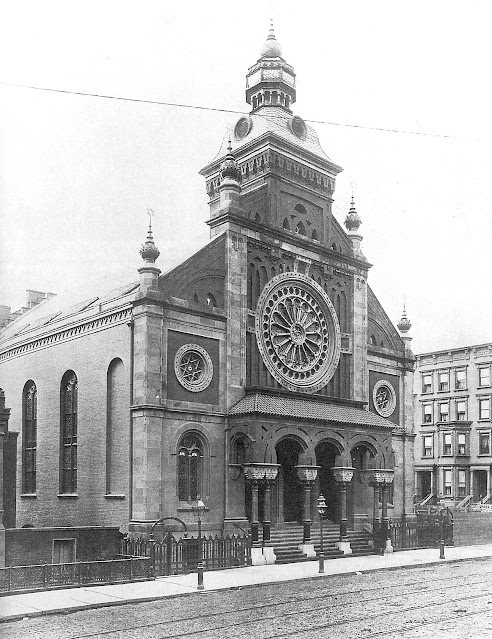
Congregation B’nai Jeshurun (“Children of Jeshurun”), incorporated in 1884, was the second oldest Jewish congregation in New York City. In 1864 it erected a synagogue on West 34th Street, between Broadway and Seventh Avenue, deemed by the New Amsterdam Gazette later, “undoubtedly the largest Hebrew place of worship in New York.” While it owned the structure, it leased the land on which it stood and in 1884, with that lease expiring, the congregation chose to move. On April 30, 1885 the New Amsterdam Gazette explained:
The growth of the city, however, of late years necessitated the congregation to look for another place of worship more suitable for the now remarkably increased and wealthy congregation, and more convenient to the large number of members residing uptown.
from The Decorator & Furnisher, October 1885 (copyright expired)
The New York Times reported on March 4, 1884, “The congregation B’nai Jeshurun has purchased from Newman Cowen a piece of property on the west side of Madison-avenue, about 25 feet south of Sixty-fifth-street, being about 75 feet from on the avenue, for $75,000.” The equivalent price the congregation paid for the vacant lot would be more than $2 million today.
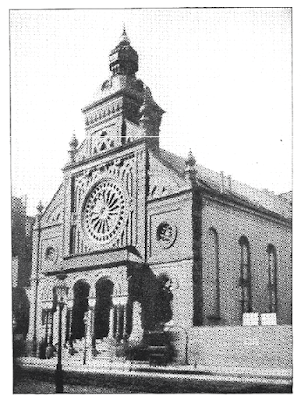
Things quickly moved forward and two weeks later, on March 21, The New York Times reported that plans for the new structure had been filed. The firm of Schwarzman & Buchman received the commission, and a recently-hired architect was given the project. The New Amsterdam Gazette wrote, “The plan of the edifice, which was selected by competition, is the work of Don Rafael Guastavino, a Spanish architect of great ability.”
Trained in Barcelona, Guastavino had arrived in New York only three years earlier. He would become known not only for his often exotic designs based in Moorish and Byzantine traditions, but for his Guastavino Arch, an incredibly strong structural arch veneered with interlocking tiles.
The New York Times reported, “The front of the synagogue will be of brick and built according to the Byzantine style. In the basement will be a large school-room. The synagogue will seat nearly 1,100 persons and will cost about $65,000.” Although the New Amsterdam Gazette called the congregation, “now one of the wealthiest in New York,” the trustees made a cost savings move. “The old synagogue…will be torn down and the stone will be used in the erection of the new building,” said The New York Times.
Construction proceeded quickly. In reporting on the cornerstone laying on August 7, 1884, The New York Times remarked, “The edifice is already far advanced toward completion, and will be dedicated about Dec. 1 next. The basement rooms will, however, be ready for occupancy after the the October festivals.”
The “fine new building,” as described by The New York Times was dedicated on March 25, 1885. The Real Estate Record & Guide said, “There was a large and fashionable gathering, and the ceremony was of an impressive character.” The New York Times remarked, “The interior of the new synagogue was modeled after the first synagogue erected in Europe, at Toledo, Spain, and is in the style of the Spanish Renaissance. The front, which is of Philadelphia brick and stone, is of the byzantine style, with Moorish combinations and a portico in the Moorish style.”
The New Amsterdam Gazette added, “Care has been taken for an abundance of light; the side aisles receiving light through large side windows and semi-circular tops, while the main aisle is lighted through the immense circular front and dome windows, and a beautiful line of half-circular ones located on each side of the frieze of the center aisle. All the windows are glazed with fancy cathedral glass.” The stained glass windows were fabricated by Lampert & Co.
The New Amsterdam Gazette continued:
The grand organ, certainly one of the finest in the city, was built by George Jardine & Son, the builders of the Cathedral organ. The most prominent feature of the building, which cannot fail to attract the attention of every visitor, is the exquisitely carved and beautifully decorated desk designed for the reader of the Books of Moses, situated in the rear of the halls. It is constructed in the form of a balcony.
The movement of the synagogue away from Midtown created a problem. The congregation’s cemetery was located on 32nd Street, between Sixth and Seventh Avenues. On February 23, 1887, The New York Times reported, “The old plot, which is only 40 by 100 feet, has become so desecrated by the refuse and rubbish which is thrown there that it has been thought advisable to remove the bodies.” The congregation met the day after the article to approve moving the bodies to Cypress Hills, Brooklyn.
The rabbi of B’nai Jeshurun was Rev. Henry S. Jacobs, a “fluent and graceful speaker,” according to The Menorah, who was “gifted with a remarkably pleasant voice, and is one of the best orators among the rabbis of the city.” King’s Handbook of New York said that under him, the congregation held “conservatively to the old Mosaic standards…paying little regard to the changeful spirit of the nineteenth century.”
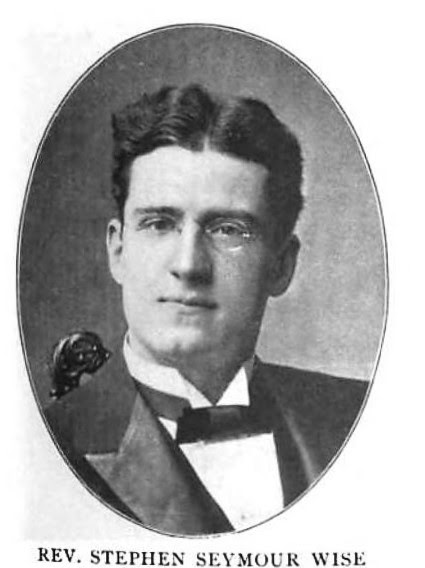
He was succeeded in April 1893 by the Hungarian-born Rev. Dr. Stephen Seymour Wise, an outspoken critic of Tammany Hall who was described by Tammany leader Richard Croker as a “narrow old man.”
from King’s Notable New Yorkers, 1899 (copyright expired)
Rev. Wise remained seven years, preaching his last sermon on June 3, 1900. The New-York Tribune commented, “He took charge of the Madison Avenue Synagogue in April, 1893, and leaves it for a poorer cure in Portland, Ore.”
In November that year, the Rev. Joseph M. Asher of Cambridge University in England, was invited to “preach on trial.” Newman Cowen, the president of the congregation, told the New-York Tribune “that Mr. Asher is expected to be the rabbi of the congregation.” And, indeed, he was installed on December 22, 1900. The comments of the Rev. Dr. Gustav Gottheil of the Temple Emanue-El, who conducted the installation, may have hinted at problems to come. The New-York Tribune reported, “Dr. Gottheil emphasized the necessity of toleration and magnanimity. He also called to the incoming rabbi’s notice that he would find ideas more advanced here than where he formerly labored.”
Despite the warning, Asher could not accept new ways of Congregation B’nai Jeshurun. On February 15, 1908 the New-York Tribune reported, “Its ritual was not sufficiently orthodox for the new rabbi and he resigned and took charge of [a] smaller but less modern congregation.”
The congregation struggled to find a long-term leader. Asher’s successor, Dr. Benjamin A. Tintner, resigned in December 1910. He was replaced by Dr. Judah L. Magnes, who immediately began a series of far-reaching changes. The Sun reported on December 19, 1911 that “he announced that it was his intention to ‘further Judaism as it has been handed down to us by the Jewish people.'” The article said, “One of Dr. Magnes’s first acts was to shut down the organ and abolish the mixed choir. The women singers were discharged and a choir of male voices was substituted.”
from King’s Handbook of New York (copyright expired)
Dr. Magnes’s insistence on strict orthodoxy caused a rift within the congregation. A member told a reporter from The Sun, “The enthusiasm with which the new plan was received seems to have waned and the young people, upon whom we depend, are anxious to have the music restored and the services made attractive.” On December 20, The New York Times added, “Strong differences of opinion, it was learned yesterday, have arisen in the congregation of B’nai Jeshurun Synagogue at Madison Avenue and Sixty-fifth Street as to the desirability of certain change in the direction of orthodoxy.”
Dr. Judah Magnes resigned in January 1912, and was be replaced by Dr. Barnet Elzas. The congregation’s focus soon turned from infighting over religious ritual to its physical location. In 1915 it decided to relocate to the opposite side of Central Park, and on January 15, 1916 the Record & Guide reported, “The Congregation B’nai Jeshurun has been granted permission by to court to sell its synagogue property…to the Alliance Realty Company.”
The New York Times, on May 3, reported, “Madison Avenue is about to lose one of its most imposing religious structures in the demolition within a few weeks of the synagogue of the Congregation B’Nai Jesurun.” The final services had been held the previous Saturday and the congregation had arranged temporary quarters while its new synagogue at 257 West 88th Street was being constructed.
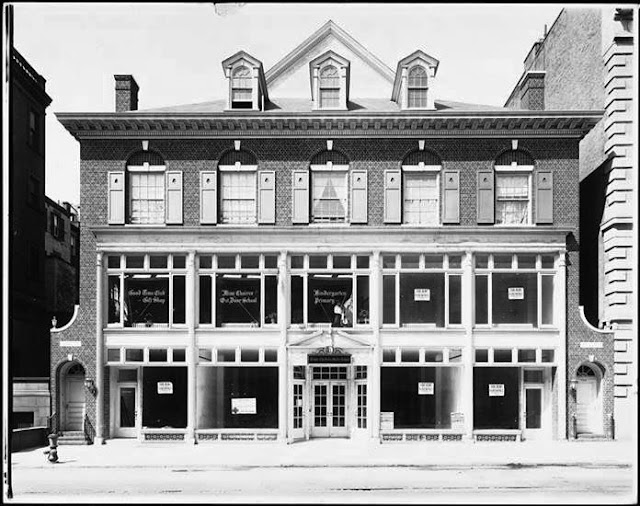
As it turned out, Raphael Guastavino’s magnificent Byzantine-inspired structure was not demolished, but otherwise obliterated by the architectural firm of Rouse & Goldstone. The firm remodeled it into a neo-Federal commercial building that bore no resemblance to its former self.
Nurses in cafeteria of Central Nurses Residence, that was demolished in the 1980’s. Gloria Herman and Ed Litcher got it right
Thanks to Bobbie Slonevsky for her dedication to Blackwell’s Almanac and the RIHS Thanks to Deborah Dorff for maintaining our website Edited by Deborah Dorff All image are copyrighted (c)
SOURCES
DAYTONIAN IN MANHATTAN
GRANTS
CITY COUNCIL REPRESENTATIVE JULIE MENIN DISCRETIONARY FUNDING THRU DYCD
FUNDING PROVIDED BY ROOSEVELT ISLAND OPERATING CORPORATION PUBLIC PURPOSE GRANTS CITY COUNCIL REPRESENTATIVE BEN KALLOS DISCRETIONARY FUNDING THRU DYCD
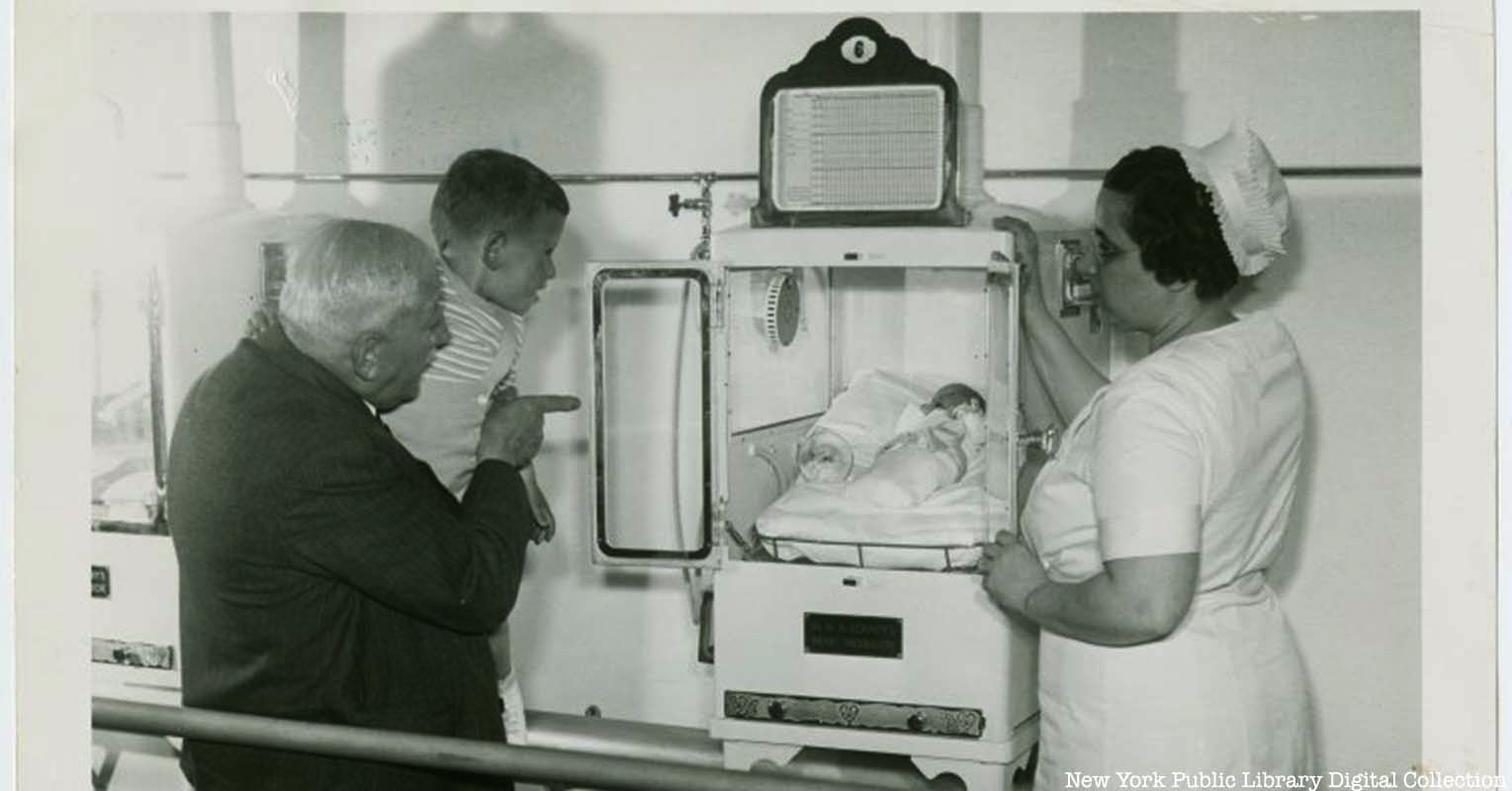
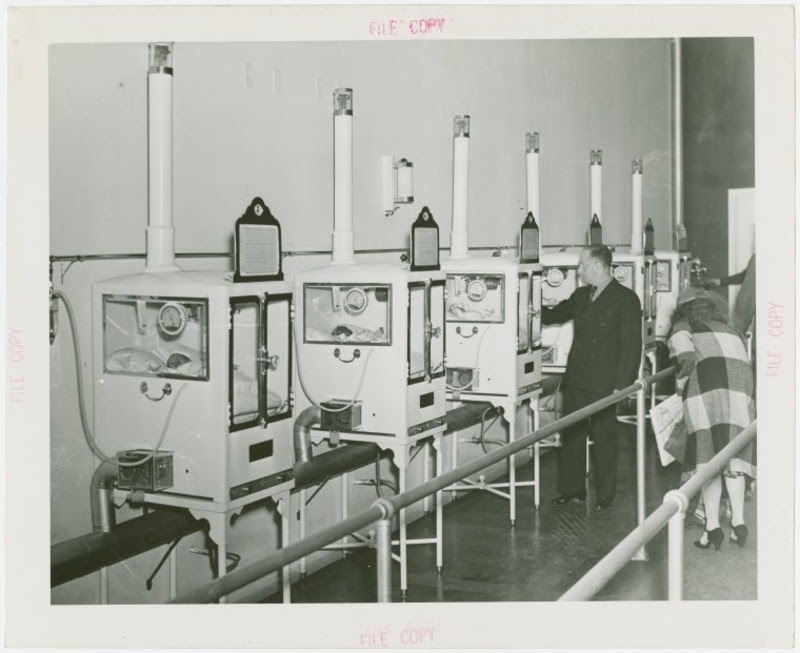
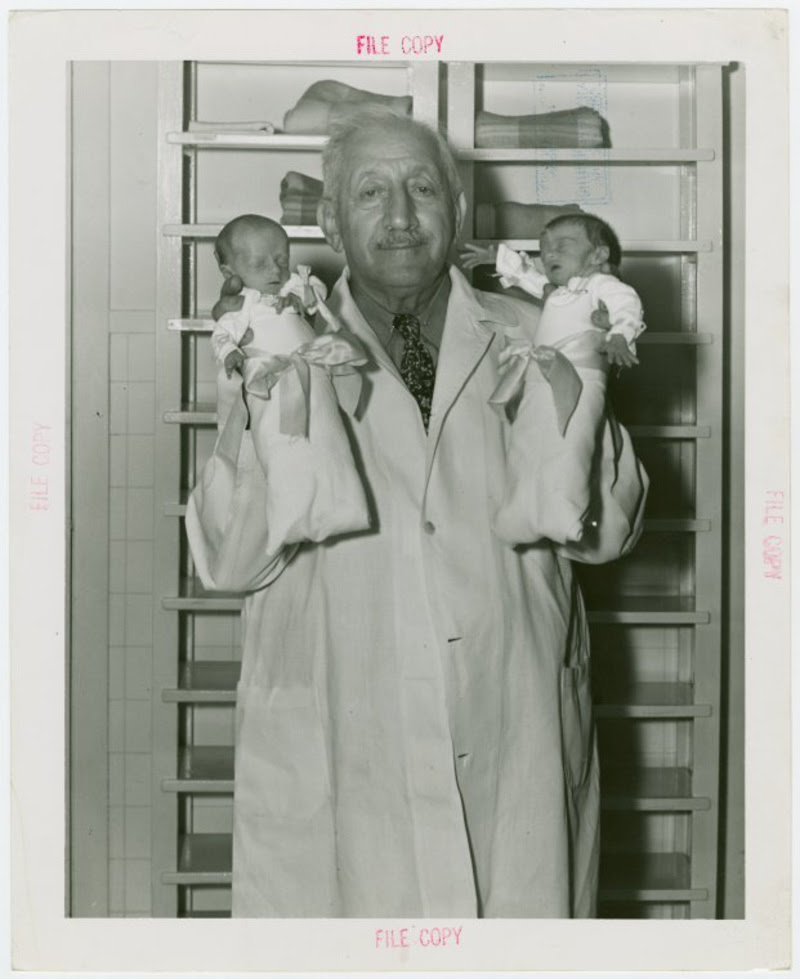
Every summer during the early 20th century, Coney Island visitors could be found feasting on Nathan’s Famous hot dogs and homemade Coney Island custard, wading through the Atlantic Ocean, or taking a ride on the rickety cars of the Cyclone. For some, a trip to the world-famous Brooklyn beach also included a visit to a fully functional neonatal intensive care unit. Paying a quarter, they gained admission into a room displaying the frailest of infants as they slept in individual incubators.With few treatment options available for premature babies, pioneer of neonatal technology Martin Couney created an incubator showcase that remained one of the babies’ best chances for survival. Once admitted into Couney’s care, the babies received a bath and if they could swallow, a small dose of brandy. Afterward, they were swaddled and placed in incubators where they remained on view all day except when being fed breast milk by extensively trained nurses every two hours.
Little is known about the early life of Couney, largely due to the editorializing of his past to fit his desired narrative. Born in Krotoszyn, Poland in 1869, Couney immigrated to the United States in 1888. Though Couney claimed to have obtained a European medical license after studying in Leipzig and Berlin, he would have been too young to obtain said degree before leaving Europe at the age of 19. In addition, novelist Dawn Raffel’s nonfiction book The Strange Case of Dr. Couney: How a Mysterious European Showman Saved Thousands of American Babies, revealed that Couney changed his name on multiple occasions.
Couney also allegedly studied under Dr. Pierre-Constant Budin, whose research on breastfeeding, perinatal care well, and umbilical cord blood revolutionized the neonatal medicine field. Adding to his tale, Couney claimed that he served as Budin’s intermediary to exhibit his Kinderbrutanstalt or “child hatchery” at the 1896 Great Industrial Exposition in Berlin. Instead, it is more likely that if Couney had even attended the event or known Budin, he served as a medical equipment technician for the exhibition.
Though Couney might not have worked alongside Budin, the doctor’s early incubators quickly grew in popularity after debuting in 1897 at Queen Victoria’s Diamond Jubilee Celebration and in 1901 at the Buffalo, New York Pan-American Exposition. Cashing in on the incubator’s growing reputation, Couney took the machines on the road, traveling across the country to major fairs and amusement parks to offer his services.
Beginning in 1903, Couney established two permanent incubator exhibits at Coney Island, one in Luna Park and another in Dreamland. Along the way, he hired nurse Annabelle Maye Segner, who later became his wife and focused on ensuring the exhibit’s cleanliness. Later on, Couney’s own daughter, Hildegard — who was born prematurely — assisted in the show’s operations as well.
While displaying helpless babies for crowds to gawk at comes off as unthinkable today, Couney’s showcase was just another iteration within the long tradition of medical and freak spectacles of the 19th and 20th centuries. As historian Bert Hansen discusses in his article “America’s First Medical Breakthrough: How Popular Excitement about a French Rabies Cure in 1885 Raised New Expectations for Medical Progress,” medical spectacles such as the incubator babies strategically worked to “satisfy the public’s curiosity about the new miracles of medicine.” In a world beset by rapid changes to standard medical practices, public showcases at the turn of the century kept the masses informed and intrigued. In turn, the showcases secured monetary support.
Men and women looking at babies in incubators. Courtesy of The New York Public Library Digital Collection. Another crucial role that incubator shows played was in helping to fight against the growing eugenics movement. Proponents of this movement viewed premature babies as weaklings that would pollute the gene pool should they live to adulthood. Across the country, Better Babies contests awarded medals to babies who represented the fittest example of American offspring — many taking place at the same fairs where Couney’s preemies were displayed. Through his shows, Couney worked to disprove these beliefs and turn public opinion in favor of protecting and providing for premature babies.Though Couney’s program had an 85 percent success rate, medical professionals remained skeptical about the efficacy of incubators. Significant scientific research on the machines had yet to be conducted, and the machines were incredibly expensive to build, costing $75,000 or $1.5 million today. Wariness on the part of doctors also stemmed from incidents of machine malfunction. Particularly, a 1904 St. Louis incubator show run by one of Couney’s rivals turned deadly.
A few years later in 1911, shortly before the opening day for Couney’s show in Dreamland that summer, the amusement park burned down. Though all the babies were miraculously saved by the NYPD, the president of the New York Society for the Prevention of Cruelty to Children argued that premature infant care should only take place within the confines of a hospital. Even so, hospitals at the time lacked the necessary resources and staff to provide the around-the-clock care Couney and his associates guaranteed their patients. In New York City, for example, a given hospital often only had one available incubator into the 1930s. If said incubator was not already in use, it was often prohibitively expensive for everyday families. In turn, Couney became known for accepting desperate cases, giving children the treatment they needed until they became well enough to return home or his operation was forced to close for the season.Lucille Horn, born in 1920 at only 2 pounds, owed her life to Couney. After doctors told Horn’s father that his daughter had no chance of surviving — her twin sister had just died at birth — he rushed her to Couney’s Coney Island show. There, she remained for six months under the watchful eye of nurses and spectators alike before being declared strong enough to go home. Horn eventually went on to live another 96 years, dying on February 11, 2017.
Though many in the medical community see Couney as absurd, his methods eventually found an ally in Dr. Julius Hess, considered today to be the father of American neonatology. Within the preface of his 1922 textbook Premature and CongenitallyDiseased Infants, Couney’s work is cited and 11 years later in 1933 the doctor also pledged his support for Couney’s show at Chicago’s Century of Progress.
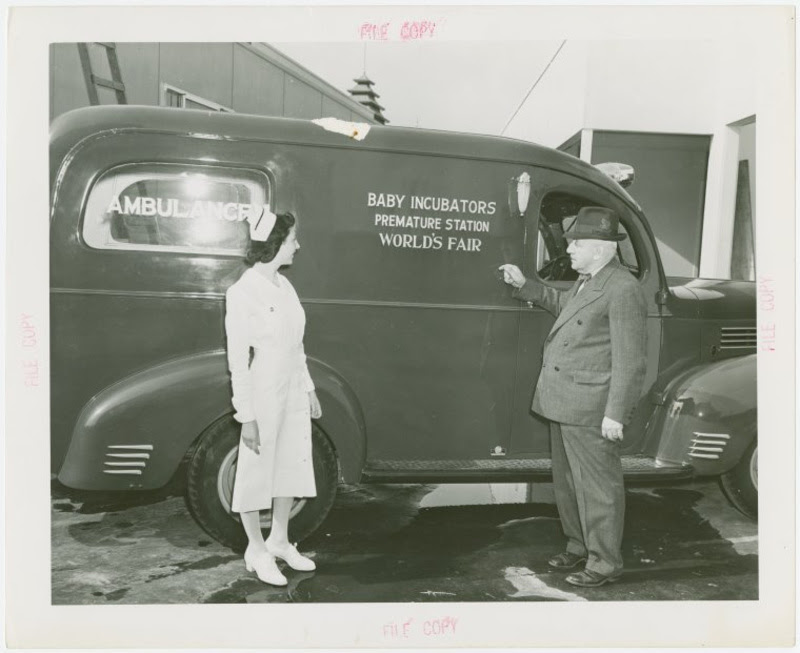
In 1943, just as Cornell Hospital opened the first dedicated premature infant station, Couney’s Coney Island show was permanently shut down. Having lost his wife in his old age, Couney lacked the support and stamina to keep the operation open. Additionally, he was broke, having blown through most of his funds to pay for his show’s operating expenses during the 1939 New York World’s Fair. Rather than making the parents of his patients pay for their children’s care, Couney relied on the donations of spectators to make money — a financial strategy that fell apart when his showcase began declining in popularity.
Between 1896 and 1943, it is believed that Couney and his family took in around 8,000 newborns of which they were able to rescue 6,500. While Couney’s accomplishments may have been under-appreciated during his lifetime, for the thousands of preemies he saved and their families, he was nothing short of a miracle worker. Today, one in ten babies in the United States are born prematurely, but thanks to Couney’s medical innovations, these children now have a chance at living a full and healthy life.
SUGGESTION OF THE DAY
LET’S STOP PASTING SIGNS ON THE TRASH CONTAINERS LET’S ORDER METAL SIGNS WITH SATURDAY PARKING RULES TO BE POSTED ON THE LAMP POSTS.
PHOTO:ROOSEVELT ISLAND DAILY
FRIDAY PHOTO OF THE DAY
SEND YOUR MEMORIES TO: rooseveltislandhistory@gmail.com
THURSDAY PHOTO OF THE DAY
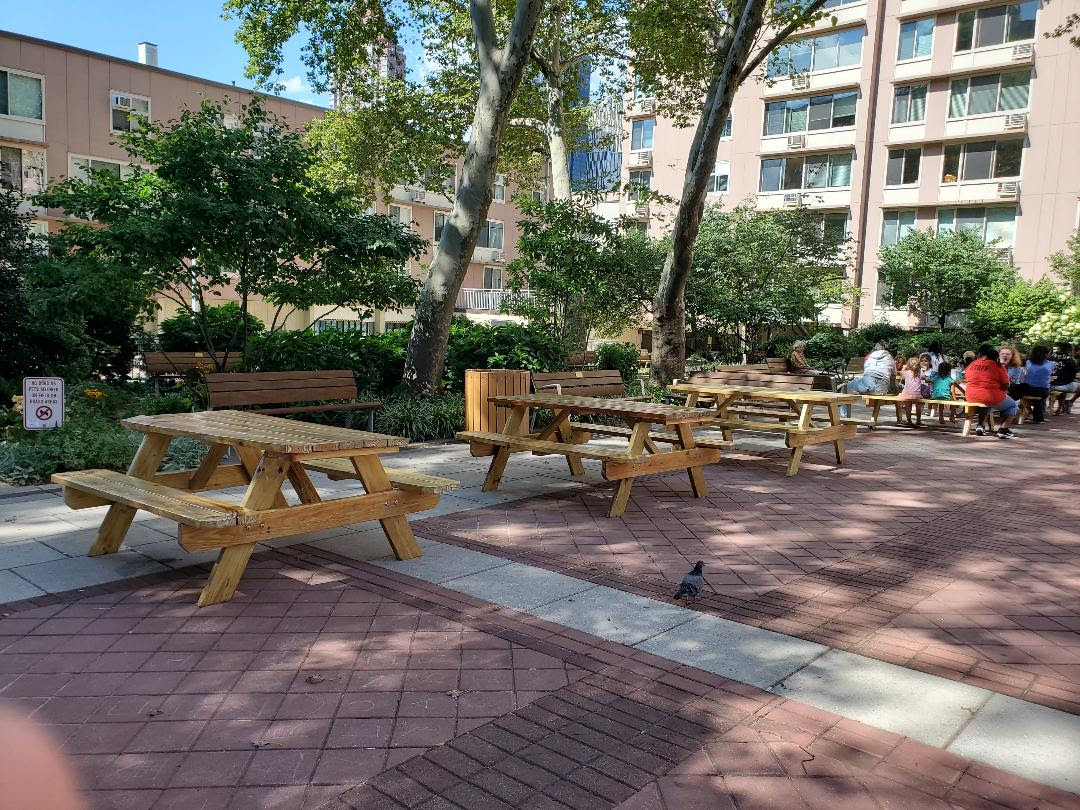
CHAPEL PLAZA WITH REFRESHED PICNIC BENCHES AND SEATING!!! GLORIA HERMAN, JANET KING, NINA LUBLIN,NANCY BROWN GOT IT RIGHT AND ED LITCHER GOT THE GRAND PRIZE: A single Feral pigeon – (Columba livia domestica), also called a city dove, a city pigeon, or a street pigeon.
Irene Madrigal is a sophomore at Barnard College intending on majoring in English and History with a minor in Spanish. As a native New Yorker, she can be found guiding her friends across the city and showing her love for her home borough, Brooklyn. When’s she not doing this, Irene can be found painting, baking apple pie in her kitchen, or writing her next article for the Columbia Daily Spectator and Untapped New York.
FUNDING PROVIDED BY ROOSEVELT ISLAND OPERATING CORPORATION PUBLIC PURPOSE GRANTS CITY COUNCIL REPRESENTATIVE BEN KALLOS DISCRETIONARY FUNDING THRU DYCD
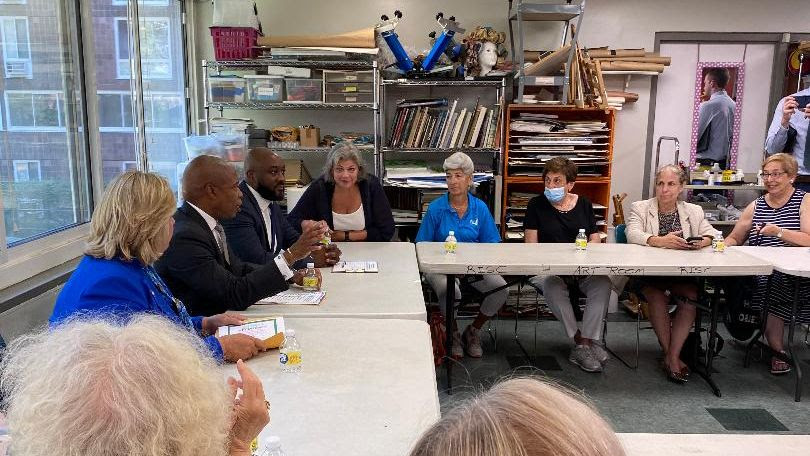
This was a last minute visit. Yesterday the word was out (at the PS217 pollsite) that the mayor was visiting today to discuss Pickle Ball.
Assembly member Seawright had arranged this visit and she and Shelton Haynes hosted the mayor.
Well, other items were on the agenda including self governance and re-districting. We were seated in the Senior Center art room with the Zumba class providing music. Mayor Adams took questions, listened attentively and asked for notes to be taken.
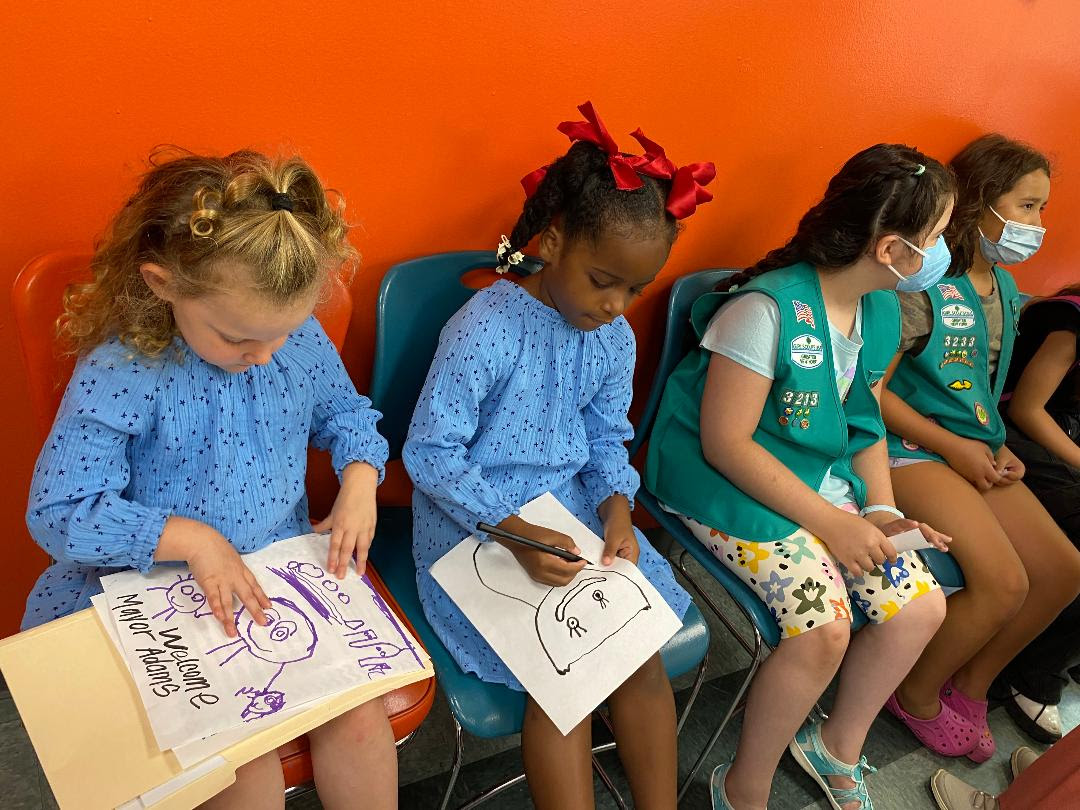
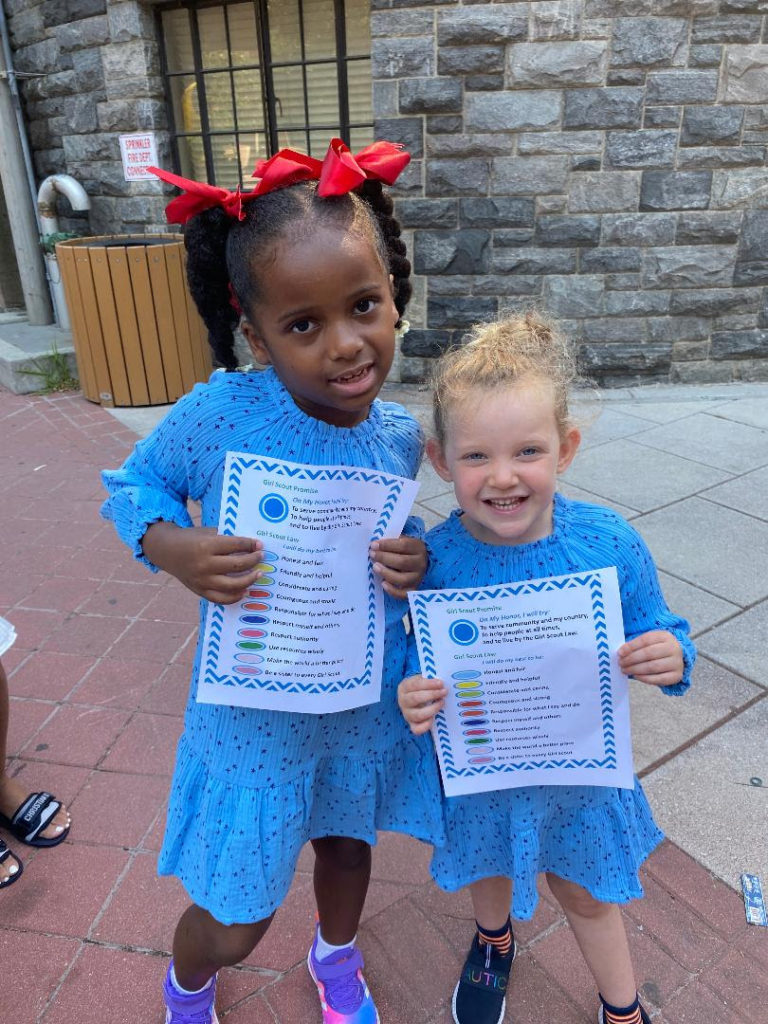
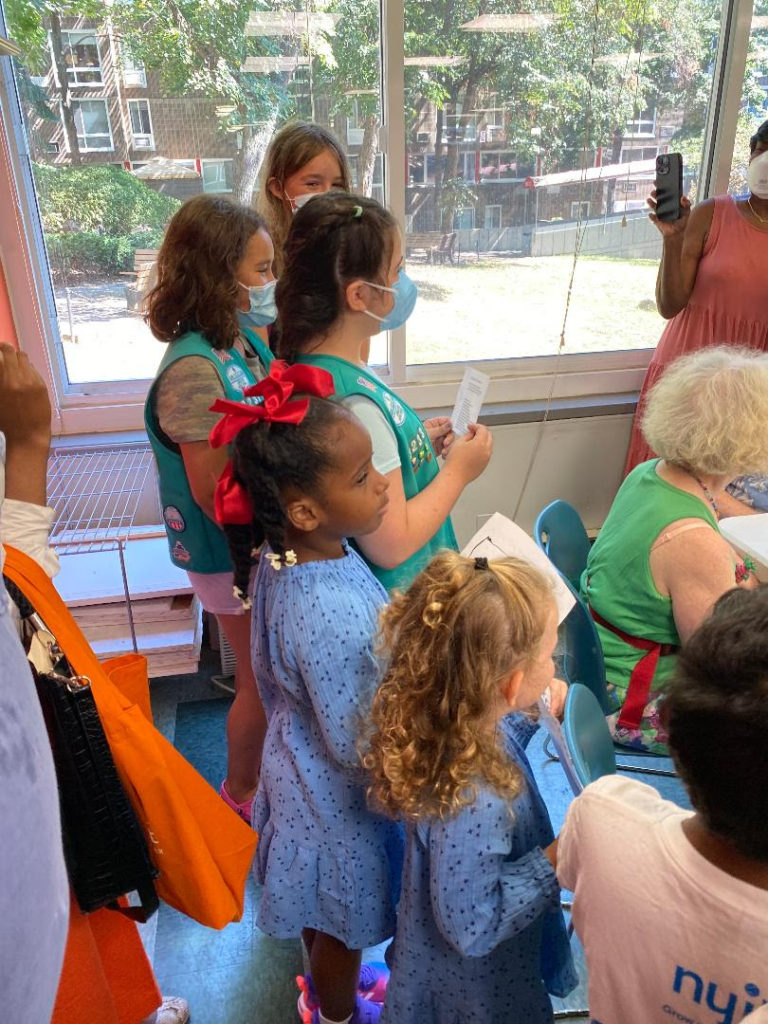
The scouts officially welcomed him and presented him with artworks.
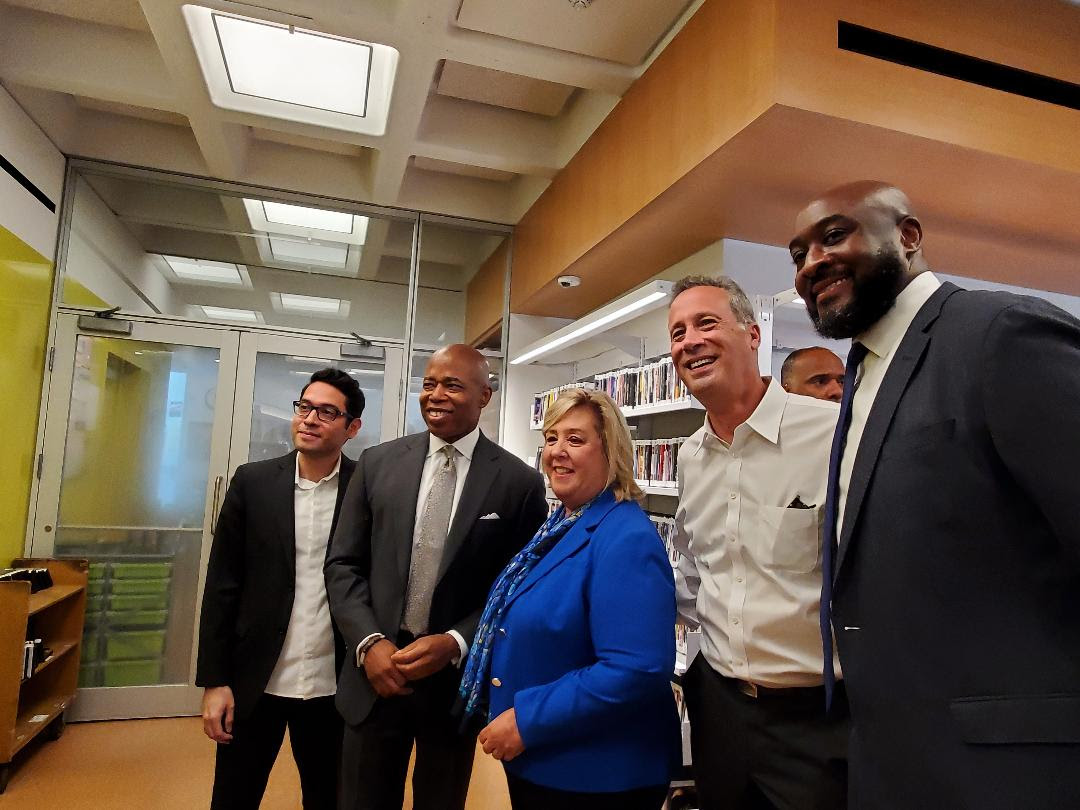
After about 30 minutes the intimate meeting was a crowd in the Senior Center. After a brisk walk we were in the NYPL branch and Tony Marx greeted him. A brief stop and we were hoofing it to the Tram.
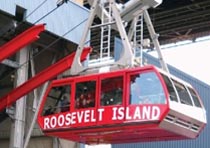
The tram ride was fun, though the mayor could barely see out the windows with a crowd around him,.
On the platform he was gone, one hour total visit. He was due to make 23 stops today!!
Welcome roundtable discussion at the CBN Senior Center. Got to welcome the mayor and remind him that Queens residents (the Blackwell family) sold the island to the City in the 1820’s and we do not want to be redistricted back to that borough.
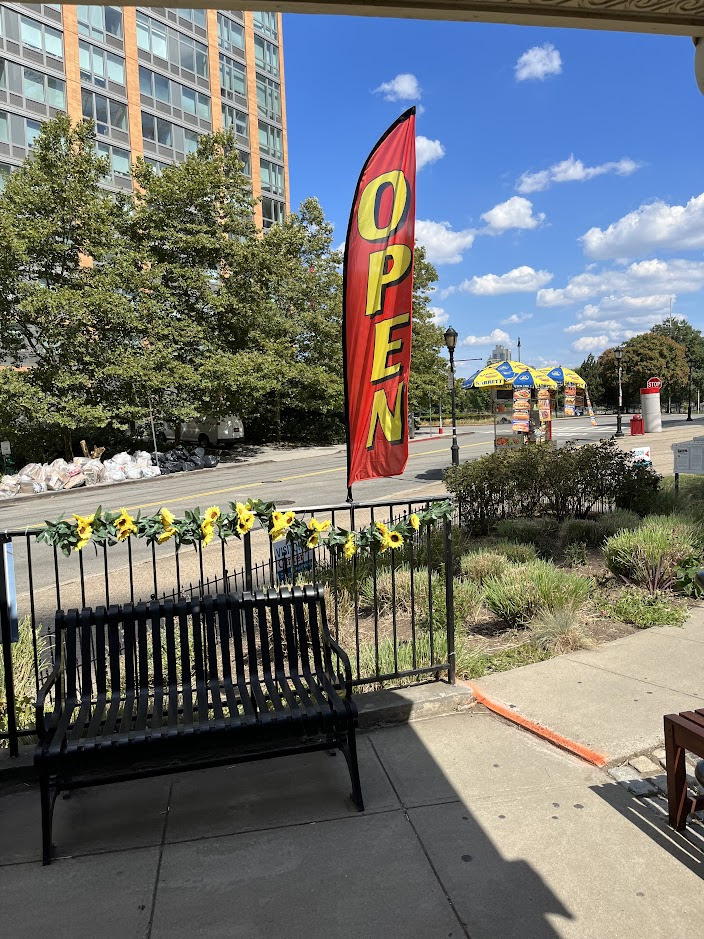
The mayor and party walked past the kiosk at a brisk pace and missed stopping in for a quick shopping spree and history lesson.
The mayor was greeted by our youngest scout members.
A quick stop at our library where Carlos Chavez-Branch Manager, Mayor Adams, Member Seawright, Tony Marx-President NYPL, and Shelton Haynes-President-RIOC had a quick visit.
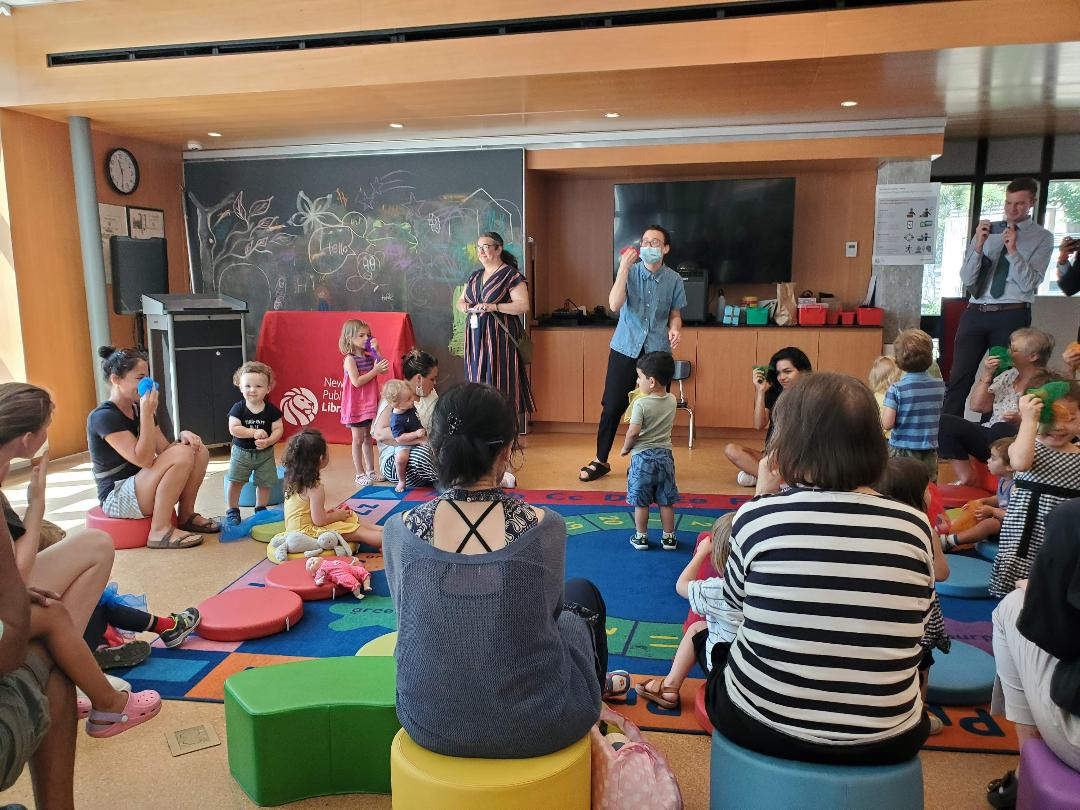
The toddlers were so engaged in their song, the entourage was barely noticed.
The island in the 1800’s when we were part of Queens.
Text by Judith Berdy Thanks to Bobbie Slonevsky for her dedication to Blackwell’s Almanac and the RIHS Thanks to Deborah Dorff for maintaining our website Edited by Melanie Colter and Deborah Dorff
All image are copyrighted (c) Roosevelt Island Historical Society unless otherwise indicated
Sources
JUDITH BERDY CHRISTINA KIRKMAN
FUNDING PROVIDED BY ROOSEVELT ISLAND OPERATING CORPORATION PUBLIC PURPOSE GRANTS CITY COUNCIL REPRESENTATIVE BEN KALLOS DISCRETIONARY FUNDING THRU DYCD
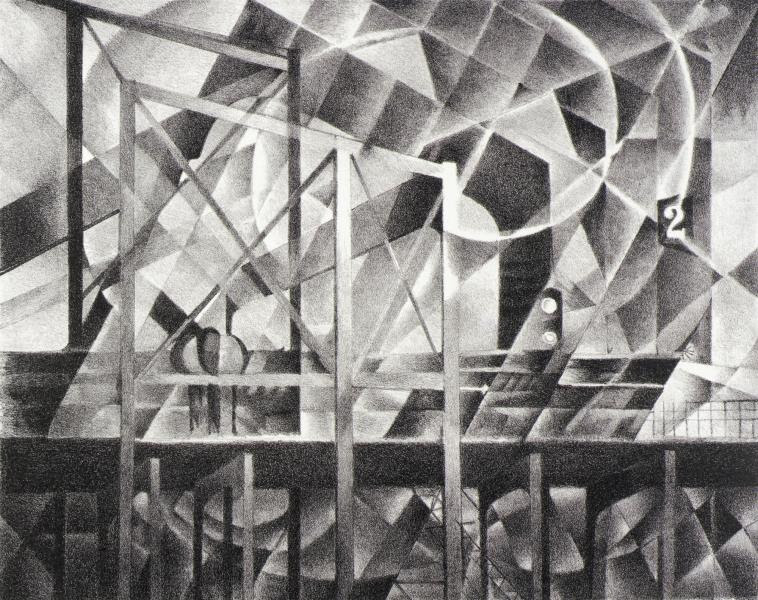
August Mosca, Elevated Structure, ca. 1946-1956, lithograph on paper, Smithsonian American Art Museum, Gift of Dr. and Mrs. Monroe Kornfeld, 1977.95
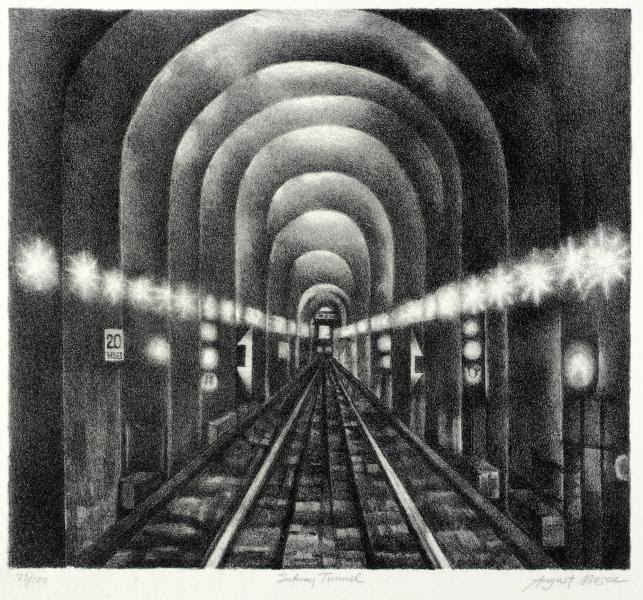
August Mosca, Subway Tunnel, ca. 1946-1956, lithograph on paper, Smithsonian American Art Museum, Gift of the artist, 1988.35.1
August Mosca, Subway No. 3, ca. 1946-1956, lithograph on paper, Smithsonian American Art Museum, Gift of the artist, 1988.35.2
WEDNESDAY PHOTO OF THE DAY
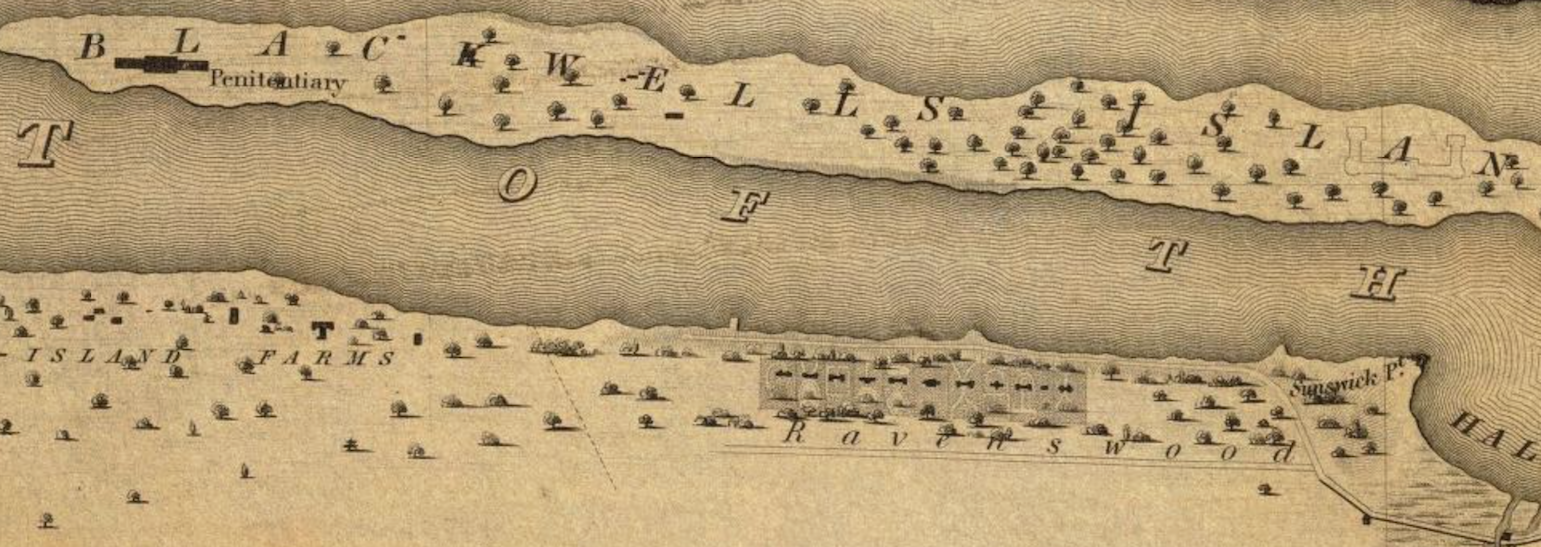
From the David Ramsey Map Collection — a 1836 view of Blackwell’s Island and Ravenswood.
THE LAST TIME THIS ISLAND WAS PART OF QUEENS…. WHEN THE BLACKWELL FAMILY OWNED IT IN THE 1800’S!!
TUESDAY PHOTO OF THE DAY
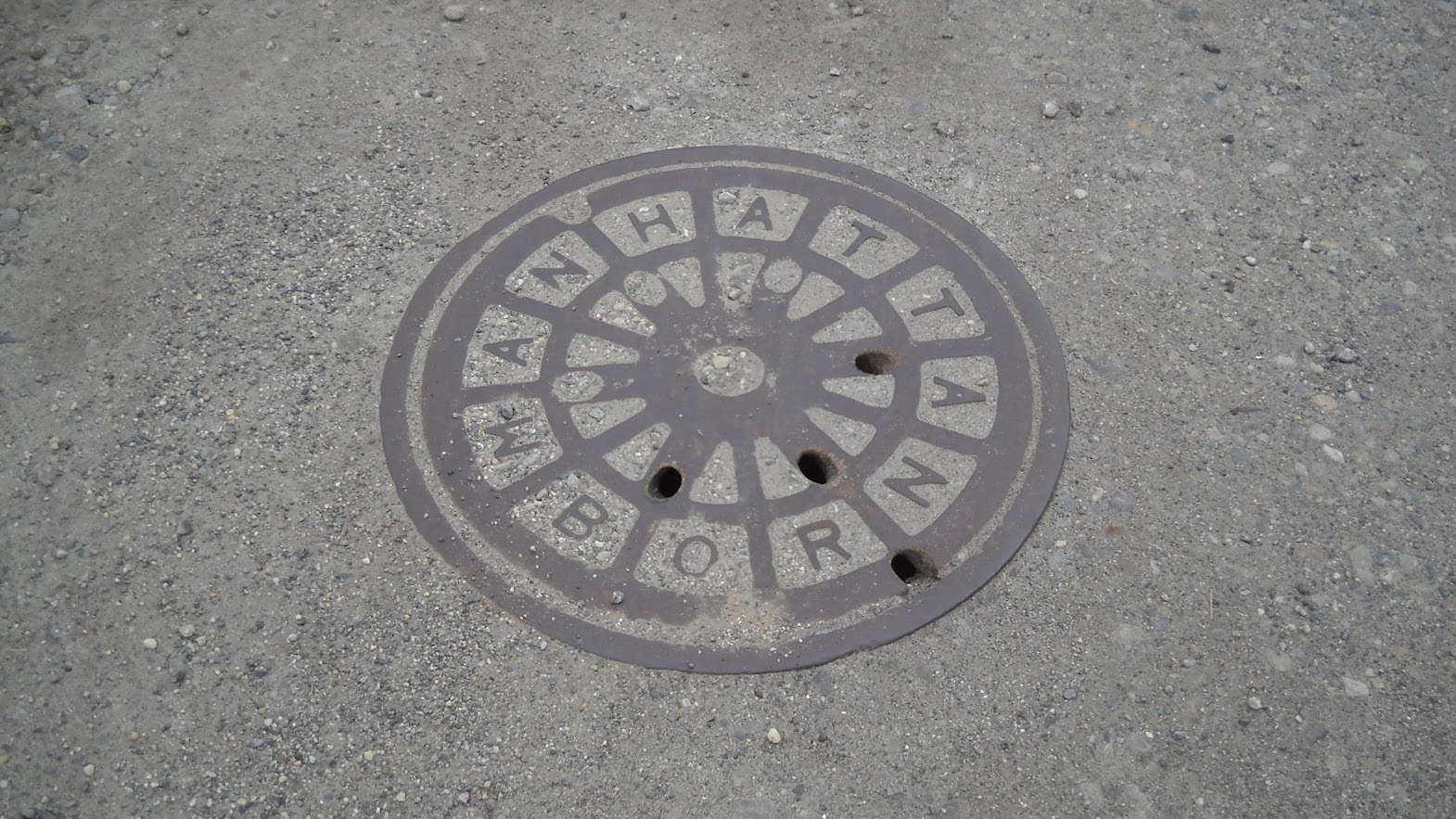
MANHOLE COVER NEAR EAST SIDE OF COLER WINNER WILL BE ANNOUNCED TOMORROW.
Text by Judith Berdy Thanks to Bobbie Slonevsky for her dedication to Blackwell’s Almanac and the RIHS Thanks to Deborah Dorff for maintaining our website Edited by Melanie Colter and Deborah Dorff
All image are copyrighted (c) Roosevelt Island Historical Society unless otherwise indicated
SMITHSONIAN AMERICAN ART MUSEUM
RIHS (C) FUNDING PROVIDED BY ROOSEVELT ISLAND OPERATING CORPORATION PUBLIC PURPOSE GRANTS CITY COUNCIL REPRESENTATIVE BEN KALLOS DISCRETIONARY FUNDING THRU DYCD
“Give me comrades and lovers by the thousand! … Give me the streets of Manhattan!” —from ‘Give Me the Splendid Silent Sun’ by Walt Whitman (1819–1892)
Most street signs in New York City are attached to light posts or traffic signal poles. In Paris and Tours, Madrid and Granada, Rome and Florence, as well as other cities across the Continent, street name signs are affixed to buildings. Occasionally, a more European version of street identification can be seen in NYC. Here are a few, all of them below 14th Street, that bring a touch of Old World charm to the Big Apple. We begin Downtown, move north up the west side to Greenwich Village, and then travel east to the East Village.
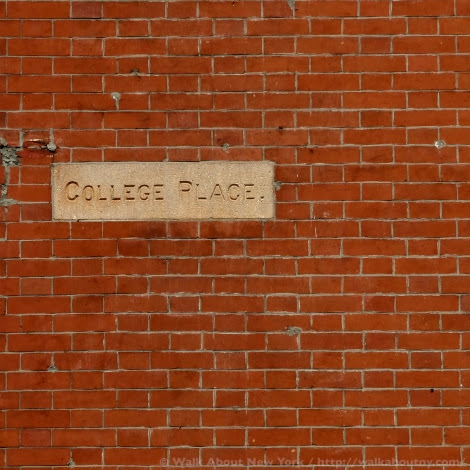
A reminder of a former campus.
Now serving as a residential building, with commercial space at the ground level, 84 West Broadway, is an ordinary-looking, red-brick building at the northwest corner of West Broadway and Warren Street. On its West Broadway-facing side is a reminder of a former name for the street, College Place. What began as King’s College in 1754 by royal charter granted by Britain’s George II, and then renamed Columbia College in 1784 because a kingly association was not wanted in a newly independent country, and is now Columbia University had its first campus here. Columbia relocated to what would become Rockefeller Center in 1857; by 1900 the school moved again to its present-day campus on Broadway in Morningside Heights. A little-noticed street sign, although hiding in plain sight, is not the only reminder of Columbia’s 18th- and 19th-centuries days in downtown. At the nearby Chambers Street subway station for the numbers 1, 2 and 3 lines a 1914, ceramic-tile mosaic depicts the school’s first building; discover this original subway art when you take our Subway Art Tour Four.
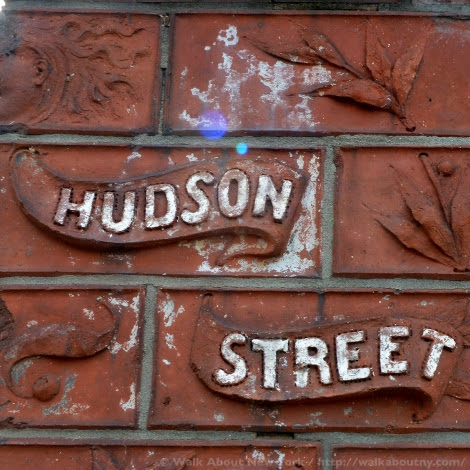
A street sign using fancy terra-cotta.
On the northwest corner of Hudson and Beach Streets, Number 135 Hudson is an 1886 red brick building. A simple, rectangular warehouse was given interest with Roman arches, created with squat brick columns, at street level. Unique craftsmanship was used to great effect for the cross-street identification. Leaf motifs surround the street names in a mix of high and low relief. Now used for residential purposes visitors can easily find the building.
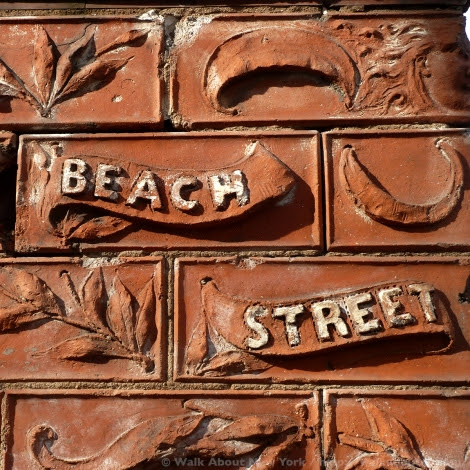
More street sign using fancy terra-cotta.
The name ‘Beach’ is a corruption of the surname of Paul Bache, the son-in-law of an area landowner. Traveling east-west Beach Street covers but a three block stretch without a beach in sight. The name first appears in 1790. Once part of tony St. John’s Park, Beach Street attracted genteel families from the late 18th century until the Hudson River Railroad came to this part of town in the 1860s. Because the land was outside the crowded city citizens moved there to escape the yellow fever epidemics of the 1790s and early 1800s; it was the country!
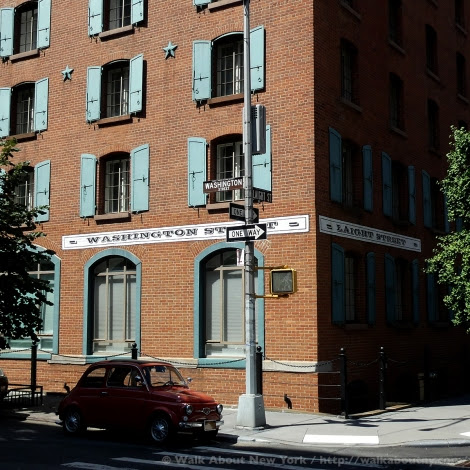
A painted street sign.
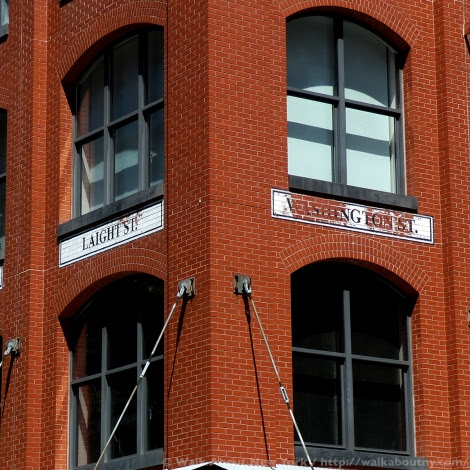
The street signs are painted at the corner of the former headquarters for the Grocers Steam Sugar Refining Company, which then sold it to the United States Sugar Refining Company, when the area, which has been called Tribeca since the 1980s, was undergoing industrialization. Now an upscale condo, it is known as the United States Sugar Building; its ten stories were the tallest in the city in 1853 when it was built. Washington Street, running north and south, begins at its southernmost point at Battery Place in Battery Park City, and ends in the north at 14th Street in the Meatpacking District. Named for America’s first president George Washington (1732–1799), Trinity Church ceded its land for the street to the city in 1808.
Another painted street sign.
And across the street 414 Washington Street, home to the Pearline Soap Factory in the late 1880s, has had a recent celebrity tenant, Justin Timberlake. He has since moved because the paparazzi were hanging around outside to snap his photo. The building has one condo loft unit on each of its seven stories. Although the painted Washington Street sign is mostly worn away, the one for Laight Street (the building is co-numbered 78 Laight) is clearly readable. Named by Trinity Church in 1794 for one of its vestrymen, Edward William Laight (1753–1852), a successful merchant, Laight Street is five blocks long in the Tribeca (which is an acronym from the three words, TRIangle BElow CAnal) neighborhood.
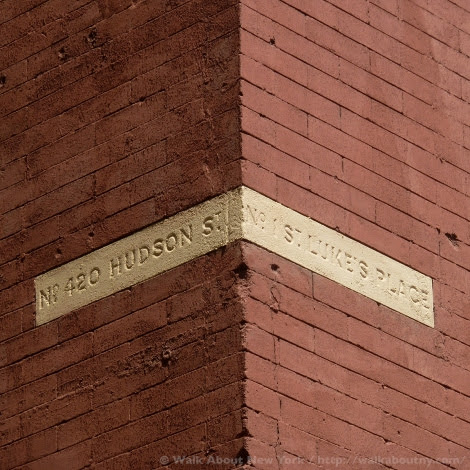
One building, two address.
Built in 1910, 420 Hudson Street/One St. Luke’s Place is a four-story, four-unit residential building. It has both addresses listed on this thin piece of stone. Hudson Street is a north-south running commercial thoroughfare; St. Luke’s Place, on the other hand is residential and most unusual. When Trinity Church was granted a charter in 1696 by England’s William II gave the church land, extending along the west side of Manhattan from present-day Wall Street to Greenwich Village. The church established St. John’s Cemetery, covering a two-block area east of Hudson Street, in 1812. For ease of access the city wanted to extend Leroy Street, which stopped on the east side of the burial ground and continued on the west side of it. Using its power of emanate domain to push through the cemetery in the early 1850s, half the cemetery remained; the other half had some of its graves moved, others not. On the north side of the street Trinity developed the land with a string of elegant houses. To help sales this newly-created stretch of Leroy Street was given some cachet by renaming it St. Luke’s Place; a consecutive, rather than alternating, numbering system was used too. After a succession of wealthy,19th-century merchants home owners, like the rest of Greenwich Village St. Luke’s Place took on a bohemian air in the early to mid-20th century. Max Eastman (1883–1969), editor of the revolutionary journal “The Masses,” lived at 11 St. Luke’s Place. Theodore Dreiser (1871–1945) began his novel “An American Tragedy.” At No. 16. Marianne Moore (1887–1972), Pulitzer Prize winner poetess, lived at No. 14 in the 1920’s when she was editor of the literary magazine, “The Dial” and working at the NY Public Library branch across the street. Painter Paul Cadmus (1904–1999) lived at No. 5 in 1934 when the U.S. Navy censored his painting “The Fleet’s In,” from an exhibition of WPA artists at the Corcoran Gallery in Washington, DC.
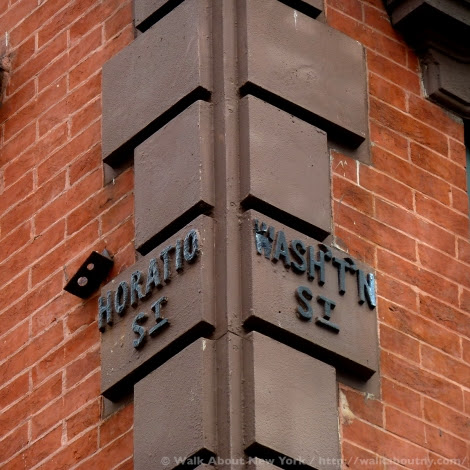
With a curious abbreviation of “Washington” this sign identifies this street corner on the sides of 92 Horatio Street, located in the West Village. Built in 1920 when this area was still rough not only around the edges but at its heart because of its proximity to the active piers of the waterfront; 100 years on this is now called in real estate lingo ”a boutique cooperative apartment building.” Divided into 77 units spread out over five floors this building is on the edge of the gentrified Meatpacking District.
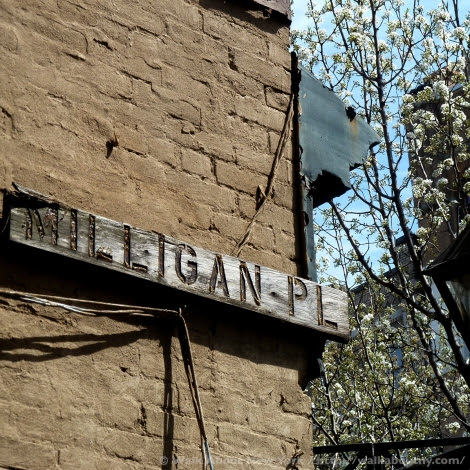
A most unusual wooden street sign.
Not a vehicular street but a secluded, gated courtyard off Sixth Avenue, Milligan Place is only big enough to hold four late 1840s dwellings. This area of Greenwich Village was part of the 300 acres belonging to Vice Admiral Sir Peter Warren (1703–1751). Some of the estate was sold to Samuel Milligan in 1799. Aaron Patchin, who married Mr. Milligan’s daughter, Isabella, surveyed the land that same year. The father-in-law gave his name to cute little Milligan Place and the son-in-law gave his to Patchin Place, around the corner and backing onto the former. Tradition tells us that the three-story structures on both places were originally built as housing for the Basque staff of the first hotel built on Fifth Avenue, the 1854 Brevoort Hotel, only three blocks away.
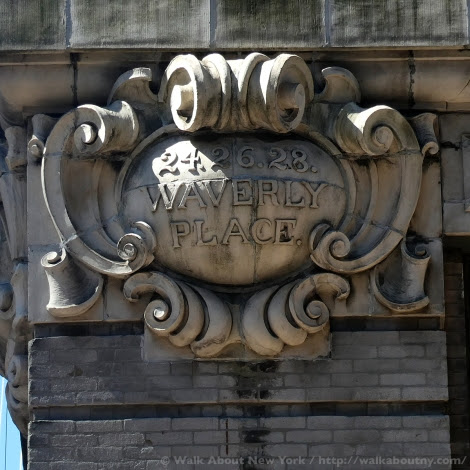
A Beaux-Arts street sign.
Known as the Waverly Building, 24 – 28 Waverly Place is one of four corner Beaux-Arts buildings at Waverly Place and Greene Street. New York University’s Department of Music is located here, and the building is used for classrooms. Named in 1833 for Sir Walter Scott’s 1811 novel, though spelled differently, Waverly Place runs between Broadway to the east to Bank Street in the west. Number 24 Waverly Place is close to Broadway. For fans of “Mad Men,” Don Draper’s bachelor pad is located on Waverly Place in Greenwich Village.
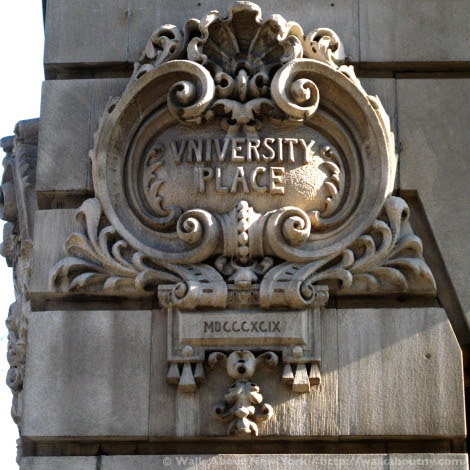
A second Beaux-Arts street sign.
A general-office, multi-tenant building, 99 University Place dates from 1900. Running north and south University Place travels from Washington Square Park at its southern end and comes to an end at East 14th Street, near Union Square. Once part of Wooster Street, it was renamed in 1838, the year after New York University moved to the east side of Washington Square. The street has been the location of several education-related institutions, the Union Theological Seminary in 1838, the New York Society Library in 1856, and the Industrial Education Association, the precursor to Teachers College, in the late 1880s. The street is home to shops and restaurants, many catering to students at NYU and The New School.
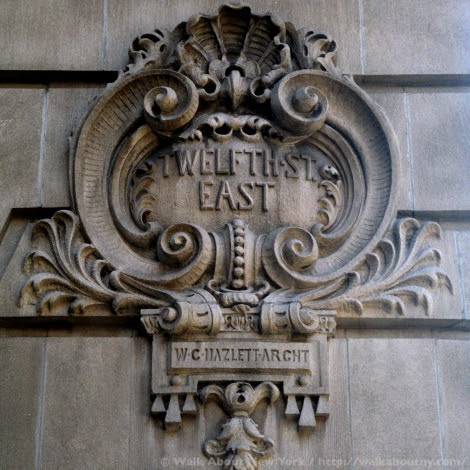
A third Beaux-Arts street sign.
On the East 12th Street side of 99 University Place, the Beaux-Arts flourishes continue for this street sign. Part of the NYC’s east-west street grid, adoped in 1811, East 12th Street at this point is a mix of residential, commercial, and business properties. The neighborhood is kept young and lively with students from NYU and the New School.
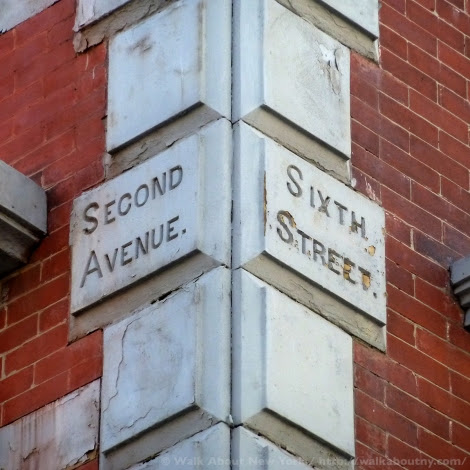
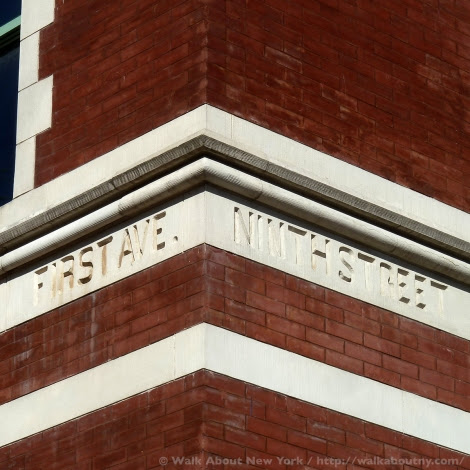
Notice the periods following ‘Avenue’ and ‘Street.’
With a double address—101 Second Avenue and 240 East Sixth Street—this five-story apartment building dates from 1877. Its ground floor houses Block Drug Store, which was established in 1881. The street names are chiseled into two of the original stone quoins. Although this part of town is known today as the East Village, from 1870 to the mid-20th century it was Little Ukraine. Centered on Sixth and Seventh Streets between First and Third Avenues at its height 60,000 Ukrainian immigrants called this area home. A more diverse neighborhood in the 21st century, and few remember its nickname, some reminders, such as the Ukrainian Museum and some restaurants, such as Veselka, remain of the time when this area was a magnet for Ukrainian immigrants.
Set in stone, likely marble.
As part of the limestone trim, the stone identifying the corner of First Avenue and Nineth Street is set into the façade of what was originally Public School 122. Built in 1885 by the architect and superintendent for school buildings, Charles B.J. Snyder (1860–1945), the school was abandoned in 1976. A community center was established at 150 First Avenue soon after; and it still operates within the building. Artists, including Keith Haring, and dancers, including Charlie Moulton, Peter Rose, Charles Dennis, and Tim Miller began to work there. Director Alan Parker filmed “Fame” there in 1979. Money paid to use the former school for filming allowed for renovations, including a dance floor. In 1980 Performance Space 122 was established within the building, and “performance art” in the early 1980s was defined by artists who worked there. The careers of Karen Finley, Spalding Gray, John Leguizamo, and others got their start and encouragement at Performance Space 122.
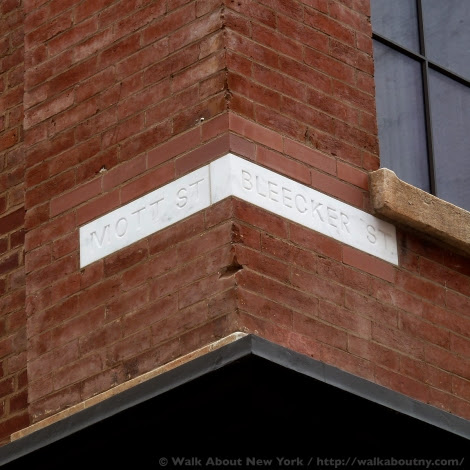
A standout sign, white against red.
Dating from 1883 the building at 36 Bleecker Street has a white marble street identifier that stands out against the red brick. Built to house the Schumacher and Ettinger Lithography Studio, it has housed the operations of other printer-related businesses during its lifetime. The seven-story, Queen Anne and Romanesque-styled building was converted to condos in 2013. Since 1991 the corner of Mott and Bleecker has been co-named for Margaret Sanger (1879–1966), the founder of Planned Parenthood, which has its executive offices at 26 Bleecker Street. Named for Anthony Lispenard Bleecker (1741– 1816), an early 19th-century landowner and farmer, travels from The Bowery in the east to Eighth Avenue in the west. Tradition tells us that Mott Street was named for Joseph Mott, a butcher and innkeeper; but the name is of uncertain origins.
See unusual and unexpected sights when you take our guided walking tours of New York City. Take the Tour; Know More!
BOSTON CITY HALL ANDY SPARBERG, M.FRANK AND HARA REISER GOT IT RIGHT
Text by Judith Berdy Thanks to Bobbie Slonevsky for her dedication to Blackwell’s Almanac and the RIHS Thanks to Deborah Dorff for maintaining our website Edited by Melanie Colter and Deborah Dorff
All image are copyrighted (c) Roosevelt Island Historical Society unless otherwise indicated
Sources
Illustrations, from above: view of a PoW Camp, Isle of Man, April 1918 by George Kenner; Ellis Island in 1903 as seen from New York Harbour (New York Historical Society); Omne Bonum, a fourteenth century bishop instructing clerics with leprosy: Medieval depictions of leprosy commonly showed the patient to have red spots by James le Palmer (British Library); The leper (Lazarus clep), 1631 by Rembrandt; the island of Spinalonga and its abandoned leper colony; and abandoned North Brother Island (background) and South Brother Island in the middle of East River, less than a mile from Manhattan.
FUNDING PROVIDED BY ROOSEVELT ISLAND OPERATING CORPORATION PUBLIC PURPOSE GRANTS CITY COUNCIL REPRESENTATIVE BEN KALLOS DISCRETIONARY FUNDING THRU DYCD