WORLD’S FAIR IMAGES FROM THE MUSEUM OF THE CITY OF NEW YORK
Monday, September 22, 2025
MUSEUM OF THE CITY OF NEW YORK
ALL IMAGES PROPERTY OF MCNY
Issue # 1538
Today, it is Flushing Meadows Park, home of the US Open, Queens Museum, Queens Theatre in the Park and long forgotten, two worlds’ fairs.
The 1939-1940 fair was a turning point on contemporary design. So many innovative structures were housing exhibits. The architects and designers became famous for decades
The structures were built to bed demolished and today only photos remain.
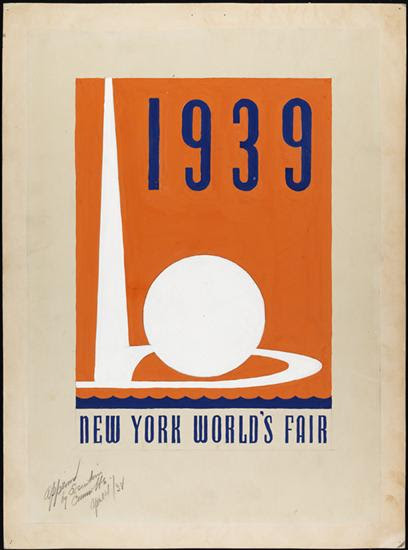
Creator New York World’s Fair (1939-1940). Board of Design
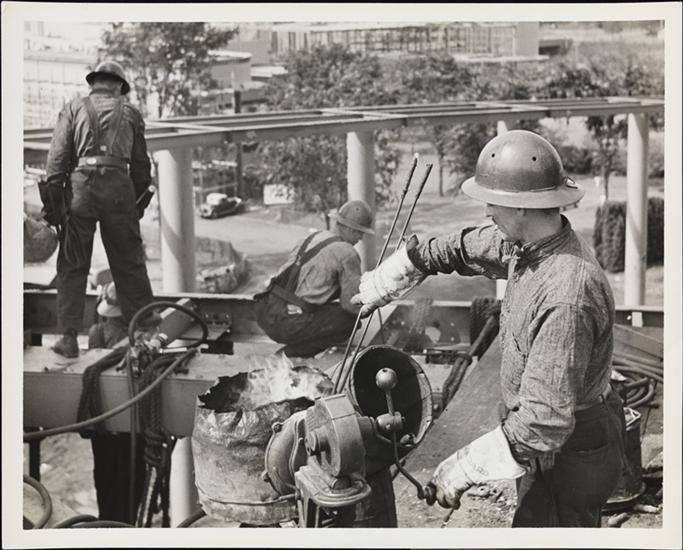
They Build the Fair (Theme Center Riveters) Photographer Richard Wurts
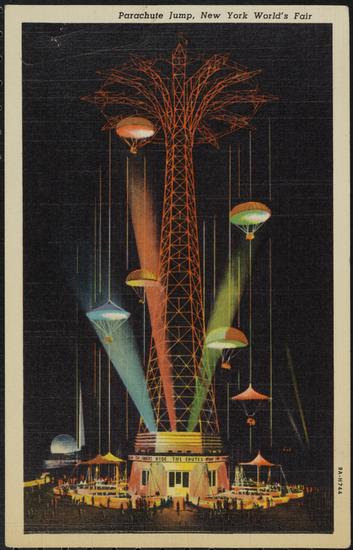
Parachute Jump, New York World’s Fair Creator Curt Teich & Co., Interborough News Company Accession number X2011.34.4304 Unique identifier MNY286985 Description Officially Licensed. Lic. by N.Y.W.F. 1939 – K-1877 | In 1941, the Tilyou family purchased the Parachute Jump and moved it to Steeplechase Park in Coney Island.
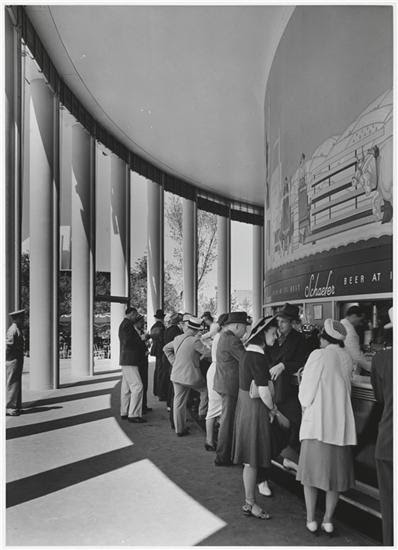
Schaefer Center at the 1939 New York World’s Fair Photographer Samuel H. (Samuel Herman) Gottscho (1875-1971) Accession number 50.137.2 Unique identifier MNY71940 Description View of a circular bar in front a mural. Men and women are gathered in front of the bar, bartenders are behind. Dated 1939
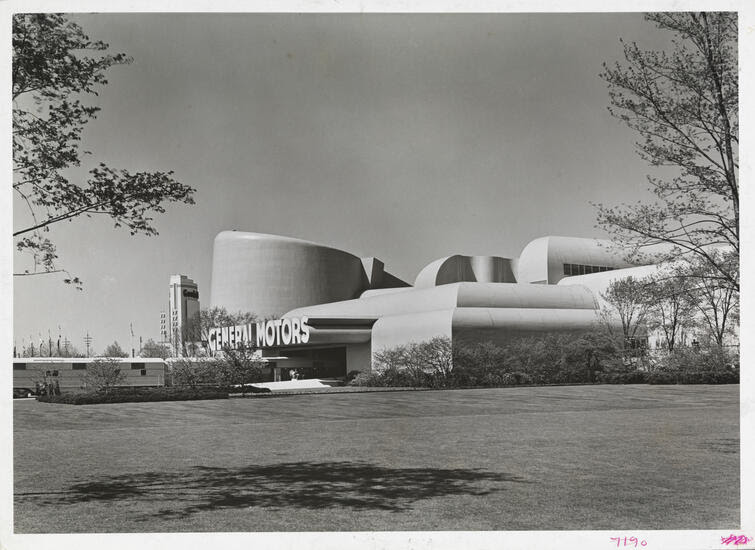
General Motors Building at the 1939 New York World’s Fair Photographer Samuel H. (Samuel Herman) Gottscho (1875-1971) Accession number 50.137.22 Unique identifier MNY71952 Description Exterior view of the General Motor’s Building from the southeast. Dated 1939
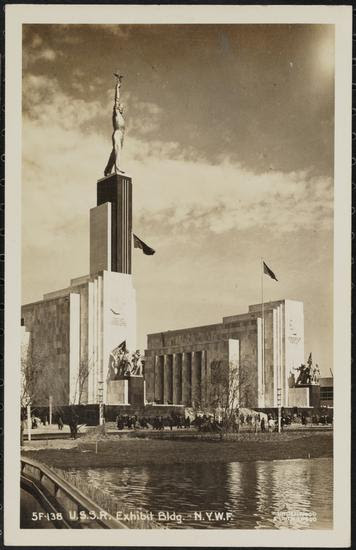
U.S.S.R. Exhibit Bldg. – N.Y.W.F. Accession number X2011.34.4302 Unique identifier MNY286978 Dated ca. 1939 Object Type postcard
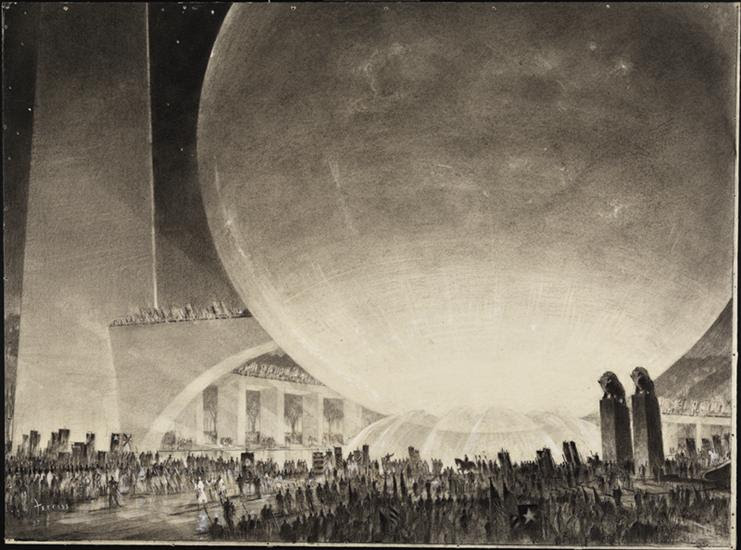
Perisphere Creator Hugh Ferriss (1889-1962) Accession number 2011.15.129 Unique identifier MNY13686 Description Black and white rendering of crowds at base of Theme Center (Trylon, Perisphere and Helicline) at night, New York World’s Fair 1939. Dated 1937
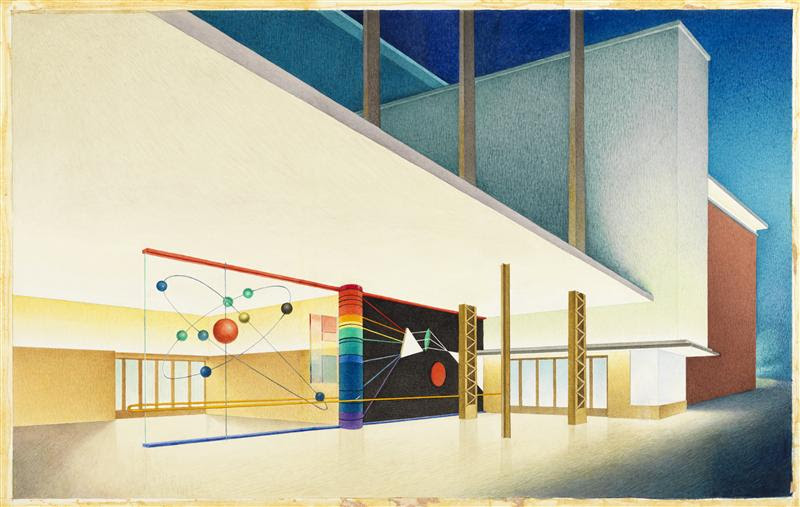
Chemicals and Plastics Building Accession number 41.44.218 Unique identifier MNY12351 Description Interior perspective drawing of Chemical and Plastics Building, showing 3 dimensional exhibit panel and cutaway roof to expose portion of exterior building, New York World’s Fair 1939.; Dated ca. 1938 Object Type watercolor (painting)
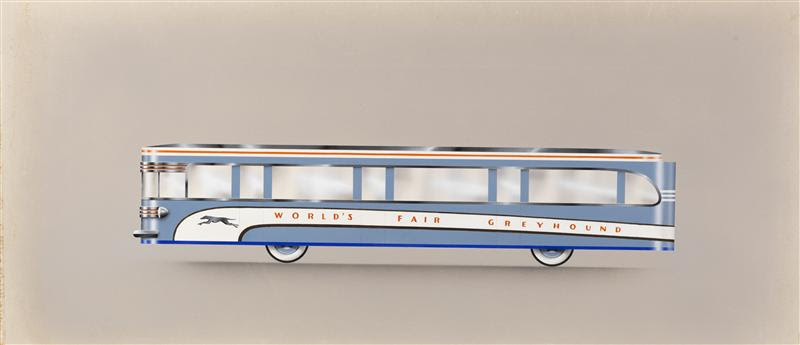
Proposed design for Greyhound Bus Creator Raymond Loewy (1893-1986) Accession number 2011.15.69 Unique identifier MNY845 Description Colored elevation drawing of streamlined coach for Greyhound bus for transport within fairgrounds; New York World’s Fair 1939. Dated 1938 Object Type painting (visual work)
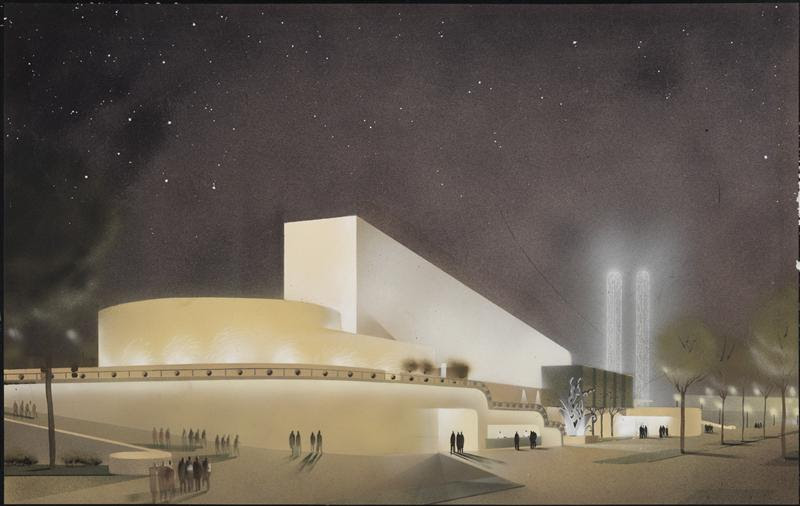
Stage at Columbia Recording Company Building, New York World’ Fair 1939. Accession number 41.44.240 Unique identifier MNY23139 Description Watercolor and ink on paper Colored drawing of interior, Columbia Recording Company stage, with insets of various arrangements for recording and showing motion pictures, New York World’s Fair 1939. Dated ca. 1938
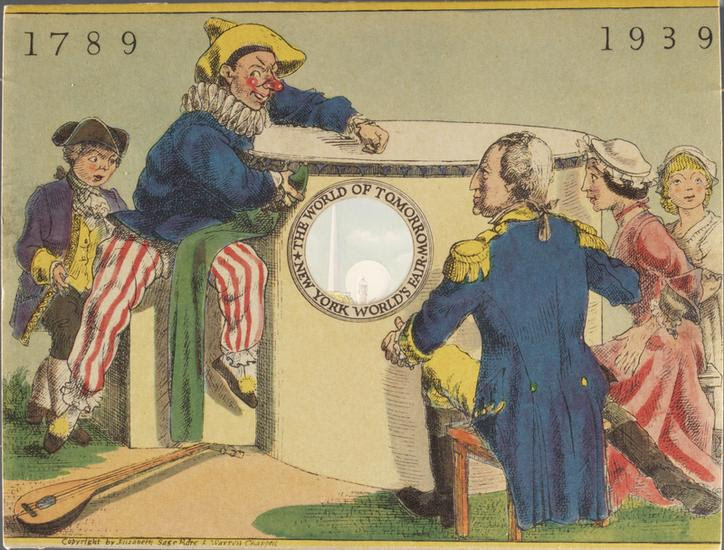
The World of Tomorrow. New York World’s Fair. Accession number 95.120.5 Unique identifier MNY286200 Description The New York World’s Fair 1789-1939 | NYWF LIC 750 | Copyright by Elizabeth Sage Hare & Warren Chappell. | Object opens to reveal accordion-like layers.
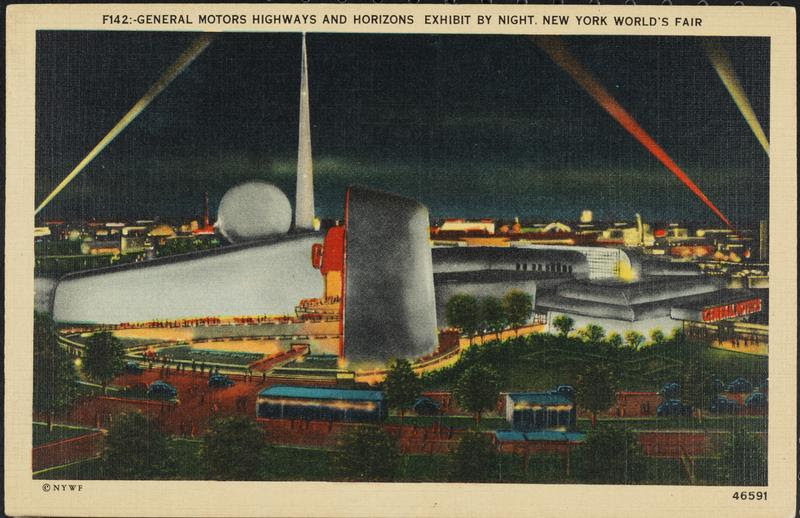
General Motors Highways and Horizons Exhibit by Night, New York World’s Fair Creator Manhattan Card Publishing Co. Accession number F2011.33.2063 Unique identifier MNY286476 Description “N.Y.W.F. LIC. 2965” Officially Licensed Dated ca. 1939
Happy 80th Ella!
CREDIT TO
Museum of the City of New York
All image are copyrighted (c) Roosevelt Island Historical Society unless otherwise indicated THIS PUBLICATION FUNDED BY DISCRETIONARY FUNDS FROM CITY COUNCIL MEMBER JULIE MENIN & ROOSEVELT ISLAND OPERATING CORPORATION PUBLIC PURPOSE FUNDS.
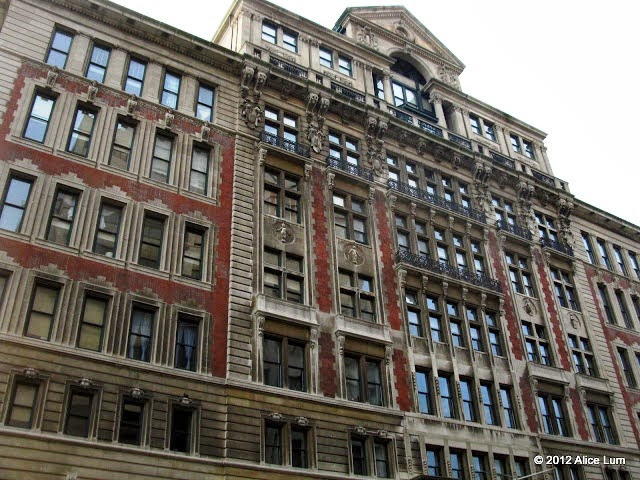
Recently I spent some time on 17th Street looking out the hospital window at 302 Second Avenue, especially staring at the bas reliefs of swaddled infants. It was time to check out the building accross the street. (The building has been restored since the photos, and the stonework is glowing white now).
James Wright Markoe earned his medical degree in 1885 at the College of Physicians and Surgeons at Columbia University. The strapping young man was as physically-inclined as intellectually. The New-York Tribune would later say of him “As a young man he was an athlete. He spent much of his spare time in the gymnasium boxing, and was classed as one of the best amateur boxers at that time.”
Boxing would soon take a back-seat to a more humanitarian interest, however. Following graduation he traveled to Munich where he spent a year advancing his medical studies. While at The Frauenklinik of Von Winkel learning obstetrical procedures, he and fellow student Samuel W. Lambert recognized the need for a clinic in New York to help needy mothers-to-be.
Manhattan at the time was filling with immigrants who struggled to survive in grimy, crowded tenements. Unsanitary conditions coupled with the inability to pay for medical help resulted in a catastrophic infant mortality rate within the tenement community. Upon the doctors’ return to New York they established the Midwifery Dispensary in 1890.
The clinic opened in a house at No. 312 Broome Street and shortly thereafter was combined with the long-defunct Society of the Lying-In Hospital. Expectant women flocked to the new facility, quickly resulting in the need for an expanded and improved space.
Dr. James Markoe not only practiced medicine among wealthy society, he was a member of it. He held memberships in the exclusive Metropolitan, Century, Racquet and Tennis, and New York Yacht Clubs. For years he was a vestryman in the highly-fashionable St. George’s Church on Stuyvesant Square.
Among James Markoe’s moneyed patients was millionaire J. Pierpont Morgan. Markoe not only became his personal physician, but a close friend. It was a friendship that would create financial advantages for Markoe’s pet project.
In 1894 the Hamilton Fish mansion at the corner of 17th Street and Second Avenue was purchased and converted for the hospital. The New York Times said “In this fairly commodious house the work of the association has increased” and quickly the building was not sufficient to care for the stream of patients. By 1895 the push was well underway to expand the Lying-In Hospital and build a new facility. On March 14 of that year Mayor William Lafayette Strong introduced a bill appropriating $12,000 to the Society of the Lying-In Hospital—about a quarter of a million dollars in today’s money.
“The Mayor asked any one who had anything to say in opposition to the appropriation of $12,000 for the Lying-In Hospital to state their objections first,” reported The New York Times. “No one responded, and the Mayor said that he was not surprised, as it would be a queer kind of man who would oppose such a charity.”
Private donations came in; but at a rather disappointing rate—at least to the mind of J. Pierpont Morgan. In 1896 donors had given $53,738; not nearly enough to even consider a new structure. On January 4, 1897 Morgan penned a letter to William A. Duer, the President of the Society of the Lying-In Hospital:
Dear Sir: I have for some time thought it desirable that your society should erect upon the land recently purchased from the estate of Hamilton Fish a suitable building for the needs of the hospital.
Being of this opinion, I have had preliminary studies made by Mr. Robertson, as architect, which I think will be satisfactory to your Board of Governors; if not, they can easily be modified.
The architect, “Mr. Robertson,” was the esteemed Robert Henderson Robertson. Morgan had taken it upon himself to choose the architect and lay out stipulations on the building’s construction. His letter would go on to explain why he had every right to do so
I assume that the cost of the building will be about $1,000,000, which sum I am prepared to donate for that purpose. The only conditions that I make are:
First—That before the building is erected it shall be apparent that the income of the hospital, from endowment or other sources, render it in all human probability sufficient to meet expenses, after the new building shall be erected.
Second—That the plans and the carrying out of same, from a medical point of view, shall be satisfactory to Dr. James W. Markoe. Yours very truly. J. Pierpont Morgan.
Morgan had put Markoe fully in command of the design of the medical aspects of the structure. The New York Times quickly published Robertson’s preliminary plans.
On January 15, 1897 the newspaper said “The proposed new hospital building will be a handsome and imposing structure of granite and pressed brick, thoroughly fireproof, ten stories in height…It will have every improvement and convenience known in modern architecture and applicable to hospital purposes. It will have accommodations for 250 patients, and, as the patients are usually discharged in two weeks, the total capacity of the hospital will be about 6,500 a year, while the outdoor service is practically unlimited.”
Invigorated by the sudden windfall, the Governors of the Society set to work to raise additional funds. Morgan’s stipulation was, after all, that the hospital be financially independent. “But they seem nowise afraid of the future,” reported The New York Times. “They expect to raise not less than $1,000,000 in a reasonable time, and are even hopeful that they may exceed that amount.”
Morgan’s patronage of the hospital was possibly a factor in its becoming a favorite money-raising event among New York’s wealthiest socialites. On February 27, 1898 The New York Times wrote “One of the most important Lenten entertainments to which society people are now looking forward will take place on the afternoon and evening of Saturday, March 19 at the Waldorf-Astoria. The Society of the Lying-In Hospital of the City of New York is to be beneficiary, and the fashionable set have come out in force to give it their patronage.”
The article listed the ladies who put their significant social heft behind the affair, including Caroline Astor, Mrs. John Jacob Astor, Mrs. Stuyvesant Fish, Mrs. Ogden Mills, Mrs. Hermann Oelrichs, Mrs. Frederic W. Vanderbilt and other prominent names like Rhinelander, Sloane, Lorillard, Whitney, Stokes, Baylies, Dodge and Morton.
The old Fish mansion was demolished and erection of the hulking new hospital began. Morgan’s initial $1 million donation proved insufficient. The New-York Tribune noted that “Because of a rise in the price of structural materials, Mr. Morgan subsequently gave $500,000 additional.”
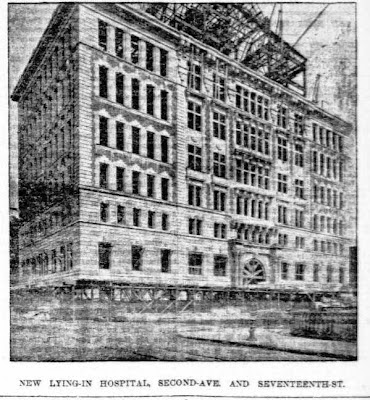
The building neared completion in August 1900 — New-York Tribune, August 13, 1900 (copyright expired)
By August 13, 1900 the building was taking form and the New-York Tribune updated readers on the progress. “The exterior of the main structure lacks only a few additions in the way of casements and doors to make it complete, and the gangs of men employed upon the central superstructure are busily at work on the iron frame.”
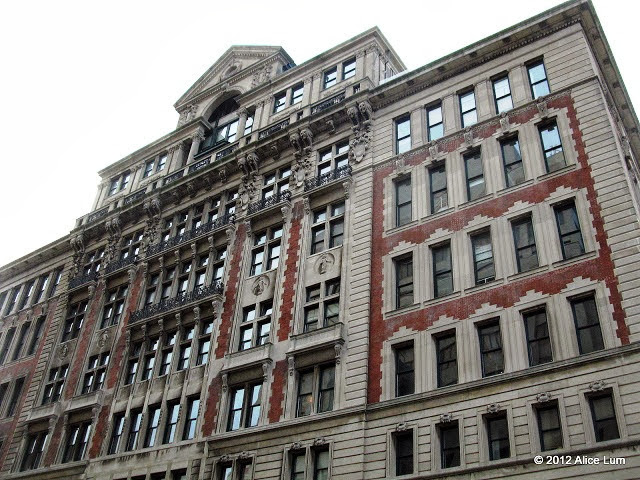
The newspaper was not especially impressed with Robertson’s design. “The main building arrests the attention of the passer by not so much because of its architecture, which is markedly lacking in ornate features, but because it stands in such striking contrast with its immediate neighborhood. It towers high above the adjacent dwelling houses, and its walls of gray Ohio limestone and bright red brick stand out sharply in comparison with their dingy brownstone.”
In explaining to its readers the purpose of the new building, the newspaper waded into what, by a 21st century viewpoint, was a swamp of potentially-offensive verbiage. “The erection of this great hospital is perhaps the logical outcome of the tremendous racial changes which have been going on in that district of the city during the last thirty or forty years. The influx of a vast foreign element has altered what was once an exclusively residence part of the city to one occupied largely by tenement dwellers. The increasing congestion of this kind of population naturally demanded hospitals, and the need of a great maternity hospital became most imperative.”
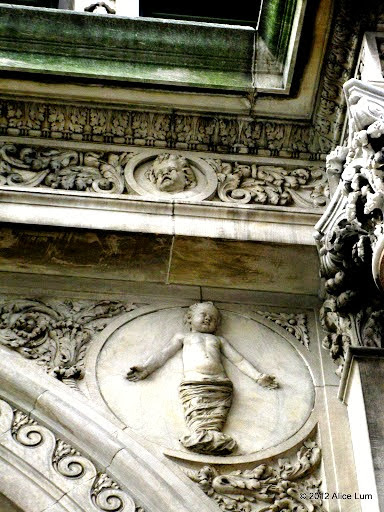
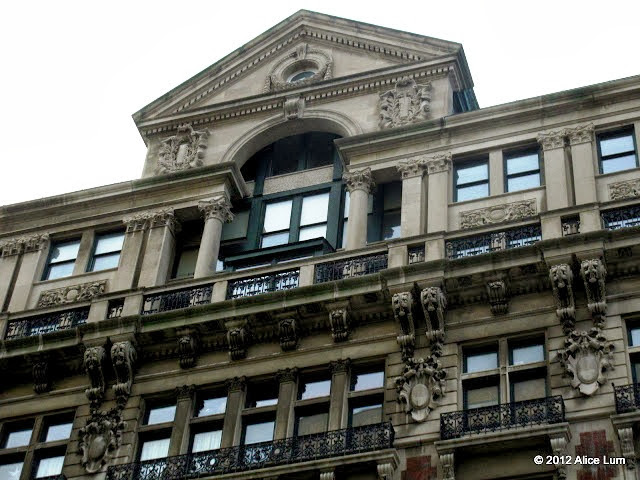
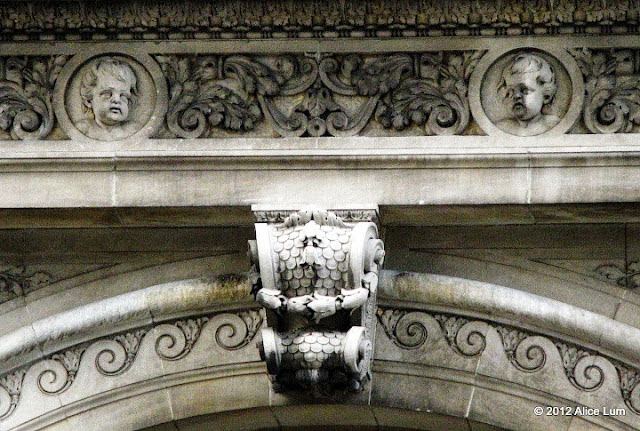
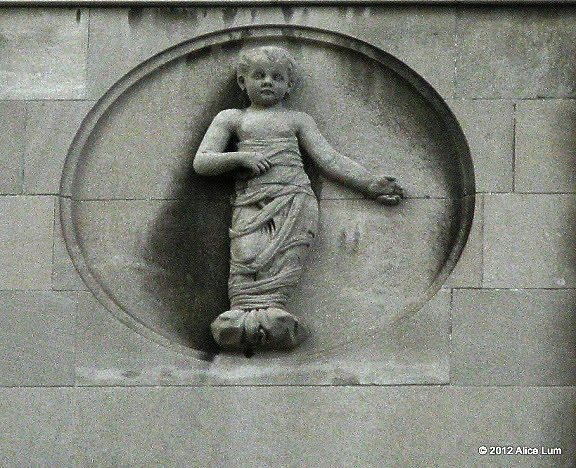
The hospital opened in January 1902; a stately Renaissance Revival structure surmounted by a Palladian pavilion. Although the Tribune complained that it lacked ornamentation, Robertson creatively included sculptures of chubby babies within the spandrels, in medalions, and within the friezes.
Adorable bas reliefs of swaddled infants appear along the facade — photo by Alice Lum
The first floor housed the offices of the doctors, the second and third floors were for “the clerical department” and accommodations for 52 nurses, while the fourth, fifth and sixth floors housed the wards. The kitchen and laundry were on the top two floors and a solarium was on the roof.
Robertson brought the design to a dramatic climax with the Palladian pavilion — photo by Alice Lum
The paint was barely dry before the expectant mothers filed in. Eight months later there had been 1,278 applicants seeking ward treatment–an average of 160 per month. In the meantime, doctors going into the field to treat the impoverished women in their homes found their jobs not always the easiest.
On August 2, 1902, just eight months after the new hospital opened, the husband of Jennie Davis rushed to get medical help as she went into labor in their apartment at No. 368 Cherry Street. Two doctors of the Lying-In Hospital, Dr. Rose and Dr. Tailford, arrived with a visiting physician. Word spread among the concerned neighbors that Rose and Tailford were students who were observing and helping a veteran doctor.
When the visiting physician left the woman in the care of Rose and Tailford, whom the neighbors supposed were merely students, a near riot broke out. The New-York Tribune reported “After examining the woman, the one the neighbors thought was a physician went away on other business, leaving the supposed students in charge of the case. Relatives and neighbors crowded in and objected to their way of treating the woman.”
Tragically, in the uproar that followed the doctors were interrupted in their treatment and Mrs. Davis died. “The crowd grew excited and threatening, and in the excitement the woman died before the child was born,” said the newspaper. The enraged group, now a rabble, seized the doctors and threw them down the tenement stairway.
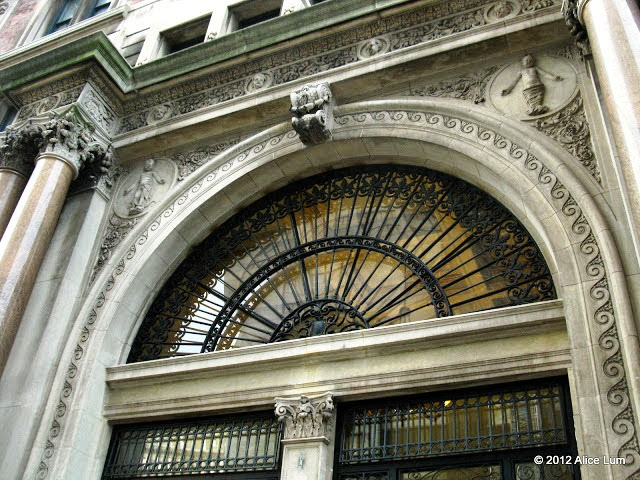
The poorest of New York City’s citizens passed through a magnificent entranceway — photo by Alice Lum
James W. Markoe continued on as Medical Director and attending surgeon at the Lying-In Hospital. In his will J. Pierpont Morgan bequeathed Markoe an annual income of $25,000 for life “because of his service at this hospital,” as reported in the New-York Tribune.
On Sunday morning April 18, 1920 as services at St. George’s Protestant Episcopal Church drew to a close, Markoe was walking up the aisle with the collection plate. Suddenly Thomas W. Simpkin, a stranger to the congregation, rose from his seat near the rear of the church and fired a bullet into the forehead of the doctor. The shooter was described in The New York Times the following day as “a lunatic, recently escaped from an asylum.”
Within seconds the life of the celebrated surgeon, the victim of an irrational act, had been snuffed out. His will instructed that had his wife and daughter not survived him, his entire estate was to be left to his beloved Lying-In Hospital.
Close inspection reveals infants popping up throughout the ornamentation — photo by Alice Lum
As the years passed, John Pierpont Morgan, Jr. was concerned about the long-term stability of the hospital his father had so generously provided for. He recruited John D. Rockefeller, Jr.; George F. Baker, Sr.; and George F. Baker, Jr. to join forces in establishing an association with New York Hospital. Upon the subsequent opening of the New York Hospital-Cornell Medical Center in 1932, the Lying-In Hospital moved out of the Second Avenue building. It became the more modern-sounding Obstetrics and Gynecology Department of New York Hospital.
In 1985 the architectural firm of Beyer Blinder Belle renovated the building—already added to the National Register of Historic Places—as offices and residential spaces. Like the New-York Tribune in 1900, the “AIA Guide to New York City” was reserved in its assessment of the design, calling it “boring until the top.”
The “top,” however, makes up for the “boring” and the delightful limestone babies—reminders of the building’s original purpose—are guaranteed to bring a smile.
photo by Alice Lum
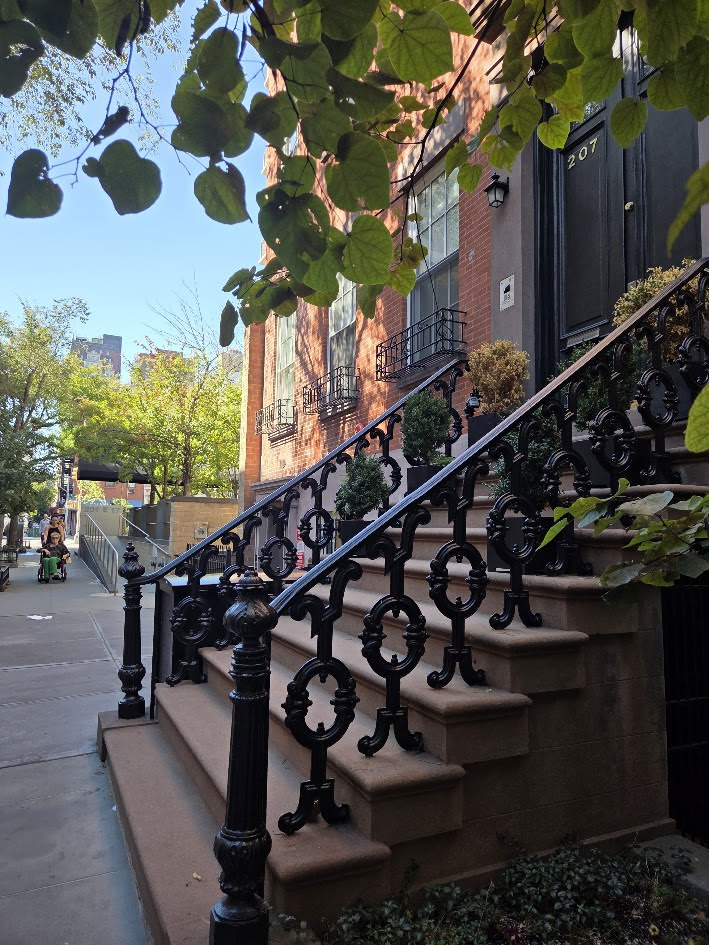
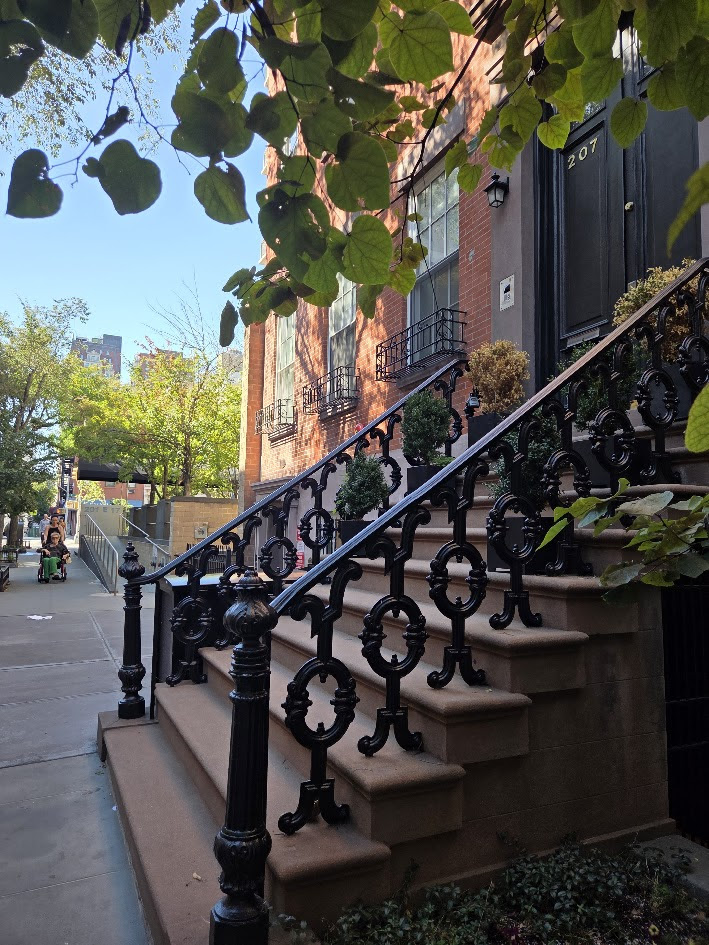
SURPRISING 17TH STREET
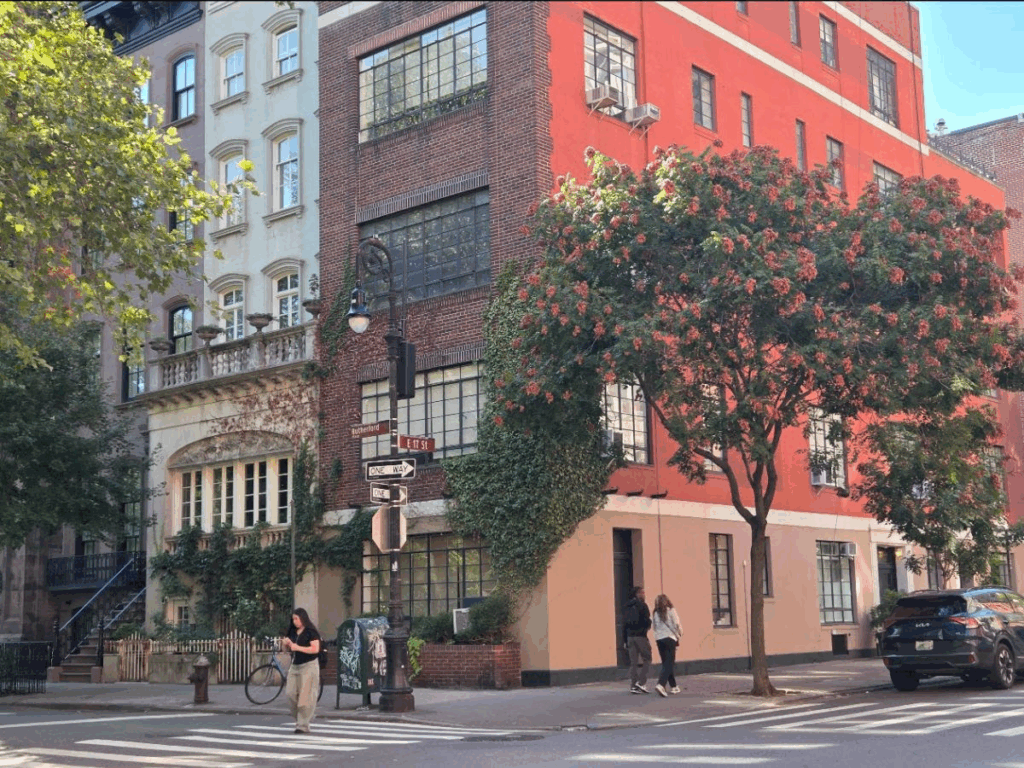
The Corner of Rutherford Place and 17th Street.
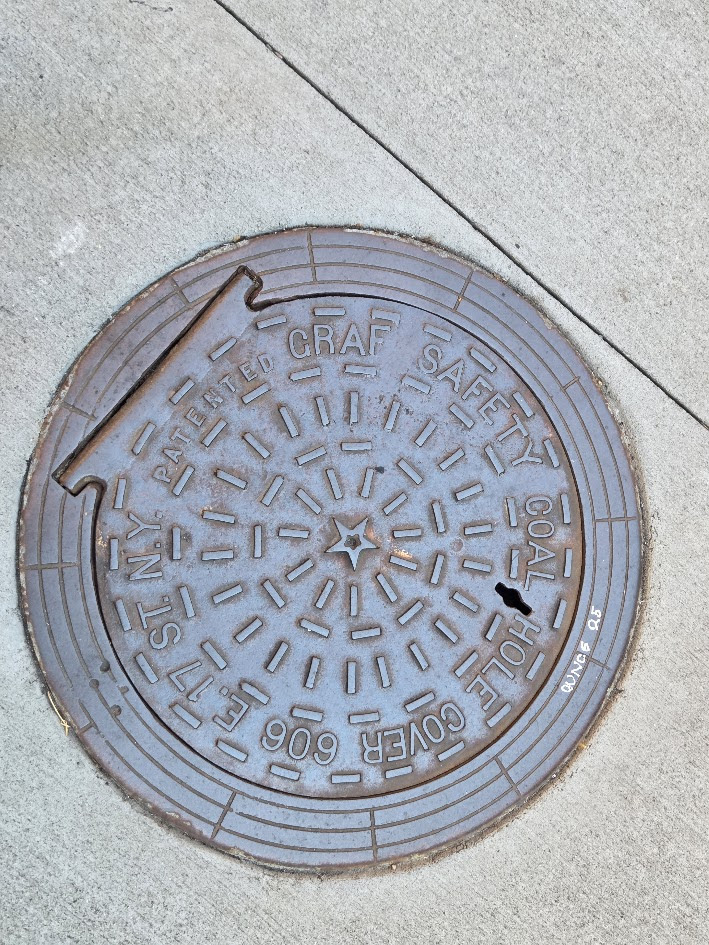
Every house needs a COAL HOLE COVER, still neatly on the sidewalk
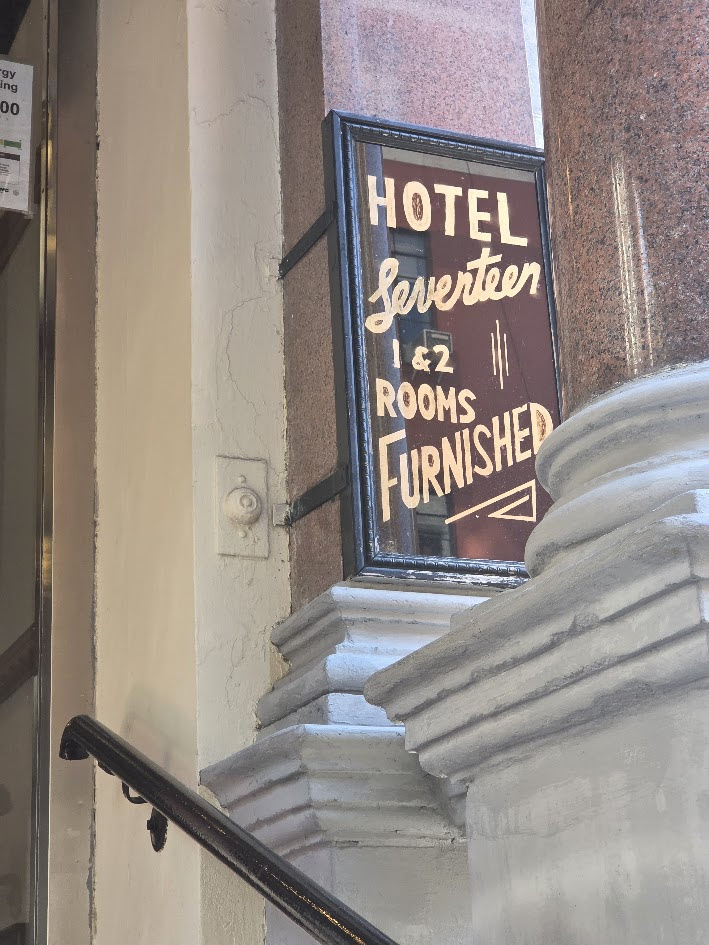
There still are furnished room houses! A rare site these days.
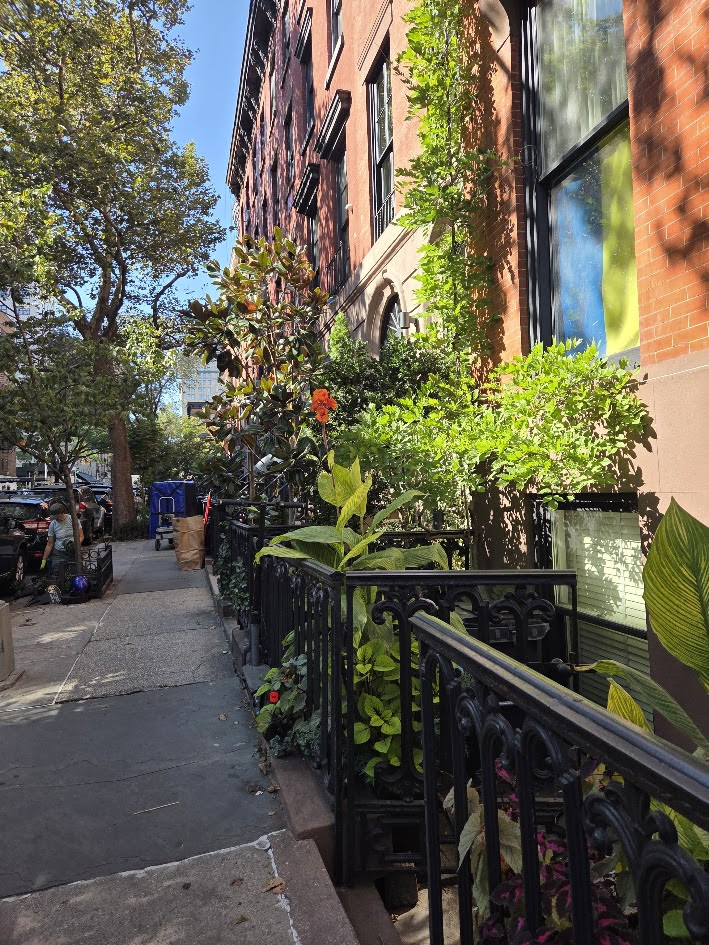
These brownstones have professionally tended fronts along with wonderful ironwork.
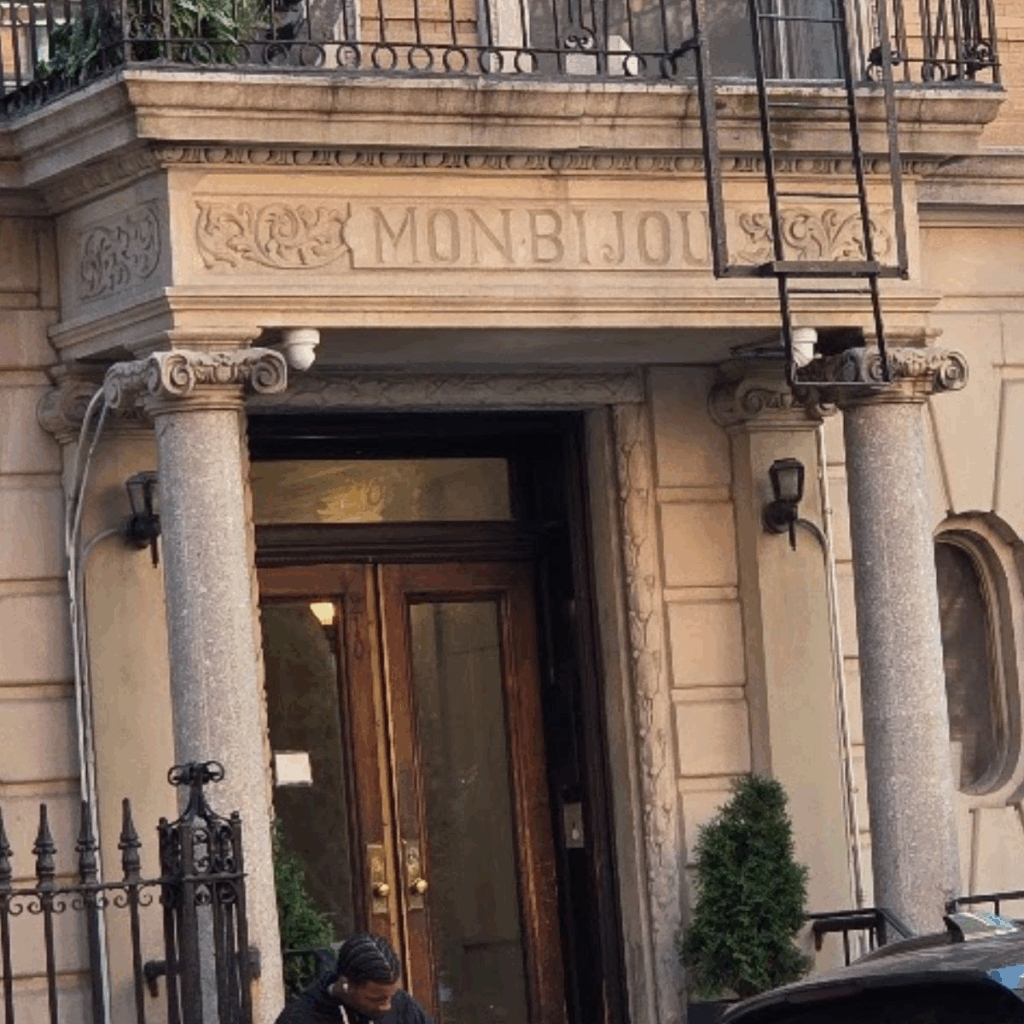
“MON BIJOU” a grand name for this building
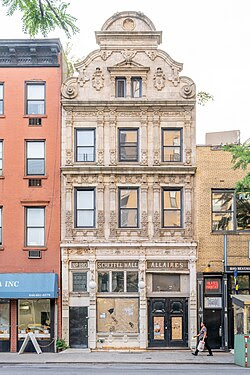
Still standing this landmark Scheffel Hall, (from Wikipedia)
Scheffel Hall at 190 Third Avenue in the Gramercy Park neighborhood of Manhattan, New York City, was built in 1894–1895, and designed by Henry Adams Weber and Hubert Drosser, at a time when the area south of it was known as Kleindeutschland (“Little Germany”) due to the large number of German immigrants who lived nearby. The building, which served as a beer hall and restaurant, was modeled after an early 17th-century building in Heidelberg Castle, the “Friedrichsbau”, and was named after Joseph Viktor von Scheffel, a German poet and novelist. It later became known as Allaire’s,[1] a name still inscribed on the building. The building’s style has been described as “German-American eclectic Renaissance Revival”.[2]
Later, in the late 1920s, the building was used by the German-American Athletic Club. By 1939 it became the German-American Rathskeller,[1] and then Joe King’s Rathskeller. O. Henry used Scheffel Hall as the setting for “The Halberdier of the Little Rheinschloss” and wrote some of his stories there.[1] Beginning in the 1970s, it was the home of Fat Tuesday’s, a well-known jazz club, and the restaurant Tuesday’s, which lasted until the early 21st century. In subsequent years it was a yoga and pilates studio and today is unoccupied.
Concert this Sunday at 5 p.m. Good Shepherd Chapel
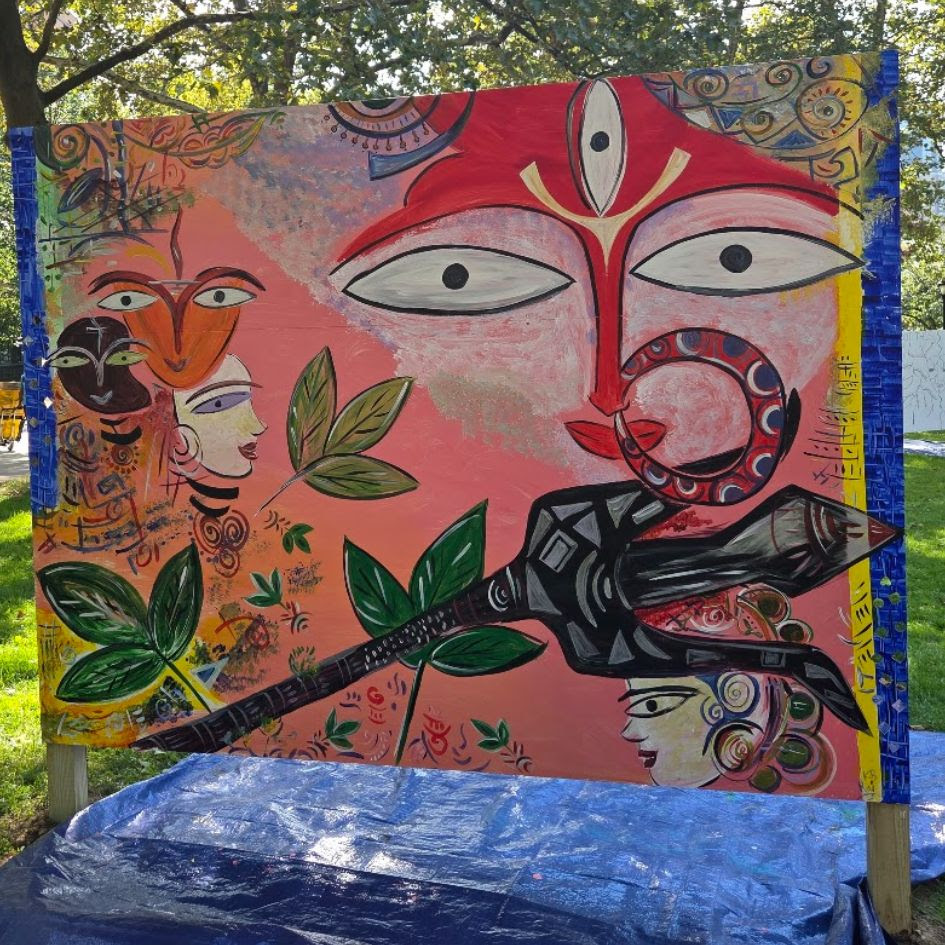
A WONDERFUL ARTWORK AT FALL FOR ARTS
Credits
DAYTONIAN IN MANHATTAN WIKIPEDIA JUDITH BERDY
All image are copyrighted (c) Roosevelt Island Historical Society unless otherwise indicated THIS PUBLICATION FUNDED BY DISCRETIONARY FUNDS FROM CITY COUNCIL MEMBER JULIE MENIN & ROOSEVELT ISLAND OPERATING CORPORATION PUBLIC PURPOSE FUNDS.
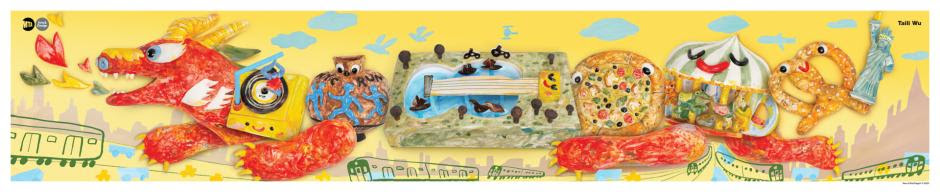
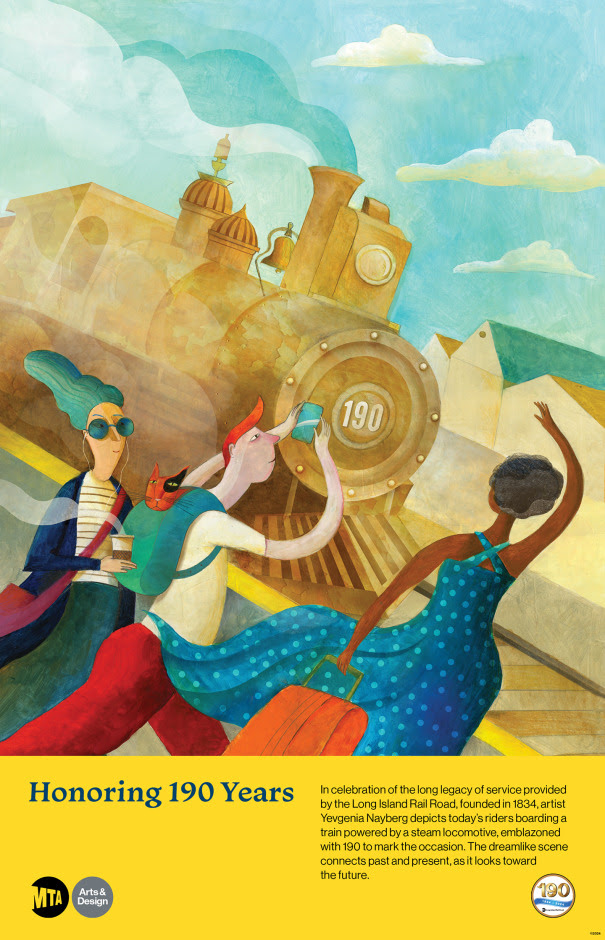
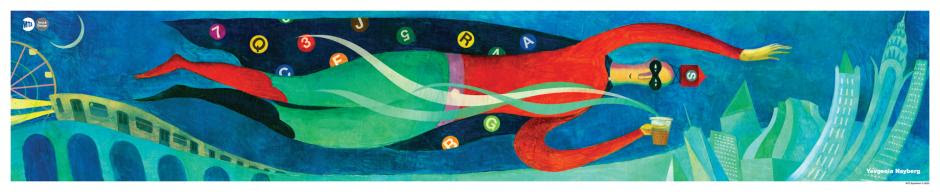
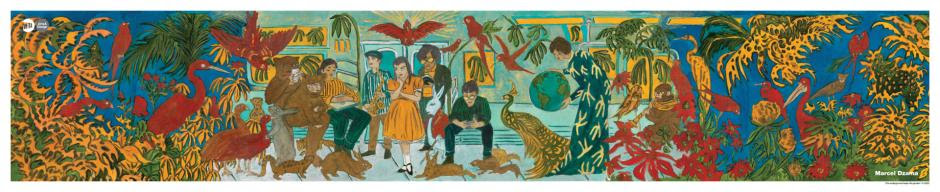
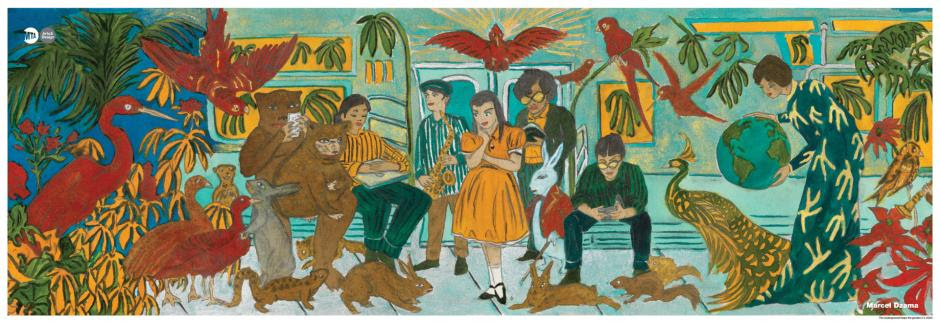
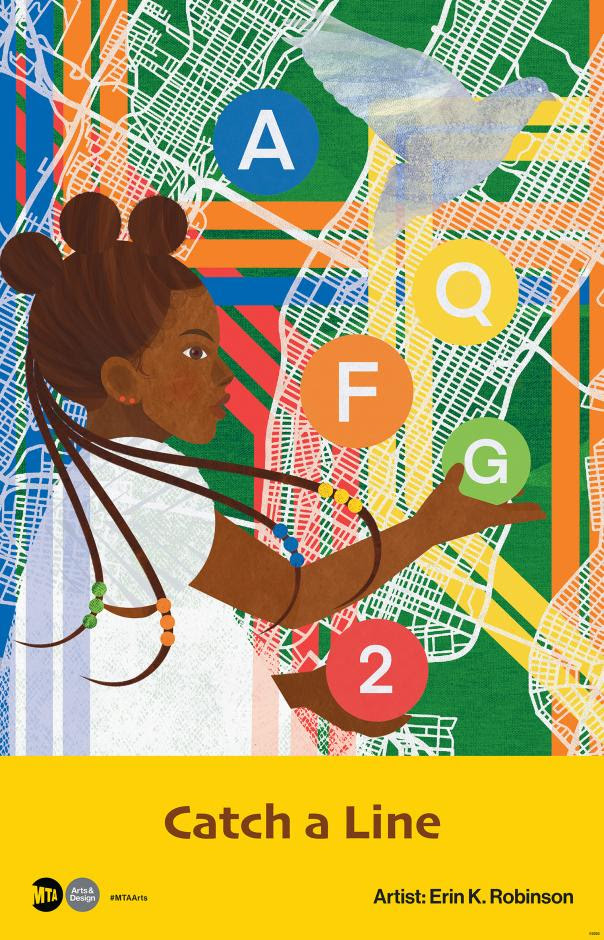
Through the Poster Program, MTA Arts & Design commissions five to six artists each year to create transit-related artwork for Poster and Art Card production.
The popular Poster program was established in 1991 to celebrate the diverse communities that make up the New York region. The commissioned work by painters, printmakers, and illustrators touches upon transit-related subjects and the places that can be discovered using the mass transit system. Posters are randomly displayed in unused advertising space on subway platforms throughout the 472 subway stations and on subway cars and buses. Printed posters are available for sale to the public through the New York Transit Museum Stores. Revenue from sales from the posters help to support the educational and exhibition programs at the non-profit museum.
The program offers illustrators and other artists the opportunity to reach a broader public, and provides the public exposure to incredible artists and visionaries who create a respite of engaging visual art.
Marcel Dzama, “The underground helps the garden 1,” 2023
Marcel Dzama, “The underground helps the garden 2,” 2023
Dennis RedMoon Darkeem, “Turtle Island Connections,” 2023
Erin K. Robinson, “Catch a Line,” 2023
Concert this Sunday at 5 p.m. Good Shepherd Chapel
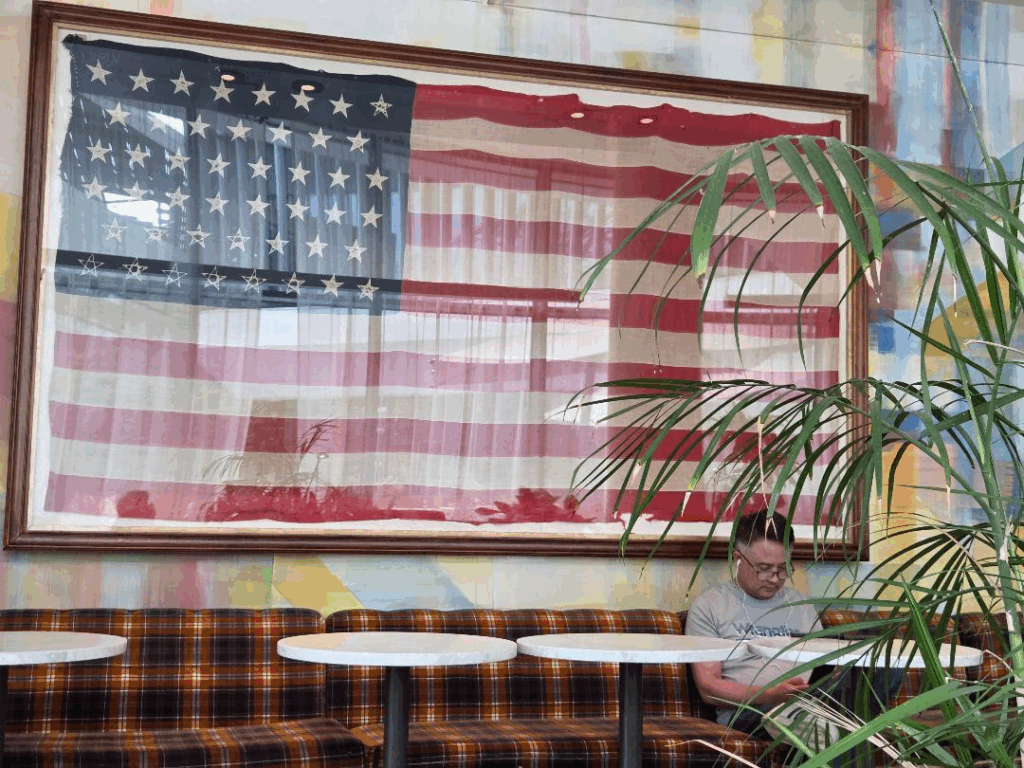
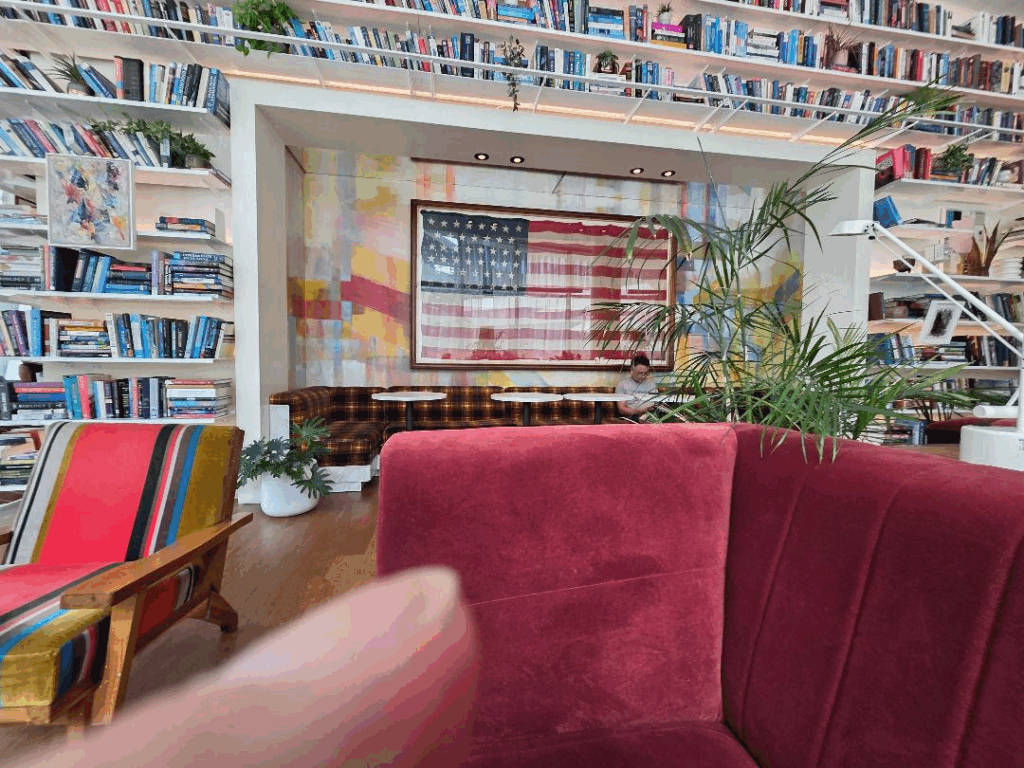
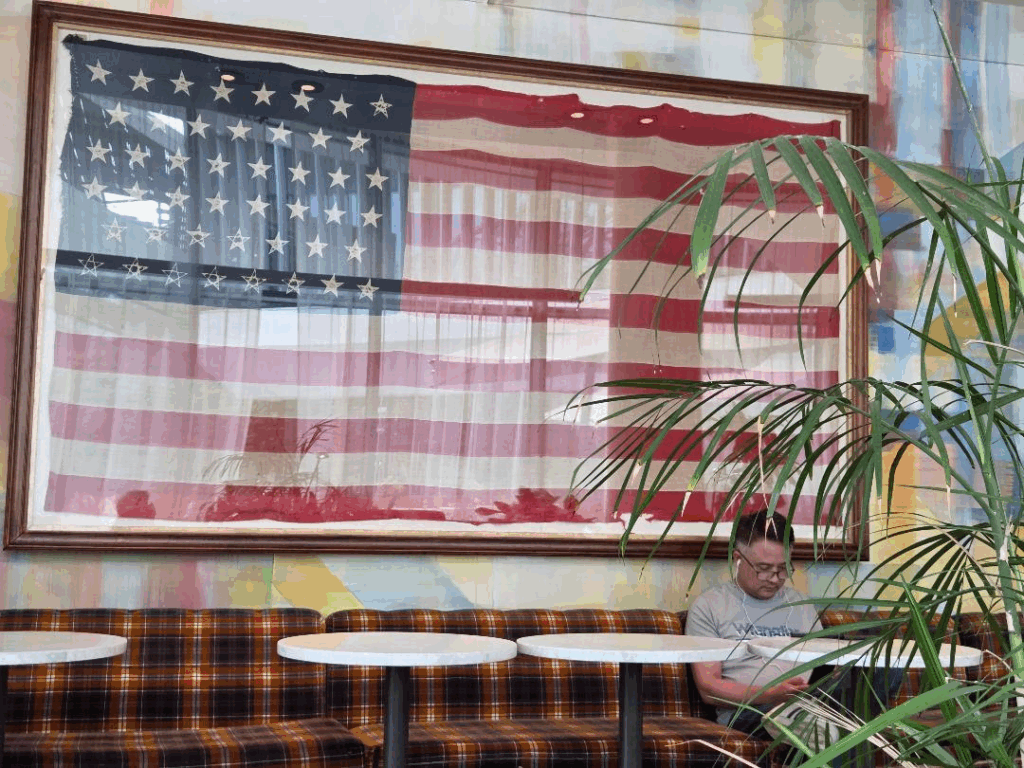
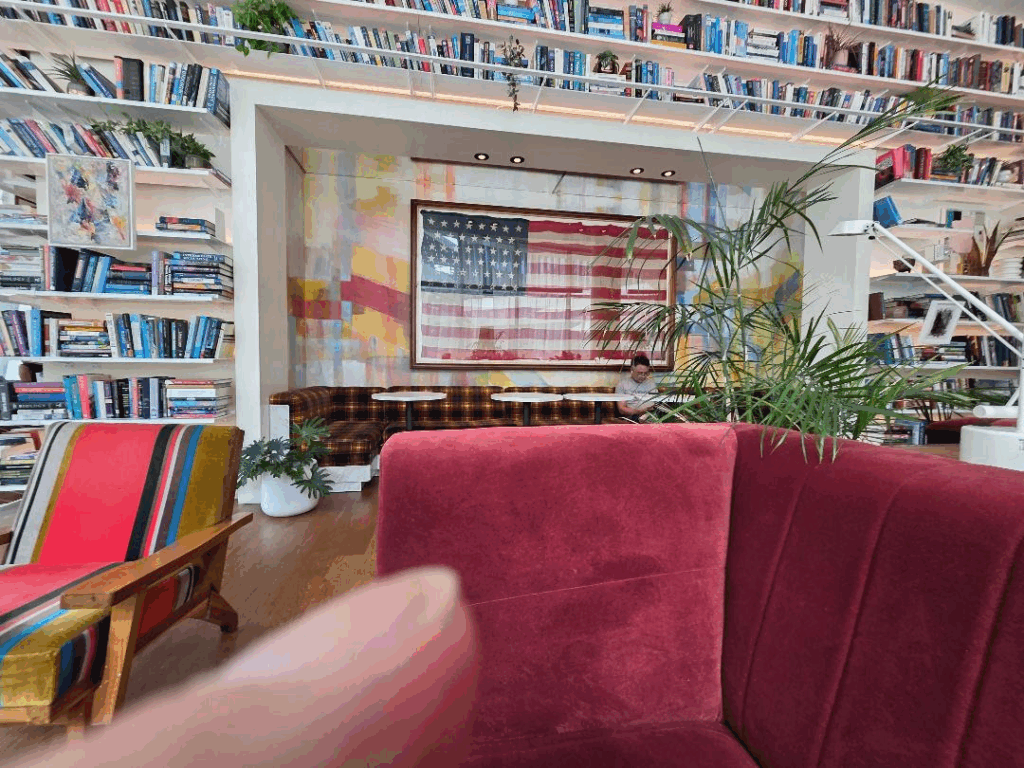
This 45 star flag is on display in the lobby of the Graduate Hotel This flag became the Official United States Flag on July 4, 1896. The 45th star was added for the admission of Utah on January 4, 1896. The flag was in use for twelve years, until 1908, when Oklahoma was admitted to the Union. It was the Official United States Flag during the Spanish-American War in 1898.
Credits
MTA ART & DESIGN JUDITH BERDY
All image are copyrighted (c) Roosevelt Island Historical Society unless otherwise indicated THIS PUBLICATION FUNDED BY DISCRETIONARY FUNDS FROM CITY COUNCIL MEMBER JULIE MENIN & ROOSEVELT ISLAND OPERATING CORPORATION PUBLIC PURPOSE FUNDS.
The ‘Most Colorful Home in Queens’ Has a Dark Secret
Wednesday, September 17, 2025
Issue # 1534
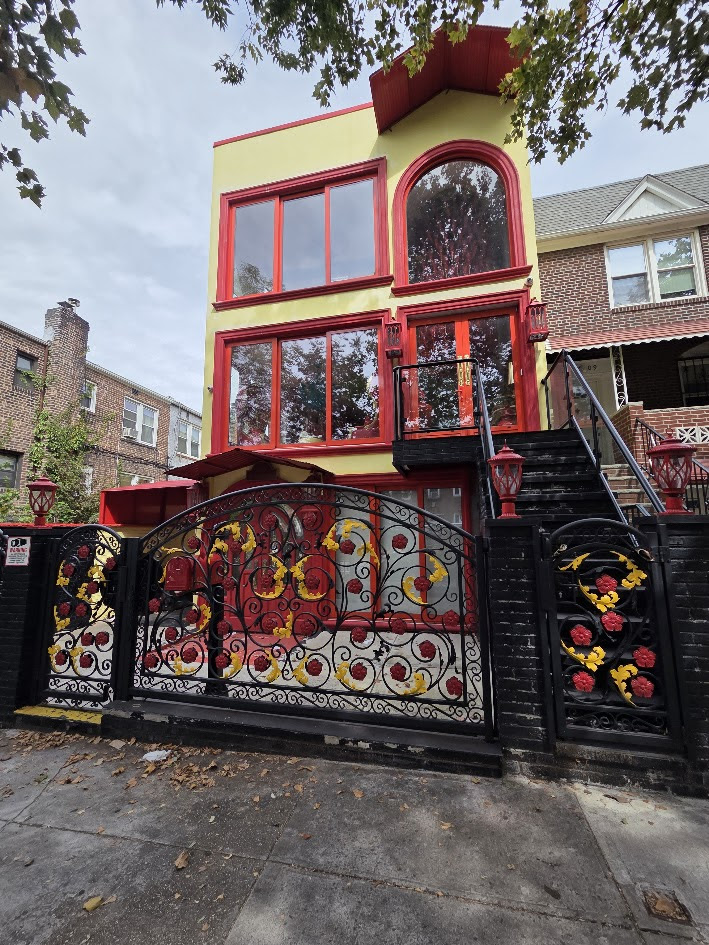
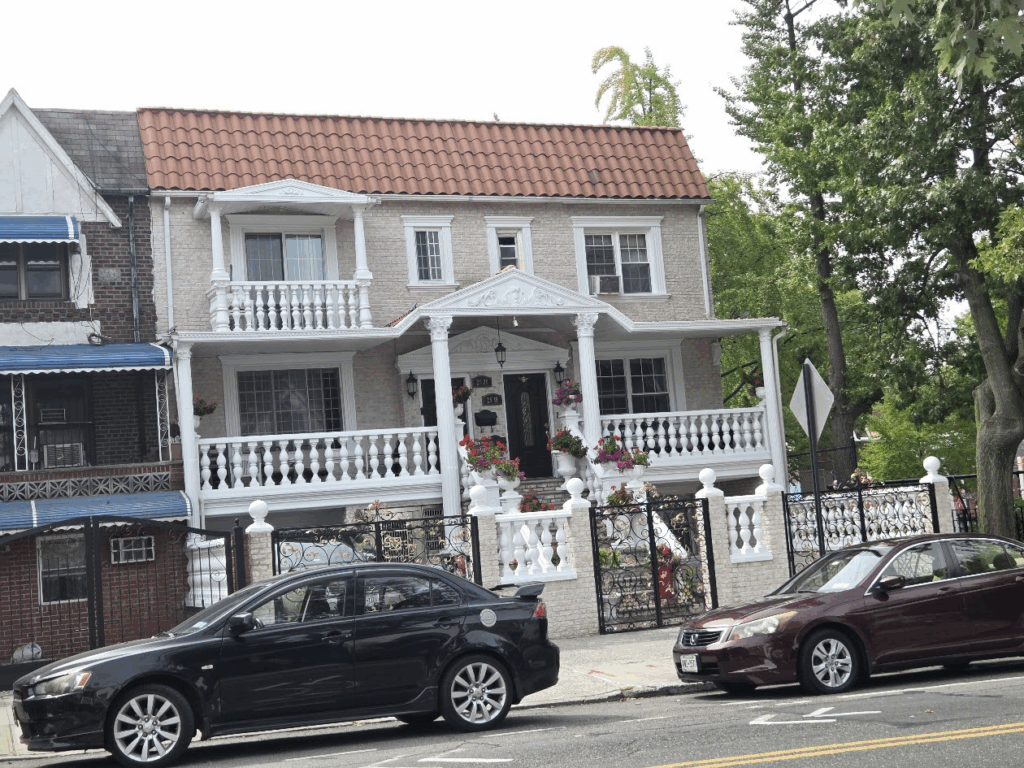
I took our Q102 bus today to order flowers and discovered some interesting businesses and homes along 36th Avenue between 21 Street and 31 Street. This house stands out as I passed it. I have seen it the last few years, but this was the first time I could view it from the sidewalk. It is quite a site and you will surely enjoy the photos of the interior.
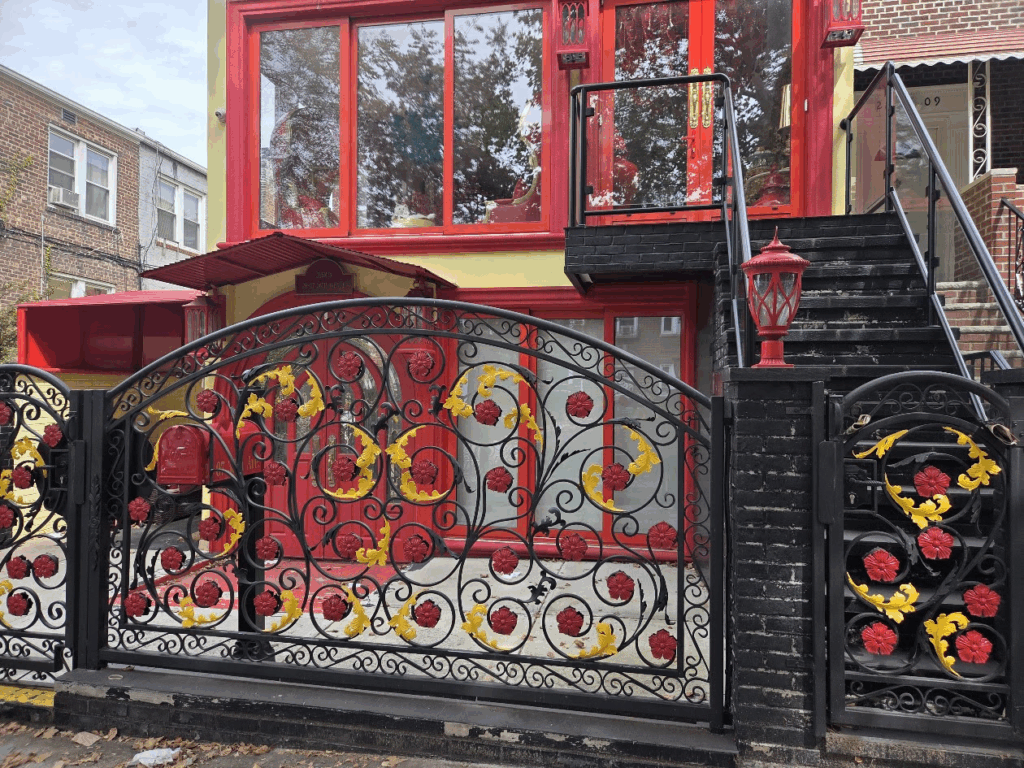
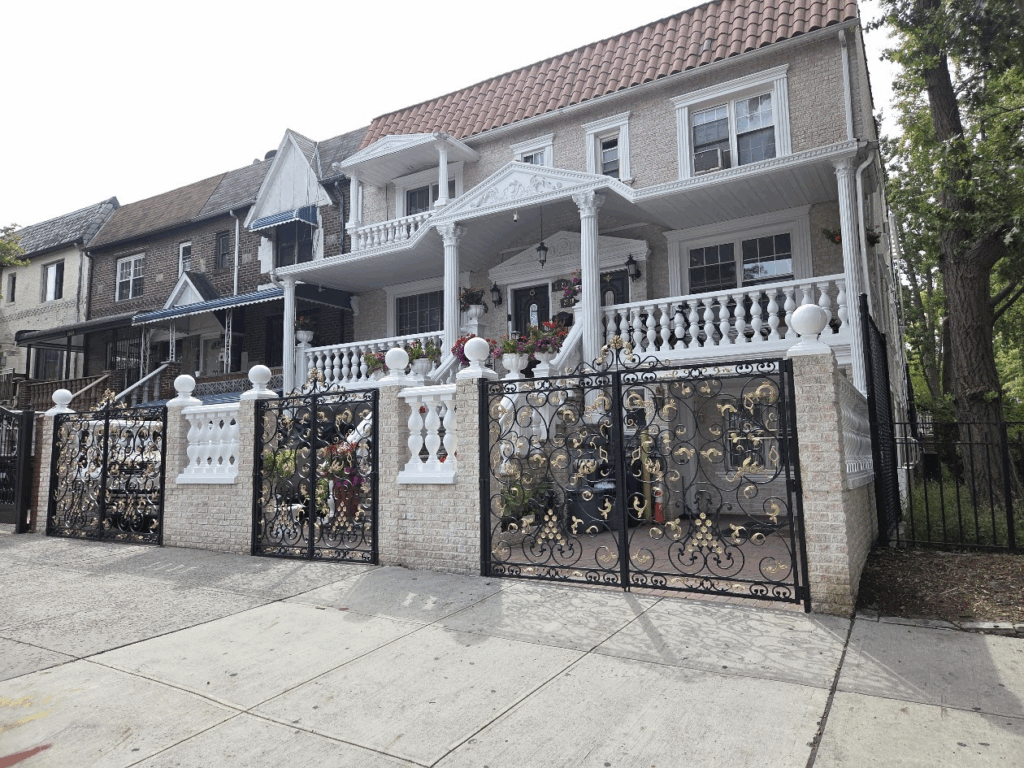
The three-story house AT 28-07 36th Avenue in Astoria, Queens, is hard to miss. The exterior walls are a pale yellow and the windows are trimmed in fire-engine red. Scrolls of metallic ocher leaves and vermilion flowers adorn the front gate. It looks like a rococo McDonald’s.
Inside, the design goes full Candy Land, from the fake pink tree and Skittles-colored chandeliers to the multicolored leather sofas off the kitchen.
The building would stick out anywhere, but especially in a neighborhood known for its red brick Tudors and walk-up apartments. And local curiosity has only grown since it landed on the market in July with an enormous $3 million price tag.
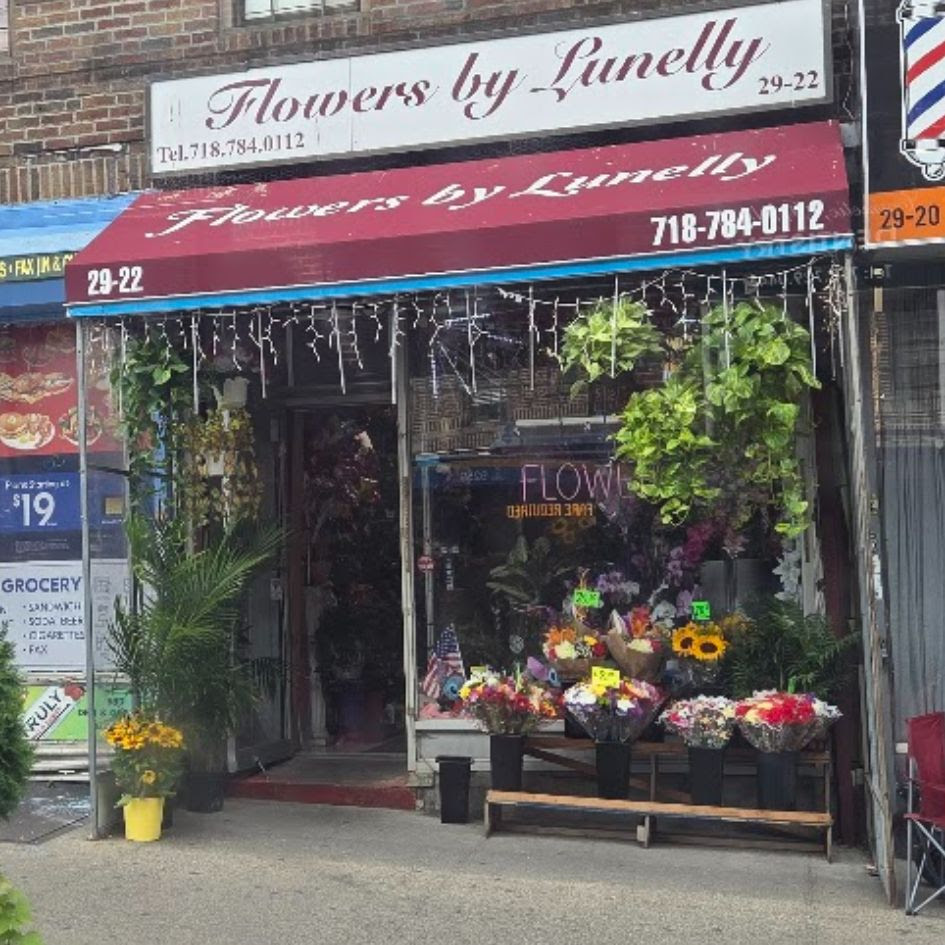
My first stop was Flowers by Lunelly. I have seen their arrangements at many island events and it is great to support this neighborhood business. The shop is on the same block as the new Q102 bus stop.
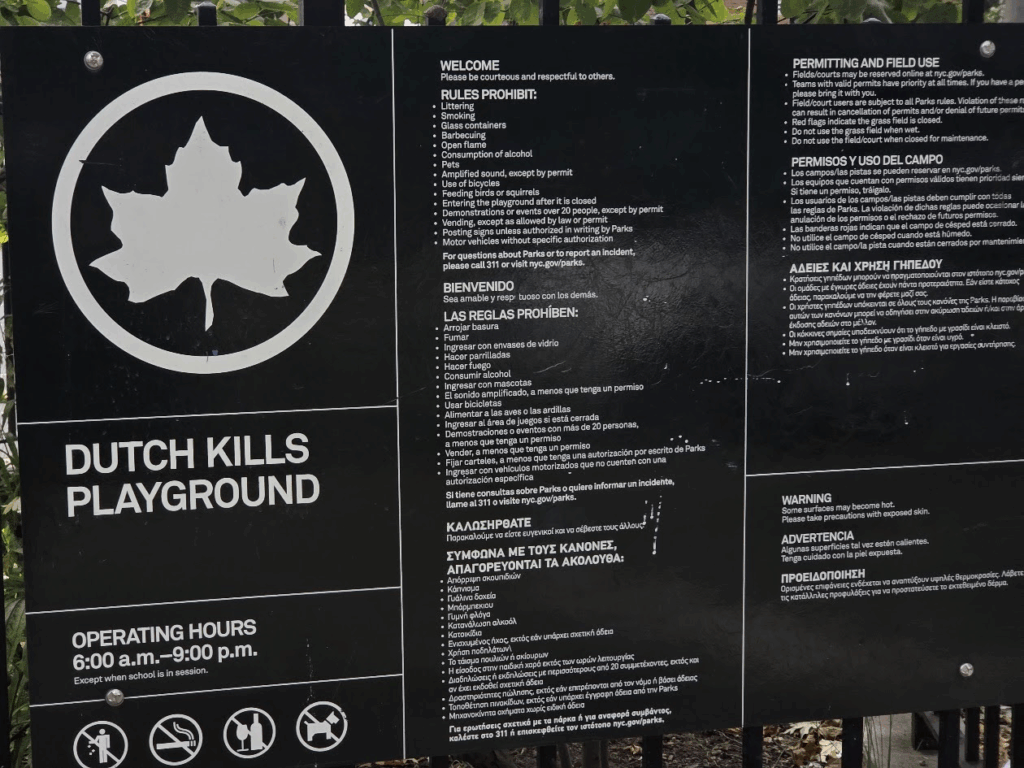
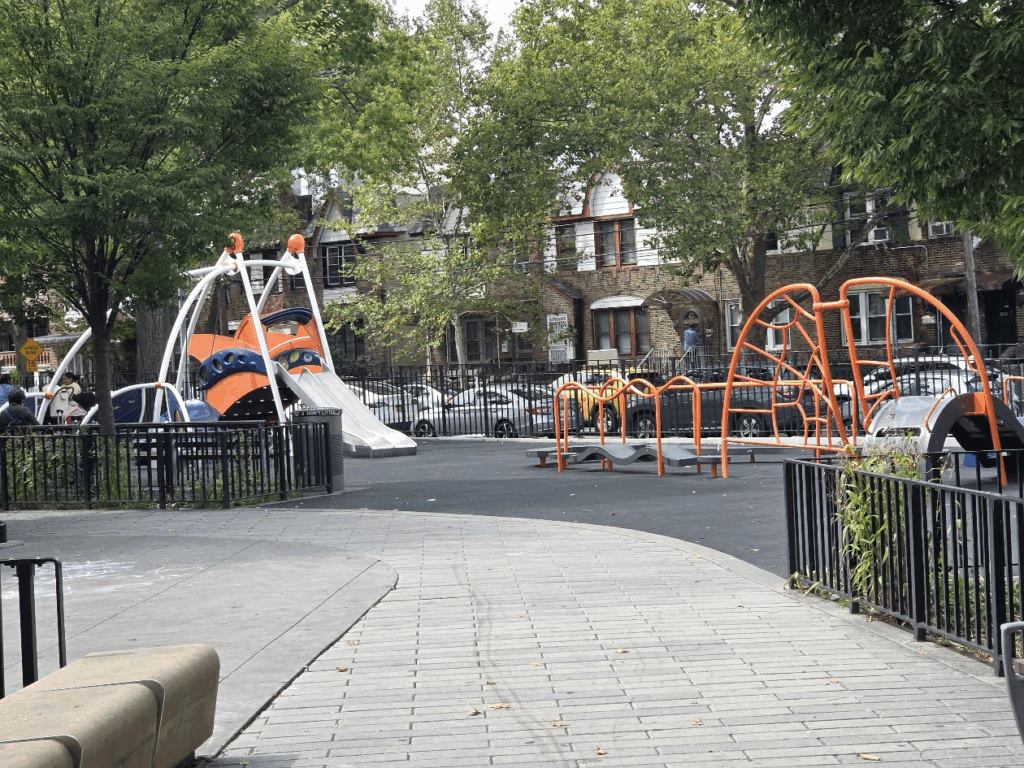
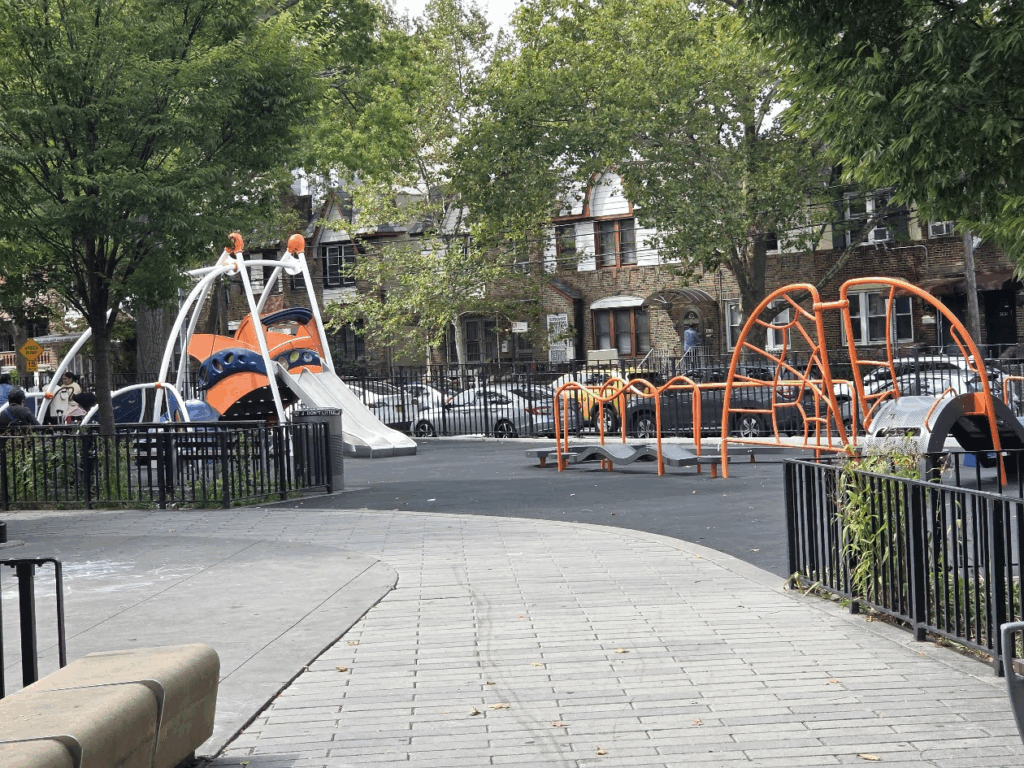
This wonderful and creative playground is on the corner of Crescent Street and 36 Avenue.
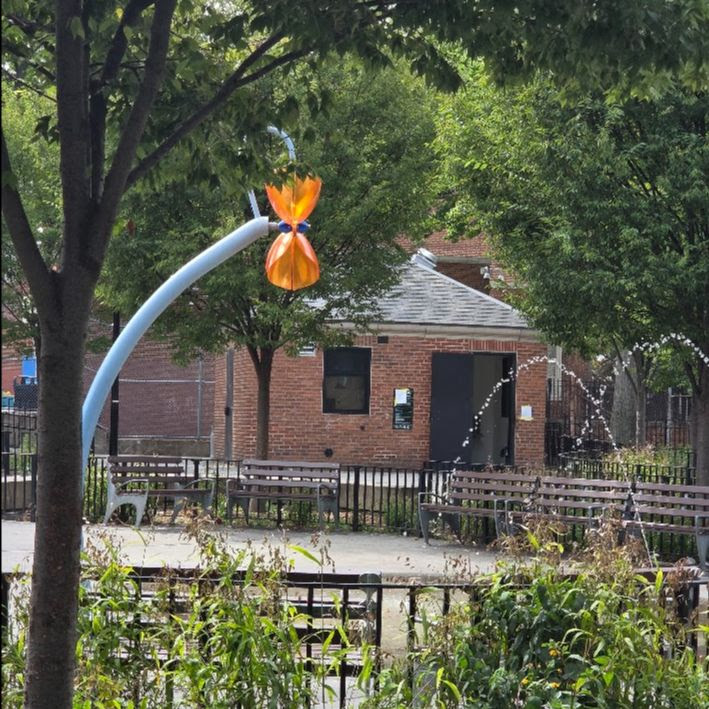
Creative water activities are in multiple locations.
Next to the Dutch Kills Playground is a home that exudes extravagance.
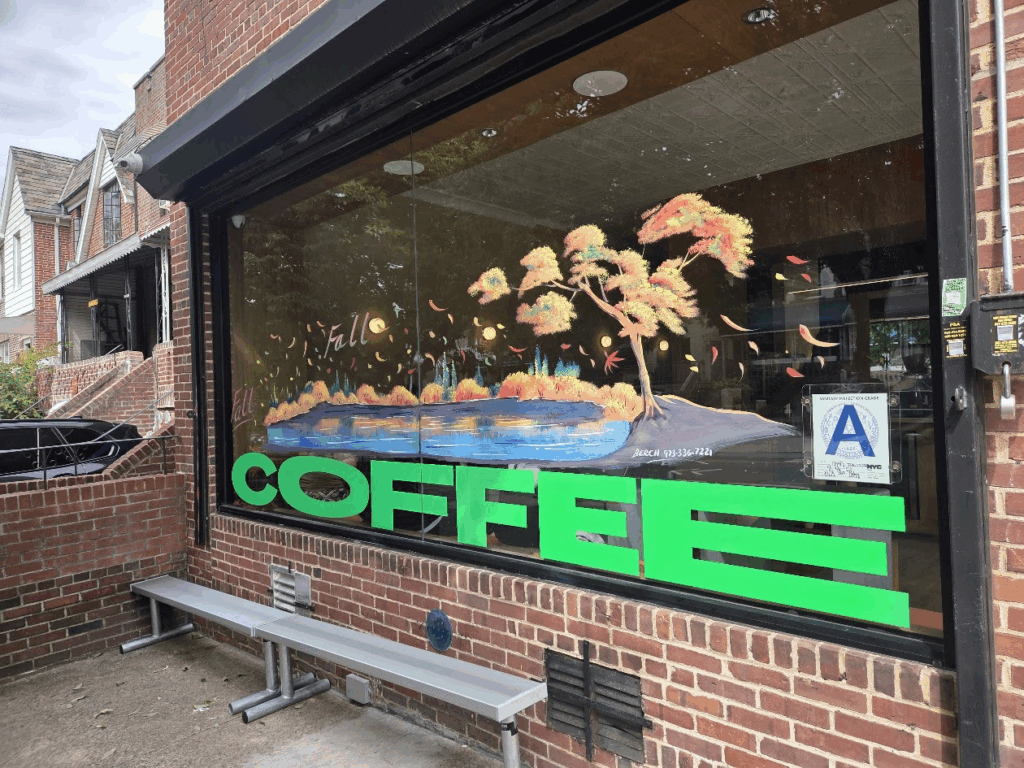
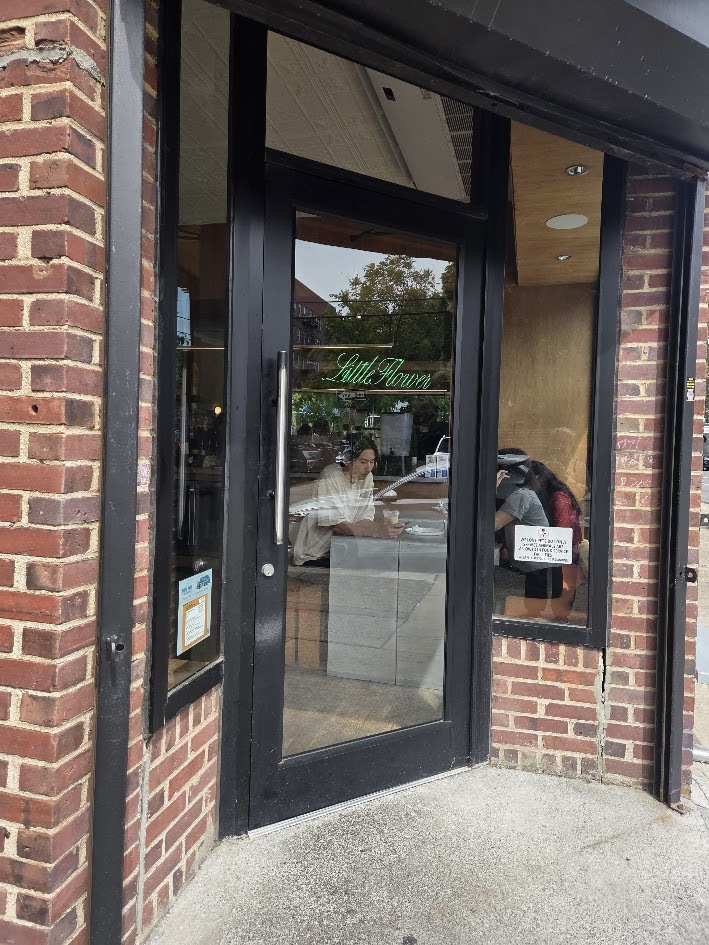
Just up the block is a cute cafe called Little Flower
There are lots more interesting spots on 36th Avenue, now just 10 minutes from the island. Stay tune for more wanderings.
Concert this Sunday at 5 p.m. Good Shepherd Chapel
What is this flag and where is it located?
CREDIT TO
JUDITH BERDY
All image are copyrighted (c) Roosevelt Island Historical Society unless otherwise indicated THIS PUBLICATION FUNDED BY DISCRETIONARY FUNDS FROM CITY COUNCIL MEMBER JULIE MENIN & ROOSEVELT ISLAND OPERATING CORPORATION PUBLIC PURPOSE FUNDS.
10 Secrets of the New York Public Library at 42nd Street
From doors that lead to nowhere to miles of underground book stacks, uncover the top secrets of the New York Public Library!
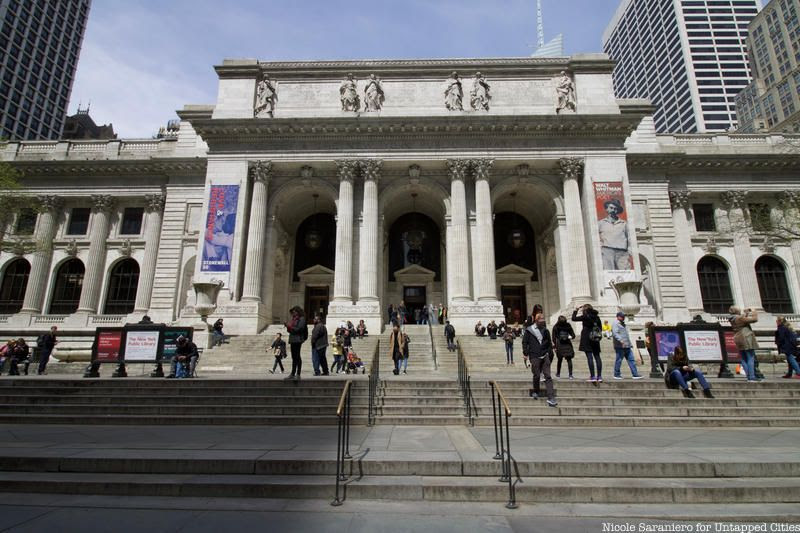
Libraries are places of wonder that inspire and satisfy the inquiries of curious minds, and there are few libraries that do so better than the New York Public Library’s Stephen A. Schwarzman Building. Standing proudly between Fifth Avenue and Bryant Park, the New York Public Library‘s midtown branch—often referred to as the “main branch” of the city’s public library system—is an invaluable research resource, an architectural treasure, and a historic New York City institution. The New York Public Library (NYPL) was founded in 1895 when already established library institutions created by John Jacob Astor and James Lenox were combined, along with a fund created by Samuel J. Tilden. These three components created a new free and public library system. The building that would house this new library was designed by the renowned architecture duo of Carrère and Hastings. The library was officially dedicated on May 23, 1911, sixteen years after the historic agreement between Lenox and Astor. Inscriptions on the facade of the building, above the main entrances, note the three founding institutions.
1. The New York Public Library has 125 Miles of Book Stacks
Now, more than 100 years later, the library continues to serve the intellectual needs of New Yorkers, expanding to 92 locations and four research centers systemwide. The original midtown library building, now considered the main branch of the system, is the second largest library in the nation, just behind the Library of Congress in Washington, D.C, and one of the largest in the world. Within its walls, the library holds not only millions of books and priceless artifacts but also many secrets waiting to be discovered.
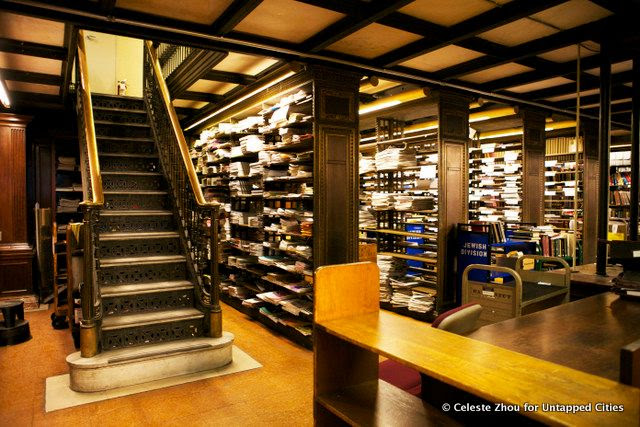
If you’ve ever walked into the New York Public Library and wondered, “Where are all the books?” the answer lies beneath your feet. Around 4 million books are stored in subterranean stacks beneath the library building and Bryant Park. The library contains 125 miles of shelving both above and underground, including 88 miles spread throughout the seven stack floors of the Humanities and Social Science Library, and 37 miles in the two-level stack extension under Bryant Park called the Milstein Research Stacks. If you look around Bryant Park, you can spot a door in the ground that serves as an emergency exit for the underground stacks.
The self-supporting steel stacks serve as structural elements of the building. The stacks act as buttresses to the floor of the Rose Main Reading Room, which stretches the length of nearly two full city blocks. Snead & Company Iron Works of Jersey City, New Jersey, were the contractors for the stacks which are made up, in part, of Carnegie steel. In addition to the sprawling stacks beneath the New York City site, there are also millions more books stored in an off-site facility in Princeton, New Jersey.
2. The New York Public Library was Built on the Site of the Old Croton Reservoir
Getting fresh and clean water to New York City was a major challenge in the early 19th century as the city rapidly expanded. The solution to the city’s water needs was the Old Croton Aqueduct. Construction started on this water transportation system in 1837, and water first flowed through it in 1842. The aqueduct moved water from the Croton River in upper Westchester County down into Manhattan. The water was stored in a receiving reservoir which was located where the Great Lawn of Central Park is now, and was distributed from a reservoir at the current site of the Schwarzman building. That reservoir was known as the Croton Reservoir.
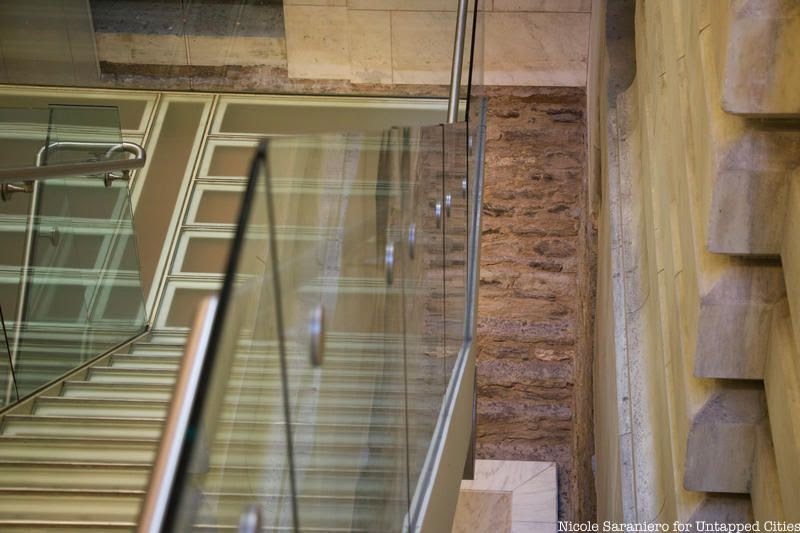
The Croton Reservoir held 20 million gallons of water within its walls, which stood 50 feet tall and 25 feet wide. Edgar Allan Poe frequently walked atop the reservoir walls to enjoy the view they offered of the city. When it became obsolete in the 1890s, it was torn down to make way for the new library building. It took two years and some 500 workers to dismantle the reservoir. The cornerstone of the library was laid in 1902. The Old Croton Aqueduct would serve as a vital water supply for New York City for nearly a century until a new aqueduct was built, which remains in service to this day. Inside the library, you can still see pieces of the reservoir walls if you look for the rough stone between the stairs on the lower levels of the South Court, near the Celeste Auditorium.
3. The Employees Only Catwalk in the Rose Reading Room
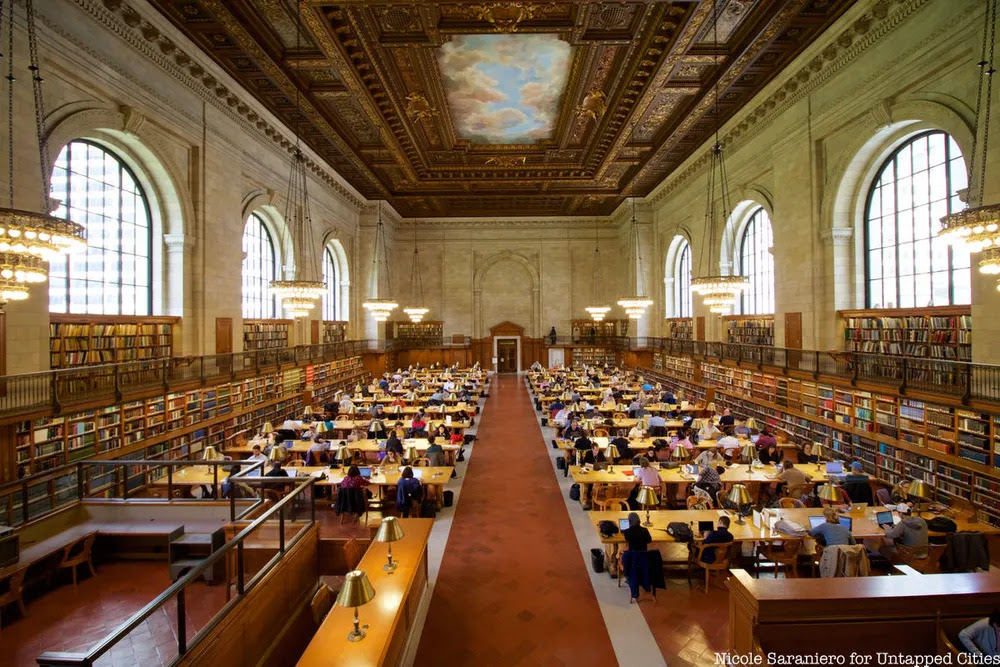
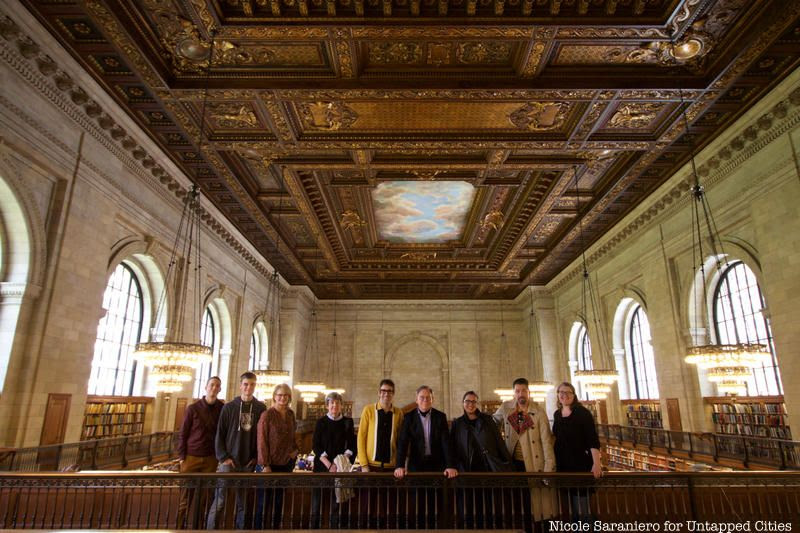
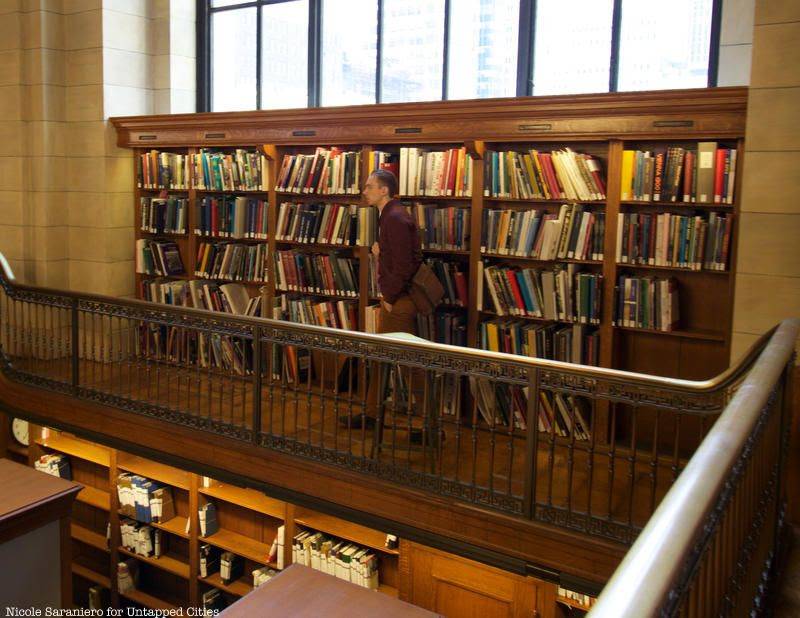
The Rose Reading Room houses the library’s General Research Division and serves as the central research hub in the Stephen A. Schwarzman Building. This area is open to anyone who needs to look something up, and most of the books are easily accessible in the open stacks. However, there is a second level of stacks above the main floor, and it’s not apparent how to access them. Ringing the Rose Reading room is an elevated mezzanine for employee use only, so if you need a book from this section, you need assistance. In addition to access to the second-level stacks, the catwalk offers a great view of the space.
In order to get to the top of the catwalk, there are tiny hidden spiral staircases behind doors that are locked to the public. On a recent visit to the New York Public Library, Untapped Cities Insiders were granted special access to walk atop the catwalk and take in the amazing views it offers of the reading room. Untapped New York Members got to walk across the off-limits level on a series of tours run in partnership with the NYPL!
4. The Adorable Book Train
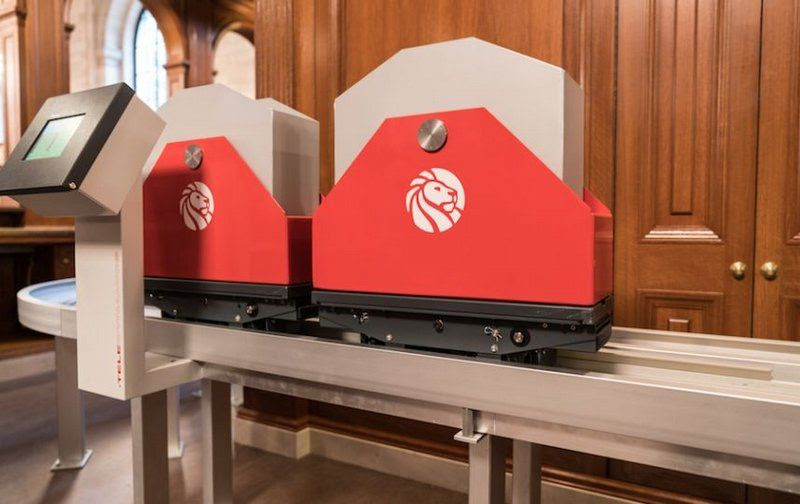
The stunning Rose Reading Room inside the New York Public Library underwent a major restoration from 2014 to 2016. The intricate plasterwork of the ceiling was restored, the mural was recreated and the lights got an upgrade. The historic room also got a new mode of book transportation, a “book train.” Before the advent of the book train, books from the tracks were transported via a conveyor belt system and dumbwaiter for oversized books.
The electrically powered train is made up of twenty-four individual cars which can carry up to thirty pounds each. The swinging design of the train’s carts allows them to move in multiple directions and remain upright while switching from horizontal to vertical positions. The train runs on 950 feet of track over the course of eleven levels. It travels at seventy-five feet per minute, which means it takes just five minutes for a book to travel from the stacks below to the Rose Reading Room.
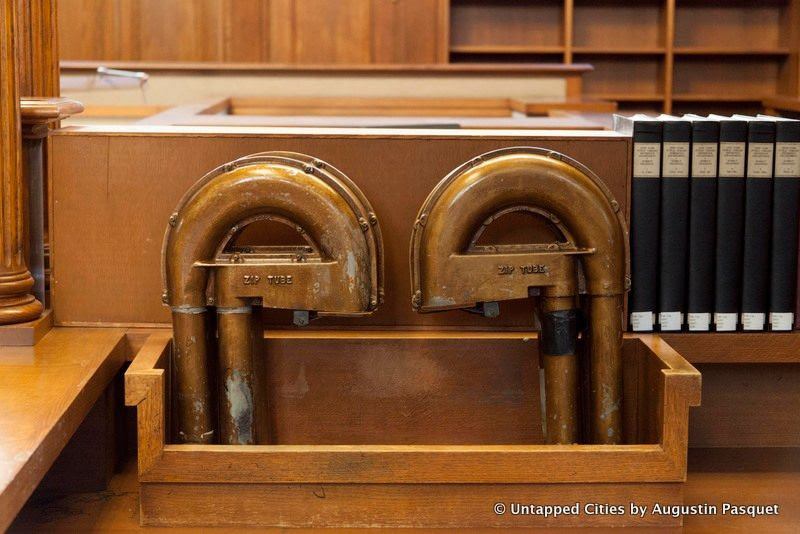
5. There are Pneumatic Tubes in the New York Public Library
Until a few years ago, the New York Public Library still used pneumatic tubes to fulfill book requests. To request a book from the stacks, you would fill out a call slip that would be sent through the tube to one of the eight levels of stacks where an employee would find your book and then send it via conveyor belt to the same spot where you submitted the slip.
The system was so efficient that it mainly went out of use because the canisters were too difficult to replace. Officially retired only a few years ago, the pneumatic tube system was receiving upgrades and new installations until 1998 according to Atlas Obscura. You can still see the tubes in the library today in the Rose Reading Room.
6. The Tiny Doors that Lead to Nowhere
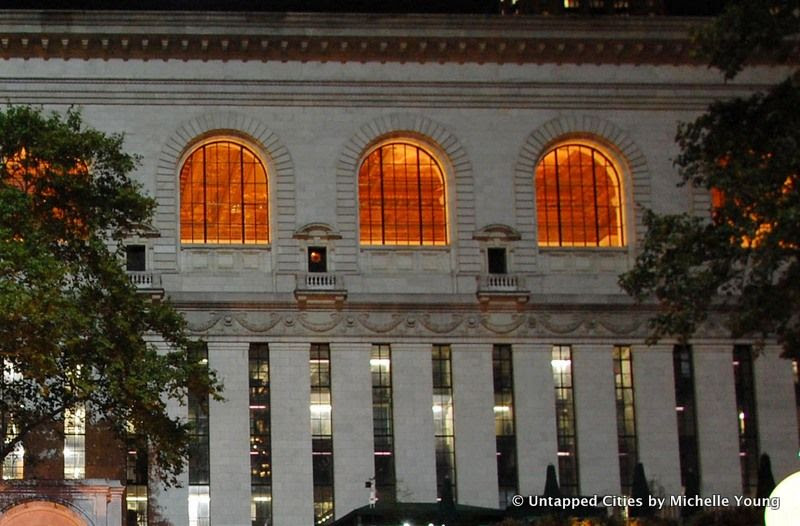
Have you ever noticed the tiny doors with mini balconies on the exterior facade of the New York Public Library, set between the arched windows of the Rose Reading Room? Clearly not level with the floor of the Reading Room and not proportionate to the monumental scale of the building, it was a mystery where these doors led and what their purpose was.
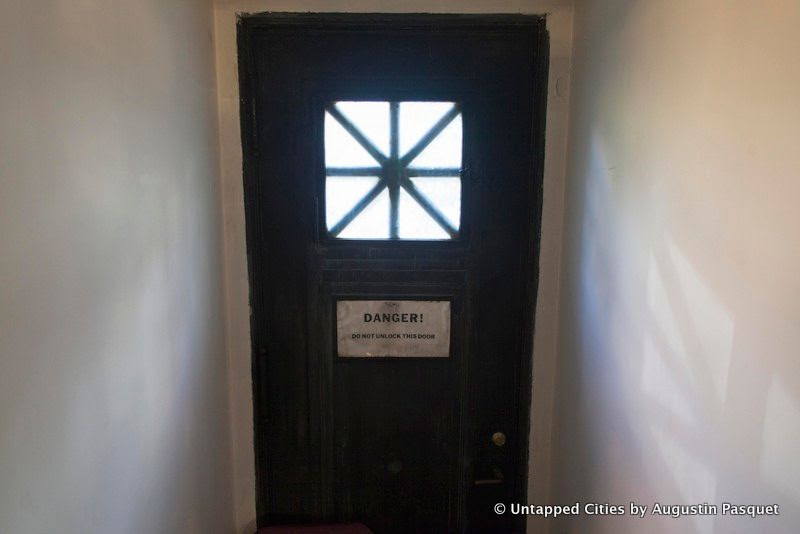
It turns out that those doors can be accessed from the catwalk of the Reading Room. Between the windows, there are wooden doors that open up to a few stairs and a short, undecorated passageway that ends at the tiny door that can be seen from the outside. When Untapped Cities discovered this, there was a foreboding sign on the door that read, “DANGER! DO NOT UNLOCK THIS DOOR!” and a window with cross bars. Photographer Max Touhey explained to us that, according to the New York Public Library, the doors were built as part of a planned extension of the building which never happened. He also says one of the windows opens and offers a view of Bryant Park.
7. It was Once the Largest Marble Building Ever Built in the U.S.
The New York Public Library required six times more marble than was used in the construction of the New York Stock Exchange and the New York Chamber of Commerce combined. At the time it was complete, the library contained 530,000 cubic feet, or roughly 4 acres, of white Vermont marble which came from two quarries on Dorset Mountain. In 1911, this made the New York Public Library the largest marble building ever built in the United States. Marble pieces that didn’t meet the high standards of the library’s architects were incorporated into other contemporary buildings including Harvard Medical School. Inside, there are various different types of marble found throughout the library. One gallery is clad in Pentelic marble, the same type of marble used to create the Parthenon in Greece.
The exterior marble on the library’s facade is twelve inches thick and the cornerstone alone weighs 7.5 tons. The splendor of the stone continues inside the library and is on grand display inside Astor Hall. Visitors to the library walk into Astor Hall from the Fifth Avenue entrance. To this day, this room is the only room in New York City constructed entirely of marble, from floor to ceiling. Even the candelabras that illuminate the space are made of marble.
8. Priceless Pieces in the NYPL Collection
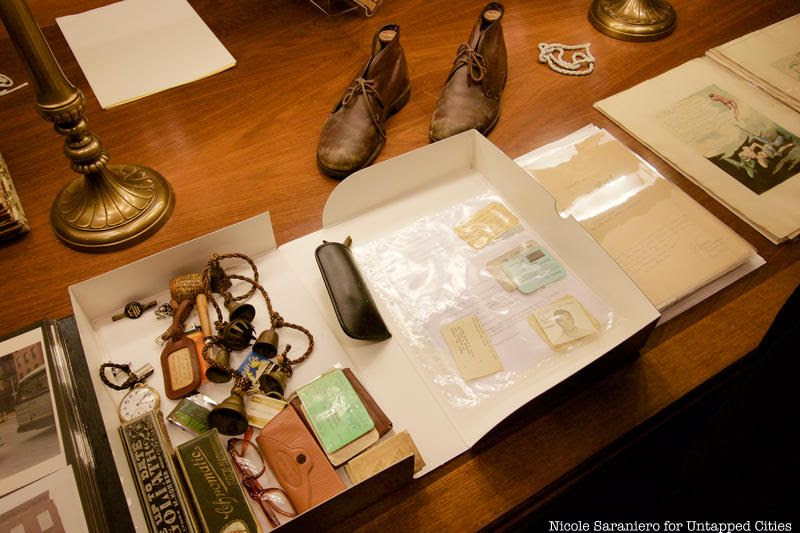
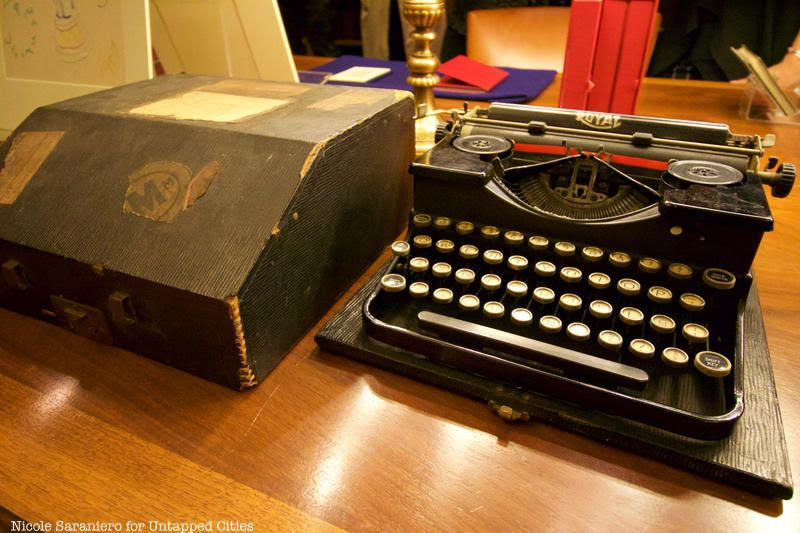
The New York Public Library has innumerable treasures tucked away in its stacks. In addition to millions of volumes, the library also possesses priceless historical artifacts. Some of the library’s items can be seen in their rotating special exhibitions and you can request to see certain items if you are conducting research. Among the amazing pieces found at the library are literally thousands of Virginia Woolf‘s personal letters, e.e. cummings‘ typewriter, boxes of personal items that belong to writer Jack Kerouac (including his shoes, library card and prayer bells), Charles Dickens‘ writing desk, a handwritten poem from Emily Dickinson, George Washington’s recipe for beer, even pieces of Percy Bysshe Shelley’s skull!
On a recent Untapped New York members-only visit to the library while showing highlights of the Berg Collection, including an annotated copy of T.S Eliot’s The Waste Land and tiny pieces of paper containing writing from the Brontë siblings, curator Carolyn Vega explained that part of what makes these items so important is that it gives a glimpse into the creative process of some of the world’s most famous writers.
Many of the library’s fascinating artifacts can be seen on display in the library’s first permanent exhibition, the Polonsky Exhibition of The New York Public Library’s Treasures. There you can see items like the original Winnie the Pooh dolls, a copy of the Declaration of Independence, and more!
9. There was a Secret Storage Location During WWII
The New York Public is an extremely valuable resource with extremely valuable items inside of it. During World War II, after the attack of Pearl Harbor, many of the library’s most valuable books and manuscripts were taken off-site to safer locations. Relocated items were taken to bank vaults around New York City and 12,000 other items from the collection, valued at that time at $10 million, were temporarily moved to a secret location 250 miles away.
World War II prompted many precautions to be taken around New York City to protect its most important buildings. Windows atop Penn Station, which at the time was a grand Beaux-Arts structure designed by McKim, Mead, & White, and the original City Hall subway station, were blacked out, baseball games weren’t played at night, and the Statue of Liberty‘s torch went dark, all for fear of becoming targets of a bombing. During the War, the library even served as a helpful resource to the military, which made use of its Map Division to the coastlines of enemy countries.
10. The Library’s Lions Don’t Have Official Names
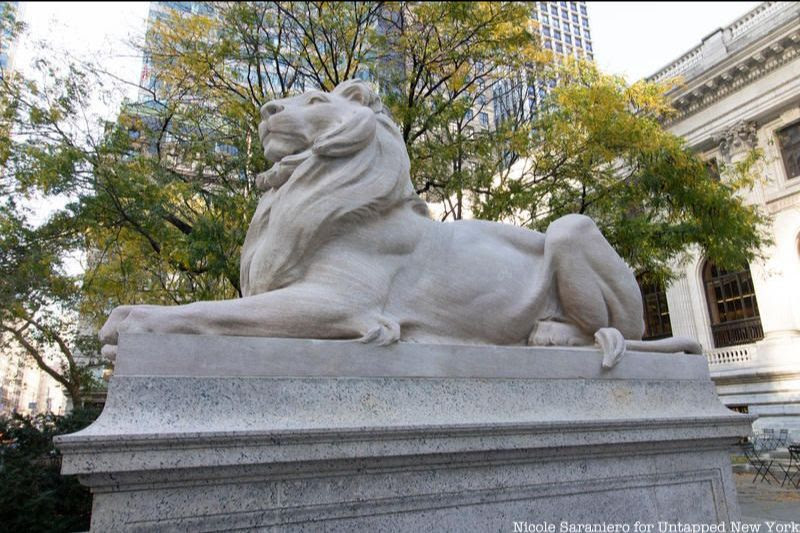
Known today as Patience and Fortitude, the lions who stand guard at the entrance of the New York Public Library have gone by many names, but officially they don’t have names. Sculpted out of Tennessee marble by Edward C. Potter, they were originally called Leo Astor and Leo Lenox after the library’s founders, John Jacob Astor and James Lenox.
There was a time when they were called Lady Astor and Lord Lenox, though both lions are male. Mayor Fiorello LaGuardia was the first to call them Patience and Fortitude. He chose these names because he felt they represented the virtues needed for New Yorkers to weather the Great Depression. The name has stuck ever since. Patience sits on the south side of the steps and Fortitude on the north.
FALL FOR ARTS NOW ON AT RIVERCROSS LAWN
Credits
UNTAPPED NEW YORK
All image are copyrighted (c) Roosevelt Island Historical Society unless otherwise indicated THIS PUBLICATION FUNDED BY DISCRETIONARY FUNDS FROM CITY COUNCIL MEMBER JULIE MENIN & ROOSEVELT ISLAND OPERATING CORPORATION PUBLIC PURPOSE FUNDS.
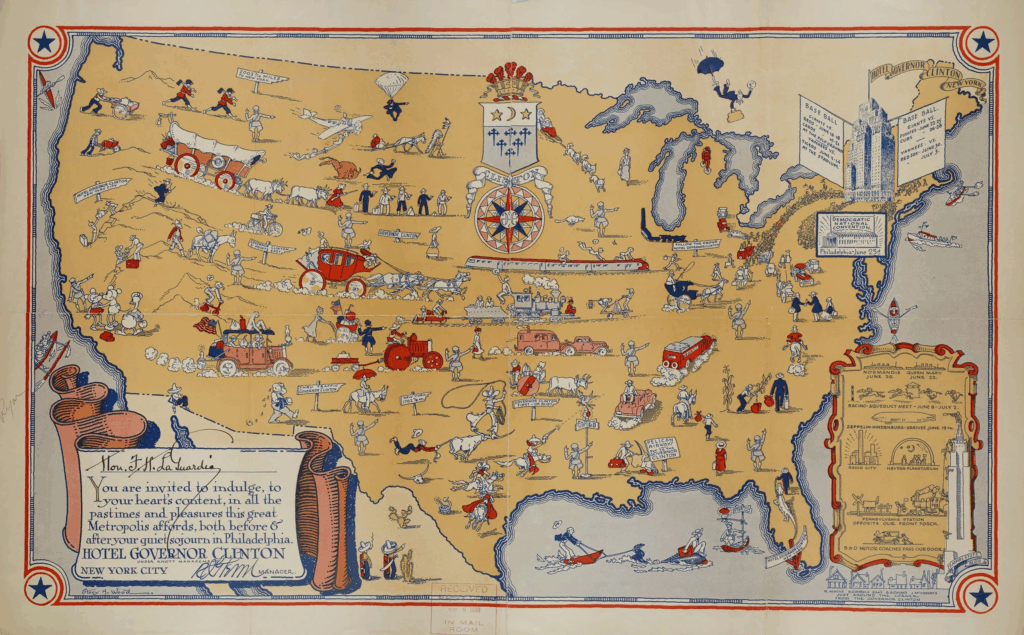
In a continuing series of articles highlighting unusual or unexpected items found in Municipal Archives or Library collections, this week For the Record features a delightful pictorial map created by artist Stacy H. Wood.
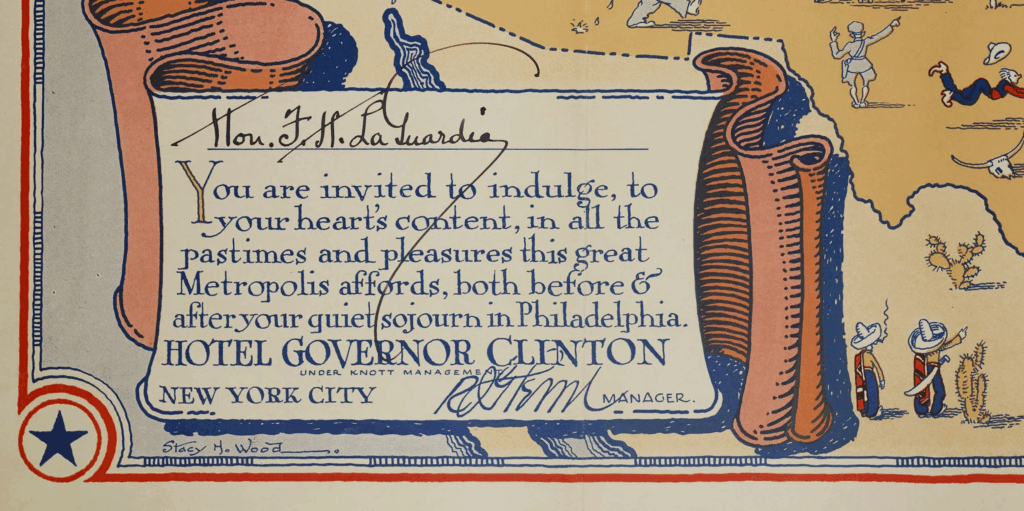
Hotel Governor Clinton map, by Stacy H. Wood, 1936. Mayor LaGuardia papers, NYC Municipal Archives.
Measuring 18 by 28.5 inches, the map depicts the United States decorated with clever cartoon figures and illustrations. It had been sent to Mayor Fiorello LaGuardia from the Hotel Governor Clinton, located on Seventh Avenue and 32nd Street in Manhattan. The Mayor’s mail room clerk date-stamped it received on June 9, 1936.
The purpose of the map is not entirely clear but seems to relate to the Democratic National Convention that would take place in Philadelphia on June 23, 1936. The legend on the lower left portion of the map is a message to Mayor LaGuardia: “You are invited to indulge, to your heart’s content, in all the pastimes and pleasures this great Metropolis affords, both before & after your quiet sojourn in Philadelphia.” And to that end, the map provides useful information about New York City events such as the dates for upcoming baseball games, arrival of ocean liners S.S. Normandie and Queen Mary, and the Zeppelin Hindenburg. It also helpfully notes the Hotel’s proximity to Radio City, the Hayden Planetarium, and Pennsylvania Station, as well as department stores, Macy’s, Gimbel’s, Saks, and B. Altman
City archivists came across the pictorial map in “Mayor LaGuardia Oversize Box #1.” In accordance with processing procedures, items that are too large to fit in half-cubic foot archival containers are “separated” from their original locations and placed in enclosures appropriate to their size. In place of the removed item, the processing archivist substitutes a “separation sheet” that provides a brief description of the item, date removed, and the new location.
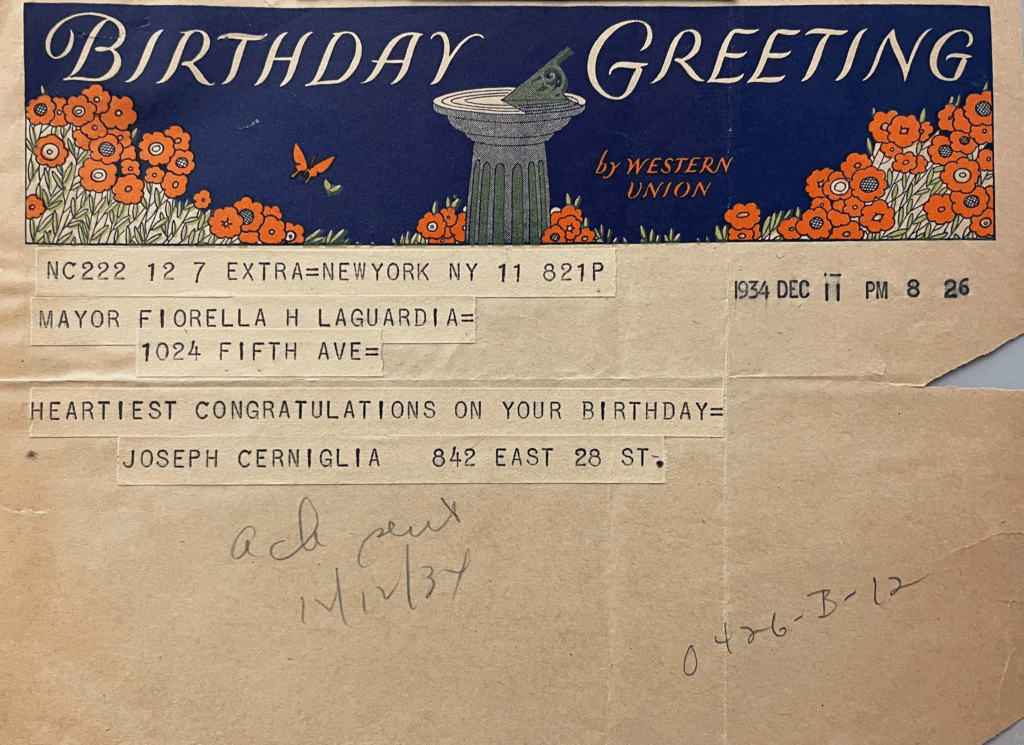
The separation sheet attached to the poster indicated that it had been originally filed in LaGuardia’s subject series in a folder labeled “Favors, Requests for, 1936-37.” Examination of the folder contents, and others similarly labeled, revealed an eclectic assortment of items. As one would expect, there are numerous letters to the Mayor (and/or his assistants) asking for help in obtaining jobs or other services. For example, on October 6, 1937, G. W. Cahan, of the Greenwood Lakes Estates Co. wrote to LaGuardia’s aide Stanley Howe asking for an introduction to Sanitation Commissioner William Carey, “… as I have an interesting proposition I would like to take up with him.” But it also contained other seemingly random objects such as a birthday greeting to the Mayor in the form of a colorful Western Union telegram.
Western Union telegram, 1934. Mayor LaGuardia papers, NYC Municipal Archives.
Most of the correspondence consists of the incoming letter and a carbon copy of the Mayor’s response. For the pictorial map there was neither a cover letter, nor a response. Perhaps the LaGuardia’s clerks decided that the poster’s legend inviting him to “indulge … in all the pastimes and pleasures of this great metropolis” constituted a request for a favor.
Hotel Governor Clinton map (detail), by Stacy H. Wood, 1936. Mayor LaGuardia papers, NYC Municipal Archives.
The serendipitous discovery of the pictorial map points out one of the limitations of archival description practices. Typically, archivists processing voluminous collections such as mayoral correspondence use the original record-creators’ identifications to describe folder contents, in this instance, “Favors, Requests For.” Item-level processing is generally not practical. It is unlikely that researchers interested in the work and career of the artist, Wood, would think of municipal government records as a possible venue for information. And even if they did, the “Favors, Request for” folder would not be an obvious source.
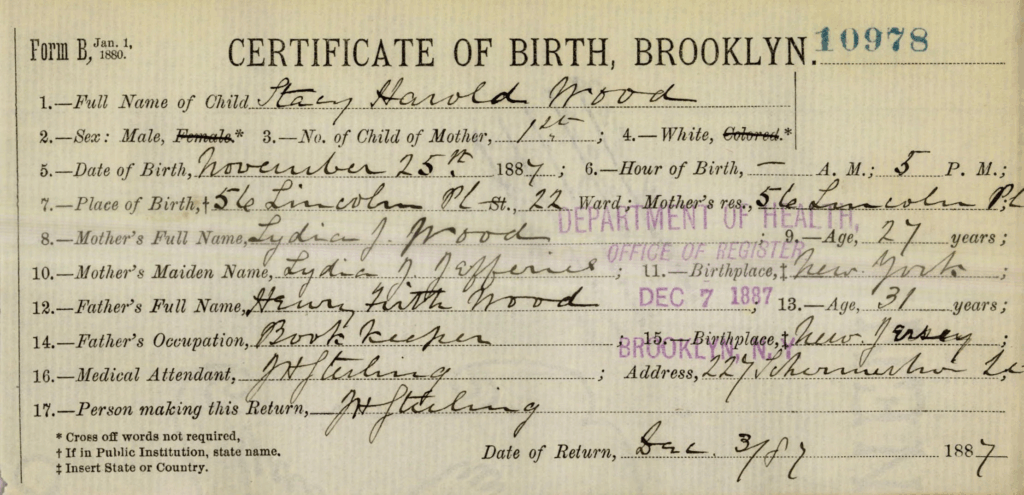
Brooklyn birth certificate for Stacy H. Wood, 1887. Historical Vital Records collection, NYC Municipal Archives.
Nevertheless, this work by the illustrator Stacy H. Wood is in the collection. An online search resulted in only minimal biographical information. He is described as an American children’s book illustrator and graphic artist active in New York during the first half of the 20th Century. Born in Brooklyn in 1887, he studied at Amherst, the Pratt Institute, and the Art Institute of Chicago. Among other cited works are other pictorial maps including one of the United States for the Boy Scouts of America 1935 Jamboree. Wood died on June 10, 1942, in Mt. Vernon, N.Y.
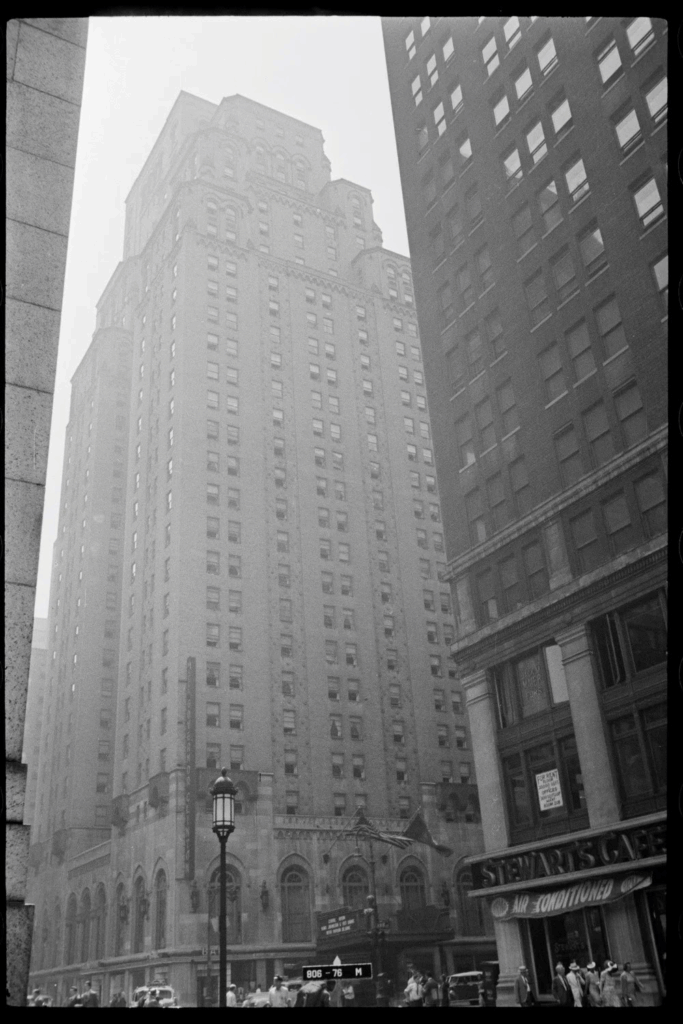
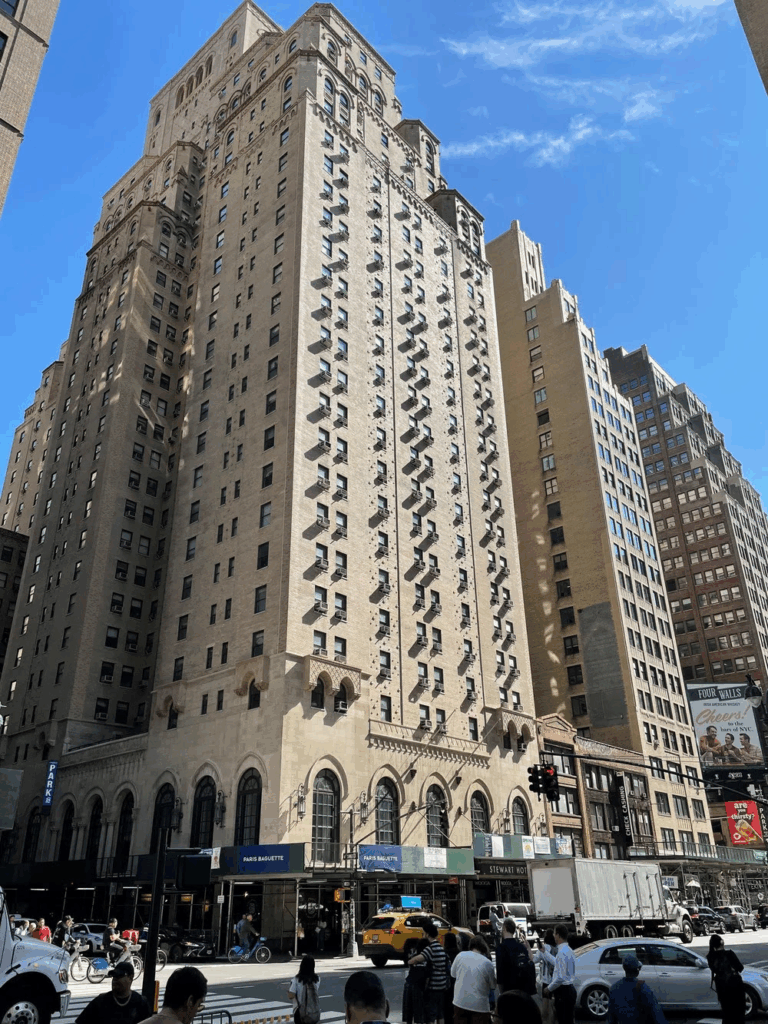
And the Hotel Governor Clinton? Renamed the Hotel Stewart at some point, it still stands today, a handsome example of Art-Deco-era construction in Manhattan. For interested researchers, the Manhattan Building Permit and Plan collections in the Archives would serve to trace its history beginning with the new building application filed on December 28, 1927, by architects Murgatroyd and Ogden. Subsequent applications document alterations and modifications through the 1970s. More recent reports indicate the building may be slated for residential conversion.
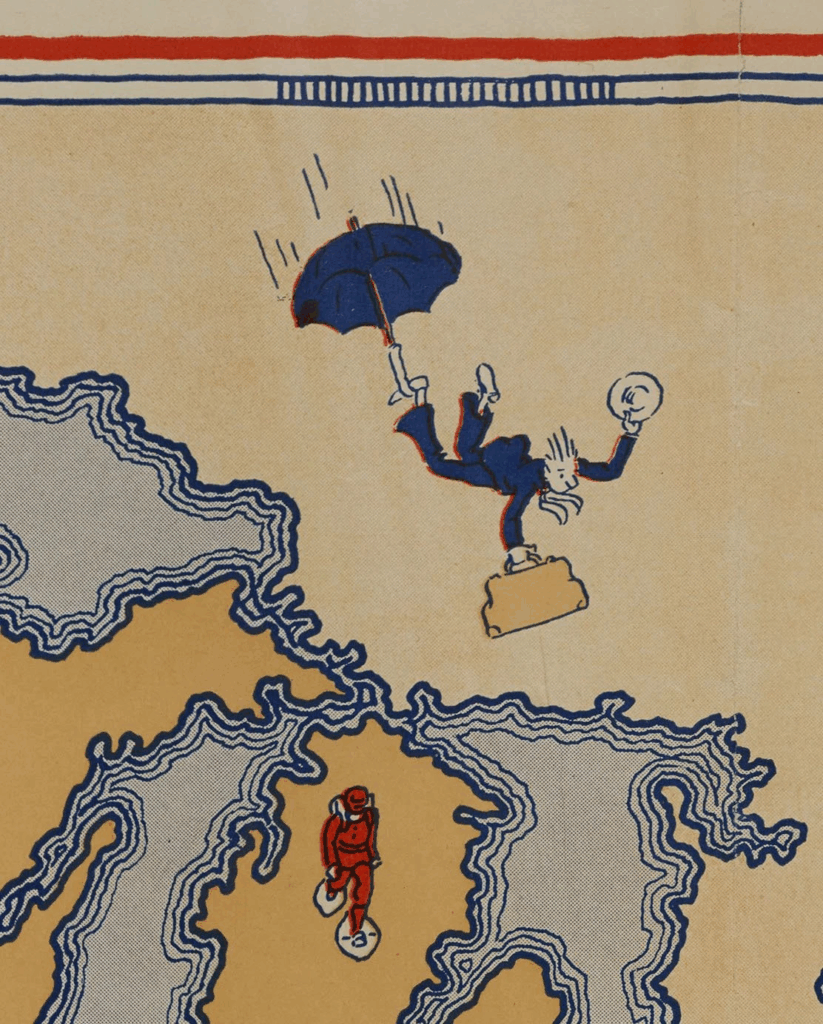
Now that we have “found” the artist Stacy H. Wood, readers are invited to take a closer look at his work. But be forewarned, you will need some time—there is a lot going on in this picture!
Hotel Governor Clinton map (detail), by Stacy H. Wood, 1936. Mayor LaGuardia papers, NYC Municipal Archives.
Hotel Governor Clinton, ca. 1939. Tax Photograph collection, NYC Municipal Archives.
Hotel Governor Clinton, ca. 1939. Tax Photograph collection, NYC Municipal Archives.
FALL FOR ARTS NOW ON AT RIVERCROSS LAWN
CREDIT TO
NEW YORK CITY MUNICIPAL ARCHVES
All image are copyrighted (c) Roosevelt Island Historical Society unless otherwise indicated THIS PUBLICATION FUNDED BY DISCRETIONARY FUNDS FROM CITY COUNCIL MEMBER JULIE MENIN & ROOSEVELT ISLAND OPERATING CORPORATION PUBLIC PURPOSE FUNDS.
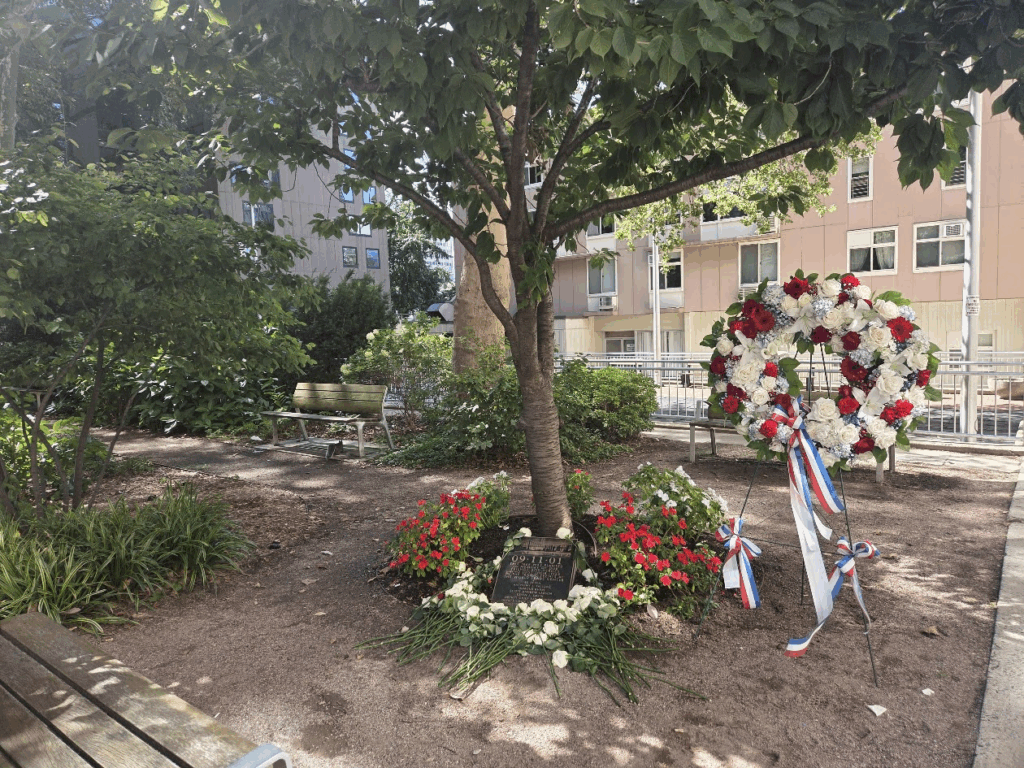
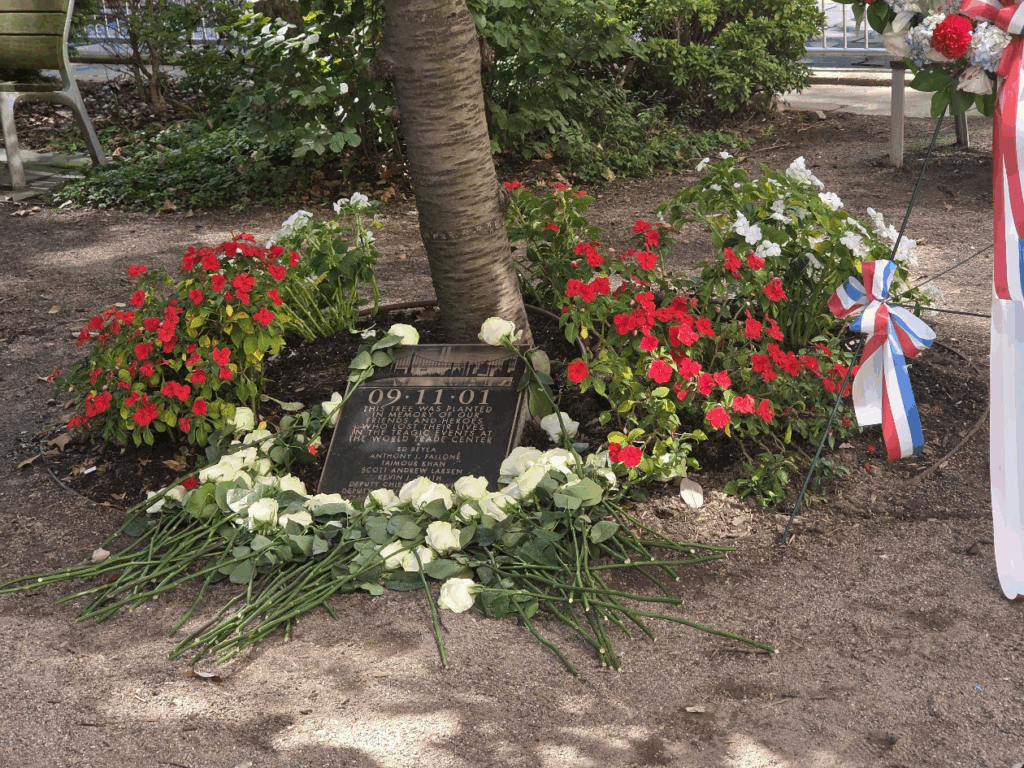
Floral wreath and white roses placed at the 9/11 Roosevelt Island Memorial
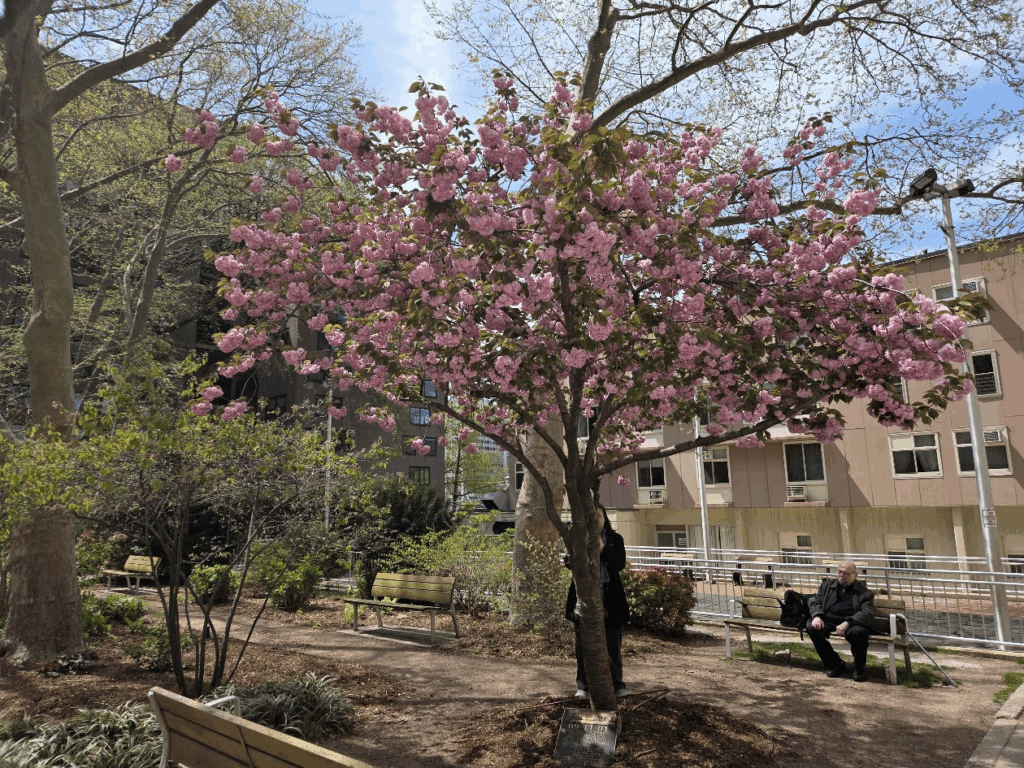
The plaque was a community inspiration with residents heading the campaign for the plaque and tree including islanders Vicki Feinmel and Margie Smith.
Everty spring the tree bursts with blooms.
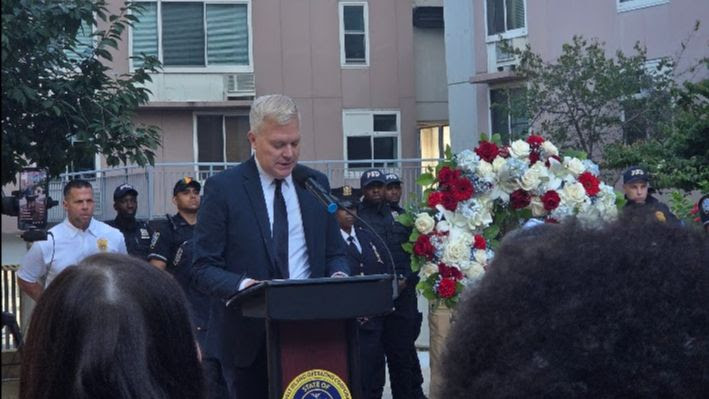
B,J. JONES Acting RIOC President and CEO addressing the audience.
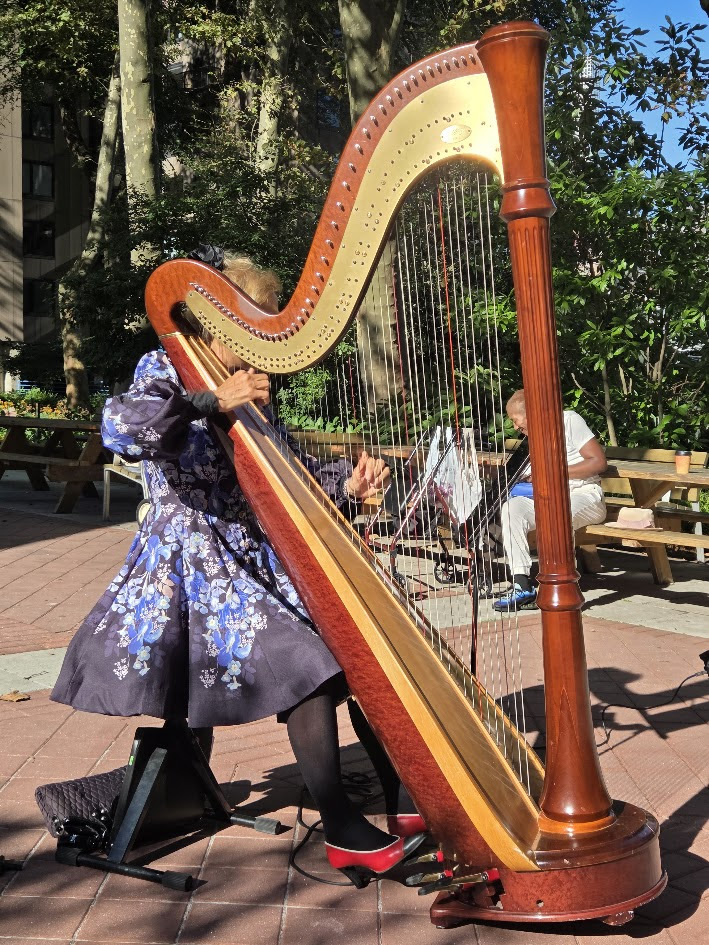
A splendid harpist performed as part of the ceremony.
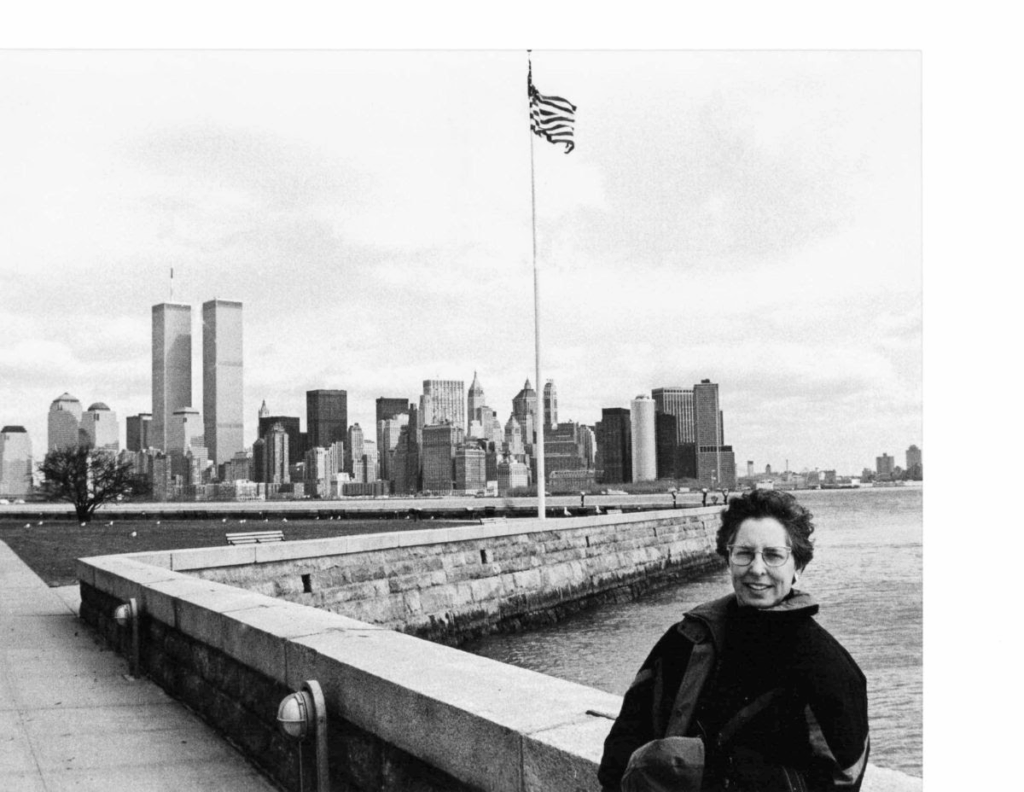
THE TWIN TOWERS FROM THE SOUTHPOINT WITH THE DELACORTE GEYSER IN THE 1980’S
ON A WINDY WINTER DAY
At Ellis Island in 1998. Photo by Phillip Carvalho
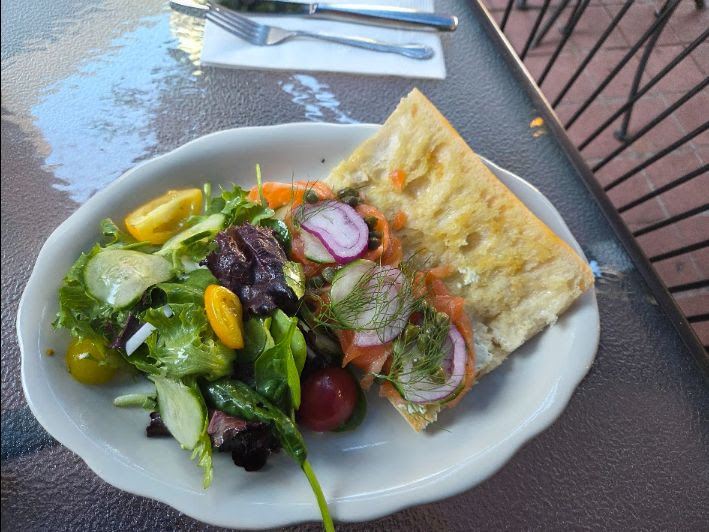
NEW EXPANDED MENU AT NISI GRILLED CHEESE IS BACK! A DELICIOUS SMOKED SALMON ON BAGUETE IS YUMMY. NEW MENU AVAILABLE UNTIL 4 P.M.
Credits
JUDITH BERDY PHILLIP CARVALHO
All image are copyrighted (c) Roosevelt Island Historical Society unless otherwise indicated THIS PUBLICATION FUNDED BY DISCRETIONARY FUNDS FROM CITY COUNCIL MEMBER JULIE MENIN & ROOSEVELT ISLAND OPERATING CORPORATION PUBLIC PURPOSE FUNDS.
Ai Wei wei debuts Camouflage at the FDR Four Freedoms State Park
Wednesday, Sept. 10, 2025
Judith Berdy
Issue # 1530
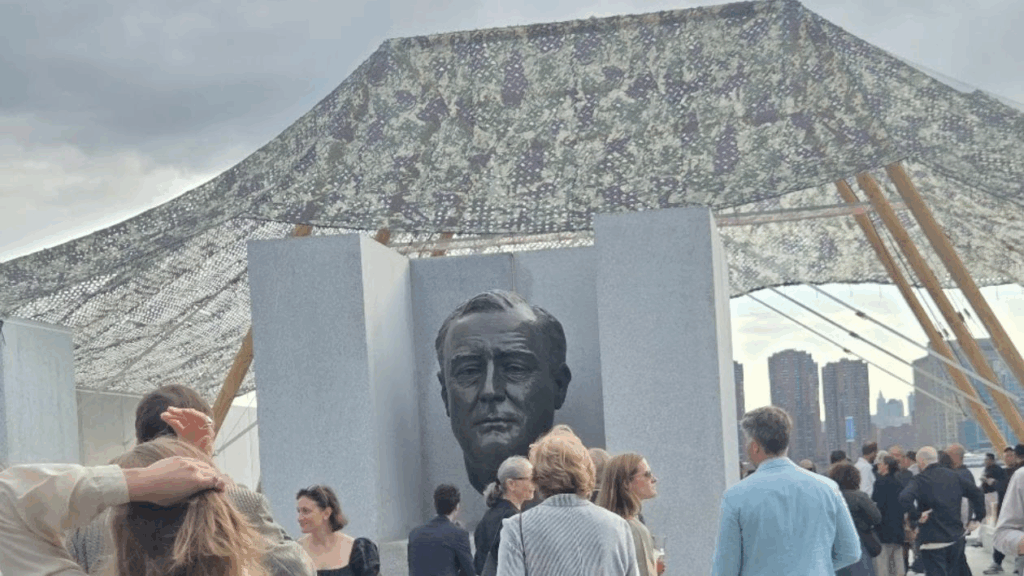
Camouflage by Ai Weiwei
On display September 10 – November 10, 2025 The pavilion is designed with the Brooklyn-based design firm Camber Studio.
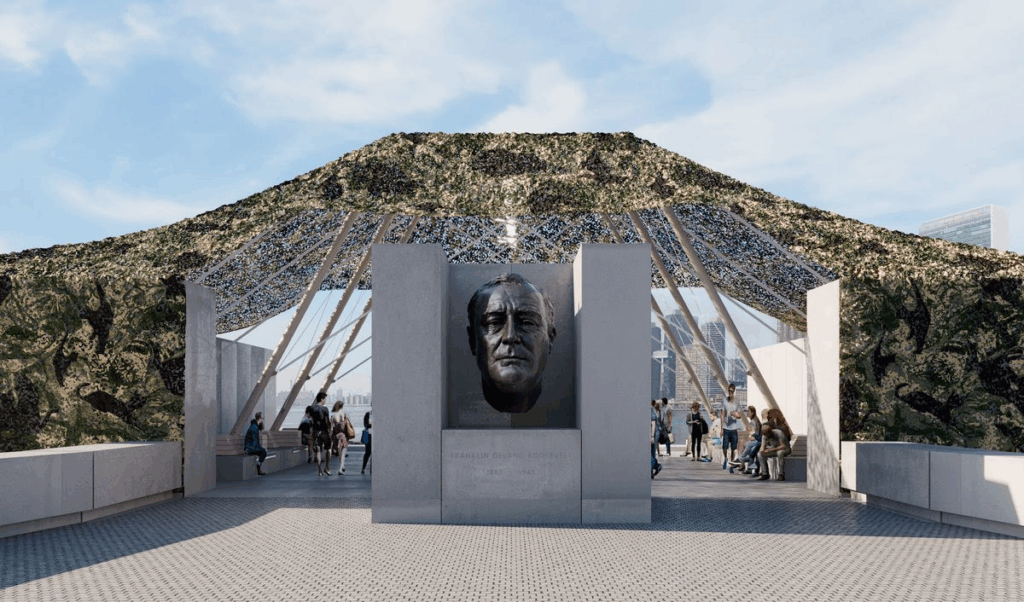
This project is based on and inspired by New York City’s Four Freedoms State Park, designed as a posthumous memorial by architect Louis Kahn to honor Franklin D. Roosevelt and his Four Freedoms. Situated on Roosevelt Island, in the East River between Manhattan and Brooklyn, the Park offers a striking view of Manhattan’s skyline and stands almost directly opposite the United Nations headquarters. The memorial spans a narrow passage approximately 200–300 meters long, centered around a statue of Roosevelt and his iconic speech on the Four Freedoms.
The concept of this project is rooted in the English term camouflage, defined in the Oxford Dictionary as both a means of disguise and concealment and as a tool for creating illusions to protect or to mislead. These dual meanings provide a compelling starting point. The installation employs camouflage as a central motif, covering the sides of the narrow passageway. Camouflage, ubiquitous in depictions of war—conflicts ignite and spread across various regions at the moment—has become a pervasive pattern across media and social platforms.
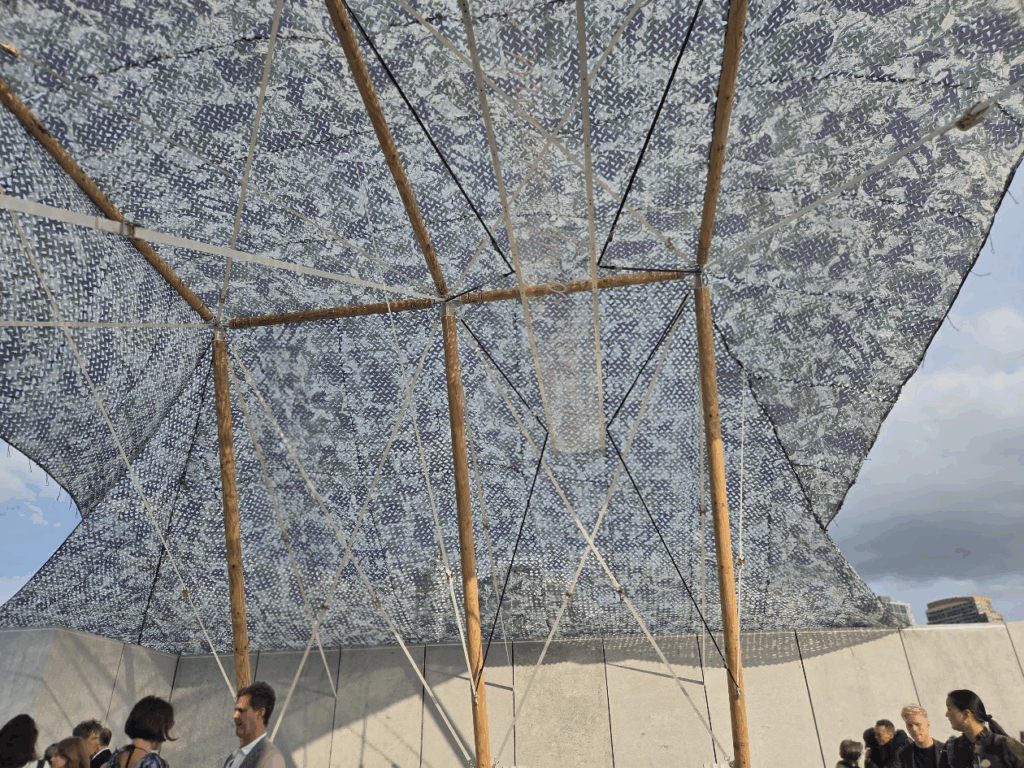
In this artwork, we reinterpret camouflage with cat patterns, replacing its traditional abstract designs. Cats, which have a sanctuary on Roosevelt Island, align seamlessly with the project’s message. Observations over time reveal that in the wake of human disasters—be it pandemics, wars, or environmental crises—animals, particularly those closely connected to humans, such as cats, often suffer profoundly. By incorporating cat patterns, the work reminds viewers that while human beings face crises of their own making, animals bear the brunt of these consequences, entirely innocent yet deeply affected.
The project explores the essence of Roosevelt’s four freedoms, beginning with freedom of speech—the fundamental right for everyone to express their understanding of goodness and justice, free from the influence of politics, religion, or economic power. It also reflects on freedom of religion, affirming that no one should dictate another’s faith or spiritual path. Freedom from want highlights the right to pursue one’s ideals, while freedom from fear takes center stage in our times. Today, fear pervades not only in war zones but even within so-called democratic societies, where uncertainty about the future renders freedom from fear a privilege, inaccessible to many.
The artwork uses the symbolic nature of camouflage to spark a dialogue about what needs protection and what requires the removal of disguise to reveal truth. This is a challenging question, but addressing it is essential.
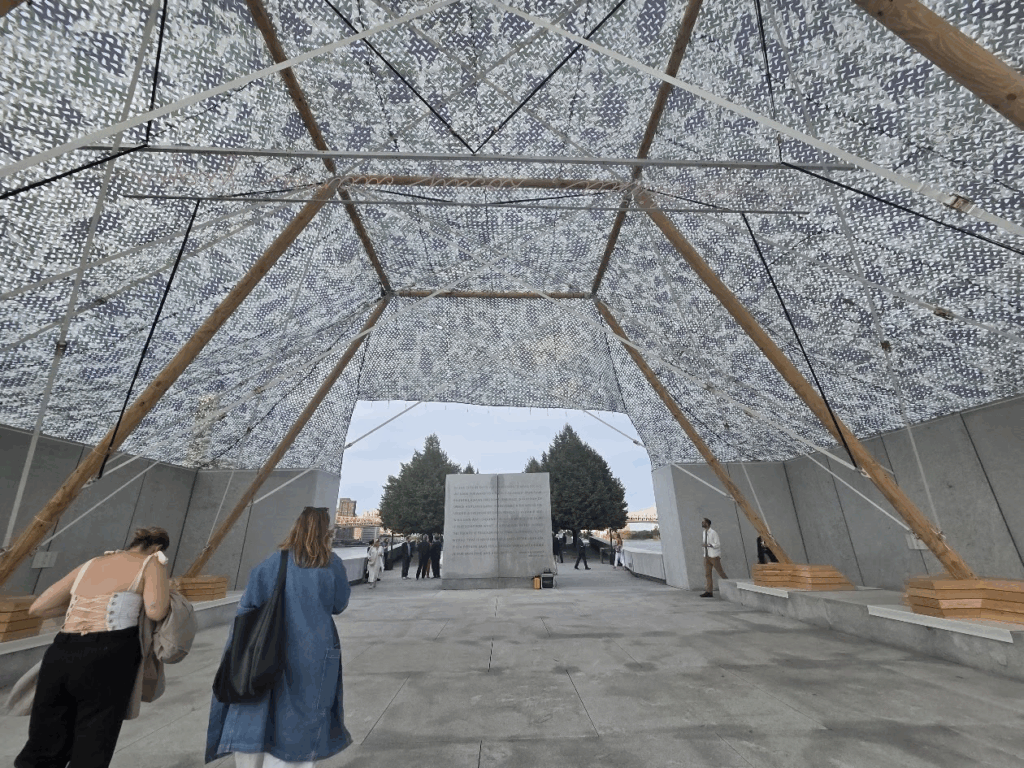
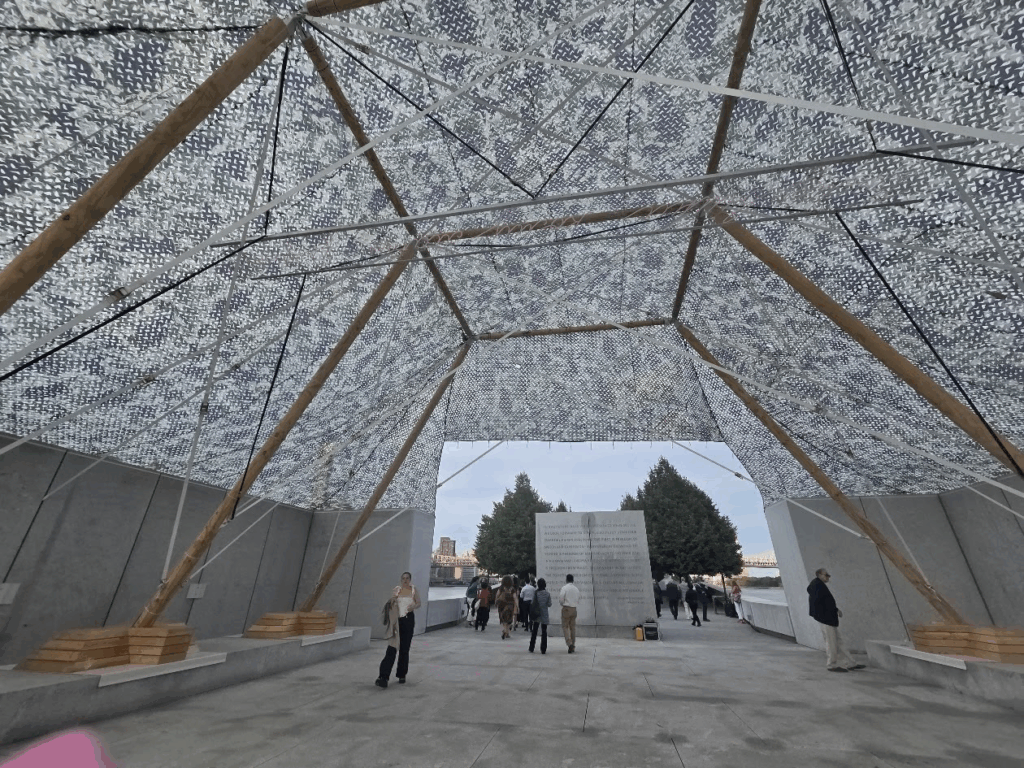
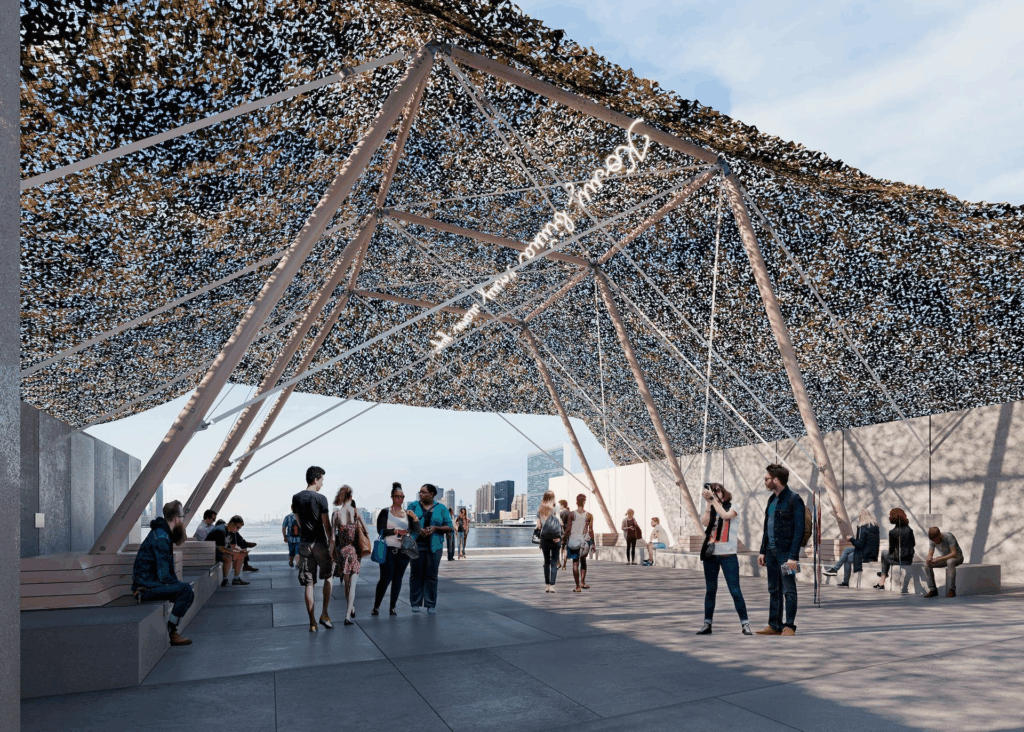
Meanwhile, we install a wooden watering frame structure at the end point of the narrow passage, draped in this camouflage. From the outside, whether viewed from New York or up close, or when the audience walks under the camouflage fabric, it resembles a battlefield. But it actually forms a pavilion-like space where people can feel the harsh and absurd reality of war.
A Ukrainian proverb, “Кому війна, кому мати рідна”, hangs from the built sanctuary structure: “For some people, war is war; for others, war is the dear mother.” In plain English, it captures the idea that for some, war is a disaster, while for others, it is an opportunity for profit. Similarly, the Chinese saying “bad luck and good fortune coexist” emphasizes the intertwined nature of misfortune and luck. Upon reflection, modern wars often arise from the pursuit of profit—but whose profit, and at what cost? How many lives must be sacrificed to achieve these gains? These are the questions we must confront.
The project incorporates public participation, encouraging visitors to print their wishes on ribbons that will be attached to the camouflage netting. This participatory element fosters greater engagement and amplifies the artwork’s message. Public involvement and awareness are integral to the essence of this work.
During the exhibition, admission to the Park will require a FREE timed-entry ticket. More information to come.
Camouflage by Ai Weiwei is commissioned by Four Freedoms Park Conservancy and the pavilion is designed with Camber Studio.
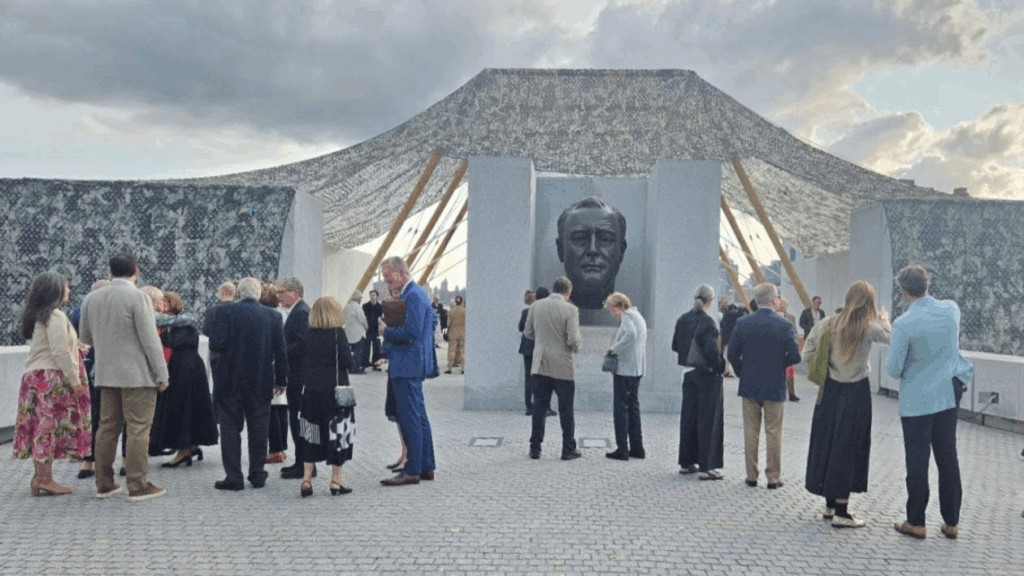
Approaching the end of the lawn and the tented area appears.
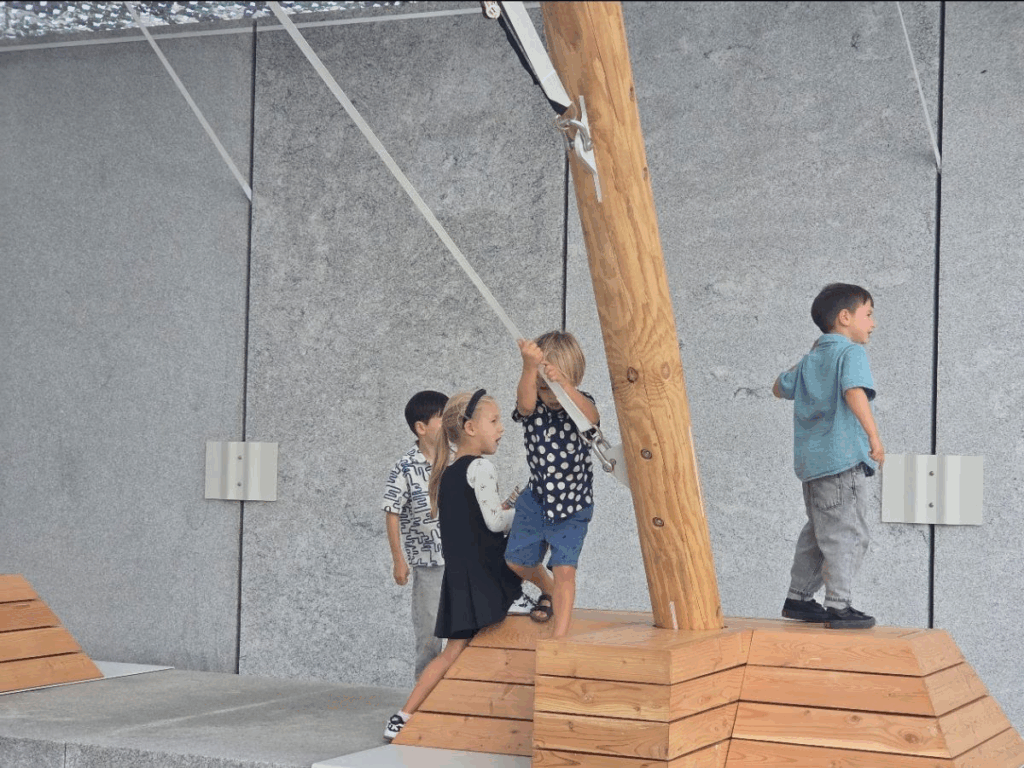
The structure is supported by giant timbers that are planted in large wooden stacks placed on the granite wall supports. More supports are strung into the walls. Though the camouflage fabic is light and airy, the supporting structure is built to support all types of wind and weather.
Nothing is better than to have kids approve of this new play area!!!
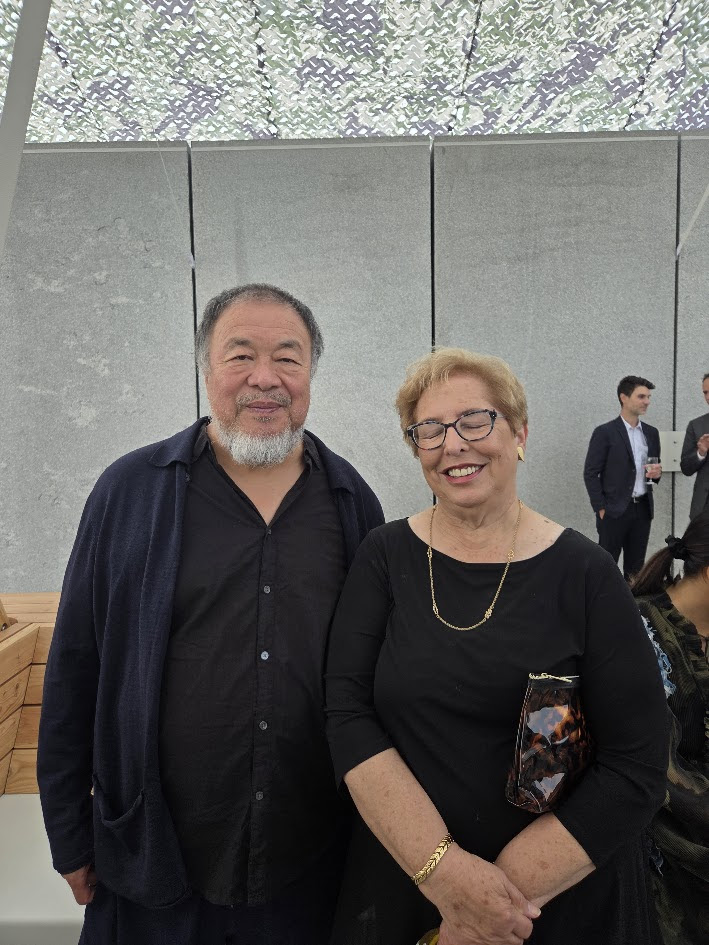
Ai Weiwei was happy to stand and great visitors. He easily chatted with the guests and told me of admiring our quiet island in the City.
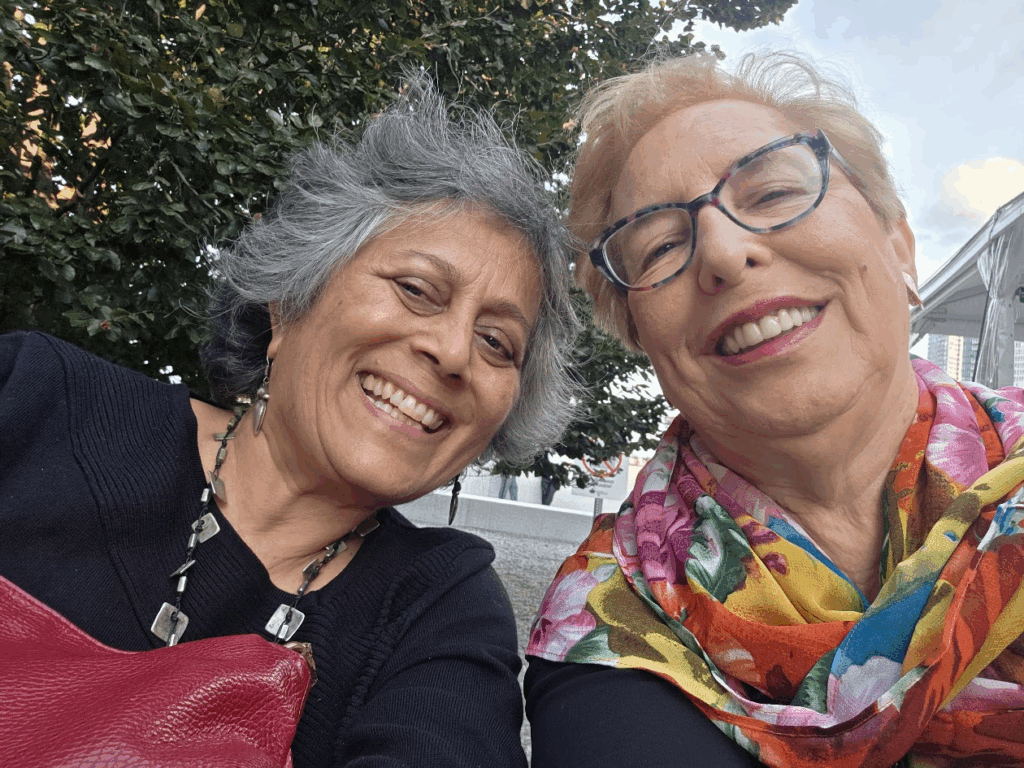
Louela Streitz and I enjoyed the evening chatting with FDR, & RI staff, Cornell friends and neighbors.
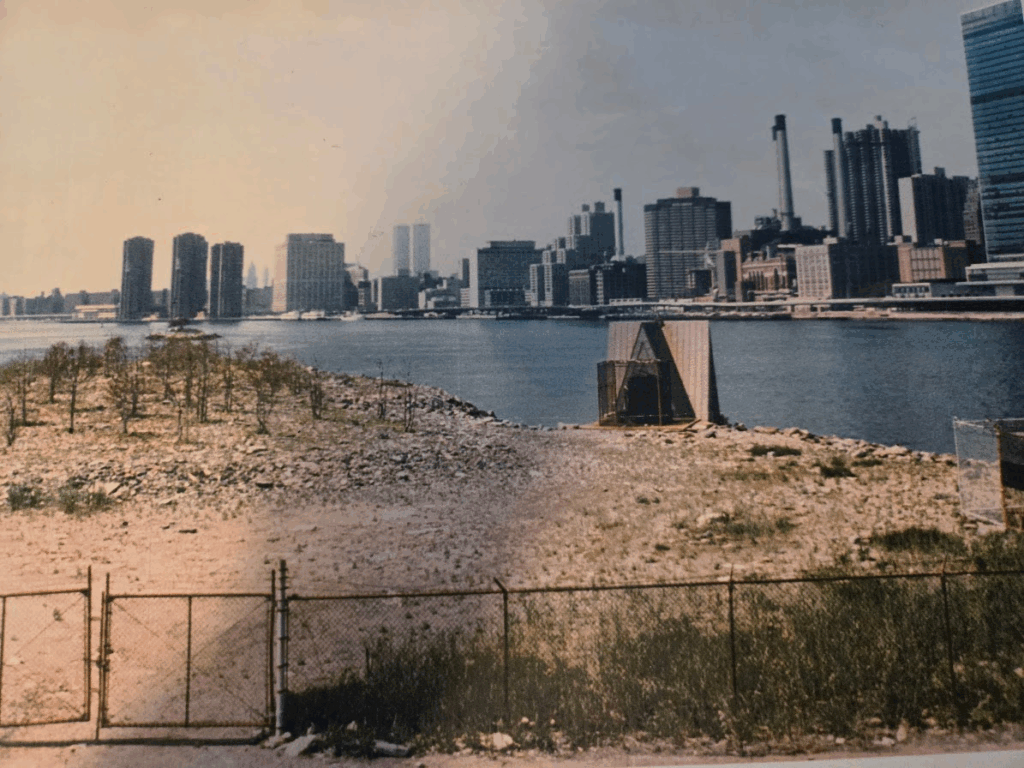
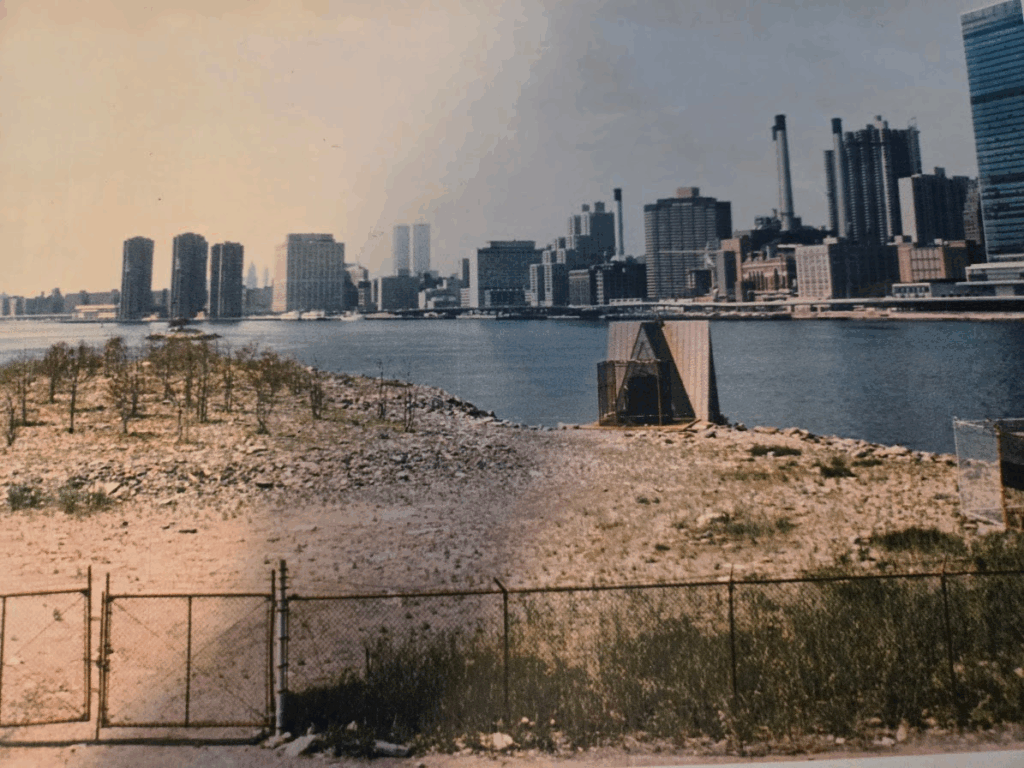
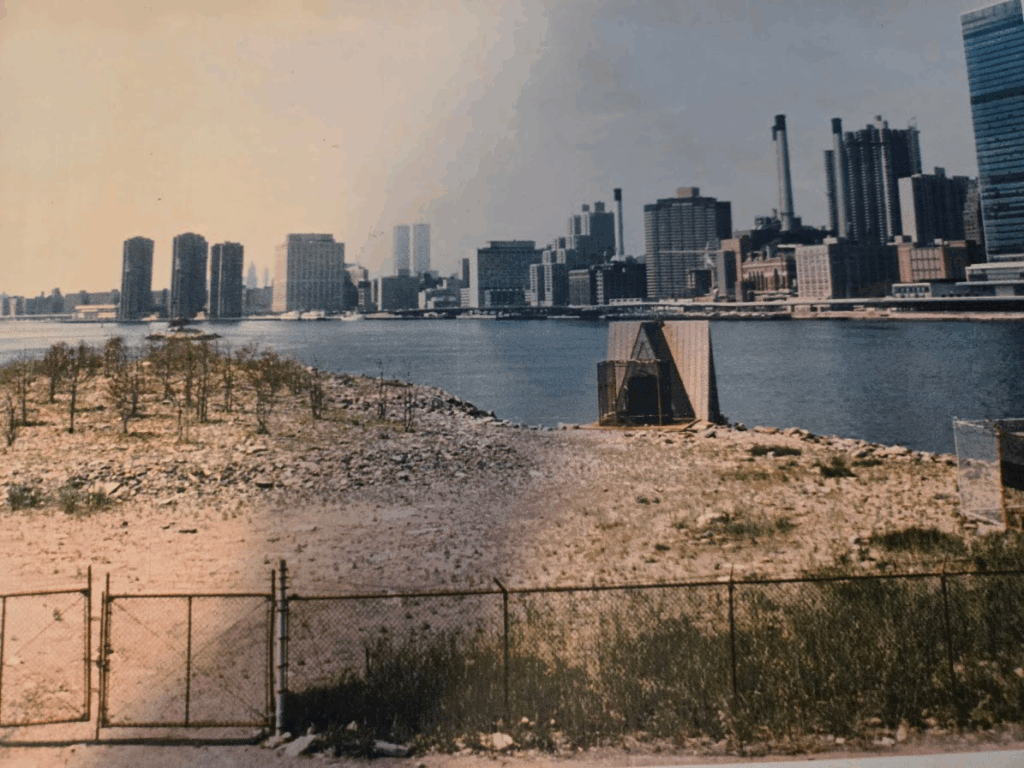
BEFORE THE FDR FOUR FREEDOMS STATE PARK, THE SOUTHPOINT WITH THE DELACORTE GEYSER IN THE 1980’S
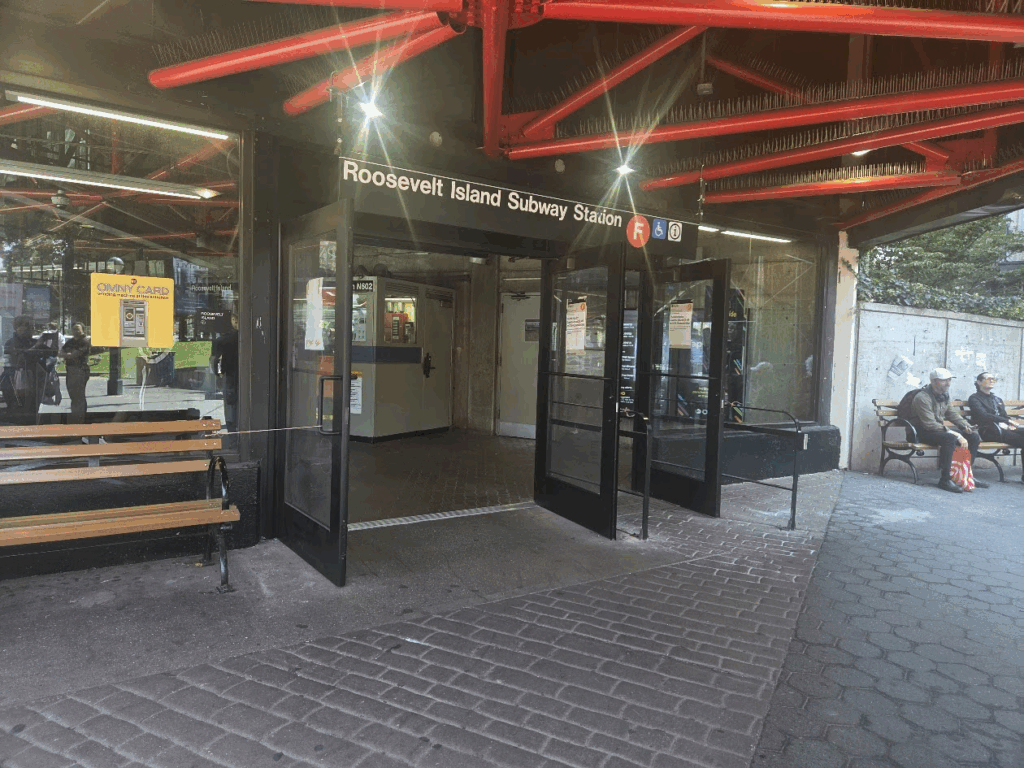
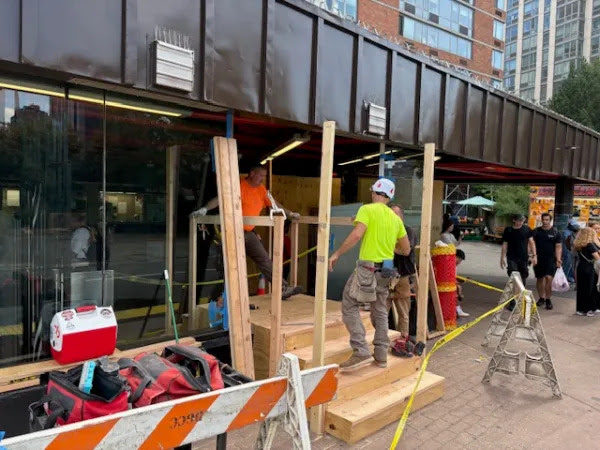
UPDATE ARE THESE THE NEW DOORS INSTALLED AT THE SUBWAY STATION, LOOKING JUST LIKE THE OLD ONES?
Credits
JUDITH BERDY
All image are copyrighted (c) Roosevelt Island Historical Society unless otherwise indicated THIS PUBLICATION FUNDED BY DISCRETIONARY FUNDS FROM CITY COUNCIL MEMBER JULIE MENIN & ROOSEVELT ISLAND OPERATING CORPORATION PUBLIC PURPOSE FUNDS.
If you lived or worked in the Gramercy area in the early decades of the 20th century, you probably passed it by without much thought
Amid modern transportation infrastructure like traffic lights, lampposts, and street signs stood a faded granite slab embedded in the sidewalk on Third Avenue near 17th Street.
What was this tombstone-like relic? New Yorkers of the era would have known it as one of Manhattan’s last milestones.
Milestones, or mile markers, helped travelers keep track of how many miles they were from City Hall as they traversed the primitive, unlit, often dangerous roads of a sparsely populated city.
Until the urbanization of the bulk of Manhattan Island in the late 19th century, milestones were often the only directionals a horseman or stagecoach driver had as they journeyed up or down one of Manhattan’s few north-south roads.
Taverns popped up around them; owners knew that weary travelers might need a hearty meal and a place to sleep before continuing in or out of the city. These “heirlooms of the past,” as one article called the milestones, were so critical, laws punished those who defaced them.
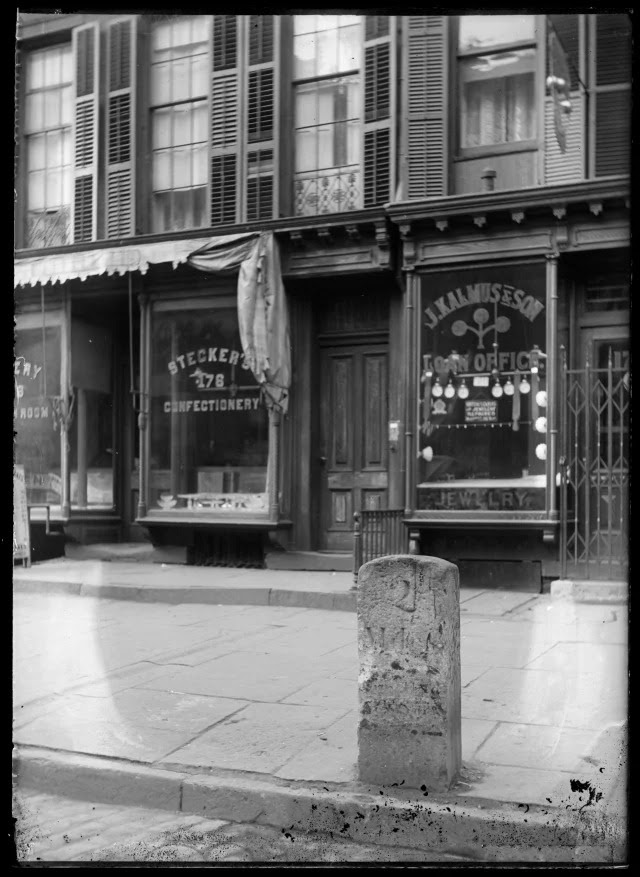
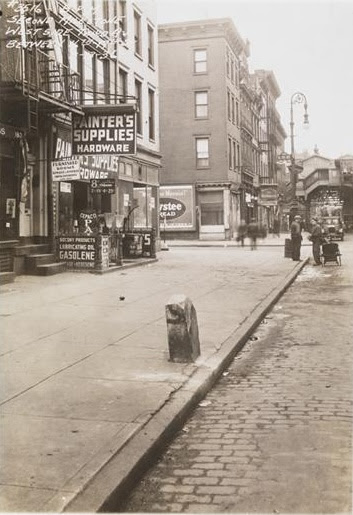
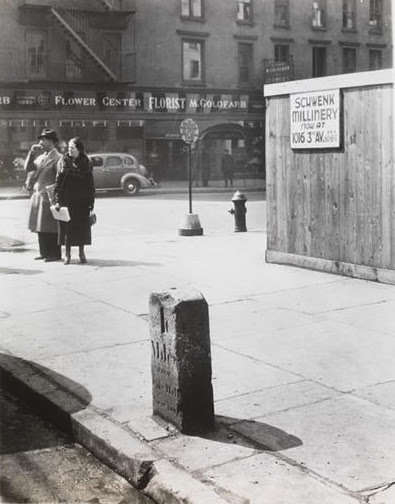
Mile marker 2, seen in the first three photos in this post, was one of 12 embedded along the Boston Post Road—a former Native American trail that ran from the Battery along the East Side and into the Bronx. Eventually subsumed by the conformity of avenues outlined in the Commissioner’s Plan of 1811, Boston Post Road roughly aligns with today’s Third Avenue.
Milestones also existed on the Bloomingdale Road, the colonial thoroughfare that began at 23rd Street and followed a path through today’s Upper West Side. Unlike the Boston Post Road mile markers, none of the Bloomingdale Road’s markers appear to have survived into the 20th century.
When mile marker 2 was removed from its longtime location on Third Avenue isn’t clear. The first photo, from 1900, reveals a chunk of granite that’s not in bad shape. The second image, from 1931, shows a closeup of a more battered milestone.
By the time the third photo was taken in 1936, it almost looks like trash on the curb waiting to be carted away. Which may have actually happened; the circumstances of its demise isn’t known.
But the fact that it managed to survive into the 1930s is astonishing. I’d attribute it to a combination of the sentimentality some New Yorkers had for ye olde days of Gotham, as well a benign neglect. After outliving its usefulness, most New Yorkers just ignored it.
The two-mile marker’s century-plus lifespan makes me wonder: What happened to the other 11 milestones that dotted Manhattan in today’s Midtown, Yorkville, and Inwood?
According to the City History Club, which in the early 1900s gained guardianship over the remaining mile markers, “some of the milestones have disappeared, while others have had a varied experience.” This includes destruction, theft, removal to a safe private yard, and getting wiped from the cityscape in the interest of “public improvement.”
Tracing the fate of these relics hasn’t been easy. But records and archives give us some information to go on.
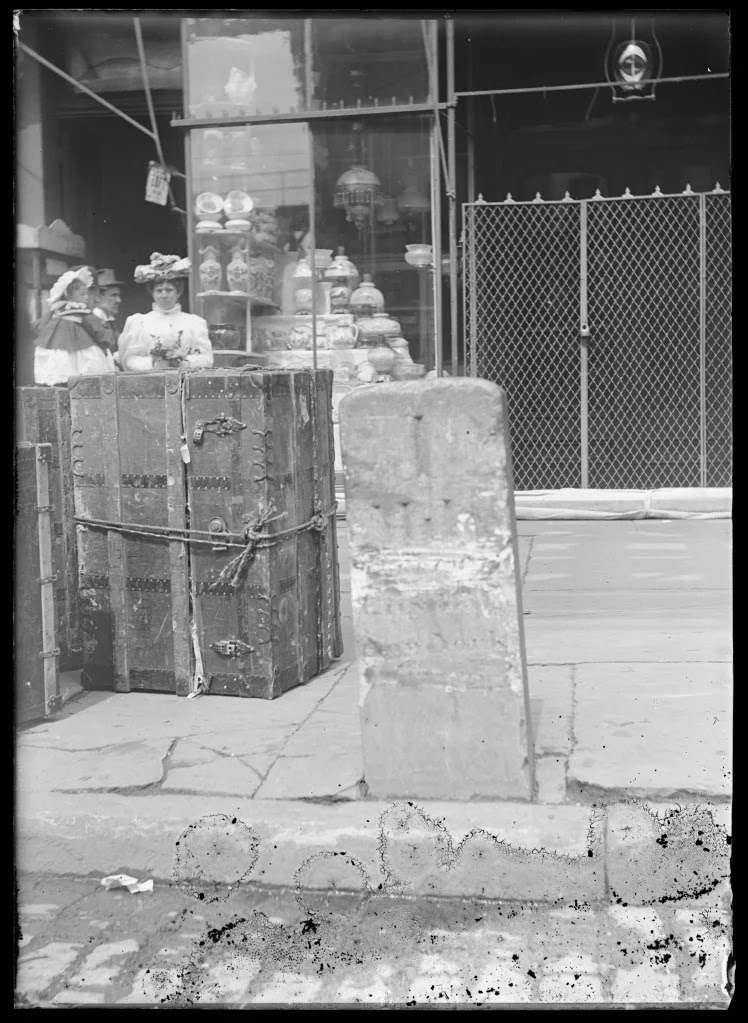
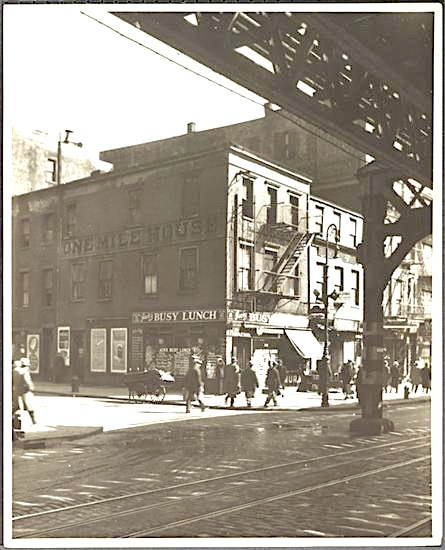
In 1904, just three of the original milestones still existed, according to a New York Times article from that year. These included mile marker 2 as well as mile marker 1, which stood in front of 213 Bowery near Rivington Street (fourth photo, from 1897).
Incredibly, the one-mile marker existed at its original Bowery location until 1926, when a truck destroyed it, according to Kevin Walsh writing in SpliceToday in 2024. Keeping its memory alive was a 20th century tavern at this location called the One Mile House (see the lettering on the side of the building), visible in the photo below from 1932.
The other mile marker survivor per the Times was at Third Avenue just above 57th Street (possibly in the fifth photo). When and how that one got the boot is a mystery.
Ah, but wait! The Times article didn’t mention the two Boston Post Road mile markers that actually still exist in Manhattan to this day.
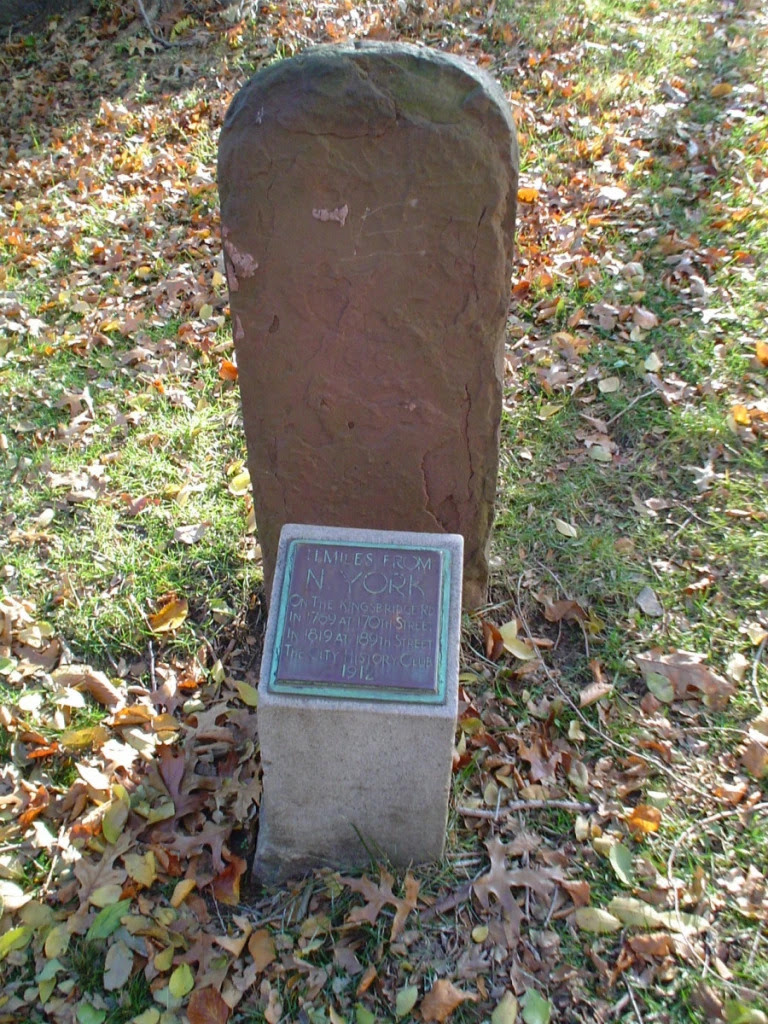
One, mile marker 11, originally stood at 189th Street. In 1912, the City History Club moved this weathered artifact to the safety of Roger Morris Park (below), which surrounds the circa-1765 Morris-Jumel Mansion on Jumel Terrace in Washington Heights.
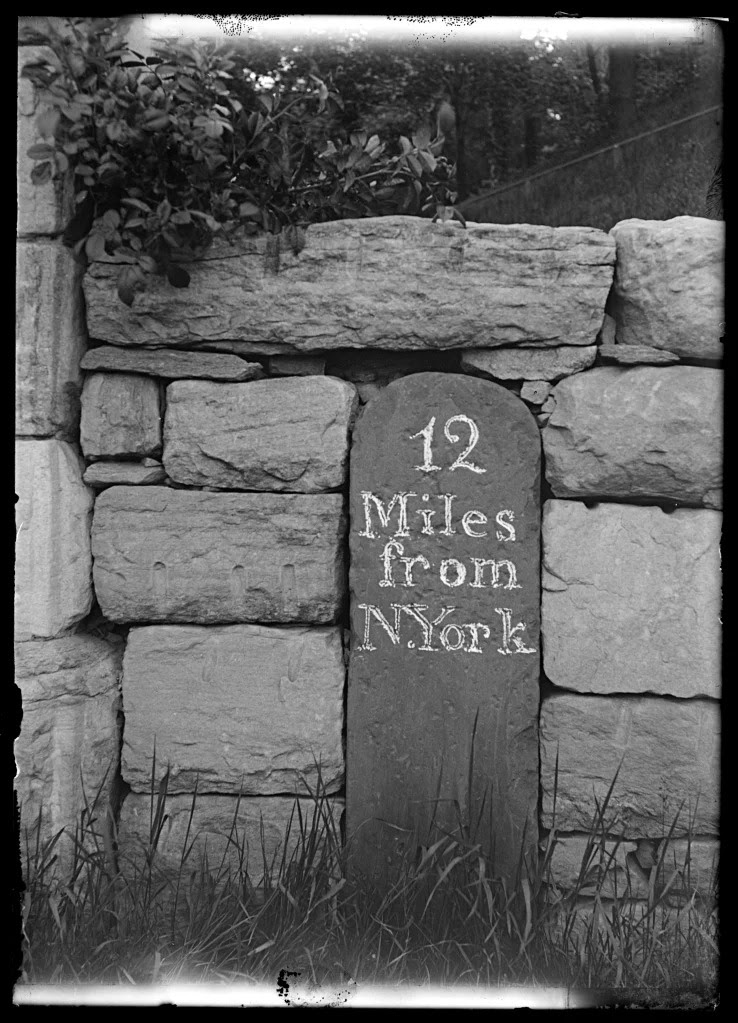
Mile marker 12 is the only milestone still visible on a city street. Its original location was at Hawthorne Street (now 204th Street) near Broadway. Workers building a mansion for wealthy merchant William Isham wanted to trash this relic, but Isham had it preserved as part of a stone gate at the entrance to his estate.
In 1911, Isham’s daughter donated to the city the land her father’s mansion once occupied, intending it to become a public park. That 12th mile marker is still built into the stone entrance that now marks Isham Park in Inwood.
Brooklyn and Queens had mile markers as well. One in Brooklyn remains (or remained? I haven’t seen it lately) on Avenue P and Ocean Parkway. In Bensonhurst, Milestone Park contains a replica of an 18th century milestone that once marked the distance to the ferries to Manhattan and Staten Island.
BEFORE THE FDR FOUR FREEDOMS STATE PARK, THE SOUTHPOINT WITH THE DELACORTE GEYSER IN THE 1980’S
All image are copyrighted (c) Roosevelt Island Historical Society unless otherwise indicated THIS PUBLICATION FUNDED BY DISCRETIONARY FUNDS FROM CITY COUNCIL MEMBER JULIE MENIN & ROOSEVELT ISLAND OPERATING CORPORATION PUBLIC PURPOSE FUNDS.
Ai Weiwei’s public art installation Camouflage goes on view 10 September at the southern tip of Roosevelt Island, directly across the East River from the United Nations and in tandem with its 2025 General Assembly—the 80th session since its founding at the end of the Second World War. At the Franklin D. Roosevelt Four Freedoms State Park, designed by the architect Louis Kahn in 1973 and realised posthumously in 2012, Ai is draping the memorial to President Roosevelt in fabric the artist designed with silhouettes of cats to reinterpret ubiquitous camouflage patterns used as a means of concealment in wartime.
“It is a deeply militarized symbol,” Ai says of the tent-like structure, supported by scaffolding, that protects, or shrouds, the memorial celebrating Roosevelt’s Four Freedoms—of speech, of religion, from want and from fear—espoused in his 1941 presidential address to the US Congress. “Presenting such an installation is necessary in a world marked by ongoing wars and the threat of even greater conflict.”
Art X Freedom
Camouflage marks the launch of Art X Freedom, the Four Freedoms Park Conservancy’s new annual commissioning programme of public art intended to inspire conversation around issues of social justice. “Let’s try to add the power of public art at a park, close to the UN, that’s dedicated to government for the good,” says Howard Axel, the conservancy’s chief executive, who is interested in compelling more people to make the short pilgrimage to the 3.5-acre park.
Ai Weiwei’s Camouflage is part of a new public art commission programme at Four Freedoms Park on Roosevelt Island
Like many New Yorkers, the acclaimed 68-year-old Chinese artist and activist, who now lives in Portugal, had never been to the park before touring it last November with Axel. On the triangular tip of the island, dramatically sited between Manhattan and Queens, Kahn designed two long alleys of Linden trees converging at a colossal bronze head of Roosevelt, poised within a granite niche. Carved on its backside is an excerpt from his Four Freedoms speech. This presides before a square open-air plaza, what Kahn called “the room”, defined on facing sides by a series of 6ft by 6ft by 12ft-high granite blocks spaced one inch apart.
“Kahn was very aware of the fact that Roosevelt is considered the architect of the UN,” says Gina Pollara, the executive director of the park who oversaw its building from the schematic plans Khan produced a year before his death. She describes this “room” as Kahn’s interpretation of a Greek temple as well as of the UN as an organisation of individual member states that compose something larger. “Roosevelt used to say that all the problems of the world could be solved sitting around a dining room table talking.”
The disguise of truth
Ai Weiwei’s Camouflage is part of a new public art commission programme at Four Freedoms Park on Roosevelt Island
Now Ai’s camouflage fabric will cover the room and cast dappled light on visitors, prompting considerations of “what needs protection and what requires the removal of disguise to reveal truth”, the artist says. Inside the tenting, LED lights spell out a proverb in Ukrainian that means: “Wars that bring misery to some may be ‘dear mothers’ to others.” Ai has also collaborated with the artist-run organisation For Freedoms that is providing ribbons printed with each of the Four Freedoms, on which people can write their own messages. These will be affixed to the camouflage netting during the exhibition.
Ai’s cat motif was inspired in part by seeing the outdoor Cat Sanctuary & Wildlife Rehabilitation Center just outside the entrance to the Four Freedoms park. In human disasters such as wars, pandemics and environmental crises, “cats are among the first to suffer”, Ai says, seeing them as emblematic of life’s most innocent and easily manipulated.
Embedded somewhere within his camouflage pattern is a single dog, which eagle-eyed viewers can have fun trying to find. “It is not only playful but also symbolic,” Ai says. “Among all the animals we love, there are different kinds. If we cannot allow those who are different to exist, civilisation itself would cease to exist.”
Watch for details about free timed tickets. The exhibition is slated to be on until November.
NEW DOORS ARE COMING TO THE SUBWAY STATION
AFTER YEARS OF BROKEN DOORS, HELD OPEN BY SAFETY TAPE, THE MTA IS INSTALLING NEW DOORS THIS WEEKEND, BUT THERE WERE MANY GLITCHES, LIKE HAVING PEOPLE WALK UP AND OVER 4 STEPS TO ENTER THE STATION………
STAY TUNED!! AND WATCH FOR THE “GRAND OPENING”
Credits
THE ART NEWSPAPER
All image are copyrighted (c) Roosevelt Island Historical Society unless otherwise indicated THIS PUBLICATION FUNDED BY DISCRETIONARY FUNDS FROM CITY COUNCIL MEMBER JULIE MENIN & ROOSEVELT ISLAND OPERATING CORPORATION PUBLIC PURPOSE FUNDS.