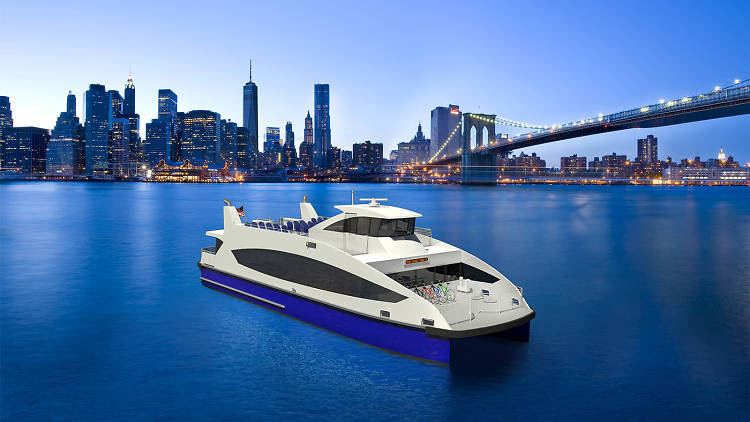
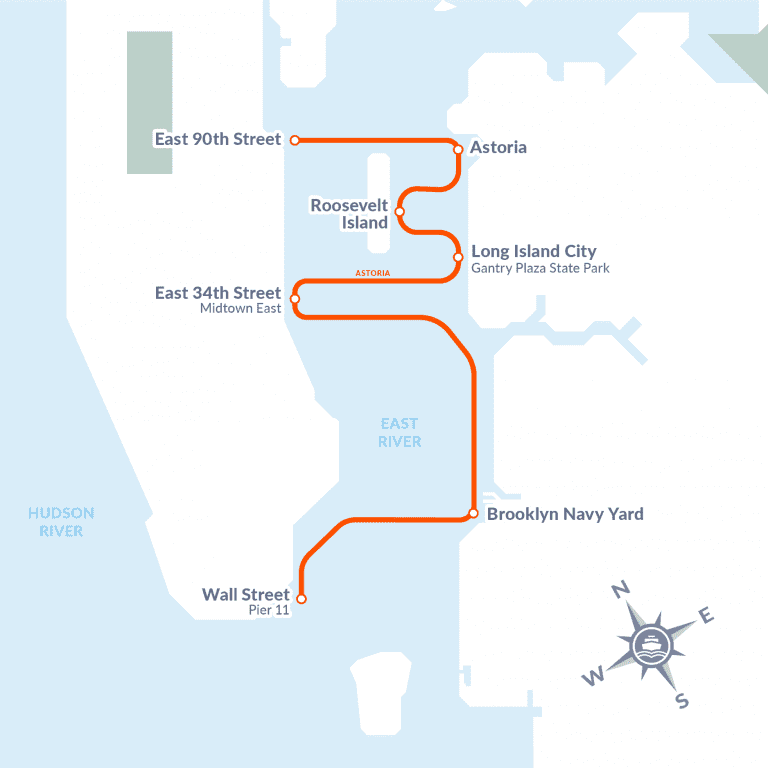
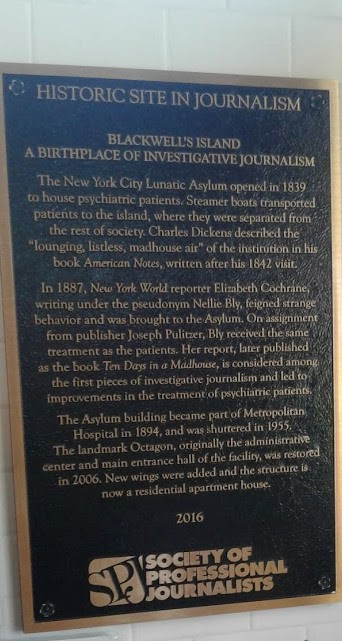
As of this Saturday, August 22nd you can get there from here. The NYC Ferry will extend the Astoria route to go 90th Street, Manhattan. This is great news on those wanting to get to the Upper East Side.
The ferry docks just north of the park at 90th Street and the FDR Drive.
Carl Schurz Park is a 14.9-acre (6.0 ha) public park in the Yorkville neighborhood of Manhattan, New York City, named for German-born Secretary of the Interior Carl Schurz in 1910, at the edge of what was then the solidly German-American community of Yorkville.
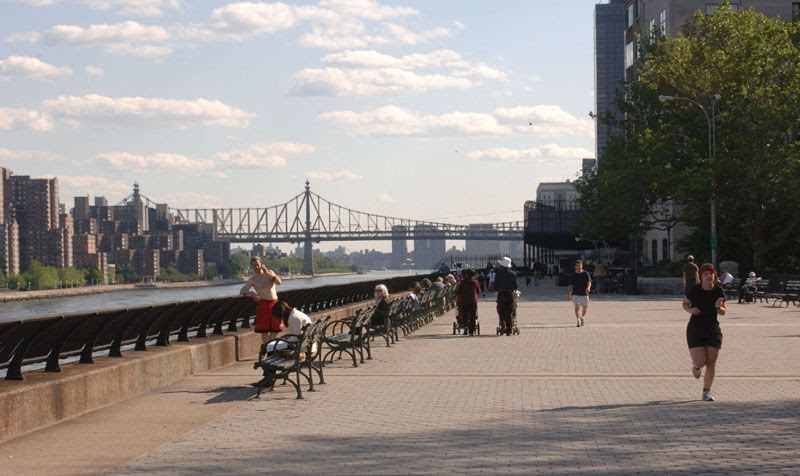
The park contains Gracie Mansion, the official residence of the Mayor of New Carl Schurz Park overlooks the waters of Hell Gate and Wards Island in the East River, and is the site of Gracie Mansion (built for Archibald Gracie, 1799, enlarged c. 1811), the official residence of the Mayor of New York since 1942. There are tours of the restored building every Wednesday. The park’s waterfront promenade is a deck built over the Franklin D. Roosevelt East River Drive, enclosing the roadway except on the side facing the East River.
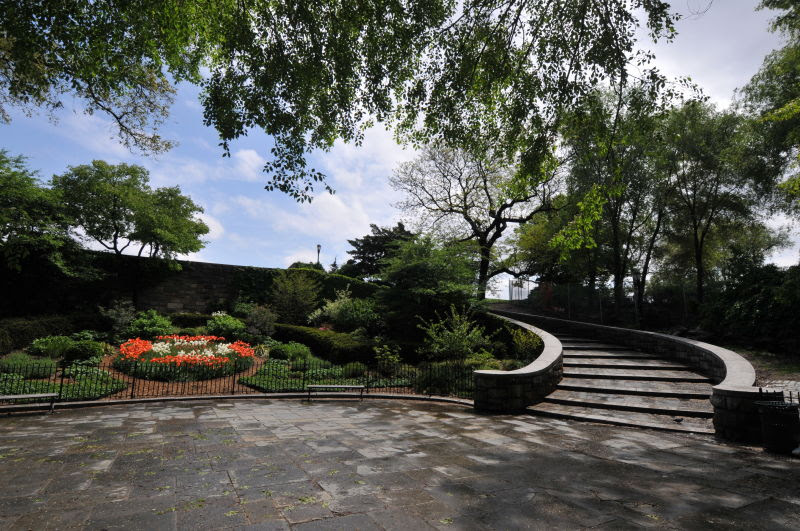
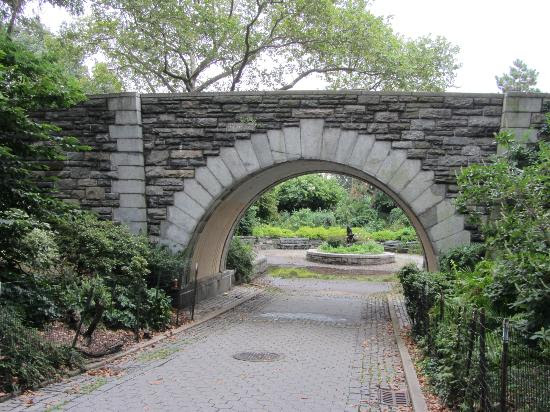
The park is bordered on the west by East End Avenue and on the south by Gracie Square, the extension of East 84th Street to the river. The East River Greenway, part of the Manhattan Waterfront Greenway, passes along the promenade platform. The park contains winding, shady paths, green lawns, waterfront views, basketball courts, a large playground for children, and two dog runs: one designated for larger dogs and one for smaller dogs. The park is maintained by Carl Schurz Park Conservancy, the oldest park conservancy in New York City, in partnership with the New York City Department of Parks and Recreation.
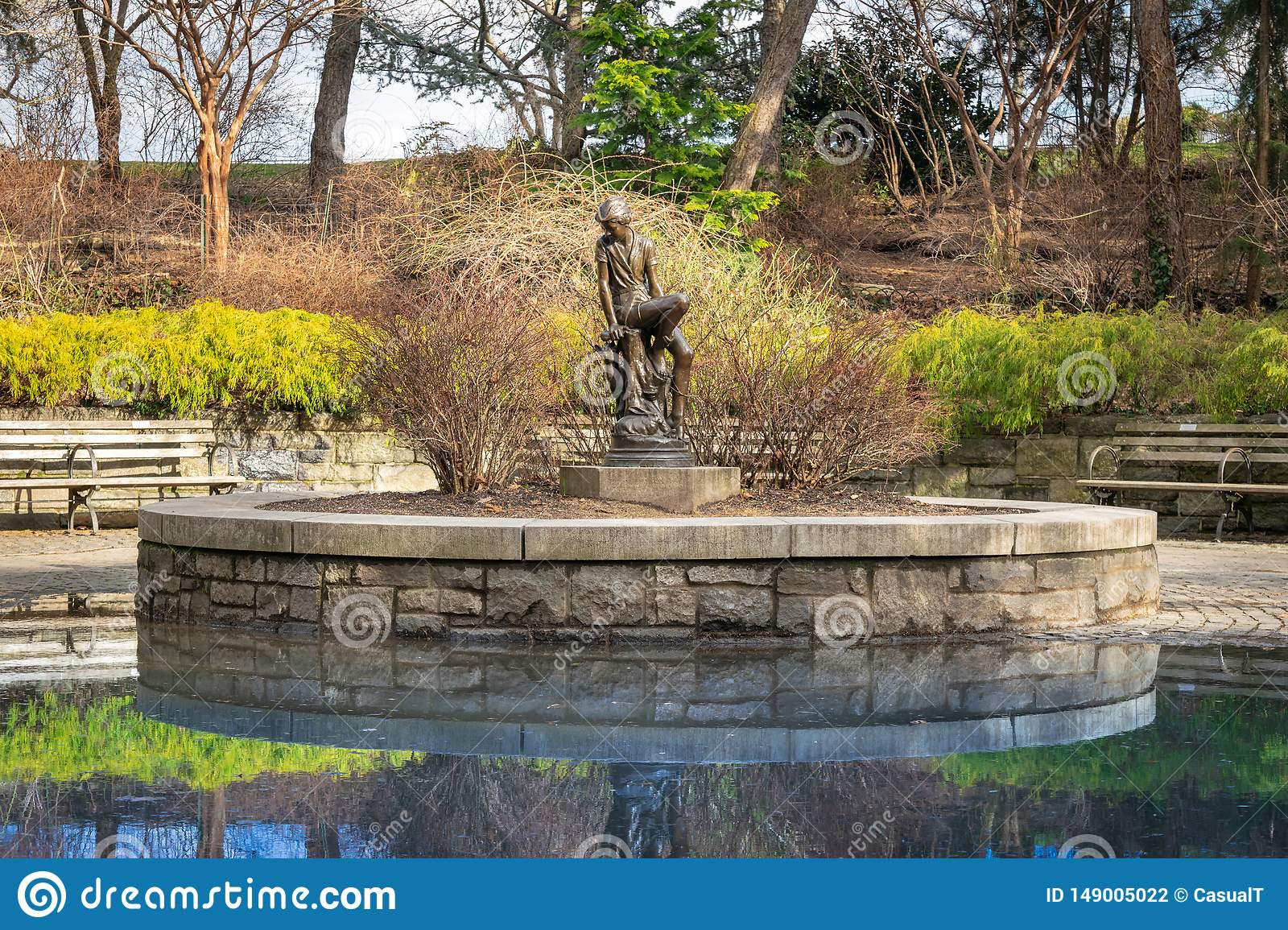
PETER PAN STATUE IN THE PARK
Carl Schurz Park Carl Schurz Park This text is part of Parks’ Historical Signs Project and can be found posted within the park.
What was here before? The Algonquins were the earliest inhabitants of this land, which was valued for its strategic location overlooking turbulent waters of the Hell Gate at this bend in the East River. The first known European owner of the land was Dutchman Sybout Claessen, who was granted the property in 1646 by the Dutch West India Company. Jacob Walton, a subsequent owner, built the first house on the site in 1770. During the Revolutionary War, the Continental Army built a fort surrounding the Walton residence to guard the strategic shipping passage of Hell Gate.
After a British attack on September 8, 1776, the house was destroyed and the Americans were forced to retreat from the fort, which the British retained until the end of the war in 1783. In 1799, a prosperous New York hant named Archibald Gracie built a country house on the land. .Bankruptcy forced Gracie to sell his house to Joseph Foulke in 1823. Foulke later subdivided the land, selling the mansion and some of the land to Noah Wheaton in 1857.
How did this site become a park? In 1896, the City of New York seized the estate from Wheaton due to non-payment of taxes, incorporating its 11 acres of grounds into East River Park. It was renamed in 1910 for the German-American statesman Carl Schurz.
The first home of the Museum of the City of New York (1924-32), the mansion has served as the official residence of New York’s mayors since Fiorello La Guardia moved there in 1942.
Illustrious landscape architects Calvert Vaux (1824-1895) and Samuel Parsons (1844-1923) completed a new landscape design for the park in 1902. Maud Sargent (1899-1992) re-designed the park in 1939 when the East River Drive underpass, now Franklin Delano Roosevelt Drive, was under construction. Sargent’s functional design used strategically placed boulders, plantings, and hardscaped plazas and walkways to obscure the new roadway below.
The park’s waterfront promenade, built over the FDR’s roof deck, was named after City College president and New York State Commissioner of Education John H. Finley. In 1975 Charles Andrew Hafner’s (1889-1960) sculpture of Peter Pan, originally created in 1928 for the old Paramount Theater’s lobby, was installed in one of the park’s cloistered gardens. Recent improvements include rebuilding of the stairs, the complete restoration of the playground and the opening of Carl’s Dog Run.
These and other projects, including the planting of flowers, have been accomplished through a partnership between NYC Parks and the Carl Schurz Park Conservancy, which has demonstrated the community’s commitment to restoring, maintaining, and preserving this park since it formed in 1974. Who is this park named for?
The Board of Aldermen named the park for the soldier, statesman, and journalist Carl Schurz (1829-1906) in 1910. Schurz was a native of Cologne, Germany, and the renaming was strongly supported by the large German adjacent community, Yorkville. After immigrating to the United States in 1852, Schurz quickly made his reputation as a skilled orator and proved to be instrumental to Abraham Lincoln’s 1860 election campaign. His most significant political offices were that of United States Senator from Missouri (1869-1875), and Secretary of the Interior (1877-81) during the Hayes administration. In his later years, Schurz was editor of the New York Tribune and an editorial writer for Harper’s Weekly. Schurz is also honored by Karl Bitter’s statue of 1913, located at Morningside Drive and 116th.
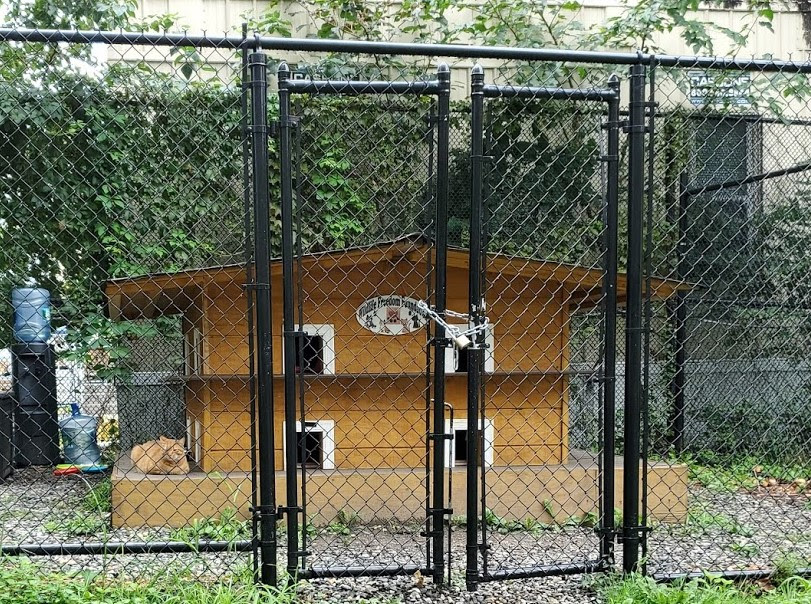
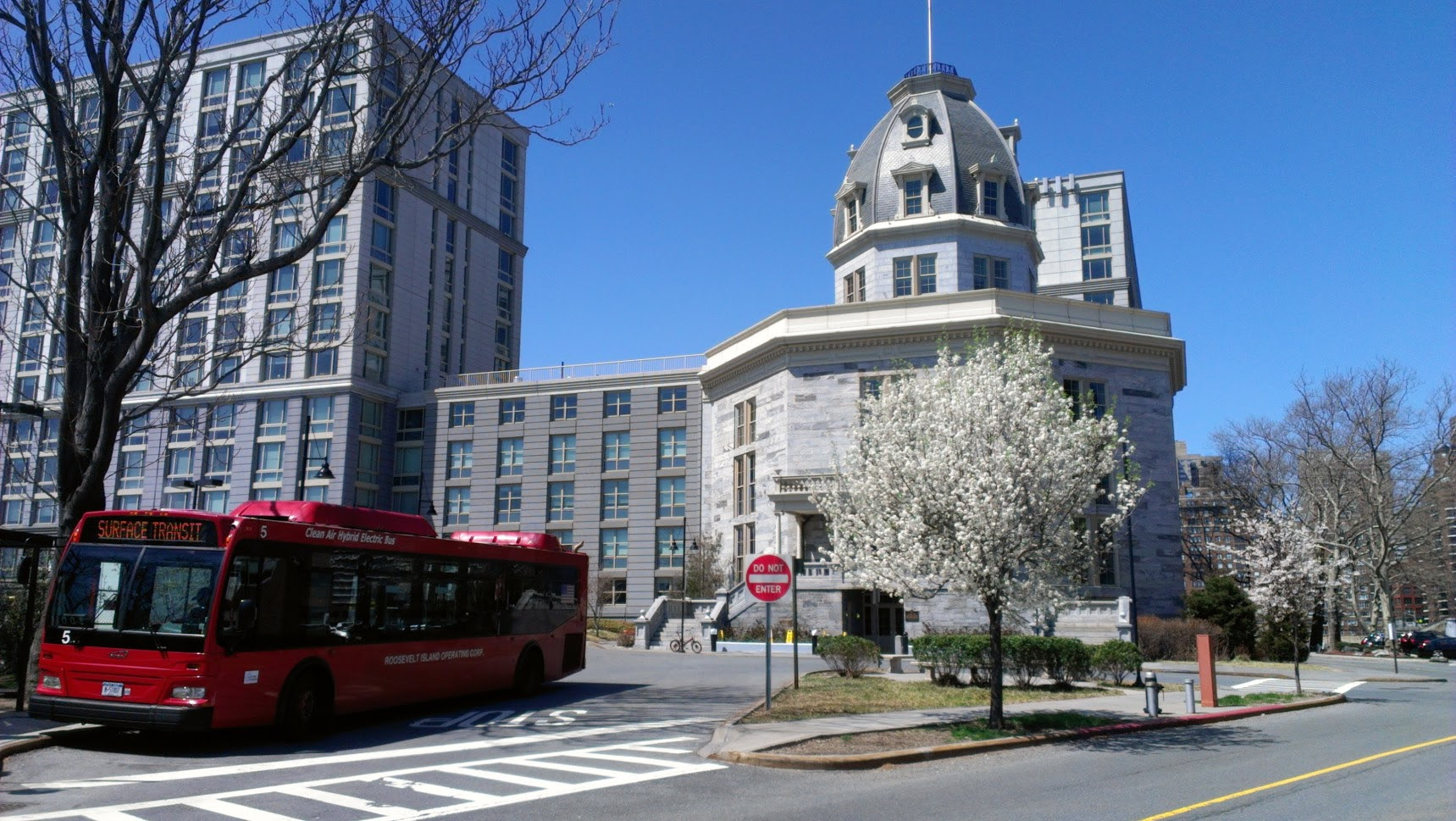
THURSDAY PHOTO OF THE DAY Octagon Cat Shelter Wildlife Freedom Foundation
Jay Jacobson came closest.
CLARIFICATION WE ARE HAPPY TO GIVE WINNERS OF OUR DAILY PHOTO IDENTIFICATION A TRINKET FROM THE VISITOR CENTER . ONLY THE PERSON IDENTIFYING THE PHOTO FIRST WILL GET A PRIZE. WE HAVE A SPECIAL GROUP OF ITEMS TO CHOOSE FROM. WE CANNOT GIVE AWAY ALL OUR ITEMS,. PLEASE UNDERSTAND THAT IN THESE DIFFICULT TIMES, WE MUST LIMIT GIVE-AWAYS. THANK YOU
ITEMS OF THE DAY
FROM THE KIOSK
GREAT STUFF FOR ALL OCCASIONS
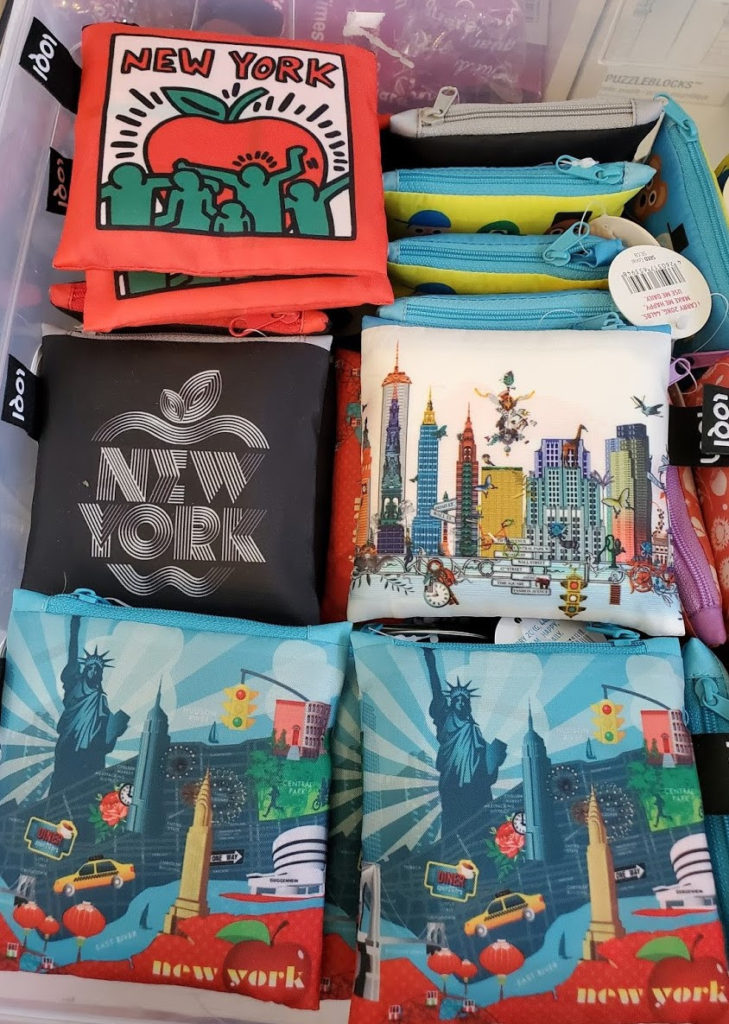
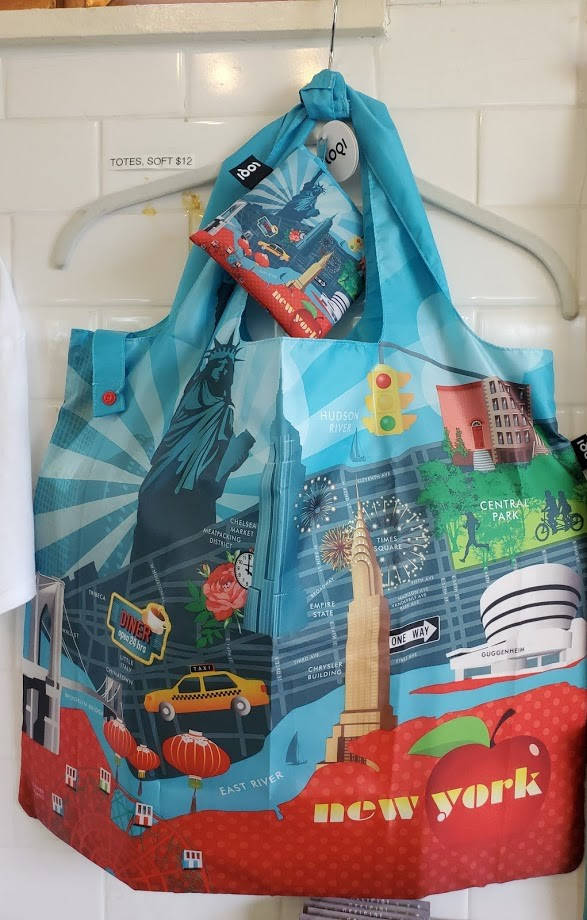
SOFT TOTES IN LOTS OF DESIGNS $12-
EDITORIAL This e-mail popped up last evening…………..and what good news. From out of the blue news that we can now get to East 90th Street by Ferry.
We can connect at 90th Street to take the Soundview Ferry to the Bronx.
The Soundview Ferry is a great ride through historic islands and now we can do it easier from here.
Yipppee!! Judith Berdy
Text by Judith Berdy Thanks to Bobbie Slonevsky for her dedication to Blackwell’s Almanac and the RIHS Thanks to Deborah Dorff for maintaining our website Edited by Melanie Colter and Deborah Dorff
PHOTOS AND TEXT COURTESY OF NYC PARKS DEPT. AND WIKIPEDIA All image are copyrighted (c) Roosevelt Island Historical Society unless otherwise indicated
FUNDING PROVIDED BY ROOSEVELT ISLAND OPERATING CORPORATION PUBLIC PURPOSE GRANTS CITY COUNCIL REPRESENTATIVE BEN KALLOS DISCRETIONARY FUNDING THRU DYCD
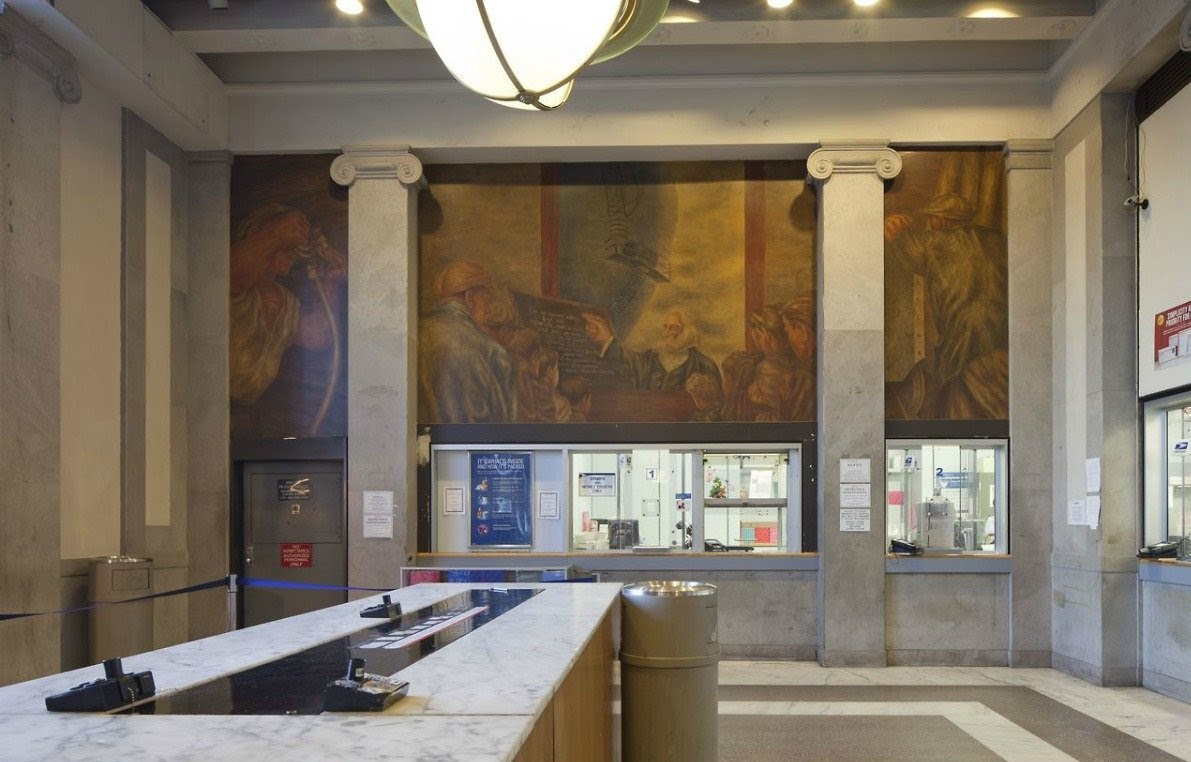
New York City has more than its share of art. Works of art can be found throughout the city, in museums, galleries, and even scattered across its parks. However, an often overlooked venue for art in New York City are post offices. During the Great Depression, federal agencies including the Treasury Department’s Section of Painting and Sculpture, often confused and conflated with the WPA, hired painters and sculptors to “secure suitable art of the best quality available for the embellishment of public buildings.” The Bronx GPO has been for sale for a few years. One developer pulled out. Stay tuned.
JAMES A FARLEY G.P.O.
The General Post Office, was designed by McKim, Mead, and White to complement their nascent Pennsylvania Station. The 8th Avenue facade possesses an extended staircase rising to fifty-three corinthian columns topped by a frieze with a quote, often mistaken for the post office’s official motto. The quote, “Neither snow nor rain nor heat nor gloom…,” was adopted, and amended, from Herodotus describing the couriers of King Xerxes, along with inscriptions of names related to postal history, like Cardinal Richelieu and King Louis XVI.
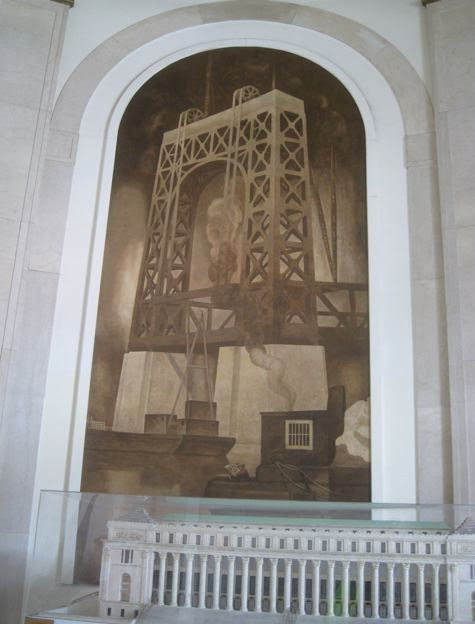
In the 1930s, Louis Lozowick, a Russian painter and art critic, painted two large oil painting in the lobby of the post office. Triborough Bridge and Lower Manhattan can still be viewed today, although the lower portion of Lower Manhattan has been covered by a memorial plaque (the lower portion can be seen on the original drawing). There are also remnants of a mural at the Annex to the Farley Post Office Building, which is unfortunately inaccessible to the public. This may change however, as the plans to convert the Farley Post Office into a train station and Amtrak waiting room got another jump start from Governor Cuomo. Stay tuned to see how the murals are handled in the refurbished terminal
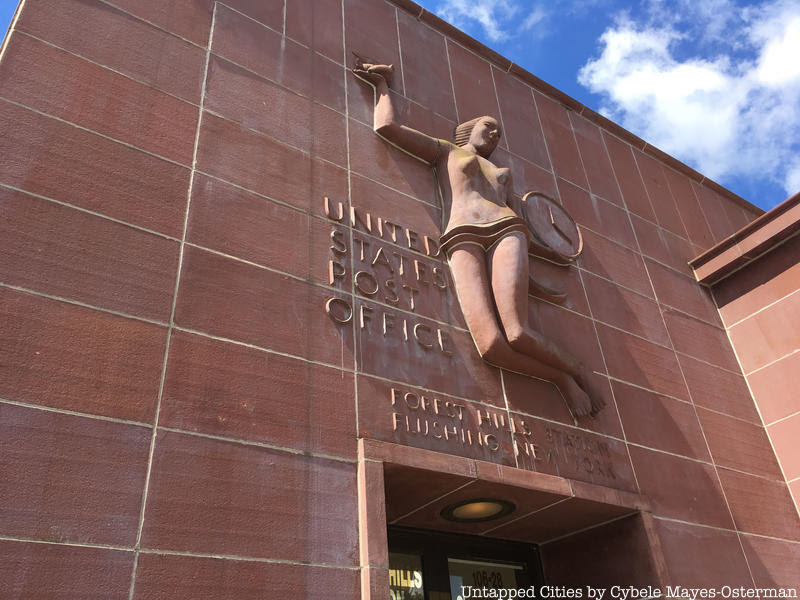
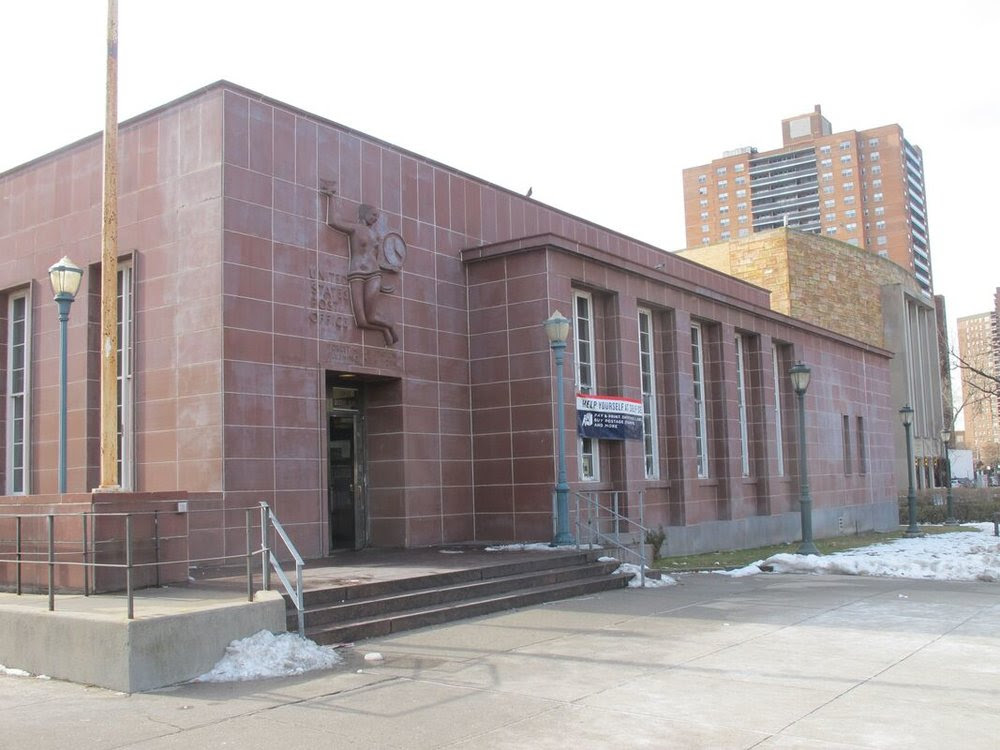
FOREST HILLS POST OFFICE
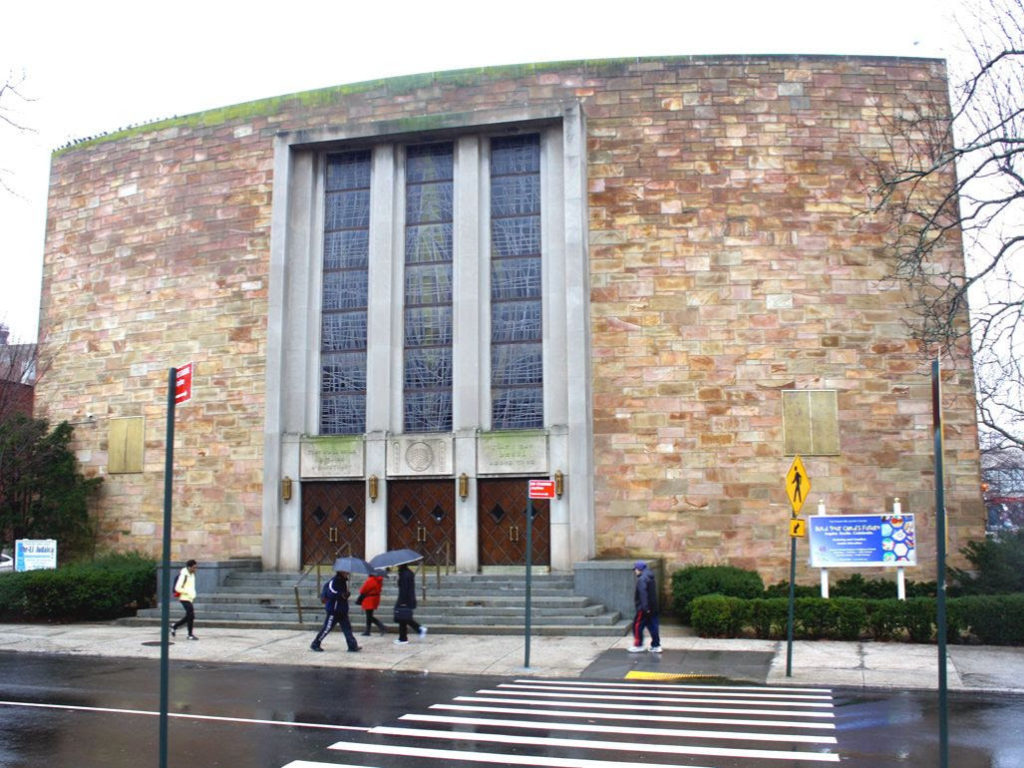
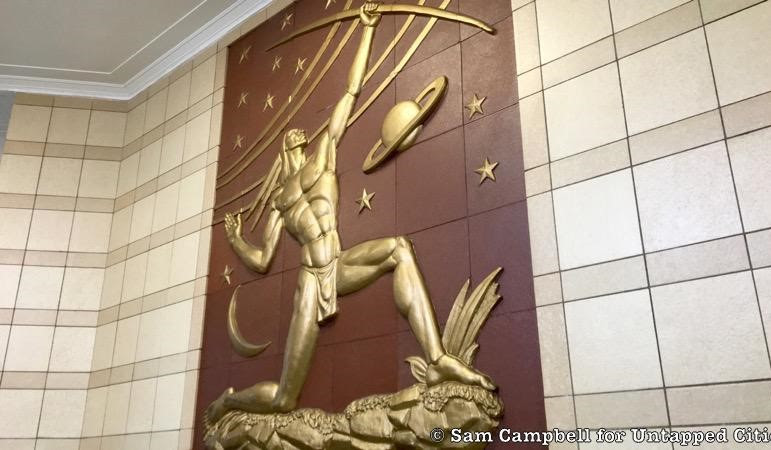
The Forest Hills Post Office is located on Queens Boulevard, near the 71st (Continental) Avenue stop on the E/F. The building was constructed pursuant to the Emergency Construction Program Act in the Art Deco style. It is adorned with a 1938 sculpture by Sten Jacobson entitled “The Spirit of Communication.” Interestingly, the building has not been designated a landmark by the City’s Landmarks Preservation Commission. Sadly the Forest Hills Jewish Center next door is slated for demolition. The two buildings complement each other facing a lovely park.
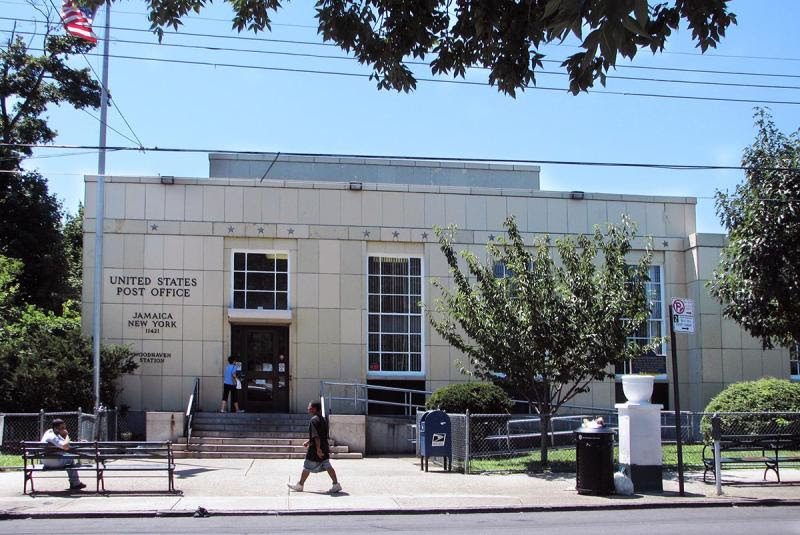
WOODHAVEN POST OFFICE
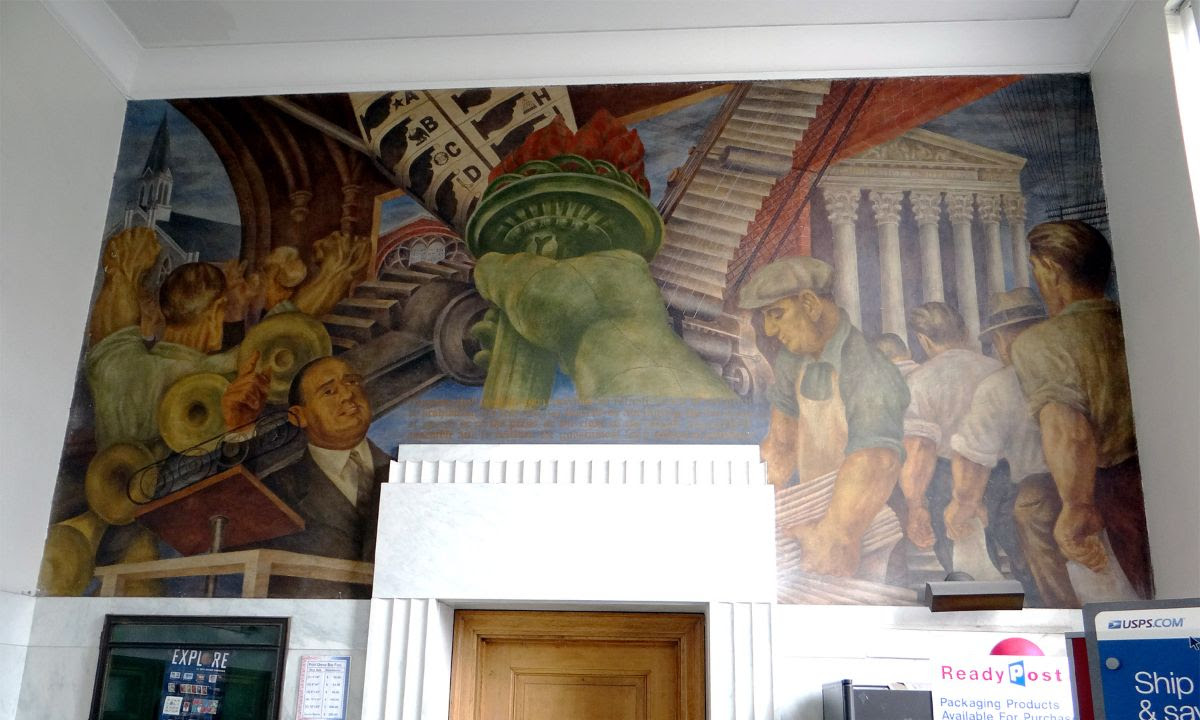
The Woodhaven Post Office is located on Forrest Park Avenue. It is located in a 1930s Art Deco style building. It is fronted by two pedestals topped with flowerpots that are reminiscent of similar decorative features installed in front of some City parks. The Post Office is located near the house in which Betty Smith wrote A Tree Grows in Brooklyn, both structures are demarcated with historical posts. The post office is decorated with Ben Shan’s mural entitled First Amendment. The mural was designed in response to Roosevelt’s commitment to the Four Freedoms (press, speech, religion, and assembly), of which the Roosevelt Island Four Freedoms Park commemorates. The mural depicts the Statue of Liberty, a New York State voters’ ballot, workers marching in protest, and the Supreme Court building.
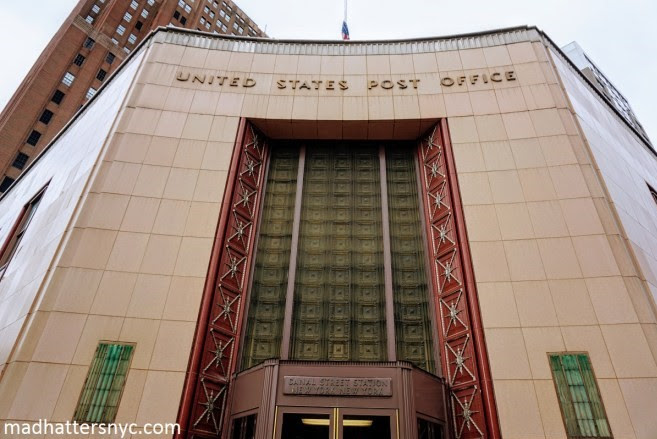
CANAL STREET
The Canal Street Post Office is located on the southeast corner of Canal Street and Church Street. The building was constructed in 1937 in the Art Moderne style, in the same vein as the main branch of the Brooklyn Public Library. The building contains an outstanding Art Deco bas relief designed by Wheeler Williams and installed in 1938.
MADISON SQUARE STATION
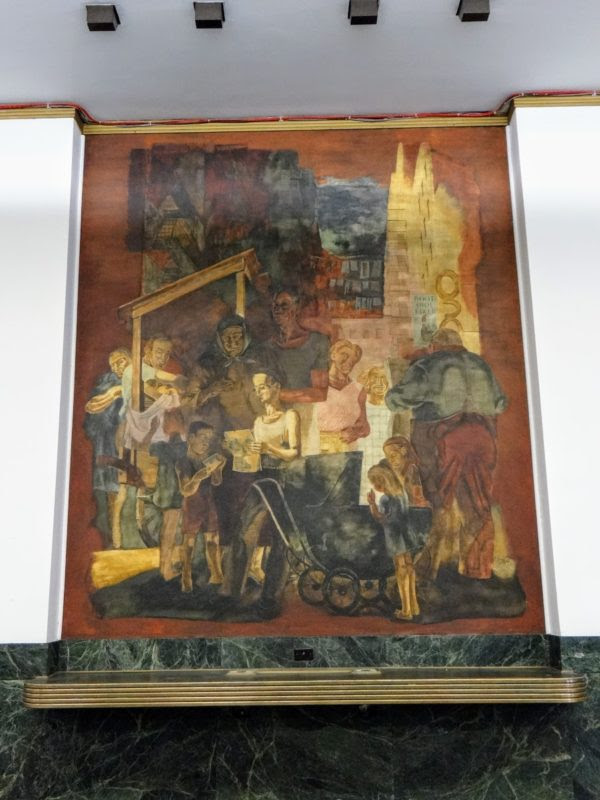
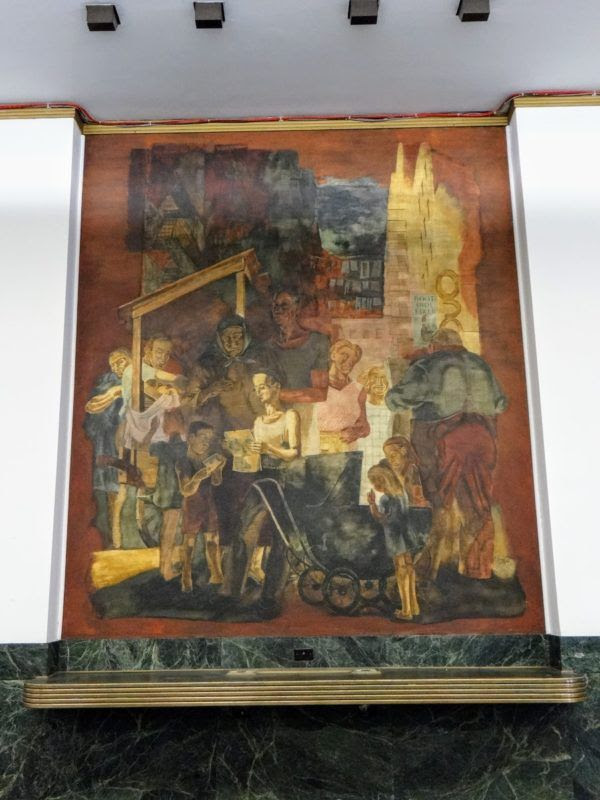
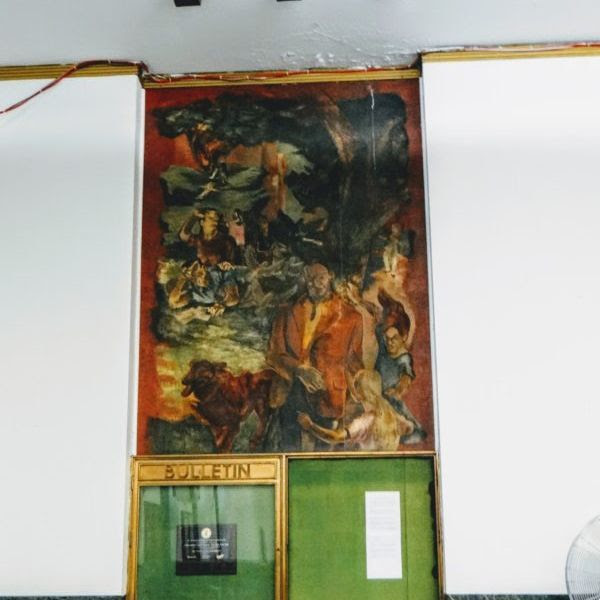
The interior of New York’s Madison Square Station post office features eight tempera-on-plaster murals entitled “Scenes of New York” (1937-1939), commissioned by the Treasury Section of Fine Arts funding. Four panels are found on each the right and left wall of the post office lobby, surrounding the central postal clerk counters.
Professor Dolkart of Columbia University School of Architecture, Planning and Preservation notes that seven of the eight McLeary murals represent different New York City neighborhoods. In each neighborhood shown, someone is depicted doing a mail-related activity: “Lower East Side (reading a letter to a group); Broadway (carrying a letter); Central Park (reading a letter while sitting on the lawn); Harlem (mailing a letter); Greenwich Village (carrying a letter?); Wall Street (carrying a stack of letters); Park Avenue (mailing a letter in the box inside an apartment building lobby).” It may be the case that the eight mural entitled Immigration shows a mail sack but this has not been confirmed. (Dolkart) For the purposes of identifying the positions of the eight panels with photos on this page, the numbering shall proceed from panel “1”: the rear of the east side of the lobby (the right side when entering from 23rd St.), clockwise to panel “8”, the rear of the west (left, from 23rd St.) side of the lobby. Put another way, panels “1” to “4” refer to those panels on the east side of the lobby, rear to front, and “5” to “8” identify the panels on the west side of the lobby, front to back.
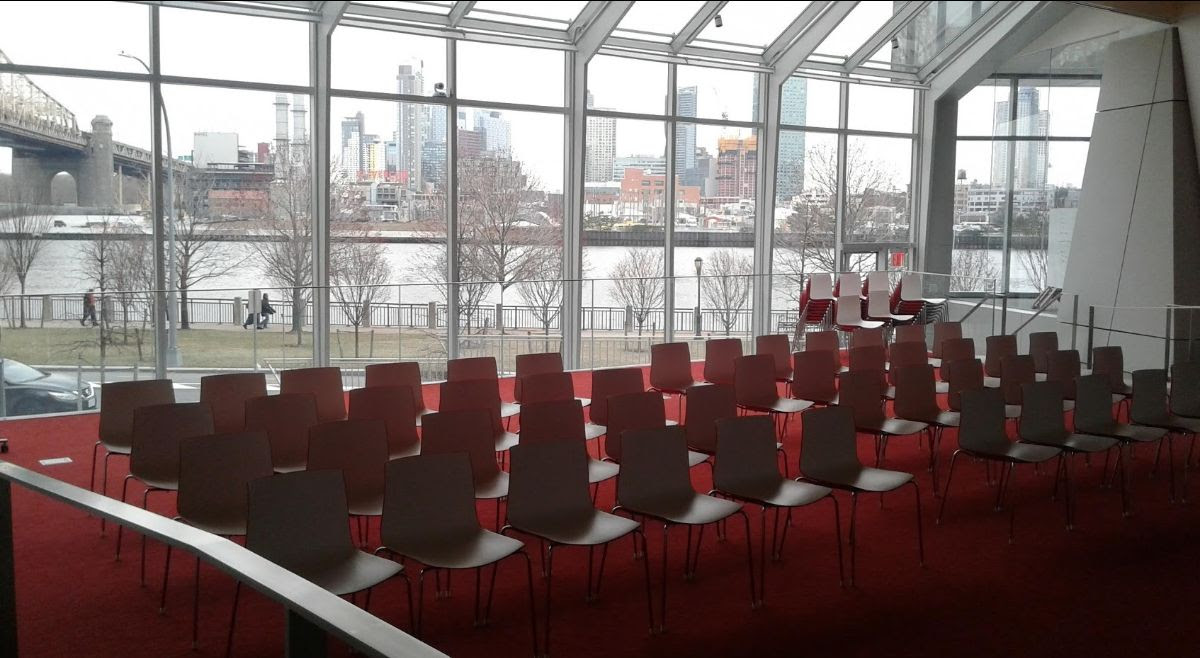
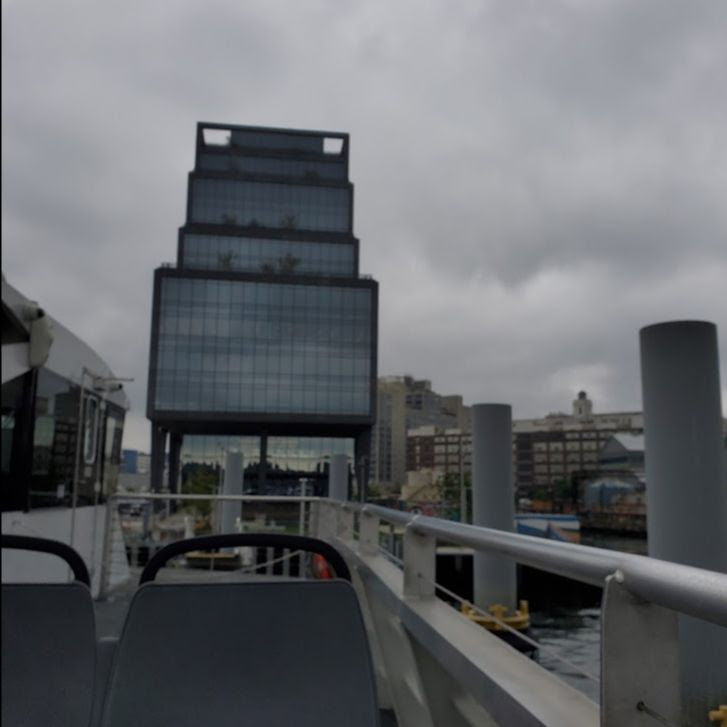
TATA INNOVATION CENTER CORNELL TECH WINNER #1 JOAN BROOKS WINNER #2 JANET SPENCER KING
CLARIFICATION WE ARE HAPPY TO GIVE WINNERS OF OUR DAILY PHOTO IDENTIFICATION A TRINKET FROM THE VISITOR CENTER. ONLY THE PERSON IDENTIFYING THE PHOTO FIRST WILL GET A PRIZE. WE HAVE A SPECIAL GROUP OF ITEMS TO CHOOSE FROM. WE CANNOT GIVE AWAY ALL OUR ITEMS,. PLEASE UNDERSTAND THAT IN THESE DIFFICULT TIMES, WE MUST LIMIT GIVE-AWAYS. THANK YOU
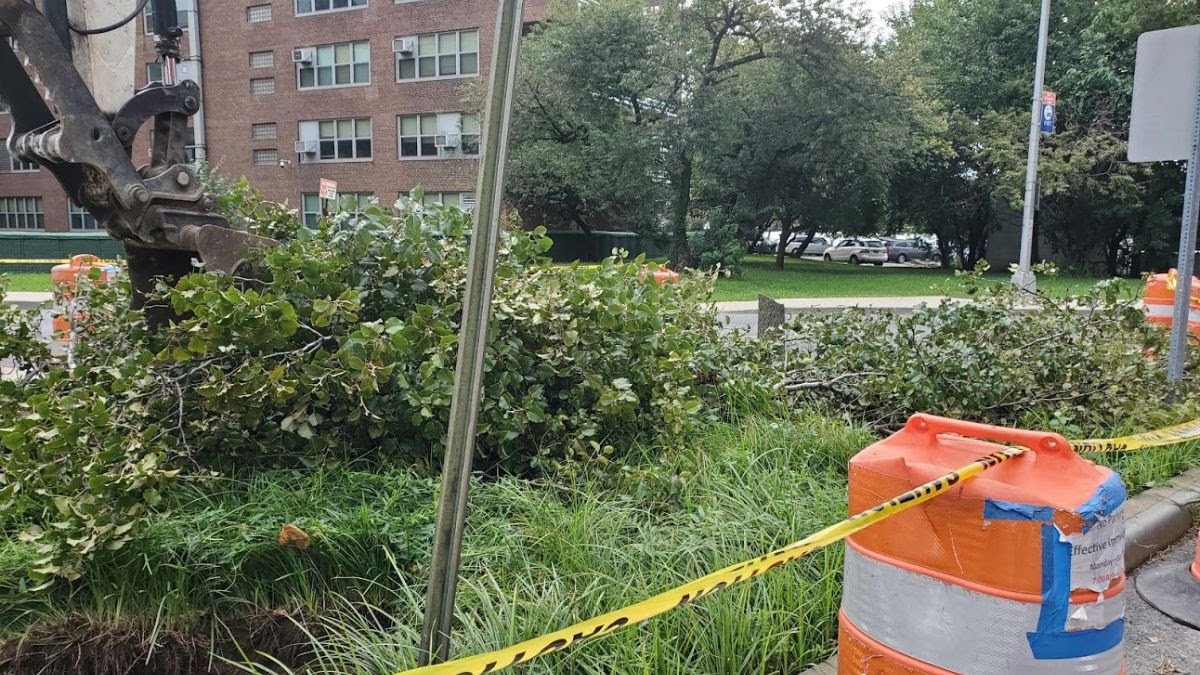
HERE TODAY, GONE TOMORROW
THIS BEAUTIFUL FLOWERING CHERRY (?) TREE LOCATED IN THE OCTAGON TRIANGLE TURNAROUND WAS CUT DOWN YESTERDAY OR TODAY SO THE AREA CAN BE REBUILT. THERE WILL BE A LARGE SIGN ON THE SITE NOW AND ONLY ONE TREE REMAINING. LUCKILY, THE SUNDIAL THAT THE RIHS PLACE IN THE AREA HAS BEEN SAVED. TELL ME WHERE YOU WOULD LIKE THE SUNDIAL TO BE RELOCATED TO.
ITEMS OF THE DAY FROM THE KIOSK GREAT STUFF FOR ALL OCCASIONS
PULLBACK SUBWAY TRAINS $12- KIOSK IS OPEN SATURDAY AND SUNDAY 12 NOON TO 5 P.M. ORDER ON-LINE BY CHARGE CARD AT ROOSEVELTISLANDHISTORY@GMAIL.COM
EDITORIAL
Looking at the artists who painted the Post Office murals, two names stand out; Ben Shahn and Louis Lozowick.
Shahn photographed the Penitentiary for a WPA project on the island and Lozowick painted and drew many images of New York City scenes and bridges. As we look farther we will discover more names we recognize.
Judith Berdy
Text by Judith Berdy Thanks to Bobbie Slonevsky for her dedication to Blackwell’s Almanac and the RIHS Thanks to Deborah Dorff for maintaining our website Edited by Melanie Colter and Deborah Dorff PHOTOS AND SOME TEXT COURTESY OF UNTAPPED CITIES (C)
All image are copyrighted (c) Roosevelt Island Historical Society WIKIPEDIA (C)
FUNDING PROVIDED BY ROOSEVELT ISLAND OPERATING CORPORATION PUBLIC PURPOSE GRANTS CITY COUNCIL REPRESENTATIVE BEN KALLOS DISCRETIONARY FUNDING THRU DYCD
Years ago I would take the Q102 bus to Astoria to go shopping. I avoided Queens Plaza. The only time I would be there would be to catch the Q102 bus when the tram was not running and I had to take the bus to the island. That is ancient history, pre 1989.
I have watched Queens Plaza blossom out my window from just the CitiCorp building sitting high in the sky. Now I look out on at least 20 hi-rises office building and residential ones.
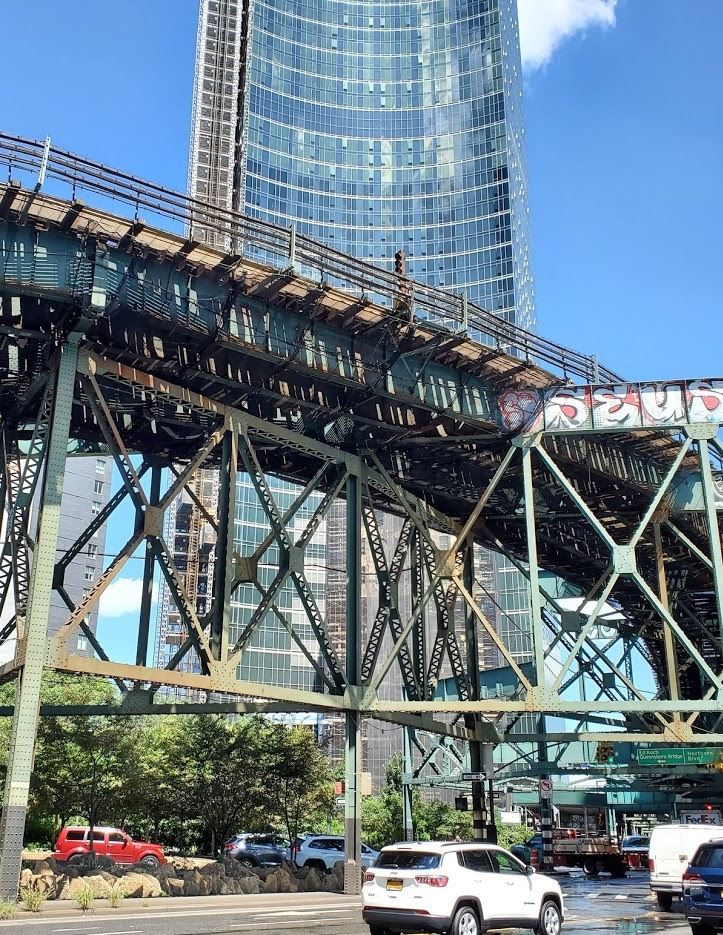
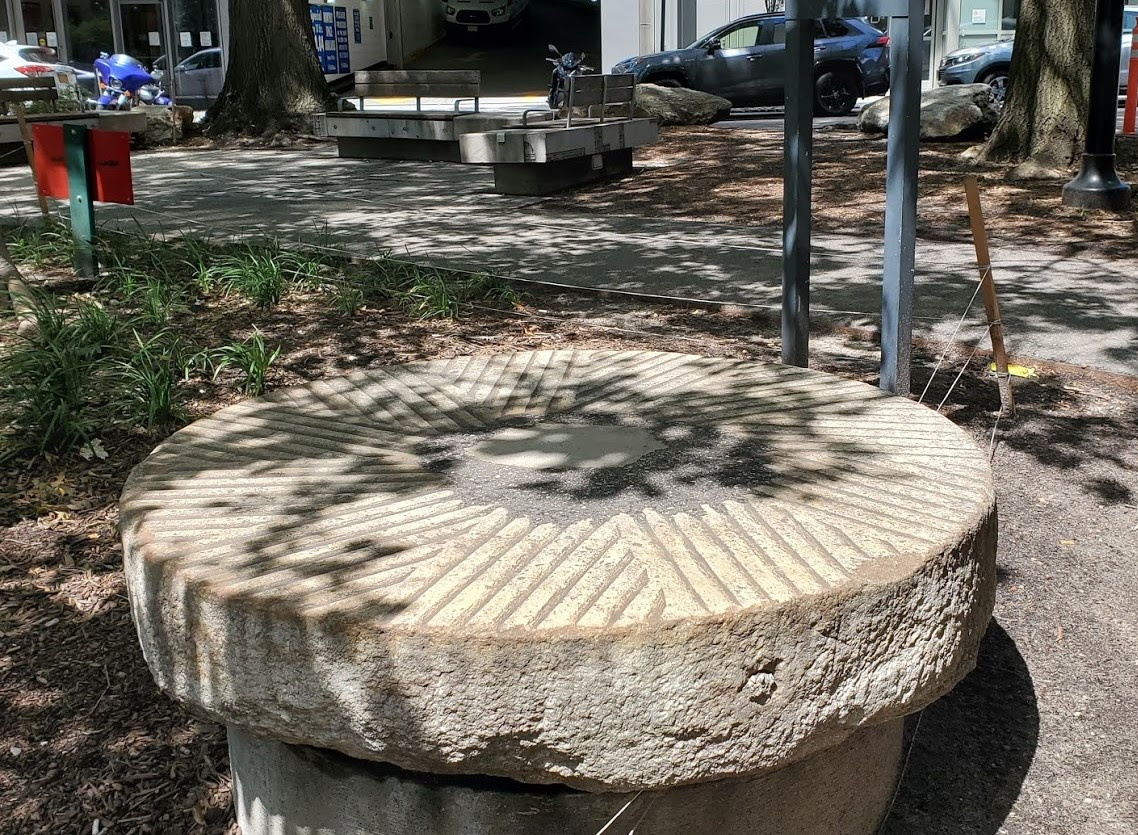
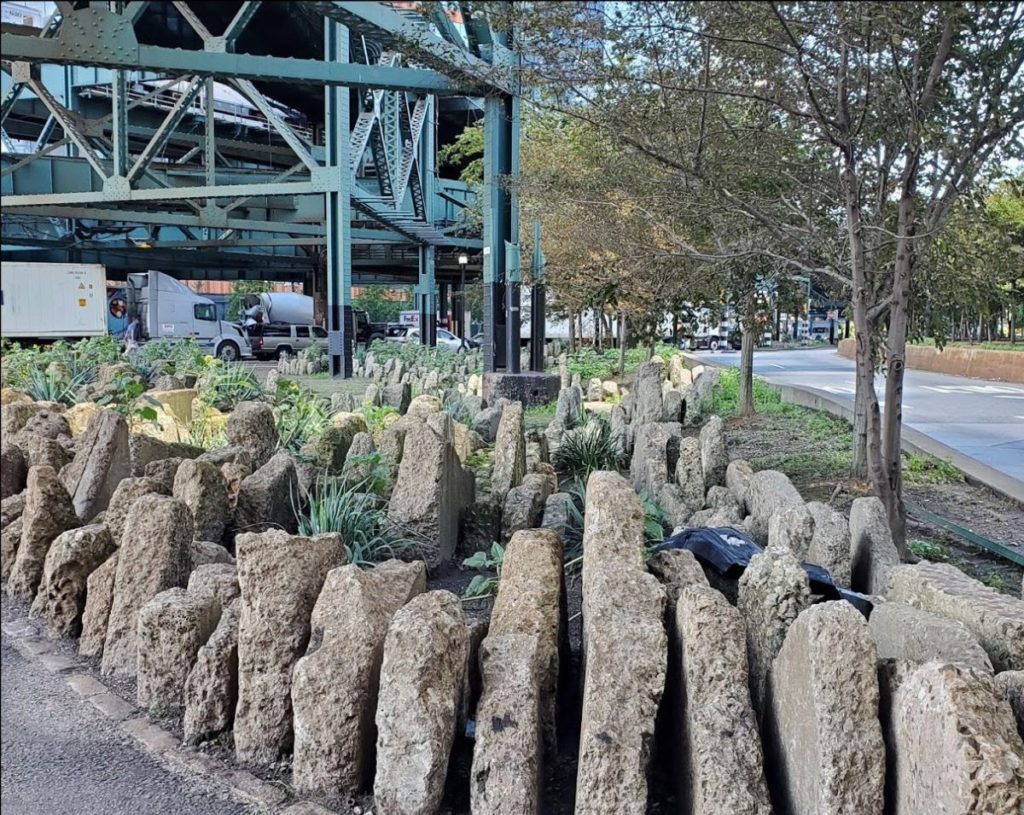
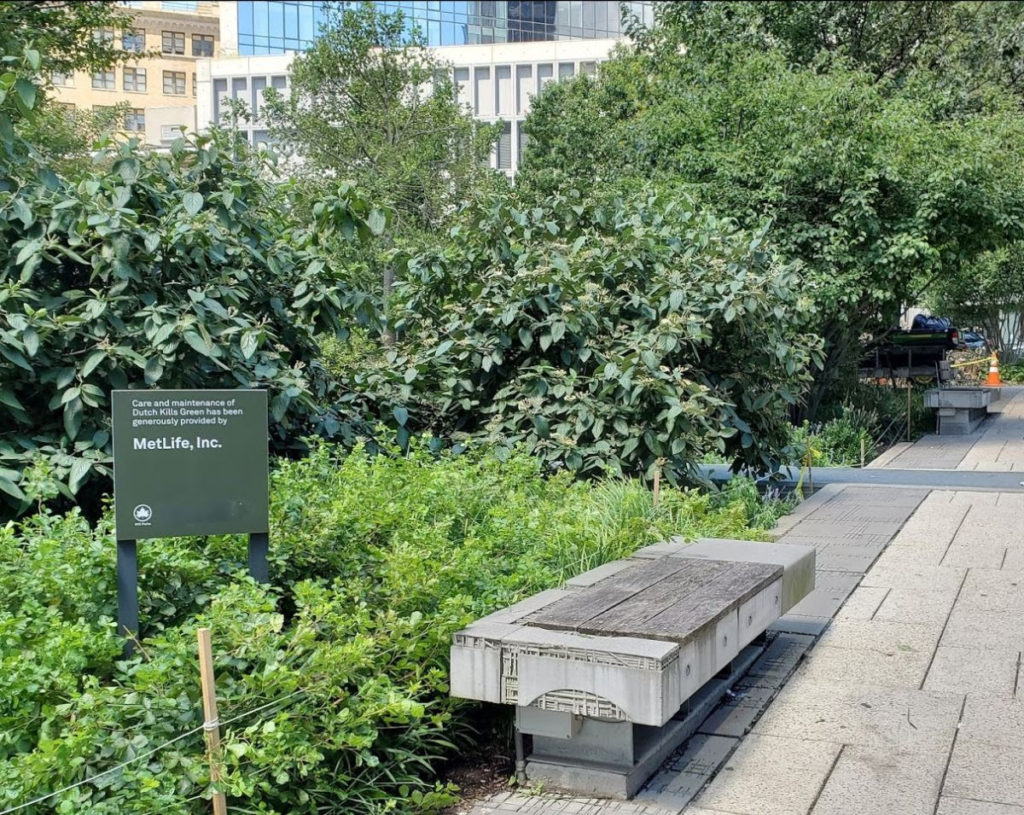
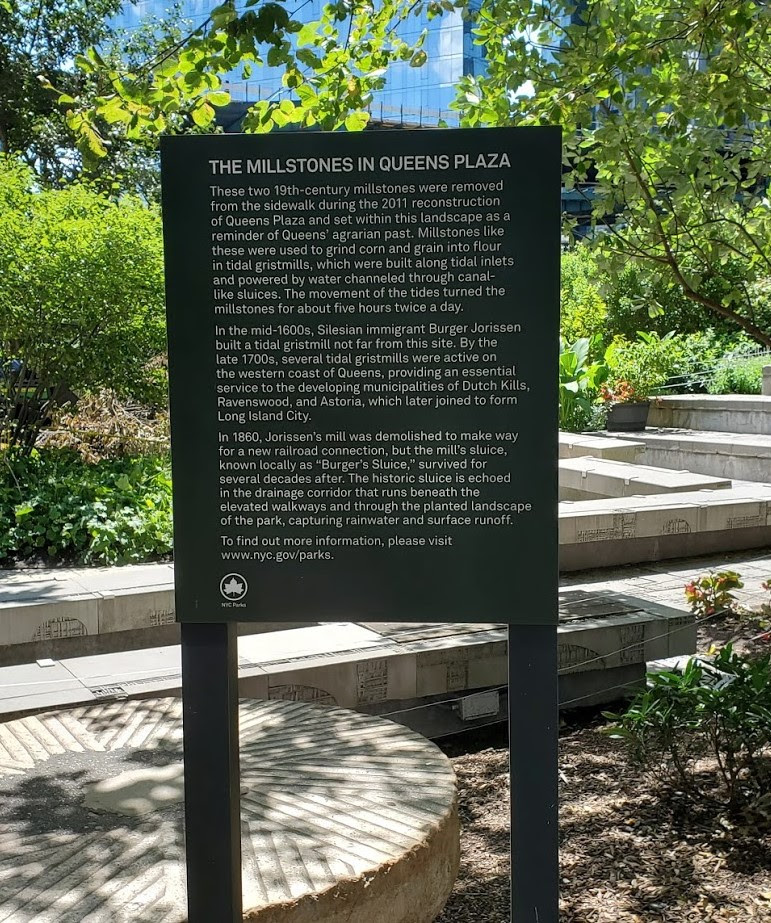
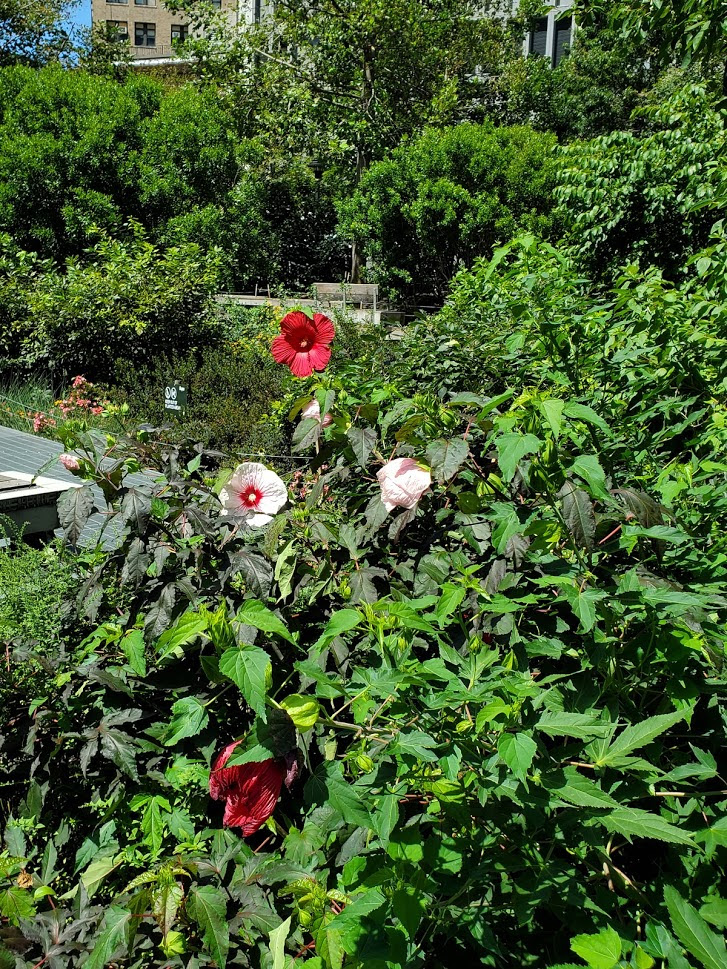
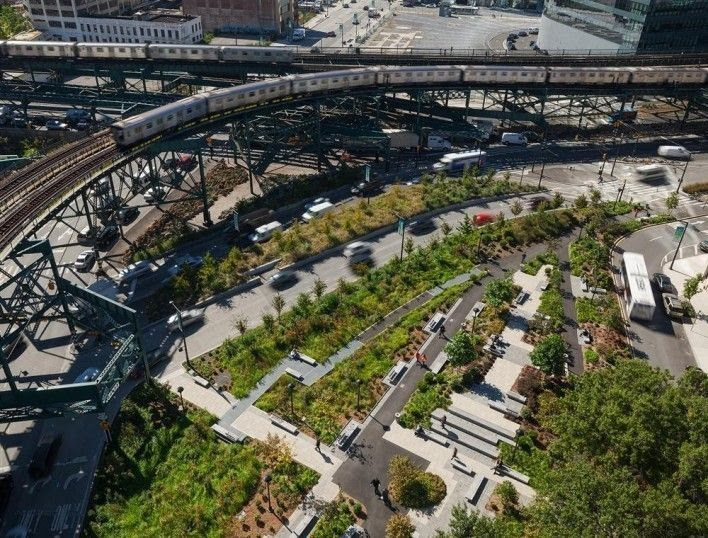
I was so taken by a lush garden in the middle of the maddening traffic pattern. After carefully crossing 5 crosswalks I found myself in a garden in between the roadways. Being a skeptical New Yorker, I was shocked at how well it was maintained. It says it is taken care of by Met Life and NYC Parks. It is called Dutch Kills Garden. The garden was opened 8 years ago after a massive project to re-route traffic in the area.
BEFORE AND AFTER GARDEN CONSTRUCTION
CHASE MANHATTAN BANK BUILDING
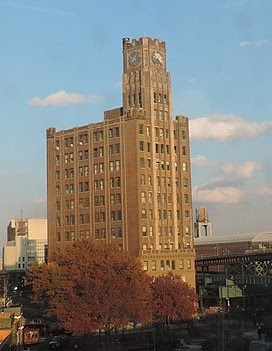
Chase Manhattan Bank Building, also known as the Queens Clock Tower and the Bank of the Manhattan Company Building, is located at the southern end of the plot containing Queens Plaza Park. It contains 11 stories of offices as well as a 3-story clock tower.
The building was designed by Morrell Smith, who had also designed other Manhattan Company branches, and until 1990, it was the tallest commercial building in Queens. It was designated as an official city landmark in 2015. As part of Queens Plaza Park’s construction, the former Chase Manhattan Bank Building will be converted into the residential development’s retail base, with more than 50,000 square feet (4,600 m2) of commercial space.
The building contains a facade of buff brick and Indiana Limestone. It is arranged into “base, shaft and capital” sections, similar to the parts of a column. The base is made of limestone and originally included a banking hall. The southern facade, facing Queens Plaza, included three vertical architectural bays that each contained windows under a relief. The entrance portico, made of masonry, was topped by a Gothic Revival entablature with a depiction of Oceanus, a Greek god that was also used as the Manhattan Company’s icon, as well as a glazed transom. A metal sign with the bank’s name was located above the first floor. These were later replaced by a utilitarian double-height glass wall. Inside was an elevator lobby, where there was access to the elevators that served the upper floors.] There was also a bank vault in the basement. On the upper stories, the southern facade is divided into three vertical bays, with buff brick standing out against the brown-brick facade.This facade contains a 2-3-2 window arrangement, with three windows in the center bay and two windows in each of the outer bays.[21] The clock tower, described before its construction as a landmark that was easily visible from other boroughs, continues above the center bay.
It contains clocks on all four faces, each with Roman numerals. This made the Chase Manhattan Bank Building the second building on Queens Plaza to contain a clock tower, the first being the adjacent Brewster Building in 1911. The clocks are non-winding Telechron clocks added by the Brooklyn-based Electime Company. Above the “XII” mark on each face were neo-Gothic-style cast-stone reliefs.Other features on the tower include carvings of gargoyles, as well as a “castellated turret, copper windows and granite shields”.Adjacent to the tower, there was formerly a rooftop sign, which faced east and advertised the Manhattan Company. (Wikipedia)
SVEN, THE FUTURE
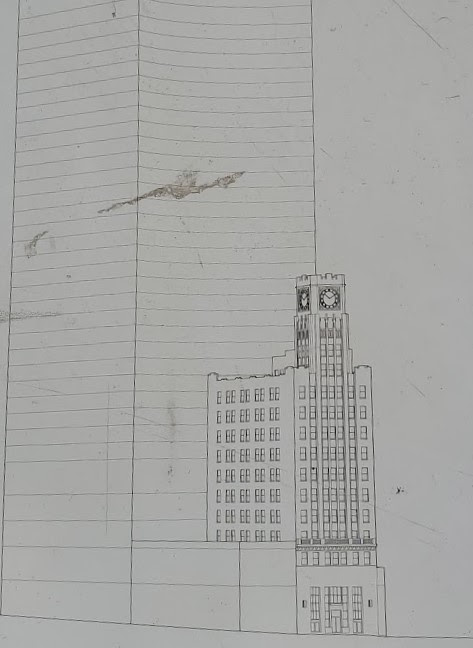
Comprising retail and office space in addition to its 958 residences, Sven rises 67 stories above the vibrant neighborhood of Long Island City, Queens. Situated directly across from Queensboro Plaza, the building’s central location offers easy access to bus and subway lines, including front door access to the E, M, and R trains. Included in the Sven development plan is a one-half acre public park that fronts the residential tower, as well as the adaptive reuse of the historic Long Island City Clock Tower. Completed in 1927 and originally home to Bank of Manhattan, the landmarked Clock Tower will now include five unique retail spaces with unmatched convenience and exposure. Set for completion in Spring of 2021, Sven is seeking a LEED Platinum certification and will be one of the tallest buildings in the borough of Queens. (The Durst Organization)
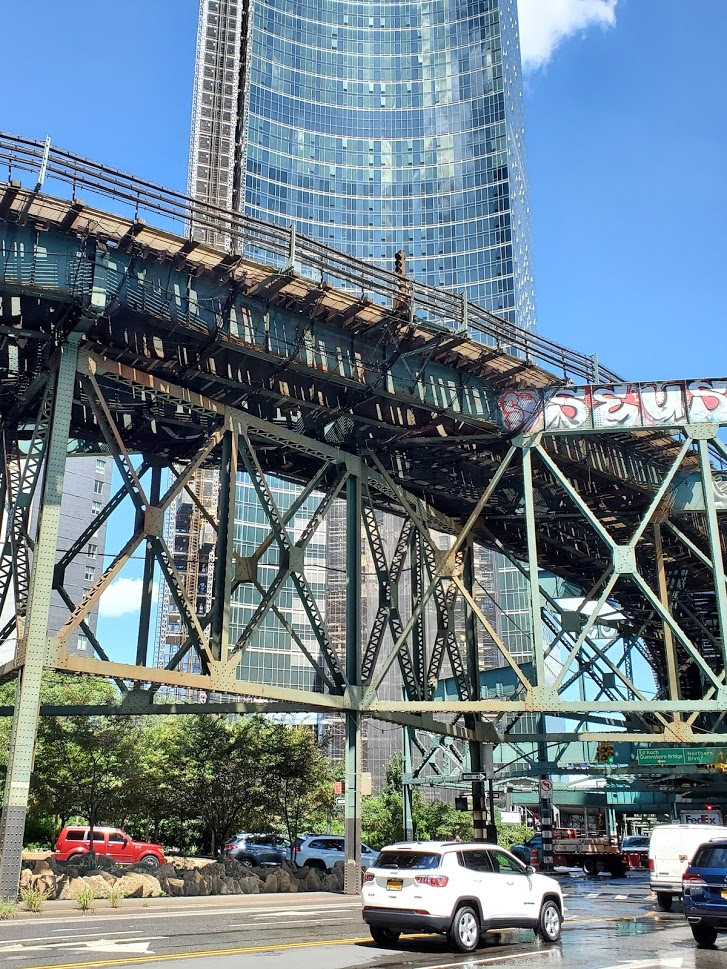
THE GREAT CRISS CROSS OF RAIL, TRAFFIC AND SKI
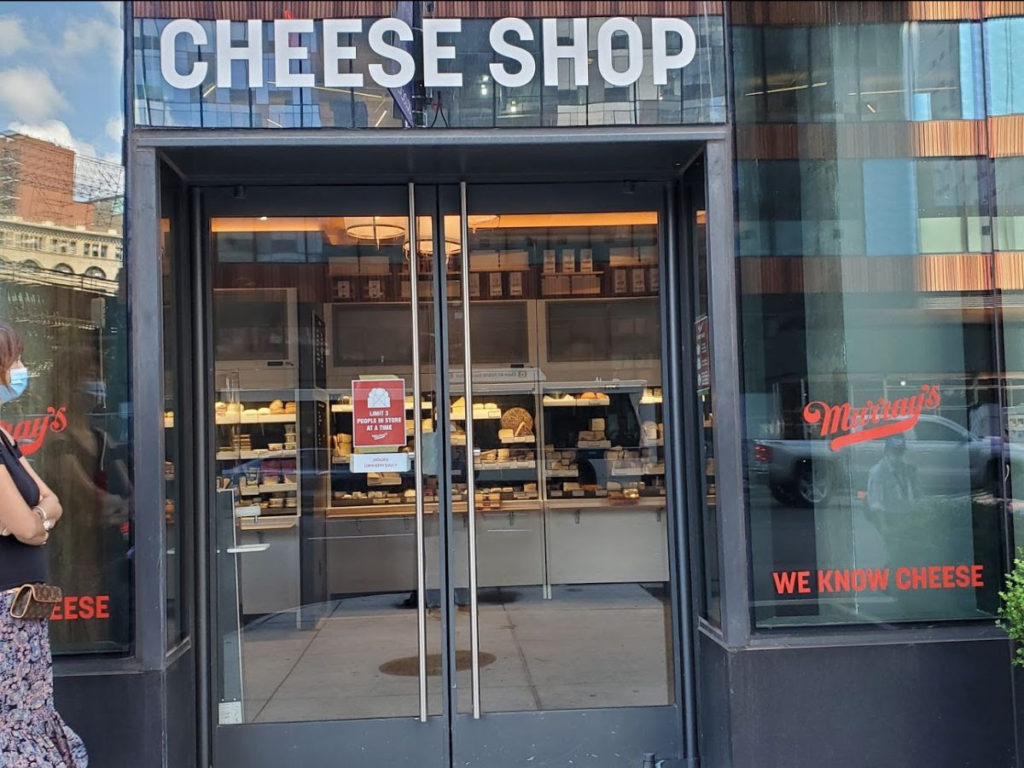
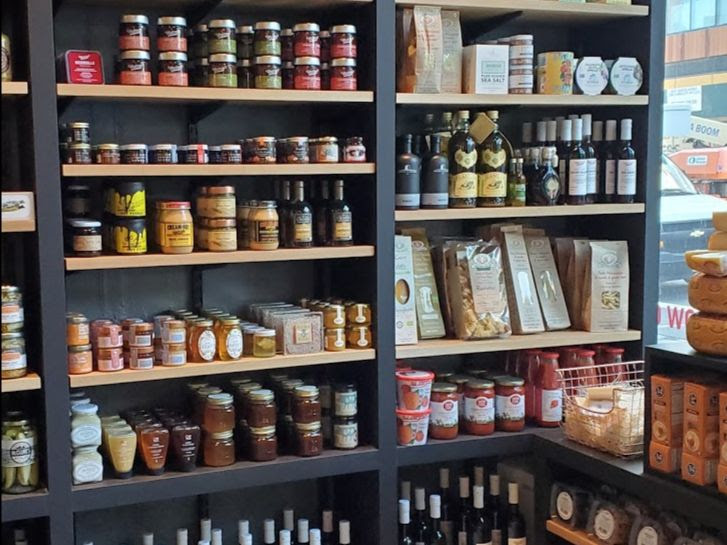
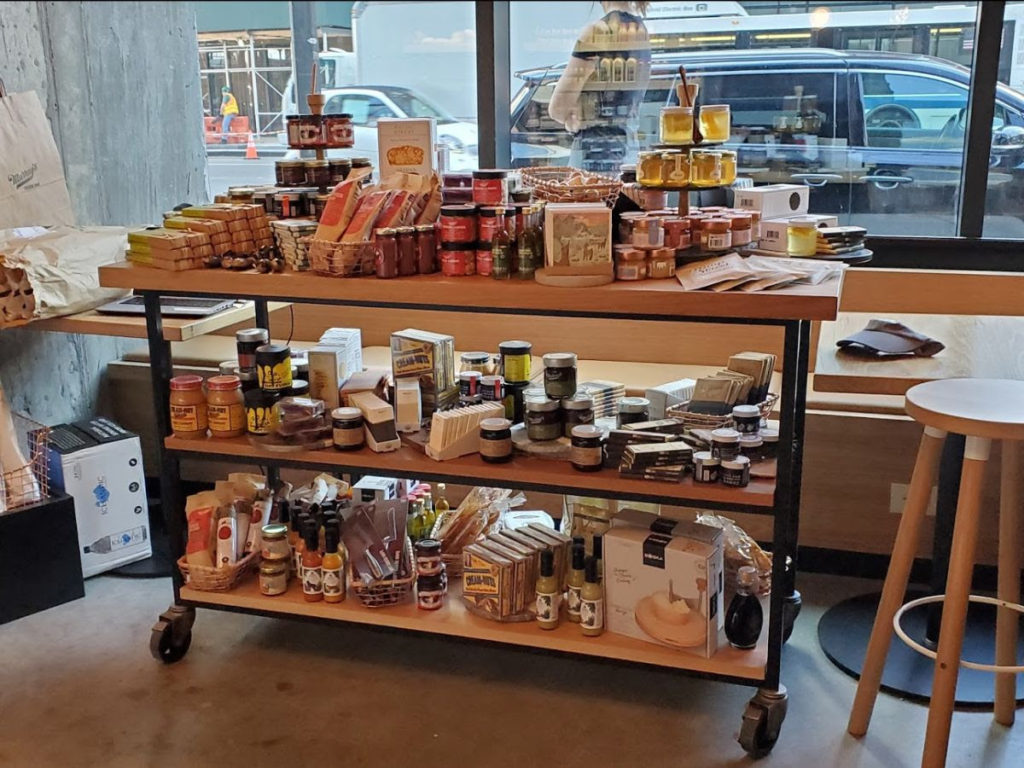
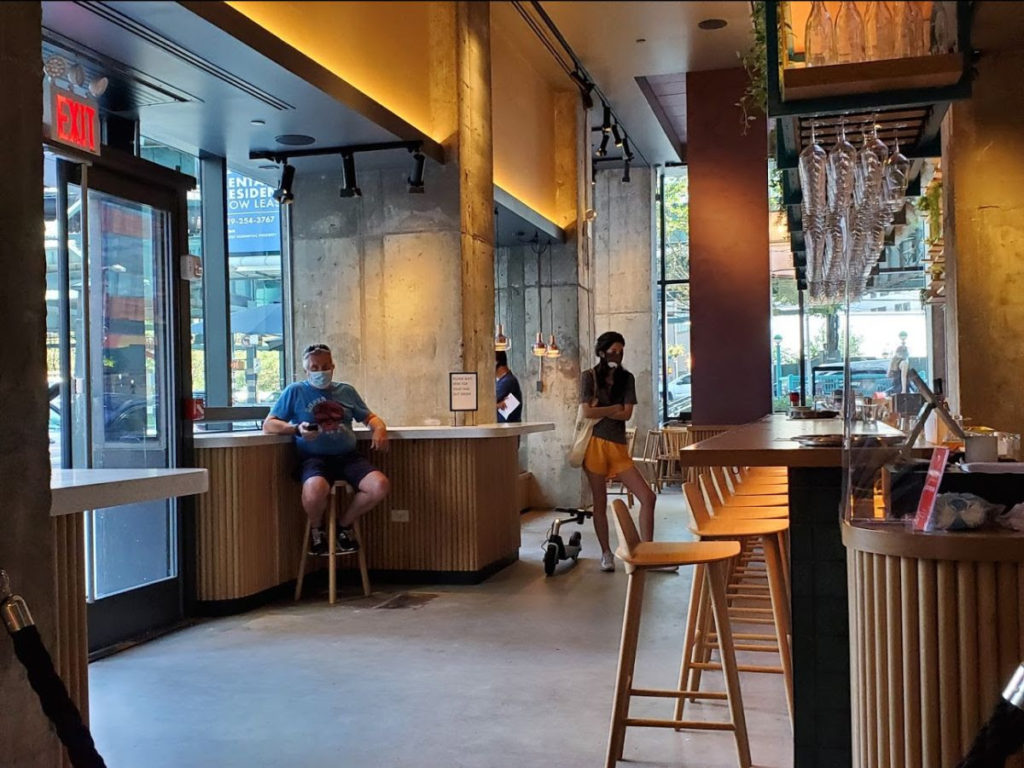
Murray’s Cheese on Jackson Avenue
Murray’s Cheese of Bleeker Street has relocated to Jackson Avenue, just feet from the Queens Plaza subway station, opened this week. It has a grocery and specialty cheese department and a bar and dining area. The shop is open daily and should be a great addition to this area that has little food sources. Next year a grand food hall is scheduled to open on the other side of the street.
Quite a different look from where disinfectants were made when I moved to the Island. (CN Plus)
CLARIFICATION WE ARE HAPPY TO GIVE WINNERS OF OUR DAILY PHOTO IDENTIFICATION A TRINKET FROM THE VISITOR CENTER. ONLY THE PERSON IDENTIFYING THE PHOTO FIRST WILL GET A PRIZE. WE HAVE A SPECIAL GROUP OF ITEMS TO CHOOSE FROM. WE CANNOT GIVE AWAY ALL OUR ITEMS,. PLEASE UNDERSTAND THAT IN THESE DIFFICULT TIMES, WE MUST LIMIT GIVE-AWAYS. THANK YOU
TUESDAY’S PHOTO OF THE DAY
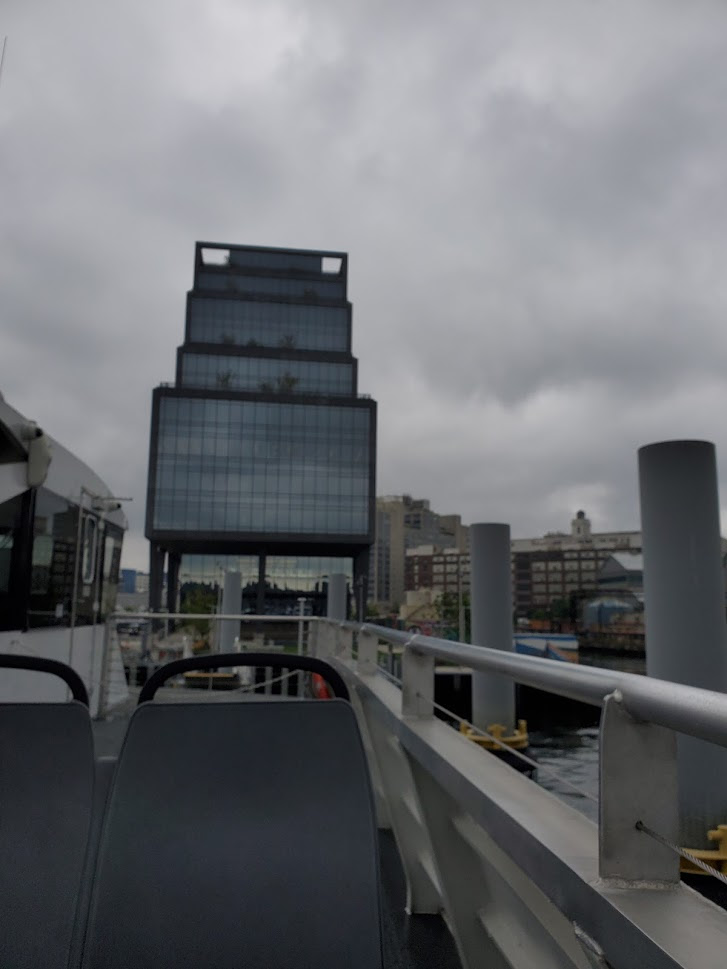
WE WORK BUILDING BROOKLYN NAVY YARD Alexis Villefane got it right!
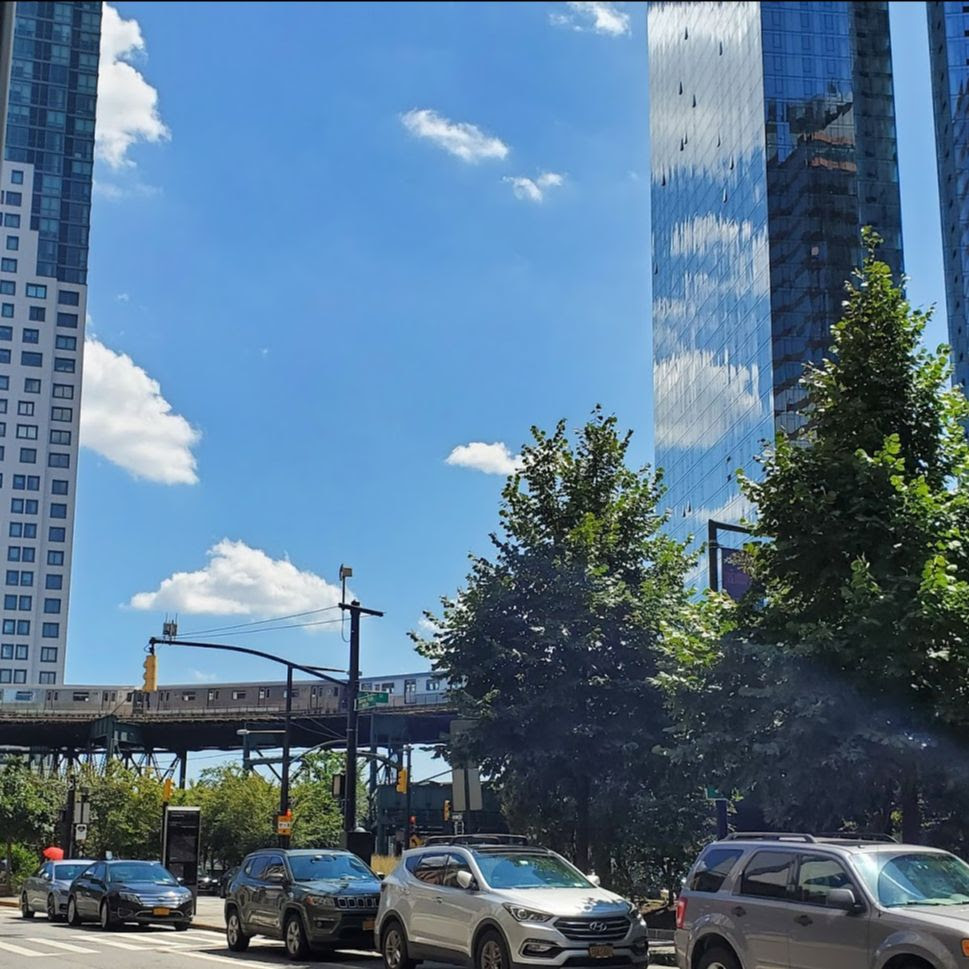
EDITORIAL It is a surprise to visit the new Queens Plaza.Aside from the little park there is no greenery, just crosswalks and traffic. I assume living here in luxury you will not long need to exit you castle in the sky.
I will continue to wander the neighborhood and find some more goodies to write about. JUDITH BERDY
NEW FEATURE
FROM OUR KIOSK
GREAT STUFF FOR ALL OCCASIONS
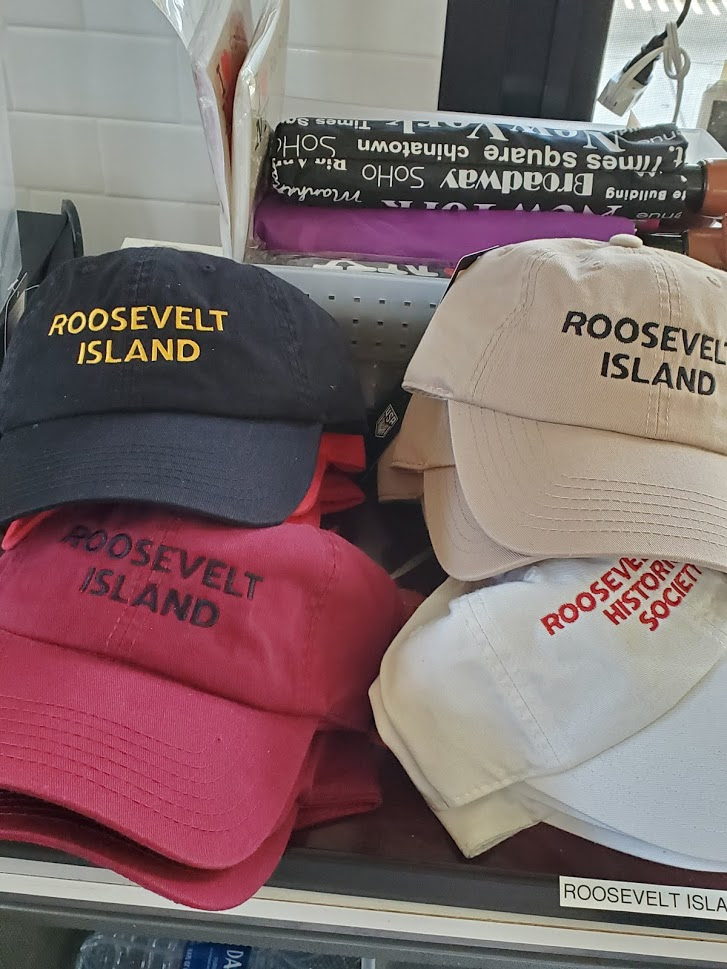
BASEBALL CAPS $12- AVAILABLE AT THE KIOSK OPEN WEEKENDS 12 NOON TO 5 P.M. ORDER ON-LINE BY CHARGE CARD ROOSEVELTISLANDHISTORY@GMAIL.COM
Text by Judith Berdy Thanks to Bobbie Slonevsky for her dedication to Blackwell’s Almanac and the RIHS Thanks to Deborah Dorff for maintaining our website Edited by Deborah Dorff All image are copyrighted (c) Roosevelt Island Historical Society unless otherwise indicated
FUNDING PROVIDED BY ROOSEVELT ISLAND OPERATING CORPORATION PUBLIC PURPOSE GRANTS CITY COUNCIL REPRESENTATIVE BEN KALLOS DISCRETIONARY FUNDING THRU DYCD
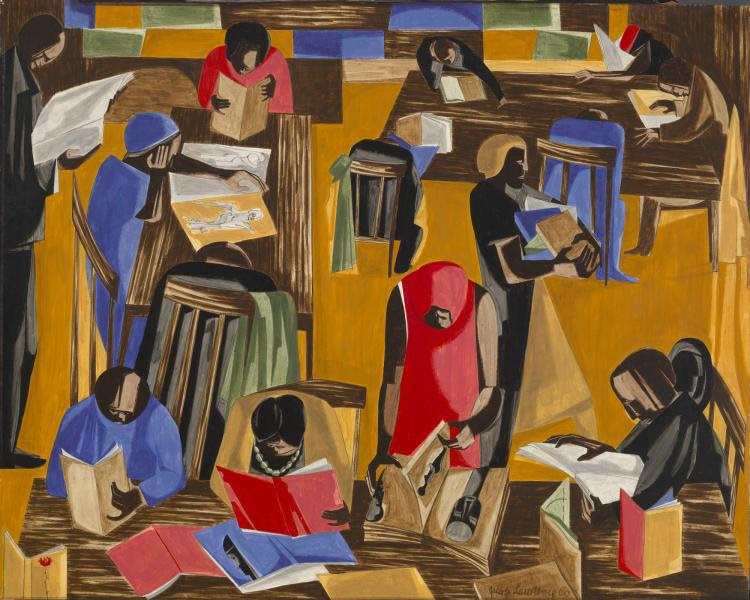
Jacob Lawrence, The Library, 1960, tempera on fiberboard, Smithsonian American Art Museum, Gift of S.C. Johnson & Son, Inc., 1969.47.24
Jacob Lawrence researched many of his paintings of African American events by reading history books and novels. Looking back at his high school years, he remembered that black culture was “never studied seriously like regular subjects,” and so he had to teach himself by visiting libraries and museums (Lawrence, 1940, Downtown Gallery Papers, Archives of American Art, quoted in Wheat, Jacob Lawrence, American Painter, 1986). This colorful view of a crowded reading room may show the 135th Street Library—now the Schomburg Center for Research in Black Culture—where the country’s first significant collection of African American literature, history, and prints opened in 1925. Everybody appears absorbed in their books, and the standing figure in the front looking at African art may represent the artist as a young man, delving deeper into his heritage.
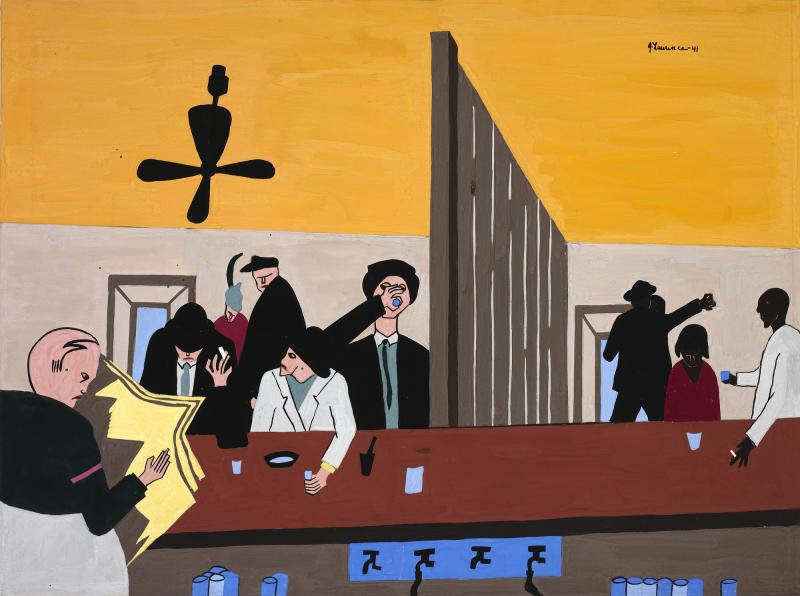
Jacob Lawrence, Bar and Grill, 1941, gouache on paper, Smithsonian American Art Museum, Bequest of Henry Ward Ranger through the National Academy of Design, 2010.52
In New Orleans, Lawrence experienced firsthand the daily reality of Jim Crow segregation, where legislation required that he ride in the back of city buses and live in a racially segregated neighborhood. His anger is apparent in Bar and Grill, which shows the interior of a café with a wall that divides the space into two distinct realms – one occupied by whites, the other by blacks. Lawrence says little about the individuals beyond their skin color and the way they are treated (customers on the left are cooled by a ceiling fan), but the skewed vantage point from behind the bar emphasizes the artificiality of the two separate worlds. African American Art: Harlem Renaissance, Civil Rights Era, and Beyond, 2012 Jacob Lawrence painted Bar and Grill shortly after arriving in New Orleans in late summer 1941.
Although he had just finished the sixty panels of his epic Migration series, he had only second-hand knowledge of the South, the point of origin for thousands of rural blacks who had made the great migration to industrial cities of the urban north. The South was a new experience for the young New Yorker. Lawrence’s mother had come from Virginia, his father from South Carolina, so as he remarked in 1961: “[In 1941] if you weren’t born in the South, your parents were. Your life had a whole Southern flavor; it wasn’t an alien experience to you even if you had never been there.”
Bar and Grill shows the interior of a café that is divided by a floor-to-ceiling wall that separates the commercial space into two realms—one occupied by whites, the other by blacks. Apart from obvious segregation by race, the image also reveals status. White customers drink in comfort, cooled by a ceiling fan above. The number of figures occupying each side of the room reflected the white-black ratio of city residents. Living in a southern city where legislation required that he ride in the back of city buses and live in a racially segregated neighborhood, Lawrence discovered the daily reality of Jim Crow segregation. This experience emerged in Bar and Grill and other paintings that dealt with what he called “the life of Negroes in New Orleans.” Several of Lawrence’s New Orleans paintings were featured along with a group of panels from the Migration series in a groundbreaking exhibition, Negro Art in America, which opened at Edith Gregor Halpert’s Downtown Gallery in New York City on December 8, 1941, the day the United States declared war on Germany and Japan.
The show was a huge success for Lawrence, who was celebrated by black and white critics alike. Halpert continued to push Lawrence’s work, and two years later, when Lawrence was drafted to serve as a steward in the Coast Guard, she persuaded his commanding officers to provide studio space so he could continue to paint. Smithsonian American Art Museum, 2010.
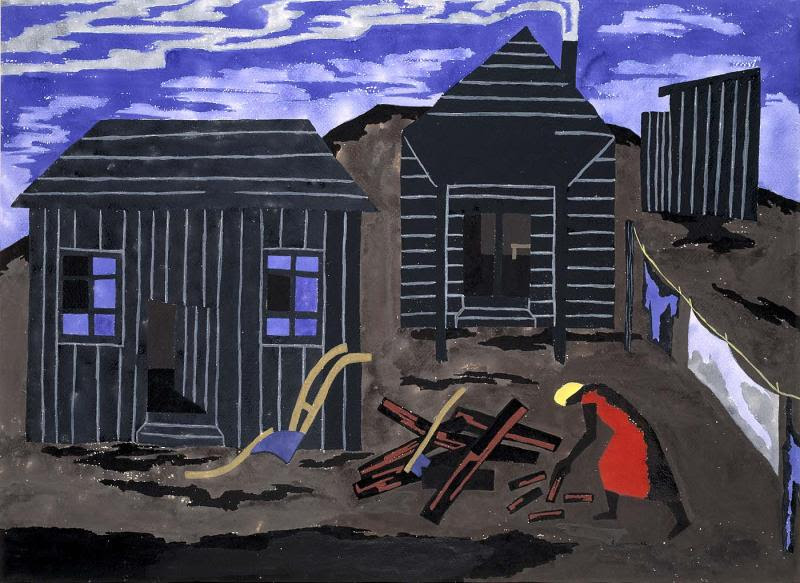
Jacob Lawrence, Firewood #55, 1942, gouache, ink and watercolor on paper, Smithsonian American Art Museum, Transfer from the U.S. Information Agency through the General Services Administration, 1966.2.3
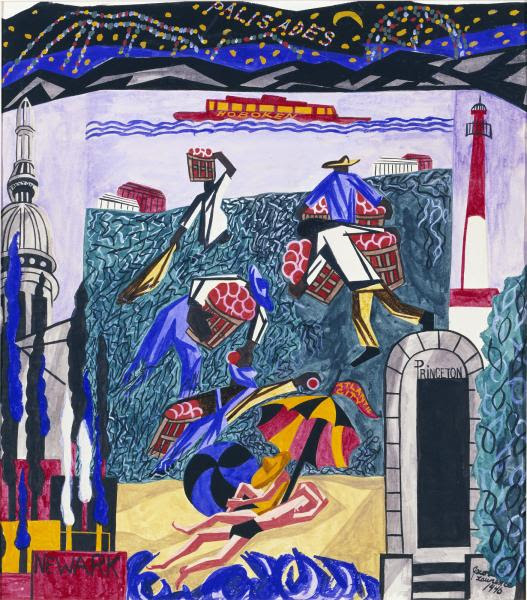
Jacob Lawrence, New Jersey, from the United States Series, 1946, watercolor, gouache, and pencil on paper, Smithsonian American Art Museum, Gift of Container Corporation of America, 1984.124.172
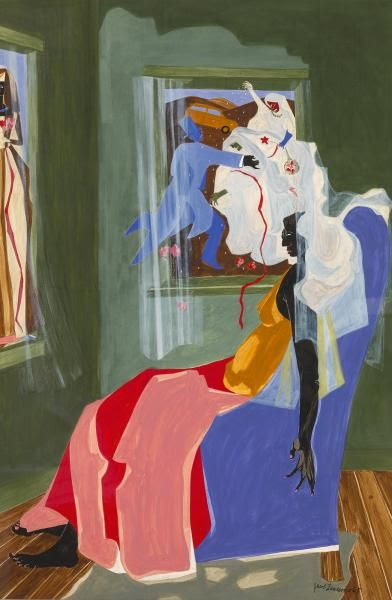
Jacob Lawrence was inspired by the women in his Harlem neighborhood. Like his own mother, they worked hard to support their families and survived on very little money. In this painting a girl rests on a chair in front of two large windows. In one, a tall, elegant lady stands with a bouquet of flowers and in the other, a bride and groom dance and throw confetti. Windows and doorways were focal points of New York’s brownstone neighborhoods, creating a link to life on the streets outside. But the bride and groom are clearly in a landscape beyond the city, and in this sense the windows have become screens onto which the young woman projects her fantasies. “Composing is most important. I seem to gravitate to geometric forms. It is like opening a book of geometry; I may not understand the formula but I love the beauty of line.” Lawrence, in Rago, “A Welcome from Jacob Lawrence,” School Arts, 1963
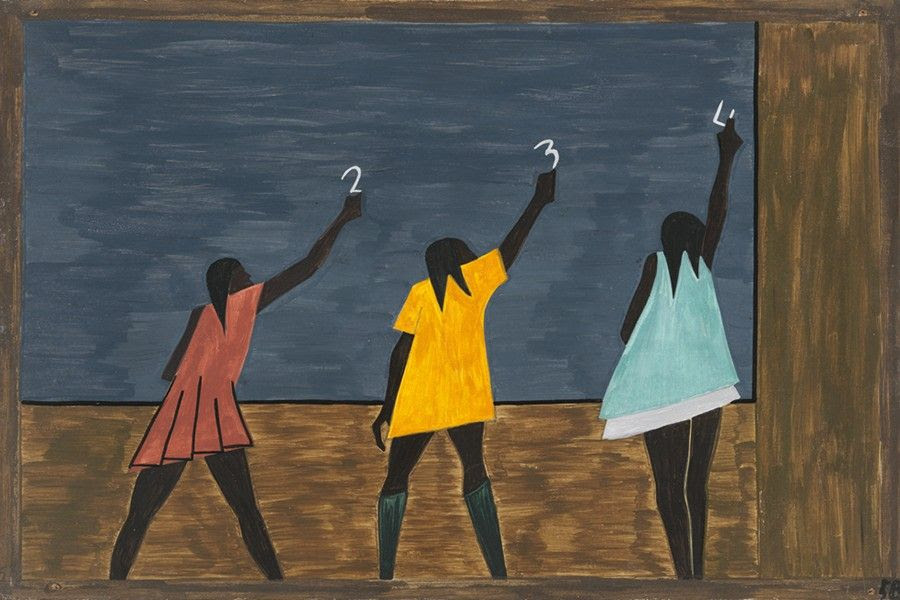
Jacob Lawrence, “In a free government, the security of civil rights must be the , 1976, opaque watercolor and pencil on paper mounted on fiberboard, Smithsonian American Art Museum, Gift of Container Corporation of America, 1984.124.170
Title “In a free government, the security of civil rights must be the same as that for religious rights. It consists in the one case in the multiplicity of interests, and in the other, in the multiplicity of sects.”–James Madison, The Federalist Papers, 1788. From the series Great Ideas.
THE
GREAT MIGRATION
INTRODUCTION WE WILL BE PRESENTING MORE VERY SOON
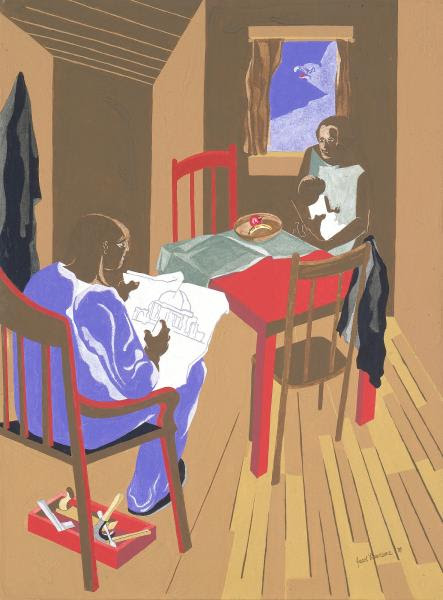
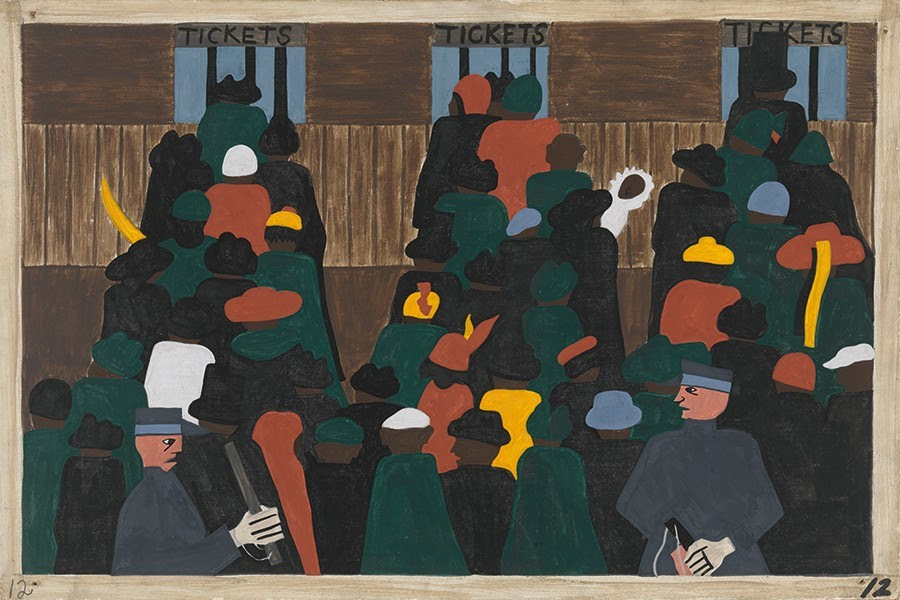
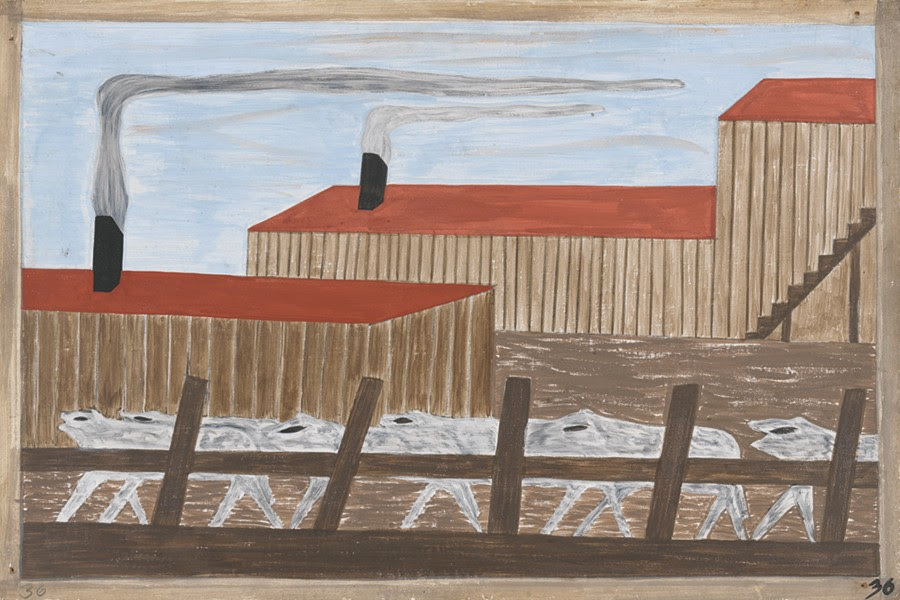
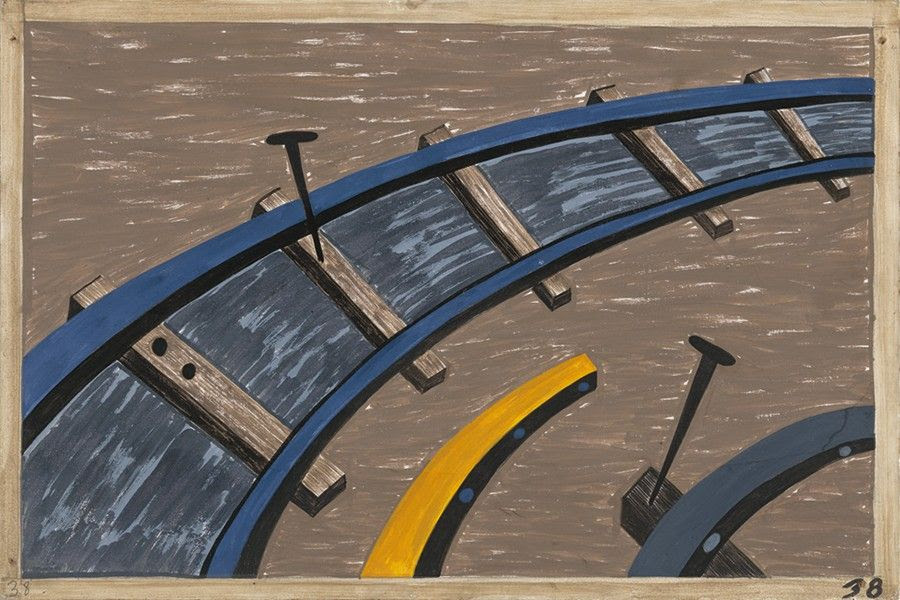
More than 75 years ago, a young artist named Jacob Lawrence set to work on an ambitious 60-panel series portraying the Great Migration, the flight of over a million African Americans from the rural South to the industrial North following the outbreak of World War I. By Lawrence’s own admission, this was a broad and complex subject to tackle in paint, one never before attempted in the visual arts. Yet, Lawrence had spent the past three years addressing similar themes of struggle, hope, triumph, and adversity in his narrative portraits on the lives of Harriet Tubman, leader of the Underground Railroad (1940), Frederick Douglass, abolitionist (1939), and Toussaint L’Ouverture, liberator of Haiti (1938). Lawrence found a way to tell his own story through the power and vibrancy of the painted image, weaving together 60 same-sized panels into one grand epic statement. Before painting the series, Lawrence researched the subject and wrote captions to accompany each panel. Like the storyboards of a film, he saw the panels as one unit, painting all 60 simultaneously, color by color, to ensure their overall visual unity. The poetry of Lawrence’s epic statement emerges from its staccato-like rhythms and repetitive symbols of movement: the train, the station, ladders, stairs, windows, and the surge of people on the move carrying bags and luggage. Following the example of the West African storyteller or griot, who spins tales of the past that have meaning for the present and the future, Lawrence tells a story that reminds us of our shared history and at the same time invites us to reflect on the universal theme of struggle in the world today: “To me, migration means movement. There was conflict and struggle. But out of the struggle came a kind of power and even beauty. ‘And the migrants kept coming’ is a refrain of triumph over adversity. If it rings true for you today, then it must still strike a chord in our American experience.”
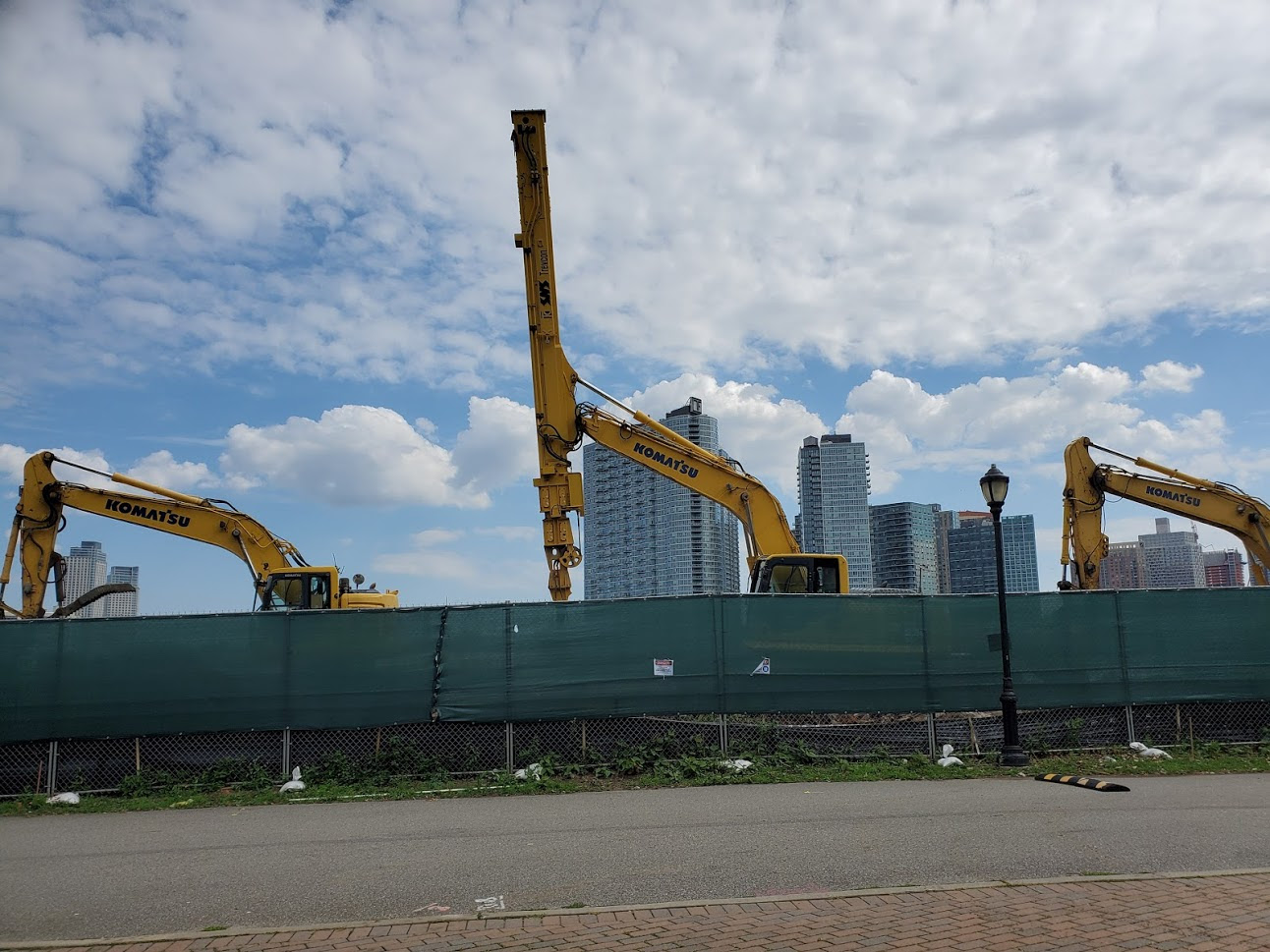
Three earthmovers that are removing all forms of life on the east side of Southpoint Park WINNER #1 ALEXIS VILLEFANE WINNER #2 JAY JACOBSON LOSERS; ROOSEVELT ISLAND
CLARIFICATION WE ARE HAPPY TO GIVE WINNERS OF OUR DAILY PHOTO IDENTIFICATION A TRINKET FROM THE VISITOR CENTER. ONLY THE PERSON IDENTIFYING THE PHOTO FIRST WILL GET A PRIZE. WE HAVE A SPECIAL GROUP OF ITEMS TO CHOOSE FROM. WE CANNOT GIVE AWAY ALL OUR ITEMS,. PLEASE UNDERSTAND THAT IN THESE DIFFICULT TIMES, WE MUST LIMIT GIVE-AWAYS. THANK YOU
NEW FEATURE
FROM OUR KIOSK
GREAT STUFF FOR ALL OCCASIONS
LOCAL HISTORY BOOKS $25- KIOSK IS OPEN WEEKENDS 12 NOON TO 5 P.M. ONLINE ORDERS BY CHARGE CARD AT ROOSEVELTISLANDHISTORY@GMAIL.COM
EDITORIAL
As I have written before, our neighbors at Coler have been confined to the campus for the last six months. As with all nursing homes in New York State, no visitors are permitted and when they will be allowed it will be on a limited basis.
All group activities are severely limited and any communal event is on hold.
As the president of the Auxiliary, an organization that provides things that the home could not provide such as clothing, birthday events, parties, gardening equipment, special meals, all kinds of refreshments including coffee makers for the units and much more.
Now we need YOU to join the Auxiliary and help us become an Auxiliary member and keep activities and other services coming. The Auxiliary meets once a month and plans events, fundraisers and supports the activities that the Therapeutic Recreation Department organizes.
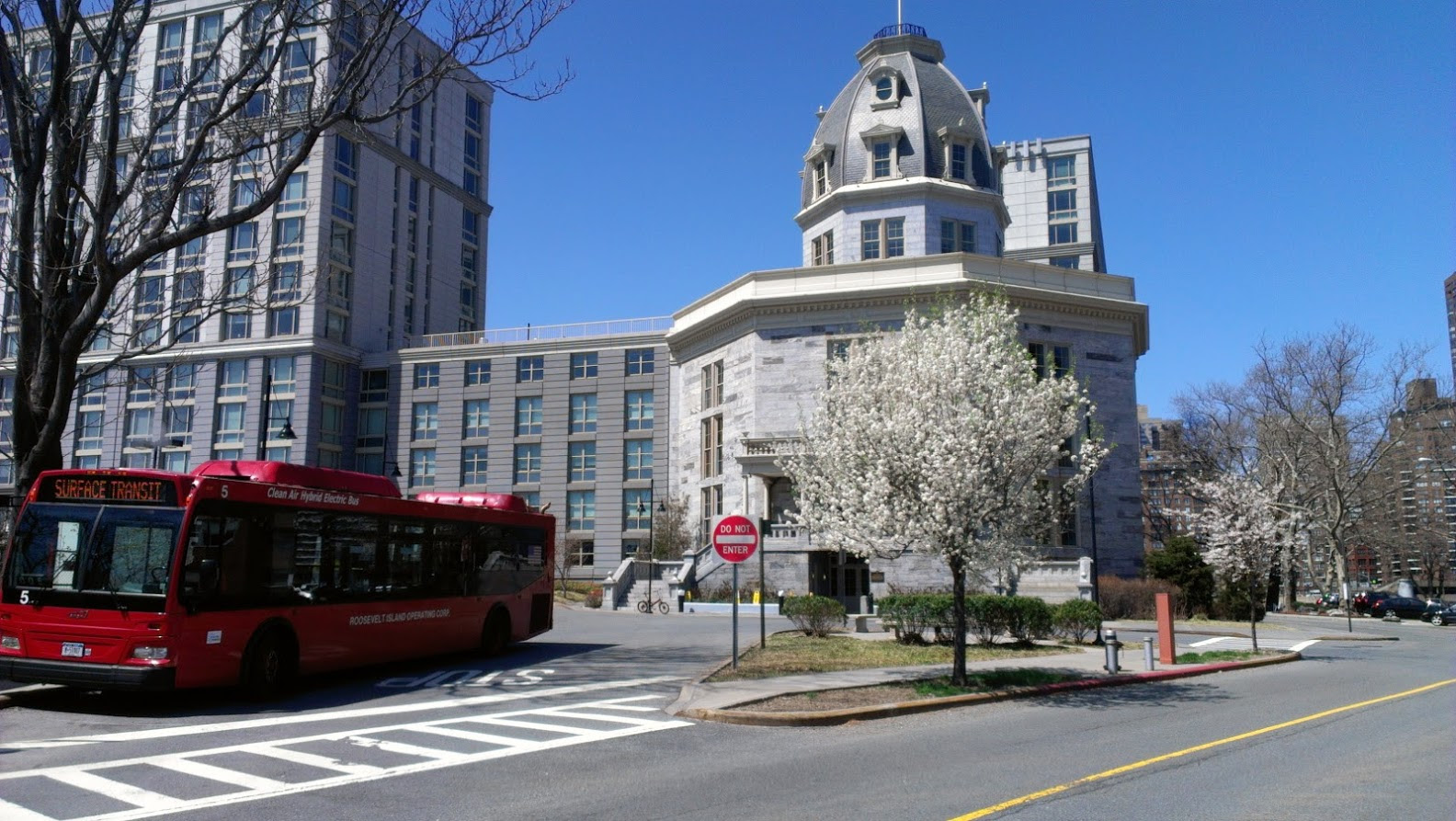
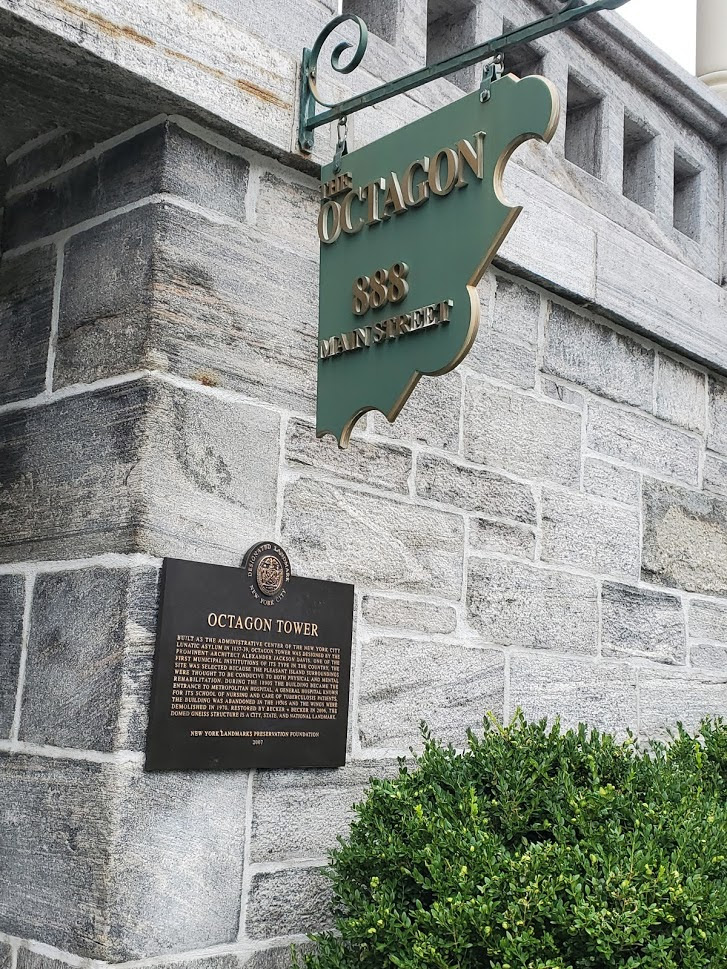
Ever since the Octagon was under development, the RIHS played an important role in its construction and design. The RIHS maintained a large amount of historical information on the building which we shared with Becker + Becker, the buildings developers and architects.
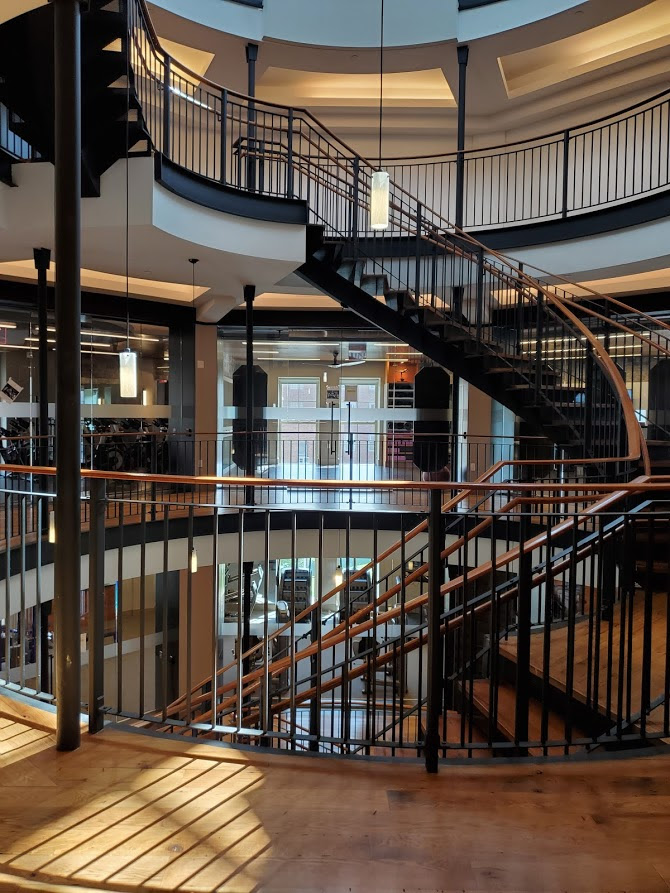
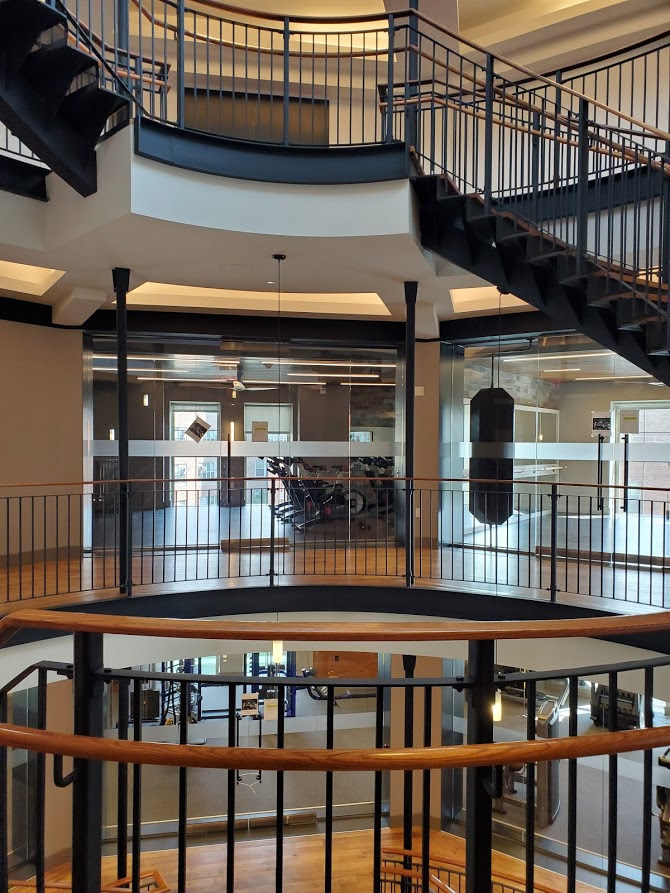
In 2006, when the building was complete, Bruce Becker donated the RIHS office space in the building. For 12 years we had a great office on the second floor of the building overlooking the lobby and a quick walk down the stairs to the Gallery space.
We have maintained the space and hosted many exhibits in the gallery.
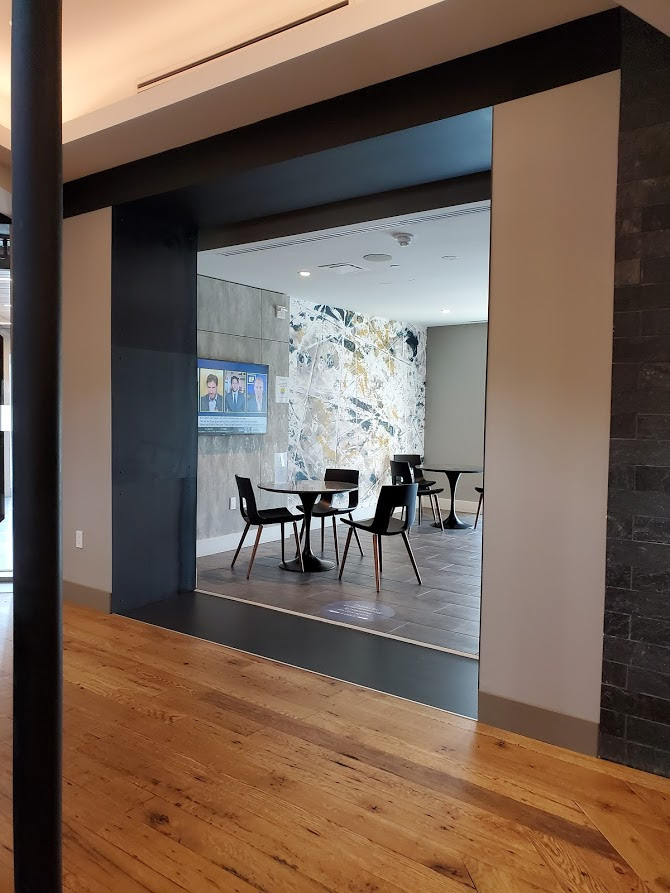
In 2017, Bozzuto, the buildings management since 2016 was renovating the lobby and spaces in the Octagonal building. Bozzuto has continued supporting the RIHS and we are delighted with our new office.
We packed up the office and it all squeezed into three storage spaces in the basement. In late 2019, we moved into our new office space on the 4th floor of the Octagon. We had the same space, just two floors up.
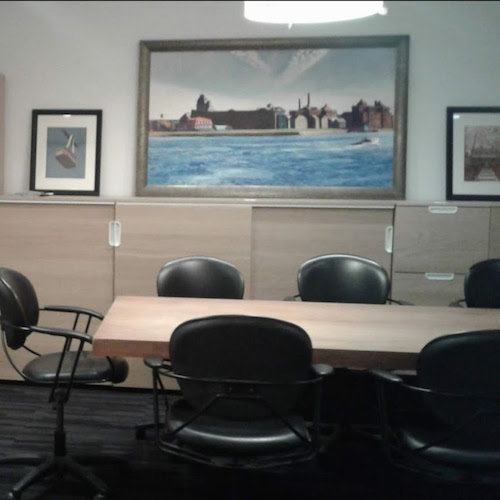
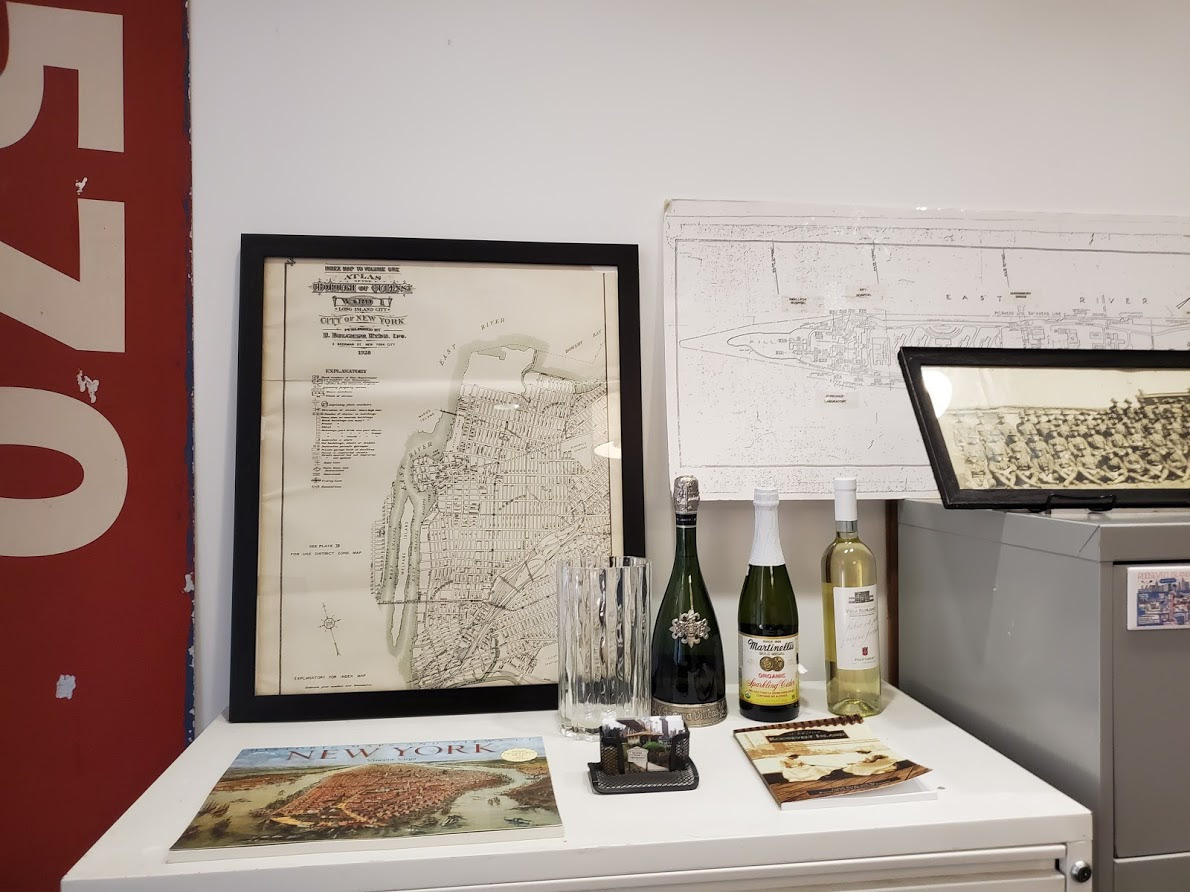
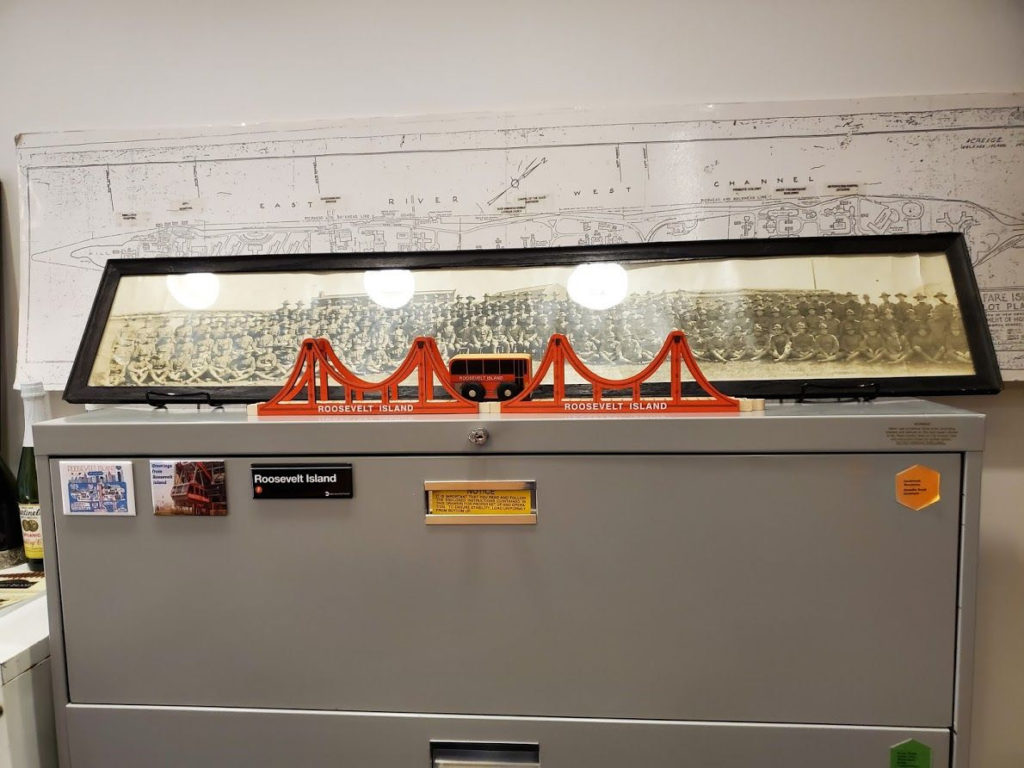
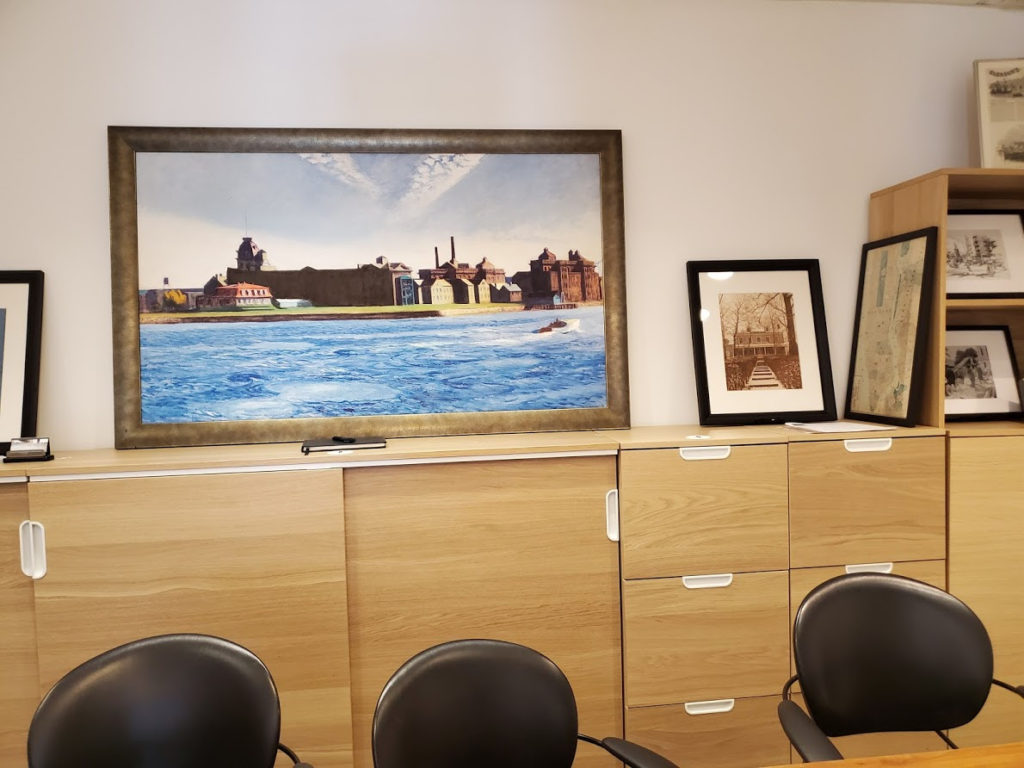
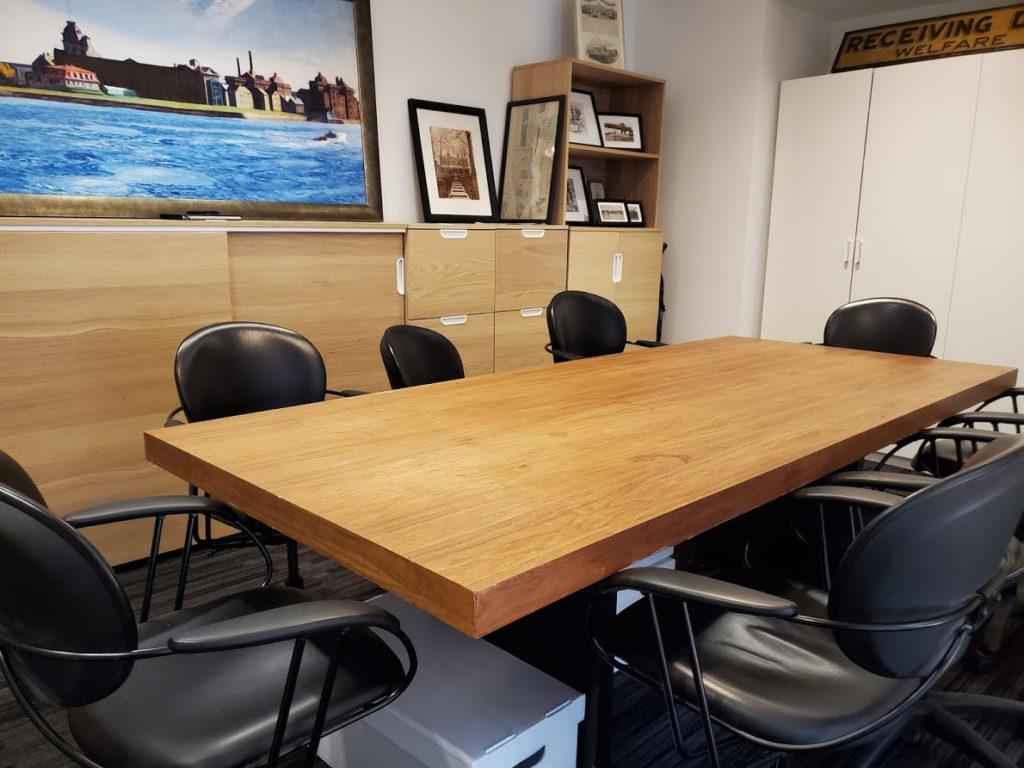
We started planning our new office with the most storage, exhibition, work and conference space into about 300 square feet. Bozzuto left us a great giant conference table and chairs, that we have polished up and serves us well.
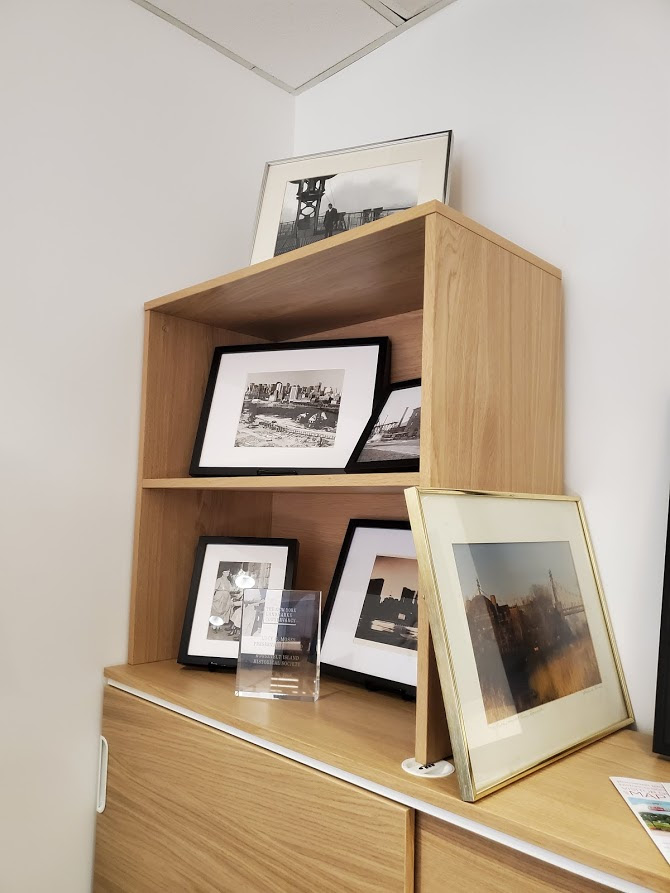
Through Matt Altwicker, our board member and architect, we chose furniture from Ikea. After trips to the planning showroom n Manhattan and the store in Brooklyn, we chose the pieces we needed.
On delivery day, 29 boxes arrived, all flat packed. With the talented help of installers and a few glitches, we were set up and ready to bring our property back into the room. In December and January we made the office look great and we were able to get most of our archives back into the room. We still have much in storage that will never fit into the space. We had a small reception the evening the building re-opened the newly renovated spaces. Thanks to our great crew of Jon Martin and Bill Weiss, lots of heavy lifting was accomplished.
We were all ready to have our own open house and celebration. Covid-19 struck and soon we will have celebrations, lectures, classes, conferences.
Take a virtual tour now and stay tuned for a real opening. Anyone can safely visit the office at any time with social distancing. Contact us for an appointment and your interest of study.
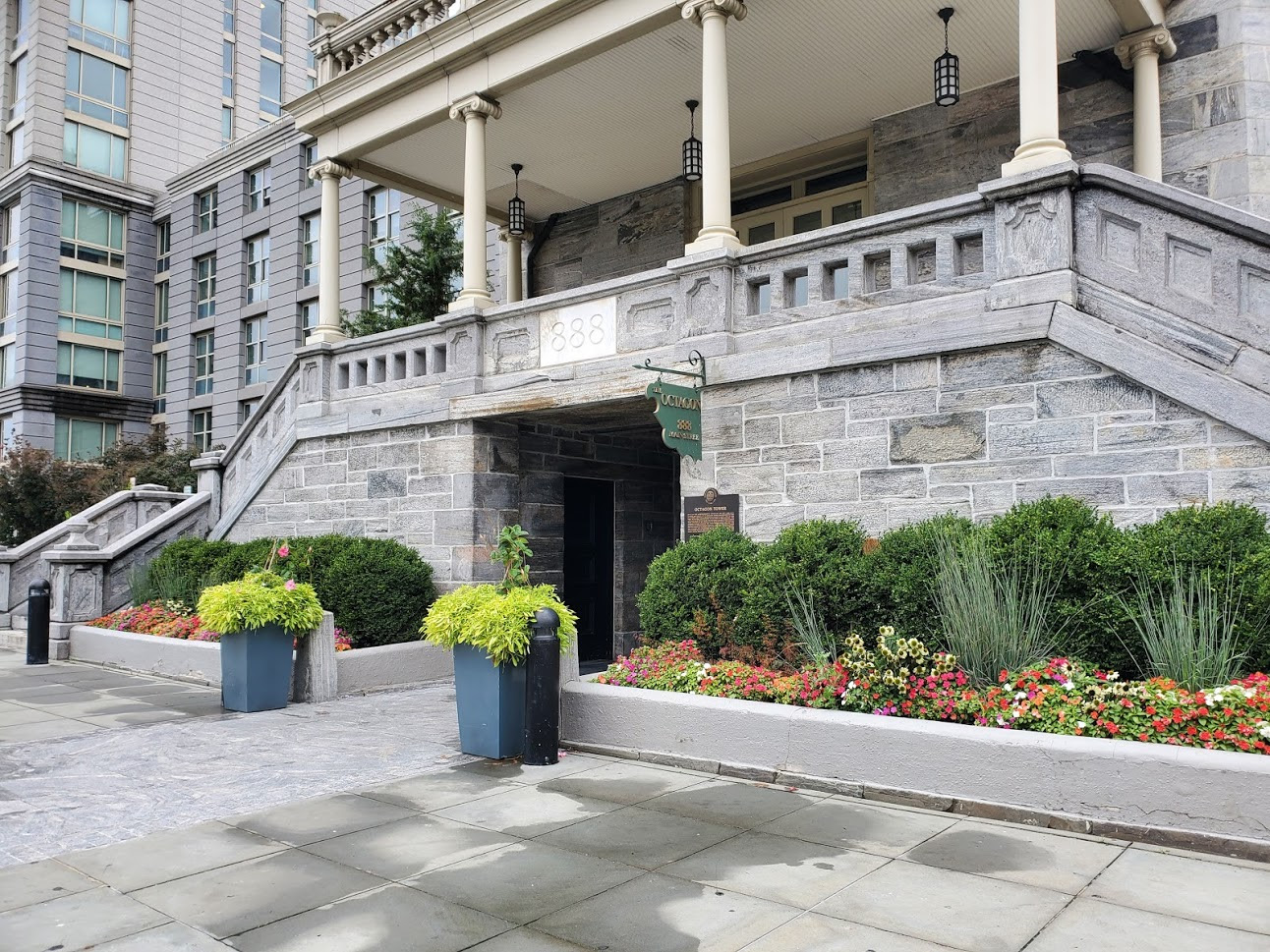
The landmark exterior with replica of original sign at entry
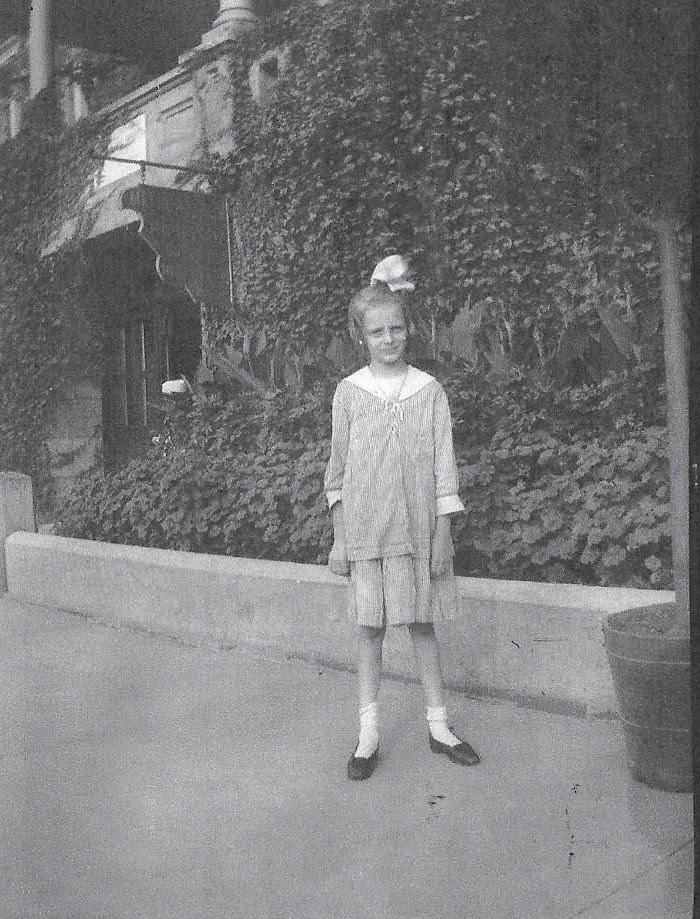
Octagon entry today and 1920’s photo of young lady at Metropolitan Hospital entry
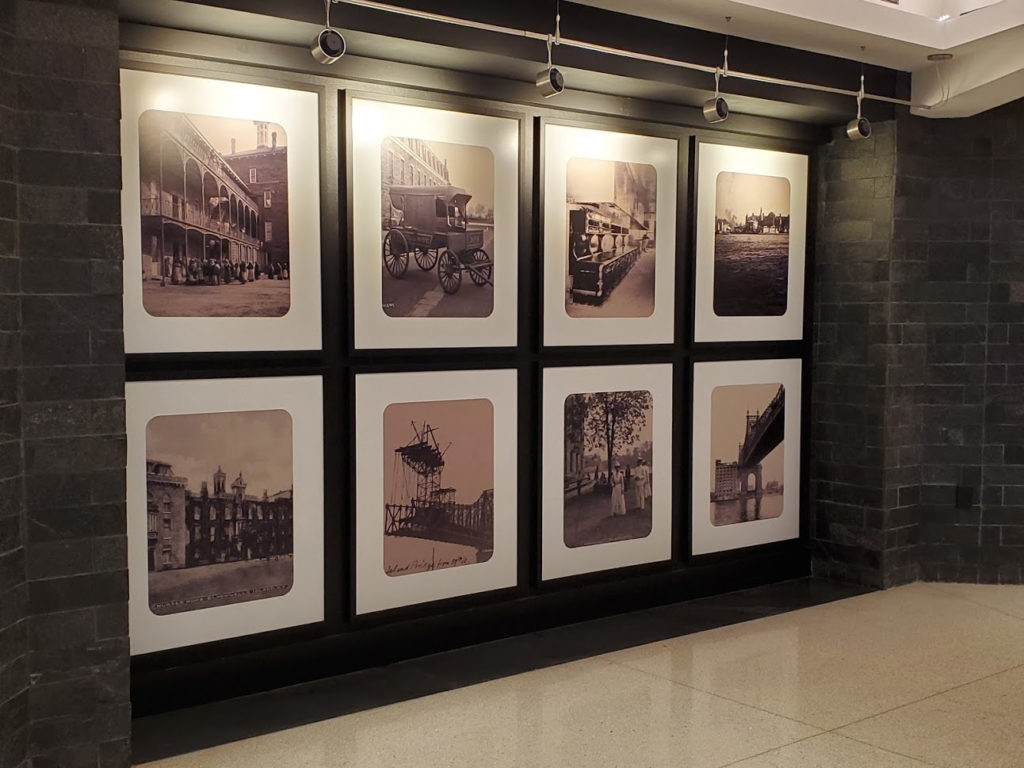
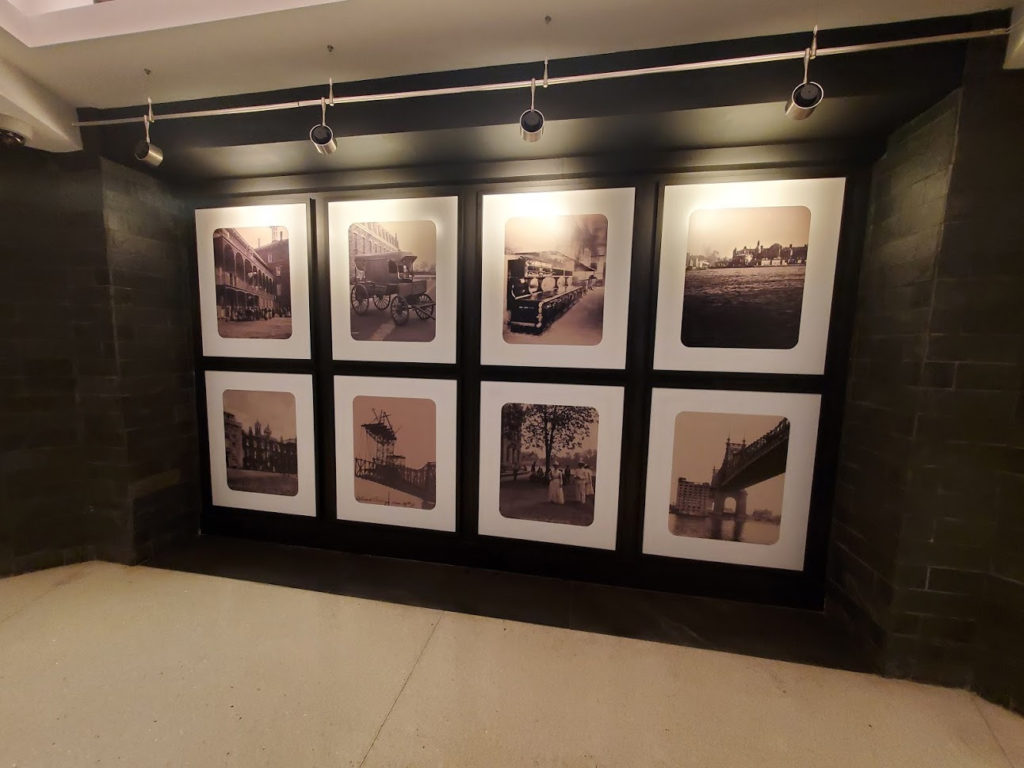
The renovated lobby boasts panels of historic photos of the island.
It is a good walk up to the 4th floor. The elevators are at the end of the hallways
BLACKWELL’S ISLAND By Edward Hopper 1928 Reproduction
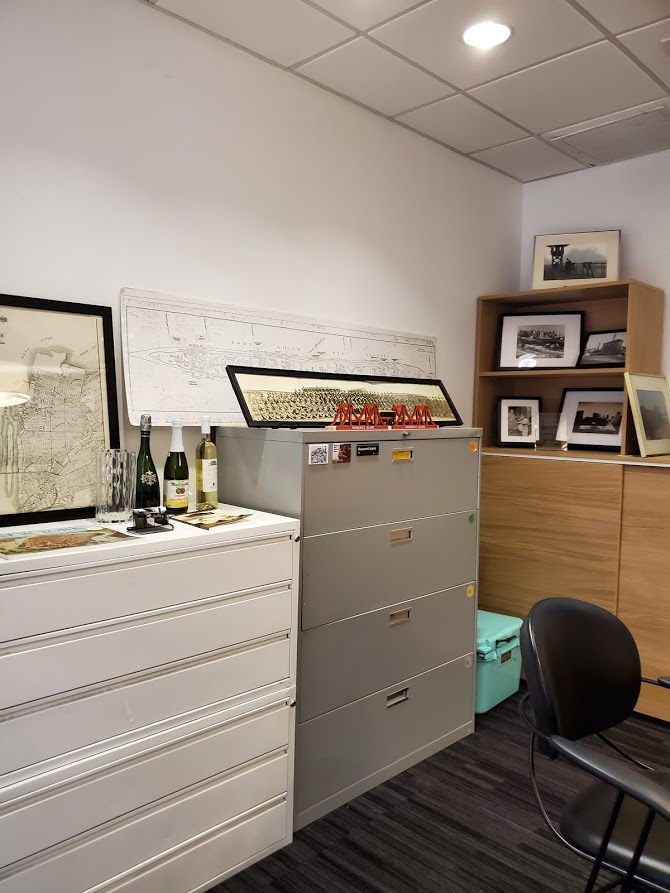
All kinds of goodies are packed in our filing cabinets and files from over 40+ year of the RIHS.
OUR WALL OF CABINETS ARE “GALANT” FROM IKEA
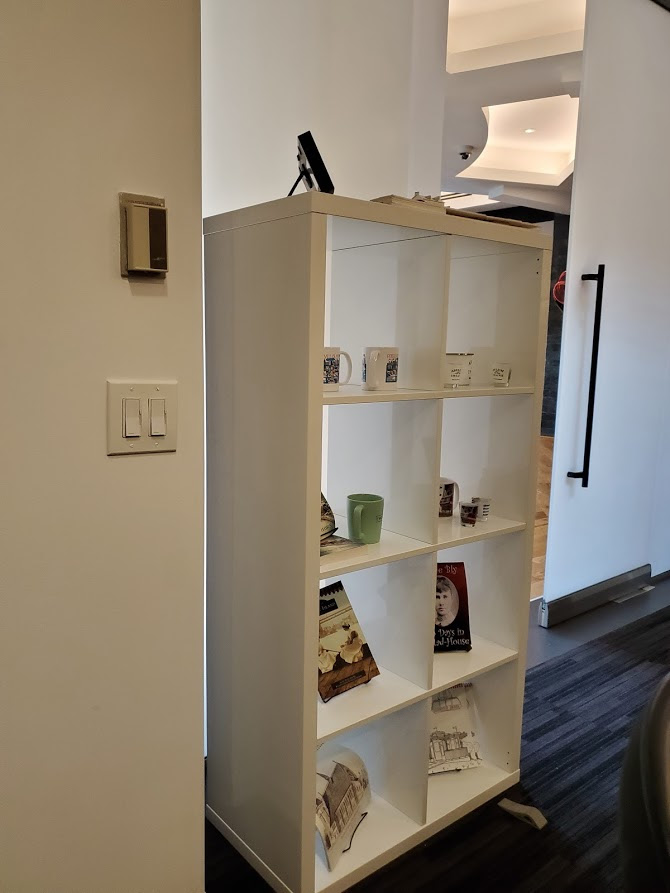
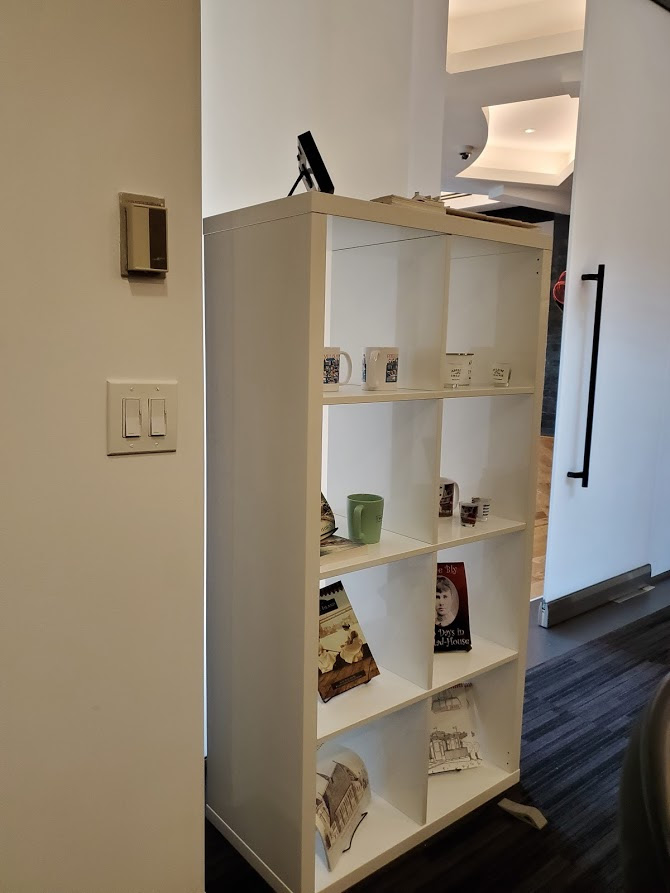
ONE OF TWO “KALLAX” DISPLAY SHELVES WITH KIOSK MERCHANDISE
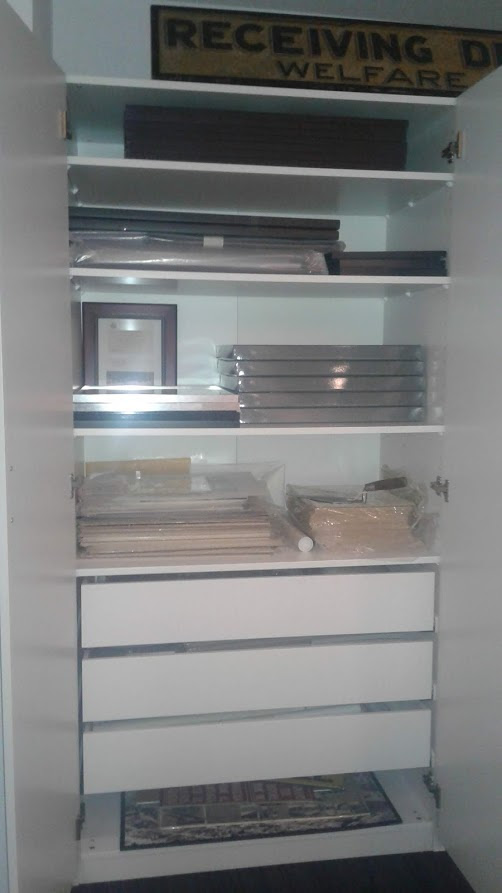
LOTS OF STORAGE SPACE
An entire wall of PAX cabinets fill the area with a great amount of storage that was custom designed for our needs.
WE SHARE THE FLOOR
There is an area with tables and chairs, water dispenser and bathrooms, just out the door from the office. Across the way is a dance or exercise studio and a teen lounge.
If you are considering IKEA office furniture, feel free to take a look at ours. We are happy with the quality, construction and styles. My only suggestion is to know the exact measurements of your walls before ordering. Consider professional installers for these items.
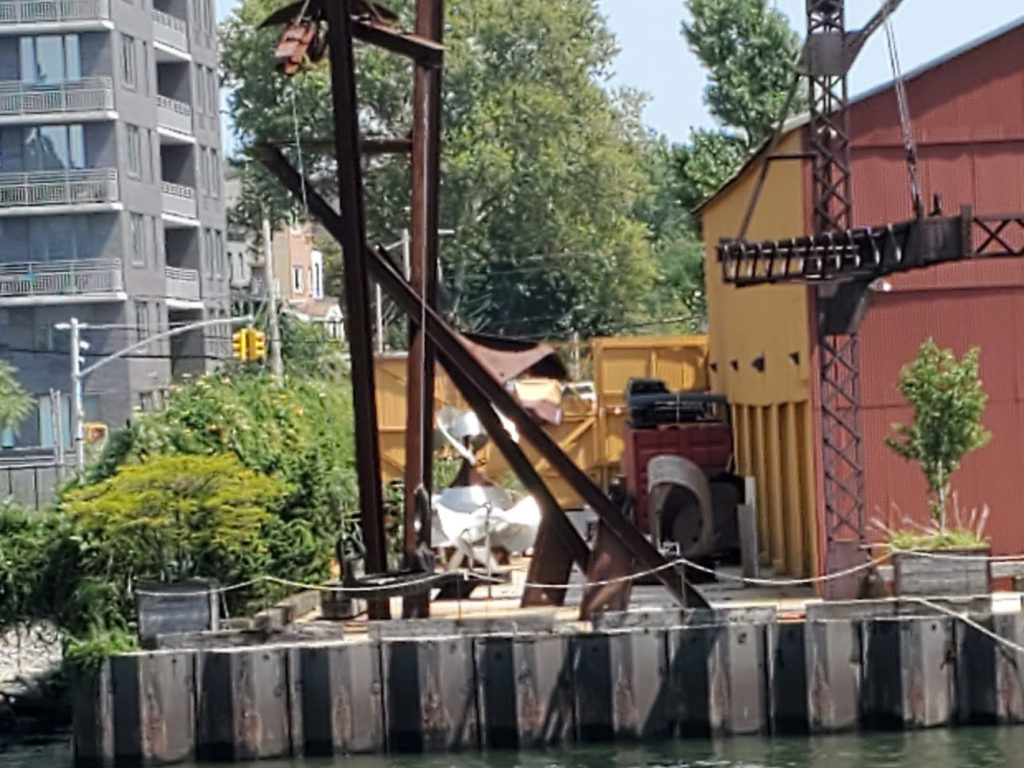
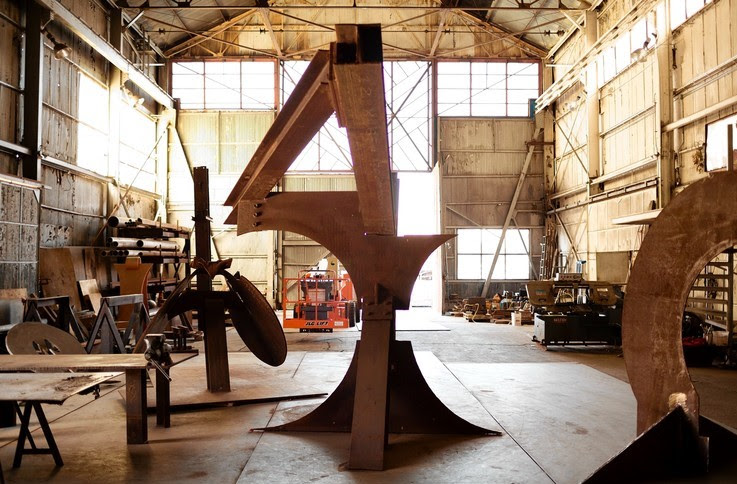
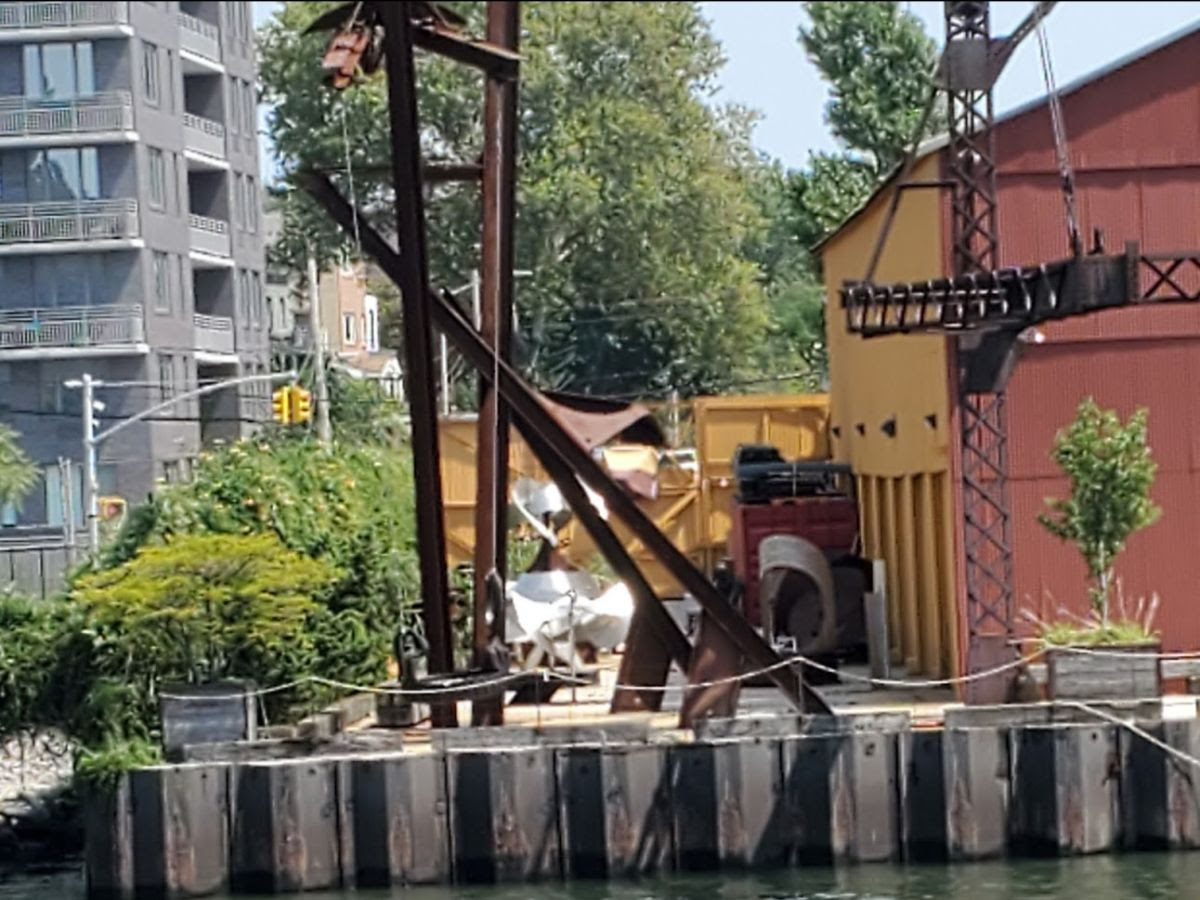
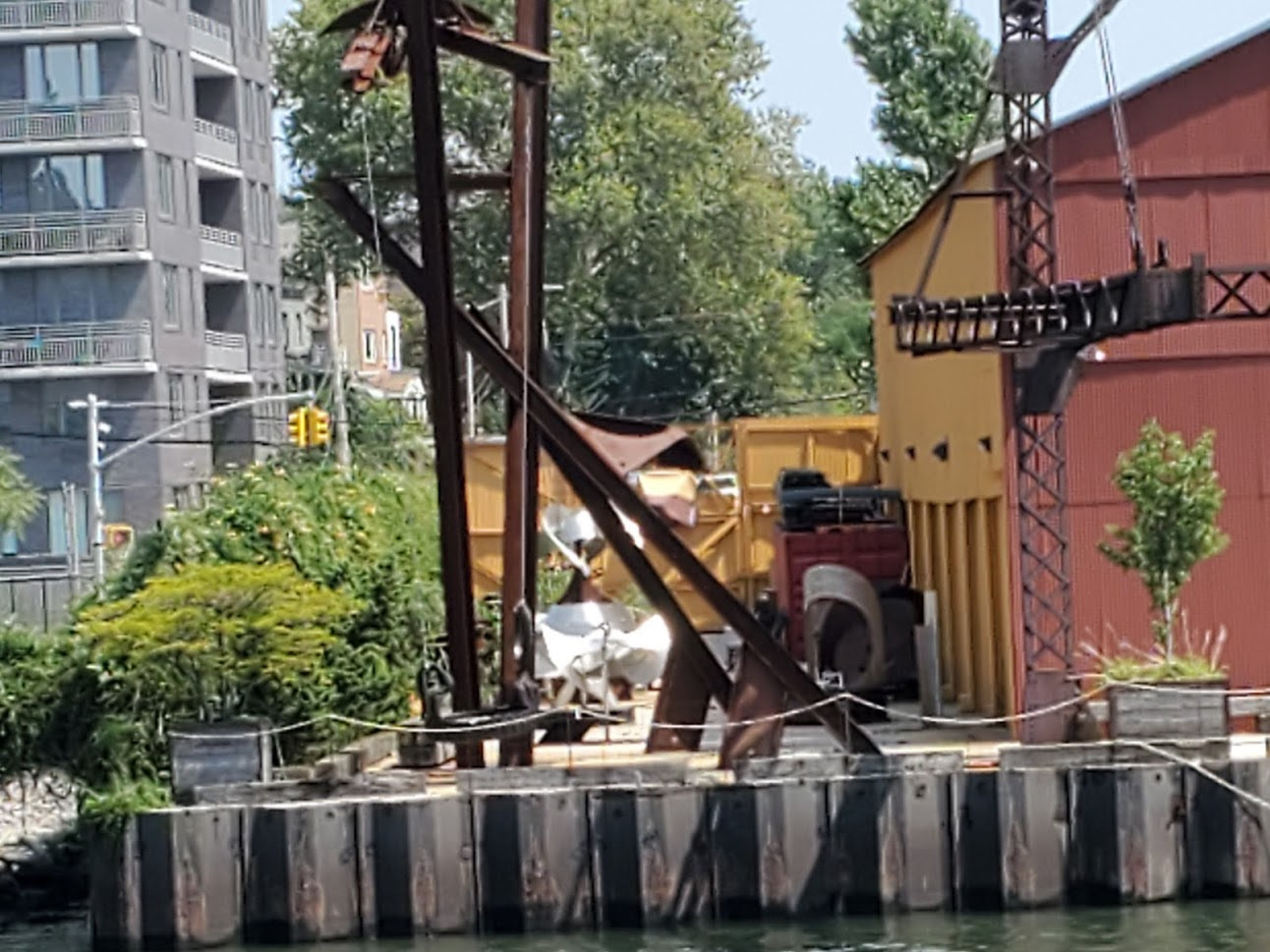
MARK DI SUVERO STUDIO FROM FERRY. LOCATED JUST NORTH OF SOCRATES PARK. PHOTO OF INTERIOR STUDIO WSJ (C) DAVID ANDREWS, JAY JACOBSON AND ALEXIS VILLEFANE GOT IT
CLARIFICATION
WE ARE HAPPY TO GIVE WINNERS OF OUR DAILY PHOTO IDENTIFICATION A TRINKET FROM THE VISITOR CENTER. ONLY THE PERSON IDENTIFYING THE PHOTO FIRST WILL GET A PRIZE. WE HAVE A SPECIAL GROUP OF ITEMS TO CHOOSE FROM. WE CANNOT GIVE AWAY ALL OUR ITEMS,. PLEASE UNDERSTAND THAT IN THESE DIFFICULT TIMES, WE MUST LIMIT GIVE-AWAYS. THANK YOU
NEW FEATURE
FROM OUR KIOSK
GREAT STUFF FOR ALL OCCASIONS
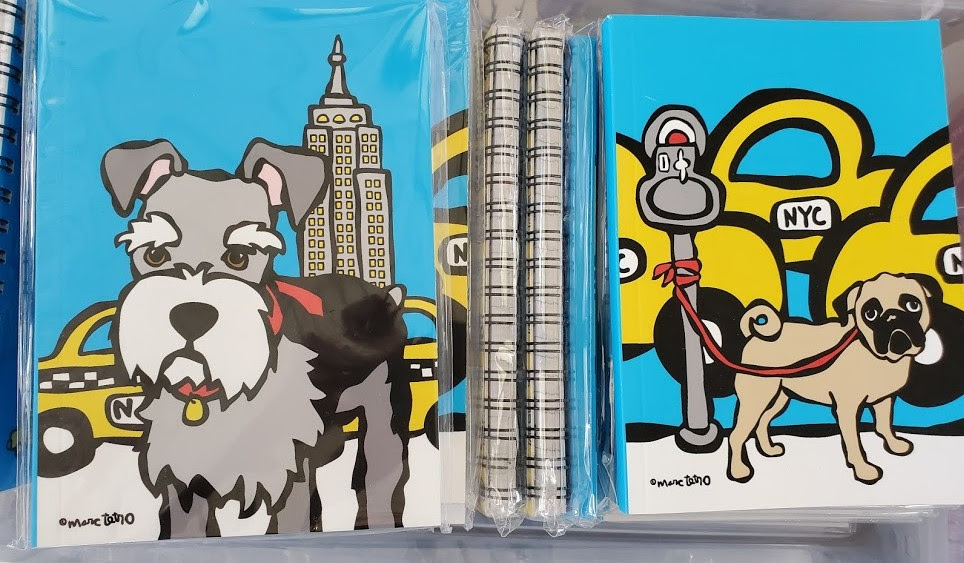
MARC TETRO NTOEBOOSK 2 FOR $5- OTHER GREAT MARC TETRO MERCHANDISE IS AT THE KIOSK. MARC HAS LEFT THE ISLAND SINCE THE PANDEMIC HAS IMPACTED THE BUSINESS
Text by Judith Berdy Thanks to Bobbie Slonevsky for her dedication to Blackwell’s Almanac Thanks to Deborah Dorff for maintaining our website Edited by Melanie Colter and Deborah Dorff All materials in this publication are copyrighted (c)
PHOTOS FROM JUDITH BERDY COPYRIGHT RIHS/2020 (C) MATERIAL COPYRIGHT WIKIPEDIA, GOOGLE IMAGES, RIHS ARCHIVES AND MAY NOT BE REPRODUCED WITHOUT PERMISSION (C)
FUNDING BY ROOSEVELT ISLAND OPERATING CORPORATION PUBLIC PURPOSE FUNDING
DISCRETIONARY FUNDING BY COUNCIL MEMBER BEN KALLOS THRU NYC DYCD
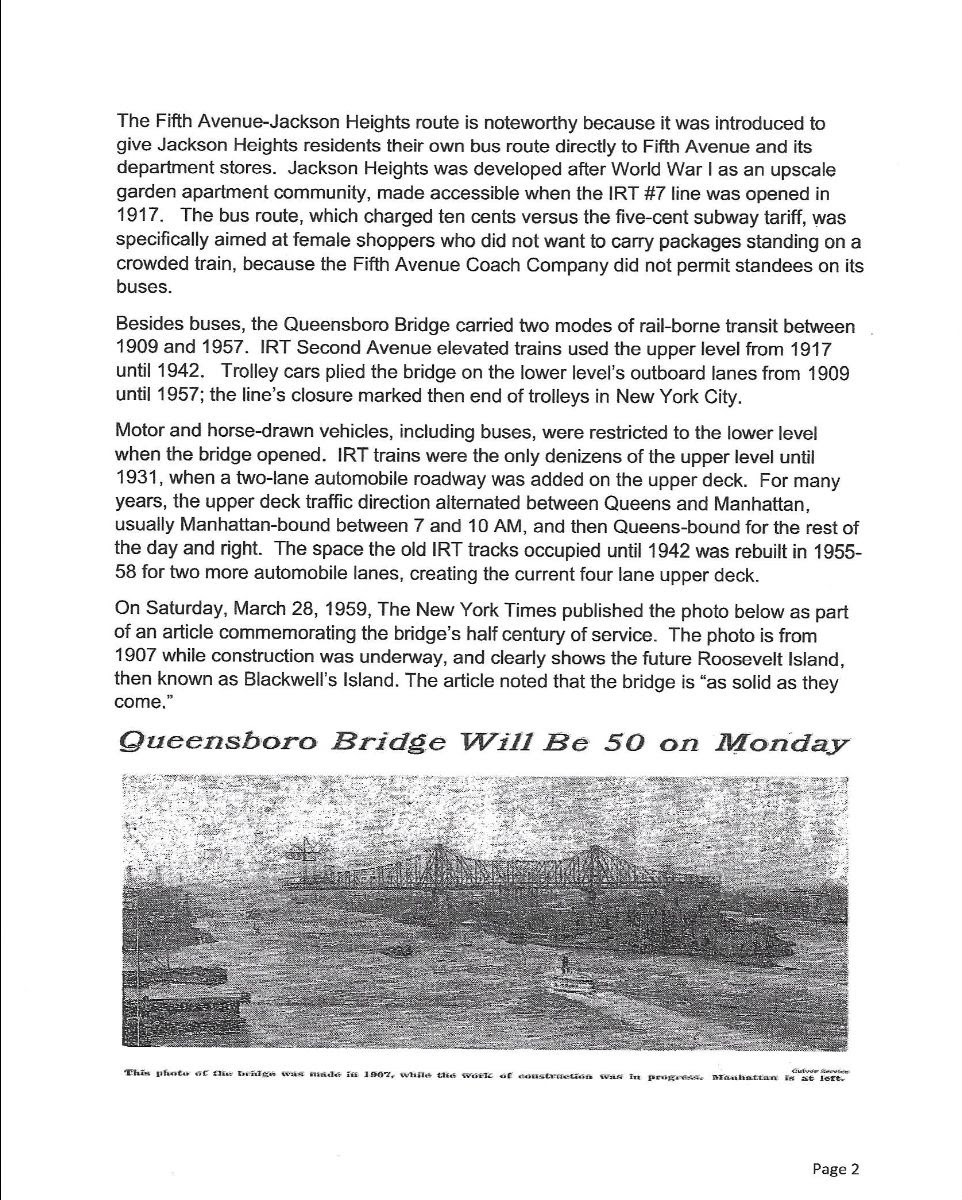
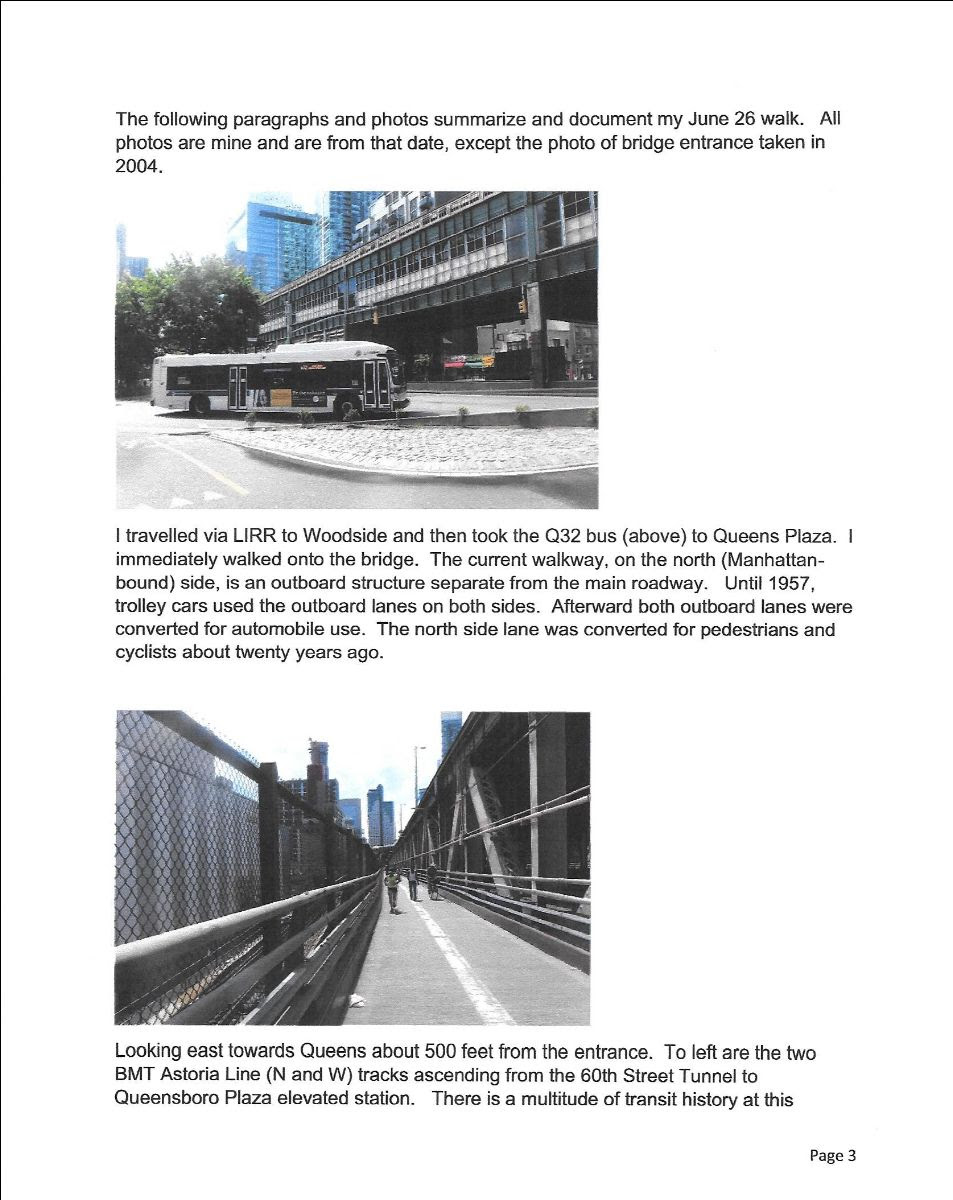
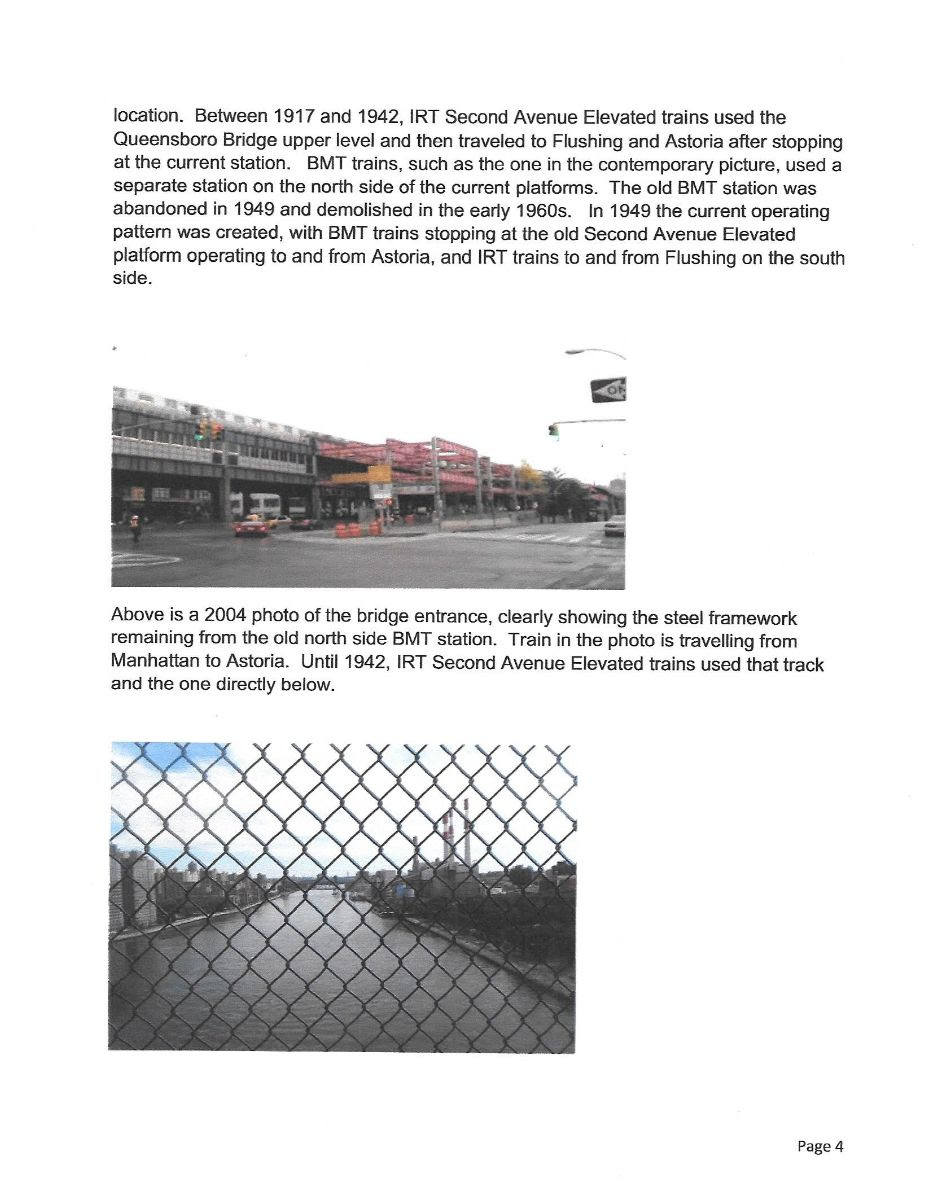
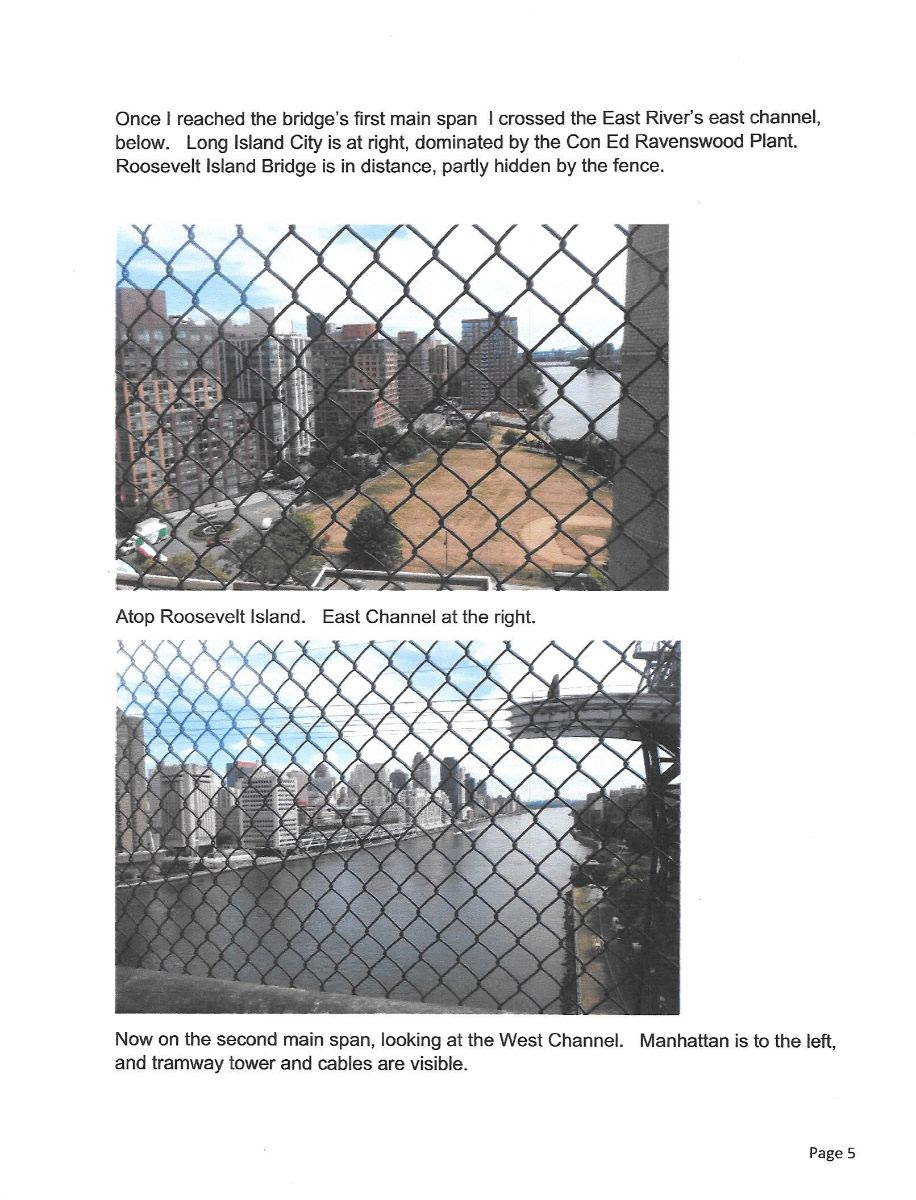
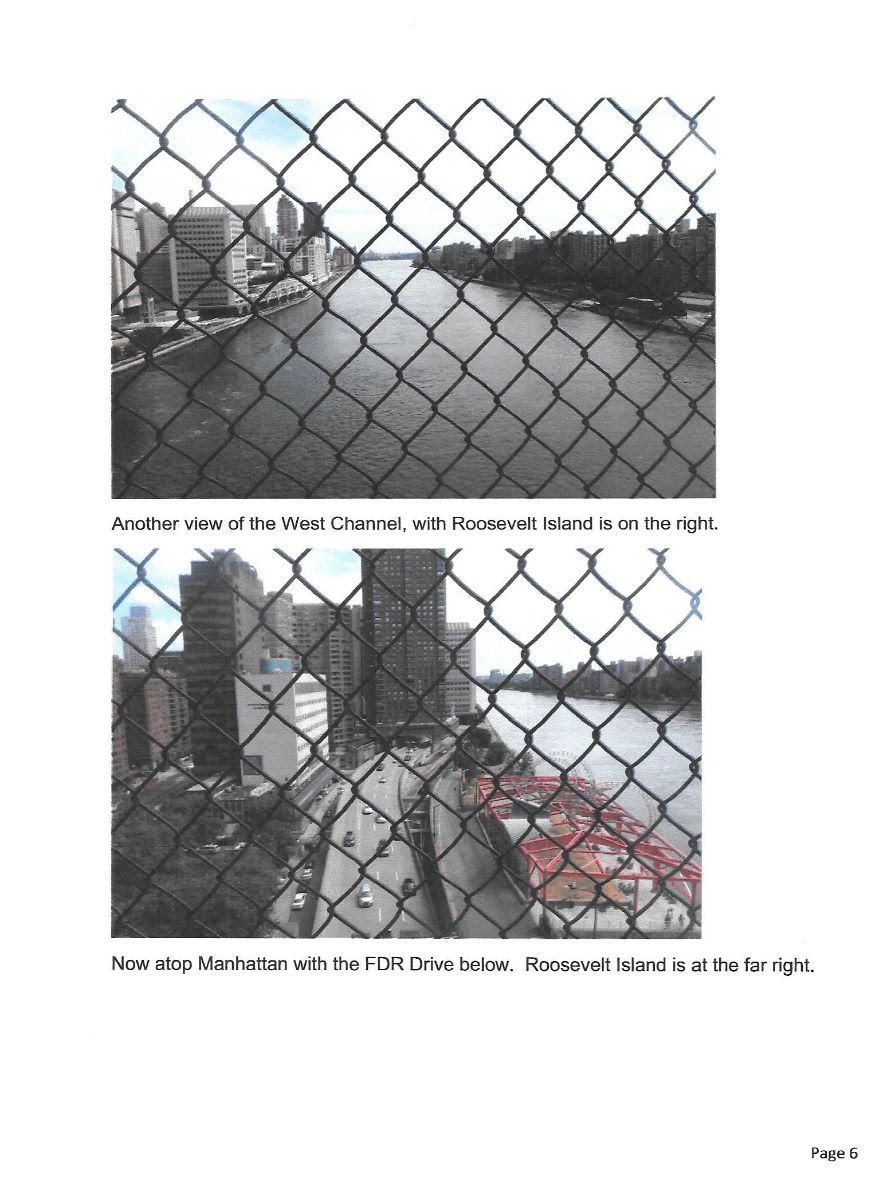
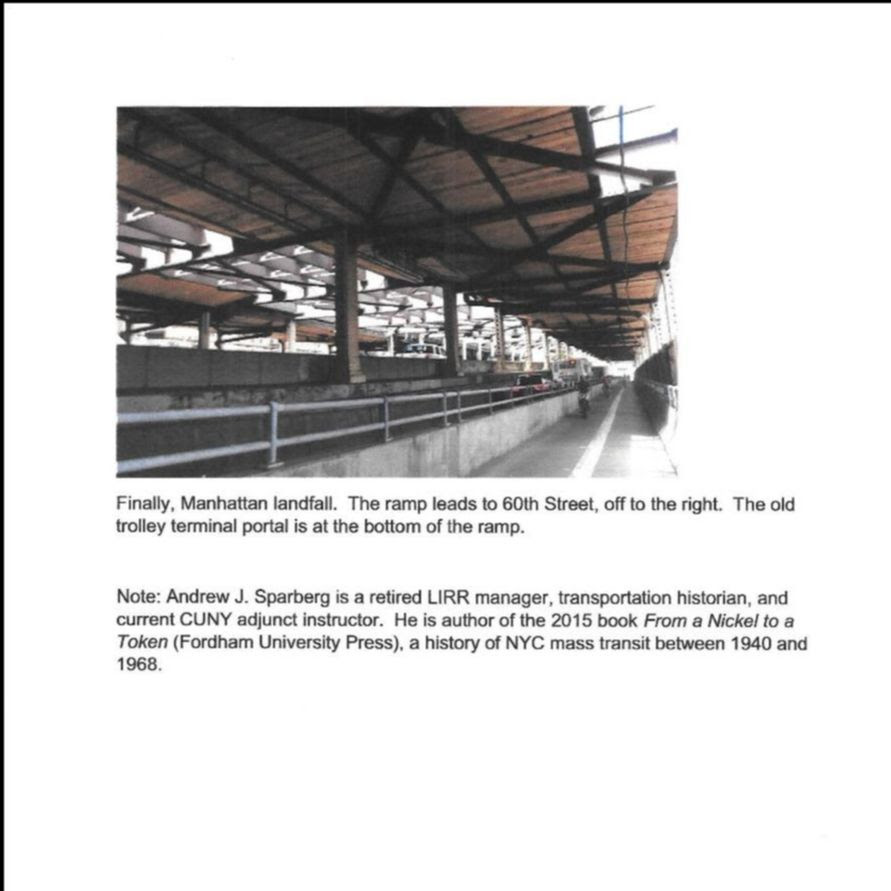
WALKING THE QUEENSBORO BRIDGE on JUNE 26, 2020 By Andrew J. Sparberg
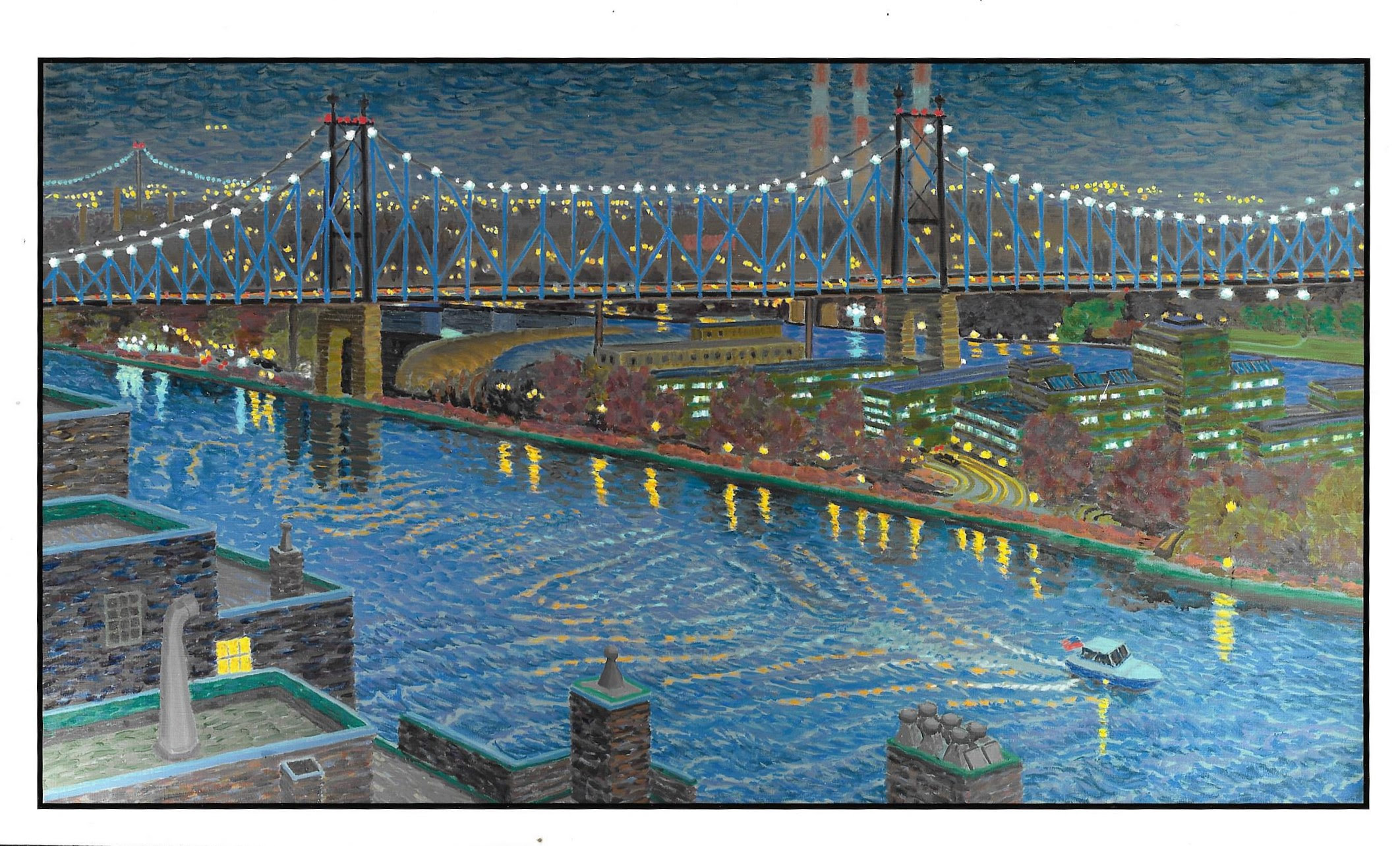
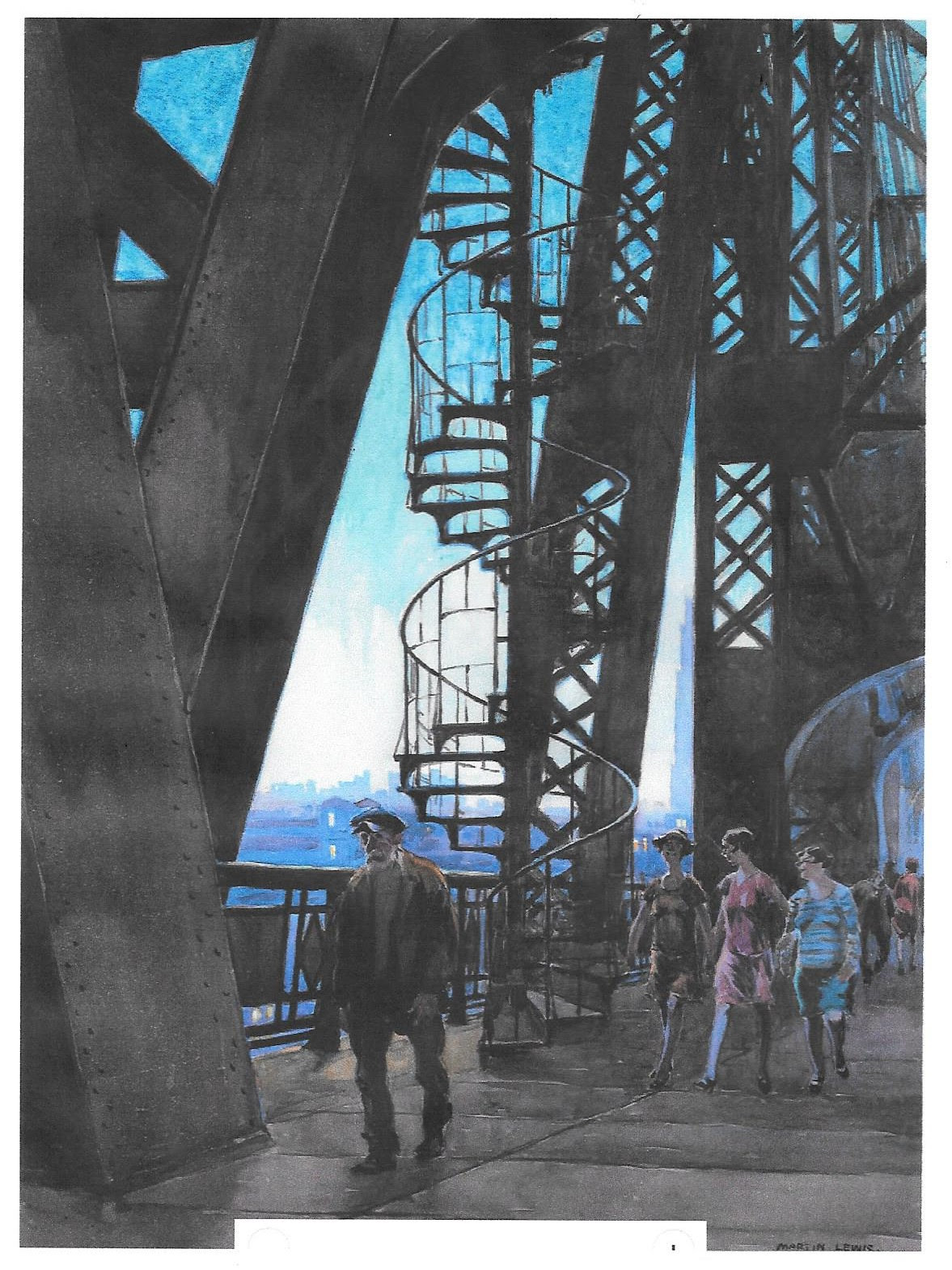
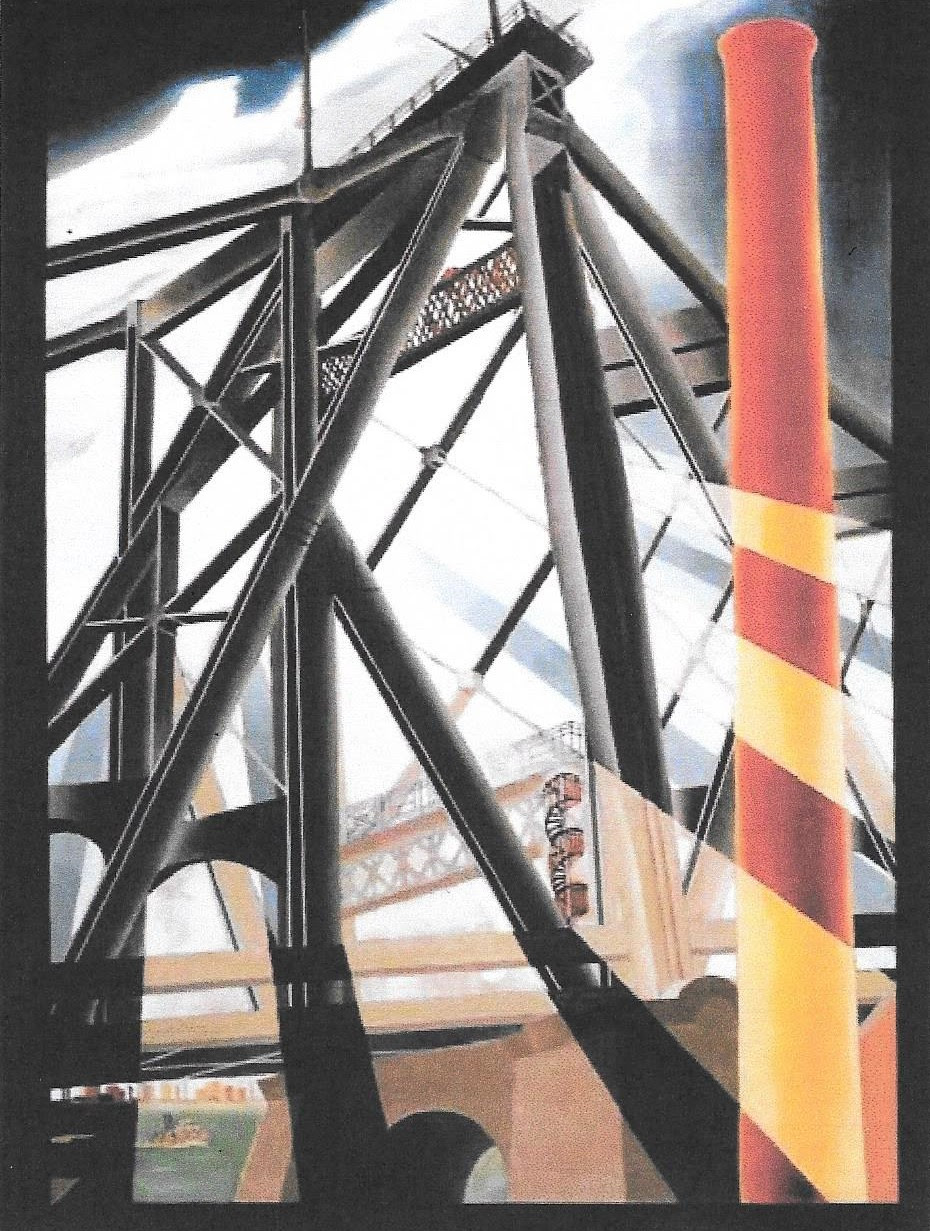
Queensborough Bridge, Autumn with a Police Boat Yvonne Jacquette 2002 (c)Queensboro Bridge by Elsie Driggs
WEEKEND PHOTO
WHAT AND WHERE IS THIS? SEND RESPONSE TO: ROOSEVELTISLANDHISTORY@GMAILCOM WIN A KIOSK TRINKET.
FRIDAY PHOTO OF THE DAY
MARK SCUVERO SCULPTURE STUDIO ASTORIA
COMING SOON
OUR NEW MUGS AND MAGNETS IN THIS DESIGN MUGS $12-, MAGNETS $5-
EDITORIAL
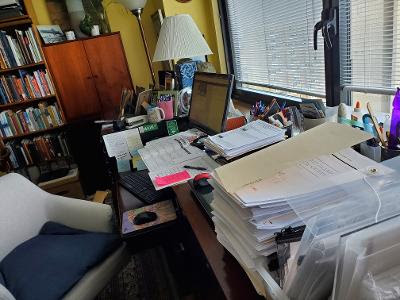
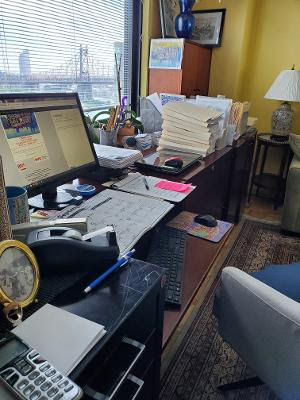
This weekend is issue #131. I have already had to get a new desk chair, go on a diet, find ways to stack more paper. I love watching programs where there are paper-free desks and ail is neat and tidy!! Mine is a combination or RIHS, Board of Elections, Coler Auxiliary, City Funding and RIOC Funding for the RiHS…..also a stray personal item included in the stacks.
I can tell you the speed that jet-skiers are going past my window, that the NYC Ferry schedule is.
I can also tell you the glitches that happen when MailChimp ( campaign builder) I use decides to stop working and refuses to properly space text.
Funding Provided by: Roosevelt Island Operating Corporation Public Purpose Funds Council Member Ben Kallos City Council Discretionary Funds thru DYCD Text by Judith Berdy Thanks to Bobbie Slonevsky for her dedication to Blackwell’s Almanac and the RIHS Thanks to Deborah Dorff for maintaining our website Edited by Deborah Dorff ALL PHOTOS COPYRIGHT RIHS. 2020 (C) PHOTOS IN THIS ISSUE (C) JUDITH BERDY RIHS
Sandra Bloodworth is the Director of the award-winning public art program, MTA Arts & Design. Since the program (formerly Arts for Transit) was launched in 1985, its team has turned New York’s century-old transportation network into a first-rate museum, exposing millions of transit riders to art, music and poetry.
Within the MTA network, you experience artworks created in mosaic, terra cotta, bronze, glass and mixed-media sculpture. Arts & Design serves the over 8.7 million people who ride subway and commuter trains daily and strives to create a meaningful transportation experience. Sandra joined Arts & Design in 1988 and has served as the Director since 1996. During her tenure, she has shepherded countless vibrant and meaningful works of art installed in subway and rail stations, while maintaining a clear and focused role as the MTA’s voice for quality urban design.
There has been an enormous growth of art installations including major hubs–like Times Square, and Atlantic Terminal—and installations in neighborhoods across the Bronx, Queens, Brooklyn and Manhattan—and the newest transportation projects: the Fulton Center, the 7-Line Extension, and extraordinary artwork for the Second Avenue Subway.
Under Sandra and her team of arts professionals, Arts & Design has been a powerful catalyst for positive changes with the public’s perception of the New York subway. Today, the program is beloved by millions who find their travel experience enhanced by public art, the Poetry In Motion program, the Lightbox photographs, the Music Under New York program, and special events in Grand Central Terminal, and Fulton Center. Arts & Design remains unwavering in its commitment to upholding the subway founders’ credo that the subway should be a place of beauty incorporating the highest design standards. In doing so, Bloodworth and her team have helped popularize the unique iconography of the New York City subway around the world.
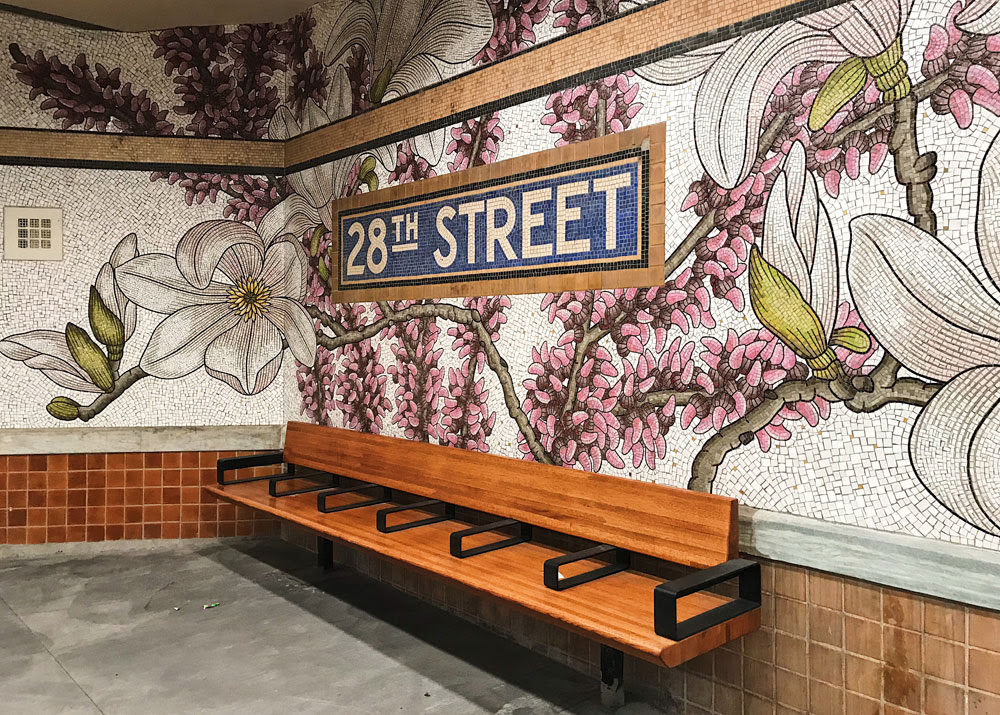
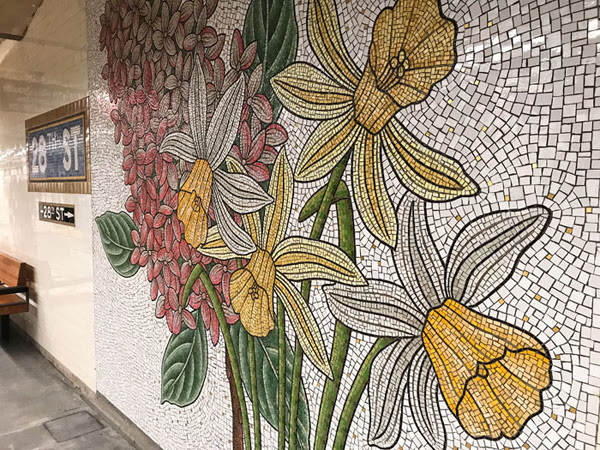
28th Street and Seventh Avenue The platform walls are covered in beautiful glass mosaic murals created by Miotto Mosaic Art Studio based on drawings by artist Nancy Blum. The murals depict vibrant red buds, hellebores, witch hazel, magnolias, daffodils, hydrangeas and camellia plants, all flowers that represent the perennial collection of the Madison Square Park Conservancy. Blum told the MTA that the goal of her design was to capture the magic of the park and enhance the station environment for subway riders. (Untapped Cities)
FUNKTIONAL VIBRATIONS 2015
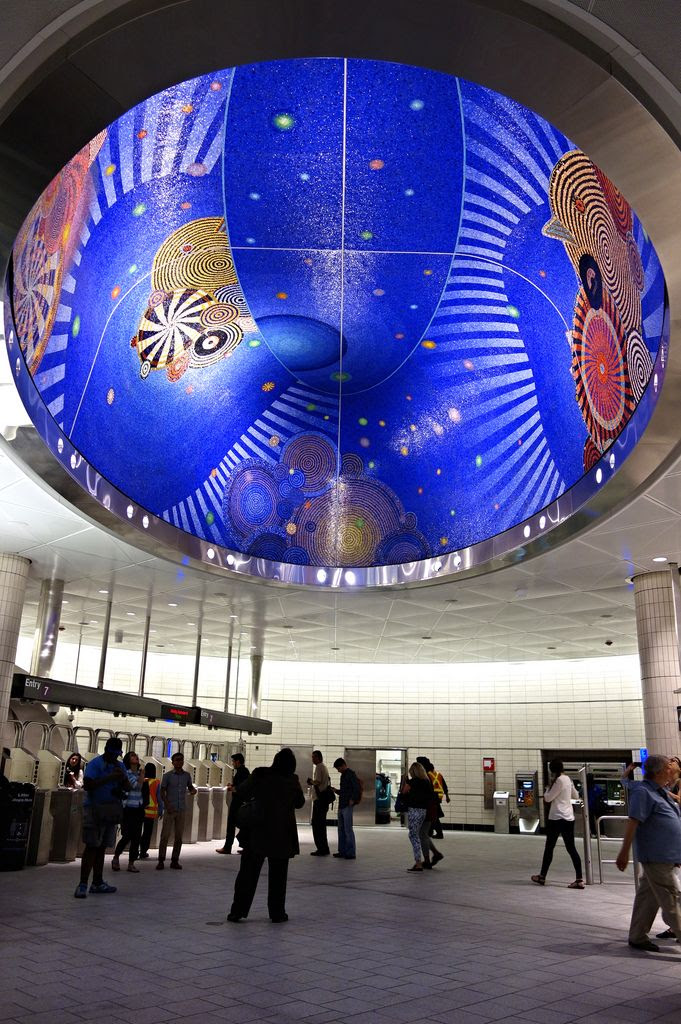
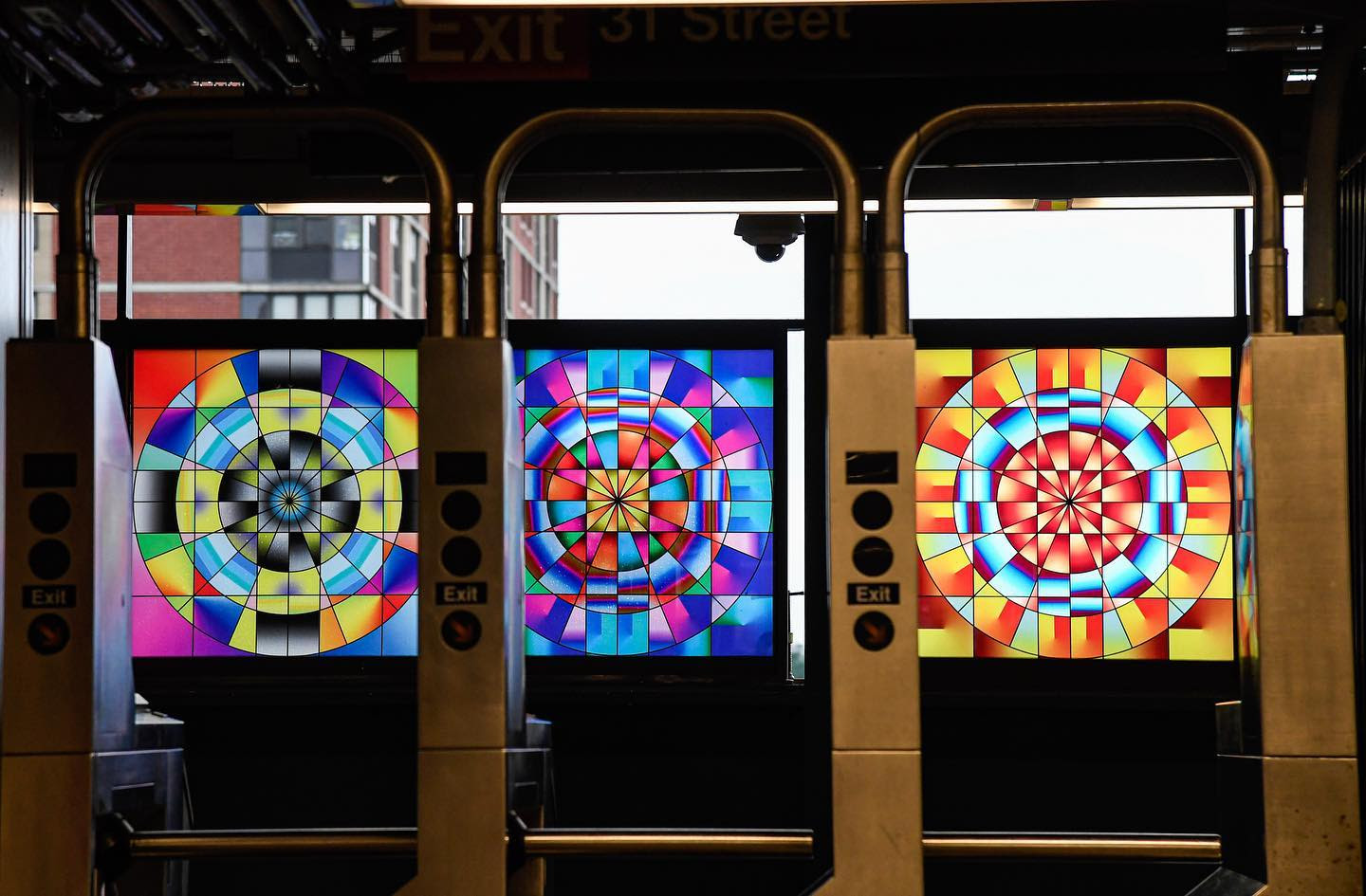
34th St–Hudson Yards
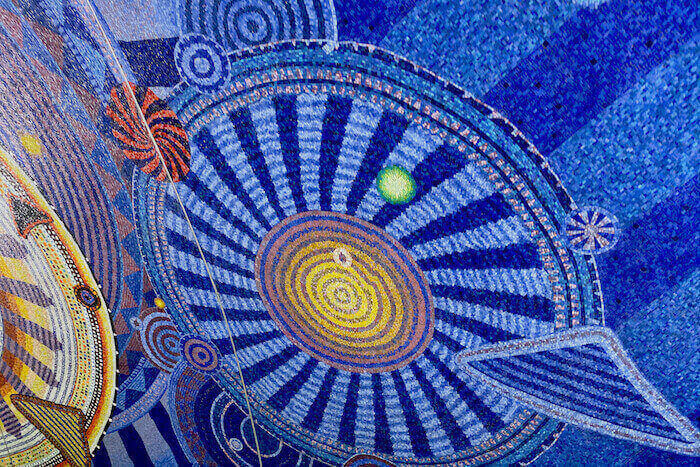
XENOBIA BAILEY Funktional Vibrations, 2015 Glass Mosaic Bailey’s artwork consists of majestic mosaics suspended above the main entrance of the new 34 St – Hudson Yards station that provide a celebratory welcome. The art crowns the station and features overlapping mandala-like circles and patterns against a cobalt blue background. In the upper right a sun-like form emits rays of color bands. Starbursts of bright light appear through the blue background. The glass mosaic artwork is vibrant, joyous and rich with pattern and texture and among the largest in Arts & Design’s collection of commissioned works in the MTA transit network. Inside the station mezzanine, the curved recessed ceiling dome contains glittering mosaics, also set against a deep blue background with repeating mandalas and patterns.
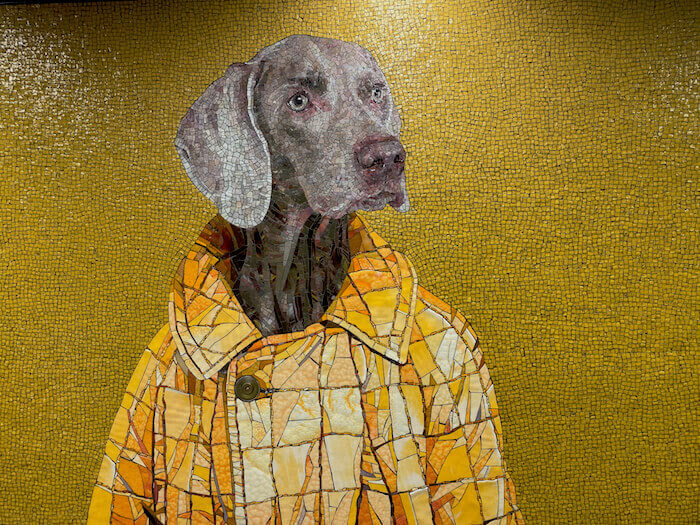
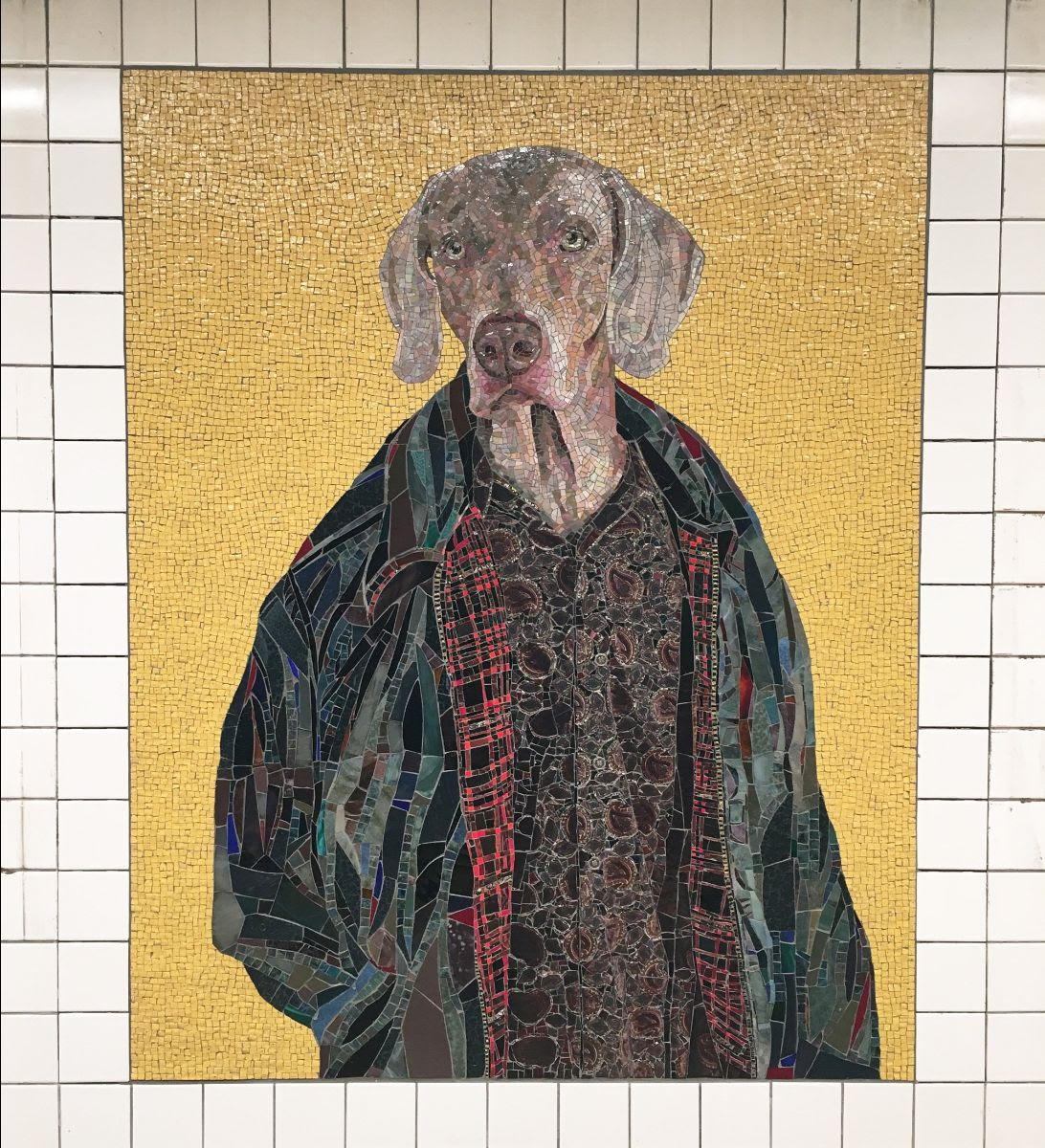
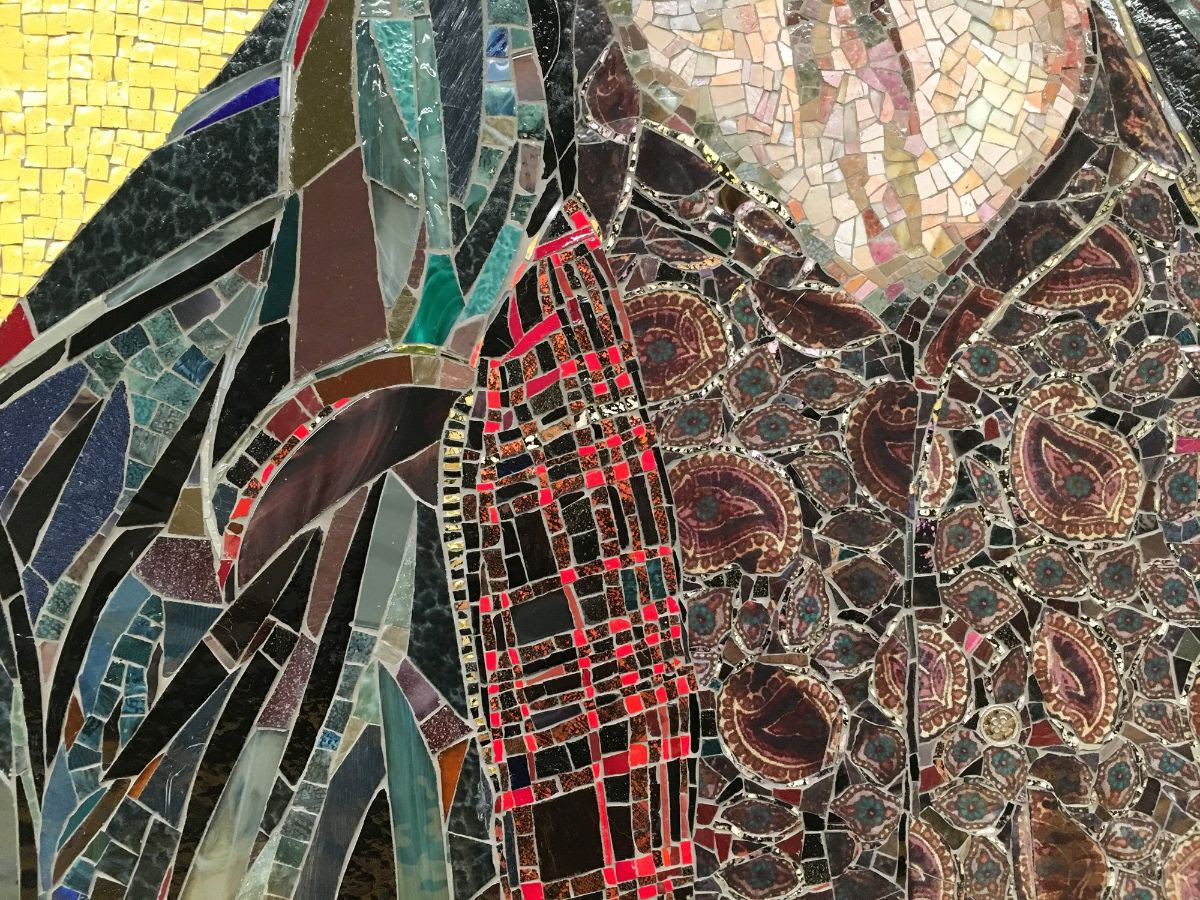
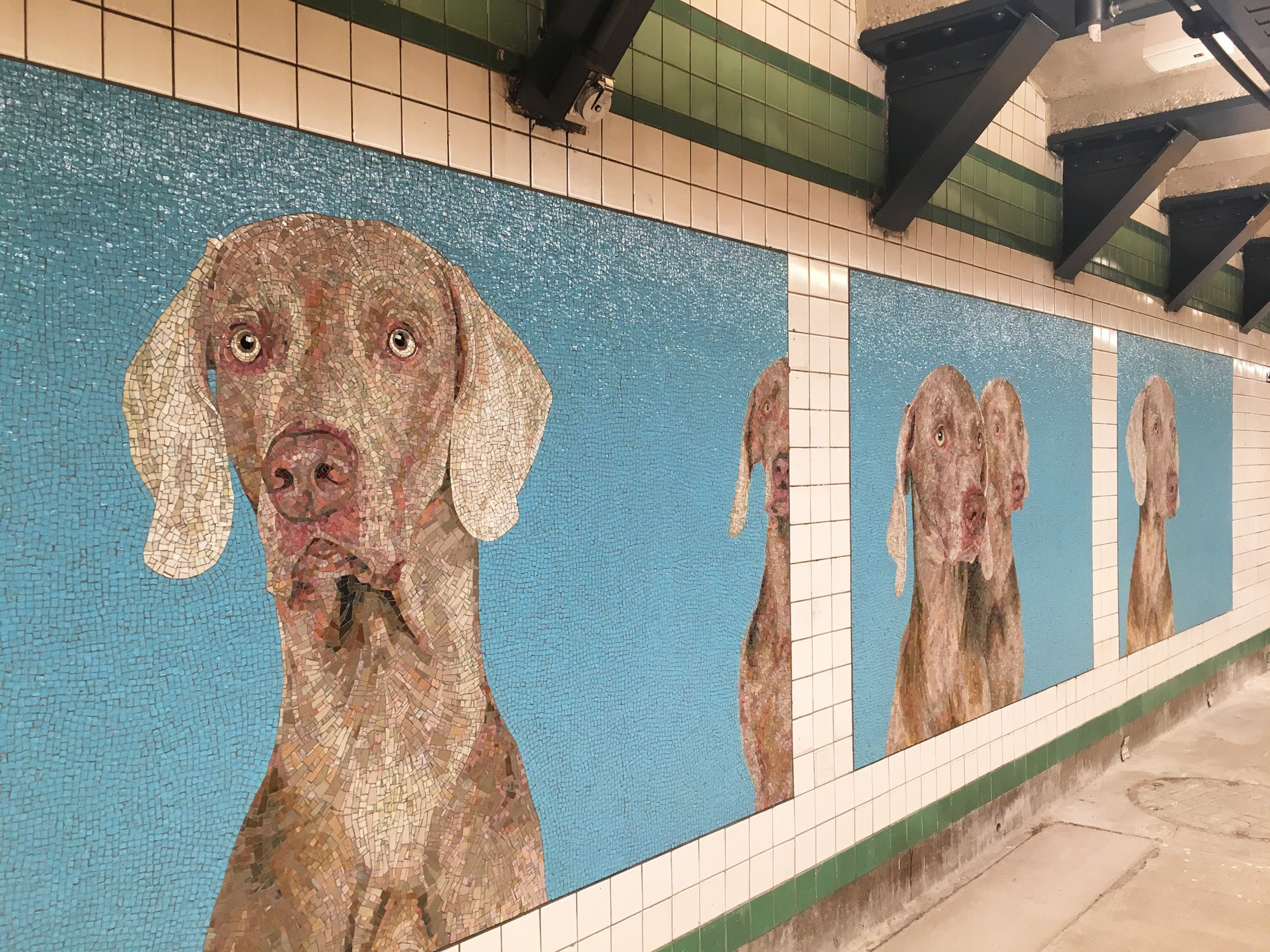
3 STREET & SIXTH AVENUE F/M STATION WILLIAM WEGMAN
I wanted to create portraits of individual characters, people who you might see next to you on the platform,” explained Wegman in a statement. And in order to do this, he employed his “quirky sense of humor” and depicted the larger-than-life dogs wearing street clothes and being grouped like waiting passengers. The MTA tapped the artist — who has been taking photographs and videos of his beloved dogs for over 40 years — and long-time Chelsea resident for the project, which is called “Stationary Figures” and has been two years in the making.
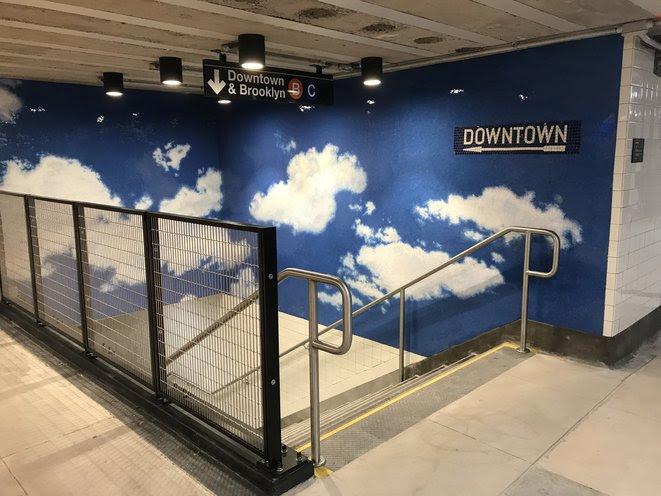
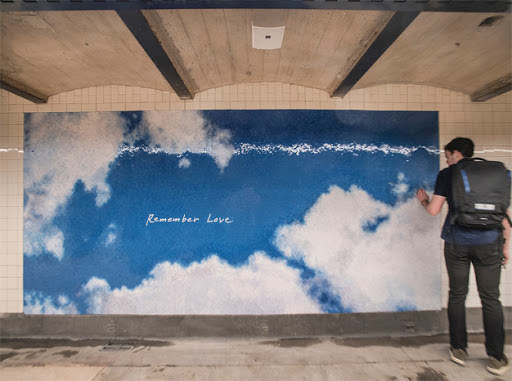
72 STREET B/C STATION SKY by YOKO ONO
“SKY” comprises six separate mosaics spanning both station platforms and mezzanine. The mosaics altogether measure 973 square feet and show a blue, cloud-filled sky embedded with written messages of hope. As riders move through the subterranean subway station, the messages of hope appear in the clouds as the perspective shifts in each mosaic. The transformation of photographs into mosaic sky paintings with subtle gradations in color and tone has created a visually striking station environment. Two mosaics are above the mezzanine stairs leading to the southbound platform where two more pieces are featured, and one mosaic each is installed on the northbound platform and in the main turnstile area on the mezzanine level.
ASTORIA BLVD STATION
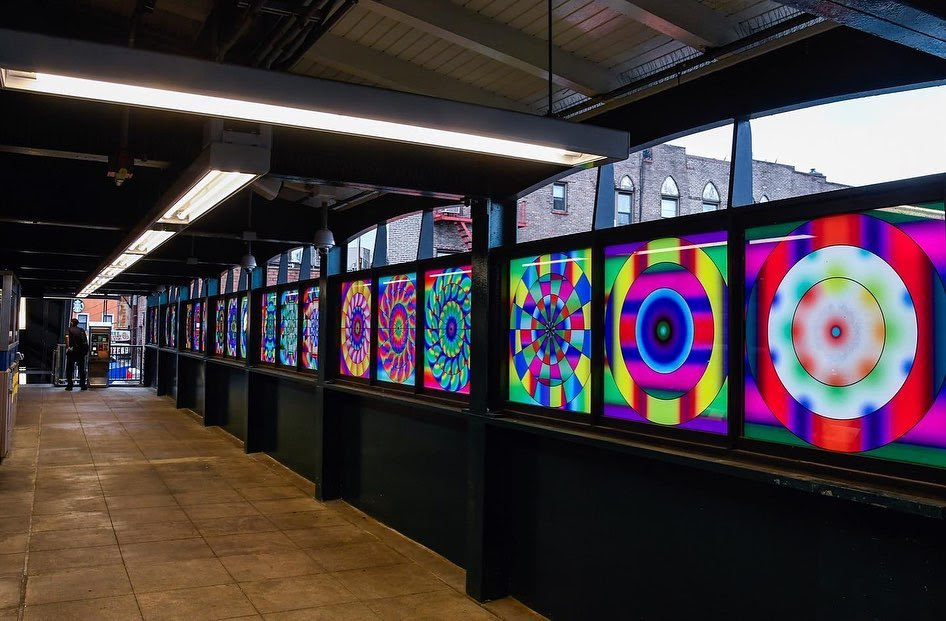
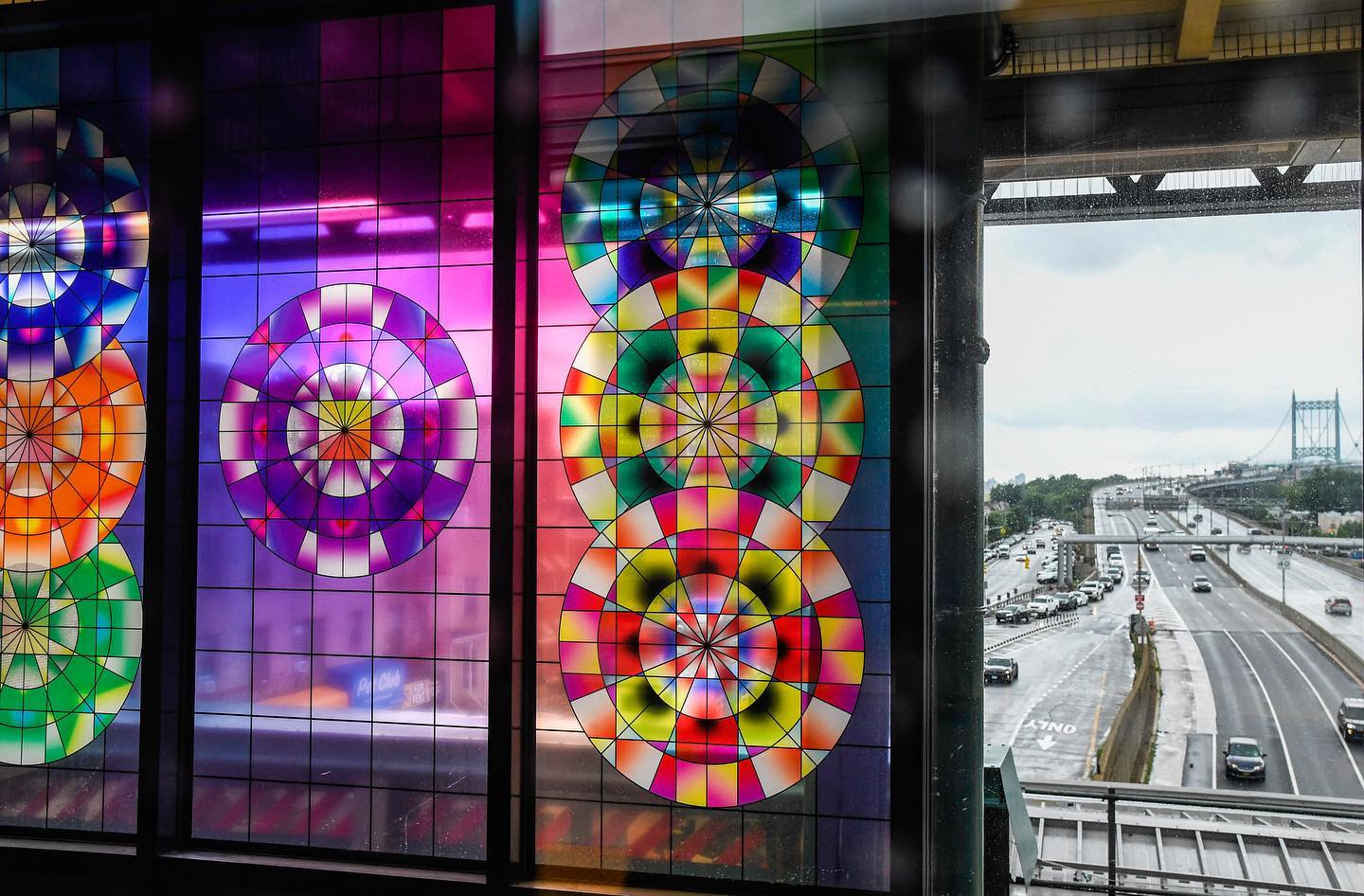
Newly commissioned artwork from MTA Arts & Design by MacArthur Fellow Jeffrey Gibson. The glass artwork is called “I AM A RAINBOW TOO”.
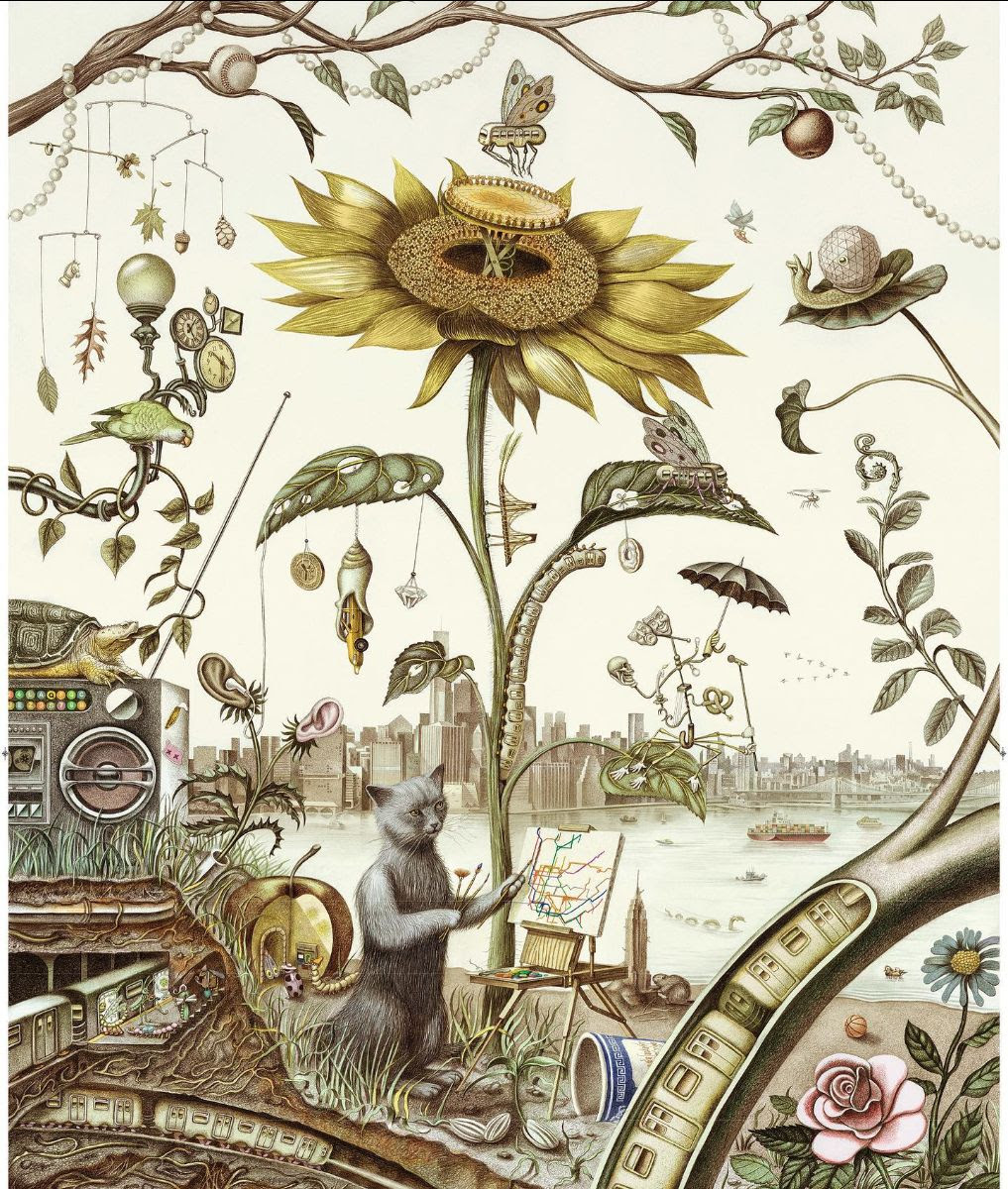
A GLORIOUS POSTER FOR THE MONTH OF AUGUST TAKE A GOOD LOOK AND WHAT CAN YOU IDENTIFY?
CONVEX DISC AT ROOSEVELT ISLAND STATION BY ROBERT HICKMAN
A SPRINKLE OF HUMOR
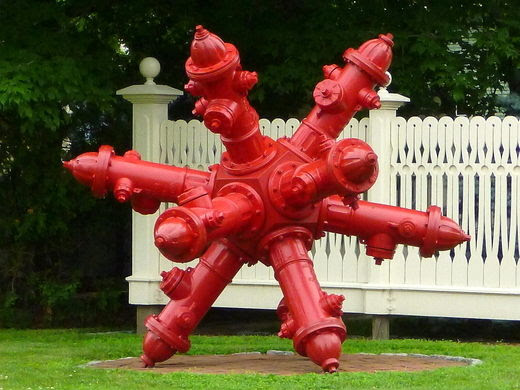
OUR FRIENDS AT RIOC ARE ADDING SPRINKLER CAPS TO SOME OF OUR HYDRANTS FOR SUMMER FUN. THESE HYDRANTS IN SHELBURNE, VERMONT WOULD REALLY DO A GREAT JOB!
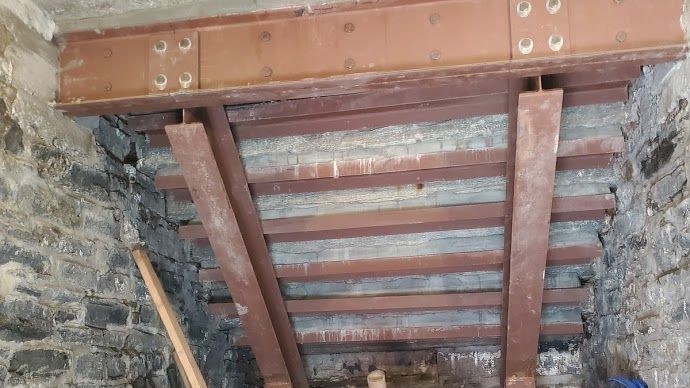
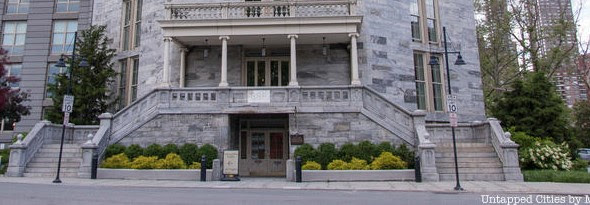
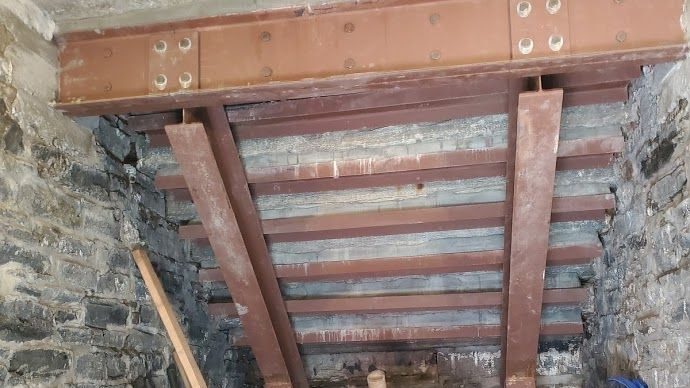
Under the Octagon staircase, work is being done to reinforce the stone stairs above. The steel is being installed to support the massive weight and to prevent water seepage. Parts of the staircase date from the 1830’s. Entry to this area is from doorways on either side next to the main outside entrance.
ITEMS OF THE DAY
FROM THE KIOSK
GREAT STUFF FOR ALL OCCASIONS
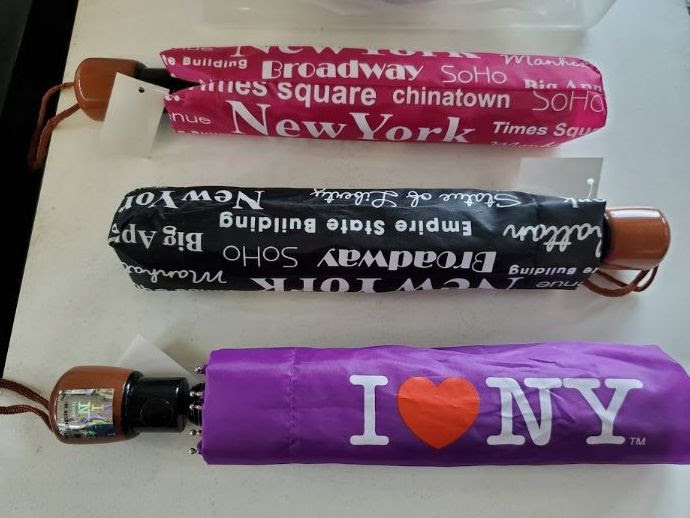
UMBRELLAS $10- SOCKS FOR GUYS AND GALS $10-
EDITORIAL
I have admired the work of Transit Art and Deign for years. Now we have new lightboxes in many locations and improved design in stations. I consider rides quick art shows. Enjoy the art, which can make the ride go faster. Judith Berdy
Text by Judith Berdy Thanks to Bobbie Slonevsky for her dedication to Blackwell’s Almanac and the RIHS Thanks to Deborah Dorff for maintaining our website Edited by Melanie Colter and Deborah Dorff
The NYC Municipal Archives Online Gallery provides research access to more than 1,600,000 digitized items from the Municipal Archives’ vast holdings, including photographs, maps, blueprints, motion-pictures and audio recordings All image are copyrighted (c) Roosevelt Island Historical Society unless otherwise indicated
FUNDING PROVIDED BY ROOSEVELT ISLAND OPERATING CORPORATION PUBLIC PURPOSE GRANTS CITY COUNCIL REPRESENTATIVE BEN KALLOS DISCRETIONARY FUNDING THRU DYCD
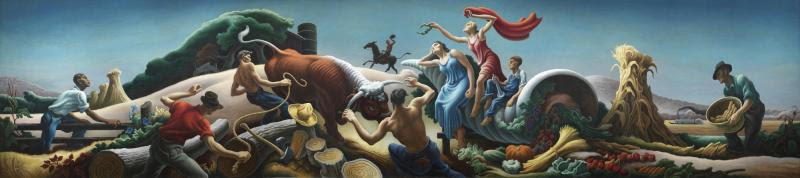
Achelous and Hercules, 1947, tempera and oil on canvas mounted on plywood, Smithsonian American Art Museum, Gift of Allied Stores Corporation, and museum purchase through the Smithsonian Institution Collections Acquisition Program, 1985.2
Intense colors and writhing forms evoke the contest of muscle and will between Hercules and Achelous, the Greek god who ruled over the rivers. In flood season, Achelous took on the form of an angry bull, tearing new channels through the earth with his horns. Hercules defeated him by tearing off one horn, which became nature’s cornucopia, or horn of plenty.
Thomas Hart Benton saw the legend as a parable of his beloved Midwest. The Army Corps of Engineers had begun efforts to control the Missouri River, and Benton imagined a future when the waterway was tamed, and the earth swelled with robust harvests. Benton’s mythic scene also touched on the most compelling events of the late 1940s. America’s agricultural treasure was airlifted to Europe through the Marshall Plan as part of Truman’s strategy to rebuild Europe and contain communism.
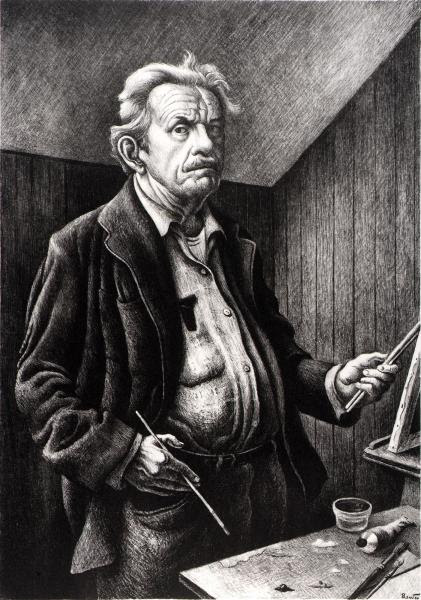
Thomas Hart Benton, Self-Portrait, 1971, lithograph on paper, Smithsonian American Art Museum, Museum purchase, 1972.102
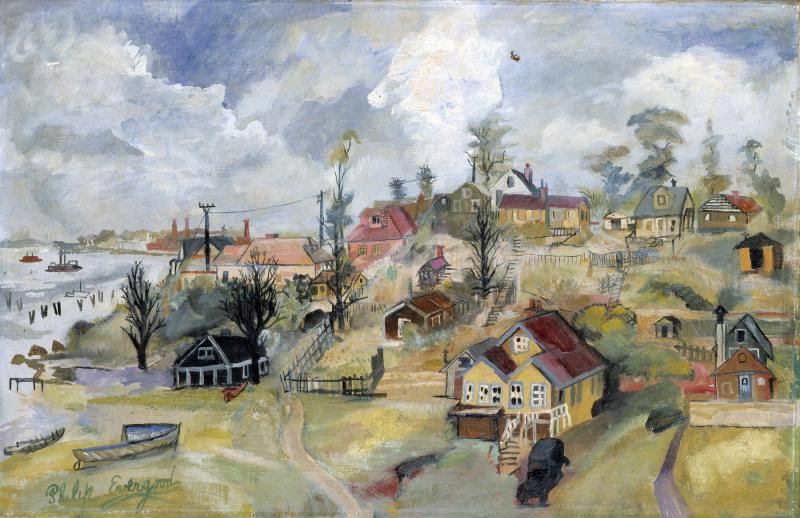
PHILIP EVERGOOD
Philip Evergood, Workers Houses, Flushing Bay, 1935-1945, oil on canvas, Smithsonian American Art Museum, Gift of Arnold and Augusta Newman, 1982.130
Many of Philip Evergood’s images protested the exploitation of America’s laborers, but this painting has a different quality. It focuses on the idea of home and community in the working-class neighborhood of Flushing Bay, in Queens. The settlement is not prosperous, but each house has its own plot of land and a few trees to soften the landscape. Smoke billowing from chimneys echoes the stacks of factories in the distance, where the people of Flushing Bay earn their living. The artist gave the painting to photographer Arnold Newman, and Newman later recalled his visit to pick it up in Evergood’s Greenwich Village studio. Evergood had decided that it needed “a spot of red here … He took out his paints and brushes and for four or five hours, long into the night, he reworked the canvas while I watched.” (Augusta and Arnold Newman to Adelyn Breeskin, December 28, 1982, SAAM curatorial file)
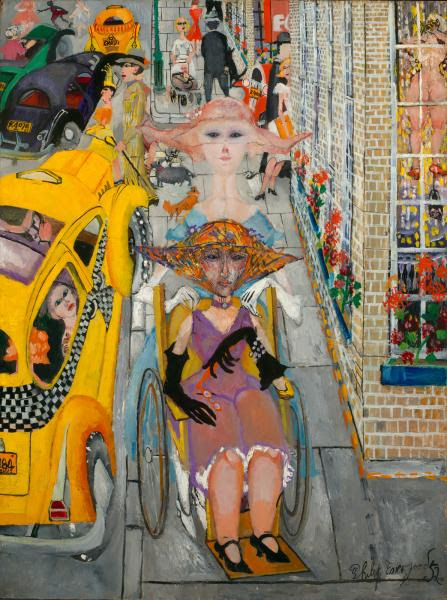
Dowager in a Wheelchair
Philip Evergood, Dowager in a Wheelchair, 1952, oil on fiberboard, Smithsonian American Art Museum, Gift of the Sara Roby Foundation, 1986.6.90
Evergood’s art reflected a deep commitment to social equality and sympathy for human frailty. Recollecting the genesis of Dowager in a Wheelchair, he wrote, “Once I saw a tragic old lady being wheeled on Madison Avenue. She was alive in spirit but her body was only half functioning. She wanted still to be young. A young, gentle, fascinatingly fresh companion was wheeling her.
As I passed, spring was in the air, a delicate whiff of lilac perfume mixed with a faint background of crushed rose petals reached my nostril & then my brain. I was disturbed. I stopped when they’d passed and followed their progress through the crowds with my eyes. Taxis & cars were too noisy. I lost sight of them in a few moments. I went sadly on my way with a vivid memory which lingered on. I consider the painting to be one of the very best I ever painted.”
Modern American Realism: The Sara Roby Foundation Collection, 2014 Philip Evergood was a political radical who throughout his career sympathized with this country’s less privileged citizens. But his sympathy also extended to those whose wealth could not shield them from the realities of life.
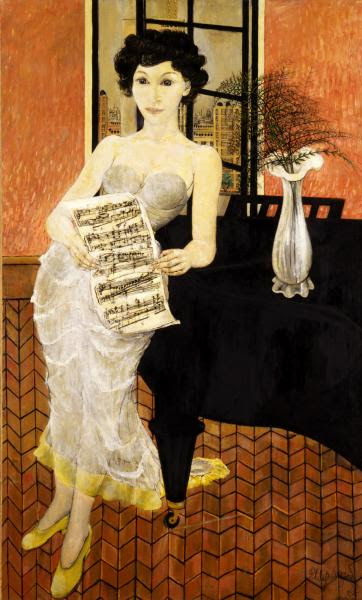
Philip Evergood, Woman at the Piano, 1955, oil on canvas, Smithsonian American Art Museum, Gift of S.C. Johnson & Son, Inc., 1969.47.57
Philip Evergood
was born in New York City. His mother was English and his father, Miles Evergood, was an Australian artist of Polish Jewish descent who, in 1915, changed the family’s name from Blashki to Evergood. Philip Evergood’s formal education began in 1905. He studied music and by 1908 he was playing the piano in a concert with his teacher.
He attended different English boarding schools starting in 1909 and was educated mainly at Eton and Cambridge University. In 1921 he decided to study art, left Cambridge, and went to London to study with Henry Tonks at the Slade School.
In 1923 Evergood went back to New York where he studied at the Art Students League of New York for a year. He then returned to Europe, worked at various jobs in Paris, painted independently, and studied at the Académie Julian with André Lhote. He also studied with Stanley William Hayter at Atelier 17. Hayter taught him engraving. He returned to New York in 1926 and began a career that was marked by the hardships of severe illness, an almost fatal operation, and constant financial trouble.
It was not until the collector Joseph H. Hirshhorn purchased several of his paintings that he could consider his financial troubles over. Evergood worked on WPA art projects from 1934 to 1937 where he painted two murals: The Story of Richmond Hill (1936–37, Public Library branch, Queens, N.Y.) and ‘Cotton from Field to Mill (1938, post office in Jackson, Ga.. He taught both music and art as late as 1943, and finally moved to Southbury, Connecticut, in 1952. He was a full member of the Art Students League of New York and the National Institute of Arts and Letters. He was killed in a house fire in Bridgewater, Connecticut, in 1973 at the age of 72.[3] He is buried in Green-Wood Cemetery, Brooklyn.[5]
FRANCIS CRISS
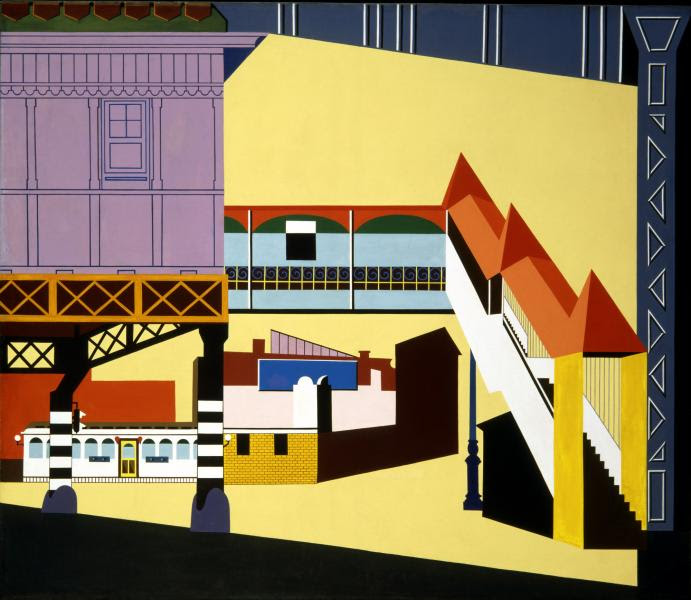
Francis Criss, Sixth Avenue “L” (mural, Williamsburg Housing Project, New York), 1937, oil on canvas, Smithsonian American Art Museum, Transfer from the Newark Museum, 1966.31.3
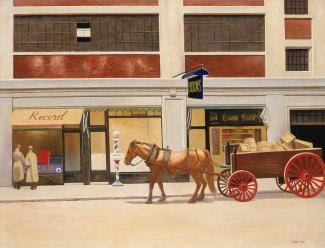
Francis Criss, City Store Fronts, 1934, oil on canvas, Smithsonian American Art Museum, Transfer from the U.S. Department of Labor, 1964.1.35
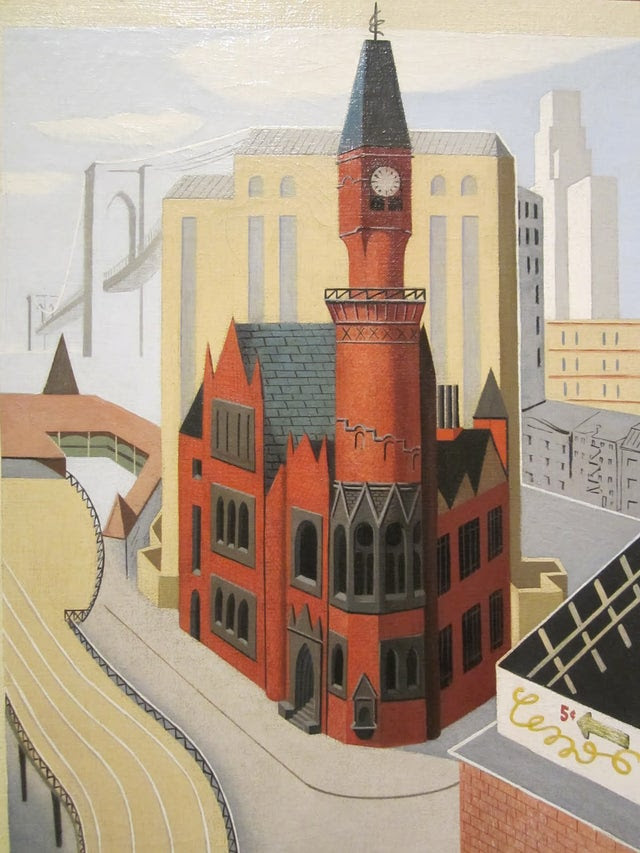
Francis Criss Jefferson Market Courthouse 1935 Note that the Women’s House of Detention is in the background.
FRANCIS CRISS
Criss was born in London and immigrated with his family at age four. He attended the Pennsylvania Academy of the Fine Arts from 1917 to 1921 on a scholarship, and later the Art Students League of New York and the Barnes Foundation, and he took private classes with Jan Matulka.
In addition to doing work for the U.S. Government under the New Deal, and contributing a mural for the Williamsburg Housing Project in Brooklyn for the Federal Art Project, Criss taught at the leftist American Artists School in the 1930s. His pupils there included Ad Reinhardt. He also held teaching positions at numerous other institutions, including the Albright Museum School, Buffalo; the Art Students League; the New School for Social Research; and the School of Visual Arts.[3] Criss was awarded a Guggenheim Fellowship in 1934.
The work from his best-known years, the 1930s and 1940s, is characterized by imagery of the urban environment, such as elevated subway tracks, skyscrapers, streets, and bridges. Criss rendered these subjects with a streamlined, abstracted style, devoid of human figures, that led him to be associated with the Precisionism movement. With distorted perspectives and dream-like juxtapositions, as in Jefferson Market Courthouse (1935), these empty cityscapes also suggest the influence of Surrealism. A turn towards more commercial work later in his career—including a November 1942 cover for Fortune Magazine—led to a decline in his reputation.
ITEMS OF THE DAY FROM THE KIOSK GREAT STUFF FOR ALL OCCASIONS
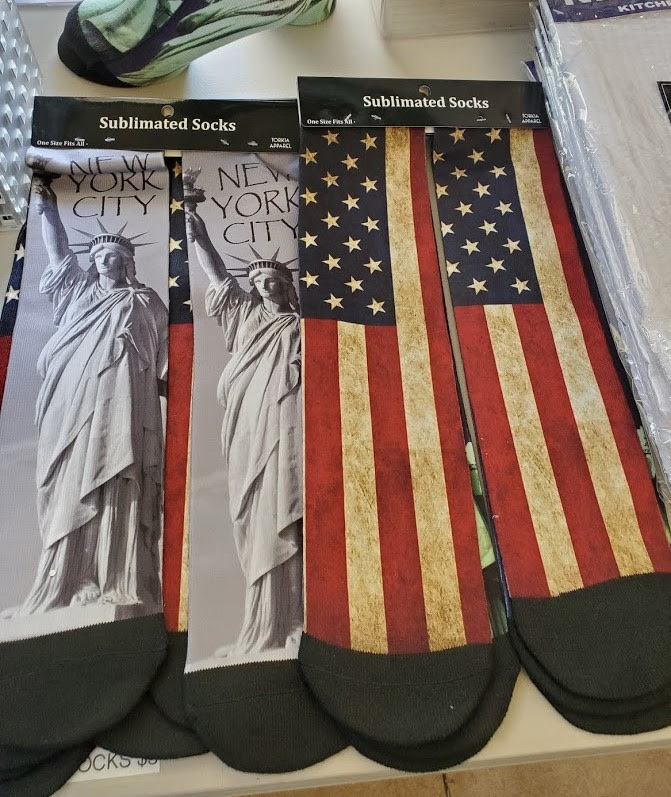
SUBLIMATED SOCKS $5- KIOSK IS OPEN SATURDAY AND SUNDAY 12 NOON TO 5 P.M. ORDER ON-LINE BY CHARGE CARD AT ROOSEVELTISLANDHISTORY@GMAIL.COM
EDITORIAL
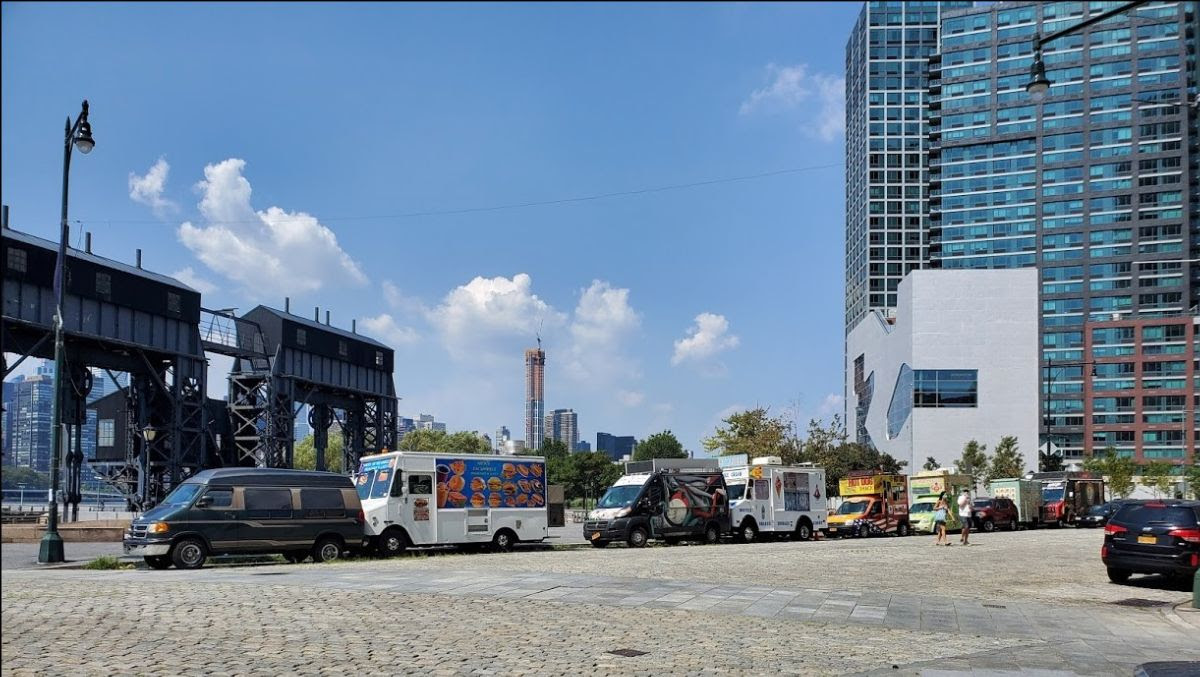
The other day a friend and I wandered over to Long Island City. Parked by the Gantry NYS Park were a dozen food trucks. I could have had any variety of choices from empanadas to vege to Mexicano.
Why 12 food trucks here and ZERO on Roosevelt Island?
I am sure there is no reason to have 12 vendors on one site when a few of them could be on Roosevelt Island. We have to stop the RIOC bureaucracy from scaring away any kind of vendor. After 7 months of Pandemic I am very tired of the poor choice of dining and the sad state of our restaurants. BRING ON VARIETY AND FOOD TRUCKS!!!
Judith Berdy
Text by Judith Berdy Thanks to Bobbie Slonevsky for her dedication to Blackwell’s Almanac and the RIHS Thanks to Deborah Dorff for maintaining our website Edited by Melanie Colter and Deborah Dorff
All image are copyrighted (c) Roosevelt Island Historical Society WIKIPEDIA (C) SMITHSONIAN AMERICAN ART MUSEUM (C)
FUNDING PROVIDED BY ROOSEVELT ISLAND OPERATING CORPORATION PUBLIC PURPOSE GRANTS CITY COUNCIL REPRESENTATIVE BEN KALLOS DISCRETIONARY FUNDING THRU DYCD
NEWTOWN CREEK ROUTE MEANDERING THRU BROOKLYN AND QUEENS.
Wednesday, August 12, 2020
OUR 128th ISSUE
OF
FROM THE ARCHIVES
A CREEK WITH MANY
BRIDGES
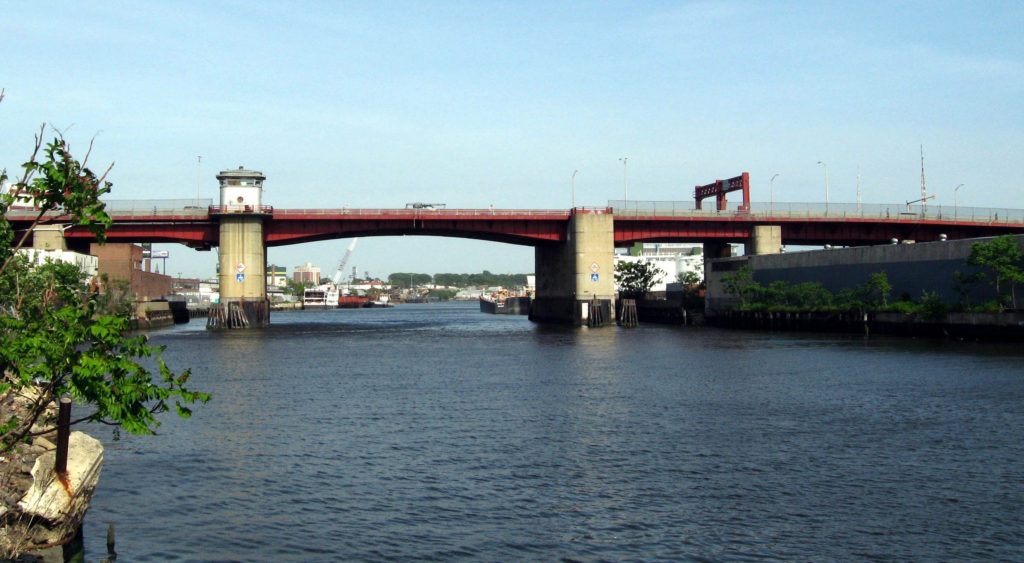
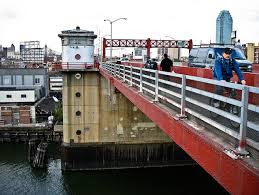
PULASKI BRIDGE
Pulaski Bridge over Newtown Creek
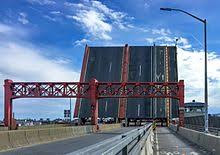
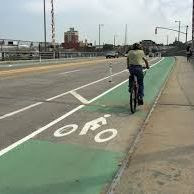
The Pulaski Bridge, which carries six lanes of traffic and a pedestrian sidewalk over Newton Creek and the Long Island Expressway, is orientated north-south and connects Greenpoint in Brooklyn to Long Island City in Queens. McGuinness Boulevard approaches the bridge from the south and Eleventh Street from the north. The Pulaski Bridge is a 54m double leaf, trunnion type bascule bridge. It has two 10.5m roadways divided by a concrete median barrier. It also carries a 2.7m pedestrian sidewalk. The bridge provides a channel with a horizontal clearance of 45.7m and a vertical clearance of 11.9m in the closed position at MHW and 13m MLW. The Pulaski Bridge was opened to traffic on September 10, 1954. The bridge was reconstructed in 1994 at a cost of approximately $40 million. The project included new approach roadways, new superstructure and approach spans, and upgrade of the bridge’s mechanical/electrical systems. The drawbridge was named for Kasimierz Pulaski, a Polish national who fought alongside General Washington during the American Revolution and who founded what would become the Calvary division of the United States Army. Recently, the general also returned to the spotlight when researchers who exhumed Pulatski’s body discovered evidence that Pulaski may have been female or intersex.
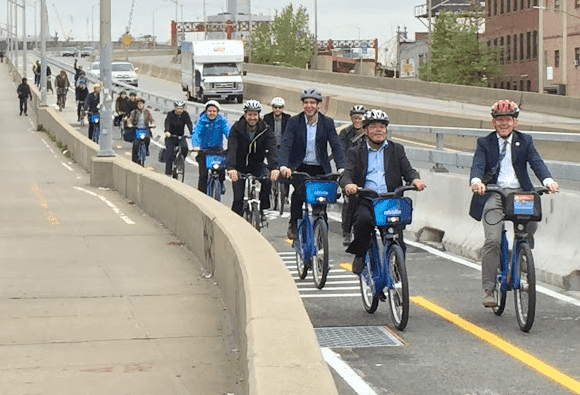
Opened in September of 1954 to replace the failing and inadequate Vernon Avenue Bridge, the current six-lane double bascule draw bridge also features a combined pedestrian and bicycle lane. It’s the 13.1 mile mark of the New York City Marathon, and is one of the busiest crossings between Brooklyn and Queens.
It opens several times a day to allow maritime traffic access to the Newtown Creek from the East River.
GREENPOINT AVENUE BRIDGE
GREENPOINT AVENUE BRIDGE
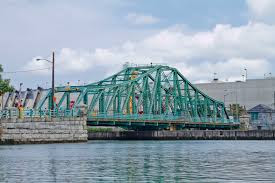
The bridge is located between Gardner Avenue in Brooklyn and 47th Street in Queens. The Grand Street Bridge is a 69.2m long swing type bridge with a steel truss superstructure. The general appearance of the bridge remains the same as when it was opened in 1903.
The bridge provides a channel with a horizontal clearance of 17.7m and a vertical clearance, in the closed position, of 3.0m at MHW and 4.6m at MLW. The bridge structure carries a two-lane two-way vehicular roadway with sidewalks on either side. The roadway width on the bridge is 6.0m and the sidewalks are 1.8m wide. The height restriction is 4.1m. The approach roadways are wider than the bridge roadway. For example, the width of Grand Avenue at the east approach to the bridge (near 47th Street) is 15.11m.
The first bridge on this site, opened in 1875, quickly became dilapidated due to improper maintenance. Its replacement, opened in 1890, was declared by the War Department in 1898 to be “an obstruction to navigation.” Following a thorough study, a plan was adopted in 1899 to improve the bridge and its approaches.
The current bridge was opened on February 5, 1903 at a cost of $174,937.
The first bridge on this site, a drawbridge known as the Blissville, was built in the 1850’s. It was succeeded by three other bridges before a new one was completed in March 1900 at a cost of $58,519. That bridge received extensive repairs after a fire in 1919 damaged parts of the center pier fender, the southerly abutment, and the superstructure. Until that time, the bridge had also carried tracks of the Long Island Rail Road. The current bridge was built in 1987.
METROPOLITAN AVENUE BRIDGE
Metropolitan Avenue Bridge
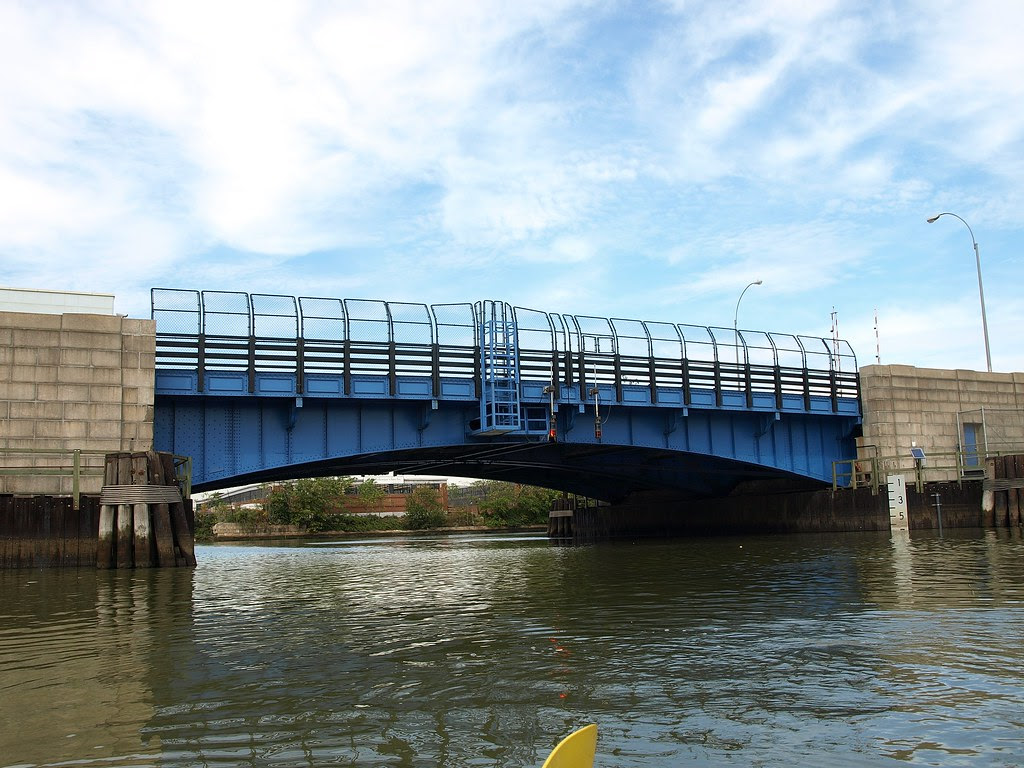
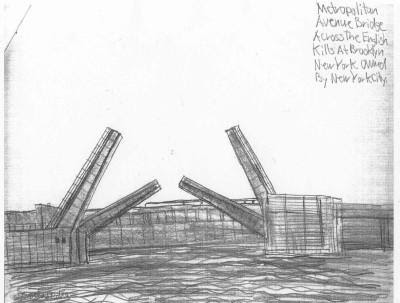
Over English Kills View of the Metropolitan Avenue Bridge Metropolitan Avenue is a two-way local City street in Kings and Queens Counties. The number of lanes varies from two to four along the entire length of Metropolitan Avenue, which runs east-west and extends from River Street in the Southside section of Brooklyn to Jamaica Avenue in Queens.
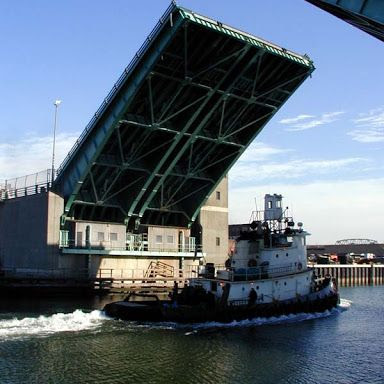
The bridge, the only one over English Kills, carries both Metropolitan Avenue and Grand Street. The bridge is situated between Vandervoort and Varick Avenues in the East Williamsburg section of Brooklyn. The Metropolitan Avenue Bridge is a double leaf bascule bridge with a span of 33.8 m. The general appearance of the bridge has been significantly changed since it was opened in 1931.
The bridge provides a channel with a horizontal clearance of 26.2 m and a vertical clearance, in the closed position, of 3.0 m at MHW and 4.6 m at MLW. The bridge structure carries a four-lane two-way vehicular roadway with sidewalks on either side. The roadway width is 16.2 m and the sidewalks are 1.8 m. There are no height restrictions on the bridge.
After the City acquired Metropolitan Avenue from the Williamsburg and Jamaica Turnpike Road Company in 1872, the existing bridge was replaced by a swing bridge, which was also used by the Broadway Ferry and Metropolitan Avenue Railroad Company. Growth in the area made the bridge inadequate by the early 20th century.
The current bridge was built in 1931. Modifications since then have included upgrading the mechanical and electrical systems and the replacement of deck, bridge rail, and fenders. The stringers were replaced and new stiffeners added in 1992.
BORDEN AVENUE BRIDGE
Borden Avenue Bridge
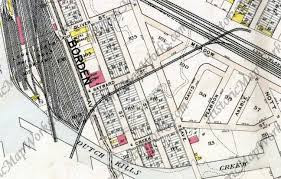
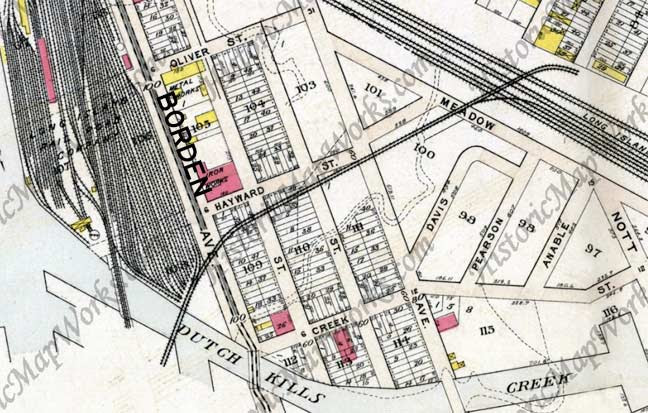
Over Dutch Kills is located just south of the Long Island Expressway between 27th Street and Review Avenue in the Blissville neighborhood. The roadway width is 10.5m and the sidewalks are 2.0m wide. The west approach and east approach roadways, which are wider than the bridge roadway, are 15.3m and 13.0m respectively.
The bridge provides a horizontal clearance of 14.9m and a vertical clearance in the closed position of 1.2m at mean high water and 2.7m at mean low water.
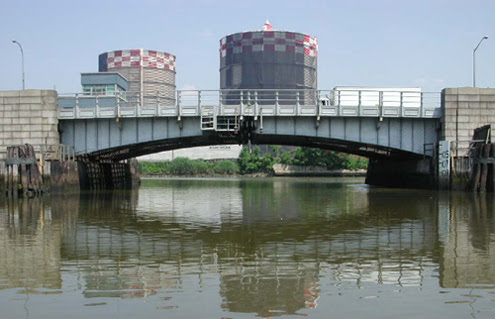
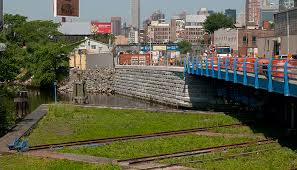
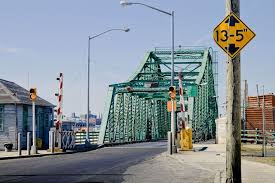
Borden Avenue Bridge is a retractile bridge, meaning that the bridge deck opens by sliding diagonally back to shore. It is one of four remaining bridges of its type in the nation. Another example is the Carroll Street Bridge over the Gowanus Canal in Brooklyn.
As part of the construction of Borden Avenue in 1868, a wooden bridge was built over Dutch Kills. This bridge was soon replaced with an iron swing bridge, which was removed in 1906. The current bridge opened on March 25, 1908 at a cost of $157,606.
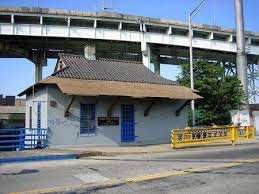
The deck’s original design consisted of creosote-treated wood blocks, with two trolley tracks in the roadway. The characteristic features of the bridge include the stucco-clad operator’s house and a rock-faced stone retaining wall. The gable-on-hip roof of the operator’s house retains the original clay tile at the upper part. Although alterations have been made, the bridge is a rare survivor of its type and retains sufficient period integrity to convey its historic design significance.
Borden Avenue was built as a plank road in 1868; at first it extended east only as far as Calvary Cemetery, but by the 1920s, it had been built as a main traffic route as far east at Grand Avenue and 69th Street in Maspeth. When the Queens-Midtown Expressway was built after World War II, Borden Avenue became the service road on the north side of the expressway and it still terminates at Grand and 69th — east of that, the service road is labeled Queens-Midtown Expressway. All service roads change to Horace Harding Expressway east of Queens Boulevard.
When the plank road was begun in the Andrew Johnson Presidential Administration, engineers were immediately met with a problem in that Dutch Kills, an inlet of Newtown Creek trafficked by cargo vessels and other shipping lay in the way. A wood bridge was hastily slapped up, but the dangers of such a structure were realized almost immediately and an iron bridge was built in 1872.
That bridge, as well, was replaced in 1908 by the current structure, a retractile bridge that can swing diagonally along tracks that greatly resemble railroad tracks to open the bridge if a vessel wishes to pass down Dutch Kills. Though there had not been reason to retract the bridge since 2005, in 2007 the structure had been judged too deteriorated to allow heavy truck and bus traffic to continue to use it, and it closed for repairs for two years.
A streetcar line ran east on Borden Avenue from Hunters Point to Newtown. Amazingly enough the street layout of 1909 is still intact in 2011, though the streets have been numbered except for Borden Avenue (which would be 52nd Avenue if it were numbered). The Queens Midtown Expressway now soars high above the area between 50th and 51st Avenues. Meadow Street has become Skillman Avenue, and Dutch Kills Creek was recognized as a redundant name and is now plain old Dutch Kills.
HUNTERS POINT AVENUE BRIDGE
Hunters Point Avenue Bridge
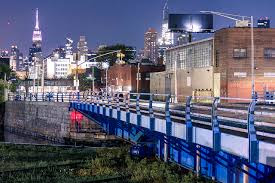
Over Dutch Kills View of the Hunters Point bridge Hunters Point Avenue is a two-lane local City street in Queens. Hunters Point Avenue is oriented east-west and extends from 21st Street to the Long Island Expressway/Brooklyn Queens Expressway interchange in Queens. The avenue is parallel to and approximately one block south of the Long Island Expressway.
The Hunters Point Bridge over Dutch Kills is situated between 27th Street and 30th Street in the Long Island City section of Queens, and is four blocks upstream of the Borden Avenue Bridge. It is a bascule bridge with a span of 21.8m. The general appearance of the bridge has been significantly changed since it was first opened in 1910.
The bridge provides a channel with a horizontal clearance of 18.3m and a vertical clearance, in the closed position, of 2.4m at MHW and 4.0m at MLW. The bridge structure carries a two-lane, two-way vehicular roadway with sidewalks on either side. The roadway width is 11.0m, while the sidewalks are 1.8m wide. The width of the approach roadways vary from the width of the bridge roadway. The west approach and east approach roadways are 13.4m and 9.1m, respectively.
The first bridge at this site, a wooden structure, was replaced by an iron bridge in 1874. That bridge was permanently closed in 1907 due to movement of the west abutment, which prevented the draw from closing. It was replaced in 1910 by a double-leaf bascule bridge, designed by the Scherzer Rolling Lift Bridge Company. The bridge was rebuilt in the early 1980’s as a single-leaf bascule, incorporating the foundations of the previous bridge.
GRAND STREET BRIDGE
Grand Street Bridge
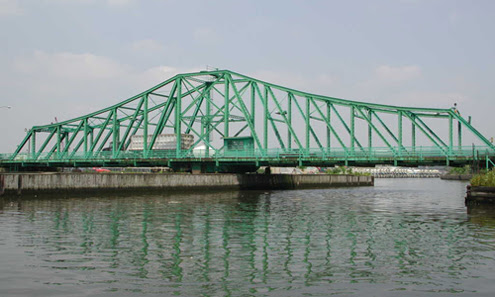
Over the East Branch of Newtown Creek View of the Grand Street Bridge Grand Street is a two-lane local City street in Queens and Kings Counties. Grand Street runs northeast and extends from the Brooklyn Queens Expressway in Brooklyn to Queens Boulevard in Queens. The road is known as Grand Street west of the bridge and Grand Avenue east of the bridge.
The bridge is located between Gardner Avenue in Brooklyn and 47th Street in Queens. The Grand Street Bridge is a 69.2m long swing type bridge with a steel truss superstructure. The general appearance of the bridge remains the same as when it was opened in 1903. The bridge provides a channel with a horizontal clearance of 17.7m and a vertical clearance, in the closed position, of 3.0m at MHW and 4.6m at MLW. The bridge structure carries a two-lane two-way vehicular roadway with sidewalks on either side. The roadway width on the bridge is 6.0m and the sidewalks are 1.8m wide. The height restriction is 4.1m. The approach roadways are wider than the bridge roadway. For example, the width of Grand Avenue at the east approach to the bridge (near 47th Street) is 15.11m.
The first bridge on this site, opened in 1875, quickly became dilapidated due to improper maintenance. Its replacement, opened in 1890, was declared by the War Department in 1898 to be “an obstruction to navigation.” Following a thorough study, a plan was adopted in 1899 to improve the bridge and its approaches. The current bridge was opened on February 5, 1903 at a cost of $174,937. Grand Street Bridge Facts.
GREENPOINT AVENUE BRIDGE
Greenpoint Avenue
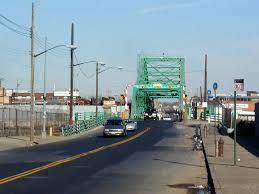
is a four-lane local street in Queens and Brooklyn, running northeast from the East River in Greenpoint, Brooklyn to Roosevelt Avenue in Sunnyside, Queens. The Greenpoint Avenue Bridge, also known as the J. J. Byrne Memorial Bridge, is located approximately 2.2 km from the mouth of Newtown Creek.
The bridge is situated between Kingsland Avenue in Greenpoint, Brooklyn and Review Avenue in the Blissville section of Queens. The Greenpoint Avenue Bridge is a double-leaf trunnion bascule, with 21.3 m wide leaves. This bridge is a steel girder structure with a filled grid deck. The bridge provides a channel with a horizontal clearance of 45.4 m and in the closed position a vertical clearance of 7.9 m at MHW and 9.4 m at MLW. The bridge structure carries a four-lane two-way vehicular roadway with a 1.2m striped median and sidewalks on either side. The roadway width is 8.6m and the sidewalks are 4.0m and 3.7m for the north and south sidewalk respectively. The approach roadways are narrower than the bridge roadway. The west approach and east approach roadways are 17.1m (including 1.4m center median) and 11.9m respectively.
The first bridge on this site, a drawbridge known as the Blissville, was built in the 1850’s. It was succeeded by three other bridges before a new one was completed in March 1900 at a cost of $58,519. That bridge received extensive repairs after a fire in 1919 damaged parts of the center pier fender, the southerly abutment, and the superstructure. Until that time, the bridge had also carried tracks of the Long Island Rail Road. The current bridge was built in 1987.
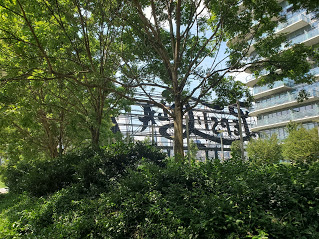
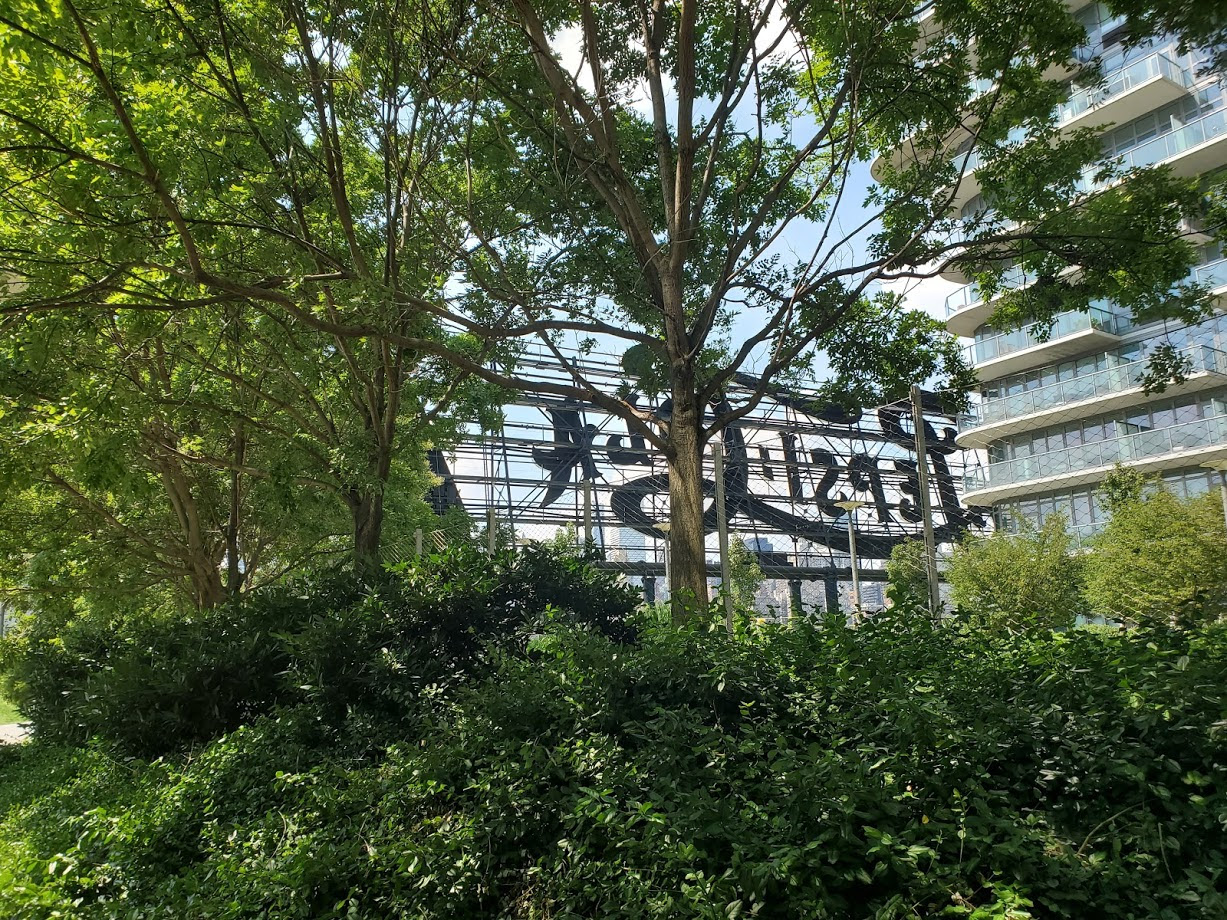
Back of Pepsi sign in LIC Jay Jacobson, Alexis Villefane, Nancy Brown and Jinny Ewald got it right!
EDITORIAL
Why worry about bridges over the Newtown Creek? Our industrial areas were centered in these areas and we needed cheap and easy water born transportation. We did not know the pollutants that were tossed and piped into the waterway. Maybe, with so many advocacy groups the creek will again be a little more safe.
More to come tomorrow,
JUDITH BERDY
NEW FEATURE
FROM OUR KIOSK
GREAT STUFF FOR ALL OCCASIONS
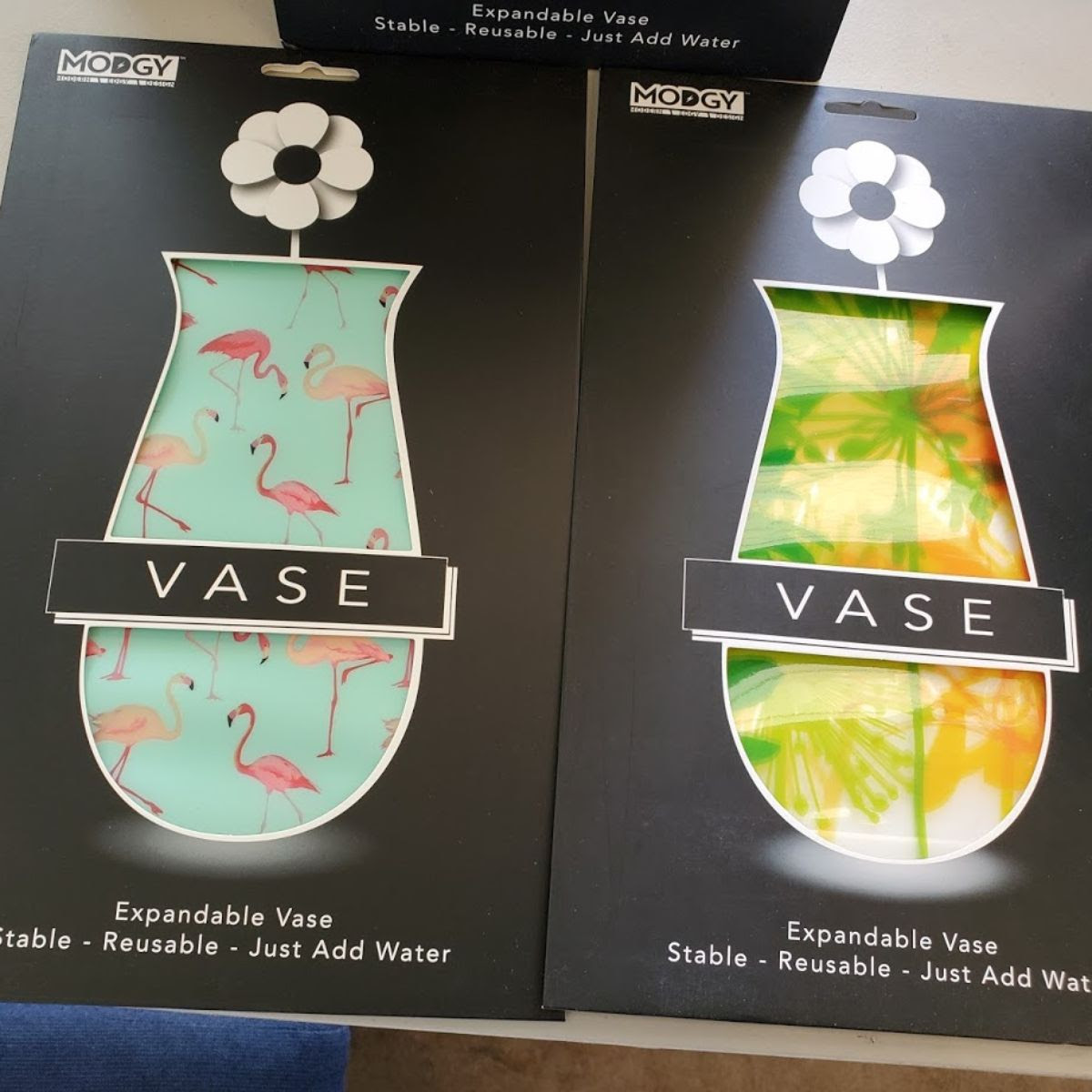
MODGY VASES UNFOLD AND HAVE A GREAT FLOWER VASE AVAILABLE AT THE KIOSK OPEN WEEKENDS 12 NOON TO 5 P.M. ORDER ON-LINE BY CHARGE CARD ROOSEVELTISLANDHISTORY@GMAIL.COM
Text by Judith Berdy Thanks to Bobbie Slonevsky for her dedication to Blackwell’s Almanac and the RIHS Thanks to Deborah Dorff for maintaining our website Edited by Deborah Dorff
THANKS TO THE NYC DEPARTMENT OF TRANSPORTATION FOR NARRATIVES, THANKS TO MITCH WAXMAN AND NEWTOWN PENTICLE FOR THEIR EXPERTISE. THANKS TO FORGOTTEN NEW YORK, TOO. All image are copyrighted (c) Roosevelt Island Historical Society unless otherwise indicated
FUNDING PROVIDED BY ROOSEVELT ISLAND OPERATING CORPORATION PUBLIC PURPOSE GRANTS CITY COUNCIL REPRESENTATIVE BEN KALLOS DISCRETIONARY FUNDING THRU DYCD
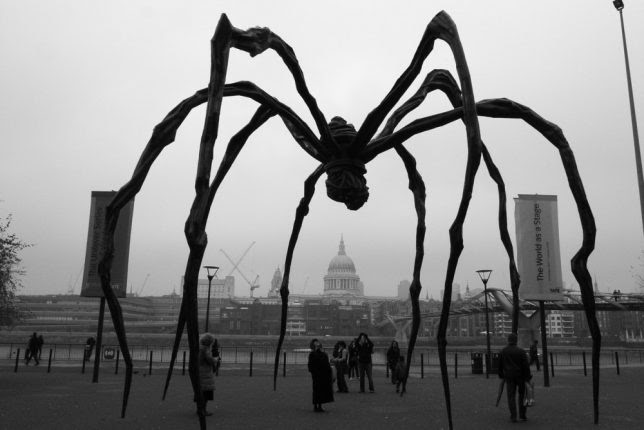
Well, not exactly. But there is a connection. Perhaps you have seen the work of the artist Louise Bourgeois. She’s world famous for her sculpture and paintings, but most of all she is known for her spiders – especially the very big ones.
Louise Bourgeois, sculpture, Maman. Bourgeois in the 1950s was a member of the American Abstract Artists Group along with Barnett Newman and Ad Reinhardt. She was friends with the artists Willem de Kooning, Mark Rothko, and Jackson Pollock. But her work transcended even contemporary categories. As she said, “I have met important figures from this century’s art: Brancusi, Léger… I have lived next to the most radical art movements, but I have always tried to make art that was my own.” (And, by the way, you can visit her home and studio downtown, precisely as it was when she left it at her death in 2010.)
Ah yes, but Roosevelt Island.
Well, in 1936, Bourgeois had opened a print shop beside her father’s tapestry gallery, and one day Robert Goldwater walked in, bought a couple of Picasso prints from her and, as she put it: “In between talks about surrealism and the latest trends, we got married.” Goldwater, a young American academic, turns out to be an interesting and soon to be influential guy.
As war clouds rose in Europe, the couple moved to New York City, where Goldwater taught in New York University’s Institute of Fine Arts and Bourgeois attended the Art Students League of New York,
Goldwater was one of the first art history students to study modern art when the subject was not considered worthy of serious graduate research. His doctoral dissertation at NYU dealt with “primitivism” and Modern art. A year later, a revised version of his dissertation appeared as Primitivism in Modern Painting, a pioneering and now classic study that examines the relationship between tribal arts and 20th-century painting. His analysis, we are told, distinguishes the romanticism of Gauguin; an emotional primitivism exemplified by the Brücke and Blaue Reiter groups in Germany; the intellectual primitivism of Picasso and Modigliani; and a “primitivism of the subconscious” in Miró, Klee, and Dali.
Later, after establishing himself as one of our leading authorities in the study of modern Western art, Goldwater became a scholar and connoisseur of the art of Africa. In the sixties, he published monographs on “Bambara Sculpture from the Western Sudan” and “Senufo Sculpture From West Africa” in addition to books on modern sculpture and surrealism.
In 1957 he became a full professor of art history at NYU, and in the same year became the first director of the Museum of Primitive Art, founded by Nelson A. Rockefeller and derived in part from Rockefeller’s personal collection. Goldwater organized the first exhibition of African art by a New York museum, which opened in 1957 in a town house on West 54th Street. In 1969, Rockefeller offered the entire Museum of Primitive Art collection to the Metropolitan Museum of Art, which established a curatorial department for the care, study and exhibition of the works. A new wing was proposed, to be named in honor of Rockefeller’s son Michael who disappeared in 1961 during an expedition in New Guinea. Goldwater served as Consultative Chairman of the Metropolitan Museum’s Department of Primitive Art from 1971 until his death. The wing, which contains both the Metropolitan Museum’s existing holdings with those of the Primitive Museum’s former holdings, opened to the public in January 1982. The departmental library was renamed the Robert Goldwater Library in Goldwater’s memory.
Bourgeois and Goldwater lived among entered the innermost circles of the period’s advanced culture in New York and abroad, surrounded by writers, scholars, critics and curators.
Louise and Robert Goldwater in Long Island, 1984.
Courtesy Fondazione Prada
But what about Roosevelt Island? Ah yes. Well, the name “Goldwater” is the clue. Robert Goldwater’s father was Dr. Sigmund Schultz Goldwater, City Commissioner for Hospitals in New York from 1934 to 1940. Dr. Goldwater played a significant role in the modernization of the New York City hospital system. At his death, Mayor Fiorello LaGuardia stated, “For him was due the credit for the rehabilitation of the hospital system of the City of New York. He was a great force for progressive medicine and the outstanding authority on hospital construction.”
Earlier, Goldwater had served a NYC Commission of Health. He was also a registered architect and an honorary member of the American Institutes for Architects. He served as a consulting expert to the US Public Health Service and to the Institute of Experimental Medicine in Leningrad, in the USSR. At his death he was advisory construction expert for 156 hospitals in the United States, Canada, Newfoundland and British Columbia.
So here is where the story has led. In 1939, the Welfare Island Hospital for Chronic Diseases opened, as a nursing, chronic care, and rehabilitative facility with 986 beds, replacing the Blackwell Island penitentiary. Designed by Isadore Rosenfield, Butler & Kohn, and York & Sawyer under Goldwater’s oversight, the hospital was known for its modern structure and facilities. It was renamed Goldwater Memorial Hospital in honor of Dr. S. S. Goldwater.
Hang on. There’s a little more. Before the hospital’s construction, Goldwater and Parks Commissioner Robert Moses debated intensely on how to use the land throughout the island. Moses wanted to tear down everything that remained on the island, and make a great public park here. Goldwater wanted a hospital park. Since Moses, however, had already opened parks on Randall’s and Wards Islands, the scale tipped in Goldwater’s favor. Dr. Goldwater originally planned to build seven modern medical facilities. Only a Nurse’s Residence (built in 1938, north of the current subway station) and this hospital materialized, while all other construction was postponed by World War II. Bird S. Coler Hospital opened in 1952, the last of the pre-Roosevelt Island constructions.
So there we are – giant spiders and Roosevelt Island. Check under your bed. You never know.
Robert and Louse Goldwater on Long Island in 1984 (Fondazione Prada)
OPOSSUM WHO WAS RESCUED AND NOW A RESIDENT OF WWF SANCTUARY ALEXIS VILLEFANE GUESSED RIGHT
A NEW FEATURE
FROM OUR KIOSK
GREAT STUFF FOR ALL OCCASIONS
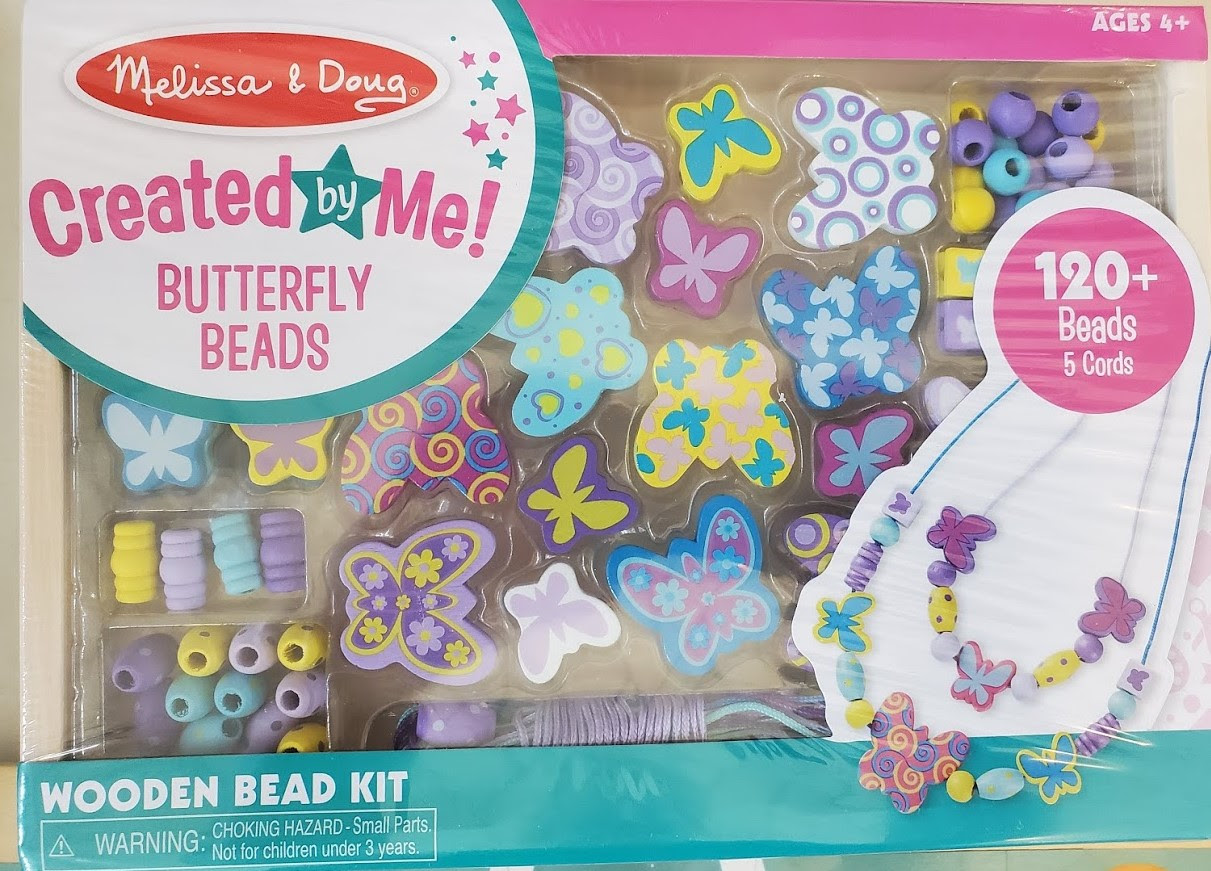
NECKLACE KIT $6- KIOSK IS OPEN WEEKENDS 12 NOON TO 5 P.M. ONLINE ORDERS BY CHARGE CARD AT ROOSEVELTISLANDHISTORY@GMAIL.COM
EDITORIAL
Thanks to Stephen Blank for today’s article on Robert Goldwater. Fascinating stories seem to come to us so frequently and mysterious questions get answered.
Judith Berdy
Text by Judith Berdy Thanks to Bobbie Slonevsky for her dedication to Blackwell’s Almanac and the RIHS Thanks to Deborah Dorff for maintaining our website Edited by Melanie Colter and Deborah Dorff
All image are copyrighted (c) Roosevelt Island Historical Society unless otherwise indicated
FUNDING PROVIDED BY ROOSEVELT ISLAND OPERATING CORPORATION PUBLIC PURPOSE GRANTS CITY COUNCIL REPRESENTATIVE BEN KALLOS DISCRETIONARY FUNDING THRU DYCD