THE F TRAIN SHUTTLE IS A TRAIN. THERE IS A LOT OF CONFUSION BETWEEN BUS AND TRAIN SHUTTLES
DURING THE WEEK FROM 5 A.M. TO MIDNIGHT THERE IS A TRAIN SHUTTLE FROM OUR STATION
The “F”SHUTTLE TRAIN WILL ONLY RUN BETWEEN 21 ST/QUEENSBRIDGE, ROOSEVELT ISLAND TO LEXINGTON AVE./63 ST. STATIONS. THERE IS ONE “F” SHUTTLE TRAIN ON ONE TRACK GOING BACK AND FORTH FROM 5 A.M. TO MIDNIGHT DURING THE WEEK.
THERE ARE NO TRAINS GOING EAST TO QUEENS AFTER QUEENSBRIDGE. THERE ARE BUS CONNECTIONS FROM THAT STATION OPERATED BY THE MTA.
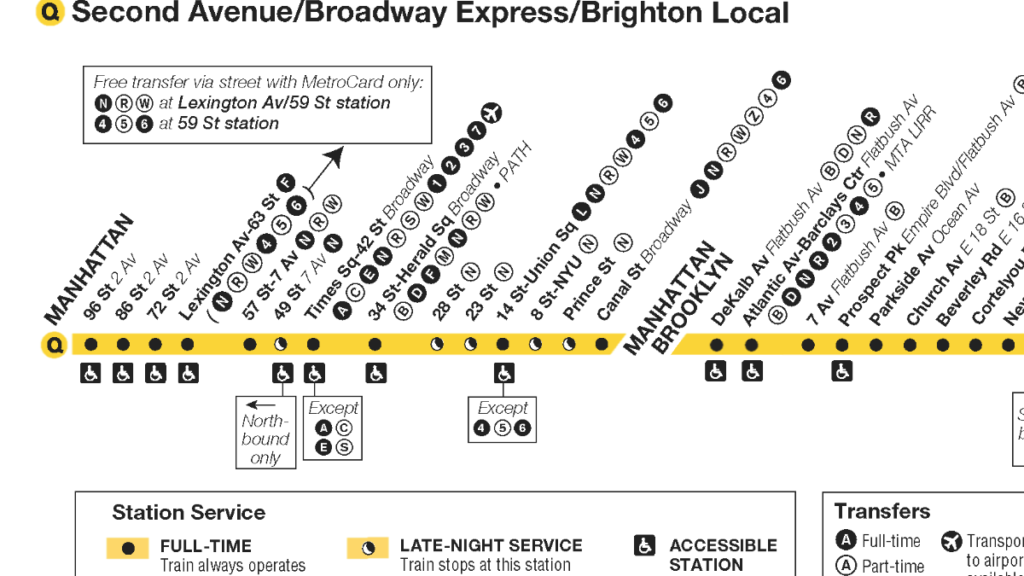
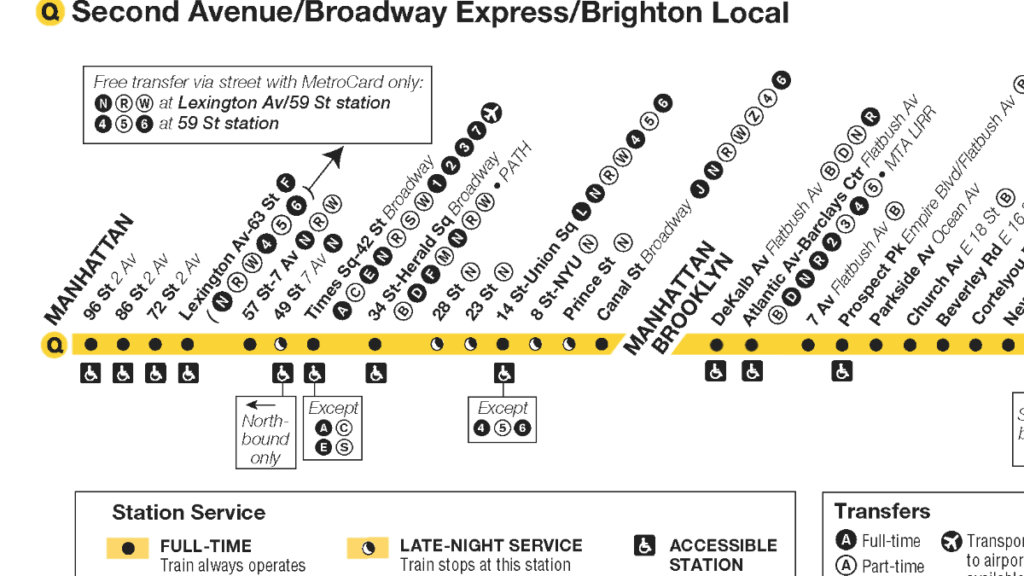
Q TRAIN CONNECTIONS AVAILABLE FROM 63/LEX STATION SOUTHBOUND Q TRAIN TO 57 STREET & 7 AVENUE Q TRAIN TO 42 STREET TIMES SQUARE (CONNECT HERE TO F TRAIN VIA PASSAGE) Q TRAIN TO 34 STREET (CONNECT HERE TO F TRAIN) Q TRAIN TO 14 STREET UNION SQUARE Q TRAIN TO CANAL STREET (OVER MANHATTAN BRIDGE TO BROOKLYN) Q TRAIN CONNECTIONS AVAILABLE FROM 63/LEX STATION NORTHBOUND (72 ST., 86 ST., 96 ST AT SECOND AVENUE)
Overnights between midnight and 5 a.m., F shuttle train service is suspended and free Q94 shuttle buses will connect the Roosevelt Island, 21 St-Queensbridge, and Queens Plaza stations. These are MTA buses.
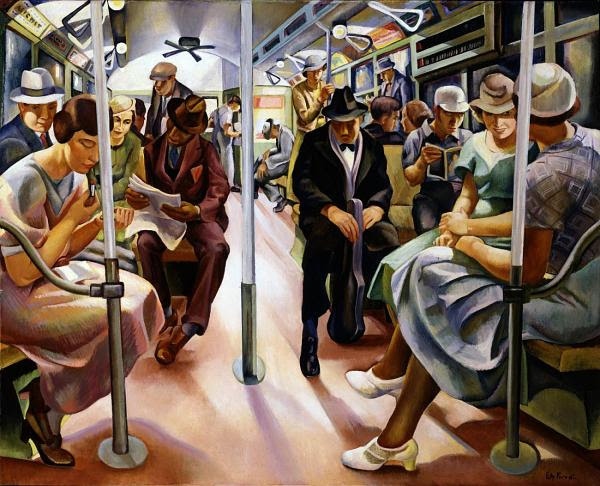
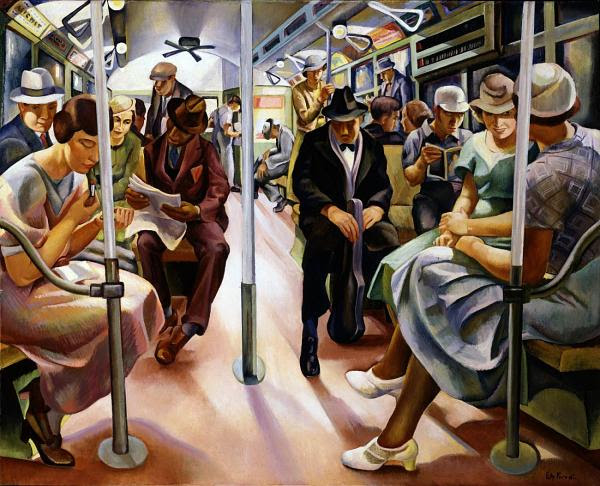
Lily Furedi, Subway, 1934, oil on canvas, 39 x 48 1⁄4 in. (99.1 x 122.6 cm.), Smithsonian American Art Museum, Transfer from the U.S. Department of the Interior, National Park Service, 1965.18.43
In this painting Lily Furedi boldly did something that few dare to do: she looked at people on the subway. She took the viewpoint of a seated rider gazing down the car at her fellow passengers. The Hungarian-born artist knew of the subway riders’ customary avoidance of staring at one’s fellow riders; most people in her painting keep to themselves by hiding behind a magazine or newspaper, or by sleeping. Those who violate the unwritten rule do so furtively. A woman takes a quiet sidelong glance at the newspaper read by the man next to her, while a man steals a peek at a young woman applying lipstick. Only two women in the foreground, who obviously know each other, dare to look directly at each other as they talk companionably.
Furedi takes a friendly interest in her fellow subway riders, portraying them sympathetically. She focuses particularly on a musician who has fallen asleep in his formal working clothes, holding his violin case. The artist would have identified with such a New York musician because her father, Samuel Furedi, was a professional cellist.
FROM A READER: With cane seats, an overhead circular fan, and almost all passengers wearing hats (other than baseball caps), this looks like an Edward Hopper painting of the NYC Subway in the 1930s….except that it has far more people than the Hopper pictures I know. Regards, Jay Jacobson
Text by Judith Berdy Thanks to Bobbie Slonevsky for her dedication to Blackwell’s Almanac and the RIHS
SMITHSONIAN AMERICAN ART MUSEUM JUDITH BERDY
RIHS
Thanks to Deborah Dorff for maintaining our website Edited by Melanie Colter and Deborah Dorff
MAYA LEVANON-PHOTOS TIK TOK & INSTAGRAM
All image are copyrighted (c) Roosevelt Island Historical Society unless otherwise indicated
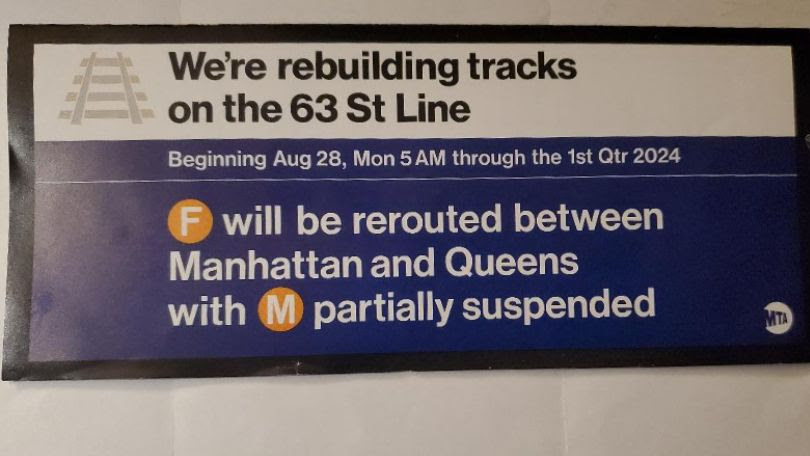
No F service at 21 St-Queensbridge, Roosevelt Island, Lexington Av/63 St and 57 St
Aug 25 – 28, Fri 9:45 PM to Mon 5:00 AM
F trains run via the E in both directions between Jackson Hts-Roosevelt Av and 5 Av/53 St.
Shuttle Bus Free shuttle buses run between Roosevelt Island and Queens Plaza, stopping at 21 St-Queensbridge and Queensboro Plaza.
THE ABOVE IS FROM THE MTA.
STARTING AUGUST 28
THE F TRAIN SHUTTLE IS A TRAIN. THERE IS A LOT OF CONFUSION BETWEEN BUS AND TRAIN SHUTTLES
DURING THE WEEK FROM 5 A.M. TO MIDNIGHT THERE IS A TRAIN SHUTTLE FROM OUR STATION
The “F”SHUTTLE TRAIN WILL ONLY RUN BETWEEN 21 ST/QUEENSBRIDGE, ROOSEVELT ISLAND TO LEXINGTON AVE./63 ST. STATIONS. THERE IS ONE “F” SHUTTLE TRAIN ON ONE TRACK GOING BACK AND FORTH FROM 5 A.M. TO MIDNIGHT DURING THE WEEK.
THERE ARE NO TRAINS GOING EAST TO QUEENS AFTER QUEENSBRIDGE. THERE ARE BUS CONNECTIONS FROM THAT STATION OPERATED BY THE MTA.
Q TRAIN CONNECTIONS AVAILABLE FROM 63/LEX STATION SOUTHBOUND Q TRAIN TO 57 STREET & 7 AVENUE Q TRAIN TO 42 STREET TIMES SQUARE (CONNECT HERE TO F TRAIN VIA PASSAGE) Q TRAIN TO 34 STREET (CONNECT HERE TO F TRAIN) Q TRAIN TO 14 STREET UNION SQUARE Q TRAIN TO CANAL STREET (OVER MANHATTAN BRIDGE TO BROOKLYN) Q TRAIN CONNECTIONS AVAILABLE FROM 63/LEX STATION NORTHBOUND (72 ST., 86 ST., 96 ST AT SECOND AVENUE)
Overnights between midnight and 5 a.m., F shuttle train service is suspended and free Q94 shuttle buses will connect the Roosevelt Island, 21 St-Queensbridge, and Queens Plaza stations. These are MTA buses.
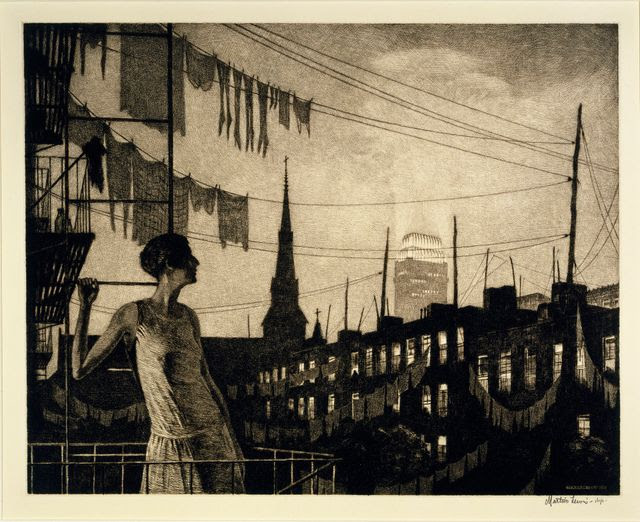
Martin Lewis is the artist behind this film noir-like masterpiece of light and darkness, a drypoint etching simply titled “Glow of the City” and completed in 1929.
It’s a study in contrasts: the dark church steeple of 19th century New York against the illumination of a 20th century skyscraper—the Chanin Building, which would have recently opened on East 42nd Street. This cathedral of commerce radiates light and power amid the everyday dreariness of tenement backyards and laundry on clotheslines.
And what about the woman in the foreground? She may be clad in an ordinary top and skirt, but she’s styled like an Art Deco goddess. She’s looking at the skyscraper, her Art Deco counterpart casting a glow over her world.
More Martin Lewis works of Depression-era New York City can be seen on the Smithsonian American Art Museum website.
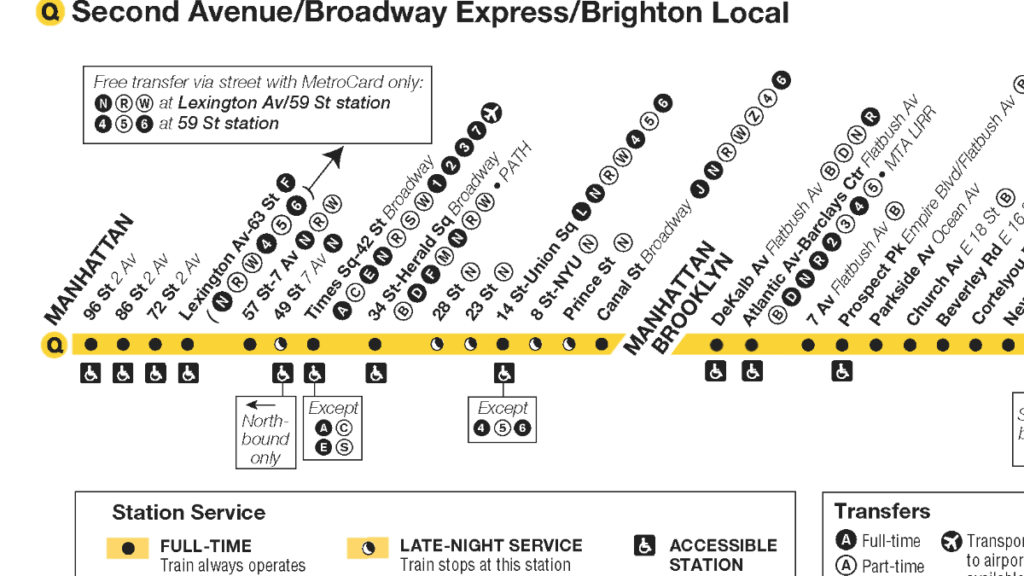
Many of our neighbors are very confused about the upcoming subway project. This is a simplified map and listings of the route of the Q train. The Q train operates from 63 St./Lexington Ave. on tracks just across from the F train. The Q train operates mostly on 7th Avenue and can easily accommodate our transportation needs. Please send your comments to:rooseveltislandhistory@gmail.com
WE WILL BE AT THE FARMER’S MARKET SATURDAY 11 A.M. TO 2 P.M. WITH MORE INFORMATION
STARTING AUGUST 28FROM THE ARCHIVES
THE F TRAIN SHUTTLE IS A TRAIN. THERE IS A LOT OF CONFUSION BETWEEN BUS AND TRAIN SHUTTLES
DURING THE WEEK FROM 5 A.M. TO MIDNIGHT THERE IS A TRAIN SHUTTLE FROM OUR STATION
The “F”SHUTTLE TRAIN WILL ONLY RUN BETWEEN 21 ST/QUEENSBRIDGE, ROOSEVELT ISLAND TO LEXINGTON AVE./63 ST. STATIONS. THERE IS ONE “F” SHUTTLE TRAIN ON ONE TRACK GOING BACK AND FORTH FROM 5 A.M. TO MIDNIGHT DURING THE WEEK.
THERE ARE NO TRAINS GOING EAST TO QUEENS AFTER QUEENSBRIDGE. THERE ARE BUS CONNECTIONS FROM THAT STATION OPERATED BY THE MTA.
Q TRAIN CONNECTIONS AVAILABLE FROM 63/LEX STATION SOUTHBOUND Q TRAIN TO 57 STREET & 7 AVENUE Q TRAIN TO 42 STREET TIMES SQUARE (CONNECT HERE TO F TRAIN VIA PASSAGE) Q TRAIN TO 34 STREET (CONNECT HERE TO F TRAIN) Q TRAIN TO 14 STREET UNION SQUARE Q TRAIN TO CANAL STREET (OVER MANHATTAN BRIDGE TO BROOKLYN) Q TRAIN CONNECTIONS AVAILABLE FROM 63/LEX STATION NORTHBOUND (72 ST., 86 ST., 96 ST AT SECOND AVENUE)
Overnights between midnight and 5 a.m., F shuttle train service is suspended and free Q94 shuttle buses will connect the Roosevelt Island, 21 St-Queensbridge, and Queens Plaza stations. These are MTA buses.
FROM THE ARCHIVES
TUESDAY AUGUST 22, 2023
ISSUE# 1067
SCENES FROM THE SUBWAY
IN DAYS GONE BY
NYC MUNICIPAL ARCHIVES
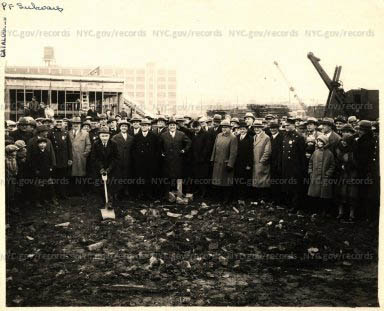
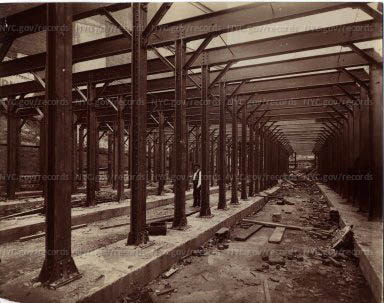
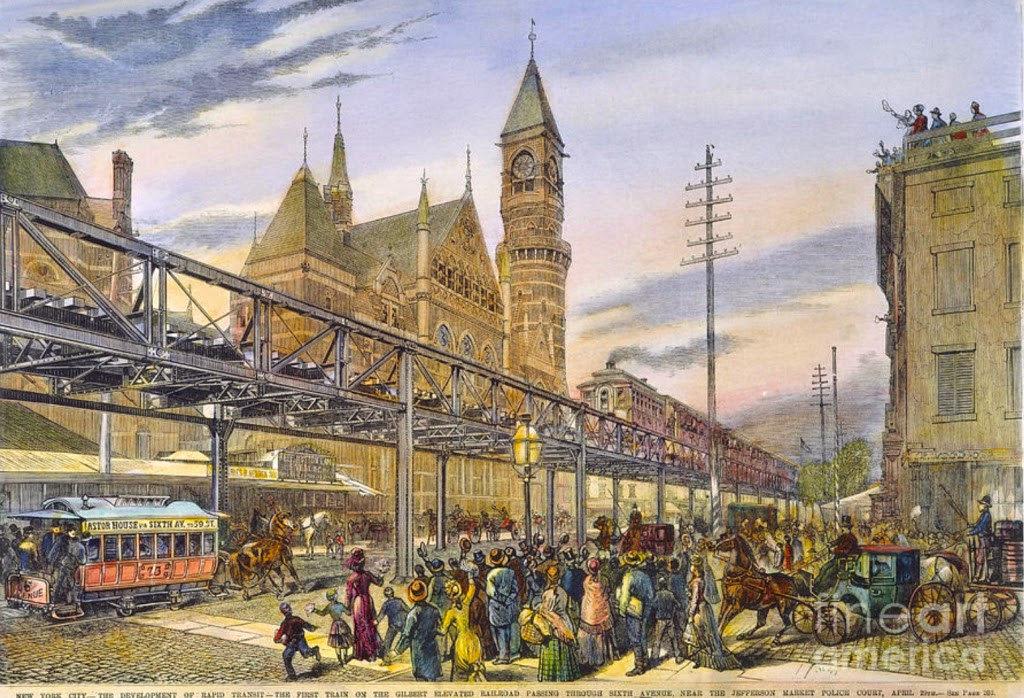
Subway Construction: Breaking ground in Long Island City for IND Subway. Date: April 1927
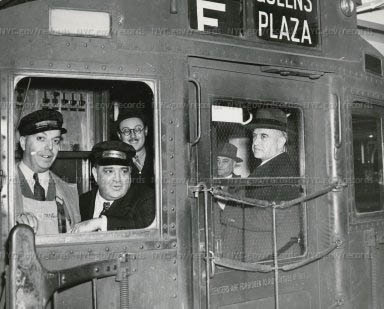
(Yes the F train)
The F to Queens Plaza!!!!
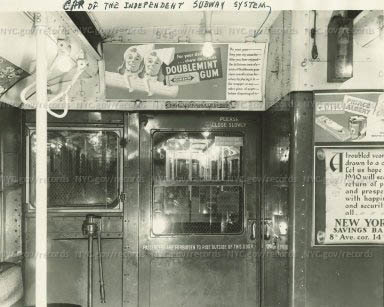
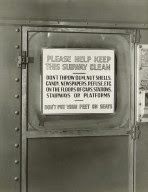
IND Subway car showing Wrigley’s Doublemint chewing gum ad, urging riders to place gum in paper before discarding it.
Many of our neighbors are very confused about the upcoming subway project. This is a simplified map and listings of the route of the Q train. The Q train operates from 63 St./Lexington Ave. on tracks just across from the F train. The Q train operates mostly on 7th Avenue and can easily accommodate our transportation needs. Please send your comments to:rooseveltislandhistory@gmail.com
STARTING AUGUST 28
THE F TRAIN SHUTTLE IS A TRAIN. THERE IS A LOT OF CONFUSSION BETWEEN BUS AND TRAIN SHUTTLES
DURING THE WEEK FROM 5 A.M. TO MIDNIGHT THERE IS A TRAIN SHUTTLE FROM OUR STATION
The “F”SHUTTLE TRAIN WILL ONLY RUN BETWEEN 21 ST/QUEENSBRIDGE, ROOSEVELT ISLAND TO LEXINGTON AVE./63 ST. STATIONS. THERE IS ONE “F” SHUTTLE TRAIN ON ONE TRACK GOING BACK AND FORTH FROM 5 A.M. TO MIDNIGHT DURING THE WEEK.
THERE ARE NO TRAINS GOING EAST TO QUEENS AFTER QUEENSBRIDGE. THERE ARE BUS CONNECTIONS FROM THAT STATION OPERATED BY THE MTA.
Q TRAIN CONNECTIONS AVAILABLE FROM 63/LEX STATION SOUTHBOUND
Q TRAIN TO 57 STREET & 7 AVENUE Q TRAIN TO 42 STREET TIMES SQUARE (CONNECT HERE TO F TRAIN VIA PASSAGE) Q TRAIN TO 34 STREET (CONNECT HERE TO F TRAIN) Q TRAIN TO 14 STREET UNION SQUARE Q TRAIN TO CANAL STREET (OVER MANHATTAN BRIDGE TO BROOKLYN) Q TRAIN CONNECTIONS AVAILABLE FROM 63/LEX STATION NORTHBOUND (72 ST., 86 ST., 96 ST AT SECOND AVENUE)
Overnights between midnight and 5 a.m., F shuttle train service is suspended and free Q94 shuttle buses will connect the Roosevelt Island, 21 St-Queensbridge, and Queens Plaza stations. These are MTA buses.
FROM THE ARCHIVES
MONDAY AUGUST 21, 2023
ISSUE# 1066
SECRETS OF
CENTRAL PARK
UNTAPPED NEW YORK
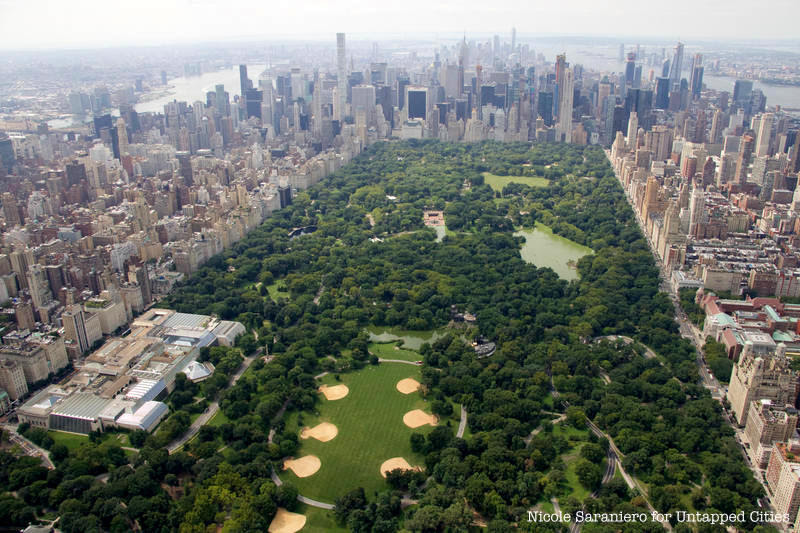
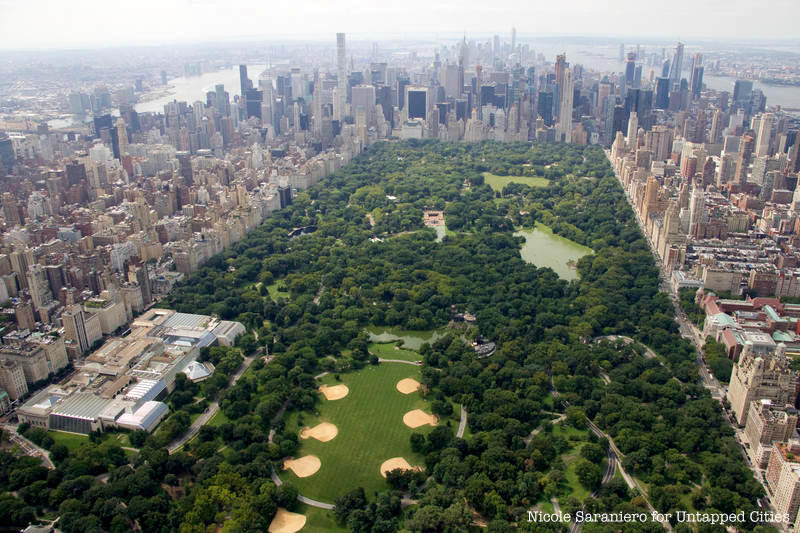
Even though Central Park is one of New York City’s most famous attractions, its 800+ acres of sprawling meadows, forests, rocky outcroppings, lawns, and bodies of water still hold many secrets waiting to be unveiled. We’ve covered the history of Central Park and its many hidden gems in a variety of different articles, from exploring what wasn’t in the original plan to shedding light on the work of the park’s overlooked architect.
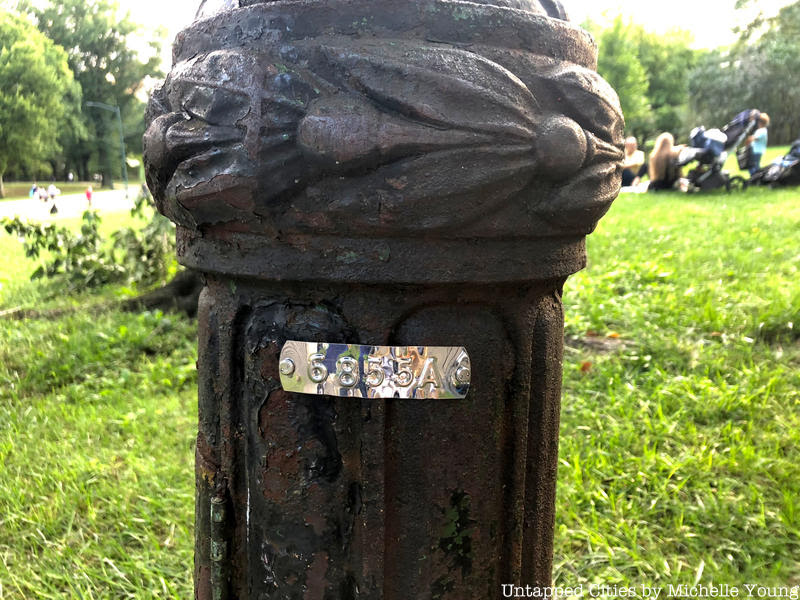
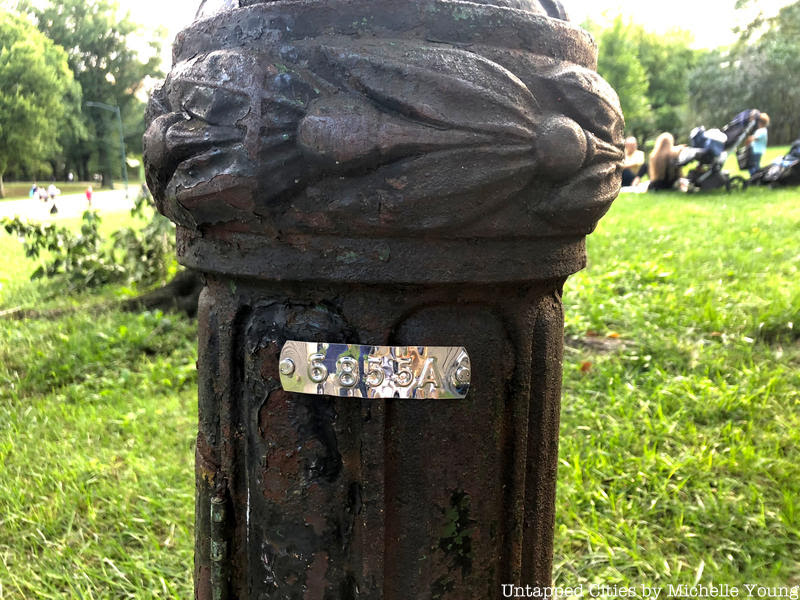
Unless you’re obsessed with lamp posts, you probably haven’t noticed the embossed numbers that are on a metal plaque bolted on each of Central Park’s cast iron lampposts, designed by Henry Bacon. The plaques can be either on the base or on the post itself, oriented appropriately. The first two or three digits actually denote the nearest cross street, and the last digit tells you if you’re closer to the east or west side of the park. An even number means east, an odd number means west.
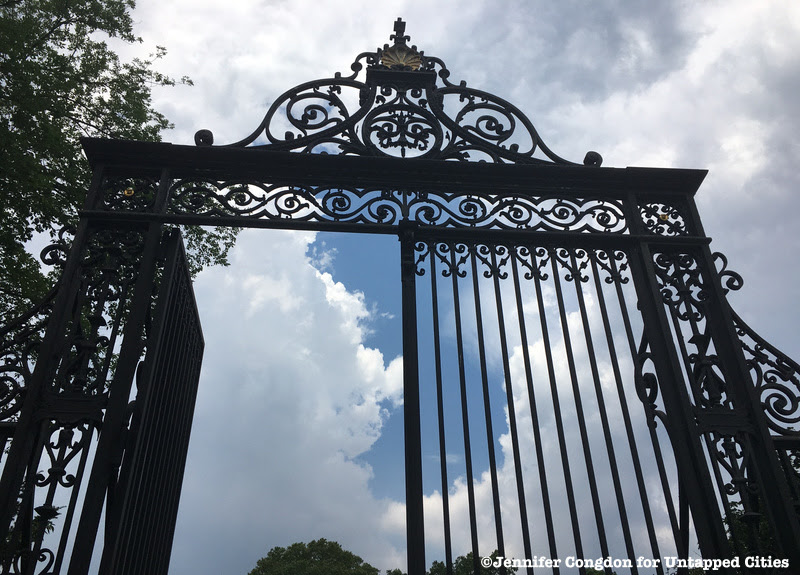
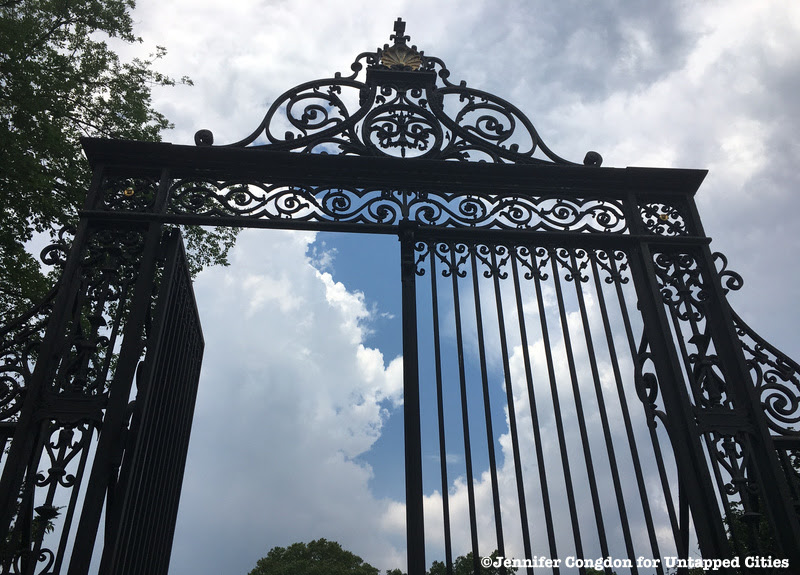
The Conservatory Garden is a quiet, lesser-traveled part of the park where you can enjoy a peaceful stroll through French, English, and Italian gardens. From 1898 until 1934, this area was covered by a massive glass conservatory (hence the name). Visitors enter the garden through massive wrought-iron gates. These gates were once part of the estate of Cornelius Vanderbilt II. Designed by George B. Post and forged in Paris in 1894, the gates survived the estate’s demolition in the 1920s. Bergdorf Goodman stands where the mansion once was on the corner of 57th Street and 5th Avenue. Vanderbilt‘s daughter, Gertrude Vanderbilt Whitney donated the gates to Central Park in 1939.
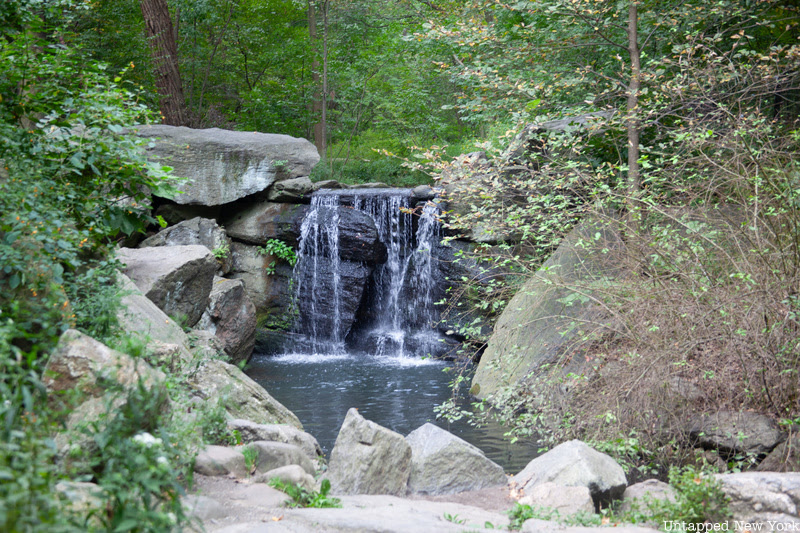
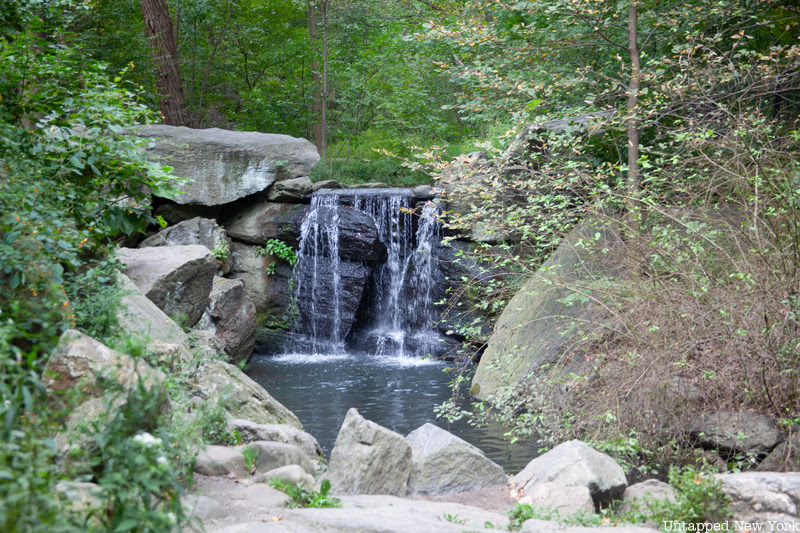
There are at least five waterfalls in Central Park, all completely man-made. Most of them are located in the Ravine. The water that flows here is actually New York City drinking water that comes from a 48-inch pipe hidden by the rocks at the Pool Grotto on West 100th Street.
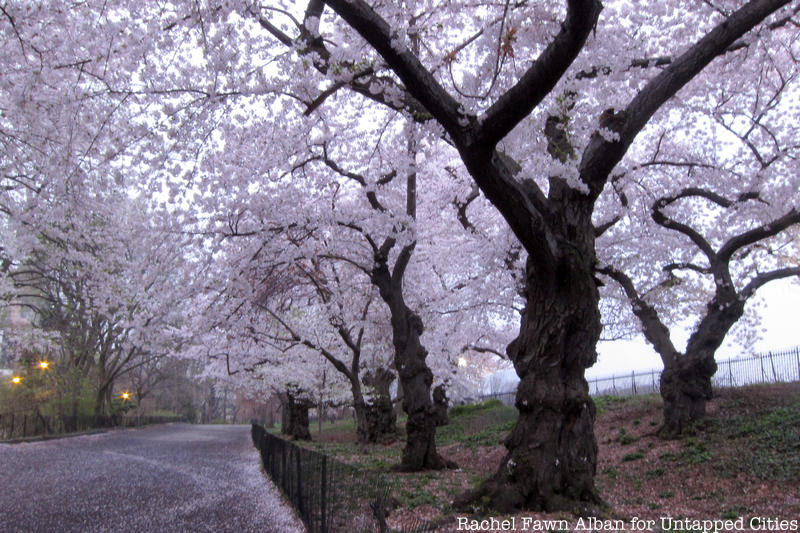
When Central Park was built, the city planted more than 270,000 trees and shrubs and preserved a handful of trees that were original to the area. Today, only about 150 trees are left from the time of Olmsted and Vaux, but many of the trees acquired over the years have a unique story. These Yoshino Cherry trees along the east side of the Reservoir may be the original trees presented as a gift to the United States by Japan in 1912. They are among the first trees to bloom in the spring, before the Kwanzan Cherry. The delicate blossoms drop quickly before the trees green out, and stay leafy for the rest of the season.
Even though Central Park is one of New York City’s most famous attractions, its 800+ acres of sprawling meadows, forests, rocky outcroppings, lawns, and bodies of water still hold many secrets waiting to be unveiled. We’ve covered the history of Central Park and its many hidden gems in a variety of different articles, from exploring what wasn’t in the original plan to shedding light on the work of the park’s overlooked architect.
Unless you’re obsessed with lamp posts, you probably haven’t noticed the embossed numbers that are on a metal plaque bolted on each of Central Park’s cast iron lampposts, designed by Henry Bacon. The plaques can be either on the base or on the post itself, oriented appropriately. The first two or three digits actually denote the nearest cross street, and the last digit tells you if you’re closer to the east or west side of the park. An even number means east, an odd number means west.
The Conservatory Garden is a quiet, lesser-traveled part of the park where you can enjoy a peaceful stroll through French, English, and Italian gardens. From 1898 until 1934, this area was covered by a massive glass conservatory (hence the name). Visitors enter the garden through massive wrought-iron gates. These gates were once part of the estate of Cornelius Vanderbilt II. Designed by George B. Post and forged in Paris in 1894, the gates survived the estate’s demolition in the 1920s. Bergdorf Goodman stands where the mansion once was on the corner of 57th Street and 5th Avenue. Vanderbilt‘s daughter, Gertrude Vanderbilt Whitney donated the gates to Central Park in 1939.
There are at least five waterfalls in Central Park, all completely man-made. Most of them are located in the Ravine. The water that flows here is actually New York City drinking water that comes from a 48-inch pipe hidden by the rocks at the Pool Grotto on West 100th Street.
When Central Park was built, the city planted more than 270,000 trees and shrubs and preserved a handful of trees that were original to the area. Today, only about 150 trees are left from the time of Olmsted and Vaux, but many of the trees acquired over the years have a unique story. These Yoshino Cherry trees along the east side of the Reservoir may be the original trees presented as a gift to the United States by Japan in 1912. They are among the first trees to bloom in the spring, before the Kwanzan Cherry. The delicate blossoms drop quickly before the trees green out, and stay leafy for the rest of the season.
New York has its very lovely public green spaces, playgrounds, and private parks.
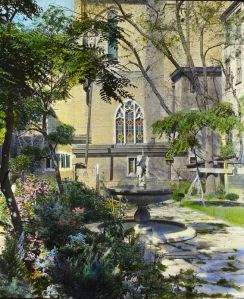
But some lucky residents have their own secret interior garden—a lush sanctuary of trees, flowers, and fountains hidden from the street between rows of brownstones and accessible only through the back doors of adjacent neighbors.
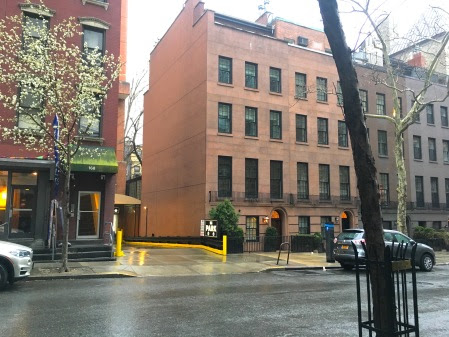
One of these magnificent gardens, Jones Wood Garden, lies between Lexington and Third Avenues and 65th and 66th Streets (above) on the same block as St. Vincent Ferrer Church.
The original Jones Wood was a 150-acre tract of high forested land that roughly spanned today’s 65th to 76th Streets from Third Avenue to the East River.
Named for a 19th century tavern owner and owned by prominent families, Jones Wood became a popular picnic and amusement spot. It was even in the running in the early 1850s to be the city’s first major public park.
In the post–Civil War years after Central Park edged out Jones Wood, builders cut down the forests and put up blocks of brownstone residences in this Lenox Hill neighborhood, as thy did all over Manhattan.
Demand for these private homes soured by the turn of the century, then picked up again after World War I. That’s when Jones Wood Garden got its start.
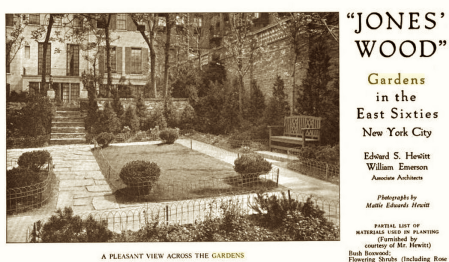
With well-to-do tenants in mind, developers purchased 12 brownstones (six on the north side of 65th Street, and six on the south side of 66th), then remodeled them by getting rid of their tall stoops and updating the amenities. They also designed a 100 by 108 feet sunken interior garden.
“This will be paved with special paving brick and flagging, and will have a fountain with a pool,” explained a New York Times article from 1919.
“Back of each house there will be a small and more intimate garden about 20 feet deep, upon which the dining room will open.” Shutters and trellises would be added to the back of each of these homes as well.
Unless you live there or know someone who does, Jones Wood Garden is pretty much off-limits to most New Yorkers.
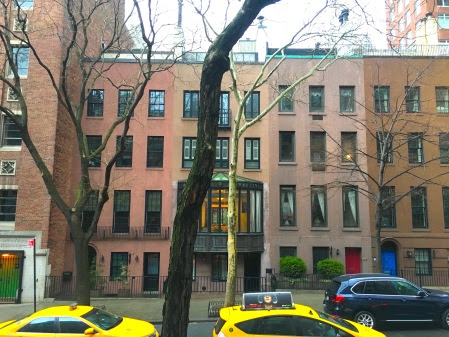
You can catch a glimpse of a few trees from the street, as I did below. But the garden sanctuary is very private, just as it was intended.
Occasionally recent photos appear, particularly when one of the homes is up for sale.
In 2015, the house at 160 East 66th Street hit the market for $12 million. Curbed has the photos, including one with the open dining room leading to the garden, as described in the 1919 Times piece.
But to get a sense of the beauty and lushness of Jones Wood Garden, we have to rely on old images, such as these black and white photos from The Garden Magazine in 1922.
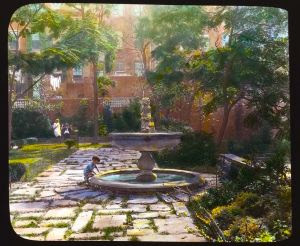
There’s also a series of color slides from the Library of Congress, dated 1921. One shows a child playing by the fountain and a woman in white (his mom? a nurse?) enjoying the peace and serenity.
[Second, third, fifth, and sixth photos: LOC; fifth photo: The Garden Magazine. Hat tip to A for sending me the LOC photos!
FRIDAY PHOTO OF THE DAY
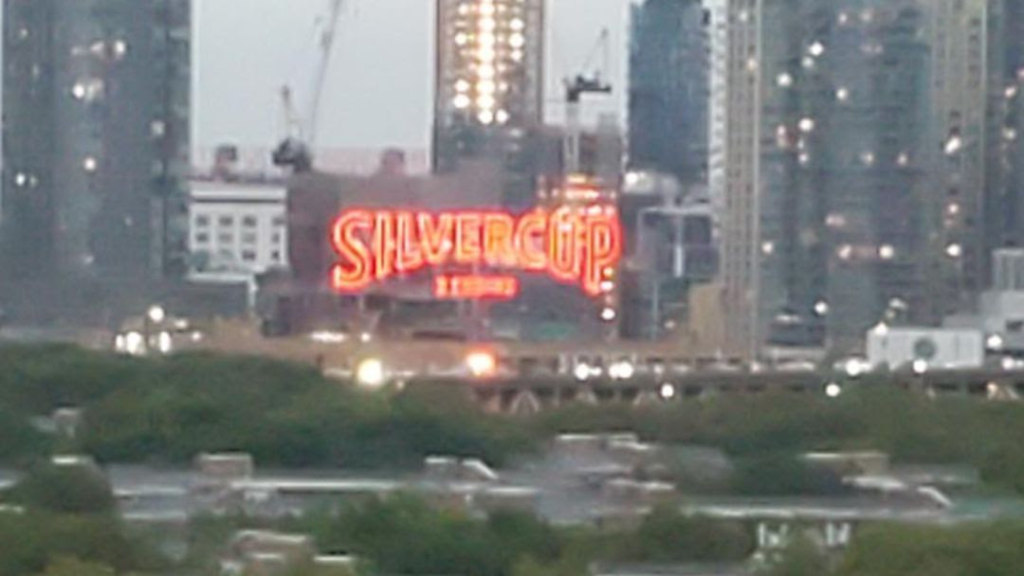
WELCOME BACK SILVERCUP SIGN
THE SIGN HAS BEEN DARK FOR A FEW WEEKS AND TONIGHT IT IS LIT AGAIN
ONCE IN A WHILE WE COME UP WITH AN IDEA FOR MERCHANDISE TO SELL IN THE KIOSK. THIS IS ONE IDEA THAT WAS NEVER USED! SUGGESTIONS FOR OTHER MERCHANDISE ACCEPTED.
Text by Judith Berdy Thanks to Bobbie Slonevsky for her dedication to Blackwell’s Almanac and the RIHS
EPHEMERAL NEW YORK JUDITH BERDY
Thanks to Deborah Dorff for maintaining our website Edited by Melanie Colter and Deborah Dorff
MAYA LEVANON-PHOTOS TIK TOK & INSTAGRAM
All image are copyrighted (c) Roosevelt Island Historical Society unless otherwise indicated
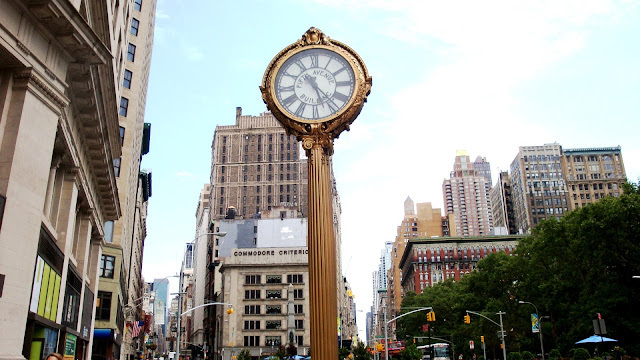
For decades the elegant Fifth Avenue Hotel at Fifth Avenue and 23rd Street attracted princes and politicians, moguls and millionaires. Directly in front of its entrance a tall sidewalk clock conveniently told the time to passing businessmen and nannies pushing baby carriages to Madison Square across the avenue.
But, as was common practice, when the Fifth Avenue Hotel left in 1908, the clock went too.
The builders of the Fifth Avenue Building that replaced the hotel at 200 Fifth Avenue wasted no time in erecting a new clock. In the busy neighborhood anchored by the relatively new Flatiron Building across 23rd Street to the south, a street clock was considered essential.
The clocks served several purposes. Not only were they a convenience for the neighboring shoppers and businessmen, they drew attention to the store or building and provided excellent advertisement.
Desiring their clock to be in keeping with the high tone of their new office building, the owners commissioned the esteemed Brooklyn firm of Hecla Iron Works to produce their clock case. Hecka (named after an active volcano in Iceland) had produced the 133 cast iron subway kiosks as well as important cast iron building facades like the B. Altman & Co. Department Store on 6th Avenue and the New York Life Insurance Building.
Of the many street clocks on the sidewalks of Manhattan, this one stood out. Installed in 1909 it was one of the most ornate in the city. It sits on a rectangular base with classical ornamentation, a fluted Ionic column rising to a capital inspired by the work of 16th Century Venetian architect Vioncenzo Scamozzi. The two large dials which advertised Fifth Avenue Building are encircled by oak leaf wreaths. To make the cast iron clock even more a work of art, it was then gilded.
The clock was wound about every eight days; a weight within the column slowly descending the full length. More recently, the mechanism was replaced with an automatic one.
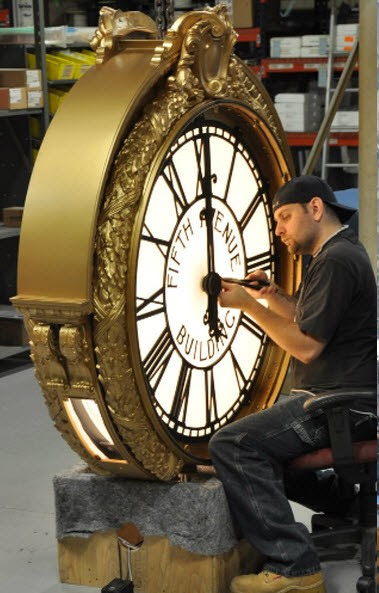
In 2011 the clock was completely restored by the Electric Time Company, Inc. of Medfield, Massachusetts. The eight-month restoration was sponsored by Tiffany & Co**.
A technician works on the eight-month restoration of the Fifth Avenue street clock in 2011 — photo courtesy Electric Time Company, Inc.
Throughout the 20th Century Manhattan’s many street clocks fell victim to auto accidents, neglect and sidewalk improvements until now only a handful remain. The well-maintained and magnificent example in front of 200 Fifth Avenue was deemed by the Landmarks Preservation Commission in 1981 “a gilded cast-iron masterpiece.”
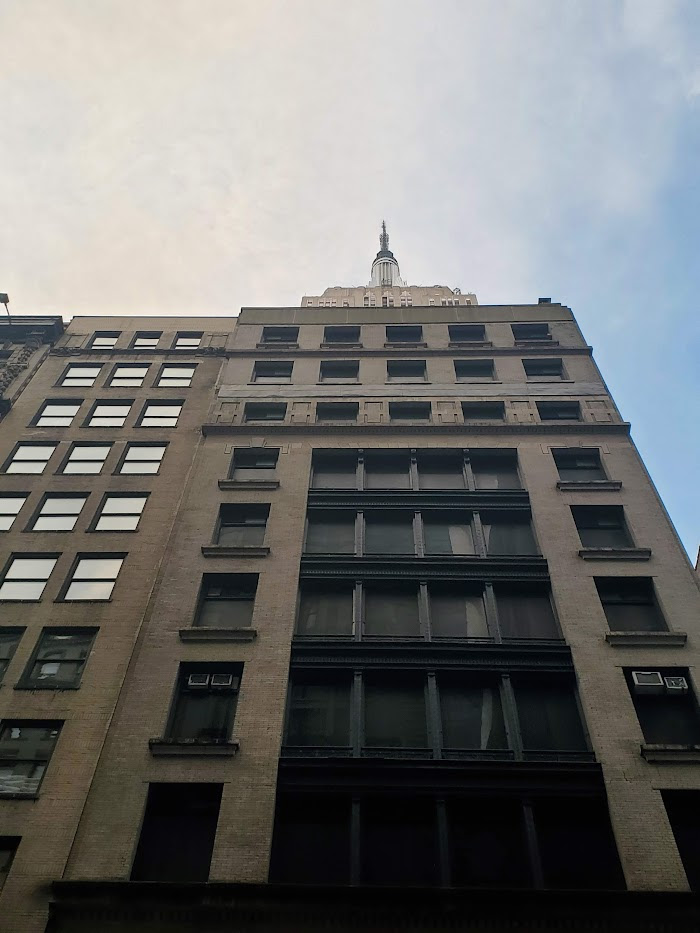
Walking up Broadway tonight a new architectural gem struck me. I may wander around the area more often to see the revitalization of the many older structures.
Living in Stutgart, Germany did not impede Caroline H. Johnston’s Manhattan real estate operations. She remotely purchased properties around the island which she improved with commercial and residential structures. As the turn of the century neared, she little by little amassed the properties around No. 1170 Broadway. In 1897 she purchased No. 1172 at the southeast corner of Broadway and 28th Street for $250,000. She acquired the abutting property at No. 1168 Broadway the following year for $110,000; and No. 1168 Broadway in 1900 for $148,005.
On March 15, 1902 The Record & Guide reported that she “has decided to erect a 12-sty store and loft building on the site.” The nearly square footprint was just over 105 feet wide on Broadway and almost 103 feet on 28th Street. The architectural firm of Schickel & Ditmars was put to work designing what would briefly be known as the Johnston Building. Their plans, filed a month later, projected the cost at $500,000. Coupled with the price of the properties, Caroline Johnston’s project would cost her the staggering equivalent of around $30 million in today’s dollars.
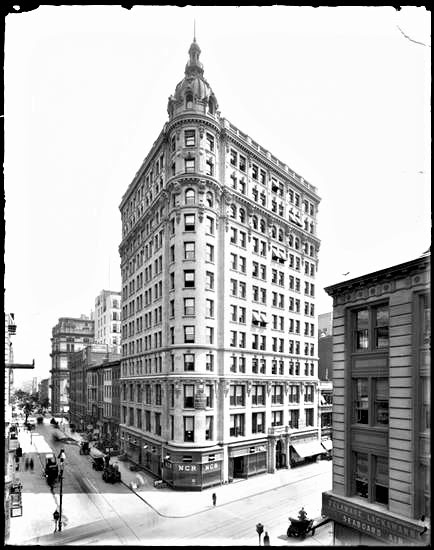
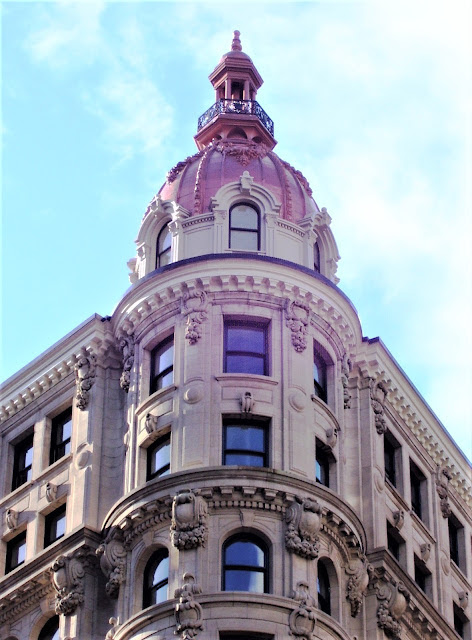
The fact that this section of Broadway was dotted with several upscale hotels may have prompted the architects to design the Johnston Building to more closely resemble a hotel than an office structure. Above the street-level storefronts, the limestone-faced building dripped with Beaux Arts decorations, its rounded corner rising to an elaborate cupola.
The lushly ornamented entrance would have been appropriate for any high-end hotel of the time. photo by Beyond My Ken
The name did not last especially long, most likely because there was another Johnston Building downtown which was already well known. Two Johnston Buildings, one on Broadway and another on Broad Street, were just too confusing.
The new structure filled with the offices of architects and other construction-related firms. In the first decade after its opening architects James B. Ware & Sons, Bosworth & Holden, W. E. McCoy, J. J. Malone, and N. Serracino were here. Builders and contractors included Jobson-Hooker Co., The Bottsford-Dickinson Co., Geo. Vassar’s Son & Co., and the Hennebigue Construction Company.
The National Cash Register Company was in the highly visible corner store in 1905. photo by Wurts Bros. from the collection of the Museum of the City of New York
Real estate firms joined the architects and builders. The International Amusement & Realty Co., the West Rockaway Land Company, and the uptown office of Frederick Soutack & Alwyn Ball, Jr. were tenants.
When the International Amusement & Realty Co. sought to update its offices in April 1910 by renovating the stairs and walls, it did not have to look far. Both the architect, James J. Malone, and the contractor, Geo. Vassar’s Son & Co., were tenants.
In June 1912 Caroline Johnston updated the show windows and replaced the roof. The building continued to lure architects and builders. That year the Atlantic Terra Cotta Company moved in and would remain into the 1920’s.
Atlantic Terra Cotta Company was a major tenant for years. Real Estate Record & Guide, December 21, 1912 (copyright expired) Atlantic Terra Cotta Company was joined in the building that year by builders Wills & Marvin Co. and architect James Brite. The well-known construction firm of Thomas J. Brady, Jr. Company took space in 1914.
A variation in the tenant list began in 1916 when A. J. Haire Publishing Co. moved in. The firm published The Corset and Underwear Review, a monthly trade journal, and the annual International Corset & Underwear Directory. The Corset and Underwear Review, July, 1921 (copyright expired)
In 1918 the general offices of the United Electric Light and Power Co. were here, and by the following year the Barker Original Bakeries System, Inc. operated from the building.
The Barker firm advertised nation-wide, hoping to attract would-be small business owners. For an investment of $5,000 (just under $74,000 today), an investor was guided through the process of opening a bread bakery. An advertisement claimed that “many wide-awake men in cities of the Middle West and East are today making $500 to $2,400 per month…who knew nothing whatever of the Baking business.” “We have solved all problems for these people, furnished an expert to start them and covered every detail to assure their success.”
Other garment-related firms in the building that year were The Textiles Company, Inc. and Naef Brothers, dealers in embroideries “that impart distinctiveness to Lingerie, Blouses and Infant’s and Children’s Dresses,” according to an advertisement.
Another new tenant in 1921 was the New York School of Filing. It entitled an advertisement on January 30 “Woman’s Best Vocation–FILING,” and claimed “We have trained and placed over five thousand girls and women in positions paying $18 to $35 per week.” (The higher salary would equal $500 today.)
After having been in the building for 37 years, Haire Publishing Company left in 1953. The neighborhood around No. 1170 suffered during the next few decades as modern Midtown business buildings attracted tenants. Small offices and stores moved in, like Josalam, headed by Joseph J. Samowich. Another tenant, Yuchius Co., operated from a storefront here and at No. 1133 Broadway.
As Christmas shoppers frantically searched for the popular Cabbage Patch dolls in 1984, Customs Agents raided the Yuchius Co. stores as well as the firm’s warehouse on West 27th Street, confiscating 20,000 counterfeit Cabbage Patch dolls. Tests by the Customs Department chemists indicated “that the stuffing in the dolls contained several volatile and flammable compounds, including benzene and toluene,” said The New York Times.
In the meantime Josalam garnered more positive press coverage. In October 1983 Joseph Samowich received his patent for “Josalam,” a decorative laminate “for home, business or even military use.” And two years later he was awarded another patent for a new “bulletproof clothing, or soft body armor.” This was Samowich’s third patent on the protective garments which he said “required fewer layers of fabric and are less costly than those currently employed” by the police and military, according to The New York Times on April 13, 1985.
photo by Beyond My Ken
The rediscovery of the neighborhood north of Madison S quare, or Nomad, at the turn of the century would result in a renaissance of No. 1170 Broadway as well. The building that looked like a hotel became one in 2012 when the Sydell Group transformed it into the NoMad hotel and restaurant. The interiors were designed by French architect Jacques Garcia.
The renovation-restoration resurrected Schickel & Ditmars’ 1903 Beaux Arts showpiece.
KEEPING WARM UNDER A SPECIAL R.I. DESIGN ORDER YOURS TODAY
$70- BEFORE 10/1 $80- AFTER 10/1 RESERVE YOURS TODAY AT FLEA MARKET Contact rooseveltislandhistory@gmail.com
FROM THE ARCHIVES
TUESDAY, AUGUST 15, 2023
ISSUE# 1061
New Jersey’s Largest
Resiliency Park
Can Hold up to
2 Million Gallons of Stormwater
6SQFT
Photos courtesy of the City of Hoboken
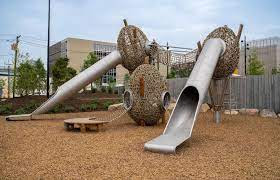
A brand new park in Hoboken will also work to prevent flooding during storms. Located at 12th and Madison Streets, ResilenCity Park includes five acres of public open space, basketball courts, and athletic fields, and has the ability to detain up to two million gallons of water. Considered the largest resiliency park in New Jersey, the new park is part of a broader effort by Hoboken to build more resilient storm infrastructure after Hurricane Sandy flooded most of the city in 2012.
The new park is part of the State and U.S. Department of Housing and Urban Development-funded Rebuild by Design project, which combats flooding caused by heavy rain, a phenomenon becoming more frequent due to climate change.
According to the city, ResilienCity Park can detain up to two million gallons of stormwater through a stormwater detention tank located below ground and through green infrastructure like rain gardens and a tank for on-site irrigation.
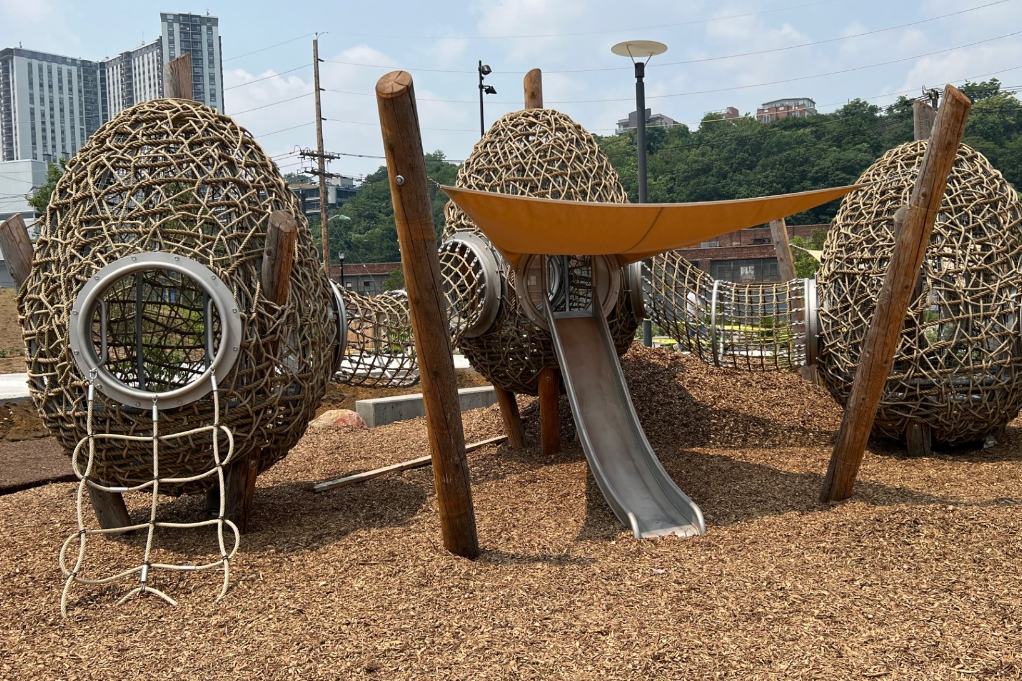
The public space includes a multi-use athletic field, a basketball court that doubles as a stormwater detention basin, a playground, a water spray area, open lawn space, and a terrace pavilion that will include a cafe and community center this fall.
“This park opening is a significant milestone in our ongoing efforts to create a sustainable and resilient community, serving as the largest resiliency park in our great state and a model for the rest of the county,” Mayor Ravi S. Bhalla said.
“Not only does this park provide much-needed, state-of-the-art open space amenities, it will also provide a critical defense against rainfall flooding, two critical quality of life improvements for our residents.”
Since 2017, Hoboken has opened two other resiliency parks: the Southwest Resiliency Park and the 7th & Jackson Resiliency Park. Together, the two parks detain a total of 670,000 gallons of stormwater which would otherwise flood city streets and residential basements.
Hoboken is set to begin an expansion of the Southwest Resiliency Park before the end of the year, doubling its size from one to two acres and increasing its stormwater capacity from 200,000 gallons to 510,000 gallons. The city is also conducting a planning process for the design of a fourth resiliency park at 800 Monroe Street.
“The ResilienCity Park – the largest of its kind in the state – will connect New Jerseyans to green, open space while offering our children and families a host of recreational activities. Just as importantly, amid the increasing intensity and frequency of storm events due to climate change, this resiliency park will help protect Hoboken’s residents and properties from extreme flooding,” Murphy said.
Built on what was formerly a vacant industrial lot, ResilienCity Park was funded by a $10 million grant from the Federal Emergency Management Agency’s (FEMA) Building Resilient Infrastructure in Communities (BRIC) program, $2 million in principal forgiveness through the NJ Infrastructure Bank, and $1 million in grants from the Hudson County Open Space Trust Fund.
According to Gothamist, during the park’s inauguration ceremony, activists from the Food & Water Watch disrupted Murphy’s speech and spoke out against two proposed gas-fired power plants by the Passaic Valley Sewerage Commission in Newark and NJ Transit in Kearney, both of which are just a few miles from the park.