Wednesday, August 6, 2025 – AN EDUCATOR THAT WORKED IN THE CITY FOR YEARS
A CHAMPION OF
FLUSHING:
THE LEGACY OF
MARY SHAW
Wednesday, August 6, 2025
NEW YORK HISTORICAL
Issue # 1504
A Champion of Flushing: The Legacy of Mary Shaw
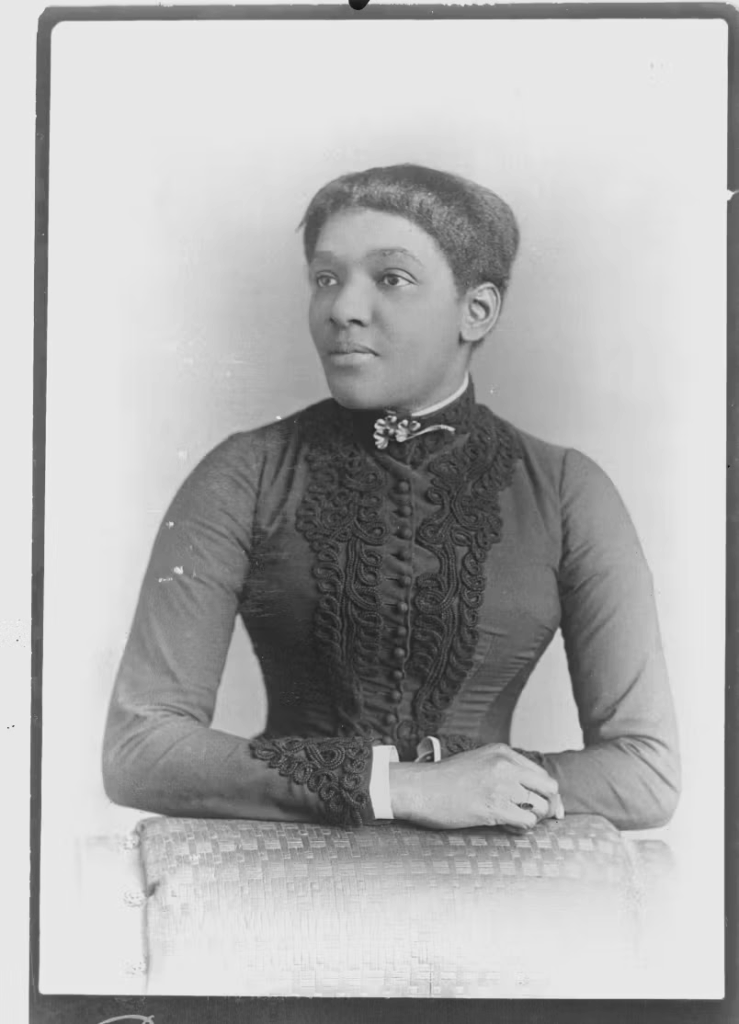
William Davis Hassler, photographer. “Copy photo of an unidentified African American Woman,” undated. New-York Historical Society
Part of researching women’s history is learning how to navigate incomplete finding aids and descriptors. For example, the image below—from the Patricia D. Klingenstein Library’s William David Hassler Photograph Collection—shows a woman, arms resting on the back of a chair. She gazes intently beyond the camera lens, and invites a host of questions. The photograph is labeled as an “unidentified African American woman” and offers little else for us: Where did the image come from? What clues can we discern from the photograph? If this is a copy, where is the original? Most of all, can we puzzle out the identity of the woman pictured?
It turns out, we can. Thanks to an abundance of newly digitized archives, photographs, and manuscripts, we now know this likeness is of Mary E. Shaw, an activist, philanthropist, and school principal who lived in Flushing, Queens. In fact, this very photograph hung for years in the Flushing branch of the Queensborough Public Library system. Finding the connection between these two copies of the same image, however, has only been made possible through recent efforts to make archival and library collections more widely available and accessible. This push to digitize archival collections—efforts which have accelerated as a result of the COVID-19 pandemic—offers new possibilities for historians and researchers and especially for those studying the experiences of women. This new landscape of digitized records also provides a rich pool of documents from which we can begin to reconstruct and understand the life of Mary Shaw, who at one point was one of Flushing’s most famous residents.
Mary Ann Elizabeth Hood appears in the historical record under several different name variations. She is sometimes listed in newspapers and other documents as Mary E., Mary Elizabeth, Mary Ann, and even Mary Ann E., reflecting a common challenge faced by researchers tracing the lives of 19th-century figures. Mary was born in Pennsylvania around 1852. She was the daughter of Lewis A. and Sarah A. Hood. Her father was actively involved in the Free Mason movement in Pennsylvania.
By the time she was 21 years old, Mary was working as a school teacher in New York City at a school supervised by prominent scholar and activist Charles L. Reason. Reason was the first African American college professor in the United States, a distinction he already held by the time Mary arrived at the school in 1873. As a working woman, Mary saved up enough money to open a bank account in the U.S. Freedman’s Savings Bank’s New York City branch that same year. It was during this time that she likely met her future husband.
In December of 1874, Mary Hood married John William A. (who often went by John W. A.) Shaw in New York City. By 1880, after spending some time in Washington, D.C., the couple had settled in Flushing—at that time an independent city—with their daughter, Ethel. The Shaw family flourished in Queens, where Mary worked as a teacher and John edited a newspaper. By 1887, Mary had become “head teacher” of the School for African American students. By the next year, she had succeeded Charles H. Thomas in the position of principal of the Colored School in that city. According to the Queens Public Library, the school was located at 86 State Street.
In Flushing, the Shaws became part of, and prominent in, a vibrant African American community–a community that was one of the earliest free Black settlements in what would eventually become New York City. The Flushing Free Library, which became a free circulating library in 1884, played an important part in supporting and nourishing the growing community, as various residents used it as a space for gathering, meetings, and lectures. For example, in September of 1887, the Lyceum Association, which consisted of young African American people, “filled the meeting room of the Flushing Free Library,” according to a Brooklyn paper. The group had connections to the A.M.E. Church, of which John Shaw was a minister. Both young men and young women participated. Mary and John Shaw likely had other connections to the library beyond what comes down to us in extant paper records, as the institution played a large enough role in their lives in Flushing to warrant a bequest of money upon Mary’s passing.
Mary was also active in the Queens County Teachers Institute. For example, in 1889, she sat in the audience and listened to Mr. Isaac H. Stout lecture on the best methods of teaching, noting that “male teachers seemed to be running out and their places filling up with women.” Mary Shaw was living proof of this observation. She worked tirelessly in her many roles as an educator in Flushing. At one Grammar School No. 2 graduation, a member of the Board of Education recognized her achievements, and said he “hoped she would remain as teacher in Flushing as long as she lived.”
Like his wife, John Shaw also cut an interesting and complex historical profile. Born in 1849 in Antigua, the British colony infamous for its sugar plantations and deadly labor conditions, he likely descended from formerly enslaved people. The British emancipated the people they enslaved there 15 years prior to John Shaw’s birth. Shaw immigrated to the United States when he was seven, and applied to be naturalized as a U.S. citizen 16 years later at the age of 23. At the time, he worked as a clerk and lived on Mulberry Street in lower Manhattan.
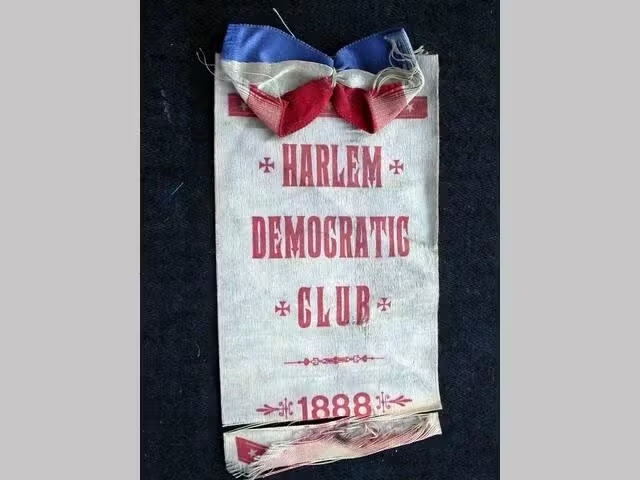
Democratic Clubs were a ubiquitous form of political organizing and partisan infrastructure at the local level. This ribbon marked membership of its wearer in the Harlem Democratic Club.
Ribbon, 1888. New-York Historical Society.
Writing in 1903, John Shaw argued that the claims and needs of African Americans received “scant consideration” from both political parties and that in both the South and in the North “there is there was “a revulsion of sentiment… against the negro,” which rendered African American men politically powerless. Nevertheless, he wrote, “the negro must fight on.” John Shaw recognized, and was not afraid to point out, the hollowness of Northern claims to equality. In some ways, Shaw’s criticism foreshadowed the sentiments that activists and radicals like Malcolm X, James Baldwin, and Stokely Carmichael would also make. For Shaw, the future lay in the young African Americans people of the early 20th century who were the “sophisticated product of the schools with his awakened consciousness, involving social and political recognition.”
Mary Shaw, too, believed in the promise of racial uplift through education and “awakened consciousness.” However, unlike her husband who used politics to advance this vision, Mary pursued this goal through a lifelong commitment to teaching and education—amassing a small fortune for herself along the way. Her teaching resume included schools in White Plains, Delaware, New York City, South Carolina, Georgia, Indiana, and, finally, Flushing. By the mid-1880s, Mary already had years of teaching experience to qualify her for an administrative role in the town’s school system.
Mary passed her love of education and pursuit of teaching to her daughter. Ethel was born in September of 1874, while the family was living in Washington, D.C. She later attended the West Newton English and Classical School (sometimes referred to as the Allen School), a model school in Massachusetts that, unique for this time, educated a racially integrated and co-ed student population. At the closing exercises, Ethel performed a piano solo. After graduating in 1891, she gained employment as a teacher at the prestigious Tuskegee Institute in Alabama. Newspapers in Ohio, Missouri, and Illinois printed the news and celebrated her appointment on the board of instructors, describing Ethel as “universally loved by teachers and fellow students.”
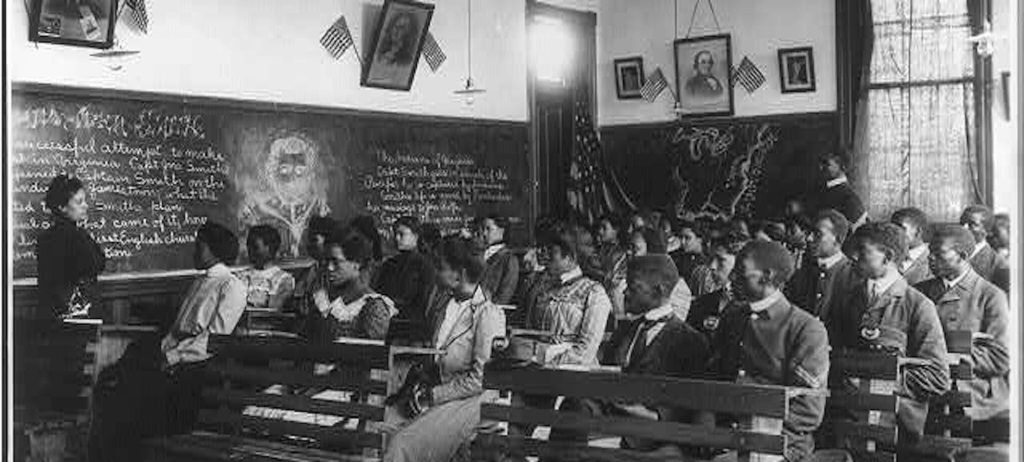
Ethel’s employment at Booker T. Washington’s Institute was just one of the ways that the family was deeply connected to Tuskegee and its mission. Both Mary and John were proponents of the kind of education that provided skills for economic, social, and moral development and uplift that was the ethos of Tuskegee under Washington’s leadership. John even composed a lecture titled, “A Tangled Skein,” which he called a “vindication of Booker T. Washington and his work.”
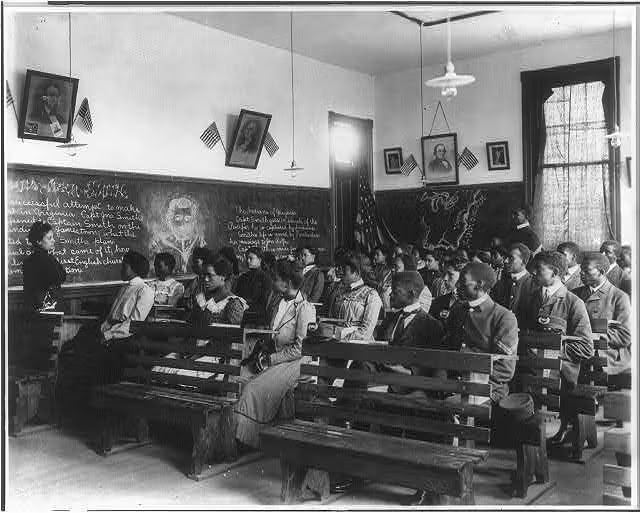
Frances Benjamin Johnston, photographer. History class, Tuskegee Institute. Tuskegee, Alabama, c.1902, around the time that Ethel Shaw was teaching at the school. Image courtesy of the Library of Congress.
The small Shaw family experienced a devastating loss when Ethel passed away while teaching in Tuskegee. The exact date of her death is currently unknown, but it was likely between 1892 and 1903. While we don’t have records of how this loss impacted Mary, her actions in the years before her own death indicate that she was profoundly saddened and felt deeply the loss of her only daughter, of whom she was extremely proud.
Mary Shaw resigned from her role as Principal in 1894, and died 11 years later in March 1905 at the age of 53 in Philadelphia. Her funeral took place at the historic St. Philip’s P. E. Church on 25th Street in Manhattan. We can in some ways understand Mary Shaw’s worldview more fully through a particularly detailed and, luckily for us, digitized document: her will. In 1903, Mary drew up a thoughtful, practical, and comprehensive will in which she delineated where and how she wanted her estate distributed—in effect, constructing her own legacy
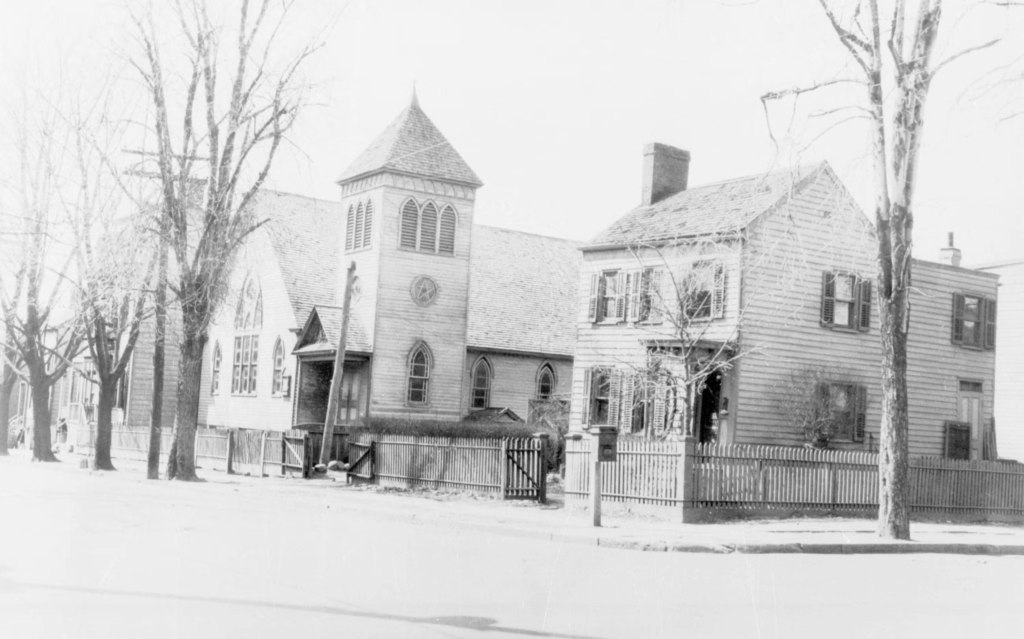
Eugene L. Armbruster, photographer. Image of Macedonia A.M.E. Church in Flushing. Image Courtesy of Queens Public Library.
The most striking detail to emerge from Mary Shaw’s will was her sizable bequest to the Tuskegee Institute. She bequeathed a total of $36,000 (though some sources say $33,000, and some even $50,000) to the Institute, specifying the amount be used to establish a scholarship fund for female students in memory of her daughter. According to the Boston Globe, it was the “largest bequest ever made by a colored person to Tuskegee Institute.” Mary Shaw’s generosity made national news, as editors reprinted the story across the states from South Carolina to Massachusetts to Indiana, from Florida to Illinois. This impressive sum spoke to both the capital that Mary had amassed as her own propertyby virtue of her status in the Flushing community and through years of teaching, the importance of Tuskegee and its mission to Mary, and her dreams for African American women. So noteworthy was Mary Shaw’s gift that a group of relations contested Shaw’s last will and testament, claiming that she was not of sound mind when making the generous bequest. Booker T. Washington sat in court the day Mary Shaw’s will was upheld. The New York Sun reported that he left the courtroom “very much pleased” at the decision to honor Shaw’s wishes.
It is clear from the contents of her will that Mary Shaw hoped to construct alternative futures to the women who, like her daughter, devoted themselves to betterment through education. In addition to her donation to the Tuskegee Institute, Shaw invested her money and legacy in the community of women around her. She left considerable sums of money to her mother and her “dear friend,” Annie Johnson, with whom she resided at the time of her death. Among the other female family and friends included in her generosity were Ada Fisher, Helen Ethelda Smith, Kate Smith, and Bella Warick. The will stipulated that an additional $1,000 go to what was then the Flushing Free Public Library, which might explain why Mary Shaw’s portrait hung there for so many years. With the money, the library purchased books for a reference section, some of which still exist there today. Boundless in her philanthropy, she gave another $1,000 to the Hospital and Dispensary of the Town of Flushing and $2,000 to St. Philips Parish Home. To her husband who survived her, she left 50 dollars.
John Shaw lived a widower for four years. At the time of his death in July of 1909, he was living in Cambridge, Massachusetts, just down the street from Harvard’s campus, working primarily as an author.
Though overlooked in histories of women activists, Mary Shaw committed herself to the work of social and educational activism. Her Flushing community has not forgotten her for it: the library also formed a “Mary Ann Shaw Society,” that builds on Mary Shaw’s legacy of investing in education, books, and community. In 2018, the Queens Borough Public Library commissioned and revealed a portrait of Mary Shaw by artist Eddie Abrams. Like the 1890 photograph, the portrait of Mary Ann Shaw now lives in the Flushing Library, where a new generation of readers will soon recognize her familiar face.
To learn more about the history of women’s involvement in the creation and expansion of public libraries, check out the Center for Women’s History’s upcoming special exhibition, Circulating Control: Women’s Book Battles, 1880-1930 (July 26, 2024-November 30, 2025.)
PHOTO OF THE DAY
NEW FOOD OPERATOR AT CORNELL TECH
WITH A LARGE MENU SELECTION OF PREPARED, SALAD & SANDWICH ITEMS.

CREDIT TO:
NEW YORK HISTORICAL
Written by Hope McCaffrey, Mellon Foundation Predoctoral Fellow at the Center for Women’s History, with special thanks to Lori Rothstein and the Queens Memory Project.
All image are copyrighted (c) Roosevelt Island Historical Society unless otherwise indicated
THIS PUBLICATION FUNDED BY DISCRETIONARY FUNDS FROM CITY COUNCIL MEMBER JULIE MENIN & ROOSEVELT ISLAND OPERATING CORPORATION PUBLIC PURPOSE FUNDS.

Copyright © 2025 Roosevelt Island Historical Society, All rights reserved.Our mailing address is:
rooseveltislandhistory@gmail.com
Leave a comment