
Thursday, October 22, 2026 – NY’s First Female Fence: A Tale Untold
New Money, Old Titles: Dollars, Dreams and Dowries
Thursday, October 22, 2026
New York Almanack
Jaap Harskamp
Issue # 1770
New Money, Old Titles: Dollars, Dreams and Dowries
October 21, 2026 by Jaap Harskamp
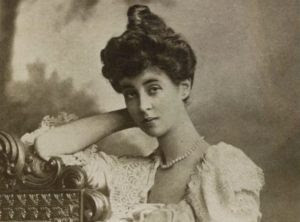
The Gilded Age, roughly from the late 1870s to the late 1890s, was an era of economic expansion and technological advance in which American industrial tycoons made massive fortunes. New elites competed to define their place in a society in flux, giving rise to an obsessive craving for status.
The desire for validation manifested itself in the building of mansions that mimicked castles or palaces. Their owners toured European capitals, ordering paintings and antiquities to decorate these grand homes.
They founded or funded museums, libraries, and concert halls to assert cultural refinement. Chasing family prestige, they exchanged daughters and dowries for the prestige of dusty European titles.
Cash for Coronets
When the American Norwegian sociologist Thorstein Veblen published The Theory of the Leisure Class in 1899, he introduced the term “conspicuous consumption” which pointed at a tendency amongst members of America’s “nouveau riche” to signal status by indulging in colossal spending.
Their public persona displayed the paradox of financial dominance and cultural inferiority. Despite control over a thriving economy, money makers suffered deep-seated insecurities, viewing the old-world European gentry as a prime cultural standard.
There were internal roadblocks too. Gatekeepers of “Old Money” such as Caroline Astor (organizer of “The Four Hundred”) guarded Manhattan’s established elite by shunning those who had assembled riches more recently.
Looking to compensate for this exclusion, social climbers were willing to “buy” rank instead. The troubled state of Europe’s aristocracy offered an opportunity.
During the late nineteenth century, time-honored noble families faced cash flow problems because of the Great Agricultural Depression (1873-1896), rising taxes, and the mounting cost of running ancestral estates. Fortunes crumbled and properties fell into disrepair.
In contrast, America’s upper crust had mountains of dollars to spare but lacked pedigree. Cash-strapped aristocrats traded ancient titles and hereditary seats with self-made tycoons. In the process, they surrendered the sacred notions of “blue blood” and “pure” ancestry.
The cross brought about transactional marital arrangements. Magnates in rail, steel, finance, or retail, exchanged daughter and dowry for the sake of a title.
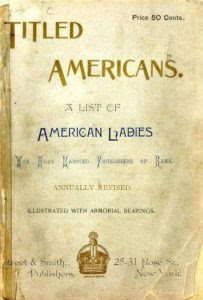
Launched in 1890, Titled Americans: A List of American Ladies Who Have Married Foreigners of Rank was an annual directory (and quarterly periodical) compiled by Philip Frederick Cunliffe-Owen, an English-born journalist employed by the New York Tribune.
The publication’s “stud book” section was a match-making catalogue for affluent families, listing eligible bachelors with their titles and properties. The 1915 edition documented 454 women who had married into European nobility during the Gilded Age, over one hundred of them to British peers.
The phenomenon made an impact, injecting billions of pounds into the British economy, but transatlantic unions were controversial on both sides of the pond. British critics feared that such arrangements would pollute the nation’s peerage. President Theodore Roosevelt was not keen either.
In 1906, writing to Whitelaw Reid, American ambassador to Britain, he expressed his dislike of marriages that were based on the “sale of the girl for her money and the purchase of the man for his title.”
Once they had crossed the Atlantic, young brides experienced a culture shock. Raised in mansions with the comfort of modern amenities, they found themselves trapped in crumbling estates and stuck in loveless marriages.
Husbands routinely kept mistresses, leaving their partners to deal with the pain of loneliness and the disdain of in-laws. These newlyweds were commodities, caught between social ambition at home and class snobbery in their new surroundings.
Dollar Princess
Payments for prestige was a vogue associated particularly with British peers, but the trend applied to Continental nobles as well. In Italy, impoverished Princes, Dukes, and Counts (and there were plenty of them) faced the strain of managing impressive palazzos and art collections. American brides provided the cash infusion to preserve these estates.
Jennie Enfield Berry was one of them. Born in 1861, she grew up at the Oak Hill estate in Rome, Georgia. In 1889, she married Henry Bruton, a Nashville tobacco manufacturer. On his death in 1892, she inherited a fortune.
While traveling in Europe, she met Prince Enrico Ruspoli, a young man with title and charm, but little else. In 1901, the twenty-three-year-old noble followed the forty-year-old widow to Georgia and proposed to her.
Following their marriage in Washington, she moved to Rome, converted to Catholicism, and changed her name to Princess Eugenia Ruspoli. She used her wealth to restore Palazzo Ruspoli, a massive former medieval monastery at Nemi, southeast of Rome.
After Enrico’s premature death in 1909, he left the estate to his brother. Eugenia fought the family in court, winning her case in 1916. She decorated the palace with Renaissance and Baroque paintings, furniture, and antiquities. Before the outbreak of the Second World War, she took part of the valuable collection back to the United States.
Nonnie May (Nancy) Stewart was born in January 1878 in Zanesville, Ohio. She became known as the “Tin Plate Heiress” in 1908, after inheriting a fortune from her second husband, William Bateman Leeds.
Having met Christopher, Prince of Greece and Denmark, in 1914 at the French resort of Biarritz, the couple married in January 1920 in Vevey, Lake Geneva. She converted to the Greek Orthodox Church and changed her name to HRH Princess Anastasia, making her the aunt-by-marriage of Prince Philip, the future Duke of Edinburgh, husband of Queen Elisabeth II.
On January 17, 1908, a crowd gathered outside the Vanderbilt mansion on Manhattan’s 57th Street to watch guests arrive for the society event of the year, the wedding of Gladys Moore Vanderbilt to Count László Széchenyi, a distinguished noble in the Austro-Hungarian monarchy.
The two had met in 1907 in Berlin. Soon afterwards, just before her twenty-first birthday, Gladys inherited a fortune from her late father, railroad magnate Cornelius Vanderbilt II who had died in 1899. She became a (financial) fixture of the Imperial Court in Vienna.
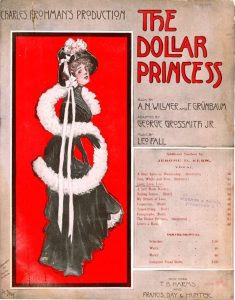
Public fascination with such transatlantic unions inspired an extraordinary musical occasion. Leo Fall was born in February 1873 at Olomouc, Moravia, into a family of musicians. Having studied at the Vienna Conservatory, he moved to Berlin to start a career as a composer of (twenty-two) operettas.
On November 2, 1907, the premiere took place in Vienna of Die Dollarprinzessin. The work became an instant hit, triumphing in Berlin in 1908. The launch of the English-language version The Dollar Princess on Broadway took place in August 1909 and ran for 288 performances.
In London, the musical play opened at Daly’s Theatre in Cranbourn Street (just off Leicester Square) in September 1909, running for 428 performances.
The phenomenon of American women marrying into European nobility peaked between 1870 and 1914. The phrase “Dollar Princess” became cemented into journalistic and social vocabulary after the operetta’s impact on both sides of the Atlantic.
Heir & Spare
Jennie Jerome was (probably) the first in a lengthy line of dollar princesses. Born in Brooklyn in 1854 to Wall Street speculator Leonard Jerome, she was an intelligent socialite and trendsetter.
In August 1873, she met twenty-four-year-old Lord Randolph Churchill, the younger son of the Duke of Marlborough, at a regatta on the Isle of Wight. He fell for her at first sight and, to his parents’ dismay, the couple were engaged three days later.
The prospect of a British noble marrying the daughter of a New York social climber was too abhorrent to contemplate – until they learned about the size of the dowry.
Jennie poured her energy in steering the military and political career of her eldest son, Winston Churchill. The marriage itself was distant and cold. Both were involved in affairs, with Jennie’s lovers including the Prince of Wales (the future King Edward VII) and King Milan I of Serbia.
Following Lord Randolph’s death in 1895, she shocked Victorian society by marrying twice more to partners two decades her junior.
Consuelo Vanderbilt, daughter of the railroad tycoon and Jockey Club founder William Kissam Vanderbilt and his wife Alva, married Charles Spencer-Churchill, 9th Duke of Marlborough, in 1895.
Alva had pushed hard for this match. Viewing her daughter as an extension of the family’s social ambitions, she was determined to secure a prestige wedding. The marriage was unhappy and loveless.
On their honeymoon, Charles told Consuela that he had married her because of his obligation “to save Blenheim,” his crumbling ancestral palace in Oxfordshire. After the birth of two sons in 1897/8, securing the line of succession, she reportedly coined the phrase “an heir and a spare” (the bride’s primary duty was to give birth to an heir to the title as well as second “spare” son, just in case). The couple spent years living apart before separating in 1906.
Mary Victoria Leiter, daughter of Chicago retail magnate Levi Ziegler Leiter, was born in May 1870. A six-foot-tall and well-educated debutante, she met politician George Nathaniel Curzon in 1890.
Married five years later, she assumed the name Mary Curzon, Baroness Curzon of Kedleston. When George was appointed Viceroy of India in 1898, she took charge of managing imperial courts, galas, and official pageantry. She held the highest social rank reached by an American woman in the history of the British Empire.
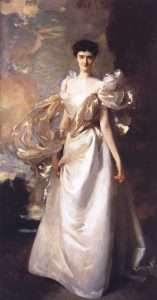
Her younger sister Margaret “Daisy” Leiter was a celebrated beauty. Visiting Mary in India in 1903, she met Henry Howard, 19th Earl of Suffolk, and they were married a year later.
Daisy helped restoring the Earl’s estate Charlton Park, Wiltshire, to its former glory. After her husband was killed in action in April 1917 during the First World War, she split her time between Britain and Tucson, Arizona.
Upon her death in 1968, she left a fine collection of paintings to the British nation (the “Suffolk Collection” is on display at Kenwood House, London).
Money & Grand Style
America was winning the economic battle of the Industrial Revolution during the Gilded Age, but it yielded to Europe in the hierarchy of cultural prestige. Transatlantic marriages captured the public’s imagination and novelists recorded the social phenomenon firsthand.
It inspired Henry James in 1904 to draft the novel The Golden Bowl which features an impoverished Italian noble engaged to an American heiress.
An observer of New York’s high society, Edith Wharton captured the nuance of marital transactions. Her 1913 masterpiece The Custom of the Country explored the relentless social climbing that drove these unions.
In her unfinished final novel, The Buccaneers (1938), she pictured a group of American young women who leave for London to “secure” titles. But it was an expat portrait painter who personified the era’s elite social climate.
John Singer Sargent was born on January 12, 1856, in Florence. His father was a medical doctor who had practiced in Philadelphia, but in 1854 the family decided to settle in Europe.
A multi-lingual cosmopolitan, John studied briefly at the Accademia delle Belle Arti in Florence, before leaving for Paris at the age of eighteen where he enrolled at the École des Beaux-Arts.
He began his career as a portraitist in Paris, but by 1886 he had moved to London where he settled in James McNeill Whistler’s old studio at 13 Tite Street, Chelsea.
In the late 1880s he made two successive trips to the United States. He traveled to New York City in September 1887 (only the second time he had crossed the Atlantic) to paint the portrait of Henry Marquand’s wife at their summer home in Newport, Rhode Island.
He received an enthusiastic welcome in Boston where, in 1888, he opened his first one man-show at the prestigious St Botolph Club.
In London he became the chosen portraitist of Dollar Princesses. Obsessed with catching the shine of jewelry in paint, he turned to Netherlandish masters like Jan van Eyck, Peter Paul Rubens, or Johannes Vermeer, meticulously studying their methods.
Having learned how to depict the texture of silks, satin, velvet, and diamonds, he became the chronicler of consumer luxury. He used his skills to produce dozens of works in the style of eighteenth-century “swagger” portraits that were designed to project the female subject’s wealth, elegance, and status.
They include a portrait (1884) of Boston-born Edith Russell who entered British elite society in 1878 as Edith, Lady Playfair, after marrying the Scottish chemist and Liberal politician Lyon Playfair, 1st Baronet Playfair.
In 1898, Singer painted a full-length portrait of nineteen-year-old Daisy Leiter before she married Henry Howard, presenting her as an American scion about to enter British high society. Commissioned by her parents, this masterpiece captured the grace of a sitter who was said by her contemporaries to have the “loveliest eyes in Washington.”
In 1904, the artist portrayed the former Mary Crowninshield Endicott of Massachusetts who married Liberal politician Joseph Chamberlain, thus becoming stepmother to Neville, the future Prime Minister.
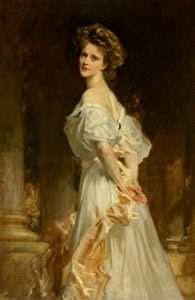
Four years later, Sargent was at Cliveden House, Buckinghamshire, to paint a portrait of Viscountess Astor, born Nancy Witcher Langhorne in Danville, Virginia. She would become the first female Member of Parliament to take a seat in the House of Commons in 1919, representing Plymouth for the Unionist (Conservative) Party.
John Singer Sargent was the chronicler of consumer luxury. The visual biographer of his era, his career was inextricably linked to the accumulation of riches. At times, there are hints at the vulnerability and isolation of his (female) sitters, but he never questioned immense wealth itself. Social concern was not on his price list.
In Britain, dollar dowries prevented the collapse of major country estates. The outbreak of war in 1914 gave some Dollar Princesses an opportunity to redefine their roles in society, providing medical care for wounded soldiers, drumming up American political and financial support for the Allied cause, and helping to foster transatlantic alliances.
The devastation of the war reshaped the global socio-political landscape and effectively brought the Dollar Princess era to a close.

PHOTO OF THE DAY
SOHO-
THE BEST PRESERVED LANDMARK
DISTRICT
CREDIT
NEW YORK ALMANACK
All image are copyrighted (c) Roosevelt Island Historical Society unless otherwise indicated
THIS PUBLICATION FUNDED BY DISCRETIONARY FUNDS FROM CITY COUNCIL MEMBER JULIE MENIN & ROOSEVELT ISLAND OPERATING CORPORATION PUBLIC PURPOSE FUNDS.


Copyright © 2026 Roosevelt Island Historical Society, All rights reserved.Our mailing address is:
rooseveltislandhistory@gmail.com
Leave a comment