Tuesday, August 11, 2026 – The Musical Journey: Bandurrias & Mandolins!

A TALE OF MISTAKEN IDENTITY:
MANDOLIN MANIA IN
MANHATTAN
Tuesday, August 11, 2026
Judith Berdy
Issue # 1729
A Tale of Mistaken Identity: Mandolin Mania in Manhattan
August 10, 2026 by Jaap Harskamp
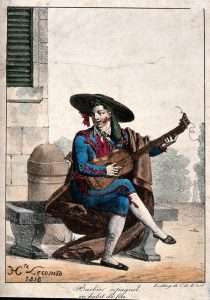
During the Renaissance (roughly 1400–1600) and Baroque (roughly 1600–1750) eras, Spanish barber shops doubled as social hubs. Barbers kept stringed instruments hanging on the wall for waiting customers to play or played them themselves to entertain patrons.
Spain has a rich lineage of stringed instruments that includes the bandurria.
Belonging to the lute family, it is a small pear-shaped, twelve-stringed instrument featuring a short neck and a headstock that holds tuning pegs. Used in traditional folk or classical ensembles, the bandurria is the most “misunderstood” member of all stringed instruments. It caused a mix-up in American music history that sparked the mandolin craze of the 1880s, highlighting an immigration paradox.
Barber-Musician
In 1775 French dramatist and bon-vivant Pierre-Augustin Caron de Beaumarchais published Le barbier de Séville (The Barber of Seville). Its main character named Fígaro would become the most famous “barber-musician.” Gioachino Rossini turned the play into a comic-opera in 1816.
In Il barbiere di Siviglia, Fígaro helps Count Almaviva to serenade his beloved Rosina with a stringed instrument beneath her balcony. By the 1880s, the opera had become wildly popular in Europe’s operatic capitals from Milan to London.
In that decade, going to the opera had become a social “must” for Manhattan’s elite. During an era that saw the rise of operatic divas, The Barber of Seville played a crucial role in this cultural phenomenon.
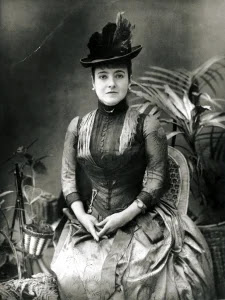
Legendary soprano Adelina Patti often toured Manhattan and her performances as Rosina in Rossini’s opera drew packed houses and generated intense media interest. When New York’s Metropolitan Opera opened for its first season, The Barber was selected as a foundational showpiece, making its premiere on November 23, 1883.
The opera was equally alive on the streets of Manhattan as the genre was part of popular culture. While major houses performed the opera in Italian, touring troupes offered vernacular versions of The Barber, recasting arias into catching ballads that were accessible to most New Yorkers. Fígaro’s opening solo piece “Largo al factotum” was a hit at the time through various translations and vaudeville adaptations.
The cult status of Rossini’s Barber coincided with the arrival of the Estudiantina Española Fígaro, a touring group known as The Spanish Students. This double musical sensation triggered a “Spanish Craze” in New York City. The performers were received as a living embodiment of Rossini’s masterpiece.
Plucking in Paris
In February 1878, sixty-four students from Madrid’s universities and colleges founded a group named the Estudiantina Española (Spanish Students) seeking to take part in the musical festivities on the eve of the Exposition Universelle (World Exhibition) in Paris. All its members were amateur musicians.
Drawing inspiration from historical serenade practices associated with student life in cities like Granada, participants dressed in Renaissance-style costumes, wearing capes, sombreros, and historical student attire. Driven by a desire to project Spanish cultural identity on an international stage, performances blended glamorized historical elements with folk music. The plucked-string ensemble featured instruments like bandurrias, guitars, violins, and tambourines (panderetas).
Members of the group arrived in Paris on March 2, 1878, and their performances proved sensational, drawing massive crowds to street and garden concerts of jotas, pasodobles, and habaneras accompanied by regional and popular dances. Mixing historical detail with exotic allure, the spectacle took Paris by storm.
A concert on March 6th outside the famous Café Riche on the Boulevard des Italiens attracted well over 50,000 onlookers, creating enormous traffic congestion. A performance in the Jardin des Tuileries the next day was also packed with enthusiastic attendees.
The group’s overwhelming success in Paris and other European capitals inspired rival ensembles to copy the model. By May 1878, guitarist and musical director Dionisio Granados split from the original group following internal disagreements and formed a splinter ensemble in Madrid.
He reduced the number of participants and named the new group Estudiantine Española Fígaro. This ensemble toured extensively throughout Europe, adapting to stage limitations if necessary and introducing vocal parts alongside the traditional plucked string instruments.
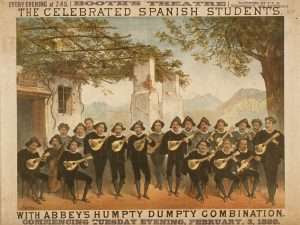
With a repertoire that fused Spanish folk tunes with classical adaptations, the Fígaro orchestra included multiple bandurrias for melody and harmony (aided by violins and cellos), guitars for rhythmic support, and tambourines for percussion, creating the typical sound of a Tuna (Iberian student string instrument groups going back to the thirteenth century). Elements of patriotism and local pride played a role in the spectacle.
At a time when nation-building faced political hurdles (regional resistance against Madrid’s centralized policies), popular musical movements bonded citizens at home and offered a romanticized flavor of Spanish character to foreign audiences. Composers started blending native folk traditions
such as Andalusian flamenco and regional dance rhythms with European classical structures. Isaac Albéniz captured the soul of nation in piano suites like Iberia, utilizing jota or habanera rhythms.
Parisians loved the visual theatricality and vibrant style of the Tuna street and stage performances. It became a rage at balls and festivities with participants wearing replica Spanish student outfits. Weary of German and Austrian domination of the musical domain, young French composers too found inspiration in Spanish tunes.
The Mediterranean region went in search of a style that contrasted with the “heavy” tones and “misty” atmosphere of Northern European compositions. Emmanuel Chabrier’s
vibrant orchestral rhapsody España (1883) is one of many examples.
Mandolin Mania in Manhattan
The Spanish Students embarked on their first visit to America in late 1879. On January 1, 1880, a reduced Fígaro ensemble, compromising nine bandurrias, five guitars, a violin (as well as five assistants), sailed into New York Harbor aboard SS France to launch an acclaimed eight-week run at Booth’s Theater on the southeast corner of 23rd Street and Sixth Avenue, Manhattan, beginning on February 3rd.
Arranged by prominent impresario Henry Eugene Abbey, their performance was an integral part of his Humpty Dumpty pantomime production. During the show’s interval, bandurria-driven Spanish tunes and medleys complemented the English vaudeville elements of the pantomime itself. It took a significant adaptation from earlier Tuna performances, but the unlikely mixture turned out to be a massive success.
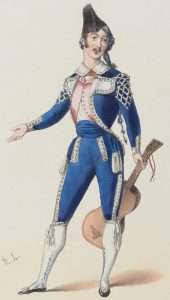
Bandurrias were unknown to most Americans; journalists mistakenly labeled them as “Spanish mandolins.” Rossini’s story of The Barber of Seville became tied to the phenomenon. The visual presence of Spanish Students ignited Manhattan’s “Mandolin Mania.”
Italian immigrants stepped in to fill the commercial demand by selling proper Neapolitan mandolins and producing instruction manuals of how to play the instrument. Musicians capitalized on the hype by forming look-alike ensembles, mimicking the name, costumes, and repertoire.
Composer Carlo Curti was born in May 1859 in the province of Potenza, Basilicata. Around 1875 he emigrated to America. Having seen the Spanish Students in 1880, he grasped the opportunity to set up a rival ensemble of Italian players that masqueraded as Spanish youth, but using mandolins rather than bandurrias. Touring extensively, Curti’s group drove the American passion for plucked instruments.
Italian Emigrants
Naples was the birthplace of the mandolin. Its metal strings were played with a plectrum to create a signature “tremolo” effect by the repeated and fast striking of a single string.
Developed by the city’s master luthiers during the mid-eighteenth century, it became the voice of Neapolitan songs and folk music. Historians credit the Vinaccia family of instrument makers (working from Rua Catalana in Naples) with perfecting the mandolin design in the 1760s. They made it an emblem of the Neapolitan soundscape.
During the nineteenth century, Naples was home to hundreds of instrument workshops. Originally embraced by classical composers like Antonio Vivaldi and Wolfgang Amadeus Mozart, the mandolin then transitioned into the ultimate symbol of popular Italian street music. It served as the melodic engine for Neapolitan folk pieces (Canzone Napoletana) and lively dances.
Italian emigration from the 1880s onward triggered a widening interest in the instrument. When millions of Italians left regions like Naples and Sicily, they carried lightweight mandolins as cultural anchors to their new destinations.
Within Europe, Marseille was a center of Italian settlement which brought a vibrant musical heritage to the historic Panier district, often referred to as “Petite Naples.”
Today, the city is a global hub for the mandolin and home to the annual Mandol’in Marseille Festival.
Italian artisans brought traditional woodworking skills to Manhattan. Having emigrated to New York in 1885, Morcone-born (Campania) luthier Angelo Mannello built a factory to produce highly ornate, award-winning mandolins. Operating his workshops at 553 East 140th Street, he employed up to seventy-five instrument makers in the early 1900s, including several artists for delicate decorative work.
Between 1880 and 1924, some four million Italians settled in the United States. They clustered in cities such as New York, Boston, Philadelphia, Chicago, and New Orleans, where music was at the heart of social life. Bowl-back Neapolitan mandolins turned up at weddings, social gatherings, and club meetings. Newcomers formed mandolin orchestras that performed everywhere, from local parish halls to mainstream civic stages.
For many second-generation Italian immigrants, such ensembles were the pathways to identity awareness and music literacy. Founded in 1924, the New York Mandolin Orchestra (NYMO) has been performing for over a century.
Roots Music & Bluegrass
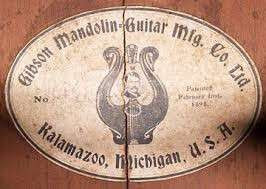
In 1898, American instrument maker Orville Gibson at Kalamazoo, Michigan, modified the Neapolitan bowl and patented (Patent Office, no. 598,245) a mandolin with a flat back and carved F-holes, producing a louder and more piercing sound. He built a national network of agents and teachers, published musical practice books, and promoted full mandolin orchestras.
Before the First World War, there were countless American mandolin ensembles producing music for social engagements and entertainment. This orchestral rage died out after the war, but the instrument found a second life in American roots music.
Gibson’s redesigned mandolin was adopted by musicians in the Appalachian Mountains, reaching new audiences by becoming the voice of bluegrass music. The 1923 Gibson F5 “Lloyd Loar” (named after its designer) was Bill Monroe’s trademark instrument as he and his Kentucky band defined the genre in the 1940s.
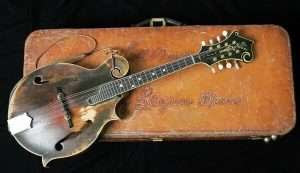
What began as a link to home for nostalgic immigrants became part of the American soundscape. This gives the mandolin its dual identity of being a marker of Italian settlement and a key force in roots music.
Nino Rota’s legendary soundtrack for Francis Ford Coppola’s The Godfather (1972, first of the trilogy) cemented the association between mandolin and Mafia. The instrument most famously appears during the film’s opening scene of Connie Corleone’s wedding celebration with master musician Giovanni Vicari (an immigrant from Catania, Sicily, nicknamed “Godfather of the Strings”) playing a Martin mandolin.
Its immediate appeal and continuous use in mafia films relied on the tremolo technique, creating a “crying” tone to balance family loyalty with brutal violence. The use of mobster-style instrumental tracks has, over the years, become a cultural stereotype. That is unfortunate. The mandolin is a traditional folk instrument that expressed the deep feelings of everyday people, not those of mob bosses.
The bandurria was restored to full international glory when it became a signature sound during Leonard Cohen’s global comeback tours between 2008 and 2013 thanks to the contribution of Zaragoza-born virtuoso Javier Mas (“shepherd of the strings”) that added Aragonese and Mediterranean textures to some of Cohen’s classic songs.
SHOW OFF YOUR CREATIVE TALENTS AT THE
CBN OLDER ADULT CENTER
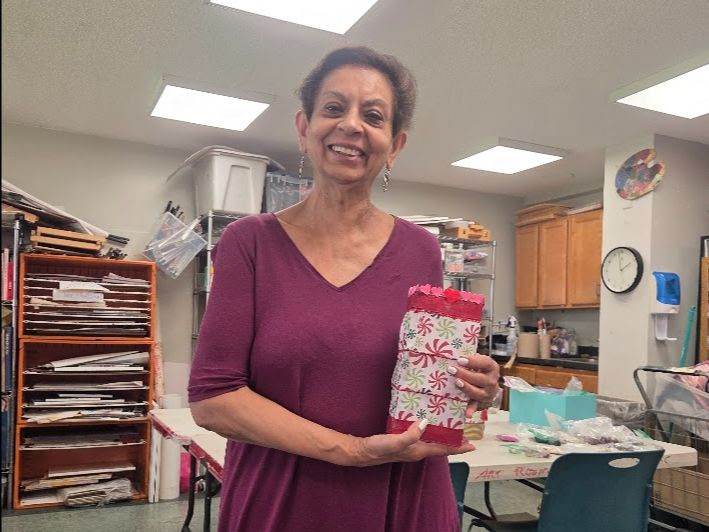
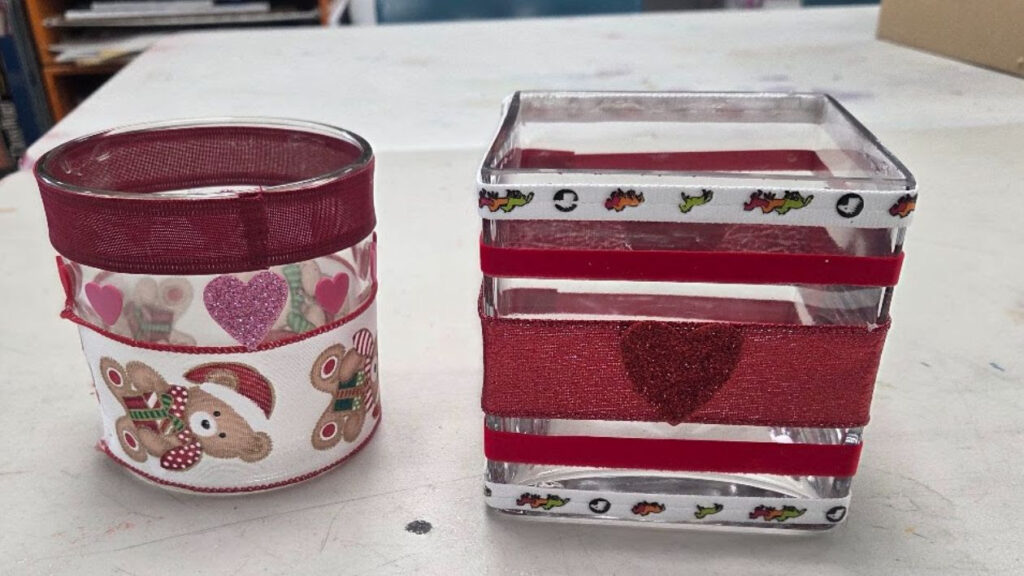
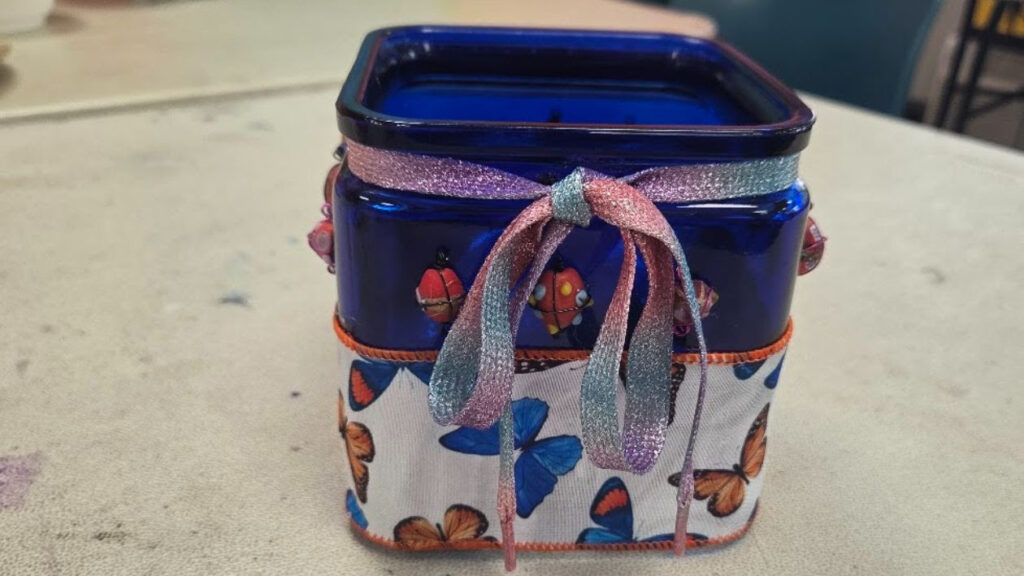
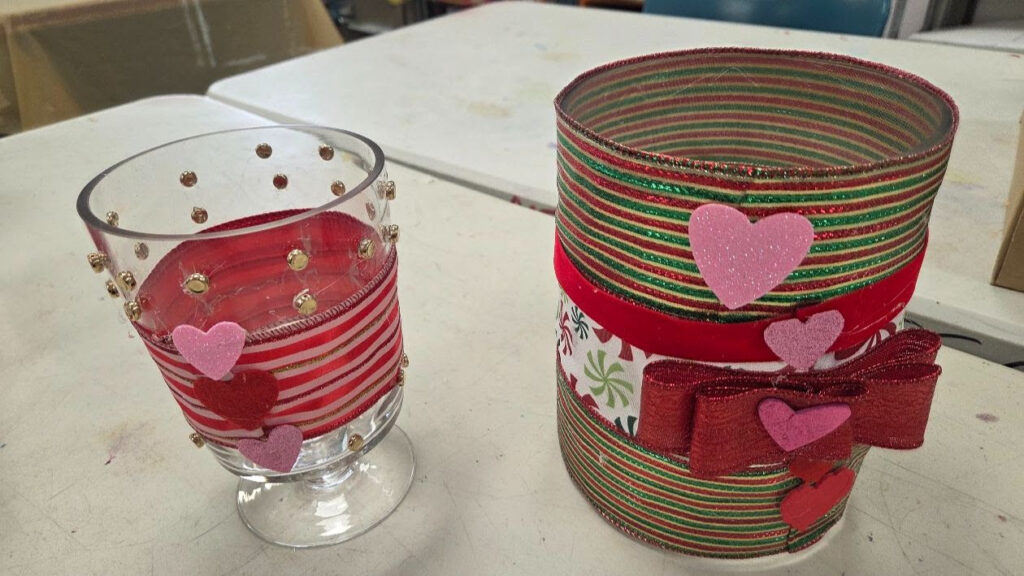
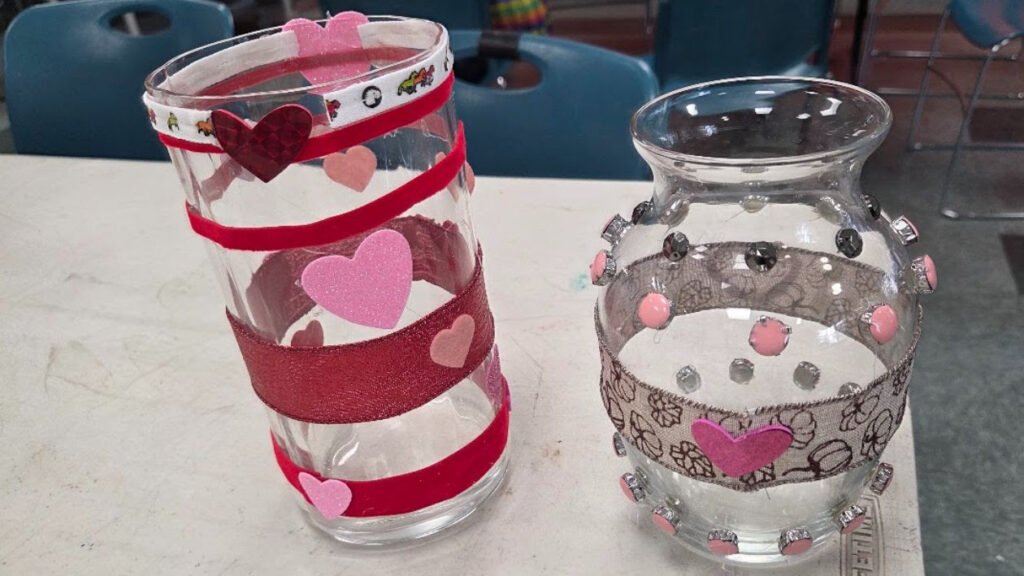
Nita Advani shows off her decorated vase made at “Jewels with Judy” at the CBN Older Adult Center.
JWJ meets twice a month and different crafts are made. Necklace making is popular so this week decorating vases was on the schedule. Ribbons, jewelry and other items are used and applied by hot glue. It is a fun way to explore a new activity. No experience needed. Next class on MONDAY, AUGUST 24th, 1- 3 pm, CBN Center, 546 Main Street.
Looking forward to seeing you there!
Judy Berdy
CREDITS
NEW YORK ALMANACK
JAAP HARSKAMP
All image are copyrighted (c) Roosevelt Island Historical Society unless otherwise indicated
THIS PUBLICATION FUNDED BY DISCRETIONARY FUNDS FROM CITY COUNCIL MEMBER JULIE MENIN & ROOSEVELT ISLAND OPERATING CORPORATION PUBLIC PURPOSE FUNDS.

Copyright © 2026 Roosevelt Island Historical Society, All rights reserved.Our mailing address is:
rooseveltislandhistory@gmail.com
Leave a comment