Weekend, August 29-30, 2026 – Step Inside An Historic Warehouse!

333 East 38 Street
&
673 First Avenue
Weekend, Aug, 28-29, 2026
Wikipedia
Judith Berdy
Issue # 1739
Yesterday, I had an appointment at a NYU Langone Health Orthopedic Center on East 38th Street.
Nothing seemed unusual about the building, modern on the ground level and brickwork above.
Once on the upper 4th floor I noticed enormous support columns on the spacious floor. I was sure no new building would have concrete columns and very high ceilings. There must be a story hiding in this structure.
Time to consult Wikipedia.
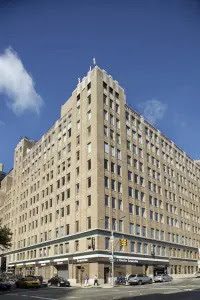
333 East 38th Street is a 12-story commercial building in the Murray Hill neighborhood of Manhattan in New York City. Located on the west side of First Avenue between East 38th and 39th streets, the building was built in 1928 as a warehouse and distribution hub for the Eleto Company, which provided delivery services for merchandise sold by Lord & Taylor and James McCreery & Company. After the package deliveries for these department stores were contracted to United Parcel Service (UPS) in 1930, UPS became a major tenant in the building and the facility served as the company’s corporate headquarters and main depot in the New York metropolitan area. UPS vacated the site in 1964 and since then the building has mostly been used as commercial and medical office space.
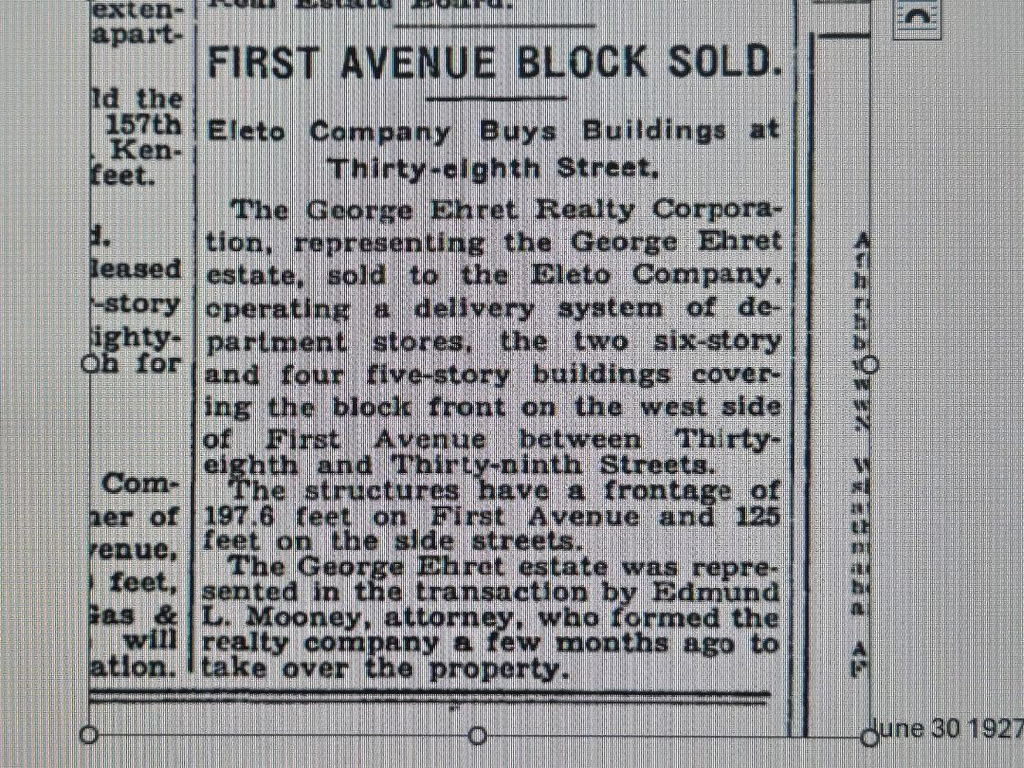
June 30, 1927 Electo Company purchases building site.
NY TImes
George Ehret was a millionaire real estate magnate and his family owned a beer brewery on the East River near Welfare Island.
Eventually George Ehret regained his property and fortune, but another hurdle was in store. On June 30, 1919 the Wartime Prohibition Act took effect, followed on October 28 by the Volstead Act which ushered in the Prohibition Era.
Production at the Hellgate Brewery came to an abrupt stop.
Luckily, George Ehret had invested heavily in New York real estate as his fortune accumulated; many of the plots purchased for the liquor business. He held 181 parcels of Manhattan realty including many valuable corner lots.
On April 6, 1925 one of the last great celebrations were held in the Ehret house on Park Avenue. The mansion was filled with “sons, daughters, grandchildren, and great-grandchildren, some of whom came from Germany” for George Ehret’s 90th birthday party, reported The New York Times.
The rumors and suspicions of only a few years earlier had been forgotten and George Ehret and his family were again accepted by New York. Two years later, on January 20, 1927, George Ehret died in his home at No. 1197 Park Avenue. A requiem mass was said in St. Patrick’s Cathedral two days later. He left an estate that was still valued at approximately $40 million.
From Wikipedia:
Eleto Company
In October 1927, the Eleto Company filed plans to construct a garage and warehouse facility on the west side of First Avenue between East 38th and 39th streets. The building was designed to accommodate the delivery services the company provided for department stores and a warehouse to replace its existing facility at 153 East 24th Street in Rose Hill.[5] A subsidiary of the Associated Dry Goods Corporation, the Eleto Company was organized in 1916 to handle the package deliveries of the Lord & Taylor and James McCreery & Company department stores, each of which previously had handled its own deliveries to retail customers.[1][8] The building was designed by Starrett & van Vleck*, an architecture firm whose works in the early twentieth century included a number of department stores such as the Lord & Taylor Building on Fifth Avenue between 38th and 39th streets.[5][9]
Property for the new building was acquired by the Eleto Company in June and July 1927; the land encompassed the entire blockfront along the west side of First Avenue and included 175 feet (53 m) of frontage on East 38th Street and 125 feet (38 m) of frontage on East 39th Street; these lots consisted of five- and six-story buildings.[10][11][12] The extended frontage on East 38th Street allowed for a loading dock and elevators to serve the upper warehouse floors without interfering with the delivery operations on the first two floors and basement level.[5]
Additional property was subsequently purchased on East 38th Street to increase the total frontage on the south side of the building to 225 feet (69 m).[13][14] Updated plans for the building were filed in February 1928 and the construction was awarded to the White Construction Company. The facility was constructed using reinforced concrete and facing along the three street fronts included granite, limestone, terra-cotta, and tapestry brick. Steel cores were used in interior columns the reduce the amount of space occupied by the structural elements on the floors.[6][15] The facility opened on April 17, 1929.[2]
*Starett & Can Vleck architects of the Steam Plant
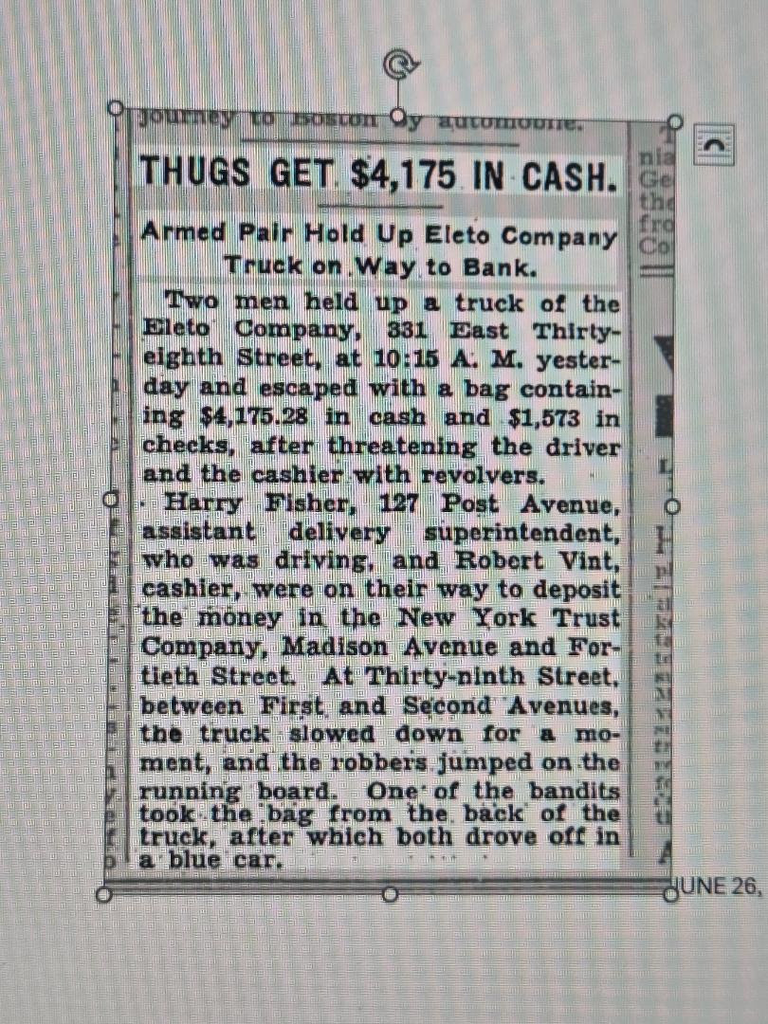
June 26, 1929
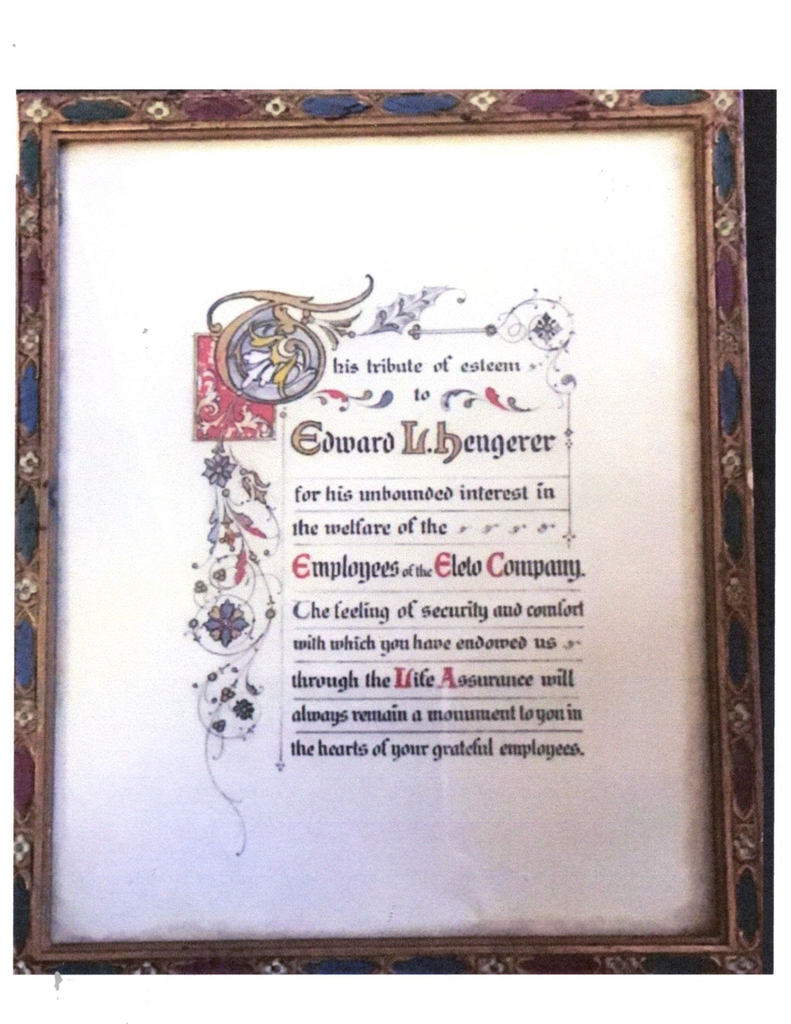
We don’t know what Edward L. Hengerer did for Eleto, but he was a
great employee.
From Wiklipedia:
United Parcel Service
In July 1930, the package deliveries for department stores owned by the Associated Dry Goods Corporation, which included Lord & Taylor and James McCreery & Company in Manhattan and the Hahne and Company of Newark, were contracted to the United Parcel Service (UPS).[16][17] As a result, UPS would become a major tenant in the Eleto Company’s building.[1] Until then, UPS operations had been limited to the West Coast of the United States. With the expansion of services to New York City, UPS also moved its corporate headquarters to the floors above its main hub at 331 East 38th Street.[17][18][19]
With a decline in retail sales following the Wall Street Crash of 1929 and the ensuing Great Depression, other department stores and specialty shops chose to outsource their deliveries to UPS and eliminate the costs of operating their own in-house delivery services.[16][19] UPS expanded its operations to serve 158 stores within the New York metropolitan area within its first year. It began providing deliveries for Bloomingdale’s, Saks Fifth Avenue, and Gimbels in 1934.[20] In 1946, Macy’s and Bamberger’s were the last major department stores in the area to have their delivery services taken over by UPS.[21] The facility at 331 East 38th Street served as UPS’ primary depot in the metropolitan area and was used to collect goods picked up from stores and sorted for deliveries to retail customers and to over fifty sub-depots located in the five boroughs of New York City, Long Island, Westchester, southern Connecticut, and northern New Jersey.[16][22][23]
The building was sold by the Eleto Company to the Seebee Corporation in 1944, but continued to be occupied by UPS and function as a service building for Lord & Taylor and James McCreery & Company.[1] In 1955, a group of tennis players that lost their tennis courts on Sutton Place to the development of an apartment building formed Tennis Center, Inc., leased the rooftop of the building from the Seebee Corporation, and added three Har-Tru tennis courts plus a clubhouse. Membership in the tennis club was limited to sixty.[24] In later years, the tennis courts were also available for rent to the public by appointment.[25]
In 1959, UPS purchased property and filed plans to construct a new warehouse in Hell’s Kitchen on the block bounded by Eleventh Avenue, Twelfth Avenue and West 43rd and 44th streets.[26][27] The building on First Avenue was sold to a group of investors in 1961 and UPS vacated the facility in 1964.[28][29]
From Wikipedia:
Other uses
The group of investors that had purchased the building in 1961, which were organized as 673 First Avenue Associates, remodeled the structure to accommodate office and manufacturing uses.[30] Tenants that moved into the building after the departure of UPS included Buick,[31] Mercedes-Benz,[32] Railway Express Agency,[33] and UNICEF (United Nations International Children’s Emergency Fund).[34] The building was fully leased in 1966.[29]
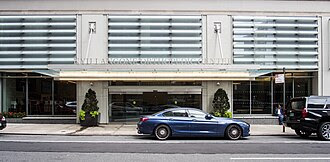
The building’s former loading docks were converted into a new office lobby as part of the renovations in 1989
After the building became largely vacant in the mid-1980s, the net lease was acquired by S.L. Green and Philips International in 1988. The structure underwent a $12 million renovation by J.C.S. Design Associates and Lev Zetlin & Associates that began the following year.[3][35][36] The building’s loading docks on East 38th Street were converted to a new 3,000-square-foot (280 m2), two-story lobby and the freight elevator that had been used for trucks was converted into four passenger elevators. Other improvements included the installation of new electrical, plumbing, heating and air conditioning systems, modernization of the two existing passenger elevators, replacement of windows and repairs to and cleaning of the facade.[3][4]
The renovated building, which became known as 333 East 38th Street, was fully leased again in 1991. New tenants that moved into the building included New York Hospital and Newbridge Communications.[3] NYU Medical Center became a tenant in the building in 2006, opening an ambulatory surgery center for orthopedic procedures in 2009 and a center for outpatient musculoskeletal services in 2012.[37][38][39] SL Green sold its leasehold interest in the building to NYU Langone Medical Center in 2014.[39] The building currently houses NYU Langone Health’s Orthopedic Center (formerly the Center for Musculoskeletal Care) and Outpatient Surgery Center.[40][41]
MORE ON THE ROXY THEATRE
FROM GUY LUDWIG:
The RKO Roxy Theatre had a checked history almost from the day it debuted – Mr. Rothafel was
ill but still managed to be there opening night. Because there is so much turmoil in the story of the “other” Roxy,
some of the notable triumphs which occurred there are overlooked. “King Kong” opened in Manhattan
not only at the RKO Roxy but simultaneously at the Radio City Music Hall. The combined seating capacity
of the two facilities was slightly less than 10,000 and yet – during the heart of the depression – both houses
played to sold-out crowds.
The so-called “television” conversion of the subsequently named Center Theatre was also – notably –
a RADIO conversion. In fact, the first NBC program to regularly emanate from “The Center” was “The Big Show”
a 90 minute, Sunday evening, live RADIO program featuring Tallulah Bankhead as host with a 50 piece
orchestra under the direction of Meredith Willson (who later wrote “The Music Man” and “The Unsinkable Molly Brown”).
Other famous NBC shows became simulcasts in the house that Roxy built including “The Voice of Firestone” (radio, television and FM!) and Kate Smith’s daily mid-day program which aired in 1951. Wally Cox had a fondly remembered
situation comedy called “Mr. Peepers” seen in those days on NBC television. It was broadcast alternately from both
the Center and Studio 8H, the home today of Saturday Night Live.
Milton Berle had been on television since 1948, originating in the 30 Rockefeller Plaza studio now occupied by
The Tonight Show (6B) … but in 1952 and ’53, most of his weekly shows came from the Center. Berle was to
go through a spectacular decline in ratings during the late 1950’s but during this earlier period, his highest ratings –
and in fact, some of the highest ratings for television EVER – occurred during his live, tuesday night broadcasts
from the theatre on the corner of 49th and 6th.
Ironically, shortly after NBC dropped its very favorable lease at the Center, they were forced to go shopping
for a similar venue to house a new weekly variety show hosted – in Living Color – by Perry Como. That show,
housed at ten times the cost of Roxy’s place, five blocks north on 6th avenue at the Ziegfeld theatre continued
through 1961. Had Perry instead moved into the Center, the theatre might well have been preserved.
guy ludwig
Westview
CREDITS
Wikipedia
TimesMachine
Judith Berdy
All image are copyrighted (c) Roosevelt Island Historical Society unless otherwise indicated
THIS PUBLICATION FUNDED BY DISCRETIONARY FUNDS FROM CITY COUNCIL MEMBER JULIE MENIN & ROOSEVELT ISLAND OPERATING CORPORATION PUBLIC PURPOSE FUNDS.
Copyright © 2026 Roosevelt Island Historical Society, All rights reserved.Our mailing address is:
rooseveltislandhistory@gmail.com
Leave a comment